Part 5D — a detailed companion to The Birth of Jesus: Eight Days, Forty Days, and the Day–Year Pattern.
“So Enoch lived a total of 365 years.”
The number 365 gives this study one of its biblical points of reference. Alongside the schematic 360-day year and the Enochic 364-day year, it helps us recognize calendar relationships within a set of symbolic numbers. The question here is how those relationships develop when the number set is compared with its reflected copy.
Part 5B followed the original twelve values until the stated expansion rule produced a closed set of forty. Part 5C examined their sums. This part returns to the forty individual values and opens a different possibility: pairs drawn from opposite sets.
The forty values form Set A. Reversing every sign forms Set B: 2645 becomes −2645, while −685 becomes 685. Both sets contain positive and negative values. Their reflection is simple arithmetic, written M(c) = −c. The complete lists are available without repeating the earlier derivation here.
The surrounding day–year framework remains anchored to Christ’s circumcision, associated with Luke 2:21, BSB. January 1 AD 1 represents symbolic AD 1 in its own Julian or Gregorian frame. Those two datums are two physical days apart. The calendar-datum appendix explains that precision. The numbers used below retain Part 5B’s local arithmetic origin; they must be converted before being read as historical BC or AD dates.
How reflection opens the set
The forty-value set was closed under the earlier within-set rule. A closed set can nevertheless gain new values when the permitted comparisons change. Here one endpoint comes from A and the other from B.
A pair qualifies when its positive separation is a multiple of 230. For example, 2645 and −2645 are separated by:
2645 − (−2645) = 5290 = 23 × 230.
The conversion 230 → 250 adds 20 units for each 230. Applied to this separation, it gives:
5290 × 250/230 = 5750, an increase of 460.
For this set operation, that increase moves each endpoint outward: the higher endpoint rises by 460 and the lower falls by 460. Consequently, the resulting width is 6210, because both ends have moved. The single-span conversion uses 25/23; the two-ended widening uses 27/23. Keeping these two operations distinct is essential to following the pattern.
LOCAL SIGNED MODEL · A × B
One rule; two distinct widths
A: 40 coordinatesB = −A Test each cross-set pair for a width divisible by 230.
The selected pair
Outward move at each end: 20 × 23 = 460.
Convert the single span
5290 × 25/23 = 5750
An increase of 460.Expand both ends
5290 + 460 + 460 = 6210
New pair: 3105 and −3105.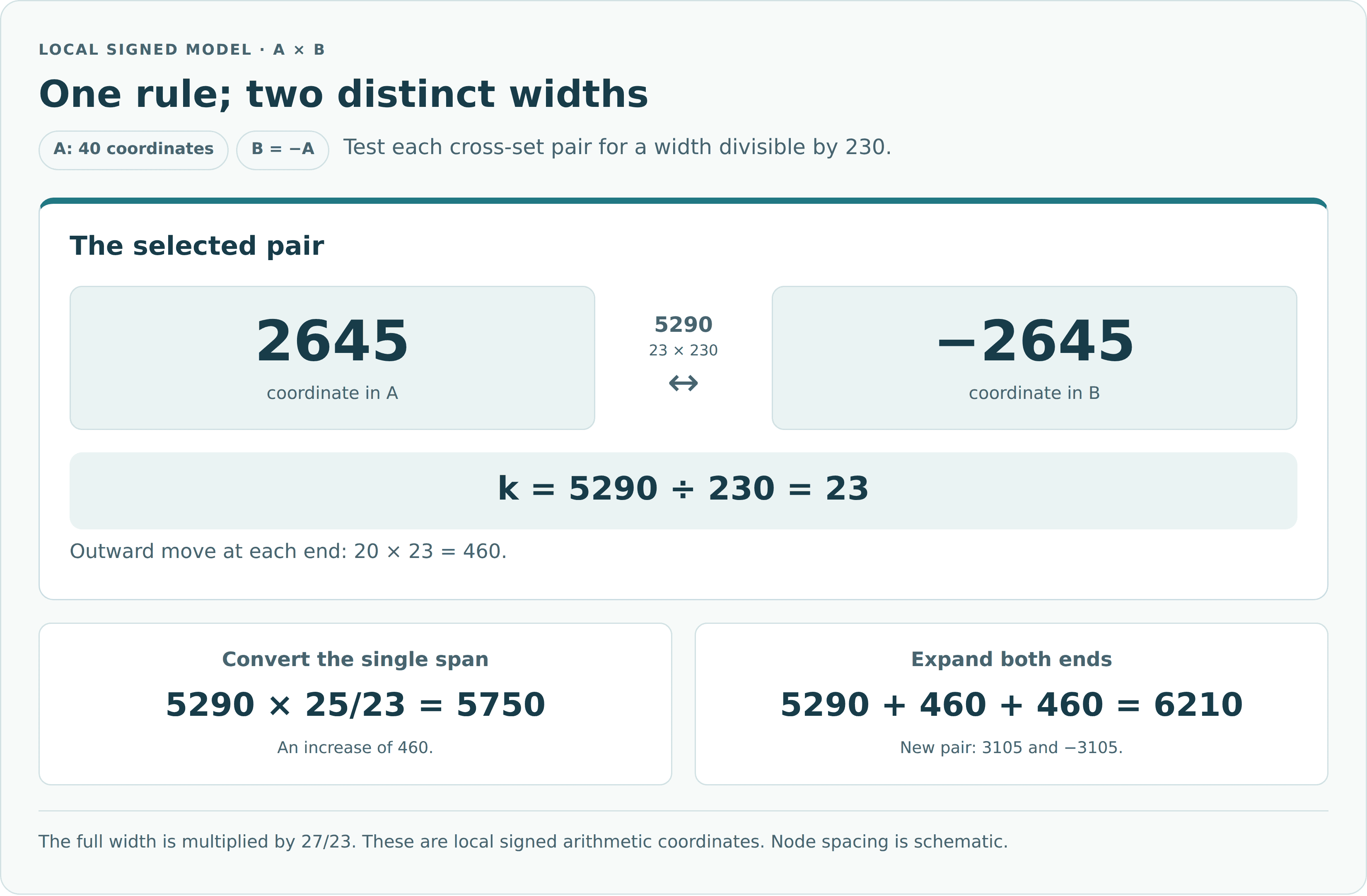
There are 24 eligible labeled cross-pairs in the initial forty-by-forty comparison. Their largest eligible separation is 5290. Some wider separations exist, but fail the 230 test. Reflection itself does not make every pair eligible: 575 and −575 give 1150, whereas 535 and −535 give 1070 and cannot undergo this operation.
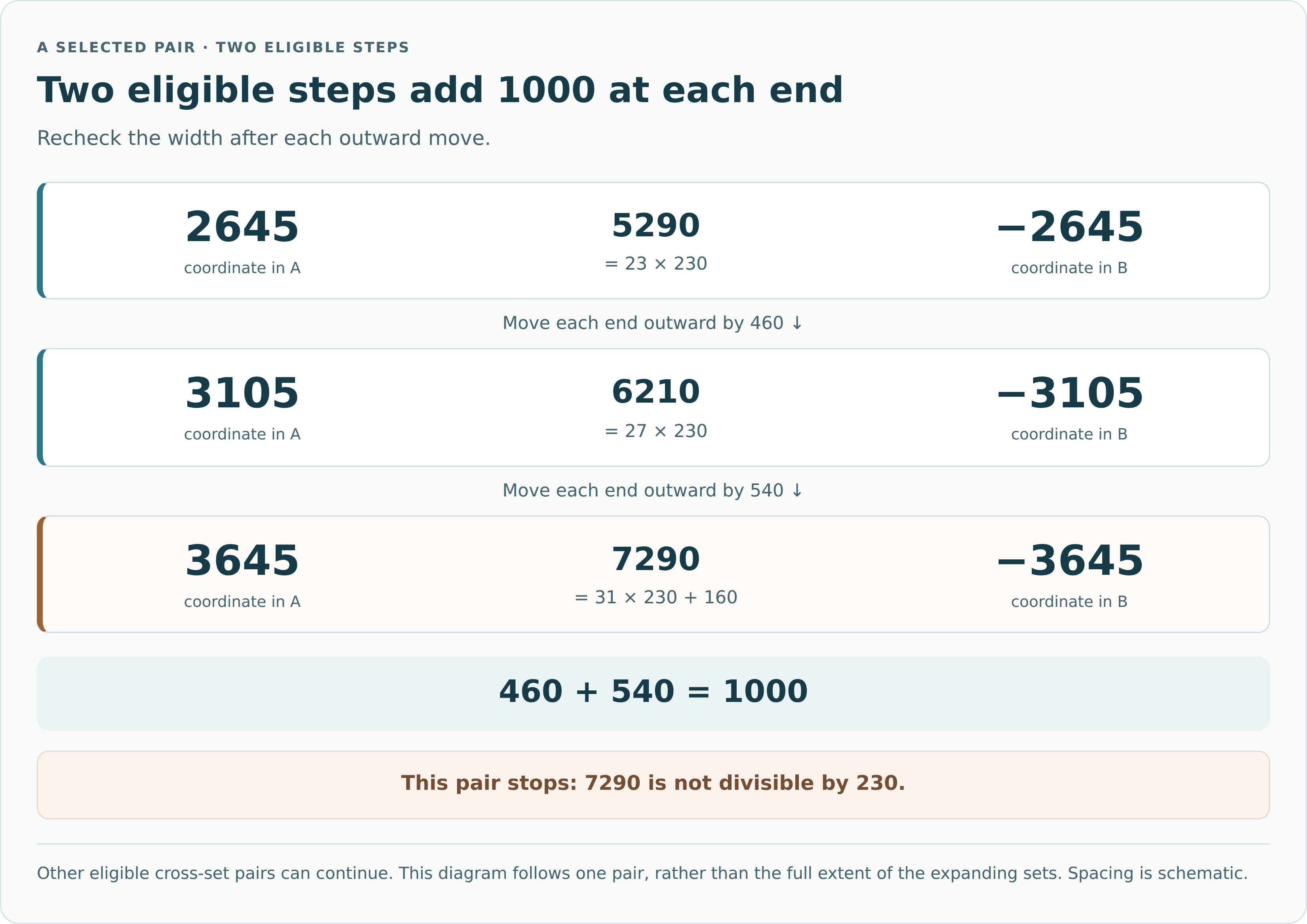
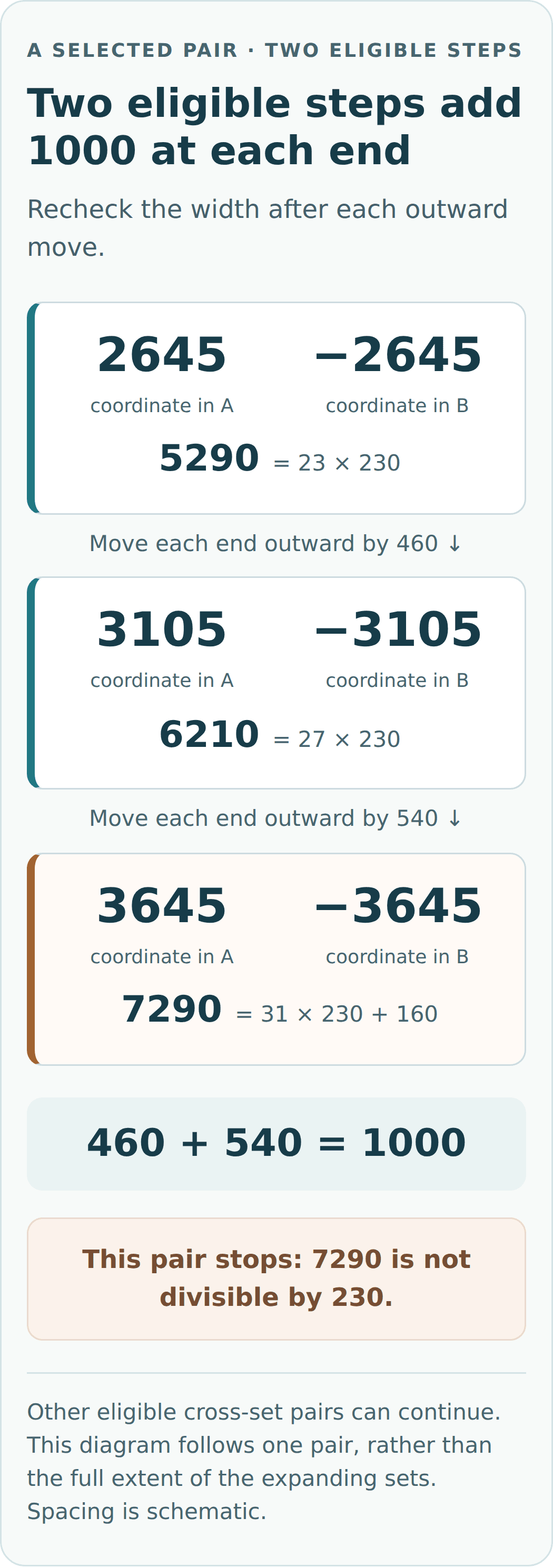
Two moves, adding 1000 on each side
The pair 2645 and −2645 makes the process especially clear.
| Pair, A / B | Separation | Next move at each end |
|---|---|---|
| 2645 / −2645 | 5290 = 23 × 230 | 460 |
| 3105 / −3105 | 6210 = 27 × 230 | 540 |
| 3645 / −3645 | 7290 · not divisible by 230 | This pair stops |
The first input is 5290 = 23 × 230. Its outward movement is 460 on each side, producing 3105 and −3105.
The second input is 6210 = 27 × 230. Its outward movement is 540 on each side, producing 3645 and −3645.
Thus each endpoint has moved 460 + 540 = 1000 from its starting position. The new separation is 7290. That number is not divisible by 230, so this particular pair has reached the end of its admissible chain.
A SELECTED PAIR · TWO ELIGIBLE STEPS
Two eligible steps add 1000 at each end
Recheck the width after each outward move.
Move each end outward by 460 ↓
Move each end outward by 540 ↓
A parallel example begins with 2825 and −2465. The same two movements produce 3285 and −2925, then 3825 and −3465. Its midpoint stays at 180, while the symmetric example’s midpoint stays at zero. Both have the same successive widths. The paired calculations show each endpoint explicitly.
The stopping of one pair does not stop the complete set. If every eligible cross-pair is processed in a round and all old values are retained, the number of values per set begins 40 → 53 → 70 → 91. The resulting arithmetic model can be shown to grow without bound; the short derivation and witness table give the exact conditions. This establishes a property of the declared number-set operation. Its spiritual interpretation remains a further question.
Calendar relationships within the expanded values
The selected endpoint 3645 is useful because of its relationship to 5, −5 and 1825. The value 1825 was already in the original forty; 3645 enters through the expansion.
1825 − 5 = 1820, and 3645 − 1825 = 1820.
Together these make 3640 = 10 × 364, divided into two equal spans of 1820 = 5 × 364. A smaller division was present in the original set: 2465 → 2645 → 2825 gives 180 + 180 = 360. Both show equal halves, although they are not connected by a single exact scaling factor.
Reflection supplies a second arrangement:
−3645 → −1825 → 1825 → 3645
Its three spans are 1820 + 3650 + 1820. The outer spans each contain five schematic 364-day years; the middle contains ten 365-day units. Their combined width is 7290.
SELECTED COORDINATES · SCHEMATIC CALENDAR COMPARISONS
A selected span: 1820 + 3650 + 1820
The reflected sequence has equal outer intervals around its central span.
The equal division on the positive side
5 → 1825 → 3645
Use −5 as the reference
3645 − (−5) = 3650
10 × 365A 360-year comparison
3605 − 5 = 3600
10 × 360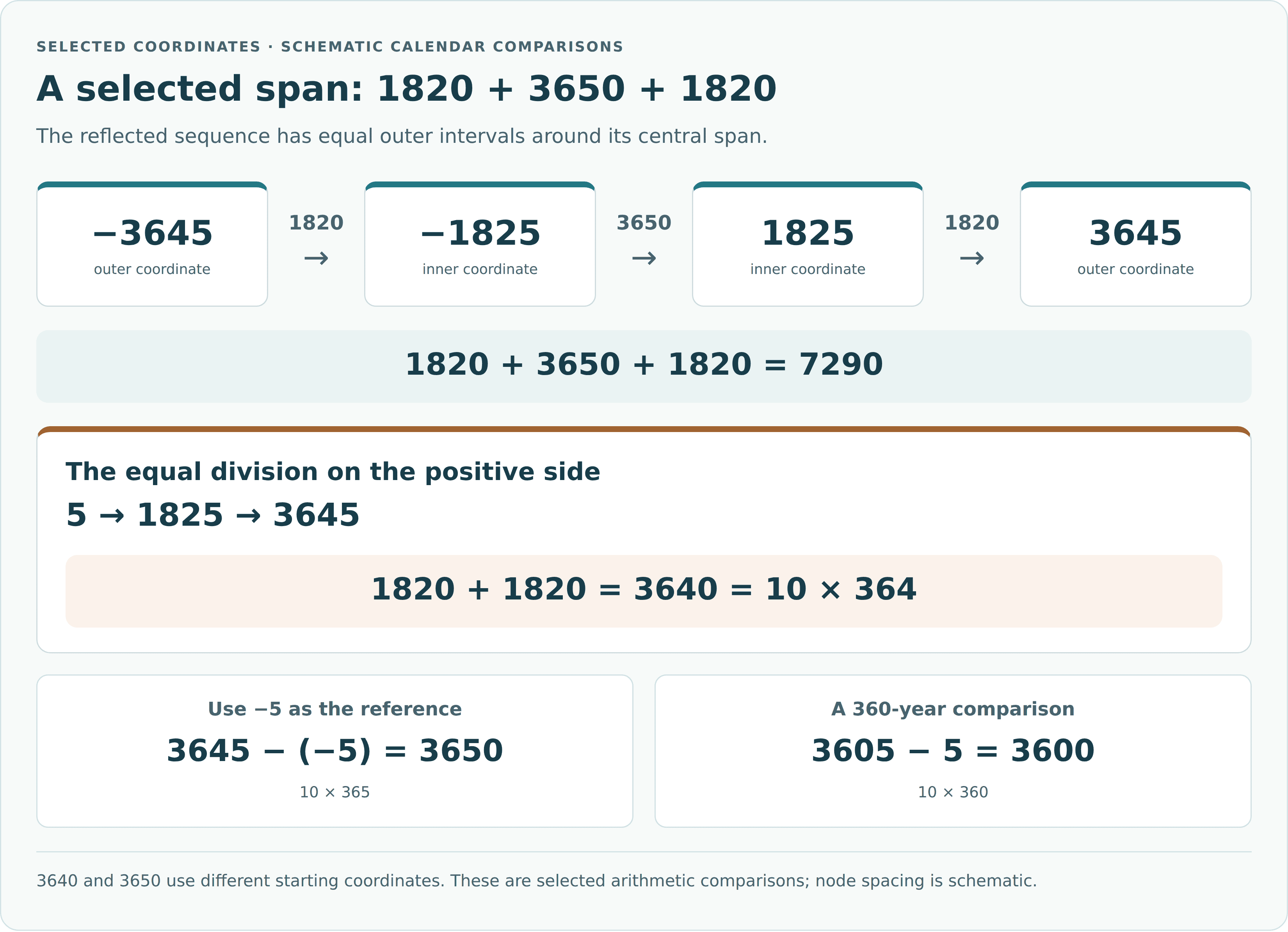
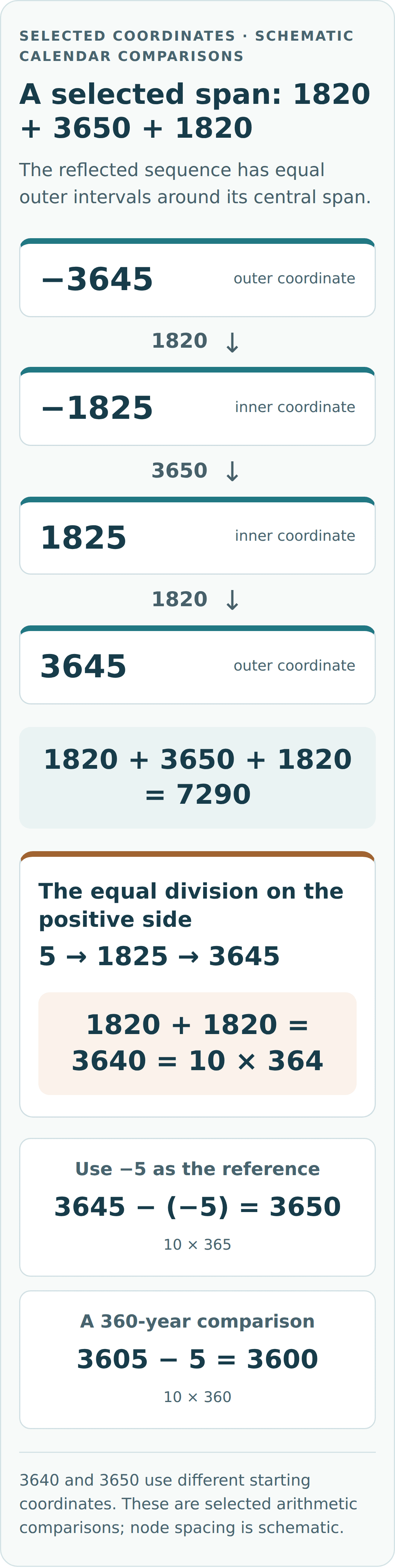
The calendar comparison table also includes 3605 − 5 = 3600, 3645 − 5 = 3640, and 3645 − (−5) = 3650. Both 3605 and 3645 appear by the second complete cross-set round. These are selected relationships within the expanding sets: ±3645 are not the full set’s outer boundaries.
The three calendar quantities have distinct meanings. The 360-day year is a schematic twelve-by-thirty framework. The 364-day year contains fifty-two complete weeks, divided into four thirteen-week quarters. 365 connects this comparison with Enoch’s stated lifespan and a schematic solar-year count; the actual astronomical solar year is slightly longer than 365 days. The arithmetic does not make the three calendars identical.
Enoch, Jared and the Christ-centered reading
Genesis 5:24, BSB describes Enoch being taken by God. The Enochic literature develops themes of heavenly order, the Watchers, judgment and restoration. Read within that setting, the linked 364 and 365 quantities offer a way to consider ordered sacred time alongside Enoch’s biblical lifespan.
Jared adds another connection. The first five ancestral intervals total 460 in both the Masoretic Text (MT) and Samaritan Pentateuch (SP), although their absolute dates differ. The Book of Jubilees places Jared in AM 461, corresponding to 460 completed years from its origin. First Enoch places the Watchers’ descent in Jared’s days; it does not give his birthday as the exact day of their descent. The Jared table and textual references keep those witnesses distinct.
My reading of the pattern is Christ-centered. The “sun of righteousness” (Malachi 4:2, BSB) provides an image of healing and restoration, while Enoch’s story supplies an earlier witness to heavenly order and judgment. In this interpretation, Christ brings the themes together. The reflected ±5 positions belong to the local symbolic construction; they do not replace the circumcision datum or establish a new birth date.
The earlier study also compared Jared 3654 BC → 4 BC → AD 3647, in two civil spans of 3650. That selected 4 BC comparison, its suggested two-day adjustment, and its theological significance remain available in the separate research notes. The normal 6 BC nativity framework is retained. No future event is assigned to AD 3647 here.
Reflection therefore contributes more than a longer list. It opens new eligible relationships, preserves the midpoint of each expanded pair, and brings selected 360, 364 and 365 comparisons into view. Their value lies in seeing the arithmetic clearly enough to consider its biblical meaning with care.
Tables and related studies
Supporting tables and research notes · Part 5A: dates and calendar frames · Part 5B: expanding the number sets · Part 5C: sums and collective dates · Part 5E: reversing the numbers · Current canonical repository.
Preserved original Part 5D discussion — the earlier research remains available in its original form.
The Holy Bible, Berean Standard Bible, BSB is produced in cooperation with Bible Hub, Discovery Bible, OpenBible.com, and the Berean Bible Translation Committee. This text of God’s Word has been dedicated to the public domain. Official terms.