An expanded span needs somewhere to stand. If we make a distance longer but do not say which end stays fixed, we have calculated a new length without identifying where it reaches. That simple distinction is essential to the Key of 23.
In the studies gathered here, a specified biblical chronology supplies a span. An exact ratio expands it. For a dated projection, one endpoint remains fixed while the other moves to a calculated position. Sometimes two such paths reach the same position; sometimes the new endpoint meets a named boundary in a schematic genealogy. The interest lies in the relationship between those specified points.
The genealogical example below returns to Enoch, whose life Scripture describes in these terms:
“Enoch walked with God, and then he was no more, because God had taken him away.”
This introduction follows three examples from the current chronological files. The supporting tables and source notes give every input, ratio, endpoint and qualification in one place.
1. Begin with the endpoint that stays fixed
The two ratios used in this article are 25/23 and 70/69. The first expands each 23 units to 25; the second expands each 69 units to 70. Since 69 is three times 23, both belong to the family of relationships studied under the Key of 23. They produce different results and must be named separately.
| Operation | Original units | Expanded units | Added units |
|---|---|---|---|
| Multiply by 25/23 | 23 | 25 | 2 |
| Multiply by 70/69 | 69 | 70 | 1 |
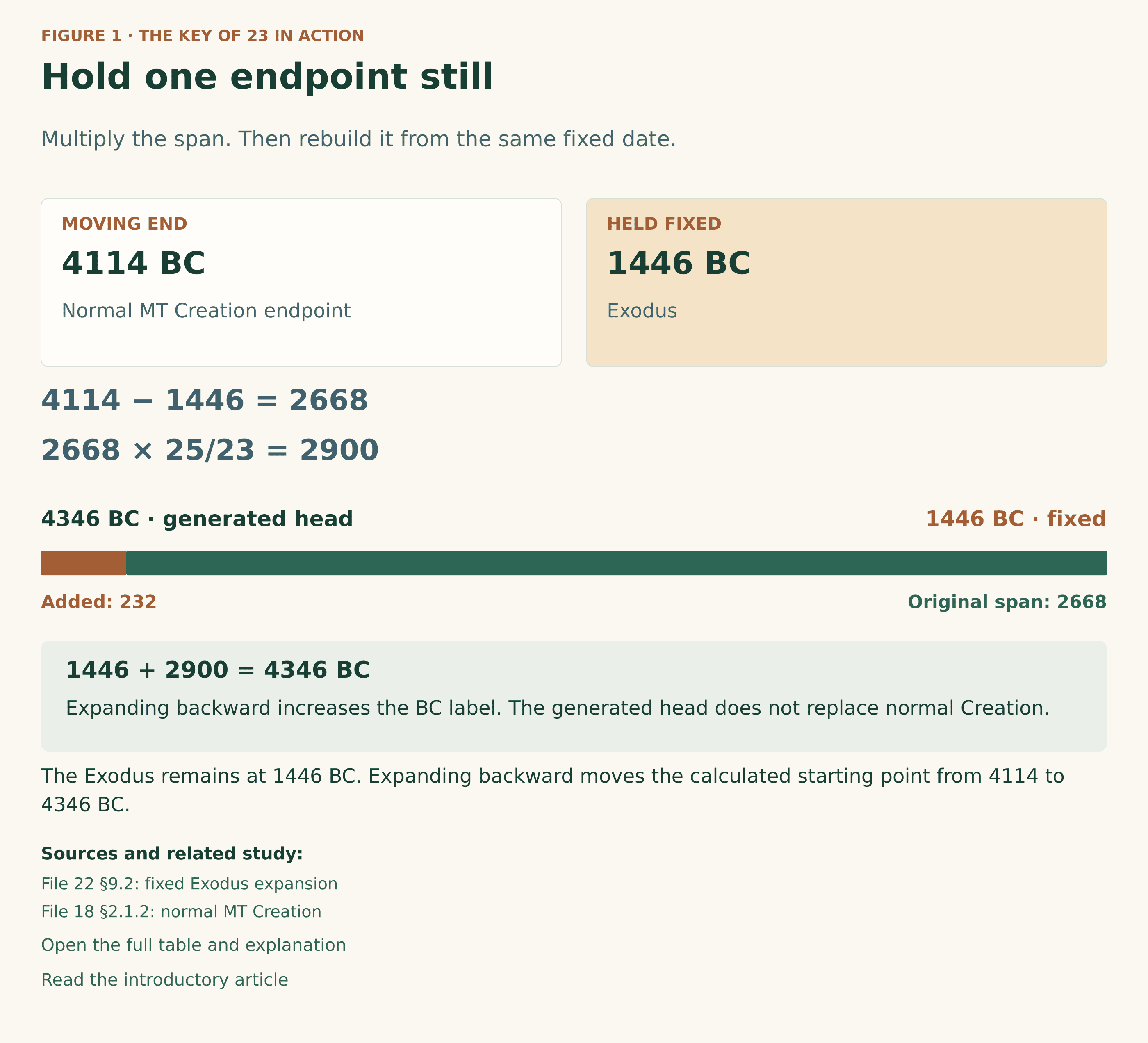
Take the standard regular Masoretic Text (MT) chronology used in this study: Creation at 4114 BC and the Exodus at 1446 BC. The span is 2668 years. Hold the Exodus fixed and expand backward:
2668 × 25/23 = 2900
1446 + 2900 = 4346 BC
The earlier endpoint moves by 232 years, while 1446 BC stays in place. The output, 4346 BC, is an expanded comparison coordinate. Creation remains at 4114 BC in the original chronology.
Figure 1 · The Key of 23 in Action
Hold one endpoint still
Multiply the span. Then rebuild it from the same fixed date.
Normal MT Creation endpoint
Exodus
4114 − 1446 = 2668
2668 × 25/23 = 2900
Sources: File 22 §9.2: fixed Exodus expansion · File 18 §2.1.2: normal MT Creation.
Model and calculation details
The source is the normal MT Creation endpoint at 4114 BC, with no + 60 Terah or restored Cainan. The span to the Exodus is 2668 years. Applying 25/23 gives 2900 years, an increase of 232. Holding 1446 BC fixed therefore gives 1446 + 2900 = 4346 BC. The result is generated; it does not replace ordinary Creation. All arithmetic remains within BC dates; no Mirror operator is used.

The same discipline applies throughout: specify the chronology, calculate its span, name the ratio, hold an endpoint, and identify the resulting position. These calculations compare chronological structures; they do not lengthen anyone’s life. Full endpoint table · Canonical calculation: File 22 §9.2.
2. Two paths meet at 4346 BC
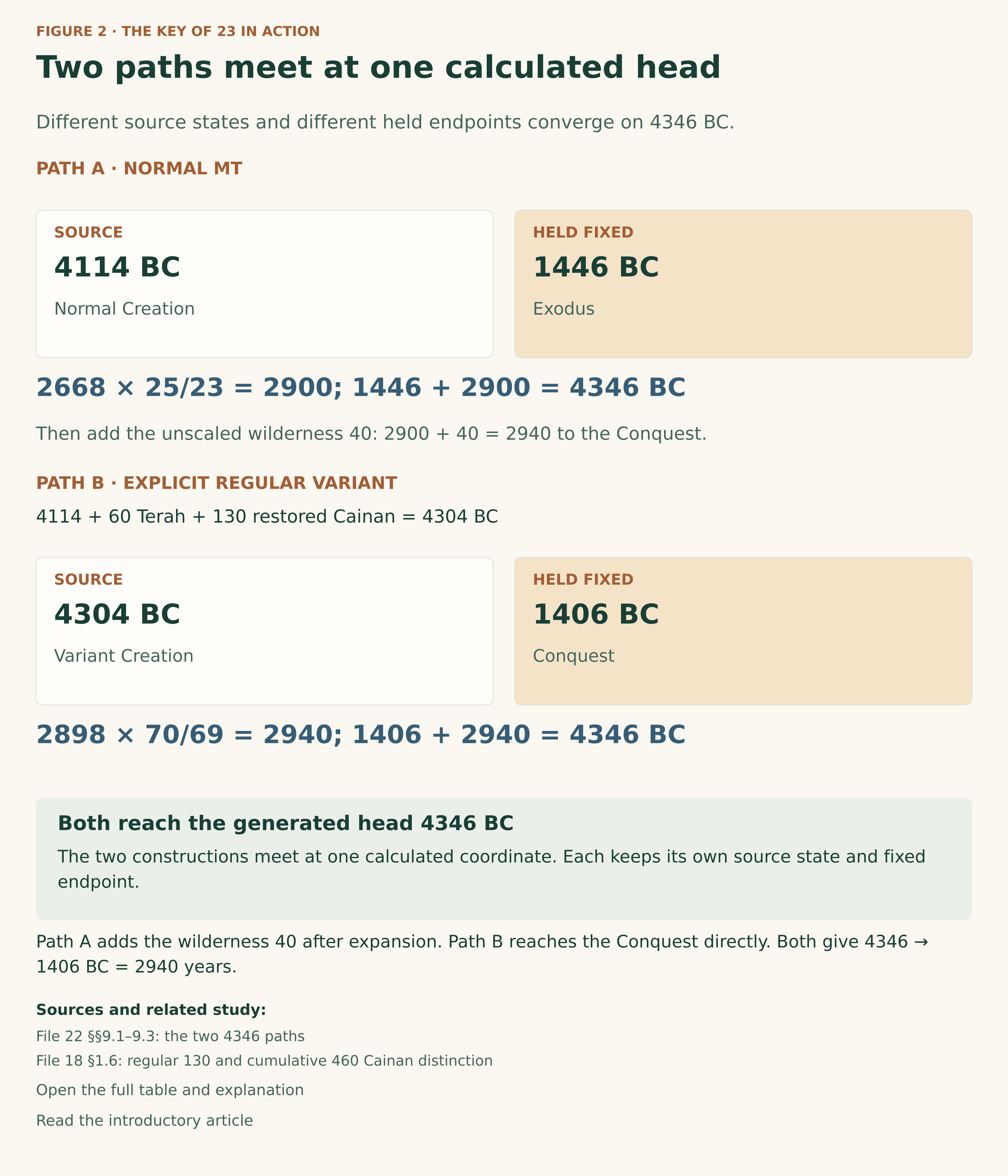
The first example becomes more interesting when a second, explicitly different chronological setting is introduced. File 22 compares the standard Creation date with a variant incorporating +60 years for Terah and +130 years for a restored second Cainan:
4114 + 60 + 130 = 4304 BC
This is an MT-based chronology with declared additions. The second Cainan is absent from the MT Genesis genealogy; his restored 130-year contribution comes from the LXX-based regular chronology. It is a begetting-age contribution, distinct from the 460-year lifespan used in cumulative calculations. The variant note explains the source distinction.
Now hold the Conquest at 1406 BC fixed and apply the other ratio:
4304 − 1406 = 2898
2898 × 70/69 = 2940
1406 + 2940 = 4346 BC
Both paths arrive at 4346 BC, although they begin with different Creation settings, use different ratios, and retain different endpoints.
Figure 2 · The Key of 23 in Action
Two paths meet at one calculated head
Different source states and different held endpoints converge on 4346 BC.
Path A · normal MT
Normal Creation
Exodus
2668 × 25/23 = 2900
1446 + 2900 = 4346 BC
Then add the unscaled wilderness 40:
2900 + 40 = 2940 to the Conquest.
Path B · explicit regular variant
4114 + 60 Terah + 130 restored Cainan = 4304 BC
Variant Creation
Conquest
2898 × 70/69 = 2940
1406 + 2940 = 4346 BC
Sources: File 22 §§9.1–9.3: the two 4346 paths · File 18 §1.6: regular 130 and cumulative 460 Cainan distinction.
Model and calculation details
Path A uses standard MT Creation 4114 BC and holds the Exodus 1446 BC fixed: 2668 × 25/23 = 2900. The 40 wilderness years are then added without scaling, giving 2940 to the Conquest. Path B explicitly opens + 60 Terah and + 130 regular restored Cainan, giving 4304 BC. Holding the Conquest 1406 BC fixed, 2898 × 70/69 = 2940. Both backward calculations reach 4346 BC. This is an exact meeting of generated coordinates, not a redating of Creation or proof of ancient authorial intent.

To compare the two on the same Conquest endpoint, extend the first path through the wilderness: 2900 + 40 = 2940 years. Those 40 years are added after the expansion. They are not multiplied by 25/23.
The resulting equality is exact. Its scope is also precise: two controlled calculations share a generated head at 4346 BC. This is not a third independently established Creation date. The 2940-year span also equals 6 × 490. File 22 reads that sixfold structure alongside the six days of Creation—a theological correspondence whose significance should be considered separately from the arithmetic. Both paths in full · File 22 §§9.1–9.4.
3. One span, two expansions, one fixed hinge
The second example moves from regular chronology to a schematic genealogy. Here a 70-year unit is assigned to each position in the selected genealogical arrangement. Such a position is not a claim that its named ancestor lived 70 years or fathered a child at that age.
The numerical display below concerns Enoch’s assigned place in the genealogical model, not a replacement for that account or for the 365 years stated in Genesis 5:23, BSB.
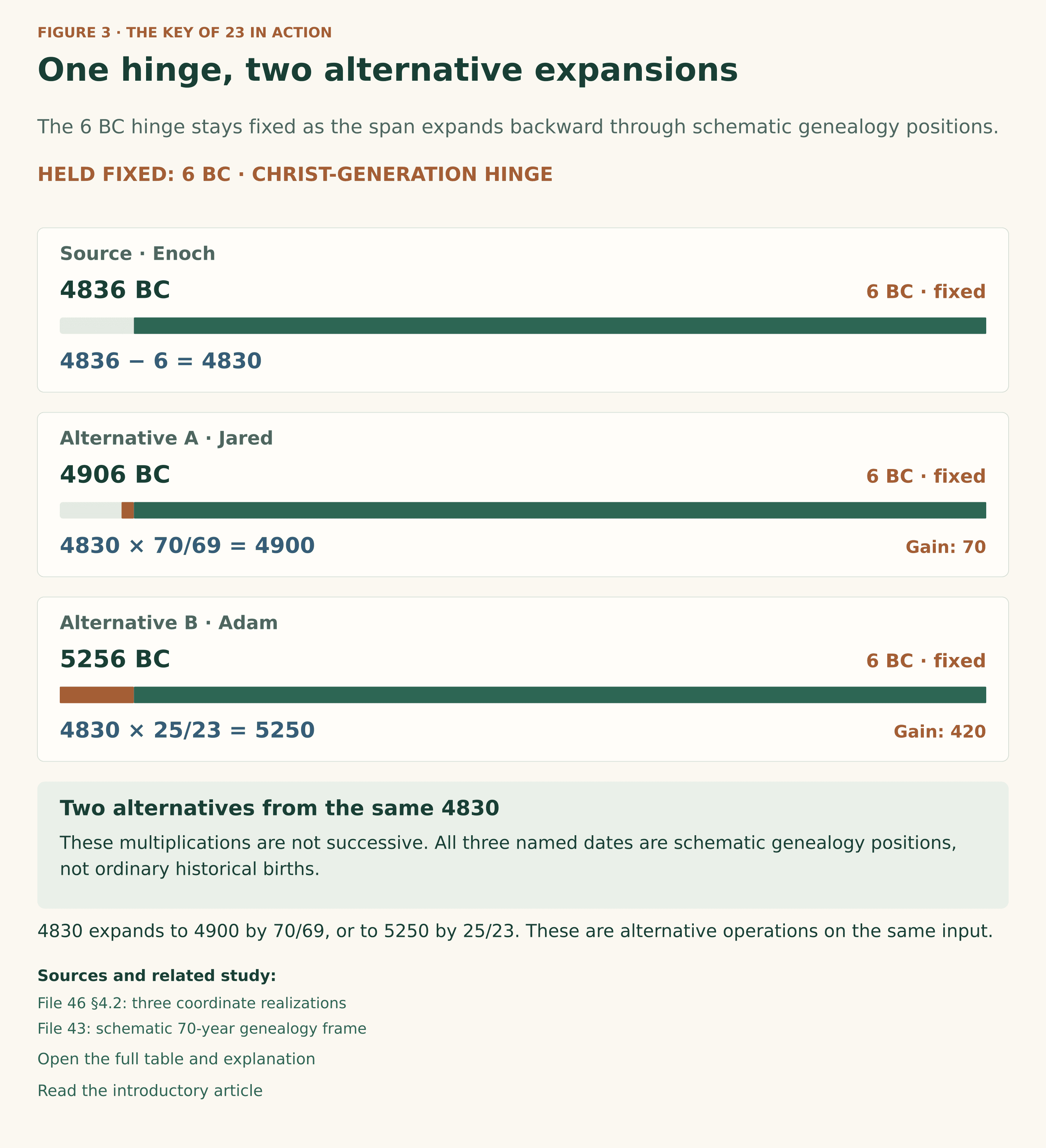
File 46 uses an Enoch boundary at 4836 BC and Christ’s model birth hinge at 6 BC. Their distance is 4830 years. Keep 6 BC fixed and expand backward in two alternative ways:
| Treatment of the same 4830-year input | Resulting span | Earlier boundary reached |
|---|---|---|
| Original span | 4830 | Enoch position: 4836 BC |
| 4830 × 70/69 | 4900 | Jared position: 4906 BC |
| 4830 × 25/23 | 5250 | Adam position: 5256 BC |
Figure 3 · The Key of 23 in Action
One hinge, two alternative expansions
The 6 BC hinge stays fixed as the span expands backward through schematic genealogy positions.
Christ-generation hinge
Source · Enoch
4836 − 6 = 4830
Original span · schematic genealogy positions
Alternative A · Jared
4830 × 70/69 = 4900
Increase: 70 years · schematic genealogy positions
Alternative B · Adam
4830 × 25/23 = 5250
Increase: 420 years · schematic genealogy positions
Sources: File 46 §4.2: three coordinate realizations · File 43: schematic 70-year genealogy frame.
Model and calculation details
In File 46’s genealogy lattice, Enoch occupies 4836 BC, Jared 4906 BC, and Adam 5256 BC. These are calculated positions on the 70-year genealogical grid, not ordinary historical birth dates. Holding the 6 BC Christ-generation hinge fixed, 4836 − 6 = 4830; 4830 × 70/69 = 4900 places the earlier endpoint at 4906 BC; 4830 × 25/23 = 5250 places it at 5256 BC. The gains are 70 and 420, respectively. The factors are alternatives; the second row is not fed into the third.

The first expansion adds 70 years, reaching one position earlier. The second adds 420 years, or six 70-year positions, reaching Adam. Each calculation begins again with 4830; the ratios are not applied successively.
These endpoints belong to the selected Luke-side arrangement in Files 43, 46 and 54. They should not be substituted for ordinary birth dates. Likewise, the genealogy’s counted names, the intervals between them, and the 70-year blocks assigned to them must remain distinct. The counting table makes those distinctions explicit and explains why the textual inventory must be specified. File 46 §4.2.
4. What happens if the other end stays fixed?
The 4830-year span can also be expanded while holding its earlier endpoint, 4836 BC, in place. Multiplying by 70/69 still gives 4900 years, but this time the later endpoint moves forward, from 6 BC to AD 65.
Because there is no civil year zero, the cross-era calculation is:
4836 + 65 − 1 = 4900 years
Figure 4 · The Key of 23 in Action
The held endpoint changes the landing
The same 4830 → 4900 expansion has two different coordinate realizations.
4830 × 70/69 = 4900
Increase: 70 years
Hold the later end: expand backward
4836 BC moves to
Christ-generation hinge
4906 − 6 = 4900
Hold the earlier end: expand forward
6 BC moves to
Schematic Enoch position
4836 + 65 − 1 = 4900
The extension is also exact:
6 + 65 − 1 = 70 years.
Sources: File 46 L2 / §2.2: forward endpoint AD 65 · File 46 §4.2: backward endpoint 4906 BC.
Model and calculation details
Both constructions apply 70/69 to 4830, producing 4900 and adding 70 years. Holding 6 BC fixed and extending backward gives 4906 BC. Holding the schematic Enoch position 4836 BC fixed and extending forward gives AD 65. The forward elapsed span is 4836 + 65 − 1 = 4900; the extension from 6 BC to AD 65 is 6 + 65 − 1 = 70. These are anchored span expansions. Crossing BC–AD here does not activate a Mirror reflection.

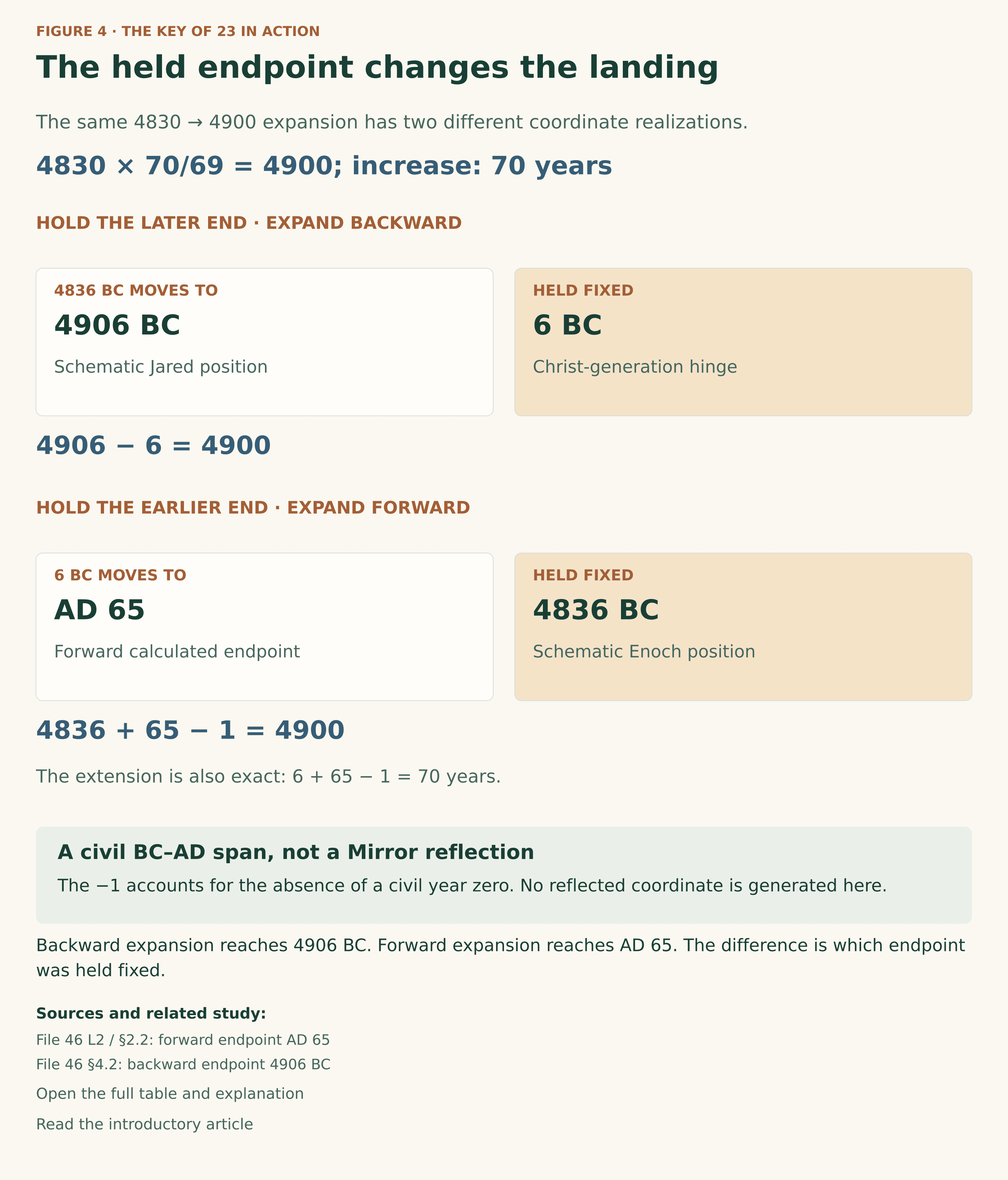
The additional 70 years occupy the model’s final generation block, from 6 BC to AD 65. AD 65 is its schematic closing boundary, not a proposed date for Jesus’ death. The genealogy’s endpoint has been extended by one assigned unit.
This is a forward projection across the BC–AD boundary. It does not reflect a date through that boundary and therefore does not invoke the formal chronological Mirror. The direction and the held endpoint explain the result. Anchor comparison table · File 46 §2.2.
5. What a numerical meeting can show
These examples illustrate two kinds of meeting. In the Creation comparison, two expansion paths converge on the same generated coordinate. In the genealogy, an expanded span reaches a boundary already identified within the selected arrangement.
File 43 adds a useful third case: 5250 + 2800 = 8050, which expands by 25/23 to 8750, a gain of 700 years. Here the source combines two schematic spans without selecting a fixed endpoint. Its result is a length, so no new date should be inferred from it. See the illustrated calculation.
The arithmetic can be checked exactly. The meaning of the correspondences calls for a further judgment. Creation, deliverance, entry into the land, and the genealogy leading to Christ provide the biblical setting for these comparisons. Reading their numerical relationships as signs of a coherent sacred history is a theological interpretation; the equations alone do not establish authorial intention or statistical improbability.
The diagrams keep the original span beside its expansion so that the reader can see what has changed, what has stayed fixed, and precisely where the two meet.
Tables and further study
- All calculations, variant notes and downloadable tables.
- Person and event figure index.
- Regular chronological tables: File 18.
- Creation convergence: File 22 §§9.1–9.4.
- Genealogical span controls: File 43 §§2–5.
- Expansion and endpoint examples: File 46 §§2.2 and 4.2.
Scripture quotations: Berean Standard Bible (BSB), public domain.
Passage wording checked against the official BSB text and the linked eBible.org edition. No NET Scripture or translators’ notes are reproduced.