Technical appendix: full chronology and proofs · File_31 — Rod of Enoch
Creation, Noah, Shem, and the Geometry of the Rainbow
A companion investigation to File_31 — The Rod of Enoch.
Status: Exploratory, noncanonical; arithmetic verified, historical assignments model-dependent, theological interpretation proposed.
Principal calendar: Prophetic/schematic 360-day year, with Nisan 1 as the opening and a fixed 6 p.m.–6 p.m. day boundary. The Enochian 364-day year remains a separate calendar state.
“I have set My rainbow in the clouds, and it will be a sign of the covenant between Me and the earth.” — Genesis 9:13 (BSB)
A rainbow is visible to us as an arc; geometrically, however, its colours lie on parts of circles centered on the point opposite the sun. The number π (pi), the ratio of a circle’s circumference to its diameter, belongs to the mathematics by which such circular forms are described. In Genesis the rainbow is also a sign: after the Flood, God pledges his covenantal faithfulness to Noah and to living creatures (Genesis 8:20–9:17). Could the biblical chronology, read through its deliberately schematic calendars and proportional structures, carry a numerical reflection of that sign?
This question is not raised because the biblical text spells out π, nor because a circle needs 360 degrees to exist. A circle has its geometry independently of any choice of angular units. Rather, the 360-day schematic year, the recurring seven and five, and two previously defined chronological families give us an opportunity to test an unexpected numerical result. One family begins with the complete cumulative lifespan chronology from Adam through Moses; the other begins with the ages of Noah and Shem. Both produce the elementary approximation 22/7. When their calendar phases are retained, each gives a closer ratio to π, by different routes.
The strongest approximation is
π ≈ (7700 × 360)/(2451 × 360 − 5) = 554400/176471 = 3.141592669617104…
Its relative error is about 5.10 parts per billion. A second, less precise calculation uses Noah and Shem and the 51 elapsed days between Nisan 6 and Iyar 27. It places the exact π point, under one specified 6 p.m. endpoint convention, during daylight on Iyar 27—the date associated with the drying of the earth in Genesis 8:14. The covenantal rainbow is not expressly dated to that day. But the narrative’s ordered movement from dry earth to exit, sacrifice, and covenant invites examination as one theological episode.
We should proceed carefully. The arithmetic can be proved; the chronological assignments must be shown; the theological interpretation can be offered and tested. None of these three tasks substitutes for the others.
1. Why begin with the 360-day year?
The Unified Chronology distinguishes normal textual ages from symbolic placements, and 360-day prophetic years from 364-day Enochian, 336-day priestly, and physical solar-year measures. This study begins with 360 because it is already an active calendar in the Day–Year studies and because 360 degrees provide a fitting, if conventional, visual vocabulary for circles. The analogy is intellectually suggestive; it does not establish a physical equivalence between one year and one revolution, and multiplying a historical year interval by 360 is a defined schematic conversion, not a calculation of elapsed solar time.
A further distinction is equally important. The first ratio is not an experimental measurement of π. It is a rational approximation formed from dates and calendar positions in an existing biblical model. Its accuracy can be independently checked, but whether the selected inputs arose independently of the sought result must also be examined. We therefore state our starting nodes and operations before any spiritual application.
The canonical Rod of Enoch already examines π through Enoch’s 365-year life, the 364-day Enochian calendar, the 299/300 harmonic, and rational approximations such as 104348/33215 and 103993/33102. Its purpose is not to make the 360-day year interchangeable with 364. Our new study supplies something different: chronological intervals that generate two instances of 22/7, with explicit calendar corrections. The two studies belong beside one another, not inside one undifferentiated set of formulas.
There is also a comparison with the separate Alpha / 1/137 study. That article investigates the measured fine-structure constant and the biblical 137/138 family, including the sevenfold 1050-year enlargement associated with 150 (= 138 × 25/23). Here 1050 will appear not because π and α are mathematically the same constant, but because both investigations repeatedly encounter the Key-of-23 chronological grammar. A common operator is a research connection, not a physical derivation of one constant from the other.
2. An independently established 12,600-year foundation
Begin with the actual, unrounded MT cumulative chronology anchored at Moses’ death and the Conquest in 1406 BC. It stacks the 26 recorded lifespans from Adam through Moses. In the source’s selected Moses/Nisan line, those lives sum to 12,600 years, setting Adam’s cumulative Year-6 coordinate at 14006 BC, Nisan 1. The selected seven-year Creation envelope opens at 14011 BC. These are formal cumulative positions, not dates when each patriarch biologically began life; the distinction is foundational to the method. See Anchors of Time: Technical Appendix and the cumulative lifespan table.
The total has a striking factorization:
14006 − 1406 = 12600 = 35 × 360 = 5 × 2520 = 2 × 6300.
Its exact midpoint is 7706 BC: two 6300-year halves reach 14006 and 1406 BC. The midpoint was therefore not invented to make a ratio resemble π; it follows from the canonical total, once the selected Year-6 starting position is fixed. The date 14011 BC is likewise legitimate as the Creation-week opening, but it belongs to a different boundary. It does not silently replace 14006 in this particular calculation.
The schematic 6 BC datum supplies the other end of our long numerator. From the midpoint to that year are exactly 7700 years. In 360-day units,
7700 × 360 = 2,772,000 = 220 × 12,600 days.
From the Conquest coordinate to 6 BC there are 1400 years, or 1400 × 360 = 40 × 12,600 days. Hence the two later intervals, 7700 and 1400, differ by precisely 6300 years, the same halfspan that established 7706 BC. The 6 BC datum is a chosen symbolic calendar epoch within the site’s day–year studies; the calculation does not determine Jesus’ literal birth date.
Another useful alignment reaches the Rounded Year-6 position of Adam at 4106 BC: 7706 − 4106 = 3600 years, corresponding to the 3600-unit Mesopotamian šár. The near-equality of calendar vocabulary and Mesopotamian number names should not be mistaken for proof that all ancient conventions are identical, but it explains why 7706 BC has multiple uses within the wider research.
3. The first approximation: the Flood’s Nisan 6 coordinate
Now select the regular MT Gear-2 Flood-closing year, 2457 BC, and the proposed symbolic phase Nisan 6. On the declared 360-day scale, the elapsed span from 7706 BC, Nisan 1 to 2457 BC, Nisan 6 is 5249 years and five days. The later arm runs from 2457 BC, Nisan 6 to 6 BC, Nisan 1: 2451 years minus those same five days. The additions and subtractions preserve the original 7700-year whole.
Earlier arm: 5249 × 360 + 5 = 1,889,645 days.
Later arm: 2451 × 360 − 5 = 882,355 days.
Total: 1,889,645 + 882,355 = 2,772,000 days.
We can therefore compare the full span with its later portion:
R₁ = 2,772,000 / 882,355 = 3.141592669617104…
Against π = 3.141592653589793…, the difference is approximately +0.000000016027311, or 5.10 parts per billion relative to π. Holding the full numerator fixed, the denominator needed for exact π would be 882355.004501468 days—only 0.004501468 day, about 6 minutes 29 seconds, beyond the chosen value. This is an error expressed in the intermediate-interval denominator, not in the numerator.
The five days are not a free-floating correction without a rationale. In this chronological interpretation, Nisan 1 is a Creation anniversary and Nisan 6 recalls Adam’s sixth day. Noah’s 600th year invites a hundredfold sixth-day association; the 601st year and the drying of the land belong to a following-year restoration. In the ordinary MT chronology Lamech, whose lifespan is 777, dies in 2463 BC; the Flood begins in 2458, closes in 2457, and Arphaxad is born in 2456. That gives a compact seven-year field from Lamech’s death to the Arphaxad birth coordinate, while distinguishing the narrated Flood year from an explicitly stated calendar date for Adam. The year labels are model dates; Genesis does not say the Flood concluded on Nisan 6.
The correction is also sensitive. Changing the five-day offset to four or six days moves the resulting ratio considerably farther from π. This is a fact about the selected fraction, not yet a probability of design. We should retain both the favorable result and the fact that changing the model’s permitted dates or day phases may create other candidate ratios. The technical appendix preserves the sensitivity test.
4. Fivefold reduction, and the 22/7 beneath the fraction
The numerator and denominator share a greatest common divisor of five:
2,772,000 / 882,355 = 554,400 / 176,471.
That reduction is particularly fitting within the proposed symbolism of five elapsed days from Nisan 1 to Nisan 6. But the deeper arithmetic appears when the later interval is rewritten around Arphaxad’s birth in 2456 BC. From 2456 to 6 BC are 2450 = 5 × 490 years. The selected earlier Flood-closing coordinate is one year earlier in the sequence, less five days toward the later endpoint, so the 2450-year arm acquires 360 − 5 = 355 days:
882,355 = 2450 × 360 + 355.
Now each fifth is exactly:
7700/5 = 1540 = 22 × 70 years, while
(2450 × 360 + 355)/5 = 490 × 360 + 71 days.
The whole ratio becomes:
R₁ = (22 × 70 × 360)/(7 × 70 × 360 + 71).
Remove the final 71-day term for the purpose of displaying the integer skeleton, and the familiar ancient approximation appears:
(22 × 70 × 360)/(7 × 70 × 360) = 22/7.
Thus the model does not start with a mysterious large fraction. The year-only relation is 22/7; a small, narratively located calendar adjustment produces a much closer approach to π. The 71 days are simply 355/5 = 360/5 − 1. That numerical identity helps explain how the five-day gap is distributed across five equal portions; it does not independently establish five dated happenings inside each segment.
This is the first main result: a fivefold partition exposes a 22/7 ratio built from 490 and 1540, and a five-day calendar phase changes it into 554400/176471. Its relationship to Daniel’s seventy weeks is one of numerical grammar: 490 is an established sevenfold biblical count, while the particular 60-day scale and chosen chronological coordinates determine the resulting fraction.
5. The invisible grid converging on Arphaxad
The fivefold reduction can be represented geographically on neither a map nor a literal timeline of events alone. It is best understood as a converging numerical grid. Starting at 7706 BC and 6 BC, advance the older endpoint by 1050 years and move the newer endpoint backward by 490 years, repeating the pair of operations five times. The dates meet at 2456 BC, the Arphaxad birth coordinate.
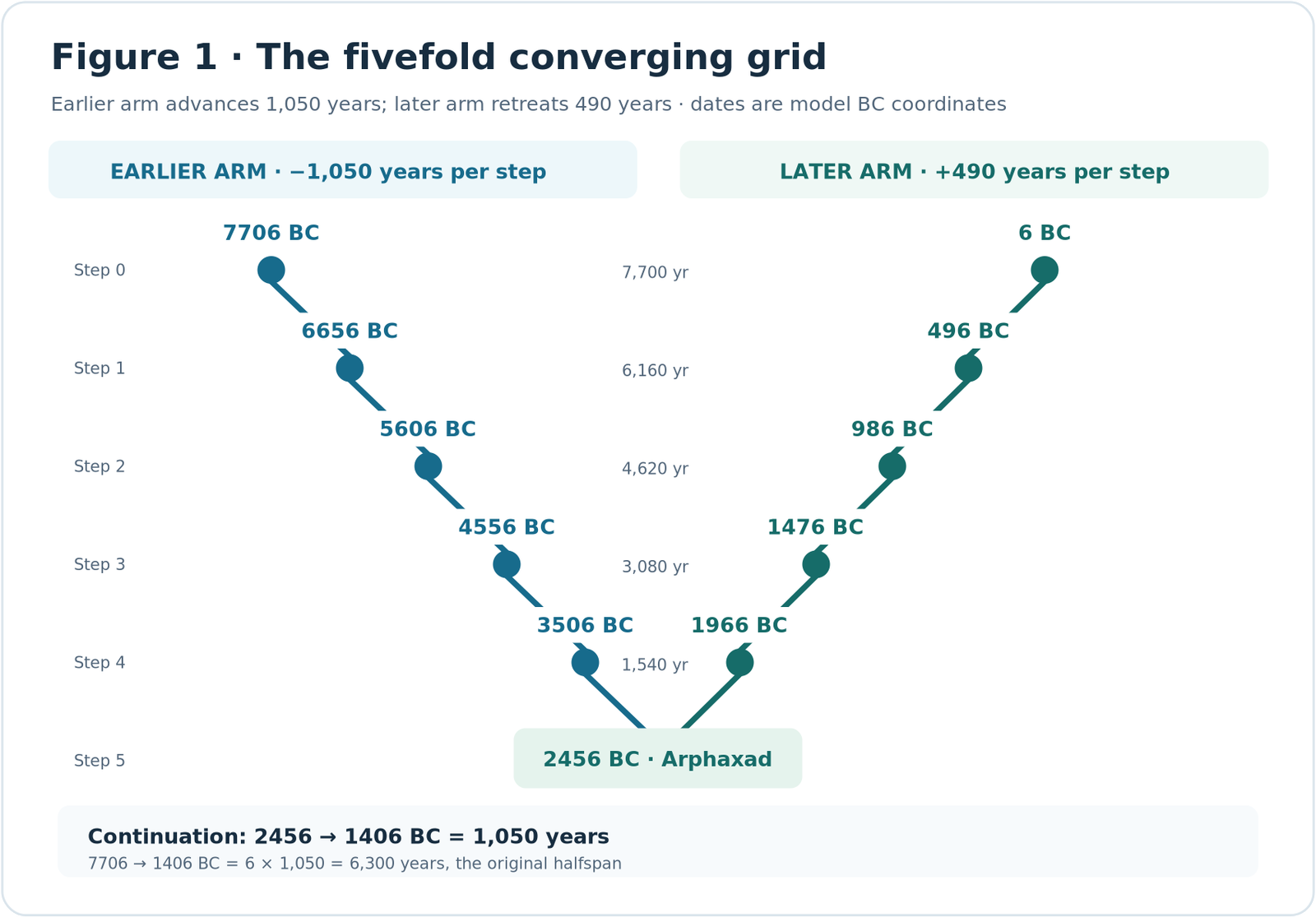
The paired movements are 1050 + 490 = 1540 = 22 × 70. Their ratio is 1050:490 = 15:7; together they make 22 parts. This is not a postulated spatial grid that existed independently of the arithmetic. It is a concise display of how the given 7700-year interval can be divided into five identical contractions, preserving both its 22/7 ratio and its fivefold structure.
The earlier track can be continued for one additional 1050-year step, from 2456 BC to 1406 BC, the Conquest. Consequently, the midpoint at 7706 BC is exactly six 1050-year intervals before 1406 BC:
6300 = 6 × 1050.
The equality 7706 − 2456 = 6656 − 1406 = 5250 follows from shifting both endpoints by 1050 years. Likewise, 4556 BC and the selected 1476 BC Joshua-birth coordinate appear together on the grid; the latter is 70 years before 1406 BC. Joshua’s lifespan of 110 years is textual, but the absolute 1476 BC birth assignment is a reconstructed coordinate from the Rounded study, not a date directly recorded in Scripture.
This extension matters because 1406 BC was not introduced to explain the grid: it was the anchor that defined the 12,600-year cumulative total in Section 2. The grid therefore returns to the setting from which the midpoint emerged. At the same time, all six rows follow mechanically from the one 1050/490 rule, so their coherence constitutes one structured finding, not six independent confirmations.
There is another cross-reference to the Alpha / 1/137 article: 1050 = 7 × 150, and 150 = 138 × 25/23. In that study, 138 is connected with six units of 23 and with the Key’s enlargement. The appearance of 1050 in our π grid deserves comparison as a shared operator and span. It should not be taken to mean that 137.036 algebraically determines π, or vice versa.
6. Noah and Shem: a second 22/7
An apparently different 22/7 arises from the selected MT Gear-1 Noah–Shem state. In that state Noah is born in 3056 BC, Shem in 2556, the Flood-start label is 2456, Noah dies in 2106, and Shem dies in 1956. The chronological model retains Shem’s 600 years; Gear 1 shifts Noah’s birth, Flood-start label, and death relative to Gear 2. The normal Gear-2 sequence instead begins with Noah in 3058 BC and the Flood start in 2458. The two states must be named, not fused. Noah and Shem: Source Notes provides the distinction.
The Gear-1 sequence gives:
3056 → 2556: 500 years; 2556 → 2456: 100 years; 2456 → 1956: 500 years.
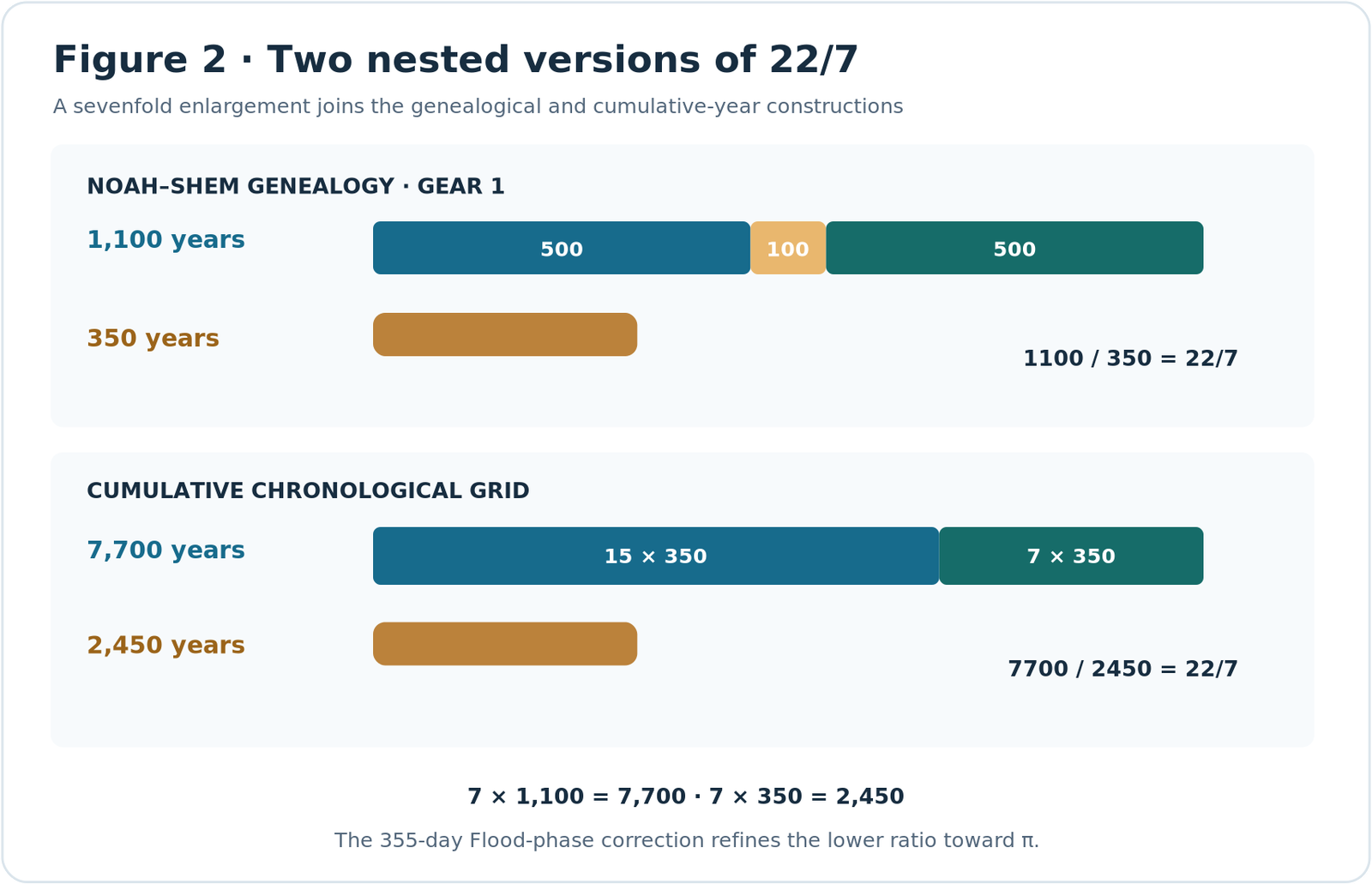
Therefore Noah’s birth to Shem’s death spans 500 + 100 + 500 = 1100 years. Two 600-year biographical intervals overlap by 100 years: Noah’s birth to the Flood-start label and Shem’s birth to his death. That is why 600 + 600 − 100 = 1100. These are overlapping lives, not two consecutive 600-year periods.
Genesis 9:28 states that Noah lived 350 years after the Flood. His total life of 950 is 600 + 350. Comparing the 1100-year Noah–Shem whole with the 350-year remainder gives:
1100/350 = 22/7.
Notice the exact scale relationship to the first construction:
7700 = 7 × 1100, and 2450 = 7 × 350; therefore 7700/2450 = 1100/350 = 22/7.
This is worth emphasizing, but also qualifying. Because 7700, 2450, 1100, and 350 all use recurrent round-number measures and shared chronological anchors, it would be premature to call the two fractions statistically independent. They are two separately intelligible biblical constructions with a direct algebraic relationship. That is stronger than saying they are random numbers, but different from establishing a unique divine signature.
A further interval inside Noah’s 950 years introduces 2706 BC: from Noah’s 3056 BC birth, 350 years reach 2706 BC, and a further 600 years reach his 2106 BC death. The 350 here is an interval measured from Noah’s birth, while the textual 350 after the Flood measures the final part of his life. They are parallel uses of the number 350, not the same historical 350-year segment. This node will become central to the second approximation.
7. The fivefold network, Shem’s death, and the Key of 23
The midpoint at 7706 BC stands 5000 years before the auxiliary Noah-life coordinate at 2706 BC. Within the biblical analogy that a thousand years are as a day (Psalm 90:4; 2 Peter 3:8), this is suggestive of five symbolic millennial days. It echoes the five elapsed days between Nisan 1 and Nisan 6 in the first calculation. The day–millennium reading is typological, not a literal interchangeability of calendar days and historical millennia.
Another simple partition follows:
7706 → 2706 → 2456 → 6 BC = 5000 + 250 + 2450 = 7700 years.
Here 250 is five 50-year jubilees in a broad biblical sense, while 2450 is five periods of 490 years. The repository’s technical Jubilee register often counts recurrent 49-year blocks, distinct from the consecrated fiftieth year; this comparison explicitly uses the 50-year symbolic measure. The exact fivefold factor is the point. Another route through the biographies is 7706 − 3056 = 4650 = 5 × 930, five times Adam’s Genesis 5:5 lifespan.
Shem’s death supplies a complementary division. 7706 − 1956 = 5750 = 5 × 1150. And the 7700-year span can be split as 5250 + 500 + 1950, corresponding to 7706 → 2456 → 1956 → 6 BC. Reduce every portion by five, and the pieces become 1050 + 100 + 390 = 1540. Within the denominator, 100 + 390 = 490. Thus the 390 associated with Ezekiel 4:5 appears as the complement to 100 in a Danielic 490-year interval. This is a structural echo; it is not an independently dated fulfillment of Ezekiel.
The 360-day system also touches the Exodus: 2706 − 1446 = 1260 = 3½ × 360, and 2706 − 6 = 2700 = 7½ × 360. These reinforce the use of 2706 as an internally functional coordinate. Yet the chosen point 2706 is still generated by the 350-year partition of Noah’s 950 years; the secondary agreements should be assessed with that dependence visible.
Finally, the original MT Creation-to-Flood span of 1656 years expands under the Key of 23 as 1656 × 25/23 = 1800 = 5 × 360. This is a distinct priestly conversion of the span, not a claim that 1656 years physically contain 1800 prophetic solar years. The Key of 23 technical appendix specifies that the 1800 resulting units belong to a 336-day priestly comparison, whereas the 360-day result for the same span uses a separate 70/69 operation and gives 1680 units. We retain the factorization 1800 = 5 × 360 as a numerical resonance without erasing the calendar-state firewall.
These relationships explain why five is not introduced solely by the reduced π fraction. It already organizes several selected elements of the chronology. But their repeated occurrence does not remove the need to test whether alternative choices could generate comparable grids.
8. The second refinement: fifty-one days to Iyar 27
The genealogical approximation begins at 1100/350 = 22/7. We now use the same 360-day schematic calendar, but a different phase correction. Genesis 8:13–14 distinguishes the first day of the first month, when the surface of the ground was dry, from the twenty-seventh day of the second month, when the earth had dried. Under a stipulated 30-day first month, Nisan 6 to Iyar 27 spans 51 elapsed days when comparable end-of-day boundaries are used.
Take the model’s 3056 BC Nisan 6 as a symbolic initial phase for Noah’s birth and move 350 schematic years plus 51 days. The calendrical endpoint is 2706 BC Iyar 27. The full 1100-year span is measured from the initial Nisan 6 phase to 1956 BC Nisan 6, the model’s Shem-death phase; the final arm must consequently be 750 years minus 51 days, not a plain 750 years. These month/day assignments to the births and deaths are proposed model phases, not dates supplied by Genesis.
The second fraction is:
R₂ = (1100 × 360)/(350 × 360 + 51) = 396000/126051 = 3.141585548706476…
Its relative error is approximately −2.26 parts per million. This is less precise than the first ratio, yet it is impressively close for a construction that begins with two narrative lifespan totals and adjusts by a named Flood-calendar interval.
What happens if instead we ask for the day coordinate that would make the ratio exactly π? It would require:
396000/π − 126000 = 50.714928781… days beyond 350 years.
That falls 0.285071219 day, or roughly 6 hours 50 minutes, before the end of a full 51-day interval. With the fixed calendar’s 6 p.m. evening boundary assigned to the end of Nisan 6, the exact-π point lands at approximately 11:09 a.m. on Iyar 27. The clock time is contingent on the assigned phase boundary; the significant model result is daylight on Iyar 27. If the starting boundary were the beginning rather than the end of Nisan 6, the ordinal date would differ by one day. This is why the technical appendix preserves the endpoint convention.
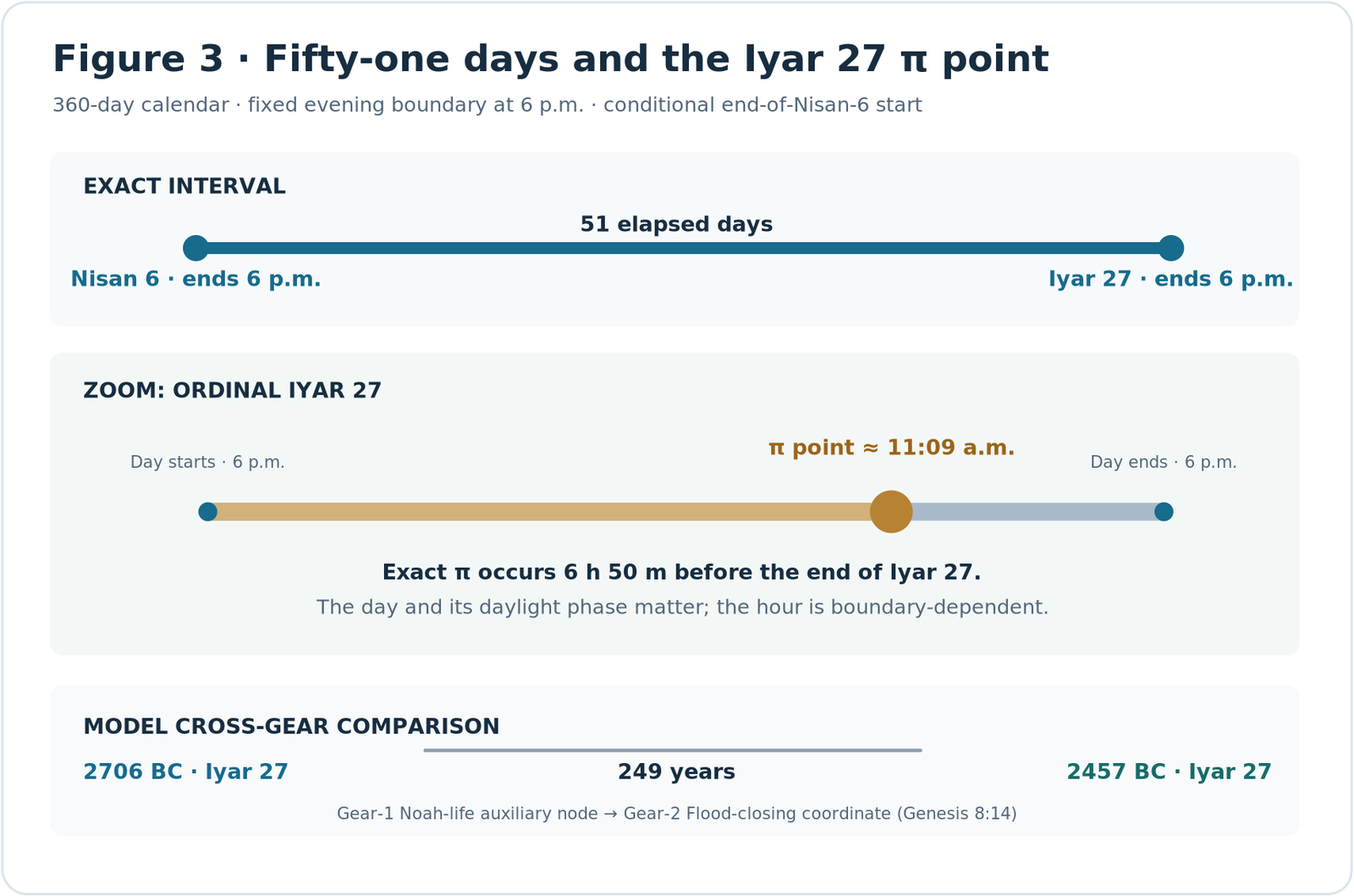
In the model, 2706 BC Iyar 27 → 2457 BC Iyar 27 = 249 schematic years, with a corresponding calendar phase. This is a cross-gear comparison: 2706 derives from the Gear-1 Noah-life construction, while the Flood-closing year 2457 belongs to the regular Gear-2 Flood sequence. The article does not turn that bridge into a single literal genealogy. It asks instead whether the same phase can be meaningfully compared across the two established modal states.
The narrative meaning is suggestive. Genesis gives Iyar 27 as the date of completed drying, followed by God’s command to leave the ark, Noah’s departure, his sacrifices, and the establishment of the covenant sign. The text does not provide precise hours for those actions or state that the first appearance of a rainbow occurred on Iyar 27. A symbolic reading may nonetheless regard the passages as one culminating covenant episode. The number π enters the proposed pattern through a daylight placement, fitting the visual character of a solar rainbow without treating Scripture as a dated observational report.
9. A circle of covenant: mathematical result and theological reading
A primary rainbow is formed by sunlight refracted and reflected within raindrops. Each observer sees a circular configuration around the antisolar point; the familiar arc is the visible portion above the horizon, while an elevated observer can sometimes see a complete ring. The primary radius is approximately 40–42 degrees. The secondary bow forms another circle, roughly 50–54 degrees in angular radius. These optical quantities can be described geometrically using π, but neither π nor any particular circle constant is uniquely inferred from the biblical word rainbow. The WMO’s International Cloud Atlas provides the optical descriptions.
The circular geometry matters to the theological reflection because the rainbow is an emblem of a promise extending to the living world. In Genesis 8–9, the waters recede, dry land reappears, living creatures emerge, Noah builds an altar, and God speaks of the continuing rhythms of earth and seasons. The ordering evokes both judgment and renewed creation. The chosen mathematical interpretation sees the form of the sign—the circle—and the date associated with the Flood’s conclusion brought together through a calendar model. This does not replace the story’s actual claim: God’s covenant is an act of faithfulness, not a theorem about π.
The scriptural sign later reappears within biblical visions. Ezekiel 1:28 describes the radiance around the divine appearance in language comparing it with a rainbow; Revelation 4:3 depicts a rainbow encircling the throne, and Revelation 10:1 describes the angel with a rainbow over his head. Those passages give a legitimate biblical basis for reading the Flood’s sign as more than meteorology. They do not, by themselves, attest a numerical π code. They allow the proposed mathematical correspondence to be discussed within a Christological and covenantal narrative rather than as a free-standing number game.
It is also useful to compare the two companion inquiries. The Alpha / 1/137 article begins with an experimentally measured, dimensionless physical constant and asks whether biblical life spans and calendar residues form meaningful analogies. The present π inquiry starts with an exactly defined mathematical constant and asks whether independently fixed chronological numbers approximate it. Neither should claim that the biblical calendar causes the constant, nor that an approximate fraction proves a physical law was known to the ancient writers. Both explore whether the numerical and literary dimensions of Scripture may illuminate each other within a providential interpretation.
File_31 — The Rod of Enoch offers an additional kind of comparison: its 104348/33215 and 103993/33102 are more accurate than either new ratio, but they arise from a different family of calendar harmonics and rational approximations. The present fractions are distinctive because their inputs are chronological distances between named biblical nodes, plus explicitly declared phase offsets. Their explanatory advantage is not superior numerical accuracy; it is their apparent fit within the previously developed chronological framework.
What, then, has been established? Two reproducible ratios, a fivefold grid, a sevenfold relationship between the 22/7 baselines, and a precisely stated daylight alignment on Iyar 27 under one calendar phase convention. What remains open is whether the choices of state, endpoint, ratio orientation, and day phase are sufficiently independent and constrained to support an inference of deliberate design. The correct next test is to formalize the allowed selection rules and compare neighboring or alternative nodes, rather than merely accumulate additional equalities.
The proposed pattern finally returns us to Genesis. Mathematics describes the geometry of a rainbow; Scripture interprets the rainbow as covenantal assurance. If the numerical correspondence is purposeful, it would not replace that message but serve as a second way of attending to it. Even without deciding that larger question, the arithmetic and the layered chronology merit preservation for further investigation.
Reading further and source controls
The article draws its chronological inputs from the public cumulative chronology appendix, Noah–Shem source notes, Key of 23 reference appendix, and Rounded Chronology research. Its closest conceptual companion is File_31 — The Rod of Enoch, with an additional comparison to 1/137 — Alpha, Creation, and Christ. The detailed ledger, precision checks, phase choices, complete six-row grid, and methodological questions are preserved in the separate technical appendix.