…and you shall observe a feast to the LORD for seven days.
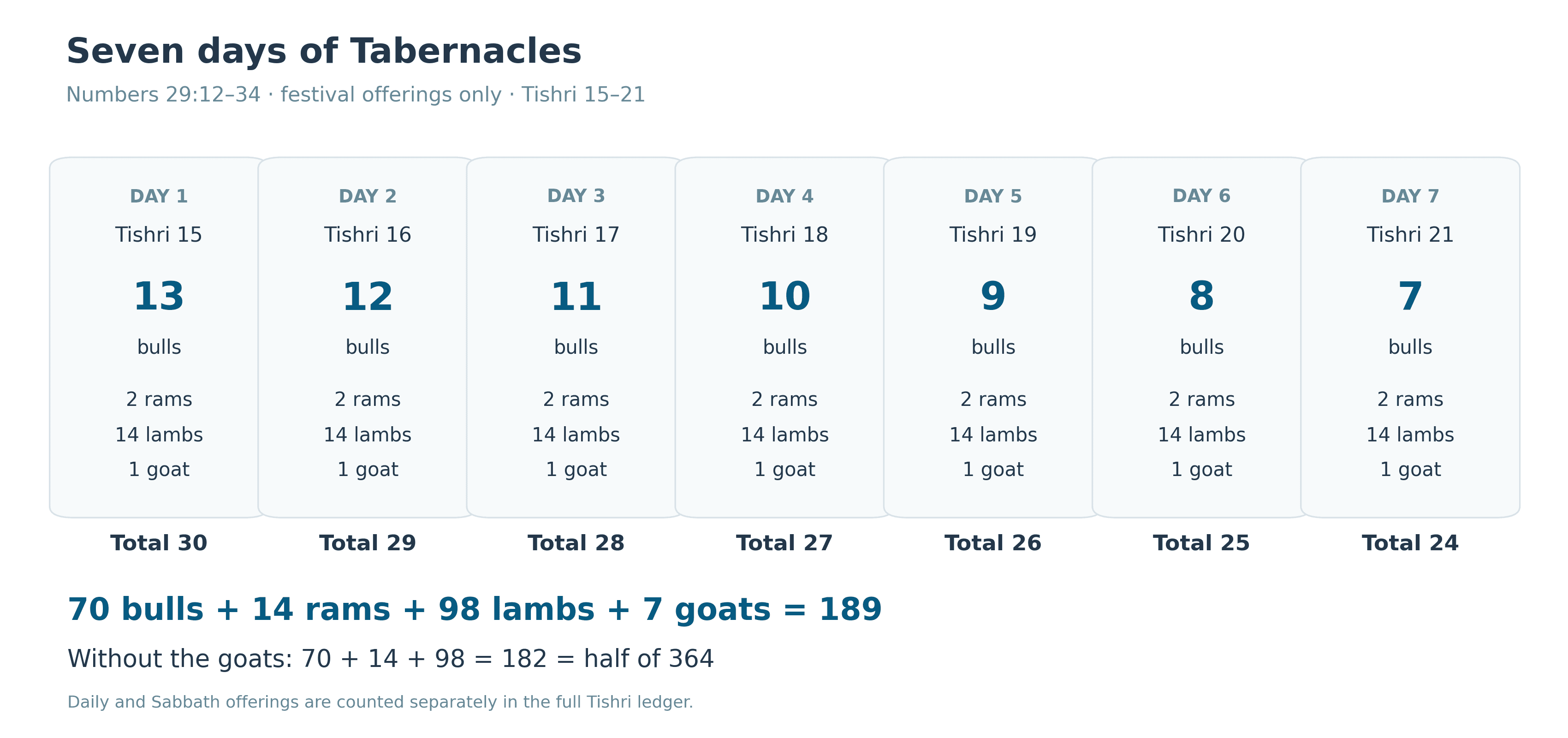
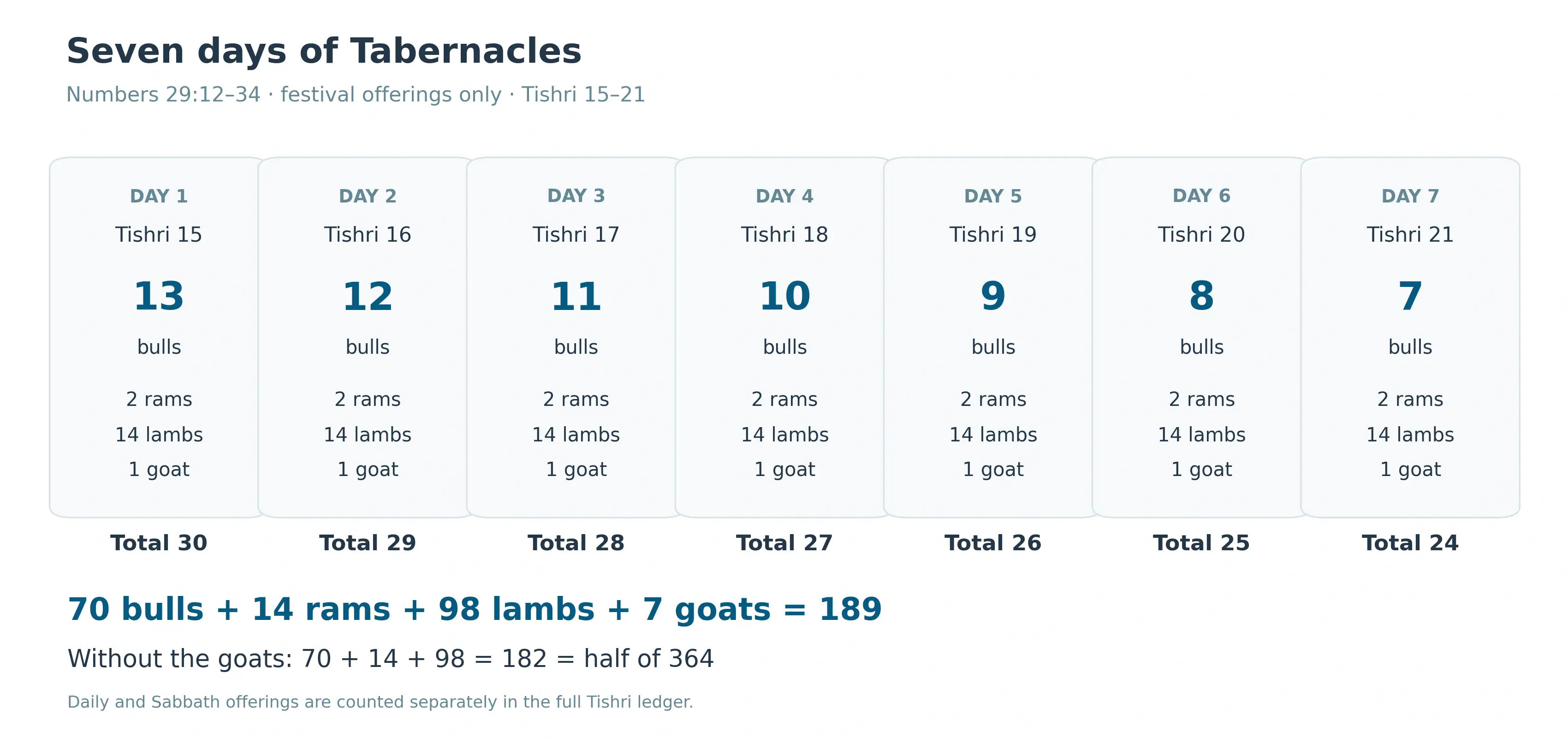
The Feast of Tabernacles has a striking numerical shape. Over its seven days, the prescribed bulls decrease from thirteen to seven. The other festival offerings remain constant: two rams, fourteen lambs, and one goat each day. An eighth-day assembly follows with a smaller set of offerings.
These counts first describe worship. This study also reads them as a template for sacred time: weeks of years, jubilee units, and the movement from exile to return. The clearest comparison joins the seven-day total to three important moments in Jacob’s life—his departure, his return, and his death—and then to the later history of Israel.
The sacrificial counts and the resulting sums can be checked directly. Their chronological meaning is the interpretation developed here.
The source of record is the Unified Chronology knowledge catalog, especially File 58: Numbers 28–29 Tishri Sacrificial Ledger. The technical appendix gives the complete tables and date conventions.
The seven-day pattern · Jacob and return · The full ledger · Supporting tables
The seven-day pattern: 182 + 7
Numbers 29:13–34 gives the offerings for each of the seven feast days. The bull counts add to seventy:
13 + 12 + 11 + 10 + 9 + 8 + 7 = 70.
The other counts are fourteen rams, ninety-eight lambs, and seven goats. The first three categories therefore total 182; the goats bring the whole to 189.
Seven days of Tabernacles
Numbers 29:12–34 · festival offerings only · Tishri 15–21
Day 1
Tishri 15
13bulls
2 rams
14 lambs
1 goat
Total: 30
Day 2
Tishri 16
12bulls
2 rams
14 lambs
1 goat
Total: 29
Day 3
Tishri 17
11bulls
2 rams
14 lambs
1 goat
Total: 28
Day 4
Tishri 18
10bulls
2 rams
14 lambs
1 goat
Total: 27
Day 5
Tishri 19
9bulls
2 rams
14 lambs
1 goat
Total: 26
Day 6
Tishri 20
8bulls
2 rams
14 lambs
1 goat
Total: 25
Day 7
Tishri 21
7bulls
2 rams
14 lambs
1 goat
Total: 24
70 bulls + 14 rams + 98 lambs + 7 goats = 189.
Without the goats: 70 + 14 + 98 = 182, half of 364.
Download full-size PNG · Download WebP
Full text of this diagram
The seven festival days are Tishri 15 through 21. The bull counts are 13, 12, 11, 10, 9, 8 and 7. Every day also has 2 rams, 14 lambs and 1 goat. The daily festival totals are 30, 29, 28, 27, 26, 25 and 24. All seven days total 70 bulls, 14 rams, 98 lambs and 7 goats: 189 animals. Without the goats, the subtotal is 182. Daily and Sabbath offerings are separate from this festival subtotal.
Image version: Seven days of Tabernacles
The bulls decrease by one each day while the other festival offerings remain constant. Daily and Sabbath offerings are counted separately in the full Tishri ledger.
The seven festival days are Tishri 15 through 21. The bull counts are 13, 12, 11, 10, 9, 8 and 7. Every day also has 2 rams, 14 lambs and 1 goat. The daily festival totals are 30, 29, 28, 27, 26, 25 and 24. All seven days total 70 bulls, 14 rams, 98 lambs and 7 goats: 189 animals. Without the goats, the subtotal is 182. Daily and Sabbath offerings are separate from this festival subtotal.
The separation matters because 182 is half of 364. Within a schematic 364-day year, the feast’s bull, ram, and lamb total corresponds numerically to half a year. The goats form an additional seven. Animals and days remain different units; the comparison concerns their numbers.
To test the relationship against chronology, the study uses a seven-year scale. The same annual festival count, repeated over seven years, gives these numerical totals:
| Festival group | Count × 7 | Chronological comparison |
|---|---|---|
| Bulls, rams, and lambs | 182 × 7 = 1,274 | Half of seven 364-day years |
| Goats | 7 × 7 = 49 | One seven-by-seven jubilee unit |
| All seven days | 189 × 7 = 1,323 | 1,274 + 49 |
| Bulls alone | 70 × 7 = 490 | Ten 49-year units |
The resulting counts are then compared with years. This step is an interpretive use of the offering list; Numbers does not expressly say that its animal totals date Jacob or the exile. The sevenfold scale makes the proposed relationship visible: 1,274 + 49 = 1,323.
The calendar setting must also be stated. The complete monthly ledger below uses the repository’s Enochian 364-day fixed-week calendar, with the first day of the seventh month on a Wednesday. Numbers supplies the offerings, but does not itself specify that weekday arrangement. The 364-day calendar is distinct from the 336-day priestly-service pattern and the 360-day prophetic year. The appendix compares these settings.
Jacob’s life and the later return from exile
The normal Masoretic Text chronology provides the main dates used here. It has 430 years in Egypt, without the optional sixty-year Terah adjustment or an inserted second Cainan. Jacob is born in 2006 BC, departs for Haran in 1929 BC, returns in 1909 BC, and dies in 1859 BC.
His departure and return must be kept separate. Each opens a different 1,323-year comparison:
- From 1929 to 606 BC is 1,323 years. A further 70 years reaches 536 BC, the return horizon.
- From 1909 to 586 BC is 1,323 years. A further 70 years reaches 516 BC, the Temple-restoration horizon.
- From Jacob’s death in 1859 to 536 BC is 1,323 years.
These are the selected chronological horizons used in the Unified Repository. They place Jacob’s personal experience of leaving and returning beside Israel’s later exile and restoration.
The death-to-return span also divides into the two parts of the festival count. In the repository’s Nisan notation:
1859n → 585n → 536n BC = 1,274 + 49 years.
Here n means a Nisan-based coordinate. The middle node belongs to the repository’s seasonal dating of Jerusalem’s fall, 586t/585n; t means Tishri. The familiar 586 BC year label remains in the separate return-from-Haran comparison above. These seasonal labels describe the chronology’s date conventions. The phase table shows exactly which coordinates are subtracted.
Jacob, exile and return
Selected repository chronology · three separate calculations · schematic spacing
Jacob’s death: the Nisan-phase route
Jacob’s departure and the exile horizon
Jacob’s return and the Temple horizon
n means Nisan. The second and third rows use BC year labels and retain their own chronological setting.
Download full-size PNG · Download WebP

Full text of this diagram
Jacob’s death: the Nisan-phase route: 1859n BC to 585n BC is 1,274 years; 585n BC to 536n BC is 49 years. Total: 1,323 years.
Jacob’s departure and the exile horizon: 1929 BC to 606 BC is 1,323 years; 606 BC to 536 BC is 70 years. Total: 1,393 years.
Jacob’s return and the Temple horizon: 1909 BC to 586 BC is 1,323 years; 586 BC to 516 BC is 70 years. Total: 1,393 years.
All node spacing is schematic. The first route is explicitly Nisan; its phase is not imported into the other routes.
Image version: Jacob, exile and return
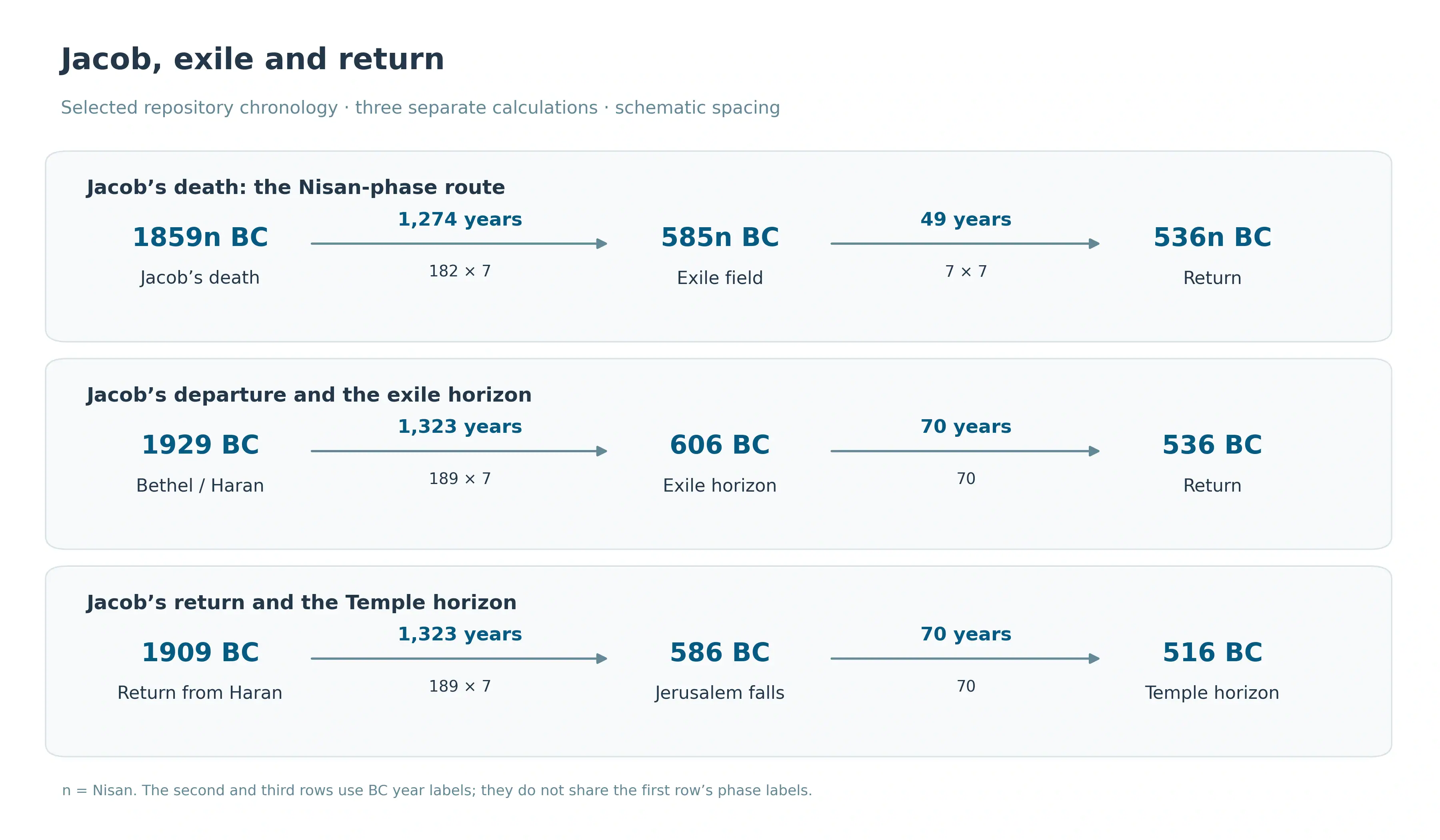
The first route divides 1,323 into 1,274 + 49, matching 182 × 7 and 7 × 7. The other two routes place a 1,323-year span before a separate 70-year span. These are chronological comparisons within the selected repository framework.
Jacob’s death: the Nisan-phase route: 1859n BC to 585n BC is 1,274 years; 585n BC to 536n BC is 49 years. Total: 1,323 years.
Jacob’s departure and the exile horizon: 1929 BC to 606 BC is 1,323 years; 606 BC to 536 BC is 70 years. Total: 1,393 years.
Jacob’s return and the Temple horizon: 1909 BC to 586 BC is 1,323 years; 586 BC to 516 BC is 70 years. Total: 1,393 years.
All node spacing is schematic. The first route is explicitly Nisan; its phase is not imported into the other routes.
The pattern’s force lies in the shared structure. The feast separates 182 and 7; the seven-year scale separates 1,274 and 49; the Jacob-to-return comparison has the same division. The other two Jacob anchors place the whole 1,323 before a further seventy-year period.
An Exodus connection within the daily sequence
The first two festival days contain thirty and twenty-nine animals. At the seven-year scale, their combined count is:
(30 + 29) × 7 = 413.
Counting 413 years forward from Jacob’s death in 1859 BC reaches 1446 BC, the Exodus. Continuing through all seven days reaches 536 BC. The eighth-day offerings add another 70 at this scale.
A second calculation reads the festival blocks in reverse order, beginning with the eighth day. Its first three blocks are ten, twenty-four, and twenty-five animals. They also total fifty-nine, producing the same 413-year Exodus span.
This is a declared reversal of the local festival list. It is different from the website’s BC–AD Mirror operation. Both sequences and their intermediate coordinates are immediately available in the forward and reverse tables.
Why the complete count is 280
The seven feast days form the largest block, but Numbers 28–29 includes other offerings within the first twenty-two days of the seventh month. The regular daily offerings continue throughout. New Moon, Trumpets, Atonement, the Sabbaths, and the eighth-day assembly add their own animals.
In the declared fixed-week calendar, the Sabbaths fall on the fourth, eleventh, and eighteenth days. Each adds two lambs. The complete Numbers-only ledger is therefore:
| Offering block | Bulls | Rams | Lambs | Goats | Total |
|---|---|---|---|---|---|
| Daily, 22 days | 0 | 0 | 44 | 0 | 44 |
| Three Sabbaths | 0 | 0 | 6 | 0 | 6 |
| New Moon | 2 | 1 | 7 | 1 | 11 |
| Trumpets | 1 | 1 | 7 | 1 | 10 |
| Atonement | 1 | 1 | 7 | 1 | 10 |
| Tabernacles, seven days | 70 | 14 | 98 | 7 | 189 |
| Eighth-day assembly | 1 | 1 | 7 | 1 | 10 |
| Total | 75 | 18 | 176 | 11 | 280 |
These additional offerings do not replace the daily offerings. On the first day, for example, both the New Moon and Trumpets offerings are included alongside the daily lambs. The separate rites in Leviticus 16 are not included in this primary total.
Two further correspondences follow. New Moon and Trumpets together give 21 × 7 = 147, matching Jacob’s lifespan. The whole count gives:
280 × 7 = 1,960 = 40 × 49.
Forty jubilee units thus form the larger framework around the festival’s 1,323-year span. The calendar comparison table shows how a fourth Sabbath or the separate Leviticus 16 rites changes the total.
Jacob’s gift and household: other bounded lists
There is a biblical precedent for animal counts representing years. Joseph tells Pharaoh:
The seven good cows are seven years, and the seven ripe heads of grain are seven years.
That interpretation is explicit in Joseph’s dream. Its use with other lists remains a further reading, but it gives a clear reason to examine the numbered animals associated with Jacob’s family.
The explicitly numbered animals in Jacob’s gift to Esau (Genesis 32:14–15) total 550. This is not a claim that exactly 550 living animals arrived: the thirty milking camels have young whose number is not stated.
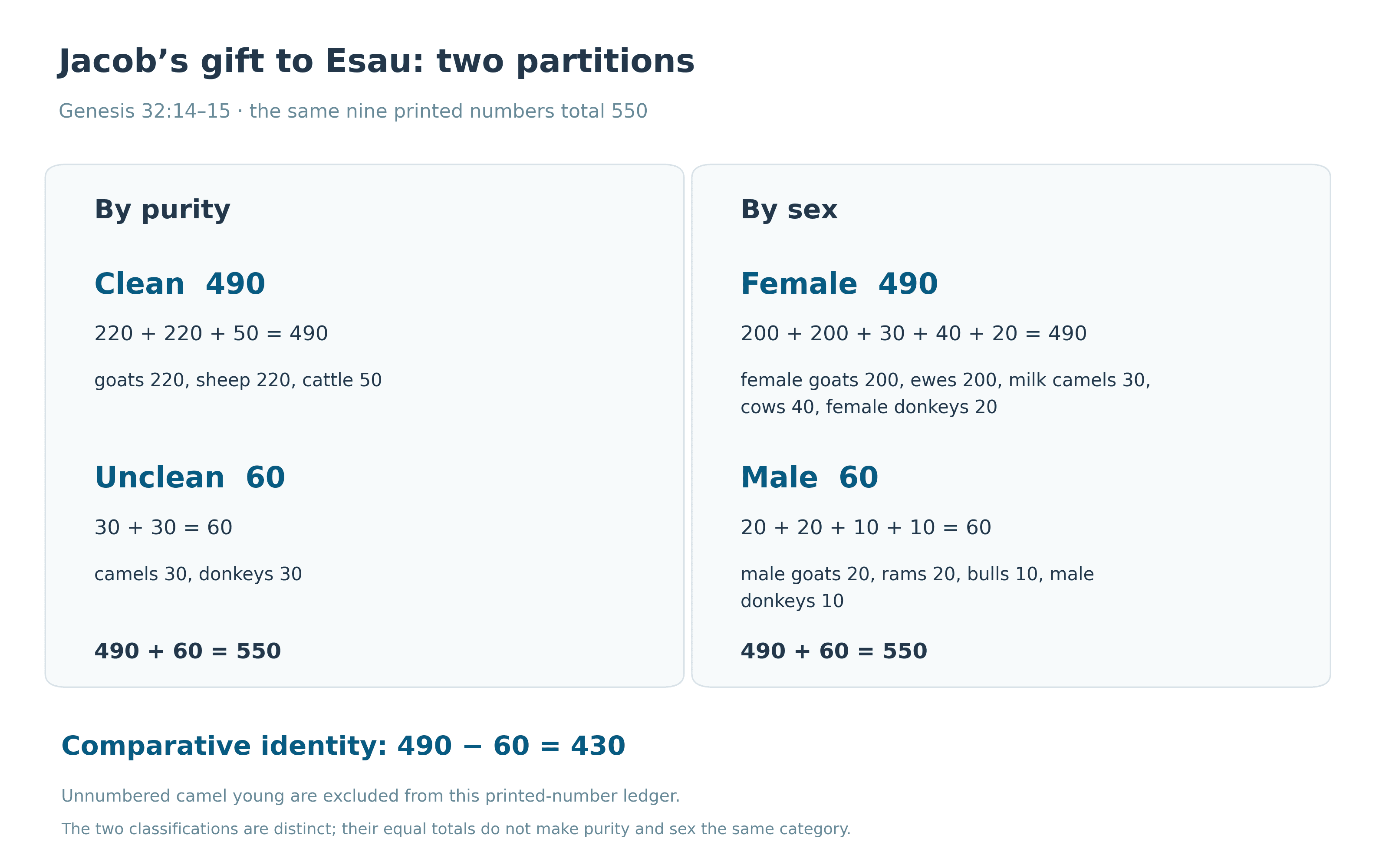
Two different classifications divide those printed numerals in the same way. Goats, sheep, and cattle—the species classed as clean under the Torah—total 490; camels and donkeys total 60. Counting the printed numbers by sex also gives 490 female and 60 male, using the male-donkey reading in the cited BSB edition.
Jacob’s gift to Esau: two partitions
Genesis 32:14–15 · the same nine printed numbers total 550
By purity
Clean: 490
Goats 220, Sheep 220, Cattle 50.
220 + 220 + 50 = 490.
Unclean: 60
Camels 30, Donkeys 30.
30 + 30 = 60.
490 + 60 = 550.
By sex
Female: 490
Female goats 200, Ewes 200, Milk camels 30, Cows 40, Female donkeys 20.
200 + 200 + 30 + 40 + 20 = 490.
Male: 60
Male goats 20, Rams 20, Bulls 10, Male donkeys 10.
20 + 20 + 10 + 10 = 60.
490 + 60 = 550.
Comparative identity: 490 − 60 = 430.
Unnumbered camel young are excluded from this printed-number ledger.
Download full-size PNG · Download WebP
Full text of this diagram
By purity, clean: Goats 220, Sheep 220, Cattle 50. Total 490.
By purity, unclean: Camels 30, Donkeys 30. Total 60.
By sex, female: Female goats 200, Ewes 200, Milk camels 30, Cows 40, Female donkeys 20. Total 490.
By sex, male: Male goats 20, Rams 20, Bulls 10, Male donkeys 10. Total 60.
The two partitions classify the same nine printed numerals independently. Unnumbered camel young are excluded; no number is guessed. The comparison 490 minus 60 equals 430 is not a separate headcount.
Image version: Jacob’s gift to Esau: two partitions
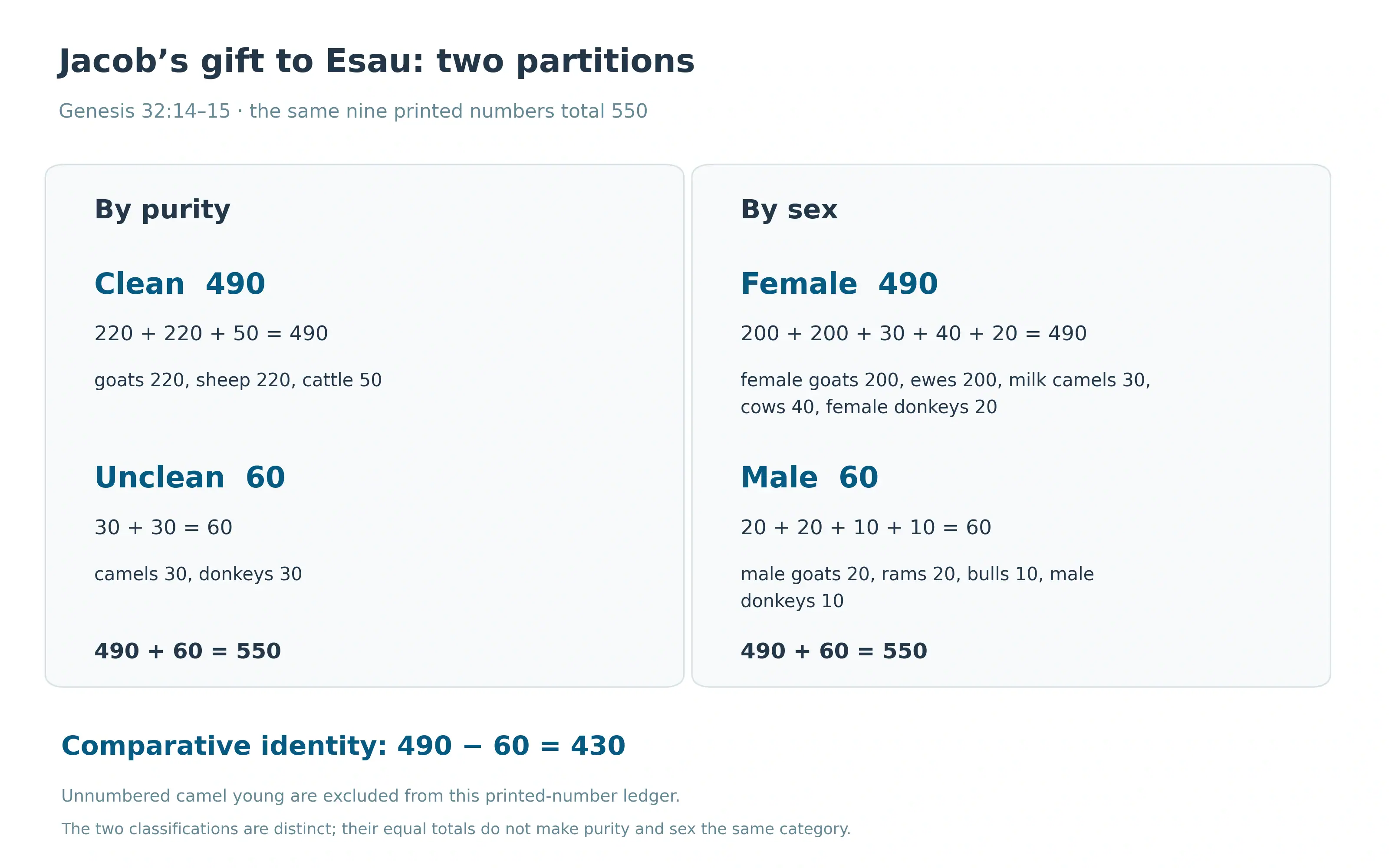
Purity and sex are separate classifications of the same printed numbers. Both produce 490 and 60. The difference 430 is a numerical comparison, not a claim that a separate group of 430 animals was sent.
By purity, clean: Goats 220, Sheep 220, Cattle 50. Total 490.
By purity, unclean: Camels 30, Donkeys 30. Total 60.
By sex, female: Female goats 200, Ewes 200, Milk camels 30, Cows 40, Female donkeys 20. Total 490.
By sex, male: Male goats 20, Rams 20, Bulls 10, Male donkeys 10. Total 60.
The two partitions classify the same nine printed numerals independently. Unnumbered camel young are excluded; no number is guessed. The comparison 490 minus 60 equals 430 is not a separate headcount.
The classifications are different, but their totals agree. Their difference, 490 − 60 = 430, corresponds to the normal MT sojourn length. The gift table accounts for every printed numeral. These are two readings of one list, rather than statistically independent witnesses.
Jacob’s household offers another compact comparison, set within the family’s move to Egypt during Joseph’s famine. Genesis 46 prints four maternal subtotals: 33, 16, 14, and 7. Pairing Leah with Zilpah and Rachel with Bilhah gives 49 + 21 = 70. Pairing the outer and inner blocks gives 40 + 30 = 70. File 58 develops these as related list structures. Their supporting table keeps the stated household total separate from the sixty-six who traveled with Jacob.
Jubilees: the same total in different units
The ancient Book of Jubilees provides a useful literary comparison. It is a non-canonical retelling of Genesis, with its own calendrical framework; it is not another manuscript reading of Numbers.
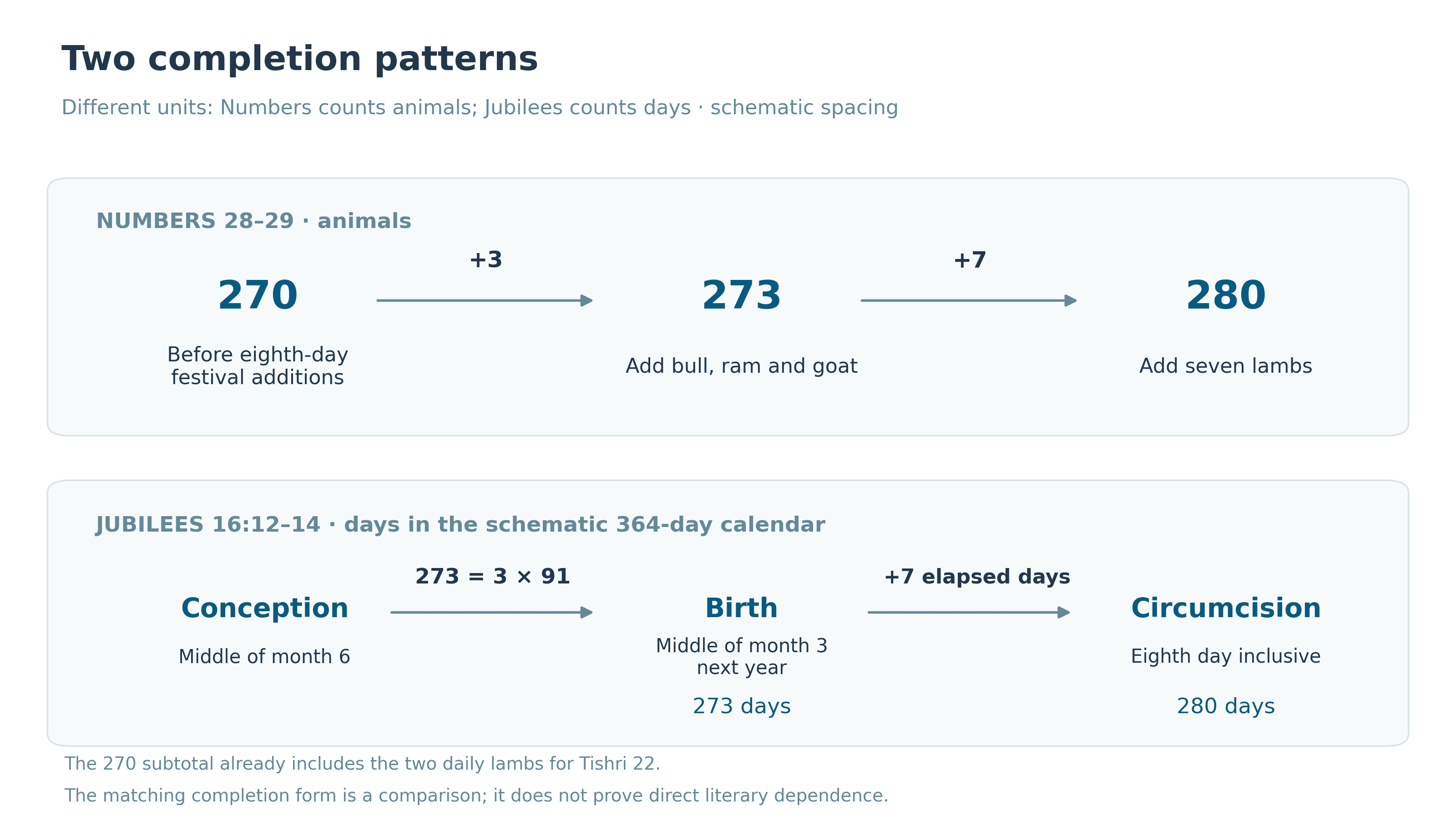
Jubilees 16:12–14 places Isaac’s conception in the middle of the sixth month and his birth in the middle of the third month of the following year. In its 364-day framework, that interval is 273 days, or three quarters of ninety-one days. Circumcision on the eighth day, counted inclusively from birth, adds seven elapsed days, giving 280.
The chapter’s Tabernacles offerings also reach 280. Its burnt and thank offerings total 39 each day; over seven days they give 273. The seven daily sin-offering goats complete the 280. Thus one chapter supplies the same 273 + 7 structure in days and in animal counts.
Numbers reaches that structure by a different grouping. Removing the eighth-day festival additions from its 280 leaves 270. Adding that day’s bull, ram, and goat gives 273; adding its seven lambs completes 280. This is a category grouping, not the order of carrying out the rite. The 270 still includes the regular daily lambs for all twenty-two days.
Two completion patterns
Different units: Numbers counts animals; Jubilees counts days. Spacing is schematic.
Numbers 28–29: animals
The 270 subtotal already includes the two daily lambs for Tishri 22; the ten eighth-day festival animals are added separately.
Jubilees 16:12–14: days
Jubilees’ date sequence is read in its schematic 364-day calendar; no AM timestamp is needed for this comparison.
Download full-size PNG · Download WebP
Full text of this diagram
The Numbers-only ledger in the declared Enochian fixed-week calendar has 270 animals before the ten eighth-day festival animals are added. This is a ledger subtotal that already includes the regular daily offerings across the full Tishri 1–22 window, including the two daily lambs for Tishri 22; it is not a strict through-Tishri-21 subtotal. Adding the eighth-day bull, ram and goat makes 273. Adding the 7 lambs completes the ledger at 280 animals. In Jubilees 16:12–14, conception is in the middle of month 6 and birth is in the middle of month 3 the next year. The schematic 364-day calendar gives 273 days, 3 times 91. Seven elapsed days to circumcision on the eighth day inclusive give 280 days from conception. The units remain distinct: animals and days. The matching completion form does not prove direct dependence between the texts.
Image version: Two completion patterns
Numbers’ animal ledger and Jubilees’ schematic day count share a 273 + 7 = 280 completion form. The correspondence supports comparison; it does not establish direct literary dependence.
The Numbers-only ledger in the declared Enochian fixed-week calendar has 270 animals before the ten eighth-day festival animals are added. This is a ledger subtotal that already includes the regular daily offerings across the full Tishri 1–22 window, including the two daily lambs for Tishri 22; it is not a strict through-Tishri-21 subtotal. Adding the eighth-day bull, ram and goat makes 273. Adding the 7 lambs completes the ledger at 280 animals. In Jubilees 16:12–14, conception is in the middle of month 6 and birth is in the middle of month 3 the next year. The schematic 364-day calendar gives 273 days, 3 times 91. Seven elapsed days to circumcision on the eighth day inclusive give 280 days from conception. The units remain distinct: animals and days. The matching completion form does not prove direct dependence between the texts.
Jubilees 7:2–3 also describes Noah offering one ox, one ram, seven sheep, and one goat—a ten-animal form like Numbers’ eighth-day festival set. Noah’s offering is on the first-month New Moon, so the matching form should not be confused with a shared festival date.
Together, these comparisons show how sacrificial counts and calendar units can be arranged around related totals. They do not by themselves prove direct literary dependence or establish the whole Jacob-to-exile chronology. The Jubilees table gives each component and its source.
What changes in other chronological settings?
The MT remains the main framework. Two alternatives are worth retaining because their differences connect directly with the feast’s central subtotal.
The localized LXX −33 interpretation assigns thirty-three of the 430 sojourn years to Canaan and 397 to Egypt. It shifts the Jacob dates displayed here thirty-three years later; it is not a conversion of the entire Septuagint chronology. The SP/215 alternative places 215 years in Egypt and shifts these Jacob dates 215 years later than the normal MT.
The difference between those two alternative settings is 215 − 33 = 182—the feast’s goat-excluded total. In the localized LXX setting, Jacob’s departure, return, and death also open three 1,290-year spans: 1896 → 606, 1876 → 586, and 1826 → 536 BC.
These comparisons broaden the pattern while preserving each chronology’s stated assumptions. The exact dates are in the MT/LXX-local/SP table. The Sojourn introduction explains the underlying textual issue.
The larger forty-jubilee span
The complete 280 count, multiplied by seven, gives 1,960 years. From Jacob’s Bethel departure in 1929 BC, that span reaches AD 32 by ordinary civil arithmetic:
1929 + 32 − 1 = 1,960.
The subtraction of one accounts for the absence of a civil year zero. The span can also be divided at the return horizon: 1929 → 536 BC = 1,393, followed by 536 BC → AD 32 = 567. Together they make 1,960.
John 7 places Jesus at Tabernacles and records His invitation to the thirsty. That gives the study a fitting theological comparison: the feast associated with Israel’s wilderness journey and restoration becomes the setting for His invitation to life. The arithmetic does not establish the historical year of John 7. File 58 preserves a more detailed Johannine proposal, with its dependencies stated; the endpoint note keeps it separate from the civil calculation.
The clearest result remains closer to the offering list itself. 182 + 7, scaled by seven, becomes 1,274 + 49. That division fits the selected Jacob-to-return chronology, while the full monthly ledger gathers the larger forty-jubilee span. The pattern brings worship, departure, exile, and restoration into one readable framework, with every retained count available for checking.
Open the supporting tables · Read the controlling canonical study · Return to the central pattern
Scripture quotations: Berean Standard Bible (BSB), public domain. Official terms.