Book 1 · Passion Week · Chapter 1
The apparent difference and the fullness of Christ’s fulfillment
John and the Synoptic Gospels place the death of Jesus within the same Passover setting, yet their descriptions appear to locate it differently in relation to the Passover meal. That apparent difference is the starting point of this book. On the familiar reading, Matthew, Mark, and Luke place Jesus’s death on Nisan 15, while John appears to place it on Nisan 14. Before deciding how to reconcile those dates, I ask what the differing presentations may communicate.
Why does the testimony take this shape? And what might John be conveying by presenting it in a way that allows for this apparent difference while still remaining truthful?
A central proposal of this book is that some calendrical and festival expectations that appear to compete with one another need not be mutually exclusive. In the events of Christ, differing perspectives may converge and be fulfilled together. What appears contradictory when the reckonings are viewed separately may prove harmonious when they are brought together in him.
I believe John’s presentation is deliberate. He bears witness to real events through a prophetic understanding of their meaning, allowing more than one calendrical perspective to disclose the fullness of Christ’s work. I also consider it likely that differing calendars contributed to the apparent difference. My premise, however, does not depend on proving that two lunar calendars were one day apart in the crucifixion year. Even if that explanation proved mistaken, the form of the Gospel testimony, with its apparent difference between John and the Synoptics, would still call for examination.
I begin with confidence in Scripture as God-breathed and useful, and in the Gospels as truthful witnesses to Jesus Christ. The synthesis I develop here is my interpretation of that testimony. I offer it with conviction and with respect for those who read the evidence differently. My aim is to make the relationships as clear as I can, so that readers may consider them one at a time.1
In this chapter
- The Gospel texts and the apparent date difference
- The premise of this inquiry
- John as an inspired prophetic witness
- Gathering the scattered in Christ
- Other readings deserve a fair hearing
- A possible historical explanation for the two dates
- Time as part of the prophetic testimony
- The first day of the week as a reference point
- The proposed convergence of day reckonings
- Firstfruits and the Two Passover Reckonings
- The Passover meal and the Passover Lamb
- Reasonable objections and limits
- Sources and notes
The Gospel texts and the apparent date difference
The Synoptic presentation is especially clear about the character of the supper. Luke records Jesus saying:
“I have eagerly desired to eat this Passover with you before My suffering.” — Luke 22:15, BSB
John, meanwhile, reports that the authorities still intend to eat the Passover when they bring Jesus before Pilate (John 18:28). Unlike the Synoptics, however, John does not identify the supper itself as the Passover meal; he presents it simply as a supper (John 13:1–2). These two descriptions create the question before us.2,3
Leviticus 23:5–6 distinguishes the Passover on the fourteenth day of the first month from the Feast of Unleavened Bread beginning on the fifteenth. In the sunset-based sequence used here, the sacrifice precedes the evening meal, and that meal falls at the beginning of Nisan 15. The following daylight hours remain within Nisan 15. This is the calendar framework behind the familiar comparison.4
Table 1 The textual basis of the apparent difference
| Passage | What the passage reports | Apparent chronological implication |
|---|---|---|
| Matthew 26:17–20 | The disciples prepare the Passover, and Jesus reclines with the Twelve that evening. | The supper is presented as the Passover meal. |
| Mark 14:12, 17 | Preparation takes place on the day associated with sacrificing the Passover lamb; Jesus comes with the Twelve in the evening. | The supper begins Nisan 15 in the sequence used here. |
| Luke 22:7–15 | The day for sacrificing the Passover lamb arrives, and Jesus expressly identifies the supper as Passover. | The crucifixion follows the meal, during the daylight of Nisan 15. |
| John 18:28 | The authorities avoid entering the Praetorium so that they remain able to eat the Passover. | Their Passover meal appears still to lie ahead. |
| John 19:14, 31, 42 | Jesus is before Pilate on the Preparation for the Passover; burial is urgent before the approaching Sabbath, described as a High Sabbath. | Read together, these notices suggest a death on Nisan 14, before the principal Passover meal. |
The numbered dates are inferred from the accounts; the cited Passion passages do not themselves identify the crucifixion as Nisan 14 or Nisan 15. Nevertheless, the apparent difference is a recognized problem in Passion chronology. Standard scholarly treatments distinguish the straightforward Synoptic reading—placing the supper and subsequent crucifixion within Nisan 15—from John’s apparent Nisan 14 chronology, while other interpretations seek to place all four accounts on Nisan 14. The range of conclusions shows why the question cannot be settled simply by treating the texts as chronologically unambiguous.5
I regard the Synoptic presentation of a Passover supper as the more explicit starting point. I also think John’s notices invite the reader to view Christ’s death in relation to the preparation and sacrifice of Passover. Friday remains the working weekday in the comparison: Mark 15:42 explicitly identifies Preparation as the day before the Sabbath. The question, therefore, is not only whether the same historical Friday could carry two calendrical dates, but also why the Gospel narratives direct attention to different aspects of the festival.2,3
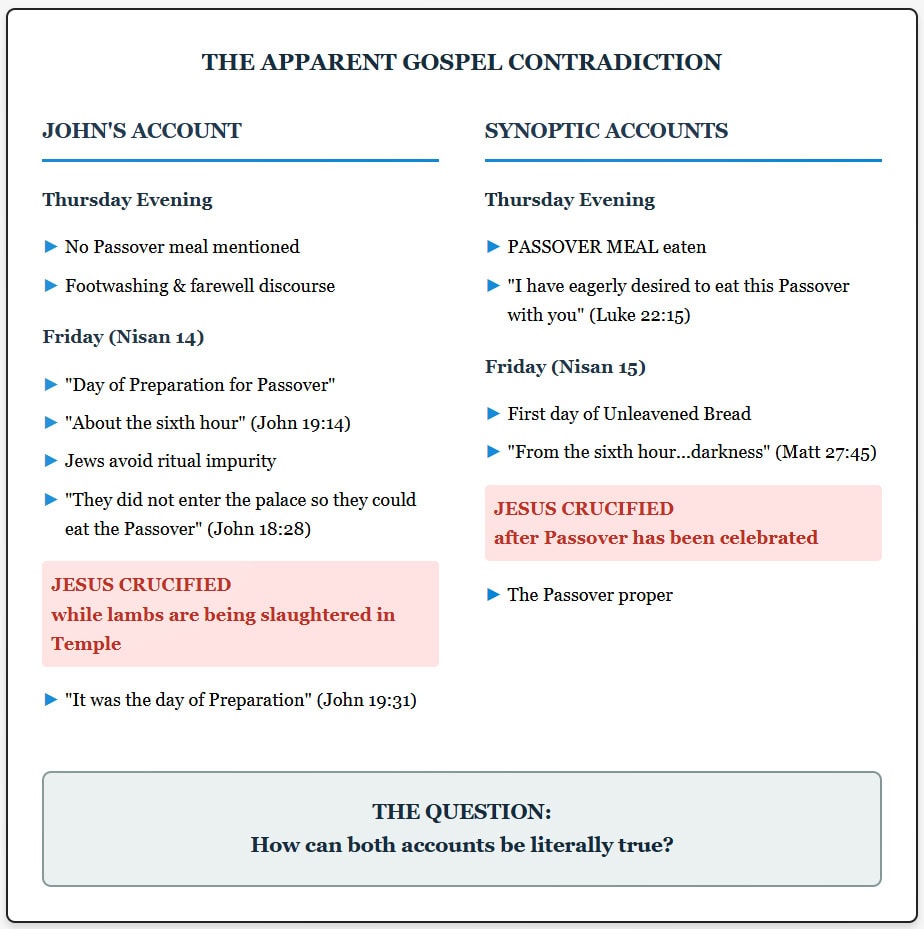
Figure 1 The apparent Gospel contradiction
The original diagram sets the two readings side by side. Its Nisan dates express the interpretation under examination. Its proposed correspondence between Jesus’ death and the slaughter of the lambs is developed below. The two sixth-hour references concern different events: John’s notice belongs to the proceedings before Pilate, whereas the Synoptic notice concerns darkness during the crucifixion. Scripture wording within the figure is retained as supplied.
The premise of this inquiry
The historical question matters: what happened, on which day, and according to whose calendar? Alongside it stands a question about the testimony itself: why does John tell the events in a way that allows this apparent difference to remain? A historical explanation and an account of the presentation’s theological meaning can illuminate one another without being identical questions.
I read John as fully aware that his presentation invites a perspective different from the one most naturally drawn from the Synoptics. I believe he works within the bounds of truth while selecting details, using expressions with more than one possible reference, and bringing the prophetic significance of events into view. An actual difference between calendars may be part of that explanation. So may conventions or circumstances that we can no longer recover with certainty.
My confidence in the significance of the comparison therefore exceeds my certainty about its precise historical mechanism. Both Nisan 14 and Nisan 15 can remain meaningful perspectives for this inquiry while the question of their historical coordination remains open. Resolving one question need not exhaust the other.
By ambiguity I mean room within a truthful presentation for more than one related understanding. The apostolic testimony supplies a firm foundation, while the relations among its details can disclose more than one layer of fulfillment. I want to examine those possibilities before requiring every apparent tension to resolve into one exclusive reconstruction.
John as an inspired prophetic witness
John begins with the Word already with God in the beginning, through whom all things came into being, and then declares that the Word became flesh. His subject is the eternal Son making the Father known within human history. The distinction between the Father and the Son remains intact, as does the confession of Christ’s divinity. The events of Jesus’ earthly life are presented from this larger perspective (John 1:1–3, 14, 18).6
I understand John as a prophet whose outlook resembles that of Daniel: events, times, numbers, and images can bear meaning together. I hold that the Gospel, the three Johannine letters, and Revelation come from the same John. On that understanding, Revelation offers a particularly important key to the Gospel’s symbolic and numerical presentation. Even if the authorship question were decided differently, the Gospel’s own signs, imagery, and elevated account of Christ would still require attention.
Revelation makes explicit a prophetic mode of expression that I also recognize in the Gospel. The Lamb, the Word of God, and the gathering of the redeemed invite comparison across the two books. Their relationship, in my reading, helps us perceive how the events of the Passion belong within a revelation whose scope reaches from creation to its fulfillment in Christ (John 1:29; Revelation 7:9–17; 19:13).6,7
John also records Jesus acknowledging his use of figurative speech and promising to speak plainly about the Father (John 16:25–29). Symbol and explanation work together. The Gospel can make its central confession clear while allowing the implications of that confession to extend beyond what any one explanation can contain. Its stated purpose is that readers believe in Jesus as the Christ, the Son of God, and receive life in his name (John 20:30–31).8
Paul expresses a complementary recognition in Romans 11:33:
“O, the depth of the riches of the wisdom and knowledge of God! How unsearchable are His judgments, and untraceable His ways!” — BSB
Paul’s careful exposition leads him to acknowledge depths beyond his explanation. I see John frequently leading the reader into those depths through signs and narrative relationships. They build upon the same Christ, with differing emphases that serve faith, hope, and love. We can know God truly while recognizing that his fullness exceeds our comprehension.9
This approach begins with divine inspiration. I understand the Gospel as God’s revelation through a human witness, and I look to Scripture’s own prophetic and symbolic practices when considering how it communicates. I also see John within an older scriptural and Jewish inheritance, whose possible roots before the Babylonian exile and connections with later communities deserve investigation. That historical inquiry can remain open while we examine the Gospel itself.
A rainbow provides an image of the approach. Its distinct colors belong to one light; their differences help disclose its fullness. In the same way, I understand the calendrical perspectives as witnesses that can direct attention to different aspects of Christ’s work. The image expresses the unity I am proposing. The particular relationships still have to be shown from the texts and the calendars.
Gathering the scattered in Christ
This proposed unity has a narrative setting in John. The Samaritan woman asks where God should be worshiped: on her ancestral mountain or in Jerusalem. Jesus affirms that salvation comes from the Jews and directs her toward worship of the Father in spirit and truth. The encounter leads Samaritans to recognize him as the Savior of the world (John 4:20–26, 39–42).10
The same gathering purpose appears in Jesus’ promise of one flock under one shepherd (John 10:16). It is then linked directly to his death. Caiaphas says it is better that one man die for the people; John explains that Jesus would die for the nation and for God’s scattered children, to bring them together into one (John 11:50–52). Revelation then depicts the redeemed from every nation before the Lamb (Revelation 7:9).7,10 The cross is thus presented as the means by which the scattered are gathered.
I read the calendrical relationships within this larger purpose. People who approach the Scriptures through different inherited reckonings may find aspects of their expectation fulfilled in the same Christ. The proposed synthesis includes Pharisaic, Sadducean, Samaritan, and Enochic or Essene perspectives, among others. I do not treat these as competing viewpoints that must cancel one another out, but as differing perspectives whose distinct expectations may converge in the same events of Christ. The historical practices of those communities require individual examination, but the theological direction of my inquiry is clear: Christ draws the witnesses toward himself and gathers his people through the work to which they bear witness.
This gives the apparent difference a constructive role. A reader may have to remain with a tension before recognizing what the perspectives disclose together. Clarity about the testimony can coexist with openness about the extent of its meaning.
Other readings deserve a fair hearing
The date question has produced several serious approaches. Some scholars read the Gospel writers’ theological emphases as involving different historical chronologies. Others seek agreement within one calendar by examining the meanings of Passover and Preparation. Some understand the Last Supper as a meal held in anticipation of the official Passover. Others investigate multiple calendars or conclude that the available evidence cannot settle the date. Each approach deserves attention to its actual argument.5
The vocabulary permits a real discussion. Luke 22:1 calls the Feast of Unleavened Bread Passover, showing that the name can encompass the wider festival. Mark 15:42 identifies Preparation with the day before the Sabbath. These usages help explain why interpreters differ over whether John refers to the principal Passover meal, another festival meal, or Friday within Passover week. They establish possibilities that must be weighed in context.2,3
I remain persuaded that the Synoptics most naturally describe the Passover meal itself, while John brings a different chronological impression to the foreground. Yet even a reading that places all four accounts on Nisan 14 would still leave John’s distinctly different presentation, in contrast to the Synoptics, to be explained. My inquiry concerns what that difference communicates as well as the calendar that may account for it.
Some scholarly treatments of John 18:28 allow for a broader festival meaning and suggest that John’s terminology may carry a deliberate ambiguity, drawing attention to Jesus as the fulfillment of the Passover sacrifice. That possibility supports considering ambiguity as a vehicle of meaning.5
A possible historical explanation for the two dates
A calendar date locates an event within a particular system of reckoning. If two communities begin a lunar month one day apart, the same historical Friday can be Nisan 14 in one reckoning and Nisan 15 in the other. Both labels can then describe one event accurately. I regard such a difference as a likely explanation of the Gospel presentation, while keeping the broader premise independent of this particular explanation.
Table 2 illustrates that relationship using two sunset-based reckonings. The reckoning associated with the supper is one day ahead of the reckoning associated with the authorities in John. These names identify their roles in the model; identifying the communities and their actual practices is a further historical question.
Table 2 A one-day offset as a working model
| Same historical interval | Reckoning associated with the supper | Reckoning associated with the authorities in John |
|---|---|---|
| Thursday after sunset | Nisan 15 begins; the supper is observed as Passover. | Nisan 14 begins; the principal Passover meal is still ahead. |
| Friday daylight | Nisan 15 continues; Jesus is crucified after the supper. | Nisan 14 continues; Jesus is crucified before the principal Passover meal. |
| Friday after sunset | Nisan 16 begins. | Nisan 15 begins; the principal Passover meal is observed. |
| Saturday daylight | Nisan 16. | Nisan 15. |
| Sunday daylight | Nisan 17. | Nisan 16. |
Several possible mechanisms need to be distinguished. Different standards for accepting testimony about the first lunar crescent could lead to different beginnings of a month. Observing conditions might also differ between locations. For such differences to produce different public dates, however, the communities would need to follow different calendrical decisions. Clear skies in one region and cloud in another would matter within that administrative setting.
Other differences concern the structure of the calendar. A solar calendar and a lunar calendar can assign festivals differently. Intercalation, the addition of a month to keep a lunar year aligned with the seasons, raises another issue. A disagreement over that added month primarily concerns which month is selected for the festival; an isolated one-day difference requires its own explanation. The mechanisms should be examined according to the kind of difference each can produce.
The inquiry therefore includes Pharisees, Sadducees, Essenes, Samaritans, regional traditions such as those associated with Galilee, and Roman civil reckoning. Each comparison requires the relevant practice to be identified. In the next chapter I begin distinguishing these systems, including the solar and lunar reckonings associated in this study with Enochic and Essene material.
Mishnah Rosh Hashanah 2:8–9 illustrates the relationship between lunar testimony and calendrical authority. The disagreement there results in different reckonings of the Day of Atonement. It shows how accepting testimony and recognizing an authority could affect a sacred date. Its setting is a later dispute, so its relevance here is comparative rather than a direct record of the Passion calendar.11
Political factors could also have affected which calendrical decision was adopted. In John 11:48 the leaders fear Roman intervention and the loss of their place and nation, a concern that forms part of the festival setting. If the lunar evidence allowed a one-day margin, local authorities may conceivably have preferred one permissible date over another for political or administrative reasons. I note this as a possibility only; the verse records their fear, not an actual calendar change.12
The proposed lunar visibility conditions in AD 33, together with alternative possibilities in AD 30, will be assessed in relation to the observing location, visibility criteria, calendar procedure, and chosen day boundaries. Within this study, a Friday crucifixion remains the principal working reconstruction. Mark’s identification of Preparation as the day before the Sabbath gives that reconstruction a strong textual basis. I also consider alternative readings, including Thursday proposals associated with “three days and three nights,” while recognizing that they must account for Mark’s wording and the surrounding Sabbath sequence.3
AD 30 and AD 33 are the principal candidate years considered here. In the lunar reconstruction cited in note 5, their Friday candidates fall on Nisan 14; assigning the same Friday to Nisan 15 requires the additional calendar offset proposed above or another explicitly defined reconstruction. The detailed assessment of the candidate years and the significance of these differing presentations will be taken up later.5
Time as part of the prophetic testimony
John repeatedly makes time serve the narrative. Jesus arrives at Bethany six days before Passover (John 12:1). At the trial John records an approximate hour (John 19:14). Jesus also announces that his hour of glorification has come (John 12:23). Such notices invite us to consider how the timing of events participates in their meaning.2,12
The days of the Passion provide the first example. On the reading proposed here, the Synoptic chronology is represented by Nisan 15–17, while John’s presentation is represented by Nisan 14–16; each sequence comprises three dates counted inclusively. When these overlapping reckonings are viewed together, their one-day displacement spans the four successive calendar dates Nisan 14–17. This combines the labels supplied by the two reckonings; both still describe the same historical events. I suggest that this composite representation may contribute to the prophetic force of Christ’s “three days and three nights” in Matthew 12:40, without implying four elapsed days or displacing the ordinary inclusive reckoning. The relation between this composite representation and elapsed time will be examined later.13
The hours surrounding the cross raise a related question. Mark presents a six-hour framework: Jesus is crucified at the third hour, followed by darkness from the sixth to the ninth hour, thus placing the cross within two successive three-hour periods. John does not reproduce that sequence. Instead, he gives an approximate sixth-hour notice during the proceedings before Pilate (John 19:14), bringing the reader’s attention to about noon. On the usual daylight-hour reading, these notices create an apparent chronological tension whose historical explanation requires separate consideration. John expressly gives an approximate hour; Mark states the third hour without that qualification. I propose, however, that John’s choice to foreground the sixth hour may also have theological significance. By directing attention to the midpoint of the Synoptic six-hour framework, his presentation brings the two three-hour periods into sharper view. The historical events and the distinct occasions attached to each time notice must remain clear, while allowing for the possibility that John’s less explicit chronology also serves a prophetic or theological purpose.13
The length of Jesus’ ministry provides another example. John explicitly names Passovers in 2:13, 6:4, and 11:55, but leaves the feast of 5:1 unidentified. That omission materially affects the chronology. If the unnamed feast was another Passover, John’s sequence permits a ministry extending through roughly three Passover-to-Passover years, or about three and a half years if roughly half a year before the first named Passover is also assumed. If it was another festival, a shorter ministry of roughly two to two and a half years remains possible. I propose that this chronological openness may itself serve John’s theological purpose. The three-and-a-half-year representation also invites comparison with the drought associated with Elijah (Luke 4:25; James 5:17) and the 1,260 days of prophetic witness in Revelation 11:3–6. John therefore need not deny a shorter historical chronology in order to allow the ministry of Christ to be perceived within the fuller prophetic pattern. As with the “three days and three nights,” the theological representation can employ a fuller temporal form without requiring every part of that form to correspond to the same measure of elapsed historical time.13
My argument is that the chronological openness in these presentations may itself be intentional. In the days of the Passion, the hours surrounding the cross, and the possible length of Jesus’ ministry, John leaves room for more than one temporal perspective without requiring the underlying historical events to be multiplied or contradicted. I shall examine these days, hours, and years individually, then ask whether their relationships form a coherent prophetic pattern. On this reading, John’s apparent ambiguity becomes part of his theological method: it allows several dimensions of prophetic fulfillment to converge in Christ while preserving the historical testimony on which they rest.
The first day of the week as a reference point
The discovery of the empty tomb gives the comparison a common narrative reference. All four Gospels place the visit they describe on the first day of the week. Their different descriptions of the morning also deserve to remain visible.14
Table 3 The four descriptions of the morning
| Passage | Time wording in the Berean Standard Bible |
|---|---|
| Matthew 28:1 | “at dawn on the first day of the week” |
| Mark 16:2 | “Very early on the first day of the week, just after sunrise” |
| Luke 24:1 | “On the first day of the week, very early in the morning” |
| John 20:1 | “Early on the first day of the week, while it was still dark” |
John draws our attention to the darkness before dawn: Mary goes to the tomb “while it was still dark” (John 20:1), whereas Mark describes the women arriving “just after sunrise” (Mark 16:2). Their shared reference is the first day of the week; any more exact harmonization must account for the particular wording of each.14
Mary finds the stone already removed. John leaves the precise moment of the resurrection unspoken, yet I read his presentation as pointing toward Christ already risen before daylight. That emphasis has theological significance in this study. It invites comparison with Christ’s identification as “the bright Morning Star” in Revelation 22:16—the announcement of the coming day while darkness remains. This reading distinguishes the discovery of the empty tomb from the resurrection itself, while recognizing the meaning that John’s emphasis on darkness may convey.14
Beginning from this shared first-day testimony, I work backward through the burial, crucifixion, arrest, and supper. This gives the study a common sequence from which to compare calendar dates. The opening of Nisan and the practices of particular communities remain further parts of the reconstruction.
The proposed convergence of day reckonings
The following original diagram brings together four proposed reckonings: a solar day beginning in the morning, a solar day beginning in the evening, a lunar day beginning in the evening, and a civil day beginning at midnight. It illustrates the convergence I seek to explore around the discovery of the empty tomb.

Figure 2 The proposed convergence point
The diagram’s circa 5–6 AM label is schematic, rather than a Gospel timestamp. A 364-day year does not by itself determine whether each day begins in the morning or the evening. The relevant day boundaries, weekday conventions, and historical associations will be examined in the chapters that follow.
Within this setting, the diagram introduces my proposal that the calendars considered here converge around the resurrection. Their differing ways of reckoning time contribute to a united witness to Christ. Later chapters examine the calendar conventions and develop the connection between the resurrection, the darkness before dawn, and the Morning Star.
Firstfruits and the Two Passover Reckonings
The significance of retaining both date perspectives can be illustrated by Firstfruits. On the Friday-to-Sunday sequence used here, a death on Nisan 14 leads to resurrection Sunday on Nisan 16; a death on Nisan 15 leads to Sunday on Nisan 17. Both reckonings can therefore be examined in relation to the same first-day testimony.
Table 4 The proposed relationships of the two date sequences
| Date perspective | Sunday date in that reckoning | Relationship examined in this book |
|---|---|---|
| Nisan 14 to Nisan 16 | Nisan 16 | Firstfruits on the fixed sixteenth coincides with Firstfruits on the day after the weekly Sabbath. |
| Nisan 15 to Nisan 17 | Nisan 17 | Firstfruits still falls on the day after the weekly Sabbath; the seventeenth also invites comparison with the resting of Noah’s ark. |
The fixed Nisan 16 observance is commonly associated with the Pharisaic tradition, while the weekly-Sabbath reading is associated with the Sadducean or Boethusian tradition. Josephus describes the barley firstfruits on the sixteenth, and Mishnah Menachot 10:3 records the dispute involving the Boethusians. These sources establish the calendrical comparison; the proposed convergence in the Passion is the interpretation I draw from it.15
The ark comparison also needs its calendar premise stated. Genesis 8:4 dates the ark’s resting to the seventeenth day of the seventh month. Identifying that date with Nisan 17 requires an autumn beginning of the year, with Tishri counted as the first month. Under that reckoning, I see a further correspondence between the ark’s rest and Christ’s resurrection.16
John’s account continues to the appearance with Thomas, described in John 20:26 as occurring eight days later. In the inclusive reckoning examined here, this brings us to the following Sunday. I also examine a 364-day calendar reconstruction in which Firstfruits falls on the first Sunday after the full seven-day festival of Unleavened Bread. My proposal is that the Thomas appearance extends the witness to this third calendrical perspective. This proposed correspondence depends on correlating the lunar and solar calendars; the lunar date numbers are not carried unchanged into the solar reckoning. Its association with Enochic and related solar traditions belongs to the detailed calendar argument.8
These examples show the purpose of the comparison. Nisan 14–16 and Nisan 15–17 can disclose different relationships, and the appearance with Thomas may add another. I read their convergence as reconciliatory: the same risen Christ answers expectations recognized through different reckonings.
The Passover meal and the Passover Lamb
The complementary witness begins with the Passion itself. In the Synoptics, Jesus presides at the Passover supper and gives the bread and cup their covenantal meaning. In the reading of John pursued here, his death is presented against the preparation of the Passover sacrifice. The same Christ gives the covenant meal and fulfills its sacrificial meaning. John’s attention to the unbroken bones of Jesus also invites comparison with the Passover instructions (John 19:36; Exodus 12:46).2,3,17
The proposed temporal correspondence with the slaughter of the lambs requires a distinction between a sacrificial period and an exact instant. Josephus describes sacrifices from the ninth to the eleventh hour in a Passover census associated with Cestius. This supplies evidence for an afternoon sacrificial practice in that setting. It does not directly give the Temple schedule in AD 30 or AD 33. John’s sixth-hour notice is before Pilate, while the Synoptic accounts place Jesus’ death after the ninth-hour cry. Their relationship to the sacrificial period is part of the comparison to be developed.13,18
I understand the Synoptic emphasis on the Passover supper and John’s emphasis on the Passover sacrifice as complementary witnesses to the fullness of Christ’s work. In the Synoptics, Jesus gives the covenant meal its meaning. In John, his death is presented in relation to the sacrifice of the Passover lamb. A historical difference in calendar reckoning may help explain how the apparent dates can coexist. The theological question is why the Gospel testimony places both aspects before the reader. Christ is presented both as the one who gives the Passover meal its covenantal meaning and as the sacrifice in whom that meaning is fulfilled.
The purpose of the comparison, as I understand it, comes back into view here: I take the Gospel presentations as converging testimonies to the same work. The next chapter turns to the calendars and their conventions, asking how these differing expectations may converge in Christ.
Reasonable objections and limits
The following questions deserve consideration as the argument develops:
The wording may permit a single-calendar reading. A broader meaning of Passover or Preparation, or an anticipatory supper, could explain the chronology differently. The apparent contrast between John and the Synoptics would still require explanation.
The proposed double date remains a reconstruction. A one-day offset is possible, but identifying the relevant communities, authorities, sacrificial practices, and circumstances of AD 30 or AD 33 requires further evidence.
The resurrection-morning accounts require careful comparison. The shared first-day testimony does not by itself establish a single arrival time, a single visit, or the precise time of the resurrection.
The convergence diagram depends on defined conventions. Its day boundaries, weekday labels, range of calendars, and proposed interval of agreement must be stated carefully. Symbolic calendrical relationships should also be distinguished from elapsed historical time.
Symbolic richness does not prove every proposed intention. Readers may recognize John’s prophetic outlook while questioning particular numerical, literary, calendrical, or authorship conclusions.
A meaningful correspondence may have more than one explanation. A pattern may arise from shared scriptural traditions, narrative choice, historical circumstance, coincidence, or deliberate theological design. Its existence and its proposed significance are therefore separate questions.
These qualifications do not remove the argument; they define its limits. Readers may find some proposed relationships persuasive while remaining unconvinced by others. The interpretation should be judged by its handling of the biblical texts, the historical evidence, and the coherence of the relationships it proposes.
Sources and notes
[1] Inspiration and usefulness. 2 Timothy 3:16–17 expresses the conviction about Scripture with which this inquiry begins. 2 Timothy 3
[2] John’s supper and Passion notices. John 13:1–2; 18:28; 19:14, 31, 36, 42. John describes the supper without explicitly identifying it as the Passover meal. The numbered Nisan date is inferred from the festival language. The sixth-hour notice belongs to the proceedings before Pilate. John 13 · John 18 · John 19
[3] The Synoptic supper and Preparation. Matthew 26:17–20; Mark 14:12–17, 22–24; Luke 22:1, 7–20; Mark 15:42. Luke 22:1 uses Passover for the wider feast, while Mark 15:42 identifies Preparation as the day before the Sabbath. Matthew 26 · Mark 14 · Luke 22 · Mark 15
[4] Festival sequence. Leviticus 23:5–6 distinguishes Passover on the fourteenth from Unleavened Bread beginning on the fifteenth. The sunset-based application to the Passion narratives is stated in the chapter. Leviticus 23
[5] Scholarship on the apparent difference. Representative discussions include Joel Marcus, “Passover and Last Supper Revisited,” New Testament Studies 59.3 (2013), 303–324, especially the introduction; Colin J. Humphreys and W. Graeme Waddington, “The Jewish Calendar, A Lunar Eclipse and the Date of Christ’s Crucifixion,” Tyndale Bulletin 43.2 (1992), 331–351, especially 332–334 and the calendar tables on 335–337; and Robin Routledge, “Passover and Last Supper,” Tyndale Bulletin 53.2 (2002), 203–221, especially 205–206 and note 14. These sources provide representative discussions of wider scholarly positions on the apparent chronology. Routledge’s note 14 discusses deliberate ambiguity in relation to the Passover sacrifice. The wider synthesis proposed here remains the argument of this book. Marcus · Humphreys and Waddington · Routledge
[6] The Word and the Lamb. John 1:1–3, 14, 18, 29. John 1
[7] Revelation as an interpretive key. Revelation 7:9–17 and 19:13 provide the explicit motifs compared here. The chapter states my understanding of common authorship and its relevance to numerical interpretation. Revelation 7 · Revelation 19
[8] Figurative speech and belief. John 16:25–29 and 20:24–31. John 20:26 supplies the eight-day expression used in the proposed following-Sunday comparison; it does not itself name a Firstfruits observance. John 16 · John 20
[9] Knowledge and its limits. Romans 11:33–36 and 1 Corinthians 3:10–11. The comparison between Paul and John concerns complementary emphases; it does not require literary dependence by John on Paul. Romans 11 · 1 Corinthians 3
[10] Gathering in Christ. John 4:20–26, 39–42; 10:16; 11:50–52. These passages ground the gathering theme. I extend this gathering theme to the proposed calendrical relationships. John 4 · John 10 · John 11
[11] Lunar testimony and authority. Mishnah Rosh Hashanah 2:8–9 records a dispute culminating in different reckonings of the Day of Atonement. Its later setting makes it comparative evidence for the role of authority, rather than direct evidence for the Passion calendar. Rosh Hashanah 2:9
[12] Political concern and the significance of time. John 11:48 records fear of Roman intervention. John 12:1 gives the six-day notice before Passover, and 12:23 announces the hour of glorification. John 11 · John 12
[13] Days, hours, and ministry length. Matthew 12:40; Mark 15:25, 33–37; John 19:14; John 2:13, 5:1, 6:4, 11:55; Luke 4:25; James 5:17; Revelation 11:3–6. Three named Passovers provide a minimum of about 2 years between the first and last. An additional intervening Passover, consecutive annual placement, and roughly half a year before the first named Passover are assumptions of the longer reconstruction. Luke and James describe the duration of Elijah’s drought. The comparison of Revelation’s 1,260 days with 3.5 years uses a schematic 360-day year, distinct from the 364-day calendar discussed elsewhere in this book. The proposed symbolic relationships do not establish additional elapsed historical time. Matthew 12 · Mark 15 · John 2 · John 5 · John 6 · John 11 · Luke 4 · James 5 · Revelation 11
[14] The first-day visits and the Morning Star. Matthew 28:1; Mark 16:2; Luke 24:1; John 20:1; Revelation 22:16. Table 3 retains the BSB time phrases. John’s emphasis on darkness supplies the setting for the proposed comparison with Christ as the bright Morning Star; the theological connection is the interpretation developed in this book. Matthew 28 · Mark 16 · Luke 24 · John 20 · Revelation 22
[15] Firstfruits reckonings. Josephus, Antiquities 3.250 describes the barley firstfruits on the sixteenth. Mishnah Menachot 10:3 records opposition associated with the Boethusians to harvesting after the first festival day unless it coincides with the conclusion of the weekly Sabbath. The party labels identify the traditions under comparison; their detailed historical application will be examined with the calendars. Antiquities 3.250 · Menachot 10:3
[16] The ark’s resting date. Genesis 8:4 gives the seventeenth day of the seventh month. Its proposed identification as Nisan 17 assumes a year beginning in Tishri. Genesis 8
[17] Unbroken bones and Passover. Compare John 19:36 with Exodus 12:46 and Numbers 9:12; Psalm 34:20 also belongs to the scriptural comparison. John 19 · Exodus 12 · Numbers 9 · Psalm 34
[18] The Passover sacrificial period. Josephus, Jewish War 6.422–423, translated by William Whiston. The ninth-to-eleventh-hour period belongs to the census setting described there. Jewish War 6.422–423
Scripture quotations in the chapter text are from the Berean Standard Bible (BSB), public domain. Scripture wording embedded in the two original diagrams is reproduced as supplied and is not designated as BSB.