A companion study connecting Books 1 and 2
Day–Year Studies • The 360 calendar and the Key of 23
“For Christ also suffered for sins once for all, the righteous for the unrighteous, to bring you to God.”
1 Peter 3:18, BSB
Book 1 follows the different calendar witnesses toward the Cross. Book 2 turns back toward Christ’s birth and then follows the heavenly testimony across the larger history of Israel and the nations. Between those inquiries lies a numerical witness that needs room of its own. The days surrounding Christ’s birth and Passion can be read as symbolic years and compared with the chronology of Creation, the Flood, the Exodus, and the Conquest. The same calendar framework that gathers the Gospel dates also supplies the measures for these longer comparisons.
I find a consistent direction in them. At the birth, the comparison gathers the positions associated with Noah’s three sons. At the Passion, a span expressed as 666 multiples of 23 expands into a doubled 7770. Its increase of 222 units leads, when read back as days, to the reconstructed lunar Day of Atonement in AD 33. Further operations carry the Creation comparison backward to 7006 BC, exactly 7000 years before the 6 BC Christ datum. The calculations give definite forms to the possibility considered in Book 1: the Cross may be the center from which the renewal of time proceeds.
I retain AD 30 beside AD 33 throughout this inquiry. Both belong to the Friday Passion possibilities considered in Book 1, and AD 30 also marks the spring beginning of the final three years leading to AD 33. The day–year comparisons give that pairing a further expression: the two years receive related spans, expansions, and Creation patterns. The two ministry beginnings also frame a three–four–three arrangement whose repeated autumn date returns us to Noah’s departure from the ark. The literal dates that generate these symbolic years also return through Adam’s chronology, the complete birth-to-Passion counts, and the Mirror. Those connections bring the calendar inputs and their numerical results into one inquiry.
My purpose is to follow that possibility carefully. An exact calculation establishes a relationship between stated dates. A historical reconstruction proposes how an ancient calendar may have been observed. A theological reading asks what the relationship may signify. I want the reader to be able to follow each step without losing the difference between them. The argument does not require every person in the narratives to have known the numerical pattern. It asks whether the One who entered their history may have ordered more than its human participants could see.
The main study develops the argument in sequence, with the Masoretic Text (MT) supplying its principal chronology. The appendices retain the fuller Gear tables, comparisons with the Samaritan Pentateuch (SP) and Septuagint (LXX), seasonal qualifications, and the secondary calculations that would otherwise interrupt the reading. Book 1’s completed chapters and the Unified Chronology’s current Markdown files remain the controlling references for their respective subjects.1
Reading the study
- The calendar and the symbolic year
- The birth and the three Gears
- The Flood year and the winter boundary
- The Exodus span and its three expansions
- Creation and the days of Jared
- The paired Passion years on the 360 calendar
- From 666 to the Day of Atonement
- AD 30 and AD 33: the paired witness
- The 3 + 4 + 3 years and the two half-weeks
- Adam and the measured life of Christ
- Alpha, Creation, and incarnation
- Creation brought back to 7006 BC
- The inverse relationships around the Cross
- The Mirror and the Enochian half week
- Christ standing in the place of humanity
- Supporting tables and counting notes
- Adam, the birth count, and the Julian Mirror tables
1 The calendar and the symbolic year
The day–year sign has a biblical setting in Ezekiel 4:4–6. Ezekiel bears the years of the people’s iniquity through a measured number of days. The present study extends that mode of comparison to a declared calendar frame. A literal day occupies a numbered position; that position is then displayed as a symbolic year. The resulting date is a coordinate for comparison. Symbolic AD 13873, for example, represents a day in literal AD 33. It is not a prediction about a future civil year.
The selected Christ frame begins at Nisan 1 in 6 BC, corresponding to Julian February 21, JD 1719282.5. I designate that opening boundary Day 0. A day receives its numbered position through completion: the first day ends at count 1, and the thirteenth day ends at count 13. That completed count supplies the symbolic AD label. The Julian-day tables identify the opening midnight of each corresponding day, so their timestamp differences must retain that earlier boundary. The companion Exodus frame begins thirty days later, on Julian March 23, 6 BC. This study uses the Christ frame throughout, unless another convention is expressly named.2
There are two distinct birth-calendar settings. Julian December 25, 1 BC, occupies symbolic AD 2135. Gregorian December 25, 1 BC, occurs two literal days later and occupies symbolic AD 2137. These are two same-named calendar dates, not two labels for one instant. Each calendar then carries its own seven elapsed days from December 25 to January 1, the eighth day counted inclusively.
Table 1 The birth and the turning of the era
| Literal calendar date | Julian frame | Gregorian frame |
|---|---|---|
| December 25, 1 BC | Symbolic AD 2135 | Symbolic AD 2137 |
| December 31, 1 BC | Symbolic AD 2141 | Symbolic AD 2143 |
| January 1, AD 1 | Symbolic AD 2142 | Symbolic AD 2144 |
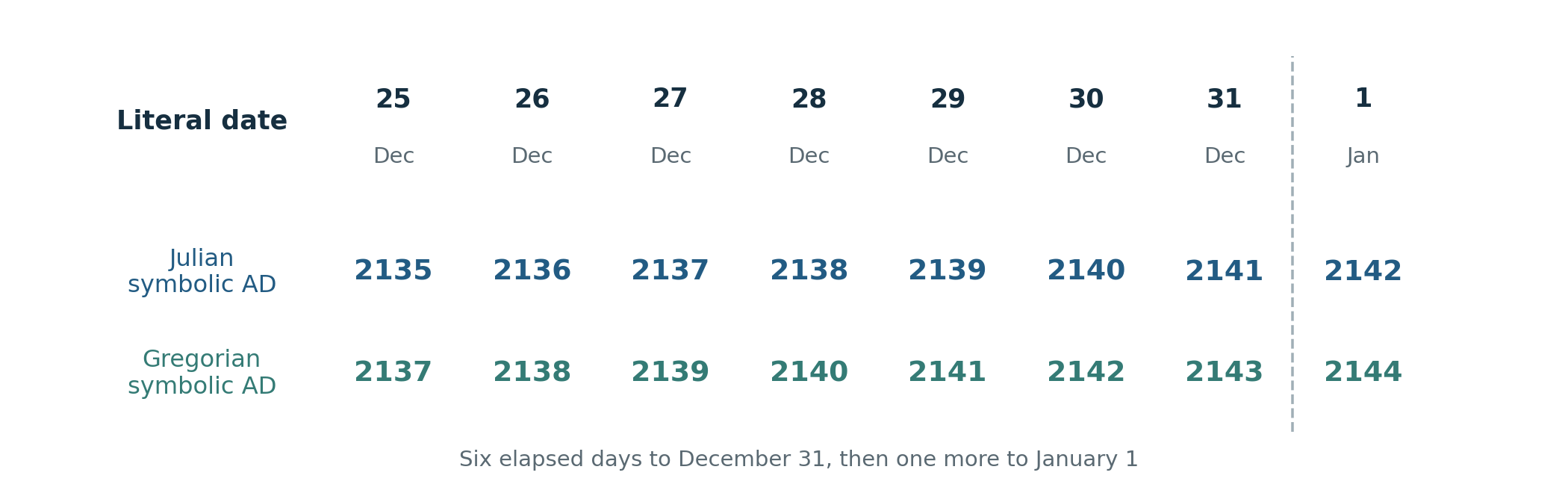
The Gregorian pair AD 2143/2144 therefore represents the closing day of literal 1 BC and the opening day of literal AD 1. The received December 25 and January 1 tradition supplies this calendar comparison; it does not establish Christ’s actual birthday. The 6 BC epoch is a separate chronological datum. Both have a place in the construction, and their roles must remain visible.
All ordinary BC-to-AD spans below use the civil rule B + A − 1. There is no year zero. Thus 2458 BC to AD 2143 is 2458 + 2143 − 1 = 4600. Dates on the same side of the era boundary are compared by subtraction. Seasonal adjustments and Rounded coordinates are introduced only where they are needed.
The Key of 23 supplies three exact span operators. Their names identify established functions within the repository. They do not turn symbolic years into measured astronomical years.
Table 2 The three expansion operators
| Operator | Rule | Simple example |
|---|---|---|
| Priestly | Multiply by 25/23 | 46 → 50; 92 → 100; 460 → 500 |
| Prophetic | Multiply by 70/69 | 69 → 70; 483 → 490 |
| Enochian | Multiply by 300/299 | 299 → 300; 598 → 600 |
Each application must also name its fixed endpoint. Expanding a span forward from the Exodus moves its AD endpoint. Expanding a span backward from the Passion moves its BC endpoint. The same multiplication can therefore participate in different constructions without making their dates interchangeable.3
2 The birth and the three Gears
The three Gears belong to the repository’s treatment of Noah, Shem, and the Flood. Gear 2 is the ordinary Shem position. Gear 1 and Gear 3 stand two years to either side of it and bear the names Japheth and Ham. They are coordinated modes of the same chronological structure. In the repository’s language, Shem can occupy the place of his brothers.
The names require care. The brother sequence Japheth/Shem/Ham may be displayed as 2560/2558/2556 BC. The Gear sequence for the representative Shem position runs in the other direction: Gear 1/2/3 gives 2556/2558/2560 BC. The following table records the Gear positions. It does not assign independently recorded 600-year lifespans to Japheth and Ham.4
Table 3 The MT Gear positions in BC
| Event | Gear 1 Japheth mode | Gear 2 Shem mode | Gear 3 Ham mode |
|---|---|---|---|
| Noah born | 3056 | 3058 | 3060 |
| Noah dies | 2106 | 2108 | 2110 |
| Shem born | 2556 | 2558 | 2560 |
| Shem dies | 1956 | 1958 | 1960 |
| Flood year opens | 2456 | 2458 | 2460 |
| Following year | 2455 | 2457 | 2459 |
The two-day separation between the Julian and Gregorian birth settings now has a corresponding two-year separation among the Gears. Shem’s Gear 1 birth at 2556 BC stands 4692 years before symbolic AD 2137. His Gear 2 birth at 2558 BC stands the same 4692 years before symbolic AD 2135. The span is 46 × 102 and expands to 5100. Likewise, Shem’s death at 1960 BC in Gear 3 reaches AD 2135 by 4094 years, while his Gear 2 death at 1958 BC reaches AD 2137 by the same span. Here 4094 = 46 × 89, expanding to 4450.
Table 4 Equal spans across adjacent Gear and calendar positions
| Earlier position | Symbolic endpoint | Span | After 25/23 |
|---|---|---|---|
| Shem born 2556 BC, G1 | AD 2137 | 4692 = 46 × 102 | 5100 |
| Shem born 2558 BC, G2 | AD 2135 | 4692 = 46 × 102 | 5100 |
| Shem dies 1960 BC, G3 | AD 2135 | 4094 = 46 × 89 | 4450 |
| Shem dies 1958 BC, G2 | AD 2137 | 4094 = 46 × 89 | 4450 |
| Noah born 3058 BC, G2 | AD 2141 | 5198 = 46 × 113 | 5650 |
| Noah born 3056 BC, G1 | AD 2143 | 5198 = 46 × 113 | 5650 |
The birth window thus receives more than one position without requiring the ordinary Gear 2 chronology to be abandoned. I understand this gathering in relation to Christ’s representative humanity. Genesis 9:18–19 presents the renewed human family through Noah’s three sons. If Shem’s place can represent his brothers within the chronology, Christ’s birth can gather the positions associated with all three brothers. The meaning will become clearer when we reach the Cross: the One who enters the family also bears its judgment.
The SP and LXX comparisons support the breadth of the pattern. In the selected Noah–Shem block, SP stands 650 years before MT and LXX stands 780 years before MT. The 130 years between SP and LXX allow the 5200-year MT comparison to be read both as 8 × 650 and as 40 × 130. The LXX Noah comparison becomes 5980, which can expand either to 6000 or to 6500. The SP death of Noah reaches the winter positions by 4900 years. Appendix A gives the full dates and Appendix B the arithmetic. MT remains the principal chronology of the study.
3 The Flood year and the winter boundary
Several renewal events in the MT chronology have a concluding year that deserves to be kept in view. The Flood occupies the 2458/2457 BC pair. The Exodus and the erection of the Tabernacle occupy 1446/1445 BC. The land’s division and rest belong to the 1400/1399 BC envelope following the Conquest. A less direct comparison joins the destruction of Sodom and the promised birth of Isaac in 2067/2066 BC.
The first members of these pairs all stand a multiple of 23 before symbolic AD 2143. Their following members stand the same distances before AD 2144. The earlier events also bear multiples of 23 among themselves: Flood to Exodus is 1012 = 44 × 23; Exodus to the onset of land rest is 46 = 2 × 23; Flood to that rest is 1058 = 46 × 23.
Table 5 Renewal years compared with the Gregorian era boundary
| BC event pair | Corresponding AD pair | Equal span | After 25/23 |
|---|---|---|---|
| Flood 2458 / 2457 | 2143 / 2144 | 4600 = 23 × 200 | 5000 |
| Sodom and Isaac 2067 / 2066 | 2143 / 2144 | 4209 = 23 × 183 | 4575 |
| Exodus and Tabernacle 1446 / 1445 | 2143 / 2144 | 3588 = 23 × 156 | 3900 |
| Land rest 1400 / 1399 | 2143 / 2144 | 3542 = 23 × 154 | 3850 |
The Flood brings the seasonal comparison into focus. Genesis 8:5 places the appearance of the mountain tops at the first day of the tenth month. On the schematic calendar of thirty-day months, that boundary stands 270 elapsed days after the first day of the year. It is ordinal day 271 when the starting day is counted as day 1. Genesis then gives forty days before Noah opens the window and sends the raven, followed by the dove sequence.5
I read the nine months and the following forty in relation to gestation and the purification after the birth of a son. Luke’s account of Christ’s presentation includes the offering of two birds. The Flood narrative moves toward an earth made habitable; the infancy narrative brings the Child through whom creation will be renewed. The shared pattern invites comparison, while each passage retains its own event and its own counting language.
The winter alignment is a declared part of the model. Genesis gives the tenth-month boundary. I identify that boundary schematically with the December/January turning point. The 270-day count by itself does not establish a Gregorian December 31. With the alignment stated, the comparison is winter to winter: the close of 2458 BC and opening of 2457 BC stand 4600 symbolic years before the close of AD 2143 and opening of AD 2144. The latter boundary represents the passage from literal 1 BC into literal AD 1.
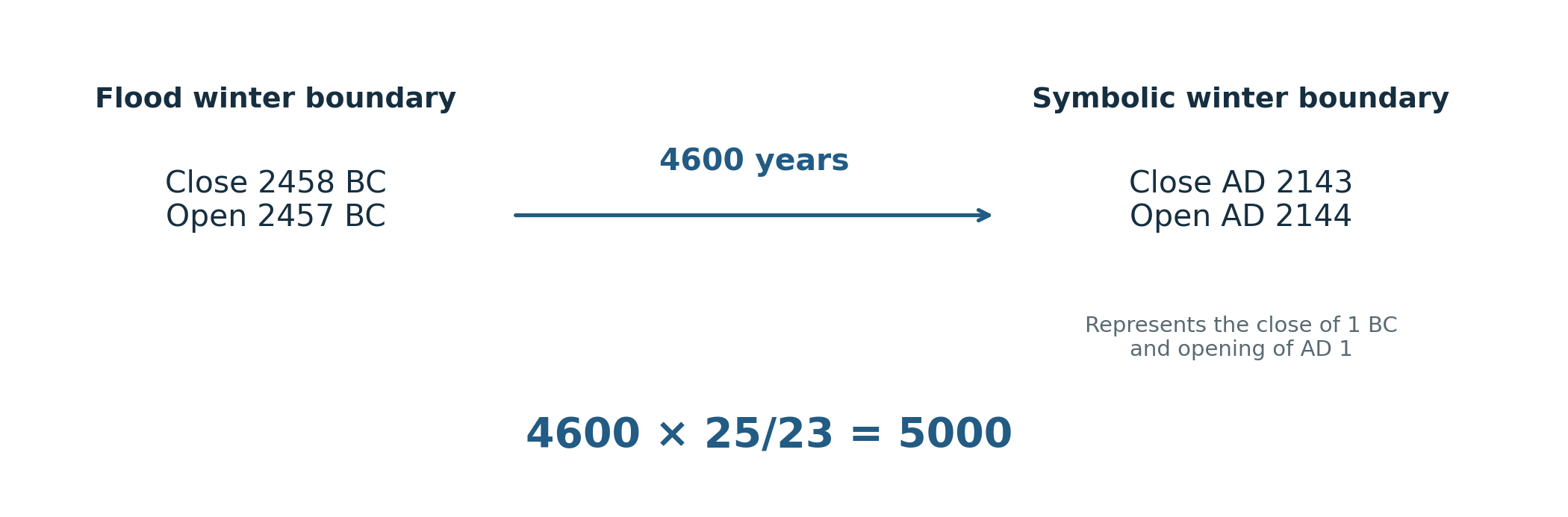
The expansion is simple: 4600 × 25/23 = 5000. Its smaller counterpart already appears in the conception and birth sequence. The selected 280-day pregnancy plus the 180-day interval between John and Jesus gives 460 days from John’s conception to Jesus’ birth. The increase from 460 to 500 is forty; the increase from 4600 to 5000 is four hundred. The differing scales allow the birth, purification, Flood, and affliction patterns to speak to one another.6
Other legitimate selections retain the same family. Nine Enochian months give 273 days; adding seven elapsed days to the inclusive eighth-day circumcision and a 180-day half-year gives 460. A 182-day half-year gives 462. These are alternative constructions with different endpoints. The difference of two recalls the Gear positions, but it must not be concealed by calling every 460 the same interval. Appendix C keeps these counts separate.
4 The Exodus span and its three expansions
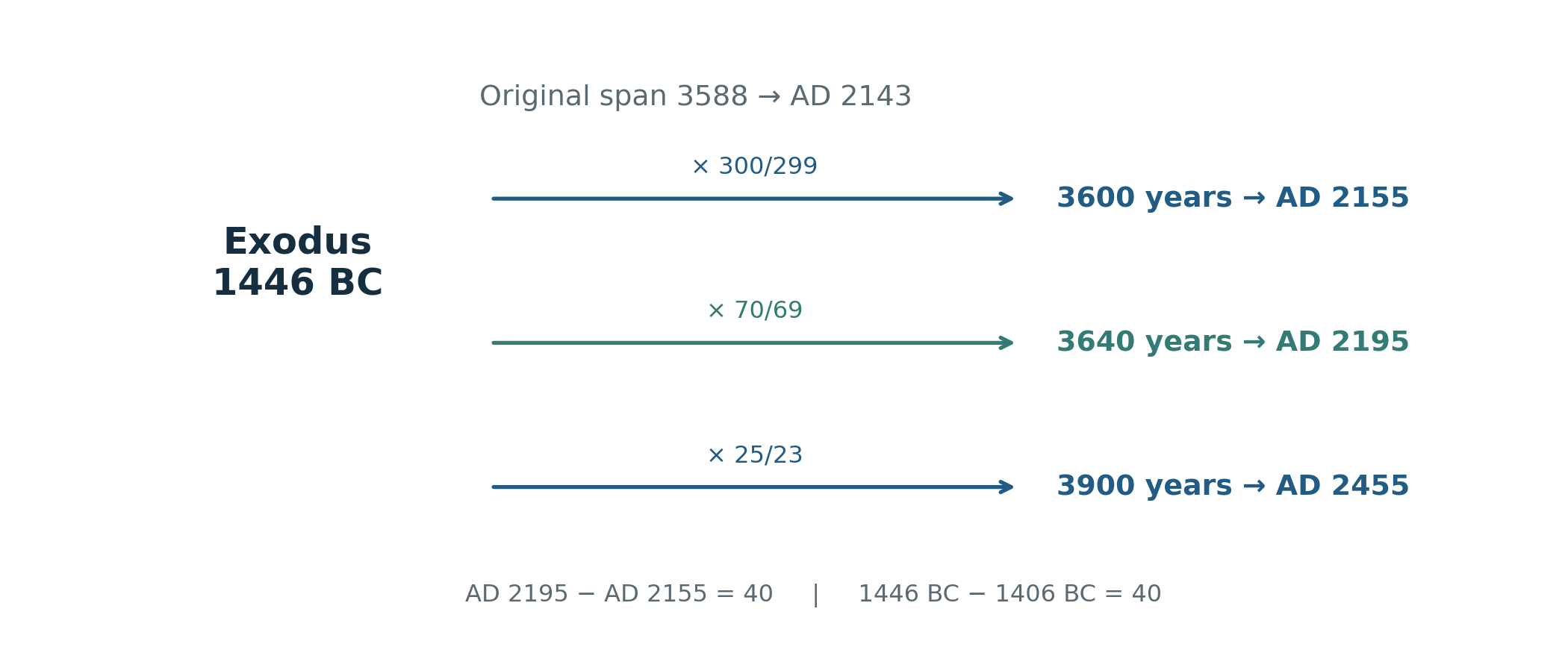
The Exodus comparison has an unusual arithmetic advantage. From 1446 BC to symbolic AD 2143 are 3588 years. This is divisible by the denominator of each of the three principal operators. Since the least common multiple of 23, 69, and 299 is 897, the span 3588 = 4 × 897 admits all three expansions without a fractional remainder.
Table 6 Three expansions with the Exodus fixed
| Rule applied to 3588 | Expanded span | Increase | New AD endpoint |
|---|---|---|---|
| 300/299 | 3600 | 12 | 2155 |
| 70/69 | 3640 | 52 | 2195 |
| 25/23 | 3900 | 312 | 2455 |
These totals carry familiar calendar forms at ten times their scale: 3600 gives ten sets of 360; 3640 gives ten sets of 364; and 3900 gives ten sets of a 360-day year with an added thirty-day month. The nearby Conquest comparison supplies 3540 years from 1406 BC to AD 2135, ten schematic lunar years of 354. These are calendar-number representations; ten mean astronomical lunar years would not equal exactly 3540 days.
The Gregorian birth position supplies the adjacent Key: 1406 BC to AD 2137 is 3542 = 23 × 154 = 46 × 77. Moving the BC anchor six years forward to the onset of rest in 1400 BC and the AD endpoint six years forward to 2143 preserves the same span. The Conquest and the ensuing rest therefore enter the birth window together.
The forty years in the wilderness fit between the first two expansions. The Exodus at 1446 BC stands 3600 years before AD 2155. The Conquest forty years later, at 1406 BC, stands 3600 years before AD 2195. The expanded AD endpoints are also forty years apart. Meanwhile, 1446 BC to AD 2195 is 3640. The wilderness interval is retained within the relation between the 360 and 364 forms.
The shorter gain also looks back toward Abraham. His birth at 2166 BC stands 4320 years before AD 2155: twelve sets of 360. The gain of twelve that produced the 3600-year form therefore enters a second comparison at the scale of a year of years.
The 3900-year branch has another setting. The selected beginning of the four hundred years in a strange land is 1846 BC. Its four hundred years to the Exodus, followed by the expanded 3900 years to AD 2455, give 4300. Ezekiel’s 390 + 40 has become 3900 + 400. I also read 3900 = 130 × 30 within the curse-related number family developed elsewhere. The calendar arithmetic and the proposed moral significance are related parts of the reading.
A residual Key of 23 remains around Moses’ own life. His birth in 1526 BC stands 3680 years before AD 2155, and his flight to Midian in 1486 BC stands 3680 years before AD 2195. The two forty-year intervals face one another. Each 3680 expands by 25/23 to 4000, a hundredfold forty.
The force of 3588 lies in this combination. One initial span admits the three calendar forms, preserves the wilderness forty, reaches back toward Abraham, and leaves another expandable span around Moses. Hosea’s son called out of Egypt, taken up in Matthew’s account of Jesus, gives the comparison its scriptural setting. My immediate purpose is to show why this span is so productive within the proposed fulfillment, rather than to retell every narrative parallel between Moses and Christ.7
5 Creation and the days of Jared
The Creation comparison reaches farther back. The repository distinguishes the Year 6 Adam position at 4116 BC from the ordinary Creation endpoint at 4114 BC. They belong to related readings of the Creation week and must retain their particular roles. The former reaches symbolic AD 2141 by 6256 years; the latter reaches AD 2143 by the same span.
6256 = 17 × 368; 6256 × (25/23) = 6800 = 17 × 400
I associate seventeen with overcoming, particularly through Joseph’s story. The chronology gives this interpretation a definite form here: seventeen groups of 368 become seventeen groups of 400. The factor will reappear at the Passion in a span containing two factors of 23.
Jared’s birth in the MT chronology is 3654 BC, 460 years after the ordinary Creation anchor. From Jared to symbolic AD 2143 are 5796 years. This span takes the prophetic form of the Key:
5796 = 69 × 84; 5796 × (70/69) = 5880 = 120 × 49 = 12 × 490
The result is 120 jubilees of forty-nine years. In the Enochic tradition, the descent of the Watchers belongs to the days of Jared. I place that tradition beside the serpent’s deception in Genesis and the later conflict over the promised land. The 460 years from Creation to Jared allow the first corruption and its later intensification to enter the same comparison with Christ.8
The same 460 can be carried back from the birth-related winter boundary. The opening of symbolic AD 2144 represents the opening of literal AD 1. Moving back 460 symbolic years reaches the opening of AD 1684. The span from the close of 4114 BC, expressed equivalently as the opening of 4113 BC, to that opening of AD 1684 is 5796 years. Thus the 460 between Creation and Jared is matched by the selected 460 between John’s conception and Christ’s circumcision. The table in Appendix C preserves the boundary notation so that a beginning-of-year label is not exchanged silently for an end-of-year label.
Genesis 3:15 supplies the narrative through which I read these relationships. The conflict is between the serpent and the woman, and between their offspring. I understand the Flood and the Conquest as stages within that conflict, with its decisive fulfillment at the Cross. The numerical comparisons join those stages to the birth of the promised Seed. They do not depend on treating every detail of the later traditions as an explicit statement of Genesis.
6 The paired Passion years on the 360 calendar
Book 1 retains AD 30 and AD 33 as the two principal Friday Passion possibilities within the period under consideration. AD 33 supplies its preferred historical setting, Friday, April 3, Julian. AD 30 has a related astronomical possibility on Friday, April 7, with Nisan 14 favored and a narrowly qualified earlier month beginning allowing Nisan 15. I regard the pairing as part of the providential gathering of the calendar witnesses.9
Spring AD 30 also has a place within the AD 33 framework. It is thirty elapsed years from the traditional conception in spring 1 BC and begins the final three years leading to the Cross. In John 2, the Temple’s forty-six years stand beside Christ’s promise to raise the temple of His body in three days. I read those three days also at the prophetic day–year scale: three years toward AD 33. The resulting 46 + 3 = 49 forms a jubilee. The traditional 1 BC conception and the 6 BC Christ frame remain distinct starting points with different functions.
John’s Gospel and Revelation invite this larger view of the body-Temple. Creation’s first three days of forming correspond to its next three days of filling. Light appears on Day 1; its appointed luminaries on Day 4. The Sunday and Wednesday beginnings, three days apart and capable of a three-and-a-half-day phase comparison, recur in Book 1 at Christ’s coming and ministry. I follow that pattern here as it approaches His death and resurrection.
In the proposed Gospel harmony, John’s Friday is Nisan 14 and the Synoptic Friday is Nisan 15. The same historical day receives two lunar month-date labels. The present comparison introduces a further operation: the Passion’s date meanings are represented on the intercalated 360 calendar.
On that calendar, Nisan 13 in AD 33 falls on Julian Friday, February 13, whose opening midnight is JD 1733154.5. From Nisan 1, Day 0, in 6 BC, the thirty-eight years contain six leap months and total 13860 days to Nisan 1 in AD 33. Thirteen further days complete Nisan 13, giving symbolic AD 13873.
38 × 360 + 6 × 30 + 13 = 13873
The thirty-eight elapsed years cross six leap months. The sixth falls in AD 31, within the modeled ministry. The governing forty-year cycle contains six six-year blocks, each with an added month, followed by a four-year block with the seventh added month. Its total is 14610 days, exactly forty Julian mean years. The scheme and the placement of its months belong to the declared model.10
Table 7 Ministry and Passion positions in the Christ frame
| 360 calendar position | Symbolic AD year | Interval from ministry opening |
|---|---|---|
| Tishri 15, AD 29 | 12585 | 0 |
| Forty elapsed days later | 12625 | 40 |
| Nisan 13, AD 33 | 13873 | 1288 = 46 × 28 |
| Nisan 14, AD 33 | 13874 | 1289 |
| Nisan 15, AD 33 | 13875 | 1290 |
The full interval from Tishri 15, AD 29, to Nisan 15, AD 33, is 1290 days: the 1260 of a common half-week with its thirty-day leap month. Two days earlier gives 1288 = 46 × 28. The ministry begins at symbolic AD 12585, which stands 14030 = 23 × 610 years after the Exodus. Appendix D retains the further forty-day and forty-year relationship.
Table 7A The corresponding spring positions
| 360-calendar position | Literal AD 30: symbolic AD | Literal AD 33: symbolic AD |
|---|---|---|
| Nisan 13 | 12763 | 13873 |
| Nisan 14 | 12764 | 13874 |
| Nisan 15 | 12765 | 13875 |
The matching Nisan positions are 1110 days apart: three common 360-day years plus the thirty-day month in AD 31. If AD 30 is selected as the Passion year, its Tishri 15, AD 26, to Nisan 15, AD 30 ministry interval contains no leap month and gives 1260 days. Appendix D sets that interval beside the 1290-day AD 29–33 interval within the same Christ frame.
The Friday on the 360 calendar stands forty-nine literal days before the preferred historical Crucifixion Friday. February 13 + 49 days = April 3. This alignment of weekdays contributes to the comparison, while February 14 remains the next 360-calendar position representing the death-day meaning. It is not a second proposed historical Crucifixion date.
The thirteenth day also carries a Creation comparison. The repository places the Fall on Day 13 of its Creation microstructure, one week after Day 6. In the selected Nisan alignment, the betrayal of Adam and Eve therefore stands on Nisan 13. This is the repository’s interpretive chronology; Genesis does not supply that month-and-day date.
John presents Judas’ betrayal as a developing event. The intention is already present before the decisive act at supper; Satan enters him when he receives the morsel, and he goes out into the night. In the literal lunar reading, Thursday’s Nisan 13 is ending as Nisan 14 begins at sunset. I retain that transition. The association with Day 13 concerns the course of betrayal leading into the suffering, while the night belongs to the newly begun date.
Jesus’ citation of Psalm 41:9 brings the raised heel into this scene. I read the psalm itself against Genesis 3:15, so that the serpent’s conflict with the Seed reaches through the psalm into the supper. John’s night is literal, and in my reading it also expresses the moral darkness of the act. The larger premise is the one guiding this study: the narrative beginnings in Genesis continue to unfold throughout Scripture, including through its numerical forms.11
Revelation brings the same conflict into its heavenly setting. The birth scene of Revelation 12 and the testimony, death, and restoration of the witnesses in Revelation 11 can be read in relation to Christ’s coming and Passion. The witnesses’ plagues also recall Moses and Aaron. I understand these as recurring forms of testimony and deliverance, fulfilled centrally in Christ and expressed again in the history of His people. The comparison does not require every figure to be reduced to one historical identity.
7 From 666 to the Day of Atonement
The Exodus-to-Passion span now supplies the principal calculation. From 1446 BC to symbolic AD 13873 are 15318 years:
1446 + 13873 − 1 = 15318 = 666 × 23 = 222 × 69
The endpoint is the 360-calendar Friday associated with the thirteenth day. The 666 of Revelation 13 stands here within a comparison beginning at the Exodus, whose plagues and witnesses also furnish the language of Revelation 11. I read the numerical meeting in relation to the fall of humanity and the suffering through which Christ overcomes it. The date placement and the multiplication are exact within the model; that meaning is the interpretation I draw from their scriptural setting.
John’s closing catch supplies a related way to express this span. He numbers 153 large fish. Selecting the 100-year generational measure, I read 153 × 100 = 15300, with the three added sixes giving 18 more. The resulting number is the same Exodus-to-Passion span. The description of the fish supplies the occasion for this generational reading; the 100-year measure is the one selected here from the Repository’s distinct generation units.12
153 × 100 + (6 + 6 + 6) = 15318 = 23 × 666
Hold the Exodus fixed and apply the prophetic expansion:
15318 × (70/69) = 15540 = 7770 + 7770
The endpoint moves from AD 13873 to AD 14095. The increase is 222, because the original span consisted of 222 groups of 69 and now consists of 222 groups of 70. Carrying the next represented day forward by the same increase gives AD 14096. The death-day companion is preserved after expanding the principal Nisan 13 span; it is not obtained by separately multiplying 15319 by 70/69.
Read those additional symbolic years back as literal days, and the comparison reaches the autumn of the same literal year, AD 33.
Table 8 The 222 day extension and Atonement
| Starting position | After 222 | Literal endpoint in AD 33 | Preferred crescent reconstruction |
|---|---|---|---|
| AD 13873 February 13 Julian | AD 14095 | September 23 Julian | Atonement begins that evening |
| AD 13874 February 14 Julian | AD 14096 | September 24 Julian | Tishri 10 daylight |
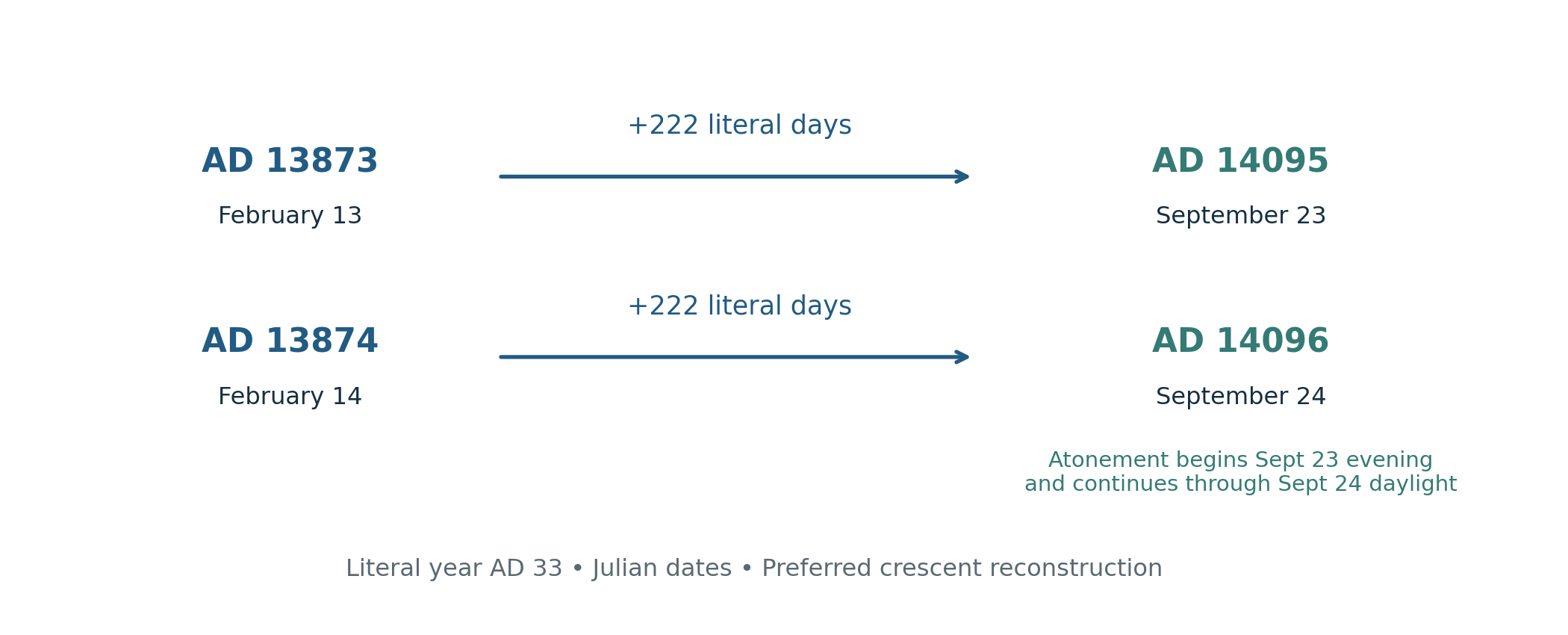
The preferred crescent reconstruction places Tishri 1 at sunset on September 14, with its daylight on September 15. Tishri 10 consequently begins at sunset on September 23 and has its daylight on September 24. NASA’s phase table places the conjunction on September 12 at 09:42 UT. The visibility reconstruction used here favors a first naked-eye crescent on September 14. Actual ancient observation and the authorities’ decision are not recorded by this calculation, so September 24 remains a reconstructed historical estimate.13
The later fixed Hebrew calendar, projected backward, gives Tishri 10 one day earlier: September 21 Gregorian, equivalent to September 23 Julian. That alternative matches the daylight of the first endpoint. The two reckonings should remain separately named. The preferred crescent estimate gives a particularly close reading of the pair as Atonement’s opening evening and following daylight.
The same expansion therefore has a numerical and a festival expression. The 666 × 23 becomes 7770 + 7770, while its added 222 brings the represented suffering to Atonement. I understand the change from curse to blessing through the sacrifice of Christ. The festival association gives the interpretation a setting already concerned with cleansing, judgment, and reconciliation.
The priestly expansion produces the companion branch:
15318 × (25/23) = 16650
With 1446 BC fixed, that span reaches symbolic AD 15205. The following represented death-day position is AD 15206. The two branches are separated by 1110 years: AD 14095 to AD 15205, or AD 14096 to AD 15206. Their relationships to Creation and the Conquest will become important below.
8 AD 30 and AD 33: the paired witness
The 1110 years between the expanded branches have already appeared as 1110 literal days between the AD 30 and AD 33 Nisan positions. I now bring the two relations together. AD 30 participates in the same structure that produced the AD 33 comparison.
The two readings and the two anchors
Revelation 13:18 transmits a familiar numerical variant: 616 beside the primary 666 reading. I retain 666 as the principal and more widely attested number while taking 616 seriously. As with the chronological variants preserved in the Unified Repository, I regard the transmitted alternative as potentially participating in the providential order.14
Table 8A The paired Nisan 13 comparisons
| Earlier anchor | Mapped Passion position | Civil span |
|---|---|---|
| Conquest, 1406 BC | AD 12763: Nisan 13, AD 30 | 14168 = 23 × 616 |
| Exodus, 1446 BC | AD 13873: Nisan 13, AD 33 | 15318 = 23 × 666 |
The two spans differ by 1150 = 23 × 50. That difference combines the 1110 between the later endpoints with the forty years between Exodus and Conquest. Thus the 616/666 pairing preserves both the ministry relation and Israel’s wilderness interval.
The ministry interval returns
The AD 30 position completes a symmetrical arrangement around the earlier calculation:
| AD 12763 AD 30 position | AD 13873 AD 33 position | AD 14095 Prophetic endpoint | AD 15205 Priestly endpoint |
| 1110 to next → | 222 to next → | 1110 to next → | — |
| Forward: 1332 = 666 + 666 → | |||
| ← Backward: 1332 = 666 + 666 | |||
Figure 4A. The original and expanded positions give 1110 + 222 + 1110 = 2442. The two equal 1332-unit spans overlap through the central 222.
From AD 12763, adding 1332 reaches AD 14095; from AD 15205, subtracting 1332 reaches AD 13873. Three further represented days extend the respective comparisons to AD 14098 and AD 13870, the latter receiving Nisan 10 and the opening of Passion Week. With the evening and morning phases specified, each local three-day figure becomes three and a half. The two halves complete seven, returning to Creation’s forming and filling. Appendix E gives the exact phase endpoints.
Shem connects the pair
Shem’s selected Gear 1 birth at 2556 BC stands 1150 years before the Conquest and 1110 before the Exodus. His birth therefore supplies the very difference between the 616 and 666 spans. At the common endpoint AD 12763, moving the earlier anchor from the Conquest to Shem changes 23 × 616 into 23 × 666:
2556 + 12763 − 1 = 15318 = 23 × 666
Hold Shem’s birth fixed and apply 25/23. The span becomes 16650, increasing by 1332 and reaching AD 14095. Shem’s comparison thus meets the same endpoint reached by the Exodus-held prophetic expansion.15
Table 8B The held anchors and expanded endpoints
| Fixed BC anchor | Original span and operator | Expanded span | New AD endpoint |
|---|---|---|---|
| Conquest, 1406 | 14168 × 25/23 | 15400 = 7700 × 2 | 13995 |
| Exodus, 1446 | 15318 × 70/69 | 15540 = 7770 × 2 | 14095 |
| Shem’s birth, 2556 | 15318 × 25/23 | 16650 | 14095 |
| Exodus, 1446 | 15318 × 25/23 | 16650 | 15205 |
The expanded 616 position at AD 13995 stands exactly 14000 years from the 6 BC Christ datum and 28000 from cumulative Creation at 14006 BC. Its doubled 7700 stands beside the doubled 7770 of the prophetic 666 expansion. Their AD endpoints are one hundred years apart. The pair therefore continues to operate after expansion, while each calculation retains its particular rule and fixed anchor.
9 The 3 + 4 + 3 years and the two half-weeks
The two ministry beginnings now supply two interlocking arrangements across the same decade. The first begins forty days after Tishri 15, at the end of the wilderness interval, in each Passion-year framework. The AD 30 option gives symbolic AD 11545, forty beyond AD 11505. The AD 33 option gives AD 12625, forty beyond AD 12585. Both positions fall on the twenty-fifth day of the eighth month in the 360 calendar.
The two expanded endpoints of 23 × 666, AD 14095 and AD 15205, receive that same month and day in literal AD 33 and AD 36. The four positions therefore retain one annual anniversary across three years, four years, and three years.
| Literal AD 26t Wilderness end Symbolic AD 11545 | Literal AD 29t Wilderness end Symbolic AD 12625 | Literal AD 33t Prophetic endpoint Symbolic AD 14095 | Literal AD 36t Priestly endpoint Symbolic AD 15205 |
| 1080 days 3 years → | 1470 days 4 years + leap → | 1110 days 3 years + leap → | — |
| Forward: 2550 = 1260 + 1290 → | |||
| ← Backward: 2580 = 1290 + 1290 | |||
Figure 4B. Each position is Month 8, day 25 on the 360 calendar. The three intervals give 1080 + 1470 + 1110 = 3660 days. The inward spans overlap through the central 1470 days.
The leap months keep the anniversary exact. There is none between the AD 26 and AD 29 positions; the AD 31 month lies in the middle four years; and the AD 35 month lies in the final three. AD 31 closes the sixth six-year block from the 6 BC epoch. The seventh month follows four years later, closing the forty-year cycle in AD 35. Ten calendar years in this particular interval therefore contain 3600 + 60 = 3660 days.16
The two inward comparisons are 11545 + 2550 = 14095 and 15205 − 2580 = 12625. Their 2550 and 2580 preserve the familiar half-week forms: 1260 + 1290 and 1290 + 1290. This complements the earlier 1110 + 222 + 1110 arrangement while giving the repeated autumn date a place of its own.
The two half-weeks: 3½ years + 1150 days + 3½ years
The same decade supplies another route between the ministry opening and the expanded Passion position. I begin forty days earlier, at Tishri 15 in literal AD 26, symbolic AD 11505. The first 1260 days reach Nisan 15 in AD 30; another 1150 reach Month 2, day 25 in AD 33; and the final 1290 reach Month 8, day 25 in AD 36, symbolic AD 15205. A parallel sequence two days later preserves every interval.
The outer intervals are exactly three and a half calendar years in each case. Their day totals differ because the first contains no leap month, while the final half-week contains the AD 35 intercalation. The AD 31 leap month falls within the intervening 1150 days. Applying the forty-year cycle to the 6 BC Nisan epoch places its seven leap months at the spring boundaries of AD 1, 7, 13, 19, 25, 31, and 35.16
Figure 4C Calendar origins of the paired 1260 + 1150 + 1290 route
| Position in the 360 calendar | Origin of the earlier coordinate | Symbolic AD pair |
|---|---|---|
| A. AD 26: Tishri 15 / 17 Month 7; ministry-opening window | 31 × 360 + 5 × 30 + 195 = 11505 | 11505 / 11507 |
| B. AD 30: Nisan 15 / 17 Month 1; alternative Passion and Resurrection | 35 × 360 + 5 × 30 + 15 = 12765 | 12765 / 12767 |
| C. AD 33: Month 2, day 25 / 27 Ascension and Flood-completion comparison | 38 × 360 + 6 × 30 + 55 = 13915 | 13915 / 13917 |
| D. AD 36: Month 8, day 25 / 27 Expanded Passion positions | 41 × 360 + 7 × 30 + 235 = 15205 | 15205 / 15207 |
Each calculation counts from the opening of Nisan in 6 BC to the selected day’s end. The first term counts ordinary 360-day years; the second counts completed leap months; and the final term locates the day within its year. Thus 195 = 6 × 30 + 15, 55 = 30 + 25, and 235 = 7 × 30 + 25. The companion date is two days later in every row. Subtracting the successive coordinates gives 1260, 1150, and 1290 in both sequences.
Figure 4D The two half-weeks coordinated with their leap months
| Interval | Ordinary calendar component | Leap month crossed | Elapsed days |
|---|---|---|---|
| A → B | 3 years + 6 months = 1260 days | None | 1260 |
| B → C | 3 years + 40 days = 1120 days | AD 31: +30 | 1150 |
| C → D | 3 years + 6 months = 1260 days | AD 35: +30 | 1290 |
3½ calendar years + 1150 days + 3½ calendar years
1260 + 1150 + 1290 = 3700 = 3660 + 40
The three–four–three arrangement preserves one annual anniversary and totals 3660 days. The companion arrangement begins forty days earlier, retains the same ending, and totals 3700. Its two outer half-weeks enclose 1150 days, with the leap months in their proper positions. The whole span is ten calendar years plus forty days: 3600 + 60 intercalary days + 40 = 3700. Both arrangements therefore belong to the same intercalation cycle.
The final pair has two distinct references. In the unchanged 360 calendar, AD 15205/15207 decodes to Month 8, day 25/27 in literal AD 36. As the expanded 23 × 666 positions, those same numbers retain the Nisan 13/15 Passion meanings from literal AD 33. The spring pair likewise belongs to the Ascension and Flood-completion comparison: Month 2, day 27 is forty elapsed days after Nisan 17, while day 25 is the earlier companion selected in this paired sequence.17
The twenty-seventh day and departure from the ark
The twenty-fifth day is the common base position. The adjacent Passion meanings carry the date forward by one or two days: Nisan 13 + 222 reaches Month 8, day 25; Nisan 14 and 15 carry it to days 26 and 27. The latter date brings the Flood narrative back into view.
Genesis 8:14 dates the fully dried earth to the twenty-seventh day of the second month. The narrative then moves through Noah’s departure with his family and the living creatures, his sacrifice, and God’s reception of its pleasing aroma. The promise concerning the earth’s seasons is followed by the covenant and its rainbow sign. I read this whole movement as renewal after judgment.
Table 9 The two seasonal placements of the Flood narrative
| Biblical event | Nisan-first Flood year | Tishri-first Flood year |
|---|---|---|
| Departure sequence: Month 2, day 27 | Iyar 27 Month 2 in a Nisan-based display | Marheshvan 27 Month 8 in a Nisan-based display |
| Ark rests: Month 7, day 17 | Tishri 17 | Nisan 17 |
The alternative year beginnings place the departure in spring or autumn. The eighth-month twenty-seventh is therefore the departure anniversary in the Tishri-first reading. Its half-year companion is the second-month twenty-seventh in the Nisan-first reading. On the stated thirty-day-month scale, resurrection on Nisan 16 or 17 followed by forty elapsed days gives Month 2, day 26 or 27. The Ascension comparison consequently meets the Flood’s completion and the family’s emergence into the renewed earth. The dated threshold is the dry earth; the departure, sacrifice, and covenant unfold in the narrative that follows.17
The month labels here belong to the schematic frame. Because that frame begins ahead of the lunar calendar, the autumn positions can also receive the lunar Atonement correspondence developed in Section 7. The calendar witnesses retain their own labels as they meet in the comparison.
This returns us to the birth discussion. Noah, Shem, and the Flood supplied the three Gear positions gathered around Christ’s coming. Their narrative now returns at the culmination of His ministry through emergence, accepted sacrifice, and covenant renewal. I understand the ascent of the offering and the Ascension of Christ within that common movement.
Why the opening position is AD 26t
The starting phase already carries a festival sequence: Tishri 10 in literal AD 26 is symbolic AD 11500; five days lead to Tishri 15 at AD 11505; and forty more lead to Month 8, day 25 at AD 11545. Atonement, Tabernacles, and the wilderness interval thus locate the opening position.
11500 + 5 + 40 = 11545
AD 26t is the autumn phase half a year before AD 27n. Moving the earlier Nisan anchors back through the same half year preserves their spans. Creation’s 4114n BC becomes 4115t BC; Jared’s 3654n becomes 3655t; the Flood’s 2458n becomes 2459t; and the 1446n Exodus has its preceding 1447t position, which I associate with Moses’ Burning Bush call.
Table 10 Matching Tishri phases, all compared with literal AD 26t
| Earlier Tishri position | Span to AD 26t | Key-of-23 result |
|---|---|---|
| Creation, 4115t BC | 4140 = 23 × 180 | 4500 by 25/23 Gain: 360 |
| Jared, 3655t BC | 3680 = 23 × 160 | 4000 by 25/23 |
| Flood, 2459t BC | 2484 = 23 × 108 | 2520 by 70/69 2700 by 25/23 |
| Pre-Exodus call, 1447t BC | 1472 = 23 × 64 | 1600 = 40 × 40 by 25/23 |
Creation’s span gains a complete 360-year unit. The Flood span converts to 2520 or 2700, and the Exodus comparison to 1600, forty multiplied by forty. All four original spans are also multiples of 46, so the same 46 → 50 conversion operates throughout them.
The temple comparison belongs here. With its selected beginning about 20 BC, the spring AD 27 position gives forty-six years. Within the AD 30 Passion framework, three further years give 46 + 3 = 49. This is the earlier counterpart of the AD 30–33 prophetic placement discussed above. John speaks of the temple’s construction and the raising of Christ’s body in three days; I read the three years alongside that literal resurrection meaning. The paired Tishri phase therefore gives the autumn departure anniversary a consistent chronological setting.18
The starting phase reaches both birth and Passion
The birth week supplies a further connection. Table 1 gave the Gregorian closing day of literal 1 BC as symbolic AD 2143. For the seasonal comparison I select its morning/Nisan position, AD 2143n. The preceding evening receives AD 2142t, half a symbolic year earlier. Literal AD 27n to symbolic AD 2143n and literal AD 26t to symbolic AD 2142t consequently give the same duration.
2143 − 27 = 2142 − 26 = 2116 = 46 × 46 = 4 × 232
The temple’s forty-six years therefore stand beside forty-six squared to the selected birth-week hinge: from 20 BC to symbolic AD 2143 are 2162 = 46 × 47 years. The square itself expands by 25/23 to 2300, the sanctuary-restoration number of Daniel 8. I read the recurrence in relation to the body John identifies as the temple. The birth/circumcision setting and the ministry declaration are joined through the same forty-six-year measure.18
The smaller 360-calendar birth count will return to this temple comparison in Section 10: its span from the ministry position is 529, exactly one quarter of 2116. The two squares connect the birth and circumcision frames through the same expansion.
The same ministry phase also reaches the symbolic Passion. From literal AD 27 to symbolic AD 13873 are 13846 = 23 × 602 years. Multiplying by 25/23 gives 15050 = 70 × 215 = 35 × 430. Appendix D retains this comparison beside the birth square and the connection from AD 11545 to the expanded 616 position. These supporting spans explain how the opening of both arrangements participates in the wider birth-to-Passion chronology.
10 Adam and the measured life of Christ
“Your eyes saw my unformed body;
Psalm 139:16, BSB
all my days were written in Your book
and ordained for me
before one of them came to be.”
The psalm speaks of the whole course of life as known and written before it unfolds. That conviction governs this part of the study. Since Christ gives His life for the world, the days between His birth and Passion belong to the offering whose chronology I am examining. I therefore look for the complete life-span comparisons, as well as the individual birth and death positions. The literal calendar dates that generate the symbolic years must also have a place within the larger structure.19
I describe the resulting repetition as fractal-like in a limited sense: related measures recur between literal dates, symbolic day–years, and the regular and cumulative chronologies. Each comparison keeps its stated starting point, phase, and fixed endpoint. The following examples show how the same measures return at those different levels.
The first Adam and the millennial day
The regular MT places Adam at 4114n BC and his death, 930 years later, at 3184n BC. Their earlier Tishri phases are 4115t and 3185t BC. The corresponding LXX positions are 5494n/5495t and 4564n/4565t BC. LXX is 1380 years earlier, or three sets of 460. Here I compare the Tishri phases with the ministry opening in AD 26t and its later anniversary in AD 36t. Their following Nisan positions, AD 27n and AD 37n, remain active members of the comparison.20
Table 10A Adam’s Creation and death compared with the literal ministry framework
| Chronology and Adam position | Matching literal endpoint | Original span | By 25/23 |
|---|---|---|---|
| MT Creation: 4115t / 4114n BC | AD 26t / 27n | 4140 = 9 × 460 | 4500 |
| MT death: 3185t / 3184n BC | AD 36t / 37n | 3220 = 7 × 460 | 3500 |
| LXX Creation: 5495t / 5494n BC | AD 26t / 27n | 5520 = 12 × 460 | 6000 |
| LXX death: 4565t / 4564n BC | AD 36t / 37n | 4600 = 10 × 460 | 5000 |
Each displayed span uses matching seasonal phases: for example, 4115t BC to AD 26t, or equivalently 4114n BC to AD 27n. The Creation and death targets are ten years apart. Subtracting their two spans therefore leaves 930 − 10 = 920, which the Key converts to 1000. The biblical lifespan remains 930; the 920 is the difference between these two comparisons.
460 → 500; 920 = 2 × 460 → 1000 = 2 × 500
In the LXX comparison, the converted spans are six thousand and five thousand years. In the MT they are four and a half thousand and three and a half thousand. Each pair differs by one thousand. I read that millennial day in relation to the warning that Adam would die in the day he ate, and to the scriptural comparison of a day with a thousand years. Adam’s estrangement at the Fall and his later physical death are gathered into the same proposed pattern of judgment and restoration. The MT death-side 3500 also supplies half of seven thousand; in my Messianic reading, it recalls the cutting off and division of the week in Daniel 9.19
Jared supplies a further internal division. His MT birth at 3655t BC stands 3680 years before AD 26t, expanding to 4000. The adjusted sequence is therefore 4140 → 3680 → 3220, with two steps of 460; after conversion it is 4500 → 4000 → 3500, with two steps of 500. The first Adam, the days of Jared, and Adam’s death occupy related positions in the comparison. Appendix G retains the Creation-week and apparent-age distinctions behind these dates.
The literal dates return through cumulative Creation
The cumulative chronology repeats this connection to the literal dates. MT cumulative Creation at 14005t BC stands 14030 = 23 × 610 years before AD 26t. Its 25/23 expansion gains 1220. The selected cumulative death of Adam, 13075t BC, stands 13110 = 23 × 570 years before AD 36t; its expansion gains 1140. Holding those BC positions fixed sends the later endpoints to AD 1246t and AD 1176t respectively. The latter stands exactly 1150 years after AD 26t.
The earlier cumulative apparent-age position, 14035t BC, stands the same 14030 years before 5t BC. Thus the birth and ministry inputs repeat the measure already found from the Exodus to symbolic AD 12585 and from the Conquest to AD 12625. Those two symbolic positions decode to the opening and wilderness completion in literal AD 29. The AD 26 equivalents remain AD 11505 and AD 11545, exactly 1080 days earlier. The shared 14030 connects these levels while retaining both ministry frameworks.
The native LXX cumulative comparison adds another recurrence. Its selected Creation endpoint is 14894n/14895t BC, and its thirty-year apparent-age overlay is 14924n/14925t BC. From the latter to AD 26t are 14950 years, gaining 1300 by 25/23 and reaching AD 1326t, or the following AD 1327n. That endpoint stands 1332 after 7t/6n BC and 1290 after AD 36t/37n. The difference is forty-two. The same 1332 = 42 + 1290 occurs in the mapped Passion-to-Ascension sequence: AD 13875 + 42 = AD 13917, followed by 1290 to AD 15207. The corresponding Nisan 13 line begins two units earlier. Native LXX Adam’s cumulative death at 13965t BC also stands an already rounded 14000 years before AD 36t.20
A birth count within the thirty-year ministry frame
I now take the thirty calendar years preceding Tishri 15, AD 26, as a precise comparison with Luke’s description of Jesus beginning at about thirty. On the selected 360 calendar this reaches Tishri 15, 5 BC. Five intercalary months fall within those thirty years, so their total is 30 × 360 + 5 × 30 = 10950 days. The birth position is day 555 from the opening epoch in 6 BC; the ministry position is AD 11505, since 555 + 10950 = 11505. The following Nisan labels are 4n BC and AD 27n. These seasonal labels matter: it is 5 BC Tishri 15 that yields 555.21
Table 10B The male-child interval and its Conquest counterpart
| Birth-calendar position | Symbolic AD | 1960 years earlier | Correspondence |
|---|---|---|---|
| 5 BC, Tishri 15: birth | 555 | 1406 BC | Conquest begins |
| Tishri 22: eighth-day circumcision, seven elapsed days later | 562 | 1399 BC | Seven-year Conquest interval completed |
| Month 8, day 25: completion boundary after 7 + 33 elapsed days | 595 | 1366 BC | Joshua’s death |
The interval from the Conquest to symbolic AD 555 is 1960 = 40 × 49, while the Exodus stands 2000 = 40 × 50 before it. The forty-unit difference returns within the birth sequence itself: AD 555 to AD 595 gives the completed forty days. From cumulative Year-6 Creation at 14006n BC, those two symbolic positions stand 14560 = 40 × 364 and 14600 = 40 × 365 away. Another 10950 = 30 × 365 reaches AD 11545, the wilderness completion in literal AD 26. The whole span is then 25550 = 70 × 365. Forty and seventy return as generation measures, just as Joshua’s birth in 1476 BC and the Exodus in 1446 BC stand seventy and forty years before the Conquest.
The forty-year generation in two calendar measures
The birth count also reaches the two expanded Passion anchors through two measures of a forty-year generation. From AD 555, 40 × 336 = 13440 reaches AD 13995, the Conquest-held expansion of 23 × 616. From the forty-day completion at AD 595, 40 × 365.25 = 14610 reaches AD 15205, the full Exodus-held expansion of 23 × 666. The first uses the Priestly Ledger; the second equals forty 360-day years with seven leap months: 40 × 360 + 7 × 30. These are the shortest and longest annual forms compared here.22
Table 10B.1 Forty-day completion and forty calendar years; symbolic dates in bold
| Birth position | After 40 days | After 14610 more days |
|---|---|---|
| 556 BC 8 BC, Tishri 15 | 516 BC 8 BC, Month 8, day 25 | AD 14095 AD 33, Month 8, day 25 |
| AD 555 5 BC, Tishri 15 | AD 595 5 BC, Month 8, day 25 | AD 15205 AD 36, Month 8, day 25 |
The Mirror branch and forward branch each preserve the autumn anniversary through exactly forty calendar years and seven leap months. From 556 BC to AD 595 are 1110 + 40 = 1150. The two forward expansions also fit the earlier symmetry: AD 13995 → AD 14095 → AD 15205 divides their 1210-unit separation as 100 + 1110. The forty-day completion therefore belongs to the same network as the forty-year generation and the three-year Passion interval.
John’s conception and the hundred-year pillar
The six-month lead of John the Baptist becomes 180 days on the selected calendar. Subtracting it from Jesus’ birth at AD 555 gives John’s birth at AD 375, corresponding to Nisan 15, 5 BC. A 280-day pregnancy supplies the two conceptions; the forty-day completion follows each birth.
Table 10B.2 The two births retain their 180-day separation
| Selected position | John the Baptist | Jesus |
|---|---|---|
| Conception, 280 days before birth | AD 95 | AD 275 |
| Birth | AD 375 Nisan 15 | AD 555 Tishri 15 |
| Forty-day completion | AD 415 | AD 595 |
The alternative 270-day pregnancies place conception at AD 105 and AD 285, retaining both births. John’s first seven days fall within Passover week, followed by eighth-day circumcision on Nisan 22; Jesus’ corresponding sequence falls within Tabernacles. The earlier conception AD 95 derives from Month 4, day 5 in 6 BC, the same numbered date as Ezekiel’s opening vision. Its throne and living-creature imagery returns in Revelation. I also use historical AD 95 for John the seer’s vision, giving a 100-year comparison with the literal 6 BC source. The historical year is a selection within the late-Domitian setting; the month/day correspondence comes from the symbolic count.23
This hundred-year interval acts as a pillar between the birth and expanded Passion comparisons. From 6 BC to AD 95 are 100 years; from AD 13995 to AD 14095 are also 100. Each earlier position stands 14000 = 140 × 100 = 50 × 280 before its corresponding later position. The 100-year separation is thus carried intact across the larger span.
The gestation measure through the larger chronology
Table 10B.3 The common 13720 span joins conception and birth
| Starting position | Expanded endpoint | Span | Units of 40 |
|---|---|---|---|
| AD 95 John’s conception | AD 14095 | 14000 = 50 × 280 | 350 × 40 |
| AD 375 John’s birth | AD 14095 | 13720 = 49 × 280 | 343 × 40 |
| AD 275 Jesus’ conception | AD 13995 | 13720 = 49 × 280 | 343 × 40 |
| AD 555 Jesus’ birth | AD 13995 | 13440 = 48 × 280 | 336 × 40 |
Each pregnancy moves seven units of 40: 350 → 343 → 336. The shared middle span is 13720 = 7 × 7 × 7 × 40; the following purification moves one further unit of 40. The same arithmetic therefore accommodates the 280-day gestation, the forty-day completion, the priestly 336, and the hundred-year generation.
The earlier MT promise chronology gives this arrangement a further setting. Abraham’s birth in 2166 BC, Isaac’s birth in 2066 BC, and Isaac’s death in 1886 BC each stand 2160 = 6 × 360 before 6 BC, symbolic AD 95, and AD 275 respectively. Abraham’s hundred years to the promised son and Isaac’s 180-year life reappear as the 100 + 180 leading to Jesus’ conception. AD 275 then divides the interval from 6 BC to AD 555 into 280 + 280.
Those two cycles complete the five cycles of 280 from the Conquest to 6 BC: together they make 7 × 280 = 1960 = 40 × 49 to AD 555. From cumulative Creation at 14006 BC, the same endpoint gives 52 × 280 = 14560 = 40 × 364. The expanded AD 13995 completes the larger pattern at 28000 = 100 × 280 = 280 × 100 from that Creation position. Appendix G gathers the supporting priestly, Mirror, and pregnancy alternatives. These repeated measures help explain how the birth counts participate in the mechanism that connects them with ministry and Passion.
Birth, circumcision, and the two squares
The birth count AD 555 has its following-day companion AD 556, derived from Tishri 15/16 in the selected 5 BC frame. Their forty-day completions are AD 595/596, and the corresponding conceptions of John are AD 95/96. This coordinated one-day movement carries the birth comparisons into the adjacent Passion positions, as Table G19 shows.
Table 10B.4 The ministry position connects the two birth frames
| Matching year labels | Original span | By 25/23 | Gain |
|---|---|---|---|
| AD 26 → AD 555 AD 27 → AD 556 360-calendar birth positions | 529 = 23 × 23 | 575 = 23 × 25 | 46 |
| AD 26 → AD 2142 AD 27 → AD 2143 Traditional birth/circumcision frame | 2116 = 46 × 46 | 2300 = 4 × 575 | 184 = 4 × 46 |
The smaller square supplies the temple’s forty-six years as its increase. Hold the symbolic birth endpoint fixed: expanding 529 to 575 moves the earlier AD 26/27 position backward by 46 to 21/20 BC. The 20 BC member retains the selected temple beginning associated with AD 27; 21 BC is its one-year companion in this comparison. The larger square carries the same relationship fourfold: 2116 = 4 × 529 expands to 2300 = 4 × 575, the sanctuary-restoration measure of Daniel 8. The Julian/Gregorian and seventh/eighth-day distinctions of the traditional frame remain as defined in Table 1 and Appendix E.24
John’s conception supplies a further division within the smaller square. From AD 26/27 to AD 95/96 are 69 = 3 × 23; another 460 = 20 × 23 reaches the birth AD 555/556. Adding the temple’s 46 = 2 × 23 gives the expanded total:
529 = 69 + 460 = 23 × 23
575 = 46 + 69 + 460 = 25 × 23
The complete life-span joins the 1110 symmetry
The birth count now joins the Passion counts directly. From symbolic AD 555 to AD 12765, the Nisan 15 position in literal AD 30, are 12210 = 555 × 22. From that same birth count to AD 13875, the Nisan 15 position in AD 33, are 13320 = 6660 + 6660. Carrying forward the already derived 1332 gain of the full Exodus-held expansion reaches AD 15207, giving 14652 = 666 × 22 from the birth.
Table 10C The complete birth-to-Passion comparisons
| From symbolic AD 555 | Span | Expression through 111 |
|---|---|---|
| AD 12765: AD 30 Nisan 15 position | 12210 = 555 × 22 | 110 × 111 |
| AD 13875: AD 33 Nisan 15 position | 13320 = 6660 + 6660 | 120 × 111 |
| AD 15207: fully expanded AD 33 Passion position | 14652 = 666 × 22 | 132 × 111 |
The intervening pattern is precisely the symmetry already established. Its Nisan 15 line is two units later than the Nisan 13 line throughout:
| AD 30 position | AD 33 position | First expanded position | Full expanded position |
|---|---|---|---|
| AD 12763 Nisan 13 | AD 13873 Nisan 13 | AD 14095 | AD 15205 |
| AD 12765 Nisan 15 | AD 13875 Nisan 15 | AD 14097 | AD 15207 |
| 1110 → | 222 → | 1110 → | Total: 2442 |
Figure 4E. Both lines preserve 1110 + 222 + 1110 = 2442 = 22 × 111. In the Nisan 15 comparison, the birth-to-AD-30 span adds 110 × 111; the combined 132 × 111 is 22 × 666.
The Nisan 13 position is also retained at birth through Tishri 13, 5 BC, symbolic AD 553. From AD 553 to AD 13873 are the same 13320 days as from AD 555 to AD 13875. Moreover, Exodus 1446 BC to AD 553 is 1998 = 3 × 666. Adding the remaining 20 × 666 gives the original 23 × 666 at AD 13873. The two-day birth positions recall the Gear distinctions already studied around the traditional birth Mirror and carry them into this later birth count.
1446 BC → AD 553 → AD 13873
3 × 666 + 20 × 666 = 23 × 666
These complete counts are central to my interpretation. The repeated multiples of 111, 555, and 666 measure the life given between the selected birth and Passion positions, while the expanded count carries the proposed reconciliation farther. I read them in the light of the ordained days of Psalm 139 and Christ’s substitutionary offering. The expanded endpoint retains its Passion meaning; its later literal calendar origin remains separately identified in Figures 4C and 4D.
The birth Mirror and the gestational gain
The Mirror gives the birth comparison its own three-year interval. Symbolic 556 BC to AD 555 is 1110 years. In the same 360-calendar cycle these positions correspond to Tishri 15 in 8 BC and 5 BC: three years containing one leap month. The month closes before Nisan 6 BC. This parallels the 1110 days from Nisan AD 30 to Nisan AD 33, which contain the AD 31 leap month. The birth and Passion arrangements therefore share a calendar interval as well as a numerical expression.
The Julian Mirror supplies a further viewpoint on the same birth day. Tishri 15, 5 BC falls on Monday, August 28, 5 BC, Julian, exactly 1587 days before January 1, AD 1. If that January day is assigned symbolic AD 1, the earlier day is symbolic 1587 BC. Its preceding evening supplies the Tishri member of 1588t/1587n BC. The repository’s paired phase rule renders the counterpart AD 1587t/1588n, with equal component spans of 3174 = 2 × 23 × 69. Appendix G gives the civil dates, the suffix rule, and the distinction between this Julian frame and the original day-555 frame.25
The combination is especially productive because 3174 = 138 × 23 = 46 × 69. Expansion by 25/23 gains 276; the gain itself converts by 70/69 to 280, overlapping the selected pregnancy measure when placed backward from the birth. Expansion of the whole 3174 by 70/69 instead gains 46, suggesting a further temple-body connection. The seven days and eighth-day circumcision also coincide with Tabernacles from Tishri 15 through the Tishri 22 assembly. I retain these as promising connections; the existing Gear discussion already supplies their larger birth framework.26
11 Alpha, Creation, and incarnation
“I am the Alpha and the Omega, the First and the Last, the Beginning and the End.”
Revelation 22:13, BSB
I add a personal curiosity concerning the fine-structure constant. Scripture describes all things as created through Christ and says that “in Him all things hold together”; Hebrews speaks of Him “upholding all things by His powerful word.” John brings that same Creator into human history: the Word became flesh. These passages supply the theological setting for the following numerical reflection.27
The constant is a dimensionless measure of the strength of electromagnetic interaction and is conventionally denoted by α, the Greek letter alpha. The notation itself adds a curiosity: alpha is the first letter named in Christ’s title, “the Alpha and the Omega.” I offer the correspondence as something worth pondering. The Creation dates used here belong to the symbolic chronology; I do not take 4116 BC as the literal historical date of humanity’s creation or present this calculation as proof.
For a separate treatment, see Alpha, Creation, and Christ: A Numerical Reflection on 1/137. It develops the patriarchal lifespan sums, the land-promise comparisons, and the proposed feast-day residues alongside this larger birth–Passion argument.
The CODATA 2022 recommended values are α⁻¹ = 137.035999177(21) and α = 0.0072973525643(11). For this calendar comparison I use the rounded inverse 137.036. The 137 already has a biblical setting: it is the lifespan of Ishmael, Levi, and Amram, while the Creation-week overlay joins seven years with Adam’s 130 years to Seth as 7 + 130 = 137.28
The first 137: Creation to Seth
The unit expression has a chronological setting before its thirtyfold form. From the opening Creation position, 4121 BC, the seven-year overlay reaches 4114 BC; Adam’s 130 years to Seth then reach 3984 BC. Seth is the appointed offspring in Abel’s place, in the genealogy leading to Christ. I read that continuity in the light of the woman’s promised seed in Genesis 3:15 and the childbirth setting of verse 16.29
4121 BC → 4114 BC → 3984 BC
7 + 130 = 137 years
1/137 = 30/4110
Using the rounded measured residue gives the following small square. Since 0.036 = 3.6 ÷ 100 and 360 = 3.6 × 100, the conversion itself supplies its symmetry:
0.036 × 360 = 3.6 × 3.6
= 12.96 days ≈ 13 days
From opening Nisan 1 in 4121 BC, 137.036 schematic years therefore reach near the close of Nisan 13 in Seth’s year, about 5:02 PM with a declared 6 PM sunset boundary. This is the model’s placement of his birth, not a month and day supplied by Genesis. The factor 30 then expresses Adam’s apparent maturity beside Christ’s age at the beginning of His ministry. Multiplying the unrounded 12.96 days by 30 gives 388.8 = 390 − 1.2 days: the near-thirteen-day feature persists as almost 13 × 30.
From the first Adam to the birth count
The regular MT Year-6 position of Adam is 4116 BC, with an apparent-age overlay of thirty years at 4146 BC. From 4116 BC to the selected Christ epoch, 6 BC, are 4110 = 30 × 137 years. Thus 30/4110 is exactly 1/137. Refining the comparison with the measured constant’s rounded inverse gives:30
30/4111.08 = 1/137.036 ≈ α
30 × 137.036 = 4111.08
(4111.08 − 4110) × 360 = 388.8 days ≈ 389 days
The extra 0.036 comes from the measured inverse constant. Its thirtyfold effect is 1.08 schematic years, or 388.8 days. Rounded to the nearest day, this carries the whole sixth day’s boundaries, 5–6, to 394–395. That is the represented Day 395, corresponding to Month 2, day 5 in the selected 5 BC frame. Using its completion coordinate, AD 395, the calculation rejoins the birth count AD 555 already established in Section 10. Appendix H retains the fractional calculation and the opening/completion distinction.
Table 11 Two fixed anchors carry AD 395 to AD 555
| Fixed anchor | To symbolic AD 395 | To symbolic AD 555 | Increase |
|---|---|---|---|
| 14006 BC Cumulative Year-6 Adam | 14400 = 40 × 360 = 120² | 14560 = 40 × 364 | 160 |
| 1446 BC Exodus | 1840 = 80 × 23 | 2000 = 80 × 25 | 160 |
The first comparison changes the forty-unit measure from 360 to 364; the second expands 1840 by the Key of 23. Their different operations give the same 160-unit movement from AD 395 to AD 555. In this sense, the constant-derived coordinate functions as a contracted counterpart of the birth of the Second Adam. The separate adjacent-boundary links, 394 → 555 and 395 → 556, each give 161 = 23 × 7.
The square measures and Moses
Three expanded spans follow the same form, 23k² × 25/23 = (5k)². The Shem, Noah, and cumulative Creation comparisons also form squares directly:
Table 11A Three expanded squares and three direct squares
| Comparison | Original span | Operation | Square total |
|---|---|---|---|
| AD 26 → AD 394 AD 27 → AD 395 Ministry positions | 368 = 23 × 4² | 25/23 | 400 = 20² |
| 4114 BC → AD 395 Regular MT Creation | 4508 = 23 × 14² | 25/23 | 4900 = 70² |
| 5494 BC → AD 395 Regular LXX Creation | 5888 = 23 × 16² | 25/23 | 6400 = 80² |
| 14006 BC → AD 395 Cumulative Year-6 Adam | 14400 = 40 × 360 | Direct count | 14400 = 120² |
| 3206 BC → AD 395 SP Shem born, primary Gear 1 | 3600 | Direct count | 3600 = 60² |
| 2106 BC → AD 395 MT Noah dies, Gear 1 | 2500 | Direct count | 2500 = 50² |
The SP birth of Shem in 3206 BC and Noah’s MT Gear 1 death in 2106 BC stand 3600 = 60² and 2500 = 50² from AD 395. These Flood survivors carry the comparison from the antediluvian world into the renewed earth. Their squares gather the Noah–Shem witness already studied at Christ’s birth beside the MT, LXX, and cumulative Creation positions.31
The direct 120² square is especially suggestive beside Moses: his 120 years divide as 40 + 40 + 40, and Christ is identified with the promised prophet like Moses. Thus the forty-unit Creation span already carries 120 × 120 before any Key-of-23 expansion. I place it beside the expanded squares as a further Mosaic association within the Creation-to-Christ comparison.32
The square expression and the 7/13 pattern
The rounded approximation can also be written as a compact sum of squares. The division by 360 gives the inverse constant; taking the reciprocal gives α:
α⁻¹ ≈ (222² + 6² + 3.6²)/360
= 49332.96/360 = 137.036
α ≈ 360/(222² + 6² + 3.6²)
A cleaner companion replaces 6² + 3.6² with 7². Because 222² + 6² = 137 × 360 and 7² − 6² = 13, it gives (222² + 7²)/360 = 137 + 13/360. The first form retains 12.96 days; the second gives exactly 13. These are symbolic expressions of the approximation. The small square joins the larger squares already displayed, while 222 = 2 × 111 recalls the birth–Passion symmetries.
Why the birth measures interlock
The birth datum supplies a further reason for the fit. From 6 BC to AD 395 are 400 = 20² years; the paired 7 BC → AD 394 also gives 400. The earlier conception coordinate, AD 275, is 280 from 6 BC, leaving 120 to AD 395. Since the birth AD 555 is another 280 after AD 275, the remainder from AD 395 to AD 555 is 160 = 40 + 120.33
AD 275 → AD 395 → AD 435 → AD 555
120 + 40 + 120 = 280 = 7 × 40
Adding the forty-day completion at AD 595 gives 120 + 40 + 120 + 40 = 320 = 160 + 160. The two cleansing intervals therefore stand 160 apart. The gestation and cleansing measures already present in the birth study meet through this common anchor. Table H4 retains the sequence and its adjacent 161-unit comparisons.
The 460 days divide as 13 × 23 and 7 × 23
The opening coordinate AD 394 divides John’s conception-to-Christ’s-birth span into the same 13/7 components used in the repository’s reconciliation pattern:34
AD 95 → AD 394 → AD 555
299 + 161 = 13 × 23 + 7 × 23 = 460
Their expansion to 325 + 175 = 500 adds 26 + 14 = 40, reaching AD 595. Separately, 299→300 carries AD 394 to 395. Holding AD 394 fixed, 161→175 carries the birth endpoint to AD 569 = 555 + 14; adding 66 reaches AD 635 = 555 + 80. The law’s 7 + 33 and 14 + 66 purification templates thus find places in the same framework. I read this as the Second Adam encompassing the restoration of both Adam and Eve. Appendix H retains the distinct fixed anchors.
The Creation pattern reaches the Passion
The forty-day male-child template carries AD 395 to AD 435. From the Conquest in 1406 BC to AD 435 are again 1840 years, expanding to 2000 and ending at AD 595, the birth count’s forty-day completion. The full 6 + 7 + 33 Creation-and-cleansing sequence can therefore be laid alongside the birth and circumcision sequence; Table H2 retains its boundaries.35
AD 395 + 40 = AD 435
AD 435 + 40 × 336 = AD 13875
AD 13875 represents Nisan 15 in literal AD 33, the Passion position used throughout this study. The expanded 23 × 666 endpoint, AD 14095, is also 13700 = 137 × 100 from AD 395: the 137 motif returns in generations of 100 years. The alternative ministry beginning, AD 11505, is 11110 = 110 × 101 from AD 395, or 11111 from its adjacent opening boundary AD 394. These few examples are sufficient to show how the proposed coordinate enters the existing ministry-and-Passion comparisons.
The doubled span and Pentecost morning
Doubling 4111.08 gives 8222 years and 57.6 days. From the Creation endpoint 4115t/4114n BC, its whole-year component reaches AD 4108t/4109n, the paired year-label Mirror of the Year-13 completion. On the Nisan branch, retaining Nisan 7 ending as the day offset, 7 + 57.6 = 64.6 falls within Day 65, the lunar Pentecost coordinate mapped in this study. With the declared sunset boundary, it is about 8:24 AM, before Peter’s third-hour address. Creation’s rest and the Fall’s Mirror thus meet the renewal associated with the Spirit’s outpouring.36
The LXX and Rounded Creation witnesses
The regular MT has supplied the detailed worked example. The regular LXX and both Rounded chronologies participate in the same comparison. The 4900 = 70² and 6400 = 80² spans in Table 11A already connect MT and LXX Creation to AD 395. Their Year-6 and apparent-age positions also join the 137/138 measures:37
4116 BC → 6 BC = 4110 = 30 × 137
4146 BC → 6 BC = 4140 = 30 × 138
5526 BC → 6 BC = 5520 = 40 × 138
The Rounded Creation blocks are 4111/4106 BC for MT and 5491/5486 BC for LXX, preserving the 1380-year difference. Comparing Rounded LXX 5486 BC with regular MT Year 6, 4116 BC, instead gives 1370 = 10 × 137. The supporting Mirror chains divide 9590 = 70 × 137 as 1370 + 8220 and, reflected, 8220 + 1370: a 1 + 6 / 6 + 1 arrangement. Appendix H displays the dates and their coordinate conventions.
Retaining the same 0.036 refinement and the declared Nisan 7 ending offset extends the sixtyfold day-phase comparison to seventyfold:
Table 11B The sixtyfold and seventyfold residues reach the two feast phases
| Scale | Additional schematic days | After two 360-day years, from Nisan 7 ending |
|---|---|---|
| 60 × 137.036 | 777.6 = 720 + 57.6 | 7 + 57.6 = 64.6 Within Day 65: mapped lunar Pentecost |
| 70 × 137.036 | 907.2 = 720 + 187.2 | 7 + 187.2 = 194.2 Within Day 195: Tishri 15 |
The added ten units contribute 129.6 days, so 64.6 + 129.6 = 194.2. The detailed MT example thus belongs to a larger coordinated system: regular LXX, Rounded LXX, and Rounded MT share its measures and, under the stated phase overlay, its movement from Creation toward renewal.
The optional earlier Tishri phase translates both AD 395 and AD 555 back 180 days/years, to AD 215 and John’s birth at AD 375. Their 160-unit gap remains. Christ’s birth is the principal correspondence; John supplies the secondary half-year position. I find it fitting that this reflection on a constant of the created order should span the first Adam’s Creation and the incarnation of the One through whom all things were made.
12 Creation brought back to 7006 BC
The Creation-to-Passion span carries a repeated factor of 23. From 4114 BC to symbolic AD 13873 are 17986 years:
17986 = 34 × 23 × 23 = 17 × 46 × 23
This joins the Creation and Exodus comparisons. Creation to Exodus is 2668 = 116 × 23. Add the 666 × 23 of the Passion span, and the total becomes 782 × 23 = 34 × 23². The factor of seventeen from the birth comparison has returned, now within a span that can leave a further Key of 23 after expansion.
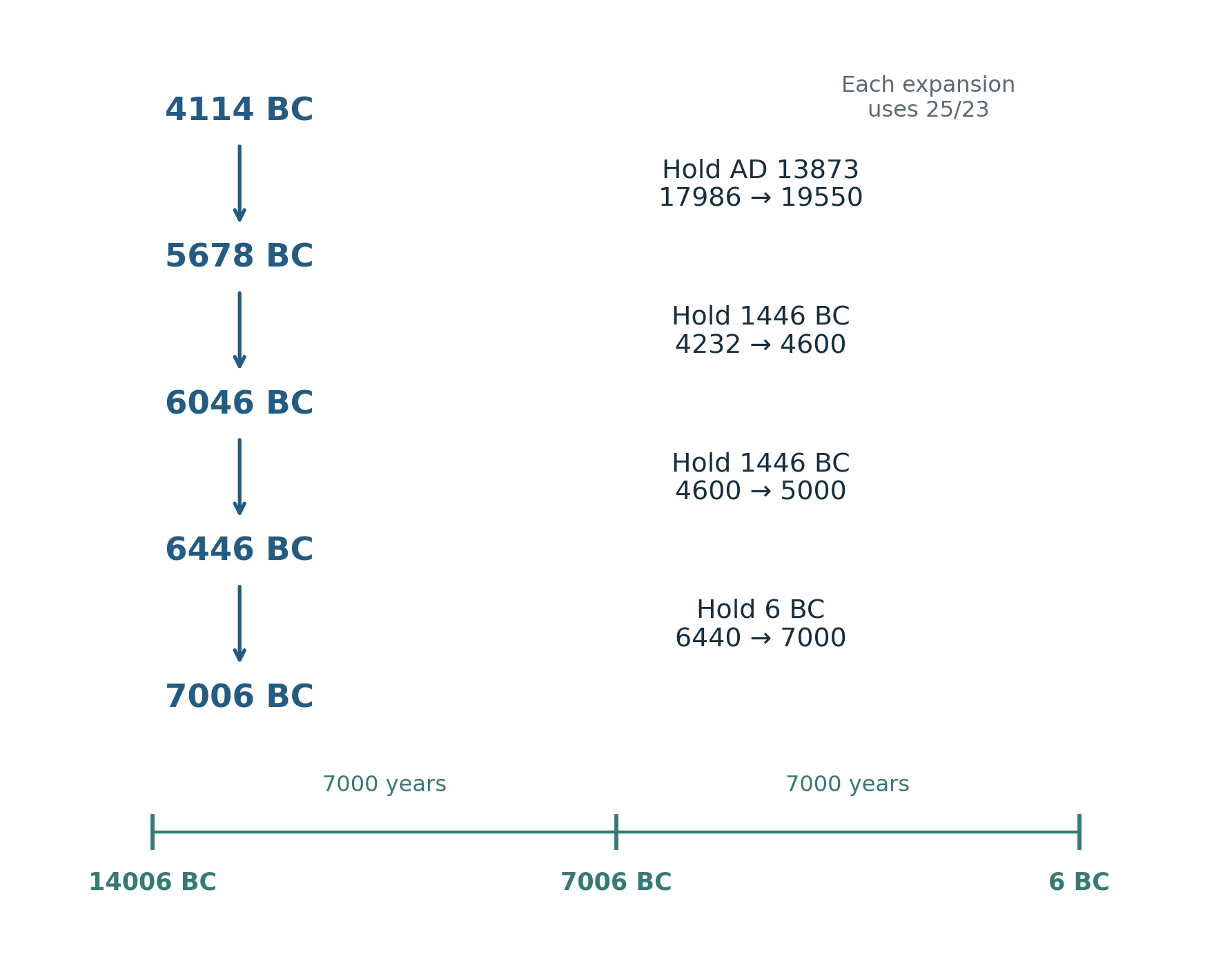
For this first movement, hold the Passion endpoint at AD 13873 and expand backward. The span 17986 becomes 19550. Under civil counting, a span of 19550 ending at AD 13873 begins at 5678 BC. The operation has moved the represented Creation position back by 1564 years.
That new position stands 4232 years before the Exodus. This is another doubled factor of 23: 4232 = 8 × 23². Hold the Exodus fixed and expand backward again. The span becomes 4600, placing the Creation comparison at 6046 BC. Since 4600 still contains the required factor of 23, a further expansion makes it 5000 and moves the date to 6446 BC.
Table 12 The successive backward expansions
| Starting BC position | Fixed endpoint | Span before expansion | Span after 25/23 | New BC position |
|---|---|---|---|---|
| 4114 | AD 13873 | 17986 | 19550 | 5678 |
| 5678 | 1446 BC | 4232 | 4600 | 6046 |
| 6046 | 1446 BC | 4600 | 5000 | 6446 |
| 6446 | 6 BC | 6440 | 7000 | 7006 |
The intermediate position 6446 BC has its own arrangement. It stands 4600 years before the 1846 BC affliction datum and 5000 before the Exodus. To the Conquest in 1406 BC are 5040 years, or four sets of 1260. From the Rounded cumulative Creation at 14006 BC to 6446 BC are 7560 years, or six sets of 1260. Thus 6446 divides the cumulative 12600-year Creation-to-Conquest span into 6 × 1260 and 4 × 1260.
Finally, hold the Christ datum at 6 BC. From 6446 BC to that datum are 6440 years. Its priestly expansion is 7000, placing the represented Creation at 7006 BC. This is exactly halfway from 14006 BC to 6 BC. The sequence that began with the Passion’s 666 × 23 comparison has reached a seven-thousand-year rest before Christ’s chronological datum.
I read this as a numerical representation of renewal reaching back toward the beginning. The underlying chronological anchors have not been replaced: ordinary MT Creation remains 4114 BC, and the newly generated dates belong to the expansion sequence. What changes is the position from which Creation is represented in relation to the Cross. The distinction lets the calculation express the proposed renewal without rewriting the source chronology.
The repeated 529 matters because one expansion can leave another exact expansion available. In the central residual, 8 × 23² becomes 8 × 23 × 25 and then 8 × 25²: 4232 → 4600 → 5000. The route also requires its stated changes of anchor. It is a sequence of expansions and comparisons, not one multiplication applied repeatedly to a single fixed interval.38
13 The inverse relationships around the Cross
The inverse studies add a different operation. They reverse the significant digits of a span while preserving its trailing zero placeholders. Thus 15500 becomes 55100, and 18200 becomes 28100. This is decimal reversal, not the reciprocal of a number. Applying the operation twice restores the original span.
The basic Rounded anchors include 14006, 4106, 1406, and 6 BC. Holding 6 BC fixed, 14006 BC gives a span of 14000; its inverse is 41000, rebuilt as 41006 BC. Likewise, 4106 BC gives 4100, whose inverse 1400 rebuilds as 1406 BC. The inverse operation exchanges the two pairs.
Now hold symbolic AD 14095 fixed and use ordinary civil spans. The same dates form a different pairing:
Table 13 Inverse spans with symbolic AD 14095 fixed
| BC source | Civil span to AD 14095 | Inverse span | Rebuilt BC date |
|---|---|---|---|
| 1406 | 15500 | 55100 | 41006 |
| 4106 | 18200 = 50 × 364 | 28100 | 14006 |
| 14006 | 28100 | 18200 | 4106 |
| 41006 | 55100 | 15500 | 1406 |
| 6 | 14100 | 14100 | 6 |
For example, 1406 + 14095 − 1 = 15500. Reverse the span to 55100, then rebuild backward from the same AD endpoint: 55100 − 14095 + 1 = 41006 BC. The result is the inverse partner of 14006 BC in the earlier construction anchored at 6 BC. The two anchors therefore rearrange the same four dates into a closed set of pairings.
The 4106 BC row is significant: its span is 18200, fifty Enochian years of 364. The civil calculation uses 4106 BC. The adjacent AD displays 4105/4106 belong to the separate Rounded Mirror convention explained in Appendix E.
Some spans remain unchanged under reversal. I call these self-inverse. The 14100 from 6 BC to AD 14095 is one, as is the 9900 between 14006 and 4106 BC. Their fixed character is part of the arrangement. A self-inverse span is still within the operation; it simply returns the same date when rebuilt from the same anchor.
The AD companions bring a proportional relationship into view. AD 4105 to AD 14095, and AD 4106 to AD 14096, each give 9990 = 9 × 1110. The further movement to AD 15205/15206 adds 1110, making 11100 = 10 × 1110 from AD 4105/4106. All three spans are self-inverse. The proportion is nine groups of 1110 followed by one more group of 1110.
The AD 30 companion adds a related Creation span. From the rounded Creation mirror at AD 4105 to expanded AD 13995 are 9890 = 23 × 430 years. This repeats the Actual cumulative-to-regular Creation bridge: 14006 to 4116 BC in the Year 6 states, or 14004 to 4114 BC at the completion endpoints. The matched states retain their own identities; Appendix E records the comparison beside the separate Rounded gap of 9900.39
The Conquest comparison at AD 15205 is also self-inverse: 1406 + 15205 − 1 = 16610. At AD 14095, the corresponding span was 15500, which changed to 55100. The two expanded Passion endpoints thus have different but coordinated functions. One participates in a nontrivial exchange of the Rounded anchors; the other preserves the Conquest span under reversal.
Jacob enters the same field. From his birth at 2006 BC to AD 14095 are 16100 years, or 7 × 2300 = 14 × 1150. Half the span is 8050 = 7 × 1150. The whole 16100 is self-inverse. I read the sevenfold structure beside Jacob’s repeated sevens and his lifespan of 147 = 3 × 7 × 7.
Inverse numbers can express different things in different settings. Here I read the reversals in relation to the undoing of the curse. Their placement around the endpoint already formed by 666 × 23 → 7770 + 7770 gives that reading a particular context. The algebra establishes the closed pairings; their redemptive meaning belongs to the argument about Christ.40
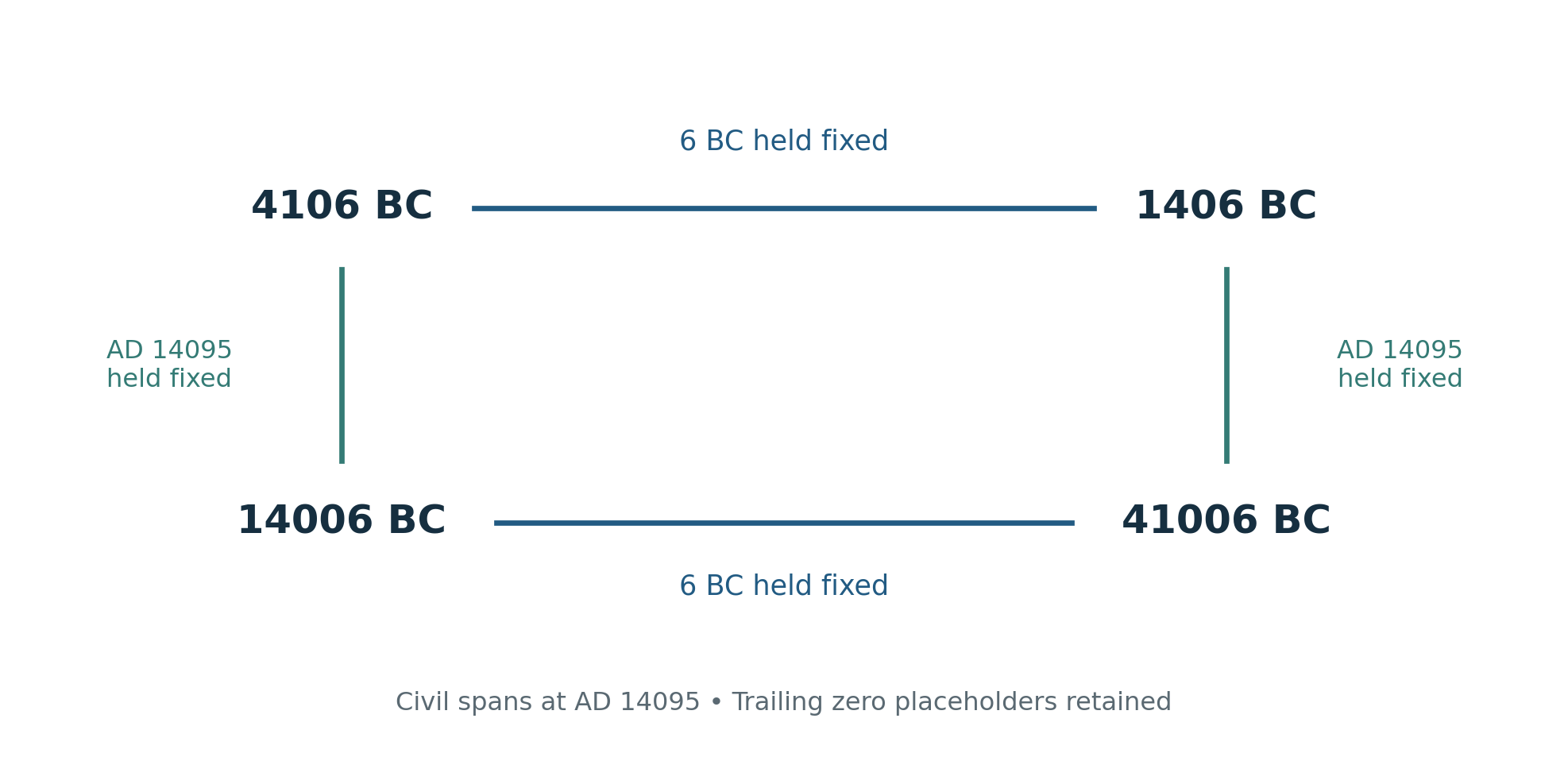
14 The Mirror and the Enochian half week
The two expanded Passion branches also face one another across the BC/AD boundary. Begin with the AD 15205 position and follow its adjacent represented days through AD 15208. Place opposite them the BC counterparts of the other branch, in reverse order: 14098 through 14095 BC. For this comparison, a BC counterpart retains the same year numeral while changing the era label. Appendix E distinguishes this convention from other Mirror operations. Every crossed pair has the same civil span.
Table 14 Crossed Passion positions
| AD position | Opposite BC position | Civil span |
|---|---|---|
| 15205 | 14098 | 29302 |
| 15206 | 14097 | 29302 |
| 15207 | 14096 | 29302 |
| 15208 | 14095 | 29302 |
The common total is 29302 = 23 × 1274. The coefficient 1274 is the Enochian half-week: 3½ × 364 = 14 × 91. Its common 360-day representation is 1260 = 14 × 90. Revelation 11 places the witnesses’ 1260-day testimony beside the three and a half days before their restoration. The numerical comparison holds those two scales together: the longer span contains the Enochian half-week as its coefficient, while the adjacent Passion positions preserve the death and third-day pattern.41
The endpoint sequence must be read according to its stated frame. If AD 15206 represents the death, then AD 15208 is the third day counted inclusively: two elapsed day-years later. The distance from the initiating position AD 15205 to AD 15208 is three. A half-year phase can extend that local symbolic interval to three and a half without altering the paired cross-axis totals. Here n marks the Nisan boundary and t the Tishri boundary. One explicit construction begins at the preceding Tishri, AD 15204t, and ends at AD 15208n. Its counterpart runs from 14099t BC to 14095n BC. Each local interval is 3½ years, and the corresponding Tishri-to-Tishri and Nisan-to-Nisan crossed spans remain 29302.
The lunar date perspectives also retain their respective third-day labels: death on Nisan 14 leads to Nisan 16, while death on Nisan 15 leads to Nisan 17. A represented sequence from the evening ending Nisan 13 to Nisan 17 morning spans three and a half day-units in a morning-based diagram. That comparison receives the betrayal boundary and the Nisan 17 resurrection label into the common frame. It should not be substituted for the literal Thursday-supper-to-Sunday-morning interval, or for the Nisan 14-to-16 third-day sequence used in the adjacent positions above.
This represented half-week does not measure the historical time spent in the tomb. Nor should it be confused with Book 1’s separately stated hourly frames around Friday noon. Noon marks the midpoint of the six-hour crucifixion framework, with Christ already on the Cross; it is not the reported hour of His death. The symbolic day-year construction concerns the calendar positions being gathered around that historical Passion.
The span contains one further connection with Shem’s numbers:
29302 = 49 × 598; 29302 × (300/299) = 29400 = 49 × 600
29302 × (25/23) = 31850 = 49 × 650
The same total therefore admits the 598/600/650 family found in the Noah and Shem comparisons. This closes a line of inquiry that began with the Gears at Christ’s birth and now reaches the represented death and resurrection. I give it as an additional relationship, rather than making it carry the entire argument.
15 Christ standing in the place of humanity
The calculations have led from the birth window through the Exodus span to the Passion, Atonement, and a represented renewal of Creation. Their theological direction depends on who occupies the center. Christ takes the place of the human family whose history the numbers measure.
This is why the three Gears matter beyond their arithmetic. In the repository’s structure, Shem occupies the positions associated with his brothers. In the fulfillment I am proposing, Christ stands for the human family represented through all three brothers. His birth gathers the representatives of the renewed world, and His death bears the judgment from which that world must be delivered. He takes the Flood upon Himself in the sacrificial and substitutionary sense intended by this reading.
The same Gear movement returns at the represented death. Shem’s Gear 2 death at 1958 BC reaches AD 12763 by 14720 years; his Gear 1 death at 1956 BC reaches AD 12765 by the same span. These are the AD 30 Nisan 13 and Nisan 15 positions. In each case 14720 = 23 × 640 expands to 16000 = 40 × 400. I see the birth pattern brought to completion here: Christ, the true Shem of God in this reading, stands between two condemned men and bears the judgment of fallen humanity. The numerical recurrence serves the substitutionary meaning already guiding the study.15
First Peter gives this interpretation a fitting scriptural setting. Its account of Christ’s suffering moves directly to Noah, the preservation of eight people through water, and baptism understood through Christ’s resurrection. The passage joins judgment, deliverance, and new life around the righteous One who suffers for the unrighteous. I bring the Gear and Flood comparisons into that setting. The numerical structure is my proposed reading of its wider chronological testimony.
The 360 calendar contributes by receiving the represented forms of other calendars. The lunar Nisan 14 and Nisan 15, the significance of the weekday, and the Enochian half-week can all enter its common language. Their native distinctions continue to matter. The same principle allows the lunar and Enochian Pentecost positions to appear as different numbered days in the common frame, as Appendix D shows.
I regard the result as a numerical witness consistent with the center of time contemplated in Book 1. The 3588-year birth comparison admits three exact expansions. The AD 30 and AD 33 Passion positions receive the paired 616/666 spans, their ministry interval returns between the expanded branches, and Shem’s birth and death connect the two parts of the study. The 15318-year Passion comparison produces the 222-day movement toward Atonement. Repeated factors of 23 then carry the represented Creation back to 7006 BC, while the inverse relationships place the Passion endpoints among the established Rounded anchors.
The literal dates that generate the symbolic years also return through the First Adam and the cumulative chronology. The 555 birth count connects the complete life-span comparisons with the 1110 + 222 + 1110 symmetry, while the birth Mirror reproduces the three-year interval found between the alternative Passion dates. In this limited fractal-like recurrence, the inputs and their symbolic results participate in the same proposed witness.
These relationships do not tell me how God renews time. They give me reason to consider whether its renewal reaches as far as the beginning from which the damage came. In Book 1 I asked whether the Cross could act upon past and future more deeply than our ordinary account of sequence permits us to imagine. Here that question receives a set of numerical forms. Creation is represented as coming to rest seven thousand years before the Christ datum, halfway across the cumulative span to that datum.
Book 2 can now return to the heavens around Christ’s birth with this companion study available beside it. The astronomical inquiry will have its own dates, positions, and uncertainties. The present study supplies the day–year relationships that would be too extensive to repeat within that account. Both inquiries look toward the same Christ, entering His creation and reconciling it through the Cross.
Appendix A The complete Noah and Shem tables
All dates in this appendix are BC. The tables use the repository’s full-430 comparison frame. MT follows the normal 430-year Egyptian sojourn, with no additional sixty years for Terah and no restored second Cainan. SP uses its equalized positions, 215 years earlier than its native dates: its Gear 2 Flood at 3108 BC corresponds to native 2893 BC. The LXX comparison retains its native second Cainan. The SP and LXX offsets below apply to the selected Noah–Shem–Flood block; they are not universal offsets for every date from Creation onward. Arphaxad remains fixed within each selected tradition at MT 2456, SP 3106, and LXX 3236 BC.
Table A1 MT Noah and Shem
| Event | G1 | G2 | G3 |
|---|---|---|---|
| Noah born | 3056 | 3058 | 3060 |
| Noah dies | 2106 | 2108 | 2110 |
| Shem born | 2556 | 2558 | 2560 |
| Shem dies | 1956 | 1958 | 1960 |
| Flood year opens | 2456 | 2458 | 2460 |
| Following year | 2455 | 2457 | 2459 |
Table A2 SP primary Noah and Shem positions
| Event | G1 | G2 | G3 |
|---|---|---|---|
| Noah born | 3706 | 3708 | 3710 |
| Noah dies | 2756 | 2758 | 2760 |
| Shem born | 3206 | 3208 | 3210 |
| Shem dies | 2606 | 2608 | 2610 |
| Flood year opens | 3106 | 3108 | 3110 |
| Following year | 3105 | 3107 | 3109 |
The SP has a local one-year companion at Noah and Shem. For Gear 2, Noah’s primary 3708 BC birth gives 600 completed years to the Flood’s 3108 BC opening. The companion 3707 BC birth gives 599 completed years to that opening, placing it in the counted six-hundredth year, and 600 to the following 3107 BC boundary. The companion moves the person positions down by one year; it does not move the Flood event or every earlier date. The source qualifies the primary Noah display as inclusive/harmonic. His primary death at 2758 BC is 350 years after the 3108 BC Flood opening; his companion death at 2757 BC is 350 after the 3107 BC close. Both matched birth-to-death subtractions preserve 950. The separate SP shorter-sojourn selection is not opened here.42
Table A3 LXX Noah and Shem
| Event | G1 | G2 | G3 |
|---|---|---|---|
| Noah born | 3836 | 3838 | 3840 |
| Noah dies | 2886 | 2888 | 2890 |
| Shem born | 3336 | 3338 | 3340 |
| Shem dies | 2736 | 2738 | 2740 |
| Flood year opens | 3236 | 3238 | 3240 |
| Following year | 3235 | 3237 | 3239 |
Within each matching Gear, the tabulated Noah lifespan is 950 and Shem’s is 600. A cross-Gear comparison can instead produce 598 or 602; it must be identified as such. The 598 → 600 or 650 comparisons do not change the matching-Gear lifespan.
Appendix B The SP and LXX support
Table B1 Noah and Flood comparisons with the birth window
| Earlier BC position | Symbolic AD endpoint | Span | Relationship |
|---|---|---|---|
| MT Noah 3060 G3 / 3058 G2 | 2141 / 2143 respectively | 5200 | 8 × 650 = 40 × 130 |
| SP Noah 3710 G3 / 3708 G2 | 2141 / 2143 respectively | 5850 | 9 × 650 |
| LXX Noah 3840 G3 / 3838 G2 | 2141 / 2143 respectively | 5980 | 46 × 130 = 20 × 299 |
| SP Flood 3108 G2 | 2137 | 5244 | 46 × 114 → 5700 |
| SP Noah 3708 G2 / 3706 G1 | 2135 / 2137 respectively | 5842 | 46 × 127 → 6350 |
| SP Noah dies 2760 G3 / 2758 G2 | 2141 / 2143 respectively | 4900 | 70 × 70 |
The 5980-year LXX span expands by 300/299 to 6000 and by 25/23 to 6500. The LXX Creation position 5494 BC stands 1656 = 23 × 72 years before Noah’s Gear 2 birth at 3838 BC. The 5200, 5850, and 5980 comparisons preserve the manuscript separations: SP adds 650 to the MT span, and LXX adds another 130. Multiples of fifty and one hundred appear both before and after expansion.
MT Lamech supplies a further cross-tradition comparison. He is born in 3240 BC and dies in 2463 BC at 777, five years before the normal MT Flood. His birth lies two years before the LXX Flood at 3238 BC, itself two years before LXX Arphaxad at 3236 BC. LXX Noah’s birth at 3838 BC is 598 years before MT Lamech’s birth.
Table B2 The Lamech comparison
| Interval | Span | Enochian expansion | Priestly expansion |
|---|---|---|---|
| 3838 BC to 3240 BC | 598 | 600 | 650 |
| 3240 BC to AD 2143 | 5382 = 9 × 598 | 5400 | 5850 |
| 3838 BC to AD 2143 | 5980 = 10 × 598 | 6000 | 6500 |
The LXX Flood itself does not give the same Key-of-23 multiple to the selected AD 2141/2143 pair. The Lamech comparison is therefore named as a cross-tradition construction. It should not be presented as though the Flood date alone supplied its arithmetic.
Appendix C Birth boundaries and seasonal counts
Table C1 Literal endpoints and Julian Day values
| Endpoint | JD at midnight | Elapsed from epoch | Symbolic AD |
|---|---|---|---|
| Julian Dec 25, 1 BC | 1721416.5 | 2134 | 2135 |
| Gregorian Dec 25, 1 BC | 1721418.5 | 2136 | 2137 |
| Julian Dec 31, 1 BC | 1721422.5 | 2140 | 2141 |
| Gregorian Dec 31, 1 BC | 1721424.5 | 2142 | 2143 |
| Julian Jan 1, AD 1 | 1721423.5 | 2141 | 2142 |
| Gregorian Jan 1, AD 1 | 1721425.5 | 2143 | 2144 |
The fixed epoch is JD 1719282.5. Gregorian December 31, 1 BC, is the same instant as Julian January 2, AD 1. Consequently, the span from symbolic AD 2143 to AD 13873 is 11730 = 17 × 690 = 17 × 30 × 23. Using Julian December 31 instead would begin at AD 2141 and give 11732.
Table C2 Alternative conception intervals
| Selected model | Calculation | Endpoint from John’s conception |
|---|---|---|
| 280-day pregnancy and 180-day birth interval | 280 + 180 = 460 | Jesus’ birth |
| Nine Enochian months and 180-day interval | 273 + 180 + 7 = 460 | Jesus’ circumcision |
| Nine Enochian months and 182-day interval | 273 + 182 + 7 = 462 | Jesus’ circumcision |
The seven in the last two rows is seven elapsed days, reaching the eighth day inclusively. The first row is the principal construction of the published birth study. There, John’s conception occupies symbolic AD 1675 or AD 1677 when Jesus’ birth occupies AD 2135 or AD 2137. The circumcision-based alternatives require their own conception positions. Luke 1:19 identifies the announcing angel as Gabriel.
The published birth model also distinguishes the inclusive fortieth-day presentation marker, thirty-nine elapsed days after birth, from a full forty-day terminal. Thus the principal 460-day model reaches 499 at the inclusive fortieth day and 500 after forty complete days. The 460 → 500 expansion uses the latter terminal. A numerical relationship should never erase that counting difference.
Table C3 The matched 5796 year boundaries
| Earlier boundary | Later boundary | Elapsed span |
|---|---|---|
| Close of 3654 BC Opening of 3653 BC | Close of AD 2143 Opening of AD 2144 | 5796 |
| Close of 4114 BC Opening of 4113 BC | Close of AD 1683 Opening of AD 1684 | 5796 |
The two earlier boundaries are 460 years apart, and so are the later boundaries. This is the boundary-based form of the Jared/John comparison. It is distinct from treating 4114 BC to the beginning of AD 1684 as an unsuffixed civil span, which would give 5797.
The Flood’s earlier seasonal alternative moves six months back from 2458n BC to 2459t BC. Here n identifies Nisan and t Tishri. When a year is represented as a day, the six-month movement corresponds to moving from spring’s 6 a.m. position to the preceding autumn’s 6 p.m. position, twelve represented hours earlier. I relate that phase difference to John’s six-month precedence over Jesus. The main 4600-year argument uses its declared winter-to-winter comparison and does not require this additional phase construction.
Appendix D Ministry Pentecost and residual spans
The ministry opening and the forty-day wilderness interval preserve a paired Exodus/Conquest relation. Hold each BC anchor fixed when applying 25/23.
Table D1 Forty days beside forty years
| BC anchor | Original AD endpoint | Original span | Expanded span | Expanded AD endpoint |
|---|---|---|---|---|
| 1446 | 12585 | 14030 = 23 × 610 | 15250 | 13805 |
| 1406 | 12625 | 14030 = 23 × 610 | 15250 | 13845 |
Each gain is 1220 = 610 + 610. Since the original AD endpoints are forty apart, AD 13845 stands 1260 after AD 12585. The associated longer comparisons are 16 BC to AD 12585 = 12600 and AD 25 to AD 12625 = 12600. These are supporting relationships; they are not needed to derive the principal 666 × 23 Passion span.
The common 360 frame also receives Pentecost’s positions from the other calendar constructions. Day 15 is represented by AD 13875. Day 65 is fifty days later, giving AD 13925; Day 75 is sixty days later, giving AD 13935. Book 1’s selected lunar calculation supplies the first position, and the Enochian arrangement supplies the second. The earlier lunar Nisan alternative can give Day 66 and remains separately identified in Book 1. These are represented festival positions, not a claim that one physical calendar observes Pentecost on all three dates.
Table D2 Festival positions received by the common frame
| Position | Ordinal day of year | Symbolic AD |
|---|---|---|
| Passover and departure representation | 15 | 13875 |
| Selected lunar Pentecost representation | 65 | 13925 |
| Enochian Pentecost representation | 75 | 13935 |
Two residual Key-of-23 comparisons use the BC counterparts of the expanded death-day labels. The operation is expressly a numeric-year counterpart comparison; its cross-axis convention is explained in Appendix E.
Table D3 Residual comparisons after taking BC counterparts
| Expanded AD label | Selected BC counterpart | Later BC anchor | Same-side span |
|---|---|---|---|
| 14096 | 14096 BC | 1446 BC | 12650 = 23 × 550 |
| 15206 | 15206 BC | 1406 BC | 13800 = 23 × 600 = 6 × 2300 |
The direct span from 1406 BC to AD 15206 is 16611. The 13800 belongs to the same-side BC comparison after taking the stated counterpart. Similarly, the direct spans from 1406 BC to AD 14095 and AD 15205 are 15500 and 16610. Keeping the direction visible prevents the residual calculation from being mistaken for a direct historical interval.
The first backward Creation position also has a Flood relation: 5678 − 2458 = 3220 = 23 × 140, expanding to 3500, half of 7000. At 6446 BC, the surrounding spans are 4600 to 1846 BC, 5000 to 1446 BC, and 5040 = 14 × 360 = 4 × 1260 to 1406 BC. The cumulative counterpart is 14006 − 6446 = 7560 = 6 × 1260.
The earlier birth comparison has a compatible division. Creation 4114 BC to Flood 2458 BC gives 1656, which expands to 1800; Flood to Exodus gives 1012, which expands to 1100; Exodus to symbolic AD 2143 gives 3588, which expands to 3900. The original spans total 6256 and the expanded spans total 6800, preserving the complete Creation-to-birth comparison under the same 25/23 rule.
The repository’s whole-span inverse study contains a larger related chain: 12600 reverses to 62100 and, rebuilt from 1406 BC, reaches 63506 BC. The 62100 expands by 70/69 to 63000, reaching 64406 BC. From there to 6 BC are 64400 years, which expand by 25/23 to 70000, reaching 70006 BC. The present 6440 → 7000 construction has one tenth of those final spans and the same 6 BC anchor. This scale relation does not make the earlier operations in the two chains identical.
The AD 30 ministry and its festival positions
The AD 30 Passion option uses Tishri 15, AD 26, to Nisan 15, AD 30. No leap month occurs within this selected interval, so its span is 1260 days. The AD 33 option uses Tishri 15, AD 29, to Nisan 15, AD 33, and contains the AD 31 leap month, giving 1290. Both use the same Christ-frame coordinates.
Table D4 The AD 30 ministry sequence
| Mapped 360-calendar position | Symbolic AD | Days to next position |
|---|---|---|
| Tishri 10, AD 26: Atonement | 11500 | 5 |
| Tishri 15, AD 26: Tabernacles | 11505 | 1150 |
| Kislev 25, AD 29: Dedication | 12655 | 110 |
| Nisan 15, AD 30: Passover Week | 12765 | — |
Thus 12765 − 1260 = 11505, and the Day of Atonement lies five days earlier at AD 11500. From Tishri 15, AD 26, to Kislev 25, AD 29, are 1080 + 70 = 1150 days, followed by 110 to Nisan 15. John 10:22–23 supplies the winter Dedication setting; Kislev 25 is the festival opening received by this schematic mapping, rather than a day number specified by John.43
The AD 29 ministry opening remains AD 12585, since 11505 + 1080 = 12585. The two Passion-year options therefore preserve their respective 1260/1290 intervals without changing the epoch.
Table D5 Further AD 30 comparisons
| Earlier anchor | Symbolic endpoint | Span or expansion |
|---|---|---|
| Exodus, 1446 BC | AD 12763 | 14208 = 888 × 16 |
| AD 25 | AD 12765 | 12740 = 35 × 364 = 26 × 490 |
| Exodus, 1446 BC | AD 12765 | 14210 = 29 × 490 |
| Shem’s death, 1958 BC, G2 | AD 12763 | 14720 → 16000 by 25/23 |
| Shem’s death, 1956 BC, G1 | AD 12765 | 14720 → 16000 by 25/23 |
From the 6 BC birth framework, AD 25 gives the thirty-year civil comparison: 6 + 25 − 1 = 30. Exodus to AD 25 is 1470 = 3 × 490, completing the difference between the twenty-six and twenty-nine jubilees. The two Shem death rows preserve the 600-year biographies 2558–1958 BC in Gear 2 and 2556–1956 BC in Gear 1. Their common span expands from 23 × 640 to 25 × 640 = 16000.
The expanded 616 position and the seventies
The earlier wilderness endpoint also meets the Conquest-held 616 expansion. Symbolic AD 13995 stands 2450 years after AD 11545: 50 × 49, or 35 × 70. Both positions retain exact multiples of seventy to the three established BC anchors.
Table D6 The common series of seventies
| Earlier anchor | Span to symbolic AD 11545 | Span to symbolic AD 13995 |
|---|---|---|
| Christ frame, 6 BC | 11550 = 70 × 165 | 14000 = 70 × 200 |
| Conquest, 1406 BC | 12950 = 70 × 185 | 15400 = 70 × 220 |
| Cumulative Creation, 14006 BC | 25550 = 70 × 365 | 28000 = 70 × 400 |
Each pair differs by 2450 = 35 × 70. The longest span to AD 11545, 25550, displays seventy 365-day units on the day–year scale. The 11550 from 6 BC to AD 11545 is also 7 × 1650, matching 14006 BC to 2456 BC. That second comparison selects cumulative Rounded Creation and the regular Rounded Flood/Arphaxad node. It consists of the 9900 = 6 × 1650 to Rounded Creation at 4106 BC, followed by another 1650 to 2456 BC.44
The temple, birth week, and Passion week
Table D7 The literal ministry position and its symbolic comparisons
| Earlier position | Later position | Original span | By 25/23 |
|---|---|---|---|
| Temple beginning, 20 BC | Literal AD 27n | 46 | 50 |
| Literal AD 27n | Symbolic AD 2143n | 2116 = 46 × 46 | 2300 |
| Literal AD 26t | Symbolic AD 2142t | 2116 = 46 × 46 | 2300 |
| Temple beginning, 20 BC | Symbolic AD 2143n | 2162 = 46 × 47 | — |
| Literal AD 27n | Symbolic AD 13873n | 13846 = 23 × 602 | 15050 = 70 × 215 = 35 × 430 |
The matching n/n and t/t birth rows preserve the half-year shift at both endpoints. The AD 2143n position is the selected seasonal phase of the closing birth-week day; the distinct January 1 values in Table 1 remain attached to their stated calendar endpoints. The last row compares a literal ministry date with a symbolic Passion coordinate. Its converted value is a duration; no additional rebuilt endpoint is required here.
Appendix E Civil dates Rounded coordinates and Mirror phases
Three different operations appear in this study: expanding a span, reversing the digits of a span, and placing dates in a reflected or counterpart arrangement. Each must retain its own rule. The equations in the main text use ordinary civil elapsed counting unless this appendix states a specific alternative.
Table E1 The counting conventions
| Convention | Rule | Use here |
|---|---|---|
| Same-side elapsed span | Subtract the year labels | BC-to-BC and AD-to-AD comparisons |
| Civil cross-axis span | B + A − 1 | All main cross-axis calculations |
| Rounded coordinate width | B + A − 2 | Only the explicitly described companion display |
| Numeric-year counterpart | Retain the numeral and change BC/AD side | Appendix D residuals and the stated crossed pairs |
| Whole-span inverse | Reverse significant digits; retain trailing zeros | Table 13 and Figure 6 |
In the Rounded coordinate convention, a BC label B has coordinate −(B − 1), and an AD label A has coordinate A − 1. A cross-axis width is therefore B + A − 2. Consequently, the widths calculated from AD 14095 in the civil convention equal those calculated from AD 14096 in this Rounded convention. The companion result is legitimate only when the change of convention is stated.
Rounded inverse sources can also use a legacy positive-coordinate display one lower than the symmetric AD label. This accounts for paired AD displays such as 4105/4106. It does not license moving an ordinary literal day-year date by one. The equal-numeral counterparts used in the present Mirror comparisons likewise remain distinct from the astronomical/civil reflection used in parts of the earlier birth series, where a symbolic AD numeral can reflect to the next BC numeral. The chosen endpoints, rather than the word Mirror alone, determine the arithmetic.45
For seasonal work, n denotes Nisan and t Tishri. In the phase calculation used here, corresponding seasonal positions on opposite sides preserve the civil year span. This is why the Tishri pair 14099t BC to AD 15204t and the Nisan pair 14095n BC to AD 15208n each give 29302, while the local Tishri-to-Nisan intervals are 3½ years. A date’s phase cannot be discarded merely because its year numeral looks convenient.
Several useful spans are self-inverse in the placeholder-preserving operation: 9900, 9990, 1110, 11100, 14100, 16100, and 16610. The operation remains defined for all of them. The phrase non-reversible, if used informally, means that reversal makes no change.
Completion counts and opening timestamps
Day 0 is the opening of Nisan 1 in the 6 BC frame. The thirty-eight years to Nisan 1 in AD 33 give 13860 days. At completion, Nisan 13 adds thirteen, yielding 13873. The Julian midnight listed for February 13 identifies the opening of the corresponding represented day; the end-of-day count is one further day. The same symbolic label names that whole day. The 13873 calculation is therefore a completed elapsed count with its stated boundary, rather than merely an inclusive increment attached to an unstated endpoint.
The two phase-resolved Passion halves
For the following local symbolic construction, n supplies the morning/Nisan position and t the evening/Tishri position. Numerically, qn = q and qt = q + 0.5. These phases carry the represented Passion meanings through the expansion; they do not replace the fixed-epoch Julian dates in Appendix F.
Table E2 Two three-and-a-half-unit halves
| Direction | At 1332 | At 1335.5 | Local Passion interval |
|---|---|---|---|
| Forward from AD 12763t | AD 14095t | AD 14099n | Nisan 13 evening → Nisan 17 morning: 3½ |
| Backward from AD 15205t | AD 13873t | AD 13870n | Nisan 10 morning → Nisan 13 evening: 3½ |
The forward half measures 14099 − 14095.5 = 3.5; the reverse half measures 13873.5 − 13870 = 3.5. Together they give seven represented units. The integer comparisons remain 12763 + 1335 = 14098 and 15205 − 1335 = 13870; the explicit phases explain the half-unit completion.
The Creation bridge and the Atonement coordinate
Table E3 The repeated 9890 Creation bridge
| Comparison | Declared states | Span |
|---|---|---|
| 14006 BC → 4116 BC | Actual Year 6 / Adam states | 9890 = 23 × 430 |
| 14004 BC → 4114 BC | Actual completion endpoints | 9890 = 23 × 430 |
| AD 4105 → AD 13995 | Rounded Creation mirror → expanded AD 30 position | 9890 = 23 × 430 |
The original Rounded comparison remains 14006 − 4106 = 9900. Its Actual 9890 counterpart is reproduced at the expanded AD 30 position without exchanging these node classes.
The Atonement position at symbolic AD 11500 also gives the doubled Mirror coordinate 2 × 11500 = 23000 = 10 × 2300. When expressed as an elapsed civil cross-axis span, an exact display is 11501 BC to AD 11500, since 11501 + 11500 − 1 = 23000. This boundary-based reflection differs from placing the identical numeral on each side, which would give 22999. The coordinate operation and the civil labels must remain explicit.
Appendix F The Atonement date and its astronomical status
The literal date arithmetic is independent of the ancient month-opening reconstruction. The table gives both the Julian Day at midnight and the Julian Day Number associated with the civil daylight date.
Table F1 The exact 222 day comparison
| Julian date in AD 33 | JD at midnight | Daylight JDN | Symbolic AD |
|---|---|---|---|
| February 13 | 1733154.5 | 1733155 | 13873 |
| February 14 | 1733155.5 | 1733156 | 13874 |
| September 23 | 1733376.5 | 1733377 | 14095 |
| September 24 | 1733377.5 | 1733378 | 14096 |
Each corresponding pair differs by 222 days. September 23 is Wednesday and September 24 Thursday. Under the preferred crescent reconstruction, Atonement begins on Wednesday evening and continues through Thursday daylight. Under the projected fixed calendar, it begins Tuesday evening and has Wednesday daylight.
The conjunction at September 12, 09:42 UT is independently tabulated by NASA. The working visibility estimate used for the preferred reconstruction places the Moon about 5½ degrees above the Jerusalem horizon at sunset on September 13, with roughly thirty minutes to moonset. Its reported Yallop value is approximately q = −0.21, compared with about q = +0.79 on September 14. Those values favor September 14 for an unaided sighting. They are retained as the reconstruction’s calculated estimates, not as a new independent ephemeris determination in this study. A conjunction table alone does not establish a visible crescent, and neither calculation records the weather or the ancient calendrical decision.
The exact statement supported by the present comparison is therefore bounded: the Key’s 222-unit increase corresponds to literal September 23/24, AD 33, and that pair receives Atonement’s evening/daylight meaning under the stated crescent reconstruction. The alternative fixed-calendar result remains available alongside it. Leviticus 23:27 and 32 supply the festival date and its evening boundary.
Appendix G Adam, the birth count, and the Julian Mirror
These tables preserve the states used in Section 10. Nisan is normative. An earlier Tishri phase is written one BC numeral higher, or one AD numeral lower: 4114n/4115t BC and AD 27n/26t illustrate the convention. Matching n/n or t/t comparisons preserve the stated span. A Creation-week member, its close, and an apparent-age overlay remain different positions.
Adam’s regular positions and the 460-year targets
Table G1 Regular Adam positions, all BC
| Selected position | MT Nisan / earlier Tishri | LXX Nisan / earlier Tishri |
|---|---|---|
| Creation-week opening | 4121n / 4122t | 5501n / 5502t |
| Year-6 opening: Adam created | 4116n / 4117t | 5496n / 5497t |
| Regular Creation endpoint; literal-week year | 4114n / 4115t | 5494n / 5495t |
| Apparent-age overlay: Year 6 + 30 | 4146n / 4147t | 5526n / 5527t |
| Apparent-age overlay: literal-week year + 30 | 4144n / 4145t | 5524n / 5525t |
| Death after 930 from the regular endpoint | 3184n / 3185t | 4564n / 4565t |
| 930-year comparison from the Year-6 opening | 3186n / 3187t | 4566n / 4567t |
The first apparent-age row is the repository’s Year-6-plus-thirty overlay. The second is the separately selected overlay on the literal-week year. The regular death row is calculated from 4114/5494 BC; the final row keeps the Year-6-based comparison separate. The matching LXX and MT positions differ by 1380 = 3 × 460. These classifications prevent an apparent-age position or Year-6 member from replacing the ordinary Creation endpoint.20
Table G2 Multiples of 460 meeting the Christ-period window
| Origin or comparison position | Nisan target / earlier Tishri phase | MT span | LXX span |
|---|---|---|---|
| Year-6 apparent age: 4146 / 5526 BC | 6n BC / 7t BC | 4140 = 9 × 460 | 5520 = 12 × 460 |
| Literal-week apparent age: 4144 / 5524 BC | 4n BC / 5t BC | 4140 = 9 × 460 | 5520 = 12 × 460 |
| Creation-week opening: 4121 / 5501 BC | AD 20n / 19t | 4140 | 5520 |
| Year-6 opening: 4116 / 5496 BC | AD 25n / 24t | 4140 | 5520 |
| Regular endpoint: 4114 / 5494 BC | AD 27n / 26t | 4140 | 5520 |
| Year-6-based 930 comparison: 3186 / 4566 BC | AD 35n / 34t | 3220 = 7 × 460 | 4600 = 10 × 460 |
| Regular death: 3184 / 4564 BC | AD 37n / 36t | 3220 = 7 × 460 | 4600 = 10 × 460 |
The origins in Table G2 are printed in their Nisan forms; use Table G1’s earlier Tishri counterpart when selecting the Tishri target. Intermediate members of the seven-year Creation envelope similarly meet the intermediate AD 20–27 Nisan positions. The AD 25/35 comparisons retain the Year-6 member; the AD 27/37 comparisons retain the regular endpoint and death. The principal ministry pattern in this study uses AD 26t/36t and their following AD 27n/37n.
The literal-week apparent-age row also works without treating the Creation days as seven symbolic years. From 4145t BC to 5t BC are 4140 years; from 5t BC to AD 26t are thirty. The corresponding Nisan labels are 4144n BC, 4n BC, and AD 27n. The following Passover in AD 27 is consequently part of the AD 26–30 ministry option and its forty-six-year temple comparison. The evening-to-morning movement can likewise be read as Tishri-to-Nisan within the represented Creation day, retaining the apparent-age overlay in either seasonal phase.
Table G3 The 920-year difference and two secondary divisions
| Comparison | Original expression | By 25/23 |
|---|---|---|
| LXX Creation/death comparison difference | 5520 − 4600 = 920 | 6000 − 5000 = 1000 |
| MT Creation/death comparison difference | 4140 − 3220 = 920 | 4500 − 3500 = 1000 |
| MT Jared, 3655t BC → AD 26t | 3680 = 8 × 460 | 4000 |
| LXX Seth, 5265t BC → AD 26t | 5290 = 230 × 23 | 5750; gain 460 |
Jared is 460 years after MT Adam. From Jared to Adam’s regular death are 470 years; shifting the later comparison target by ten years leaves the second adjusted 460. LXX Seth is 230 years after Adam, hence 5264n/5265t BC. The millennial-day interpretation concerns these converted comparisons. Adam’s stated 930-year lifespan remains the chronological source.
Cumulative Creation, death, and the repeated gains
Table G4 Selected Actual cumulative positions, all BC
| Position | MT | Native LXX |
|---|---|---|
| Nisan Creation envelope | 14011–14004 | 14901–14894 |
| Year-6 opening | 14006n / 14007t | 14896n / 14897t |
| Selected endpoint | 14004n / 14005t | 14894n / 14895t |
| Endpoint + 30 apparent-age overlay | 14034n / 14035t | 14924n / 14925t |
| 930 later than the selected endpoint | 13074n / 13075t | 13964n / 13965t |
MT cumulative and regular corresponding Creation members are separated by 9890: 14006 − 4116 and 14004 − 4114 both give that span. These are Actual comparisons. The Rounded comparison 14006 − 4106 = 9900 retains its own state, as in Appendix E. The same year label, 14006 BC, therefore requires its selected node-class when used here.
Table G5 Cumulative comparisons with literal birth and ministry positions
| Fixed BC position | Literal later position | Span | By 25/23 | Gain |
|---|---|---|---|---|
| MT apparent age: 14035t | 5t BC | 14030 = 23 × 610 | 15250 | 1220 |
| MT Creation: 14005t | AD 26t | 14030 = 23 × 610 | 15250 | 1220 |
| MT Adam death: 13075t | AD 36t | 13110 = 23 × 570 | 14250 | 1140 |
| LXX apparent age: 14925t | AD 26t | 14950 = 23 × 650 | 16250 | 1300 |
| LXX Adam death: 13965t | AD 36t | 14000 = 14 × 1000 | Already rounded | — |
Holding the BC origin fixed, the MT Creation gain sends AD 26t to AD 1246t, and its death gain sends AD 36t to AD 1176t. The following Nisan displays are AD 1247n and AD 1177n. Thus 1176t − 26t = 1150, equivalently 1177n − 27n = 1150. This retains the earlier Tishri phase instead of relabeling a following Nisan year as Tishri. The gains 1220 and 1140 also equal 2 × 610 and 2 × 570.
The MT birth-side span is the same 14030 found in Appendix D: 1446 BC to symbolic AD 12585 and 1406 BC to AD 12625. Holding those BC anchors fixed gains 1220 in each case. Since 12585 + 40 = 12625, the latter expanded endpoint is 13845, exactly 1260 after 12585. This is the repeated 1220 + 40 construction. Its AD 29 calendar origins remain separate from the literal AD 26 inputs in Table G5.
Table G6 The LXX 1332 = 42 + 1290 recurrence
| Level | First position | After 42 | After a further 1290 |
|---|---|---|---|
| Literal seasonal years | 7t BC / 6n BC | AD 36t / 37n | AD 1326t / 1327n |
| Mapped Nisan 13 line: days become years | AD 13873 | AD 13915 | AD 15205 |
| Mapped Nisan 15 line: days become years | AD 13875 | AD 13917 | AD 15207 |
In the first row, the total 1332 combines the 32 years from 7t BC to AD 26t with the 1300-year expansion gain. The 1290 is also 1300 − 10. In the Nisan 15 row, the first forty-two days comprise two to Nisan 17 and forty more to Month 2, day 27. The remaining 1290 includes the AD 35 leap month and reaches Month 8, day 27 in AD 36. The earlier line retains Month 2, day 25 as its paired comparison. The first row is a year-level recurrence; the last two preserve the fixed-epoch calendar-day mapping.
Native LXX Creation at 14894n BC gives Adam’s cumulative death at 13964n BC after 930 years. Its earlier Tishri counterpart is 13965t BC, and 13965 + 36 − 1 = 14000. A separate Year-6 comparison gives 14896 BC to symbolic AD 15205 = 30100 = 70 × 430, combining the seventy- and 430-year captivity measures in this numerical reading. The Year-6 and endpoint rows remain distinct.
Table G7 Joshua’s thirty-year translation within the 14030 span
| Earlier arrangement | Thirty years later throughout | Component span | By 25/23; gain |
|---|---|---|---|
| 14034 BC → Joshua’s birth, 1476 BC | 14004 BC → Exodus, 1446 BC | 12558 = 23 × 546 | 13650; +1092 |
| 1476 BC → 4 BC | 1446 BC → AD 27 | 1472 = 23 × 64 | 1600; +128 |
| Complete interval | Complete interval | 14030 = 23 × 610 | 15250; +1220 |
The gains add as 1092 + 128 = 1220. The four BC positions in the first arrangement are Nisan displays, including the selected apparent-age origin and following-spring birth position. This gives a smaller-scale articulation of the 14030 comparison without adding another chronology variant.
The day-555 birth, conception, and calendar forms
Table G8 Calendar origins of the birth and ministry counts
| Literal 360-calendar position | Origin of symbolic count | Symbolic AD |
|---|---|---|
| 5 BC, Tishri 10 | 1 × 360 + 190 | 550 |
| 5 BC, Tishri 13 | 1 × 360 + 193 | 553 |
| 5 BC, Tishri 15 | 1 × 360 + 195 | 555 |
| 5 BC, Tishri 22 | 1 × 360 + 202 | 562 |
| 5 BC, Month 8, day 25 | 1 × 360 + 235 | 595 |
| AD 26, Tishri 10 | 31 × 360 + 5 × 30 + 190 | 11500 |
| AD 26, Tishri 15 | 31 × 360 + 5 × 30 + 195 | 11505 |
| AD 26, Month 8, day 25 | 31 × 360 + 5 × 30 + 235 | 11545 |
The thirty calendar years from the first Tishri 15 to the second contain 10950 = 30 × 365 days. This is the total for this selected intercalated interval, rather than a change to the calendar’s ordinary 360-day year. Seven elapsed days reach the eighth-day circumcision. The completed 7 + 33 interval reaches the forty-day completion boundary; the inclusive fortieth day itself is one day earlier. The 1366 BC comparison selects Joshua’s death at age 110 from his 1476 BC birth.
Table G9 Forty and seventy annual forms from cumulative Creation
| Selected BC origin | Symbolic endpoint | Span | Annual form |
|---|---|---|---|
| 14006n BC | AD 555n | 14560 | 40 × 364 |
| 14006n BC | AD 595n | 14600 | 40 × 365 |
| 14006n BC | AD 11545n | 25550 | 70 × 365 |
| 14005t BC: alternative selected origin | AD 556t / 596t / 11546t | 14560 / 14600 / 25550 | Same three measures |
The last row preserves the alternative labels throughout; it does not mix its 556t start with the Nisan row’s 595 or 11545 endpoint. In the Nisan comparison, 14560 + 40 = 14600 and 14600 + 10950 = 25550. The forty-unit adjustment parallels 40 × 49 + 40 = 40 × 50. The two selected cumulative origins are different Creation members, rather than the earlier Tishri/Nisan expressions of one member. Their later symbolic year-level phases are declared here for these span comparisons; the literal origins of day 555 and day 11545 remain those of Table G8.
The trailing five-day difference also has its own exact position: cumulative Creation’s opening member, 14011 BC, to symbolic AD 550 gives 14560 = 40 × 364. Here AD 550 is derived from 5 BC Tishri 10. Its thirty-calendar-year counterpart is AD 11500, derived from AD 26 Tishri 10. The 14560 is a symbolic-year comparison with AD 550, not the literal interval between 14011 BC and 5 BC.
Table G10 The conception count AD 275
| Earlier anchor | Span to symbolic AD 275 | Expression |
|---|---|---|
| Exodus, 1446 BC | 1720 | 4 × 430 |
| Jerusalem’s destruction, 586 BC | 860 | 2 × 430 |
| Conquest, 1406 BC | 1680 | 5 × 336 |
| Cumulative Creation, 14006 BC | 14280 | 42½ × 336 |
The 280-day pregnancy measure places conception at AD 555 − 280 = AD 275. The 336-day factors receive their priestly significance from 48 × 7 and the repository’s 24-course service ledger. This is fitting to the birth narratives’ opening with Zechariah’s priestly service and John’s promised birth. The ledger is an ideal numerical architecture; reconstructing its precise historical administration is a separate question.21
Table G11 The paired 49 × 280 conception comparisons
| Pregnancy measure before AD 555 | Conception position | Later symbolic anchor | Span |
|---|---|---|---|
| 280 days | AD 275 | AD 13995: expanded 23 × 616 position | 13720 = 49 × 280 |
| 270 days | AD 285 | AD 14005: selected companion position | 13720 = 49 × 280 |
The two ten-unit shifts preserve the same gestational product. The expanded AD 13995 position also stands 13440 = 40 × 336 after the AD 555 birth count, giving another priestly-ledger expression. The change from AD 275 to AD 285 is the declared alternative pregnancy measure.
Whole-life counts, the birth Mirror, and the Julian frame
Table G12 Further whole-life and Mirror products
| Comparison | Span | Expression |
|---|---|---|
| 1 BC → symbolic AD 12765 | 12765 | 555 × 23 |
| 12766 BC → AD 12765 | 25530 | 1110 × 23 |
| 12766 BC → AD 555 | 13320 | 6660 + 6660 |
| 556 BC → AD 555 | 1110 | Three 360-day years + one leap month |
| 556 BC → AD 14097 | 14652 | 22 × 666 |
| AD 555 → AD 12805 | 12250 | 25 × 490 |
In the final row AD 12805 is Month 2, day 25 in literal AD 30, forty days beyond the Nisan 15 position AD 12765. Forty-two beyond Nisan 15 gives Month 2, day 27, AD 12807, forty elapsed days after a Nisan 17 resurrection; its span from AD 555 is 12252. The exact 25 × 490 belongs to the earlier paired position. The birth-to-expanded-Passion total 22 × 666 likewise uses the stated Nisan 15 line. Its Nisan 13 counterpart preserves that total when the birth position is also shifted two units earlier, from AD 555 to AD 553.
| Birth through the Mirror | Passion-year comparison |
|---|---|
| 8 BC Tishri 15 → 5 BC Tishri 15 Symbolic 556 BC → AD 555 | AD 30 Nisan 15 → AD 33 Nisan 15 Symbolic AD 12765 → AD 13875 |
| 1110 days 1080 + 30; leap closes before Nisan 6 BC | 1110 days 1080 + 30; leap closes before Nisan AD 31 |
Figure G1. Extending the same forty-year cycle backward supplies the birth-side three-year interval. The birth and Passion dates preserve the same month/day at both ends of their respective intervals.
Table G13 The Julian subtraction and its two symbolic frames
| Proleptic Julian position | Weekday | JD at midnight | Role |
|---|---|---|---|
| January 1, AD 1 | Saturday | 1721423.5 | Assigned symbolic AD 1 in this Julian Mirror frame |
| August 28, 5 BC | Monday | 1719836.5 | 1587 days earlier; 360-calendar Tishri 15, 5 BC |
The subtraction is 1587 = 23 × 69 = 3 × 23². Assigning AD 1 to the later day gives the earlier coordinate 1 − 1587 = −1586, rendered 1587 BC without a year zero. The same literal birth day remains symbolic AD 555 when counted from the 6 BC epoch. These are two explicitly selected coordinate frames. As a cross-check, AD 33 Nisan 13 is Julian February 13, AD 33, JD 1733154.5; subtracting 13873 − 555 = 13318 days reaches JD 1719836.5.
The opening evening of the feast is Sunday, August 27. In the day–year phase mapping, that evening supplies the Tishri member 1588t BC, paired with the following 1587n BC morning. File 09 Appendix A and the State Vocabulary Register §31.57 give the paired Mirror rule Yt/(Y−1)n BC → AD (Y−1)t/Yn. Its application here is 1588t/1587n BC → AD 1587t/1588n. This is the paired January-centered state; standalone exact numeric-year counterparts have their own distinct treatment.25
Table G14 Component checks for the paired Julian Mirror
| BC member | AD member | Equal component span |
|---|---|---|
| 1588t BC | AD 1587t | 1588 + 1587 − 1 = 3174 |
| 1587n BC | AD 1588n | 1587 + 1588 − 1 = 3174 |
Thus 3174 = 2 × 23 × 69 = 6 × 23², with pair-centers 1587 units on either side of the January hinge. The two half-year phase widths are preserved. The related birth-to-traditional-Mirror comparison also checks in matching phases: 1447t BC to AD 555t, or 1446n BC to AD 556n, is 2001 = 23 × 87; from AD 555t/556n to AD 2142t/2143n is 1587 = 23 × 69. Their sum is the already studied 3588 = 23 × 156. These phase comparisons retain their declared seasonal labels alongside the fixed literal Julian dates.
Table G15 Two expansions of the 3174 paired span
| Operation | Expanded span | Gain | Retained association |
|---|---|---|---|
| 3174 × 25/23 | 3450 | 276 | 276 × 70/69 = 280 gestational measure |
| 3174 × 70/69 | 3220 | 46 | Possible forty-six-year temple-body connection |
Hold the AD pair fixed and place the first gain backward on the BC side. The birth pair 1588t/1587n BC moves by 276 to 1864t/1863n BC. Completing that gain from 276 to 280 adds four more, reaching 1868t/1867n BC, the positions obtained by counting the selected pregnancy measure backward from the original pair. The second operator applies to the gain of 276; the separate second row applies 70/69 to the whole 3174.
The festival correspondence is equally compact. A birth at Tishri 15 places the seven initial days on Tishri 15–21 and the eighth-day circumcision on Tishri 22, the concluding assembly. I use the eighth-day reading of John 7:37’s last and greatest day here. John does not number that day in the verse, while Leviticus 23 explicitly supplies the seven-day festival and eighth-day assembly. John 7:22–23 also discusses circumcision in this Tabernacles setting. The 276/280 gestational overlap and the possible forty-six-year extension are retained as promising connections rather than developed into additional chains.26
John, the priestly course, and the generation measures
Table G16 Calendar origins of the additional birth counts
| Symbolic AD | Literal 360-calendar source | Selected role |
|---|---|---|
| 95 | 6 BC, Month 4, day 5 | John’s conception: 280-day measure |
| 105 | 6 BC, Month 4, day 15 | John’s conception: 270-day measure |
| 275 | 6 BC, Month 10, day 5 | Jesus’ conception: 280-day measure |
| 285 | 6 BC, Month 10, day 15 | Jesus’ conception: 270-day measure |
| 375 | 5 BC, Nisan 15 | John’s birth |
| 382 | 5 BC, Nisan 22 | Eighth-day circumcision; seven elapsed days |
| 415 | 5 BC, Month 2, day 25 | Forty-day completion after John’s birth |
The evening opening John’s Nisan 15 birth date and the following morning are expressed as AD 374t/375n. Their intervening midnight recalls the Passover midnight in Egypt, 1441 literal years earlier, from 1446 BC to 5 BC. On the symbolic year axis, 1446 BC → AD 375 and 1406 BC → AD 415 each give 1820 = 5 × 364. The ministry comparison also repeats the complete-life count: 375 → 12585 and 415 → 12625 each give 12210 = 110 × 111; 375 → 12625 gives 12250 = 25 × 490. Here 12585/12625 retain their literal AD 29 origins.
Abijah is eighth among the twenty-four priestly divisions, and Zechariah belongs to it. For an unanchored schematic roster, set the service-year opening at AD 39: the eighth week runs from AD 88 to AD 95, seven elapsed days between its boundaries. Selecting its close for conception gives 39 + 56 + 280 = 375, with 56 + 280 = 336 = 2 × 24 × 7. John’s birth then returns to the roster opening one priestly ledger later. Luke places conception after the service and return home; the zero-delay boundary is my schematic selection. The alternative conception at AD 105 adds ten days after that close, so 56 + 10 + 270 retains 336.46
The exile comparisons belong beside this roster. From 606 BC to AD 95 are 700 = 7 × 100, making AD 88–95 the closing seven-year interval of the seventh century. From 606 BC to John’s symbolic birth AD 375 are 980 = 490 + 490. From the selected 536 BC Daniel 10 frame to AD 95 are 630 = 1260 ÷ 2; the related 637 = 1274 ÷ 2 reaches AD 102. Gabriel’s named appearances belong to Daniel 8–9 and Luke 1; Daniel 10 supplies the distinct third-year-of-Cyrus vision frame.
Table G17 The Abraham–Isaac sequence displaced by 2160 years
| Regular MT anchor | 2160 years later | Role in this comparison |
|---|---|---|
| Abraham’s birth: 2166 BC | 6 BC | Literal epoch |
| Isaac’s birth: 2066 BC | AD 95 | John’s symbolic conception |
| Isaac’s death: 1886 BC | AD 275 | Jesus’ symbolic conception: 280 days |
| Entrance into Egypt: 1876 BC | AD 285 | Jesus’ symbolic conception: 270 days |
The first three rows preserve the full 100 + 180 = 280 sequence. The ten-year change in the last row matches the ten-unit shift between the conception alternatives. Entrance into Egypt in 1876 BC to AD 275 gives 2150 = 5 × 430, alongside the 4 × 430 from the Exodus and 2 × 430 from 586 BC in Table G10. Ezekiel’s 390 + 40 = 430 explicitly combines bearing iniquity with a day for a year, supplying the prophetic context for this comparison.47
Table G18 Backward steps from the expanded 616 endpoint, AD 13995
| Earlier position | Span to AD 13995 | 280-unit cycles |
|---|---|---|
| AD 555: Jesus’ symbolic birth | 13440 | 48 × 280 |
| AD 275: Jesus’ symbolic conception | 13720 | 49 × 280 |
| 6 BC: literal epoch | 14000 | 50 × 280 |
| 14006 BC: cumulative Creation | 28000 | 100 × 280 = 280 × 100 |
The seven cycles from the Conquest comprise 1400 + 280 + 280 = 1960. Cumulative Creation adds 12600 = 45 × 280 before the Conquest, making 52 cycles to AD 555. From Creation to the expanded AD 13995 are fifty cycles before 6 BC and fifty after it. The 49 × 280 step selects AD 275; the AD 285 alternative retains its ten-unit-shifted companion AD 14005 in Table G11.
Two short Mirror checks complete the mechanism. First, AD 95 → AD 555 is 460 → 500 by 25/23, extending the endpoint to AD 595 and gaining the forty-day completion. Its declared coordinate counterpart, 96 BC, stands 650 before AD 555 and 690 before AD 595. Hold AD 595 fixed and expand backward by 70/69: 690 → 700 moves 96 BC to 106 BC, counterpart of AD 105. Thus the ten-unit gain supplies the alternative 270-day pregnancy. The other operator, 25/23, would turn 690 into 750, a gain of 60.
106 BC → 6 BC → AD 95
96 BC → AD 5 → AD 105
Each step = 100 years
These rows are reversed Mirror counterparts: AD 95 pairs with 96 BC, AD 105 with 106 BC, and 6 BC with AD 5. They preserve the 100-year generation across the civil boundary without a year zero. This is the declared numeric-year counterpart convention, distinct from the phase-resolved paired Julian rule in Tables G13–G15.
The forty-year branches retain a further crossed Mirror comparison: 14096 BC → AD 15207 and 14098 BC → AD 15205 each give 29302 = 23 × 1274, where 1274 = 3½ × 364. The two-unit displacement is essential; 14096 BC → AD 15205 alone gives 29300. These crossed endpoints compare the two expansions of 23 × 666. The 23 × 616 endpoint AD 13995 joins them through the birth span 40 × 336.
The paired birth positions and the temple comparison
Table G19 The following-day companion preserves the birth spans
| Symbolic birth and literal source | Forty-day completion | Add 13320 6660 + 6660 | Add 13440 40 × 336 |
|---|---|---|---|
| AD 555 5 BC, Tishri 15 | AD 595 | AD 13875 AD 33, Nisan 15 | AD 13995 |
| AD 556 5 BC, Tishri 16 | AD 596 | AD 13876 AD 33, Nisan 16 | AD 13996 |
The Tishri 15/16 birth alternatives carry the selected lunar/solar possibilities into the 360-calendar mapping. The Gospel Passion framework retains John’s Nisan 14 and the Synoptics’ Nisan 15; the Nisan 15/16 column above records the adjacent mapped positions reached by the stated birth spans. AD 13995 comes from expanding the Nisan 13 anchor by 25/23; AD 13996 carries its following-day companion forward after that operation. This is the same practice of retaining the next day’s death alongside the initial suffering/betrayal position used earlier in the study.48
The birth-side 1110 also retains its companion: 556 BC → AD 555 and 555 BC → AD 556 correspond respectively to Tishri 15 and Tishri 16 in 8 BC → 5 BC. The second pair translates both endpoints one day forward, preserving the three years and leap month while moving the center one unit. At the year-label level, 6 BC → AD 555 and 5 BC → AD 556 each give 560 = 280 + 280; 6 BC → AD 5 gives ten. These comparisons connect the literal 6/5 BC source setting with its symbolic birth counts.
Table G20 The crossed birth and completion positions divide 2001
| BC starting position | Birth or completion | Selected AD companion anchor | Division of the total |
|---|---|---|---|
| 596 BC | AD 555 Birth | AD 1406 Conquest counterpart | 1150 + 851 = 2001 |
| 556 BC | AD 595 Forty-day completion | AD 1446 Exodus counterpart | 1150 + 851 = 2001 |
Thus 23 × 87 = 23 × 50 + 23 × 37. The 1150 is half of 2300, joining this arrangement with the smaller and larger squares of Table 10B.4. Advancing all three positions forty years preserves the two component spans. The AD 1406/1446 anchors are the explicitly selected counterparts of the Conquest/Exodus labels for this comparison; the civil cross-axis calculations use BC + AD − 1.
The temple-to-conception comparison gives 21 BC → AD 95 and 20 BC → AD 96, each 115 = 46 + 69 = 5 × 23. Another 460 reaches the respective symbolic birth. In the larger frame, advancing both members of AD 27 → AD 2143 by one also gives AD 28 → AD 2144, retaining 2116. These one-unit translations preserve their spans; the separately stated Tishri/Nisan phase pairs retain the controls of Table D7.
A reversed-order association can be retained briefly. The coordinate Mirror of Jesus’ birth AD 555 and John’s conception AD 95 places them at 556 BC and 96 BC. Their 460-unit separation now runs from the represented birth of Jesus toward John’s conception. I read this as a numerical picture of the Baptist’s testimony that the One coming after him was before him: the preexistence of the Word who became flesh. The historical conception and birth order remains the source of the forward count; the reflected order supplies the theological image.48
Appendix H The alpha comparison and its counting controls
This appendix preserves the supporting calculations for Section 11. The input is the measured inverse constant; the dates, calendar units, and interpretation are the selected states of this study. Existing regular, cumulative, Year-6, and Creation-week endpoint positions retain their separate meanings.
The measured value and the nearest-day form
Write D = 30 × α⁻¹, expressed numerically in schematic-year units, and compare it with 4110. Multiplying the difference by 360 gives the additional day count. The successive precisions are:
Table H1 From the measured inverse to the whole-day comparison
| Precision used | D | Additional days (D − 4110) × 360 |
|---|---|---|
| CODATA central inverse 137.035999177 | 4111.07997531 | 388.7911116 |
| Rounded inverse 137.036 | 4111.08 | 388.8 |
| Nearest-day chronological form | 4111 + 29/360 | 389 = 360 + 29 |
The additional-day counts produced by the rounded and central inverse values differ by about 0.00889 day, approximately 12 minutes 48 seconds. Rounding the central additional-day result to 389 changes it by about 0.209 day, approximately five hours. The final chronology therefore uses a nearest-day approximation. At that precision, 30/(4111 + 29/360) ≈ 0.00729735153437. The 0.036 is the chosen decimal refinement from the measured inverse; the original ratio 30/4110 equals 1/137 exactly.28
At the selected anniversary, 4116 BC, Nisan 6 + 4110 calendar years reaches 6 BC, Nisan 6. Adding one 360-day year and 29 days reaches Month 2, day 5 in 5 BC. From the epoch’s opening Nisan 1 = 0, that whole date occupies coordinates [394, 395]. Before nearest-day rounding, the translated sixth-day interval is [393.7911116, 394.7911116], crossing portions of the two adjacent numbered days.
The complete sixth day and the 6 + 7 + 33 sequence
A numbered day d occupies the interval [d − 1, d]. Thus the whole sixth day is [5, 6]. Square brackets in Table H2 give the opening and completion coordinates of one whole day. The final column uses the separate 161-unit translation into the established birth sequence.
Table H2 The Creation and purification boundaries retain the birth sequence
| Selected Creation position | Original coordinate | After adding 389 | After adding 161 more |
|---|---|---|---|
| Opening Nisan 1 | 0 | 389 | 550 Translated opening coordinate |
| Whole Nisan 6 Adam | [5, 6] | [394, 395] | [555, 556] Birth comparison |
| Whole Nisan 13 Eve/Fall comparison | [12, 13] | [401, 402] | [562, 563] Circumcision comparison |
| Whole Day 46 Month 2, day 16 | [45, 46] | [434, 435] | [595, 596] Forty-day completion |
The completion boundaries read 389 + 6 + 7 + 33 = 435; their translated counterparts read 550 + 6 + 7 + 33 = 596. The alternative Nisan 7/14 starting form reaches Month 2, day 17. Jubilees 3:9–11 supplies the Adam/male-child purification association; the Day-13 Fall follows the Creation–Passion interpretation used in this study. The two strands are kept identifiable.35
Two comparisons coexist here. The expansion gain takes the completion coordinate 395 → 555 by 160; applied to the whole represented day, it gives [394, 395] + 160 = [554, 555]. The adjacent birth comparison takes [394, 395] + 161 = [555, 556]. The latter gives 394→555 and 395→556. Each calculation retains its displayed endpoints.
The Key of 23 and the two calendar measures
Table H3 Supporting expansions around the rounded coordinate
| Comparison | Original span | Operator | Expanded span | Increase |
|---|---|---|---|---|
| Ministry positions AD 26 → AD 394 AD 27 → AD 395 | 368 = 23 × 4² | 25/23 | 400 = 20² | 32 |
| 137 × 30, plus the apparent thirty 138 × 30 | 4140 | 25/23 | 4500 | 360 |
| Regular Creation endpoint 4114 BC → AD 395 | 4508 = 23 × 14² | 25/23 | 4900 = 70² | 392 |
| LXX Creation endpoint 5494 BC → AD 395 | 5888 = 23 × 16² | 25/23 | 6400 = 80² | 512 |
| Exodus held fixed 1446 BC → AD 395 | 1840 = 23 × 80 | 25/23 | 2000 Ends AD 555 | 160 |
| Conquest held fixed 1406 BC → AD 435 | 1840 = 23 × 80 | 25/23 | 2000 Ends AD 595 | 160 |
| Selected Herodian temple anchor 20 BC → AD 395 | 414 = 69 × 6 | 70/69 | 420 = 70 × 6 | 6 |
| Conquest held fixed 1406 BC → AD 389 | 1794 = 299 × 6 | 300/299 | 1800 = 360 × 5 Ends AD 395 | 6 |
| Crossed Mirror comparisons 435 BC → AD 394 434 BC → AD 395 | 828 = 23 × 36 | 25/23 | 900 | 72 |
For the ministry comparison, hold AD 394/395 fixed. Expanding 368 to 400 moves AD 26/27 backward by 32 years to 7/6 BC: 7 BC → AD 394 and 6 BC → AD 395 each span 400. The matched year-label pairs retain the stated Tishri/Nisan alternatives. The LXX–MT offset also follows the square structure: 1380 = 23 × (16² − 14²) expands to 1500 = 80² − 70².
The 414-unit Herod comparison uses 20 BC → AD 395; its adjacent companion is 21 BC → AD 394. Its 70/69 expansion adds six, as the 300/299 operation adds six to 1794. The different operators retain their displayed spans. The direct cumulative 14400 = 120² in Table 11A is already present as 40 × 360, before expansion.
SP Shem: 3206 + 395 − 1 = 3600 = 60²
MT Noah: 2106 + 395 − 1 = 2500 = 50²
The 300/299 row carries coordinate 389 through the six-day position: +5 reaches the opening boundary 394, and +6 the completion boundary 395. The matching year-label spans 1407 BC → AD 394 and 1406 BC → AD 395 each give 1800 = 5 × 360. Thus the opening and completion forms retain their separate five- and six-day counts.
The cumulative comparison in Table 11 uses 364/360 to carry 14400 to 14560. Its gain is 40 × 4 = 160. The Exodus comparison uses 25/23 to carry 1840 to 2000. Both hold their earlier anchors fixed and end at AD 555. The difference between the two anchors is preserved: 14006 − 1446 = 14400 − 1840 = 14560 − 2000 = 12560. The 360- and 364-day registers supply two forms of the forty-unit comparison.
The two crossed Mirror spans of 828 expand by 72, the repository’s standard schematic precessional-day measure. They form an exact fivefold relationship with the first row: 4140 = 5 × 828, 4500 = 5 × 900, and 360 = 5 × 72. The precessional 72-year scale and the schematic 360-day year remain separately declared measures.
The 400-year anchor and the gestation overlap
The first column below retains the established symbolic AD coordinates. The third compares their year labels with the literal 6 BC anchor, using BC + AD − 1. These cross-axis spans are distinct from the 360-calendar day count whose opening Nisan 1 in 6 BC is Day 0.
Table H4 The common anchor explains the 120 + 40 + 120 overlap
| Symbolic coordinate | Position in the model | Year-label span from 6 BC | From the preceding row |
|---|---|---|---|
| AD 275 | Christ’s conception | 280 = 7 × 40 | — |
| AD 395 | Adam-derived completion coordinate | 400 = 10 × 40 | 120 |
| AD 435 | Adam-derived forty-day completion | 440 = 11 × 40 | 40 |
| AD 555 | Christ’s birth | 560 = 14 × 40 | 120 |
| AD 595 | Birth’s forty-day completion | 600 = 15 × 40 | 40 |
The pregnancy gives 555 − 275 = 280 = 120 + 40 + 120. Its midpoint is AD 415, also the midpoint of the inner forty-day interval 395–435. That coordinate already marks John’s forty-day completion, 375 + 40 = 415. Extending to AD 595 gives 595 − 275 = 320 = 160 + 160; the intervals 395–435 and 555–595 are exact 160-unit translations of one another.
The adjacent 161-unit links remain 394→555 and 395→556, with the boundary controls of Table H2. The exact 120 + 40 + 120 palindrome uses the 395→555 comparison. Its adjacent forms retain their one-unit adjustments; for example, 276→395→435→556 gives 119 + 40 + 121 = 280. The paired 400-year anchor uses 7 BC→AD 394 beside 6 BC→AD 395.
The unit expression, the squares, and Day 13
The unit-scale comparison starts from 4121 BC. Its 137 whole years consist of seven to the regular endpoint 4114 BC and 130 more to Seth’s year 3984 BC. The thirtyfold comparison separately starts from the Year-6 Adam position, 4116 BC, and reaches 6 BC after 4110 years. The opening, endpoint, and Year-6 positions retain their stated roles.
1/137 = 30/4110
1/137.036 = 30/4111.08
30 × 12.96 = 388.8 = 13 × 30 − 1.2 days
At unit scale, 12.96 elapsed days from opening Nisan 1 reach within ordinal Day 13. Beginning that first day at 6 PM places the result at 5:02:24 PM on Day 13. The central inverse 137.035999177 instead gives 12.95970372 days, about 5:01:58 PM. Rounding to 13 days places the result at the closing boundary. The thirtyfold residue is multiplied before rounding: 388.8 becomes 389 days at nearest-day precision. A subsequent 299→300 operation is a separate one-unit adjustment; it is not part of that rounding.
Table H5 The square expressions distinguish the baseline and the residue
| Numerator | Division by 360 | Schematic days beyond 137 years |
|---|---|---|
| 222² + 6² = 49320 | 137 | 0 |
| 222² + 6² + 3.6² = 49332.96 | 137.036 | 12.96 |
| 222² + 7² = 49333 | 137.036111… | 13 |
The first two rows give the full formula α ≈ 1/[(222² + 6² + 3.6²)/360] = 360/49332.96. The final row is the simpler companion α ≈ 360/49333. Its residual thirteen follows from 7² − 6² = (7 − 6)(7 + 6) = 13. Within the Creation interpretation, the seventh day stands between six preceding days and six following days: 6 + 1 + 6 = 13, spanning through the Day-13 Fall position.
The 222 recalls the established symmetry 1110 + 222 + 1110 = (5 + 1 + 5) × 222 = 11 × 222 = 2442. Each outer span is 5 × 222 = 1110, with one 222-unit span at the center. This is the birth–Passion symmetry recalled by 222² in the constant expression.
The 299 + 161 partition and the two purification periods
The established birth coordinates give 95→394→555 = 299 + 161. The adjacent line 96→395→556 gives the same partition and its completion at AD 596. The following table states which coordinate is held fixed in each operation.
Table H6 Each expansion retains its own fixed anchor
| Original span | Operator | Expanded span and gain | Fixed coordinate; endpoint movement |
|---|---|---|---|
| 299 = 13 × 23 | 25/23 | 325; +26 | AD 95; 394→420 |
| 161 = 7 × 23 | 25/23 | 175; +14 | AD 394; 555→569 |
| 460 = 20 × 23 | 25/23 | 500; +40 | AD 95; 555→595 |
| 299 = 13 × 23 | 300/299 | 300; +1 | AD 95; 394→395 |
For the full partition, holding AD 95 fixed gives 95→420→595 = 325 + 175. The separate 161-arm operation holds AD 394 fixed and ends at 569. These are distinct applications of the same expansion, allowing the twenty-six- and fourteen-unit gains to remain identifiable.
Male-birth purification template:
AD 555 + 7 + 33 = AD 595
Female-birth purification template:
AD 555 + 7 + 7 = AD 569
AD 569 + 66 = AD 635 = AD 595 + 40
Leviticus 12 prescribes these periods for the mother: 7 + 33 = 40 after a son and 14 + 66 = 80 after a daughter. The fourteen-unit expansion supplies the division at AD 569; the additional 66 belongs to the law’s template. The eighty-day comparison is therefore a typological extension alongside the forty-day completion. In the Creation sequence Eve is constituted within Adam before her separate formation; I read the corresponding inclusion here as the Second Adam’s restoration embracing both.34
The doubled expression, the Mirror, and Pentecost
For this calculation retain the rounded-inverse quantity D = 30 × 137.036 = 4111.08, rather than replacing it with the nearest-day value used elsewhere. Its double admits two equivalent decompositions:
2D = 8222.16 schematic years
= 8220 years + 777.6 days
= 8222 years + 57.6 days
2 × 388.8 = 777.6 = 2 × 360 + 57.6
Table H7 Two whole-year components retain the same full doubled expression
| Whole-year component | From 4115t/4114n BC | Remaining schematic days |
|---|---|---|
| 4110 + 4110 = 8220 | AD 4106t/4107n | 777.6 |
| 4111 + 4111 = 8222 | AD 4108t/4109n | 57.6 |
The second row checks component by component: 4115 + 4108 − 1 = 4114 + 4109 − 1 = 8222. The Year-13 completion is 4109t/4108n BC; its paired year-label Mirror is AD 4108t/4109n. File 09’s suffix inversion preserves the half-year distance. This is a year/phase-coordinate correspondence. The following Nisan-branch day-offset calculation additionally retains the declared Nisan 7 ending, rather than asserting an exact reflection of that full month/day instant.36
Ending Nisan 7 has coordinate 7. Adding the 57.6-day remainder gives 64.6, within ordinal Day 65 = [64, 65]. On the declared sunset clock, 0.6 × 24 = 14.4 hours after 6 PM, or 8:24 AM. Using the central inverse gives 57.5822232 days, landing about 7:58 AM on the same day. The alternative 777.6-day decomposition first passes through two further 360-day years and reaches the same result.
Day 65 here is the study’s lunar Pentecost mapped to the 360-day grid, distinct from the Enochian Day-75 mapping. Acts 2:15 places Peter’s address at the third hour, conventionally about 9 AM; the outpouring and gathering precede it, without a stated elapsed interval. The correspondence is therefore Pentecost morning before that address. Rounding 57.6 to 58 identifies the closing Day-65 boundary and cannot preserve the morning clock time.
The regular LXX and the Rounded comparison
The regular LXX members used here follow the ordinary 1380-year Creation offset: 4116 + 1380 = 5496 BC for Year 6 and 4146 + 1380 = 5526 BC for the apparent-age overlay. The Rounded lower members, 4106/5486 BC, are ten years later than their respective Year-6 positions. The 1370 comparison deliberately joins Rounded LXX to regular MT Year 6.
Table H8 The 137 and 138 measures retain their stated chronological positions
| State or comparison | BC positions | Span |
|---|---|---|
| Regular MT, Year 6 | 4116 → 6 | 4110 = 30 × 137 |
| Regular MT, apparent-age overlay | 4146 → 6 | 4140 = 30 × 138 |
| Regular LXX, apparent-age overlay | 5526 → 6 | 5520 = 40 × 138 |
| Regular LXX → MT, corresponding Year-6 positions | 5496 → 4116 | 1380 = 10 × 138 |
| Rounded LXX → Rounded MT, lower members | 5486 → 4106 | 1380 = 10 × 138 |
| Rounded LXX → regular MT, Year 6 | 5486 → 4116 | 1370 = 10 × 137 |
The Rounded Mirror labels and the six-plus-one partition
For these comparisons, distinguish the retained civil/legacy rendering from File 51a’s current symmetric Rounded display. On the Rounded grid, q(B BC) = −(B − 1) and q(AD A) = A − 1. Its cross-axis width is WR = B + A − 2; the ordinary civil count between those same printed labels is C = B + A − 1 = WR + 1. The legacy rendering labels a positive coordinate q as AD q; the symmetric Rounded display labels it AD (q + 1).
Table H9 The two renderings preserve the same stated widths
| Comparison | Civil/legacy labels Use C = BC + AD − 1 | Symmetric Rounded labels Use WR = BC + AD − 2 | Common duration |
|---|---|---|---|
| Upper Rounded MT boundary | 4111 BC → AD 4110 | 4111 BC → AD 4111 | 8220 = 60 × 137 |
| Rounded LXX through regular MT Year 6 | 5486 BC → 4116 BC → AD 4105 | 5486 BC → 4116 BC → AD 4106 | 1370 + 8220 = 9590 |
| Reflected construction | 4106 BC → AD 4115 → AD 5485 | 4106 BC → AD 4116 → AD 5486 | 8220 + 1370 = 9590 |
For the reflected chain, the signed coordinates are −4105 → +4115 → +5485. Their increments are 8220 = 6 × 1370 and 1370, totaling 9590 = 7 × 1370. The regular MT Year-6 value enters as a named comparison node; it does not become the Rounded MT Creation anchor. The earlier civil/legacy labels retain their expressly stated equations.
Further opening-and-closing distinctions extend the same pattern: 5486 BC → AD 5476 and 5481 BC → AD 5481 each span 10960 = 80 × 137 on the symmetric Rounded grid. Their ordinary civil counts are 10961. I leave the fuller development of these boundary nuances outside the present comparison.
The declared phase overlay from Pentecost to Tabernacles
The fractional calculation uses schematic 360-day units. For the rounded residue r = 0.036, the extra ten units contribute 10r × 360 = 129.6 days. The sixtyfold remainder is 777.6; the seventyfold remainder is 907.2. Removing two complete 360-day years and retaining the starting coordinate of 7 gives the phases in Table 11B.
7 + (777.6 − 720) = 64.6
64.6 + 129.6 = 194.2
Day 195 = [194, 195]
195 = 6 × 30 + 15: Tishri 15
With the declared 6 PM day opening, coordinate 194.2 is about 10:48 PM early in Tishri 15. The central measured inverse instead gives a seventyfold remainder of 907.1792604 days, reaching 194.1792604, still within the same feast day. The calculation retains 64.6 before adding 129.6; “Day 65 plus 130” is its rounded description.
The feast phases arise from the explicitly retained Nisan-7-ending offset and decimal refinement. Rounded year labels supply the integer spans; the calendar phase is the additional schematic overlay. These Rounded constructions and the unrounded Year-13 Mirror in Table H7 retain their respective year endpoints. Table 11B compares their day phases. This is how the LXX and Rounded examples extend the regular MT argument while preserving each chronology’s stated anchors.37
The two thirty-year positions and the secondary Tishri phase
The apparent thirty years of the first Adam and Christ’s approximately thirty years at the beginning of His ministry frame the chronological sequence 30 + D + 30. The proposed reciprocal image can be written unambiguously as (30/D) × (D/30) = 1, with D = 4111 + 29/360 at the nearest-day precision. This expresses the two thirty-year positions in the selected symbolic comparison.
The earlier Tishri phase translates the day-year coordinates by −180: 395→215 and 555→375. The gap remains 160. The adjacent 161-unit links also translate: 394→555 becomes 214→375, and 395→556 becomes 215→376. This is the schematic half-year movement in the represented days, alongside the literal seasonal year-label conventions already defined in Appendix E. The primary Nisan comparison reaches Christ’s birth; the translated phase reaches John’s.
Sources and notes
- The two books and this companion. Book 1 contents; Chapter 18, especially its description of Book 2’s intended scope; Day–Year Studies; Unified Chronology file index. This study develops my birth-to-Passion synthesis without assigning it a new canonical file number. ↩
- Birth datums and ordinal counting. The Birth of Jesus and Its Symbolic Dates; its supporting tables; the calendar-datum appendix. The December 25 tradition and the 6 BC frame have distinct functions. ↩
- Expansion rules. File 46 for 25/23, 70/69, fixed-anchor discipline, and the 23² family; File 12 for the 300/299 Enochian operator and calendar conventions. These are exact symbolic span operations. ↩
- The three Gears. File 00; File 11, especially its working state register; File 18; File 72. Genesis 9:18–19 supplies the narrative of the three sons and the repopulated earth. ↩
- The Flood and its seasonal mapping. Genesis 8:5–12. The tenth-month boundary is 270 elapsed days from the opening of a schematic thirty-day-month year. The winter identification is the author’s declared mapping. The 1400n–1399n BC rest envelope preserves the onset and conclusion as distinct positions, as emphasized in File 52f’s land-rest counting note. ↩
- Conception purification and presentation. Luke 1; Luke 2:21–24; Leviticus 12; the published birth study named in note 2. The modeled pregnancy and six-month values are schematic. Gabriel’s name and the distinction between forty elapsed days and the inclusive fortieth day are retained. ↩
- Abraham Moses and the Exodus. Genesis 15:13–16; Ezekiel 4:4–6; Hosea 11:1; Matthew 2:13–15. The 1846 BC affliction anchor is a selected chronological interpretation of the four hundred years; it does not replace the normal 430 years in Egypt used for the MT baseline. ↩
- Creation Jared and the serpent. File 07 preserves the Year 6, ordinary Creation endpoint, and Day 13 states; File 18 supplies the genealogical dates. Genesis 3:15; Genesis 5; 1 Enoch 6:6 for the days of Jared. The repository’s Day 13 synthesis is not presented as an explicit date in Genesis or a verbatim chronological assertion of Jubilees. ↩
- AD 30, AD 33, and the body-Temple. Book 1 Chapter 4 retains the two Friday candidates, the traditional spring 1 BC to spring AD 30 comparison, and the distinct autumn AD 29 / spring AD 30 ministry approaches. Its source is Colin J. Humphreys and W. G. Waddington, “The Jewish Calendar, A Lunar Eclipse and the Date of Christ’s Crucifixion,” Tyndale Bulletin 43.2 (1992), 331–351. The AD 30 earlier-crescent option is highly qualified. John 2:19–22 supplies the Temple’s forty-six years, the three days, and the identification of Christ’s body; Book 1 Chapter 11 develops its relation to Revelation 11. The 46 + 3 = 49 relation is my further prophetic day–year reading alongside the AD 30–33 ministry framework. ↩
- The common calendar and the Passion. Book 1 Chapter 5; File 12 §7A; Chapter 4 for the preferred historical April 3, AD 33 setting and its lunar alternatives. The 360-calendar February position is a mapped comparison. The six leap months and the AD 31 placement belong to the selected epoch and cycle. ↩
- Betrayal and the Johannine reading. John 13:2, 18, 27–30; Psalm 41:9; Genesis 3:15. John directly cites the psalm. The Genesis-to-psalm-to-John relationship is the author’s intertextual reading. The shared authorship perspective for the Johannine writings follows Book 1’s stated position. ↩
- The 153 large fish and the selected generation unit. John 21:11 supplies 153 large fish. File 15 controls the distinct Abrahamic 100, Jacobean 70, and Mosaic 40 generation units. The present reading selects 100 and adds 6 + 6 + 6 = 18 to 15300. The result is exactly 15318 = 23 × 666. Interpreting the fish as generations and the three sixes through the number-of-man theme is my numerical reading of the Johannine setting. ↩
- Atonement in AD 33. Fred Espenak, NASA, Phases of the Moon from 1 to 100, AD 33 September row; B. D. Yallop, A Method for Predicting the First Sighting of the New Crescent Moon, NAO Technical Note 69, 1997; US Naval Observatory guidance on crescent visibility; Hebcal conversion of Tishri 10, 3794; Leviticus 23:27, 32. The quoted q values in Appendix F belong to the working visibility reconstruction; NASA independently supports the conjunction time. Neither source establishes an ancient recorded observance. ↩
- The 616 variant. Revelation 13:18, BSB, prints 666 and records 616 in its manuscript footnote. Irenaeus, Against Heresies 5.30.1, discusses a reading fifty lower while defending 666. This provides early testimony to the variant. My providential reading of its chronological pairing is distinct from Irenaeus’s assessment. ↩
- Shem’s paired birth and death positions. File 11; File 72, especially Appendix C. The selected G1 / Arphaxad-bound Shem biography is 2556–1956 BC; the ordinary G2 biography is 2558–1958 BC. Each retains 600 years. The main-text 2556 BC comparison is explicitly Gear 1. Luke 23:32–33 places a criminal on each side of Jesus. The identification of Christ as the true Shem is my typological reading. ↩ ↩
- The anniversaries, half-weeks, and their leap months. File 12 §7A.1–3 gives six six-year blocks and a final four-year block, each closed by a thirty-day intercalation. Applying the cycle to the selected 6 BC Christ frame gives the spring closing months of AD 1, 7, 13, 19, 25, 31, and 35. The 1080 / 1470 / 1110 anniversary display and the 1260 / 1150 / 1290 companion route are present applications. The companion route contains the AD 31 leap month within its middle 1150 days and the AD 35 month within its final three-and-a-half-year interval. Its first half-week contains none. Figure 4C retains the one-based end-of-day counts from the Nisan opening epoch; Figure 4D checks differences between matching boundaries. ↩ ↩
- Departure, sacrifice, covenant, and Ascension. Genesis 8:4, 14–22; Genesis 9:8–17; Acts 1:3, 9; Ephesians 5:2. Genesis dates the fully dried earth; departure and sacrifice follow in the narrative, with the rainbow covenant in the next chapter. The Nisan-first/Tishri-first seasonal alternatives are explicitly selected here. The Ascension month-days use forty elapsed days in thirty-day months; an inclusive forty-day reckoning would place the resulting date one day earlier. The sacrificial and Ascension correspondence is my typological interpretation. ↩ ↩
- Tishri anchors and the temple-body comparisons. File 07 §1.1 preserves 4114n / 4115t BC; File 05 §5 preserves 1472 → 1600; File 13 §§8–9 preserves the 20 BC-to-AD 27 forty-six years and 4140 with its +360 expansion. John 2:19–21 identifies the temple with Jesus’ body; Daniel 8:14 connects 2300 evenings and mornings with sanctuary restoration. The AD 26t phase, 1447t Burning Bush placement, 2116 birth square, and 13846 Passion comparison are the present synthesis. The call’s month and day are not stated in Exodus. The n/t comparison is expressly phase-resolved; it does not replace the Julian/Gregorian date and counting distinctions in Table 1 and Appendix E. ↩ ↩
- The Second Adam and the ordained days. Psalm 139:16; Genesis 2:17; Genesis 5:5; 1 Corinthians 15:21–22, 45–49; 2 Peter 3:8; Daniel 9:26–27. Jubilees 4:29–30 provides an ancient comparison of Adam’s 930 with the thousand-year day. The 930 − 10 = 920 → 1000 route here is my additional numerical construction; the middle-of-the-week Messianic correspondence is my interpretation of the Danielic setting. ↩ ↩
- Regular and cumulative Adam positions. File 07; File 13; File 18; File 73 §1.2. Regular Year 6, week-close, apparent-age overlay, and death remain separately labeled. Native LXX cumulative Creation is 14901–14894 BC; MT is 14011–14004 BC. The endpoint-plus-thirty overlays and the 930-year death rows are explicitly selected derivations. The native LXX Year-6 member is 14896 BC. All gains use exact 25/23 with the named BC origin held fixed. ↩ ↩ ↩
- The thirty-year birth comparison and priestly measures. File 12 §§6–7A; Luke 3:23; Luke 1:5–25; Leviticus 12. The selected 5 BC Tishri birth frame is counted within the established 6 BC Nisan epoch. Thirty calendar years to AD 26 contain five leap months and 10950 days. Forty elapsed days are distinguished from the inclusive fortieth day. The Priestly Ledger is 24 × 7 × 2 = 336; File 12 distinguishes that ideal architecture from particular historical execution details. The 270/280-day pregnancy values are schematic measures. ↩ ↩
- The forty-year generation measures. File 12 §§6.3.1–6.3.2 and 7A.1. The 336 is the ideal Priestly Ledger; 365.25 is the mean of the author-declared intercalated forty-year cycle, totaling 14610 days. They are the boundary annual measures compared here, not universal bounds on every possible calendar interval. Both literal Month-8-day-25 comparisons in Table 10B.1 contain exactly forty calendar years and seven leap months. AD 13995 comes from the Conquest-held 616 × 23 × 25/23; AD 14095 from the Exodus-held 666 × 23 × 70/69; AD 15205 from the Exodus-held 666 × 23 × 25/23. ↩
- The conception date and the two Johns. Luke 1:24–36; Leviticus 12:2–4; Ezekiel 1:1, 5–10, 26–28; Revelation 4:2–8. The 180-day lead and 270/280-day pregnancies are schematic selections. Month 4, day 5 yields coordinate 95 as 3 × 30 + 5. The Baptist’s conception and the seer’s vision are different events joined numerically here. I select historical AD 95 for Revelation within the late-Domitian reading of Irenaeus, Against Heresies 5.30.3; that passage does not specify the exact year AD 95 or the month/day of the vision. ↩
- The 529 and 2116 birth comparisons. File 13 §§8–9; File 09; John 2:19–21; Daniel 8:14. The smaller comparison is the present synthesis. Its year-label pairs are 26→555 and 27→556; 21 BC is the explicitly translated companion of the selected 20 BC temple anchor. Holding the birth endpoint fixed determines the backward gain of 46. The traditional 2116 comparison retains the phase-resolved 26t→2142t and 27n→2143n in Table D7. Consecutive 555/556 day-year coordinates, seasonal t/n pairs, and the Julian/Gregorian two-day distinction are separately declared states; their common numerals do not identify their calendar sources. ↩
- The birth Mirror and phase-resolved Julian comparison. File 09 Appendix A.2–A.5; State Vocabulary Register §31.57; File 12 paired/single Mirror controls. The generic paired rule is Yt/(Y−1)n BC → AD (Y−1)t/Yn, with component spans BC + AD − 1. The Julian dates are proleptic Julian calculations, calibrated to this study’s AD 33 Nisan 13 = February 13, AD 33, JD 1733154.5. The backward cycle places a closing leap month before Nisan 6 BC. The day-555 frame, the January-1-assigned-AD-1 frame, and the later seasonal Mirror comparison remain explicitly distinguished. ↩ ↩
- Tabernacles, circumcision, and the gestational gain. Leviticus 12:2–4; Leviticus 23:34–39; John 7:22–23, 37–39. The Tishri 22 identification selects the eighth-day reading of John’s last and greatest day; John 7:37 itself leaves the number unstated. The gains 276 and 46 come from the distinct 25/23 and 70/69 operations on 3174. Converting the first gain 276 by 70/69 completes it to 280. The pregnancy and temple-body associations are retained as promising interpretive connections. ↩ ↩
- Alpha and the Creator who became flesh. Revelation 22:13, 16; John 1:3, 14; Colossians 1:16–17; Hebrews 1:3. The conventional scientific symbol α and the biblical title Alpha and Omega are associated here as a further personal curiosity. The present section develops the author’s theological reflection within the selected chronology. ↩
- The fine-structure constant and rounding. NIST SP 959, CODATA 2022 recommended values (May 2024) gives α = 0.0072973525643(11) and α⁻¹ = 137.035999177(21); parentheses give one standard uncertainty in the final digits. Thus the inverse uncertainty is ±0.000000021. The full CODATA report was published September 16, 2025. The chronological illustration uses 137.036 and then a nearest-day approximation in the declared 360-day mapping. Table H1 distinguishes those precisions. ↩ ↩
- The unit-scale Creation–Seth comparison. File 07 controls the Creation opening, Year-6, endpoint, and Day-13 states; File 29, §§1.2 and 7.4 supplies the 7/130/137 interpretation. Genesis 5:3 gives Adam’s age of 130 at Seth’s birth. Genesis 4:25 calls Seth the offspring appointed in Abel’s place; the name is explained there as granted or appointed. Luke 3:23, 38 supplies Christ’s approximate ministry age and the genealogy through Seth and Adam. Genesis 3:15–16 supplies the seed promise and childbirth context. The Nisan-13 placement of Seth is the present schematic construction, not a date stated in Genesis. ↩
- Creation positions and the 137 harmonic. File 07 controls the Year-6 4116 BC, apparent-age 4146 BC, regular endpoint 4114n/4115t BC, and cumulative 14006 BC states. File 29 §7.4 treats 137 = 130 + 7 and the scientific analogy. See Genesis 5:3, Genesis 25:17, and Exodus 6:16, 20. The selected Year-6 and endpoint positions remain distinct. File 12 §§4–5 controls the separate calendar measures, active 300/299 ratio, and schematic precessional states. ↩
- The Noah–Shem direct squares. See Tables A1–A2; File 11; and File 18 §3.2.1. SP Shem’s primary Gear 1 / Arphaxad-bound birth is 2991 BC in the native frame, or 3206 BC after the stated +215 comparison adjustment; it is 650 years before MT Gear 1 at 2556 BC. MT Noah’s Gear 1 dates are 3056→2106 BC, retaining 950 years. The SP lower companion remains distinct. The two displayed squares are direct civil cross-axis counts using BC + AD − 1. ↩
- Moses, the direct square, and the promised prophet. Deuteronomy 34:7 gives Moses’ lifespan as 120 years. Acts 7:23, 30, 36 supplies the three forty-year stages. Deuteronomy 18:15, 18 promises a prophet like Moses; Acts 3:20–26, especially verse 22 applies the promise in its proclamation of Jesus. The association of 120² with this Mosaic pattern is the author’s numerical interpretation. The 14400 span is a direct cumulative year-label count, using 14006 + 395 − 1, and is not derived by the Key of 23. ↩
- The common birth anchor and the gestation overlap. The previously established conception, birth, and completion coordinates appear in Section 10 and Appendix G. The present comparison uses 6 BC→AD 395 = 400 and 6 BC→AD 275 = 280 under BC + AD − 1, yielding the intervening 120. Its paired anchor is 7 BC→AD 394 = 400. Table H4 displays the 120–40–120 sequence and its forty-day extension. Table H2 retains the whole-day boundaries; the adjacent 161-unit links select their stated endpoints. ↩
- The 13/7 partition and purification templates. File 29 controls the reconciliation interpretation. File 60, §5 records its Covenant–Levi–Conquest embodiment: 1866 BC→1567 BC→1406 BC = 299+161, explicitly in its MT Minimum/−215 state. That comparison does not replace this article’s ordinary 430-year-Egypt baseline. Here AD 95→394→555 supplies the same partition. Leviticus 12:2–5 gives the mother’s 7+33 and 14+66 periods. The eighty-day extension and the inclusion of Eve within the Second Adam are typological readings. The square identities and the established 222 decomposition are algebraic reformulations of the stated approximation and spans. ↩ ↩
- The Creation and male-child template. Jubilees 3:9–11, R. H. Charles translation associates Adam’s forty days with the seven-plus-thirty-three male-child purification law; compare Leviticus 12:2–4. The Day-13 Fall is the repository’s Creation–Passion interpretation; Jubilees 3:17 supplies its own later Fall date. The mapped Day-6/Day-13/Day-46 sequence and its Day-7/Day-14/Day-47 companion are declared template positions. Opening Nisan 1 is coordinate 0; a whole numbered day d occupies [d−1, d]. ↩ ↩
- The doubled span and the Pentecost-morning comparison. File 09, Appendix A controls paired Mirror suffix inversion and the civil cross-axis calculation; File 07, §3.2 retains the Day/Year-13 interval 4109–4108 BC. The full expression uses the rounded inverse 137.036: 57.6 and 777.6 days are exact for that input. The central inverse gives 57.5822232 and 777.5822232 days. The clock comparison declares a 6 PM day opening and retains Nisan 7 ending as its offset. Acts 2:1–15 distinguishes the Spirit’s outpouring and the crowd’s reaction from Peter’s third-hour address; its BSB note explains that hour as nine in the morning. The text does not specify the interval between those events. Day 65 uses this article’s lunar-to-360 Pentecost mapping. ↩ ↩
- The LXX and Rounded Creation comparisons. File 07 retains the ordinary MT/LXX Creation offset of 1380; the LXX Year-6 and apparent-age members used here are derived as 4116+1380=5496 and 4146+1380=5526. File 51a, §17.4 and the September 25 Rounded-coordinate clarification controls the 4111/4106 and 5491/5486 BC blocks, the symmetric AD display, and the distinction between WR=BC+AD−2 and ordinary C=BC+AD−1. Table H9 retains the civil/legacy equations beside the current Rounded labels. The 60/70/80 multiples, decimal refinements, and Nisan-7-ending phase comparison are the present article’s explicitly declared synthesis; they do not assign seasonal phases to Rounded labels merely from their digits. ↩ ↩
- The repeated Key and the Creation route. File 46 §6A.3 and its appendix treatment of 4232 → 4600 → 5000; File 52f §§6–7, including the larger 64400 → 70000 chain. The route in Table 12 is the present synthesis using those operations and the stated anchors. ↩
- The Actual 9890 and Rounded 9900 Creation bridges. File 52f, its state-control table and §3.6, identifies the matched 14004 / 4114 BC completion endpoints and 14006 / 4116 BC Year 6 states, both separated by 9890. File 52a retains the rounded poles and their 14005 / 4105 / 1405 A-space magnitudes. The ordinary rounded cumulative-to-regular gap remains 9900. ↩
- Inverse numbers and Rounded anchors. File 52a; File 52f §1.2 for placeholder-preserving reversal and its coordinate notes. The finite closure in Figure 6 is a directly checked property of the four displayed dates. It is not a statistical uniqueness claim. Genesis 47:28 gives Jacob’s 147-year lifespan. ↩
- The half-week and the witnesses. Revelation 11:3–13; Revelation 12; Revelation 13:5, 18; Book 1 Chapter 5 for 1274 and 1260; Chapter 10 for the distinct calendar and hourly Passion frames. 1 Peter 3:18–22 supplies the opening quotation and the Noah–baptism–resurrection setting. ↩
- SP primary and companion positions. File 72’s opening controls and Noah/Shem sections retain the primary 3708/2758 BC pair, its local 3707/2757 companion, and the independent 3108/3107 Flood-year interval. These modes are not interchangeable with a global one-year shift. ↩
- Dedication and the AD 30 ministry option. John 10:22–23 places Jesus at Dedication in Jerusalem in winter. 1 Maccabees 4:52–59 identifies the twenty-fifth of the ninth month, Kislev, and the eight-day dedication festival. The present table receives its opening position into the selected 360-calendar mapping; John does not identify the particular festival day of Jesus’ appearance. The AD 26–30 placement belongs to the AD 30 Passion option. ↩
- The 11550 and Rounded Flood/Arphaxad comparison. File 52a §§5 and 10 preserves regular Rounded Creation/Flood at 4106/2456 BC and cumulative Rounded Creation at 14006 BC. File 52f lists Arphaxad / Flood at 2456 BC as one selected Rounded source node. The comparison 14006 − 2456 = 11550 is cross-system; 2456 is the regular Rounded node in this row, while cumulative Rounded Flood remains 4836 BC. The 70 × 365 expression uses the stated 365-day annual form. ↩
- Coordinate and phase conventions. File 09 for phase-resolved Mirror comparisons; File 52a and File 52f for Rounded coordinate widths and the legacy/symmetric AD display. The earlier birth series’ astronomical/civil reflection is separately described in its Mirror section. The present study names its local counterpart operations rather than assuming that all uses of Mirror share one label rule. ↩
- Abijah’s course and the exile comparisons. 1 Chronicles 24:10; Luke 1:5, 19, 23–24; File 12 §6.3.1; Daniel 9:2, 21–24; Daniel 10:1. The roster is unanchored and schematic. Its eighth-week boundaries 88 and 95 are seven elapsed days apart. A conception at the closing boundary, or ten days afterward for the alternative, is not a delay specified by Luke. The 606/536 BC anchors are the chronology selected for these comparisons. The 630/637 spans reach AD 95/102 respectively; Gabriel is named in Daniel 9, while the Daniel 10 messenger is unnamed. ↩
- The promised son and the generation–gestation measures. File 18; File 15; File 09 Mirror controls; Genesis 21:5; Genesis 35:28; Ezekiel 4:4–6. Abraham’s age 100 at Isaac’s birth and Isaac’s 180-year life are the scriptural intervals compared here. This begetting-age comparison is distinct from File 15’s formal call-to-death authorization of the Abrahamic 100. Coordinate Mirror examples use AD N ↔ (N+1) BC and the civil cross-axis span BC + AD − 1; seasonal paired states retain their separate protocol. All new gestational and generational associations are the author’s numerical interpretation of the selected framework. ↩
- Following-day companions, Mirror translations, and preexistence. File 12 calendar and Mirror controls; File 09 Mirror controls; John 1:1–3, 14–15, 30. Following-day coordinates are carried forward after the expansion of the stated Nisan 13 anchor. The 555 BC→AD 556 comparison is the one-unit translation of 556 BC→AD 555; its center moves with both endpoints. Numeric-year reflection AD N↔(N+1) BC remains distinct from this translation and from the paired seasonal protocol. The AD 1406/1446 companions in Table G20 are explicitly selected comparison anchors. The reflected birth-order association is the author’s theological interpretation of Christ’s preexistence, not a proposed historical reversal of the births. ↩ ↩
Scripture quotation: Berean Standard Bible (BSB), public domain. Chronological and theological synthesis © 2026 490d.com.