Sevens, the two Temples, and the expectation of restoration
Daniel’s seventy weeks, the rabbinic chronology of the two Temples, and Enoch’s ten weeks all arrange sacred history through meaningful periods. Their similarities invite comparison. The clearest historical connection is also the simplest: Seder Olam Rabbah explicitly interprets Daniel’s seventy weeks as 70 years of desolation plus 420 years of the Second Temple.
“Seventy weeks are decreed for your people and your holy city”
— Daniel 9:24, Berean Standard Bible, opening words
The more difficult question is whether that rabbinic calculation also made Enoch’s sixth week point to the Roman destruction of Jerusalem in AD 70. The sources examined here do not establish that connection. The distinction matters: an explicit interpretation of Daniel, a proposed interpretation of Enoch, and an arithmetical comparison each need their own evidence.
How seventy weeks become 490 years
Daniel begins by considering Jeremiah’s seventy years concerning Jerusalem’s desolation. Gabriel’s answer speaks of seventy “weeks,” or “sevens,” and then divides them into seven weeks, sixty-two weeks, and a final week. Under the familiar reading of these as weeks of years, the calculation is:
70 × 7 = 490 years
49 + 434 + 7 = 490 years.
The biblical precedent for counting years in sevens is explicit in Leviticus 25:8: seven sabbaths of years make forty-nine years. 2 Chronicles 36:20–23 also joins Jeremiah’s seventy years with the land’s Sabbath rest and the opening of restoration under Cyrus. These passages explain why later readers could connect chronology with rest, release, and renewal.
The arithmetic does not, by itself, identify every event. Readers have differed over Daniel’s starting declaration, anointed figures, and final crisis. Dean R. Ulrich’s study of early Jewish interpretations describes that diversity. Here the focus is the particular use made by the rabbinic chronology.
The rabbinic arrangement: 70 + 420
Seder Olam, traditionally associated with the second-century teacher Rabbi Yose ben Halafta, measures history through scriptural intervals. In chapter 28, Rabbi Yose relates Daniel’s seventy weeks to the time between the destructions of the First and Second Temples. Its seventy years of desolation and 420 years of the rebuilt Temple produce the same total as seventy seven-year units.
70 + 420 = 490 years.
This is a different division of 490 from Daniel’s 49 + 434 + 7. In particular, Daniel’s first seven weeks are 49 years; they should not be relabeled as the rabbinic seventy-year desolation.
Daniel and rabbinic chronology
Two arrangements of 490 years
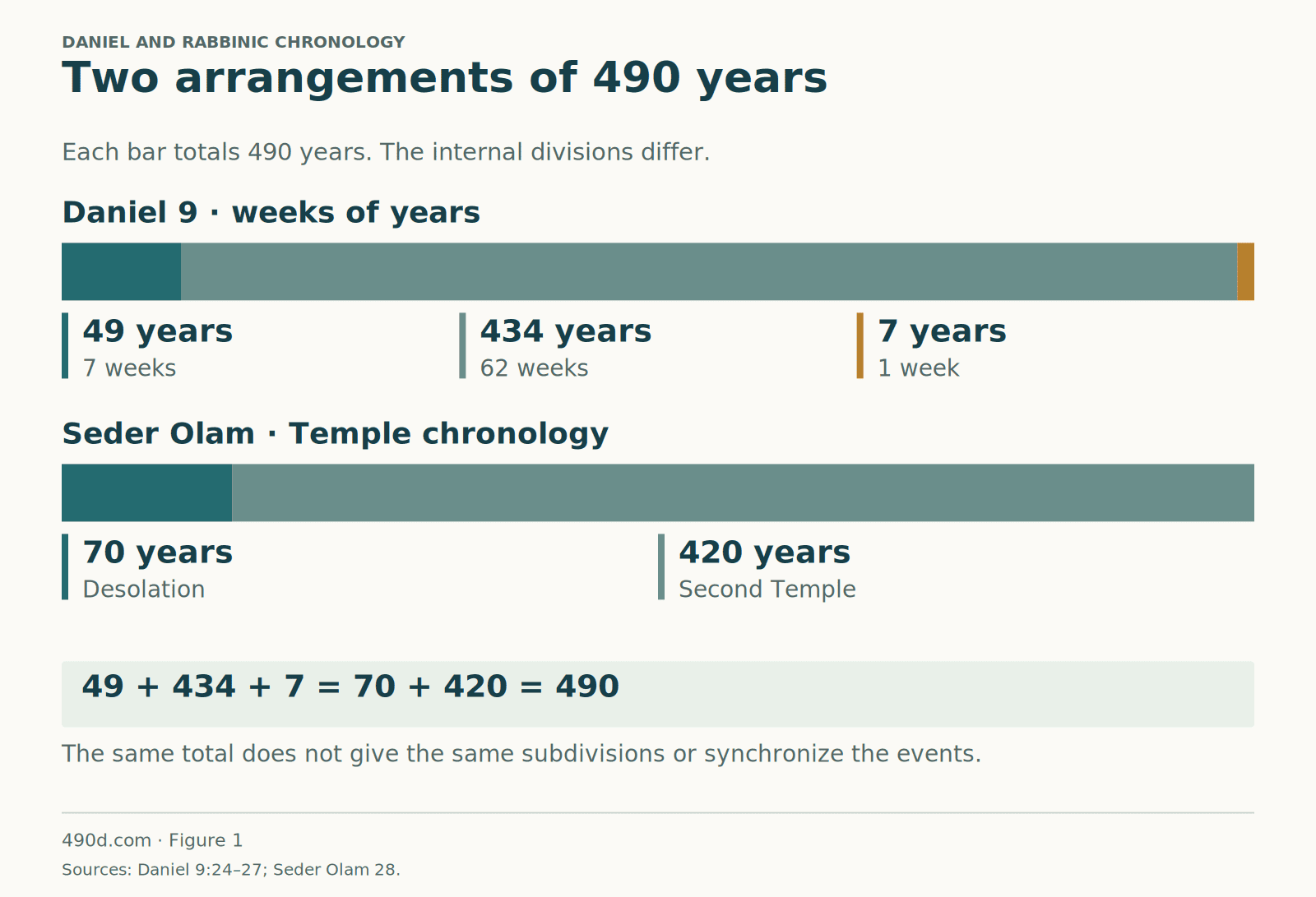
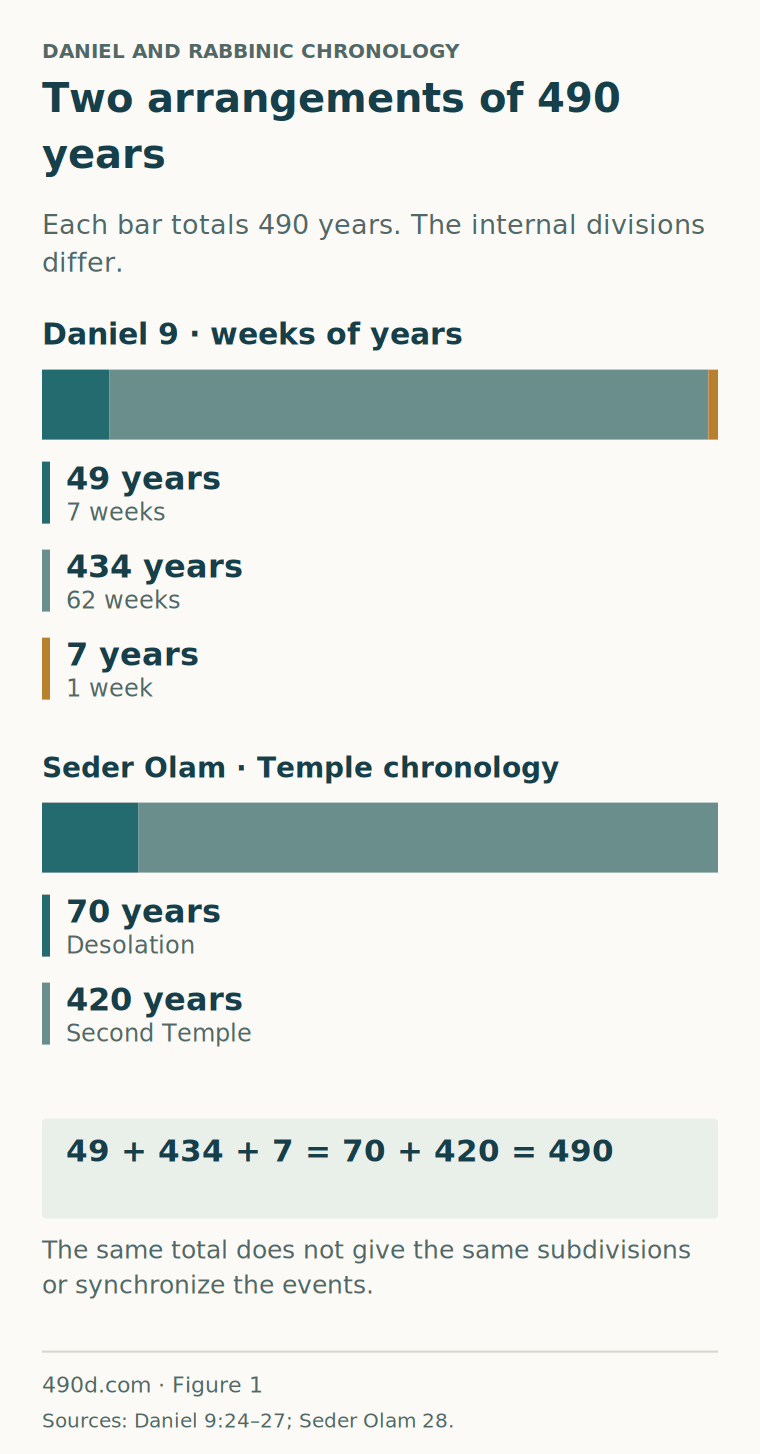
Each bar totals 490 years. The internal divisions differ.
Daniel 9 · weeks of years
- 49 years7 weeks
- 434 years62 weeks
- 7 years1 week
Seder Olam · Temple chronology
- 70 yearsDesolation
- 420 yearsSecond Temple
Relative lengths only. The same total does not give the same subdivisions or synchronize the events.
Sources: Daniel 9:24–27; Seder Olam 28.
Full text description
The first bar contains 49, 434, and 7 years. The second contains 70 years of desolation and 420 years allocated to the Second Temple. Both total 490. Daniel’s first seven weeks equal 49 years; they are not the rabbinic seventy-year desolation.
The 420-year Temple period has its own components: 34 Persian years, 180 Greek years, 103 Hasmonean years, and 103 Herodian years. They are stated in Seder Olam 30 and Babylonian Talmud, Avodah Zarah 9a. The full ledger shows how these fit inside the larger calculation.
The older Jewish Encyclopedia article by M. Seligsohn and the Executive Committee of the Editorial Board explains the shortened Persian allocation through this Danielic framework. More recent discussion by Zev Farber, drawing on Chaim Milikowsky’s critical edition, examines the biblical king identifications behind the chronology. These are credited explanations of the scheme. They do not establish that its compilers knew and intentionally concealed the full historical chronology, or that they acted because of Enoch.
The Persian period: compare the same interval
The frequently quoted 34 years concern Persian rule while the Second Temple stood. The tradition’s broader Medo-Persian allocation is 52 years. The distinction is essential when comparing its figures with historical chronology.
On a narrow screen, scroll the table sideways to see every column.
| Number | What is being counted |
|---|---|
| 34 years | Persian rule while the Second Temple stood |
| 52 years | The broader Medo-Persian allocation; a different interval |
Mitchell First’s Jewish History in Conflict frames the whole-period comparison as 52 years against 207 years, from the Babylonian defeat in 539 BC to the beginning of Greek rule in 332 BC. Hagith Sivan’s account of Jerusalem under Persian rule gives those historical boundaries. Thus this particular difference is 207 − 52 = 155 years. The familiar expression “about 165 missing years” concerns other comparisons and conventions; it cannot simply replace every computed difference.
This substantial discrepancy deserves explanation. Arithmetic alone, however, cannot tell us the compilers’ full intentions. A claim that the chronology was designed to suppress Christian readings of Daniel requires its own historical argument. The original memorandum supplied no adequate source for that claim.
Enoch’s ten weeks
The Apocalypse of Weeks is a short section within 1 Enoch. Its numerical sequence is normally read as 93:1–10, followed by 91:11–17. Enoch is seventh in the first week; the final numbered week reaches angelic judgment and a new heaven. After the ten numbered weeks come unnumbered weeks of righteousness.
The following chart follows the ancient narrative, with the familiar historical identifications explained in the verse-by-verse table. It uses no fixed year scale.
The Apocalypse of Weeks
Enoch’s ten weeks
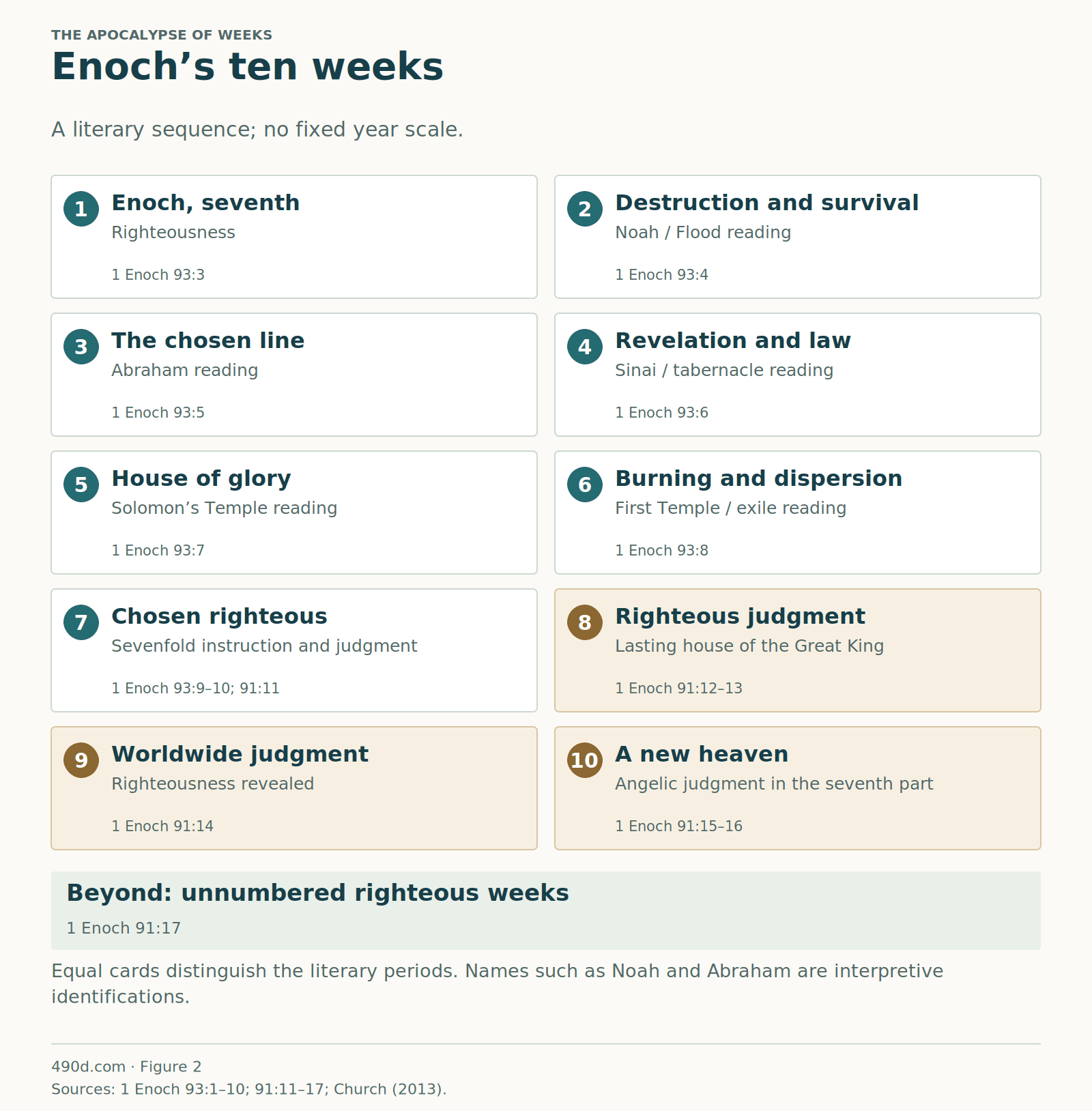
A literary sequence; no fixed year scale.
- 1Enoch, seventhRighteousness1 Enoch 93:3
- 2Destruction and survivalNoah / Flood reading1 Enoch 93:4
- 3The chosen lineAbraham reading1 Enoch 93:5
- 4Revelation and lawSinai / tabernacle reading1 Enoch 93:6
- 5House of glorySolomon’s Temple reading1 Enoch 93:7
- 6Burning and dispersionFirst Temple / exile reading1 Enoch 93:8
- 7Chosen righteousSevenfold instruction and judgment1 Enoch 93:9–10; 91:11
- 8Righteous judgmentLasting house of the Great King1 Enoch 91:12–13
- 9Worldwide judgmentRighteousness revealed1 Enoch 91:14
- 10A new heavenAngelic judgment in the seventh part1 Enoch 91:15–16
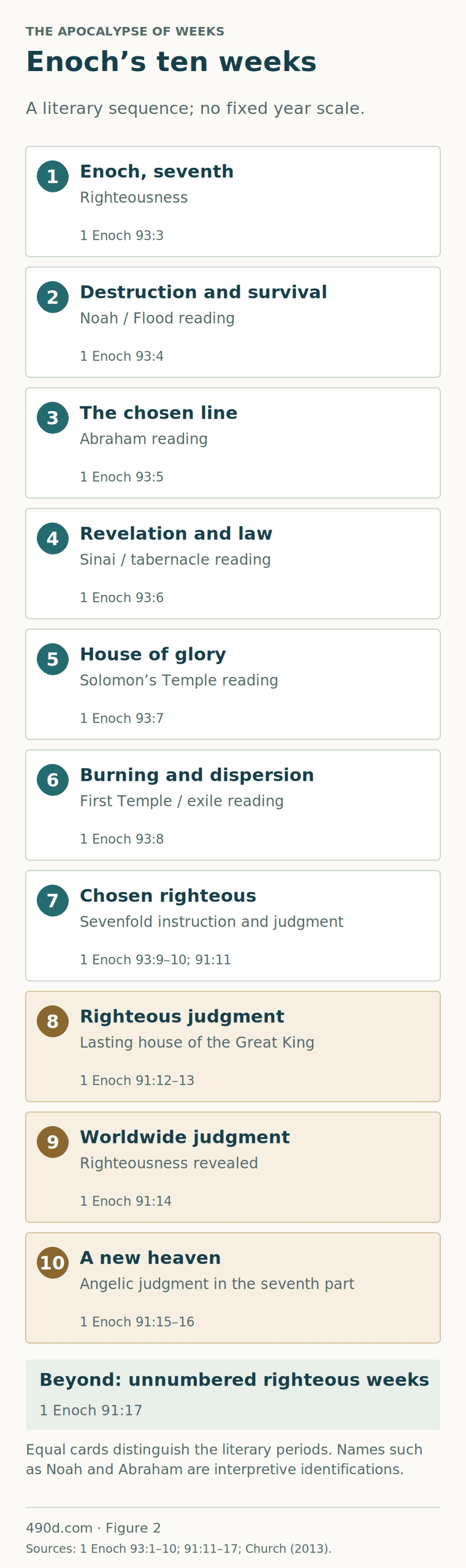
Equal cards distinguish the literary periods. Names such as Noah and Abraham are interpretive identifications.
Sources: 1 Enoch 93:1–10; 91:11–17; Church (2013).
Full text description
Weeks 1–7 show Enoch; destruction and survival; the chosen line; revelation and law; the house of glory; burning and dispersion; and the chosen righteous. Weeks 8–10 show righteous judgment and a lasting house; worldwide judgment; and angelic judgment with a new heaven. Unnumbered righteous weeks follow. No fixed year lengths are assigned. The detailed table supplies verse references and interpretive identifications.
Philip Church describes the arrangement as ten weeks of seven generations. Loren T. Stuckenbruck emphasizes a necessary limit: seventy parts are implied, but equal elapsed durations cannot be inferred from the text. Enoch supplies no rule saying that every part lasts seventy ordinary years.
Accordingly, assigning seventy years to each of seventy parts would produce 4900 years, but the fixed duration is an additional premise. It is useful to examine such a model when it is declared. It should not be presented as a total explicitly written in 1 Enoch.
Does the sixth week point to AD 70?
In the usual historical reading, Week 5 concerns Solomon’s Temple, and Week 6 moves through apostasy, the ascent commonly identified with Elijah, the burning of the Temple, and dispersion. Church’s discussion and B. J. Oropeza’s 2024 explanation locate this destruction in the First Temple’s history.
A later reader may find a further resemblance to Rome’s destruction of the Second Temple in AD 70. That is a possible theological application. It is not a consequence of shortening the interval between the two destructions: even within a shorter chronology, the first destruction and the second remain different events.
The original memorandum cited John P. Pratt’s “Enoch’s Ten Week Prophecy” for an AD 70 reading. Pratt did propose that application in 2015, but within his own 728-year weeks and 104-year days. His sixth week contains AD 70 within a much larger period; AD 70 is not its closing boundary. That is a separate modern model, with its own premises. His article does not supply evidence that the rabbis borrowed from Enoch, nor does it argue for a post-AD 70 composition of the apocalypse.
The manuscript evidence also matters. 4Q212, an Aramaic Enoch manuscript from the first century BC, attests the Apocalypse of Weeks before the Roman destruction. It supports the continuation from 93:10 into 91:11. The surviving fragments are incomplete, including a gap across Weeks 3–6, so they do not independently settle the wording-history of every clause. They do rule out treating the whole apocalypse as a work first composed after AD 70. The manuscript note explains the evidence and its limits.
Another ancient witness: the tenth jubilee
The Qumran text 11QMelchizedek (11Q13) offers a closer documented connection between numbered sacred periods and final restoration. Its second column joins liberty and remission with a tenth-jubilee horizon and the Day of Atonement. It draws on scriptural release traditions, including Leviticus 25. On a forty-nine-year cycle, ten jubilees have the same numerical length as Daniel’s seventy year-weeks:
10 × 49 = 70 × 7 = 490 years.
The exact reconstruction at the jubilee boundary remains debated. Logan Williams’s 2023 discussion adopts a reading proposed by Ariel Feldman in 2018 and explains how it differs from the earlier edition. The useful comparison here is the shared language of release and atonement; no exact modern date is being extracted from the fragment.
How this relates to the chronology on 490d
The website’s Enoch study develops a separate numerical investigation, controlled by File 68. Its primary seventy-year generation model gives 7 × 70 = 490 years per week; its bounded seventy-two-year companion gives 504. File 68 also proposes an earlier seven-week core while acknowledging the early ten-week form and the evidence for its unity. The proposed core remains a reconstruction.
Another distinction helps explain the comparison. File 68’s 420 work years + 70 Sabbath years describes categories within a 490-year framework. Seder Olam’s 70 years of desolation + 420 Temple years describes successive historical periods. The sums agree while the things being counted differ. The units and models table keeps those meanings visible.
These correspondences make the subject worth studying: sacred time is repeatedly associated with judgment, rest, and restoration. The documented Daniel–Seder Olam connection can be stated confidently. An Enochic influence on that rabbinic calculation remains a question requiring further evidence.
Continue with the supporting tables, manuscript notes, and credited sources.