Enoch’s position in the biblical genealogy gives this study its starting point. Jude introduces him as:
“Enoch, the seventh from Adam, also prophesied about them:”
The Apocalypse of Weeks likewise places Enoch seventh in its first week. What happens if this arrangement is developed into seven weeks of seven generational positions? The 490d study explores that question with two schematic generation lengths: 70 years and 72 years. Both produce a complete seven-week pattern, with a shared endpoint at AD 65 and a further relationship to the 360- and 364-day calendar measures.
The year lengths and BC/AD placements are the study’s mathematical interpretation. The ancient text supplies the weeks and their narrative; it does not explicitly assign 70 or 72 years to each patriarchal generation.
1. The ancient text and the seven-week reading
The Apocalypse of Weeks survives in 1 Enoch 93:1–10 and 91:11–17. Read in numerical order, it describes ten weeks, followed by an unnumbered righteous future. The first seven move through primordial history, judgment and preservation, election, law, the sanctuary, destruction and dispersion, and the emergence of an instructed righteous community.
The seven-week reading developed in File 68 proposes that an earlier, complete seven-week composition may underlie that expanded form. Its argument draws partly on the concentrated ending in 1 Enoch 91:8–10, where evil is removed and the righteous awaken and receive wisdom.
This is a reconstruction of compositional history. The Aramaic manuscript 4Q212 already witnesses the ancient expanded form and supports the sequence from 93:10 into 91:11. It does not supply a surviving manuscript of the proposed earlier seven-week edition. The textual note in the appendix explains that distinction and identifies the editions used here.
Within those limits, the first seven weeks provide a coherent field for chronological comparison: seven generations per week, repeated seven times.
2. Seven weeks of seven positions
The first week follows this order:
Adam, Seth, Enosh, Kenan, Mahalalel, Jared, Enoch.
Adam occupies the first position and Enoch the seventh. Methuselah begins Week 2. This is the essential correction to the older chart, which placed a symbolic pre-Adam position inside Week 1 and consequently moved Enoch into Week 2.
The corrected arrangement places that symbolic interval before the numbered weeks. The count is therefore:
7 × 7 = 49 positions within the seven weeks.
1 symbolic interval before Adam + 49 positions = 50 intervals in the complete outer frame.
The extra interval is a theological bookend in the model. It adds neither an eighth textual week nor a historical human ancestor before Adam. The corrected opening rows show the names and dates together.
3. Two year lengths, one endpoint
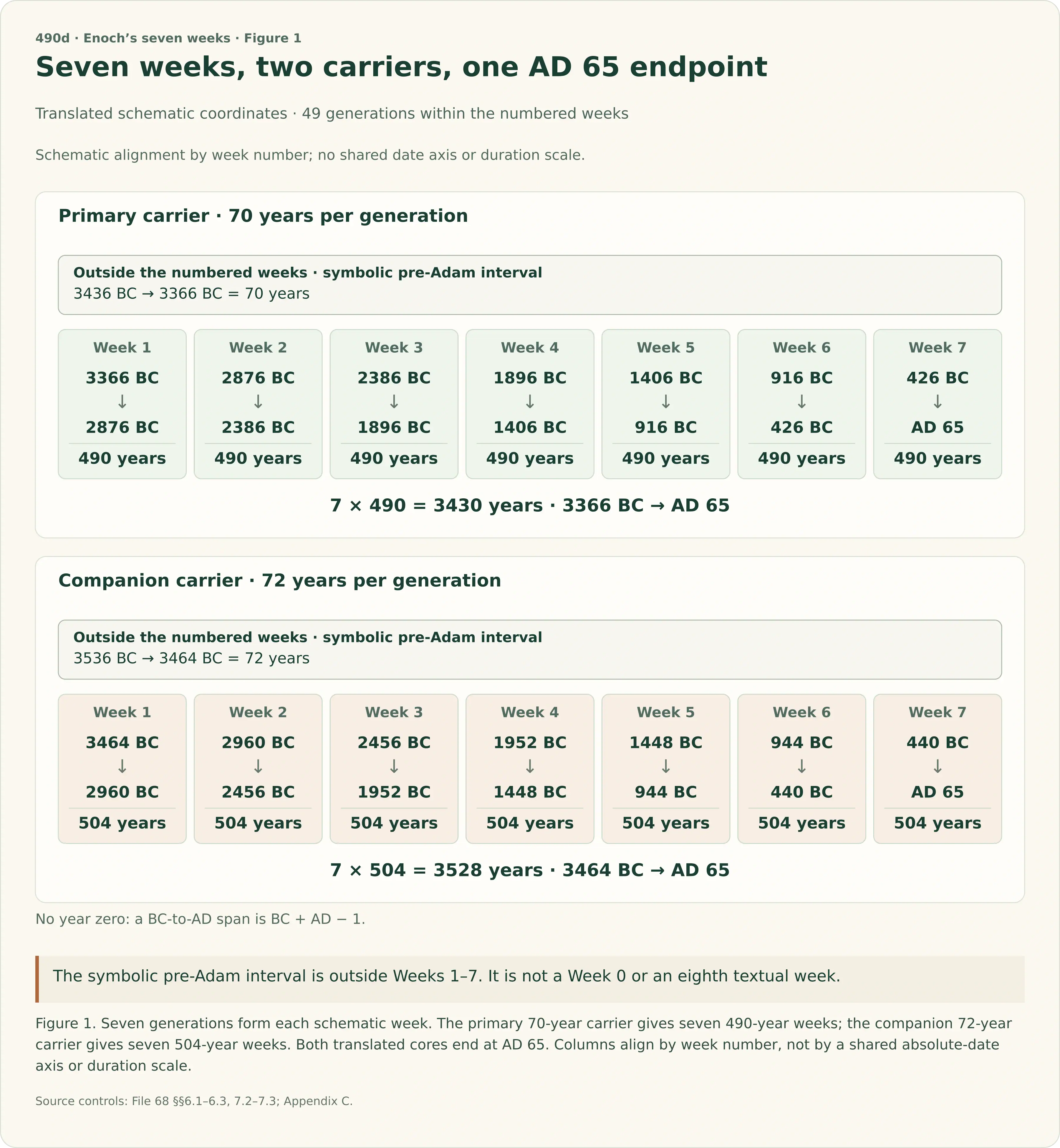
The primary construction assigns 70 years to each generational position. Seven positions make a 490-year week; seven weeks make 3430 years. The companion construction assigns 72 years to each position, producing 504-year weeks and a total of 3528 years.
| Model | One schematic generation | One week | Seven weeks | Adam’s schematic starting date | Endpoint |
|---|---|---|---|---|---|
| Primary | 70 years | 7 × 70 = 490 years | 49 × 70 = 3430 years | 3366 BC | AD 65 |
| Companion | 72 years | 7 × 72 = 504 years | 49 × 72 = 3528 years | 3464 BC | AD 65 |
490d · Enoch’s seven weeks · Figure 1
Seven weeks, two carriers, one AD 65 endpoint
Translated schematic coordinates · 49 generations within the numbered weeks
Schematic alignment by week number. The rows are not one shared absolute-date axis or duration scale.
Primary carrier · 70 years per generation
Week 1
3366 BC↓2876 BC490 yearsWeek 2
2876 BC↓2386 BC490 yearsWeek 3
2386 BC↓1896 BC490 yearsWeek 4
1896 BC↓1406 BC490 yearsWeek 5
1406 BC↓916 BC490 yearsWeek 6
916 BC↓426 BC490 yearsWeek 7
426 BC↓AD 65490 years7 × 490 = 3430 years · 3366 BC → AD 65
Companion carrier · 72 years per generation
Week 1
3464 BC↓2960 BC504 yearsWeek 2
2960 BC↓2456 BC504 yearsWeek 3
2456 BC↓1952 BC504 yearsWeek 4
1952 BC↓1448 BC504 yearsWeek 5
1448 BC↓944 BC504 yearsWeek 6
944 BC↓440 BC504 yearsWeek 7
440 BC↓AD 65504 years7 × 504 = 3528 years · 3464 BC → AD 65
No year zero: a BC-to-AD span is BC + AD − 1.
Source controls: File 68 §§6.1–6.3, 7.2–7.3; Appendix C.
Read the calculation and scope
The primary week boundaries are 3366, 2876, 2386, 1896, 1406, 916, 426 BC and AD 65. The companion boundaries are 3464, 2960, 2456, 1952, 1448, 944, 440 BC and AD 65. Civil cross-era arithmetic has no year zero: 3366 + 65 − 1 = 3430 and 3464 + 65 − 1 = 3528. The pre-Adam intervals are 3436 − 3366 = 70 and 3536 − 3464 = 72. Thus the numbered core contains 49 generations; the outside interval makes 50 carrier spans only when included separately. These are schematic coordinates in the article’s reconstruction.
View or download the full-size illustration
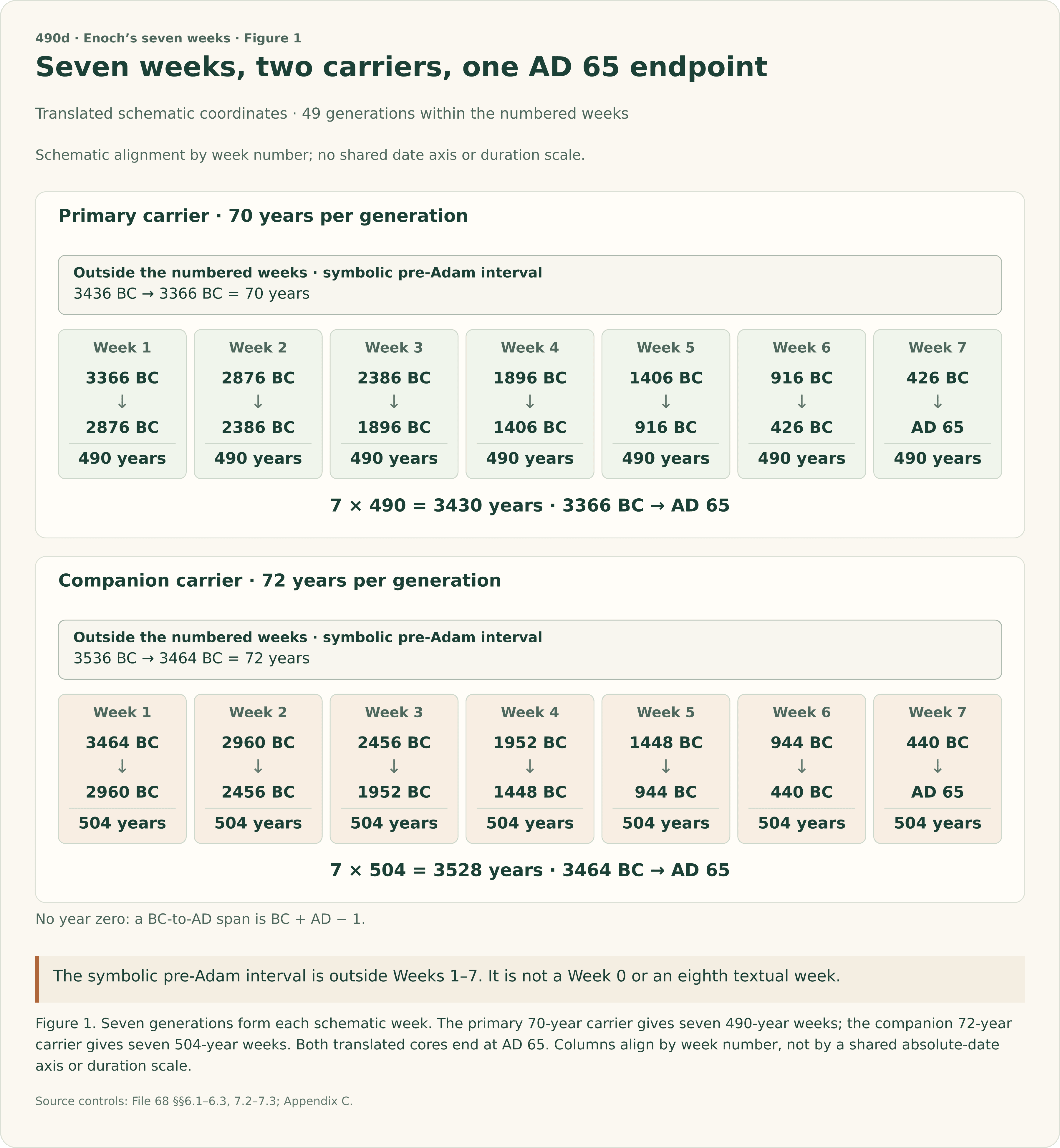
These are the translated positions in File 68: the later of two parallel placements separated by 110 years. They are schematic dates, distinct from ordinary MT Creation at 4114 BC and from the lifespans recorded in Genesis. Their purpose is to measure the proposed generational structure consistently.
Because civil chronology has no year zero, the crossing from BC to AD requires subtracting one:
3366 + 65 − 1 = 3430 years.
3464 + 65 − 1 = 3528 years.
The final generation is 6 BC–AD 65 in the 70-year model and 8 BC–AD 65 in the 72-year model. Thus the study’s 6 BC nativity anchor begins the primary final generation and falls two years inside its companion. AD 65 is the common schematic close; the historical destruction of the Jerusalem Temple belongs to AD 70.
The outside symbolic intervals are 3436–3366 BC and 3536–3464 BC, respectively. Including them gives 50 × 70 = 3500 and 50 × 72 = 3600 years. They remain visibly separate from the seven-week totals.
4. Why 110 years enters the calendar comparison
The 110-year separation is already present in the paired chronology. In the primary model, the earlier placement runs from 3476 BC to 46 BC; its translated counterpart runs from 3366 BC to AD 65. Every corresponding boundary moves forward by the same amount:
3476 − 3366 = 110, and 46 + 65 − 1 = 110.
An ordinary generational interval measures between adjacent boundaries in one placement. A stretched interval measures from a boundary in the earlier placement to the next boundary in the later placement. It therefore includes the generation’s ordinary length plus the 110-year separation.
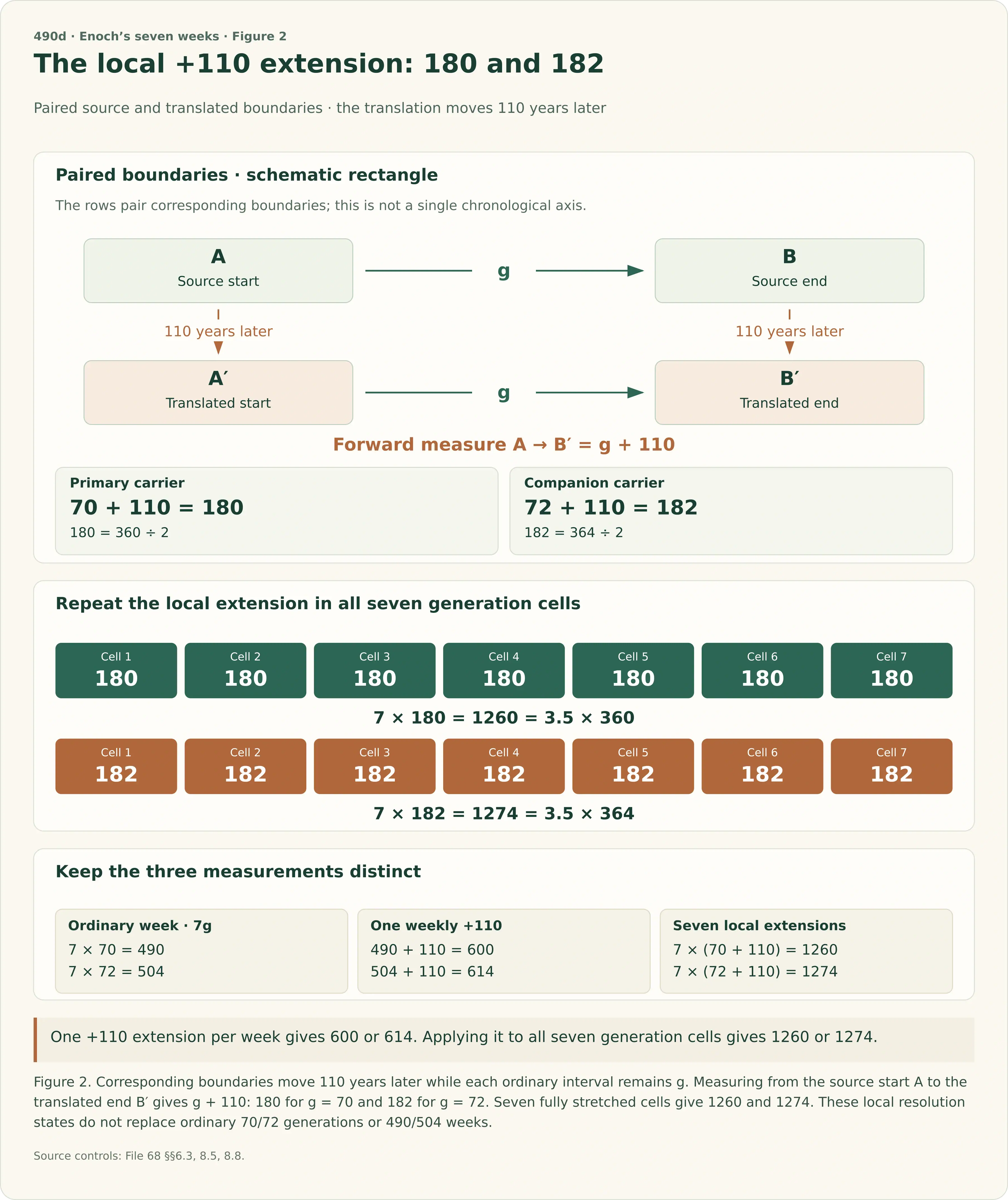
490d · Enoch’s seven weeks · Figure 2
The local +110 extension: 180 and 182
Paired source and translated boundaries · the translation moves 110 years later
Paired boundaries · schematic rectangle
The horizontal rows pair corresponding boundaries; this is not a single chronological axis.
Forward measure A → B′ = g + 110
Primary carrier
70 + 110 = 180180 = 360 ÷ 2Companion carrier
72 + 110 = 182182 = 364 ÷ 2Repeat the local extension in all seven generation cells
7 × 180 = 1260 = 3.5 × 360
7 × 182 = 1274 = 3.5 × 364
Keep the three measurements distinct
Source controls: File 68 §§6.3, 8.5, 8.8.
Read the calculation and scope
Let A and B be an ordinary generation’s start and end, separated by g. Translation sends each boundary 110 years later to A′ and B′, so A′→B′ is still g. The forward cross-rail measurement A→B′ is g + 110, not g − 110. The primary first cell illustrates this: source 3476→3406 BC, translated 3366→3296 BC, and 3476−3296=180. The companion cell is 3574→3502 BC, translated 3464→3392 BC, giving 3574−3392=182. Seven local cells give 7×180=1260=3.5×360 and 7×182=1274=3.5×364. In contrast, extending one ordinary week once gives 490+110=600 or 504+110=614. The calendar equalities express numerical forms in their named registers; they do not turn civil years into literal days.
View or download the full-size illustration
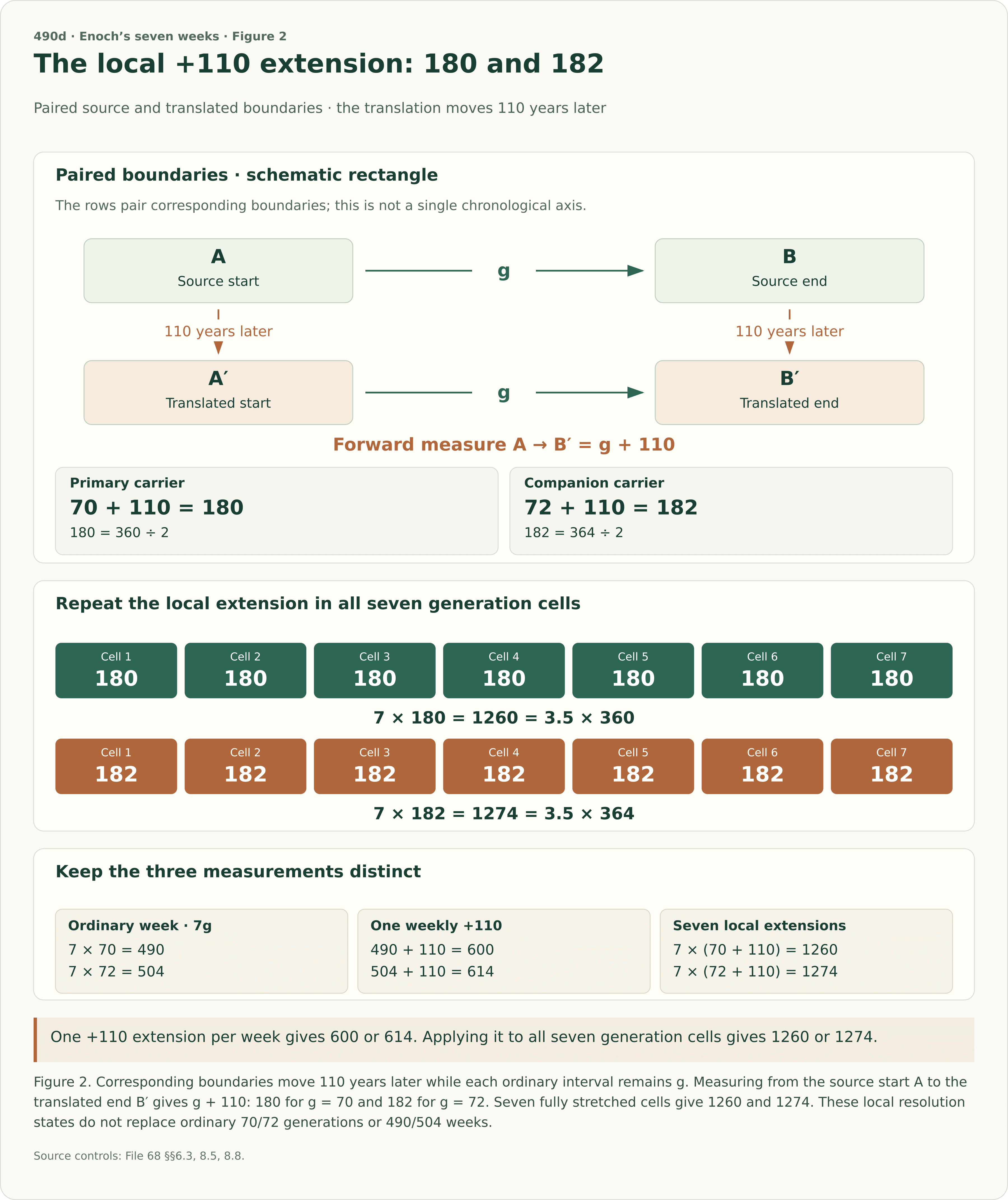
The two resulting measures are:
70 + 110 = 180 = 360 ÷ 2.
72 + 110 = 182 = 364 ÷ 2.
The values 180 and 182 match the numbers of days in half of the respective calendar measures. Here they are measured in schematic years; the comparison is numerical, across the two scales. The 364-day year has 52 complete weeks and four 91-day seasons, while 360 is the distinct prophetic reckoning.
Applying the stretch to each of seven generations gives:
7 × 180 = 1260 = 3.5 × 360.
7 × 182 = 1274 = 3.5 × 364.
This is the calendar connection: the paired generational models yield corresponding half-year and three-and-a-half-year numerical forms. The ordinary generations remain 70 and 72 years, and their ordinary weeks remain 490 and 504 years. The appendix’s resolution table keeps these measures distinct.
5. Toward Luke and Matthew
The corrected named sequence retains the second Cainan between Arphaxad and Shelah, following the LXX/Lukan comparison used in this study. Native MT and SP genealogies omit that generation; their ordinary tables remain separate. The position of Cainan matters when comparing named successions, but it does not license changing the fixed dates of this schematic at will.
File 69 develops the wider Gospel comparisons around Enoch. Luke traces the genealogy backward through Adam to God; Matthew organizes the Abraham-to-Jesus succession into three groups of fourteen. Their application requires careful distinctions between named persons, occupied positions, and the intervals measured between boundaries. The present article establishes the seven-week foundation; the appendix identifies the count distinctions needed before continuing into those larger comparisons.
6. Sacred history measured through weeks
The theological force of the pattern comes from the narratives it organizes: creation, preservation through judgment, election, inheritance, the loss of wisdom, and its restoration. Enoch’s seventh position joins genealogy to the language of the week. Repeated sevenfold measures then connect the study’s generational framework with its Sabbath and calendar interpretations.
The primary 70-year construction and its 72-year companion preserve different but related numerical forms. Their exact arithmetic gives the comparison definition; the ancient texts give it theological content. Read together, they offer a structured way to explore sacred time while keeping textual evidence, chronological modeling, and interpretation visible to the reader.
Tables and further study
- Detailed Study: the complete generational table and wider comparisons.
- Technical appendix: corrected week boundaries, opening generations, and source notes.
- File 68: full canonical study, especially §§6–8 and Appendices C and H.
- File 69: Gospel comparisons, especially §§1–3.
- File 12: calendar definitions.
Scripture quotation: Berean Standard Bible (BSB), public domain. Official translation terms. The discussion of 1 Enoch uses the separately identified sources in the technical appendix.