Technical appendix: chronological states and exact arithmetic · Alpha · Pi · Phi · e
The fifth study in the mathematical-constants series: α, π,
Φ, e, and √2
Research companion · 12 November 2026 · Version 4 · Exploratory
and noncanonical
Companion: Technical
appendix: chronological states, dependencies, and verification
The principal proposal of this study is that the Rounded biblical chronology has a connected geometric architecture. Its cumulative and regular Creation and Flood coordinates, Noah’s regular birth, and the shared Conquest and Christological terminations can be read together through the elementary geometry of a square, a right triangle, and a circle. The smaller genealogical and covenantal intervals develop that framework at further scales.
Two working approximations express its central relationships:
The constructions meet at regular Rounded Creation, 4106 BC. The 9900-year denominator in the larger construction is also six 1650-year units, or three of the combined 3300-year measures in the circular construction. This gives the fractions a shared chronological setting. Their proposed significance concerns the connected structure and the narrative functions of its nodes, together with the accuracy of the approximations.
The accompanying Key of 23 follows the same contours. Its established calendrical transformations connect the Rounded outline with more detailed chronological expressions and continue into the principal branches: Peleg, Abram, Isaac, Jacob, Egypt, and Moses/Joshua. I therefore picture the structure as a tree. Its trunk, main branches, and smaller branches share recognizable numerical forms; the Key of 23 remains available throughout as a common calendrical transformation grammar.
The working √2 vocabulary examined here is 10/7 = 100/70 and 99/70. The first supplies a coarse reading; the second preserves the ninety-nine/hundred distinction central to the genealogical and covenantal observations. The expression 140/99 is the doubled reciprocal counterpart of 99/70, already supplied by the large Creation frame. The preferred shared-denominator comparison with π remains:
The established chronology supplies the narrative nodes; the selected geometric ratios organize their relationships and generate explicitly identified extensions. The chronological sources and calendrical operators were not invented for this investigation. The larger geometric reading is the research proposal developed from them.
My governing premise is that biblical chronology is inspired language whose vocabulary and grammar have become partly obscured, and that my work seeks to recover how to read it.
Decoding therefore involves identifying recurring numerical forms, understanding their functions within the narratives, and checking whether those meanings remain coherent when the forms reappear across traditions and throughout Scripture.
The prose and numerical language interpret and constrain one another. Within my providential reading, their fuller composition can unfold toward Christ beyond what any individual writer understood.
The presentation begins with the trunk so that the reader can see the whole structure before following its branches. The ninety-nine-year clues retain their importance in the discovery record and receive their full discussion below. Appendix F records the sequence of discovery; explanatory order in the article does not turn later recognition into an earlier prediction.
This is a companion to the earlier α, π, Φ, and e investigations. The canonical Markdown repository governs dates, source states, and operations. The final e publication package v6, dated 10 November 2026, remains the reference for that completed study.
- 1. The trunk: Creation, Flood, Conquest, and Christ
- 2. One triangle and one circle
- 3. The Key of 23 follows the trunk and its branches
- 4. The cumulative Flood opens the extended framework
- 5. A readable outline and its finer articulation
- 6. Complementary bows in Rounded and actual chronology
- 7. Two ninety-nine-year clues
- 8. The Rounded genealogy completes the intervals
- 9. The family setting of 70, 99, and 140
- 10. The 440 measure, Joseph, and the connection with e
- 11. Joshua’s two lifespans and the architectural comparisons
- 12. Inverse numbers and the Christ-facing anchor field
- 13. A π comparison inside the inverse expression
- 14. Creation, renewed beginnings, and the cornerstone
- 15. Exploratory geometric extensions and endpoint leads
- 16. The connected architecture and its present research boundary
1. The trunk: Creation, Flood, Conquest, and Christ
The core outline uses the following coordinates. Their agreement as labels is retained together with the different roles those labels occupy.
| Structural role | Coordinate, BC | State used here |
|---|---|---|
| Cumulative Creation | 14006 | Rounded cumulative node; also an actual cumulative internal Year-6 label under its own definition |
| Regular Creation | 4106 | Rounded regular node |
| Cumulative Flood / Arphaxad opening | 4836 | Rounded cumulative node; also the head of the actual Nisan 4836–4829 envelope |
| Regular Noah’s birth | 3056 | Rounded coordinate, co-registering with the selected Gear-1 comparison |
| Regular Flood | 2456 | Rounded / Gear-1 Flood label; regular Arphaxad’s birth independently shares the year |
| Conquest / Moses’ death | 1406 | Shared ordinary and cumulative termination |
| Christological datum | 6 | Selected symbolic birth-era anchor |
The ordinary Gear-2 Flood remains 2458 BC. The 4836 BC cumulative Flood head is a different node class from the actual table’s internal 4831 BC station. These definitions allow the shared labels to be compared without collapsing their source states.
The larger Rounded comparison joins cumulative Creation at 14006 BC, regular Creation at 4106 BC, and the selected Christ datum at 6 BC:
The full span over the cumulative-to-regular Creation gap gives the fraction supplied directly by these three coordinates:
Its whole-span midpoint is 7006 BC:
Using that midpoint supplies the companion fraction:
The 7006 BC coordinate was already active in the Φ and e studies. The present use identifies its role as the midpoint that places 70, 99, and twice 70 in one proportional construction.
| Scale | Measure | Chronological setting |
|---|---|---|
| 1× | 99 | Arphaxad → Peleg; Abraham → circumcision |
| 10× | 990 | Noah 3056 → Isaac 2066 BC |
| 100× | 9900 | Rounded cumulative → regular Creation, 14006 → 4106 BC |
The actual Creation comparison supplies a related but distinct observation. Its internal sixth-year pair is 14006/4116 BC; its completion pair is 14004/4114 BC. Both preserve the 9890-year bridge:
Those pairs have different node classes and are not interchangeable endpoints. The 9890 bridge is actual chronology, whereas the 9900 comparison explicitly opens the Rounded state; File_22, §§5 and 7, controls the actual distinctions.
Corresponding Creation boundaries in the two registers
The bridge is preserved at corresponding boundaries:
| Register | Cumulative display, BC | Regular display, BC | Matched separation |
|---|---|---|---|
| Rounded | 14011 / 14006 | 4111 / 4106 | 9900 at either corresponding member |
| Actual Nisan full envelope | 14011 → 14004 | 4121 → 4114 | 9890 at corresponding heads or closes |
| Actual internal sixth-year positions | 14006 | 4116 | 9890 |
The Rounded five-year difference between its displayed members and the actual seven-year envelope are different presentations. In particular, actual 14006 is an internal sixth-year position, while 14004 is its Creation-week closing boundary. The numerical distinction is exact:
The first exposes the Rounded backbone; the second opens the corresponding calendrical and sojourn vocabulary. The downstream Noah–Flood–Conquest patterns continue this complementarity.
At one tenth of the actual bridge:
Thus the Noah-facing interval to Abraham’s age-99 boundary is 989, while the interval to Isaac’s birth is 990. The two larger levels give the exact paired scaling:
The original 99 → 100 passages supply an analogous threshold motif. They are not an exact rescaling of the whole 989 → 990 pair. The exact Rounded numerical family is 99 → 990 → 9900; the exact adjacent-state correspondence is 989/990 → 9890/9900.
The inherited 1650 and 1050 backbone
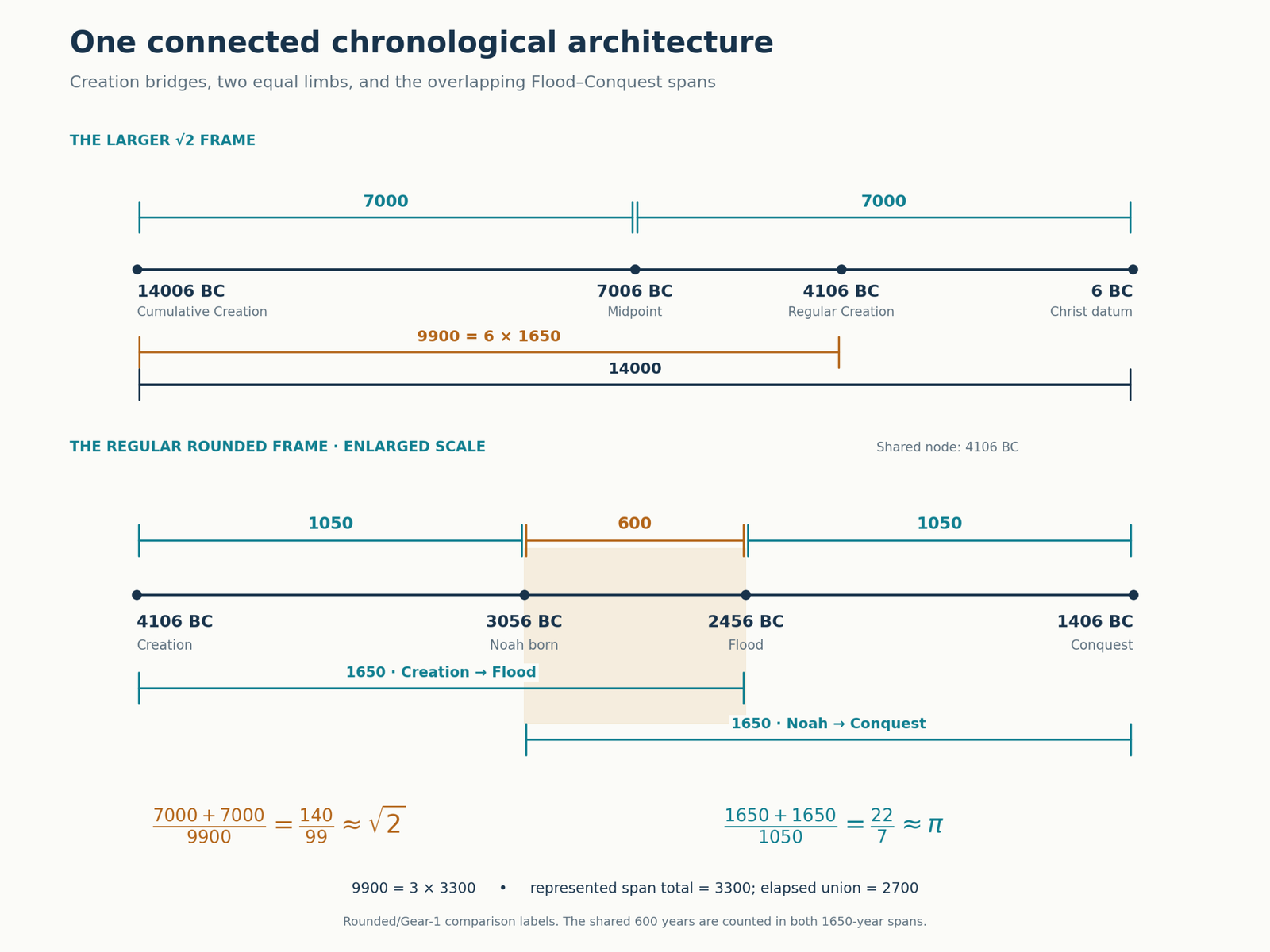
The 9900 bridge already belongs to a larger canonical construction. File_51a, §16.10.1 supplies six successive 1650-year units between the selected cumulative and regular Creation nodes, followed by one more to the regular Rounded Flood:
| Rounded comparison, BC | Length | 1650-year units |
|---|---|---|
| Cumulative Creation 14006 → regular Creation 4106 | 9900 | 6 |
| Regular Creation 4106 → regular Flood 2456 | 1650 | 1 |
| Cumulative Creation 14006 → regular Flood 2456 | 11550 | 7 |
The factorization 1650 = 22 × 75 places the working π numerator beside a directly stated Abrahamic age: Abram leaves Haran at seventy-five (Genesis 12:4). The same bridge can be written 9900 = 6(22 × 75) = 100 × 99. This is a comparison of the inherited module’s factors with the present vocabulary.
The regular Rounded trunk has a second unit. Creation 4106 → Noah’s birth 3056 → Flood 2456 → Conquest 1406 BC gives:
Creation → Flood is 1050 + 600 = 1650; Noah’s birth → Conquest is 600 + 1050 = 1650. Their shared interval is the six hundred years from Noah’s birth to the selected Flood. File_51a §16.3 already records this arrangement; the 9900-year bridge appendix, §A3 displays its overlap explicitly.
The two modules synchronize exactly:
The common total 11550 is their least common multiple. From cumulative Creation, the regular Flood is therefore the eleventh 1050-year boundary, and the Conquest the twelfth:
Equivalently, the full extent is 12600 = 8(1650) − 600 = 21(600). The eight represented spans include the last two overlapping spans; subtracting 600 removes their duplicate count.
The 600-year rail and the complementary 2000/2100 spans
The 1050 also appears from Noah’s birth 3056 to Jacob’s birth 2006 BC. Noah’s Rounded death at 2106 BC stands 2100 = 1050 + 1050 before the selected 6 BC datum. File_51a §§4.1, 4.3, and 13.3 retain the corresponding Creation-side measures. Together they give:
| Route, BC | Partition |
|---|---|
| Creation 4106 → Noah’s Rounded death 2106 → Christ datum 6 | 2000 + 2100 |
| Creation 4106 → Jacob’s birth 2006 → Christ datum 6 | 2100 + 2000 |
No event is assigned here to the arithmetic midpoint of the later 2100 years. The 2006 → 6 comparison remains 2000, rather than being absorbed into the 600-year group.
The six-hundred-year links have their own declared endpoints:
| Selected interval, BC | Length | Role |
|---|---|---|
| Noah’s birth 3056 → Rounded/Gear-1 Flood 2456 | 600 | Birth-to-Flood interval |
| Shem’s birth 2556 → death 1956 | 600 | Covenant-line lifespan |
| Exile datum 606 → Christ datum 6 | 600 | Adopted chronological comparison |
The two 990-year constructions in section 8 also translate by 600 at both endpoints: 3056 → 2066 becomes 2456 → 1466. Thus six hundred serves as a lifespan, an overlap, a translation, and a measure of the complete 12600-year extent. These functions give substance to the description “rail”; they remain distinct executions.
The √2 and π constructions meet at 4106 BC
The large frame reads the two 7000-year limbs over the Creation bridge:
From that same regular Creation node, the two overlapping 1650-year spans give:
The numerator is the sum of Creation → Flood and Noah’s birth → Conquest, with their shared 600-year section counted in both. Their elapsed union remains 2700 years. A reference circle of diameter 1050 has working circumference 3300 and semicircumference 1650 under this approximation.
The scale connection between the two constructions is:
Thus the denominator in the larger √2 comparison is three times the represented whole-circle measure in the π comparison. This equality expresses their common backbone. It follows from the declared construction and is retained as a structural connection.
2. One triangle and one circle
For a square of side s, its diagonal d obeys:
The diagonal divides the square into two right-angled triangles with equal legs. Constructing a new square on that diagonal doubles the original area. The geometric relationship is exact; no rational fraction can equal the irrational √2 exactly.
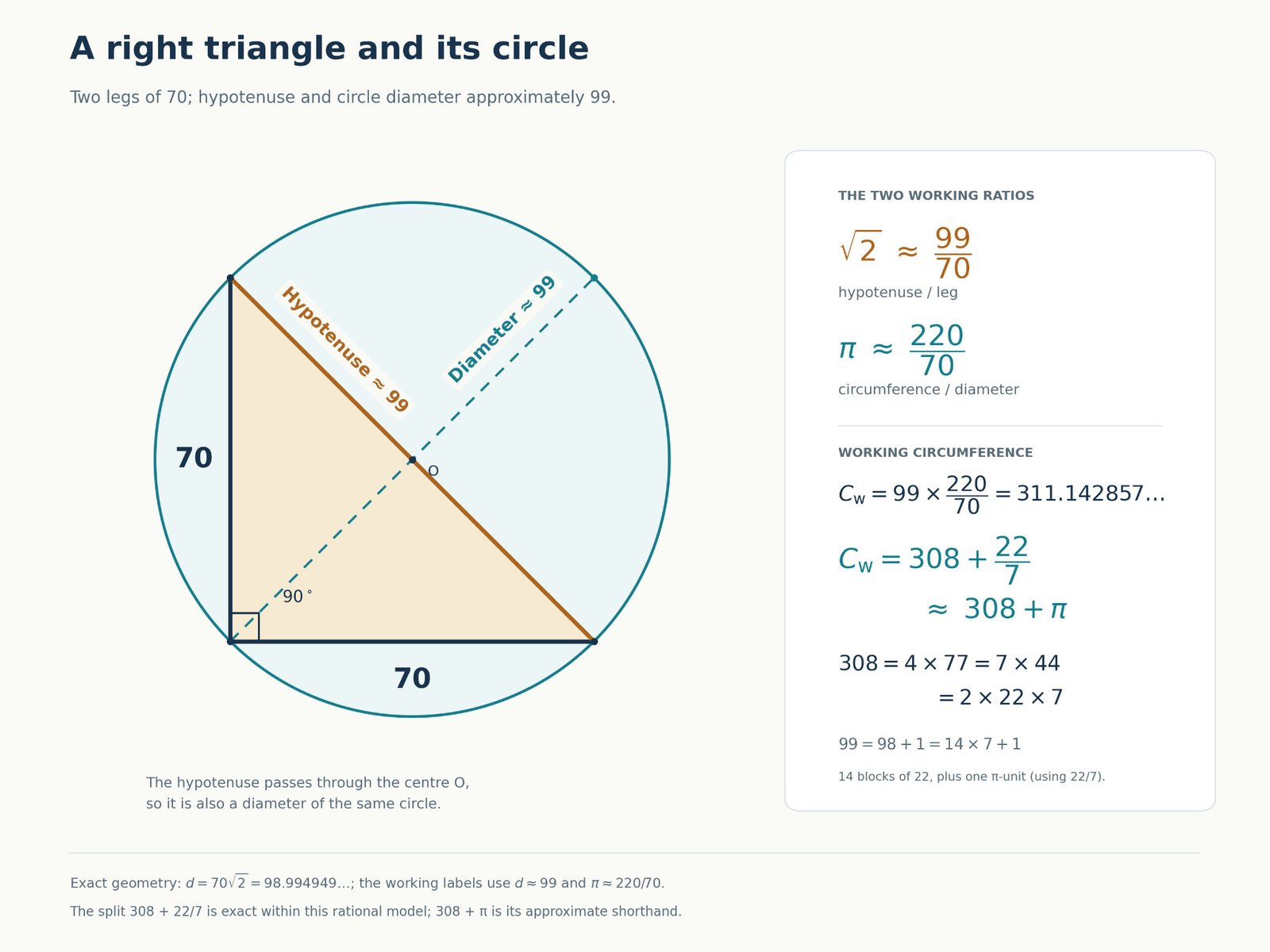
The seventy-unit scale follows from combining the two fractions. The smallest common denominator of 22/7 and 99/70 is 70, giving 220/70 and 99/70. Once those approximations are used together, seventy is the smallest shared integer scale.
For legs of 70, the exact hypotenuse is:
Draw a circle with this hypotenuse as a diameter. The right-angle vertex lies on the same circle. A second diameter can cross the hypotenuse at the centre. The triangle and circle now share a physical segment: the hypotenuse is also a circle diameter.
The two preferred fractions are:
The shared denominator keeps 70 as the comparison measure, while the numerator difference exposes 11 × 11. The difference between the fractions is 121/70, not 121.
Using the approximate diameter 99 gives a working circumference:
Its relation to the other measures becomes clearer in exact fractional form:
The rational-model decomposition is exactly 308 + 22/7; replacing 22/7 by π gives the approximate shorthand. The integer component is 308 = 4 × 77 = 7 × 44 = 2 × 22 × 7.
The square, its circle, and the gestational measure
Completing the two perpendicular legs into a square gives:
For the exact diagonal 70√2, the circle’s area is 2450π. Using the working π ratio 22/7 gives the whole-number area 7700. The resulting comparison is:
| Working measure | Value | Shared seventy-unit form |
|---|---|---|
| Square area | 4900 | 70 × 70 |
| Circle area using exact diagonal and 22/7 | 7700 | 70 × 110 |
| Circle less square | 2800 | 70 × 40 |
The area relation therefore carries the same 110 − 70 = 40 vocabulary that will recur in Joseph and Joshua. Its difference 2800 is numerically ten times the perimeter 280. These are comparisons between geometric measures read symbolically, with their length and area roles stated.
The perimeter also supplies the study’s full 280-day gestational measure: forty weeks. The nine-month seasonal construction uses 270 days on twelve thirty-day months; those two gestational registers retain their respective functions.
Using 99 as the circle’s working diameter gives a different exact area coefficient:
With π itself this is approximately 7697.6874. The quarter is already built into 99² − 2 × 70² = 1: division by four gives the quarter-unit excess over 2450. Read as a year coefficient, it supplies 2450 years and one ninety-day schematic season. The 7700 whole-area pattern and this quarter-unit refinement are related calculation states; Appendix I records their separate values.
The selected Flood markers on the 360-day display are rain completion at ordinal Day 87, Ark rest at Day 197, mountain tops visible at Day 271, and covering removal at Day 361. They occupy successive summer, autumn, winter, and spring regions in the spring-start alignment; Days 271 and 361 are exact quarter-year openings. The traditional John–Jesus conception and birth sequence likewise occupies autumn, spring, summer, and winter phases. This seasonal comparison has its narrative basis independently of choosing the 2450 or 2450.25 coefficient.
The fractions have measurable accuracy:
| Fraction | Target | Signed relative error |
|---|---|---|
| 99/70 | √2 | +51.02 ppm, approximately +0.00510% |
| 140/99 | √2 | −51.02 ppm, approximately −0.00510% |
| 220/70 = 22/7 | π | +402.50 ppm, approximately +0.04025% |
These are useful coarse approximations, not the most precise ratios available. Their proposed value is the combination of accuracy, small numerical vocabulary, and chronological provenance.
The relationship between the two √2 expressions is exact:
Reciprocating and doubling leaves exact √2 unchanged. For these rational approximations it exchanges the lower and upper expressions. Their underlying integer identities are:
The chronological forms express one near-geometric progression, 70 → 99 → 140. The two approximations are related parts of that structure.
Reading the same triangle in two directions
For an equal-leg right triangle, the exact geometry gives both:
The first reads hypotenuse over one leg; the second reads the sum of the legs over the hypotenuse. With working lengths 70, 70, and 99, they become 99/70 and 140/99. On the chronological scale, the lengths are 7000, 7000, and approximately 9900.
The circular part of the chronological variation uses a reference diameter of 1050, two semicircular measures of 1650, and circumference 3300. It therefore operates at a linked scale: the triangle’s working 9900 hypotenuse equals three of these 3300 circumferences. The original seventy-unit figure instead shares its approximate 99-unit hypotenuse directly with its own circumcircle. Each drawing retains its stated diameter and circumference.
The relationship also reaches the smaller branches. Joshua’s ordered 70 + 40 + 70 construction becomes the trunk’s 1050 + 600 + 1050 when multiplied by fifteen. The detailed Joseph/Joshua discussion below supplies the source states and narrative setting of that recurrence.
3. The Key of 23 follows the trunk and its branches
The Key of 23 is the established calendrical transformation grammar accompanying the geometric structure. Its principal operators are:
They relate the schematic Priestly 336-, Prophetic 360-, and Enochian 364-day reckonings to the common mathematical reference:
File_12 controls these calendar definitions. K is a construct within the grammar; the actual solar year varies. Converting a year-count changes its stated calendar register. Its numerical result can then participate in the symbolic chronological comparisons described here.
A thirty-year articulation of the 14000-year frame
The large Rounded frame runs 14006 → 6 BC = 14000 years. A single thirty-year allowance, located at Adam’s apparent-age end or at the Christ-side thirty-year comparison, gives:
At Adam’s end, the existing localized apparent-age overlay gives 14036 BC. With 6 BC fixed:
The resulting 15256 BC coordinate is a generated Priestly projection. The Christ-side alternative uses a thirty-year ministry/apparent-age measure; its exact civil arithmetic and its distinction from the repository’s adopted ministry phases are recorded in Appendix K. The two alternatives place one thirty-year allowance at either end.
This complements the 9900/9890 Creation bridges. The clear 14000-year outline and the 23-divisible 14030-year articulation are two readings of the same declared frame.
The covenant branch: 989 beside 990
Noah’s selected 3056 BC birth reaches Abraham’s age-99 covenant coordinate and Isaac’s birth in adjacent years:
The first span factors as 989 = 23 × 43. Its expansion gives:
The onward interval from circumcision to the Exodus is:
The complete chain therefore reads:
Here Abraham’s stated 175-year lifespan (Genesis 25:7) supplies the proposed numerical reading of the transformed whole. The covenant boundary partitions it into 1075 and 675. For a single coordinate execution, hold the Exodus at 1446 BC fixed and scale the whole chain: the generated coordinates are 3196 → 2121 → 1446 BC. The original covenant date remains 2067 BC; 2121 is its position within that transformed comparison.
The sojourn vocabulary retains its own endpoints:
The selected MT comparison gives 215 years from Abram’s call out of Haran to entry into Egypt, followed by 430 years to departure. This is the 430-year Egyptian-sojourn state, with its preceding 215 retained separately.
The 989 is also one tenth of the actual cumulative–regular Creation bridge:
File_22, §§5–7 already preserves that decimal bridge and 989 → 1075 expansion. The present Noah–covenant realization gives the smaller measure another declared narrative placement.
This is what it means for the Key of 23 to follow the tree’s contours: the operation meets the large Creation bridge and the internal covenant division leading toward the Exodus. The geometry and the calendrical grammar remain distinguishable functions within one proposed architecture.
4. The cumulative Flood opens the extended framework
The cumulative Flood provides a further gateway into the extended construction. Its 4836 BC coordinate belongs both to the Rounded cumulative presentation and, under a different definition, to the opening of the actual Nisan Flood envelope, 4836–4829 BC. The internal actual station remains 4831 BC. File_09, File_22, and File_51a govern those states.
With the Christ datum at 6 BC fixed:
The expanded backward coordinate is therefore 4906 BC. The square of seventy now supplies a common input for the two geometric ratios.
The coarse and finer √2 readings
Holding 6 BC fixed throughout:
| Source span | Ratio | Resulting span | Projected coordinate, BC |
|---|---|---|---|
| 4906 → 6 = 4900 | 10/7 = 100/70 | 7000 | 7006 |
| Same 4900 | 99/70 | 6930 | 6936 |
| Same 4900 | 220/70 | 15400 | 15406 |
The first two differ by exactly one seventy:
Thus the coarse reading returns to 7006 BC, the midpoint of the 14006 → 6 frame; the finer reading produces 6936 BC. The latter remains a generated comparison coordinate. No historical event is assigned to it here.
The π extension returns to 7706 BC
The 15400-year output divides at:
The midpoint is the prior π-research coordinate, 7706 BC. It is already the midpoint of cumulative Creation 14006 → Conquest 1406 BC, with 6300 years on each side. The new construction reaches it by a different declared route from the cumulative Flood:
The last three values and their midpoint relationship follow algebraically once the initial span and operations have been chosen. The research interest is their agreement with the prior 7706 construction and the recurring chronological roles of its endpoints.
The same 4900 years with the other endpoint held fixed
The earlier Shem–Christ research also expands the same 4830-year interval while holding its cumulative Flood beginning fixed. The enlarged span then ends in AD 65:
The minus one is the ordinary civil crossing of BC/AD without a year zero. File_30, §§6 and 8.3, controls that execution. It is a forward interval, independent of the parked Mirror inquiry.
The endpoint extension is seventy years:
Consequently:
The two ratio readings can now be displayed with their complete endpoints:
| Fixed terminal anchor | Numerator interval | Denominator interval | Ratio |
|---|---|---|---|
| 6 BC | 6936 → 6 BC = 6930 | 4906 → 6 BC = 4900 | 99/70 |
| AD 65 | 6936 BC → AD 65 = 7000 | 4836 BC → AD 65 = 4900 | 10/7 |
The 4900-year denominator has shifted seventy years as a whole. So has the 7000-year interval when comparing 7006 → 6 BC with 6936 BC → AD 65. This is the 100/99 distinction expressed as a coordinated seventy-year displacement. The 2100 years between 6936 and 4836 also equal two 1050 units; that is a consequence of this arrangement.
AD 65 retains its modeled position within the wider judgment field discussed in File_30 and the Shem–Christ source tables. The exact 4900-year target from 4836 BC is AD 65. The Temple-destruction reference remains AD 70 within its separate historical and phase setting.
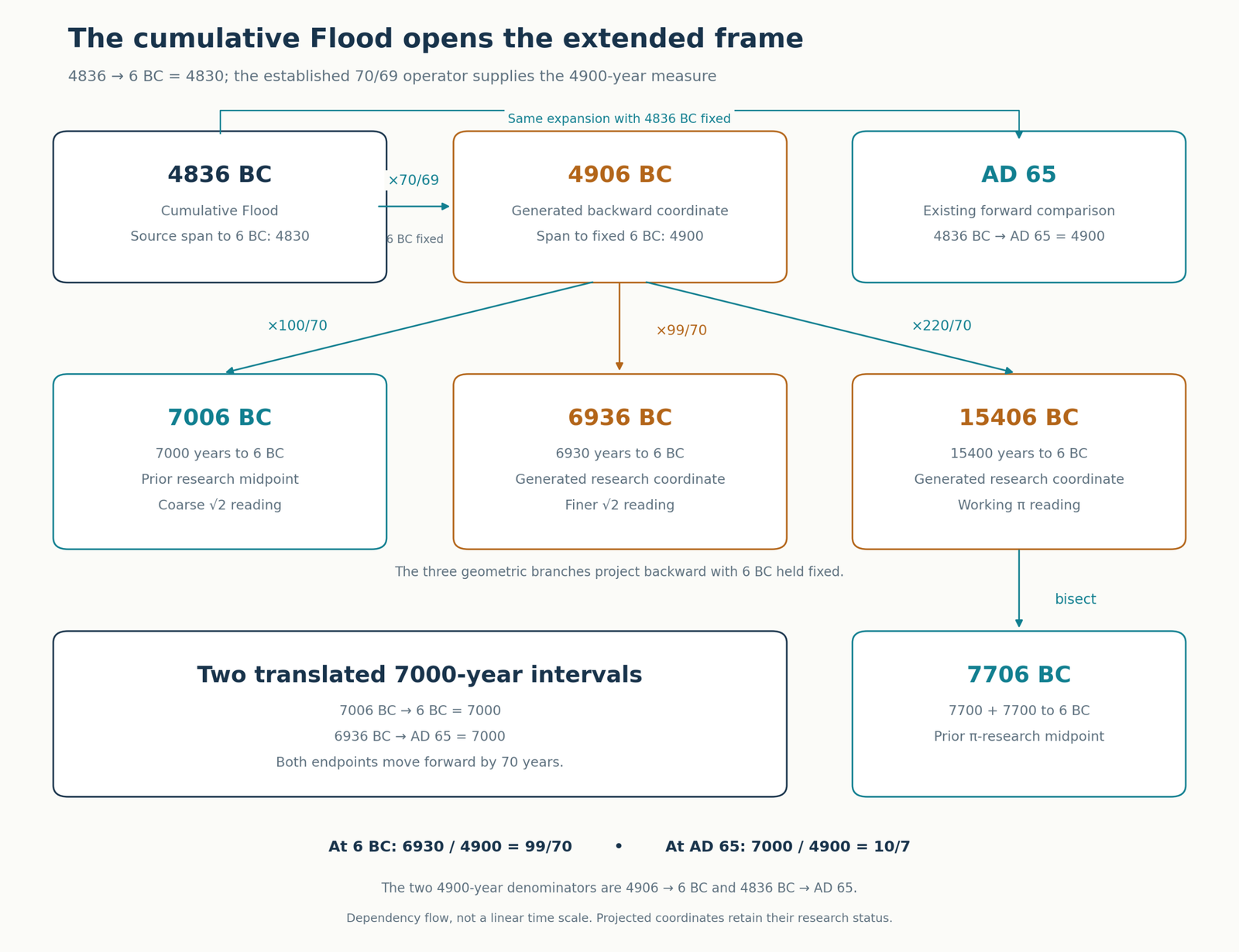
These extended lines have a structural role within the proposal. They reconnect the cumulative Flood with the previously active 7006 and 7706 nodes and with the established 4900-year judgment comparison. Their meaning is assessed through those connections and their narrative setting.
The earlier π study and the shared Creation field
The π companion, §2, begins with the actual cumulative span from 14006 to 1406 BC:
Its midpoint is 7706 BC. That article also explicitly compares 7706 with Rounded regular Creation at 4106 BC, obtaining 3600 years. The existing landmarks subdivide the present three-node comparison as:
The first two limbs make the 9900-year denominator of 140/99; all three make its 14000-year numerator. The shared 14006 label supports a declared comparison between the actual cumulative π construction and the Rounded cumulative construction. Their source states remain distinct.
The earlier π study developed its own 22/7 framework and much finer calendar-sensitive approximations. This article examines the coarse ratio’s interaction with √2. It neither replaces those calendar calculations nor imports their day-level precision into the present fractions.
5. A readable outline and its finer articulation
The Rounded chronology gives an accessible first reading of the structure. Its principal blocks make the narrative’s broad numerical forms visible. Returning to the actual figures can recover distinctions that the simpler outline compresses: a covenant threshold and its promised birth, corresponding week boundaries, or the finer division of an overlapping span.
Within the governing premise of chronology as language, this resembles different levels of reading. Simple expression can carry a complete and valuable meaning. More detailed expression can develop that meaning through additional distinctions. Careful study makes those distinctions teachable and available to the reader; this is the ordinary fruit of sustained investigation.
Accuracy and chronological provenance
The working hypothesis currently assigns 10/7 and 99/70 roles in the chronological vocabulary. The 140/99 expression is the established complementary reading of the latter. Other rational approximants belong to the mathematical background until a chronological derivation gives them a role. The proposed progression is from a coarse ratio to a sharper rational expression and, where independently specified chronological boundaries justify it, to comparison with the exact constant itself.
The continued fraction of √2 supplies convergents such as 7/5, 17/12, 41/29, and 99/70. The intermediate 10/7 has a different mathematical classification. It is not slightly more accurate than 7/5: the latter is marginally closer. The proposed significance of 100/70 comes from its chronological relation to 99/70, especially the hundred/ninety-nine threshold.
Increasing precision can help identify the constant being represented. Chronological provenance and narrative coherence remain necessary to that assessment. The actual figures can add meaningful detail even when a selected comparison is not a closer decimal estimate. The Rounded and actual readings are complementary expressions in this inquiry.
The thirty-five-year example
Take the 2456 → 6 BC span of 2450 years and keep 6 BC fixed:
The two outputs differ by 35 years. Exact √2 would give approximately 3470.823228 BC, so the finer rational output is about 0.177 year from that geometric target. The 3506 BC coordinate also occurs in the earlier π grid; its prior derivation is retained.
The named genealogical son Shelah is born thirty-five years after Arphaxad:
His span to the same Christ datum is:
With 6 BC fixed, the established calendrical operator therefore returns 2421 BC to the 2456 BC comparison coordinate. The geometric alternatives and the calendrical conversion share a thirty-five-year difference. Their directions and their source intervals differ, as the equations show. The interpretation that these are coarse and finer expressions of a common pattern remains a research hypothesis.
Seventy years as a readable outline
The Babylonian example illustrates how a broad chronological statement can remain meaningful alongside finer endpoint choices:
| Stated comparison, BC | Year-label difference |
|---|---|
| Rounded exile/restoration 606 → 536 | 70 |
| 605 → 536 | 69 |
| 605 → 537 | 68 |
| Josiah 609 → Babylon’s fall 539 | 70 |
The final row has different narrative endpoints. These alternatives do not describe one identical historical interval. The Rounded 606 → 536 presentation supplies the accessible seventy-year outline used in this research. Its BC labels end in 1 or 6 under the repository’s anchored mod-5 coordinate convention. This makes precise a familiar reading practice: a reader first understands an interval as “about seventy years,” then studies the finer boundaries when the narrative calls for them.
For the 69-year comparison, the calendrical relation is exact within the common reference K:
Holding 536 BC fixed, expanding 605 → 536 by 70/69 reconstructs the 606 BC comparison label. This does not require an unchanging physical solar year.
A further author-noted comparison pairs Aaron 1529 → Josiah 609 BC and Moses 1526 → exile 606 BC. Each is 920 = 23 × 40 years, expanding by 25/23 to 1000, a gain of 80 = 40 + 40. That gain matches the 80 years from Moses’ birth in 1526 to the Exodus in 1446 BC. Those paired endpoint choices and the possible allocation of the gain are recorded in Appendix K. They illustrate how the same grammar can follow a branch without requiring every introductory reader to master its finer articulation.
6. Complementary bows in Rounded and actual chronology
The regular Rounded sequence gives the easily recognized bow:
Its two overlapping 1650-year spans supply 11/7 each over the 1050 comparison measure, and 22/7 together. The semicircular reading has a narrative setting in the covenant bow after the Flood (Genesis 9:12–17). The proposal concerns a symbolic geometric reading of the stated intervals.
The ordinary actual 1056 and 1656
The actual Creation-completion → normal Gear-2 Noah → Flood sequence is:
The working π reading of 1056 gives:
The established Prophetic conversion supplies a related count:
The first 336 is the quotient in a geometric comparison; the second occurrence factors the converted Prophetic count. Their numerical agreement meets the Priestly 336-day vocabulary while retaining these different roles.
The source count also factors as:
Under the repository’s schematic seventy-two-year precessional-day/degree convention, 1656 represents twenty-three such units. This is a schematic celestial comparison. Reading the converted 1800 numerically as degrees gives ten semicircles, or five complete turns. Its wider chronological functions remain available alongside the bow interpretation.
The calendar identity is:
The first Key output is a Priestly count of 1800; the companion output is a Prophetic count of 1680.
A finer overlapping construction: 1058 + 598 + 1058
A second construction combines declared comparison states:
Here 4114 is actual Creation completion, 3056 is the selected Gear-1/Rounded-coincident Noah coordinate, 2458 is the Gear-2 Flood opening, and 1400 is the land-division/rest-onset boundary. The 598 belongs to this cross-Gear comparison. The ordinary actual Noah-to-Flood interval in the preceding construction remains 600.
Both overlapping spans are 1656:
Applying 25/23 once to each represented component gives:
Counting their common middle in both spans therefore gives:
The two flanks total 2300. Within my proposed narrative vocabulary, they carry the cleansing measure, while the represented middle 1300 carries the curse comparison. These meanings belong to the theological reading of the arrangement; the arithmetic defines the parts being interpreted. The single elapsed interval is 2714, becoming 2950 under the same conversion. The 3600 represented total counts the 650 overlap twice.
For a coordinate execution, hold the 1400 BC rest-onset boundary fixed. The converted sequence is 4350 → 3200 → 2550 → 1400 BC, with lengths 1150 + 650 + 1150. The generated coordinates illustrate the transformation; the original source dates retain their definitions.
The Creation rest-year interval 4115 → 4114 BC brackets the beginning, and the land-rest interval 1400 → 1399 BC brackets the end. Caleb’s testimony supplies forty-five elapsed years from his age forty to eighty-five; in the adopted chronology, 1445 → 1400 BC = 45. The six-year Conquest process is 1406 → 1400, followed by the completed rest-year boundary at 1399. The Jordan-to-rest tables preserve those endpoint distinctions.
The angular notation is kept exact: 1800° = 10π radians, while 3600° = 20π radians. Using 3600/1150 as a circular comparison gives 72/23 ≈ 3.13043478. Its proposed value here is the complementary calendrical and narrative articulation of the Rounded bow.
An ideal π target beside the Rounded diameter
If the semicircular measure is fixed at 1650 and π itself is used, the required diameter is:
Its excess over 1050 is approximately 0.422624407 schematic year, or 152.144786 days on the 360-day count. This is a diameter calculation; the radius is half that value. The target is derived from π with 1650 held fixed. A separately sourced chronological match to the additional fraction of a year remains open.
7. Two ninety-nine-year clues
Peleg: the genealogical ninety-nine
I begin with two ninety-nine-year observations that direct attention toward the larger Rounded expressions. Both have genealogical or narrative starting points.
In the regular MT genealogy, Arphaxad is 35 when Shelah is born; Shelah is 30 when Eber is born; Eber is 34 when Peleg is born. Therefore:
With the normal Arphaxad coordinate at 2456 BC, Peleg is born in 2357 BC:
This is Arphaxad’s age at the birth of a later descendant, not his stated begetting age for Shelah. The Peleg technical appendix, §A1, preserves the unrounded calculation. Genesis 10:25 associates division with Peleg’s days. The model uses his birth as the schematic Babel marker, an earliest-bound interpretation rather than an explicitly dated statement about the Tower.
Abraham: the covenant threshold
The second 99 is directly stated. Abraham is 99 when circumcised, and Ishmael is 13 (Genesis 17:24–26). Isaac is promised for the corresponding time next year; Abraham is 100 when Isaac is born (Genesis 17:21; 21:5). Ishmael’s corresponding age is therefore 14 by calculation.
| Boundary | Abraham | Ishmael |
|---|---|---|
| Circumcision | 99 | 13 |
| Isaac’s birth | 100 | 14, calculated |
The proposed contrast is a threshold before fulfillment: 99 before 100, and 13 before 14. Circumcision and covenant promise already occur at the earlier boundary, with the promised birth still ahead.
The narrative of Genesis 18–19 places the renewed announcement of Isaac’s birth beside the judgment of Sodom. Under the adopted schematic reading, circumcision and Sodom belong to the 2067 BC setting, before Isaac’s 2066 BC birth. Abraham’s age at circumcision is explicit; the destruction account does not separately repeat his age. The absolute BC placement and same-year association remain model-dependent.
The two 99-year fields have a further exact parallel:
| Regular MT field | Beginning, BC | Ninety-nine-year endpoint, BC |
|---|---|---|
| Arphaxad → Peleg / proposed Babel marker | 2456 | 2357 |
| Abraham → circumcision / proposed Sodom placement | 2166 | 2067 |
Both beginnings and both endpoints are 290 years apart:
The broader field is:
It contains two overlapping 390-year intervals, Shem → Abraham and Arphaxad → Isaac. The hundred from 2556 to 2456 is the Shem-to-Arphaxad relation, co-registering with the Gear-1 Flood label. A distinct Noah-bound Gear-2 comparison uses Shem 2558 → Flood 2458 BC for its hundred. Those executions retain their separate source states.
Creation boundaries, Sodom, and the promised son
The 99 is part of a narrative setting. Genesis 17 gives the covenant sign and the promise of Isaac; Genesis 18 renews that promise before turning toward Sodom; Genesis 19 describes the city’s judgment. Within the age-99 schematic association used here, covenantal ordering and transgressive disorder stand beside one another.
Creation proceeds through separation and ordering: light and darkness, waters and dry land, and living creatures according to their kinds (Genesis 1). I read the Watchers’ rebellion and Sodom’s transgression against that background of appointed boundaries. 1 Enoch 6:1–6 places the angels’ descent in Jared’s days. Jude 6–7 places angels abandoning their proper domain beside Sodom’s pursuit of forbidden flesh. The boundary-crossing connection is already present in that scriptural comparison.
Circumcision marks the flesh in the setting of the promised seed. Ishmael receives the sign at thirteen, but God identifies Isaac as the son through whom the covenant will continue. Abraham at ninety-nine awaits that son’s birth at one hundred. I read the paired 99/100 and 13/14 thresholds as anticipation of completion.
The distinction is between the sign’s appointed function and the fuller realization it anticipates. Circumcision is a God-given sign; the moral failure belongs to human beings who sin and fall short of God’s glory (Romans 3:23–26). A bodily sign does not itself impart the life toward which the promise leads. Paul locates Abraham’s righteousness by faith before circumcision and calls the sign its seal (Romans 4:9–12). His argument carries the enduring promise toward Christ, the promised Seed (Galatians 3:16–22); his Isaac–Ishmael comparison distinguishes birth through promise from birth according to flesh (Galatians 4:21–31). The explicit better-covenant language belongs to Hebrews 8:6–13, while Colossians 2:10–12 speaks of completeness in Christ and circumcision beyond human hands.
The missing one: sheep, coin, son, and son of Abraham
Jesus supplies a repeated narrative form for the restoration of an incomplete whole. In Luke 15, a hundred sheep become ninety-nine through the loss of one, and ten coins become nine. Seeking and recovery lead to rejoicing, which Jesus explicitly connects with a sinner’s repentance:
The ninety-nine are the remaining flock; the lost sinner is represented by the missing one. This preserves the distinction between an incomplete whole and the moral condition of the person needing recovery.
The third parable presents the lost member as a son. The younger son confesses his sin, returns, and is received by his father, who describes him as lost and found, dead and alive again. The story begins with two sons; its connection with the preceding parables is the repeated movement of loss, recovery, and restored family fellowship.
Zacchaeus in Luke 19:1–10 gives that movement a further narrative expression. As in Luke 15, people grumble at Jesus’ reception of a sinner. Zacchaeus responds with generosity and restitution; Jesus announces salvation and publicly affirms him as a son of Abraham, immediately explaining His mission as seeking and saving the lost. I read him as a rejected son publicly reclaimed. The passage records the crowd’s condemnation and Jesus’ affirmation without specifying a formal cancellation of covenant membership or narrating his circumcision.
These Gospel passages provide retrospective canonical corroboration for the proposed numerical language. The genealogical 99 at Peleg and Abraham’s explicitly stated age remain the starting observations. Jesus’ parables illuminate a related form: a whole awaiting its missing one, restored through the action of the one who seeks.
Noah and Abraham: wholeness, walking, and circumcision
The Hebrew word תָּמִים gives the ninety-nine discussion a further narrative connection. Genesis 6:9 describes Noah through wholeness and walking with God; Genesis 17:1 places the corresponding command to Abraham immediately after stating his age as ninety-nine:
| Expression | Noah: Genesis 6:9 | Abraham: Genesis 17:1 |
|---|---|---|
| Wholeness | תָּמִים הָיָה — he was blameless/wholehearted | וֶהְיֵה תָמִים — be blameless/wholehearted |
| Walking | Noah walked with God | Walk before me |
The adjective belongs to a vocabulary of completeness, soundness, and integrity. Its immediate application here concerns a person’s relationship with God. The conjunction of ninety-nine and the command toward wholeness is explicit in Genesis 17:1; reading it alongside the approaching hundred-year birth threshold is the proposed numerical interpretation. Genesis 6:9 supplies the Noah parallel.
Circumcision adds a concrete action of removal. The principal biblical meaning of מוּל is “circumcise”; the rite cuts away the foreskin. Genesis 17:14 uses a different root, כרת, for the exclusion of the uncircumcised covenant-breaker from his people. In Exodus 4:25, that same כרת root describes Zipporah’s removal of her son’s foreskin. The textual setting therefore joins bodily cutting, covenant belonging, and the consequence of exclusion.
This connection does not require deriving the preposition מוּל, “facing/opposite,” from circumcision. Klein’s dictionary treats that word separately. Nor does the argument depend on a proposed universal two-letter מ־ל base. Appendix J retains the lexical distinctions and the actual plural form in Exodus 4:26.
Received Jewish interpretation carries the Noah connection specifically to his birth. Avot de-Rabbi Natan 2 includes Noah among those born circumcised, citing the description in Genesis 6:9. Tanchuma, Noach 5 makes the same association. Tanchuma, Bereshit 11 connects Lamech’s recognition of Noah’s birth circumcised with the anticipated relief from the ground’s curse. Rashi on Genesis 17:1 preserves the corresponding interpretation of Abraham’s wholeness through circumcision.
These are distinguishable witnesses. Genesis describes Noah’s character in 6:9; it does not state at his birth in 5:28–29 that he was circumcised. The later interpretation applies that wholeness to his birth. Within the present reading, Noah’s beginning is thus associated with wholeness bestowed, while Abraham at ninety-nine receives the command toward wholeness before the promised son’s birth at one hundred.
That association meets the already established chronology. Noah’s selected birth coordinate, 3056 BC, lies 989 years before Abraham’s regular age-99 setting in 2067 BC, and 990 years before Isaac’s birth in 2066 BC. In the author-applied Rounded event grouping, the covenant threshold shares the 2066 BC block. The word and the received interpretation give a narrative connection around the existing 989/990 distinction; they do not generate those dates.
One short of a generational measure
The same threshold form can be compared across the three generational units:
| Complete measure | One short | Factorization of the short measure |
|---|---|---|
| Mosaic 40 | 39 | 3 × 13 |
| Jacobean 70 | 69 | 3 × 23 |
| Abrahamic 100 | 99 | 3 × 33 |
For the middle member, the established prophetic operator gives 69 × 70/69 = 70. The total has the same proportional form, because the three units are evenly spaced: 39 + 69 + 99 = 207 = 3 × 69, while 40 + 70 + 100 = 210 = 3 × 70. Thus 207 × 70/69 = 210. This is a relation between the totals; the individual 39 → 40 and 99 → 100 comparisons retain their one-unit additions.
The Creation microstructure in File_07, §§2.4 and 3.2 places the Fall on Day 13, seven days after Adam’s Day 6. In the proposed Nisan overlay, Nisan 13 stands one day before Nisan 14 = 2 × 7, interpreted toward Passover atonement. That Day-13 placement is the repository’s interpretive framework, rather than a day number explicitly supplied by Genesis.
The wilderness judgment supplies a further narrative comparison. Using the Exodus, reconnaissance-year, and Conquest labels 1446 → 1445 → 1406 BC gives 1 + 39 = 40 years. The generation judged after the spies’ report dies before entry, with Joshua and Caleb excepted from that condemned census generation. Numbers 14:29–34 itself expresses judgment through the correspondence of forty days and forty years. Here the one-short interval belongs to a story of failure and exclusion.
The millennial-day reading shows that ancient interpretation could make such numerical meaning explicit. Jubilees 4:29–30 explains Adam’s 930 years as seventy short of the thousand-year day in which he must die. The recorded lifespans through Noah all remain below a thousand. Shem’s five hundred remaining years after Arphaxad’s birth supply a half-thousand measure in the new-world lineage (Genesis 11:10–11); the selected 2456 → 1956 BC comparison uses that post-Flood birth boundary.
I approach these as expressions within a developing inspired language. The narrative determines whether a shortfall means moral failure, exclusion, anticipation, or a sign awaiting fuller realization. The proposed syntax is shared; its force depends on the event it describes.
8. The Rounded genealogy completes the intervals
The Rounded Scaffold is a separate, already documented mod-5 chronological construction. It does not replace the unrounded MT chronology. Its adjustments were established before this √2 investigation and must be read from their controlling source, File_51a.
The decisive local adjustment is Eber’s begetting age, 34 → 35. Consequently:
| Relationship | Unrounded regular MT | Rounded Scaffold |
|---|---|---|
| Arphaxad → Peleg | 35 + 30 + 34 = 99 | 35 + 30 + 35 = 100 |
| Noah → Peleg in the selected comparison | 600 + 99 = 699 | 600 + 100 = 700 |
| Peleg’s birth | 2357 BC | 2356 BC |
The 2356 BC coordinate is therefore an existing Rounded birth position, not a new date invented to complete the present ratio. Noah, Shem, and Arphaxad occupy 3056, 2556, and 2456 BC in this Rounded frame.
The first resulting construction is:
Its whole span divided by its earlier part gives:
The same proportion appears with the internal partition reversed:
The 1466 BC endpoint has a defined model function. It bisects Moses’ adopted 1526–1406 BC life into 60 + 60 years. It is also twenty years before the 1446 BC Exodus. The first census, dated to the second year after departure in Numbers 1:1–3, is modeled at 1445 BC. Its age-twenty threshold points approximately to births around 1465 BC, depending on birthdays and calendar boundaries. Thus 1466 is an adjacent schematic comparison, not an exact census birth cutoff.
The two 990-year outer intervals differ by a 600-year translation: Noah → Arphaxad is 600, and Isaac → Moses’ midpoint is 600. Their interior 700/290 partitions exchange order. This is a relationship between two declared chronological constructions, rather than two independent statistical trials.
The Rounded event block and its finer articulation
In the Rounded event grouping adopted for this comparison, Abraham’s ninety-ninth-year covenant threshold is represented at the hundred-year measure, so the covenant and Isaac’s birth share the 2066 BC coordinate. The regular biography distinguishes 2067 and 2066 BC. This is an author-applied grouping of the two events, alongside the canonical Eber 34 → 35 genealogical adjustment; the two operations retain their separate provenance.
The geometric proposal is therefore about levels of resolution. The Rounded structure expresses the principal blocks; the unrounded account can articulate threshold and fulfillment within them. The 99/100 difference at Abraham and the 99/100 genealogy at Peleg are two examples of that relationship.
9. The family setting of 70, 99, and 140
The small-number vocabulary also gathers around Abraham’s family. Genesis 11:26 introduces Terah’s sons at his age 70. The repository preserves a Terah age-70 begetting state, and separately an age-130 state under the +60 Terah variant. The collective naming of Abram, Nahor, and Haran does not independently settle their birth order. Here the 70-year comparison explicitly uses the base state, Terah 2236 → Abraham 2166 BC.
Abraham’s circumcision supplies 99. His age at Isaac’s marriage supplies 140 by adding two stated biblical quantities: Abraham is 100 when Isaac is born, and Isaac is 40 when he marries Rebekah (Genesis 21:5; 25:20).
The chronology therefore offers a family setting for 70, 99, and twice 70: begetting, covenant circumcision, and the marriage through which the promised line continues. These durations occupy different positions around Abraham’s life; they are compared as interval lengths, not presented as three consecutive events separated by those amounts.
Arphaxad’s stated 35 at Shelah’s birth supplies half of 70. Within the same unrounded genealogy:
Its relative error is the same as that of 99/70. Noah’s 350 post-Flood years supplies tenfold 35, or half of 700 (Genesis 9:28). The arithmetic permits a halved-seventy vocabulary at two scales.
A secondary theological suggestion concerns Cainan. Jubilees 8:3–4 portrays him recovering forbidden Watcher teachings about celestial omens, sinning through them, and concealing the action from Noah. File_53, §3, interprets Shelah as receiving the covenantal counting-position forfeited by Cainan. Reading the MT 35 as a symbolically halved 70 associated with disrupted succession is a new proposal in this investigation. Neither the 35-year statement nor Jubilees explicitly says that a former 70-year period was shortened as punishment. The hypothesis relates separate textual and genealogical observations without transferring Jubilees’ dates into MT.
Generational measures and their synchronization
File_15, §§2–4 defines the Abrahamic, Jacobean, and Mosaic units through their call-to-death spans:
| Standard | Call-to-death ages | Unit | Four generations |
|---|---|---|---|
| Abrahamic | 75 → 175 | 100 | 400 |
| Jacobean | 77 → 147 | 70 | 280 |
| Mosaic | 80 → 120 | 40 | 160 |
In the proposed geometric reading, each seventy-unit side can represent a Jacobean generation, and the square’s four-sided perimeter expresses four generations. Its 280 thus meets both the gestational and the fourth-generation vocabulary.
The two-unit and three-unit synchronizations are:
The square’s perimeter is therefore the least common multiple of forty and seventy. Bringing in the hundred-year unit gives 1400 = 5 × 280. The same value is half the working area difference:
The Conquest-to-Christ comparison in File_15 uses precisely those endpoints. Its 1400 years contain fourteen Abrahamic, twenty Jacobean, or thirty-five Mosaic generations. At the cumulative scale, 14006 → 6 BC gives ten such blocks, or 14000 years. This places the geometry’s principal measures within the existing chronology’s orientation toward Christ.
10. The 440 measure, Joseph, and the connection with e
Doubling numerator and denominator gives another useful display:
Here 440 is already Arphaxad’s Rounded lifespan, corresponding to the unrounded 438. The 140 is Abraham’s calculated age at Isaac’s marriage. The form therefore suggests a chronological comparison involving two independently specified durations; it does not depend only on rewriting abstract fractions.
The 440 measure also connects Joseph and Joshua. File_51a, §7.6, already records:
| Figure | Rounded birth, BC | Rounded death, BC | Lifespan |
|---|---|---|---|
| Joseph | 1916 | 1806 | 110 |
| Joshua | 1476 | 1366 | 110 |
Both birth-to-birth and death-to-death separations equal 440 = 4 × 110. The gap between Joseph’s death and Joshua’s birth is 330; the complete birth-to-death envelope is 550 = 110 + 330 + 110. The 440 is a displacement of corresponding lifetime boundaries, not the empty interval between their lives. Joseph’s unrounded 1915–1805 BC life remains a separate state.
Joseph’s forty–thirty–forty life
Within the Rounded Joseph state, the established Egypt boundaries divide his life as:
| Interval, BC | Years | Role |
|---|---|---|
| 1916 → 1876 | 40 | Joseph’s Rounded birth → entry into Egypt |
| 1876 → 1846 | 30 | Entry → four-hundred-year pre-Exodus boundary |
| 1846 → 1806 | 40 | That boundary → Joseph’s Rounded death |
The 1846 → 1446 BC comparison supplies the 400-year boundary used here. The division gives two complementary groupings of Joseph’s single 110-year life:
Those are the same decompositions displayed by Joshua’s two chronological placements in the next section. Within Joseph, the two seventy-year portions overlap by thirty years. Within the paired Joshua placements, the two 110-year measures overlap by forty.
Joseph’s Rounded death also bisects the Abraham-to-Exodus span:
The Joseph–Joshua parallel has a narrative setting. Joseph preserves the family through its descent into Egypt; Joshua, an Ephraimite of Joseph’s tribal house, leads the people into the inheritance. Joshua 24:29–32 places Joshua’s death at 110 beside the burial of Joseph’s bones in the land; Numbers 13:8, 16 identifies Joshua with Ephraim. The two lifespan measures thus belong to linked stories of preservation and arrival.
Separately, each 110 supplies half the working π measure relative to seventy; together they supply the whole:
For a reference circle of diameter 70, the 22/7 approximation gives circumference 220 and semicircumference 110. That reference circle states the ratio; the diagram’s diagonal-diameter circle uses approximately 99 and has the different circumference 311⅐.
This supplies a chronological reason to express the completed e study’s lower fraction fourfold:
The denominator can now represent four Joseph/Joshua lifespan units. The numerator 1196 is the corresponding fourfold expression of the already studied 299; this article has not independently established a new 1196-year source interval.
The comparison can be displayed as:
| Constant | Expression | Shared chronological measure |
|---|---|---|
| √2 | 198/140 | 140 shared with the π display |
| π | 440/140 | 440 shared with the e display |
| e | 1196/440 | Four units of the stated 110-year lifespan |
The word nesting therefore need not mean that all numerators and denominators match. A chronological measure may serve as an output or comparison quantity in one ratio and as the denominator in another. Equivalent-fraction rescaling alone can manufacture shared quantities; its research value depends on the independent chronological roles of the quantities and the reason for the chosen scale.
The finished e appendix, §C.1, had already preserved another exact arithmetic connection with 22/7:
The e study’s proposed primary grammar remains its independently motivated 299/110 and 666/245 fractions. Its mediant 193/71 and further derived identities retain their secondary mathematical status. The present comparison adds √2 to the investigation of shared chronological vocabulary without reopening the completed e article.
11. Joshua’s two lifespans and the architectural comparisons
The cumulative Joshua extension supplies a separate 110-year register. File_22, §9A.3, lays Joshua’s stated lifespan after the Moses/Conquest boundary:
This is a cumulative continuation, distinct from Joshua’s regular 1476–1366 BC biography.
Two lives, seventy years apart
The two placements give a symmetric sequence:
The regular life occupies 70 + 40 = 110, and the cumulative continuation occupies 40 + 70 = 110. Their corresponding beginnings and ends are seventy years apart. The outer elapsed envelope is 70 + 40 + 70 = 180; the two represented lifespan measures total 110 + 110 = 220, counting the shared forty-year section within each life.
The ratio therefore has a specific chronological interpretation:
The fifteenfold counterpart in the Rounded trunk
The inherited Creation–Noah–Flood–Conquest arrangement is an exact larger counterpart of Joshua’s two placements. Its 1050 + 600 + 1050 is fifteen times Joshua’s 70 + 40 + 70:
| Measure | Joshua pair | Creation–Flood / Noah–Conquest pair |
|---|---|---|
| Each represented span | 110 | 1650 |
| Displacement of corresponding endpoints | 70 | 1050 |
| Shared overlap | 40 | 600 |
| Sum of the represented spans | 220 | 3300 |
| Elapsed union | 180 | 2700 |
Every right-hand value is fifteen times its counterpart. Consequently the same sum-of-spans/displacement comparison gives:
One 1650 span gives 1650/1050 = 11/7; the paired spans give 22/7. Reversing the comparison gives 1050/3300 = 7/22, the working reciprocal of π. A reference circle of diameter 1050 would therefore have working circumference 3300 and semicircumference 1650 under the selected 22/7 approximation.
This is a proportional comparison of declared chronological intervals. It preserves the distinction between represented span totals and elapsed coverage established above. The new contribution is the exact fifteenfold recurrence between the Joshua placements and the inherited Rounded trunk; equivalent presentations of their common ratio remain dependent expressions of that relationship.
David and the Temple
Toward the Temple foundation coordinate at 966 BC:
The ordinary Davidic accession coordinate supplies another partition of the same whole:
This places four units of 99 from the Conquest to David, and four units of 110 from the Conquest to the Temple. The comparison deliberately crosses registers: the Joshua endpoint is cumulative, while David 1010 BC belongs to the ordinary royal chronology. The Rounded royal companion is 1011 BC and must not be substituted silently; 966 BC is a shared Temple label under its respective source definitions.
The Joshua overlap now supplies a defined connection with the diagram’s 220/70 ratio. The David–Temple comparison retains its supporting cross-register role and gives the architectural theme a narrative setting in the preparation for the Temple and its building.
12. Inverse numbers and the Christ-facing anchor field
The Rounded chronology already supports the inverse-number operations controlled by File_52a. This inverse is decimal digit reversal, distinct from taking a reciprocal. For the whole-span operation used here, remove a span’s trailing zeros, reverse the remaining core, then restore the trailing-zero places.
Thus 1400 becomes 4100, not 41. Likewise 14000 becomes 41000. The values 70, 99, 990, and 9900 return unchanged under this rule. This explicit decimal representation is part of the model’s arithmetic grammar.
With 6 BC held fixed, the source already supplies a Christ-facing anchor field:
| Source, BC | Span to 6 BC | Inverted span | Rebuilt coordinate, BC |
|---|---|---|---|
| Conquest 1406 | 1400 | 4100 | 4106 |
| Rounded regular Creation 4106 | 4100 | 1400 | 1406 |
| Rounded cumulative Creation 14006 | 14000 | 41000 | 41006 |
| Existing generated inverse pole 41006 | 41000 | 14000 | 14006 |
The lower Creation and Conquest members exchange; the cumulative member opens into the inverse pole at 41006 BC. The 6 BC datum is a selected symbolic Christ-birth reference, not a new historical determination of Jesus’ birthday.
Applying the same digit rule to the components of 99/70 leaves that fraction unchanged. Applying it to the alternative expression gives:
Its decimal behavior is exact:
The identities 140 = 99 + 41 and 410 = 4 × 99 + 14 explain the exchange. The leading 1 and 4 change places while the two-digit repeating blocks 41 and 14 exchange. This repetition follows from the denominator 99; its possible interpretive importance arises from agreement with the already active 1400/4100 and 14000/41000 chronological field.
The chronological ratio comparison is:
Here the 14000-year whole is inverted relative to 6 BC, while the stable 9900-year bridge is retained as the comparison measure. A whole-coordinate inversion is a different execution: inverting both original Creation positions relative to 6 BC gives 41006 and 1406 BC, separated by 39600 years. The technical appendix preserves both calculations so the chosen comparison remains explicit.
On the proposed providential reading, one framework carries information through more than one perspective: chronological intervals, a geometric approximation, decimal reversal, and a Christ-facing anchor. This is the sense in which I use the expression saturation of information. It describes the hypothesis of coordinated meaning, not a count of statistically independent confirmations.
13. A π comparison inside the inverse expression
The next observation concerns the inverse fraction:
It is therefore almost exactly one greater than π:
The derived π fraction differs from π by approximately −56.82 ppm, comparable in relative size to the approximately −51.02 ppm error of 140/99 for √2.
At the level of chronological durations, subtracting one means subtracting one full 9900-year comparison-unit:
The 31100 remainder is generated by this operation. It has not been independently identified here as a source interval between separately established event coordinates.
There is also an exact relation to the familiar 22/7 expression:
The numerator of this difference is one because 22 × 99 − 311 × 7 = 1.
The two √2 fractions and two π fractions have a particularly concise arithmetic connection:
The second identity rewrites the inverse calculation, since 10(140/99 − 1) = 410/99. The first identity is an additional comparison using the same arithmetic expression; it is not the digit inverse of 99/70.
| √2 expression | Arithmetic comparison | π expression |
|---|---|---|
| Lower: 140/99 | Multiply by 10, subtract 11 | Lower: 311/99 |
| Upper: 99/70 | Multiply by 10, subtract 11 | Upper: 22/7 |
These exact relationships concern the rational fractions. For the constants themselves, 10√2 − 11 is approximately 3.142135624, exceeding π by about 0.000543. The comparison is not an identity between the exact constants, nor does it introduce a new calendrical conversion operator.
The preferred visual comparison remains the simpler one:
It keeps the chronological seventy visible and exposes the square difference without requiring the larger inverse field as a starting point.
14. Creation, renewed beginnings, and the cornerstone
The recurring figures belong to beginnings of different kinds. Adam stands at humanity’s beginning; Noah at the renewed world after the Flood; Arphaxad at the continuing post-Flood genealogical line; Peleg at the division of peoples; Abram at the covenantal family’s beginning; Isaac at the promised line’s continuation. These are related narrative functions, not a claim that each event is an identical creation.
Creation is especially suited to architectural interpretation. Job 38:4–6 describes the earth through foundations, measurements, a measuring line, and a cornerstone. In Hebrews 11:9–10, Abraham, Isaac, and Jacob await the city whose architect and builder is God. Babel’s city built to secure a human name provides a narrative counterpoint to that awaited city.
The New Testament develops the same imagery corporately. Ephesians 2:20–22 presents Christ as cornerstone, the building fitted together, and its growth into a holy temple. First Corinthians 3 moves from God’s giving growth to God’s building, Christ as its foundation, and the community as God’s temple. Geometry and fruitful growth therefore have a shared biblical metaphor within which the present √2, π, and e comparisons may be interpreted.
On this reading, the constants symbolize complementary aspects of divine architecture. √2 supplies the square’s diagonal and a length enlargement that doubles square area; π supplies circular measure. Their simple rational forms may be suitable for a schematic framework, while the unrounded chronological details preserve threshold, departure, judgment, and fulfillment comparisons around it.
This remains an interpretive proposal. A ratio’s exact arithmetic can be demonstrated separately from its chronological provenance and proposed meaning. The theological reading does not establish the source dates, and no inference about an ancient author’s knowledge of modern constant notation follows automatically. The providential hypothesis allows meaning beyond an author’s consciously formulated mathematics, while still requiring controlled calculations and a coherent reading of Scripture.
For inferred dates, the governing Conservation of Narrative Information method retains its order: earliest textually permissible bounded inference, narrative inheritance, and then retrospective canonical corroboration. A later architectural or Christological echo can enrich a chronological reading; it cannot turn an inferred event date into an explicitly stated biblical one.
The Key of 23 retains its established function as common calendrical transformation grammar. Its 25/23, 70/69, and 300/299 operators connect 336-, 360-, and 364-day schematic reckonings with the common mathematical reference 8400/23 days. That reference is not an actual unchanging solar year. None of the new fraction comparisons in this article is being added to that calendrical operator family.
The tree metaphor gives the proposal an explanatory order. The large Creation–Flood structure is its trunk. Peleg, Abram, Isaac, Jacob, Egypt, and Moses/Joshua form principal branches. Ages, thresholds, and subdivisions develop the smaller branches. The Key of 23 follows the same structure through its established transformations. The form recurs across scales while each narrative contributes its particular meaning.
15. Exploratory geometric extensions and endpoint leads
Why extend the construction beyond the chronological nodes?
The purpose of an extension is to investigate whether the established regular and cumulative dates are selected intersection nodes within a larger proportional construction. An auxiliary point beyond the original chronological extent can reveal relations among its internal measures, just as extending lines in a geometric drawing can make their common construction visible.
The generated 19806 BC coordinate has that exploratory role. Its proposed value lies in the inherited nodes and units it reconnects. Each extension retains its source span, fixed endpoint, chosen ratio, and resulting coordinate; the discussion then asks what established relationships the construction makes visible. Within the governing hermeneutic, the larger pattern may supply grammar connecting the chronology’s local numerical statements. The complete geometry remains to be recovered.
The 1986 and 19806 BC projections
The preceding structures invite a limited further test. Apply the selected √2 approximation to two existing spans, always holding 6 BC fixed:
These are generated research coordinates. The operations produce them exactly because the selected rational factor is used. Exact √2 instead gives projected coordinates approximately 1985.898987 and 19804.989873 BC.
The Abraham comparisons are:
Thus Abraham’s birth divides the interval between the two generated coordinates into 49 blocks of 360 years and a half-block:
One existing Rounded counterpart is available: 1986 BC is Shelah’s Rounded death coordinate, 2421 − 435. That comparison belongs to the secondary Rounded death-date layer. The geometric projection meets an existing model coordinate without converting it into an independently demonstrated historical date.
For completeness, the π companion gives paired projections:
| Source coordinate; 6 BC fixed | Using 99/70 | Using 220/70 |
|---|---|---|
| 1406 BC, span 1400 | 1986 BC | 4406 BC |
| 14006 BC, span 14000 | 19806 BC | 44006 BC |
Their separations are 2420 = 20 × 11² and 24200 = 200 × 11². Those differences follow from the common-source comparison and the numerator difference 220 − 99. They are predictable components of one construction, not additional independent discoveries.
The 19806–6306–6 comparison: π and a Fibonacci lead
The earlier √2 projection supplies 19806 BC with 6 BC held fixed. The Φ study supplies the prior research coordinate 6306 BC. Their spans to the same Christ datum give a new placement of the working π proportion:
The fraction compares the whole with its final limb. The adjacent limbs instead give 13500/6300 = 15/7.
| Comparison | Length | Backbone form |
|---|---|---|
| Generated 19806 → 6 BC | 19800 | 12 × 1650 |
| Prior Φ coordinate 6306 → 6 BC | 6300 | 6 × 1050 |
| Cumulative Creation 14006 → Conquest 1406 BC | 12600 | 12 × 1050 |
Thus 19800/12600 = 11/7, and the 6300 half of 12600 supplies the doubling to 22/7. These exact equations reuse the inherited 1650:1050 proportion. The 19806 BC coordinate remains generated; 6306 BC retains its prior Φ-research derivation.
A further description of the same whole is:
Fifty-five is a Fibonacci number in the 21–34–55–89–144 sequence already explored in the Φ companion’s Fibonacci extension. That earlier construction includes 6906 → 1406 BC = 5500 = 55 × 100. Here the √2-derived span expresses 55 through blocks of 360 years.
The discovery order matters: the 99/70 projection generated the outer coordinate first; its comparison with 6306 then disclosed 22/7; the 55 × 360 expression was recognized afterward. These are several readings of one constructed span. Fifty-five supplies a specific Φ lead, while a chronologically motivated golden division of this 19800-year whole has not yet been identified. The suggested “labyrinth” remains an image for intersecting routes whose full organization is unresolved.
A recalled extension of the 1650 backbone across the Mirror is parked in Appendix J. Its civil-span arithmetic is recorded there; no larger Mirror geometry is developed at this stage.
One perimeter from the 2456 BC coordinate
Taking the perimeter as a symbolic year measure from the shared 2456 BC Arphaxad / Rounded-Flood / Gear-1 comparison label gives 2456 − 280 = 2176 BC. This generated endpoint lies ten years before Abram’s birth, 770 years before the Conquest, and 777 before the selected 1399 BC rest boundary.
It also stands 4830 = 69 × 70 after the recurring 7006 BC coordinate. Applying the existing operators to that span gives 4900 by 70/69 and 5250 by 25/23. The first equals the square’s area; the second equals the earlier 7706 → 2456 BC arm of the π construction. Holding 7006 BC fixed and expanding the later arm from 4830 to 4900 reaches 2106 BC, Noah’s Gear-1 / Rounded death coordinate, seventy years after 2176. Appendix I keeps the endpoints and arithmetic together.
Eight perimeters and eight circumferences
The Flood’s eight preserved people suggest a paired exploratory experiment: apply the same eightfold multiplier to both boundaries. The multiplier comes from the narrative; the two geometric lengths retain their previously derived values.
The resulting 216 BC comparison node has paired distances from Joshua’s two placements:
| Joshua boundary, BC | Years to 216 BC | Form |
|---|---|---|
| Regular birth 1476 | 1260 | 18 × 70; 3½ × 360 |
| Regular death 1366 | 1150 | 50 × 23 |
| Cumulative start 1406 | 1190 | 17 × 70 |
| Cumulative end 1296 | 1080 | 3 × 360 |
Using the full rational circumference gives:
From the opening of Nisan 6 in 2456 BC, the whole 2488-year component reaches AD 33 at the same phase, using the civil year count without year zero. The remainder contains another 360-day year plus 360/7 days. Nisan 6 opens five elapsed days after Nisan 1, so the final annual offset is 5 + 360/7 = 395/7 = 56.428571… days: within ordinal Day 57, month 2 day 27, in AD 34.
Keeping the same Nisan-6 opening and duration while shifting the source year gives:
| Starting year, BC | Endpoint on the 360-day grid | Relation to the adopted AD 33 Ascension comparison |
|---|---|---|
| 2458 | AD 32, month 2 day 27 | Previous year |
| 2457 | AD 33, month 2 day 27 | Same mapped date and year |
| 2456 | AD 34, month 2 day 27 | First anniversary |
The 2457 BC row is the Flood-closing coordinate already used in the π study. The Birth–Cross companion associates month 2 day 27 with forty elapsed days after Nisan 17. These are symbolic 360-day calculations, with ordinary BC/AD year labels and an explicitly declared starting boundary; the end of Nisan 6 would move the endpoint into Day 58.
The eight-souls association has a direct narrative setting in 1 Peter 3:20–22, which moves from the eight preserved through water to baptism, Christ’s resurrection, and His entrance into heaven. I retain the paired eightfold construction as a lead to trace within that narrative. The dates 2176 and 216 BC are generated comparison nodes, and the three endpoint years are translations of the same calculation.
These extensions explore whether the one geometric construction can organize the chronology’s broad outline toward Christ. Their detailed claims and dependencies remain visible in the appendix.
16. The connected architecture and its present research boundary
The central result of this stage is the connected placement of the two geometric readings: (7000 + 7000)/9900 at the cumulative–regular Creation bridge, and (1650 + 1650)/1050 from regular Creation through Noah and the Flood to the Conquest. The cumulative Flood then opens the 4900-year square-of-seventy construction, returning through the coarse and finer √2 ratios to 7006 and 6936 BC, and through π to the doubled 7700 frame. The Key of 23 follows the large bridge and the 989/621 covenant partition. This is the trunk around which the supporting material is now arranged.
The arithmetic establishes several precise relationships. The Rounded 990/700 and 9900/7000 expressions reduce to 99/70. The 14000/9900 comparison gives its 140/99 counterpart. The same seventy-unit denominator presents π as 220/70, with the numerator difference 11². The established inverse rule connects the 14/41 chronological field to the repeating decimals, and a derived subtraction gives 311/99 as a further π comparison. The 440 measure already has several chronological roles and provides a declared meeting with the e fraction’s fourfold expression.
My broader hypothesis is that this combined triangle–square–circle figure may supply a compact template for the Rounded chronology’s principal structure, with finer narrative distinctions articulated through the unrounded measures. The 99 at Peleg and Abraham, the 70/40/110 Joseph–Joshua patterns, and the 280/1400/2800 generational relationships give that proposal a defined vocabulary. Within my providential reading, the numerical language develops through the scriptural story toward Christ and can carry relationships richer than an individual human writer recognized. The appendix records which quantities are textual, inherited model coordinates, or newly generated comparisons.
The textual comparison adds the shared language of wholeness and walking with God at Noah and Abraham, together with the received circumcision interpretation. The inherited 1650/1050/600 backbone now supplies an exact fifteenfold counterpart to Joshua’s overlap. These additions strengthen the chronological and narrative setting of the proposed vocabulary. The 19806–6306–6 π comparison and Fibonacci 55 expression remain exploratory extensions whose larger geometric organization is unresolved.
The compact shared-denominator vocabulary remains:
A triangle of two seventy-unit legs supplies a hypotenuse approximately ninety-nine units long. That same segment becomes the circle’s diameter. The geometry gives a clear illustration of the proposed chronological harmony: distinct measures fitting together within one construction, interpreted in relation to the God who creates, renews, and builds His people around Christ.
The organizing claim is a proposed numerical language of divine architecture extending toward Christ. Exact arithmetic, source-qualified chronology, and theological interpretation contribute different kinds of evidence to that claim. Readability at the Rounded level and richer articulation in the actual figures are complementary features of the proposed language. The fine angular, calendrical, and narrative constructions remain documented together with the relationships still awaiting resolution.
Sources and companion reading
-
490d Unified Chronology Knowledge Catalog and canonical Markdown source index. Canonical dates, controls, and state definitions govern this exploratory companion.
-
File_51a — Rounded Scaffold, especially §§3.1–3.4, 4.1–4.3, 5.1, 7.6, 13.3, 16.3, 16.10.1–16.10.4, and the monarchy clarification: Rounded genealogy, Peleg, Arphaxad’s lifespan, secondary death dates, Joseph/Joshua, and literal/Rounded royal distinctions.
-
File_52a — Inverse-Number Architecture, §§2.1, 3, 7, and 16.4: whole-span rule, stable bridge, and Christ-facing inverse poles.
-
File_22 — Cumulative MT Harmonics, §§5, 7, and 9A.3: actual 9890 bridge and cumulative Joshua continuation. File_18 — Chronological Data Tables: raw-table and variant-state controls.
-
Peleg and Babel — technical appendix, §A1: the unrounded 35 + 30 + 34 genealogy and the inferred Babel birth marker.
-
File_53 — Jubilees Creation-Genealogy Witness, §3; Jubilees 8, R. H. Charles translation: Cainan’s transgression and the repository’s interpretive expunction comparison.
-
Pi and Biblical Chronology and technical appendix: prior 22/7 structures, 7706 BC, and separate calendar refinements.
-
Phi and Biblical Chronology and technical appendix: 7006 BC, the π–Φ field, and Conservation of Narrative Information.
-
e and Biblical Chronology and technical appendix, final author-supplied publication package v6, 10 November 2026: the two coarse e fractions, 110, 1466 BC, and the secondary π-linked determinant identity.
-
Alpha, Creation, and Christ: the first study in the integrated series.
-
Biblical passages: Genesis 9:28; 10:25; 11:10–26; 17:21–26; 18–19; 21:5; 25:20; 50:26; Numbers 1:1–3; Joshua 24:29; Psalm 90:10; Job 38:4–6; Luke 15:4–7; Hebrews 11:9–10; Ephesians 2:20–22; 1 Corinthians 3:6–16.
-
File_15 — Generational Axiom, §§2–4 and 6: 100/70/40 standards, fourth-generation scales, LCM 1400, and the Conquest-to-Christ pair.
-
File_07 — Creation, §§2.4, 3.2, and the 930 + 70 reception-history discussion; Jubilees 4:29–30: distinguish the repository’s Day-13 framework from Jubilees’ explicit millennial-day interpretation.
-
1 Enoch 6; Jude 6–7; Luke 15; Luke 19:1–10; Romans 3–4; Galatians 3–4; Colossians 2; Hebrews 8: boundary, promise, recovery, covenant, and fulfillment comparisons.
-
Flood Day–Year Part 4b tables; Birth–Cross companion; 1 Peter 3:20–22: ordinal Flood markers, mapped Ascension date, and the eight-souls narrative.
-
Genesis 6, Genesis 17, Exodus 4; Brown–Driver–Briggs, מוּל, מוּלָה, and תָּמִים; Klein, מול: lexical meanings, distinct homonyms, and the circumcision forms.
-
Avot de-Rabbi Natan 2; Tanchuma, Noach 5; Tanchuma, Bereshit 11; Rashi on Genesis 17:1: received Noah–Abraham circumcision and wholeness interpretations.
-
The 9900-year bridge — technical appendix, §A3: the inherited paired 1650-year spans and their 600-year overlap, controlled by File_51a.
-
File_12 — Calendrical Physics, particularly the shared-K definitions and precessional display dependency; File_17 — Prophetic Time Span Anatomy: calendar registers and established prophetic numerical vocabulary.
-
File_09 — Cumulative Architecture, §§0.3.1, 3A.1, and 3A.4.2: actual cumulative week ontology, Flood head/internal distinctions, and matched Conquest/rest boundaries.
-
File_30 — Alpha–Omega Link and the 4900/4300 Master Cycle, §§6 and 8.3; Shem–Christ source tables, §§5–8: fixed-start 4830→4900 expansion, exact AD 65 target, and phase-resolved judgment/ministry fields.
-
Jordan-to-rest technical tables, Tables 1–2: Caleb 40/45/85, Conquest process 1406→1400, rest interval 1400→1399 BC; Joshua 14: direct testimony.
-
Genesis 9, Jeremiah 25, Jeremiah 29, Luke 3:23: covenant bow, seventy-year narrative, and the approximate thirty-year ministry-age expression. Absolute dates and the numerical comparisons retain their model/research status.
Research boundary: Version 4 is based on the complete, byte-verified v3 package. It makes the connected Creation–Flood–Conquest–Christ architecture the principal argument, with the Key of 23 following the trunk and its covenantal branches. It integrates the post-v3 resolution, complementary-bow, apparent-age, cumulative-Flood, projected-midpoint, AD 65, and Noah–covenant–Exodus discussions. All earlier research families remain present. The Φ labyrinth, larger Mirror geometry, and sourced match to the ideal π-diameter residue remain unresolved. Verification checks arithmetic under declared inputs; the governing inspired-language hermeneutic and the proposed meanings retain their stated interpretive roles.