This is the active supporting study for Noah’s Flood: Seasonal Columns and Chronological Mirrors. All table values retain their event, state, phase and counting qualifications.
Sources and the scope of the supporting study
This document accompanies Part 4b: Noah’s Flood—Seasonal Columns and Chronological Mirrors. It preserves the substantive calculations, alternative registers and interpretive leads of the original discussion. Its table headings name which values are ordinary chronological anchors, cumulative coordinates, symbolic day–year projections or proposed comparative states. Corrections repair equations or event assignments; absence from the repository Canon alone does not remove novel research.
The calendar section supplies the four columns, older counters, intercalation, regular comparisons and probability questions. The Mirror and cumulative section supplies the civil and seasonal operations, prophetic-period families, Enoch, all twenty-six cumulative lifespans and the Sumerian chart. The figure/person/event index (data ZIP) directly connects diagrams to passages and tables. All downloadable CSVs retain their named column fields and may be opened in a spreadsheet.
| Source | Principal control in this study |
|---|---|
| File 00 §3.9 and File 09 Appendix A | Civil span, single-node, astronomical and paired seasonal Mirror operations |
| File 02 and File 18 | MT/SP/LXX Flood coordinates, events, calendar phases and tabulated states |
| Files 07, 11 and 22 | Creation, gears and cumulative harmonic architecture |
| Files 12, 17 and 23 | Calendar registers, leap placements, prophetic periods and the Ark protocol |
| Files 13, 20 and 55 | Christological alternatives, Jubilees and the Moses framework |
| Files 21, 26, 27 and 34 | Sumerian comparative framework and cosmic/precessional constructions |
| File 46 | Expansion operations and their fixed endpoints |
| Genesis 7 and 8, BSB | Flood narrative and explicit dated notices |
| Daniel 8, 9 and 12, BSB | Stated numbers and their literary setting |
| 1 Enoch, astronomical section and Jubilees 3 / 6 | Extra-biblical calendar and garden-entry traditions |
| Oxford ETCSL: Sumerian King List | Transmitted reign figures, uncertainties and subtotal distinctions |
Current source captures and a block-by-block conservation inventory accompany the publication package. The reader does not need those editorial records to follow the calculations; each active table explains its own state.
Research history and continuing leads
The original records a research beginning on 22 October 1991, approximately forty hours of work weekly, and an important refinement of the Flood studies on 12–13 September 2024. It describes a study of roughly sixty thousand words at that stage, alongside about a dozen related draft books. These are the author’s research-history statements, not independent counts of the present replacement article.
The author describes knowing the Lord as Teacher as the chief reward of the work. This conviction explains the interpretive interest in the numerical patterns; it does not replace arithmetic or textual verification. A suggestion that a 2024 moment might have an exact-hour relationship was not worked through with a complete calendar calculation in the source. It remains an undeveloped lead, rather than a verified date or forecast.
The chromosome analogy similarly illustrates the repeated pairing of 23 and 46. It is an analogy, not biological evidence of how biblical chronology was composed. The number 1176 = 3.5 × 336 is retained as a proposed priestly half-week lead. Its numerical value is established; a claimed Mirror correspondence needs specified endpoints and a declared reflection protocol before it can become a tested comparison.
The study’s language of large and small scrolls, nested time and repeated patterns describes a theological synthesis. Each scale transformation must still name its units. A nominal day mapped to a year, and a nominal year mapped to 360 years, are different stages; neither can be omitted merely because the final result is attractive.
Additional links retained from the developing discussion
The earlier origins 751/750 + 180 = 931/930 and 721/720 + 180 = 901/900 prompted a comparison with the Northern Kingdom. The ordinary division anchor is 930 BC in the repository’s register; its declared preceding seasonal companion is 931. The source’s schematic terminal reference 721 gives 210 from 931 and 209 from 930. This is a selected endpoint analogy, not proof that the projected origin independently dates the kingdom’s history. The two origins and both spans remain visible.
The expanded Creation-to-Flood length 1656 × 25/23 = 1800 = 5 × 360 is also read beside Lamech’s death five years before the MT Flood: 2463 → 2458 BC. Mapping five nominal 360-day years gives 1800 days, and a further day–year projection compares that measure with 1800 symbolic years. The stages are distinct; five ordinary years do not literally occupy 1800 years.
A 490-year span contains seventy seven-year sabbatical cycles. The source proposes this as the background for the land’s missed Sabbaths and its seventy-year rest in 2 Chronicles 36:21, BSB, alongside Daniel’s seventy sevens and flood imagery. The numerical count is exact; the text does not independently identify the beginning of a unique 490-year period through that count alone.
The Adam/Eve purification proposal includes two endpoint placements, not merely two names for the same calculation:
| Source branch | Proposed Adam endpoint comparison | Proposed Eve endpoint comparison | Status |
|---|---|---|---|
| Carry the approximately forty-one-day residue outside the ideal 604800-day volume | Cleansing at numbered 46/47 compared with the beginning of Noah’s Flood year | Cleansing at 86–88 compared with the outbreak around numbered day 47 | Source’s residue-placement proposal; approximate solar reference and counter choice must remain stated |
| Leave the residue outside the schematic count | Numbered 47 compared with the Flood’s outbreak at 47 | Numbered 86–88 compared with the rain-end position around 87 | Source’s alternative nominal alignment, not an independently verified exact-hour calculation |
Both branches use the same 604800 = 1800 × 336 = 1680 × 360 ideal day-volume. Neither branch establishes that Genesis states Adam’s or Eve’s cleansing date. They preserve the original interpretation of a remainder while the calendar section supplies the independently reproducible volumes and placements.
The source’s Revelation 12 reading also specifically proposes that the woman’s seed through Christ becomes renewed sons of God taking the place of the rebellious angelic sons of God. The slow precessional timepiece is interpreted as an image of the saints’ enduring life. This preserves the proposed angelic/human role comparison; it is not an explicit identification of the twelve stars or a measured duration stated in Revelation.
Calendar registers and the four seasonal columns
These tables preserve the detailed Flood day–year model, including its alternative boundaries. They distinguish the narrated events from the thirty-day-month calendar used to calculate their positions, the day–year projection applied to those positions, and the interpretations that connect the resulting numbers. A date in a symbolic column is a projected label. It does not redetermine Noah’s historical date.
The regular comparisons use the MT full-430-year Egypt framework, with the Exodus at 1446 BC and the ordinary Gear-2 Flood at 2458 BC. The fixed regular Arphaxad node is 2456 BC. Terah’s +60 alternative is declared when opened; MT/SP restored second Cainan remains off, while the LXX comparison retains its native second Cainan. Nisan is the default. SP dates used beside the MT in the comparison grid have been equalized to the same full-430 framework, rather than silently importing the SP native 215-year Egypt setting. File 18 §§2–4 controls these distinctions.
The three schematic day registers remain distinct:
| Register | Day measure | Mathematical use |
|---|---|---|
| Priestly ledger | 336 = 24 × 14 = 168 + 168 | The ideal service-course register underlying 25/23 |
| Prophetic year | 360 = 12 × 30 | The month grid and prophetic half-week |
| Enochian year | 364 = 52 × 7 | The weekly register and its four 91-day seasons |
The Priestly ledger is a foundational register, not a failed solar calendar. The bridge 336 + 28 = 364 adds four weeks without altering its baseline. A physical solar mean, the intercalated 360-day reconstruction, and the exact rational Key-of-23 operators are additional, separately declared calculations. File 12 §§5–7A and File 17 §14 supply the controls.
The final four-column ledger
All entries below are symbolic BC labels. Column headings retain the source’s window-length names, 720, 750, 900 and 930. They are not four separately dated historical Floods. For an explicitly declared elapsed marker d, the source’s later morning ledger calculates the label by L − d. The Tishri columns add 180 to the corresponding Nisan labels. The 750 and 930 columns carry the optional extra 30 relative to their partners.
| Row | Marker | 720 | 750 | 900 | 930 |
|---|---|---|---|---|---|
| 0 | Window origin | 720 | 750 | 900 | 930 |
| 1 | Creation-anniversary morning | 714 | 744 | 894 | 924 |
| 2 | Ark-entry warning / preparation boundary | 681 / 680 | 711 / 710 | 861 / 860 | 891 / 890 |
| 3 | Door shut and rain begins | 674 | 704 | 854 | 884 |
| 4 | Forty-day rain ends | 634 | 664 | 814 | 844 |
| 5 | Ark rests | 524 | 554 | 704 | 734 |
| 6 | Mountain tops visible | 450 | 480 | 630 | 660 |
| 7 | Raven and first dove release group | 410 | 440 | 590 | 620 |
| 8 | Dove with olive leaf: second release | 404 / 403 | 434 / 433 | 584 / 583 | 614 / 613 |
| 9 | Last dove: third release | 397 / 396 | 427 / 426 | 577 / 576 | 607 / 606 |
| 10 | Cover removed; ground surface dry | 360 | 390 | 540 | 570 |
| 11 | Earth completely dry; exit follows | 304 | 334 | 484 | 514 |
The complete marker ledger, including offsets and qualifications, is available as CSV (data ZIP). “Earth completely dry; exit follows” represents the second month’s twenty-seventh day, followed by the command to leave. The command and departure receive no separate date in Genesis 8:14–19 (BSB). The new-year notice in Genesis 8:13 (BSB) concerns the dry ground surface and removal of the covering, an earlier stage.
The “forty-day rain ends” row concerns the rain, not the entire Flood. The 150-day rise/prevailing-water interval reaches the Ark’s rest. It begins at the outbreak and includes the forty-day rain; those spans are not added as two successive periods. Genesis 7:11–12, 24 (BSB) and Genesis 8:3–4 (BSB) supplies the underlying dated narrative.
The model places the raven and the first dove in one release group. Scripture narrates the raven first, then the dove, but does not state that their release occurred in the same hour, on the same day, or seven days apart. This remains a reconstruction. There are three dove releases, in Genesis 8:8, 10 and 12 (BSB), and two explicitly recorded subsequent seven-day waits. The late transcript’s statement that the dove was sent only twice confuses two later rereleases with the total number of releases.
Numbered days, completed intervals and morning/evening
The Ark-entry row retains 681/680 and its corresponding other-column alternatives. The source expressly labels the earlier value as exclusive and the later as inclusive. In the later dove rows it reverses that order: 404 inclusive / 403 exclusive, then 397 inclusive / 396 exclusive. Each pair records a counted-week alternative. It must not be silently turned into an unrestricted one-year shift, or uniformly assigned a Tishri/Nisan meaning.
A numbered seventh day is reached after six completed days. The source also considers a daylight-oriented half-day framing: 0.5 + 6 + 0.5 =7. A morning-to-morning or evening-to-evening calculation must keep the selected boundaries; a partial seventh day is not automatically a completed seven-day interval. The suggested daylight entry of animals, morning visibility of mountains and fourth-day appearance of the luminaries are narrative/phase interpretations, not independently supplied hour-stamps. Similarly, a seven-day unit can be represented through its opening boundary, its seventh numbered day, or its completion. Those are distinct counters for one time-unit. The paired values preserve that distinction; they do not imply two physical releases of the same bird.
The source also makes a particular seasonal analogy: evening maps to autumn and morning to spring. It explicitly uses 711 BC evening / 710 BC morning, 481 BC evening / 480 BC morning, and an evening raven label 411 BC beside its morning 410 BC. These declarations are retained as phase readings within the symbolic model. Genesis gives the olive-leaf dove’s evening return, but does not timestamp the raven’s departure. The inference that its darker plumage and departure evoke night is interpretive, rather than a new textual datum.
The original Part 4a companion preserves an earlier 721/751 rendering. The difference is explained by its numbered-day and opening/completion labels; those old entries should not be treated as a second set of independent observations. In particular, the earlier sequence has a separate initial seven-day gap before the first dove, while the later Part 4b table groups the raven and first dove. Both reconstructions belong in the record, with their different assumptions visible. The earlier duplicate dry-earth row is resolved by identifying the two new-year boundary views as surface dryness, followed later by complete dryness.
| Earlier marker | Counter | 721 column (BC) | 751 column (BC) | Later rendering |
|---|---|---|---|---|
| Creation anniversary | 7 | 714 | 744 | 714/744 |
| Entry warning | 40 | 681 | 711 | 681/680;711/710 |
| Flood outbreak | 47 | 674 | 704 | 674/704 |
| Rain end | 87 | 634 | 664 | 634/664 |
| Ark rest | 197 | 524 | 554 | 524/554 |
| Mountain tops | 270 | 451 | 481 | 450/480 |
| Raven | 310 | 411 | 441 | 410/440 |
| First dove: early version | 317 | 404 | 434 | Firstdovegroup410/440;second434/433 |
| Second dove: early version | 324 | 397 | 427 | Lastdove427/426 |
| Third dove: early version | 331 | 390 | 420 | Notinlater0+7+7grouping |
| Cover removalopening | 360 | 361 | 391 | 360/390 |
| Earlier duplicate dry row | 361 | 360 | 390 | 360/390 |
| Complete dryness; exit follows | 417 | 304 | 334 | 304/334 |
CSV: earlier/later model history (data ZIP); complete earlier 721/751 ledger (data ZIP). The earlier first-dove position remains available as a conditional inferred-gap reconstruction; it is not discarded merely because the later release grouping differs.
| Narrative marker | Uniform elapsed offset from the Flood-year opening | Numbered day | Later Part 4b label, L = 750 |
|---|---|---|---|
| Flood outbreak II/17 | 46 | 47 | 704 BC |
| Rain ends after forty days | 86 | 87 | 664 BC |
| Ark rests VII/17 | 196 | 197 | 554 BC |
| Mountain tops X/1 | 270 | 271 | 480 BC |
| New-year surface dryness I/1 | 360 | 361 | 390 BC |
| Complete dryness II/27 | 416 | 417 | 334 BC |
This uniform ledger is a thirty-day-month reconstruction. The older 410/417-day comparisons also choose their own origins. From creation-anniversary ordinal day 7 to closing ordinal day 417 the difference is 410; from Flood ordinal day 47 to day 417 it is 370. The number 417 is a numbered closing position, not 417 elapsed days after the Flood began. The older mountain-to-exit comparison uses 417 −270 =147 =3×49, a mixed opening/completion counter. The uniform completed interval is 416 −270 =146. The proposed three-jubilee correspondence is retained with its original counter declaration;147 is not silently described as the uniform completed duration.
Festival analogies and their two-day offsets
| Comparison | 720 | 750 | 900 | 930 |
|---|---|---|---|---|
| Later VII/15 feast-date comparison | 526 | 556 | 706 | 736 |
| VII/15 opening evening alternative | 527 | 557 | 707 | 737 |
| Later Kislev25/Hanukkah date comparison | 636 | 666 | 816 | 846 |
CSV: festival offsets (data ZIP). The VII/15 comparison is two days before the Ark’s VII/17 rest. In a Tishri-start month numbering, the corresponding spring-side month is compared with Passover/Unleavened Bread. Under that same alternative numbering the eighty-seventh numbered-day rain-end position lies two days after Kislev 25, the later Hanukkah date. The festival comparisons therefore preserve the source’s two-day adjustments while distinguishing them from Genesis’ own calendar statements. They do not establish that Noah celebrated either later feast.
526 BC, used in the selected numerical ladder, is the separate VII/15 comparison in the 720 column, not the Ark’s VII/17 rest at 524 BC. Those markers must not be conflated when counting matches.
Intercalation, physical residues and the Priestly ledger
The declared forty-year cycle
The reconstructed 360-day system uses six six-year segments followed by one four-year segment, each closed by a thirty-day leap month:
6 + 6 + 6 + 6 + 6 + 6 + 4 = 40 years
6 × (6 × 360 + 30) + (4 × 360 + 30) = 14610 days = 40 × 365.25
The reconstruction is anchored at 1446 Nisan BC, then 6 Nisan BC, thirty-six forty-year cycles later. Within the cycle beginning 606 Nisan BC, the closing boundaries are 600, 594, 588, 582, 576, 570 and 566 Nisan BC; each leap month closes its preceding segment. CSV: cycle boundaries (data ZIP).
A leap month may be counted or left outside a schematic span when that choice is declared. Thus 1260 and 1290 can be the uncounted- and counted-insertion expressions of a half-week. A seven-year span can appear as 1260 + 1260, 1260 + 1290, or, if its placement crosses two closures, 1290 + 1290. The insertion’s placement must be stated. File 12 §7A expressly retains this option principle.
This prevents a false conflict between a day-level marker and its surrounding week-unit. The actual date can lie within the mapped week while the numerical comparison uses that week as a unit. The study’s year-scale SP/Egypt/Jerusalem framework and Ezekiel’s day-scale siege patterns employ this same nesting. Their precision is assessed within their declared registers, rather than by forcing every week to be a single exact-day timestamp.
Approximate solar years and exact rational year conversion
The original model compares 460, 1656 and 1196 solar years with their Priestly expansions. The operators are exact:
460 × 25/23 = 500; 1656 × 25/23 = 1800; 1196 × 25/23 = 1300.
When the expanded units are counted at 336 days each, they yield the following day-volumes. The solar comparison in the original uses the approximate tropical reference 365.2422 days. Its remaining fractions must be preserved before rounding.
| Solar span (years) | Priestly 336-day units | 336-day volume (days) | Solar day-volume (365.2422) | Surplus (days) | S_K surplus (days) |
|---|---|---|---|---|---|
| 460 | 500 | 168000 | 168011.412 | 11.412 | 23/2 |
| 1656 | 1800 | 604800 | 604841.0832 | 41.0832 | 207/5 |
| 1196 | 1300 | 436800 | 436829.6712 | 29.6712 | 299/10 |
CSV: solar/Priestly remainders (data ZIP). The source’s approximately eleven, forty-one and thirty days are therefore legitimate approximate physical comparisons. They are not exact astronomical identities. Current Canon also supplies the calibrated reference S_K = 336023/920 and its physical-residue rule N/40 days. That gives 11.5, 41.4 and 29.9 days for the same three spans. The two physical references must be named individually; the calibrated values do not silently replace the old approximate calculation.
The ideal common-ratio reference is K = 8400/23. Under that ideal reference the day-volumes are exactly equal. For example, 1656 × K = 1800 × 336 = 604800 days. Both 1800 Priestly years and 1680 Prophetic years occupy that day-volume: 1800 × 336 = 1680 × 360. Likewise 500 × 336 = 168000 and 1300 × 336 = 436800. These identities keep the calendar units distinct while comparing their volumes.
The thirty- and sixty-day placement alternatives
The intercalated 360-day calendar is a third register. In its declared 1446n epoch, the number of enclosed leap months depends on the particular endpoints. The following table calculates the closures actually included by each interval. A closure at the starting Nisan boundary has already occurred and is excluded; one at the ending boundary is included.
| Nisan labels (BC) | Phase | Leap months | Extra starting-half-year leap days | Total (days) | Surplus over ideal 336-day ledger (days) |
|---|---|---|---|---|---|
| 4114→2458 | Nisan to Nisan | 289 | 0 | 604830 | 30 |
| 4174→2518 | Nisan to Nisan;+60 | 290 | 0 | 604860 | 60 |
| 3654→2458 | Nisan to Nisan | 209 | 0 | 436830 | 30 |
| 3714→2518 | Nisan to Nisan;+60 | 209 | 0 | 436830 | 30 |
| 4174→3714 | Nisan to Nisan;+60 | 81 | 0 | 168030 | 30 |
| 4114→3654 | Nisan to Nisan | 80 | 0 | 168000 | 0 |
| 3714→2518 | Tishri3715 to Tishri2519 | 209 | 30 | 436860 | 60 |
| 4114→2458 | Tishri4115 to Tishri2459 | 289 | 30 | 604860 | 60 |
| 4174→2518 | Tishri4175 to Tishri2519 | 290 | 0 | 604860 | 60 |
CSV: 360-calendar placement remainders (data ZIP). These values explain why a remaining thirty or sixty days need not be an error. The default 4114→2458 Nisan span contains 289 leap months and is thirty days longer than the ideal 604800-day Priestly volume. The +60 span 4174→2518 contains 290 leap months and is sixty days longer. Both 3654→2458 and 3714→2518 Nisan Jared spans contain 209 closures and exceed 436800 by thirty days.
At 3714 Nisan BC a closing leap month occurs. Beginning instead at 3715 Tishri BC includes that month before the Nisan boundary; the Jared-to-Flood comparison therefore acquires another thirty days, making sixty. At the opposite endpoint no such extra insertion occurs. This is an endpoint-placement explanation within the reconstructed cycle. It does not assert that Genesis supplies the cycle or its precise historical execution.
The source’s masculine 40-day and feminine 80-day purification imagery remains a typological application of Leviticus 12 (BSB) and the Adam/Eve garden-entry reading in Jubilees. The model starts from Adam’s sixth-day formation and considers 6+40 =46 beside 6+41 =47, corresponding to the forty-day purification motif and the approximately forty-one-day physical residue. These are declared typological offsets, not a statement that the later Torah labels Genesis’ Flood onset as Adam’s purification. It also considers, separately, sixth- or eighth-day positions for Eve, giving eighty-day endpoints around numbered days 86–88. Genesis does not date Eve’s formation to an eighth day or impose the later childbirth law on Adam. The proposal compares their purification motifs with the forty-day rain and the approximate day-residues; it does not convert the association into an attested Genesis chronology.
The regular year-scale comparisons
| Comparison | From (BC) | To (BC) | Span |
|---|---|---|---|
| MT Creation to Jared | 4114 | 3654 | 460 |
| MT Creation to Flood | 4114 | 2458 | 1656 |
| MT Jared to Flood | 3654 | 2458 | 1196 |
| LXX Creation to Seth | 5494 | 5264 | 230 |
| LXX Creation to Noah birth | 5494 | 3838 | 1656 |
| SP primary Creation to Jared | 4414 | 3954 | 460 |
| SP primary Creation to Noah death | 4414 | 2758 | 1656 |
| MT Lamech death to Flood | 2463 | 2458 | 5 |
| MT Flood to fixedArphaxad | 2458 | 2456 | 2 |
| SP +60 Arphaxad to Egypt | 3166 | 1876 | 1290 |
| SP fixedArphaxad to400-afflictionhead | 3106 | 1846 | 1260 |
| Egypt to fallJerusalem | 1876 | 586 | 1290 |
| 400-afflictionhead to fallJerusalem | 1846 | 586 | 1260 |
| MT Arphaxad to conceptionanchor | 2456 | 6 | 2450 |
| Nisan+60 Creation to ArkrestA | 4174 | 524 | 3650 |
| +60 Creation to exitA | 4174 | 304 | 3870 |
| Default Creation to exitB | 4114 | 334 | 3780 |
| Default Creation to shiftedTishriexitB | 4114 | 514 | 3600 |
| LXX +60 Creation to shiftedTishriexitB | 5554 | 514 | 5040 |
| LXX +60 to MTdefault mixedCreationhead | 5554 | 4114 | 1440 |
| Enoch ascension to lastdove607 | 3127 | 607 | 2520 |
| Enoch ascension to lastdove577 | 3127 | 577 | 2550 |
| Enoch ascension to lastdove427 | 3127 | 427 | 2700 |
| Enoch ascension to lastdove397 | 3127 | 397 | 2730 |
| Conquest to raven440 | 1406 | 440 | 966 |
| Conquest to olive433 | 1406 | 433 | 973 |
| Conquest to lastdove426 | 1406 | 426 | 980 |
| Conquest to symbolic526 | 1406 | 526 | 880 |
| Exodus to symbolic526 | 1446 | 526 | 920 |
| Creationweek to ravenBstart | 4121 | 441 | 3680 |
| Creationweek close to oliveB | 4114 | 434 | 3680 |
| SP Creation primary to Arkentry uppercounter | 4414 | 711 | 3703 |
| Legacy SP Creation display to Arkentry lowercounter | 4413 | 710 | 3703 |
CSV: complete regular comparison ledger (data ZIP). These are same-side BC subtractions. The 1846 head is the symbolic 400-year Affliction position before the Exodus, distinct from the 1876 entry into Egypt in the MT’s 430-year framework. The SP 3106 node is its fixed Arphaxad date and also its Gear-1 Flood-start convergence; the Gear-2 Flood is 3108. With +60 opened these become 3166 and 3168, respectively. Thus the Gear-2 two-year Flood-to-Arphaxad interval remains visible beside the Egypt and Jerusalem two-year windows; it does not turn the Gear-1 convergence into a two-year interval.
The SP bridges 3166→1876→586 = 1290 + 1290 and 3106→1846→586 = 1260 + 1260 are useful year-scale comparisons, explicitly opening the 60-year alternative in the first route. File 17 §§12–13A controls the half-week and Ezekiel relations. In the MT comparison, 2456→6 = 2450 = 5 × 490 links the Arphaxad datum with the conception-anchor field.
The source’s 3650 Creation-to-Ark-rest span is 10 ×365, ten common 365-day years. Its echo of Enoch’s 365-year lifespan is typological; ten true-solar years are not exactly 3650 days. The matched 1656 forms retain different Noah nodes: LXX birth, MT Flood, SP primary death. The SP rest-themed Creation-to-Noah-death comparison is therefore distinguished from the MT judgment/Flood comparison.
Two separate civil cross-axis rows, using BC + AD − 1, are 2518 BC→AD 33 = 2550 = 1260 + 1290 and 2516 BC→AD 33 = 2548 = 7 × 364. The transcript’s alternative equation “2550 = 1290 + 1290” is incorrect; that sum is 2580. The AD 33 Passion state is preferred in File 13 §6; AD 30 remains an admitted alternative.
The Ark rested on VII/17; under the alternative seasonal numbering the model compares that with I/17. The proposed resurrection anniversary is a calendar/typological reconstruction, not a Gospel-stated month/day. If I/17 is selected, a forty-day interval on thirty-day months reaches II/27, matching Genesis’ complete-dryness marker. The older assertion of an II/17 exit/ascension anniversary would yield only thirty days and is corrected. The Gospel’s forty-day resurrection-to-ascension span is preserved without claiming that its festival dates are textually explicit.
The exit-related Creation spans compare 3870 = 3 × 1290, 3780 = 3 × 1260, 3600 = 10 × 360 and 5040 = 14 × 360. Their endpoints are separately listed above. The mixed comparison 5554−4114 = 1440 opens LXX +60 while retaining default MT; it is valid arithmetic with different variant settings, not the ordinary matched-state gap. The ordinary matched MT/LXX Creation gap is 1380.
The paired early-ledger comparison 4121→441 and 4114→434 gives 3680 at both ends, or 4000 after 25/23 expansion. It maps the seven-unit Creation week to the seven-unit raven/first-dove interval of that earlier reconstruction. The later morning 440 raven marker is another phase and must not be substituted into the 3680 equation without changing the result.
For the conquest/bird sequence the coherent Nisan single-column rows are 1406→440 = 966 = 483 + 483, 1406→433 = 973 = 490 + 483, and 1406→426 = 980 = 490 + 490. Using the inclusive alternatives 434 or 427 instead changes the completed differences by one. The calculation must name the chosen boundary. The expansion 966 × 70/69 = 980 adds fourteen, corresponding to two seven-unit waits. The 1400→1399 land-rest transition remains distinguished from the six-year 1406→1400 structural close.
Enoch’s ascent at 3127 BC supplies four straightforward comparisons with the final-dove alternatives: 2520, 2550, 2700 and 2730, respectively. The last is 7.5 × 364; 2700 is 7.5 × 360. The associated theme of ascent without return is interpretation. Enoch’s lifespan is 365, while Noah’s is 950; the two people must not be conflated by a transcript typo. The separate Mirror comparisons are evaluated in the Mirror section.
The selected seven-marker ladder
The source selects 894, 710, 664, 526, 480, 434 and 411 BC. These labels draw on different declared columns and boundaries: 894 is the Tishri-column Creation anniversary, 526 is the distinct festival offset, and 411 is the earlier evening raven label. The selection is an interpretive ladder, not seven independent physical events all expressed in one uniform column.
| Start BC | End BC | Span | ×23 |
|---|---|---|---|
| 894 | 710 | 184 | 8 |
| 710 | 664 | 46 | 2 |
| 664 | 526 | 138 | 6 |
| 526 | 480 | 46 | 2 |
| 480 | 434 | 46 | 2 |
| 434 | 411 | 23 | 1 |
CSV: selected chain (data ZIP). Without the inserted festival marker 526, the internal spacings are 184, 46, 184, 46 and 23, or 8, 2, 8, 2 and 1 units of 23. The two halves 894→664 and 664→434 each occupy 230, followed by 23 to 411: 230 + 230 + 23 = 483. The Prophetic expansion makes 483 × 70/69 = 490, adding seven. Holding 894 fixed moves 411 to 404, a dove-week boundary in the earlier rendering.
The Priestly expansion 460→500 adds forty. That gain is compared with Genesis 8:6’s forty-day interval. The source’s claim that this directly moves the mountain marker 480 to the raven marker 440 lacks a declared 460-unit starting anchor: such an execution would require 940. The legitimate comparison is the amount of extension, forty, rather than an established dated endpoint lock. Holding the explicitly supplied 894→434 span fixed at its start would instead generate 394, and those two operations must not be exchanged.
The earlier six-by-five comparison matrix
| Symbolic (BC) | LXX Creation 5494 BC | MT Creation 4114 BC | Jared 3654 BC | Flood 2458 BC | Exodus 1446 BC |
|---|---|---|---|---|---|
| 894 | 4600 =23×200 | 3220 =23×140 | 2760 =23×120 | 1564 =23×68 | 552 =23×24 |
| 710 | 4784 =23×208 | 3404 =23×148 | 2944 =23×128 | 1748 =23×76 | 736 =23×32 |
| 664 | 4830 =23×210 | 3450 =23×150 | 2990 =23×130 | 1794 =23×78 | 782 =23×34 |
| 480 | 5014 =23×218 | 3634 =23×158 | 3174 =23×138 | 1978 =23×86 | 966 =23×42 |
| 434 | 5060 =23×220 | 3680 =23×160 | 3220 =23×140 | 2024 =23×88 | 1012 =23×44 |
| 411 | 5083 =23×221 | 3703 =23×161 | 3243 =23×141 | 2047 =23×89 | 1035 =23×45 |
CSV: all 30 cells (data ZIP). This earlier matrix excludes the subsequently selected festival 526 marker and uses five regular anchors. Every cell is an exact 23 multiple; the corresponding 46 factor is retained in the CSV, including the half-integer cases in the 411 row. This is a reproducible selected congruence comparison, not an independent probability test.
The associated tenfold patterns are retained with their actual factors: 5494→894 = 4600 = 10 × 460; 5494→664 = 4830 = 10 × 483; 3654→894 = 2760 = 10 × 276; and 4114→434 = 3680 = 20 × 184 = 10 × 368. The old wording “3680 is ten times 184” is corrected. 710→434 = 276, whose comparison with the 276 aboard Paul’s ship is a numerical/typological association. 2458→434 = 2024 = 23 × 88 and 2458→1446 = 1012 = 23 × 44 retain the full/half relationship. Their Priestly expansions are 2200 and 1100, with gains of 176 and 88, respectively.
Ordinary exact-ratio conversions
| Comparison | Input | Ratio | Expanded | Gain |
|---|---|---|---|---|
| Creation to Jared | 460 | 25/23 | 500 | 40 |
| Creation to Flood | 1656 | 25/23 | 1800 | 144 |
| Jared to Flood | 1196 | 25/23 | 1300 | 104 |
| Creation4114 to symbolic664 | 3450 | 25/23 | 3750 | 300 |
| Jared3654 to symbolic664 | 2990 | 25/23 | 3250 | 260 |
| Flood2458 to symbolic664 | 1794 | 25/23 | 1950 | 156 |
| Exodus1446 to symbolic664 | 782 | 25/23 | 850 | 68 |
| Creation4114 to dove434 | 3680 | 25/23 | 4000 | 320 |
| Jared3654 to dove434 | 3220 | 25/23 | 3500 | 280 |
| Flood2458 to entry710 | 1748 | 25/23 | 1900 | 152 |
| Flood2458 to mountains480 | 1978 | 25/23 | 2150 | 172 |
| Flood2458 to dove434 | 2024 | 25/23 | 2200 | 176 |
| Flood2458 to Exodus1446 | 1012 | 25/23 | 1100 | 88 |
| Jared3654 to anniversary894 | 2760 | 25/23 | 3000 | 240 |
| Arphaxad2456 to rest524 | 1932 | 70/69 | 1960 | 28 |
| Flood2458 to feast526 | 1932 | 70/69 | 1960 | 28 |
| Danielic two halves | 966 | 70/69 | 980 | 14 |
| Selectedseven-marker total | 483 | 70/69 | 490 | 7 |
CSV: complete ratio ledger (data ZIP). In particular 1748→1900 =950+950 preserves the double-Noah-lifespan comparison; 1794→1950 =5×390 and 1978→2150 =5×430 preserve the Ezekiel siege-number echoes. The 1932→1960 expansion is 40×49, forty jubilees, whether its 1932 input is Arphaxad 2456→rest 524 or Flood 2458→feast 526. Those equal lengths have different endpoint classes.
The Temple comparisons and the held endpoint
John 2:20 supplies the forty-six-year statement; John 2:21 explains the temple-body identification. The calendar equation 20 BC→AD 27 = 46 is an explicit Johannine harmonic in File 13 §8. It is distinct from that file’s preferred ministry/Passion bracket AD 29t/30n→AD 33n/33t and its temple-body event near AD 30. The harmonic label AD 27 must not silently overwrite that event chronology.
| Input | Span | Ratio | Expanded | Gain | Held endpoint | Generated endpoint |
|---|---|---|---|---|---|---|
| Rain-end label664 to Herodian start | 644 | 25/23 | 700 | 56 | earlier | AD 37 |
| Rain-end label664 to temple46 close | 690 | 70/69 | 700 | 10 | earlier | AD 37 |
| Dove434 to Herodian start: prophetic | 414 | 70/69 | 420 | 6 | later | 440 BC |
| Dove434 to Herodian start: priestly | 414 | 25/23 | 450 | 36 | later | 470 BC |
| Dove434 to AD27, Christ endpoint held | 460 | 25/23 | 500 | 40 | later | 474 BC |
| Dove434 to AD27, Dove endpoint held | 460 | 25/23 | 500 | 40 | earlier | AD 67 |
CSV: fixed-endpoint Temple projections (data ZIP). The first two rows show 644→700 and 690→700 converging on the same generated AD 37 endpoint when symbolic 664 BC is held fixed. Their operators differ: 25/23 and 70/69. If the later endpoint AD 27 is held, 460→500 moves the projected earlier endpoint from 434 to 474 BC, forty years backward. Holding the earlier dove marker instead moves AD 27 to AD 67. Neither generated endpoint is asserted as a historical date.
For the 414 span, 414 × 70/69 = 420, whereas 414 × 25/23 = 450. Holding 20 BC fixed, the first route moves the earlier marker 434→440, a six-unit extension that can be compared with the inclusive seven-unit week. The source’s equation using 25/23 to reach 420 is repaired rather than retained as executable arithmetic.
The earlier half-week lead 1176 =3.5×336 is also preserved beside 1260 =3.5×360. It is a Priestly-unit half-week, not a fourth arbitrary calendar correction. The source does not supply a complete endpoint execution for its 1176 Mirror reference, so it remains an unworked lead rather than an asserted dated match.
The backward extension provides the context for the source’s theological analogy with Shem and Japheth walking backward to cover Noah’s nakedness. The analogy concerns covering and reversal; the text in Genesis 9:23 (BSB) does not itself state a numerical operation. Similarly, the proposed contrast between thirteen as curse/judgment and seven as completion remains theological interpretation, not an independently established mathematical meaning of every occurrence.
The complete 161-unit comparison grids
161 = 7 × 23. The fourteen reference labels below reproduce the source’s full comparison set, alongside the current canonical primary labels in the same equalized frame.
| Reference | Historical BC | Current primary BC |
|---|---|---|
| LXX Creation | 5494 | 5494 |
| LXX Seth birth | 5264 | 5264 |
| SP Creation historical inclusive display | 4413 | 4414 |
| MT Creation | 4114 | 4114 |
| SP Jared historical shifted label | 3953 | 3954 |
| LXX Noah birth | 3838 | 3838 |
| MT Jared birth | 3654 | 3654 |
| MT Lamech birth | 3240 | 3240 |
| SP Noah historical companion death | 2757 | 2758 |
| MT Gear2 Flood | 2458 | 2458 |
| Abraham age99 covenant | 2067 | 2067 |
| Jacob covenant | 1929 | 1929 |
| Exodus | 1446 | 1446 |
| Land-division/rest-onset structural close | 1400 | 1400 |
CSV: reference anchors (data ZIP). Current SP 4414, 3954 and 2758 replace the source’s 4413, 3953 and 2757 in the primary comparison. File 18 does admit Noah’s qualified companion death 2757, but it does not extend that Noah/Shem adjacency to Jared or Creation. The SP Creation-to-Noah-death identity is 4414−2758 = 1656, controlled by File 11 §8.1.
The source itself also records 4414→711 = 3703 beside 4413→710 = 3703. The first is a valid current-primary Creation comparison using the source’s upper Ark-entry boundary. It preserves the seven-unit flanking motif without moving Creation. In each case 3703 = 161 × 23 = 23 × 23 × 7, not 161×7.
Exact matches in the historical selection
| Symbolic (BC) | Reference (BC) | Reference event | Span | ×161 |
|---|---|---|---|---|
| 894 | 4114 | MT Creation | 3220 | 20 |
| 894 | 3953 | SP Jared historical shifted label | 3059 | 19 |
| 710 | 4413 | SP Creation historical inclusive display | 3703 | 23 |
| 664 | 5494 | LXX Creation | 4830 | 30 |
| 664 | 3240 | MT Lamech birth | 2576 | 16 |
| 664 | 2757 | SP Noah historical companion death | 2093 | 13 |
| 526 | 2458 | MT Gear2 Flood | 1932 | 12 |
| 480 | 1929 | Jacob covenant | 1449 | 9 |
| 480 | 1446 | Exodus | 966 | 6 |
| 434 | 5264 | LXX Seth birth | 4830 | 30 |
| 434 | 3654 | MT Jared birth | 3220 | 20 |
| 434 | 1400 | Land-division/rest-onset structural close | 966 | 6 |
| 411 | 4114 | MT Creation | 3703 | 23 |
| 411 | 3953 | SP Jared historical shifted label | 3542 | 22 |
CSV: historical exact matches (data ZIP). There are 14, not 15. Their row counts are 2, 1, 3, 1, 2, 3 and 2, an average of exactly two. Six of the fourteen have a 161 factor divisible by three, allowing an integral Prophetic expansion through 483. Their factors are 30,12,9,6,30 and 6. The two factors 30 and two factors 20 are also the source’s emphasized tenfold examples; factor 20 is not divisible by three.
Exact matches with current SP primary rows
| Symbolic (BC) | Reference (BC) | Reference event | Span | ×161 |
|---|---|---|---|---|
| 894 | 4114 | MT Creation | 3220 | 20 |
| 664 | 5494 | LXX Creation | 4830 | 30 |
| 664 | 3240 | MT Lamech birth | 2576 | 16 |
| 526 | 2458 | MT Gear2 Flood | 1932 | 12 |
| 480 | 1929 | Jacob covenant | 1449 | 9 |
| 480 | 1446 | Exodus | 966 | 6 |
| 434 | 5264 | LXX Seth birth | 4830 | 30 |
| 434 | 3654 | MT Jared birth | 3220 | 20 |
| 434 | 1400 | Land-division/rest-onset structural close | 966 | 6 |
| 411 | 4114 | MT Creation | 3703 | 23 |
CSV: current-primary exact matches (data ZIP). This fixed seven-label grid has 10 exact matches. Its 710 row has none. The separately declared 4414→711 boundary comparison remains available, but is not counted as a match to 710. The historically reported “all seven selected labels have an exact partner” therefore belongs to the older selection. It is not a current-Canon finding about the fixed 710 grid.
Every historical comparison: 98 cells
| Symbolic (BC) | Reference (BC) | Span | ×161 | Remainder |
|---|---|---|---|---|
| 894 | 5494 | 4600 | 28 | 92 |
| 894 | 5264 | 4370 | 27 | 23 |
| 894 | 4413 | 3519 | 21 | 138 |
| 894 | 4114 | 3220 | 20 | 0 |
| 894 | 3953 | 3059 | 19 | 0 |
| 894 | 3838 | 2944 | 18 | 46 |
| 894 | 3654 | 2760 | 17 | 23 |
| 894 | 3240 | 2346 | 14 | 92 |
| 894 | 2757 | 1863 | 11 | 92 |
| 894 | 2458 | 1564 | 9 | 115 |
| 894 | 2067 | 1173 | 7 | 46 |
| 894 | 1929 | 1035 | 6 | 69 |
| 894 | 1446 | 552 | 3 | 69 |
| 894 | 1400 | 506 | 3 | 23 |
| 710 | 5494 | 4784 | 29 | 115 |
| 710 | 5264 | 4554 | 28 | 46 |
| 710 | 4413 | 3703 | 23 | 0 |
| 710 | 4114 | 3404 | 21 | 23 |
| 710 | 3953 | 3243 | 20 | 23 |
| 710 | 3838 | 3128 | 19 | 69 |
| 710 | 3654 | 2944 | 18 | 46 |
| 710 | 3240 | 2530 | 15 | 115 |
| 710 | 2757 | 2047 | 12 | 115 |
| 710 | 2458 | 1748 | 10 | 138 |
| 710 | 2067 | 1357 | 8 | 69 |
| 710 | 1929 | 1219 | 7 | 92 |
| 710 | 1446 | 736 | 4 | 92 |
| 710 | 1400 | 690 | 4 | 46 |
| 664 | 5494 | 4830 | 30 | 0 |
| 664 | 5264 | 4600 | 28 | 92 |
| 664 | 4413 | 3749 | 23 | 46 |
| 664 | 4114 | 3450 | 21 | 69 |
| 664 | 3953 | 3289 | 20 | 69 |
| 664 | 3838 | 3174 | 19 | 115 |
| 664 | 3654 | 2990 | 18 | 92 |
| 664 | 3240 | 2576 | 16 | 0 |
| 664 | 2757 | 2093 | 13 | 0 |
| 664 | 2458 | 1794 | 11 | 23 |
| 664 | 2067 | 1403 | 8 | 115 |
| 664 | 1929 | 1265 | 7 | 138 |
| 664 | 1446 | 782 | 4 | 138 |
| 664 | 1400 | 736 | 4 | 92 |
| 526 | 5494 | 4968 | 30 | 138 |
| 526 | 5264 | 4738 | 29 | 69 |
| 526 | 4413 | 3887 | 24 | 23 |
| 526 | 4114 | 3588 | 22 | 46 |
| 526 | 3953 | 3427 | 21 | 46 |
| 526 | 3838 | 3312 | 20 | 92 |
| 526 | 3654 | 3128 | 19 | 69 |
| 526 | 3240 | 2714 | 16 | 138 |
| 526 | 2757 | 2231 | 13 | 138 |
| 526 | 2458 | 1932 | 12 | 0 |
| 526 | 2067 | 1541 | 9 | 92 |
| 526 | 1929 | 1403 | 8 | 115 |
| 526 | 1446 | 920 | 5 | 115 |
| 526 | 1400 | 874 | 5 | 69 |
| 480 | 5494 | 5014 | 31 | 23 |
| 480 | 5264 | 4784 | 29 | 115 |
| 480 | 4413 | 3933 | 24 | 69 |
| 480 | 4114 | 3634 | 22 | 92 |
| 480 | 3953 | 3473 | 21 | 92 |
| 480 | 3838 | 3358 | 20 | 138 |
| 480 | 3654 | 3174 | 19 | 115 |
| 480 | 3240 | 2760 | 17 | 23 |
| 480 | 2757 | 2277 | 14 | 23 |
| 480 | 2458 | 1978 | 12 | 46 |
| 480 | 2067 | 1587 | 9 | 138 |
| 480 | 1929 | 1449 | 9 | 0 |
| 480 | 1446 | 966 | 6 | 0 |
| 480 | 1400 | 920 | 5 | 115 |
| 434 | 5494 | 5060 | 31 | 69 |
| 434 | 5264 | 4830 | 30 | 0 |
| 434 | 4413 | 3979 | 24 | 115 |
| 434 | 4114 | 3680 | 22 | 138 |
| 434 | 3953 | 3519 | 21 | 138 |
| 434 | 3838 | 3404 | 21 | 23 |
| 434 | 3654 | 3220 | 20 | 0 |
| 434 | 3240 | 2806 | 17 | 69 |
| 434 | 2757 | 2323 | 14 | 69 |
| 434 | 2458 | 2024 | 12 | 92 |
| 434 | 2067 | 1633 | 10 | 23 |
| 434 | 1929 | 1495 | 9 | 46 |
| 434 | 1446 | 1012 | 6 | 46 |
| 434 | 1400 | 966 | 6 | 0 |
| 411 | 5494 | 5083 | 31 | 92 |
| 411 | 5264 | 4853 | 30 | 23 |
| 411 | 4413 | 4002 | 24 | 138 |
| 411 | 4114 | 3703 | 23 | 0 |
| 411 | 3953 | 3542 | 22 | 0 |
| 411 | 3838 | 3427 | 21 | 46 |
| 411 | 3654 | 3243 | 20 | 23 |
| 411 | 3240 | 2829 | 17 | 92 |
| 411 | 2757 | 2346 | 14 | 92 |
| 411 | 2458 | 2047 | 12 | 115 |
| 411 | 2067 | 1656 | 10 | 46 |
| 411 | 1929 | 1518 | 9 | 69 |
| 411 | 1446 | 1035 | 6 | 69 |
| 411 | 1400 | 989 | 6 | 23 |
CSV: all 98 historical comparisons (data ZIP). Each cell satisfies span = 161 × quotient + remainder. A nonzero remainder, including a multiple of 23, is not an exact 161 match. Earlier dialogue lists mixed exact matches with remainder-bearing examples and contains several incorrect remainders; the table above recalculates every cell.
Every current-primary comparison: 98 cells
| Symbolic (BC) | Reference (BC) | Span | ×161 | Remainder |
|---|---|---|---|---|
| 894 | 5494 | 4600 | 28 | 92 |
| 894 | 5264 | 4370 | 27 | 23 |
| 894 | 4414 | 3520 | 21 | 139 |
| 894 | 4114 | 3220 | 20 | 0 |
| 894 | 3954 | 3060 | 19 | 1 |
| 894 | 3838 | 2944 | 18 | 46 |
| 894 | 3654 | 2760 | 17 | 23 |
| 894 | 3240 | 2346 | 14 | 92 |
| 894 | 2758 | 1864 | 11 | 93 |
| 894 | 2458 | 1564 | 9 | 115 |
| 894 | 2067 | 1173 | 7 | 46 |
| 894 | 1929 | 1035 | 6 | 69 |
| 894 | 1446 | 552 | 3 | 69 |
| 894 | 1400 | 506 | 3 | 23 |
| 710 | 5494 | 4784 | 29 | 115 |
| 710 | 5264 | 4554 | 28 | 46 |
| 710 | 4414 | 3704 | 23 | 1 |
| 710 | 4114 | 3404 | 21 | 23 |
| 710 | 3954 | 3244 | 20 | 24 |
| 710 | 3838 | 3128 | 19 | 69 |
| 710 | 3654 | 2944 | 18 | 46 |
| 710 | 3240 | 2530 | 15 | 115 |
| 710 | 2758 | 2048 | 12 | 116 |
| 710 | 2458 | 1748 | 10 | 138 |
| 710 | 2067 | 1357 | 8 | 69 |
| 710 | 1929 | 1219 | 7 | 92 |
| 710 | 1446 | 736 | 4 | 92 |
| 710 | 1400 | 690 | 4 | 46 |
| 664 | 5494 | 4830 | 30 | 0 |
| 664 | 5264 | 4600 | 28 | 92 |
| 664 | 4414 | 3750 | 23 | 47 |
| 664 | 4114 | 3450 | 21 | 69 |
| 664 | 3954 | 3290 | 20 | 70 |
| 664 | 3838 | 3174 | 19 | 115 |
| 664 | 3654 | 2990 | 18 | 92 |
| 664 | 3240 | 2576 | 16 | 0 |
| 664 | 2758 | 2094 | 13 | 1 |
| 664 | 2458 | 1794 | 11 | 23 |
| 664 | 2067 | 1403 | 8 | 115 |
| 664 | 1929 | 1265 | 7 | 138 |
| 664 | 1446 | 782 | 4 | 138 |
| 664 | 1400 | 736 | 4 | 92 |
| 526 | 5494 | 4968 | 30 | 138 |
| 526 | 5264 | 4738 | 29 | 69 |
| 526 | 4414 | 3888 | 24 | 24 |
| 526 | 4114 | 3588 | 22 | 46 |
| 526 | 3954 | 3428 | 21 | 47 |
| 526 | 3838 | 3312 | 20 | 92 |
| 526 | 3654 | 3128 | 19 | 69 |
| 526 | 3240 | 2714 | 16 | 138 |
| 526 | 2758 | 2232 | 13 | 139 |
| 526 | 2458 | 1932 | 12 | 0 |
| 526 | 2067 | 1541 | 9 | 92 |
| 526 | 1929 | 1403 | 8 | 115 |
| 526 | 1446 | 920 | 5 | 115 |
| 526 | 1400 | 874 | 5 | 69 |
| 480 | 5494 | 5014 | 31 | 23 |
| 480 | 5264 | 4784 | 29 | 115 |
| 480 | 4414 | 3934 | 24 | 70 |
| 480 | 4114 | 3634 | 22 | 92 |
| 480 | 3954 | 3474 | 21 | 93 |
| 480 | 3838 | 3358 | 20 | 138 |
| 480 | 3654 | 3174 | 19 | 115 |
| 480 | 3240 | 2760 | 17 | 23 |
| 480 | 2758 | 2278 | 14 | 24 |
| 480 | 2458 | 1978 | 12 | 46 |
| 480 | 2067 | 1587 | 9 | 138 |
| 480 | 1929 | 1449 | 9 | 0 |
| 480 | 1446 | 966 | 6 | 0 |
| 480 | 1400 | 920 | 5 | 115 |
| 434 | 5494 | 5060 | 31 | 69 |
| 434 | 5264 | 4830 | 30 | 0 |
| 434 | 4414 | 3980 | 24 | 116 |
| 434 | 4114 | 3680 | 22 | 138 |
| 434 | 3954 | 3520 | 21 | 139 |
| 434 | 3838 | 3404 | 21 | 23 |
| 434 | 3654 | 3220 | 20 | 0 |
| 434 | 3240 | 2806 | 17 | 69 |
| 434 | 2758 | 2324 | 14 | 70 |
| 434 | 2458 | 2024 | 12 | 92 |
| 434 | 2067 | 1633 | 10 | 23 |
| 434 | 1929 | 1495 | 9 | 46 |
| 434 | 1446 | 1012 | 6 | 46 |
| 434 | 1400 | 966 | 6 | 0 |
| 411 | 5494 | 5083 | 31 | 92 |
| 411 | 5264 | 4853 | 30 | 23 |
| 411 | 4414 | 4003 | 24 | 139 |
| 411 | 4114 | 3703 | 23 | 0 |
| 411 | 3954 | 3543 | 22 | 1 |
| 411 | 3838 | 3427 | 21 | 46 |
| 411 | 3654 | 3243 | 20 | 23 |
| 411 | 3240 | 2829 | 17 | 92 |
| 411 | 2758 | 2347 | 14 | 93 |
| 411 | 2458 | 2047 | 12 | 115 |
| 411 | 2067 | 1656 | 10 | 46 |
| 411 | 1929 | 1518 | 9 | 69 |
| 411 | 1446 | 1035 | 6 | 69 |
| 411 | 1400 | 989 | 6 | 23 |
CSV: all 98 current-primary comparisons (data ZIP). This is a current-data audit, not a replacement historical account. Both grids remain accessible so that the preservation of the source model and the status of its claims can be evaluated separately.
What the exploratory probability examples actually measure
The original study asks whether its alignments are unusually common. That research question is preserved, together with its proposed 4/12, 5/13, 7/66 and 98-cell trial models. The following figures correct their arithmetic while keeping their assumptions visible. They are hypothetical binomial demonstrations, not probabilities that the whole biblical pattern arose by chance.
For independent, identically distributed trials, the calculation would be P(X = k) = C(n,k) p^k (1−p)^(n−k); P(X≥k) sums the upper tail. The study’s dates share endpoints, are chosen after examining several alternatives, and mix counted boundaries and festival offsets. Those dependencies and selection procedures require a specified null model before the formula can be used as evidence.
| Hypothetical source model | n | k | p | P(exactly k) | P(at least k) |
|---|---|---|---|---|---|
| 4of12 source | 12 | 4 | 33/1000 | 0.0004488205681 | 0.0004743318605 |
| 5of13 source | 13 | 5 | 33/1000 | 3.850880474e-05 | 4.032237119e-05 |
| 7of66 declaredtrialslots | 66 | 7 | 1/46 | 0.0004885865145 | 0.0005817630727 |
| 15claimedof98 conditionalcounterfactual | 98 | 15 | 1/7 | 0.1068341314 | 0.4293533028 |
| 14observedlegacyof98 illustrative | 98 | 14 | 1/7 | 0.1144651408 | 0.5438184436 |
| 15claimedof98 naivecounterfactual | 98 | 15 | 1/161 | 8.605713275e-17 | 8.893381022e-17 |
CSV: exact hypothetical binomial calculations (data ZIP). The 4/12 and 5/13 models use the source’s assumed p =0.033. Its proposed adjustment (1/46)/0.667 is about 0.03259, rounded to 0.033; the factor 0.667 is an assumption rather than an established probability of the allowed phase choices. Adding the actual Flood anchor to the success count is also not an additional random trial: that anchor generated the projected labels.
For the 7/66 illustration, the exact computed upper tail is approximately 0.000581763, rather than the transcript’s 0.000741. More fundamentally, the source counts twelve event rows plus a datum, four columns, twelve extra dual-boundary entries and two literal Flood heads: 13 ×4 +12 +2 =66 slots. Combining the duplicate door-shut and rain-start entries gives the final eleven event classes plus a datum: 12 ×4 +12 +2 =62 slots.
| Stage | Slots | Distinct labels | Anchor-class slots | Distinct anchor-class labels |
|---|---|---|---|---|
| late12eventrows_plusdatum | 66 | 61 | 6 | 6 |
| final11eventrows_plusdatum | 62 | 61 | 6 | 6 |
CSV: population audit (data ZIP). Both stages contain 61 unique BC labels. Duplicate slots are not independent observations. The selected seventh anchor-class marker 526 is a festival-offset entry below the event table; it is absent from the declared 66-slot population. The native table contains six labels in the selected congruence class. The phrase “multiples of 46” means spans from the held MT Creation anchor: (4114 − label) mod46 =0. The BC label itself need not be divisible by 46.
The proposed conditional 161 probability also needs its denominator corrected. All fourteen historical reference labels and all seven selected symbolic labels share one residue class modulo 23. If the remaining modulo 7 classes were uniformly distributed, the conditional per-cell probability would be 23/161 =1/7, calculated as (1/161) ÷ (1/23). It is not (1/161)/23, and 1/7 is 14.2857%, not close to 50%. The current SP primary replacements no longer share the same modulo 23 class, so that historical condition is not uniformly true of the corrected 98-cell grid.
Under the merely illustrative independent 98-trial model with p=1/7, at least the actually observed fourteen historical matches has probability approximately 0.543818. At least fifteen would be 0.429353, not 0.9999. Treating the dates as independent unrestricted integers with p = 1/161 instead would ignore the deliberate modulo 23 conditioning.
The historical alternative “at least one match in each of seven rows” calculation used 1−(13/14)^14. That assumes p = 1/14, without deriving it from the 161 or conditional 7 residue problem. Its corrected value is 0.645665 per row and 0.0467788 for seven independent rows, rather than the reported 0.6513 and 0.0282. With the historical conditional p = 1/7, the corresponding values would be 0.884457 and 0.423385. CSV: row-coverage illustrations (data ZIP). Neither version resolves the dependence caused by sharing the same fourteen reference dates among all seven rows.
The value of the comparisons therefore lies first in reproducible arithmetic, explicit alternatives, narrative placement and theological coherence. The original proposed combined odds with another study of Genesis birth dates remain a research proposal: no joint null model, independence proof or complete second-study trial ledger is supplied here. The numbers above do not establish an extreme statistical certainty of divine design.
Source corrections and continuing research
The numerical models, calendar alternatives and theological interpretations remain available. Incorrect arithmetic, incorrectly assigned people, and event labels contradicted by the biblical text are repaired. The full correction ledger (data ZIP) identifies the original block, the rejected formula and its corrected execution. The unchanged original transcript remains at its original address.
Additional research can strengthen the model by keeping four things separately reproducible: the dated textual narrative, each calendar and phase rule, the chosen comparison set, and any proposed null model. The gain is a clearer account of the same research, capable of further refinement without treating every source-era label as an equally current chronological anchor.
Mirror, cumulative and Sumerian comparisons
These tables support the Part 4b Flood study. They retain its larger chronological comparisons while showing the operation used in each case. A symbolic BC or AD coordinate represents a position in a calculation; it does not claim that Noah released a bird in that historical year.
The principal controls are File 00 §3.9, File 09 §3 and Appendix A, File 18 §§6A–6C, File 22 §§5–7, and Files 21 and 34 for the Sumerian constructions. The dated source capture and unchanged original chart accompany the publication package.
1. Three operations that must remain distinguishable
Converting a year to astronomical notation changes its label. For example, 6 BC is astronomical year −5. It does not reflect the date or alter an elapsed span. For ordinary BC–AD spans the civil calculation is BC + AD − 1: there is no civil year zero.
The Canon also preserves precise numeric-year Mirror nodes, such as 1406 BC → AD 1406. Their elapsed comparison is 1406 + 1406 − 1 = 2811. A separately declared Protocol 1 comparison instead uses the AD 1405 target and gives 2810. These are different operations and cannot silently replace one another.
For a half-year seasonal pair, File 09 Appendix A requires suffix inversion:
Yt / (Y − 1)n BC → AD (Y − 1)t / Yn.
Here t means Tishri and n means Nisan. The BC pair 1407t / 1406n is about half a year wide; its AD counterpart is 1406t / 1407n, also half a year wide. Both same-season component comparisons give 2812. Writing AD 1406n / 1407t would create a one-and-a-half-year pair and would fail the exact phase comparison.
| State | Source and target | Elapsed check |
|---|---|---|
| Precise single Tishri node | 1407t BC → AD 1407t | 2813 |
| Precise single Nisan node | 1406n BC → AD 1406n | 2811 |
| Paired Tishri component | 1407t BC → AD 1406t | 2812 |
| Paired Nisan component | 1406n BC → AD 1407n | 2812 |
| Separately declared Protocol 1 contrast | 1406 BC → AD 1405 | 2810 |
The averaged value of the two single-date spans is also 2812, but averaging is an explanation of this particular paired state, not a general rule for arbitrary date ranges. The Canon’s simplified seasonal model centers these pairs on the start of January 1, AD 1, associated with the traditional circumcision and naming datum. This is a chronological model; it does not claim that Scripture supplies every month, day and hour used in it.
Download the phase-pair register (data ZIP).
2. Four crisscross comparisons: 980 and 966
The later Flood ledger places the first raven/dove sending at morning coordinates 410, 440, 590 and 620 BC. Its final dove-flight alternatives include the completed-week coordinates 396, 426, 576 and 606 BC. Comparing them with the indicated AD-side surface-dry coordinates gives:
| Raven / first-dove coordinate BC | Final-dove completed-week coordinate BC | AD-side target | Raven span | Final-dove span |
|---|---|---|---|---|
| 410 | 396 | 571 | 980 | 966 |
| 440 | 426 | 541 | 980 | 966 |
| 590 | 576 | 391 | 980 | 966 |
| 620 | 606 | 361 | 980 | 966 |
Each cell uses BC + AD − 1. Thus 410 + 571 − 1 = 980 and 396 + 571 − 1 = 966. The difference is 14, corresponding to the two explicitly stated seven-day waits in Genesis 8:10–12. The comparison expands by 966 × 70/69 = 980, or 483 + 483 → 490 + 490.
Where exact seasons are opened, the raven pair 411t / 410n BC compares with AD 570t / 571n, the paired counterpart of 571t / 570n BC. Both components then return 980. The corresponding pairs are 441t / 440n → AD 540t / 541n, 591t / 590n → AD 390t / 391n, and 621t / 620n → AD 360t / 361n. This explains why an AD label must carry its proper phase after pairing rather than simply inherit the BC-side suffix.
The final-dove pairs marked inclusive/exclusive in the original are counted-week alternatives. They are not automatically Tishri/Nisan pairs. The 966 column expressly chooses the completed-week endpoint; selecting 397 rather than 396, for example, changes that integer comparison to 967.
The underlying raven-to-uncovering interval is 50 nominal days, 310 → 360, in the author’s selected 360-day reconstruction. Genesis 8:7 and 8:13 associate the raven’s movements with the receding waters and later report the uncovered ground surface. Complete earth-dryness is the later second-month, twenty-seventh-day notice, not this first-month surface-dry notice. The reconstruction that sends the raven at night and the first dove the following morning remains a proposed reading; the numerical fit does not establish those hours as stated narrative facts.
Download all four 980/966 comparisons (data ZIP).
The four 966 units from Conquest to the mirrored Flood
The source’s longer chain becomes exact when its seasonal components are displayed consistently:
| Step | Tishri component | Nisan component | Increment |
|---|---|---|---|
| Conquest-side start | 1407t BC | 1406n BC | — |
| Raven / first-dove comparison | 441t BC | 440n BC | 966 |
| First AD-side seam | AD 526t | AD 527n | 966 |
| Second AD-side seam, generated | AD 1492t | AD 1493n | 966 |
| Mirrored Flood pair | AD 2458t | AD 2459n | 966 |
The whole span is 3864 = 4 × 966 = 8 × 483. For example, 1406n BC → AD 2459n gives 1406 + 2459 − 1 = 3864. The source’s compressed unsuffixed 1406 BC → AD 2458 gives 3863 and must not be used as the proof of 3864. The association between four paired spans and the four pairs of people saved in the Ark is typological interpretation of the arrangement.
3. Creation and the Conquest: 5520 and 6900
Creation’s endpoint and the Conquest’s paired AD-side counterpart provide a compact comparison:
| Creation endpoint state | Paired AD Conquest target | Tishri check | Nisan check | Converted length |
|---|---|---|---|---|
| MT 4115t / 4114n BC | AD 1406t / 1407n | 4115 + 1406 − 1 = 5520 | 4114 + 1407 − 1 = 5520 | × 25/23 = 6000 |
| LXX 5495t / 5494n BC | AD 1406t / 1407n | 5495 + 1406 − 1 = 6900 | 5494 + 1407 − 1 = 6900 | × 70/69 = 7000; × 25/23 = 7500 |
At the other ends of the windows, MT 4122t / 4121n BC compares with AD 1399t / 1400n and again gives 5520. LXX 5502t / 5501n BC gives 6900 to that same target. These equal component spans preserve the seven-year width of each schematic window.
Jared’s regular birth occurs 460 years after the normal MT Creation endpoint. Therefore 5520 − 460 = 5060, and 5060 × 25/23 = 5500. The source reads 6000, 5500, 7000 and 7500 through the six-day, morning/evening and seventh-day-rest motifs. The proposed seven-and-a-half-unit extension is an Enochian comparative interpretation; Genesis’ Creation week remains seven days.
The LXX-to-MT difference used here is 1380 = 23 × 60, comparing matched Terah states. The separate cross-variant comparison 5554 − 4114 = 1440 intentionally combines LXX +60 with normal MT and cannot replace that matched 1380 difference.
The source’s earlier 894 BC → AD 1406 claim likewise needs its phase shown. Unsuffixed elapsed arithmetic gives 2299. The paired completion 895t / 894n BC → AD 1406t / 1407n gives 2300 on both components. This retains the proposed tenfold relation to the 230-day symbolic interval without silently omitting the civil crossover correction.
The old formula “6900 × 70/23 = 7000” is corrected to 6900 × 70/69 = 7000. The ratios 70/69 and 25/23 are separate transformations.
4. The 1150, 1260, 1290 and 1335 comparisons
The later source uses morning datums 720, 750, 900 and 930. Earlier 721/751 labels and later counted-week alternatives remain accessible in the calendar tables. They must not be flattened into one unnamed counter. An inclusive numbered total counts the opening unit; a completed elapsed total does not.
The Kislev 25 comparison and 1150
On a Tishri-start, thirty-day-month model, Kislev 25 is the nominal 85th day, two days before the 87th-day rain-end marker. Its four projected labels are 636, 666, 816 and 846 BC. The matching exit-associated AD labels are 514, 484, 334 and 304.
| Kislev 25 coordinate BC | Same numeric exit target AD | Completed civil span | Inclusive numbered total | Explicit phase-expanded Nisan target AD | Completed paired span |
|---|---|---|---|---|---|
| 636 | 514 | 1149 | 1150 | 515 | 1150 |
| 666 | 484 | 1149 | 1150 | 485 | 1150 |
| 816 | 334 | 1149 | 1150 | 335 | 1150 |
| 846 | 304 | 1149 | 1150 | 305 | 1150 |
The last two columns explicitly open the paired seasonal companion: an exit pair 515t / 514n BC has AD counterpart 514t / 515n. They do not claim that 636 BC → AD 514 is 1150 completed years. With only those two unexpanded labels it is 1149. The alternative reading of Daniel 8’s 2300 evenings and mornings as 1150 full days is retained as an interpretive option, distinct from the straightforward 2300-unit reading.
Download the 1150 counter comparisons (data ZIP).
The 1260 and 1290 family
The source combines 360 + 720 + 180 = 1260, reading these as a time, times and half a time. A declared leap-month insertion adds 30 and gives 1290. The 390-unit counterpart is not the same count as 360 unless the insertion is stated.
At the final table’s raw morning-label level, 720 BC → AD 540 and 900 BC → AD 360 each span 1259 completed years, or an inclusive numbered 1260. Similarly, 720 → AD 570, 750 → AD 540, 900 → AD 390 and 930 → AD 360 give 1289 completed years, or an inclusive numbered 1290. Opening the corresponding outer boundary or phase-expanded partner adds the separately declared unit; it must be visible in the calculation.
One especially clear source comparison already specifies the festival’s preceding evening:
| Festival-evening coordinate BC | Ark-rest numeric AD target | Completed civil span |
|---|---|---|
| 527 | 734 | 1260 |
| 557 | 704 | 1260 |
| 707 | 554 | 1260 |
| 737 | 524 | 1260 |
The festival’s fifteenth-day morning labels are 526, 556, 706 and 736; the seventeenth-day Ark-rest labels are 524, 554, 704 and 734. The preceding evening permits a three-day inclusive festival/rest comparison. Its application to Jesus’ ministry, death and resurrection remains a calendar and typological proposal; the source texts do not independently date that ministry to exactly 1260 days or every associated anniversary to an hour.
Download the festival/rest comparisons (data ZIP).
Three families associated with the numbered 1335th unit
The source proposes three four-column crisscross families. Their raw integer endpoint sums are 1334, so ordinary BC + AD − 1 gives 1333 completed years. An explicitly chosen outer AD boundary one unit farther gives 1334 completed years and therefore a locally inclusive numbered 1335th unit.
| Family | BC sources, in order | Same numeric AD targets, in matching order | Raw completed span | Declared outer AD targets | Outer completed / numbered total |
|---|---|---|---|---|---|
| Datum → second-dove alternative | 720, 750, 900, 930 | 614, 584, 434, 404 | 1333 | 615, 585, 435, 405 | 1334 / 1335 |
| Creation anniversary → raven | 714, 744, 894, 924 | 620, 590, 440, 410 | 1333 | 621, 591, 441, 411 | 1334 / 1335 |
| Flood outbreak → mountains | 674, 704, 854, 884 | 660, 630, 480, 450 | 1333 | 661, 631, 481, 451 | 1334 / 1335 |
These are qualified counter constructions. The outer target must be declared rather than silently supplied. The counted-week dove alternatives do not by themselves authorize assigning a particular Tishri/Nisan phase to every slash pair. The table preserves the proposed comparison and its valid arithmetic but does not present the raw morning rows as a completed 1335-year proof.
Daniel 12:12 refers to the end of 1,335 days; the verified BSB and NIV texts do not use an ordinal “1335th day” that forces this reconstruction. The ordinal explanation belongs to the local interpretive model. Also, 46 × 29 = 1334, not 1335.
Download every endpoint and counter in the three families (data ZIP).
Why the differences are significant within the proposal
| Difference | Numerical connection | Proposed Flood correspondence |
|---|---|---|
| 1260 − 1150 = 110 | 150 − 40 = 110 | Rain-end to the 150-day rest marker |
| 1290 − 1260 = 30 | 180 − 150 = 30 | An inserted month or the difference between half-year and 150 days |
| 1335 − 1290 = 45 | 40 + 7 − 2 = 45 | Forty-day and seven-day motifs adjusted by the two-unit comparison |
The two-day Kislev 25/27 and festival 15/17 differences are read beside the two-year Flood-to-Arphaxad anomaly. That association is the author’s interpretive argument; it does not identify all these distinct events, units and counters as one literal duration. The initial priestly lead 336 × 3.5 = 1176 is also preserved, but the original does not supply an independently executable endpoint pair for its 1176 Mirror claim.
5. Enoch: same-side years and AD-side comparisons
The normal MT chronology places Enoch’s taking at 3127 BC, 987 years after 4114 BC. His 365-year lifespan and the Enochic 364-day calendar are related interpretively, while their numerical values remain distinct.
| Operation | Endpoints | Span | Comparison |
|---|---|---|---|
| Same-side BC | 3127 → 607 | 2520 | 1260 + 1260 |
| Same-side BC | 3127 → 577 | 2550 | 1260 + 1290 |
| Same-side BC | 3127 → 427 | 2700 | 7.5 × 360 |
| Same-side BC | 3127 → 397 | 2730 | 7.5 × 364 |
| Civil cross-axis | 304 BC → AD 3127 | 3430 | 70 × 49 |
| Civil cross-axis | 514 BC → AD 3127 | 3640 | 10 × 364 |
| Civil cross-axis | 744 BC → AD 3127 | 3870 | 3 × 1290 |
AD 3127 is a stated precise numeric-year Mirror node, not an astronomical relabeling of 3127 BC. The first four rows are entirely BC comparisons and use subtraction; the later rows use BC + AD − 1. The 607/577 endpoints give 2520/2550 respectively, not 2550 twice. The 427/397 endpoints give 2700/2730 respectively.
The source reads the final dove’s departure without return beside Enoch’s taking and Christ’s ascension, and relates the Spirit’s descent like a dove and His remaining on Jesus to John 1:32–33. The Book of Enoch supplies the Watcher-intermediary context; Scripture’s own taking-of-Enoch narrative does not date it to the anniversary of Noah’s exit. That anniversary remains the proposed thematic correspondence.
The broader source also proposes a triple 1260 extension and an eight-unit analogy using 365. The 365 belongs to Enoch’s lifespan, not Noah’s. Of the four displayed Creation-anniversary labels 714, 744, 894 and 924, the exact cross-axis spans to AD 3127 are 3840, 3870, 4020 and 4050. The 3870 = 3 × 1290 row is valid; none of those four raw comparisons gives 3780 = 3 × 1260. The triple-1260 and unspecified 365-extension leads remain preserved as proposals whose missing endpoint operation has not been recovered, rather than as verified equations.
Download the Enoch comparison register (data ZIP).
6. The complete cumulative MT register
Cumulative chronology adds the selected 26 lifespans in succession rather than following their overlapping ordinary biographies. The Moses/Nisan line spans 12600 years from Adam’s 14006 BC internal Year-6 coordinate to Moses’ death/Conquest in 1406 BC. The full Creation window is 14011–14004 BC. Its endpoint, internal coordinate and seven-year envelope answer different questions.
The exact Aaron/Tishri line is 3.5 years earlier in phase than the Moses/Nisan line. The original transcript’s whole-year three-year bands are retained in the downloadable register, alongside the Canon’s phase-resolved values. The ordinary three-year branch and exact 3.5-year phase branch are both valid in their stated reckonings. Aaron’s lifespan remains 123 and Moses’ remains 120; a phase separation does not change either lifespan.
| Person / event | Selected lifespan | Moses / Nisan BC | Aaron / phase BC | Forwarded seven-year window BC |
|---|---|---|---|---|
| Apparent Birth | — | 14036 | 14039.5 | 14041–14034 |
| Adam, Year 6 | 930 | 14006 | 14009.5 | 14011–14004 |
| Seth | 912 | 13076 | 13079.5 | 13081–13074 |
| Enosh | 905 | 12164 | 12167.5 | 12169–12162 |
| Kenan | 910 | 11259 | 11262.5 | 11264–11257 |
| Mahalalel | 895 | 10349 | 10352.5 | 10354–10347 |
| Jared | 962 | 9454 | 9457.5 | 9459–9452 |
| Enoch | 365 | 8492 | 8495.5 | 8497–8490 |
| Methuselah | 969 | 8127 | 8130.5 | 8132–8125 |
| Lamech | 777 | 7158 | 7161.5 | 7163–7156 |
| Noah | 950 | 6381 | 6384.5 | 6386–6379 |
| Shem | 600 | 5431 | 5434.5 | 5436–5429 |
| Ark Warning | 120 | 4951 | 4954.5 | 4956–4949 |
| The Flood | — | 4831 | 4834.5 | 4836–4829 |
| Arphaxad | 438 | 4831 | 4834.5 | 4836–4829 |
| Shelah | 433 | 4393 | 4396.5 | 4398–4391 |
| Eber | 464 | 3960 | 3963.5 | 3965–3958 |
| Peleg | 239 | 3496 | 3499.5 | 3501–3494 |
| Reu | 239 | 3257 | 3260.5 | 3262–3255 |
| Serug | 230 | 3018 | 3021.5 | 3023–3016 |
| Nahor | 148 | 2788 | 2791.5 | 2793–2786 |
| Terah | 205 | 2640 | 2643.5 | 2645–2638 |
| Abraham | 175 | 2435 | 2438.5 | 2440–2433 |
| Isaac | 180 | 2260 | 2263.5 | 2265–2258 |
| Jacob | 147 | 2080 | 2083.5 | 2085–2078 |
| Levi | 137 | 1933 | 1936.5 | 1938–1931 |
| Kohath | 133 | 1796 | 1799.5 | 1801–1794 |
| Amram | 137 | 1663 | 1666.5 | 1668–1661 |
| Moses | 120 | 1526 | 1529.5 | 1531–1524 |
| Conquest | — | 1406 | 1406 | — |
The two-year Shem resolution on either side of the ordinary three-year separation supplies the forwarded 2 + 3 + 2 = 7 envelope. Opening the exact 3.5-year branch instead requires the separately identified 7.5-year phase spread; it does not make the integer seven-year display wrong. The warning’s 120 years lie inside the cumulative Shem/Flood structure and are not an additional life to add again to the 26-life sum.
The cumulative table prints the Flood and Arphaxad under the same broad envelope. Those entries retain distinct event markers within the Shem resolution; they do not assert that the ordinary Flood outbreak and Arphaxad’s birth happened on the same day or in the same literal year.
The MT warning window 4956–4949 → Flood 4836–4829 spans 120. Its head 4956 → Moses’ birth 1526 spans 3430. The SP cumulative warning window 4836–4829 aligns with the MT Flood window; the SP Flood is 4716–4709, 120 years later. These are comparative cumulative states and do not change the ordinary MT Flood in 2458 BC.
The original also proposes 360 and 360 + 360 from an overlay of Shem’s 600-year members. The warning seam makes an explicit reconstruction possible. Deriving an SP Shem head as 4716 + 600 = 5316 BC, the selected heads read:
| Reconstructed overlay | Stated operation | Length |
|---|---|---|
| SP Shem head → MT warning head | 5316 − 4956 | 360 = 600 − 120 − 120 |
| MT Shem head → SP Flood head | 5436 − 4716 | 720 = 600 + 120 |
| Common portion of the two 600-year members | 5316 − 4836 | 480 |
The 5316 member is derived here from the selected SP Flood head and Shem’s 600 years; it is not an additional directly displayed row in File 18 §6C. The 360 comparison selects the internal warning seam, while 720 measures the combined outer span. Simply overlapping two 600-year members offset by 120 gives a 480 overlap, so the warning selection must remain visible rather than calling every part of the overlay 360. The original’s design interpretation is retained on these stated conditions.
The original table’s adjoining Joshua line is retained with its state corrected. 1296 BC is a schematic SP cumulative death target, 110 years after the 1406 BC start; File 22 §9A also uses it in the restored-Cainan product comparison. The corresponding forwarded start window is 1411–1404 BC. The source’s 1521–1404 label spans 117 and cannot be identified as Joshua’s 110-year ordinary lifespan. His regular biography remains 1476–1366 BC, also 110 years.
Download the full register, including the original whole-year bands (data ZIP).
Matched Flood and Conquest windows
4836–4829 BC → 1406–1399 BC gives 3430 at both matched endpoints: 4836 − 1406 = 4829 − 1399 = 3430 = 70 × 49 = 7 × 490. The six-year conquest/rest-onset interval 1406–1400 and its ensuing seventh-year position 1399 remain distinguishable inside that seven-year comparison.
The New Testament and judgment envelopes
| Cumulative Flood member BC | Target | Elapsed span | Meaning |
|---|---|---|---|
| 4836 | 6 BC | 4830 | Birth-envelope head |
| 4829 | AD 2 | 4830 | Birth-envelope end |
| 4836 | AD 65 | 4900 | Judgment-week head |
| 4829 | AD 72 | 4900 | Judgment-week end |
| 4831 | AD 70 | 4900 | AD 70 as an event inside that envelope |
| 4836 | AD 30 | 4865 = 4830 + 35 | Allowed AD 30 ministry/death comparison |
| 4836 | AD 33 | 4868 = 4830 + 38 | Preferred AD 33 event target, a different span |
The birth envelope 6 BC → AD 2 spans seven completed years, with the familiar 6 BC → AD 1 six-year interval and its further year. The judgment envelope is AD 65–72. AD 70 lies inside it; 4836 BC → AD 70 is 4905, not 4900, and 4829 BC → AD 70 is 4898. An event within an envelope must not be substituted for both envelope endpoints.
The source’s 4830 + 35 echoes the tenfold 483 + 3.5 comparison. It reaches AD 30 from the selected head; it does not also yield AD 33 without changing a component. Both targets may be discussed, but they require their own arithmetic.
Download the matched cumulative/NT comparisons (data ZIP).
Shem, the exile and the final dove coordinate
| Cumulative anchor | Target BC | Span |
|---|---|---|
| Shem head 5436 BC | 606 | 4830 |
| Shem head 5436 BC | 536 | 4900 |
| Flood head 4836 BC | 536 | 4300 |
| Shem head 5436 BC | 396 | 5040 = 2520 + 2520 |
| Flood head 4836 BC | 426 | 4410 = 9 × 490 |
The last row begins at the Flood, not Shem: 5436 − 426 would be 5010. An additional 490 from 426 BC reaches AD 65, since 426 + 65 − 1 = 490; it does not reach 536 BC. This connects the selected 4410 row with the 4900 judgment-week head.
The 536 BC coordinate remains the repository’s restoration/altar reference and the endpoint of the 606 → 536 schematic seventy-year comparison. Daniel 9:1–2 dates its prayer to Darius’ first year; this passage does not independently establish 536 BC as the exact historical year of that revelation. The restoration comparison and the text’s own chronological designation should remain separate.
The two Creation-week comparisons 14011 − 4121 = 14004 − 4114 = 9890 = 23 × 430 form the actual cumulative-to-regular bridge in File 22 §5. This is not the separate Rounded 9900 bridge.
7. Restoring second Cainan: what moves and what stays fixed
The LXX second Cainan supplies 130 + 330 = 460 years. Adding that lifespan to the comparative MT cumulative chain shifts Adam through Arphaxad earlier by 460 years, with Shelah and subsequent rows converging on the original chain. This is a restored-Cainan comparative state, not the normal MT text or a correction to it. A regular genealogical insertion uses the 130-year begetting interval; the cumulative insertion uses the full 460-year lifespan.
| State | Baseline | Restored Cainan | Effect |
|---|---|---|---|
| Creation Year6 | 14006BC | 14466BC | +460 |
| Creation Nisan week | 14011–14004BC | 14471–14464BC | +460 both endpoints |
| Flood / Arphaxad Moses line | 4831BC | 5291BC | +460 |
| Flood / Arphaxad forwarded week | 4836–4829BC | 5296–5289BC | +460 both endpoints |
| Cainan inserted lifespan | absent | 4853→4393BC | 460 lifespan |
| Cainan forwarded birth / close | absent | 4858–4851→4398–4391BC | 460 endpoint-to-endpoint |
| Shelah convergence | 4393BC | 4393BC | unchanged from here |
The normal regular restored-Cainan lifespan member 2551–2091 BC also spans 460, as File 16 records. Its 2091 endpoint is compared with Abraham’s Call coordinate. Neither this coincidence nor the LXX/MT textual difference establishes the historical motive that the MT “intentionally dropped” Cainan; that statement was stronger than the evidence offered in the dialogue.
Three larger lengths require three separately specified constructions:
| Construction | Endpoints / operation | Length |
|---|---|---|
| Restored Flood to the birth envelope | 5296 BC → 6 BC; 5289 BC → AD 2 | 5290 = 23 × 230 |
| Reconstructed Protocol 1 contrast using the standard Moses-line member | 5291 BC → AD 5290; 5291 + 5290 − 1 | 10580 = 23 × 460 |
| Restored cumulative Creation endpoint to paired Conquest target | 14465t / 14464n BC → AD 1406t / 1407n | 15870 = 230 × 69 = 23² × 30 |
The second row supplies an explicit, separately declared reconstruction of the source’s 10580 scalar. It is not the same Mirror state as the following phase-paired row, and it is not the self-mirror span of the entire 5296–5289 envelope. Single same-numeric-year nodes would give 10591 for 5296 BC → AD 5296 and 10577 for 5289 BC → AD 5289. The source’s compressed phrase “to itself in the Mirror” does not suffice to choose an operation by itself.
The third row checks as 14465 + 1406 − 1 = 14464 + 1407 − 1 = 15870. Its week heads, 14472t / 14471n BC → AD 1399t / 1400n, give the same length. Conversion yields 15870 × 70/69 = 16100 = 7 × 2300, or 15870 × 25/23 = 17250 = 7.5 × 2300. The source’s 14466 is the ordinary internal Year-6 coordinate; it is not interchangeable with the endpoint 14464 or the head 14471.
Download the restored-Cainan register (data ZIP).
8. The recovered Sumerian chart and its four states
The unchanged original bitmap is available at its existing image address. The following transcription preserves its comparative research while distinguishing a tablet’s transmitted reign from the author’s assigned biblical counterpart and absolute BC coordinate.
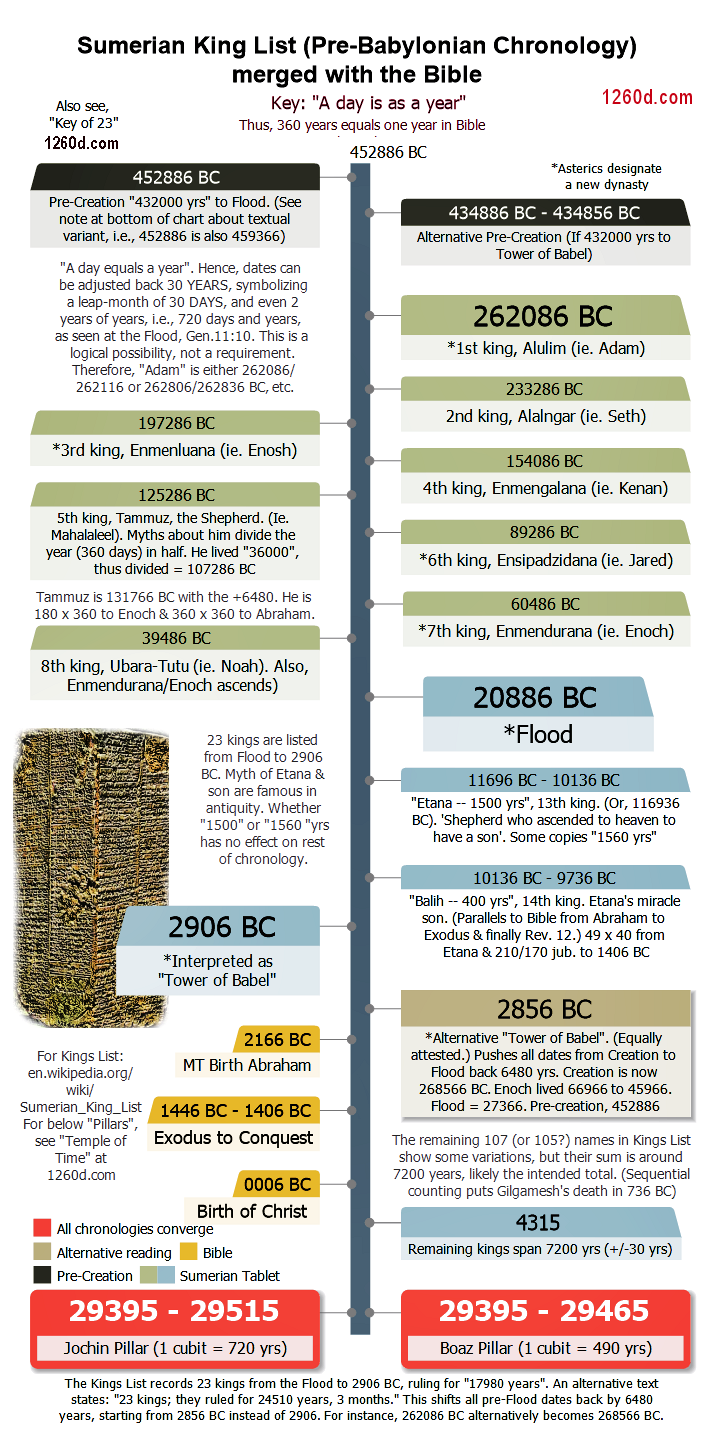
The Oxford ETCSL King List translation, lines 1–39, gives eight antediluvian kings with a combined 241200 years. The chart compares those kings with eight selected biblical figures. It does not claim that the tablet names Adam or Noah, supplies these biblical identities, or contains the modern projected BC dates.
| SKL figure | Biblical comparison | Base BC | Selected reign | +720 BC | +6480 BC | Combined BC |
|---|---|---|---|---|---|---|
| Alulim | Adam | 262086 | 28800 | 262806 | 268566 | 269286 |
| Alalngar | Seth | 233286 | 36000 | 234006 | 239766 | 240486 |
| Enmenluana | Enosh | 197286 | 43200 | 198006 | 203766 | 204486 |
| Enmengalana | Kenan | 154086 | 28800 | 154806 | 160566 | 161286 |
| Tammuz / Dumuzid | Mahalalel | 125286 | 36000 | 126006 | 131766 | 132486 |
| Ensipadzidana | Jared | 89286 | 28800 | 90006 | 95766 | 96486 |
| Enmendurana | Enoch | 60486 | 21000 | 61206 | 66966 | 67686 |
| Ubara-Tutu | Noah | 39486 | 18600 | 40206 | 45966 | 46686 |
The eight reigns sum to 241200, and 262086 − 20886 = 241200. The full native biblical genealogy is not an eight-name King List. The comparative alignment, including Tammuz/Dumuzid with Mahalalel, is the author’s model.
| Additional state | Base / selected coordinate BC | Alternative BC | Function |
|---|---|---|---|
| Pre-Creation | 452886 | 453606, 459366, 460086 | Base, +720, +6480, combined +7200 |
| Flood | 20886 | 21606, 27366, 28086 | Same four declared states |
| Alternative Pre-Creation display | 434886 | 434856 | Original chart’s alternative terminal-field construction |
| Adam +30 | 262116 | 262836 | +30 and +30/+720 states |
| Short Babel / terminal | 2906 | 2936 | Base and +30 Apparent Mode |
| Long Babel / terminal | 2856 | 2886 | Base and +30 Apparent Mode |
The original image’s long-state note correctly has Adam 268566, Enoch 66966 → 45966 and Flood 27366, but it leaves Pre-Creation at the short-state 452886. A consistently shifted long-state Pre-Creation is 459366. The short and long rails differ by 6480 throughout. A +30 mode and a selected local +2-year rail are likewise named alternatives, not compulsory corrections to every row. Scaling two ordinary years of 360 nominal days supplies a distinct 720-year macro comparison; +2 and +720 must never be applied as interchangeable local operators.
The 23 post-Flood rulers
The ETCSL translation’s lines 40–94 report a 24510-year subtotal with three months and three-and-a-half days. A selection of its individual whole-year reign values—including the apparatus-dependent 670, 420 and 300—sums to 17980. The Canon calls the corresponding computational states Sumerian A / SKL Short and Sumerian B / SKL Long. This article preserves both states without treating the selected component sum as if it were the same reported subtotal or flattening their textual apparatus.
| Position | Ruler | Selected whole-year reign |
|---|---|---|
| 1 | Jushur | 1200 |
| 2 | Kullassina-bel | 960 |
| 3 | Nangishlishma | 670 |
| 4 | En-tarah-ana | 420 |
| 5 | Babum | 300 |
| 6 | Puannum | 840 |
| 7 | Kalibum | 960 |
| 8 | Kalumum | 840 |
| 9 | Zuqaqip | 900 |
| 10 | Atab | 600 |
| 11 | Mashda | 840 |
| 12 | Arwium | 720 |
| 13 | Etana | 1500 |
| 14 | Balih | 400 |
| 15 | En-me-nuna | 660 |
| 16 | Melem-Kish | 900 |
| 17 | Barsal-nuna | 1200 |
| 18 | Zamug | 140 |
| 19 | Tizqar | 305 |
| 20 | Ilku | 900 |
| 21 | Iltasadum | 1200 |
| 22 | En-men-barage-si | 900 |
| 23 | Aga | 625 |
| State | Whole-year reign total | Selected terminal BC | Generated Flood BC |
|---|---|---|---|
| Short | 17980 | 2906 | 20886 |
| Long | 24510 | 2856 | 27366 |
The duration difference is 6530 = 6480 + 50, while the assigned Flood coordinates differ by 6480 because their terminal anchors differ by 50. The appended three months and three-and-a-half days remain a separate textual datum; under an explicitly opened scalar, 3.5 × 360 = 1260. Their fractional payload is not silently folded into these whole-year tables.
Download the eight-king four-state register (data ZIP) and the 23 selected Kish reigns (data ZIP).
Every additional lead in the original chart
| Original chart item | Preserved construction | Qualification |
|---|---|---|
| Tammuz’s divided 36000 reign | 125286 → 107286 = 18000 | Interpretive halfway point, not a second transmitted full reign |
| Tammuz → Enoch | 125286 → 60486 = 64800 = 180 × 360 | In the long state, 131766 → 66966 gives the same length |
| Long-state Tammuz → Abraham | 131766 → 2166 = 129600 = 360 × 360 | States of both endpoints are explicit |
| Etana’s displayed interval | 11696 → 10136 = 1560 | The selected textual reign remains 1500; current File 21 separates them |
| Etana typographic alternative | Original image: 116936 | Current File 21 corrects the typo to 11696 |
| Etana → Balih’s close | 11696 → 9736 = 1960 = 40 × 49 | The image’s 40-jubilee lead; displayed 1560 + 400, not a merged literal reign |
| Balih’s close → Conquest | 9736 → 1406 = 8330 = 170 × 49 | Preserves the image’s 170-jubilee continuation |
| Etana’s full Conquest comparison | 11696 → 1406 = 10290 = 210 × 49 | 40 + 170 = 210 jubilees |
| Balih | 10136 → 9736 = 400 | Selected reign; ETCSL apparatus also has 410 |
| Remaining 107 or 105 names | Approximately 7200 years, with ±30 alternatives | Retained source-chart counting proposal, not a newly verified complete list |
| End-of-SKL coordinate | 2886 BC → AD 4315 = 7200 | Projective construction, not literal reigns extending into a known future |
| Gilgamesh pointer | Source image associates its sequential count with 736 BC | Historical source-chart lead, not an independently established Gilgamesh death date |
| Jachin pillar | AD 29395 → AD 29515 = 120 | Projective Boundary in Temple-Time; source factor is 720 years per cubit |
| Boaz pillar | AD 29395 → AD 29465 = 70 | Projective Boundary in Temple-Time; separate factor is 490 years per cubit |
The Etana image’s assertion that some copies give him 1560 is not confirmed by the inspected ETCSL apparatus: it gives 1500 and an alternative 635. Its 1560 dynasty subtotal concerns En-me-nuna and Melem-Kish. The 1560 coordinate difference remains useful and is retained; it should not be converted into an attested Etana reign variant. The ascended-shepherd and miraculous-son parallels are interpreted beside biblical ascension and patriarchal narratives, without making Etana and a biblical patriarch the same historical person.
The chart extends that interpretation through Balih’s 400. Its Abraham-to-Exodus comparison is specifically the 400-year affliction member, 1846 → 1446 BC, rather than the 720 years from Abraham’s birth in 2166 to the Exodus. Balih, as the son associated with Etana’s ascent narrative, is compared with the promised or miraculously given son in the patriarchal story. The author then reads Revelation 12 alongside this theme: a child, ascent to God and the ensuing wilderness period. These are comparative theological readings, not an identification of Balih with Isaac or proof that Revelation borrowed Etana’s story.
The original bitmap prints the Pillar numbers without an era. The AD prefixes are supplied by the current Canon, File 21 §6.3 and Appendix F, which expressly classifies them as Projective Boundary coordinates from the Temple-Time / Ezekiel temple framework. They are model endpoints, not ordinary dated pillars or a forecast of events in those AD years.
9. From 3430-year units to the precessional display
| Same-side or civil comparison | Exact result | Scale |
|---|---|---|
| 262086 BC → 6 BC | 262080 | 720 × 364 |
| 262806 BC → 6 BC | 262800 | 720 × 365 |
| 262086 BC → 4836 BC | 257250 | 75 × 3430 |
| 4836 BC → 1406 BC | 3430 | One further unit |
| 262086 BC → 1406 BC | 260680 | 76 × 3430 |
| 262086 BC → AD 2025 | 264110 | 77 × 3430 |
| 262086 BC → 2886 BC | 259200 | 720 × 360 = 10 × 25920 |
| 262086 BC → 2876 BC | 259210 | 10 × 161² |
The AD 2024/2025 comment records the original study’s 2024 setting. Under ordinary civil arithmetic the exact 77-unit target is AD 2025: 262086 + 2025 − 1 = 264110. AD 2024 gives 264109. This is a source-era structural comparison, not an updated assertion about the present year or a prediction of an event.
The source’s subtraction 262086 − 259200 produces 2886, not both 2886 and 2166. Abraham’s 2166 BC coordinate is 720 years later than 2886, and his birth to the Exodus 1446 also spans 720. Alternatively, holding the 259200 length while ending at 2166 would require a generated origin of 261366, a different coordinate. The +720 Adam rail 262806 minus the same 259200 length reaches 3606; it does not turn the original subtraction into the 2166 equation.
The nested scaling proposal can now be stated with its units visible: 259200 deep-time years ÷ 360 = 720 biblical comparison years; a further contraction 720 ÷ 360 = 2 nominal year-units; those two year-units may then be mapped to two day-units by the day–year rule. This chain relates the two-year Flood-to-Arphaxad resolution to the larger scale; it does not mean that 259200 ordinary years literally equal two days. Counting the 360-day body separately from the four Enochian seasonal days is a declared counting choice, not literal equality between 360 and 364.
25920 and the corrected square
The repository uses the schematic precessional measure 72 years per degree, yielding 360 × 72 = 25920 years. Its quarter is 6480 and its half is 12960. Modern primary-source descriptions give approximately 26000 years (NASA) or 25800 years (ESO). Thus the exact 25920 here is an idealized structural measure, not an epoch-invariant astronomical measurement or evidence by itself that every ancient source used it.
The near-match with the Key of 23 is:
25920 + 1 = 25921 = 161² = (7 × 23)² = 49 × 23².
The original “(23 × 49)²” is a typographical/arithmetic error: it is 1270129. The corrected square remains central in File 21 Source §14 and Appendix F Note A. Scaling it tenfold yields 259210, ten more than 259200; that difference generates the 2886 versus 2876 terminal pair from the same 262086 origin. This supplies the Jubilee-square comparison without changing the Great-Year definition to 25921.
The link between 49-year cycles, their jubilee-completion imagery and the King List’s 23 rulers is the proposed interpretation of the square; the King List does not expressly give that calculation. Nor is the legacy claim that 25920 was “common in antiquity” independently established by the sources inspected for this rewrite.
The 11270 and 16560 leads
The source combines 23 × 490 = 230 × 49 = 11270 while distinguishing Daniel 8’s 2300-unit expression from Daniel 9’s seventy sevens. It also records 1656 × 10 = 16560 = 23 × 720 as a proposed connection to the Sumerian Flood field. The article does not supply a complete endpoint pair for that specific 16560 claim, so the scalar is preserved as a research lead without inventing a new pair to prove it.
The 1656 comparison occurs at different narrative positions in the selected ordinary textual chronologies: MT Creation → Flood, LXX Creation → Noah’s birth, and the selected SP Creation → Noah’s death. It is not 1656 years from Creation to the Flood in all three traditions. Those different positions are part of the comparative argument.
Download the complete large-scale comparison register (data ZIP).
10. Related SP, Egyptian and interpretive comparisons
The ordinary cross-tradition SP chains 3106 → 1846 → 586 BC = 1260 + 1260 and 3166 → 1876 → 586 BC = 1290 + 1290 remain in the calendar and day–year tables. Here 1846 is the representative 400-year-before-Exodus coordinate, while 1876 is the normal MT 430-year Egypt-entry coordinate. The +60 Terah selection and the Gear-1 or Gear-2 choice must be stated. A comparative use of MT Egypt anchors does not make the native SP sojourn Egypt-only 430. See the SP / Egypt backbone.
The larger comparisons are read within an interpretive framework joining Creation, Flood, Exodus, Conquest and new creation. Revelation 10 combines rainbow, fiery legs, the little scroll, book-eating and seven thunders. The proposed correspondences connect the rainbow with the Flood, the fiery pillars with the Exodus, book-eating with Ezekiel, and the unrecorded thunders with a storm-like interval before judgment. The nesting of trumpets within the seventh seal and the little-scroll scene between the sixth and seventh trumpets provides the literary analogy for nested time scales.
The “great scroll / little scroll” reading contrasts the vast cumulative and Sumerian constructions with individual narrative days projected as years. It remains an interpretation of the imagery; Revelation does not expressly identify its scrolls with these chronological tables. Likewise, the woman, sun, moon and twelve stars of Revelation 12 are read through Christ, the redeemed sons of God and a slow celestial timepiece. Identifying her twelve stars with a zodiacal precessional framework is a proposed astronomical analogy, not the passage’s explicit identification and not a claim about replacing Israel.
The celestial host in Daniel 8:10–14 and the shining wise in Daniel 12:3 supply the source’s angelic/cosmic reading of time. Their presence does not by itself prove that those texts encode a specified precessional equation. 2 Peter 3:3–10 brings Creation, the Flood, future judgment, divine patience and repentance into the same discussion. Its day/thousand-year analogy runs in both directions. The source interprets that reciprocity as permission to attend to both large and small patterns while keeping the passage’s ethical purpose: patience invites repentance and judgment still comes unexpectedly.
The analogy of a fractal describes these repeated structures across scales. It is not a demonstrated formal mathematical fractal, a validated statistical proof, or a basis for assigning a dated future fulfillment. The exact equations, the selected calendar operations, and the theological interpretation remain visible together, so each can be assessed on its own evidence.
Return to the detailed Part 4b article.
Read the unchanged original discussion.
The Holy Bible, Berean Standard Bible, BSB is produced in cooperation with Bible Hub, Discovery Bible, OpenBible.com, and the Berean Bible Translation Committee. This text of God’s Word has been dedicated to the public domain.