Detailed companion · Part 4a · 6 October 2026 · v1. Additional symbolic projections accompany the completed Flood chronology. The full calculation tables and unchanged earlier discussion are linked below.
This is the account of Shem. Two years after the flood, when Shem was 100 years old, he became the father of Arphaxad.
Arphaxad’s birth provides the point of departure for this study. Genesis places it two years after the Flood, at the beginning of the renewed human family. In the normal MT chronology used here, the Flood belongs to 2458 BC and Arphaxad’s birth to 2456 BC. Their relationship supplies a way to examine the Flood’s days as a second, symbolic chronology.
The Flood introduction, its dated-event tables, and the detailed Flood study explain the narrative calendar. This companion develops the additional research: two symbolic date columns, their relationship to Creation and Jared, and the 430-year and Key-of-23 connections that emerge when those columns are compared with the regular chronology. The full supporting tables expose each calculation and distinguish the inherited projection labels from uniform elapsed-day counts.
1. Three scales of time
The argument brings three scales together. Genesis supplies dated events and stated durations. A declared calendar places those events within a continuous count. A day–year projection then treats selected numerical labels as years and compares the resulting positions with independently established chronological coordinates.
Those steps need to remain visible. A symbolic date such as 674 BC is a projected counterpart of the Flood’s beginning; it does not replace the Flood’s regular date of 2458 BC. Likewise, an expanded comparison coordinate for Jared does not change his birth date or lifespan.
Unless a section explicitly opens an alternative, the regular dates follow the Masoretic Text (MT), Nisan reckoning, the full 430 years in Egypt, and Noah’s normal Gear-2 setting. No second Cainan or +60 Terah adjustment is included in that baseline. The optional +60 comparison is named wherever it is used. The calculations are ordinary regular or local symbolic calculations; they do not activate the separately defined Rounded Chronology.
Creation’s endpoint is 4114 BC, with the Creation-week boundary display 4121 → 4114 BC. The distinct Year-6 / Adam position, 4116 BC, is not substituted for that endpoint. Jared’s regular birth is 3654 BC. These coordinates are controlled by File 07 and the regular tables in File 18.
2. Why begin with Arphaxad?
Arphaxad gathers several features of the new-creation reading into one coordinate. In the selected MT chronology, Lamech dies in 2463 BC, the Flood begins in 2458 BC, and Arphaxad is born in 2456 BC:
2463 → 2458 → 2456 BC = 5 + 2 = 7 years.
Methuselah’s death also belongs to 2458 BC, two years before Arphaxad. Lamech’s full MT life is 777 years, and his naming of Noah anticipates relief from the toil associated with the cursed ground (Genesis 5:28–29, BSB). The association of Noah with relief and rest therefore belongs to the narrative before numerical comparisons are introduced.
I read these relationships alongside the Creation week: Adam, the cursed ground, the seventh-day rest, the Flood, and the renewed human line. The Flood does not begin a second literal Creation week in Genesis. The proposed connection is a typological correspondence between a week of days and a seven-year arrangement around Lamech’s death and Arphaxad’s birth. The MT 777 remains distinct from the canonical LXX lifespan selection of 753.
Arphaxad also connects the Flood to the later chronological datums. The differences from 2456 BC to 1876, 1446, 1406, 586 and 6 BC are all multiples of ten. In particular:
2456 − 6 = 2450 = 5 × 490.
Here 6 BC is the selected nativity datum within this research. The argument concerns its chronological position, not a month-and-day birth date stated in the Gospels. The optional Terah state places Arphaxad at 2516 BC; it is an alternative comparison, not the default 2456 BC coordinate.
The seven-year famine and Ezekiel’s siege framework provide related 2 + 5 and 5 + 2 arrangements. Jacob enters Egypt after two famine years, with five remaining (Genesis 45:6, BSB). Ezekiel’s dated sequence can be viewed through an approximately five-year interval followed by the siege period. These patterns supply a narrative context for choosing Arphaxad; their exact calendar details belong to the Ezekiel studies and the chart methodology.
The original proposal also placed Arphaxad’s conception soon after the family left the Ark. Genesis does not date his conception. That suggestion remains a biological reconstruction supporting the new-family interpretation, rather than an additional biblical date.
3. Two calendar windows, two symbolic origins
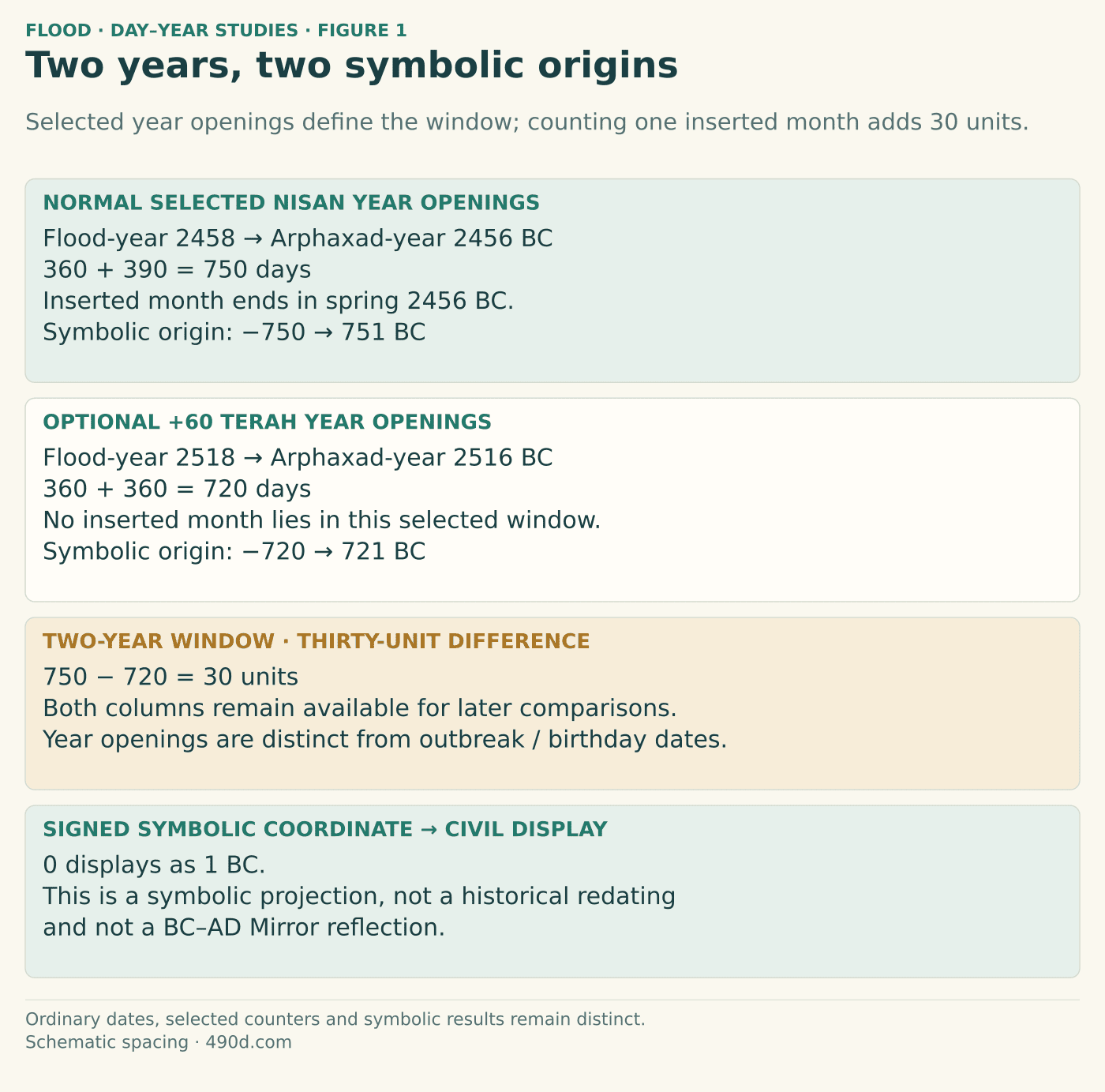
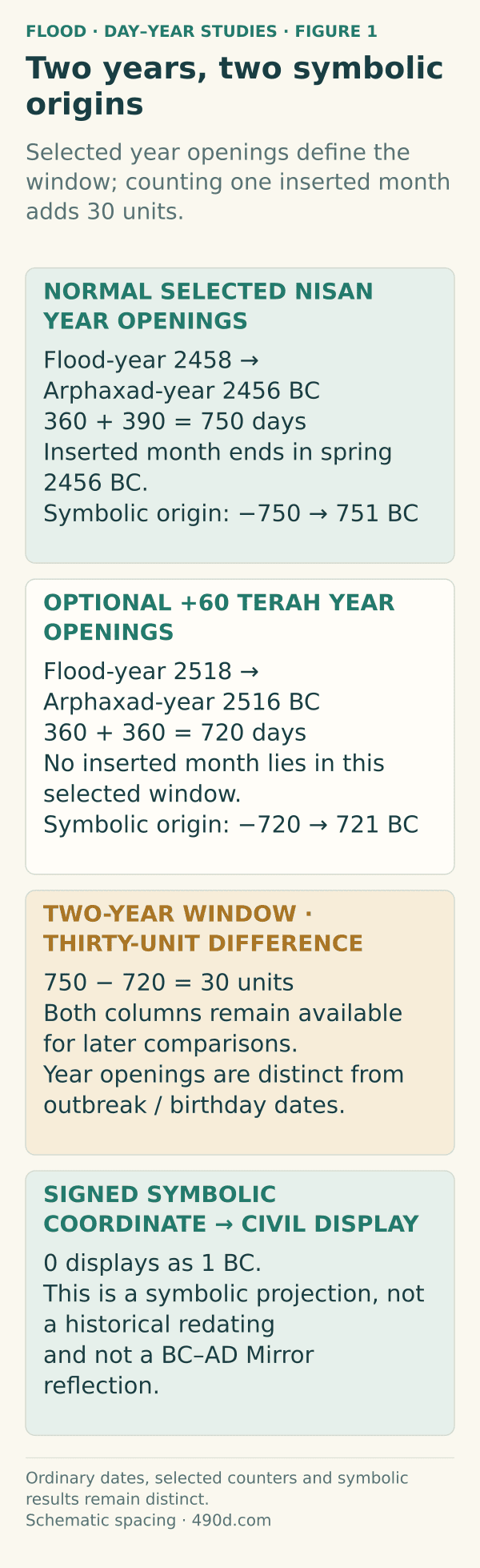
The starting window is measured from the selected beginning of Noah’s Flood year to the Arphaxad-year boundary two years later. It is not the shorter interval from the explicitly dated Flood outbreak on month 2, day 17 to that boundary.
In the reconstructed 360-day calendar, two ordinary years contain 360 + 360 = 720 days. If a thirty-day intercalary month is included, the same two-year window contains 360 + 390 = 750 days. The scheme is governed by File 12 §7A: six six-year stages followed by four years, with a thirty-day month closing each stage. Across forty years it gives 40 × 360 + 7 × 30 = 14610 days.
The selected Nisan windows illustrate the two possibilities. The normal 2458 → 2456 BC window includes a leap month closing in spring 2456 BC. The +60 Terah window, 2518 → 2516 BC, does not contain one under the same phase rule. Their different counts follow the declared calendar alignment; they are not competing statements about an intercalation recorded in Genesis.
Accessible text and image downloads
Two selected year-opening Flood–Arphaxad windows use the Nisan calendar phase. Normal year openings 2458 to 2456 BC: 360 plus 390 equals 750 days, with an inserted month ending in 2456; signed symbolic origin minus 750 displays as 751 BC. Optional plus 60 Terah year openings 2518 to 2516 BC: 360 plus 360 equals 720 days, with no inserted month; signed symbolic origin minus 720 displays as 721 BC. These do not count an exact interval from the second-month Flood outbreak to Arphaxad’s birthday. Symbolic coordinate 0 displays as 1 BC. The projection does not historically redate Arphaxad or reflect dates by the Mirror.
Desktop PNG · Phone PNG · Desktop WebP (ZIP) · Phone WebP (ZIP) · Text-based SVG (ZIP)
Full table and calculation · Scripture: Genesis 11:10 (BSB) · Genesis 7:11 (BSB) · Genesis 7:11 and 8:3–4; comparative calendar basis (BSB) · Genesis 11:10; Arphaxad relationship, not a symbolic 1 BC date in Scripture (BSB)
The symbolic display represents these backward distances as signed coordinates −720 and −750. Using the year-label convention in which zero displays as 1 BC, they become 721 BC and 751 BC. A selected numerical day label d advances the coordinate, giving:
Column A = 721 − d BC · Column B = 751 − d BC.
For example, label 47 gives 674 and 704 BC; label 87 gives 634 and 664 BC. Both columns remain available when comparing with the regular chronology, whether or not +60 Terah is active in a particular comparison. Their constant thirty-year separation represents the projected numerical difference of the thirty-day insertion.
The signed-to-civil display uses astronomical year numbering. It does not assert that Arphaxad was born in AD 1, and it performs no BC–AD Mirror operation. The historical anchor remains Arphaxad’s selected regular year; zero is the symbolic coordinate origin. File 00 §3.9 and File 09 Appendix A govern the separate Mirror protocols.
Counting an intercalation or leaving it out is a declared option within these schematic comparisons. It must not silently change a table of elapsed time. The calendar-window table shows the cycle phase and the projected origins separately.
4. Preserve the projection labels; identify their boundaries
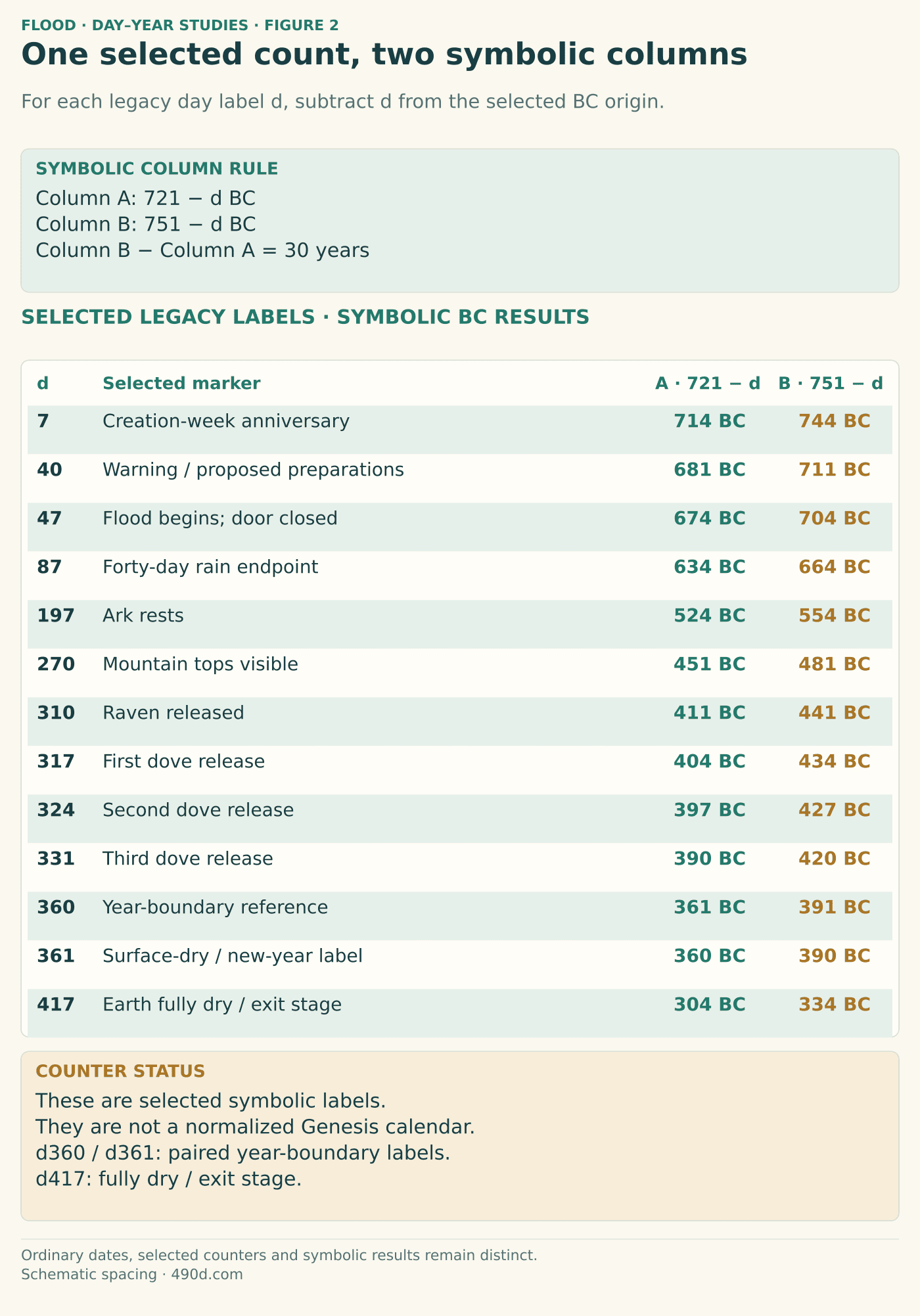
The inherited sequence uses labels 7, 40, 47, 87, 197, 270, 310, 317, 324, 331, 360, 361 and 417. They are research labels with a particular boundary convention, not a uniform column of elapsed days from the Flood’s outbreak.
The model ordinarily marks the completion of a named day. At the first of a month it also uses the opening boundary: 270 marks the opening of month 10 after nine thirty-day months, while 360 marks the year-turn after twelve. The paired 360/361 labels distinguish the completed-year boundary from the first numbered day of the next year. Keeping those roles explicit preserves the original construction without treating different counters as interchangeable.
Accessible text and image downloads
A two-column symbolic table applies BC origin minus selected day label. Day 7 gives 714 and 744 BC; 40 gives 681 and 711; 47 gives 674 and 704; 87 gives 634 and 664; 197 gives 524 and 554; 270 gives 451 and 481; 310 gives 411 and 441; 317 gives 404 and 434; 324 gives 397 and 427; 331 gives 390 and 420; 360 gives 361 and 391; 361 gives 360 and 390; 417 gives 304 and 334. All are symbolic BC coordinates. These are source-selected labels, not a normalized narrative calendar.
Desktop PNG · Phone PNG · Desktop WebP (ZIP) · Phone WebP (ZIP) · Text-based SVG (ZIP)

Full table and calculation · Scripture: Genesis 2:1–3; interpretive anniversary comparison (BSB) · Genesis 7:1–4; warning and proposed preparations marker (BSB) · Genesis 7:11, 16 (BSB) · Genesis 7:12 (BSB) · Genesis 8:4 (BSB) · Genesis 8:5 (BSB) · Genesis 8:6–7 (BSB) · Genesis 8:8–12; selected release spacing (BSB) · Genesis 8:13 (BSB) · Genesis 8:14–19 (BSB)
Genesis dates the outbreak and the Ark’s resting on the seventeenth days of months 2 and 7 (Genesis 7:11; 8:4, BSB). Under thirty-day months, the inherited labels 47 and 197 differ by 150. Label 417 belongs to the final fully dry-earth stage, after which the exit is narrated (Genesis 8:14–19, BSB). Label 361 concerns the new-year surface-dry notice of Genesis 8:13, not the complete dryness of verse 14. Genesis gives no separate month-and-day date for the departure.
Several intervening positions require reconstruction. Label 40 is a proposed preparation or initial-entry marker seven days before the onset. Genesis 7:4 gives the warning; 7:13 associates Noah’s household’s entry with the outbreak day. The earlier entry period is therefore a proposal, not a separately stated month-2/day-10 arrival. The model also places the later forty-day wait from the appearance of the mountain tops and supplies a seven-day gap between the raven and the first dove. The two later dove waits are explicitly numbered; the first gap and absolute bird dates are inferred.
These choices help explain a proposed correspondence with the Temple’s destruction. In the inherited month-opening count, 270 + 40 = 310 places the raven stage at the end of day 10 of the eleventh month. With the Flood months read from Tishri, that eleventh month corresponds to Av, the fifth month from Nisan:
On the tenth day of the fifth month, in the nineteenth year of Nebuchadnezzar king of Babylon, Nebuzaradan commander of the imperial guard, who served the king of Babylon, came to Jerusalem.
Jeremiah 52:13, NIV then describes the burning. The alignment compares a reconstructed Flood date with a stated Jerusalem date; it does not make the raven’s day an explicit date in Genesis. The normal Nisan reading and the alternative Tishri reading must remain named.
The complete projection ledger retains every inherited label and both symbolic columns. The adjacent uniform calendar table gives completed days and numbered dates for the explicit Genesis dates. This allows the reader to move between the large comparison and its smaller day-boundary detail without losing the distinction.
5. A Creation-week bridge of 3430 years
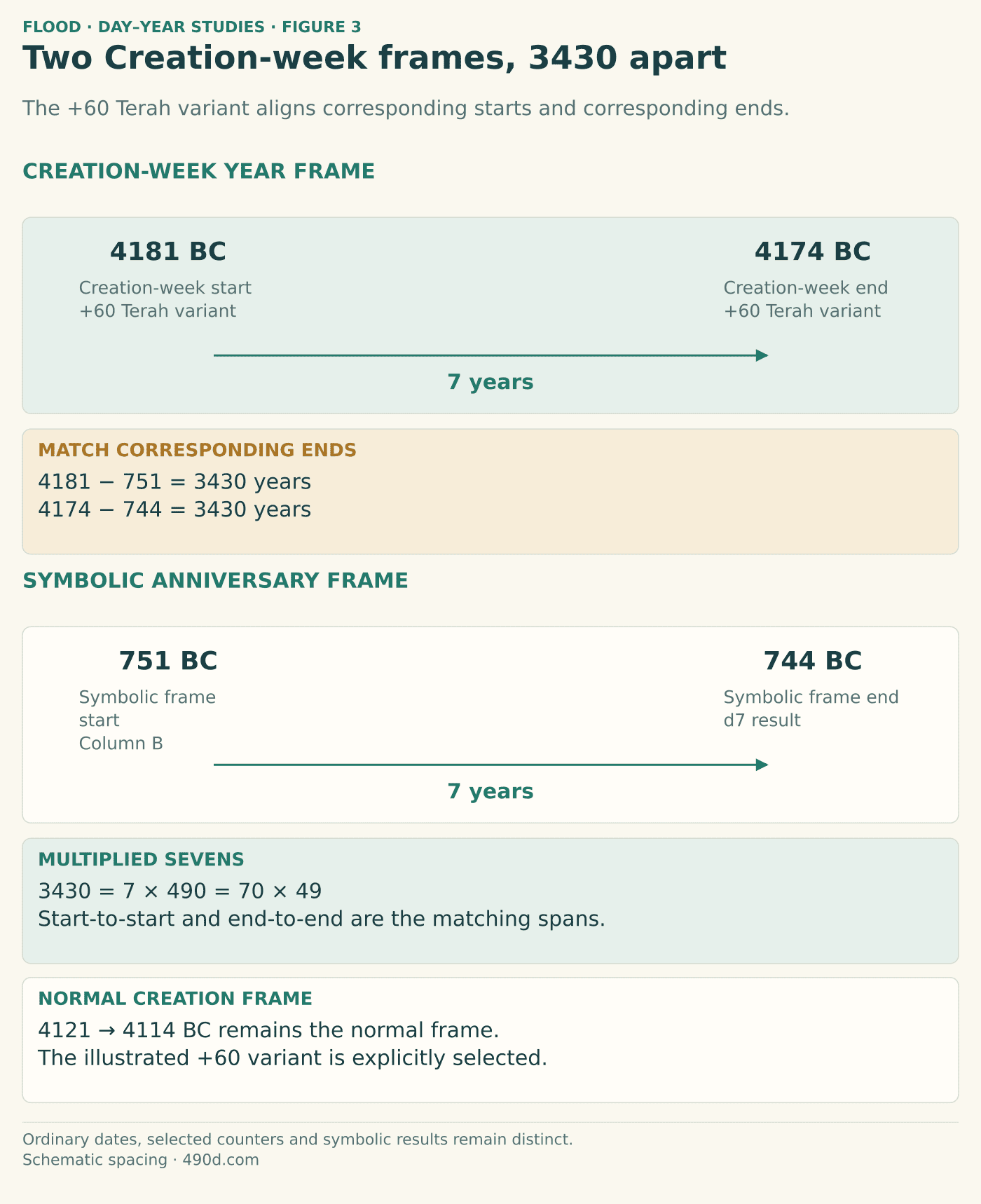
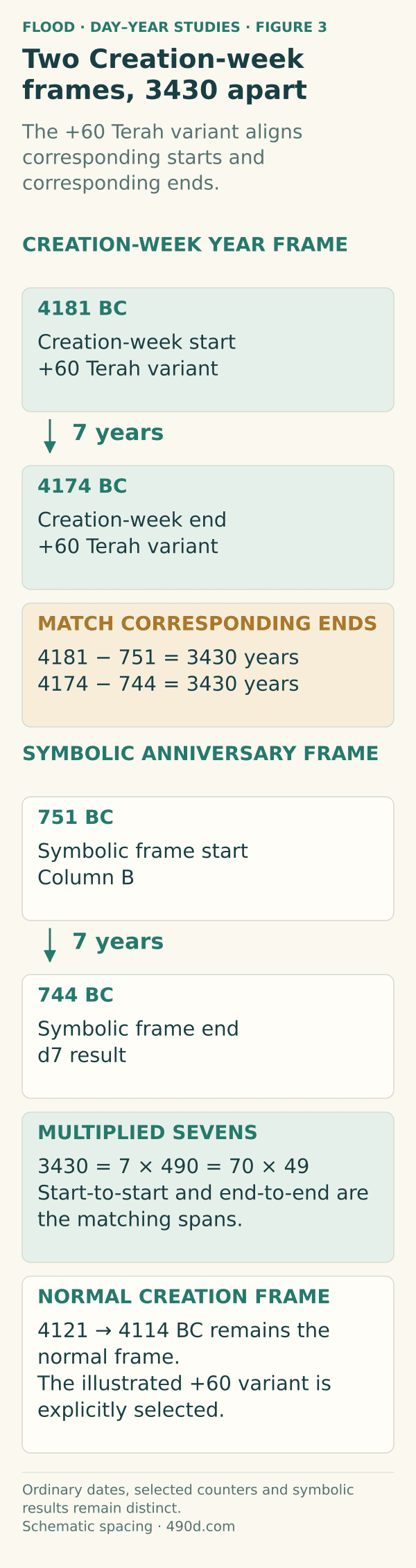
The optional +60 Terah state moves the Creation-week boundary display to 4181 → 4174 BC. The first seven-unit bracket in Column B is 751 → 744 BC. Comparing corresponding endpoints gives:
4181 − 751 = 4174 − 744 = 3430.
3430 = 7 × 490 = 70 × 49.
Accessible text and image downloads
Two seven-year frames are compared. Creation week with the plus 60 Terah variant: 4181 to 4174 BC. Symbolic Column B anniversary frame: 751 to 744 BC. Both frames span seven years. Corresponding starts differ by 3430 years and corresponding ends also differ by 3430. 3430 equals seven times 490 and seventy times 49. Normal Creation week remains 4121 to 4114 BC.
Desktop PNG · Phone PNG · Desktop WebP (ZIP) · Phone WebP (ZIP) · Text-based SVG (ZIP)
Full table and calculation · Scripture: Genesis 1:1–2:3 (BSB) · Genesis 11:32 and Acts 7:4; chronology variant (BSB) · Genesis 2:1–3; symbolic comparison (BSB)
The two seven-year brackets therefore have the same shape and stand 3430 years apart, point for point. The term “seventy jubilees” here means seventy units of forty-nine years. It does not establish an uninterrupted historical record of Jubilee observance across that entire span. The brackets mark seven elapsed position-units between boundaries; enumerating every endpoint label inclusively would be a different count.
The interpretation reads the Flood as a new beginning aligned with Creation. Its mathematical force lies in the matched endpoints: the same +60 state is retained at both Creation boundaries, while the same 751-column origin governs the projected bracket. The matched-week table exposes those selections rather than blending them with the default Creation endpoint of 4114 BC.
6. Jared, the Watchers, and the added forty
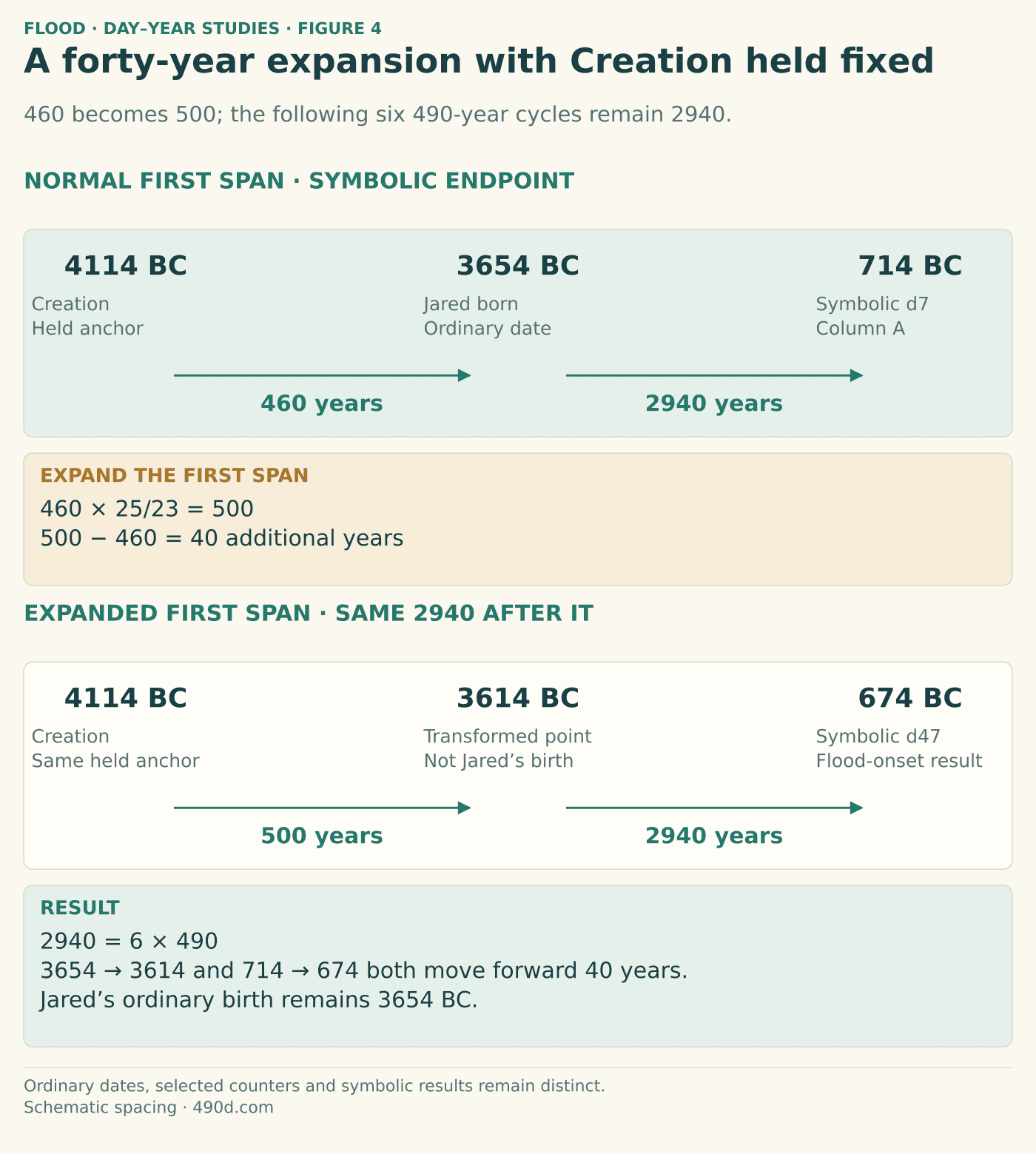
Jared’s birth is 460 years after the normal Creation endpoint:
4114 − 3654 = 460.
The Enochic and Jubilees traditions place the Watchers in Jared’s days (1 Enoch 6:6; Jubilees 4:15, 22). Those accounts do not date their transgression precisely to his birth. Jubilees initially describes a descent to instruct humanity, followed by their later sin. This study uses Jared’s birth as the numerical coordinate for his era while retaining those literary distinctions.
Jared’s regular coordinate connects with the first seven-unit bracket in Column A:
3654 − 714 = 2940 = 6 × 490.
The sequence can be read as one initial Jared-related segment followed by six 490-year units. Its first segment is 460, so this “1 + 6” grouping is typological; it is not seven equal units of 490. The comparison recalls the reversal of a six-plus-one Creation pattern through the intrusion of corruption.
The Key of 23 supplies a further step:
460 × 25/23 = 500 · 500 − 460 = 40.
Hold Creation fixed and place that forty-year gain at the Jared side. The generated comparison coordinate becomes 4114 − 500 = 3614 BC. It then stands six 490-year units before the projected Flood-onset position:
3614 − 674 = 2940.
Accessible text and image downloads
Two rows start at Creation 4114 BC. Normal row: 460 years to Jared birth 3654 BC, then 2940 years to symbolic 714 BC, day label 7. Expanded row: 500 years to transformed 3614 BC, then the same 2940 years to symbolic 674 BC, day label 47. 460 times 25 divided by 23 equals 500, an increase of 40. Both subsequent coordinates move forward by forty years, while Creation is held fixed. Jared is not redated.
Desktop PNG · Phone PNG · Desktop WebP (ZIP) · Phone WebP (ZIP) · Text-based SVG (ZIP)
Full table and calculation · Scripture: Genesis 1:1 (BSB) · Genesis 5:15–20 (BSB) · Genesis 2:1–3; symbolic comparison (BSB) · Genesis 7:11; event basis for selected d47 (BSB) · Ezekiel 4:6; day–year interpretive background, not the 25/23 rule (BSB)
Both endpoints of the original 3654 → 714 comparison move forward forty years to give 3614 → 674. In Column A, 714 → 674 is the transition from the seventh-unit bracket’s end to the projected onset. The following forty-day rain advances the inherited onset label 47 to label 87. Thus the forty-year gain has a direct numerical counterpart in the rainfall duration, while its placement must be specified in each comparison.
Jared remains historically at 3654 BC. The expanded 3614 coordinate is the output of a fixed-Creation comparison, not a redating of Jared’s life. File 17 §10.4 supplies the related 460 → 500 and 1196 → 1300 decompositions.
The literature supplies the judgment setting for the numerical proposal. In 1 Enoch 10 and Jubilees 5, the Watchers’ offspring turn against one another, and their fathers witness their destruction; the Flood judgment belongs to the wider narrative. Their destruction should not be described as though both texts explicitly say they all drowned. Enoch is Jared’s son and the messenger of judgment in the Enochic account. These traditions inform the interpretation without becoming additional Genesis chronology.
7. The 430-year cycles and Samaria
The two columns yield related multiples of 430 at their projected Flood-onset positions:
| Selected comparison | Calculation | Span |
|---|---|---|
| Normal Creation → Column A onset | 4114 − 674 | 3440 = 8 × 430 |
| +60 Jared → Column B onset | 3714 − 704 | 3010 = 7 × 430 |
The second row explicitly uses +60 Terah: Jared’s comparison birth is 3654 + 60 = 3714 BC. If its 460-year Creation-to-Jared component is expanded by forty, the adjusted comparison coordinate is 3674 BC; advancing the projected onset by the same forty reaches the rain-end position 664 BC. The span remains:
3674 − 664 = 3010 = 7 × 430.
The interpretation associates seven with completion and eight with renewal. Those meanings draw their relevance from the Flood’s narrative movement, from the genealogy’s new family, and from the 430-year Egyptian sojourn and Ezekiel’s 390 + 40. The arithmetic alone does not assign a covenant meaning to every multiple of 430.
The 721-column origin also provides a northern-kingdom comparison. The earlier study expressed the connection as spring 721 BC / autumn 722 BC. Current File 17 §9.2A, following File 00, distinguishes the actual fall of Samaria in late 722 BC ±1 from the schematic 726–721 BC node. The symbolic 721 coordinate can therefore be associated with that terminal horizon; it must not replace the actual fall-state with an exact spring date. A historical event, a seasonal display, and a schematic node are related selections with different precision.
8. A chain of multiples of 23
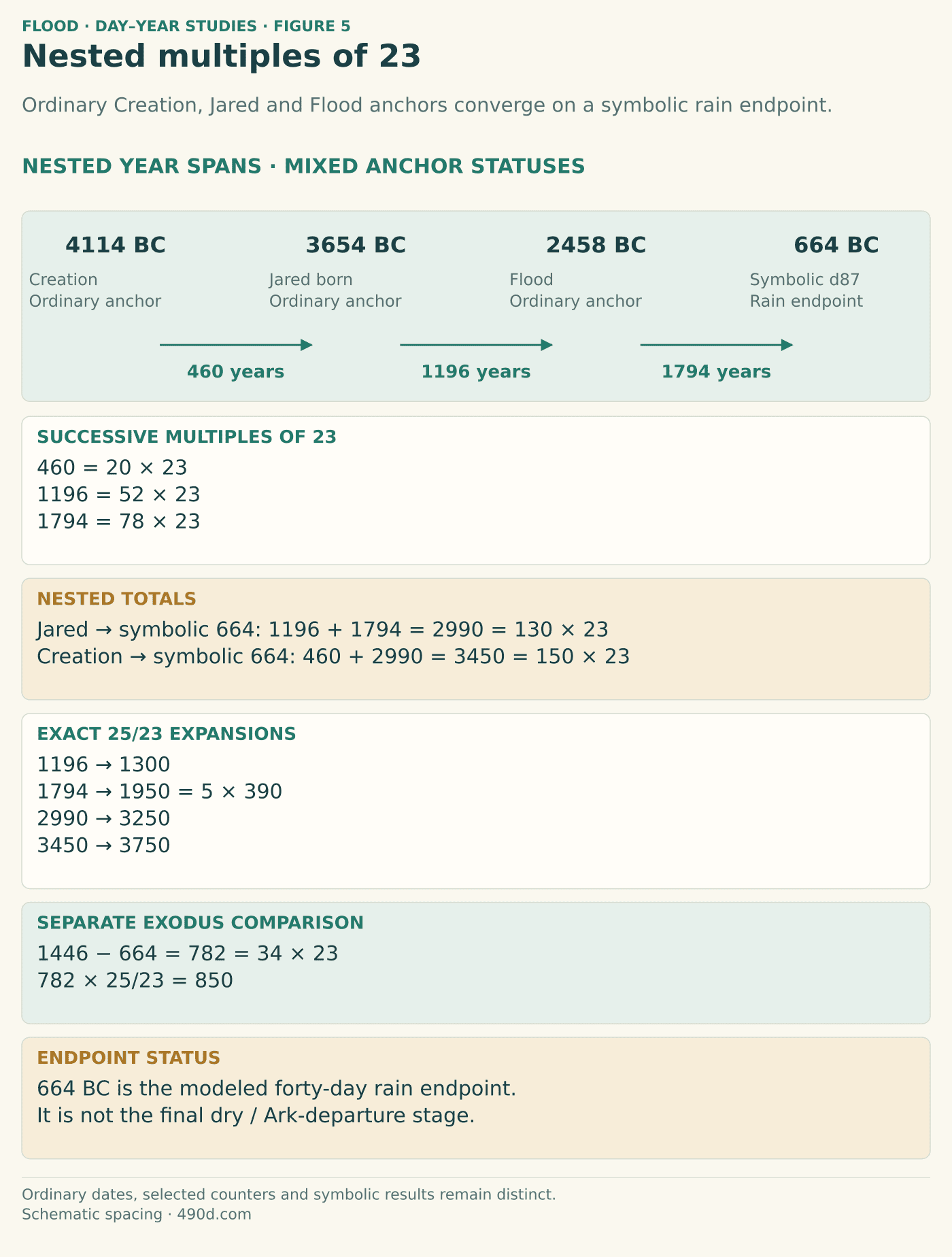
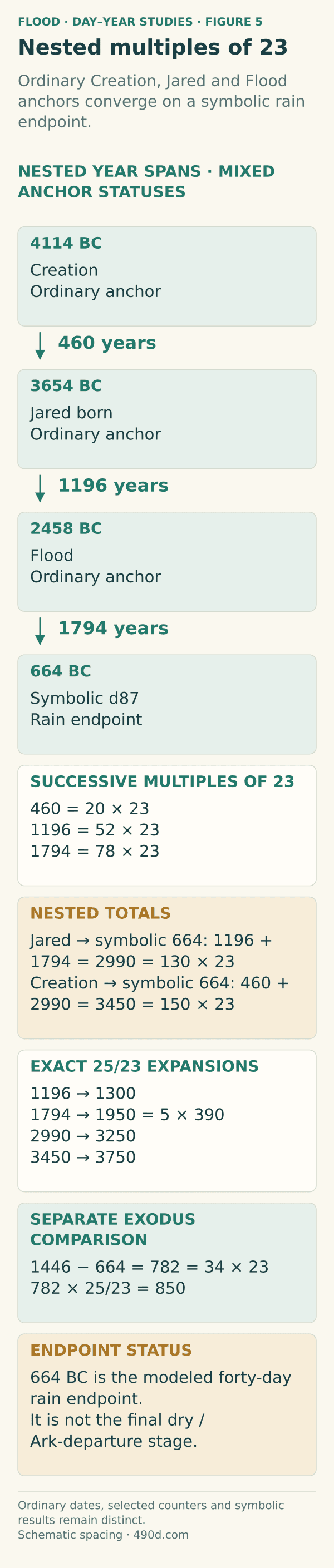
Column B’s label 87 projects to 664 BC. This is the end of the model’s forty-day rain, not the end of the whole Flood. It links Creation, Jared, the regular Flood, and the Exodus through several exact multiples:
| Regular coordinate → symbolic rain-end coordinate | Years | Factorization |
|---|---|---|
| Creation 4114 → 664 BC | 3450 | 23 × 150 |
| Jared 3654 → 664 BC | 2990 | 23 × 130 |
| Flood 2458 → 664 BC | 1794 | 23 × 78 |
| Exodus 1446 → 664 BC | 782 | 23 × 34 |
The 150 coefficient recalls the Flood’s prevailing-water duration. The 130 coefficient belongs to the study’s curse-and-judgment interpretation; it is a proposed thematic correspondence rather than a universal meaning of 130. The intermediate regular interval is also a multiple of 23:
3654 − 2458 = 1196 = 23 × 52.
Accessible text and image downloads
The sequence is ordinary Creation 4114 BC, Jared birth 3654 BC, ordinary Flood 2458 BC, then symbolic Column B day 87 rain endpoint 664 BC. The gaps are 460, 1196 and 1794 years, respectively twenty, fifty-two and seventy-eight times 23. Nested totals are 2990 equals 130 times 23 from Jared, and 3450 equals 150 times 23 from Creation. Multiplying by 25 divided by 23 converts 1196 to 1300, 1794 to 1950, 2990 to 3250 and 3450 to 3750. A separate Exodus comparison gives 1446 minus 664 equals 782, thirty-four times 23, expanding to 850. The 664 endpoint is symbolic and marks the rain endpoint, not the end of the entire Flood narrative.
Desktop PNG · Phone PNG · Desktop WebP (ZIP) · Phone WebP (ZIP) · Text-based SVG (ZIP)
Full table and calculation · Scripture: Genesis 1:1 (BSB) · Genesis 5:15–20 (BSB) · Genesis 7:11 (BSB) · Genesis 7:12; event basis for selected d87 (BSB) · Exodus 12:40–41 (BSB) · Ezekiel 4:6; day–year interpretive background, not the 25/23 rule (BSB)
Expanding the connected portions by the same 25/23 operator preserves their addition:
1196 → 1300 · 1794 → 1950 · 2990 → 3250.
1300 + 1950 = 3250 · 1950 = 5 × 390.
The Creation-to-Jared portion expands from 460 to 500. Consequently the complete Creation-to-664 interval expands from 3450 to 3750, with 500 + 1300 + 1950 = 3750. The separate Exodus-to-664 interval expands from 782 to 850. The conversion table shows all inputs, gains and outputs.
This component agreement is more informative than an isolated multiplication. Each part belongs to the same declared regular-to-symbolic chain, and the expanded sum agrees with the expansion of the whole. A new endpoint can be generated only after choosing which existing endpoint stays fixed. The conversions here initially compare lengths; they do not silently relocate Creation, Jared or the Flood. File 00, File 22 and File 55 control the ratio and the separation of chronological states.
9. The covenant-related sequence in the original chart
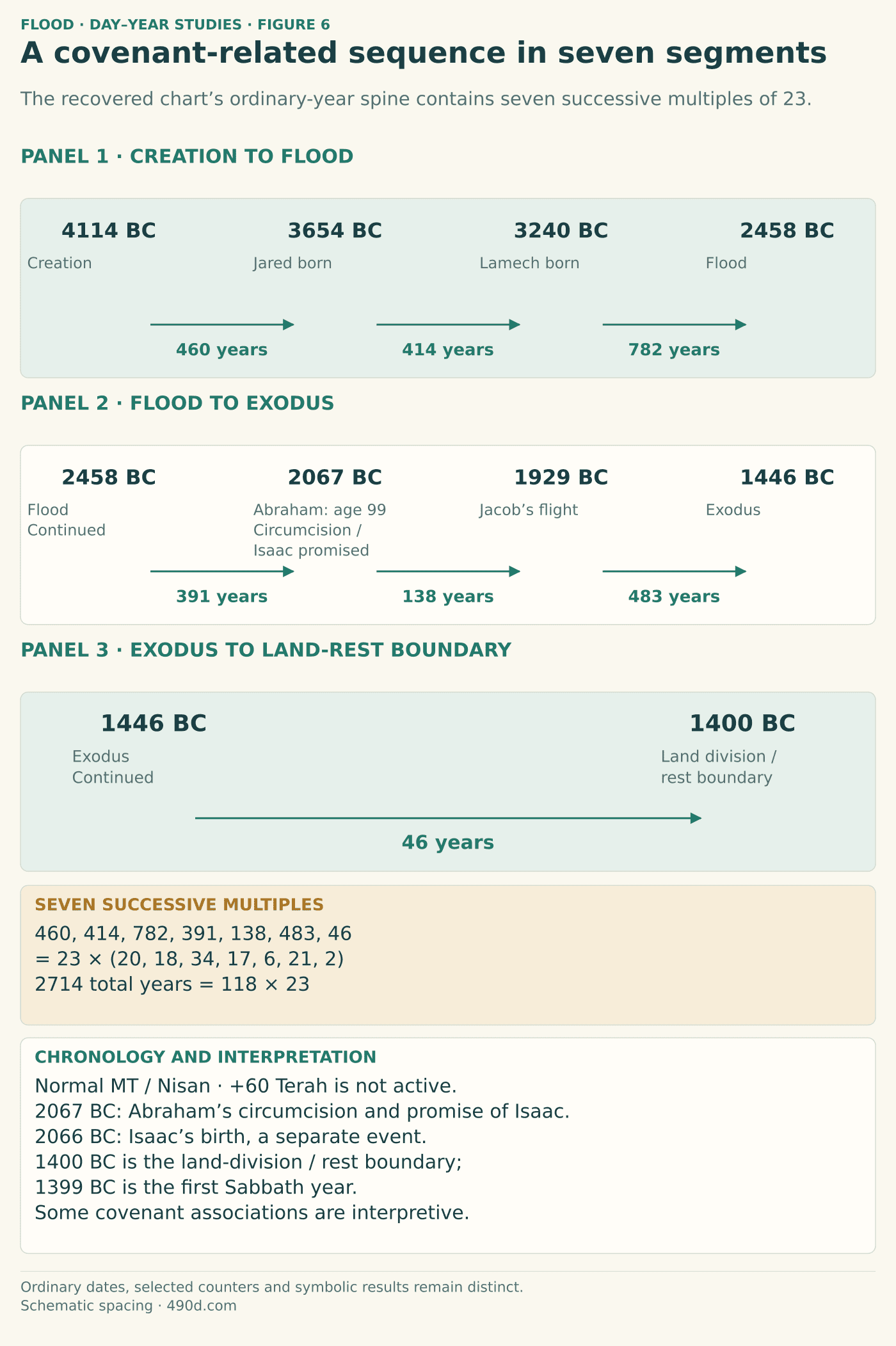
The original illustration carries an additional sequence that deserves its own explanation. It connects Creation, Jared’s era, Lamech’s birth, the Flood, circumcision, Jacob’s flight and ladder vision, the Exodus, and the Conquest’s land-division/rest boundary. Its seven successive spans are:
460 + 414 + 782 + 391 + 138 + 483 + 46 = 2714 = 23 × 118.
Accessible text and image downloads
Three linked panels show the ordinary MT Nisan chain. Panel one: Creation 4114 BC to Jared 3654 by 460, to Lamech birth 3240 by 414, to Flood 2458 by 782. Panel two continues at Flood 2458 to Abraham’s circumcision and promise of Isaac at age 99 in 2067 BC by 391, to Jacob flight 1929 by 138, to Exodus 1446 by 483. Isaac is born separately in 2066 BC. Panel three continues from Exodus 1446 to land division and rest boundary 1400 by 46. The seven gaps equal twenty, eighteen, thirty-four, seventeen, six, twenty-one and two times 23, totaling 2714, 118 times 23. The first Sabbath year is separately 1399 BC. Covenant associations at some nodes are interpretive.
Desktop PNG · Phone PNG · Desktop WebP (ZIP) · Phone WebP (ZIP) · Text-based SVG (ZIP)

Full table and calculation · Scripture: Genesis 1:1 (BSB) · Genesis 5:15–20 (BSB) · Genesis 5:25 (BSB) · Genesis 7:11 (BSB) · Genesis 17:1, 21, 24 (BSB) · Genesis 28:10–22 (BSB) · Exodus 12:40–41 (BSB) · Joshua 11:23 (BSB) · Leviticus 25:2–4; interpretive land-rest year alignment (BSB)
The first three span Creation to the Flood: 460 + 414 + 782 = 1656. The next three span the Flood to the Exodus: 391 + 138 + 483 = 1012. The final 46 reaches 1400 BC. This “three + three + one” arrangement invites comparison with Creation’s forming, filling and rest. The modern figure keeps that proposed reading distinct from the dates and lengths that support it.
Some covenant associations are explicit in the biblical narratives, including Noah, circumcision, Jacob’s promise and Sinai. The description of Jared’s era as a corrupted covenant and Lamech’s birth as a covenant-related station is interpretive. Noah’s father Lamech must also remain distinct from the Cainite Lamech of Genesis 4:19–24, BSB. Their shared name permits a literary comparison involving marriage, vengeance and seven; it does not merge their biographies. Genesis 21:28–31, BSB likewise brings seven ewe lambs and an oath together at Beersheba, providing a narrative basis for the chart’s seven/oath association.
The 1400 BC endpoint is the land-division/rest boundary in the controlled Conquest sequence, followed by 1399 BC as the first Sabbath/rest year. Six campaign years, 1406 → 1400, can be grouped structurally as 3 + 3, followed by the rest-year interval 1400 → 1399. This supplies the chart’s further 3 + 3 + 1 analogy; the internal division is not an independently dated narrative event. The difference between 1446 and 1400 is 46. Moving the endpoint to 1399 would give 47 and change this particular construction. The Conquest study explains the 1400–1399 interval; the diagram preserves the chosen boundary rather than calling two adjacent years one date.
The chart also includes secondary AM labels and an LXX comparison. Its principal labels fit a Creation-year-one convention, but some lower annotations mix completed years and numbered years or use a different Noah state. The chart reconciliation table preserves those original labels alongside explicit corrected or qualified readings. The native-Cainan LXX Creation endpoint of 5494 BC stands 1380 = 23 × 60 before MT 4114 BC in matched settings. Starting from that earlier Creation head preserves divisibility by 23 for spans to the same later circumcision, Jacob, Exodus and land-division anchors, as the LXX comparison table shows. It does not give every LXX patriarch the same 1380-year date offset. File 18 supplies the distinct manuscript tables.
10. Reading the chronology as a connected narrative
The purpose of this study is to examine a proposed chronological design across three richly dated turning points: the Flood, the Exodus and Conquest, and the fall of Jerusalem. Their shared themes include judgment, preservation, covenant, rest and renewed beginnings. The larger intervals provide the setting within which the smaller months, weeks and day-boundaries acquire interpretive relevance.
The Flood’s 721/751 projection columns make that proposal testable. The reader can inspect the origin, the event label, the chosen regular state and the operator, then see precisely what correspondence follows. Extra-biblical traditions can enrich the reading while remaining identified as traditions. A calendar insertion can be included or omitted as a stated model choice. A fixed-anchor expansion can generate a new comparison coordinate while preserving the historical biography.
The linked relationships give reasons to investigate intentional design. Their interpretation should be assessed through the whole dated and literary setting, rather than through the transcript’s repeated assurances of certainty. This study supplies no calculated probability that the pattern could arise by chance.
Continue with the full supporting tables and calculation notes, the Flood narrative chronology, or Part 4b’s further applications. The latter remains the next separate research continuation.
Original discussion: Read the complete original Part 4a discussion and its recovered chart. Its wording, order, old labels and navigation are preserved as historical source material.
The Holy Bible, Berean Standard Bible, BSB is produced in cooperation with Bible Hub, Discovery Bible, OpenBible.com, and the Berean Bible Translation Committee. This text of God’s Word has been dedicated to the public domain.
Scripture taken from the Holy Bible, NEW INTERNATIONAL VERSION®, NIV® Copyright © 1973, 1978, 1984, 2011 by Biblica, Inc.® Used by permission. All rights reserved worldwide.
NEW INTERNATIONAL VERSION® and NIV® are registered trademarks of Biblica, Inc. Use of either trademark for the offering of goods or services requires the prior written consent of Biblica US, Inc.