The Exodus begins Israel’s journey toward an inheritance; the crossing of the Jordan brings that promise into the land. Between departure and possession lie a generation in the wilderness, the leadership of Moses and Joshua, and the transition from warfare to rest.
Joshua brings that movement to a memorable conclusion:
So Joshua took the entire land, in keeping with all that the LORD had spoken to Moses. And Joshua gave it as an inheritance to Israel according to the allotments to their tribes. Then the land had rest from war.
The numerical study begins with a correspondence that Scripture itself makes. After the reconnaissance of Canaan, the forty days become a measure of the wilderness judgment:
In keeping with the forty days you spied out the land, you shall bear your guilt forty years—a year for each day—and you will experience My alienation.
These passages establish the two subjects of this study: measured time and the arrival at rest. The reconstruction developed below places the Conquest in 1406 BC, land division and the onset of rest in 1400 BC, and the completed rest-year endpoint in 1399 BC. The seven-year span then becomes a meeting place for larger patterns associated with Moses, Joshua, Jacob, and Levi.
For a shorter introduction, see From the Jordan to Rest: The Conquest’s Seven-Year Pattern, with its technical appendix. This detailed companion supplies the wider comparisons and their derivations. The principal tables are directly accessible: narrative dates, Caleb and the rest year, the forty-year spans, the lifespan patterns, the three generational measures, Jacob and Levi, Aaron and Moses, and the calendar calculation.
The chronological ground beneath the pattern
The discussion follows the normal Masoretic Text (MT) chronology, with Nisan-based year reckoning, the Exodus in 1446 BC, and the Conquest in 1406 BC. The BC dates are the chronology’s reconstructed coordinates. They are not dates printed in the biblical text.
Three kinds of information work together. Scripture supplies ages, durations, and dated events. The canonical chronological files place those data within a BC framework. Arithmetic then exposes relationships among the chosen coordinates. A structural division such as 1439 BC, seven years after the Exodus, has a different status from the narrated crossing of the Jordan. Keeping that distinction visible allows the pattern to be examined without inventing an event for every number.
The forty-year wilderness period also contains a more precisely described journey. Deuteronomy 2:14 measures 38 years from Kadesh-barnea to the crossing of the Brook of Zered. That statement retains its own endpoints. A broad 1 + 38 + 1 outline can describe the forty-year frame, but it should not turn the first and last years into exactly dated one-year intervals on either side of Deuteronomy’s journey.
Table 1. What the narrative actually dates
| Event | Biblical timing | Chronological use |
|---|---|---|
| Tabernacle erected | First day of the first month in the second year; Exodus 40:17 | 1445 BC in the adopted framework |
| Departure from Sinai | Twentieth day of the second month in the second year; Numbers 10:11 | Context preceding the reconnaissance narrative |
| Miriam’s death | First month; Numbers 20:1 | The passage does not specify the day |
| Aaron’s death | First day of the fifth month in the fortieth year; Numbers 33:38 | Explicit month and day at the close of the wilderness era |
| Moses’ opening address in Deuteronomy | First day of the eleventh month in the fortieth year; Deuteronomy 1:3 | A dated address; the verse does not date his death |
| Jordan crossing | Tenth day of the first month; Joshua 4:19 | 1406 BC in the adopted framework |
| Passover in the land | Fourteenth day of the month, at evening; Joshua 5:10 | Four date-label steps after the crossing |
| Jericho’s marching sequence | Six days, followed by a seventh; Joshua 6:3–4, 15 | A stated seven-day pattern, without a supplied month/day for its beginning |
Text links: Exodus 40:17; Numbers 10:11; 20:1; 33:38; Deuteronomy 1:3; Joshua 4:19; 5:10; 6:3–4, 15.
The contrast among the three siblings is worth preserving. Aaron’s death is explicitly dated to the first day of a month; Miriam’s is dated only to a month; Moses’ address is dated, while his death is described later. A proposed pattern cannot supply the missing days and then use those supplied dates as independent evidence for itself.
Caleb’s testimony: six years followed by a year of rest
Caleb supplies a strong personal anchor for the land-division period. He was 40 when sent to explore Canaan and 85 when requesting his inheritance, 45 years after the promise made through Moses (Joshua 14:7, 10).
The working chronology places the mission in 1445 BC, one year after the Exodus. Forty-five years later is 1400 BC. The Jordan crossing at 1406 BC divides that interval into 39 years before entry and 6 afterward:
1445 → 1406 → 1400 BC = 39 + 6 = 45.
This is more precise than subtracting a generic forty-year wilderness period from Caleb’s forty-five. His count starts with the mission, not with the Exodus a year earlier.
File 06 §1 places land division, Caleb’s age of 85, and the onset of the land-rest interval at 1400n BC. The suffix n means Nisan reckoning. The rest-year interval is 1400n–1399n BC; 1399n BC is its completed endpoint. Thus:
1406 → 1400 → 1399 BC = 6 + 1 = 7.
490d · The Conquest in Detail · Figure 1
From the Jordan to the year of rest
Caleb’s testimony and the Conquest sequence answer different chronological questions.
Caleb: forty-five years remembered
His stated ages are 40 at the mission and 85 at the land division.
Mission to Canaan
1445 BCCaleb age 40
Jordan / Conquest
1406 BC39 years after the mission
Land division
1400 BCCaleb age 85
1445 − 1400 = 45
The reconstructed sequence gives 39 + 6, while Caleb’s testimony supplies the 45-year total.
The Conquest and its rest year
The seven-year frame distinguishes the six-year process from the following year of rest.
Conquest begins
1406 BCNisan
Land-rest onset
1400 BCRest year begins
Completed rest-year endpoint
1399 BCRest year ends
1400–1399 BC is the rest year within the seven-year frame.
Normal MT / Nisan working chronology. Caleb’s ages and 45-year interval are textual; the BC placement is reconstructed. Bars are proportional within each panel, using independent scales. Cards are schematic. Rest-year phase labels correspond to 1400n–1399n BC.
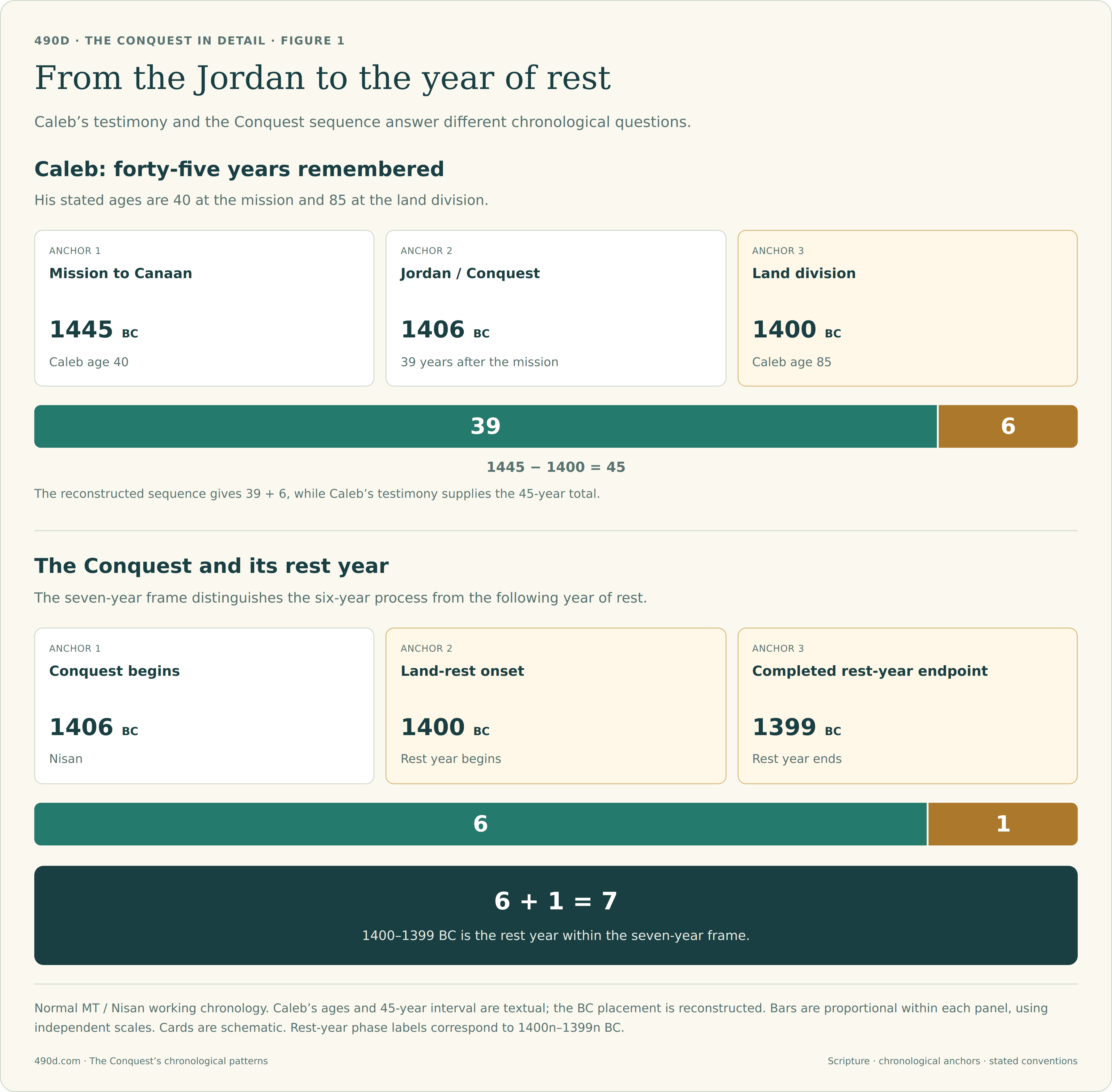
Table 2. Caleb’s count and the completed seven
| Interval or age | Calculation | Result |
|---|---|---|
| Caleb’s age at inheritance | 40 + 45 | 85 |
| Reconnaissance → crossing | 1445 − 1406 | 39 years |
| Crossing → land division / rest onset | 1406 − 1400 | 6 years |
| Reconnaissance → land division | 1445 − 1400 = 39 + 6 | 45 years |
| Rest-year interval | 1400n → 1399n BC | 1 year |
| Crossing → completed rest-year endpoint | 1406 − 1399 = 6 + 1 | 7 years |
Sources: Joshua 14:7–10; File 06 §1; File 63 §3.5; File 18 §2.4.
The distinction between onset and completion is central. The seventh year begins at the 1400 boundary and closes at 1399. The pattern is six years leading into a year of rest; it is not seven completed years of warfare followed by an eighth year.
Jericho offers a related pattern within the conquest narrative. Six days of marching culminate in a distinctive seventh day, with seven priests, seven horns, and seven circuits on that final day. The seventh day there brings victory; the seventh year in the chronological reconstruction brings the rest interval to completion. This is a comparison of numerical form and narrative movement. It does not identify Jericho’s marching week with Nisan 10–17 or establish the weekday of the Jordan crossing.
The wider biblical analogy is the movement from six to seven: Creation’s work and rest, and the land’s six years of cultivation followed by its Sabbath year (Genesis 2:2–3; Leviticus 25:3–4). Joshua’s rest-from-war language is being read in that setting; Joshua does not itself print the reconstructed sabbatical dates.
Two forties, and the seven years they share
The adopted chronology places Joshua’s death in 1366 BC. The whole interval from the Exodus through the Conquest to that endpoint is therefore:
1446 → 1406 → 1366 BC = 40 + 40 = 80.
Each forty can be displayed as seven followed by thirty-three. The second division has the completed rest year as its hinge; the first has the structural coordinate 1439 BC:
1446 → 1439 → 1406 → 1399 → 1366 BC
7 + 33 + 7 + 33 = 80.
The word structural matters. There is no separately dated event at 1439 BC in this argument. It is a calculated division of the first forty, and it will also appear in the Jacob and Levi comparisons below.
Now shift attention to the central sequence. 1439–1399 BC spans forty years; 1406–1366 BC spans another forty. They share 1406–1399 BC, the seven-year Conquest-to-rest interval:
1439 → 1406 → 1399 → 1366 BC = 33 + 7 + 33.
The same seven closes one forty and opens the other. Counting it once gives 73 years:
40 + 40 − 7 = 73.
490d · The Conquest in Detail · Figure 2
Two forties, and the seven they share
First see the whole sequence; then shift the starting point to reveal the overlap.
The full eighty-year sequence
Exodus
1446 BCBeginning of the first 40
Structural partition
1439 BCNo separately dated event
Conquest
1406 BCBeginning of the second 40
Completed rest-year endpoint
1399 BCSeven years after entry
Joshua’s death
1366 BCEnd of the second 40
1446 → 1406 BC
First consecutive span: 40 years
1406 → 1366 BC
Second consecutive span: 40 years
The two consecutive forty-year spans meet at the Conquest.
A shifted pair shares the seven
The focus now begins at 1439 BC. The bars use a new, 73-year scale.
1439 → 1399 BC: 33 + 7 = 40
1406 → 1366 BC: 7 + 33 = 40
33 + 7 + 33 = 73
The shared seven runs from Conquest entry to the completed rest-year endpoint.
Normal MT / Nisan working chronology. The 1439 BC node is a structural partition. Bars are proportional within each panel, with independent 80-year and 73-year scales. Anchor-card spacing is schematic. The 73-year union is a derived calculation.
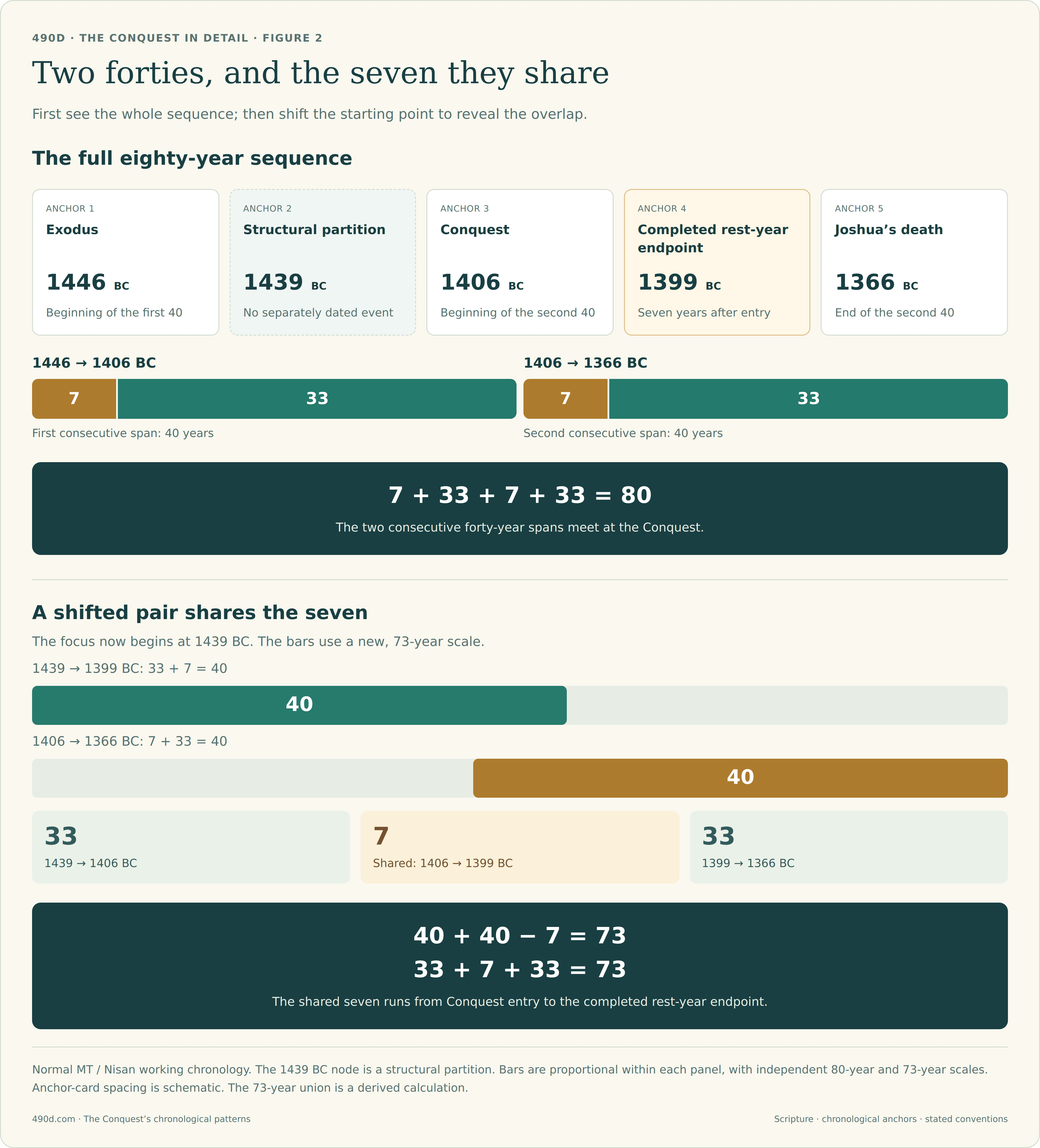
Table 3. Consecutive and overlapping measures
| Measure | Dates BC | Calculation | Years |
|---|---|---|---|
| First consecutive forty | 1446 → 1406 | 7 + 33 | 40 |
| Second consecutive forty | 1406 → 1366 | 7 + 33 | 40 |
| Whole Exodus-to-Joshua span | 1446 → 1366 | 40 + 40 | 80 |
| Shifted forty | 1439 → 1399 | 33 + 7 | 40 |
| Shared Conquest-to-rest interval | 1406 → 1399 | 1406 − 1399 | 7 |
| Union of the overlapping forties | 1439 → 1366 | 33 + 7 + 33 = 40 + 40 − 7 | 73 |
Source: File 63 §2.6 and §§3.2–3.6. The 73-year union is the direct calculation from its registered endpoints.
The significance lies in the seven’s double function. A single period of entry, conquest, and completed rest serves as the closing portion of one measure and the opening portion of another. The overlap is therefore more informative than listing two unrelated occurrences of forty. Once the endpoints are selected, however, its arithmetic is a dependent consequence of that selection, not an additional independent probability test.
The birth-law form within the lives of Moses and Joshua
Leviticus 12:2–5 gives two purification periods following childbirth. For a male child, seven days are followed by thirty-three; for a female child, two weeks are followed by sixty-six days. In calculation form:
7 + 33 = 40
14 + 66 = 80.
The second is the doubled numerical form of the first. File 14 §2.1 uses these as a comparative pattern, and File 63 applies that pattern to larger chronological spans. The biblical law concerns days; its application to years is an interpretive comparison.
Moses’ life provides a particularly clear arrangement. Scripture gives his age as 80 when he speaks to Pharaoh and 120 at death (Exodus 7:7; Deuteronomy 34:7). In the adopted whole-year chronology, the Exodus divides his life into 80 + 40. File 63 §4.5 displays the internal form:
1526 → 1512 → 1446 → 1439 → 1406 BC
14 + 66 + 7 + 33 = 120.
Here 1512 BC and 1439 BC are calculated partitions; no additional biographical events are assigned to them. The first eighty years take the doubled form; the final forty take the single form. This gives the Exodus the role of a new beginning within Moses’ own life and within Israel’s national story.
Joshua’s life brings the Conquest and rest into view. His lifespan is stated directly:
Some time later, Joshua son of Nun, the servant of the LORD, died at the age of 110.
The working dates 1476–1366 BC place Joshua at 70 at the Conquest and 77 at the completed rest-year endpoint:
1476 → 1406 → 1399 → 1366 BC = 70 + 7 + 33 = 110.
490d · The Conquest in Detail · Figure 3
Moses and Joshua: two lives, two divisions
The chronological anchors carry a numerical comparison; the internal partitions do not create new events.
Moses: eighty, then forty
Moses’ birth
1526 BCAge 0
Structural partition
1512 BCCalculated age 14; no dated event
Exodus
1446 BCAge 80 at the Exodus phase
Structural partition
1439 BCCalculated age 87; no dated event
Moses’ death
1406 BCStated lifespan: 120
80 + 40 = 120
The birth-law comparison divides eighty as 14 + 66 and forty as 7 + 33.
Joshua: seventy, then forty
Joshua’s birth
1476 BCCalculated birth date
Conquest
1406 BCCalculated age 70
Completed rest-year endpoint
1399 BCCalculated age 77
Joshua’s death
1366 BCStated lifespan: 110
The first seventy include thirty years to the Exodus and forty more to the Conquest.
Normal MT / Nisan working chronology. Bars are proportional within independently scaled 120-year and 110-year panels; cards are schematic. Ages 14, 87, 70, and 77 are calculations. The birth-law interpretation is distinct from the arithmetic.
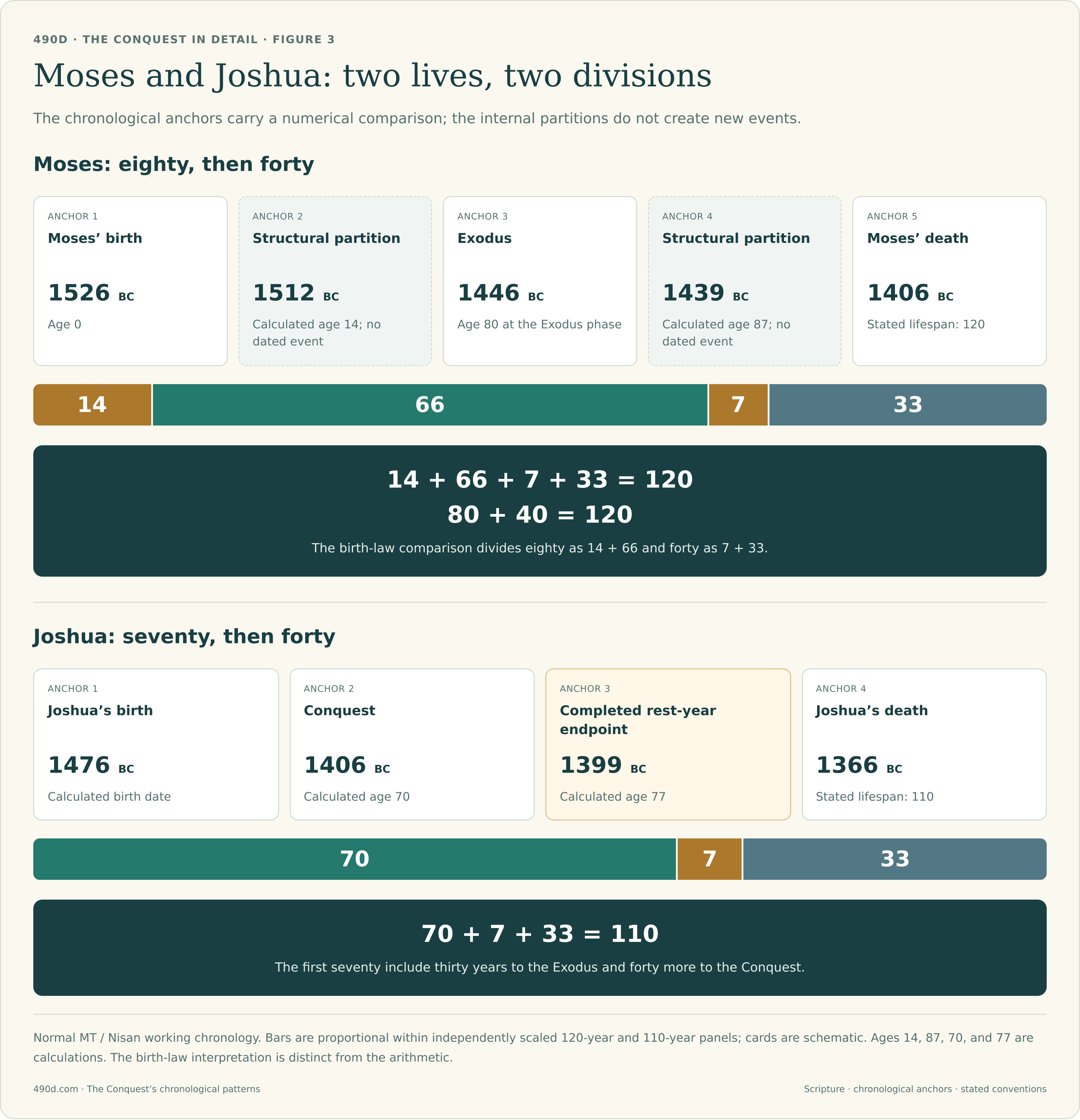
Table 4. Textual ages and calculated divisions
| Person / interval | Dates BC | Calculation | Status |
|---|---|---|---|
| Moses: birth → Exodus | 1526 → 1446 | 14 + 66 = 80 | Age 80 is textual; the 14/66 division is structural |
| Moses: Exodus → death | 1446 → 1406 | 7 + 33 = 40 | Difference of textual ages 80 and 120; internal division structural |
| Moses: complete lifespan | 1526 → 1406 | 14 + 66 + 7 + 33 = 120 | Lifespan 120 is textual |
| Joshua: birth → Exodus | 1476 → 1446 | 30 | Calculated age in the working chronology |
| Joshua: birth → Conquest | 1476 → 1406 | 70 | Calculated age |
| Joshua: birth → completed rest year | 1476 → 1399 | 77 | Calculated age at the completed boundary |
| Joshua: complete lifespan | 1476 → 1366 | 70 + 7 + 33 = 110 | Lifespan 110 is textual; intermediate ages and BC placement reconstructed |
Sources: File 63 §§3.6 and 4.5; File 55 §2.3; File 18 §2.4, with the biblical passages above.
Joshua’s 1296 BC cumulative endpoint, used elsewhere in the canonical files, belongs to the method of adding complete lifespans. It is not a second historical death date and does not enter these regular-life calculations. Similarly, the 33 years after the completed rest endpoint are computed from the adopted dates; Joshua 23:1 describes a long time after rest but does not state thirty-three years.
Abraham, Jacob, and Moses: three measures from calling to death
The forty associated with Moses belongs to a wider set of post-calling spans. File 15 compares the years from Abraham’s call to his death, from Jacob’s Bethel/Haran departure to his death, and from Moses’ Exodus commission to his death.
The measures are 100, 70, and 40 years. They use a common biographical relationship, making the comparison more specific than three isolated numbers.
490d · The Conquest in Detail · Figure 4
Three lives after the call
The compared spans begin at each person’s own call or Exodus commission.
Abraham
2091 → 1991 BC100 years from the stated call or beginning of service to death.
Jacob
1929 → 1859 BC70 years from the stated call or beginning of service to death.
Moses
1446 → 1406 BC40 years from the stated call or beginning of service to death.
= 10 : 7 : 4
Three post-calling spans supply the units used in the generational comparison.
Normal MT / Nisan chronology, 430 years in Egypt, no +60 Terah. Bar lengths share a 100-year duration scale; they are not aligned on one historical date axis. Jacob’s age 77 follows the working chronology. Card spacing is schematic.
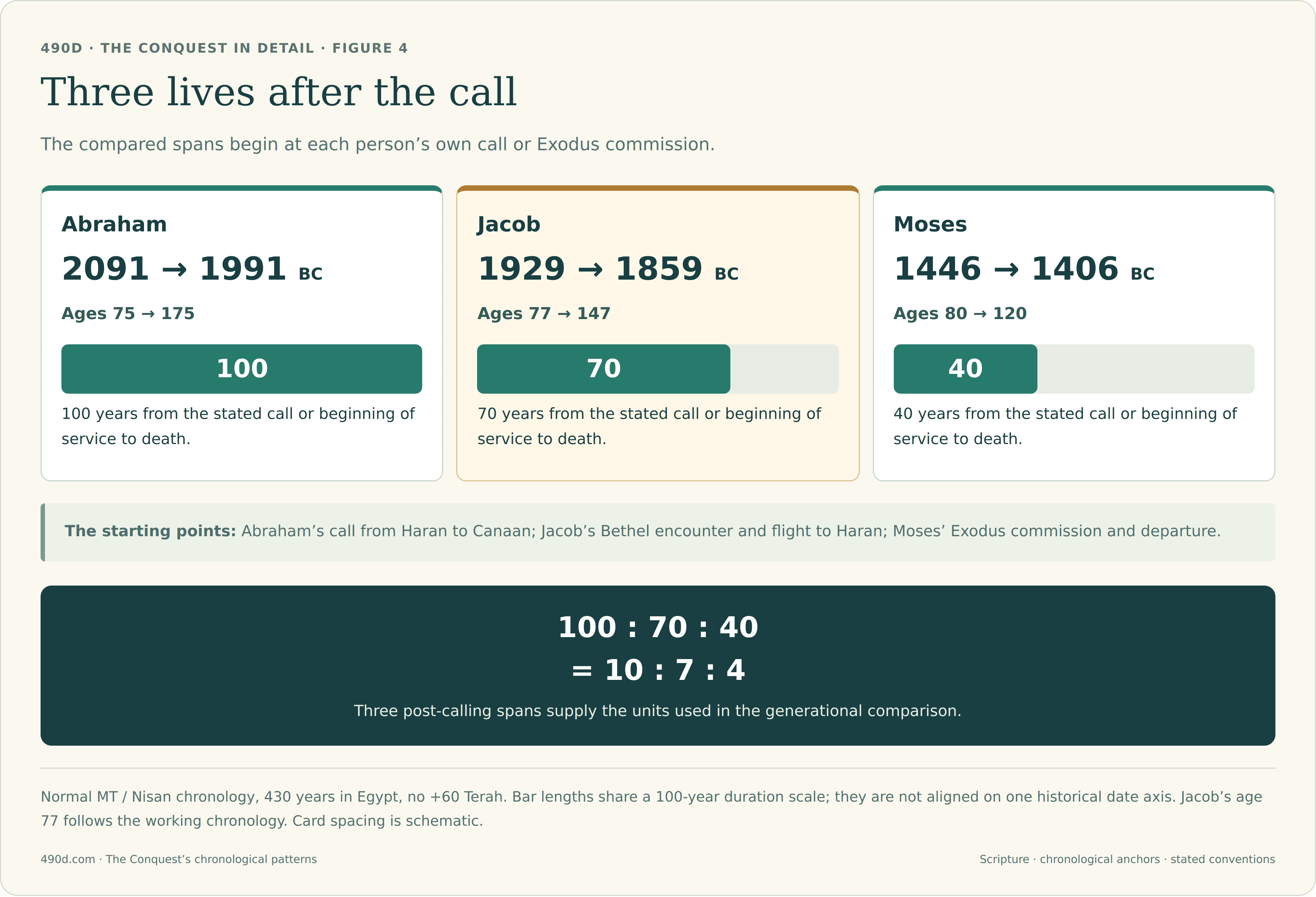
Table 5. The post-calling measures
| Person | Beginning | Death | Calculation | Age comparison |
|---|---|---|---|---|
| Abraham | Haran → Canaan call, 2091 BC | 1991 BC | 2091 − 1991 = 100 | 75 → 175 |
| Jacob | Bethel / flight to Haran, 1929 BC | 1859 BC | 1929 − 1859 = 70 | 77 → 147 |
| Moses | Exodus, 1446 BC | 1406 BC | 1446 − 1406 = 40 | 80 → 120 |
Sources: File 15 §§1–2, with File 01, File 04, and File 18. Jacob’s age of 77 at Bethel is a chronological derivation; it is not directly stated in Genesis.
Abraham’s date here concerns departure from Haran toward Canaan, not a newly assigned date for leaving Ur. Jacob’s 1929 BC departure must likewise remain distinct from his 1909 BC return and his later 1876 BC entry into Egypt.
These are comparative generational measures, not a claim that every biblical generation lasts the same number of years. The exact ratio 100 : 70 : 40 = 10 : 7 : 4 preserves their differences. For the Conquest study, the most useful connection is Jacob’s seventy-year unit: it helps explain why the larger 490-year span below can be read as seven such units.
Jacob and Levi converge on the same structural boundary
The 1439 BC division is not introduced only to split the Exodus-to-Conquest forty. Current canonical comparisons give it two further roles.
First, Jacob’s Bethel/Haran date of 1929 BC stands 483 years before the Exodus. A further seven years reach 1439:
1929 → 1446 → 1439 BC = 483 + 7 = 490.
Because 483 = 69 × 7 and 490 = 70 × 7, the final seven completes the seventy-week measure. The same whole is 7 × 70. Jacob’s own seventy years from calling to death, 1929–1859 BC, form its first seventy-year unit.
This is the source-controlled Jacob comparison in File 15 §2.3 and File 62 §8.6. Its terminal coordinate remains structural; it is not a revised date for Moses’ death or a dated fulfillment of Daniel 9.
Second, Levi’s regular birth in 1919 BC stands 480 years before the same boundary:
1919 → 1439 BC = 480 = 12 × 40.
Continue for another forty, to the completed land-rest endpoint:
1439 → 1406 → 1399 BC = 33 + 7 = 40.
The whole becomes:
1919 → 1399 BC = 480 + 40 = 520 = 13 × 40.
490d · The Conquest in Detail · Figure 5
Jacob and Levi meet at one structural boundary
The 1439 BC position closes Jacob’s 490-year interval and opens Levi’s final forty.
Jacob’s seven groups of seventy
Bethel / flight to Haran
1929 BCJacob’s call-state
Exodus
1446 BC483 years from Bethel
Structural endpoint
1439 BCSeven more years
490 = 7 × 70
Levi’s twelve forties, plus one
Levi’s birth
1919 BCStarting anchor
Structural partition
1439 BCTwelve forties completed
Conquest
1406 BC33 years later
Completed rest-year endpoint
1399 BCSeven more years
520 = 13 × 40
The last 33 + 7 completes a thirteenth forty-year unit.
Thirteen counts forty-year units in this structure. It does not make Levi a thirteenth son of Jacob.
Normal MT / Nisan whole-year display. The shared 1439 BC position is structural, not a separately dated event. Thin bars are proportional within independent 490-year and 520-year panels; cards are schematic. Levi’s thirteen units are an interpretive count of forty-year spans.
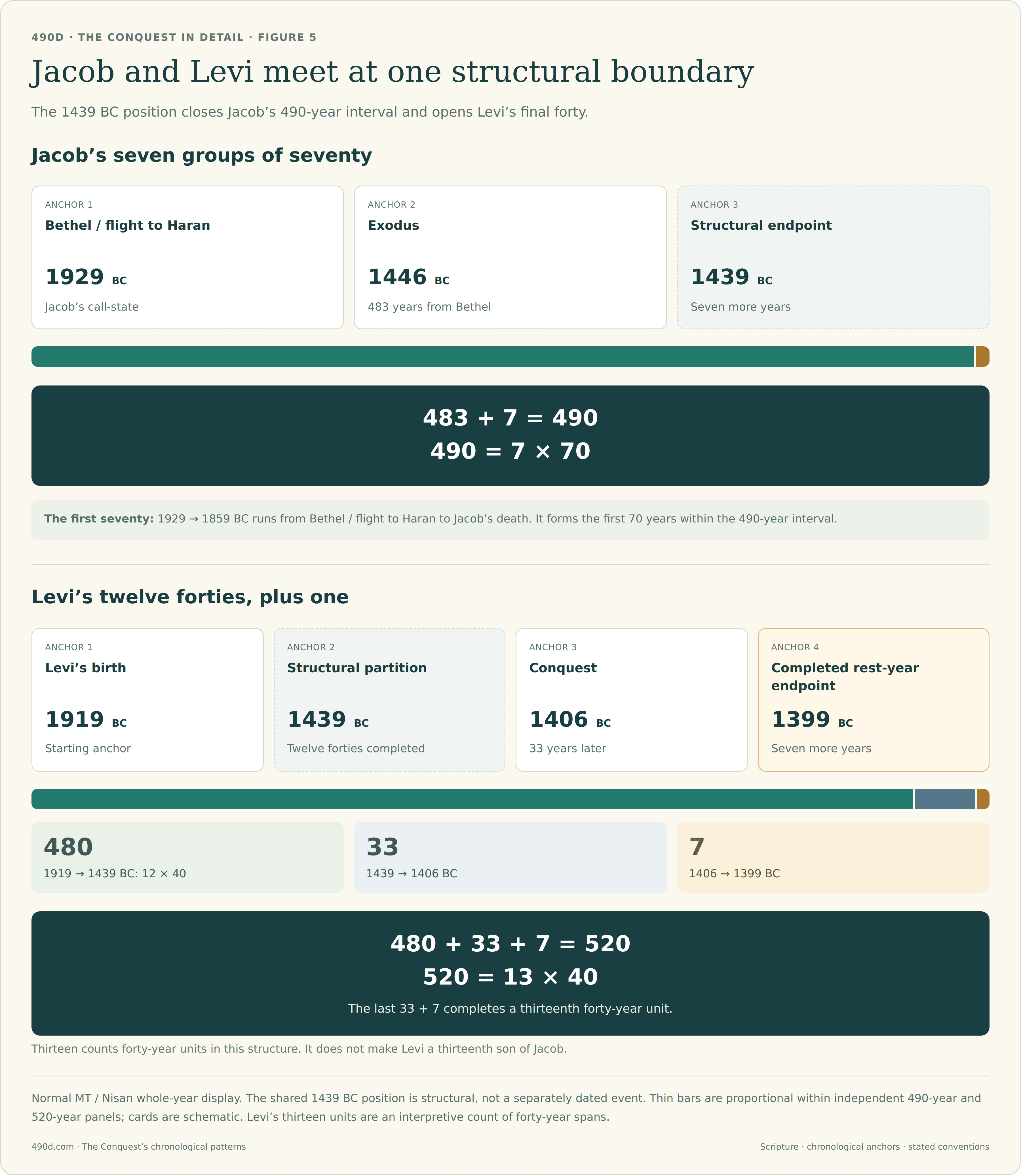
Table 6. Jacob’s 490 and Levi’s 520
| Comparison | Dates BC | Calculation | Meaning |
|---|---|---|---|
| Jacob’s post-calling life | 1929 → 1859 | 70 | First seventy-year unit in the larger 490 |
| Jacob’s calling → Exodus | 1929 → 1446 | 483 = 69 × 7 | Larger source-controlled comparison |
| Exodus → structural division | 1446 → 1439 | 7 | Completes 483 + 7 |
| Jacob’s calling → structural division | 1929 → 1439 | 490 = 7 × 70 | Seven Jacobean units |
| Levi’s birth → structural division | 1919 → 1439 | 480 = 12 × 40 | Twelve Mosaic-scale units |
| Structural division → completed rest year | 1439 → 1399 | 33 + 7 = 40 | Thirteenth unit in the Levitical comparison |
| Levi’s birth → completed rest year | 1919 → 1399 | 520 = 13 × 40 | Full Levitical span |
Sources: File 15; File 62; File 63 §§2.3–2.6. Levi’s regular birth is controlled by Files 04 and 18.
The Levitical interpretation belongs to the organization of Israel’s tribes. Joseph can be represented through Ephraim and Manasseh in the land allotments, while Levi is set apart for priestly service (Joshua 14:3–4). The resulting twelve-plus-one comparison does not make Levi Jacob’s thirteenth son, nor does it imply that Jacob’s sons were born forty years apart.
The final forty brings the study back to its central seven. In this Levitical span, 1406–1399 BC closes the forty. In Joshua’s final 1406–1366 BC span, it opens the forty. The institutional comparison and the personal biography therefore meet at the same transition from entry toward completed rest.
Calendar note: Aaron, Moses, and the half-week
Aaron and Moses also invite a comparison with the prophetic half-week. Their stated ages provide the starting point; the calendar model adds a distinct phase-sensitive reading.
Exodus 7:7 gives Moses’ age as eighty and Aaron’s as eighty-three when they speak to Pharaoh. The ordinary age-label difference is therefore 3 years. The canonical files preserve that branch alongside a separate 3.5-year phase-resolved comparison, governed by the Nisan/Tishri framework. The second is a calendrical model; it is not an exact day count stated in Exodus.
Table 7. Two distinct representations
| Representation | Calculation on a 360-day basis | Status |
|---|---|---|
| Ordinary three-year age-label difference | 3 × 360 = 1080 | Difference of the stated age labels, expressed schematically in days |
| Phase-resolved half-week | 3.5 × 360 = 1260 | Canonical calendrical model, requiring its declared phase convention |
| Half-week with one included leap month | 1260 + 30 = 1290 | Calendar comparison; inclusion depends on the window’s placement |
Sources: File 06 §6; File 12 §§6.3 and 7A; File 17 §§12.1–12.3.
The last row is a related calendar calculation, not a third textual age difference between the brothers. Nor can the 3.5-year value be recovered simply by subtracting two unsuffixed BC birth labels. No projected Aaron birth-date is needed to establish the Conquest and land-rest argument.
How the forty-year calendar scheme works
The current calendar source gives an explicit construction for combining 360-day schematic years with 30-day intercalations. Six cycles contain six schematic years and one added month each; a seventh cycle contains four years and one added month:
6 × (6 × 360 + 30) + (4 × 360 + 30) = 14610 days.
That is forty schematic years plus seven added months:
40 × 360 + 7 × 30 = 14400 + 210 = 14610.
The resulting mean is exactly 365.25 days per year.
490d · The Conquest in Detail · Figure 6
Forty schematic years, seven added months
The arithmetic reaches a 365.25-day mean; the proposed calendar remains a reconstruction.
A reconstructed calendar model: six six-year cycles and one four-year cycle, each receiving one thirty-day intercalary month.
6 × 360 days
+ 30 days2160 + 30 = 2190 days
6 × 360 days
+ 30 days2160 + 30 = 2190 days
6 × 360 days
+ 30 days2160 + 30 = 2190 days
6 × 360 days
+ 30 days2160 + 30 = 2190 days
6 × 360 days
+ 30 days2160 + 30 = 2190 days
6 × 360 days
+ 30 days2160 + 30 = 2190 days
6 × 2190 = 13140 days
4 × 360 + 30 = 1470 days.
The final four-year cycle receives the seventh added month.
14610 = 40 × 365.25
Forty base years plus seven added months: 14400 + 210 days.
6 + 6 + 6 + 6 + 6 + 6 + 4 = 40 years
The half-week corollary
3.5 × 360 = 1260
1260 + 30 = 1290
The interval’s placement determines whether an added month falls inside the count. The extra month is not automatic for every three-and-a-half-year span.
Schematic 360-day base with seven thirty-day intercalations. Cycle cards are schematic, not proportional in area. The 365.25-day figure is the arithmetic mean of this construction. Historical use is not established by the equality. Leap-month inclusion depends on interval placement.
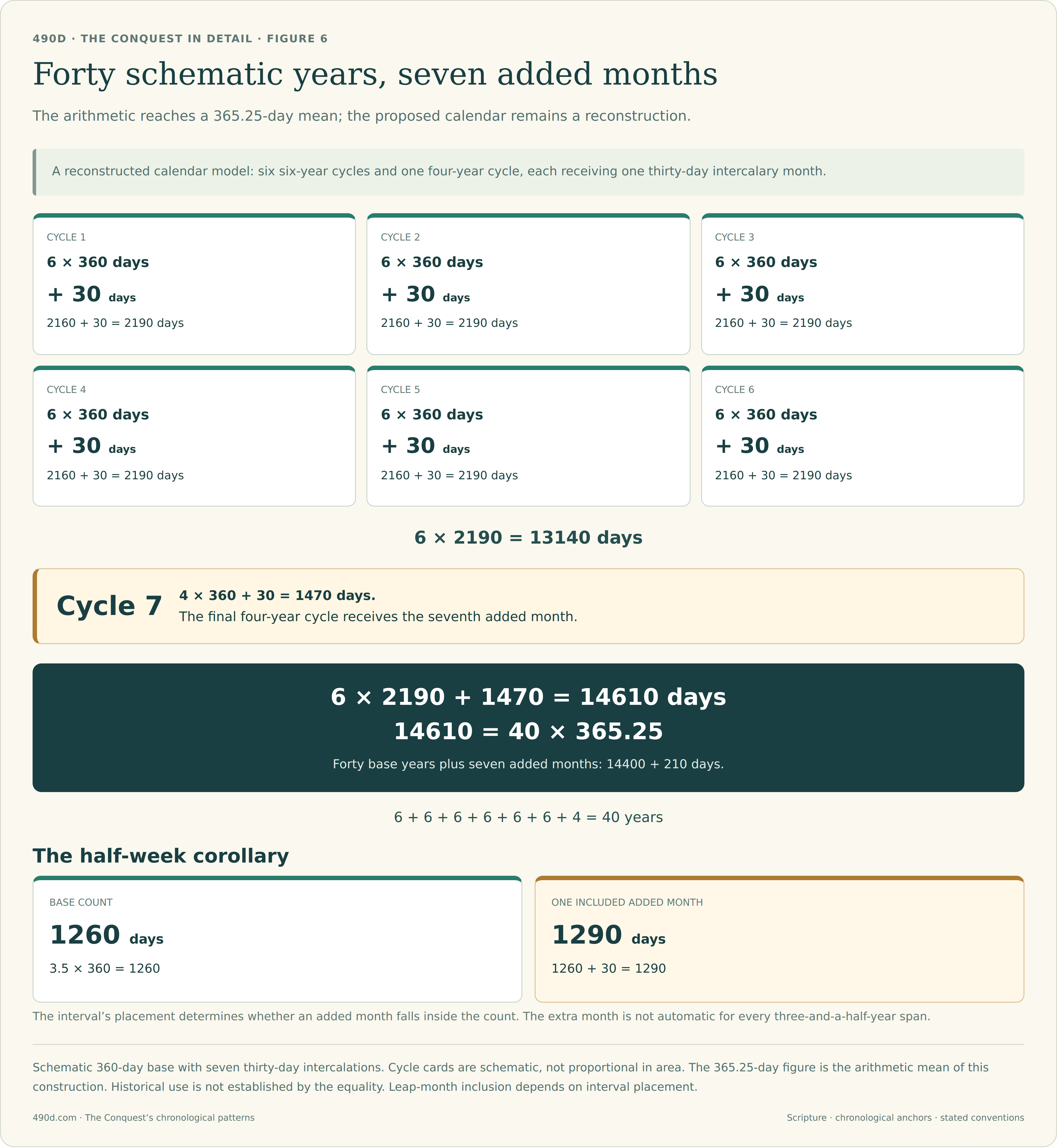
Table 8. The reconstructed forty-year cycle
| Component | Schematic years | Added months | Days |
|---|---|---|---|
| One six-year cycle | 6 | 1 | 6 × 360 + 30 = 2190 |
| Six such cycles | 36 | 6 | 6 × 2190 = 13140 |
| Closing four-year cycle | 4 | 1 | 4 × 360 + 30 = 1470 |
| Complete cycle | 40 | 7 | 13140 + 1470 = 14610 |
| Mean year | — | — | 14610 ÷ 40 = 365.25 |
Source: File 12 §§7A.1–7A.3.
The forty-year cycle is a reconstructed system whose arithmetic closes on the Julian mean year. It is not a biblical statement that Israel historically observed these exact intercalation positions. The 1470 = 3 × 490 = 30 × 49 closing block is another exact property of the scheme.
Within this arrangement, a three-and-a-half-year window crosses at most one cycle-ending intercalation. Counting a window without that month gives 1260 days; including one gives 1290. The particular window and its placement must be declared before applying the difference to dated events. The equation alone does not identify a death date, the beginning of Jericho’s marches, or the day on which a backward projection must start.
This preserves the useful calendar relationship while leaving the Conquest’s seven-year pattern grounded in its own chronological anchors. File 17 §13A gives a separately controlled day-scale application in Ezekiel; that application does not automatically date the events of Joshua.
What the completed pattern brings into focus
The numbers follow the story’s central movement. Moses leads Israel out; Joshua brings Israel in. Caleb’s testimony connects the long wait with a received inheritance. The land’s rest marks the transition from entry and conquest toward settlement.
The six-plus-one sequence gives that transition a week-like shape. The shared seven joins two forty-year measures. The 7 + 33 form appears within the larger Exodus-to-Joshua chronology, while the 14 + 66 form supplies its doubled counterpart in the Mosaic comparison. Jacob’s 490 and Levi’s 520 give the structural 1439 boundary a wider role without changing the historical Conquest date.
These relationships are exact within the declared chronology. Their theological interpretation concerns formation, inheritance, priestly service, and rest. The arithmetic does not by itself establish a probability of deliberate design, and generated partitions should not be counted as independently dated discoveries.
Rest also has a defined narrative scope. Joshua 13:1 acknowledges land still to be possessed. The rest passages celebrate a decisive fulfillment, not the disappearance of every future conflict. That distinction allows the numerical pattern to serve the narrative rather than flatten it.
Joseph’s bones give this movement a tangible human expression. His request looked forward to God bringing Israel out of Egypt; Moses carried the bones, and Joshua records their burial at Shechem (Genesis 50:25–26; Exodus 13:19; Joshua 24:32). File 61 §14.5 connects the forty-year Exodus-to-entry journey with that continuity of promise. The burial verse does not specify that the burial itself occurred in 1406 BC. The significance is the passage from a promise carried through the wilderness to an inheritance received in the land.
The conclusion is consequently the one the book itself emphasizes:
Not one of all the LORD’s good promises to the house of Israel had failed; everything was fulfilled.
Sources and conventions
The controlling canonical Markdown collection supplies the current chronology and amendments. File 06 controls the Conquest and rest-year interval; File 63 §§2–4 controls the overlapping forties, Levi comparison, Joshua biography, and Mosaic birth-law display. File 15 defines the 100/70/40 generational measures; File 62 supplies the Jacob 483/490 application. Files 14, 12, and 17 distinguish the birth-law, calendar, and prophetic-span comparisons. File 18 provides the chronological tables.
All same-side BC spans use subtraction. The suffix n denotes Nisan reckoning; it does not mean that every event occurred on Nisan 1. The main diagrams use simplified whole-year labels, while the rest-year table preserves 1400n–1399n. The differences measure the displayed year coordinates, not exact anniversaries for events whose day is unstated. Calendar-day counts in the final section are explicitly schematic.
Return to the shorter introduction or its supporting appendix. The eight tables in this detailed study remain directly linked near the opening.
Further reading: Exodus and Conquest: Additional Day–Year Patterns.
Scripture quotations: Berean Standard Bible (BSB), public domain.