Detailed companion · 6 October 2026 · v1. Expanded calendar tables and inherited projections accompany this study. Its earlier article remains unchanged at its original address.
Day–Year Study · Part 3b · Detailed companion
In keeping with the forty days you spied out the land, you shall bear your guilt forty years—a year for each day—and you will experience My alienation.
Numbers 14:34 gives this study its point of departure: Israel’s forty days of reconnaissance become forty years of bearing guilt. Ezekiel 4:4–6 supplies another explicit day–year sign. These passages invite comparison between short narrative periods and longer chronological structures. The further correspondences examined here are an interpretation of those structures; each calculation must retain its own calendar, origin and counting rule.
This supplement develops six connections: a selected 700-day framework, its recurring 350, the 343-day interval from the middle of Unleavened Bread to the Tabernacle’s erection, Moses’ intercession alongside Ezekiel’s 390 + 40, the relation of atonement to delayed inheritance, and the traditional three forties at Sinai. Its chronological backbone runs from Jacob’s entry into Egypt through Moses’ life to the Conquest, and onward to the schematic Temple and Jerusalem’s fall.
For the basic narrative, read Moses and the Exodus and the detailed Mosaic study. The detailed Conquest study explains the land’s 1400–1399 BC rest interval. The full tables accompanying this supplement retain its subsidiary comparisons and alternative projections. The complete earlier article remains at its original address.
1. Dates, numbered days and symbolic coordinates
A date can mark the beginning of a day, the whole numbered day, or a larger unit containing that day. These are useful views of the same calendar. Their arithmetic differs when both endpoint days are included. The distinction is especially important when moving from dated events to a day–year comparison.
This study uses a 360-day base calendar, with twelve 30-day months, for its short-span tables. Let D count completed days from the start of Nisan 1 in the Exodus year; let n = D + 1 number the calendar days. The diagrams and full tables also call that numbered counter q. Nisan 1 is therefore D0, numbered day 1. The source article also has a selected scaffold, here called s, whose labels sometimes combine those two conventions. We retain that scaffold as a model while showing the corresponding dated counts separately.
| Datum | Completed days D | Numbered day n | Basis |
|---|---|---|---|
| Nisan 1, year 1 | 0 | 1 | Calendar origin |
| Nisan 18, year 1 | 17 | 18 | Fourth of the seven feast dates, Nisan 15–21 |
| Sivan 1, year 1 | 60 | 61 | Selected Sinai-arrival reading |
| Nisan 1, year 2 | 360 | 361 | Tabernacle erected: Exodus 40:17 |
| Iyyar 20, year 2 | 409 | 410 | Departure from Sinai: Numbers 10:11 |
| Tishri 1, year 2 | 540 | 541 | Beginning of month 7 |
| Tishri 10, year 2 | 549 | 550 | Day of Atonement |
Exodus 19:1 does not settle the Sinai-arrival day identically across translations and interpretations. The original article follows a Sivan 1 reading. Exodus 19:1, BSB, reads “on the same day of the month that the Israelites had left the land of Egypt”; its reading must remain visible alongside the selected Sivan 1 model. The textual and date alternatives show why this choice matters.
The calendar also has two legitimate registers: base days with leap additions omitted, and days with specified additions counted. The reconstructed intercalation scheme in File 12 §7A closes cycles of 6 + 6 + 6 + 6 + 6 + 6 + 4 years, each with a 30-day month. Its forty-year total is:
40 × 360 + 7 × 30 = 14,610 days = 40 × 365.25.
With the Nisan 1446 BC origin, the next closures are 1440, 1434, 1428, 1422, 1416, 1410 and 1406 BC. The preceding cycle closes at the 1446 origin. An added month immediately before that origin belongs to the preceding cycle. A selected +30 comparison inside the Exodus-to-Tabernacle model is a transferred counting alternative; this phase does not require a physical insertion inside 1446–1445 BC. The calendar table keeps these choices separate. Larger week units and their precise constituent days can both contribute to a symbolic reading without becoming interchangeable coordinates.
2. A proposed 700-day framework
The original supplement begins the sequence before Passover. It proposes a six-month plague interval, with a selected additional month:
180 + 30 = 210 days.
Exodus does not state either the total duration of the ten plagues or their first calendar date. Thus the proposed head s−210 is a premise of the framework. The source then places Nisan’s opening at s0, Sinai at s60, a selected mountain-period close at s146, departure at s410, and the spies’ return at s490.
| Selected scaffold leg | Units | Function in the model |
|---|---|---|
| −210 → 0 | 210 | Proposed plague prelude |
| 0 → 60 | 60 | Exodus season to chosen Sinai head |
| 60 → 146 | 86 | Selected mountain-period envelope |
| 146 → 410 | 264 | Remaining Sinai interval |
| 410 → 490 | 80 | Selected departure-to-spies-return envelope |
| −210 → 490 | 700 | Total source scaffold |
Accessible text and image downloads
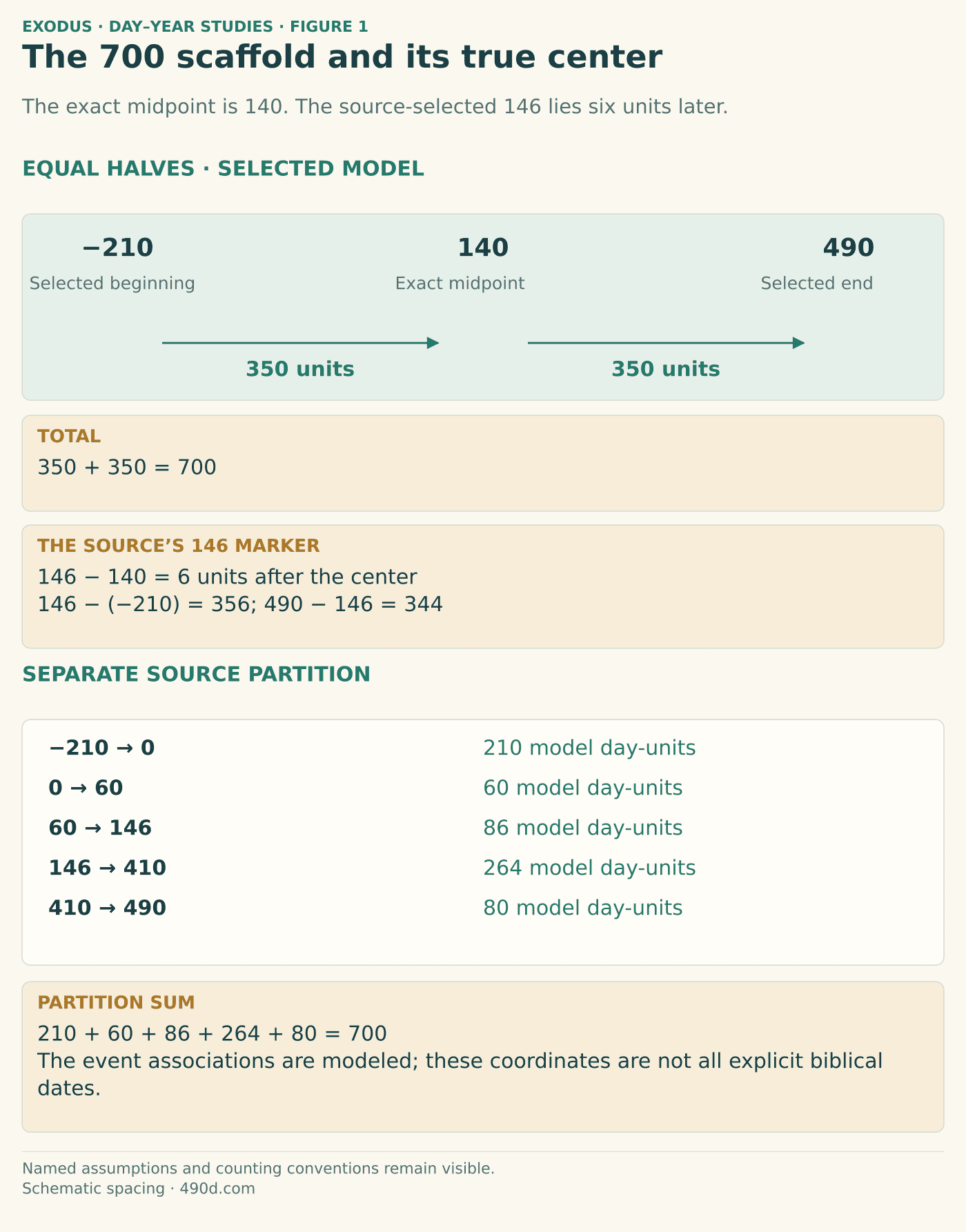
Equal halves of a source-selected scaffold: −210 to 140 is 350; 140 to 490 is 350; total 700. A separate selected 146 point is six units after 140, leaving 356 before it and 344 after it. A five-part source partition lists −210 to 0 as 210; 0 to 60 as 60; 60 to 146 as 86; 146 to 410 as 264; 410 to 490 as 80. Sum 700. Historical event associations remain modeled.
Desktop PNG · Phone PNG · Desktop WebP (ZIP) · Phone WebP (ZIP) · Text-based SVG (ZIP)
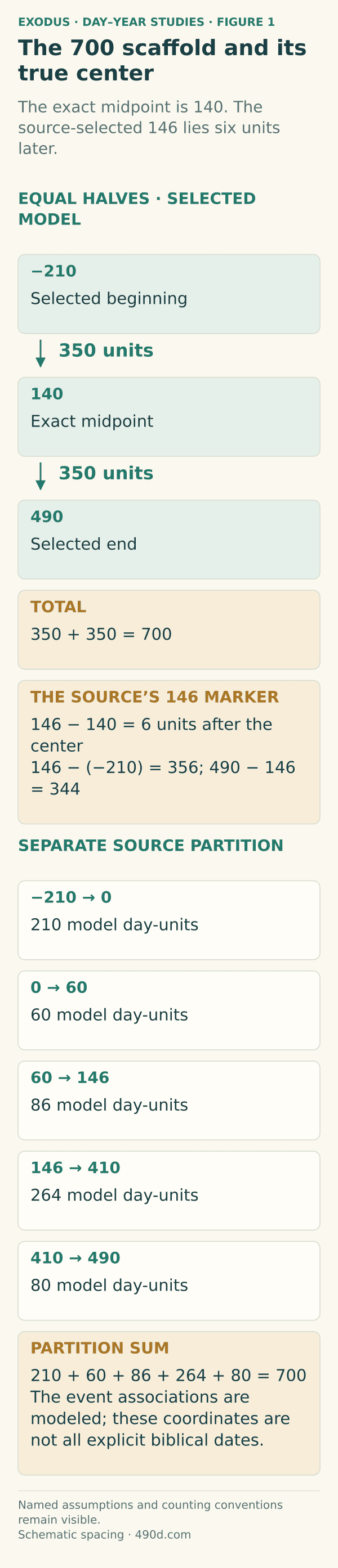
The sum is exact within the chosen coordinates: 210 + 60 + 86 + 264 + 80 = 700. Those component lengths do not independently prove the proposed event dates. In particular, Scripture gives the spies forty days but does not give this model’s expedition boundaries s450 and s490. Nor does it identify one mountain descent at s146 as both the breaking of the first tablets and the presentation of the renewed tablets. Those are distinct events. Here s146 preserves the source’s selected mountain close without assigning two conflicting episodes to it.
The framework has an intelligible narrative shape. Judgment falls on Egypt, Israel is delivered and receives the covenant, Moses intercedes after its breach, and judgment eventually falls on Israel’s unbelief. Mercy stands within a sequence bounded by judgment. That theological reading survives the distinction between stated events and selected calendar placements.
The total can be grouped as 10 × 70 or 100 × 7. It is one hundred ordinary weeks of days; under the day–year scalar, it becomes one hundred weeks of years. It is also ten 70-unit blocks. The phrase “ten weeks” alone would describe 70 units, not 700.
The exact midpoint is s140:
140 − (−210) = 350; 490 − 140 = 350.
The selected s146 point falls six units after it, dividing the outer span into 356 + 344. Its proximity can support a literary comparison between interrupted judgment, intercession and covenant renewal. It should be described as a nearby hinge rather than an exact numerical center.
3. Why 350 recurs
The 350 pattern has several different sources. Each can be retained with its own denominator or counting convention.
| Relationship | Calculation |
|---|---|
| Half the outer scaffold | 700 ÷ 2 = 350 |
| Fifty ordinary weeks | 50 × 7 = 350 |
| Five 70-unit blocks | 5 × 70 = 350 |
| Five sevenths of the 490-unit core | 490 × 5/7 = 350 |
| Jacob’s entry to Moses’ birth | 1876 − 1526 = 350 years |
Daniel’s seventy weeks supply a 490-year measure when a week is seven years. Five blocks of seventy total 350, and two equal 350 halves total 700. These are related groupings, but 350 is five sevenths of 490, not five sevenths of 700.
“Seventy weeks are decreed about your people and your holy city…”
— Daniel 9:24 (ESV, wording checked against Text Edition 2025; emphasis added).
The stay at Sinai
The source’s “350 days at Sinai” can be preserved through inclusive counting under its selected Sivan 1 arrival.
“On the third new moon after the people of Israel had gone out of the land of Egypt, on that day they came into the wilderness of Sinai. … There Israel encamped before the mountain, …”
— Exodus 19:1; Exodus 19:2 (ESV, wording checked against Text Edition 2025).
“In the second year, in the second month, on the twentieth day of the month, the cloud lifted from over the tabernacle of the testimony…”
— Numbers 10:11 (ESV, wording checked against Text Edition 2025).
From the start of Sivan 1 to the start of Iyyar 20 in the following year, 409 − 60 = 349 completed days. Counting both dated days gives 350 calendar days. In numbered-day notation the same result is 410 − 61 + 1 = 350. The source’s s60 → s410 = 350 is a useful schematic counterpart, but the literal date calculation needs the inclusive rule. This is a counting distinction, not a reason to discard the 350 comparison.
A second calculation selects 345 and expands it through the Prophetic Key-of-23 operator:
345 × 70/69 = 350.
The source places an ascent near s64. Taken literally, 410 − 64 = 346. A selected s65 head produces 345. The expanded comparison therefore belongs to the s65 alternative or another expressly declared boundary adjustment; it cannot be established by rounding 346 down without explanation.
The 70/69 and 25/23 operators are distinct. For example, 69 × 25/23 = 75, and 345 × 25/23 = 375. Neither is the exact physical solar-to-360-day ratio, which for a 365.25-day year is 487/480. File 00 §3.1.1 relates 70/69 to an approximate solar calibration and 25/23 to a distinct 336-day Priestly calibration. Those contexts explain the operators without making them interchangeable. File 17 §7 controls the interpretive expansion rules. Their significance comes from the chosen numerical relationships, rather than a claim that the sun changes a 345-day interval into 350 physical days.
Jacob’s 350-year prelude to Moses
The regular MT chronology supplies a particularly clear year spine:
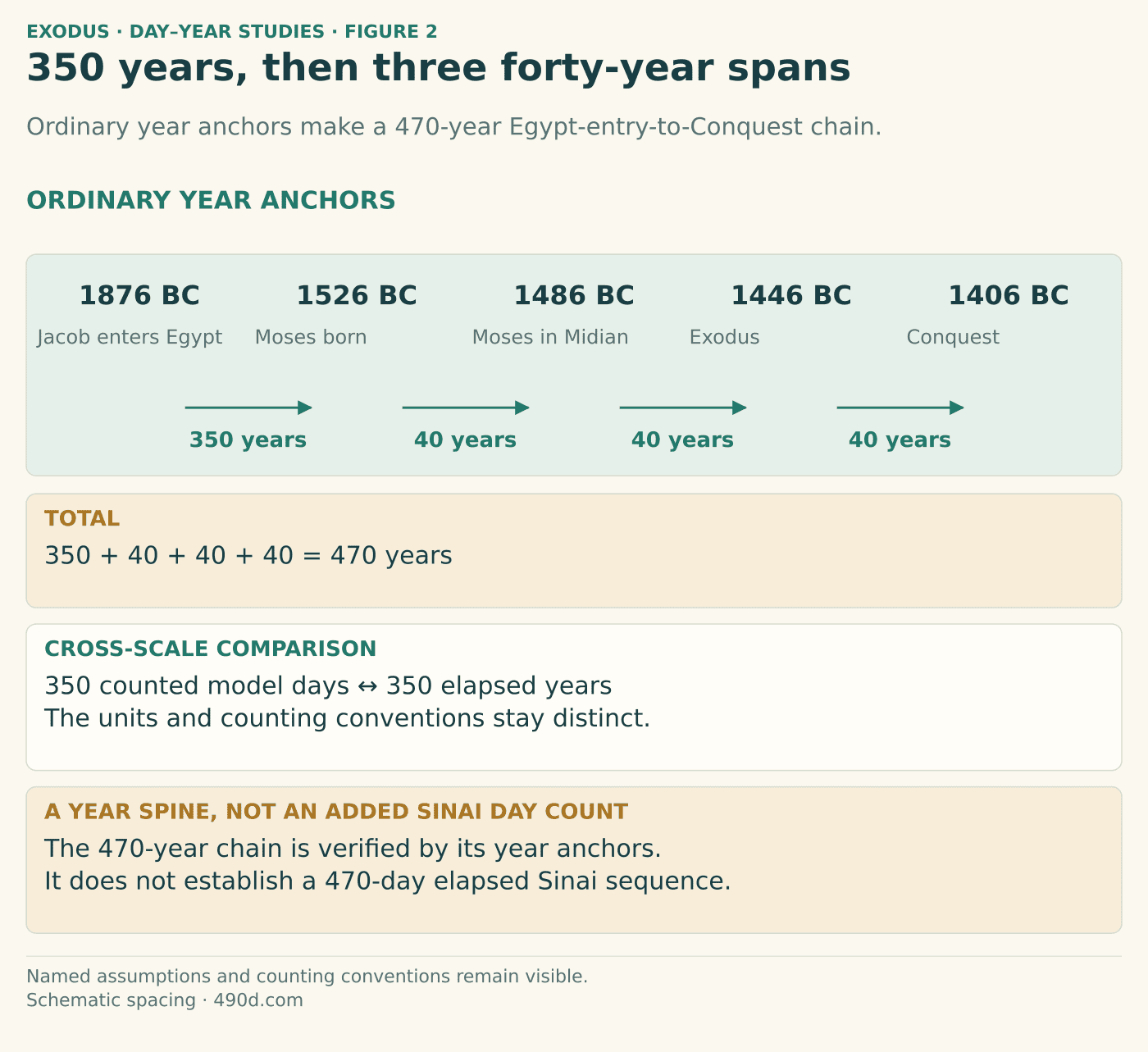
1876 → 1526 → 1486 → 1446 → 1406 BC = 350 + 40 + 40 + 40.
Accessible text and image downloads
Five ordinary BC year anchors: Egypt entry 1876; Moses born 1526; Midian 1486; Exodus 1446; Conquest 1406. Gaps 350, 40, 40 and 40 years, totaling 470. A separate comparison pairs 350 inclusively counted model days with 350 elapsed chronology years. Sinai day-periods are not added to this year chain as literal elapsed days.
Desktop PNG · Phone PNG · Desktop WebP (ZIP) · Phone WebP (ZIP) · Text-based SVG (ZIP)
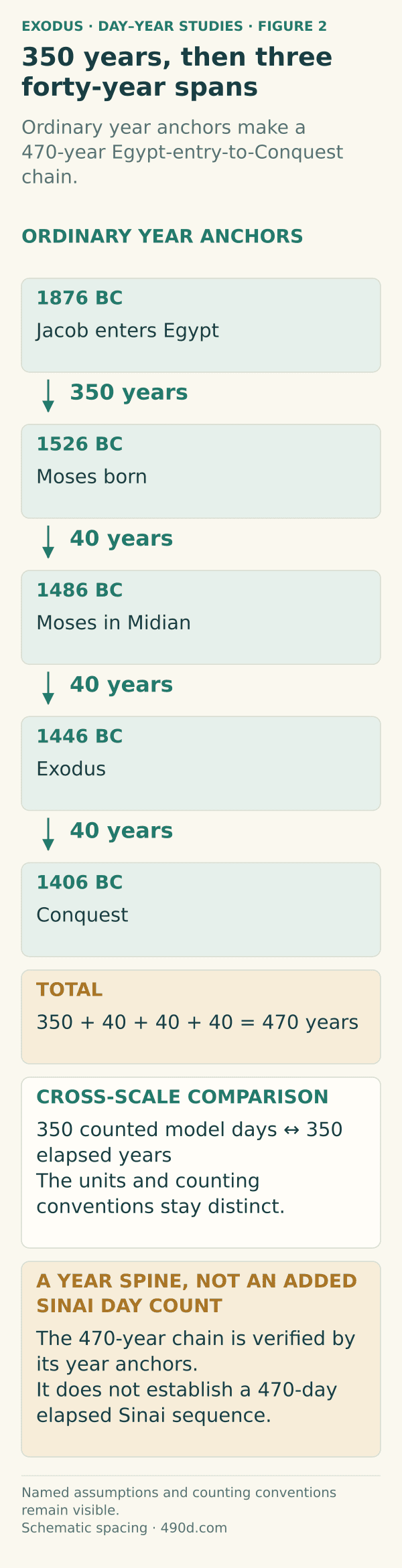
Jacob enters Egypt in the selected 1876 BC chronology. Moses is born 350 years later, leaves Egypt at forty, returns at eighty, and dies at 120 as the Conquest begins. Thus 350 + 120 = 470 years spans Jacob’s entry to Israel’s entry into the land. These assignments use the regular MT 430-year Egyptian-sojourn route; SP and LXX sojourn readings should be identified separately when introduced.
“And Jacob lived in the land of Egypt seventeen years. So the days of Jacob, the years of his life, were 147 years.”
— Genesis 47:28 (ESV, wording checked against Text Edition 2025).
Jacob’s own seventeen years in Egypt belong within this larger sojourn; they are not the 350-year starting quantity. Files 18 and 55 supply the regular chronology, with File 55 explaining the Moses node.
The supplement also forms 470 from Sinai’s selected 350 plus three forties. One version uses the two tablet forties and the spies’ forty; another uses the traditional three Sinai forties. These are component comparisons. The mountain periods occur within the Sinai stay, so adding them to 350 does not create a continuous 470-day journey. The chronological 470-year spine and the overlapping 470-component sum illuminate each other as different structures.
Covenant interrupted and renewed
The broken tablets make interruption visible. Israel’s covenant is breached, Moses intercedes, and renewed tablets follow. Daniel’s half-week and its language of an anointed one being cut off provide a further theological comparison.
“And he shall make a strong covenant with many for one week, and for half of the week he shall put an end to sacrifice and offering…”
— Daniel 9:27 (ESV, wording checked against Text Edition 2025; emphasis added).
“And after the sixty-two weeks, an anointed one shall be cut off and shall have nothing…”
— Daniel 9:26 (ESV, wording checked against Text Edition 2025; emphasis added).
The Hebrew verb commonly transliterated karat appears in the idiom of cutting a covenant and in language of being cut off. That lexical connection helps explain the source’s reading of covenant, judgment and renewal. It does not make 350 Daniel’s stated half-week duration: 350 is half the enlarged 700 framework, while the ordinary prophetic half-week is 3.5 years. The resemblance is one of structure and theological meaning.
4. From the middle of Unleavened Bread to the Tabernacle: 343
The seven dated days of Unleavened Bread are Nisan 15–21. Their fourth and central date is Nisan 18. The broader Passover preparation window, Nisan 10–21, contains twelve dated days; its center falls between the 15th and 16th. These are different windows, each with an intelligible midpoint.
“At midnight the LORD struck down all the firstborn in the land of Egypt…”
— Exodus 12:29 (ESV, wording checked against Text Edition 2025; emphasis added).
Midnight is the judgment-and-deliverance hinge within Nisan 15. In a sunset-based day it is not the transition from Nisan 14 to 15. Nisan 18 is the selected midfeast date used here; Scripture does not explicitly date the Red Sea crossing to it or say Tabernacle construction began then. The comparison is from a feast midpoint to the Tabernacle’s explicitly dated erection.
“The LORD spoke to Moses, saying, ‘On the first day of the first month you shall erect the tabernacle of the tent of meeting’… In the first month in the second year, on the first day of the month, the tabernacle was erected.”
— Exodus 40:1; Exodus 40:2; Exodus 40:17 (ESV, wording checked against Text Edition 2025; emphasis added).
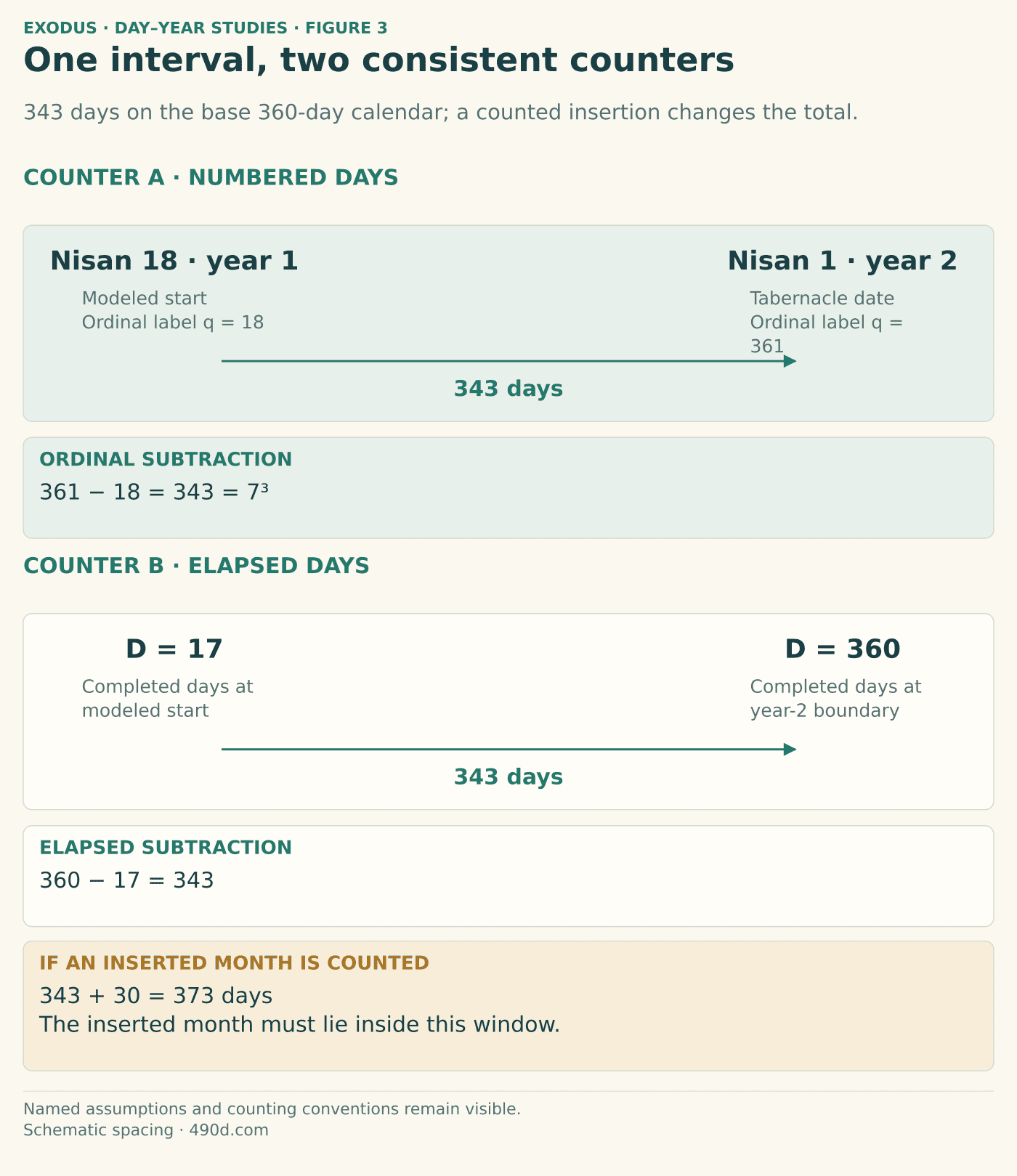
On the base calendar, the calculation is consistent in either notation:
361 − 18 = 343 numbered-day steps.
360 − 17 = 343 completed days.
343 = 7 × 7 × 7.
Accessible text and image downloads
Two rows count the same modeled interval. Ordinal labels: Nisan 18, year 1, q=18, to Nisan 1, year 2, q=361; 361 minus 18 equals 343. Elapsed coordinates: D=17 to D=360; 360 minus 17 equals 343. Both use the base 360-day register. If a 30-day insertion is counted inside the window, 343 plus 30 equals 373. Seven cubed equals 343.
Desktop PNG · Phone PNG · Desktop WebP (ZIP) · Phone WebP (ZIP) · Text-based SVG (ZIP)
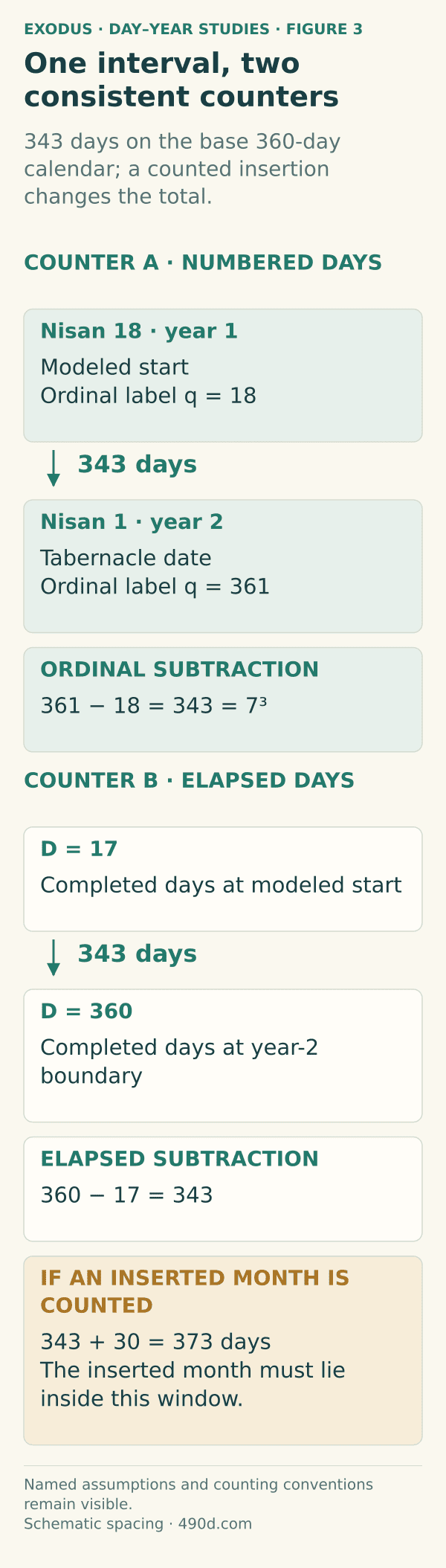
Counting both endpoint days would give 344. Adding a selected counted 30-day month within the comparison window would give 373. That alternative must identify its transferred or independently chosen intercalation register; it is not physically required by the frozen 1446 cycle. The 343 relation belongs to the base-day register.
The source also partitions its scaffold as s18 → s60 → s361 = 42 + 301 = 343. If the selected Sinai date is expressed uniformly as numbered day 61, the partition becomes 18 → 61 → 361 = 43 + 300 = 343. The outer total survives; the internal leg lengths reveal which notation is in use.
Deliverance, provision, covenant and dwelling
The narrative moves from rescue to a people among whom God dwells. Israel passes through the sea, receives food and water, arrives at Sinai, hears the covenant, and erects the Tabernacle. Exodus 16:1 dates arrival in the Wilderness of Sin to the fifteenth of the second month; this does not by itself date the first manna meal or the water episode in Exodus 17. The earlier supplement’s roughly 45- and 50-day staging should remain approximate narrative placements.
“Then the cloud covered the tent of meeting, and the glory of the LORD filled the tabernacle. And Moses was not able to enter the tent of meeting because the cloud settled on it, and the glory of the LORD filled the tabernacle.”
— Exodus 40:34; Exodus 40:35 (ESV, wording checked against Text Edition 2025; emphasis added).
The cubic number invites a spatial analogy: deliverance is fulfilled in covenantal dwelling, and 7³ expresses a complete structure in three dimensions. The arithmetic is exact under the stated endpoints. Its application to completed redemption is the study’s theological reading of the journey.
The broader comparison retains several biblical sevens: Creation’s seventh-day rest; Jacob’s seven years of service for Rachel; seven weeks of years before the Jubilee; Daniel’s seventy weeks; and Solomon’s Temple, summarized as seven years of construction. The Temple’s dated months give a 7.5-year envelope, while its dedication occurs in the seventh month, a distinct notice. The seven-lamp Tabernacle lampstand is also distinct from the Temple’s ten lampstands. These motifs support a reading of ordered sacred time; they do not all supply the same interval. Revelation 21:3 brings the theme of dwelling with God to its theological culmination. The supporting comparison table gives the individual passages.
5. Moses’ intercession and Ezekiel’s 390 + 40
Two forty-day tablet episodes frame the covenant’s breach and renewal.
“Moses entered the cloud and went up on the mountain. And Moses was on the mountain forty days and forty nights.”
— Exodus 24:18 (ESV, wording checked against Text Edition 2025; emphasis added).
“When the people saw that Moses delayed to come down from the mountain, the people gathered themselves together to Aaron… Then Moses turned and went down from the mountain with the two tablets of the testimony in his hand… And as soon as he came near the camp and saw the calf and the dancing, Moses’ anger burned hot, and he threw the tablets out of his hands and broke them at the foot of the mountain.”
— Exodus 32:1; Exodus 32:15; Exodus 32:19 (ESV, wording checked against Text Edition 2025; emphasis added).
“So he was there with the LORD forty days and forty nights. He neither ate bread nor drank water. And he wrote on the tablets the words of the covenant, the Ten Commandments.”
— Exodus 34:28 (ESV, wording checked against Text Edition 2025; emphasis added).
Moses implores God to remember His people and promises. His offer to be blotted out makes the personal cost of mediation explicit.
“But Moses implored the LORD his God and said, ‘O LORD, why does your wrath burn hot against your people, whom you have brought out of the land of Egypt with great power and with a mighty hand?… Turn from your burning anger and relent from this disaster against your people.’”
— Exodus 32:11; Exodus 32:12 (ESV, wording checked against Text Edition 2025).
“But now, if you will forgive their sin—but if not, please blot me out of your book that you have written.”
— Exodus 32:32 (ESV, wording checked against Text Edition 2025; emphasis added).
The text records Moses’ offer and God’s response; it does not report that Moses’ own life effected substitutionary atonement. Nevertheless, his intercession provides a meaningful theological bridge to Ezekiel’s enacted bearing of punishment, and, in Christian interpretation, to Christ’s mediation. The comparison concerns the burden of representing a sinful people before God.
“Then lie on your left side, and place the punishment of the house of Israel upon it. For the number of the days that you lie on it, you shall bear their punishment. For I assign to you a number of days, 390 days, equal to the number of the years of their punishment… And when you have completed these, you shall lie down a second time, but on your right side, and bear the punishment of the house of Judah. Forty days I assign you, a day for each year.”
— Ezekiel 4:4; Ezekiel 4:5; Ezekiel 4:6 (ESV, wording checked against Text Edition 2025; emphasis added).
Ezekiel’s MT sign gives 390 + 40 = 430 days, expressly assigned as years. The LXX witness must be handled separately; its Israel-side figure is not silently supplied by this MT table. Moses’ two tablet forties give 80. The movement from 80 to 430 is a thematic correspondence, not an arithmetic doubling: 80 × 2 = 160.
The longer 430-year backbone
The chronological context is stronger when the complete spine remains visible:
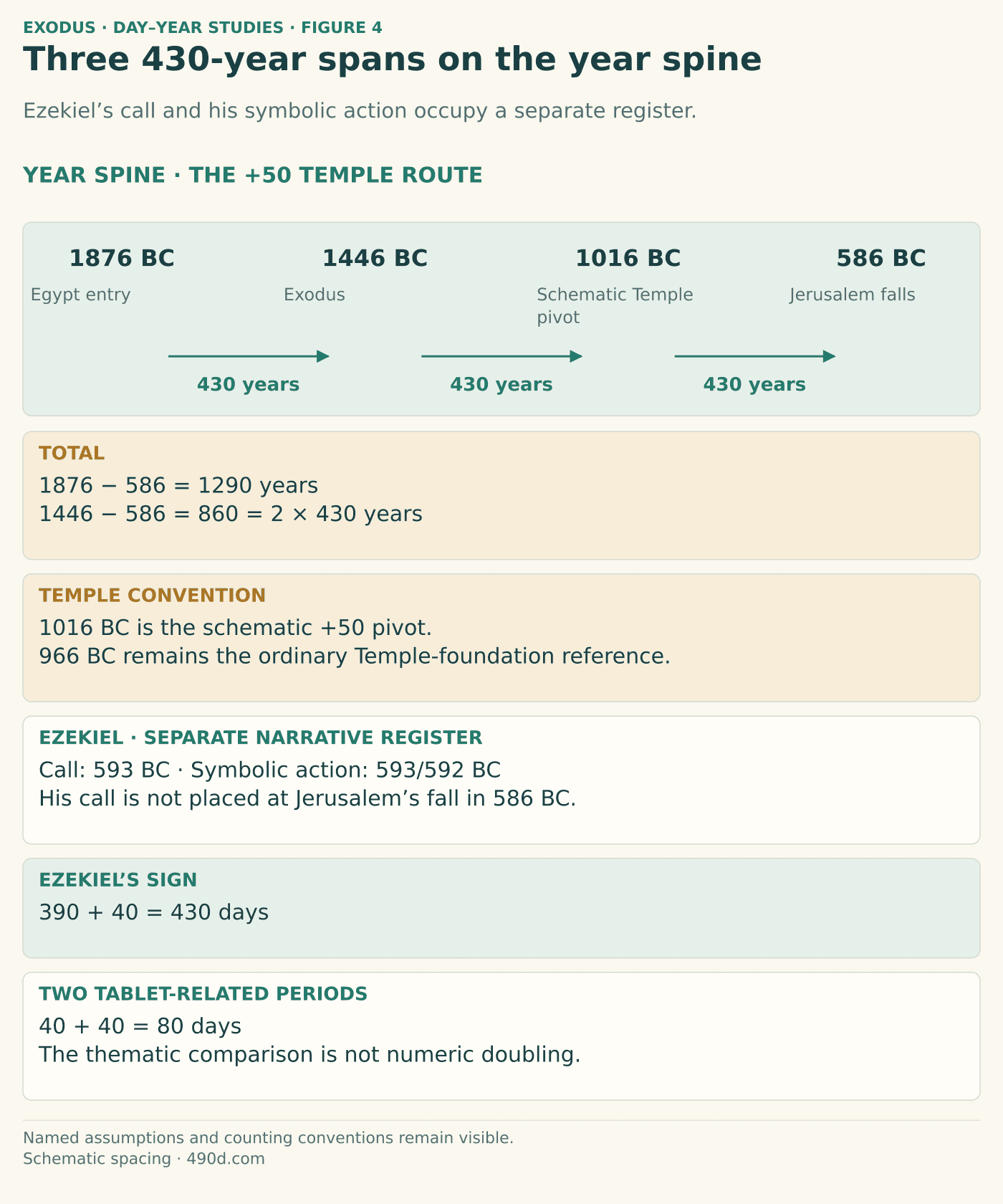
1876 → 1446 → 1016 → 586 BC = 430 + 430 + 430.
Accessible text and image downloads
A year chain runs Egypt entry 1876 BC to Exodus 1446 BC by 430, to schematic Temple 1016 BC by 430, to fall 586 BC by 430. Exodus to fall totals 860. Separate cards locate Ezekiel’s call 593 BC and symbolic action 593/592 BC; 390 plus 40 equals 430 days. Another card shows two tablet periods, 40 plus 40 equals 80 days. Neither day count is numerically doubled to obtain 860 years. Ordinary Temple 966 BC remains separate.
Desktop PNG · Phone PNG · Desktop WebP (ZIP) · Phone WebP (ZIP) · Text-based SVG (ZIP)
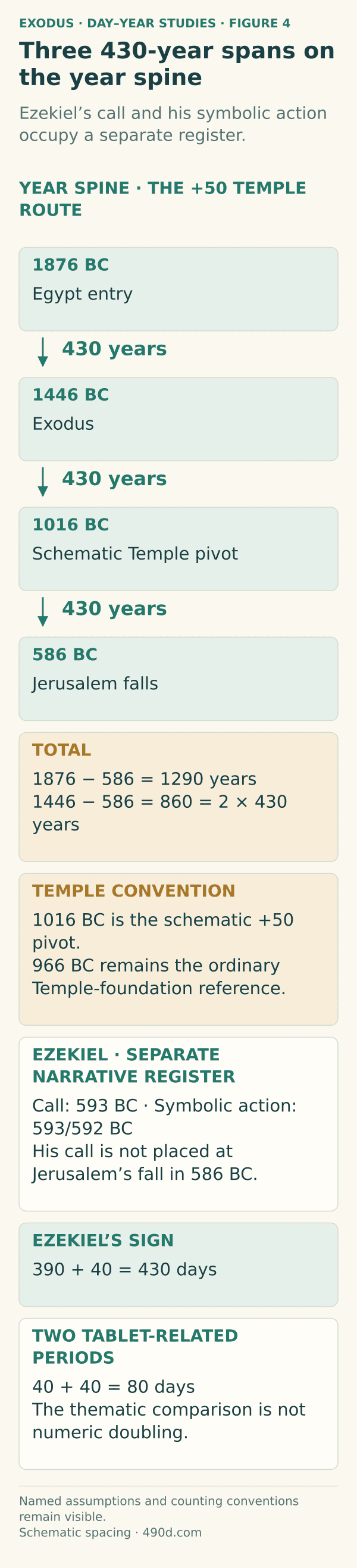
The 1016 BC coordinate is the schematic Judges–Temple pivot, associated with the +50 Kings route. The ordinary Temple-foundation coordinate is 966 BC; it must remain a separate historical register. File 64 §§3.7, 8.2 and 8.9 develops the schematic Nexus and its repeated 430 carriers. With that distinction, 1876 − 586 = 1290 = 3 × 430, and 1446 − 586 = 860 = 2 × 430.
The 586 BC endpoint is Jerusalem’s fall. Ezekiel’s call belongs to 593 BC, and the 390 + 40 sign belongs to his early ministry context, conventionally represented here as 593/592 BC. It is therefore misleading to date the sign itself to 586 and claim precisely 860 years between the enactments. The 860-year relation connects Exodus and fall; Ezekiel’s sign interprets the guilt leading toward that catastrophe. File 17 §13A supplies the Ezekiel date controls.
A short-span 390 + 40 counterpart
The source scaffold also partitions s60 → s450 → s490 = 390 + 40 = 430. Its latter forty compares the reconnaissance in Numbers 13:25. The exact calendar placement is inferred: numbered day 450 is Sivan 30 in year 2, and numbered day 490 is Av 10, rather than Tammuz. Forty elapsed steps can run between those boundaries; a forty-day inclusive expedition needs its first and last dated days specified, such as days 451–490. The boundary alternatives preserve both ways of presenting the model.
The three 430-year legs provide the larger backdrop; the selected 390 + 40 days provide a closer numerical analogue to Ezekiel. Together they express the supplement’s movement from broad chronological structure into particular narrative periods. This nesting has interpretive value even where Scripture does not expressly state the selected calendar endpoints.
6. Atonement, Jubilee and delayed inheritance
The Jubilee law joins counted years, atonement and recovered inheritance.
“You shall count seven weeks of years, seven times seven years, so that the time of the seven weeks of years shall give you forty-nine years. Then you shall sound the loud trumpet on the tenth day of the seventh month. On the Day of Atonement you shall sound the trumpet throughout all your land. And you shall consecrate the fiftieth year, and proclaim liberty throughout the land to all its inhabitants. It shall be a jubilee for you…”
— Leviticus 25:8; Leviticus 25:9; Leviticus 25:10 (ESV, wording checked against Text Edition 2025; emphasis added).
Seven weeks of years total 49, followed by the consecration of the fiftieth year. The trumpet sounds on Tishri 10, the Day of Atonement. The themes are liberty, return to property and return to clan. The separate seven-year debt-release law in Deuteronomy 15 should be cited separately rather than folded into every Jubilee provision.
The 490-date comparison
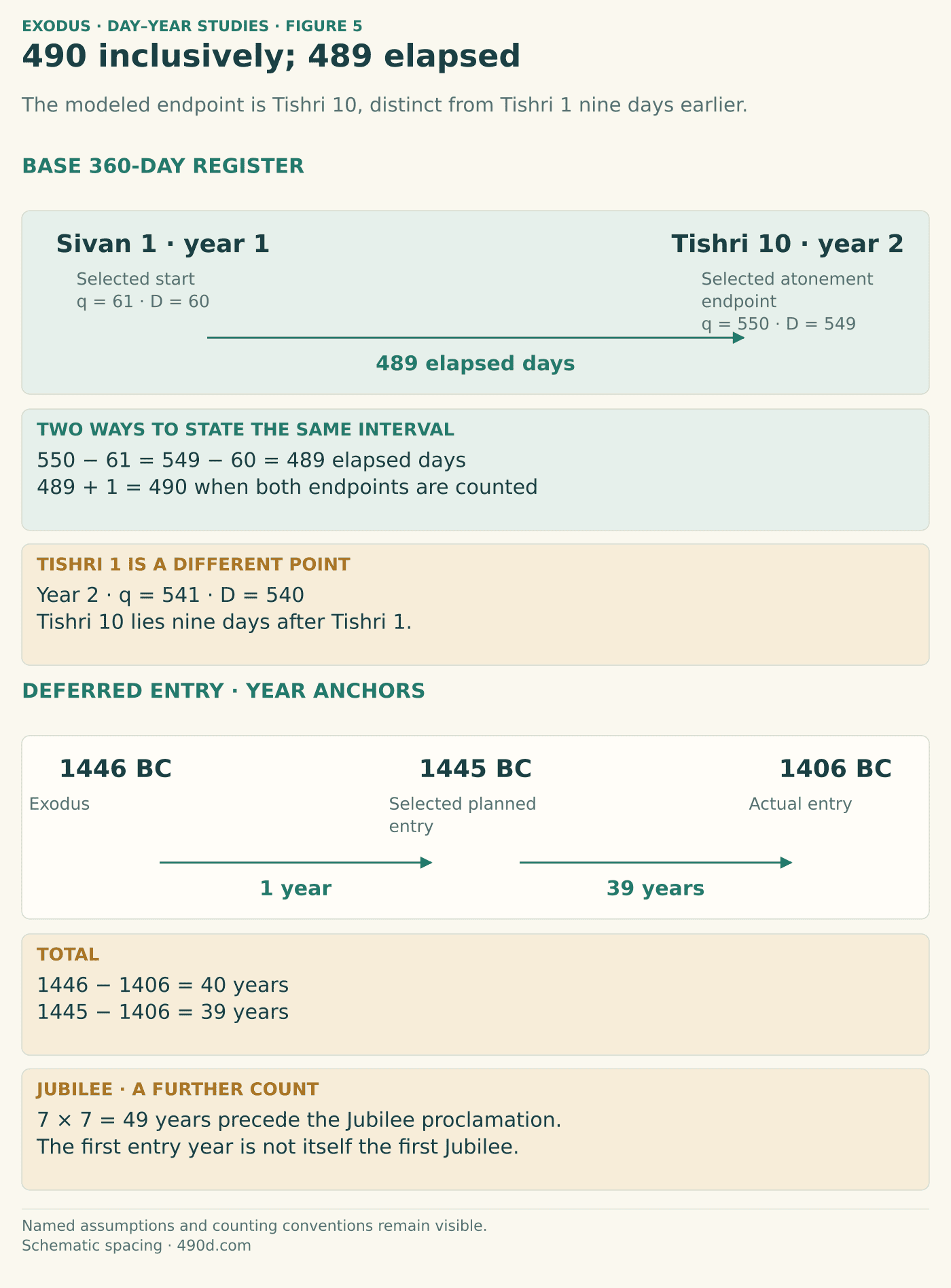
Under the selected Sivan 1 arrival, Sinai to Tishri 10 in the following year spans 489 completed days, or 490 calendar days inclusively:
549 − 60 = 489; 550 − 61 + 1 = 490.
Accessible text and image downloads
Two counters for a modeled Sivan 1, year 1, to Tishri 10, year 2, span: ordinal q=61 to q=550 gives 489 elapsed days or 490 inclusively; elapsed D=60 to D=549 also gives 489. Tishri 1, year 2, has q=541/D=540 and lies nine days before Tishri 10. Separate year anchors show Exodus 1446 BC, selected planned entry 1445 BC and actual entry 1406 BC: 1 plus 39 equals 40 years. Jubilee is counted after 49 years, not at first entry.
Desktop PNG · Phone PNG · Desktop WebP (ZIP) · Phone WebP (ZIP) · Text-based SVG (ZIP)
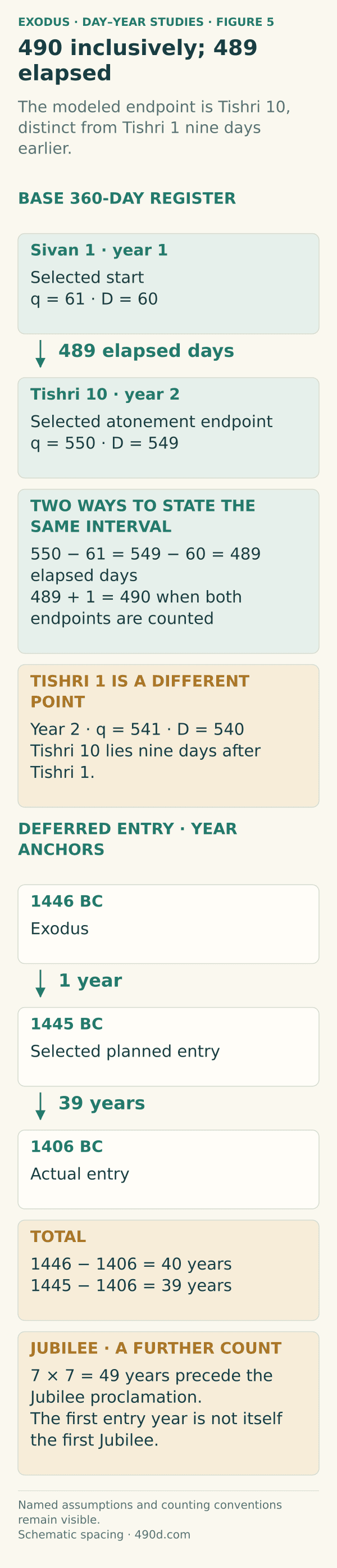
Tishri 1 has elapsed label D540, numbered day 541. Tishri 10 has D549, numbered day 550. The source’s earlier “540” atonement label conflated the month’s opening with its tenth day. Its s60 → s550 = 490 can be retained as a scaffold relation, and the inclusive dated calculation explains the intended correspondence to Daniel’s seventy weeks.
“Seventy weeks are decreed about your people and your holy city, to finish the transgression, to put an end to sin, and to atone for iniquity, to bring in everlasting righteousness, to seal both vision and prophet, and to anoint a most holy place.”
— Daniel 9:24 (ESV, wording checked against Text Edition 2025; emphasis added).
The comparison concerns the second year’s atonement date, the year of the proposed immediate land entry. The first annual Tishri 10 after Exodus falls in year 1; it already precedes that second-year date. Likewise, beginning a land-based Jubilee count on entry is distinct from proclaiming the first completed Jubilee. Leviticus 25 requires the counted 49 years. This study does not claim a biblical proclamation of a Jubilee immediately upon entering the land.
The proposed 1445 BC entry is a counterfactual reading: without the refusal to enter, the people could have moved toward inheritance in the second year. The connection with atonement and liberty is theological. The actual selected Conquest date is 1406 BC. Thus the difference from proposed 1445 entry is 39 years, within the 40-year Exodus-to-Conquest era beginning in 1446 BC.
“According to the number of the days in which you spied out the land, forty days, a year for each day, you shall bear your iniquity forty years, and you shall know my displeasure.”
— Numbers 14:34 (ESV, wording checked against Text Edition 2025; emphasis added).
Caleb provides the later measure of fulfilled inheritance.
“And now, behold, the LORD has kept me alive, just as he said, these forty-five years since the time that the LORD spoke this word to Moses, while Israel walked in the wilderness. And now, behold, I am this day eighty-five years old.”
— Joshua 14:10 (ESV, wording checked against Text Edition 2025; emphasis added).
The regular chronology places his reconnaissance at 1445 BC and his allocation at 1400 BC: 1445 − 1400 = 45 = 39 + 6. The 39 reaches entry in 1406; the following six reaches the allotment/rest-onset year. The broader land-rest interval is 1400–1399 BC. Joshua’s regular death remains 1366 BC, not an endpoint moved merely to fit this comparison.
Unbelief delays participation in the promised inheritance, while the law’s atonement-and-liberty language supplies a picture of restoration. That connection is the original supplement’s principal interpretive contribution here. The corrected counting preserves it without treating a hypothetical entry-year Jubilee as a stated event.
7. Three forties at Sinai and Moses’ 120 years
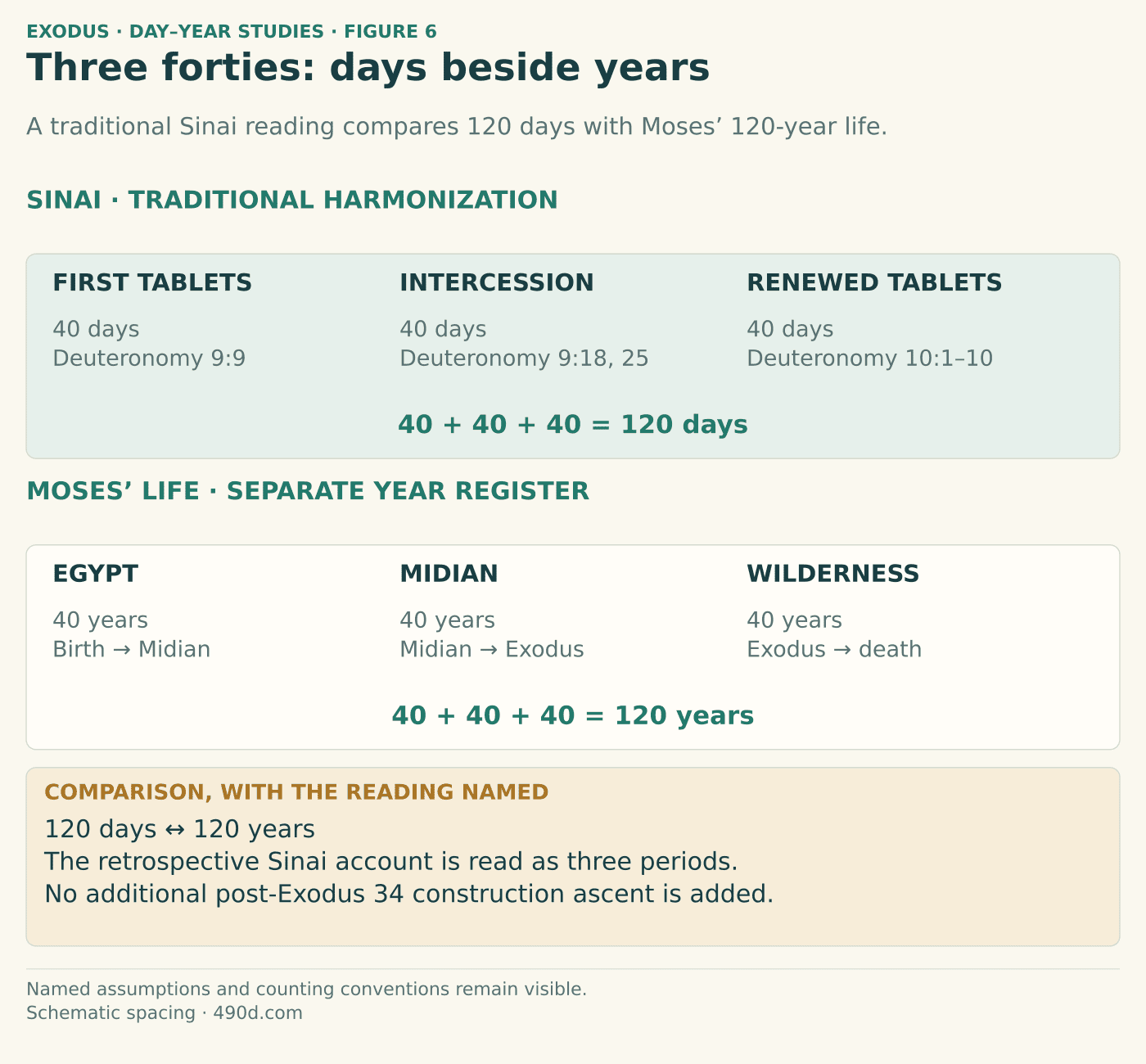
Exodus expressly names the forty-day tablet episodes. Deuteronomy 9:18, 25 and 10:10 also recount forty-day intercession and renewed mountain attendance. The traditional harmonization reads these as three successive forties: first tablets, intercession after the breach, and renewed tablets.
Accessible text and image downloads
Two separate rows each contain three forties. Traditional Sinai interpretation: first tablets 40 days, middle intercession 40 days and renewed tablets 40 days; sum 120 days. Moses’ life: Egypt 40 years, Midian 40 years and wilderness 40 years; sum 120 years. Days and years are separate units. No additional construction ascent after Exodus 34 is introduced.
Desktop PNG · Phone PNG · Desktop WebP (ZIP) · Phone WebP (ZIP) · Text-based SVG (ZIP)
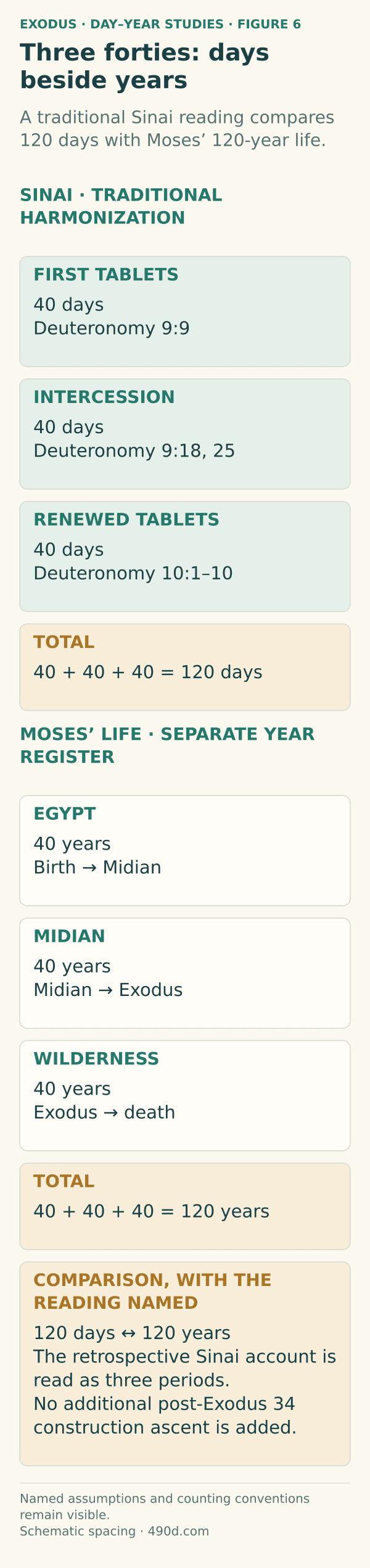
Their total is 40 + 40 + 40 = 120 days. The interpretation of whether each notice describes a distinct period must remain visible; the passages are also retrospective accounts. The standard three-period order places intercession before the final tablets. It does not require a further forty-day construction-instruction ascent after the renewed tablets. The textual and traditional evidence explains the sequence.
Moses’ life supplies the corresponding three forties in years: Egypt, 1526–1486; Midian, 1486–1446; wilderness, 1446–1406 BC. Acts 7 identifies the forty-year stage boundaries, Exodus 7:7 gives his age eighty at the confrontation with Pharaoh, and Deuteronomy gives his age at death.
“Moses was 120 years old when he died. His eye was undimmed, and his vigor unabated.”
— Deuteronomy 34:7 (ESV, wording checked against Text Edition 2025; emphasis added).
The stages invite comparison with formation, refinement and fulfillment. The first Sinai forty establishes the covenant, the middle period confronts its breach through intercession, and the final period renews the covenant. Moses’ Egyptian formation, Midian exile and wilderness service form another three-part sequence. This is a correspondence of narrative roles; the phases need not perform identical actions to share a pattern.
The number 120 has two further contexts in the original argument.
“Then the LORD said, ‘My Spirit shall not abide in man forever, for he is flesh: his days shall be 120 years.’”
— Genesis 6:3 (ESV, wording checked against Text Edition 2025; emphasis added).
Genesis 6:3 is often read as a 120-year warning before the Flood, although a lifespan interpretation also exists. The verse does not state that Noah spent 120 years building the Ark. The warning reading can be compared with Moses’ lifespan as a period leading toward judgment and a new beginning.
“In those days Peter stood up among the brothers (the company of persons was in all about 120)…”
— Acts 1:15 (ESV, wording checked against Text Edition 2025; emphasis added).
Acts 1:15 describes about 120 people in the early assembly, before Pentecost. Acts 2 then describes the Spirit’s coming. The correspondence concerns the formation of a community in which God dwells; Acts does not independently give an exact Pentecost headcount of 120 or locate every one of them in the upper room at that moment.
The original study’s 350 + 120 = 470 comparison remains relevant here. In years it is Jacob’s entry to the end of Moses’ life. In the Sinai arrangement it is the selected 350 plus an overlapping three-forty component total. The progression 430 years in Egypt → Sinai’s proposed 120 days → 40 wilderness years likewise compares different scales of preparation and transition; it is not a sum in one time unit.
8. Seasonal births and inherited symbolic projections
Aaron and Moses: three years and the half-year phase
Exodus 7:7 gives Aaron’s age eighty-three and Moses’ eighty. Their ordinary age-label difference is 3 years. With the principally Tishri Aaron and Nisan Moses phases, the reconstructed separation can be 3.5 years; the wider phase possibilities include 3 ± 0.5. File 04 §3.5, File 23 and File 62 §8 preserve this seasonal distinction. Bare BC integers must not replace the seasonal coordinates.
The numerical equivalents are 3 × 360 = 1080, 3.5 × 360 = 1260, and, with a selected added month, 1260 + 30 = 1290 days. This helps explain the supplement’s half-week comparison. It does not establish the 210-day duration of the plagues.
Aaron’s death on the first day of the fifth month is stated in Numbers 33:38. Deuteronomy 1:3 dates Moses’ address to the first day of the eleventh month; it does not date his death to that day. Consequently an exact Av 1–Shevat 1 death interval cannot be asserted from those verses. A winter death phase or a selected six-month comparison must remain a reconstruction.
One label, several possible operations
The earlier article places several projections next to each other. They become comprehensible when each declares its fixed origin and direction.
| Operation | Selected input | Output |
|---|---|---|
| Signed display: negative s becomes (1 − s) BC | −210 | 211 BC |
| Separate earlier offset from Exodus: 1446 + 210 | +210 | 1656 BC |
| Fixed-head biography overlay: 1936 − s | 410 / 450 / 490 | 1526 / 1486 / 1446 BC |
| Earlier positive offset: 1446 + 550 | +550 | 1996 BC |
| Later positive offset: 1446 − 550 | +550 | 896 BC |
The 1936 − s overlay preserves the original biography calculation, but its fixed head is 1936 BC. It is not the earlier 1446-based offset operation. File 64 identifies a restored second-Cainan death state at 1936 BC and uses 1936 → 1446 → 956 = 490 + 490 with a schematic Judges endpoint. That canonical structure supplies a meaningful context for the 1936 head; it does not turn every selected short-span coordinate into a dated narrative event.
The old Conquest comparison also preserves a local −400 → 0 window, alongside Miriam, Aaron and Moses and the generational measures 100, 70 and 40 controlled by File 15. This window is a selected 400-unit projection, distinct from forty wilderness years. Jericho’s seven-day sequence and the land’s seven-year Conquest/rest envelope invite a further day–year analogy. The inherited-projections table retains these proposals without inventing exact death days for all three siblings.
Finally, the earlier article gives 2766/2736 BC as symbolic Aaron birth coordinates and relates the broader subject to Daniel’s 1290/1335. They remain documented as legacy projection heads, not Aaron’s ordinary birth dates. Their difference is 30. Relative to 1446, their offsets are 1320 and 1290, respectively. The supplement does not supply a complete equation deriving 1335 from these heads. Daniel’s 1335 − 1290 = 45 remains an independently stated difference; a fuller proposed linkage needs its own endpoints and counting rule.
These operations are also distinct from the BC–AD Mirror. A signed display in which positive s is written AD s is a chosen coordinate display. With zero permitted, s0 renders as civil 1 BC; assigning the origin itself AD 1 instead requires a separate origin convention. Formal astronomical reflection of 1446 BC gives AD 1445 under the single-date protocol, and ordinary civil elapsed spans use BC + AD − 1. File 00 §3.9 and File 09 Appendix A control the Mirror. The calculations above do not become Mirror operations merely by crossing the BC–AD divide.
9. Reading the connected pattern
The supplement’s argument is cumulative in meaning: judgment opens a way to deliverance; deliverance leads to covenant; intercession responds to breach; renewed covenant makes dwelling possible; unbelief delays inheritance; and atonement, liberty and rest describe restoration. The numerical comparisons follow that narrative movement across several scales.
The 343 comparison contributes a complete sevenfold shape from feast midpoint to dwelling. 350 links the half-scaffold, the chosen Sinai count and the year prelude to Moses. 390 + 40 relates selected short-span components to Ezekiel’s explicit sign. The 430-year spine supplies the broad backdrop. The traditional 120 days then parallels Moses’ 120 years, while the Jubilee comparison joins sacred time to recovered inheritance.
I read these correspondences as suggestive of a providentially ordered chronology. The case is clearest when the actual calculations and their premises remain visible. Repeated values alone do not demonstrate every inferred event date or prove that each biblical writer consciously designed the whole arrangement. The theological interpretation and the arithmetic can each be assessed without losing the relationship between them.
Tables, sources and the original article
Open the full calendar tables and subsidiary comparisons, including the 700-unit ledger, 350 alternatives, 343 count, Sinai 390 + 40 model, atonement count, and projection rules.
The chronological controls are File 12, File 15, File 17, File 18, File 23, File 55 and File 64, with File 00 and File 09 governing date operators and Mirror conventions. The companion studies supply Moses, the Conquest and Solomon’s Temple. The series begins with the dated reference tables and Ezekiel chart methodology.
Historical original: Read the complete earlier Part 3b supplement. Its original wording, six tables and links are preserved unchanged. This revised detailed companion has its own address and sits beneath the introductory studies.
Download the data: Table CSVs and JSON, figure captions, and the person/event index (ZIP).
Scripture quotations marked (ESV) are from the ESV® Bible (The Holy Bible, English Standard Version®), © 2001 by Crossway, a publishing ministry of Good News Publishers. ESV Text Edition: 2025. The ESV text may not be quoted in any publication made available to the public by a Creative Commons license. The ESV may not be translated in whole or in part into any other language. Used by permission. All rights reserved.
Scripture quotations marked BSB are from the Berean Standard Bible, public domain. Translation terms.