Ezekiel’s dates belong to a larger chronological argument. His enacted siege divides 430 years into 390 and 40 days, while the histories of Egypt, the Exodus, the Temple, and exile repeat those components at the year scale. This study begins with that framework, then follows it into Ezekiel’s seven-day windows and individual dated oracles. The detailed chart is the close view of a pattern first visible across centuries.
I read this nesting as part of the prophetic meaning of the dates: the same chronological language joins Ezekiel’s signs to the Flood, Moses, Jeremiah, the Temple, and Daniel’s numbered periods. The arithmetic can be checked separately from this interpretation. Scripture supplies the dates and the explicit day–year sign; the wider synthesis brings those particulars into one chronological picture.
This methodology accompanies Part 1a: the complete charts and reference tables. The tables preserve the original study’s substantive constructions, including alternatives not yet incorporated into the canonical repository. Where a working construction conflicts with the current Canon, the disagreement is identified beside the calculation.
1. The textual starting point
On the fifth day of the month—it was the fifth year of the exile of King Jehoiachin—the word of the LORD came directly to Ezekiel the priest, the son of Buzi, in the land of the Chaldeans by the River Kebar. And there the LORD’s hand was upon him.
Ezekiel 1:1 identifies the fourth month. The call therefore gives a numbered exile year, month, and day: year 5, month 4, day 5. Ezekiel later describes his arrival among the exiles:
I came to the exiles at Tel-abib who dwelt by the River Kebar. And for seven days I sat where they sat and remained there among them, overwhelmed.
In the enacted siege sign, Ezekiel lies on his left side for 390 days and then on his right side:
When you have completed these days, lie down again, but on your right side, and bear the iniquity of the house of Judah. I have assigned to you 40 days, a day for each year.
The digit calculation is 390 + 40 = 430. Numbers supplies another explicit day–year sign:
In keeping with the forty days you spied out the land, you shall bear your guilt forty years—a year for each day—and you will experience My alienation.
These passages establish their own day–year correspondences. My extension is to test the intervals between Ezekiel’s dated events in the same numerical language. That extension should remain distinguishable from the instructions themselves. The 390-day input here belongs to the MT-based reading; the LXX’s 150-day reading is a separate textual state, not a replacement inside this calculation.
The chronological backbone: three 430-year blocks
The broad structure comes before the fine calendar coordinates:
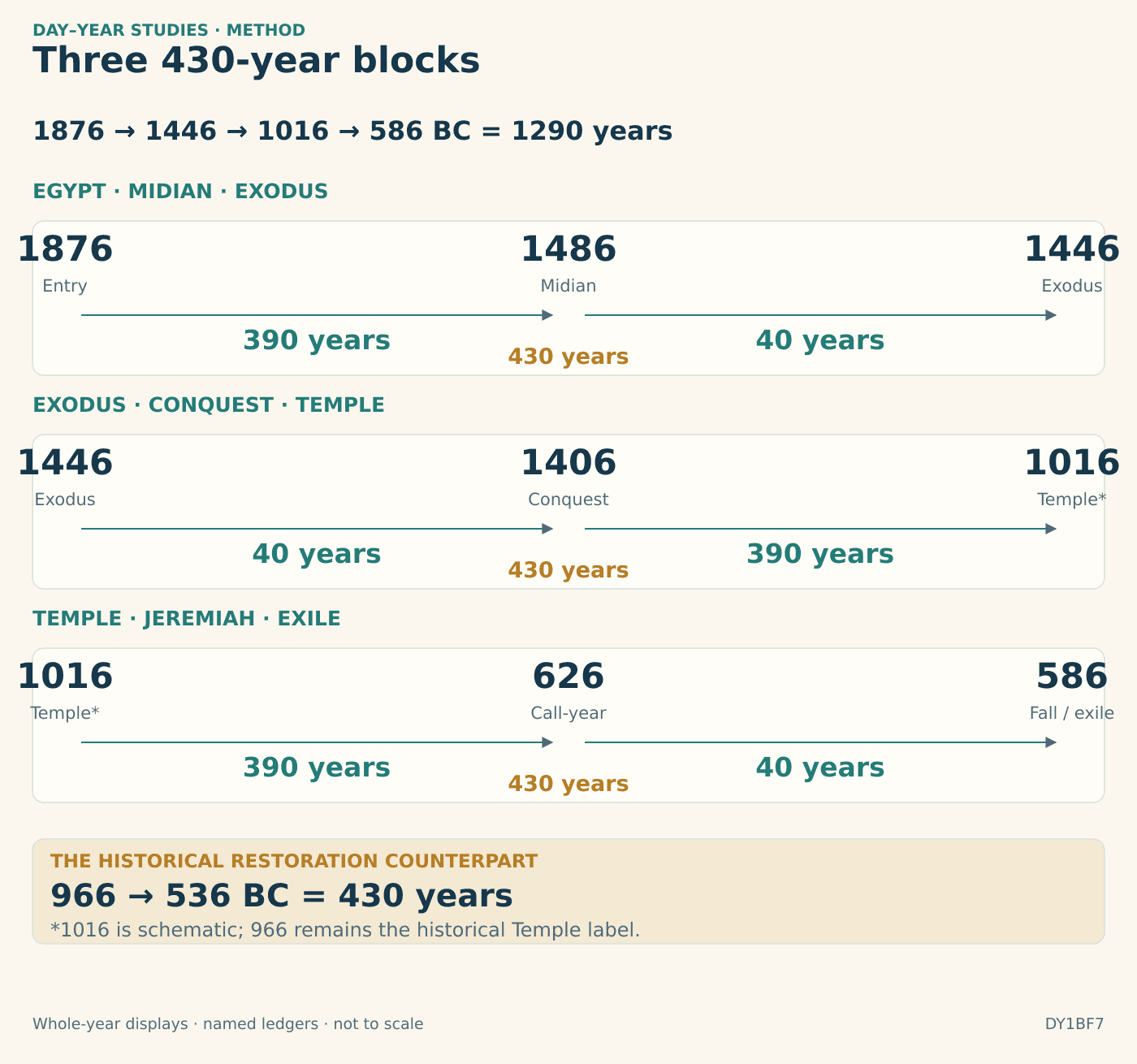
1876 → 1446 → 1016 → 586 BC = 430 + 430 + 430 = 1290 years.
The first block begins with Jacob’s entry into Egypt and ends at the Exodus. The later blocks use the schematic Kings-of-Judah Temple pivot 1016 BC, fifty years earlier than the ordinary historical foundation label 966 BC. File 08 §§1.1–1.3 and File 18 §2.5 retain both ledgers. The schematic route expresses the repeated 430; it does not move the historical Temple foundation.
Ezekiel’s 390 + 40 then supplies a finer partition within each block:
| Movement | Model coordinates BC | Partition | Narrative connection |
|---|---|---|---|
| Egypt → Midian → Exodus | 1876 → 1486 → 1446 | 390 + 40 | Moses’ departure at forty and his forty years in Midian lead to deliverance. |
| Exodus → Conquest → schematic Temple | 1446 → 1406 → 1016 | 40 + 390 | Forty wilderness years precede the Temple pivot in the schematic Kings route. |
| Schematic Temple → Jeremiah’s call → fall/exile | 1016 → 626 → 586 | 390 + 40 | Jeremiah’s ministry and the movement to Egypt and Babylon close the third block. |
The three blocks give 3 × 430 = 1290, while their inner order is 390 + 40 | 40 + 390 | 390 + 40. The Moses and Conquest dates have their ordinary chronological roles; 1016 is explicitly schematic. The 626 Jeremiah label is the call-year selection used in this comparison, consistent with the model’s forty-year ministry span; Jeremiah 1:2–3 supplies the regnal setting, rather than a printed BC year. The final 586 field includes the destruction and dispersal: Jeremiah accompanies the group that goes to Egypt (Jeremiah 43:4–7), while others are taken to Babylon. It does not assert that every departure occurred on one identical day.
Acts 7:23–30, BSB supplies the two forty-year phases behind the Midian comparison.
The ordinary Temple chronology supplies a parallel restoration witness: 966 → 536 BC = 430 years. The 536 endpoint broadly marks the return, restored worship, and beginning of reconstruction. Ezra 3:1–8 distinguishes the altar and offerings from the foundation work in the second year. The Canon also preserves the phase-qualified 967 BC, second month → 537 BC, second month = 430 foundation-to-foundation line. File 19 §§10.5–10.6 retains the 430.5-year reign-ledger calculation beside these 430 expressions. The historical, schematic, and month-qualified displays reinforce the theme without becoming one interchangeable date ledger.
The Flood counterpart: the same spans in years
From Jerusalem’s fall, 586 + 1290 = 1876 reaches the Egyptian entry hinge, while 586 + 1260 = 1846 reaches the 400-year bondage hinge. Another corresponding span reaches the SP Flood/Arphaxad field:
| Selected SP comparison | Earlier hinge → Egyptian hinge → Jerusalem hinge, BC | Legs |
|---|---|---|
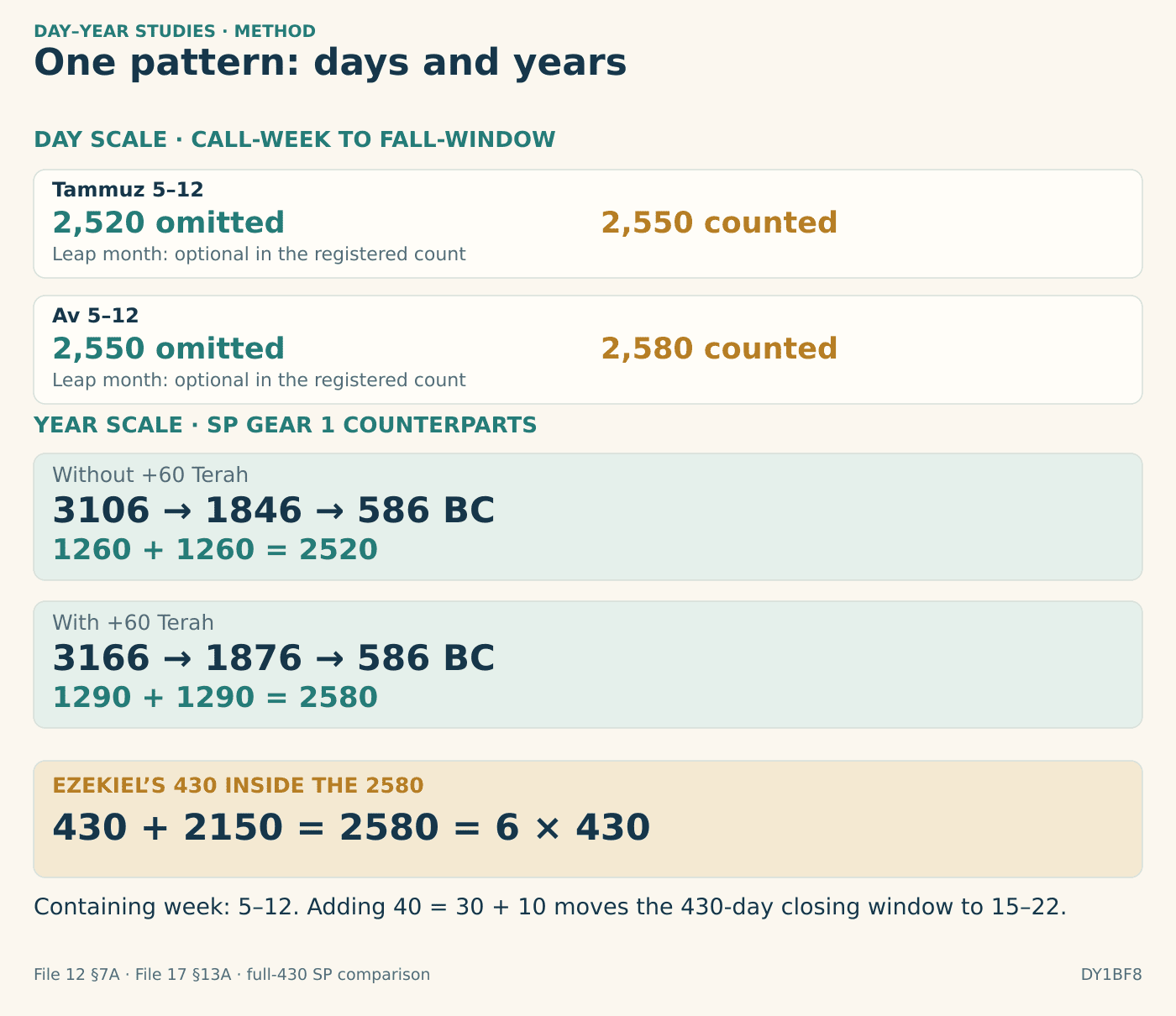
| Gear 1, no +60 Terah | 3106 → 1846 → 586 | 1260 + 1260 |
| Gear 1, +60 Terah | 3166 → 1876 → 586 | 1290 + 1290 |
| Gear 2, no +60 Terah | 3108 → 1848 → 588 | 1260 + 1260 |
| Gear 2, +60 Terah | 3168 → 1878 → 588 | 1290 + 1290 |
These comparisons use the full-430 SP frame. Gear 2 Flood start 3108 precedes fixed Arphaxad 3106 by two years; Gear 1 Flood start shares the 3106 coordinate. Flood start and Arphaxad’s birth remain distinct event classes. The explicit +60 Terah alternative carries these earlier nodes to 3168/3166. File 18 §3.1.4 controls the SP coordinates, and File 17 §13A.9 records the principal paired-year comparisons.
The two-year movement is repeated at three hinges: Flood → Arphaxad, 1878 famine → 1876 entry, and 588 siege → 586 fall. The siege pair expresses the approximate separation of its year labels; its exact month/day duration needs the separate calendar calculation. The 1848/1846 pair is the thirty-year-earlier bondage counterpart, not a replacement for the famine/entry pair.
This is how seven days can open into a larger chronological structure. The overwhelmed call-week corresponds to 593 → 586 = 7 years. At the next scale, 7 × 360 = 2520 years links 3106 → 586, while the two thirty-year components yield 2580 = 1290 + 1290, linking 3166 → 586. These are day–year and year–day counterparts, not formal BC–AD Mirror operations. All these dates remain on the BC side.
I interpret the call’s thirtieth-year opening as a signal of the +30 register, and the rainbow-like appearance after rain (Ezekiel 1:28, BSB) as a recollection of the Flood’s covenant sign. File 17 §§13A.5–13A.9 preserves these typological and structural readings. The arithmetic and the imagery support a unified reading; they do not establish how much of the complete pattern Ezekiel consciously understood.
From centuries to weeks and days
The movement is from the broad chronological spans to ordinary dated history, then into particular months, week units, and days. At each scale, a selected point can lie within a larger containing unit. The cumulative chronology has seven-year envelopes containing particular year members; Ezekiel’s chart carries seven-day windows containing the particular days of the call, siege, breach, Temple destruction, and refugee report.
This context gives the detailed tables their purpose. I understand the dated oracles as parts of a larger prophetic pattern, including the 1260, 1290, 2150, and 2300 components associated with Daniel. The repository’s mathematical controls test the coordinates and operations; this article also explains the theological synthesis for which those calculations are being examined. The resulting correspondence may exceed any one prophet’s conscious view of the whole. That is my interpretation of the chronological design, rather than a biographical claim demonstrated by the tables.
2. Numbered years and the two seasonal beginnings
The original study reads Ezekiel’s continued dating from Jehoiachin’s exile as recognition of his royal standing; its description of him as the last rightful heir is an interpretive judgment. The working chart begins with that exile and uses two year containers:
| Model | First year begins | Order of scriptural months |
|---|---|---|
| Primary Nisan model | Nisan 1, 597 BC | 1–12 |
| Alternative Tishri model | Tishri 1, 598 BC | 7–12, then 1–6 |
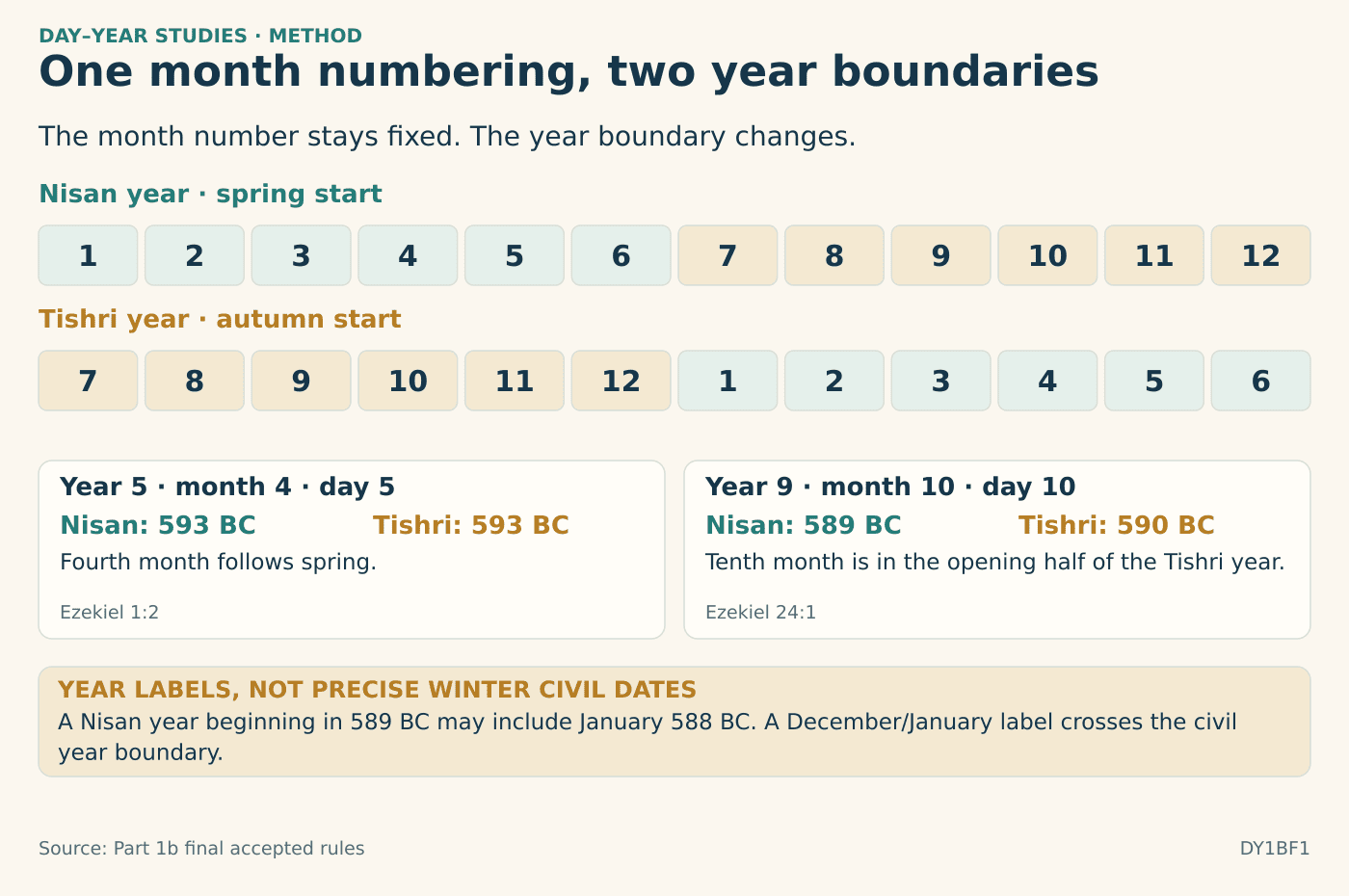
The month numbers remain spring-based in both models. Starting the year in Tishri does not turn Scripture’s seventh month into its first month. Also, the fifth numbered year begins after 4, rather than 5, complete years.
For exile year Y, the chart’s seasonal-year labels are:
| Scriptural month | Nisan-model BC label | Tishri-model BC label |
|---|---|---|
| 1–6 | 597 − (Y − 1) | 598 − Y |
| 7–12 | 597 − (Y − 1) | 598 − (Y − 1) |
For the call, 597 − 4 = 593 BC. The fifth Tishri year begins in autumn 594 and runs into autumn 593; its fourth scriptural month falls after spring, also in 593. For the siege’s ninth-year tenth month, the Nisan container is labelled 589 BC, whereas the Tishri container is labelled 590 BC.
The original discussion arrives at this rule through an intuitive six-month construction. For months 1–6, move from autumn into the following spring and then count the spring-numbered month. For months 7–12, look back to the spring preceding that autumn and count the month from there. This is useful when a formula obscures which half of the year contains the event.
A seasonal-year label does not settle the January–December civil year. Tevet lies around December/January. A Nisan year labelled 589 BC can contain January 588 BC; the Nisan year labelled 586 BC can contain January 585 BC. Consequently, a chart’s 589 label and a canonical civil 588 date need not conflict. File 17 likewise recognizes the 586/585 boundary for the report of Jerusalem’s fall.
The study uses Nisan as its primary convention, retaining Tishri as an explicit alternative. I also consider the ambiguity meaningful for the numerical study. This is an interpretive judgment; it does not prove that Ezekiel intended both reconstructions simultaneously.
3. All thirteen dated inputs
The focused siege diagram uses only some of Ezekiel’s dates. The complete input catalogue remains essential, including the months the text leaves unstated.
| Passage / reading | Exile year | Month | Day | Nisan label BC | Tishri label BC | Subject |
|---|---|---|---|---|---|---|
| Ezekiel 1:1–2 BSB / MT | 5 | 4 | 5 | 593 | 593 | Call vision |
| Ezekiel 8:1 BSB / MT | 6 | 6 | 5 | 592 | 592 | Temple vision |
| Ezekiel 20:1 BSB / MT | 7 | 5 | 10 | 591 | 591 | Elders inquire |
| Ezekiel 24:1 BSB / MT | 9 | 10 | 10 | 589 | 590 | Siege begins |
| Ezekiel 26:1 MT input; NET link | 11 | Unspecified | 1 | 587 | 588 or 587; month unspecified | Tyre oracle |
| Ezekiel 29:1 BSB / MT | 10 | 10 | 12 | 588 | 589 | Egypt oracle |
| Ezekiel 29:17 BSB / MT | 27 | 1 | 1 | 571 | 571 | Egypt oracle, later date |
| Ezekiel 30:20 BSB / MT | 11 | 1 | 7 | 587 | 587 | Egypt’s broken arm |
| Ezekiel 31:1 BSB / MT | 11 | 3 | 1 | 587 | 587 | Egypt compared to cedar |
| Ezekiel 32:1 BSB / MT | 12 | 12 | 1 | 586 | 587 | Lament for Pharaoh |
| Ezekiel 32:17 BSB / MT | 12 | Unspecified | 15 | 586 | 587 or 586; month unspecified | Egypt/Pit lament |
| Ezekiel 33:21 BSB / MT | 12 | 10 | 5 | 586 | 587 | Fugitive brings fall news |
| Ezekiel 40:1 BSB / MT | 25 | Beginning of year; Nisan/month 1 is the model interpretation | 10 | 573 | 573 under Nisan interpretation | Future Temple vision |
The year/month/day columns record the passage’s reading, rather than a later civil conversion. Three qualifications prevent false precision:
- Ezekiel 26:1: the working MT input is year 11, month unspecified, day 1. The linked NET text preserves that reading. Current BSB instead reads year 12, month 11, day 1, and notes the MT’s year 11. The BSB reading is a separate input state.
- Ezekiel 32:17: the verse supplies year 12 and day 15 but no month. Month 12 can be inferred from the preceding dated oracle, but that inference must be labelled.
- Ezekiel 40:1: “the beginning of the year” does not explicitly name month 1. The Nisan construction treats it as month 1; an autumn reading requires a distinct model. The verse also locates the vision fourteen years after the city fell; that relationship remains a separate input for the Temple comparison.
The month and chapter reference guide preserves all twelve month names, approximate modern seasons, and the original chapter-event orientation. The dates of later Jewish observances serve as modern reference aids. They are not additional dates supplied by Ezekiel.
4. What calendar is being constructed?
The historical background of the dialogue discusses a lunisolar year of approximately 354 days and seven intercalary months in nineteen years. Those observations should not be confused with the study’s 360-day year plus thirty-day intercalations. A later nineteen-year practice is not a cycle explicitly prescribed in Exodus.
Exodus 12:2 makes the Exodus month the first month. The original background also mentions April 9, 1446 BC as a reconstructed Exodus-calendar datum. That exact civil date is retained as a reported proposal, not established by Exodus 12:2 itself. It needs a declared civil calendar and reconstruction before it can carry historical precision.
The canonical control for the study’s intercalated 360-day model is File 12, §7A. Its forty-year grammar is:
6 × (6 × 360 + 30) + (4 × 360 + 30) = 14,610 days = 40 × 365.25 days.
Six six-year units followed by a four-year unit contain seven inserted thirty-day months. The thirty-six-year portion is 13,140 = 36 × 365 days; the final four-year portion is 1,470 = 3 × 490 = 30 × 49 days. These relationships describe the declared model. Its phase is fixed here by the author’s calendar anchors: 1446n BC → 6n BC = 1440 = 36 × 40, with 606n BC a cycle start because 1446 − 606 = 21 × 40 and 606 − 6 = 15 × 40. From 606n the constituent cycles close at 600n, 594n, 588n, 582n, 576n, 570n, and 566n BC, each with its thirty-day leap month. These are the cycle-close labels used in this study; no preceding-year relabeling is substituted for them.
File 12 §7A.2 separately permits the leap months to be counted or omitted from a schematic calculation. A fixed intercalation schedule therefore does not force every displayed span to include the inserted days. A seven-year span can register 1260 + 1260, 1260 + 1290, or, if it crosses two qualifying insertions that are counted, 1290 + 1290. The chosen register must be named.
The original forty-year diagram also proposes a longer adjustment: read its footer as omitting the last thirty-day insertion of the hundredth forty-year block. Under that reading, (100 × 14,610 − 30) ÷ 4,000 = 365.2425 days per year. The result equals the Gregorian mean-year length, but the proposed insertion schedule is not thereby the historical Gregorian calendar. This distinct extension remains in the full chart companion.
5. Four datums and signed day coordinates
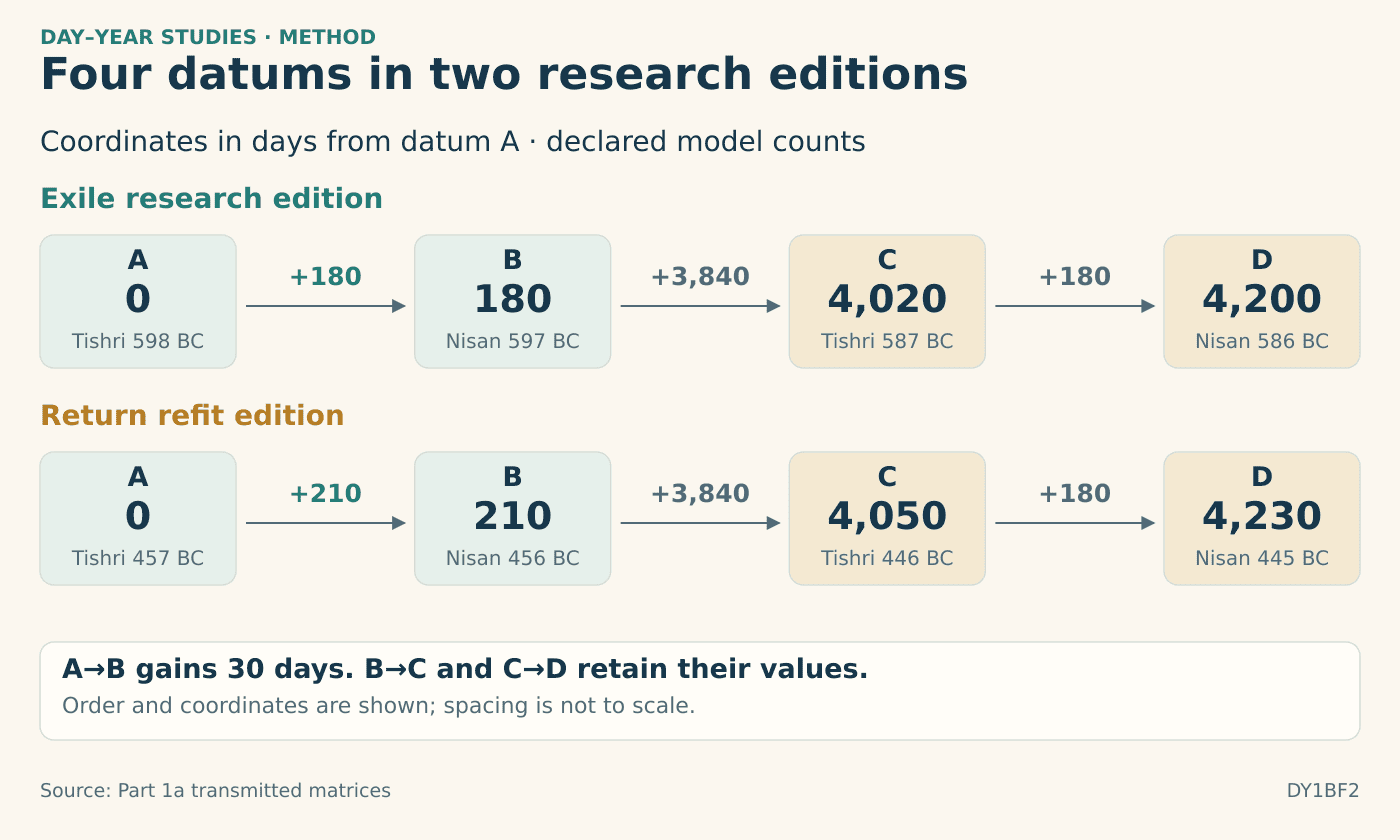
The Exile edition uses four reference points. A datum is the zero from which a count is measured.
| Datum | Source’s model label | Julian Day (JD) | Coordinate from A |
|---|---|---|---|
| A | Tishri 598 BC | 1503251.5 | 0 |
| B | Nisan 597 BC | 1503431.5 | 180 |
| C | Tishri 587 BC | 1507271.5 | 4,020 |
| D | Nisan 586 BC | 1507451.5 | 4,200 |
A Julian Day is a continuous day count. In this convention, .5 marks midnight and .75 marks 06:00. It is a timestamp system; using it does not verify an ancient event’s reconstructed calendar date.
The source’s integer cells reproduce the operation floor(event JD − datum JD). All 72 Exile cells reproduce under that rule. The operation retains the whole-day coordinate; a timestamp ending in .75 can have an exact interval containing a quarter-day. For example, the source’s city and Temple window starts lie exactly 2,550.25 and 2,580.25 days after the call, while their displayed coordinates are 2,550 and 2,580.
The original legend also distinguishes bold literal counts from starred figurative counts associated with alternative calendar readings. The asterisks are retained in the complete Exile and Return matrices. Their interpretive class cannot be recovered from the number alone: many starred cells also reproduce by JD subtraction.
6. From a day coordinate to a symbolic year
The call’s JD is 1504996.5. From datum B it lies 1,565 days forward; from datum D it lies 2,455 days backward:
1504996.5 − 1503431.5 = 1565
1504996.5 − 1507451.5 = −2455
The day–year operation reads these signed counts as astronomical year coordinates. A positive 1565 becomes AD 1565. Astronomical −2455 becomes 2456 BC, because astronomical year 0 is 1 BC. For a nonpositive astronomical year a, the BC label is 1 − a.
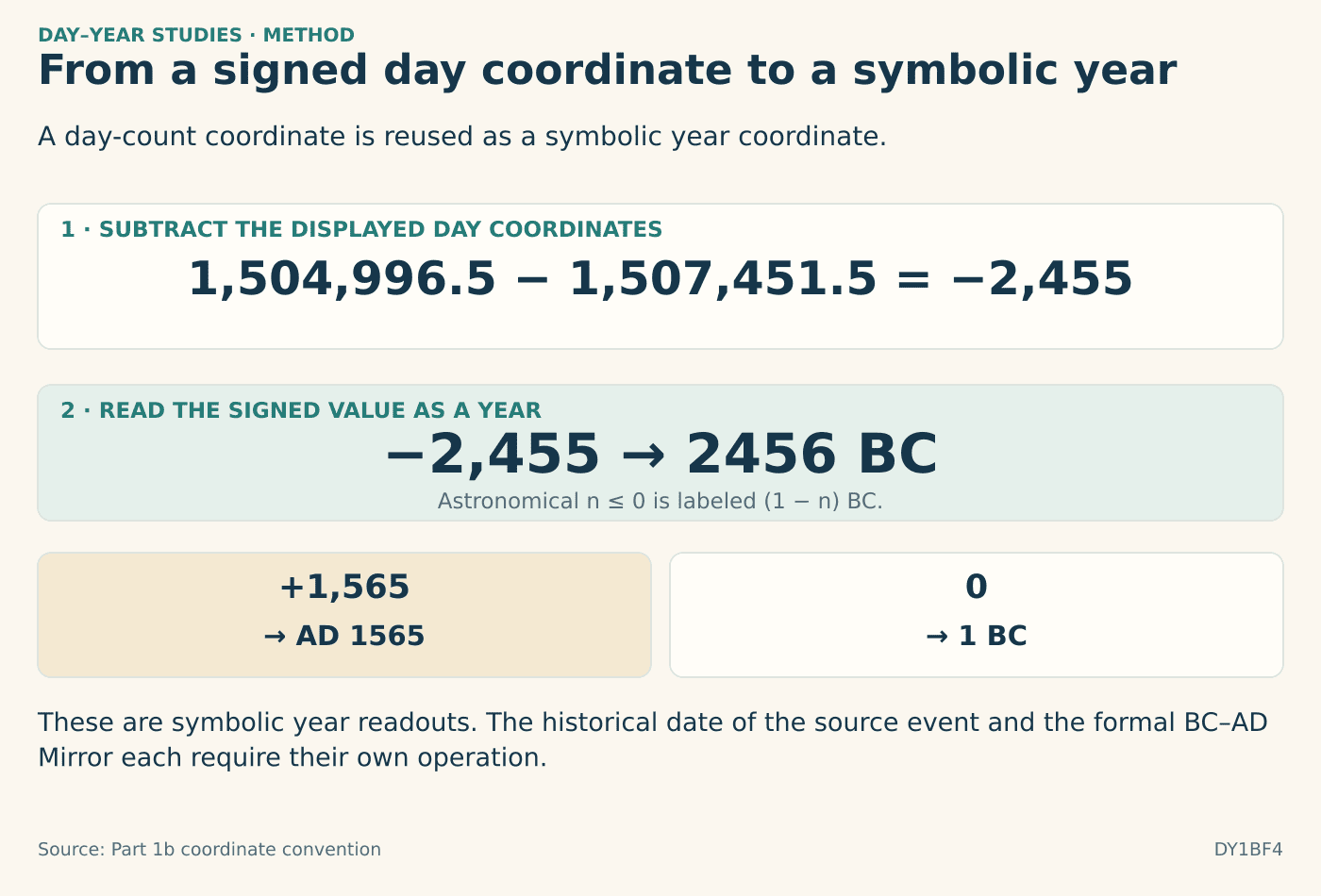
These are symbolic labels, not claims that Ezekiel’s call historically occurred in 2456 BC or AD 1565. Nor is this subtraction itself the formal BC–AD Mirror. The Mirror has its own operations in File 00 §3.9 and File 09 Appendix A, including rules for paired seasonal coordinates. A moved template, a signed offset, a civil BC/AD conversion, and a reflection must each be named when used.
The broader register’s “1 BC / AD 1” hinge and 6 BC–AD 2 window likewise require boundary labels. Astronomical 0 and +1 are successive years, not a single interchangeable year. The Exodus chart’s “Day 0+” convention—moving into Day 1—is a separate day-index convention.
7. The call, the posture, and the Temple vision
The original working sequence measures the posture counts from the call-week anchor:
| Marker | Days after the anchor | Exile JD |
|---|---|---|
| Call / carried-week start | 0 | 1504996.5 |
| End of the first 390 days | 390 | 1505386.5 |
| First Temple vision | 420 | 1505416.5 |
| End of 390 + 40 | 430 | 1505426.5 |
Thus the Temple vision falls thirty days into the last forty-day section of this particular construction. Ezekiel 8:1 dates the vision; it does not say that it occurred on the 420th day of the posture. The synchronization is part of the model.
Ezekiel’s seven overwhelmed days precede the following word of the LORD. If an exact posture start is placed after those days, its endpoints shift from a count taken at the first call anchor. The chart therefore needs to identify whether it is showing a propagated call-week boundary or an independently reconstructed vigil start. Some copied source captions keep “fifth year” after 390 days or give inconsistent day labels. The revised tables use the derived +390/+420/+430 descriptions and preserve the copied captions in the evidence export.
8. Carrying the seven-day week forward
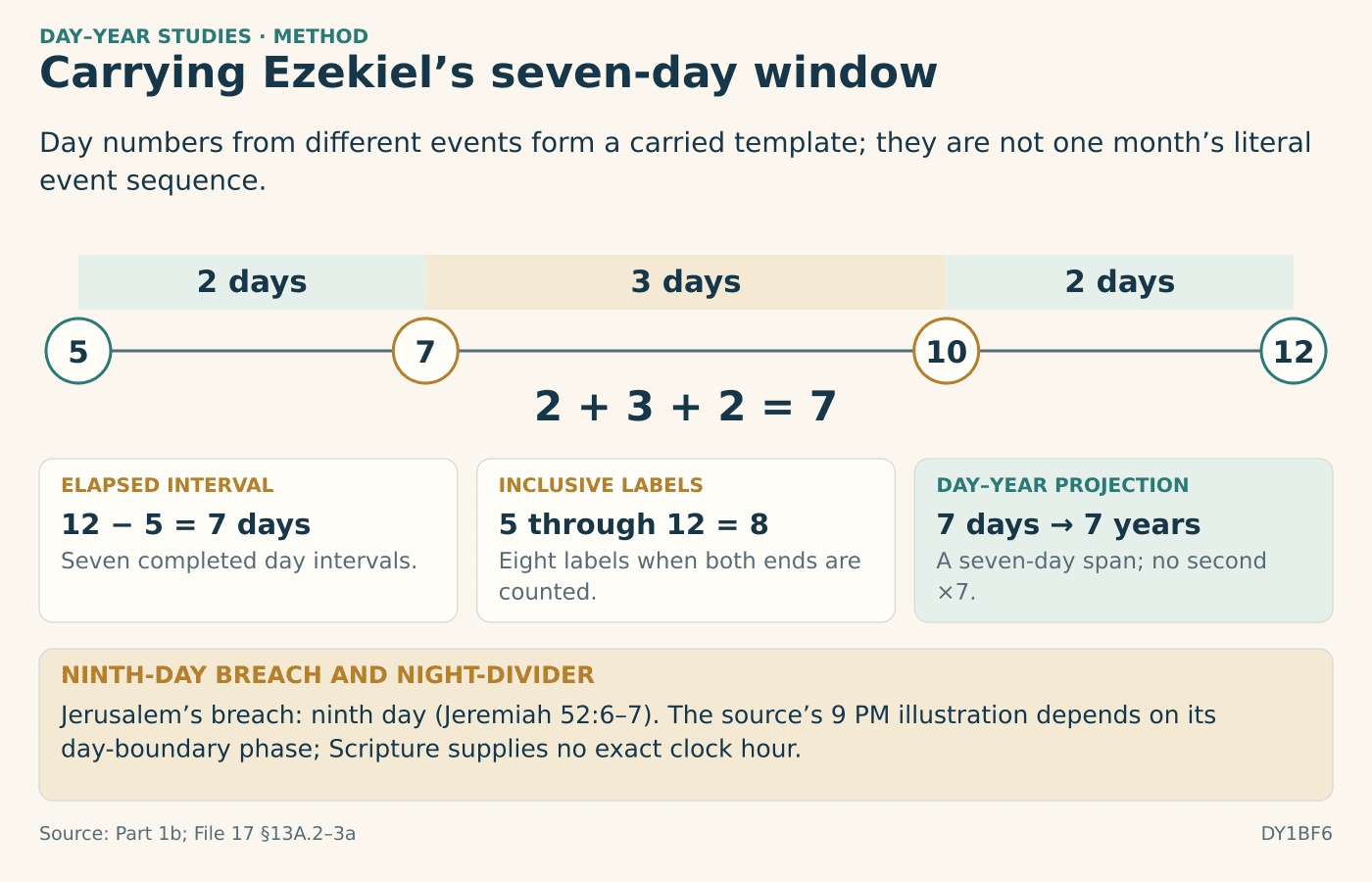
My distinctive extension carries the call’s seven-day calibration to every Ezekiel date, including dates outside the focused siege selection. A seven-day window corresponds to a seven-year window: one day for one year. The containing week and a particular day inside it are both valid units of analysis. At the broader year-of-years scale, the seven-year unit supplies 7 × 360 = 2520; that is a separately declared change of scale, not an accidental second multiplication of an individual day.
The fifth-to-twelfth-day window spans 7 elapsed days, while inclusive counting names 8 day labels. The text states seven overwhelmed days; synchronizing those days with the plotted 5→12 boundaries is the study’s construction. File 17’s structural calibration divides the window as 5 → 7 → 10 → 12, or 2 + 3 + 2 = 7. The dates contributing to this scheme belong to different months and years; the diagram compares their positions, rather than placing them in one literal historical week.
In the principal comparison, the call in 593 BC and the city’s fall in 586 BC frame seven years; the event’s position within the carried seven-day window is compared with its position in that week of years.
The Book of Jubilees offers an analogy in its weeks of years. Here the comparison is with a seven-year week, distinguished from a forty-nine-year jubilee. The dialogue also invokes a 2,540-year forward transfer, but does not supply its derivation. That inherited cross-reference remains an open development item, not an additional result proved here.
Jeremiah 52:6–7 places the city’s breach on the ninth day of the fourth month and the army’s escape at night. The original study reads that night inside the 5→12 window as a divider and relates it to Daniel 9’s middle-of-week imagery. Its illustrative 9 PM is not a recorded biblical clock time. An exact half-week placement depends on the declared morning/evening origin and half-day phase; the narrative’s night and the proposed numerical midpoint remain distinguishable. File 17 retains this night-divider comparison as structural typology.
9. Week units, counted intercalation, and the siege partition
Ezekiel 24:1 dates the siege to year 9, month 10, day 10. The working matrix plots day 5 as the beginning of the carried 5–12 week containing that actual tenth day. Both the containing week and the selected event-day coordinate are meaningful; they answer different questions. Likewise the source’s city 4/5 and Temple 5/5 rows are window starts. The city’s narrative date is 4/9; the Temple’s destruction accounts give 5/7 in 2 Kings 25:8 and 5/10 in Jeremiah 52:12.
Adding five days to the source’s siege-window marker yields this comparison:
| Allocation | Call → actual day-10 siege | Siege → report | Total |
|---|---|---|---|
| Original working coordinates | 1,625 | 1,105 | 2,730 |
| Current File 17 §13A.3a | 1,655 | 1,075 | 2,730 |

The Canon’s latter interval is 1,080 − 5 = 1,075 = 2.5 × 430; its first interval is 1,655 elapsed days, or 1,656 inclusively. The un-intercalated total is 2,700, expanded to 2,730 by the declared thirty-day insertion. The Canon’s author-ruling interpretation uses a roughly two-and-a-half-year siege and distinguishes approximately 899 days to the city’s fall and approximately 176 days for the subsequent report interval.
The two numerical partitions must be identified, but their difference does not by itself show that the original construction is erroneous. File 17 gives its stated scheme-instance; the original matrix retains the phase determined by the anchored cycle and its source datums. Counted versus omitted intercalation is a further register choice, expressly permitted by File 12. The source JDs remain unchanged, and the comparison reproduces File 17’s numbers without substituting one calculation for the other.
The call-week is Tammuz 5–12, 593 BC. Carrying it to the corresponding 586 windows gives the four-form family:
| 586 BC window | Leap month omitted | Leap month counted |
|---|---|---|
| Tammuz 5–12 | 2520 = 1260 + 1260 | 2550 = 1260 + 1290 |
| Av 5–12, containing the Temple-fall days | 2550 = 1260 + 1290 | 2580 = 1290 + 1290 |
The Av line adds the ordinary thirty-day month to the Tammuz line. Its 2580 includes one counted intercalary month plus that ordinary month; the decomposition 1290 + 1290 does not require two inserted leap months in this particular seven-year interval. The counted Temple comparison gives 2580 = 6 × 430 and 2580 − 430 = 2150 = 5 × 430. File 17 §§13A.3, 13A.4, and 13A.8 registers these compositions, including the companion 2730 = 430 + 2300.
The carried window also applies to the call, completion of its 390-day projection, and the first refugee’s arrival: each retains days 5–12 in its respective month. Since 390 = 13 × 30, that projection preserves the day-of-month position in the present construction. The extra 40 = 30 + 10 moves the window to days 15–22 for the 430-day endpoint. These are containing units; a particular narrative event or a chosen posture boundary can be located more precisely within them.
10. The Return experiment: translation and refitting
The dialogue next adds 51,510 days to eighteen Exile timestamps. The total can be expressed as:
141 × 360 + 25 × 30 = 51,510 days.
This is not exactly 141 mean Julian years: 141 × 365.25 = 51,500.25, a difference of 9.75 days. A uniform addition preserves every fractional day and every pairwise interval. The eighteen-row exact-addition table records all original timestamps and sums.
The subsequently accepted Return edition contains seventeen rows and four new datums:
| Datum | Model label | JD |
|---|---|---|
| A | Tishri 457 BC | 1554731.5 |
| B | Nisan 456 BC | 1554941.5 |
| C | Tishri 446 BC | 1558781.5 |
| D | Nisan 445 BC | 1558961.5 |
This edition is a refitted construction rather than the exact uniform list:
| Cluster | Observed shift |
|---|---|
| A and the call / +390 / +420 / +430 cluster | +51,480 days |
| B, C, D, siege and report rows | +51,510 days |
| Jehoiachin accession and city/Temple window rows | +51,509.75 days |
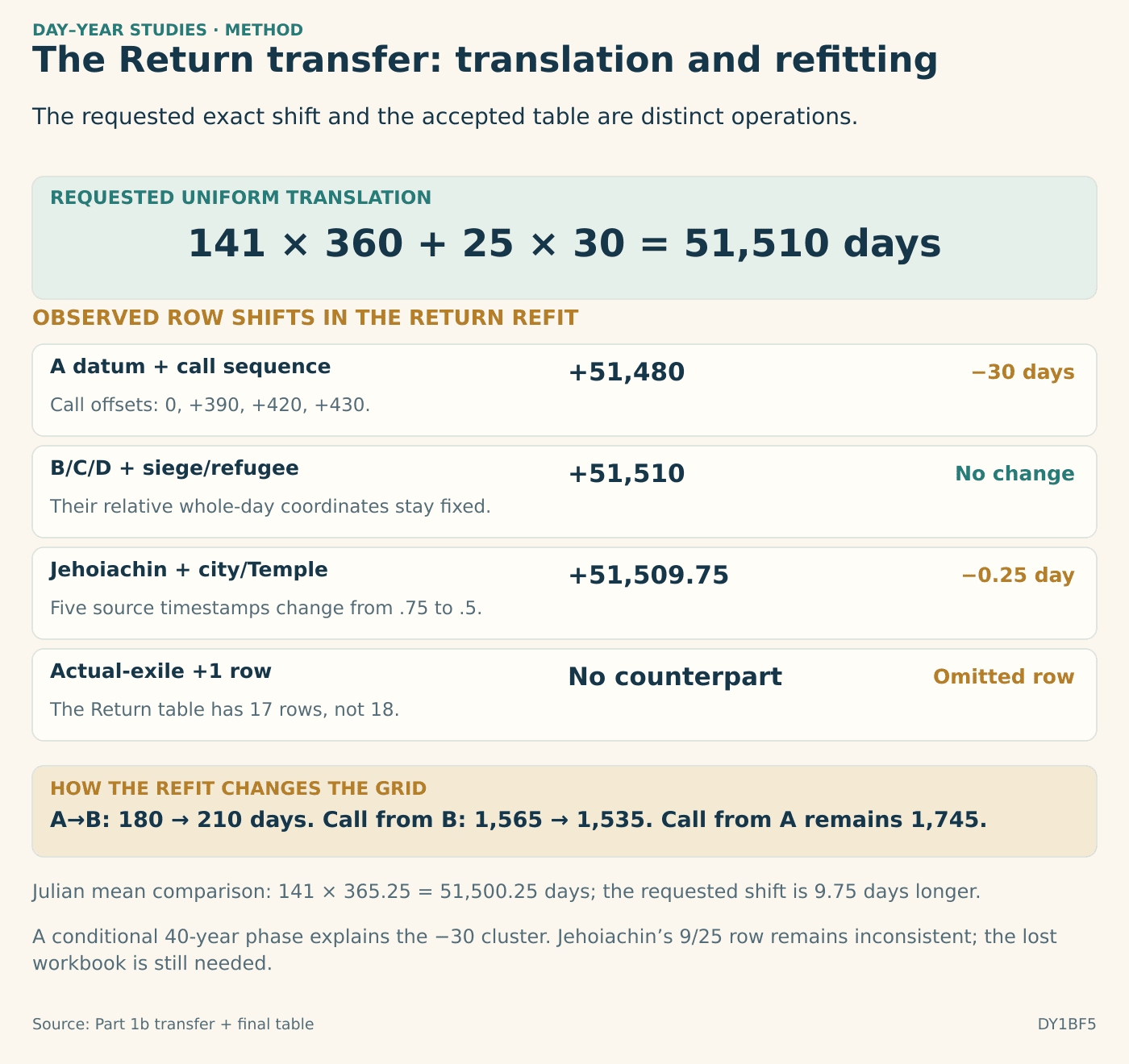
A–B consequently grows from 180 to 210 days. B–C remains 3,840; B–D remains 4,020; C–D remains 180. The call’s A coordinate stays 1,745, while its B coordinate contracts from 1,565 to 1,535. The original B+1 exile row has no Return counterpart.
Why the transferred table changes some counts by thirty
The transferred table follows a recognizable calendar pattern. Its thirty-day differences can be tested against the declared cycle.
The author has now specified the phase directly: the calendar begins at 1446n BC and again at 6n BC, thirty-six forty-year cycles later; 606n BC is therefore a cycle start. Its constituent closes are 600n, 594n, 588n, 582n, 576n, 570n, and 566n BC. Testing all forty phase positions against the source matrices recovers the same arrangement. The calendar anchor is author-declared; the numerical recovery provides a check of the printed coordinates.
| Comparison in the published model | Completed leap months | Day count |
|---|---|---|
| Nisan 597 to the call-year 593 | 1 | Call coordinate: 4 × 360 + 95 + 30 = 1565 |
| Nisan 456 to the transferred call-year 452 | 0 | Call coordinate: 4 × 360 + 95 = 1535 |
| Nisan 597 to Nisan 456 | 25 | 141 × 360 + 25 × 30 = 51510 |
| Call-year 593 to transferred call-year 452 | 24 | 141 × 360 + 24 × 30 = 51480 |
This explains why the transferred call sequence moves thirty days less than the Nisan datums. It also reproduces the change from 180 to 210 days between the autumn and spring datums: the transferred interval contains a leap month.
This checks the author-declared calendar phase under the specified month and day-boundary conventions; it does not independently establish the historical ancient calendar. It reproduces all eighteen Exile rows and sixteen of the seventeen Return rows at the whole-day level, retaining the source’s quarter-day markers separately. One exception remains: the transferred Jeconiah row’s Julian Day is thirty days later than this model gives for its copied ninth-month, twenty-fifth-day label. The original label and number remain in the archived source; that discrepancy needs the underlying workbook or an additional author-declared rule.
For readers exploring the wider framework, both Nisan datums extrapolate to the same 6 BC model zero-boundary under this uninterrupted forty-year scheme. That mathematical convergence does not establish a historical Nisan 1 date. The chart’s zero boundary is distinct from its separately numbered first day, and the old diagram’s four-thousand-year adjustment has not been applied in this extrapolation. The cycle phase now has the author’s explicit anchor; the exact proleptic Julian conversion and four-thousand-year adjustment still require their own source controls.
The published Return table has two demonstrable copied sign errors: its B and C rows should read +210 and +4,050 from A. Both JD subtraction and the final Part 1b table establish the positive signs. These corrections do not alter the underlying timestamps.
Copied civil dates require their own check. The Return city row’s JD1559056.5 converts to June 19, 445 BC in the proleptic Julian calendar, whereas the source parenthesis says June 10. The Temple row similarly converts to July 19 rather than July 10, and the Jehoiachin row to December 9, 457 BC rather than November 30. The reader tables distinguish the source model labels from computed civil timestamps. Neither is silently presented as a historically verified event.
11. The wider chronological setting
The complete regular MT reference supplies the people and events used for comparison. The normal reference includes Adam’s birth/death 4114–3184 BC, the Flood 2458–2457, Abraham 2166–1991, entry into Egypt 1876, Exodus 1446, Temple commencement 966, and Joshua’s lifespan 1476–1366 BC. The Creation envelope 4121–4114 is a declared seven-year construction. Within it, 4116 identifies the selected Year-6/formation anchor, while 4114 is the selected regular birth endpoint; they are not interchangeable starting dates.
The patriarchal calculation behind Abraham’s reference date is 430 + 130 + 60 + 100 = 720, followed by 1446 + 720 = 2166 BC. The 430-year Egypt model is the baseline. A 215-year sojourn including Canaan is an explicit alternative; native SP and LXX genealogies introduce additional differences, so they are not simply every MT date shifted by 215. The LXX’s separate 33-year adjustment must also be declared when active.
The optional +60 Terah state has a backward scope beginning at Terah; it does not shift Abraham and every later person. The comparison concerns Abraham’s departure from Haran and Terah’s death, rather than treating departure from Ur and Haran as one event. The source’s Shem 2556–1956 is an Arphaxad-bound companion state; the preferred Noah/Flood-bound regular Gear-2 row is 2558–1958. Aaron remains 123 years and Moses 120. Either can be expressed through a Nisan or Tishri phase; the relative coordinate separation is 3 ± 0.5, with the principal cumulative pairing Aaron/Tishri and Moses/Nisan giving 3.5. An integer display, a phase-qualified span, and a literal lifespan are different fields; their differences are not inherently errors.
The companion preserves the cumulative chronology, the wider Ezekiel/Daniel/Return register, the Solomon Temple datums, and the Exodus and Flood calendar comparisons. Those are separate model views with their own assumptions. Their numerical relationships can be compared without turning a schematic endpoint into an ordinary biography or an optional state into the default.
12. Development history and unresolved work
The source’s long exchange repeatedly reversed the seasonal rule and occasionally subtracted an extra year. The final authorial six-month explanation resolved that rule. The prose above consolidates those corrections; the archive preserves the complete exchange.
The 1943–1955 transfer remains an unanswered experiment in the source. It asks whether transferring the template changes the leap-month placement and therefore the day counts. Since the transcript does not provide a completed modern table, this study uses the original template and does not claim a successful modern reconstruction or prediction.
The 2,540-year cross-reference, the original civil Exodus-date proposal, and the unknown night-breach hour likewise retain their stated limits. The conditional Return reconstruction explains much of the refitting, but does not recover the original private workbook or certify every row’s calendar label. These are specific research questions, rather than reasons to discard a novel construction.
Sources and full tables
Read the complete chart companion, including its preserved working matrices, corrected signs, uniform-transfer comparison, calendar guide, and all broader source tables. The principal canonical controls are File 12, File 17 §13A, File 18, and File 09. The chapter/date inputs link directly to their Scripture editions.
The original Part 1b dialogue preserves the development, earlier wording, and original tables. The replacement retains its substantive method while distinguishing textual inputs, constructed calendars, projections, and canonical corrections.
Scripture quotations are from the Berean Standard Bible (BSB). The Holy Bible, Berean Standard Bible, BSB is produced in cooperation with Bible Hub, Discovery Bible, OpenBible.com, and the Berean Bible Translation Committee. This text of God’s Word has been dedicated to the public domain. Official BSB terms. The NET link for Ezekiel 26:1 identifies the MT-based input; no NET Scripture text or translators’ notes are reproduced in this replacement.