This is the chart companion to Constructing Ezekiel’s Day–Year Chart. It brings the original Part 1a tables into a readable, linked reference collection. The complete Exile and Return models, broader prophecy register, patriarchal chronologies, Temple comparisons, and Exodus and Flood views remain available here.
Read a table by identifying its textual input, calendar convention, datum, operation, and interpretive status. Biblical dates, constructed calendar coordinates, and symbolic projections are distinct kinds of information. A construction absent from the canonical repository remains part of this study; where a construction conflicts with a current canonical control, the specific conflict is explained.
Jump to the Exile matrix, Return matrix, exact transfer, wider register, regular or cumulative chronology, Temple, Exodus, Flood, cycle, diagram arguments, or month guide.
Begin with the chronological backbone
These tables are the close view of a larger prophetic chronology. Begin with 1876 → 1446 → 1016 → 586 BC = 430 + 430 + 430 = 1290. The three component orders are 390 + 40 | 40 + 390 | 390 + 40, passing through Moses in Midian, the Exodus and Conquest, the schematic Temple pivot, and Jeremiah’s call/exile field. The historical 966 → 536 BC = 430 restoration counterpart remains a distinct ledger.
The SP companions carry the same vocabulary in years: 3106 → 1846 → 586 = 1260 + 1260, or, with the explicit +60 Terah variant, 3166 → 1876 → 586 = 1290 + 1290. Gear-2 upper members repeat the two-year hinges through 3168 → 1878 → 588. The 606 n cycle start fixes the leap-month closes 600 n, 594 n, 588 n, 582 n, 576 n, 570 n, 566 n. Counting or omitting those insertions remains a separate, canonically admitted choice.
Read the full backbone and nested-scale explanation, the Flood counterparts, and the day/week and intercalation comparison before treating the individual oracle dates as isolated entries. The diagrams in Part 1b explain the interpretation; the complete tables here preserve the calculations and alternatives.
Reading guide to the series
The lettered part labels are retained as cross-references to the original addresses. Descriptive titles make the sequence easier to follow. The Temple-template series has its own part numbering; its “Part 5” is not the Birth of Jesus section of this day–year series.
| Original label | Subject / destination |
|---|---|
| Part 1a | Charts and reference tables |
| Part 1b | Constructing Ezekiel’s day–year chart |
| Parts 2 a–2 c | Ezekiel: chronological and symbolic comparisons |
| Part 3a | Solomon’s Temple |
| Part 3b | Exodus / Tabernacle and Conquest |
| Parts 4 a–4 c | Flood developments |
| Part 5a | Birth of Jesus and chart |
| Part 5b | Key of 23 capstone / iterative sets |
| Part 5c | Collective symbolic-date sums |
| Part 5d | Expanded sets and Mirror |
| Part 5e | Inverted timelines |
Additional original links: 2b · 2c · 4b · 4c. Mature companions: Ark · Moses · Flood · Conquest.
The Ark, Moses, Flood, and Conquest companions develop mature portions of the earlier discussions. Their existence does not establish that every original subpart has been absorbed. The Birth of Jesus material is being handled separately; this package changes none of its pages.
The working models and their controls
| View | What it preserves | How to read it |
|---|---|---|
| Exile and Return matrices | Four-datum signed counts and calendar alternatives | Historical working editions with explicit canonical comparison |
| Exact Return translation | Eighteen timestamps, each increased by 51,510 | An exact arithmetic experiment, distinct from refitting |
| Wider prophecy register | All printed Ezekiel, Daniel, decree, and Return rows | A research register with source and calculated fields separated |
| Regular chronology | All original people and event rows | Ordinary chronology, with gear, phase, and variant notes |
| Cumulative chronology | Stacked lifespans, envelopes, Cainan, and Joshua appendix | A schematic register distinct from ordinary biography |
| Temple, Exodus, and Flood views | Every original tabulated construction | Separate declared models; day windows must not replace narrative dates |
The canonical chronology collection controls the points it addresses. Files 12, 17, and 18 are central here; Files 09 and 22 control cumulative comparisons, and Files 21 and 34 control the Sumerian King List states. The original printed workbooks and illustrations remain separately preserved.
1. Ezekiel: the four-datum Exile matrix
The datums are A/Tishri 598, B/Nisan 597, C/Tishri 587, and D/Nisan 586 BC. Each integer cell reproduces floor(event JD − datum JD). All 72 source coordinate cells check. The original asterisk classification remains visible: a starred count marks the source’s figurative/alternative-calendar interpretation; a plain bold literal count belongs to its literal-count class. A double asterisk is retained as source typography, without inventing another numerical operator. The exact source styling is preserved in the archived spreadsheet.
| Event / marker | Source model label | JD | A | B | C | D | Derived proleptic Julian timestamp |
|---|---|---|---|---|---|---|---|
| A) Tishri Datum (Jecon’s exile) | 598 BC | 1503251.5 | 0 | -180 | -4020 | -4200 | 598 BC, 09/06, 00:00 |
| Jecon 3mo/3mo10d reign | 9/25 (Nov 30) 3mo/3mo10d, 598 BC | 1503336.75 | 85 | -95 | -3935 | -4115 | 598 BC, 11/30, 06:00 |
| B) Nisan Datum (Jecon’s exile) | 597 BC | 1503431.5 | 180 | 0 | -3840 | -4020 | 597 BC, 03/04, 00:00 |
| Jecon/Ezek exile: Zed 11yr reign | 1/1 (Mar 4/5, MD), 597 BC | 1503432.5 | 181 | 1 | -3839 | -4019 | 597 BC, 03/05, 00:00 |
| “7-d” Vision | 5th yr, 4th mo, 5th-(12th) d, 593 BC | 1504996.5 | 1745 | 1565 | -2275 | -2455 | 593 BC, 06/16, 00:00 |
| Call +390 days | Derived interval from call anchor | 1505386.5 | 2135 | 1955 | -1885 | -2065 | 592 BC, 07/11, 00:00 |
| Temple vision / call +420 days | 6th yr, 6th mo, 5th d, 592 BC | 1505416.5 | 2165 | 1985 | -1855 | -2035 | 592 BC, 08/10, 00:00 |
| Call +430 days | Derived interval from call anchor | 1505426.5 | 2175 | 1995 | -1845 | -2025 | 592 BC, 08/20, 00:00 |
| 2.) Siege week-start marker (actual day 10) | 9th yr, 10th mo, 5th d, 590 BC | 1506256.5 | 3005 | 2825* | -1015 | -1195* | 590 BC, 11/28, 00:00 |
| 1.) Siege week-start marker (actual day 10) | 9th yr, 10th mo, 5th d, 589 BC | 1506616.5 | 3365* | 3185 | -655* | -835 | 589 BC, 11/22, 00:00 |
| 2a.) City-fall window start | 4/5 (Jun 10), 587 BC | 1507186.75 | 3935 | 3755* | -85 | -265* | 587 BC, 06/15, 06:00 |
| 2b.) Temple-destruction window start | 5/5 (Jul 10), 587 BC | 1507216.75 | 3965 | 3785* | -55 | -235* | 587 BC, 07/15, 06:00 |
| C) Tishri Datum (Zed’s exile) | 587 BC | 1507271.5 | 4020 | 3840* | 0 | -180* | 587 BC, 09/08, 00:00 |
| 2.) 1st Refugee Post-Fall | 12th yr, 10th mo, 5th d, 587 BC | 1507366.5 | 4115 | 3935* | 95 | -85* | 587 BC, 12/12, 00:00 |
| D) Nisan Datum (Zed’s exile) | 586 BC | 1507451.5 | 4200* | 4020 | 180* | 0 | 586 BC, 03/07, 00:00 |
| 1a.) City-fall window start | 4/5 (Jun 10), 586 BC | 1507546.75 | 4295* | 4115 | 275* | 95 | 586 BC, 06/10, 06:00 |
| 1b.) Temple-destruction window start | 5/5 (Jul 10), 586 BC | 1507576.75 | 4325* | 4145 | 305* | 125 | 586 BC, 07/10, 06:00 |
| 1.) 1st Refugee Post-Fall | 12th yr, 10th mo, 5th d, 586 BC | 1507726.5 | 4475* | 4295 | 455* | 275 | 586 BC, 12/07, 00:00 |
“Call +390,” “Temple vision +420,” and “Call +430” are derived interval descriptions. The evidence export also retains the copied source captions, some of which have inconsistent year/day labels. A .75 timestamp contains a quarter-day marker, so an integer cell need not be an exact integer elapsed interval.
Narrative dates and plotted boundaries: the siege’s actual verse date is 10/10, while the matrix plots 10/5 as a carried-week start. The city’s 4/5 and Temple’s 5/5 entries are likewise window starts. Jeremiah 52:6–7 gives the city’s 4/9 breach and night escape; 2 Kings 25:8 and Jeremiah 52:12 give Temple dates 5/7 and 5/10.
| Actual day-10 siege overlay | Call → siege | Siege → fugitive report | Total |
|---|---|---|---|
| Source’s unchanged working coordinates | 1,625 | 1,105 | 2,730 |
| Current File 17 §13A.3 a allocation | 1,655 | 1,075 | 2,730 |
The thirty-day insertion is on different sides of the siege boundary. Each allocation is retained under its declared construction; the fixed cycle phase and the option to count or omit intercalation must be read separately. The original matrix is not rejected merely because a different schematic partition is also retained in Canon. A seasonal-year label such as Nisan 589 is a different issue: its winter dates can lie in civil 588 BC.
2. The accepted Return matrix
The Return model uses A/Tishri 457, B/Nisan 456, C/Tishri 446, and D/Nisan 445 BC. Its seventeen rows form a refitted model, rather than eighteen identical translations of the Exile list. Two copied signs have been repaired: B from A is +210, and C from A is +4,050. All 68 displayed coordinates then reproduce the whole-day subtraction rule.
| Event / marker | Source model label | JD | A | B | C | D | Derived proleptic Julian timestamp |
|---|---|---|---|---|---|---|---|
| A) Tishri Datum (Jecon’s exile) | 457 BC | 1554731.5 | 0 | -210 | -4050 | -4230 | 457 BC, 08/16, 00:00 |
| Jecon 3mo/3mo10d reign | 9/25 (Nov 30) 3mo/3mo10d, 457 BC | 1554846.5 | 115 | -95 | -3935 | -4115 | 457 BC, 12/09, 00:00 |
| B) Nisan Datum (Jecon’s exile) | 456 BC | 1554941.5 | 210 Source {-210}; sign corrected | 0 | -3840 | -4020 | 456 BC, 03/14, 00:00 |
| “7-d” Vision | 5th yr, 4th mo, 5th-(12th) d, 452 BC | 1556476.5 | 1745 | 1535 | -2305 | -2485 | 452 BC, 05/27, 00:00 |
| Call +390 days | Derived interval from call anchor | 1556866.5 | 2135 | 1925 | -1915 | -2095 | 451 BC, 06/21, 00:00 |
| Temple vision / call +420 days | 6th yr, 6th mo, 5th d, 451 BC | 1556896.5 | 2165 | 1955 | -1885 | -2065 | 451 BC, 07/21, 00:00 |
| Call +430 days | Derived interval from call anchor | 1556906.5 | 2175 | 1965 | -1875 | -2055 | 451 BC, 07/31, 00:00 |
| 2.) Siege week-start marker (actual day 10) | 9th yr, 10th mo, 5th d, 449 BC | 1557766.5 | 3035 | 2825* | -1015 | -1195* | 449 BC, 12/07, 00:00 |
| 1.) Siege week-start marker (actual day 10) | 9th yr, 10th mo, 5th d, 448 BC | 1558126.5 | 3395* | 3185 | -655* | -835 | 448 BC, 12/02, 00:00 |
| 2a.) City-fall window start | 4/5 (Jun 10), 446 BC | 1558696.5 | 3965 | 3755** | -85 | -265* | 446 BC, 06/25, 00:00 |
| 2b.) Temple-destruction window start | 5/5 (Jul 10), 446 BC | 1558726.5 | 3995 | 3785* | -55 | -235* | 446 BC, 07/25, 00:00 |
| C) Tishri Datum (Zed’s exile) | 446 BC | 1558781.5 | 4050 Source {-4050}; sign corrected | 3840* | 0 | -180* | 446 BC, 09/18, 00:00 |
| 2.) 1st Refugee Post-Fall | 12th yr, 10th mo, 5th d, 446 BC | 1558876.5 | 4145 | 3935* | 95 | -85* | 446 BC, 12/22, 00:00 |
| D) Nisan Datum (Zed’s exile) | 445 BC | 1558961.5 | 4230* | 4020 | 180* | 0 | 445 BC, 03/16, 00:00 |
| 1a.) City-fall window start | 4/5 (Jun 10), 445 BC | 1559056.5 | 4325* | 4115 | 275* | 95 | 445 BC, 06/19, 00:00 |
| 1b.) Temple-destruction window start | 5/5 (Jul 10), 445 BC | 1559086.5 | 4355* | 4145 | 305* | 125 | 445 BC, 07/19, 00:00 |
| 1.) 1st Refugee Post-Fall | 12th yr, 10th mo, 5th d, 445 BC | 1559236.5 | 4505* | 4295 | 455* | 275 | 445 BC, 12/16, 00:00 |
The source’s Hebrew-model labels are retained alongside independently computed proleptic-Julian timestamps. In particular, the Jehoiachin, city, and Temple rows’ copied modern month/day parentheses do not match their new JDs. A computed civil date explains a JD; it does not verify an ancient event. The methodology’s conditional cycle reconstruction accounts for the thirty-day refitting under stated assumptions and identifies the remaining Jehoiachin label mismatch.
3. The exact 51,510-day translation and the refitted comparison
The source’s first experiment adds exactly 51,510 to each of eighteen JDs. Every fraction and pairwise interval survives. Its composition is 141×360 + 25×30, rather than 141 mean-Julian years. The accepted Return table subsequently uses +51,480 for the early cluster, +51,510 for later datum/siege/report rows, and +51,509.75 for quarter-day rows normalized to midnight.
| Source row / event | Original JD | Original JD +51,510 |
|---|---|---|
| 2 · A) Tishri Datum (Jecon’s exile) | 1503251.5 | 1554761.5 |
| 3 · Jecon 3mo/3mo10d reign | 1503336.75 | 1554846.75 |
| 4 · B) Nisan Datum (Jecon’s exile) | 1503431.5 | 1554941.5 |
| 5 · Jecon/Ezek exile: Zed 11yr reign | 1503432.5 | 1554942.5 |
| 6 · “7-d” Vision | 1504996.5 | 1556506.5 |
| 7 · “7-d” Vision +390 d | 1505386.5 | 1556896.5 |
| 8 · 1st Temple vision | 1505416.5 | 1556926.5 |
| 9 · “7-d” Vision +390+40=430 d | 1505426.5 | 1556936.5 |
| 10 · 2.) Siege of Jrslm begins | 1506256.5 | 1557766.5 |
| 11 · 1.) Siege of Jrslm begins | 1506616.5 | 1558126.5 |
| 12 · 2a.) Fall of Jrslm. Bab Exile | 1507186.75 | 1558696.75 |
| 13 · 2b.) Temple destroyed | 1507216.75 | 1558726.75 |
| 14 · C) Tishri Datum (Zed’s exile) | 1507271.5 | 1558781.5 |
| 15 · 2.) 1st Refugee Post-Fall | 1507366.5 | 1558876.5 |
| 16 · D) Nisan Datum (Zed’s exile) | 1507451.5 | 1558961.5 |
| 17 · 1a.) Fall of Jrslm. Bab Exile | 1507546.75 | 1559056.75 |
| 18 · 1b.) Temple destroyed | 1507576.75 | 1559086.75 |
| 19 · 1.) 1st Refugee Post-Fall | 1507726.5 | 1559236.5 |
| Event | Exact translated JD | Accepted Return JD | Observed shift | Difference from exact shift |
|---|---|---|---|---|
| A) Tishri Datum (Jecon’s exile) | 1554761.5 | 1554731.5 | 51480.0 | -30.0 |
| Jecon 3mo/3mo10d reign | 1554846.75 | 1554846.5 | 51509.75 | -0.25 |
| B) Nisan Datum (Jecon’s exile) | 1554941.5 | 1554941.5 | 51510.0 | 0.0 |
| “7-d” Vision | 1556506.5 | 1556476.5 | 51480.0 | -30.0 |
| “7-d” Vision +390 d | 1556896.5 | 1556866.5 | 51480.0 | -30.0 |
| 1st Temple vision | 1556926.5 | 1556896.5 | 51480.0 | -30.0 |
| “7-d” Vision +390+40=430 d | 1556936.5 | 1556906.5 | 51480.0 | -30.0 |
| 2.) Siege of Jrslm begins | 1557766.5 | 1557766.5 | 51510.0 | 0.0 |
| 1.) Siege of Jrslm begins | 1558126.5 | 1558126.5 | 51510.0 | 0.0 |
| 2a.) Fall of Jrslm. Bab Exile | 1558696.75 | 1558696.5 | 51509.75 | -0.25 |
| 2b.) Temple destroyed | 1558726.75 | 1558726.5 | 51509.75 | -0.25 |
| C) Tishri Datum (Zed’s exile) | 1558781.5 | 1558781.5 | 51510.0 | 0.0 |
| 2.) 1st Refugee Post-Fall | 1558876.5 | 1558876.5 | 51510.0 | 0.0 |
| D) Nisan Datum (Zed’s exile) | 1558961.5 | 1558961.5 | 51510.0 | 0.0 |
| 1a.) Fall of Jrslm. Bab Exile | 1559056.75 | 1559056.5 | 51509.75 | -0.25 |
| 1b.) Temple destroyed | 1559086.75 | 1559086.5 | 51509.75 | -0.25 |
| 1.) 1st Refugee Post-Fall | 1559236.5 | 1559236.5 | 51510.0 | 0.0 |
Under thirty-day months, a leap month after month 12, and six six-year cycles followed by a four-year cycle, one of forty possible phases satisfies all ten tested constraints. It explains twenty-five leap months between the Nisan datums but twenty-four between the call years. This is an inverse reconstruction of the printed model, not historical proof of an ancient intercalation schedule. The model’s single Return exception and optional 4,000-year adjustment remain explicit.
4. The wider Ezekiel, Daniel, and Return register
This preserves all 29 printed register rows, including their week windows, JDs, notes, and alternate-date claims. The private workbook linked by the original page was not publicly retrievable. Its printed register is available, but the workbook’s original formulas have not been recovered.
The first comparison column applies the same datum B as the four-datum Exile matrix. A mismatch identifies a row requiring another origin, convention, or correction; it does not silently overwrite the source’s declared value. Some later rows are clearly date lists or alternate windows rather than the same JD-subtraction operation.
Broader Ezekiel, Daniel, and Return register: source reconstruction
The original private workbook is not publicly accessible. This table preserves every copied row, including proposed dates, uncertain envelopes, and unfinished corrections. Its numerical claims are not all certified.
| Scripture reference | Legacy narrative date | Event | Source day count | Source symbolic label | Source full-week/envelope | Source Julian Day | Source notes |
|---|---|---|---|---|---|---|---|
| 2Ki 23:29–35; 2Ch 36:2–4 | 609 BC 6/25 (Aug 29) | Jehoahaz 3mo reign | -4205 | 4206 BC | 4211–4204 or 4206–4199 | 1499226.75 | Josiah dies. Pharaoh exiles Jehoahaz to Egypt. |
| 2Ki 23:36; 2Ch 36:5 | 609 BC 9/25 (Nov 27) | Jehoiakim 11yr reign | -4115 | 4116 BC | 4121–4114 BC | 1499316.75 | Jehoiachin freed 17640d post exile. 49x9yr to Hanukkah 168 BC. |
| 2Ch 36:9–10; 2Kg 24:8 | 598 BC 9/25 (Nov 30) | Jehoiachin 3mo/3mo10d reign | -95 | 96 BC | 101–94 BC or 96–89 | 1503336.75 | Jehoiakim dies. Hanukkah 430yr later same day. |
| 2Ch 36:10 | 597 BC 1/1 (Mar 4/5, MD) | Exile: Zedekiah 11yr reign | 0 | 1 BC / AD 1 | 6 BC – AD 2 | 1503432.5 | Datum. Ezek. exiled. 597–581 BC: 4600 exiled. 11yr3mo total. |
| 586 BC 4/5 (Jun 10) | Fall of Jrsm. Bab Exile | 4115 | 4115 | 4115–4112 AD | 1507546.75 | 17x490d pattern twice | |
| 586 BC 5/5 (Jul 10) | Temple destroyed | 4145 | 4145 | 4135–4142 AD | 1507576.75 | Exile to Babylon | |
| Jer 41:1;42:7 | 586 BC 5/7 (Sep 8) | Exile to Egypt | 4205 | 4205 AD | 4204–4211/4215 AD | 1507636.75 | Gedaliah killed. Rest exiled to Egypt 3mo after Bab. |
| Dn 1,8,9,12; Jr 46:2 | 605 BC ~6/25 (~Sep 7) | Daniel’s captivity | -2735 | 2736 BC (or 2766) | 2757–2736 & 2787–2766 BC | 1500696.5 | Post Nabopolassar’s death. Nebuch. made king+3yr training. |
| Jer 1:2;25:3; Eze 1:1 | 626 BC 1/1 (Mar 8) | Ezek. born & Jer. called | -10585 | 10586 BC | 10591–10584–10581 BC | 1492842.75 | #1492482.5 if N1, 627 BC. |
| Jer 28 | 594 BC 5/5 (July 18) | Jer vs false prophet | 1230 | 1230/1231 AD | 1230–1260 AD (“5th m”) | 1504662.75 | Han. false 2yr return prophecy. Ezek fin. 390d siege 720d later. |
| 594 BC 7/1 (Se 16) | False prophet dies | 1290 | 1290/1291 | 1290–1320 AD (“7th m”) | 1504722.75 | Dies 2mo after Jer’s prophecy | |
| Jer 34 | 588 BC 1/15 (Ap 1) | Zed Cov. of Release | 3315 | 3315 AD | 3300–3307 & Pas.3315–3322 | 1506746.75 | Slave release. Sync to Sab. yr & festivals. |
| Jer 34 | 588 BC 7/15 (Se 28) | Zed revokes cov. | 3495 | 3495 AD | 3480–3490 & Tab.3495–3502 | 1506926.75 | Syncs w/ 5th Sab. yr of 7 cycles (Jubilee) |
| Eze 40:1 | 573 BC 1/10 (Mar 8) | Eze Temple Vision | 8770 | 8770 AD | 8765–8772 & 8770–8777 AD | 1512201.75 | 17 jub. from entering Promised Land |
| Jer 52:31; 2Ki 25:27 (source: Must still correct to 561BC!) | 560 BC 12/25 (Feb 13) | Jehoiachin freed | 13495 | 13495 AD | 13490–13497 & 13495–13502 | 1516926.75 | Last pre-Christ reigning king born |
| Jer 52:31; 2Ki 25:27 | 560 BC 13/25 (Mar 15) | Jehoiachin freed | 13525 | 13525 AD | 13520–13527 & 13525–13532 | 1516956.75 | “37th yr” Event in leap month |
| Dan 8 | 551 BC 1/1 (Mar 4) | Daniel’s 2300 rev. | 16801 | 16801 AD | 16800–16807 & 16815 AD | 1520232.5 | 46yr to 597 BC. 460yr to 1011 BC (David’s dynasty) |
| Dan 8 | 551 BC 7/15 (Sep 14) | Daniel’s 2300 rev. | 16995 | 16995 AD | 16995–17002 AD | 1520426.5 | 7d Tab + 1150d = 7d Chanukah anniv. |
| Ezra 3 | 536 BC 2/15 (Ap 28) | Temple foundation laid | 22335 | 22335 AD | 22334 ±11d | 1525766.5 | 430yr after Solomon’s same month |
| Dan 10; Ezra 3 | 536 BC 1/15 (Mar 29) | Daniel’s 21d delay | 22305 | 22305 AD | 22304 ±11d | 1525736.5 | 3wk applied 539–536 BC. PM to AM Enochic |
| Ezra 3 | 537 BC 7/15 (Aug 31) | Tabernacles observed | 22095 | 22095 AD | 22094 ±11d | 1525526.5 | Altar rebuilt 7m1d. Tabernacles kept 7m15–21d |
| 537 BC 2/15 (Apr 3) | Foundation laid (alt yr) | 21945 | 21945 AD | 21944 ±11d | 1525376.5 | Still 430yr to Solomon’s temple | |
| Ez 6;7:8,9;8:15; Neh.2:1–11;6:15 | 537 BC 1/6 (Feb 24) | Return Decree | 21186 | 21186 AD (±6d) | 21186+4m=21306 | 1525337.5 | 4mo journey implied in Ezra & Neh. |
| 538 BC 7/15 (Sep 6) | Daniel’s 70wk on Tab. | 21735 | 21735 AD | 21734 ±11d | 1525166.5 | Alt. yr for Altar rebuilt & Tabernacles | |
| Dan 9 | 538 BC 1/15 (Mar 10) | Dan’s 70wk on Pass. | 21555 | 21555 AD | 21554 ±11d | 1524986.5 | Alt. decree. Template: +/-6d |
| 539 BC 7/15 (Sep 11) | Fall of Babylon | 21375 | 21375 AD | 21374 ±11d | 1524806.5 | 7m16d on Tabernacles. Writing on Wall | |
| Ezra 5:2; Hag 1:15 | 520 BC 7/24 (Oct 10) | Zerub. temple begins | 28314 | 28314 AD | 28304 ±11d | 1531745.5 | |
| Ezra 6:15 | 515 BC 12/3 (Jan 26) | Temple finished | 29913 | 29913 AD | 29924 ±11d | 1533344.5 | 1600d total. 1200d to Pillar 29515 AD |
| 516 BC 12/3 (Jan 31) | Alt. temple finish | 29553 | 29553 AD | 29564 ±11d | 1532984.5 | 1240d to Passover |
- The table is a research register. Narrative dates stated by Scripture, proposed placements, alternative calendar readings, and symbolic outputs are distinct classes.
- The source itself says Jehoiachin’s 560 BC release date still needs correction to 561 BC. Preserve both source rows and the correction flag; changing only the date label would leave the Julian Day and symbolic outputs unreconciled.
- Several cells do not match the same Julian-datum calculation used in the four-datum chart. A separate comparison table lists the differences rather than silently replacing the author’s inputs.
- The source “Exile to Egypt 5/7 (Sep 8)” has a month-number/date mismatch against its seventh-month Gedaliah reference. Retain it as a source discrepancy requiring date-level reconciliation.
- The source 551 BC → 1011 BC “460 years” arithmetic is correct, but 1011 BC is the Rounded monarchy member in File 18, whereas ordinary David’s accession is 1010 BC. Preserve the Rounded state label.
- Ezekiel’s alleged birth year and the placements of Jeremiah’s slave-release covenant, Daniel’s festival revelations, the decree, and the Temple’s precise start-day are reconstructions; the verse references alone do not make every assigned day a transmitted date.
- The quoted fractional Julian Days are kept exactly. Whole-day differences must declare their boundary/floor convention; a .25 or .5 fraction is not disposable typographical noise.
Broader register: independent raw-datum check
For this check alone, B = Julian Day 1503431.5 and count = floor(event Julian Day − B). It verifies displayed arithmetic; it does not prove that this is the intended operator for every source row.
| Row / event | Source count | JD difference from B | Whole-day floor | Status |
|---|---|---|---|---|
| B01 Jehoahaz 3mo reign | -4205 | -4204.75 | -4205 | Matches floor |
| B02 Jehoiakim 11yr reign | -4115 | -4114.75 | -4115 | Matches floor |
| B03 Jehoiachin 3mo/3mo10d reign | -95 | -94.75 | -95 | Matches floor |
| B04 Exile: Zedekiah 11yr reign | 0 | 1.0 | 1 | Different: preserve and reconcile |
| B05 Fall of Jrsm. Bab Exile | 4115 | 4115.25 | 4115 | Matches floor |
| B06 Temple destroyed | 4145 | 4145.25 | 4145 | Matches floor |
| B07 Exile to Egypt | 4205 | 4205.25 | 4205 | Matches floor |
| B08 Daniel’s captivity | -2735 | -2735.0 | -2735 | Matches floor |
| B09 Ezek. born & Jer. called | -10585 | -10588.75 | -10589 | Different: preserve and reconcile |
| B10 Jer vs false prophet | 1230 | 1231.25 | 1231 | Different: preserve and reconcile |
| B11 False prophet dies | 1290 | 1291.25 | 1291 | Different: preserve and reconcile |
| B12 Zed Cov. of Release | 3315 | 3315.25 | 3315 | Matches floor |
| B13 Zed revokes cov. | 3495 | 3495.25 | 3495 | Matches floor |
| B14 Eze Temple Vision | 8770 | 8770.25 | 8770 | Matches floor |
| B15 Jehoiachin freed | 13495 | 13495.25 | 13495 | Matches floor |
| B16 Jehoiachin freed | 13525 | 13525.25 | 13525 | Matches floor |
| B17 Daniel’s 2300 rev. | 16801 | 16801.0 | 16801 | Matches floor |
| B18 Daniel’s 2300 rev. | 16995 | 16995.0 | 16995 | Matches floor |
| B19 Temple foundation laid | 22335 | 22335.0 | 22335 | Matches floor |
| B20 Daniel’s 21d delay | 22305 | 22305.0 | 22305 | Matches floor |
| B21 Tabernacles observed | 22095 | 22095.0 | 22095 | Matches floor |
| B22 Foundation laid (alt yr) | 21945 | 21945.0 | 21945 | Matches floor |
| B23 Return Decree | 21186 | 21906.0 | 21906 | Different: preserve and reconcile |
| B24 Daniel’s 70wk on Tab. | 21735 | 21735.0 | 21735 | Matches floor |
| B25 Dan’s 70wk on Pass. | 21555 | 21555.0 | 21555 | Matches floor |
| B26 Fall of Babylon | 21375 | 21375.0 | 21375 | Matches floor |
| B27 Zerub. temple begins | 28314 | 28314.0 | 28314 | Matches floor |
| B28 Temple finished | 29913 | 29913.0 | 29913 | Matches floor |
| B29 Alt. temple finish | 29553 | 29553.0 | 29553 | Matches floor |
The source itself says that Jehoiachin’s 560 BC release label must be corrected to 561 BC; that instruction is retained beside the legacy row. Changing the year alone would not reconstruct the affected JD and symbolic outputs. The copied 5/7 (September 8) exile-to-Egypt field conflicts with its seventh-month Gedaliah setting; its month label remains flagged. The comparison also identifies the Return-decree row’s 720-day difference without inventing its intended datum. The attested release days 25 and 27, a declared intercalary-month alternative, and the differing date states should remain distinct. The register’s day 0/“1 BC–AD 1” hinge does not equate two astronomical years:0 is 1 BC and+1 is AD 1. Copied week windows that do not match their named anchors remain identified as source fields, not endorsed new arithmetic.
5. The complete regular chronological reference
All 58 original person/event rows are retained below. The source-date column preserves the reference used in the developing study. The adjacent notes identify current canonical states and necessary qualifications. Use the current MT/LXX/SP regular tables for cross-tradition selection; this source table does not turn every entry into a default for all three traditions.
| Person / event | Source date labels | Source years | Source notes | Current control / status |
|---|---|---|---|---|
| Creation | 4121 – 4114 | 7 | Seven days of Creation as years | Envelope 4121–4114; Year-6 anchor 4116 and selected regular endpoint 4114 are distinct. |
| Adam | 4114 – 3184 | 930 | ||
| Seth | 3984 – 3072 | 912 | ||
| Enosh | 3879 – 2974 | 905 | ||
| Kenan | 3789 – 2879 | 910 | ||
| Mahalalel | 3719 – 2824 | 895 | ||
| Jared | 3654 – 2692 | 962 | ||
| Enoch | 3492 – 3127 | 365 | ||
| Methuselah | 3427 – 2458 | 969 | ||
| Lamech | 3240 – 2463 | 777 | ||
| Noah | 3058 – 2108 | 950 | See below note | |
| Shem | 2556 – 1956 | 600 | See notes for Noah & Shem in LXX table concerning “2-yrs” | Source Arphaxad-bound companion. Primary Noah/Flood-bound regular G 2:2558–1958 BC. |
| Arphaxad | 2456 – 2018 | 438 | ||
| Salah | 2421 – 1988 | 433 | ||
| Eber | 2391 – 1927 | 464 | ||
| Peleg | 2357 – 2118 | 239 | Tower of Babel (2357 BC) | |
| Reu | 2327 – 2088 | 239 | ||
| Serug | 2295 – 2065 | 230 | ||
| Nahor | 2265 – 2117 | 148 | ||
| Terah | 2236 – 2031 | 205 | ||
| Abraham | 2166 – 1991 | 175 | Call of Abram (2091 BC), Covenant of Pieces (2081 BC), Covenant of Circumcision & Destruction of Sodom (2067 BC) | Normal 2166–1991; optional+60 Terah operates backward from Terah, not on Abraham. |
| Sarah | 2156 – 2029 | 127 | ||
| Ishmael | 2080 – 1943 | 137 | ||
| Isaac | 2066 – 1886 | 180 | Wedding of Isaac (2026 BC) | |
| Jacob | 2006 – 1859 | 147 | Jacob flees Esau (1929 BC) Jacob works for wives (1929-1922-1915 BC) Jacob returns to Canaan (1909 BC) | |
| Esau | 2006 – ? | – | Esau marries (1966 BC) | |
| Levi | 1919 – 1782 | 137 | ||
| Judah | 1918 – 1789 | 129 | Death year per tradition | 129-year input is traditional, not a lifespan supplied by Genesis. |
| Joseph | 1915 – 1805 | 110 | Joseph sold as slave (1898 BC) 7 years plenty (1885-1878 BC) 7 years famine (1878-1871 BC) | |
| Benjamin | 1906 – ? | – | Birth of Benjamin (likely 1906 BC) | Birth date is reconstructed. |
| Israelites in Egypt | 1876 – 1446 | 430 | ||
| Kohath | – | 133 | ||
| Amram | – | 137 | ||
| Aaron | 1529 – 1406 | 123 | Birth (summer of 1530 exact) Death (summer of 1407) | Lifespan 123 remains fixed. Read the integer 1529–1406 display and summer 1530–1407 note with their seasonal conventions. Principal cumulative Aaron/Tishri and Moses/Nisan separation is 3.5; integer labels alone do not establish a lifespan error. Canonical summer death 1407 precedes Moses 1406. |
| Moses | 1526 – 1406 | 120 | Birth (winter of 1526 exact) Flees to Midian (1486 BC) Exodus (1446 BC) Tabernacle (1445 BC) Death (winter of 1406) | |
| Joshua, “And also וְגַם all that GENERATION died” (Judges 2:9-10) | 1476 – 1366 | 110 | “Generation” of 40-yrs implied (1406-1366) | |
| Saul’s Reign | 1050 – 1010 | 40 | ||
| David’s Reign | 1010 – 970 | 40 | ||
| Solomon’s Reign | 970 – 930 | 40 | Solomon’s Temple (966-959 BC) | |
| Fall of Samaria | 722 or 721 | – | Northern Kingdom falls | |
| Siege of Jerusalem | 701 | – | By Sennacherib | |
| First Babylonian Deportation | 605 | – | Including Daniel | |
| Second Babylonian Deportation | 597 | – | Including Ezekiel | |
| Fall of Jerusalem | 586 or 587 | – | Temple destruction | |
| Fall of Babylon | 539 | – | September | |
| Decree of Cyrus Zerub. Temple | 538 or 537 537/536 | – | Jews return from Babylon. Angelic appearances of Dan.9-12. | |
| Rebuilding of the Temple | 520 – 516 or 515 | 3.5-4.5 | ||
| Purim | 473 | – | Time of Esther | |
| Ezra’s return to Jerusalem | 458 or 457 | – | ||
| Nehemiah rebuilds Jerusalem’s walls | 445 or 444 | – | ||
| Hanukkah | 168 – 165 or 167 – 164 | 3-4 | “Abomination of desolation” | |
| Herod’s temple construction begins | 20 | – | ||
| John the Baptist & Jesus born | 6 – 4 | – | Conceptions & births | |
| Jesus’ ministry | 26 – 30 AD or 29 – 33 AD | 3.5 | Ending on Passover | |
| Fall of Jerusalem to Romans | 66 – 70 AD | 4 | ||
| Bar Kochba revolt | 132 – 135 AD | 3 | Final dispersion | |
| Israel becomes a nation again | 1948 AD | – | ||
| Jerusalem under Israel’s control | 1967 AD | – |
Key distinctions are the Creation envelope 4121–4114 versus selected anchors 4116 and 4114; the source’s Arphaxad-bound Shem 2556–1956 versus the primary Noah/Flood-bound Gear 2 Shem 2558–1958; and Aaron’s 123-year lifespan versus phase-qualified birth/death labels. Joshua’s ordinary lifespan remains 1476–1366 BC. Judah’s 129-year lifespan is a traditional input, and Benjamin’s birth entry is reconstructed, rather than an age-at-death supplied by Genesis.
The source’s combined reference markers include the 120-year warning span,2578–2458 BC, the Flood 2458–2457, Conquest 1406–1400, and thefirst Sabbath/rest 1399. The warning span ends at the Flood. This is the study’s chronological reading of Genesis 6:3, distinguished from that verse’s wording alone.
For Abraham, 430+130+60+100=720, so 1446+720=2166 BC. The optional 215-year Egypt/Canaan sojourn and+60 Terah state are explicit variants. The latter’s backward scope begins at Terah; native SP/LXX genealogies contain further differences, including separately declared LXX 33-year states. Haran and Ur departures are not one event.
6. The cumulative reference and the appended Joshua register
Cumulative chronology stacks completed lifespans end to end. A boundary shared by a father’s closing lifespan and a son’s opening lifespan is a feature of this construction, not a claim that their historical births and deaths were simultaneous.
The first table preserves all 29 original rows, their whole-year track, envelope, and lifespan fields. The comparison table separates the current main trunk from the appended Joshua state and source-field problems.
Cumulative MT register: source whole-year display
Cumulative coordinates stack lifespans end-to-end. They are schematic boundaries rather than ordinary birth dates. The source’s whole-year Aaron labels are retained here beside current phase-resolved controls.
| Person or boundary | Source Aaron/Moses display | Source envelope | Source lifespan |
|---|---|---|---|
| Adam | * 14009 – 14006 | 14011 – 14004 | 930 |
| Seth | * 13079 – 13076 | 13081 – 13074 | 912 |
| Enos | * 12167 – 12164 | 12169 – 12162 | 905 |
| Kenan | * 11262 – 11259 | 11264 – 11257 | 910 |
| Mahalaleel | * 10352 – 10349 | 10354 – 10347 | 895 |
| Jared | * 9457 – 9454 | 9459 – 9452 | 962 |
| Enoch | * 8495 – 8492 | 8497 – 8490 | 365 |
| Methuselah | * 8130 – 8127 | 8132 – 8125 | 969 |
| Lamech | * 7161 – 7158 | 7163 – 7156 | 777 |
| Noah | * 6384 – 6381 | 6386 – 6379 | 950 |
| Shem | * 5434 – 5431 | 5436 – 5429 | 600 |
| Flood to Arphaxad: “Shem, Ham & Japheth” allow ±2 | * 4834 – 4831 | 4836 – 4829 | ±2 |
| Arphaxad | * 4834-4831 | 4836-4829 | 438 |
| Shelah | * 4396 – 4393 | 4398 – 4391 | 433 |
| Eber | * 3963 – 3960 | 3965 – 3958 | 464 |
| Peleg | * 3499 – 3496 | 3501 – 3494 | 239 |
| Reu | * 3260 – 3257 | 3262 – 3255 | 239 |
| Serug | * 3021 – 3018 | 3023 – 3016 | 230 |
| Nahor | * 2791 – 2788 | 2793 – 2786 | 148 |
| Terah | * 2643 – 2640 | 2645 – 2638 | 205 |
| Abraham | * 2438 – 2435 | 2440 – 2433 | 175 |
| Isaac | * 2263 – 2260 | 2265 – 2258 | 180 |
| Jacob | * 2083 – 2080 | 2085 – 2078 | 147 |
| Levi | * 1936 – 1933 | 1938 – 1931 | 137 |
| Kohath | * 1799 – 1796 | 1801 – 1794 | 133 |
| Amram | * 1666 – 1663 | 1668 – 1661 | 137 |
| Aaron/Moses | * 1530/1526 | 1531/1524 | 123.5/120 |
| Death: Aaron/Moses | * 1407/1406 | 1411 – 1404 | (Exodus *1446) |
| Joshua begins a new line | 1296 | 1521 – 1404 | 110 |
- File 18 §6A uses a primary Moses/Nisan line and an Aaron/Tishri companion 3.5 years earlier; e.g. Adam 14006 / 14009.5 BC. Preserve the original integer display as an integer display, not as the exact phase difference.
- Aaron remains 123 and Moses 120. Read the combined “123.5/120” source cell as a phase-qualified coordinate carrier where that convention is active, rather than automatically treating it as a claim to alter Aaron’s 123-year lifespan.
- File 09 §3A.5.2 and File 22 §9A.3 preserve the MT-derived appended 110-year Joshua block 1406→1296, with death week 1301–1294. It remains outside File 18 §6A’s primary MT trunk and does not revise Joshua’s regular 1476–1366 biography. File 18 §6C independently uses 1296 as its SP cumulative target. The source 1521–1404 range is unexplained and must not be silently changed into the canonical 1411–1404 birth-boundary week.
- The source ±2 explanation belongs to the cumulative envelope mechanism. It is not the SP-local Noah/Shem primary-minus-one station rule.
- The source 120-year Flood warning is retained as an interpretive chronology construction. The Genesis 6:3 “120 years” reading and a precisely dated warning period are different claims.
Cumulative MT: current phase-resolved companion
This companion gives the current authoritative phase-resolved values. It accompanies the preserved source table; it does not silently change the original record.
| Person or boundary | Lifespan | Moses / Nisan | Aaron / Tishri | Seven-year envelope |
|---|---|---|---|---|
| Apparent Birth | — | 14036 BC | 14039.5 BC | 14041–14034 BC |
| Adam, Year 6 | 930 | 14006 BC | 14009.5 BC | 14011–14004 BC |
| Seth | 912 | 13076 BC | 13079.5 BC | 13081–13074 BC |
| Enosh | 905 | 12164 BC | 12167.5 BC | 12169–12162 BC |
| Kenan | 910 | 11259 BC | 11262.5 BC | 11264–11257 BC |
| Mahalalel | 895 | 10349 BC | 10352.5 BC | 10354–10347 BC |
| Jared | 962 | 9454 BC | 9457.5 BC | 9459–9452 BC |
| Enoch | 365 | 8492 BC | 8495.5 BC | 8497–8490 BC |
| Methuselah | 969 | 8127 BC | 8130.5 BC | 8132–8125 BC |
| Lamech | 777 | 7158 BC | 7161.5 BC | 7163–7156 BC |
| Noah | 950 | 6381 BC | 6384.5 BC | 6386–6379 BC |
| Shem | 600 | 5431 BC | 5434.5 BC | 5436–5429 BC |
| Ark Warning | 120 | 4951 BC | 4954.5 BC | 4956–4949 BC |
| The Flood | — | 4831 BC | 4834.5 BC | 4836–4829 BC |
| Arphaxad | 438 | 4831 BC | 4834.5 BC | 4836–4829 BC |
| Shelah | 433 | 4393 BC | 4396.5 BC | 4398–4391 BC |
| Eber | 464 | 3960 BC | 3963.5 BC | 3965–3958 BC |
| Peleg | 239 | 3496 BC | 3499.5 BC | 3501–3494 BC |
| Reu | 239 | 3257 BC | 3260.5 BC | 3262–3255 BC |
| Serug | 230 | 3018 BC | 3021.5 BC | 3023–3016 BC |
| Nahor | 148 | 2788 BC | 2791.5 BC | 2793–2786 BC |
| Terah | 205 | 2640 BC | 2643.5 BC | 2645–2638 BC |
| Abraham | 175 | 2435 BC | 2438.5 BC | 2440–2433 BC |
| Isaac | 180 | 2260 BC | 2263.5 BC | 2265–2258 BC |
| Jacob | 147 | 2080 BC | 2083.5 BC | 2085–2078 BC |
| Levi | 137 | 1933 BC | 1936.5 BC | 1938–1931 BC |
| Kohath | 133 | 1796 BC | 1799.5 BC | 1801–1794 BC |
| Amram | 137 | 1663 BC | 1666.5 BC | 1668–1661 BC |
| Moses | 120 | 1526 BC | 1529.5 BC | 1531–1524 BC |
| Conquest | — | 1406 BC | 1406 BC | — |
- The Aaron/Tishri track differs by 3.5 years; Aaron’s lifespan remains 123. The Apparent-Age+30 overlay is a named comparison state.
- The restored-Cainan+460 shifts Adam through Arphaxad; the inserted Cainan life is 4853–4393 BC on the Moses line, with birth envelope 4858–4851 BC. Shelah 4393 BC and later rows remain unchanged.
- Cumulative Joshua 1406→1296 is a separate appended 110-year block. Regular Joshua 1476→1366 does not change.
The MT cumulative main trunk closes at Moses 1406 BC. A distinct canonized downstream register lays Joshua’s 110 years after that boundary: 1406−110=1296 BC, death-week 1301–1294. File 22§9A.3 controls that state. It is not Joshua’s ordinary 1366 death, and the independent SP 1296 target has a different construction. The source’s “1521–1404” seven-year field remains visible in the preserved source column but is not a valid seven-year interval.
The restored-Cainan cumulative variant adds 460 backward at its defined insertion. It is not native MT and must not be added again to an LXX table that already contains Cainan. The source’s SP/LXX comparison below and the graphical calculation register retain these additional states and their qualifications.
In the source MT/SP comparison, the matching envelopes 4836–4829 and 4716–4709 BC remain 120 years apart. The SP warning envelope 4836–4829 coincides with the MT Flood/Arphaxad boundary envelope; the source treats this as support for a 120-year warning construction. Its overlapping Shem comparisons are described as 360 and 360+360. The outer comparison 5436→4716=720 checks; the precise 360 bisection remains the source’s interpretation until its selected endpoints are stated. Separately, the MT warning upper member 4956→1526=3430=70×49 matches Moses’ birth boundary. Within the LXX cumulative Shem envelope 6350–6343, 6346→1446=4900 selects an envelope member;6346 is distinct from the primary Moses-line node 6345.
The study interprets the Exodus 1446 reference as Israel’s national birth. That theological reading accompanies the symbolic-year assignment; it does not turn a coordinate assignment into a second historical date.
7. Solomon’s Temple: five datum constructions
These five rows preserve the proposed mapping of Ezekiel’s opening and closing weeks to Temple and Solomon-regnal datums. Each corresponding endpoint advances by 2,730 years. The first row crosses the BC/AD divide: 156+2575−1=2730, with the paired 149 BC→AD 2582 likewise giving 2730. The minus 1 is required by civil year numbering’s lack of year 0.
Five Temple datum alternatives
Each row is a separate calendar-origin and accession interpretation. The symbolic date labels do not replace the historical Temple chronology.
| Datum type | Calendar origin | Construction-date state | Symbolic start | Symbolic end |
|---|---|---|---|---|
| Temple (Tishri) | Tishri 966 BC | Ziv 966 BC | 156-149 BC | AD 2575-2582 |
| Temple (Nisan) | Nisan 966 BC | Ziv 966 BC | AD 25-32 | AD 2755-2762 |
| Solomon (Nisan) | Nisan 970 BC | Ziv 967 BC | AD 1135-1142 | AD 3865-3872 |
| Solomon (Tishri) | Tishri 970 BC | Ziv 966 BC | AD 1315-1322 | AD 4045-4052 |
| Solomon (Nisan) | Nisan 970 BC | Spring 966 BC | AD 1495-1502 | AD 4225-4232 |
- Every endpoint translates the corresponding start by 2730. For the BC/AD row, 156 BC → AD 2575 gives 156 + 2575 − 1 = 2730; this is ordinary civil elapsed arithmetic, not the canonical Mirror operation.
- The 2730 construction span equals 7.5 × 364; it is the Enochian day-year measure. A 360-day 7.5-year measure would instead be 2700. Keep both calendar registers distinct.
- File 18 §2.5.4 retains 967 BC for the ordinal 480th-year foundation state and 966 BC for the cardinal elapsed-480 state. The 967/966 alternatives are matched states, not an excuse to combine inputs from different rows.
- Ziv is month 2. The source last row says “Spring 966 BC” without specifying Ziv; its 1495–1502 output must therefore be retained as a separate source construction, rather than relabeled as the second-month output.
- The Tishri-970 row retains the author’s fourth-regnal-year interpretation. The table alone does not establish an accession/nonaccession rule; the method’s full assumptions must accompany it.
The schematic Ziv 966/Ziv 967 alternatives and seasonal regnal beginnings are model inputs. These are projections, not alternative historical lifespans for Ezekiel. A 2,730 shift is not automatically a formal Mirror reflection.
8. Exodus and Tabernacle: the preserved calendar comparison
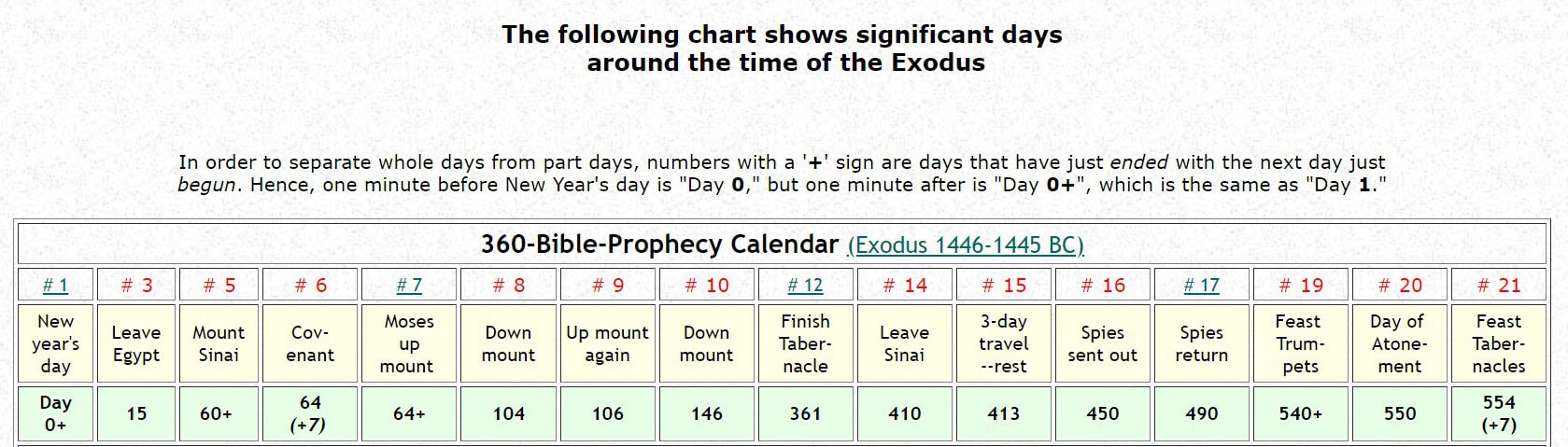
This comparison keeps all 16 selected events and the original nonconsecutive source-column identifiers. Its prophetic 360-day display and lunar comparison are separate tracks. “Day 0+” marks the movement into the first numbered day; an attached+7 retains the source’s seven-day construction.
Exodus event register: 360-day grid and lunar comparison
The event order and all sixteen source counts are preserved. Numbers are model outputs, except where the narrative itself states an interval or date.
| Legacy column | Event | 360-day display | Lunar comparison |
|---|---|---|---|
| # 1 | New year’s day | Day 0+ | Day 0+ |
| # 3 | Leave Egypt | 15 | 15 |
| # 5 | Mount Sinai | 60+ | 59+ |
| # 6 | Covenant | 64 (+7) | 63(+ 7) |
| # 7 | Moses up mount | 64+ | 64+ |
| # 8 | Down mount | 104 | 103 |
| # 9 | Up mount again | 106 | 105 |
| # 10 | Down mount | 146 | 144 |
| # 12 | Finish Tabernacle | 361 | 356 |
| # 14 | Leave Sinai | 410 | 405 |
| # 15 | 3-day travel –rest | 413 | 408 |
| # 16 | Spies sent out | 450 | 443 |
| # 17 | Spies return | 490 | 483 |
| # 19 | Feast Trumpets | 540+ | 532+ |
| # 20 | Day of Atonement | 550 | 542 |
| # 21 | Feast Tabernacles | 554 (+7) | 546 (+7) |
- The plus sign marks a completed boundary at the start of the next counted day: Day 0+ is the beginning of Day 1. It is not a new arithmetic addition operator.
- The source’s Exodus projection identifies Nisan/Abib 1 at 1446 BC with symbolic AD 1, then assigns AD 2 to the next day. An elapsed offset of zero and numbered Day 1 are different labels for the starting position.
- The source instructs readers to treat lunar equivalents as comparisons. They are retained to show how the selected calendar affects the outputs; do not substitute them into the 360-day grid without a declared conversion.
- Missing source columns #2,#4,#11,#13,#18 are genuinely omitted in this excerpt. Preserve the full original linked chart as a separate dependency rather than inventing values.
- The 430-day Ezekiel cycles are presented as comparisons with the Exodus event scaffold; the scaffold itself is a novel constructed model, not automatically a canonical historical chronology.
| Source ID | Event | Source year/month/day | 360-day display | Lunar display | References | Notes / assumptions |
|---|---|---|---|---|---|---|
| #1 | The (first) New Year (1446 BC) | 01/01/01 | Bible-Prophecy- 360 -cal. *** Day 1 (incl.) ( Day ‘0’ excl.) | Lunar cal. *** Day 1 (incl.) ( Day ‘0’ excl.) | Exodus 12:2; 12:40-41 | First day of the new datum for counting the years. I.e., The first day of the first year. |
| #2 | Select Lamb/ Passover | 01/01/10 and 14th | Day 10 and 14 | Day 10 and 14 | Exodus 12:2-6 | |
| #3 | Exodus from Egypt | 01/01/15 | Source cell blank; current excerpt gives15 | Day 15 | Exodus 12:51 | Day 15-21 = 7 days of unleavened bread. (Exodus 13:6.) Day 16 = first-fruits, plus 49 days (7 x 7) until Pentecost (Lev. 23:9-14). |
| #4 | Wilderness of Sin | 01/02/15 | Day 45 | Day 45 | Exodus 16:1 | Intermediate stop en route to Mt Sinai. Manna begins. |
| #5 | Mount Sinai | 01/03/01 | Day 61 (incl.) (Day 60 excl.) | Day 60 (incl.) (Day 59 excl.) | Exodus 19:1 | Day 61 is assumed to have just begun, (i.e., just after evening). Climax of journey. Law and terms of covenant given given over next 350 days. |
| #6 | Sprinkling of blood of Sinai covenant | 01/03/04 | Day 64 | Day 63 | Exodus 19:11; 24:4; 24:1-11 | Occurs 3½ days after arrival at Mount Sinai. |
| #7 | Moses ascends mount 40 days to receive law on tablets of stone, etc. (1446 BC) | 01/03/05? | Bible-Prophecy-cal. *** Day 65 (incl.) Day 64 (excl.) (p.m.?) | Lunar cal. *** Day 64 (65?) (incl.) Day 63 (64?) (excl.) (p.m.?) | Exodus 24:12-18 | Day 64 ending to day 71 ( day 70 of lunar) are the 7 days “the glory of God” covered the Mount. Moses ascends into the cloud on the 7th day and stays 33 more days , a total of 40 days on the Mount. Also, Day 65 is the day of Pentecost ; counted 49 days after first fruits , Exodus 34:22. Scholars see similarity of this Pentecost with the Pentecost of Acts 1, i.e., “tongues of fire ,” and “a sound like mighty wind.” |
| #8 | Moses comes down mount Golden calf | 01/04/14? | Day 104 (p.m.?) | Day 103 (p.m.?) | Exodus 32 | Jewish tradition places golden calf on 01/04/17 of lunar cal. [16th, if by Bible-Prophecy cal.] |
| #9 | Moses ascends mount second time for 40 days | 01/04/16? | Day 106 (a.m.) | Day 105 (a.m.) | Exodus 32:30; 34:2,28 | |
| #10 | Moses descends again | 01/05/26? | Day 146 (a.m.) | Day 144 (a.m.) | Exodus 34:27-35 | |
| #11 | Building of tabernacle furnishings begins | 01/05/27 ? | Day 147 | Day 145 | Exodus 35 | |
| #12 | Tabernacle assembled, then cloud covers tabernacle (1445 BC) | 02/01/01 | Bible-Prophecy-cal. *** Day 361 | Lunar cal. *** Day 356 | Exodus 40:1,17,34, Numbers 9:15-23 | Plus 7 (and 8) days ordination of sons of Aaron., Lev. 8:33; 9:1. Instructions about Jubilees, etc., given sometime over next 49 days. Passover celebrated second time, Numbers 9. |
| #13 | Census taken | 02/02/01 | Day 391 | Day 386 | Numbers 1:1-3 | Males 20 yearsoldandupward are counted (Numbers 1:3). The archived source incorrectly said under. |
| #14 | Leave Sinai: Cloud lifts from tabernacle | 02/02/20 | Day 410 | Day 405 | Numbers 9:15-23; 10:11 | Next 40 days based upon the total of the data supplied us, taken literally as is, and confirmed by Jewish tradition and the prophet Ezekiel; i.e., 3 + 30 + 7 days = 40 days, (40½?) from day 410 till day 450. (See next two columns.) |
| #15 | Camp rests after 3-days journey | 02/02/23 | Day 413 | Day 408 | Numbers 10:33-36 | Israelites complain about manna—get quail 30 days (Numbers 11). Miriam sins, camp does not move for 7 more days, Num 12. Pentecost would have been day 425 , the day they should have entered Promised Land. |
| #16 | Send out 12 spies | 02/03/29- 30 (?) | Day 449- 450 (p.m.) | Day 442- 443 (p.m.) | Numbers 13:1-24 | Day 449 is according to Jewish tradition, but day 450 is more accurate. (See previous row.) The same conflict occurs for the date of the fall of Jerusalem’s temple — tradition has Av. 9 , the prophet Jeremiah says Av. 10, (Jeremiah 52:12). Importantly, both these dates are the anniversaries of when the spies came back with the evil report — in agreement with the prophet Ezekiel, who ties all these events together, (ch. 4; 24:15-27). |
| #17 | 12 spies return with “evil report” (1445 BC) | 02/05/9- 10 (?) | Bible-Prophecy-cal. *** Day 489- 490 (p.m.) | Lunar cal. *** Day 482- 483 (p.m.) | Numbers 13:25-33 | (See previous column.) (Note: The dates of Ezekiel’s symbolic siege (Ezek. 4) with the literal one seven-years later bears upon this. It brings out the week of Av. 5-12, i.e., Day 485-492 . Note the 390 + 40 + 40 days from the first Passover week, (1446 BC). See Notes .) |
| #18 | Presume to enter land | 02/05/10-11? | Day 490-491 | Day 483-484 | Numbers 14:1, 25, 40 | It is possible that this day is the same as the 40th day of spying (14:1), but note verse 25. |
| #19 | Trumpets | 02/07/01 | Day 541 (incl.) (Day 540 excl.) | Day 533 (incl.) (Day 532 excl.) | Lev. 23:23-25; Numbers29:1-6 | (Likely, first time observed.) An assembly called—and day of rest with trumpet blasts, etc. (Later: Rosh Hashanah—New Year’s Day) |
| #20 | Day of Atonement | 02/07/10 | Day 550 | Day 542 | Lev. 16; 23:26-32; Numbers 29:7-11 | (First time observed.) Solemn rest day when sins are atoned for by high priest. Jubilee (every 49 years, Lev. 25:8-55; 27:17-24) was proclaimed on this day. Jubilee cycles were intended to commence from this date, but were delayed 39 more years (i.e., 1406 BC) because of unbelief. |
| #21 | Seven-day Feast Tabernacles | 02/07/15-21,22 | Day 555-561 (incl. of 555) (Day 562 = 02/07/22) | Day 547-553 (incl. of 547) (Day 554 = 02/07/22) | Exodus 23:16b; 34:22b; Lev. 23:33-36,39-43; Numbers29:12-38; Deuteronomy 16:13–15 (corrected range) | Memorialize the journey from Egypt to Canaan by living in booths (tabernacles). Also, to give thanks for produce of the land once they entered. (The 8th day was a special Sabbath, i.e., “day 562 .”) |
The older full chart also compares 350/390/430 years from Egypt entry to Moses’ birth, flight, and Exodus with 350/390/430 days from Sinai arrival to departure, spies sent, and spies returned. Its two pairs of forty-day periods have proposed nearly/exactly 343=49×7 separations. Day positions and elapsed intervals remain distinct, and the reconstructed ascent/spies dates are not all dates transmitted by the text.
The source’s older linked explanation supplies the arrival, Sinai, Moses’forty-day periods, Tabernacle, and departure setting for these selected columns. Its earlier calculation involving day 2000 is retained as development material in the saved full-chart explanation. The preserved source explanations remain part of the companion’s technical record.
9. Flood: four datums and the Nisan detail
The Flood table uses symbolic datums 720,750,900,930 BC. The 180-day separation expresses the seasonal displacement; the 30-day alternatives represent a declared calendar adjustment. These are symbolic projected labels, distinct from Noah’s historical Flood-year chronology.
Flood projection register: four symbolic datums
These are symbolic BC year labels generated from selected calendar datums. They are not the regular MT Flood dates 2458–2457 BC.
| No. | Event | 720 BC Datum | 750 BC Datum | 900 BC Datum | 930 BC Datum |
|---|---|---|---|---|---|
| 1 | Creation anniversary | 714 BC | 744 BC | 894 BC | 924 BC |
| 2 | Ark entry‡ | 681 excl. /680 incl. BC | 711 excl. /710 incl. BC | 861 excl. /860 incl. BC | 891 excl. /890 incl. BC |
| 3 | Ark door shut & Flood begins | 674 BC | 704 BC | 854 BC | 884 BC |
| 4 | Rain ends (40-day phase; source: “Flood ends”) | 634 BC | 664 BC | 814 BC | 844 BC |
| 5 | Ark lands on Ararat* | 524 BC | 554 BC | 704 BC | 734 BC |
| 6 | Mountains visible | 450 BC | 480 BC | 630 BC | 660 BC |
| 7 | 1st: Raven & Dove sent | 410 BC | 440 BC | 590 BC | 620 BC |
| 8 | 2nd: Dove sent†‡ | 404 incl. /403 excl. BC | 434 incl. /433 excl. BC | 584 incl. /583 excl. BC | 614 incl. /613 excl. BC |
| 9 | 3rd: Dove sent‡ | 397 incl. /396 excl. BC | 427 incl. /426 excl. BC | 577 incl. /576 excl. BC | 607 incl. /606 excl. BC |
| 10 | Earth dry, ark uncovered | 360 BC | 390 BC | 540 BC | 570 BC |
| 11 | Noah/Animals leave ark | 304 BC | 334 BC | 484 BC | 514 BC |
- The two Nisan datums are 720 and 750 BC. The Tishri companions add 180 to each BC label, producing the 900 and 930 datum columns. This is an explicitly schematic half-year transfer.
- All displayed values represent the source’s 6 a.m. / spring-as-morning convention. The second dove is sent at dawn and returns in the evening.
- The Ark’s 7th-month/17th-day resting lies two days after the Tabernacles comparison at month 7/day 15: 526/556 BC in the Nisan columns and 706/736 BC in the Tishri companions. The Tishri seasonal reinterpretation associates this point with Passover.
- The one-year pairs such as 681/680 or 404/403 encode two countings of a seven-day interval. The two printed endpoints themselves are one unit apart; they are not a seven-year span.
- The 40 days concern rainfall; Genesis 7–8 continues through the prevailing waters, Ark’s resting, drying ground, and exit. The source “Flood ends (40 days)” wording should not imply that all Flood events finish after 40 days.
- The four-datum table combines Ark closure and Flood beginning; the Nisan detail splits them into two rows with the same outputs. Both views are retained because they disclose event classification.
Flood projection register: Nisan detail
These are symbolic BC year labels generated from selected calendar datums. They are not the regular MT Flood dates 2458–2457 BC.
| No. | Event | 720 BC Datum | 750 BC Datum |
|---|---|---|---|
| 1 | Creation anniversary | 714 BC | 744 BC |
| 2 | Ark entry‡ | 681 excl. /680 incl. BC | 711 excl. /710 incl. BC |
| 3 | Ark door shut | 674 BC | 704 BC |
| 4 | Flood begins | 674 BC | 704 BC |
| 5 | Rain ends (40-day phase; source: “Flood ends”) | 634 BC | 664 BC |
| 6 | Ark lands on Ararat* | 524 BC | 554 BC |
| 7 | Mountains visible | 450 BC | 480 BC |
| 8 | 1st: Raven & Dove sent | 410 BC | 440 BC |
| 9 | 2nd: Dove sent†‡ | 404 incl. /403 excl. | 434 incl. /433 excl. |
| 10 | 3rd: Dove sent‡ | 397 incl. /396 excl. | 427 incl. /426 excl. |
| 11 | Earth dry, ark uncovered | 360 BC | 390 BC |
| 12 | Animals leave ark | 304 BC | 334 BC |
- The two Nisan datums are 720 and 750 BC. The Tishri companions add 180 to each BC label, producing the 900 and 930 datum columns. This is an explicitly schematic half-year transfer.
- All displayed values represent the source’s 6 a.m. / spring-as-morning convention. The second dove is sent at dawn and returns in the evening.
- The Ark’s 7th-month/17th-day resting lies two days after the Tabernacles comparison at month 7/day 15: 526/556 BC in the Nisan columns and 706/736 BC in the Tishri companions. The Tishri seasonal reinterpretation associates this point with Passover.
- The one-year pairs such as 681/680 or 404/403 encode two countings of a seven-day interval. The two printed endpoints themselves are one unit apart; they are not a seven-year span.
- The 40 days concern rainfall; Genesis 7–8 continues through the prevailing waters, Ark’s resting, drying ground, and exit. The source “Flood ends (40 days)” wording should not imply that all Flood events finish after 40 days.
- The four-datum table combines Ark closure and Flood beginning; the Nisan detail splits them into two rows with the same outputs. Both views are retained because they disclose event classification.
The forty days of rain overlap the 150-day section: in this table 674→634 lies within 674→524. They must not be added into a 190-day total. The source label “Flood ends (40 days)” means the rain or forty-day phase ends, rather than the entire Flood narrative.
The detail preserves the inclusive/exclusive Ark-entry and dove counts, the 40-day and 150-day sections, Ark resting, visible mountains, uncovering, and leaving. It also retains the source’s 6 AM morning convention, the autumn/spring flip between Tabernacles and Passover, and the proposed Tabernacles marker two days before the Ark’s resting. These are stated model choices, not extra month/day dates recorded in Genesis.
The chart’s 410-day marker and its related week treatment must be read within this particular legacy construction. Current Flood and Moses companions, and Files 12,17,23, supply additional calendar/window controls; their differing start boundaries should be compared before a count is transferred into another model. The table is preserved here without declaring every projected value an independently canonized date.
10. The forty-year cycle and its longer extension
The related solar morning-to-morning explanation develops the source’s half-day and symbolic-year conventions within a separate template series.
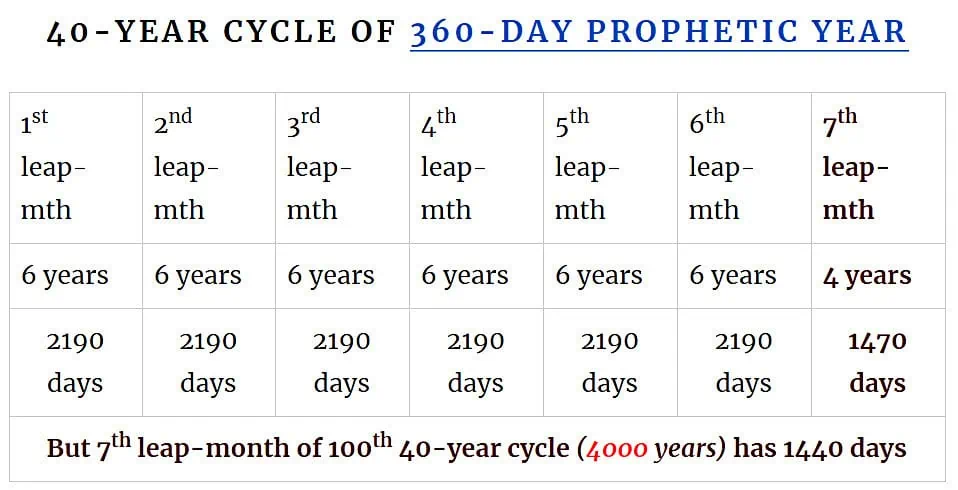
The ordinary cycle is 6×2190+1470=14610=40×365.25, controlled by File 12§7A. The diagram’s wording about the “7th leap-month” of the hundredth cycle refers numerically to reducing the last four-year subtotal from 1,470 to 1,440: omission of a 30-day insertion. The resulting 4,000-year mean is 365.2425, equal to the Gregorian mean but obtained by a different proposed timetable. This extension is retained as source research; it is not silently substituted for the canonical ordinary cycle.
11. The full diagram arguments, made explicit
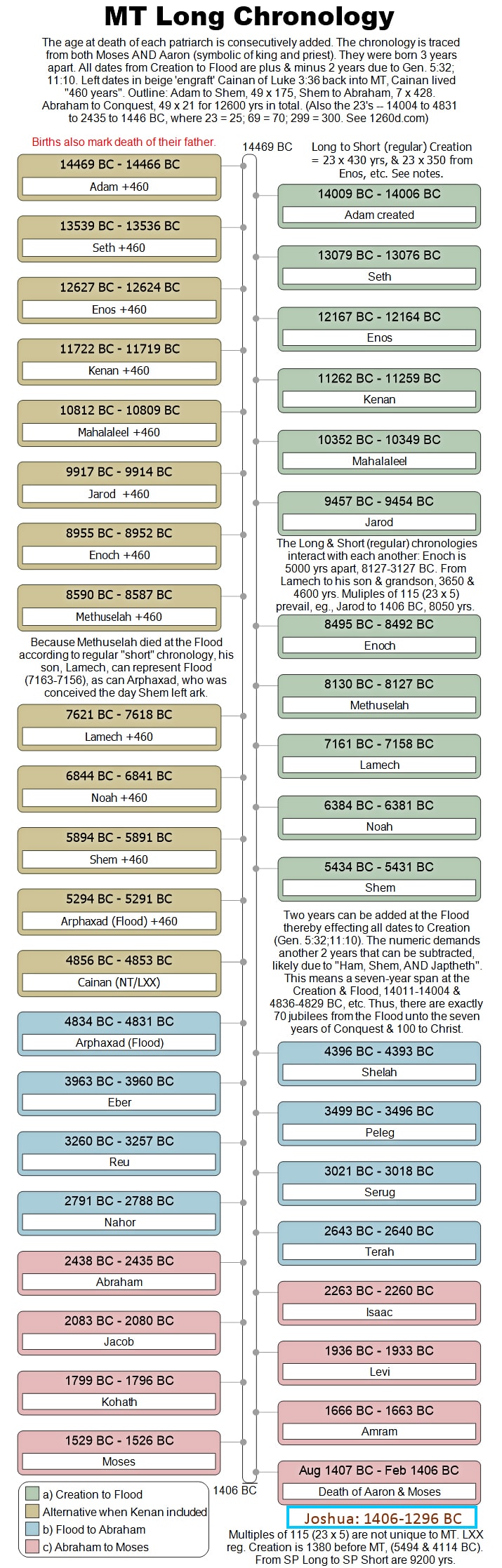
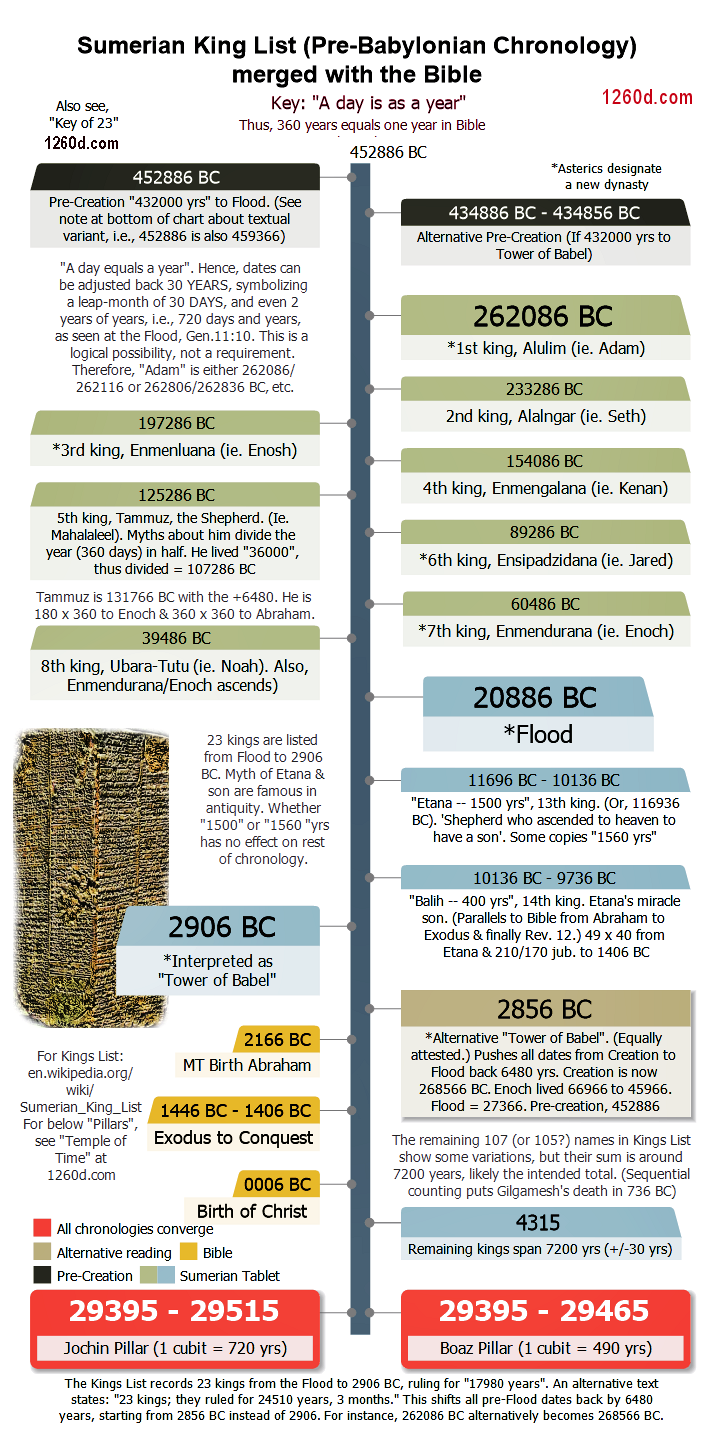
The original cumulative and Sumerian diagrams contain arguments that would be lost if only their central timelines were retained. The calculation register below transcribes and explains all 36 assessed graphical claims. A checked subtraction verifies the selected numbers; it does not establish a typological identification or statistical certainty.
| ID / original figure | Source argument | Explanation and selected state | Canonical control |
|---|---|---|---|
| G40-01 40-year-cycle-360-day-prophetic-yearchart.webp | Six six-year cycles of 2190 days each, followed by a four-year cycle of 1470 days. | The reconstructed scheme is controlled by File 12 §7A.1: 6×2190+1470=14610=40×365.25. This is a calendar model, not a schedule stated in Scripture. | File 12 §7A.1 |
| G40-02 40-year-cycle-360-day-prophetic-yearchart.webp | The last four-year subtotal in the hundredth forty-year cycle is 1440 days instead of 1470. | The source calls this the “7th leap-month” of the 4000-year cycle, but 1440 is a four-year subtotal. Its numerical meaning is omission of one 30-day insertion. This longer extension was not found in the retrieved canonical controllers; retain it as source research. | File 12 §7A; source extension |
| G40-03 40-year-cycle-360-day-prophetic-yearchart.webp | The diagram’s longer adjustment yields a 4000-year mean of 365.2425 days. | Derived explanation: 100×14610−30=1460970 days; 1460970÷4000=365.2425. This equals the Gregorian mean while using a different proposed civil timetable. It does not replace the ordinary canonical forty-year model. | Source footer; derived arithmetic |
| GMT-01 MT-Long-Chronology-with-Cainan-and-Joshua.jpg | Patriarchal lifespans are stacked backward from Moses and Aaron, whose tracks are three years apart in the diagram’s integer display. | The cumulative method is controlled by Files 09 and 18. Keep the source’s integer three-year display distinct from the current exact 3.5-year Aaron/Tishri phase separation. | Files 09 and 18 §6A |
| GMT-02 MT-Long-Chronology-with-Cainan-and-Joshua.jpg | The diagram allows a two-year variation at the Flood and propagates it back toward Creation. | This is the cumulative envelope mechanism of File 18 §6A and File 07. It is distinct from the SP-only adjacent Noah/Shem station rule. | Files 07 and 18 §6A |
| GMT-03 MT-Long-Chronology-with-Cainan-and-Joshua.jpg | The beige branch inserts second Cainan’s 460-year lifespan into the MT cumulative chain. | Name the restored cumulative-Cainan variant and its +460 operator. It is not native MT. A native LXX chain already containing Cainan receives no additional insertion. | Files 09 and 18 §6B |
| GMT-04 MT-Long-Chronology-with-Cainan-and-Joshua.jpg | Adam→Shem is 175×49; Shem→Abraham is 7×428; Abraham→Conquest is 21×49. | The selected cumulative coordinates give 14006−5431=8575; 5431−2435=2996; 2435−1406=1029. Their sum is 12600. These are cumulative boundaries, not ordinary historical birth intervals. | Files 09 and 18 §6A |
| GMT-05 MT-Long-Chronology-with-Cainan-and-Joshua.jpg | The header associates the 14004, 4831, 2435, and 1446 labels with the ratios 23:25, 69:70, and 299:300. | The precise endpoint operations are not fully specified in that caption. Retain the caption with the source diagram; use File 22’s explicit bridge equations for a featured calculation. The active Enochian expansion is 300/299; 299:300 may describe its input/output relation. | Files 12, 17, and 22 |
| GMT-06 MT-Long-Chronology-with-Cainan-and-Joshua.jpg | In the stacked chronology, each son’s opening boundary also marks his father’s closing lifespan. | This is a property of cumulative stacking. It does not assert that historical fathers died on their sons’ actual birthdays. | File 18 §6 method |
| GMT-07 MT-Long-Chronology-with-Cainan-and-Joshua.jpg | The diagram links cumulative and regular Creation by 23×430, with an Enosh comparison of 23×350. | The selected checks are 14004−4114=9890=23×430 and 12164−4114=8050=23×350. Declare the cumulative member and regular Creation endpoint; neither is an unnamed generic “Creation date.” | File 22; File 18 source nodes |
| GMT-08 MT-Long-Chronology-with-Cainan-and-Joshua.jpg | Cumulative and regular Enoch have closing boundaries 8127 and 3127 BC, 5000 apart. | Cumulative Enoch closes at 8492−365=8127; regular Enoch closes at 3492−365=3127. The 8127 node also opens cumulative Methuselah. It is not cumulative Enoch’s birth. | File 18 §6A and regular MT table |
| GMT-09 MT-Long-Chronology-with-Cainan-and-Joshua.jpg | The diagram mentions 3650- and 4600-year Lamech/descendant comparisons and recurring multiples of 115. | Retain this source interpretation. The caption does not identify all endpoints clearly enough to feature those spans as independent verified calculations. Any further use must state the regular/cumulative member selection. | Source interpretation; endpoints unspecified |
| GMT-10 MT-Long-Chronology-with-Cainan-and-Joshua.jpg | A Jared-to-Conquest comparison gives 8050 years. | The selected envelope member 9456→1406 gives 8050=23×350. The ordinary Moses-line node 9454 gives 8048. Label 9456 as an envelope member rather than rewriting the primary node. | File 18 §6A envelope |
| GMT-11 MT-Long-Chronology-with-Cainan-and-Joshua.jpg | Because regular Methuselah dies in the Flood year, cumulative Lamech may represent the Flood; Arphaxad is associated with conception at Ark exit. | Methuselah’s regular death/Flood coincidence is canonical. Lamech’s representation and Arphaxad’s precise conception-day association are typological or reconstructed. Scripture does not supply that conception day. | Files 18 and 23; reconstructed conception association |
| GMT-12 MT-Long-Chronology-with-Cainan-and-Joshua.jpg | The two-year alternatives and Aaron/Moses separation yield Creation and Flood envelopes of seven years. | The admitted examples are 14011–14004 and 4836–4829 BC. Preserve those envelopes and distinguish the author’s son-order explanation from the arithmetic definition. | Files 07 and 18 §6A |
| GMT-13 MT-Long-Chronology-with-Cainan-and-Joshua.jpg | The source compares the Flood/Conquest weeks through seventy jubilees and also mentions a hundred-jubilee relation to Christ. | The matched base pairs 4836→1406 and 4829→1399 each give 3430=70×49. A 100×49 Christ comparison requires a named restored-Cainan or selected Cainan/Flood member; base 4836→6 is not 4900. Keep the source claim while stating its endpoint selection before reuse. | File 09 matched 3430 spans; selected variant for 4900 |
| GMT-14 MT-Long-Chronology-with-Cainan-and-Joshua.jpg | Aaron dies in summer 1407; Moses in winter 1406; a separate Joshua block runs 1406–1296 BC. | The phase sequence preserves Aaron before Moses. Files 09 §3A.5.2 and 22 §9A.3 control the appended MT-derived 110-year block and death week 1301–1294. It is distinct from regular Joshua 1476–1366 and the independent SP cumulative square target. | File 18 §2.4; File 09 §3A.5.2; File 22 §9A.3 |
| GMT-15 MT-Long-Chronology-with-Cainan-and-Joshua.jpg | The caption mentions LXX comparisons of 2580×6 to 1446 BC and 2921×5 to AD 439. | The products are 15480 and 14605. The caption requires its starting nodes and active variants to be supplied before these become featured chronological proofs. Preserve it as a source comparison, without statistical inference. | Source comparison; endpoint selection required |
| GSKL-01 Sumerian-King-List-merged-with-Bible-updated3-1.bmp | The diagram’s scale is “a day is a year”: 360 Sumerian years correspond to one biblical-scale year. | This is the canonical 360:1 SKL scale state. It is not ordinary elapsed-year chronology. | File 21 calculation engine; File 34 |
| GSKL-02 Sumerian-King-List-merged-with-Bible-updated3-1.bmp | Short pre-Creation is 452886 BC, 432000 years before Flood 20886; Long pre-Creation is 459366. | File 21 Table 6.1 and File 34 preserve both state fields. The Long/Short displacement is 6480; neither state silently corrects the other. | File 21 Table 6.1; File 34 |
| GSKL-03 Sumerian-King-List-merged-with-Bible-updated3-1.bmp | An alternative pre-Creation pair is 434886–434856 BC, associated with 432000 years to a Babel target. | The exact 432000 calculation from 434886 uses the 2886 BC Apparent-Mode Babel target. Using 2906 instead gives 431980. Keep the projective companion and its chosen target explicit. | File 21 §7.4; Babel state selection |
| GSKL-04 Sumerian-King-List-merged-with-Bible-updated3-1.bmp | The source admits a 30-year Apparent-Mode adjustment and a scaled two-year variation of 720. | The +30 mode, local ±2 field, and scaled ±720 field are distinct canonical operators. The source calls these adjustments logical possibilities, not compulsory changes to every date. | File 21 four-state matrix; File 34 |
| GSKL-05 Sumerian-King-List-merged-with-Bible-updated3-1.bmp | Adam/Alulim may be displayed at 262086, 262116, 262806, or 262836 BC. | These selected values respectively retain the base, +30, +720, and +720+30 states. The displayed companions are not four independent historical birth dates. | File 21 Table 6.1 and Apparent Mode |
| GSKL-06 Sumerian-King-List-merged-with-Bible-updated3-1.bmp | The eight antediluvian king nodes are 262086, 233286, 197286, 154086, 125286, 89286, 60486, and 39486 BC. | File 21 Table 6.1 controls the numeric nodes. Their Adam–Noah name correspondences are the study’s typological/entity mapping, not a claim that the SKL text names the biblical patriarchs. | File 21 Table 6.1 |
| GSKL-07 Sumerian-King-List-merged-with-Bible-updated3-1.bmp | Tammuz’s 36000-year reign is divided in half, yielding a comparison node at 107286 BC. | The arithmetic is 125286−18000=107286. The year-division tradition and Mahalalel correspondence are interpretations; the number does not replace Mahalalel’s MT lifespan of 895. | File 21 Tammuz comparison; source midpoint |
| GSKL-08 Sumerian-King-List-merged-with-Bible-updated3-1.bmp | The diagram compares Tammuz with Enoch by 180×360 and with Abraham by 360×360. | These use different Tammuz states: 125286→60486=64800=180×360, while 131766→2166=129600=360×360. The shifted 131766 node must not be substituted into the Enoch comparison. | File 21 §8.2 |
| GSKL-09 Sumerian-King-List-merged-with-Bible-updated3-1.bmp | Enmendurana is compared with ascending Enoch; Ubara-Tutu is compared with Noah. | Retain the typological correspondence, with the SKL and biblical individuals distinguished. The source maps their narrative roles rather than establishing historical identity. | File 21 Table 6.1 and §5 |
| GSKL-10 Sumerian-King-List-merged-with-Bible-updated3-1.bmp | Twenty-three post-Flood kings span 20886→2906; Etana and his son illustrate an ascent/miracle-birth pattern. | The displayed Short span is 17980. Etana’s transmitted 1500 and the diagram’s 1560 display remain separate inputs; the source’s claim that the rest of the model is unaffected belongs to its fixed-anchor construction. | File 21 Table 6.2 |
| GSKL-11 Sumerian-King-List-merged-with-Bible-updated3-1.bmp | Etana’s displayed interval is 11696–10136 BC, while source reign values include 1500 and 1560. | The displayed subtraction gives 1560. File 21 explicitly corrects the source’s stray 116936 label to 11696 while retaining 1500 as source reign data. Do not confuse display arithmetic with textual attestation. | File 21 §6 author-resolution note |
| GSKL-12 Sumerian-King-List-merged-with-Bible-updated3-1.bmp | Balih follows Etana at 10136–9736 BC for 400 years; the source compares the pair with Abraham, the Exodus, and Revelation 12. | The 400-year subtraction checks. Keep the miracle-son and Revelation comparisons as typology, not identification of Balih with a biblical person. | File 21 Table 6.2; source typology |
| GSKL-13 Sumerian-King-List-merged-with-Bible-updated3-1.bmp | The source gives 49×40 from Etana to Balih’s endpoint, followed by 210/170 jubilees to 1406 BC. | All three checks hold: 11696−9736=1960=49×40; 11696−1406=10290=210×49; 9736−1406=8330=170×49. The full-resolution caption reads 210/170, not 210/70. | File 21 Table 6.2; displayed endpoints |
| GSKL-14 Sumerian-King-List-merged-with-Bible-updated3-1.bmp | The Long tier uses Creation 268566, Enoch 66966→45966, and Flood 27366 BC; the same caption prints pre-Creation 452886. | The first three states agree with File 21. The final label remains the Short pre-Creation member; current Long pre-Creation is 459366. Explain the mixed label without altering the archived diagram. | File 21 Table 6.1; File 34 tier states |
| GSKL-15 Sumerian-King-List-merged-with-Bible-updated3-1.bmp | The remaining 107 or 105 named kings are approximated by 7200 years, with AD 4315 as the endpoint; a provisional Gilgamesh death is 736 BC. | The 7200 span to AD 4315 uses 2886 BC under civil arithmetic. From 2856 it would end at AD 4345. Retain the uncertain name count and Gilgamesh placement as legacy research, without declaring them settled canonical dates. | File 21 Table 6.2; legacy qualifications |
| GSKL-16 Sumerian-King-List-merged-with-Bible-updated3-1.bmp | The diagram retains a 7200-year post-Babel span with a ±30 companion. | File 21 controls AD 4315 and its state companions. A ±30 adjustment and a chosen Babel node must be declared; do not treat 7200 as an exact text-stated sum for every king-list variant. | File 21 Table 6.2 |
| GSKL-17 Sumerian-King-List-merged-with-Bible-updated3-1.bmp | The pillar intervals are 29395–29515 for Jachin and 29395–29465 for Boaz, with source cubit scales of 720 and 490 years. | File 34 Appendix B.3 identifies all three boundary labels as AD. The interval lengths are 120 and 70; the cubit multipliers belong to the Temple measurement model and are not those literal elapsed spans. Preserve these as projective boundaries, not predicted historical events. | File 34 Appendix B.3; File 21 §7; File 10 witness controls |
| GSKL-18 Sumerian-King-List-merged-with-Bible-updated3-1.bmp | The alternate twenty-three-king total moves the SKL Flood and Creation back by 6480. | The full lists give 20886→2906=17980 and 27366→2856=24510. Their duration difference is 6530; accounting for the 50-year terminal-anchor difference gives the 6480 upstream displacement. Both the duration and coordinate differences matter. | File 21 Short/Long control; File 34 |
Particularly useful distinctions include cumulative Enoch’s closing boundary 8127 versus regular Enoch’s 3127, giving 5,000; selected Jared envelope member 9456→1406, giving 8,050; and the two matched Flood/Conquest comparisons 4836→1406 and 4829→1399, each 3,430=70×49. The Sumerian comparisons distinguish Short and Long tiers,30-year Apparent Mode,720-year gear steps, and 360:1 scaling. None should be merged into an unnamed date.
12. Month and chapter reference guide
| Spring number | Month | Approximate modern season | Reference observances |
|---|---|---|---|
| 1 | Nisan | March–April | Passover; Unleavened Bread |
| 2 | Iyar | April–May | Second Passover / Pesach Sheni; Lag Ba Omer (later observance) |
| 3 | Sivan | May–June | Shavuot |
| 4 | Tammuz | June–July | Fast of 17 Tammuz (later observance) |
| 5 | Av | July–August | Tisha B’ Av (later observance) |
| 6 | Elul | August–September | Preparation for autumn festivals |
| 7 | Tishri | September–October | Trumpets; Day of Atonement; Tabernacles |
| 8 | Heshvan | October–November | No principal festival in source guide |
| 9 | Kislev | November–December | Hanukkah begins (later observance) |
| 10 | Tevet | December–January | Hanukkah may continue; Fast of 10 Tevet |
| 11 | Shevat | January–February | Tu Bi Shvat (later observance) |
| 12 | Adar | February–March | Fast of Esther; Purim (later observances) |
| Chapters | Narrative / oracle setting |
|---|---|
| 1–3 | Call, scroll, and watchman commissioning |
| 4–7 | Siege sign and judgment / end |
| 8–11 | Temple vision and departure of glory |
| 12–19 | Signs, judgment, rulers, and lament |
| 20–24 | Elders, judgment, sisters, and siege announcement |
| 25 | Ammon, Moab, Edom, and Philistia |
| 26–28 | Tyre and Sidon |
| 29–32 | Egypt oracles and laments |
| 33 | Watchman and report of Jerusalem’s fall |
| 34–36 | Shepherds, Edom, and restoration |
| 37 | Dry bones and reunification |
| 38–39 | Gog |
| 40–48 | Restored Temple, land, and city |
The twelve-month list is a modern orientation aid; seasons vary with the calendar. The chapter guide preserves the original event descriptions while dropping the external guide’s rejected speculative BC labels. An undated chapter does not become a new dated input merely because it has a place in the narrative.
Related source studies
The original page’s related references are retained here once each: the complete cumulative chronology table, Mirror and Key-of-23 development, Solomon’s Temple template, 980-year scaffold, older consecutive symbolic-date overview, complete older Exodus chart, and its related 1446 BC study. These remain source references with their own development histories.
Working files and the preserved originals
The methodology explains the adopted year rules, carried seven-day window, canonical allocation, and conditional Return reconstruction. The downloadable package includes the readable tables, CSV/JSON exports, complete source captures, verified canonical snapshots, and reconstruction scripts. Published Google table exports retain the displayed values and formatting; their original formulas are not available in those exports.
The original Part 1a page preserves the original order, illustrations, and table wording. The corresponding original Part 1b dialogue preserves the development of the method.
Scripture references identify their passage and edition where a reading is material. This chart companion introduces no direct NET Scripture quotation or translators’ note. Original archived quotations and illustrations retain their source wording and attribution; they have not been relabelled as BSB. New BSB quotations appear in the linked methodology, with its own end-of-article acknowledgment.