The Ark’s dimensions belong first to the story of preservation through the Flood. They also provide a starting point for comparing the numbers of the vessel with the ages and eras surrounding Noah, the patriarchs, and Moses:
And this is how you are to build it: The ark is to be 300 cubits long, 50 cubits wide, and 30 cubits high.
The proposal developed here is to double those numerical measurements and compare 600, 100, and 60 with the chronology. The shorter illustrated introduction, Noah’s Ark: Its Dimensions and the 600-Year Pattern, explains the central relationship. This detailed study follows its wider connections, especially the way two equal spans can overlap around a shared center.
The working dates follow the normal Masoretic Text (MT) chronology: Nisan reckoning, 430 years in Egypt, no inserted second Cainan, and no +60 Terah adjustment unless explicitly introduced. These are regular chronological dates, not a cumulative sequence formed by adding complete lifespans. The canonical Markdown files govern the date labels and their permitted variations.
For direct access to the supporting data, use the tables for dimensions, Noah and Shem, Jacob to the Conquest, Isaac’s bookends, overlapping spans, the Terah alternative, and the wider comparisons.
The dimensions and their proposed chronological meaning
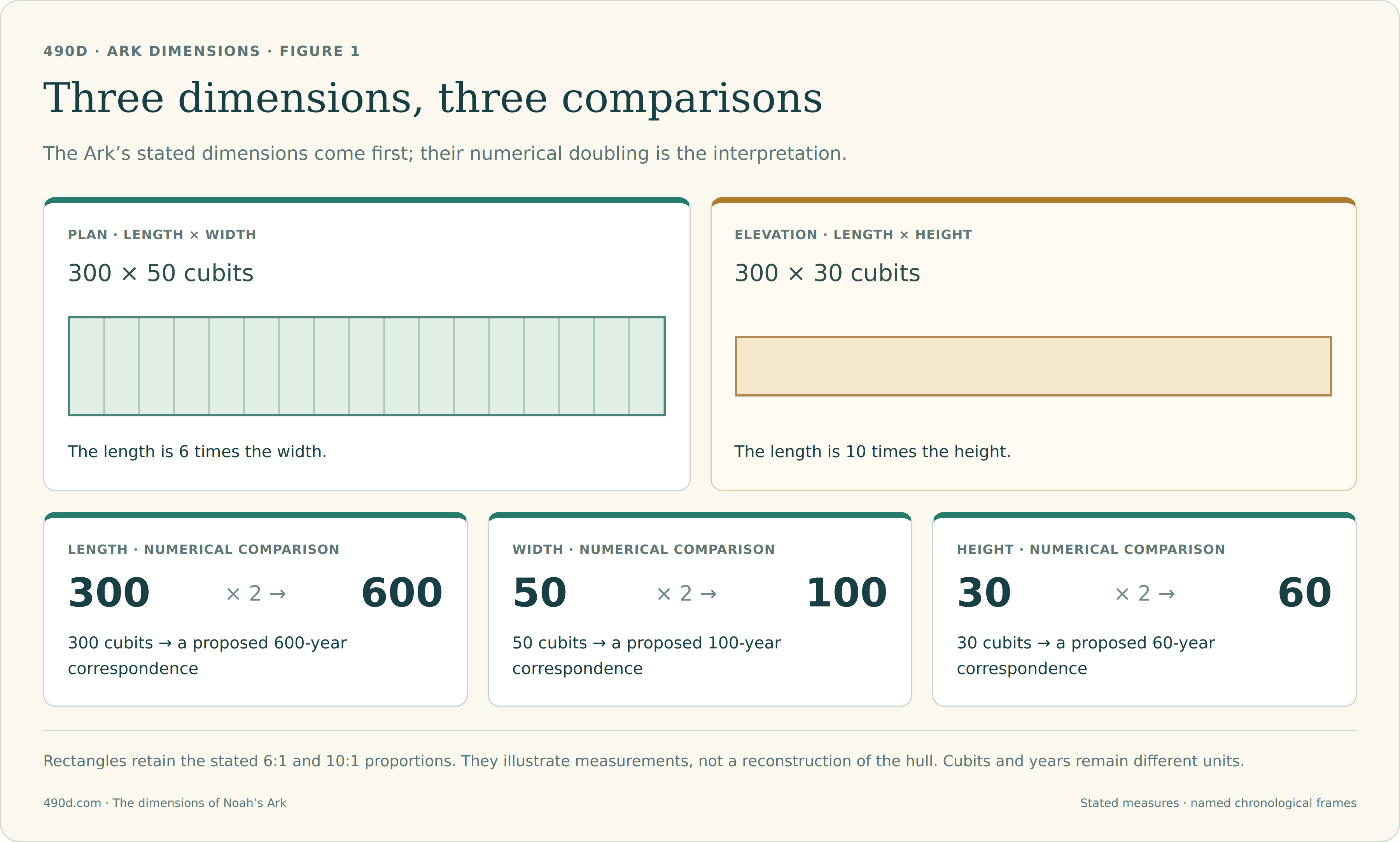
Doubling gives a simple set of numbers:
The three measurements
| Dimension | Stated measurement | Numerical doubling | Comparison in the chronology |
|---|---|---|---|
| Length | 300 cubits | 300 × 2 = 600 | Noah’s age at the Flood; Shem’s lifespan; Jacob-to-Conquest era |
| Width | 50 cubits | 50 × 2 = 100 | Shem at Arphaxad’s birth; Abraham at Isaac’s birth |
| Height | 30 cubits | 30 × 2 = 60 | Isaac at Jacob’s birth; separately, the optional Terah adjustment |
The doubling preserves the Ark’s proportions. The length is six times the width and ten times the height, just as 600 is six times 100 and ten times 60.
490d · Ark dimensions · Figure 1
Three dimensions, three comparisons
The Ark’s stated dimensions come first; their numerical doubling is the interpretation.
The length is 6 times the width.
The length is 10 times the height.
300 cubits → a proposed 600-year correspondence
50 cubits → a proposed 100-year correspondence
30 cubits → a proposed 60-year correspondence
Rectangles retain the stated 6:1 and 10:1 proportions. They illustrate measurements, not a reconstruction of the hull. Cubits and years remain different units.
The animals entering in pairs offer a narrative image for this doubling (Genesis 7:9). The numerical step itself is an interpretive choice: Genesis does not tell us to change cubits into years. Its value must therefore be assessed through the relationships it brings into view. A recurring number becomes more informative when it joins named events and preserves a recognizable division of time.
Noah and Shem: two measures of 600
Genesis 7:6 places Noah at age 600 when the Flood comes. Shem’s genealogy supplies a complete life of the same length:
This is the account of Shem. Two years after the flood, when Shem was 100 years old, he became the father of Arphaxad. And after he had become the father of Arphaxad, Shem lived 500 years and had other sons and daughters.
Thus 100 + 500 = 600. Noah’s 600 is his age at a turning point; Shem’s 600 is his entire lifespan. The smaller 100 is embedded within the larger 600, matching the doubled width-to-length proportion of the Ark.
The current canonical sources preserve two ways of relating Shem’s 100 to the surrounding dates. The Arphaxad-bound reading follows Genesis 11:10 directly: 100 at Arphaxad’s birth, two years after the Flood. The Noah-bound comparison joins Noah’s 500-to-600 sequence and places Shem’s 100 at the Flood. They are distinct named comparisons, and their endpoints must remain distinct.
Within the Noah-bound Gear-2 comparison, Noah’s birth at 3058 BC, Shem’s reference at 2558 BC, the Flood at 2458 BC, and Shem’s death at 1958 BC form:
500 + 100 + 500 = 1100.
The first 500 + 100 reaches Noah’s Flood age of 600. The last 100 + 500 spans Shem’s 600 years. The two 600-year spans share a central 100, so counting their common portion once gives 600 + 600 − 100 = 1100.
490d · Ark dimensions · Figure 2
Two spans of 600 share one century
A named Gear-2 structural comparison: 3058 → 2558 → 2458 → 1958 BC.
Noah’s birth
3058 BCShem’s G2 birth reference
2558 BCFlood
2458 BCShem’s G2 death reference
1958 BCNoah’s birth → Flood
Shem’s G2 reference → death
Two 600-year spans share 100 years.
Normal MT, Nisan; named G2 biological/triad reference. Bars are proportional within the 1100-year interval. Anchor cards are schematic. The shared 100 years end at the Flood, not at Arphaxad’s birth.
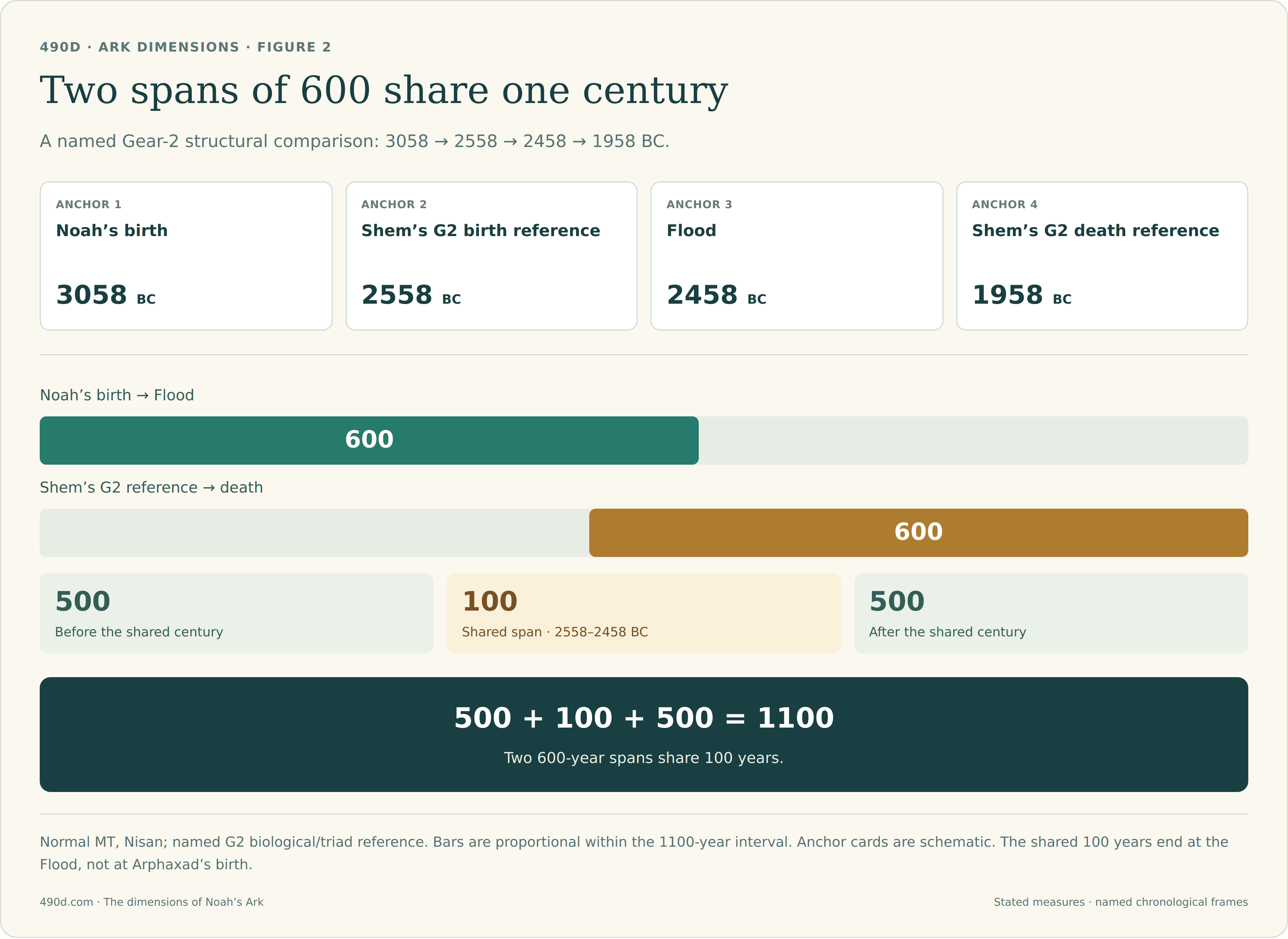
This is an overlapping structure, not 1200 consecutive years. It also must not be used to move the age stated in Genesis 11 from Arphaxad’s birth to the Flood without identifying the change of comparison.
Two named Shem comparisons
| Comparison | Sequence, BC | Internal division | Meaning |
|---|---|---|---|
| Noah-bound, Gear 2 | 2558 → 2458 → 1958 | 100 + 500 = 600 | Shem’s triad / biological reference; central event is the Flood |
| Arphaxad-bound, Gear 1 | 2556 → 2456 → 1956 | 100 + 500 = 600 | Elected-lineage station; central event is Arphaxad’s birth |
| Noah, normal Gear 2 | 3058 → 2458 → 2108 | 600 + 350 = 950 | Flood age and complete lifespan |
Sources: File 18 §1.3.5, File 47 §0.3 and §§5.1–5.2, and File 02 §6.2. File 47’s clarification identifies 2556 BC as Shem’s elected-lineage station, not a second biological birth. The paired endpoints in each row preserve the appropriate lifespan; they are not interchangeable pieces of one biography. Arphaxad remains 2456 BC in the normal position.
Jacob to the Conquest: a 600-year era
The next 600 belongs to a people’s history. Jacob’s birth in 2006 BC stands 600 years before Moses’ death and the opening of the Conquest in 1406 BC.
The story supplies a natural division. Jacob enters Egypt at 130 (Genesis 47:9); the Egyptian sojourn lasts 430 years in the MT reading of Exodus 12:40–41; another 40 years lead from the Exodus to the Conquest. Together they give 130 + 430 + 40 = 600.
Moses’ birth divides the same interval another way: 2006 − 1526 = 480, followed by his 120-year life to 1406 BC. Thus the final fifth of this 600-year era is occupied by the life of its deliverer.
490d · Ark dimensions · Figure 3
Jacob to Moses: one era, two divisions
Jacob’s birth in 2006 BC → Moses’ death / Conquest opening in 1406 BC.
Through Egypt and the wilderness
Jacob’s birth → Egypt entry
Egypt entry → Exodus
Exodus → Conquest
Through Moses’ birth and life
Jacob’s birth → Moses’ birth
Moses’ birth → death
480 + 120 = 600
The same start: Jacob’s birth. The same endpoint year: 1406 BC.
Normal MT; Nisan; 430 years in Egypt; no +60 Terah or second Cainan. Thin bars are proportional. Cards are schematic. Whole-year spans do not assert matching days.
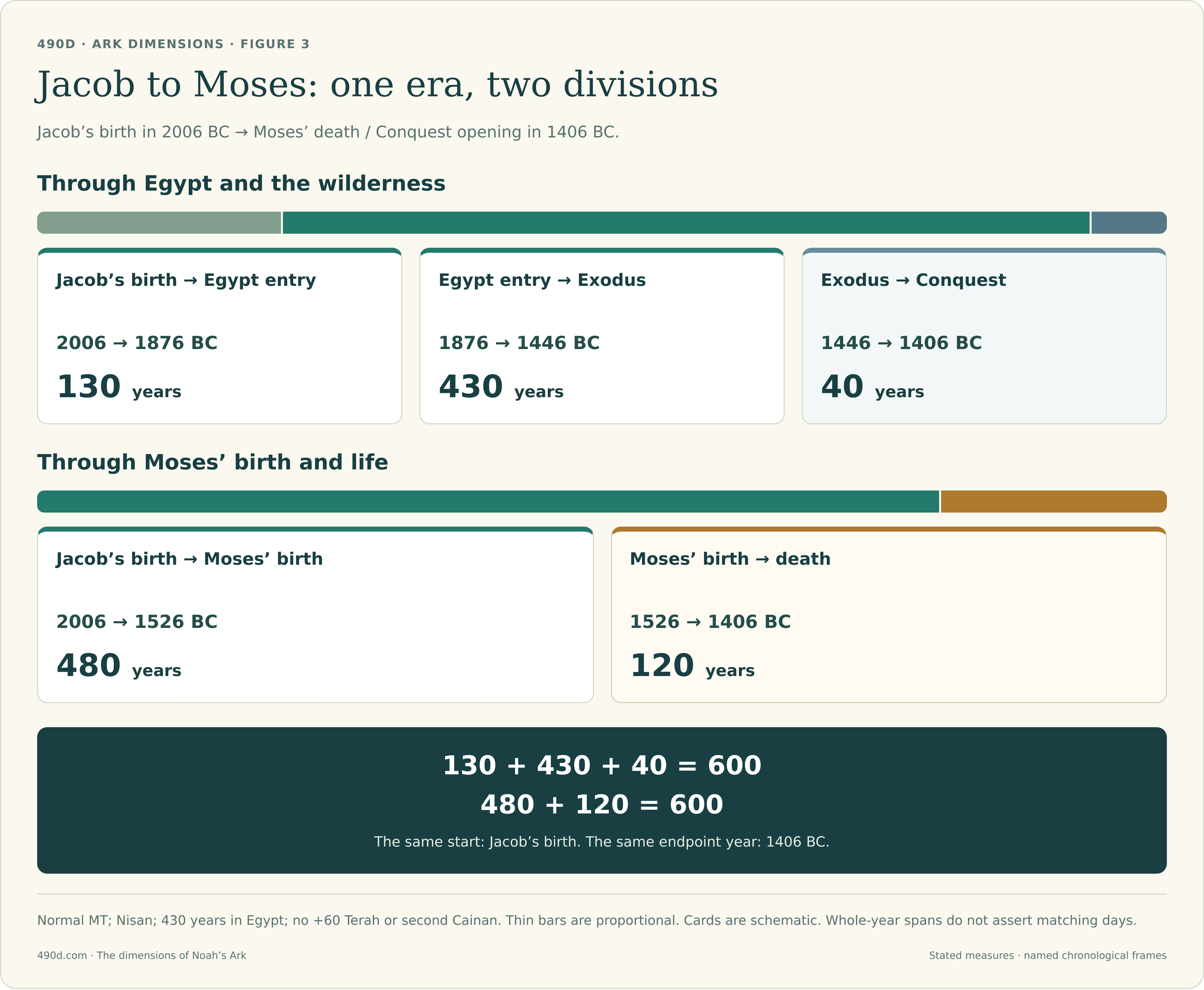
Two divisions of the Jacob-to-Conquest span
| Interval | Dates BC | Years |
|---|---|---|
| Jacob’s birth → Egypt entry | 2006 → 1876 | 130 |
| Egypt entry → Exodus | 1876 → 1446 | 430 |
| Exodus → Conquest | 1446 → 1406 | 40 |
| Jacob’s birth → Moses’ birth | 2006 → 1526 | 480 |
| Moses’ birth → death | 1526 → 1406 | 120 |
| Complete era | 2006 → 1406 | 600 |
Sources: File 04 §1.1, File 18 §§1.4 and 2.3–2.4, and File 55 §1.2. The 430 years are Israel’s Egyptian sojourn, distinct from the 400-year affliction. The terminal events share the year label 1406 BC; Moses’ death and the Conquest are not being assigned the same day.
The warning of 120 years
The 120 of Genesis 6:3 brings Noah’s chronology into comparison with Moses’ life. File 23 §5.5 reads the passage as both a countdown to the Flood and an anticipation of the lifespan represented by Moses. Under the countdown reading, Noah’s age when the final 120 begins is 600 − 120 = 480.
In the normal MT position, the resulting illustration is 3058 → 2578 → 2458 BC: 480 years to the inferred warning point, followed by 120 to the Flood. File 23 displays the same calculation in its minimum position, 2843 → 2363 → 2243 BC; adding 215 to all three labels preserves both spans.
Noah’s 480 + 120 and the Jacob-to-Conquest 480 + 120 therefore have a common shape. The last 120 leads to a transition involving judgment and preservation. The warning point is inferred from the countdown interpretation; neither the passage nor this calculation establishes 120 years of Ark construction.
Isaac’s 60 years and the two 120-year bookends
Isaac was 60 when Jacob and Esau were born (Genesis 25:26). His birth in 2066 BC therefore extends the Jacob-to-Conquest interval by 60 years:
2066 − 1406 = 660 = 60 + 600.
This provides a direct comparison with the Ark’s doubled height within the normal MT chronology. It does not depend on the optional Terah adjustment.
Isaac’s death makes another division visible. He lives 180 years (Genesis 35:28), reaching 1886 BC, when Jacob’s age is 2006 − 1886 = 120. At the other end of the era, Moses’ life also lasts 120 years. Between Isaac’s death and Moses’ birth lie 1886 − 1526 = 360 years.
The 600-year era is consequently framed by two 120s:
120 + 360 + 120 = 600.
490d · Ark dimensions · Figure 4
Two 120-year ends around 360
The Isaac–Jacob and Moses anchors divide the same 600-year interval.
Isaac’s birth in 2066 BC precedes Jacob’s birth in 2006 BC by 60 years.
Jacob’s birth
2006 BCIsaac’s death
1886 BCMoses’ birth
1526 BCMoses’ death
1406 BCJacob’s birth → Moses’ birth
Isaac’s death → Moses’ death
60 + 600 = 660
Two 480-year spans share 360 years. Isaac-to-Moses adds the initial 60.
Derived illustration using normal MT anchors, with 430 years in Egypt. The two bars are proportional within Jacob-to-Moses’ 600 years. The initial 60-year extension is a separate callout; cards are schematic.
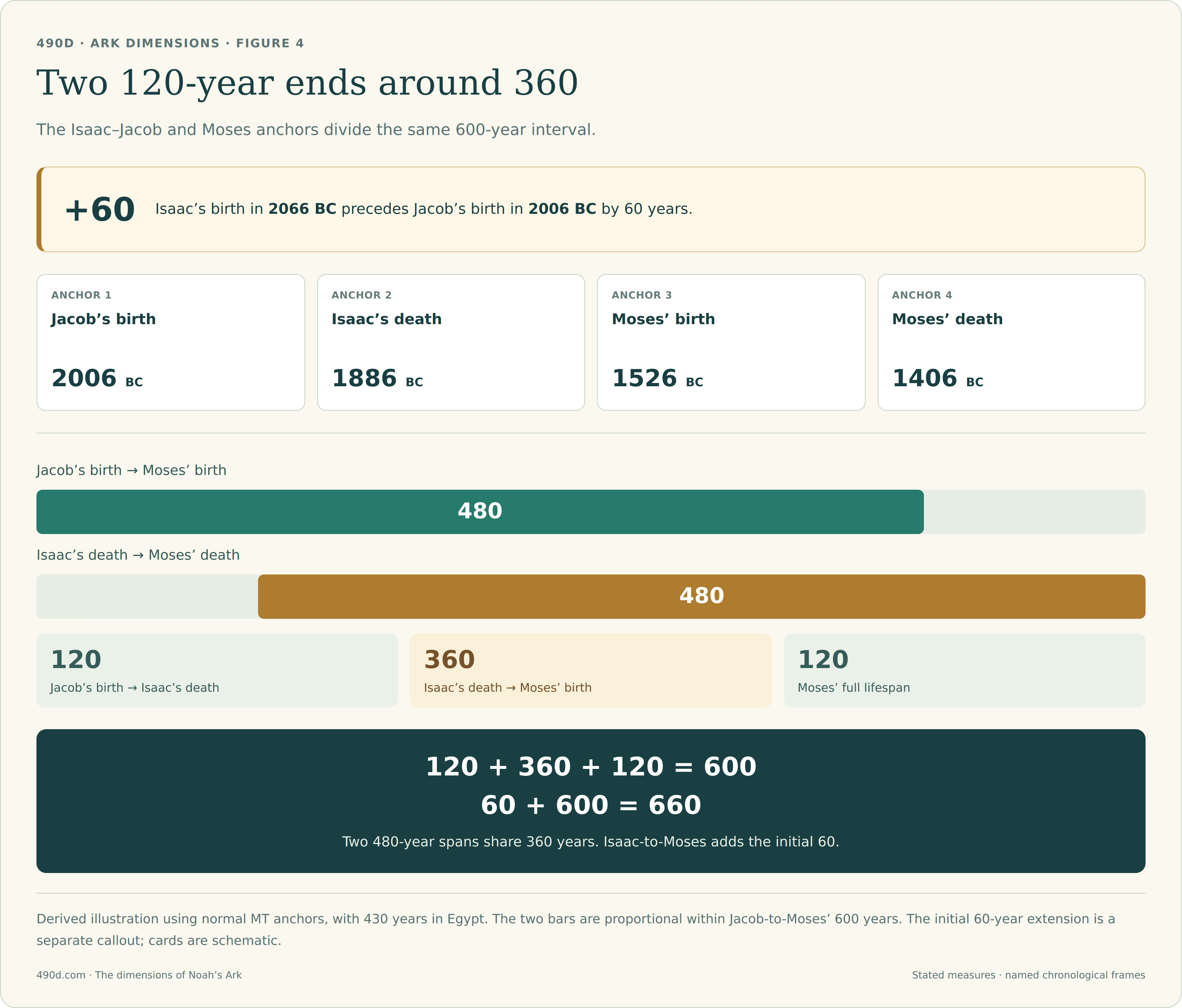
The bookends and their shared center
| Interval | Dates BC | Years |
|---|---|---|
| Isaac’s birth → Jacob’s birth | 2066 → 2006 | 60 |
| Jacob’s birth → Isaac’s death | 2006 → 1886 | 120 |
| Isaac’s death → Moses’ birth | 1886 → 1526 | 360 |
| Moses’ birth → death | 1526 → 1406 | 120 |
| Jacob’s birth → Moses’ birth | 2006 → 1526 | 480 |
| Isaac’s death → Moses’ death | 1886 → 1406 | 480 |
The two 480-year spans share the middle 360, giving 480 + 480 − 360 = 600. This is a derived illustration of the dates in File 18 §§2.3–2.4 and File 47 §5.1. It makes the original bookend observation precise without requiring another chronological adjustment.
The 100-year centers in Shem and Abraham
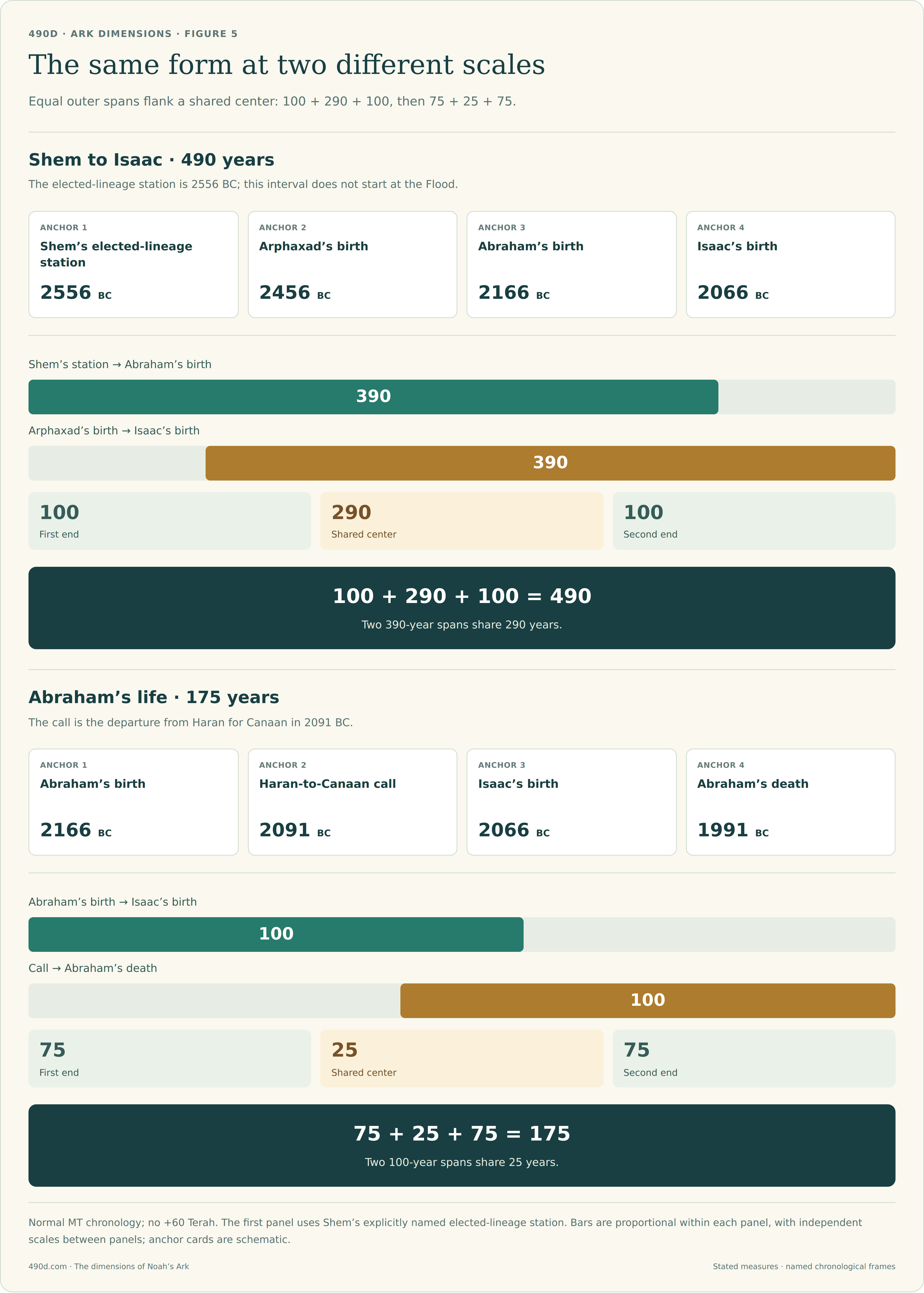
The doubled width also directs attention to fatherhood at 100. Shem’s 100 leads to Arphaxad; Abraham’s 100 leads to Isaac (Genesis 21:5). In the Arphaxad-bound comparison, those equal outer spans surround the 290 years from Arphaxad to Abraham:
2556 → 2456 → 2166 → 2066 BC
100 + 290 + 100 = 490.
The first node is Shem’s elected-lineage station, not the Flood. Each outer 100, joined to the middle 290, forms a 390-year span. Thus 390 + 390 − 290 = 490. File 47 §8.1 registers the 390- and 490-year endpoint relationships; the four-node arrangement displays their shared center.
Abraham’s own life has a smaller version of this structure. He leaves Haran for Canaan at 75 (Genesis 12:4), becomes Isaac’s father at 100, and dies at 175 (Genesis 25:7). His life divides into 75 + 25 + 75. Birth to Isaac is 100 years; departure from Haran to Abraham’s death is another 100. Those two 100s share the 25 years of waiting for Isaac.
490d · Ark dimensions · Figure 5
The same form at two different scales
Equal outer spans flank a shared center: 100 + 290 + 100, then 75 + 25 + 75.
Shem to Isaac · 490 years
The elected-lineage station is 2556 BC; this interval does not start at the Flood.
Shem’s elected-lineage station
2556 BCArphaxad’s birth
2456 BCAbraham’s birth
2166 BCIsaac’s birth
2066 BCShem’s station → Abraham’s birth
Arphaxad’s birth → Isaac’s birth
Two 390-year spans share 290 years.
Abraham’s life · 175 years
The call is the departure from Haran for Canaan in 2091 BC.
Abraham’s birth
2166 BCHaran-to-Canaan call
2091 BCIsaac’s birth
2066 BCAbraham’s death
1991 BCAbraham’s birth → Isaac’s birth
Call → Abraham’s death
Two 100-year spans share 25 years.
Normal MT chronology; no +60 Terah. The first panel uses Shem’s explicitly named elected-lineage station. Bars are proportional within each panel, with independent scales between panels; anchor cards are schematic.
Equal spans and their overlap
| Arrangement | Outer spans counted | Shared center | Whole interval |
|---|---|---|---|
| Noah/Shem, Noah-bound | 600 + 600 | 100 | 1100 |
| Jacob/Moses bookends | 480 + 480 | 360 | 600 |
| Shem elected-lineage → Isaac | 390 + 390 | 290 | 490 |
| Abraham’s life | 100 + 100 | 25 | 175 |
Sources and endpoints: Noah/Shem table, bookend table, File 47 §8.1, and File 01 §2.1. These arrangements have different scales and events, but the same readable form: equal outer portions around a shared middle. Counting the overlap twice explains why the sum of the two larger spans exceeds the whole.
The canonical files also preserve 1906 BC as a bounded birth-label for Benjamin in Jacob’s hundredth-year comparison. With Jacob’s 2006 BC birth, the arithmetic is 2006 − 1906 = 100, followed by 1906 − 1406 = 500 to the Conquest. This supplies another 100 + 500 = 600 arrangement. Its evidential status differs from the explicitly stated fatherhood ages of Shem and Abraham: Benjamin’s birth-label is a reconstructed structural comparison, not an age stated in Genesis. See File 01 §2.2 and File 61 §13.2.
A separate use of 60: the Terah alternative
The optional +60 Terah reading offers another comparison with the doubled height. It moves Terah and the earlier ancestral field 60 years earlier while leaving Abraham’s birth fixed at 2166 BC in the same Egypt-only sojourn position. Its effect must be kept separate from the two-year Noah/Shem choice.
Noah’s death and Abraham’s birth under +60 Terah
| Selected Noah row | Normal birth → death BC | With +60 Terah, BC | Relation to Abraham’s 2166 BC birth |
|---|---|---|---|
| Gear 2 | 3058 → 2108 | 3118 → 2168 | Noah’s death is 2 years earlier |
| Gear 1 | 3056 → 2106 | 3116 → 2166 | Same year label |
Every row retains Noah’s 950 years. The matching-year observation therefore requires Gear 1 together with +60 Terah. It is meaningful within that selected comparison, but it is not the normal Gear-2, no-+60 result. The source rules are in File 02 §6.2 and File 18 §§1.3.1 and 1.4.
The interpretation associates the end of Noah’s life with the beginning of Abraham’s: the survivor of one world gives way to the patriarch through whom the promise advances. The coincidence belongs to the selected year labels; the narrative does not record the two events as occurring on the same day. The Ark’s height provides a proposed numerical association, while the Terah reading has its own genealogical basis.
From the patriarchal era to the wider framework
The larger chronology carries related divisions beyond Moses. In the ordinary whole-year Temple display, Abraham’s birth at 2166 BC precedes the 966 BC foundation by 1200 years. The valid partition is 720 to the Exodus, then 480 to the Temple. File 63 §4.4 supplies this route. Its 480 begins at the Exodus in 1446 BC; it is a different interval from Jacob-to-Moses’ birth, even though their numerical lengths agree.
Selected wider comparisons
| Route | Division | Total | State / source |
|---|---|---|---|
| Abraham 2166 → Exodus 1446 → Temple 966 BC | 720 + 480 | 1200 | Regular MT; ordinary whole-year Temple display; File 63 §4.4 |
| Abraham 2166 → Exodus 1446 → nativity anchor 6 BC | 720 + 1440 | 2160 = 6 × 360 | Regular MT and the working 6 BC nativity anchor; File 01 §5.1 |
| Shem elected-lineage 2556 → Abraham 2166 → 6 BC | 390 + 2160 | 2550 = 7 × 360 + 30 | Derived comparison of the File 47 §8.1 and File 01 §5.1 endpoints |
The last row extends the 2160 by 390 = 360 + 30. Read schematically, the 2550 corresponds to seven units of 360 with one additional 30. At the calendar scale, that is seven 360-day schematic years plus a month. The chronological span in the table is still 2550 years; the calendar expression is the pattern being compared with it.
This does not establish a rule that every historical seven-year interval contained precisely one extra month. Intercalation depends on the calendar and the selected interval. Nor is the working 6 BC nativity anchor derived from the Ark’s dimensions. These are wider comparisons within the declared framework, subordinate to the simpler 600-year structures.
A pattern within the story of deliverance
The comparison between Noah and Moses has a narrative foundation. Noah’s Ark preserves life through the Flood; Moses’ basket preserves the child who will lead Israel out of Egypt. Both vessels use the Hebrew word tebah (Genesis 6:14; Exodus 2:3). File 23 §1 develops this as a theological connection between preservation through water and the emergence of a deliverer.
The numerical observations give that connection a particular shape. Noah reaches 600 at the Flood. Shem’s full life is 600. Jacob’s birth begins a 600-year era whose closing 120 years are Moses’ life. Isaac adds the 60-year extension, while the fatherhood ages and overlapping spans bring the 100-year measure into view.
The shared centers are especially revealing as a way of reading the structure. 500 + 100 + 500, 120 + 360 + 120, 100 + 290 + 100, and 75 + 25 + 75 each organize a whole around a middle that belongs to two equal spans. The divisions help the reader see relationships that a list of dates alone can obscure.
In Christian interpretation, these patterns can be read within the larger gathering of history toward Christ described in Ephesians 1:9–10. That theological reading gives the comparisons their proposed significance. The arithmetic itself establishes the stated relationships under their named conventions; it does not by itself establish statistical independence or prove that the Ark’s builder encoded every later interval.
The argument is therefore strongest where the numbers remain attached to their stories: a vessel preserving life, a family becoming a people, and a deliverer whose life closes a long era. The Ark’s proposed template offers a compact way to contemplate those connections, while the source tables keep each date, span, and interpretation open to examination.
Sources and further reading
For the shorter explanation, return to Noah’s Ark: Its Dimensions and the 600-Year Pattern, with its technical appendix.
The canonical Markdown index supplies the controlling sources. Files 02, 18, and 47 govern Noah/Shem dates and bindings; Files 01, 04, and 55 supply Abraham, Jacob, and Mosaic anchors. File 23 controls the tebah and 120-year interpretation; File 61 §13.2 retains the bounded Benjamin comparison; File 63 §4.4 supplies the corrected Abraham-to-Temple route. File 12 §7A provides calendar controls for readers pursuing the wider schematic comparisons.
All intervals here use whole-year labels on the BC side and ordinary subtraction. No Mirror convention, cumulative lifespan coordinate, or Rounded Chronology operator is being applied. Local variants are identified where they enter the argument.
Scripture quotations: Berean Standard Bible (BSB), public domain.