Technical appendix: chronological states and exact arithmetic · Alpha · Pi · Phi
The fourth study in an integrated investigation of α, π, Φ,
and e
Research companion · v2 · 9 November 2026 · Exploratory and
noncanonical
Companion: Technical
appendix: chronological states, operators, and exact arithmetic
Central proposition. The present study does not ask whether Genesis names Euler’s number. It asks whether two coarse rational approximations to e—299/110 and 666/245—can express, within a pre-existing system of biblical chronology, the linked themes of life multiplying and the created world subjected to mortality. The chronological argument precedes the theological interpretation; the arithmetic can be checked independently of the proposed symbolism.
Reading this study
This is the fourth in a group of related, noncanonical investigations: Alpha, Creation, and Christ: 1/137, Pi and the Biblical Chronology with its technical appendix, and Phi and the Biblical Chronology with its technical appendix. The 490d Unified Chronology Knowledge Catalog and its canonical Markdown sources control chronological states, textual witnesses, and calendrical operators. This article extends those studies; it does not amend the canon or claim that all its projected BC coordinates are independent historical dates.
The reader will meet three different kinds of statement. A biblical text may explicitly provide an age, event, or theological theme. The chronology then assigns a schematic BC coordinate in a specified MT, SP, LXX, or cumulative register. Finally, a mathematical operation generates a projected coordinate and invites interpretation. These three levels should not be confused. The diagrams are maps of the proposed chronology, not archaeological timelines.
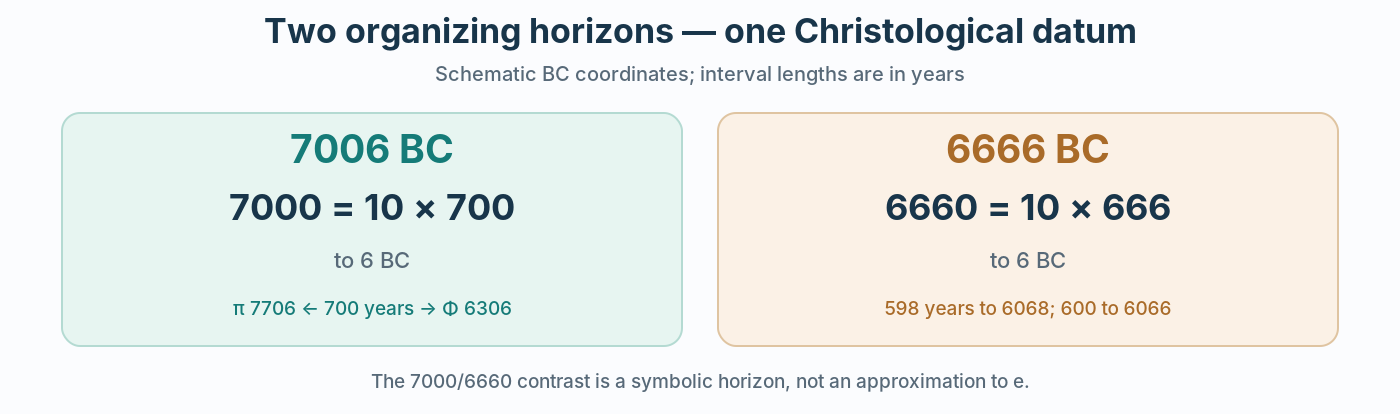
The argument will return repeatedly to two conspicuous figures:
The first is the already established midpoint between the π and Φ projected coordinates, 7706 and 6306 BC. The second is the opening of the present 299/110 corridor. I did not begin this inquiry by seeking a way to put these two figures beside one another. They emerged as the two coarse fractions were tested against chronological intervals already under study. Their contrast—sevenfold fullness beside the repeated 666—will become intelligible only after the derivations have been shown.
- 1. Creation blessed, creation subjected to corruption
- 2. Why e, and why two coarse fractions?
- 3. The Key of 23: a shared calendrical grammar
- 4. The first expression: 6666–6446–6068 BC and 299/110
- 5. Shem’s 600 years and the two parallel rails
- 6. The second expression: 666/245 from cumulative Shem to the Conquest
- 7. Regular Creation also enters through 245
- 8. One Creation week, two chronological registers
- 9. The unexpected arrival at 7006 BC
- 10. The visual contrast: 7000 and 6660
- 11. A wider field, and a limit to the argument
- 12. Conclusion: one creation, two movements
1. Creation blessed, creation subjected to corruption
Genesis opens with a blessing: humanity, made in God’s image, is commanded to be fruitful, multiply, and fill the earth (Gen. 1:26–28). Later, the same earth becomes difficult ground. Adam will eat from it through toil; he will return to the dust from which he was taken (Gen. 3:17–19). Growth and mortality are therefore not two unrelated topics accidentally placed in one ancient book. They are two conditions of humanity’s life in the world narrated by Genesis.
The Flood repeats this tension. Human violence and corruption culminate in judgment (Gen. 6–8), yet Noah and his sons again receive the commission to be fruitful and multiply (Gen. 9:1, 7). The mandate to populate the earth survives judgment. So does the recognition of the human heart’s inclination to evil (Gen. 8:21). The world after the Flood is renewed, but it is not yet the world of final restoration.
The same two movements appear later in Israel’s story. The descendants of Jacob multiply in Egypt even while oppression grows around them (Exod. 1:7–14). Exodus brings deliverance through judgment. The Conquest represents inheritance and a fresh beginning, but Israel is warned that blessing and curse remain real covenant alternatives (Deut. 28–30). At the New Testament culmination, Paul speaks of death entering through Adam and life through Christ (Rom. 5:12–21; 1 Cor. 15:21–22). Romans 8:20–22 portrays creation itself as subjected to frustration and decay while awaiting liberation.
John 12:24 gives the themes their sharpest Christological expression. Jesus compares his approaching death to a grain of wheat that falls into the earth and dies, and thereby bears much fruit. Multiplication is not set against the Cross; in this metaphor the passage through death becomes the way to fruitfulness. This does not make mathematical decay a moral evil. Rather, the narrative allows a mathematical opposition—growth and decrease—to be read as an analogy for a theological drama.
These themes make Euler’s number worth investigating, provided we do not pretend that the biblical text contains a modern differential equation.
2. Why e, and why two coarse fractions?
Euler’s number is
It appears wherever a quantity changes continuously at a rate proportional to its present amount. For a chosen rate parameter and time coordinate ,
The same constant governs both expressions; only the direction of change differs. When , the first quantity is multiplied by , and the second by . These equations are illustrations of proportional growth and decay. No ancient census, mortality curve, or measurable “rate of sin” is being inferred from them.
The investigation begins instead with two approximate expressions:
The lower approximation uses , a number already active in the site’s chronology and in the Enochian Key-of-23 expansion. The upper is equivalently , bringing together (and its double) with the 490-year measure. These are not continued-fraction convergents of . They are coarse chronological fractions whose value for this study lies in the numbers and operations that produce them.
Their closeness is sufficiently good to support the analogy: the lower differs from by about 36.79 parts per million, and the upper by 31.46 parts per million. Yet numerical proximity alone would be a weak argument. Many chosen ratios approximate familiar constants. The relevant test is whether these numerators and denominators emerge through a controlled, already documented chronology—and whether the resulting dates connect with other parts of that chronology without freely changing the rules.
The two fractions also work in opposite directions. The upper factor expands a span; the reciprocal of the lower factor contracts one. Their near-reciprocity is a helpful mathematical image for multiplication and decrease, but its theological significance must be argued from the biblical narrative, not assumed from the signs of exponents.
3. The Key of 23: a shared calendrical grammar
The earlier studies developed what I call the Key of 23. It is not a physical constant comparable to π or . It is a family of fixed rational operations within the chronological model, associated with different schematic measures of a year:
| Named operation | Original schematic year | Expansion | Common schematic reference |
|---|---|---|---|
| Priestly | 336 days | days | |
| Prophetic | 360 days | days | |
| Enochian | 364 days | days |
For example, , or about 365.21739 days. This is a schematic common year, not the exact tropical year; physical solar-year lengths vary with definition and epoch. The chronology’s broader calibration questions belong to the canonical calendar studies.
In the present investigation, four straightforward operations are especially useful:
Each requires a fixed endpoint. To enlarge a span measured backward from the Exodus, we move its represented beginning earlier; we do not shift the Exodus. The Key supplies the transformation grammar. The coarse fractions supply the proposed numerical vocabulary. The biblical chronology supplies the coordinates on which both act.
4. The first expression: 6666–6446–6068 BC and 299/110
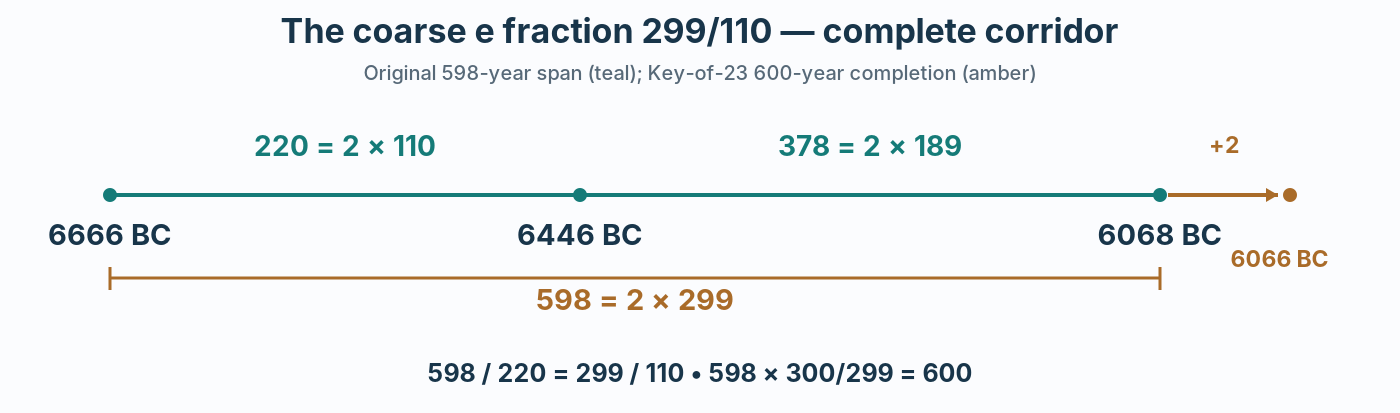
Consider the three proposed schematic coordinates:
The consecutive differences are
and the whole span is
Consequently the fraction is not just a pair of numerals placed side by side:
The middle station expresses the denominator, while the full corridor expresses the numerator. The remaining gives the complementary part. The chosen coordinates are schematic comparison positions. Their appearance in the chronology is not a biblical assertion that an event occurred in each such year. Earlier uses of 6666 BC and 6446 BC provide antecedents, but the complete three-node fraction is the new comparison tested here.
Now the Enochian operator steps in:
With 6666 BC held fixed, the contracted end 6068 BC corresponds to a 600-year ending at 6066 BC. These two dates are not interchangeable. The first yields the exact fraction; the second expresses its Key-of-23 completion.
This 598-to-600 operation was already familiar from the Noah–Shem and inverse-number research. It is especially natural here because is both the numerator of a coarse fraction and the denominator of the Enochian calendar transformation. The common factor explains the ease of conversion without needing to postulate a new operator.
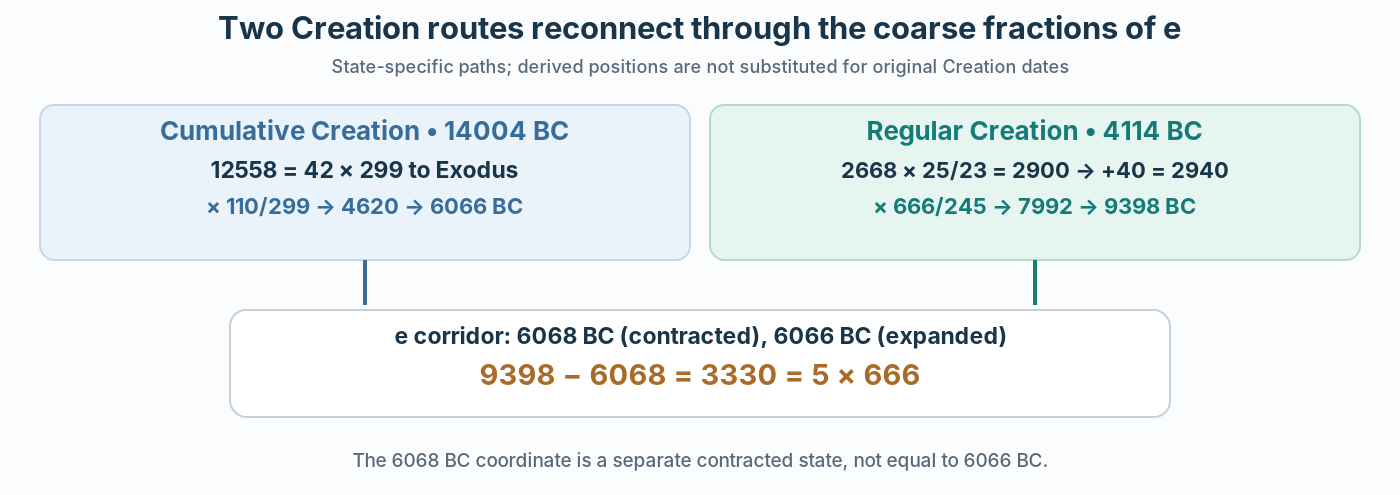
A second route reaches 6066 BC from the cumulative Creation chronology. File_22 preserves the complete Creation-week endpoint at 14004 BC and the Exodus at 1446 BC:
Contract that duration by the reciprocal :
placing the represented beginning years before 1446 BC, at 6066 BC. This is a new use of the coarse fraction upon an independently documented canonical interval. File_22 separately expands the same 12558-year root by to 12600; the contraction above does not replace that canonical expansion. It draws on the same 299-divisibility, for a different stated purpose.
The regular and cumulative chronology must remain distinct, but already the first fraction has become more than a decimal resemblance. It connects a 598/600-year corridor with the cumulative Creation-to-Exodus root.
5. Shem’s 600 years and the two parallel rails
The Φ study provides a second 600-year family. Its cumulative MT Shem coordinates are 5436 and 4836 BC, separated by 600 years. It projects them backward by 1470 years:
These projected dates preserve Shem’s 600-year span:
They also correspond, within the specified comparison register, to regular Gear-2 Noah’s 3058-to-2458 BC interval. The Φ article gives the 1470-year displacement its own mathematical rationale; we use that result here rather than re-deriving Φ.
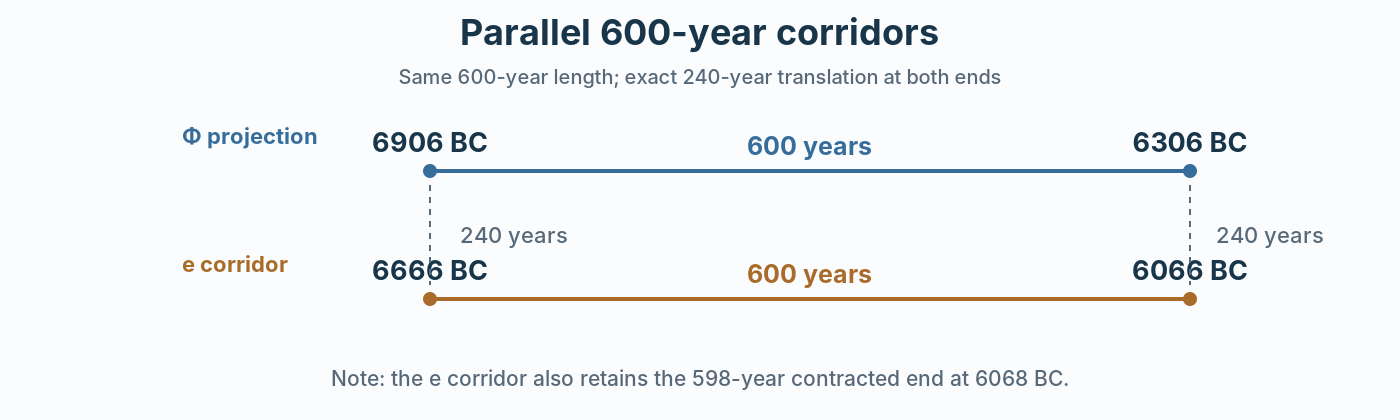
Beside it stands the corridor’s expanded 600-year form:
The two full 600-year rails are translated by precisely 240 years:
Thus a single diagram can preserve 6906–6306 (the Φ projection) and 6666–6066 (the comparison). Their equal lengths and the shared 240-year translation are exact. The latter rail still retains 6068 BC as its contracted -based endpoint. We should not collapse the 598 and 600 registers simply because both serve the interpretation.
The Flood is a further common narrative hinge, but it must be named with its proper chronological state. In the published π study, 2456 BC is the Gear-1 Flood-start / Gear-2 Arphaxad-birth position associated with ; 2457 BC belongs to the Gear-2 Flood closing and the more exact ark-drying/exit calculations, while 2458 BC is the ordinary Gear-2 Flood opening. These years are not three competing corrections to a single date. They are distinct event or modal labels. The Φ projection to 6306 BC is compared with 2458 BC, whereas the related π Fibonacci and framework also employs 2456 BC. The chronological convergence is real within the model only when those distinctions are retained.
6. The second expression: 666/245 from cumulative Shem to the Conquest
The second coarse fraction becomes intelligible through two durations already present in the Φ study. From the cumulative Shem/Flood hinge at 4836 BC to the Conquest at 1406 BC are
The Φ projection moves that beginning back 1470 years to 6306 BC, increasing the Conquest-facing duration to
Both durations are exact multiples of the denominator of the second coarse fraction. Apply , keeping the Conquest fixed:
and
The original 1470-year difference is ; after applying the same fraction it becomes . One ratio thus maps the entire three-node arrangement, not merely two convenient individual spans. The generated 14726 BC coordinate also appears in prior inverse-number research, but this chronological route through is distinct and should be judged as such.
The first striking meeting occurs at 6068 BC. For the new 10730 BC coordinate,
The contracted endpoint of the corridor is therefore the exact midpoint of the span from 10730 to 1406 BC. This does not arise from improving the decimal approximation to . It arises from applying the other coarse fraction to the independently established 3430-year Shem–Conquest interval and comparing the result with the first fraction’s corridor.
7. Regular Creation also enters through 245
A third, shorter input strengthens the construction. File_22 supplies the regular MT Creation-week endpoint at 4114 BC and the Exodus at 1446 BC. Their distance is
The established priestly Key-of-23 operator produces
With the Exodus fixed, this gives the generated Super-Creation coordinate 4346 BC. Add Israel’s forty-year wilderness interval to the Conquest:
Now use the coarse fraction:
The resulting station lies exactly between the previously generated 10730 BC coordinate and the first corridor’s 6068 BC:
Combining the two expressions gives the following entire sequence:
| Generated / comparison positions, BC | Consecutive duration | Units of 666 |
|---|---|---|
| 14726 → 10730 | 3996 | 6 |
| 10730 → 9398 | 1332 | 2 |
| 9398 → 6068 | 3330 | 5 |
| 6068 → 1406 | 4662 | 7 |
| 14726 → 1406 | 13320 | 20 |
Thus the full construction is units of 666. Several of these relationships follow once the selected input durations are mapped by one common factor; they are parts of one structure, not four independent tests of intentional encoding.
The crucial new intersection is the middle : it reconnects the regular Creation branch, through 9398 BC, with the branch’s 6068 BC endpoint.
8. One Creation week, two chronological registers
There is a theological reason not to treat the previous section as mere number play. Both branches ultimately lead back to the complete Creation week, represented in two chronological registers.
The actual cumulative and regular MT Nisan completion/lower-bound positions are respectively 14004 and 4114 BC. The interval between them is
These are not Rounded chronology dates, whose bridge must be kept separate. Nor should these endpoints be confused with the sixth-year/Adam-state pair 14006 and 4116 BC, which preserves the same 9890-year difference. File_22 and the Φ study explicitly distinguish those positions. The seven-year envelopes are 14011–14004 BC cumulatively and 4121–4114 BC regularly.
The completion coordinates are suited to a retrospective literary reading of the whole Creation week. On the sixth day the multiplication blessing is spoken (Gen. 1:28); the seventh day marks completion and rest (Gen. 2:1–3); the curse enters only with the later transgression (Gen. 3). We should not move the Fall into the seventh day, or infer an unstated historical date from the numerical representation. Rather, the completed week may stand schematically for the created order subsequently experienced as both fruitful and mortal.
The cumulative branch gives years from 14004 BC to the Exodus, hence the contraction to 6066 BC. The regular branch gives years from 4114 BC to the Exodus, then the expansion to 4346 BC, years to the Conquest, and expansion to 9398 BC. These are different, named sequences, not a single undocumented transformation of the 9890-year gap.
Their resulting positions come together across . The two week-completion coordinates can therefore be related within the same exploratory framework without being conflated. This is the central chronological expression of the two theological motifs: creation commissioned to multiply, creation later subjected to mortality, and both themes carried forward through Israel’s history toward Christ.
9. The unexpected arrival at 7006 BC
We can now return to a coordinate established before this investigation. The π and Φ studies place their projected positions at 7706 BC and 6306 BC. Their midpoint is
The Φ study already knew one route to that middle date. Its projected Shem coordinate 6906 BC stands 6900 years before the selected 6 BC Christ datum. With that endpoint held fixed,
placing the represented beginning at 7006 BC.
The present corridor supplies a second one-step route. Its intermediate position is 6446 BC, and
Applying the priestly operator gives
again reaching 7006 BC. The 6446-to-7006 route has an antecedent in the earlier Birth and Cross of Christ in Symbolic Time, §12, where 6446 BC arises from an altogether different sequence of Creation and Key-of-23 comparisons. The new point is not that 6446 or 7006 BC had never been written down. It is that 6446 now arises as the internal station of the corridor, so the independently developed investigation meets a previously documented path to the π–Φ midpoint.
The two paths should be set alongside one another, not statistically counted as independent miracles:
| Source position | Span to 6 BC | Key-of-23 operation | New span | Destination |
|---|---|---|---|---|
| 6906 BC, Φ projection | 6900 | 7000 | 7006 BC | |
| 6446 BC, corridor | 6440 | 7000 | 7006 BC |
This is the meeting that prompted the present inquiry to become a larger article. The grammar has entered a location that the π and Φ work had already made structurally important, without introducing a new transformation rule.
10. The visual contrast: 7000 and 6660
The architectural center of the article can now be stated simply:
The 7006 BC position is centered within the 700 + 700 span from the π projection at 7706 BC to the Φ projection at 6306 BC. The 6666 BC position begins the 598-year corridor that becomes 600 years through . Within that corridor and its wider consequences appear the 666-year multiples generated by .
The comparison is visual, grammatical, and theological—not an assertion that , which it does not. The numerical grammar that approximates remains and . The paired 7000 and 6660 horizons disclose the contrasting symbolic fields into which those fractions have led.
Seven, seventy, and seven hundred evoke completion and the fullness of a created order in biblical and schematic time. The number 666, given explicitly in Revelation 13:18, is a fitting symbol for creaturely disorder and human pretension in the author’s theological reading. Biblical textual criticism also records the variant 616 for Revelation 13:18; that variant must not be hidden, even though the present numerical comparison is specifically the 666 register. These associations do not mean that 600 itself is intrinsically evil, nor that every occurrence of seven guarantees blessing. Noah’s 600 years before the Flood, for example, encompass both the preparation for judgment and the renewal of the world.
The contrast is therefore best expressed as fruitfulness under the blessing of God, yet within a creation marked by sin and mortality. Christ’s life, death, and resurrection supply the narrative resolution, not a numerical proof. The number is mathematically indifferent to good and evil. It is the biblical story that supplies the proposed direction of meaning.
11. A wider field, and a limit to the argument
Several larger coordinates belong to the same construction, but they should support rather than displace its principal contrast.
The route from 6306 BC gave 14726 BC. Measured to the fixed 6 BC Christ datum,
and the priestly operator produces
hence 16006 BC. The Φ study had already reached 16006 BC by another route: the 15806-to-2006 BC span is 13800 years, and , with Jacob’s 2006 BC coordinate held fixed. The prior study also records as an antecedent in the inverse-number literature. The new contribution is the distinct way the coarse fraction arrives at 14726 BC from the -year Shem/Flood–Conquest interval.
There is also a coordinated two-point transformation:
The priestly operator converts the first separation into the second when both source spans are measured to 6 BC. This is a shared-algebra result, not four independent confirmations.
A further organizing position, 5006 BC, is used in the broader research conversation. It is years after 6446 BC and stands 5000 years before 6 BC, while 6446 BC stands 5000 before the Exodus. The parallel 5040-year comparisons run to AD 35 and the Conquest respectively. This is a useful secondary pattern. Its earlier π–Φ derivation is documented in Phi, §12A and Technical Appendix M3; it remains supplementary to the present e argument.
Other observations also belong in an appendix. The two coarse fractions differ by exactly , which equals . Their mediant reduces to , a legitimate convergent of . Their denominators 245 and 110 relate arithmetically to the π approximation , since and . Indeed, . These are worthwhile mathematical consequences. They are not the proposed biblical grammar itself, and we should not search for an interpretive significance for every number that the two fractions generate.
The most demanding question remains one of selection. Biblical chronological systems contain many dates, ratios, and transformations. Once an interesting relationship is found, neighboring identities will often follow automatically. Here the most substantial arguments are the pre-existing canonical roots , , and ; the two coarse fractions applied by declared rules; the independently documented π–Φ midpoint; and the resulting intersections at 6068, 7006, and 16006 BC. A rigorous assessment must preserve the research history, distinguish generated coordinates from biblical events, and record which identities are consequences of the same algebra.
12. Conclusion: one creation, two movements
The investigation began with two seemingly modest fractions:
Their chronology has now become much more specific. The lower fraction is present in the 6666–6446–6068 BC corridor and its 598-to-600 expansion. The upper operates upon 2940, 3430, and 4900 years derived from regular Creation, cumulative Shem, and the Φ projection. The two fractions meet at the 6068 BC station and the repeated 666-year measures. The same Key-of-23 grammar then connects their generated positions to the established 7006 BC center of π and Φ, and to the 16006 BC extension.
The opening of the story is the Creation week, whose two complete chronological registers preserve a 9890 = 23×430 interval. The biblical blessing is multiplication; the tragedy is mortality and a cursed ground. The Flood renews the multiplication command after judgment. The Exodus and Conquest carry the themes of deliverance, increase, inheritance, and covenantal warning. At Christ, the image of a grain dying and bearing much fruit brings the narrative to its theological climax.
This is the sense in which I propose a mathematical language of biblical chronology. The constants suggest different kinds of mathematical relation: α in the fine-structure analogy, π in circle and periodicity, Φ in proportion, and in proportional growth and decay. The Key of 23 provides a shared calendrical transformation grammar through which their coarse chronological expressions sometimes intersect. None of this establishes that an ancient human writer calculated the modern constants. It proposes instead a coherent numerical reading whose calculations, state distinctions, and interpretive claims can be examined separately.
The article’s most memorable visual expression is deliberately simple:
Between and around those horizons run the 700-year arms of π and Φ, the 598/600 years of ’s first corridor, and the intersecting multiples of 666. The arithmetic is exact within its specified schematic coordinates. Its possible status as a deliberately composed biblical numerical language remains the hypothesis being tested.
Sources and companion reading
- Alpha, Creation, and Christ: 1/137 — the 137/138 research, 299 and 666 antecedents, and Creation/Christ comparisons.
- Pi and the Biblical Chronology and technical appendix — , the Noah–Shem corridor, the 2456/2457/2458 state distinctions, and 7706 BC.
- Phi and the Biblical Chronology and technical appendix — 5436/4836, 6906/6306, the 1470 + 3430 = 4900 projection, the π–Φ midpoint, and the Fibonacci-related outer field.
- The Birth and Cross of Christ in Symbolic Time, especially §12 — an earlier, independently described 6446-to-7006 BC route.
- 490d Unified Chronology Knowledge Catalog and canonical Markdown index — source hierarchy, model states, and chronological controls. In particular File_22: Cumulative MT Harmonics, §§8–9, controls the 12558 and 2668-to-2940 calculations.
- Biblical texts: Genesis 1–3, 6–9; Exodus 1–14; Deuteronomy 28–30; John 12:24; Romans 5:12–21; 8:20–22; 1 Corinthians 15:21–22; Galatians 3:13; Revelation 13:18.
Editorial status: Exploratory research companion. The exact identities have been checked; chronological labels are model-dependent; intentional encoding and the theological reading remain proposed interpretations. No canonical amendment follows from this article.