Technical appendix · √2 study · π study
- 1. Reading the three companions together
- 2. Chronology before geometric reuse
- 3. One square, two circles and two triangles
- 4. The complete nested construction
- 5. Reading the picture through the narrative
- 6. The Flood-day geometry
- 7. The eighth circle and the Pentecost comparison
- 8. Regular and cumulative realizations
- 9. The third-circle measures toward Temple and Christ
- 10. The recovered year: 222 and the 9800/9801 square
- 11. Bounded extensions and remaining questions
- 12. What the common grammar explains
- Sources and technical companion
Version 2 · 15 November 2026 · Published research article
Technical companion: Exact geometry, chronology and phase ledger
Series companions: Published π study · √2 v10
1. Reading the three companions together
The square and the circle belong together in the elementary geometry underlying this investigation. A square gives a diagonal through √2; a circle gives circumference through π. When a circle is inscribed within a square, and a second circle passes through the square’s corners, the same side supplies the diameters of two natural circular measures. At side seventy, those measures come close to 220 and 311. The chronological studies had already brought these numbers into relation before the fuller two-circle picture was developed.
I approach biblical chronology as an inspired numerical language whose grammar is partly obscured. Its numbers are encountered within stories: Creation, the Flood, the patriarchal family, the Exodus and Conquest, sanctuary and Temple, and fulfillment in Christ. The prose does more than decorate an arithmetic result. It identifies what a number is doing—whether it describes a beginning, a boundary, a judgment, a period awaiting completion, or a restored whole. Conversely, the chronological measures can draw attention to relationships within the narrative that might otherwise remain implicit.
This study develops the common geometric picture disclosed by the earlier π and √2 investigations. The original π study begins with chronological spans and explicitly defined calendar corrections, obtaining approximations to π. The √2 study begins with cumulative and regular chronology, obtaining 140/99 and 99/70 and developing their connections with the Flood and the genealogy. Their present companion asks how those established numerical forms can be read within one construction. It therefore retains their discovery histories rather than presenting a geometric drawing as the original source of every date.
The foundational picture is a square of side seventy, area 4900 and diagonal 70√2. Its inner circle has diameter seventy; its outer circle has diameter 70√2. The upper half-square is a mountain triangle. A smaller inverted triangle, bounded by the inner circle, gives the lower counterpart. Enlarging squares and circles alternately produces a reproducible nested sequence. I read that sequence through Creation, heavenly order, descent and ascent, and renewed creation. The exact construction can be demonstrated independently of that interpretation; its proposed meaning arises from the narrative and the chronology together.
Conservation of Narrative Information guides the treatment of an unstated date: first the earliest permissible bounded inference, then inheritance from a clear narrative parallel, and then retrospective canonical corroboration. The Flood’s bird sequence is a particularly important example. Genesis dates some boundaries and states the waits; the selected reconstruction supplies the earliest same-day raven/first-dove alignment. Its ensuing Day 318 becomes a joint of the geometric argument. That day is inferred under declared constraints, while the 70-day extensions beyond departure are generated comparisons. Their different roles will remain visible.
I adopt the Enochic/Jubilees framework of the earlier studies: the Watchers’ descent, Enoch’s witness, the Flood, renewed transmission through Cainan, Babel, and the continuing judgment of rebellious powers toward Christ. Within my providential reading, the composition can carry a fulfillment richer than an individual human writer consciously formulated. This is the governing theological perspective of the research, alongside the separate question of what historical evidence would demonstrate ancient use of this exact diagram.
Regular and cumulative chronology, actual and Rounded states, MT/LXX/SP/Jubilees, Flood Gears and calendar phases are named wherever they contribute to an equation. A shared year numeral can belong to different objects. The Key of 23 supplies established calendrical transformation grammar—25/23, 70/69 and 300/299—rather than an additional universal constant. Each execution identifies both the interval changed and the endpoint held fixed. The source register in Appendix A makes these distinctions available without interrupting every paragraph.
The exposition proceeds from inherited chronology to geometry, then through the Flood and the eightfold comparison toward the recovered-year construction. That last argument concerns 9800 and 9801, but its theological content cannot be conveyed by writing only 99²=9801. Its one represents a complete schematic year in a declared chronological comparison. Section 10 develops the source states, the 222 gain, Year 6 and Year 13, and the authorial reading of restoration in full.
The three studies are intended to be independently readable and mutually illuminating. Useful repetition serves that purpose. The completed e publication v6 is not revised here, and the later Φ/e/α synthesis remains a subsequent investigation. The purpose of this study is to establish and explain the common square-and-circle grammar clearly enough that later integrations can retain their own evidence.
2. Chronology before geometric reuse
The prior π foundations
The published π study begins with the actual cumulative MT lifespan framework, ending at Moses’ death and the Conquest in 1406 BC. Its selected internal Year-6 coordinate is 14006 BC; the whole span is:
Its midpoint is consequently 7706 BC. The selected Christ datum at 6 BC gives the later numerator 7700 years. A regular Gear-1 Flood/Arphaxad comparison at 2456 BC divides that whole into 5250+2450, with 7700/2450=22/7. The midpoint and named termini preceded the recognition of their constant comparison. Their chronological provenance should remain part of the argument even when a later diagram expresses their proportions economically.
The finer π fraction uses the ordinary Gear-2 Flood-closing year 2457 BC with a declared Nisan-6 opening phase. On the schematic 360-day scale, the later part is 2451×360−5 days:
The difference from π is about 5.10 parts per billion relative to π. With the numerator held fixed, the exact-π denominator is about 0.004501468 day larger. This is a conditional comparison of specified chronological quantities and a specified phase. It is different from multiplying a geometrical diameter by a known π, as later sections of this study will do.
A second source family is Noah and Shem. In the selected MT Gear-1 state, Noah’s birth 3056 BC, Shem’s birth 2556, the Flood label 2456, Noah’s death 2106 and Shem’s death 1956 give:
Their ratio is 1100/350=22/7. Noah’s 350 post-Flood years are textual; the absolute coordinates are model assignments. The ordinary Gear-2 dates differ and do not give the identical 1100 construction. The published second refinement adds the 51-day Nisan-6-to-Iyar-27 interval to a 350-year denominator, obtaining 396000/126051. Its exact-π phase uses the end of Nisan 6, a different boundary from the primary fraction’s opening phase. Appendix C preserves these derivations without blending their origins.
The regular Creation–Exodus counterpart adds another source-defined arrangement. Creation completion 4114→Exodus 1446 has midpoint 2780; the ordinary Flood 2458 divides its later half into 322+1012, so 1012/322=22/7. Expanding the 2668-year whole by 25/23 with Exodus 1446 fixed generates 4346 BC. This branch, its midpoint rails and its Danielic comparisons are established parts of the prior π research. Its later meeting with 4206 is a new connection, not a new discovery of 4346 itself.
The √2 foundation and its source states
The √2 inquiry uses the Rounded cumulative and regular Creation coordinates 14006 and 4106 with the same 6 BC datum:
The whole-span midpoint 7006 gives 9900/7000=99/70. Thus a chronological framework supplies one near-geometric progression, 70→99→140. The two fractions are related by doubling the reciprocal; their product is exactly two. The actual matching Year-6 pair is instead 14006/4116, with bridge 9890. Actual completion 14004/4114 retains that same 9890, while the Rounded bridge is 9900. The shared 14006 numeral retains distinct actual-internal and Rounded roles.
The regular Rounded sequence then gives:
Creation→Flood and Noah→Conquest each measure 1650 and overlap by 600. Their sum is 3300; their elapsed union is 2700. Against reference diameter 1050, 3300/1050=22/7. The scale connection is 9900=3×3300. It links the chronological constructions without turning the 1050 reference circle into the original side-70 square’s circumcircle.
| Source field | Selected labels, BC | Mathematical role |
|---|---|---|
| Actual cumulative MT | Year 6, 14006; Conquest, 1406 | 12600 and midpoint 7706 |
| Rounded cumulative/regular MT | 14006; 4106; 6 | 14000/9900 and 9900/7000 |
| Ordinary actual regular MT | Creation complete 4114; Flood 2458; close 2457 | The 1656 span and dated Flood-day frame |
| Rounded/Gear-1 comparison | Noah 3056; Flood label 2456; Conquest 1406 | 1050+600+1050 |
| Fixed elected-lineage birth | Arphaxad 2456 | Independent birth role at the shared year label |
The canonical source supplies those state definitions. The present study does not select an alternative because it produces a cleaner number and then quietly substitute it for the original. Where a construction compares different states, the transition itself is part of the statement, as in the 4206 co-registration developed below.
An operation preserves something specified
Translation moves both endpoints by the same amount and preserves an interval. Uniform scaling changes lengths in a specified ratio; square area changes by the square of that ratio. Reflection changes the sign of a defined chronological coordinate. A Key-of-23 execution changes an interval count under its established calendar grammar while one endpoint is held fixed. These are different operations, even when their outputs meet at one numeral.
The reference identity is:
The common reference is a mathematical construct in the grammar, not a universal physical solar year. Counting the same reference interval in different calendar units explains why the outputs carry different register labels. Numerical factorization such as 1800=5×360 can subsequently contribute a symbolic reading, while the executed 25/23 output retains its Priestly register. Appendix A states the chronological application protocol, and Appendix F records both principal executions used in the restored-year chapter.
Once these inputs and operations are established, the drawing becomes a way of seeing their relationships. The geometry does not replace their sources. It makes a candidate common grammar explicit enough to check, explain, and compare across the narrative.
Units in the comparisons. A geometric length begins in diagram units. The Flood-day illustration reads its numerical measures directly in schematic days; the jubilee and eightfold calendar projections instead assign 360 schematic days to each linear unit. These are distinct declared scales. Square areas begin in square units: their reuse as year-numbers in section 10 is a numerical correspondence, not a length-to-area or area-to-time conversion.
3. One square, two circles and two triangles
Let the earth-square in the proposed picture have side seventy. Its exact area is 4900=10×490 and its diagonal 70√2. Rotating the square gives a diamond orientation with vertices at the top, bottom, left and right. I use that orientation because it makes the upper mountain and the lower counterpart visible without changing any metric relationship.
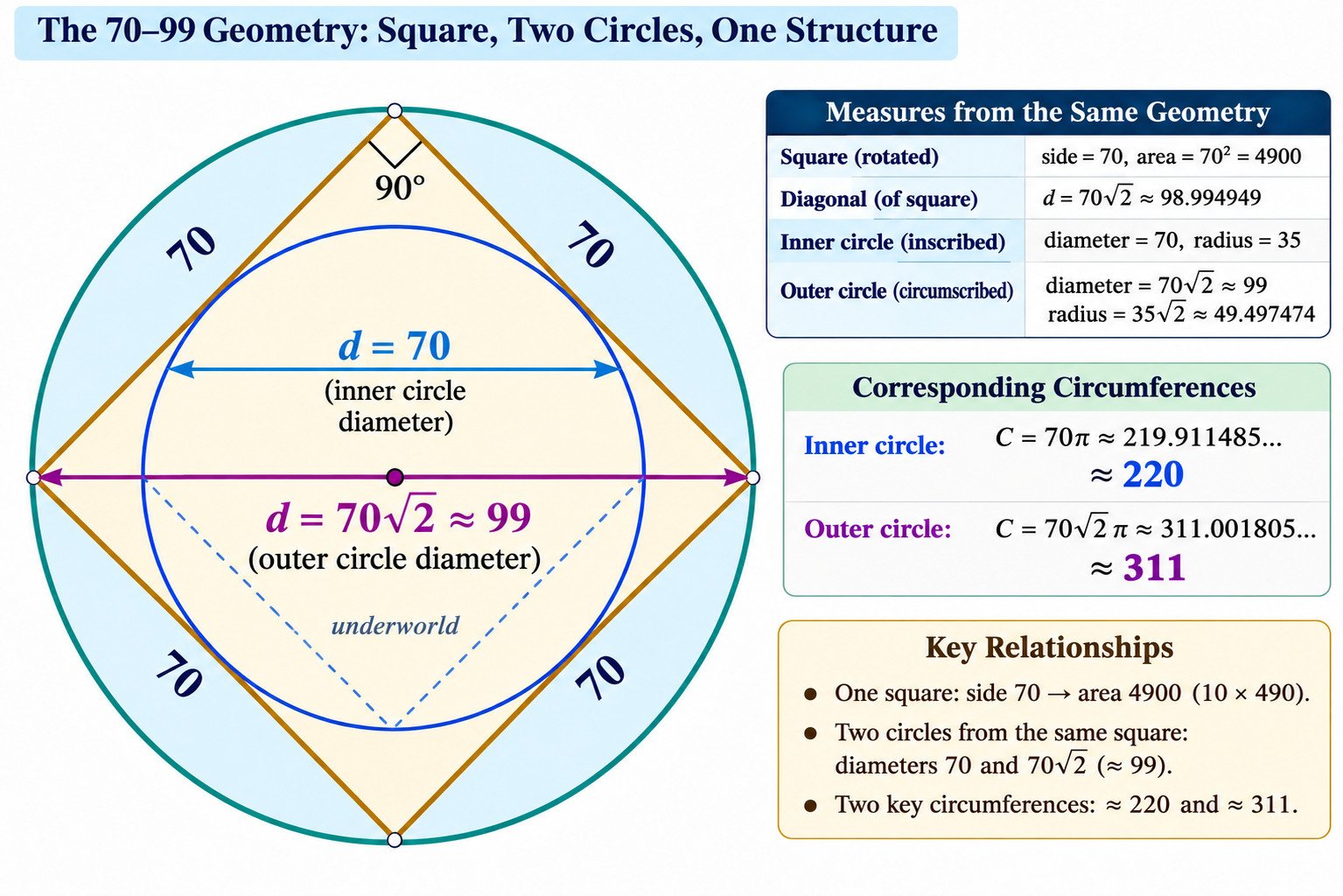
The two circles are natural companions
The inner circle has radius 35 and circumference 70π≈219.911485751. The outer circle has radius 35√2 and circumference 70√2π≈311.001805671. The outer linear measures are √2 times the inner ones; its area is twice the inner area. Both circles belong to the same exact square, which is circumscribed about the inner and inscribed within the outer.
| Measure | Exact value | Working value or numerical reading |
|---|---|---|
| Earth-square area | 70²=4900 | 10×490 |
| Earth-square perimeter | 280 | Four 70-unit sides |
| Inner diameter | 70 | 70 |
| Inner circumference | 70π≈219.911485751 | 220 under 22/7 |
| Inner area | 1225π≈3848.451000647 | 3850 under 22/7 |
| Outer diameter | 70√2≈98.994949366 | 99 |
| Outer circumference | 70√2π≈311.001805671 | 311 integer; Cw=311+1/7 rational |
| Outer area | 2450π≈7696.902001295 | 7700 with exact diagonal and 22/7 |
The number seventy is the least common integer denominator of the chronology-led 22/7 and 99/70 approximations. The exact construction then explains why the approximately-220 and approximately-311 circuits can appear together. The 220 is not assigned to the diameter-99 outer circle. It belongs to the diameter-70 inner/reference circle.
The unit defect is exact: 99²−2×70²=1. The working 99 slightly exceeds the true diagonal, while it stands one below the symbolic hundred. Those two comparisons have different meanings. The mathematical excess over 70√2 must remain distinct from the narrative shortfall before completion at 100.
The mountain and the smaller inverted triangle
The upper mountain is the upper half of the original square. Its two sloping legs are exactly seventy, its horizontal hypotenuse 70√2, and its altitude 35√2. Its exact area is 2450, half the square. Its exact perimeter is 140+70√2≈238.994949366, with working perimeter 239.
The smaller inverted triangle is drawn within the inner circle. Its base runs from x=−35 to x=35 along the central horizontal diameter, and its lower vertex is at (0,−35). Its base is consequently seventy and its altitude thirty-five. Each sloping side is 35√2. Its exact area is 1225, a quarter of the earth-square, and its perimeter is 70+70√2≈168.994949366, working 169.
The two perimeters differ by one exact side of the square:
Thus 239−169=70 is the readable working form of an exact cancellation. The two lower slopes together equal the upper triangle’s base. The difference is not produced by an arbitrary rounding of unrelated sides; it belongs to the shared construction.
| Triangle | Slopes | Horizontal base | Height | Area | Exact perimeter |
|---|---|---|---|---|---|
| Upper mountain | 70, 70 | 70√2 | 35√2 | 2450 | 140+70√2 |
| Lower inverted | 35√2, 35√2 | 70 | 35 | 1225 | 70+70√2 |
The small inverted triangle is also half the innermost square of the nested construction, whose side is 35√2 and area 2450. This locates it naturally within the larger recurrence. It is not the same object as simply halving the original upper triangle’s sides: that other half-sized triangle has legs 35, base 35√2 and working hypotenuse 49.5. The √2 article uses that half-size reading in its Arphaxad/Shelah comparison; both triangles retain their separate jobs.
Exact and working calculation states
Four states are available when the outer diameter and π are independently retained as exact or replaced by their working values:
| Diameter | Circle constant | Circumference | Area |
|---|---|---|---|
| 70√2 | π | 70√2π | 2450π |
| 70√2 | 22/7 | 220√2 | 7700 |
| 99 | π | 99π | 2450.25π |
| 99 | 22/7 | 2178/7 | 7700+11/14 |
These states were already distinguished in √2 v8 Appendix I.3. The November development gives particular prominence to the exact circumference 311.001805671… and its nested eightfold consequence. It does not retrospectively replace the old rational Cw or its discovery history. Section 7 will use permanent diameter/π labels for the states so that a change in table order cannot change which calculation is meant.
The remaining original square/circle comparisons below explain the area, boundary and genealogy readings that were developed before the fuller two-circle synthesis. Their new place here gives them more room while the √2 article retains its own sufficient foundation.
Seventy and seventy-seven around the boundary
The square has four equal sides of 70. Each side joins two points separated by a 90° angle at the circle’s centre. The corresponding quarter-circle arc uses the working circumference already derived in √2 v8 §2:
Each quadrant therefore places a straight square-side measure of 70 beside a circular measure of 77 plus its fractional residue. The entire circumference carries the residue 22/7 ≈ π; each quarter carries 11/14 ≈ π/4. The two integer components are 4×70 = 280 and 4×77 = 308. The full rational circumference is 311.142857…; 311 is the simplified expression used elsewhere in the study.
Two rounded outlines: 239, 253, and 275
The working circumference lies between two fourfold integer outlines:
Here 312 is an upward approximation to the whole circumference, or the result of rounding each quadrant upward to 78. In my proposed numerical vocabulary, 77 supplies the completed form and 78 = 6×13 an opposing form. This is an interpretive use of the neighboring integers; the exact quadrant remains 77 + 11/14. The four 77 and four 78 measures describe alternative outlines, not exact intersections at every 90°.
The mountain triangle’s working perimeter and the 77-based closed semicircle boundary share the diameter 99:
The semicircle boundary includes its diameter; its arc alone is 154 in this integer presentation. Keeping the fractional circumference gives 99 + Cw/2 = 1782/7 = 254.571428…; the 78-based presentation instead gives 255. The following observation specifically uses the 77-based outline.
Since 253 = 23×11, the established Priestly operator supplies:
For this geometric interval comparison the common starting origin is held fixed, and the 253-unit boundary-length interval is extended to 275. No civil date is attached to that origin. The descending sequence 275 → 253 → 239 consequently gives:
The gain under the Key of 23 and the difference between the two boundaries thus reproduce the working semicircle ratio. This depends on the selected 77 outline and the existing approximations; it is not an independent measurement of π.
There is chronological provenance for both boundary numbers. The ordinary actual Gear-2 Flood opening at 2458 BC stands 1012 years before the 1446 BC Exodus:
I read this within the Ararat–Sinai mountain sequence. The calculation uses the Flood-opening and Exodus year coordinates, rather than a day-resolved interval from the ark’s later resting to Israel’s arrival at Sinai. Meanwhile, Arphaxad’s 99 years to Peleg and the 239-year lives of Peleg and Reu give the triangle’s 99 and 239 a genealogical setting. Peleg’s 30 + 209 and Reu’s 32 + 207 each total 239 in Genesis 11.
Two mountain triangles and Peleg’s divided earth
The actual cumulative lifespan succession places Peleg, Reu, and Serug at 3496 → 3257 → 3018 BC:
I compare these two lifespan boundaries with the two triangular halves of the square. Joining them removes their shared working diagonal twice from the sum of their perimeters:
Thus 478 counts the two triangular boundaries, including the internal division twice; 280 is the square’s outer perimeter. Their two exact triangular areas are 2450 + 2450 = 4900. Peleg’s name and the statement נִפְלְגָה הָאָרֶץ, “the earth was divided” (Genesis 10:25), supply the narrative setting for reading the shared diagonal as division of the whole earth. The existing 4900-year Peleg–Conquest Mirror correspondence in √2 v8 §14 supplies a separately sourced chronological comparison for that area-number.
The cumulative Rounded lifespan method rounds each 239 to 240. With Peleg’s cumulative 3496 BC starting node unchanged, the companion chain is 3496 → 3256 → 3016 BC, giving 240 + 240 = 480. This is File_51a’s cumulative whole-lifespan rounding, distinct from its regular remaining-years death-date method. The boundary accounting remains coherent:
In this reading 239 falls one short of 240 as 99 falls one short of 100. The completed integer outline 70 + 70 + 100 supplies the coarse 100/70 = 10/7 vocabulary; it does not replace the exact right-triangle hypotenuse 70√2. The two cumulative 240-year blocks also prepare the comparison with the 480 years from Exodus to the Temple developed in √2 v8 §11.
The square, its circle, and the gestational measure
Completing the two perpendicular legs into a square gives:
For the exact diagonal 70√2, the circle’s area is 2450π. Using the working π ratio 22/7 gives the whole-number area 7700. The resulting comparison is:
| Working measure | Value | Shared seventy-unit form |
|---|---|---|
| Square area | 4900 | 70 × 70 |
| Circle area using exact diagonal and 22/7 | 7700 | 70 × 110 |
| Circle less square | 2800 | 70 × 40 |
The area relation therefore carries the same 110 − 70 = 40 vocabulary that will recur in Joseph and Joshua. Its difference 2800 is numerically ten times the perimeter 280. These are comparisons between geometric measures read symbolically, with their length and area roles stated.
The perimeter also supplies the study’s full 280-day gestational measure: forty weeks. The nine-month seasonal construction uses 270 days on twelve thirty-day months; those two gestational registers retain their respective functions.
Using 99 as the circle’s working diameter gives a different exact area coefficient:
With π itself this is approximately 7697.6874. The quarter is already built into 99² − 2 × 70² = 1: division by four gives the quarter-unit excess over 2450. Read as a year coefficient, it supplies 2450 years and one ninety-day schematic season. The 7700 whole-area pattern and this quarter-unit refinement are related calculation states; √2 appendix I records their separate values.
The selected Flood markers on the 360-day display are rain completion at ordinal Day 87, Ark rest at Day 197, mountain tops visible at Day 271, and covering removal at Day 361. They occupy successive summer, autumn, winter, and spring regions in the spring-start alignment; Days 271 and 361 are exact quarter-year openings. The traditional John–Jesus conception and birth sequence likewise occupies autumn, spring, summer, and winter phases. This seasonal comparison has its narrative basis independently of choosing the 2450 or 2450.25 coefficient.
The same area-numbers amplify the jubilee and forgiveness vocabulary:
| Working area-number | Factorization | Numerical reading developed here |
|---|---|---|
| Circle: 7700 | 100×77 | The seventy-seven form at hundredfold scale |
| Square: 4900 | 100×49 = 10×(70×7) | The forty-nine-year jubilee count; the seventy-times-seven form at tenfold scale |
The different multipliers remain explicit. The areas are measured in square units; their numerical reuse in chronological spans is a symbolic correspondence whose dates retain their independent source definitions. Their ratio recovers the established half-π expression, 7700/4900 = 11/7.
The rounded-diameter model also preserves a small shared residue. Write πw = 22/7. Then:
The whole-number circle area 7700 uses the exact diagonal 70√2 with πw. The value 7700 + 11/14 instead uses the rounded diameter 99 with πw. The quadrant’s arc-length and this latter area-number contain the same numerical residue, 11/14, in their respective units. Their agreement follows from 99² − 2×70² = 1; it is a connected consequence of the construction.
Two radii, a full year, and the Flood genealogy
The centre is the origin, or pole, at r = 0. The black dot marks it without a letter in the earlier rotated source view, reproduced as Figure B4 in section 5. Directions 0° and 180° identify opposite rays from that centre; the angular direction at the pole itself is undefined. The straight diameter is approximately 99 units. Degrees measure the angle between its rays, while the units measure length and receive their schematic chronological interpretation.
Each working radius is half of 99:
The equal radii place the working measure midway between 49 and 50. A duration of 49.5 elapsed years lies within its fiftieth year. I read this in relation to the forty-nine-year count and fiftieth-year proclamation of Leviticus 25:8–11, whose jubilee announcement falls on the Day of Atonement. The geometry supplies the half-measure; the text supplies the jubilee vocabulary.
The Flood genealogy supplies another ordered reading of 99. The following entries use the ordinary actual MT Gear-2 frame: Flood start 2458 BC, closing year 2457 BC, and fixed Arphaxad birth 2456 BC. The Rounded/Gear-1 comparison in √2 v8 §1 retains its stated role.
| Event | Coordinate, BC | Shem’s age in this alignment | Noah’s age in this alignment |
|---|---|---|---|
| Flood begins | 2458 | 98 | 600 |
| Flood’s closing year | 2457 | 99 | 601 |
| Arphaxad is born | 2456 | 100 | 602, derived |
Genesis 7–8 supplies Noah’s 600th/601st-year markers; Genesis 11:10 supplies Shem’s age 100 at Arphaxad’s birth, two years after the Flood. The canonical year-coordinate alignment gives the intermediate ages. In this narrative order:
The one-year Flood interval occupies the final year of the 99-year age measure. Its position is retained as 49 + 49 + 1. The centred half-year decomposition and this genealogical sequence are readings from different declared reference points: the geometric centre in one case, Shem’s birth in the other. The year-coordinate comparison does not replace the separate day-and-month boundaries of the Flood narrative.
Arphaxad to Shelah and Peleg: the smaller triangle and square
The MT genealogy gives 35 years from Arphaxad to Shelah, then 30 to Eber, and 34 to Peleg. With Arphaxad’s birth held fixed at 2456 BC:
The two measurements from the same starting point are therefore 35 to Shelah and 99 to Peleg. The first is a directly stated begetting age; the second is the sum of the three genealogical intervals. √2 v8 §15 gives the fuller Peleg and Babel discussion.
Halving the entire working triangle gives:
The smaller triangle’s working hypotenuse is the original circle’s working radius. Here 35 and 99 have genealogical provenance; 49.5 is the geometric half of 99. The same pair also permits a square reading:
In this reading 99 represents a perimeter and 35 its corresponding approximate diagonal in a rescaled square. The original seventy-unit square instead has perimeter 280 and working diagonal 99. These two expressions bracket the same exact proportion:
They are the doubled forms of 140/99 and 99/70, with the same relative accuracy of approximately 0.00510%. Their geometric roles and algebraic dependence remain explicit.
4. The complete nested construction
The alternation of square and circle is reproducible. Begin with S1 of side 35√2. Its circumcircle C1 has diameter seventy. The square enclosing C1 is S2, the earth-square of side seventy. Its circumcircle C2 has diameter 70√2. Continue by circumscribing a square about each circle and then a circle about the next square. The squares alternate orientation by 45°.
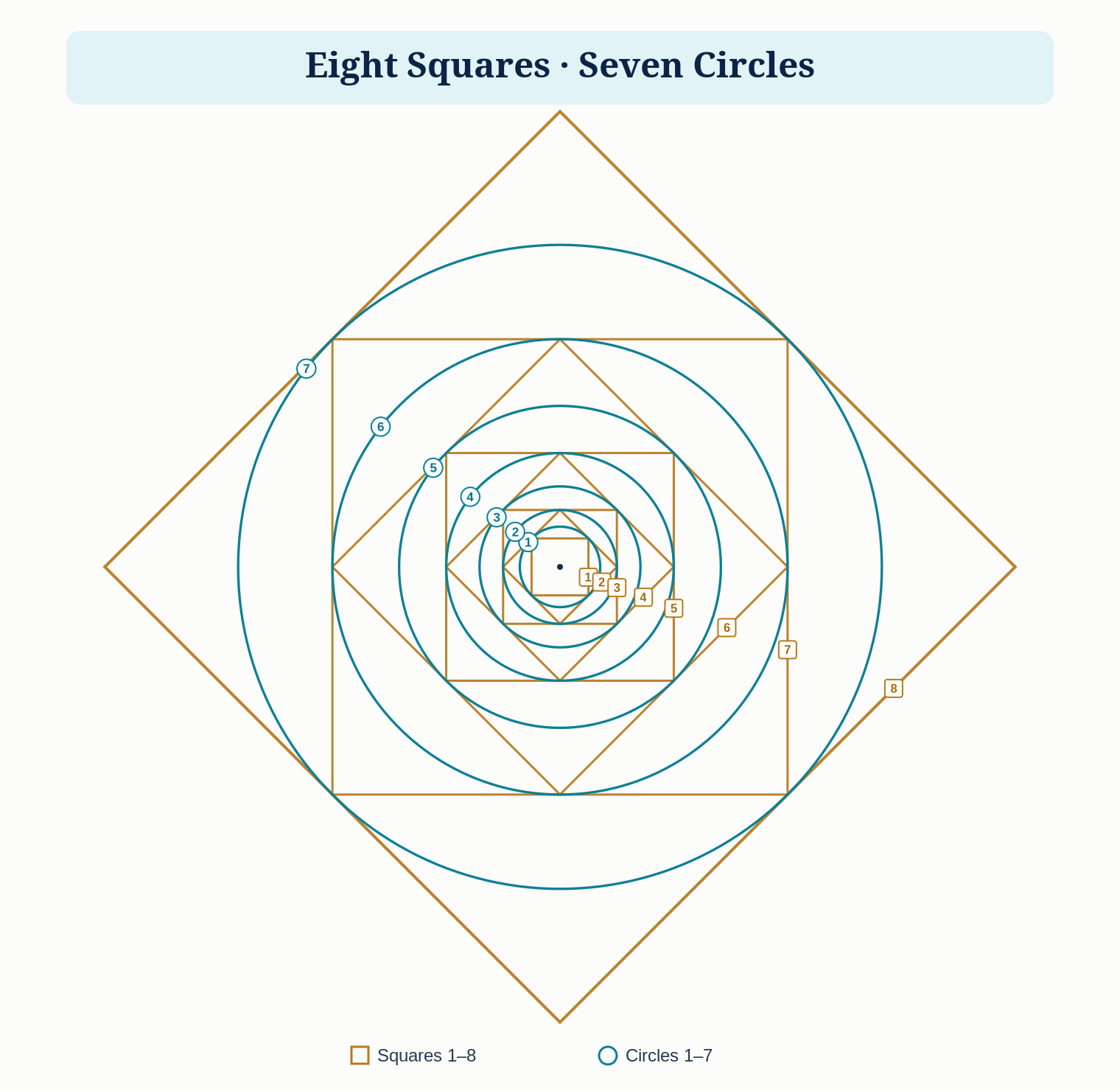
If a[n] is a square side and d[n] its circumcircle diameter, then:
One stage multiplies every corresponding linear measure by √2 and every corresponding area by two. Two stages double the linear measures. A rotation changes orientation while these scale rules describe size. The two transformations can be represented together, but their mathematical jobs remain distinct.
| Level | Square side | Square area | Circle diameter | Circumference |
|---|---|---|---|---|
| 1 | 35√2 | 2450 | 70 | 219.911485751 |
| 2 | 70 | 4900 | 70√2 | 311.001805671 |
| 3 | 70√2 | 9800 | 140 | 439.822971503 |
| 4 | 140 | 19600 | 140√2 | 622.003611342 |
| 5 | 140√2 | 39200 | 280 | 879.645943005 |
| 6 | 280 | 78400 | 280√2 | 1244.007222684 |
| 7 | 280√2 | 156800 | 560 | 1759.291886010 |
| 8 | 560 | 313600 | 560√2 | 2488.014445369 |
Every exact square area is a multiple of 490. The main earth-square carries ten such units, the next twenty, and the sequence continues by doubling. This property belongs to the geometry once its first scale has been selected; eight rows do not constitute eight independent chronological inputs.
Seven expansions and the eightfold outer circumference
The numbered circles begin at diameter seventy. Seven circle-to-circle expansions reach C8:
The original approximately-311 outer circle is C2. Six expansions from it reach C8, giving:
The four even-index circles C2, C4, C6 and C8 have circumferences approximately 311, 622, 1244 and 2488. They are two nesting stages apart. This is the exact reason an eighth-circle circumference can also be read as eight copies of the original approximately-311 circuit. That equality does not make C8 the sum of all eight unequal circumferences.
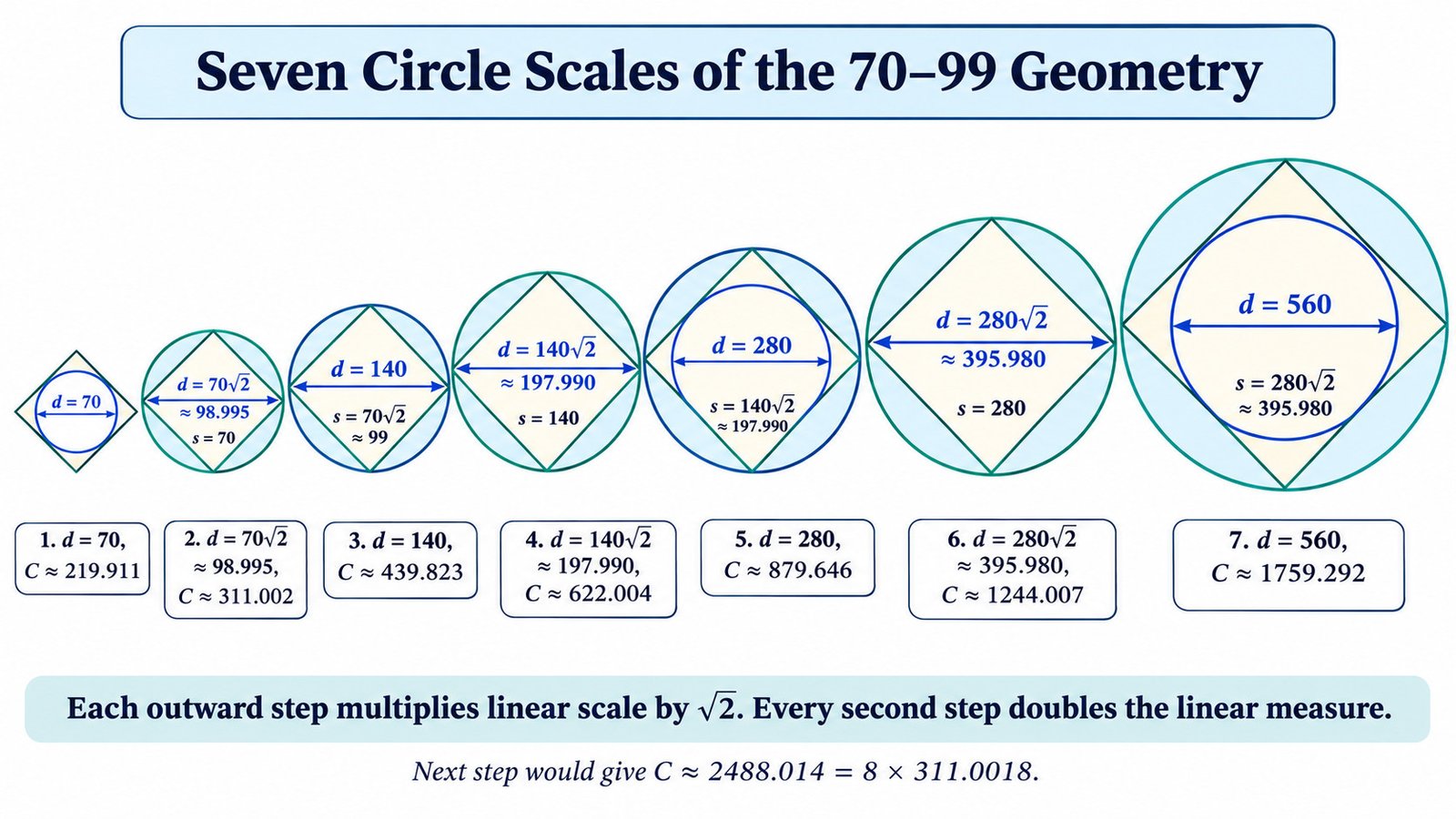
The odd-square residues
The working square sides at odd levels are 49.5, 99, 198 and 396. Their areas differ slightly from the exact √2-derived areas:
| Level | Working side | Exact area | Working area | Difference |
|---|---|---|---|---|
| 1 | 49.5 | 2450 | 2450.25 | 1/4 |
| 3 | 99 | 9800 | 9801 | 1 |
| 5 | 198 | 39200 | 39204 | 4 |
| 7 | 396 | 156800 | 156816 | 16 |
Doubling a working side quadruples the area defect, so 1/4→1→4→16 is one propagated feature. Even-level sides 70, 140, 280 and 560 remain exact whole numbers. I keep the exact area ladder and this working residue ladder side by side. Calling the working odd-level areas exact multiples of 490 would erase the very distinction that section 10 will interpret through the recovered one.
The nesting also conserves earlier relationships under enlargement. An inner circle is simultaneously a circumcircle of one square and an incircle of the next. A side, diagonal and diameter change their roles at a new level while retaining specified scale relations. That economy is the proposed geometric grammar. The following symbolic readings depend on it, but they should not be mistaken for new laws that permit arbitrary chronological transformations.
5. Reading the picture through the narrative
I read the same two-dimensional construction from above and in profile. In the overhead reading, the rotated square represents the whole earth, with its corners supplying the four-directional extremities. The inner and outer circles give two enclosures. In the vertical reading, the upper triangle is the mountain, the central diameter the terrestrial width, and the small inverted triangle the lower realm. These are symbolic views of a common figure. They do not assert that a literal physical earth is a square inside a spherical shell.
Genesis supplies the narrative order: separated waters and the רָקִיעַ, the expanse, then gathered waters and appearing dry land. The Flood returns the narrative through waters, mountain, emerging earth and renewed covenant. The geometry supplies relationships among enclosures, halves and shared boundaries; the story identifies why those relationships may carry theological significance. This is the sense in which I say that chronology is built geometrically while the narrative interprets the image.
The central width 35+35=70 is measured across the inner circle. The larger left/right extent is the original square’s diagonal 70√2, approximately 99. They must remain visibly different. The small inverted triangle descends thirty-five from the center, while the mountain rises 35√2. The comparison therefore preserves two levels rather than forcing the smaller underworld figure into the reflected outer half-square’s dimensions.
Creation, mountain, descent and ascent
The mountain within the square and circle
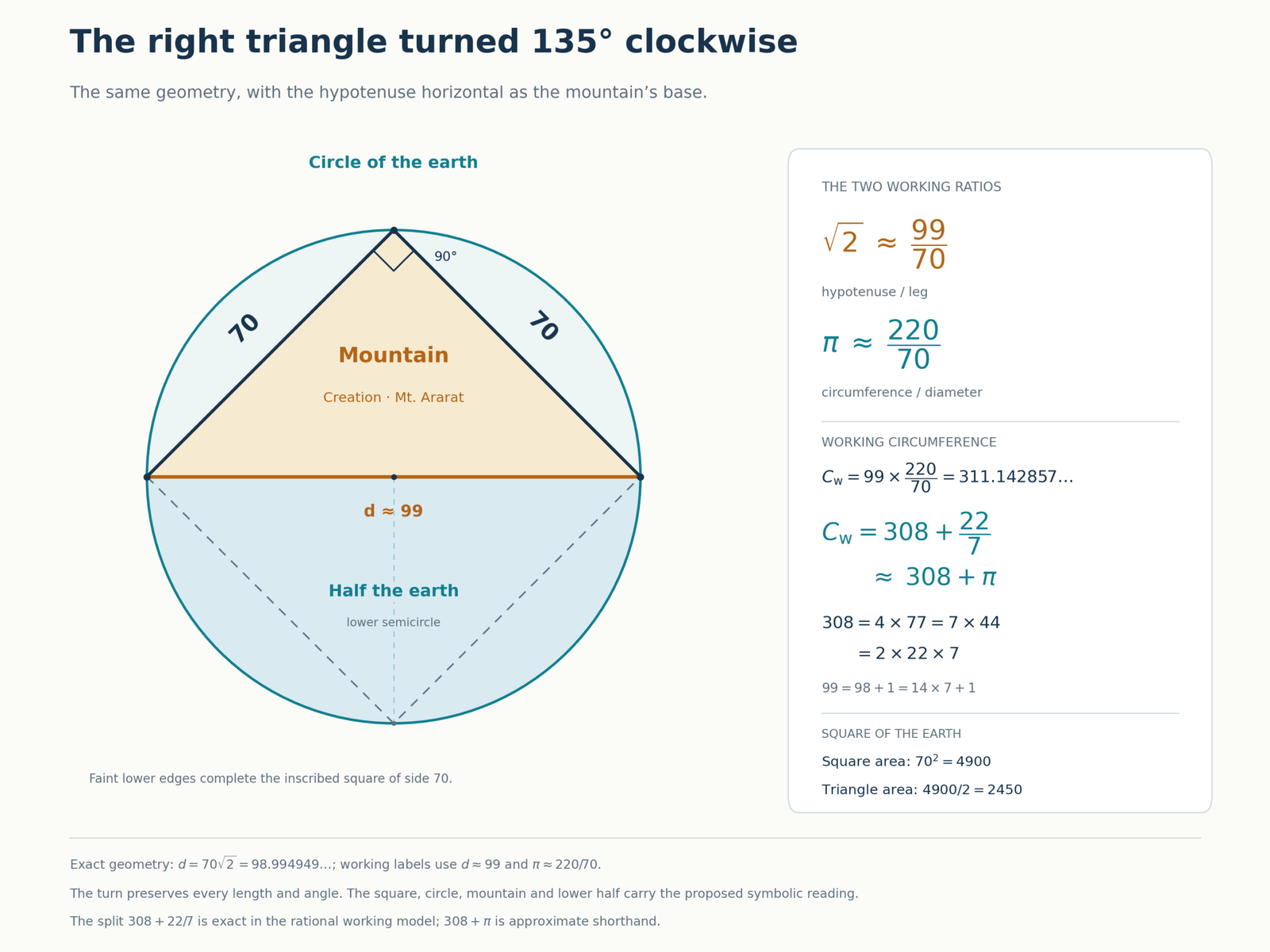
I turn the triangle 135° clockwise because this orientation better reveals the symbolic picture I believe the geometry is intended to convey: the square of the earth within its circle, divided in half, with a mountain standing above half the earth. The upper triangle is half the inscribed square, while the blue lower semicircle shows the half-earth beneath its base. In this reading the figure represents Creation and the Flood, with Mount Ararat as the mountain of renewed beginning. Genesis 1:9–10 describes dry land appearing from the gathered waters; Genesis 8:4 locates the ark’s rest on the mountains of Ararat.
The turn preserves the two seventy-unit legs, their right angle, the hypotenuse/diameter, and the circle. The whole square has area-number 4900, and its upper triangular half has area-number 2450. The right panel retains the same working fractions and the circumference’s 308 + 22/7 ≈ 308 + π decomposition. Full-resolution figure.
The faint lower edges matter: together with the upper triangle they complete the square inscribed in the circle. The upper mountain is half that square; the blue lower region is a semicircle. The figure places these distinct shapes together in one symbolic picture of earth, waters, judgment, and renewed beginning. Ararat supplies one narrative setting for the mountain; the broader Creation and Christological reading gives it further settings.
From Atonement to Passover and Ascension
The following inherited radius and paired-height comparison concerns the outer-circle reflection in Figure B4. The new small inverted triangle in Figure B1 has height 35 and is not a second copy of the 35√2 outer radius. Their theological descent/ascent readings can coexist without equating these different triangles.
For this calendar reading each linear unit represents one schematic year of 360 days. The working radius represents 49.5×360 = 17820 days; the exact radius represents 12600√2 = 17819.090885900998… days. The radius shortfall is consequently 0.909114099… days, or 21.818738376… hours. Including both symmetric halves gives the previously established 1.818228198… days, or 43.637476752… hours.
The half-year component is exact on the schematic twelve-month calendar:
The 180 days are six thirty-day months, carrying the autumn Tishri position to its spring Nisan counterpart. For each row below the centre’s starting boundary is held fixed, and the radius is measured forward:
| Centre’s selected boundary | Working-radius endpoint, 49½ years later | Exact-radius endpoint |
|---|---|---|
| End of Tishri 10 | End of Nisan 10 | Early Nisan 10 |
| End of Tishri 17 | End of Nisan 17 | Early Nisan 17 |
The end-of-day anchor is consequential. Subtracting the radius shortfall from the working endpoint leaves approximately 2.18 hours after the corresponding Nisan day begins. The word early describes that position within a schematic day; a historical clock time is not assigned. The backward radius has the opposite sign for its endpoint correction.
I therefore read the end-of-Tishri-10–17 field toward the early-Nisan-10–17 field, joining the jubilee’s Atonement proclamation with the Passion-week setting. Genesis 7:4 supplies the seven-day warning and forty days of rain; Genesis 8:4 supplies the ark’s seventeenth-day rest in the seventh month. These distinct Flood events contribute their motifs to the proposed correspondence. The subsequent forty-day resurrection-to-Ascension sequence is supplied by Acts 1:3, 9.
The Nisan 16 Firstfruits nuance belongs to the Johannine Nisan 14 Passion alignment, alongside the companion Nisan 15–17 reading. File_13 governs those Gospel-calendar states. The fixed end-of-Tishri-17 radius calculation above reaches early Nisan 17; the Nisan 16 reading retains its separately identified calendar state. The broad narrative correspondence carries the interpretation.
Read Christologically, the mountain and its lower reflection evoke Nisan 15–17: death, rest, and resurrection. The lower reflected half-square gives visible form to Christ’s descent “into the lower parts of the earth” (Ephesians 4:9), followed by his return to earthly life in resurrection and, after forty days, his ascension to heaven (Acts 1:3, 9). In this reading the reflected half participates in the same movement through judgment and death into renewed creation. It also allows the full geometric comparison of approximately 22 + 22 hours to remain present within the simpler Nisan 15–17 symbolism.1
The Transfiguration as a Christological overlay
The Transfiguration is a principal Christological overlay of the mountain diagram. I adopt the identification of its high mountain with Hermon, the mountain of the Watchers’ descent in 1 Enoch 6:6. In this reading Christ’s manifested glory reverses the mountain’s rebellious association. Moses and Elijah bring their Sinai/Horeb encounters into the scene, giving the three figures their proposed triangular correspondence. Luke says they discuss Christ’s departure, his ἔξοδος, at Jerusalem; Matthew and Mark immediately relate disclosure of the vision to his resurrection. The scene anticipates his death, resurrection, ascension, and return in glory.2
Second Peter brings the same themes together with unusual economy. The holy-mountain witness establishes Christ’s majesty and coming in 1:16–18; verse 19 turns to prophetic light in darkness until daybreak and the rising morning star. Chapter 3 joins Creation and the Flood, the day–thousand-years correspondence, judgment, and the new heavens and earth. Within the Creation-week interpretation, 6000 + 1000 supplies the accessible six-days-and-rest outline. The Gospels’ six/eight-day framing can carry that broad symbolism, while the seven-and-a-half refinement developed in √2 v8 §11 supplies a finer reading. The diagram’s 49.5-year radius, its approximately one-day or paired two-day discrepancy, and the opposite-endpoint 49 + 50 reading remain available within the Passion-week interpretation. The retained Nisan 16/17 calendar states and their selected anchors govern the dates; a precise date for the Transfiguration is not required.
Matthew 18: the ninety-nine and forgiveness
Matthew 18 brings the numerical vocabulary into a single teaching sequence. Verses 12–14 describe the ninety-nine sheep and recovery of the one that strayed. After teaching about restoring a sinning brother, Peter asks how often to forgive. Jesus’ answer in verses 21–22 is rendered seventy-seven times or seventy times seven. The following parable concerns mercy and the forgiveness of debt.
I read these forms together: the diagram’s 99, its four circular integer components of 77, and the area-numbers 7700 = 100×77 and 4900 = 10×(70×7). The forty-nine-year count also contributes the jubilee’s vocabulary of restoration and liberty. The text gives the numerical echoes a coherent setting of recovery, release, and forgiveness toward Christ. This is retrospective canonical corroboration within the study’s governing hermeneutic; the arithmetic and chronological derivations retain their own stated provenance.
√2 appendix P gathers the model states, shared-origin genealogical intervals, boundary calculations, and dependencies for this section. √2 appendix F preserves the discovery sequence separately from this explanatory arrangement.
Seven and seven-and-a-half from Eden to Ararat
Ezekiel 28:13–16 joins Eden, God’s holy mountain, initial blamelessness, and corruption. Within that mountain reading the actual Creation–Flood interval 4114 → 2458 BC supplies the underlying 1656. Keeping its Creation end as the fixed origin, apply the two existing operators separately to that same source interval:
These are alternative transformed representations of the original interval; the second calculation does not apply 25/23 to 1680. The source Flood date remains 2458 BC. Their quotient is 1680:1800 = 14:15 = 336:360, an algebraic relationship among the established outputs rather than a newly introduced calendrical operator.
The coming-short form is exact within the transformed mountain measure:
A literal seven-year source-boundary movement before conversion gives the finer companion (1656−7)×70/69 = 1673−7/69 = 1672.89855… . It rounds to 1673, and to 1675 at mod-five resolution. This keeps the order of subtraction and transformation visible. The following-heptad Fall/covering vocabulary, with its Day/Year-13 and 14 boundaries, retains the source distinctions already governed by Files_69–70; it is not a new date inferred from 1680−7.
I have long read Revelation’s eighth, who is “of the seven,” as an extension belonging to the seventh mountain and king. In the present geometry that reading becomes seven units plus one half, 1680 + 120 = 1800, rather than eight complete 240-year units. The half-unit assignment is the proposed numerical decoding of that narrative relation. From Mount Eden to Mount Ararat, the seven-mountain structure therefore has a completed form, a coming-short form, and a related seven-and-a-half representation in the established calendar grammar.
Creation’s phased week and the final night
The full regular Creation envelope supplies the governing phase template. Files_07 and 09 retain two seven-year lines offset by half a year:
| Calendar line | Opening, BC | Completion, BC | Elapsed width |
|---|---|---|---|
| Tishri | 4122t | 4115t | 7 years |
| Nisan | 4121n | 4114n | 7 years |
| Combined outer envelope | 4122t | 4114n | 7½ years |
The January-centered model places autumn/Tishri at schematic 6 PM, January 1 at midnight, and spring/Nisan at 6 AM. The outer envelope consequently moves from evening through seven full symbolic days and one final night to daybreak. The earliest label is 4122t, paired with 4121n; 4121t would yield a different, 6½-year interval to 4114n.
At the millennial-day scale I read this as 7000 followed by a concluding symbolic night of 500, reaching 7500 at daybreak. At the mountain scale the same proportion gives 1680 + 120 = 1800. Revelation 20:7–15 supplies the final brief release of Satan after the millennium, the siege of the beloved city, his casting into the lake where the beast and false prophet already are, and the ensuing resurrection/judgment and abolition of death. Revelation 21 then presents the new creation and descending Jerusalem; 22:5 and 16 join the absence of night with Christ as the bright morning star. The final-night and half-day durations are my schematic reading of that narrative sequence, not separately stated chronological lengths in Revelation.
The city is square in plan with equal length, breadth, and height (Revelation 21:16). A cube gives the direct architectural presentation of those dimensions; I also explore a mountain/pyramid visualization. The diagram carries the square in plan and the mountain in profile as a symbolic template. It does not specify a unique three-dimensional construction of the city. The familiar six-plus-one Creation pattern supplies the broad reading; the seven-and-a-half envelope supplies its finer seasonal articulation. √2 v8 §3’s Transfiguration passage brings that pattern to Christ’s manifested glory without requiring the finer 7500 measure for the basic recognition.
Watchers, Babel, and the inheritance of the land
The narrative reading follows the Enochic and Jubilees framework used throughout this investigation.3 Scripture and these intertestamental witnesses illuminate the same trail of heavenly rebellion, its renewed influence, judgment, and restored inheritance. The Watchers descend in Jared’s generation; Enoch bears witness against their transgression; the Flood judges the corrupted world. This establishes the earlier narrative setting of the Jared–Enoch geometry. See 1 Enoch 6 and Jubilees 4:15–24.
Cainan supplies the post-Flood continuity. Jubilees 8:3–4 describes his recovery and copying of the Watchers’ celestial teachings, his sin through them, and his concealment of the matter from Noah. The old rebellion’s teaching therefore reappears before Babel. Peleg’s division of the nations belongs within this continuing narrative. Deuteronomy 32:8–9, read with the heavenly-sons wording, connects the nations’ allotment with the heavenly powers while retaining Jacob as the LORD’s own inheritance.
Babel’s tower expresses the attempt to establish humanly constructed access to heaven. Its antithesis is Jacob’s revealed stairway, where the heavenly connection accompanies God’s promise of land and blessing to the families of the earth. The trail continues into the Conquest: Numbers 13:33 connects the Anakim with the Nephilim in the spies’ report; Joshua 11:21–23 records their defeat, the survivors in Gaza, Gath, and Ashdod, and the land’s rest. David and his servants then defeat the descendants of Rapha in Gath in 2 Samuel 21:15–22. The related names carry the giant tradition through the successive stages.
The heavenly-access and city antithesis continues toward Christ. John 1:51 locates the ascending and descending angels upon the Son of Man. Revelation 13 presents the beast’s counterfeit authority; chapters 17–18 identify Babylon, whose sins reach heaven; chapter 21 presents Jerusalem descending from God. Within this reading, Babel and Babylon stand opposite the heavenly city and the access God himself grants. The Enoch and Peleg bridges accordingly meet at the reflected Conquest field, joining ascent, dispersion, judgment of the giants, and the giving of the land within the same chronological architecture.
Third, seventh and eighth: a declared symbolic reading
I count the circle levels from the innermost diameter-seventy circle. The third circle consequently has diameter 140 and surrounds the square of side 70√2; the seventh has diameter 560; the eighth has diameter 560√2. Within the proposed interpretation, the third level expresses an enlarged heavenly perspective, the seventh a sevenfold completion, and the eighth the enclosing new-creation/transcendence reading.
Paul’s third-heaven language in 2 Corinthians 12:2–4 gives the third level a scriptural association. Ephesians 4:10 speaks of Christ ascending above all the heavens; Hebrews 7:26 describes Him as exalted above the heavens; Psalm 148:4 addresses the heavens of heavens and waters above the heavens. These passages provide the theological vocabulary of enclosure and transcendence. They do not themselves supply diameters 140, 560 or 560√2.
The seven-heaven and seven/ten-heaven traditions mentioned in the research checkpoint supply a wider comparative setting. Their textual and recensional differences require their own treatment before a historical argument about ancient diagram use. Here I use third/seventh/eighth as a declared symbolic numbering of the mathematical circle levels. Three-to-seven elaboration is not another Key-of-23 operator, and symbolic conservation does not by itself identify every ancient heavenly tier with a square or circle.
The eighth circle has a precise place: it encloses the eighth square after seven intervening circles. My Christological reading sees the completed figure gathered within a further encompassing order. The eighth belongs to the same construction, while opening a view beyond its previously drawn boundary. That meaning arises from the combined narrative and geometric reading; the linear measure follows independently from the recurrence in section 4.
The earlier mountain/king interpretation requires an additional distinction. Revelation 17’s seven mountains and an eighth who is of the seven were read through seven plus a half mountain units, 1680→1800, in the √2 research. Those seven-and-a-half units are not eight complete circles. I retain both interpretive forms because they address different counted objects. Their possible coordination is an interpretation to explain, rather than a reason to change either count.
The common pole and the recovered whole
The center gives the drawing a stable origin. Opposite radius directions can be separated by 180°, but length 99 is not ninety-nine degrees; angular direction at the pole itself is undefined. The two exact circles share the same center. Moving between their levels preserves that center while changing the enclosing radius. This supplies a visible setting for the narratives of leaving an appointed place and being brought back into ordered relation.
The restored one has several already documented forms: Abraham’s ninety-nine before the promised son’s hundred-year threshold, the lost sheep within a flock of a hundred, the whole dove day that leaves either 100 or 99 to the departure boundary, and the exact/working square areas 9800/9801. I read these together through restoration and wholeness. Their units and source histories remain distinct: a patriarch’s age, a parable’s count, a schematic day, and an area-number reused in years.
The theological composition therefore depends on preserving differences. The picture becomes more informative when we can say which shape, origin, scale and narrative each number inhabits. Its proposed coherence is a relationship among those stated objects, not permission to exchange them silently whenever their numerals agree.
6. The Flood-day geometry
The source of the shared day-scale proof is √2 v8 main §13 and Appendices R–S. I reproduce its connected foundation here because it belongs to the argument of this manuscript as well. The original and the revised √2 study retain their own complete proof. The copied foundation below uses the same event dates, inference, boundary choices and generated extensions.
The Flood narrative gives the shared geometry of π and √2 a setting within a dated sequence of events. The ark rests on a mountain, the dove brings evidence of renewed life, and the earth becomes dry. On the declared 360-day calendar, the selected reconstruction places these stages at Days 197, 318, and 417. Their relationship brings the circle and triangle together:
Here 99 is the working hypotenuse/diameter, 220 is the working π numerator against the common unit 70, and 121 is their difference, 11². Day 318 is the joint. The following seventies complete a year’s circuit; the whole dove day accommodates the finer 99/100 reading. I therefore treat the Flood-day construction as a foundation of the shared geometric reading developed in this study. The longer chronological spans and the Flood’s days give that reading complementary narrative settings.
The calendar and the narrative anchors
This illustration uses the ordinary MT Gear-2 Flood year, 2458 BC, and the following 2457 BC closing year. Nisan 1 supplies the year-origin; the Flood begins on the seventeenth day of the second month. The diagram’s numerical measures are compared here with schematic days; its separate jubilee/Passion conversion remains 360 days per linear unit. Months contain thirty days. For year y, month m, and day d, the numbered day is:
| Narrative stage | Numbered day | Source of the position |
|---|---|---|
| Seven-day warning | 40 | Inferred seven days before the Flood opening |
| Flood begins | 47 | Second month, seventeenth day |
| Forty-day rain completes | 87 | Forty-day model interval from 47 |
| Ark rests | 197 | Seventh month, seventeenth day |
| Mountain tops appear | 271 | Tenth month, first day |
| Initial raven/first-dove alignment | 311 | Forty days later; earliest same-day alignment |
| Second dove release; olive leaf on return | 318 | First stated seven-day wait |
| Third dove release; no return | 325 | Second stated seven-day wait |
| Covering removed | 361 | Following year, first month, first day |
| Earth dry; departure command follows | 417 | Following year, second month, twenty-seventh day |
Genesis supplies the named month/day dates and the waits. The initial raven/first-dove alignment and the resulting bird-release dates follow the bounded reconstruction already recorded in the Flood-day tables. The two seven-day waits connect three releases: Day 325 is the second repeated release, third overall.
A numbered day has an opening and a close. Let b measure elapsed days from the opening of Nisan 1: Day N opens at b = N−1 and closes at b = N. For the principal 197 → 318 → 417 construction, use their closing boundaries. The later 99/100 comparison uses both boundaries of Day 318. These choices define the comparison without assigning unstated clock hours to the events; √2 appendix S gives the full ledger.
Day 318 joins the circle and triangle
The circle in the diagram has working diameter 99 and rational-model circumference:
Its simplified integer expression is 311, already encountered at Enoch. With the symbolic Creation-completion reference placed at b = 7, that circumference reaches the dove day; the working diameter then reaches the departure threshold:
The ark-rest boundary supplies the companion interval 417−197 = 220. Its division at the dove day is exact within the declared integer construction:
Thus the Flood comparison places the same 99, 220, and 121 already established in the diagram at connected narrative positions. The integer circumference and the full rational 311 + 1/7 retain their respective roles; substituting the latter would generate endpoints one seventh of a day later.
The two circle scales remain explicit. A reference circle of diameter 70 has working circumference 220; the original circle of diameter 99 has circumference 311 + 1/7. The 220 interval belongs to the first scale, while 311 belongs to the simplified presentation of the second.
The two seventies complete the annual circuit
The triangle supplies the common leg measure 70. Extending the departure threshold by one leg and then the other gives:
| Boundary | Position | Status in this construction |
|---|---|---|
| Ark rest | 197 | Selected dated boundary |
| Olive-leaf dove | 318 | Selected reconstructed boundary |
| Departure threshold | 417 | Selected dated boundary |
| First seventy beyond departure | 487 | Generated geometric extension |
| Second seventy beyond departure | 557 | Generated annual counterpart of the ark-rest date |
The two constants can now be read directly from those intervals:
The second seventy reaches the following anniversary of the ark’s rest:
The seventies are geometric projections beyond the narrated departure. Their combined endpoint completes one circuit of the schematic year from the ark-rest boundary. The same measures also admit the two-leg normalization:
At the first extension, 487−7 = 480 = 240+240. Each completed triangle boundary is 70+70+100. The finer pair is 239+239 = 478 and reaches 485 from the same reference. These repeat the 99-to-100 completion of the Peleg–Reu triangles. Their shared diagonal is counted twice: removing it gives the same outer square perimeter, 480−200 = 478−198 = 280.
The whole dove day: 99 and 100 together
Numbered Day 318 occupies the interval from b = 317 to b = 318. With the departure boundary 417 fixed:
The hundred includes the whole dove day; the ninety-nine begins at its close. The date remains Day 318. This gives the ninety-nine/hundred completion a precise role in the day construction, corresponding to Abraham’s circumcision at ninety-nine and Isaac’s birth at one hundred.
The opening boundary also gives:
The 120 is half the completed triangle perimeter 240. The finer half-perimeter is 70+49.5 = 119.5: the 49.5 radius/half-base is one component of that boundary measure. The second equation reaches b = 270, the opening of numbered Day 271, when the mountain tops appear.
Abram’s 318 supplies brief corroboration. The trained men in Genesis 14 share the Hebrew root חנך with Enoch, and the canonical files already connect their number with the Tabernacle chronology. The two covenants give 318+318 and 311+311 years to 1445 BC; to the Exodus in 1446 BC the corresponding forms are 318+317 and 311+310. This places the Flood’s paired measures within a wider covenantal setting.4
Creation’s seven-plus-seven and the bird sequence
The symbolic seventh-day reference belongs to the study’s Creation–Flood reading. Creation completion 4114 BC stands 1656 years before the selected 2458 BC Flood. At day scale, the reference gives 7+40 = 47 and 47+40 = 87: two forties, or eighty from the reference. These invite comparison with the forty/eighty-day childbirth-purification periods and the two birds at Jesus’ presentation.5
The bird sequence preserves the paired seven-day waits:
Here 0, 7, and 14 are schematic reference indices r, giving N = r+311. They recall the Creation and following-heptad vocabulary in √2 v8 §11. The initial bird release is numbered Day 311, with 310 days completed at its opening. Its numbered label and elapsed boundary remain distinct.
The calendar’s full-year circuit has its own endpoint: the covering is removed on numbered Day 361, 360 elapsed days from the opening of Nisan 1, in Noah’s 601st year. Genesis 8:6’s earlier window opening and 8:13’s removal of the covering remain separate acts. The geometric circuit and the calendar-year circuit therefore retain their respective narrative positions.
Four seventy-seven components reach the same endpoints
The circumference’s four integer components supply another route:
Nisan 10 to the modeled rain-completion day 87 gives 77; three further components reach the olive-leaf dove day 318. Nisan 17 to the final dove day 325 gives four times 77. Thus:
The four components total 308; the simplified circumference is 311. Their three-unit difference accounts for the shift from references 7/14 to Nisan 10/17. The full rational residue is 22/7 beyond 308, retaining its additional 1/7 beyond the simplified three.
The seventeenth-day reference also joins the ark’s rest:
Day 197 is Tishri 17 in this Nisan-start year. The tenth-day reference has the Nisan/Tishri Atonement–jubilee counterpart discussed in √2 v8 §3, with the seasonal origin declared for each reading. The intermediate quarter points receive no additional narrated events merely from the geometric construction.
The triangle’s 239 and the finer endpoint
The finer mountain perimeter, 70+70+99 = 239, reaches the final dove position through inclusive reckoning:
Days 87 through 325 contain 239 days. Their opening-to-opening difference is 238; a 239-day elapsed difference joins the openings of Days 87 and 326.
Retaining the full rational circumference gives a related geometric point. With b again measured from the opening of Nisan 1:
The lower point lies within numbered Day 87; the upper lies early in Day 326, one seventh of a day beyond the completion of Day 325. The final release retains its modeled Day 325 label. The fractional comparison describes the finer geometry alongside that integer date.
The Key of 23 follows the Flood days
The selected closing-to-opening intervals are:
They run from the close of Day 40 to the opening of Day 271, and from the close of Day 87 to the opening of Day 318. Each contains 230 complete intervening days; uniform opening-to-opening comparisons would give 231.
Hold b = 87 fixed and apply the established 25/23 operator to its 230-day interval:
Preserving the following hundred-day segment generates:
The transformed chain adds twenty to the first segment and retains the hundred. In a separate execution, hold the year-origin b = 0 fixed and transform the whole generated 437-day interval:
This last comparison recalls Noah’s 950-year lifespan at day scale. The 337, 437, and 475 coordinates are generated by the stated executions; the dated departure threshold remains Day 417. The same calendrical grammar that accompanies the year structures therefore also follows the Flood-day construction.
The foundation is the connected placement of the measures: circumference to the dove day, diagonal to the dry-earth threshold, the shared π/√2 numerators between the ark-rest and departure boundaries, and the projected legs completing the annual circuit. The whole-day and fractional readings articulate this integer outline more finely. The following cumulative Noah–Shem comparisons examine the same template in years. The diagram’s earlier jubilee/Passion conversion remains one linear unit to 360 schematic days; comparison with Flood days and fivefold cumulative-year lengths uses explicitly declared numerical scales.
Two complete circuits and the near-forty-nine complement
The modeled annual circuit and the geometrical circumference are both complete circuits in their own registers. Ark rest 197→its generated annual counterpart 557 spans 360 days. The exact outer circle’s circumference is 311.001805671… . Their difference is:
At the simplified integer level, 311+49=360 exactly. The approximately-forty-nine complement fits the jubilee vocabulary already present in the figure’s 49.5 radii and 4900 area. The near-equality is a consequence of the exact circumference being near 311; it is not an additional independent precision test. Its interpretive force comes from the two completed circuits and their place within the narrative of release and renewed life.
The full rational model instead has Cw=311+1/7 and complement 48+6/7. Retaining that value shows why the old rational perimeter/calendar exploration and the new exact-circle comparison cannot be merged into one number. Section 7 follows their eightfold forms while preserving the phase conventions of both.
The published π study’s 377-day envelope supplies a complementary narrative scale. It runs from the selected opening of Iyar 10 before the Flood to next-year Iyar 27. Its 377 is a whole-episode envelope, while the 360 here is an ark-rest anniversary circuit. The 40-day interval after the mountain-top notice is the biblical waiting period used in the bird reconstruction; it must not be identified with every other schematic forty within the envelope. Appendix C/D records the two origins.
7. The eighth circle and the Pentecost comparison
Four states on one declared 360-day scale
The exact eighth circumference is C8=560√2π=8C2. Its difference from the integer 2488 is 0.014445368685… units. When each unit is interpreted as a schematic year of 360 days, the excess is 5.200332726635… days. That conversion is declared; it does not turn a circumference into an astronomical elapsed-time measurement.
The four original outer-circle states give:
| Diameter / π state | One circuit | Eight circuits | Days beyond 2488×360 |
|---|---|---|---|
| Exact √2 / exact π | 311.001805671086 | 2488.014445368685 | 5.200332727 |
| Exact √2 / 22/7 | 311.126983722081 | 2489.015869776647 | 365.713119593 |
| 99 / exact π | 311.017672705390 | 2488.141381643116 | 50.897391522 |
| 99 / 22/7 | 311.142857142857 | 2489.142857142857 | 411.428571429 |
The true geometric C8 belongs to the first row. The other rows are eightfold comparison lengths using their declared substitutions. They are not three alternative exact circumferences of the unchanged original figure. The diameter-99/22/7 row is the prior √2 working-circle calculation.
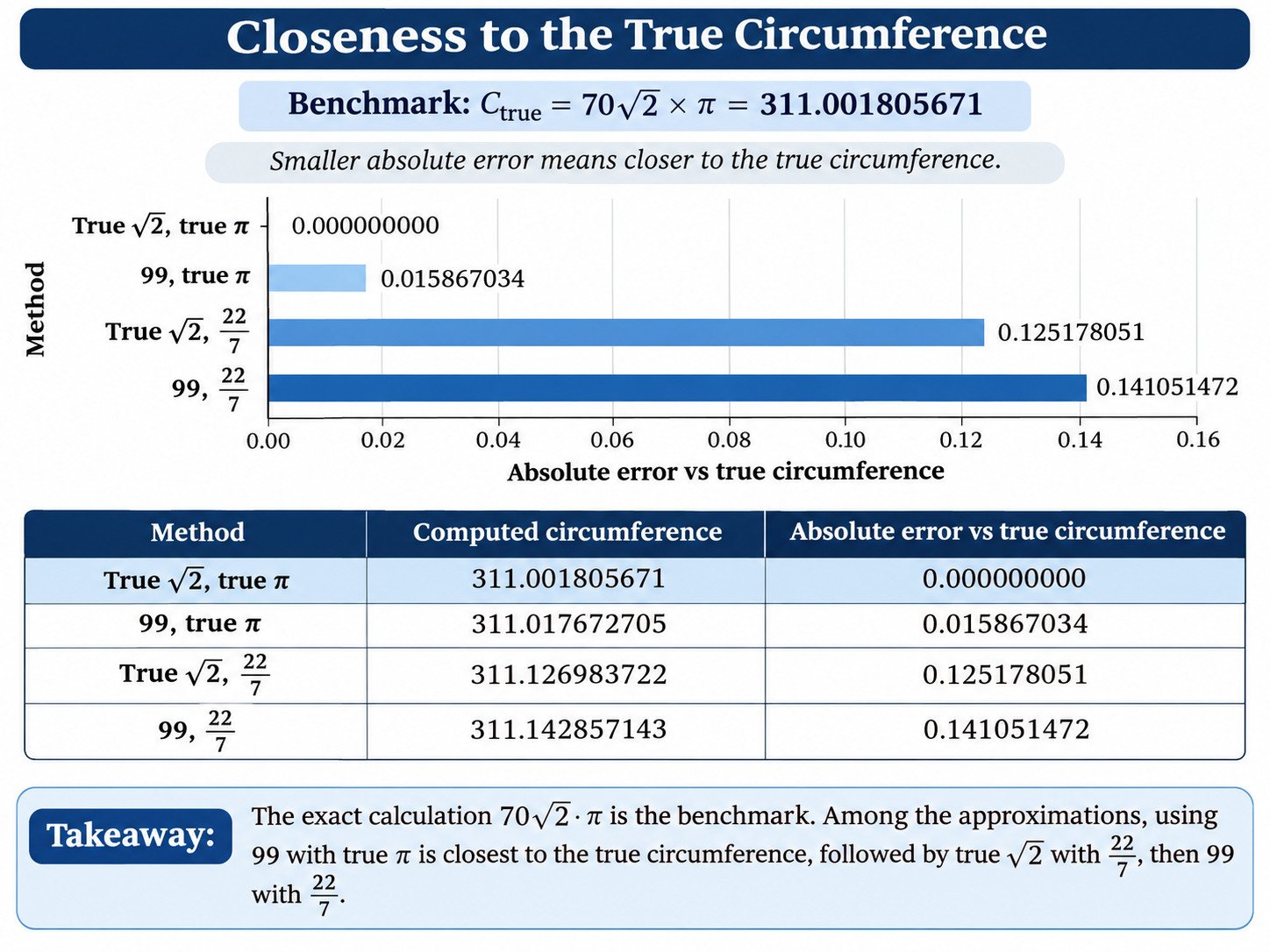
The effect of substituting 22/7 for exact π over eight circuits is about one schematic year: 360.512786866 days at exact diameter and 360.531179907 at diameter 99. Substituting 99 for the exact diagonal adds 45.697058795 days with true π or 45.715451836 with 22/7. The cross-state difference, exact diagonal with 22/7 minus diameter 99 with exact π, is 314.815728071 days. These related residuals come from the same four inputs; none supplies another independently dated biblical interval merely by its proximity to an integer.
One Sunday and two numbered positions
In the AD 33 calendar framework used here, the Resurrection/Firstfruits Sunday is labeled Nisan 16 in John’s reckoning and Nisan 17 in the Synoptic reckoning. Both count forty-nine elapsed days, fifty inclusively, to the same Pentecost Sunday:
| Gospel reckoning | Firstfruits, same Sunday | Elapsed days | Pentecost ordinal from Nisan 1 |
|---|---|---|---|
| John | Nisan 16 | 49 | 65 |
| Synoptics | Nisan 17 | 49 | 66 |
Thus the Pharisaic fixed Nisan-16 Firstfruits rule and the Sadducean Sunday-after-weekly-Sabbath rule overlap on Sunday in the year being considered. The rule comparison is distinct from the differing Gospel month beginnings that give that Sunday its two labels. My detailed calendar treatment is in The Cross at the Center of Time, chapter 4. Day 65 and Day 66 are two ordinal representations within the corresponding reckonings; they are not successive historical Pentecost Sundays.
The historical month example there uses Nisan 30 and Iyar 29, putting the ordinals at Sivan 6/7. The present normalized 360-day arithmetic uses two thirty-day months and labels the same ordinals Sivan 5/6. I therefore keep the ordinal endpoints 65/66 explicit when applying the geometric subtraction. This prevents a month-length change from concealing a one-day shift while retaining the already established Sunday convention.
Normalize each Gospel reckoning separately, measuring every model year as 360 days and opening Nisan 1 as annual boundary zero. Opening Nisan 17 is boundary 16 within either reckoning: this is a shared numerical reference, not a claim that their Nisan-17 dates are the same historical day. Day 65 opens 48 days after its reckoning’s Nisan 17; Day 66 opens 49 days after its own. John’s actual Firstfruits-to-Pentecost interval remains 65−16=49; the Synoptic interval is 66−17=49. The table’s one-day difference therefore belongs to the two calendar labels, not to two historical Pentecost instants.
Backward projection from the principal Pentecost endpoints
Subtract each eightfold circumference from the corresponding AD 33 Pentecost boundary. Civil years are counted without zero: 2456 BC→AD 33 is 2456+33−1=2488 years. The result is:
| Diameter / π state | John: backward from opening Day 65 | Synoptics: backward from opening Day 66 |
|---|---|---|
| Exact √2 / exact π | 2456 BC Iyar 29; 19.1920 h after opening | 2456 BC Iyar 30; 19.1920 h after opening |
| Exact √2 / 22/7 | 2457 BC Iyar 29; 6.8851 h after opening | 2457 BC Iyar 30; 6.8851 h after opening |
| 99 / exact π | 2456 BC Nisan 14; 2.4626 h after opening | 2456 BC Nisan 15; 2.4626 h after opening |
| 99 / 22/7 | 2457 BC Nisan 13; 13.7143 h after opening | 2457 BC Nisan 14; 13.7143 h after opening |
The hours are fractions of a model day after its opening, not separately established historical clock times. The endpoint definitions determine these date labels. Choosing day closes instead would shift both ends by one day; the same-Sunday count would remain forty-nine elapsed days, while the printed boundary projection would change.
The exact geometry and its Pentecost comparison are primary in this reading. I do not choose the diameter-99 rows because they happen to move the projection into the Passion neighborhood. They remain subordinate comparisons explaining what the established working approximation changes. Their roughly 45.7-day displacement is a mathematical consequence of the diameter substitution.
Jubilees supplies the bounded Flood conclusion
Jubilees 5:31 places dry earth on the seventeenth of the second month; 5:32 has the animals sent out on its twenty-seventh. At 6:1 Noah leaves the ark on the first of the third month and builds the altar; the following verses narrate atonement, sacrifice and covenant. On a thirty-day second month the interval from Iyar 27 to Sivan 1 is four elapsed days, five dates inclusively. The exact-diameter Iyar 29/30 projections lie inside that bounded narrative interval.
Jubilees 6 subsequently locates covenant remembrance and the Festival of Weeks in the third month. This gives the Pentecost reading literary context beyond an isolated numerical resemblance. It does not state that Noah’s third-month-first departure is itself the historical Pentecost date, nor derive the geometry. The source supplies dated departure stages and a covenant/festival setting; the circle comparison supplies the calculated projection.
The year distinctions matter. Ordinary Gear-2 Flood closure is 2457 BC; 2456 is the separately sourced Rounded/Gear-1 Flood/Arphaxad comparison. The first row’s 2456 placement is therefore an anniversary/cross-state correspondence to the close-of-Flood narrative, not a new claim that Jubilees literally dates its exit to that BC year. The second exact-diameter row changes the π convention and falls in 2457, but it is about one schematic year longer. Neither is silently substituted for the other.
Preserve the earlier rational Ascension reading
The original √2 v8 main §23 and Appendix I.6 already applied the eight-souls multiplier to both the square perimeter and Cw. The latter gives 8Cw=2489+1/7 years. Starting at opening Nisan 6 in 2457 BC, the last fractional annual offset is 5+360/7=56.428571 days, lying within ordinal Day 57, month 2 day 27, in AD 33. That was read with the forty-day Resurrection–Ascension comparison. From source years 2458 and 2456 the same calculation reaches AD 32 and AD 34.
The published π daylight residue uses end Nisan 6, whereas this old eight-cycle calculation uses its opening. The new exact-Pentecost comparison begins from the declared Day-65/66 endpoint instead. Their common Nisan and Flood vocabulary does not make them one anchored execution. Retaining all three origins preserves the actual research sequence and prevents a desirable correspondence from being manufactured through an unannounced boundary substitution.
Ascension, Firstfruits and the Creation-day neighborhood can also be inspected by translating the same endpoints. Moving the principal Pentecost endpoints back nine days gives the source’s subordinate Day-56/57 forty-day comparison; moving further back reaches the Firstfruits neighborhood. These are translations of one geometric input. Their narrative significance may be discussed, but they are not independent recalibrations of the circumference.
The principal interpretation remains the conjunction of a complete geometric circle, a complete annual circuit, eight preserved persons, covenantal emergence and Pentecost. First Peter 3:20–22 already joins eight persons preserved through water with baptism, Christ’s resurrection and His entrance into heaven. Within that setting, the exact eightfold circumference supplies a candidate numerical reading of the same narrative movement.
8. Regular and cumulative realizations
The picture’s value would be limited if it merely supplied attractive numbers after a chronology had been forgotten. The following examples retain named source intervals. They show different actions—calendar transformation, translation, overlap and reflection—rather than claiming that every example is one literal drawing at one common scale. The complete chronological investigation remains in the √2 companion and the original π study.
Enoch gives a dated circumference
Begin with the Rounded ascension at 3121 BC. It lies 990 years after Rounded Creation’s opening display at 4111 BC:
Using actual Creation’s opening at 4121 BC as a separately declared comparison gives the fuller thousand:
The ten-year difference between the two Creation openings therefore supplies the tenfold ninety-nine/hundred threshold. This is the same proposed one-short vocabulary already encountered at Abraham and Peleg, now read through 990 beside 1000. The second equation deliberately compares an actual Creation opening with a Rounded Enoch endpoint.
Jubilees 4:29–30 explicitly interprets Adam’s 930 years as falling seventy short of a thousand-year day. In the present construction Enoch’s taking reaches the thousand-year position from Creation, while preserving the 990 from the Rounded opening. The completion belongs to his Creation-to-ascent position; his own lifespan remains 365 years. This distinction lets the millennial-day interpretation and the full-year interpretation coexist without making Enoch biologically a thousand years old.
At cumulative scale the corresponding Rounded sequence is:
The actual-opening comparison partitions that same whole differently:
Thus the paired registers preserve an exact complementary identity:
The lower cumulative member, 14006 BC, is 10885 years before the same Rounded ascension. Its five-year separation from 14011 will matter in the circumference comparison.
Enoch’s 365 is already divisible by five. The Rounded opening-to-birth interval adds a conspicuous power of five:
The larger Creation-to-ascension interval is:
Recall the original diameter-99 circle’s full working circumference:
Dividing the dated Enoch interval first by five and then by seven reproduces that same circumference exactly:
The lower cumulative member supplies its integer counterpart:
The two cumulative source members are five years apart; after division by 35 their outputs differ by 1/7. Dividing these circumference expressions by the shared working diameter 99 gives respectively 22/7 and 311/99. The latter was already derived from the inverse expression 410/99 − 1. Enoch now gives both expressions a dated realization. Their recurrence is assessed with that earlier dependency retained.
Here “full” refers to the full rational-model circumference, and 311 to its integer counterpart. The accuracy of these values against exact geometry remains as defined in √2 appendix I; the larger expression is not automatically the closer value merely because it retains a fractional part.
Cumulative Noah and Shem accommodate the same boundary measures
Noah and Shem accommodate the fivefold circumference
Noah’s 950-year and Shem’s 600-year cumulative lifespan blocks total 1550. Both lifespans are already divisible by five. The Rounded Moses-line states are Noah 6386, Shem 5436, and Flood/Arphaxad 4836 BC; the +5 Aaron presentation gives 6391, 5441, and 4841 BC. Actual internal counterparts are 6381, 5431, and 4831 BC, with the seven-year envelopes supplied by File_18.
Three selected comparisons expose the circle’s neighboring forms:
| Selected chronological comparison, BC | Duration | Duration divided by five |
|---|---|---|
| Actual internal Noah 6381 → Rounded upper Flood 4841 | 1540 | 308 = 4×77 |
| Rounded outer Noah–Flood comparison 6391 → 4836 | 1555 | 311 |
| Actual outer Noah–Flood comparison 6386 → 4829 | 1557 | 311.4 |
The first row is deliberately mixed: an actual internal Noah coordinate and a Rounded Flood boundary. It is not the minimum of either pure envelope. The second compares the chosen outer Rounded members; the third compares the actual seven-year envelope’s outer members.
The full rational circumference at fivefold scale is:
It exceeds the Rounded outer span by 5/7 year but fits within the actual outer span, leaving:
The chronology therefore accommodates the four-77 expression, the integer 311, and the full rational 311 + 1/7 through specified actual, Rounded, and mixed comparisons. Its actual and Rounded widths are retained, rather than treating the whole family as one interchangeable interval. The possible relation of the remaining one-year component to the regular Flood-closing year before Arphaxad is an alignment to examine further; the additional 2/7 and the endpoint classes remain visible.
Enoch and the accompanying 430-year branch
The same lengths reconnect exactly with the earlier Enoch comparison:
The Rounded Noah–Shem outer span reproduces the integer-circumference Enoch interval at one-seventh scale. The full rational circumference reproduces the companion from the cumulative Creation member five years earlier. These are connected identities among the specified chronological quantities; their algebraic relationship remains part of their provenance.
File_51a §16.2 already records the Key-of-23 branch at the upper Rounded Noah coordinate:
The gain is exactly 430. Hold cumulative Noah 6391 BC fixed and transform its 4945-year interval to the Exodus. The enlarged later comparison endpoint is 6391−5375 = 1016 BC, giving:
The source Exodus remains 1446 BC; 1016 is generated in this execution. The added interval repeats the preceding Egypt-to-Exodus 430 years. This established calendrical branch accompanies the new circumference accommodation without requiring another operator.
Two triangle boundaries meet cumulative Shem
At fivefold scale, one triangle’s finer perimeter is 239×5 = 1195, beside the completed integer 240×5 = 1200. Two triangle boundaries give 2390 and 2400. With each selected Flood coordinate held fixed, extending those lengths backward produces:
Here 5431 is actual cumulative Shem and 5436 the Rounded Moses-line coordinate, also present as the actual envelope’s upper member. Regular Shem is 2556 BC. The subtraction uses Shem’s cumulative 600-year lifespan block; Noah’s age 600 at the regular Flood supplies the separate narrative parallel.
The finer mixed-state construction also returns a clean actual internal construction:
Thus the ten-year difference between the two doubled perimeter measures is absorbed by the ten-year difference between the selected Flood anchors. Across the whole actual seven-year envelope, the 2400 construction preserves 1800 point for point:
| Actual Flood member, BC | Generated earlier point: Flood + 2400 | Corresponding actual cumulative Shem member, BC | Separation |
|---|---|---|---|
| 4836 | 7236 | 5436 | 1800 |
| 4831 | 7231 | 5431 | 1800 |
| 4829 | 7229 | 5429 | 1800 |
The generated 7236–7229 envelope is therefore 1800 years before the corresponding Shem envelope, since 2400−600 = 1800. These are generated research coordinates, not newly assigned patriarchal birth dates.
The two triangles still belong to the one square-and-circle template. Their summed perimeters count the shared diameter twice. Removing it gives the same outer square measure in both presentations:
The working circle at fivefold scale has circumference 5Cw = 1555 + 5/7. The sum 2390 is not itself a circumference; it contains both copies of the internal diagonal. This is the fivefold version of the earlier 239+239 / 240+240 square construction.
A 5/8/13 partition through the two Shem registers
The generated 7236 coordinate now joins cumulative and regular Shem:
At the 360-year symbolic scale:
File_51a §21.3 already records the eight-unit cumulative–regular Shem bridge. The new backward triangle construction adds its five-unit branch. The result is a Fibonacci 5/8/13 partition, with 8/5 < Φ < 13/8. The whole is thirteen units of 360 chronological years, not thirteen literal years. The node 7236 retains its geometric derivation, while the named Shem coordinates retain their existing chronological provenance.
Peleg, Enoch and the common Conquest Mirror
Peleg’s 4900 and Enoch’s 9900 meet the same Conquest Mirror
The cumulative Peleg node adds an established partner to Enoch’s Mirror bridge. File_51a already places Rounded Peleg at 3501/3496 BC and measures 4900 to the opposite members of the Conquest block. The earlier published treatment is the Peleg–Babel technical appendix, A3. With the Conquest Mirror member held fixed, Enoch and Peleg give:
| Rounded cumulative source, BC | Conquest Mirror, AD | Rounded width WR |
|---|---|---|
| Enoch 8501 | 1401 | 9900 |
| Peleg 3501 | 1401 | 4900 |
| Enoch 8496 | 1406 | 9900 |
| Peleg 3496 | 1406 | 4900 |
The Peleg equations use the same symmetric Rounded display convention as the Enoch equations:
The source labels remain Enoch for the 9900 Mirror bridge, Peleg for the 4900 bridge, and Jared for the 7000 Flood-facing interval. Their coordination is the argument.
The actual cumulative Peleg coordinate converges with the Rounded value at 3496 BC. Its Nisan envelope also opens at 3501 BC. Those two numerals have their declared roles within the actual seven-year field, whose closing boundary is 3494n. File_18, §6A and the Peleg clarification, preserves the complete seasonal comparison:
| Actual cumulative Peleg envelope, BC | Phase-resolved Conquest/rest Mirror envelope, AD |
|---|---|
| Nisan: 3501n–3494n | 1400n–1407n |
| Tishri: 3502t–3495t | 1399t–1406t |
Each corresponding boundary gives 4900 civil years through BC + AD − 1. Thus the relation preserves both complete seven-year fields. The compressed Rounded pair and the actual seasonal envelopes articulate the same Peleg–Conquest connection at their respective levels; √2 appendix N records all four seasonal equations.
A hybrid reading of diagonal, square, and semicircle
The 9900/4900 comparison has an exact expression in the two working √2 fractions already identified:
In the geometric reading, 4900 carries the square’s area-number, 70², while 9900 carries one hundred times its approximate diagonal-number, 99. Chronological spans supply the numbers; the square and triangle assign their geometric roles. The established one-unit relation 99² − 2 × 70² = 1 remains the finer diagonal/area connection.
The same 4900 also joins the circle vocabulary. √2 v8 §12 derived the 7700-year span from generated 10156 BC to the selected Flood at 2456 BC. Comparing that specified length with Peleg’s Mirror width gives:
The 4900 is twice the 2450 reference in the immediately preceding full-π construction. The hybrid can therefore also be written:
These are linked descriptions of the same registered lengths: a finer and coarser √2 product, square-area and diagonal numbers, and a half-π comparison. The differently placed chronological spans retain their endpoints; the factorizations express their numerical compatibility.
Five thousand between Enoch and Peleg
The matching Rounded cumulative members are separated by exactly five thousand:
This is a brief additional connection with the mod-5 vocabulary already encountered through Enoch’s regular Rounded 525 and 625. The detailed cumulative architecture remains in the canonical files. Here the common Conquest Mirror brings two jubilee measures together at the same hundredfold scale:
I read this as a possible blending of the fifty- and forty-nine-year jubilee measures. Leviticus 25:8–11 places the seven sevens and fiftieth-year proclamation together, while Jubilees organizes its chronology through sevenfold weeks of years. The 5000 observation is retained at this simple level.
The earlier 4346 branch and Daniel’s paired rails
Actual regular MT Creation completion 4114→Exodus 1446 is 2668 years. With Exodus fixed, 25/23 expands it to 2900 and generates 4346 BC. The prior π study’s double-week overlay is consequently 4353→4346→4339, with each week seven years. The cumulative Flood envelope is 4836→4829. The source’s matched openings and matched closes both give 483 years:
The 70/69 expansion of either stated 483-year interval supplies 490. On the opening rail, its added week is 4353→4346; on the closing rail it is 4346→4339. These are alternative alignments. Adding both weeks to one rail would change the claim.
| Rail | Cumulative Flood | After 490 | After further 4340 | After further 35 | After further 35 |
|---|---|---|---|---|---|
| Opening | 4836 BC | 4346 BC | 6 BC | AD 30 | AD 65 |
| Closing | 4829 BC | 4339 BC | AD 2 | AD 37 | AD 72 |
Each rail spans 4900 years using civil BC+AD−1 across the era. In heptads its parts are 70+620+5+5, a tenfold reading of Daniel’s 7+62+half+half. The original paired-boundary version 483+4347+35+35 is compatible: its 4347 includes the relevant Creation week. The source argues the Danielic meaning through those explicit alternatives; Daniel 9 itself does not state 4900 elapsed years.
The earlier π text also retains MT/LXX and SP–MT constructions with their own source dates. For example, the native-Cainan LXX endpoint 5494 and MT endpoint 4114 differ by 1380, while the selected MT Flood at 2458 divides their regular midpoint arrangement into repeated 1012 arms and a 322 comparison. Under the stated Exodus-fixed enlargement, the corresponding 1100/350 forms appear. The LXX’s own Flood date remains different. Likewise the SP–MT one-fifth 1050+490 reproduces the year-only 5250+2450 π skeleton without independently reproducing its 71-day refinement. These are source-qualified comparisons of traditions, not a single merged chronology.
This is the intended scope of the common grammar: a construction whose particular relationships recur in several chronologically specified forms. A generated node may function as a structural vertex before a narrated event occupies it. A common target may make an interval subtraction intelligible. A consistent narrative setting can then make the resulting geometry interpretable. None of those actions requires changing the original biographies or counting dependent expressions as independent observations.
9. The third-circle measures toward Temple and Christ
The third circle has exact diameter 140 and circumference 140π≈439.822971503. Its inscribed square has side 70√2, perimeter 280√2≈395.979797464, and area 9800. Its upper half-square triangle has base 140 and equal sides 70√2, giving exact perimeter 140+140√2≈337.989898732.
The working ledger replaces the exact side 70√2 by its label 99, while retaining the exact diameter 140 and using π=22/7. Thus 338=140+2×99, 396=4×99 and 440=140×22/7. These are working readings of the original construction, not a newly constructed exact side-99 square whose circumcircle would have diameter 99√2. Their numerical partitions are:
| Measure | Exact geometry | Working value | Tenfold chronological comparison |
|---|---|---|---|
| Circle diameter | 140 | 140 | 1400 |
| Upper triangle perimeter | 140+140√2 | 338 | 3380 |
| Square perimeter | 280√2 | 396 | 3960 |
| Circle circumference | 140π | 440 | 4400 |
| Square less triangle | 140√2−140 | 58 | 580 |
| Circle less square | 140π−280√2 | 44 | 440 |
The whole-number year comparisons belong to the working column. Their exact irrational counterparts are printed alongside them so that an exact calendar identity is not attributed to an approximate geometric length.
Conquest between Egypt and Temple
The inherited source labels give:
The 1846 coordinate is the selected four-hundred-year pre-Exodus boundary: 1846→1446 is 400; adding the forty years to Conquest gives 440. Conquest→Temple foundation 966 gives the other 440, while Exodus→Temple remains 480. This retains the source’s stated roles rather than assigning a new Exodus date to make two circles fit.
The Joseph/Joshua chronology supplies independent uses of 110 and 440. Their Rounded biographies are 1916→1806 and 1476→1366, each 110 years, with corresponding boundaries displaced by 440. Joshua’s regular and cumulative placements give 70+40+70 and represented total 220. Those are different operations from the Egypt–Conquest–Temple equal arms. Their narrative settings—descent into Egypt, preservation, entry into inheritance and sanctuary building—make the common vocabulary meaningful without requiring the lifetimes to be one continuous biography.
A specified Creation variant through Temple destruction to Christ
File_07’s −215 Sojourn/+60 Terah Creation week is 3966→3959 BC. It differs from the normal 4121→4114 week. Using its opening 3966, the selected Temple-destruction coordinate 586 and Christ datum 6 gives:
At tenfold scale, the triangle boundary 3380 leaves 580 to complete the square perimeter 3960. The Temple foundation 966 also divides the same whole: 3966→966 is 3000, followed by 380 to the destruction label and 580 to the Christ datum. The date labels retain their canonical model roles and selected historical conventions; the geometry does not independently determine a destruction year.
Creation and Temple are linked narratively through sacred space, guarded access, cherubim and life. Job 38’s foundations and cornerstone provide a further architectural witness. In the Christological reading, the destroyed sanctuary and the renewed people as God’s building are brought toward Christ, whom Ephesians 2 names as cornerstone. The mathematical boundaries make a proposed numerical articulation of that story; the story supplies the direction of interpretation.
The larger circumference and the local SP alternative
File_51a’s 4406 BC is an alternate local SP option, not its transmitted Rounded SP state. In a separate execution it is also generated from the Conquest-to-Christ interval: with 6 BC fixed, 1400×22/7=4400 gives 4406. Those two provenances can be compared only when their states remain identified.
The resulting cross-state reading is:
Its numerical relation is ten times 440−396=44. It is not a single native SP Creation timeline running through the MT variant. The shared geometric partition can be evaluated precisely because the source classes remain separate.
Finally, the third square’s perimeter becomes the seventh square’s side: 4(70√2)=280√2 exactly, working 4×99=396. The relation does not create a second independent 3960-year witness; it is one conserved geometric measurement seen at two levels. The exact third-circle diameter 140, scaled tenfold to 1400, will organize the final 7+2+1 partition in the next chapter.
10. The recovered year: 222 and the 9800/9801 square
Begin with the whole year and the two Creation weeks
The third square has exact area (70√2)²=9800. Giving its side the working value 99 produces 99²=9801. The geometrical difference is one square-area unit. My proposed chronological reading concerns a different kind of unit: a complete schematic year. The relationship matters because the chronology has already provided a Year-6 human-creation field, a later Year-13/Fall field, and a specified set of variant and apparent-age states through which they can be compared.
The argument therefore begins with those year intervals. In the actual cumulative MT comparison, the first Creation week is 14011n→14004n BC. The reconstructed second heptad continues to 13997n. The ordinary actual regular counterpart is 4121n→4114n→4107n. They are different chronological registers, with the same declared seven-plus-seven structure.
| Year or boundary | Cumulative actual MT, BC | Regular actual MT, BC | Role |
|---|---|---|---|
| First-week opening | 14011n | 4121n | Inherited opening |
| Year 6 | 14006n→14005n | 4116n→4115n | Humanity/Adam field |
| Year 7 | 14005n→14004n | 4115n→4114n | First Sabbath/completion |
| Year 13 | 13999n→13998n | 4109n→4108n | Woman/Fall reconstruction |
| Year 14 | 13998n→13997n | 4108n→4107n | Covering/recovery completion |
File_70 locates the first תּוֹלְדֹת heading at Genesis 2:4 after the completed Creation account. The following narrative returns to human formation, proceeds through the woman, the food test, Fall, curse, covering and expulsion. The source reads that return as reopening Day 6 within a second sevenfold frame. The first week is directly narrated; the second heptad is the source’s schematic reconstruction, interpreted through the Genesis seam, Jubilees and the Danielic atonement framework.
The corresponding interval openings of Years 6 and 13 are seven years apart. A completed-count rail can display 4121→4115→4114→4108→4107 as 6+1+6+1. That display identifies the close of Year 13 at 4108, while the year itself occupies 4109→4108. The table deliberately preserves both boundaries. The later translated pair 4206/4205 will likewise denote a whole year, not two interchangeable labels for a single Fall instant.
In the author’s Nisan typology, the thirteenth position carries separation, exposure and Fall; the fourteenth brings covering and Passover restoration. Genesis does not explicitly name those Nisan dates. The source’s literary and theological reading explains why the second week belongs in the comparison before any gain of 222 is calculated.
Two inherited variants before one Key execution
The relevant regular variant is the −215 Sojourn state with +60 Terah. Its first week is 3966→3959 BC, its Year 6 is 3961→3960, and its Year 13 is 3954→3953. File_07 also records the normal +60 week at 4181→4174. Corresponding boundaries of these two weeks differ by 215:
Those whole-week differences remain 215. The 222 arises when the completion of the earlier variant is compared with the opening of the other state through an explicitly executed transformation.
Take 3959 BC, the first-week completion of the −215/+60 variant, and Joshua’s Conquest at 1406 BC. Their interval is 2553=111×23 years. Hold 1406 BC fixed, and apply the established Priestly operator to that interval:
The generated earlier endpoint is 1406+2775=4181 BC. It meets the already recorded opening of the normal +60 week. Thus the transformed endpoint is an opening, while the input endpoint 3959 is a completion. Their 222-year difference contains both the 215 variant displacement and the seven-year difference of position within a Creation-week field.
This is the principal Key execution of the chapter. Its input, operator, fixed endpoint and output are fully declared. The numerical gain follows necessarily from its input. The independently registered source role of 4181 makes the meeting chronologically intelligible, while shared underlying offsets keep it from being another independent probability trial.
The analogous source/Conquest-rest pairs 3953→1400 and 3952→1399 also measure 2553. Separate executions holding those different endpoints fixed generate 4175 and 4174. They describe a translated rail. They neither transform the entire week uniformly by 222 nor add two more independent proofs of the main operation.
Transporting the gain to the apparent-age Year-13 field
File_07’s apparent-age table supplies a localized +30 overlay. The −215/+60 Year-6 pair 3961/3960 becomes 3991/3990. Advancing seven years toward its Year-13 position decreases the BC numerals to 3984/3983. Now transport the previously calculated 222 gain as an additive translation:
The final arrow is not a second Key-of-23 multiplication. No separately specified interval ending at 3984/3983 has been multiplied by 25/23. The derived gain is being carried to a different declared coordinate comparison. That act is part of the proposed restorative reading and must remain distinguishable from the original permitted calendar execution.
The dependence control is transparent:
The second boundary gives 4205 in the same way. The seven-year Year-6→Year-13 movement is offset by the seven-year component within 222. The ordinary chronology still contains its original distinct Years 6 and 13. The new overlay places their whole-year fields in correspondence; it does not rewrite the source narrative or move Eve biologically into another historical year.
I interpret that conservation and superposition as restoration. Genesis 1:27 creates male and female within humanity’s beginning; Genesis 5:2 calls them together אָדָם. Genesis 2 describes the woman drawn from the man and recognized as his flesh and bone. The subsequent separation, transgression and covering can be read as a further account of the same humanity, now exposed to loss and brought toward reconciliation. The transported year retains the content of that later account while meeting the original Year-6 field.
Three 4206 roles, not one merged event
Two other source-defined routes must be kept beside the generated translation. The ordinary actual MT Year-6 value 4116 gains +60 Terah to become 4176; File_07’s +30 apparent-age overlay then gives 4206. Separately, File_18 records native SP Normal/G2 Creation week 4206→4199, whose first year is 4206→4205. These are distinct node classes:
| Route to 4206/4205 | Source and operation | Meaning |
|---|---|---|
| Native SP first Creation year | SP week 4206→4199; first year 4206→4205 | SP native chronology; not MT Year 6 |
| MT apparent-age overlay | 4116+60+30=4206; corresponding one-year field | Localized MT Year-6 overlay; not a new ordinary Creation date |
| Restorative Year-13 transport | 3984/3983+222=4206/4205 | Generated correspondence; not another Key execution |
The SP native 215-year Sojourn framework is not an extra −215 imposed in the MT transport. The +60 and +30 have their MT source roles; they do not become global operations on every biblical date. A shared numeral is useful precisely because these different routes can be identified separately. Its occurrence does not collapse traditions or demonstrate one historically shared instant.
For the following schematic comparison I align the displayed year fields on declared Nisan openings and closes. The cumulative MT n field is source-defined. Where SP or apparent-age tables give unsuffixed year labels, the synchronized Nisan display is the comparison convention, rather than an independently supplied season for every node. That phase declaration is sufficient for the numerical whole-year model while retaining the narrower source claims.
Matched fields and the opposite closing boundary
Return to cumulative actual MT Year 6, 14006n→14005n. Compare it with the synchronized 4206n→4205n field. Matching openings or matching closes give the same 9800-year separation:
Taking the opening of the earlier year to the opposite close of the later field instead gives:
| Comparison | Elapsed schematic years | Included year boundary |
|---|---|---|
| Earlier opening → later opening | 9800 | Later year has not yet elapsed |
| Earlier close → later close | 9800 | Corresponding closes |
| Earlier opening → later close | 9801 | Includes the whole terminal year |
The extra chronological one is a complete year. On the declared scale it contains 360 schematic days. It is not an extra day added to repair a near miss, and it is not a fractional correction to the diagonal. Geometrically, the difference between 9800 and 9801 is one area unit. Chronologically, the corresponding comparison adds one full year. I am using a stated numerical analogy between these measures, not equating their physical dimensions.
The Year-6 interval at the terminal field now carries the proposed Year-13 restorative overlap. The transported whole year is therefore richer in this interpretation than an isolated Adam creation point. It conserves male-and-female humanity at its beginning and the later woman/Fall/covering account in one restored year-field. The original seven-year distinction remains legible in the derivation rather than being erased from the source chronology.
The one recovered: lost sheep, covering and Christ
Matthew 18 and Luke 15 provide the language of a whole awaiting the recovery of one. The ninety-nine are the remaining flock; the missing sheep is the one sought. The parables culminate in recovery and rejoicing. I read the complete terminal year beyond 9800 through that restoration motif: the lost one is not an insignificant remainder but a recovered whole-year block within the schematic chronology.
Genesis 3:21 supplies garments of skin after transgression. It does not name the animal’s species or explicitly assign the act to Nisan 14. The atoning-covering and Passover-Lamb reading belongs to the source’s canonical typology, leading toward Christ. It gives the proposed thirteenth-to-fourteenth movement a theological direction, while the arithmetic continues to distinguish Year-13 opening, its close, and the succeeding covering year.
The Christological interpretation joins the two narratives of humanity rather than replacing either one. The first presents male and female within created unity; the second unfolds relation, separation, exposure and the need for divine covering. Under the proposed numerical language, the 215+7 gain transports the later field into the original human-creation position. Christ’s recovery of the lost gives that superposition its final theological sense. The argument is consequently about conserved information and reconciliation, not merely the pleasing square number 9801.
The Day-318 proof supplies a related completion at another declared scale. Its opening leaves one hundred to the departure boundary; its close leaves ninety-nine. The single dove day is included or excluded as a complete interval. Here a whole schematic year is included or excluded. The resemblance is a shared whole-interval grammar, not an identity between the physical durations of one day and one year.
What the recovery preserves
The restored-year reading does not require the Gospel sheep parables to contain the number 9801. Ninety-nine belongs first to a count of the remaining flock and, in the geometry, to a working linear measure. Squaring that measure produces an area-number. The chronology then supplies a separately named interval whose whole-year boundary comparison reproduces that number. The interpretation joins these forms through the idea of the recovered whole; it does not treat them as interchangeable quotations of one biblical quantity.
This matters for the missing one. In the geometric equation, the one is an excess of the working square over the exact one; the 99 side itself slightly exceeds the exact √2 side while standing below 100. In the parable, the one is missing from a complete flock. In the year comparison, the one is the terminal year included by measuring to its close. Their numerical roles differ. What I propose is that the complete-year overlay supplies the narrative content through which those related forms can speak of restoration. The geometry alone neither identifies that content nor determines which theological reading must follow.
The original Year-14 covering also remains the succeeding unit in its source frame. Superposing the Year-13 field on Year 6 does not make Years 13 and 14 one native year or remove the Sabbath/completion boundary between accounts. The covering and Passover interpretation supplies the movement toward reconciliation; the measured 9801 expression identifies the complete terminal year selected in this comparison. Keeping the source’s succession and the generated superposition together is the purpose of the table rather than an obstacle to it.
The comparison is bounded by already declared states: the Year-6 and Year-13 positions, localized apparent age, the two Sojourn/Terah variants, and the Conquest-fixed execution. It is not a proposal to add 222 wherever a desired date might occur. Its explanatory value lies in conserving the original seven-year difference within an explicitly displayed restorative overlay and meeting independently categorized source roles. The algebra makes that dependence visible; the narrative explains why I consider this particular use meaningful.
Seven, two and one blocks of fourteen hundred
The third-circle diameter 140 supplies a tenfold unit of 1400. The cumulative Year-6-to-Christ span is then:
The 9800 segment uses the matching opening 4206. Its opposite-close companion 4205 gives 9801 and is a different endpoint selection. Substituting 9801 into the exact seven-unit first part would destroy the stated partition. This larger reading is another description of the inherited whole, not an additional independent date derivation.
The separate fixed-1446 operation begins with 4114−1446=2668 and expands it by 25/23 to 2900, generating the prior π coordinate 4346. Its new adjacent relationship is 4346−4206=140; 4346−1406=2940=6×490, while 4206−1406=2800. The six-490 statement belongs to the full 4346→1406 span. It must not be assigned to the shorter 4206→1406 interval.
A secondary household witness
File_69’s unshifted Terah-to-Sarah accordion is 2296→2236→2226→2166→2156 BC, or 60+10+60+10. Its 6+1+6+1 at decennial resolution supplies a narrative comparison with the double Creation frame. This interleaves named source states; it is not one continuous Terah biography. The −215 shadow 2081→2021→2011→1951→1941 retains the same intervals but is quarantined from the parent’s proof-bearing state.
The inherited source coordinates also give 4181→2021→1661 as 2160+360=7×360, and the separately stated −215/+60 opening 3966→1446 gives 2520. Jacob’s variant birth 1791 and entry 1661 preserve his textual age 130. These later connections enrich the six/seven and thirteenth/fourteenth vocabulary. Their shared inputs make them dependent comparisons, and they should remain after the central whole-year explanation rather than bury it.
The chapter’s result is thus a source-qualified restorative construction. One Key execution generates 222, a later translation transports that gain, three differently typed 4206 roles meet at a common year label, and a complete terminal year produces the 9801 companion to 9800. The geometry supplies the exact/working square pair; the narrative supplies the meaning I propose for the recovered one. Appendix F preserves every input, endpoint, phase declaration and dependency so that this interpretation can be assessed without flattening its distinctions.
11. Bounded extensions and remaining questions
The earlier √2 study explored whether auxiliary points outside its original dates disclose a wider proportional construction. This is a legitimate geometric question when the auxiliary point retains its generator. The detailed 1986/19806, 2176/216 and eight-perimeter calculations are preserved in Appendix G with their original source order. Their transfer gives the main √2 article more room without deleting those discoveries.
The inverse-fraction comparison also belongs here in brief. The chronological digit-reversal construction gives 140/99→410/99; subtracting one produces 311/99. Its companion identities are 10(99/70)−11=22/7 and 10(140/99)−11=311/99. The operation relates working rational fractions. At exact √2, 10√2−11 differs from π. It is not another universal law or Key-of-23 operator. The independent chronological realization of 311 and Cw at Enoch remains stronger contextual evidence than the inverse identity alone.
The smaller 169-perimeter observations are recorded separately in Appendix G. A generated coordinate, an inherited battle-year window and a convention-dependent thirteenth/fourteenth-year retrospection are not interchangeable kinds of evidence. The Abrahamic 318 support remains corroboration for the Flood day rather than a competing center of the study.
Open work includes matching the cumulative 9/7 spare amount to any regular one-year interval with complete phases, understanding the wider Mirror geometry, and testing the earlier Φ/Fibonacci leads. The recalled AD 4145 reach remains parked. None of these leads licenses choosing a new organizing coordinate. The construction in this manuscript is evaluated through its established square, circles and named chronological attachments.
12. What the common grammar explains
The square-and-circle construction supplies a compact way of keeping several previously documented relationships together. Side seventy gives area 4900 and a diagonal close to ninety-nine. Its incircle gives a circuit close to 220; its circumcircle a circuit close to 311. The upper and lower triangles differ by exactly seventy in perimeter. Successive enclosures change linear scale by √2 and area by two, while preserving the common center and the role of each intervening circle.
The chronology supplies its own specified realizations. The original π fractions arise from cumulative and Noah/Shem intervals with declared phases. The √2 fractions arise from the cumulative/regular Creation comparison and its midpoint. The Flood-day construction gives 121+99=220 at connected narrative boundaries, then 70+70 to the annual ark-rest counterpart. Enoch reproduces the rational and integer circumferences; the bounded Mirror relates 9900 and 4900 through a common target. The recovered-year construction places exact and working area-numbers beside a fully identified whole-year interval.
These results have different dependencies. The circumference errors and odd-square residues follow from a few selected geometric inputs; several chronological partitions are translated or rescaled readings of the same spans. Their compatibility describes one connected construction. The separately sourced identities of its narrative endpoints give that construction its biblical content.
Within my providential interpretation, the common grammar concerns Creation, appointed order, judgment, covering, restored inheritance and fulfillment in Christ. The square and circle are not merely abstractions attached to the story afterward. Their repeated chronological roles invite the possibility that the prose and numbers are mutually interpreting forms of the same composition. At the same time, the present geometric reconstruction does not establish that an ancient scribe drew this exact diagram or consciously calculated every modern expression used to describe it.
The three companion studies now have defined tasks. The original π article retains its chronological discovery and precision argument. The √2 article retains its independent chronological proof, including the complete Day-318 foundation. This combined study gives the shared geometry and its fuller theological interpretation their own space, with the current figures, exact/working ledgers and discovery concordance available together. Later Φ, e and α integrations can be pursued from that stated foundation while preserving the provenance of those studies.
Sources and technical companion
The technical appendix supplies the state register, exact geometry, original π calculations, complete Flood-day proof, four-state phase projections, recovered-year ledger and transferred extensions. Primary chronological authority remains the canonical raw Markdown, especially Files 07, 09, 12, 13, 15, 18, 22, 51a, 51b, 52a, 53, 69 and 70.
Published antecedents are π main, π technical appendix, and √2 v8 of 14 November 2026, preserved unchanged beside this new independently versioned manuscript. The calendar convention is explained in The Cross at the Center of Time, chapter 4. The Flood conclusion and covenant/festival context are in Jubilees 5–6, VanderKam translation.
The diagram and restoration developments were recorded in the 15 November checkpoint v4, A–AE, and the focused 222/9801 brief. Their first full combined presentation was working v1 of this study; the focused brief’s own v1 was a different document. The present v2 makes minor prepublication clarifications while retaining that independent discovery and edition history. Appendix H records their sequence and the confirmed Sunday convention without altering the original √2 discovery stages.
The mountain’s exact height is half its hypotenuse: 35√2. Its rounded reference is therefore 99/2 = 49.5. Each diagram unit represents 360 days, giving a working radius of 49.5 × 360 = 17820 days and an exact radius of 12600√2 days. Their difference is (49.5 − 35√2) × 360 = 0.909114099… days, or 21.818738376… hours. Including the reflected lower triangle doubles the vertical comparison to 1.818228198… days, or 43.637476752… hours: approximately 22 + 22. These are the two symmetric geometric contributions; the forty days to heavenly ascension belong to the later Acts sequence. The shortfall compares the exact height with the rounded reference, with the horizontal base through O held fixed; the exact summit touches the exact circumcircle. Genesis 8:4 supplies the seventeenth day of the seventh month; the Nisan application follows the author’s Tishri/Nisan and Passover reading. The article retains Nisan 15–17 as the symbolic frame without fixing clock hours or changing the canonical Passion date states. The ratio 99/70 compares the diagram’s lengths; it is not an additional multiplier in converting units to days. An earlier 99/77 was a typo, now corrected; the resulting 28/56-hour figures are superseded. See √2 appendix O.4–O.5 for the calculation and discovery sequence, and √2 appendix P for the fuller diagram reading and its selected calendar boundaries.↩︎
The main text adopts Hermon; Trites, “Transfiguration,” 72, argues for it from the high-mountain description and northern geographical setting. The Gospels leave the mountain unnamed. Moses’ Sinai encounter and Elijah’s Horeb encounter supply the narrative association; no exact arrangement of the three figures on the drawing is stated by the Gospels. Matthew 17:1 and Mark 9:2 say “after six days”; Luke 9:28 says “about eight days.” Read together in ordinary narrative usage, they communicate a bounded interval of roughly a week. The symbolic reading retains those two expressions as an envelope around the seventh-day completion and entry into the eighth. With an evening origin, six completed days reach the seventh day’s opening; seven reach the eighth night’s opening; seven and a half reach its dawn. The proposed final 1500 years are therefore (7.5−6)×1000, with “eighth” an ordinal containing that dawn. This is not the different elapsed calculation (8−6)×1000 = 2000. The same proportional interval is 360 at the 240-year mountain scale. The familiar 6000+1000 reading leads; the 7500 and half-day refinement comes from the declared Creation-phase template. The Transfiguration passage supplies the narrative corroboration and resurrection connection, not an independently measured half-day duration or a Nisan date for the event. The one-radius and doubled discrepancies remain approximately 22 and 44 hours. The current end-of-Tishri-17 radius reaches early Nisan 17; Nisan 16 retains its separately identified Johannine alignment. No new full-diameter calendar anchor was specified in this follow-up, and no doubled discrepancy is silently substituted into the unchanged radius calculation.↩︎
This article adopts the angelic/Watchers reading preserved in 1 Enoch and Jubilees. Alternative human-only readings include the Sethite interpretation discussed by Augustine, City of God XV.22–23, and the princes/judges explanation recorded by Rashi on Genesis 6:2. Rashi also records another messenger explanation. I do not follow the human-only readings here, because in my judgment they do not preserve the intertextual continuity carried by the Watchers, Cainan, Babel, the giant traditions, and their later judgment. The main argument develops the Enochic/Jubilees reading as its established interpretive framework.↩︎
Canonical File_32 P46 already links the 318 trained men with Enoch through חנך and the 636-year Tabernacle comparison. Use 2081−1445=318+318 and 2067−1445=311+311; to 1446 the corresponding sums are 318+317 and 311+310. The fourteen-year covenant separation persists in both presentations. Abraham’s 2166→1446 span also supplies 360+360. The late-2082/early-2081 battle window reaches the corresponding 1446/1445 boundaries, while the covenant comparison resolves at 1445. This schematic Sinai–Tabernacle event-year embraces the instructions, building and inauguration; the initial covenant remains in 1446. The related Deuteronomy commands concern remaining at Horeb and circling Seir respectively. √2 appendix S.9 gives the boundary and source details. The fuller 159-year exploration is retained only in the supporting research notes.↩︎
Leviticus 12 gives 7+33=40 and 14+66=80; Luke 2:22–24 records the two-bird offering at Jesus’ presentation. The bird option in Leviticus 12:8 applies when a lamb cannot be afforded. The Flood comparison concerns repeated dove releases and does not require two different doves. The earlier forty in 7+40+40 is measured from the declared symbolic reference, not an added forty-day biblical warning.↩︎