Part 5A · A detailed companion to The Birth of Jesus: Eight Days, Forty Days, and the Day–Year Pattern
Luke connects the announcements, conceptions and births of John and Jesus before bringing the narrative to circumcision and presentation at the Temple:
In the sixth month, God sent the angel Gabriel to a town in Galilee called Nazareth, to a virgin pledged in marriage to a man named Joseph, who was of the house of David. And the virgin’s name was Mary.
When the eight days until His circumcision had passed, He was named Jesus, the name the angel had given Him before He had been conceived.
These events provide the sequence for this study. The numerical model reads a literal day as a symbolic year, then compares the resulting coordinates with Creation, the Exodus and prophetic periods. Luke supplies the narrative order; the exact day counts and calendar placements below are the study’s schematic framework.
The central reference is January 1, AD 1: Christ’s circumcision and naming, assigned symbolic AD 1. December 25 is counted backward from that covenant datum. The Julian and Gregorian calendars each supply their own January 1 and December 25. Their relationship is explained in the calendar-datum appendix; the principal tables here keep each endpoint exact.
Direct tables: event sequence · calendar endpoints · complete symbolic dates · Mirror comparisons.
John and Jesus: 180 + 100 + 180
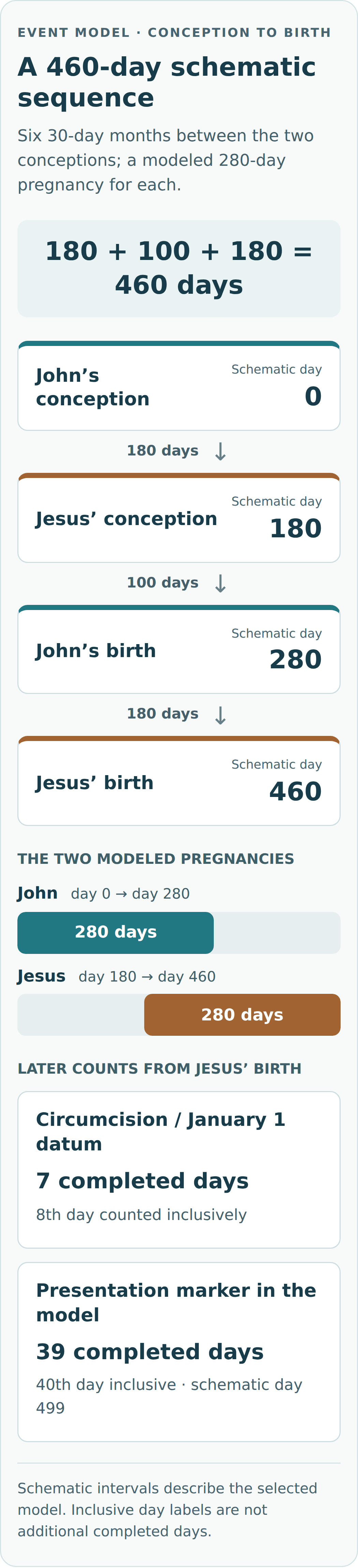
The model uses 280 days for each pregnancy and 180 days between the two conceptions, and therefore between the two births. This gives four principal markers:
| Marker | Days from John’s conception |
|---|---|
| John’s conception | 0 |
| Jesus’ conception | 180 |
| John’s birth | 280 |
| Jesus’ birth | 460 |
The middle interval is 280 − 180 = 100, so the whole structure is:
180 + 100 + 180 = 460
Both pregnancies remain 280: John’s runs from 0 to 280, and Jesus’ from 180 to 460. This is the origin of the 460 that later becomes important in the Key of 23 Capstone.
EVENT MODEL · CONCEPTION TO BIRTH
A 460-day schematic sequence
Six 30-day months between the two conceptions; a modeled 280-day pregnancy for each.
180 + 100 + 180 = 460 days
John’s conception
Schematic day0
Jesus’ conception
Schematic day180
John’s birth
Schematic day280
Jesus’ birth
Schematic day460
THE TWO MODELED PREGNANCIES
John day 0 → day 280
Jesus day 180 → day 460
LATER COUNTS FROM JESUS’ BIRTH
Circumcision / January 1 datum
7 completed days
8th day counted inclusively
Presentation marker in the model
39 completed days
40th day inclusive · schematic day 499
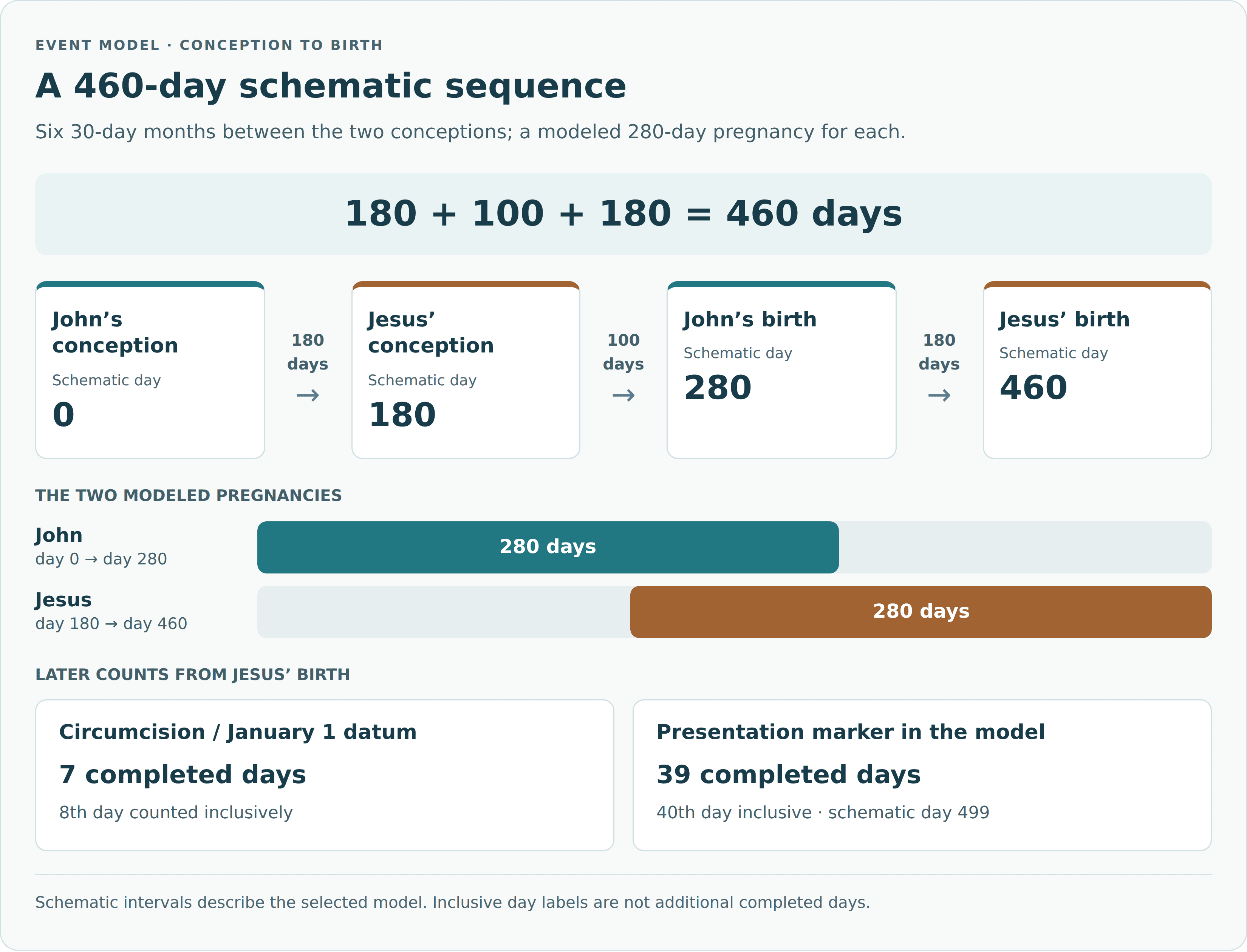
The six-month relationship in Luke is expressed here through the schematic half-year of 180 days. The Gospel does not measure either pregnancy as exactly 280 days or the interval as exactly 180. Those selected units let the comparison bring together 280 = 7 × 40, the forty-day purification count and the 360-day year.
Leviticus gives 7 + 33 = 40 days after the birth of a son, with circumcision on the eighth day (Leviticus 12:2–4, BSB). Its daughter-related periods total 80, allowing the separate schematic comparison 280 + 40 + 40 = 360. The priestly cycle supplies another weekly relationship: 168 = 24 × 7 = 12 × 14. These are related numerical scales, not interchangeable lengths of the same event. The priestly and purification notes explain their uses.
The eighth day and the fortieth day
Count December 25 as day 1. January 1 is then day 8 inclusively, seven elapsed days later. With January 1 assigned coordinate +1, December 25 has coordinate −6, displayed as symbolic 7 BC.
The fortieth numbered day is 39 elapsed days after birth:
−6 + 39 = 33
It falls on February 2, literal AD 1, and carries the symbolic label AD 33. A full forty-day interval instead ends on February 3 and gives AD 34. Likewise, January 2 is the eight-elapsed-day terminal; it is not the inclusive eighth-day circumcision on January 1.
These distinctions preserve both sets of comparisons. The completed introduction’s day table explains the counting; the complete event table for this study places inclusive markers and completed-period terminals in separate rows.
The AD 33 projection connects the infant’s presentation with the preferred Nisan Passion center in File 13 §§6–7. It is a typological correspondence. AD 34 remains the completed-period display, and AD 30 remains a separately qualified Passion alternative.
Two fixed 360-calendar beginnings
The 360-calendar comparison begins earlier, in 6 BC. Its two selected Julian starts are thirty days apart:
| Selected frame | Fixed Julian beginning |
|---|---|
| Christ 360-calendar frame | February 21, 6 BC |
| Exodus 360-calendar frame | March 23, 6 BC |
These are instances of the study’s intercalated calendar, which uses ordinary 360-day years and occasional 390-day years. An interval across it is not calculated by multiplying every intervening year by 360.
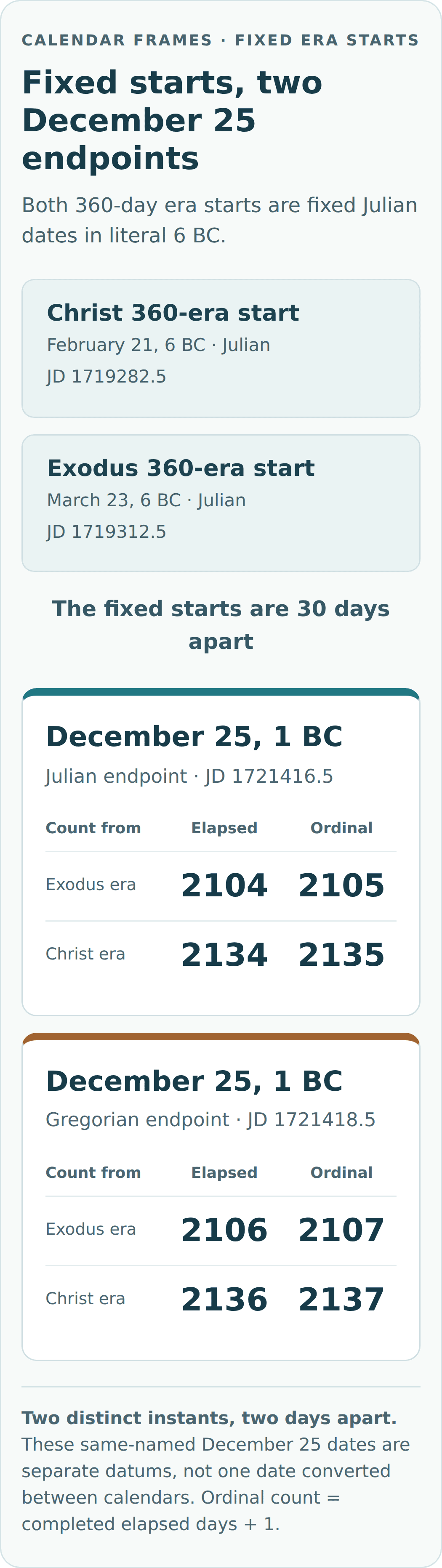
From those fixed beginnings to Julian December 25, 1 BC, the elapsed intervals are 2134 and 2104 days. Count the beginning as day 1, and the event occupies day 2135 in the Christ frame and day 2105 in the Exodus frame. On the day–year scale, those ordinals become symbolic AD 2135 and AD 2105.
Choosing Gregorian December 25, 1 BC supplies a different endpoint, two days later. Its ordinals are 2137 and 2107. The two 6 BC starts remain fixed in Julian; converting the date label of one instant does not lengthen its interval.
CALENDAR FRAMES · FIXED ERA STARTS
Fixed starts, two December 25 endpoints
Both 360-day era starts are fixed Julian dates in literal 6 BC.
Christ 360-era start
February 21, 6 BC · Julian
JD 1719282.5
Exodus 360-era start
March 23, 6 BC · Julian
JD 1719312.5
The fixed starts are 30 days apart
December 25, 1 BC
Julian endpoint · JD 1721416.5
December 25, 1 BC
Gregorian endpoint · JD 1721418.5
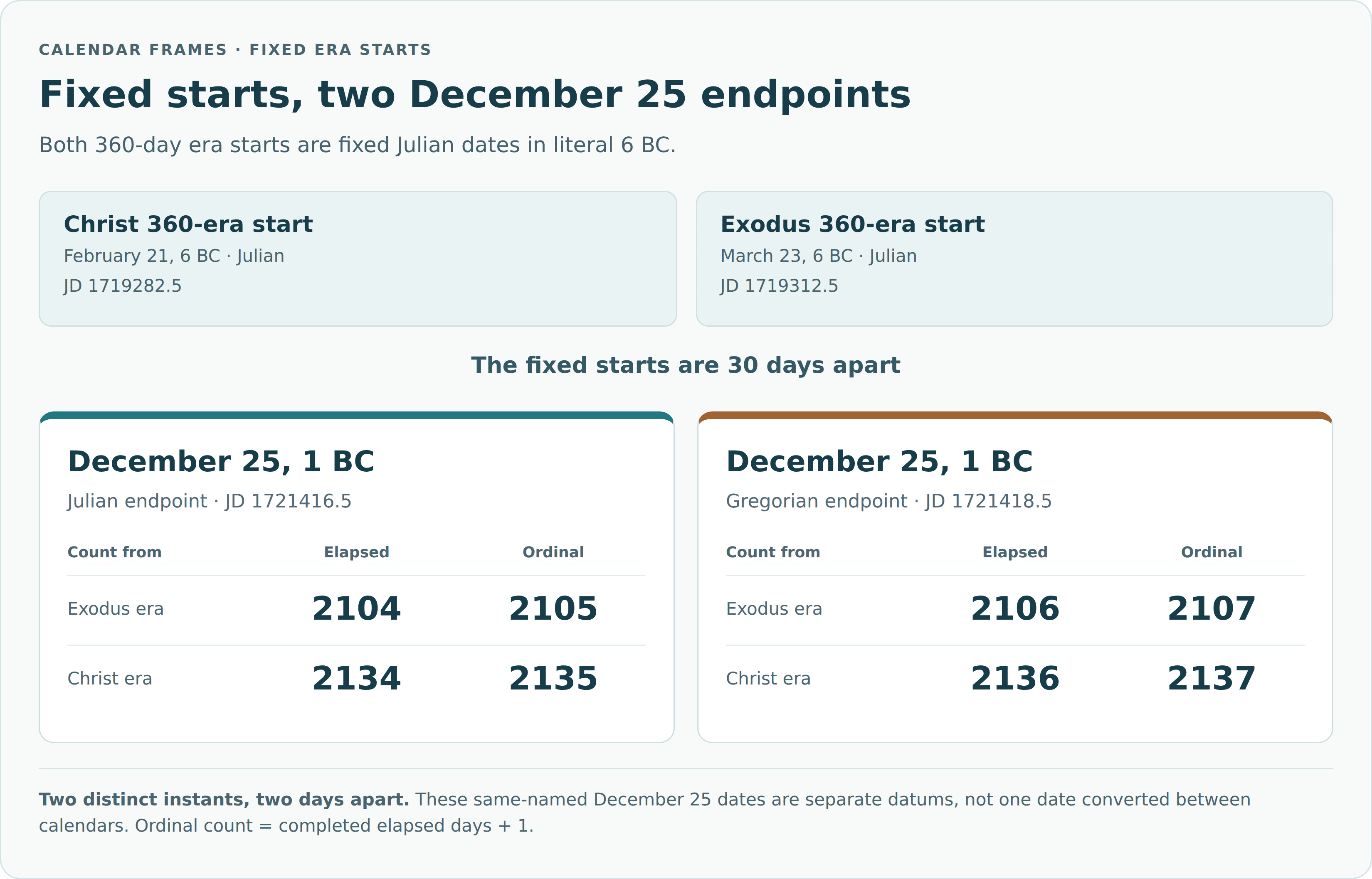
The same distinction applies at circumcision: Julian January 1 gives ordinals 2142/2112, while Gregorian January 1 gives 2144/2114. Each calendar’s own birth-to-circumcision interval remains seven elapsed days. The endpoint table gives Julian Day values, elapsed intervals and ordinals side by side.
I read the coexistence of the two calendar datums as providential: their two literal days reproduce a relationship familiar from Noah and Shem’s two-year gears. Gear 2 remains the normal chronological center. A reciprocal calendar reading, an alternative gear and the SP’s adjacent companion row each need their own designation; the calendar-datum appendix keeps those finer distinctions together.
A forty-day extension: 460 becomes 500
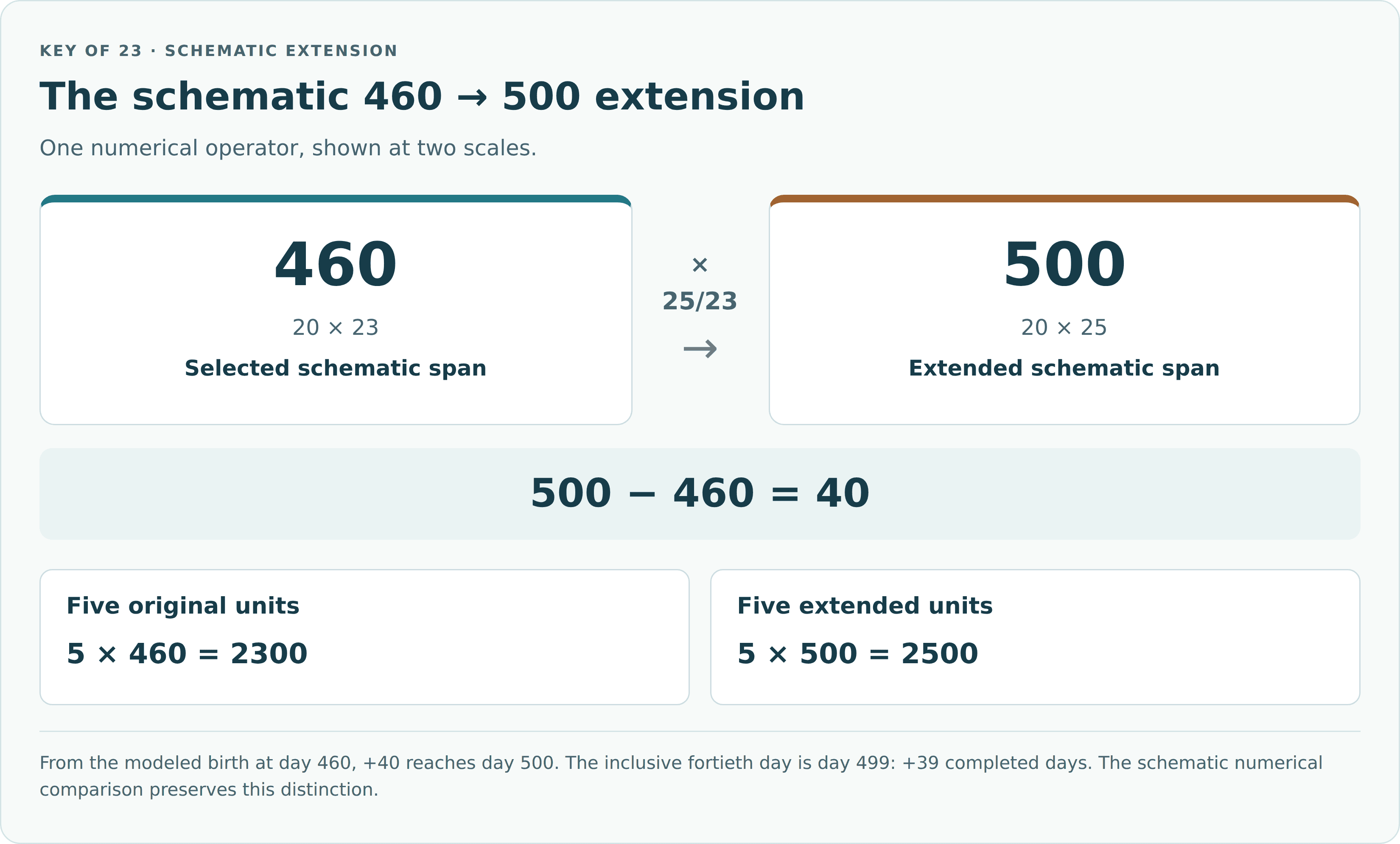
The Key of 23 changes twenty units of 23 into twenty units of 25:
460 × 25/23 = 500
500 − 460 = 40
The 460-day conception-to-birth model thereby extends to its 500-day completed-period terminal, forty elapsed days after Jesus’ birth. The inclusive fortieth-day marker is one day earlier, at 499 days from John’s conception. Keeping both markers makes the connection to purification clear without shifting the eighth-day covenant datum.
KEY OF 23 · SCHEMATIC EXTENSION
The schematic 460 → 500 extension
One numerical operator, shown at two scales.
460
20 × 23
Selected schematic span
500
20 × 25
Extended schematic span
500 − 460 = 40
Five original units
5 × 460 = 2300
Five extended units
5 × 500 = 2500
The narrative is equally important. Gabriel announces both births; Luke brings Mary and Jesus to the Temple, where Simeon and Anna recognize the significance of the Child. The offering is a pair of turtledoves or two young pigeons (Luke 2:22–38, BSB). I read the paired offering and the forty-unit overlap in relation to Adam and Eve, male and female, and restoration in Christ. This is the theological interpretation accompanying the calculation; the law’s purification concerns the mother after childbirth.
From the Exodus toward a new beginning
The 6 BC calendar frame continues the Exodus-based forty-year structure:
1446 − 6 = 1440 = 36 × 40 = 3 × 480
The temple framework supplies the earlier 480 = 12 × 40. The study compares the Tabernacle, Solomon’s Temple and Christ’s body, which John identifies as the temple in Jesus’ saying (1 Kings 6:1, BSB; John 2:19–21, BSB). The Exodus and 6 BC are chronological anchors within the model; December 25 is its traditional birth-calendar placement.
A second bridge is 1406 − 6 = 1400. This is the least common multiple of the three generation units developed in File 15:
1400 = 35 × 40 = 20 × 70 = 14 × 100
The comparison joins the Conquest frame to the Incarnation frame and places the years of conquest and rest beside the Creation pattern. Its exact seasonal variants are given in the generation and Conquest notes.
John’s role before Jesus also invites comparison with Aaron’s role before Moses. Acts explicitly identifies the promised prophet in relation to Moses:
For Moses truly said unto the fathers, A prophet shall the Lord your God raise up unto you of your brethren, like unto me; him shall ye hear in all things whatsoever he shall say unto you. And it shall come to pass, that every soul, which will not hear that prophet, shall be destroyed from among the people.
The half-year terminal comparison for Aaron and Moses belongs to their death phases. It does not make their births six months apart: Exodus 7:7 gives ages 83 and 80. The typological parallel and the chronological phase calculation therefore remain distinct.
Cross the frames: 3780 = 3 × 1260
The two thirty-separated calendar frames also form paired Mirror comparisons. Here the Mirror uses the astronomical/civil rendering: symbolic AD n reflects to (n + 1) BC. It is a reflection of generated coordinates, with no civil year zero.
John’s conception is symbolic AD 1645 in the Exodus frame and AD 1675 in the Christ frame. Their reflected labels are 1646 and 1676 BC. Cross those with Jesus’ birth in the opposite frame:
1676 BC → AD 2105 = 1676 + 2105 − 1 = 3780
1646 BC → AD 2135 = 1646 + 2135 − 1 = 3780
SYMBOLIC MIRROR · SELECTED CROSS-FRAME PAIRS
Two cross-frame Mirror comparisons
Each comparison joins one era’s mirrored conception coordinate to the other era’s birth coordinate.
CHRIST-ERA MIRROR → EXODUS-ERA BIRTH
1676 BC
Mirrored John conception
Christ 360-era coordinate
AD 2105
Jesus birth
Exodus 360-era coordinate
1676 + 2105 − 1 = 3780
EXODUS-ERA MIRROR → CHRIST-ERA BIRTH
1646 BC
Mirrored John conception
Exodus 360-era coordinate
AD 2135
Jesus birth
Christ 360-era coordinate
1646 + 2135 − 1 = 3780
3780 = 3 × 1260 symbolic years
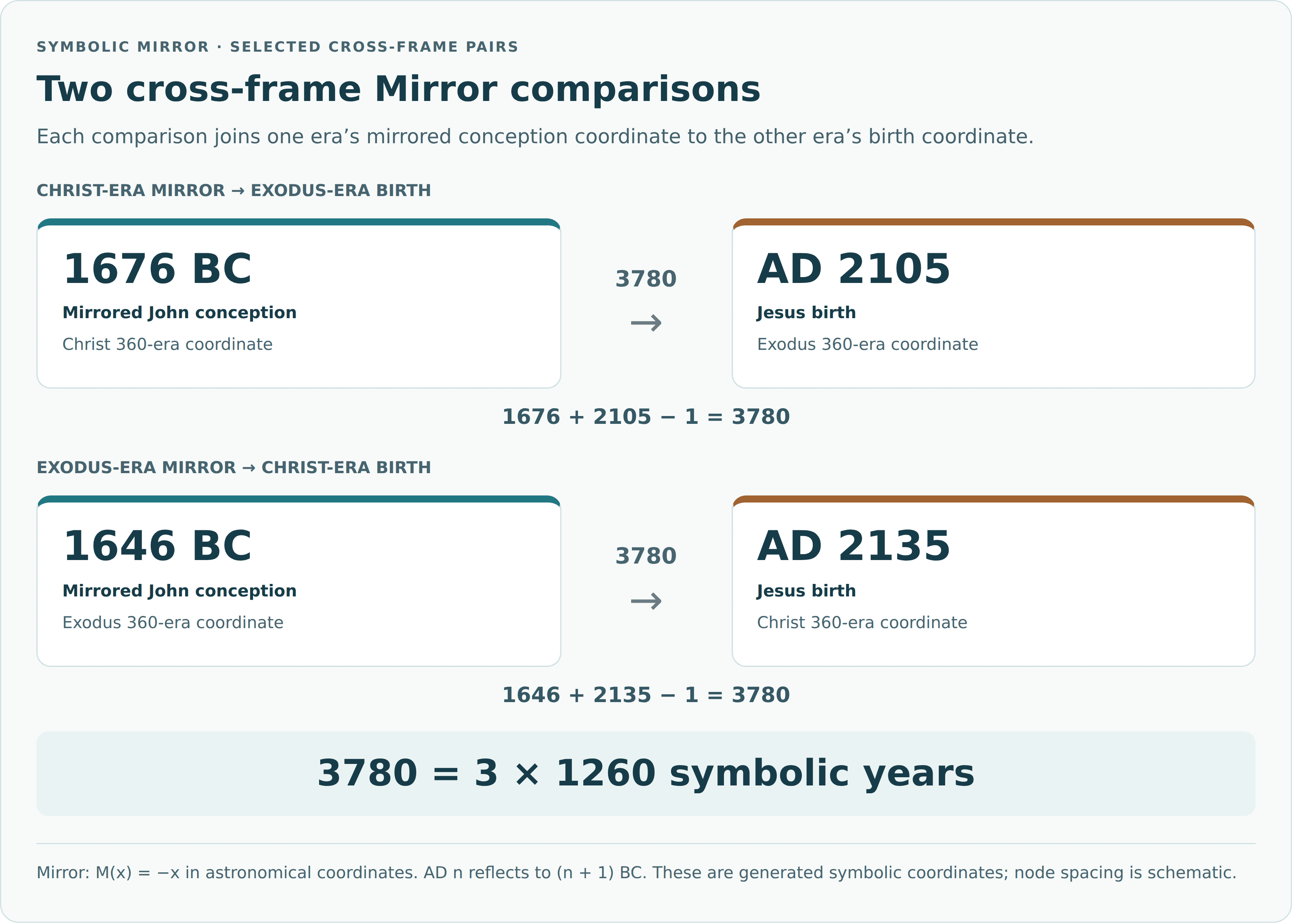
Thus 3780 = 3 × 1260 = 10½ × 360. John’s birth crossed with the reflected conception of Jesus gives the same total. Using the opposite frames is essential; arbitrary pairing of the slash-separated dates does not always give 3780. The Mirror span table names every retained endpoint.
On the same side of the Mirror, the thirty-day separation produces 430, 460 and 490. The conception-to-birth interval is 460 within either frame; cross from one frame to the other, and it becomes 460 − 30 = 430 or 460 + 30 = 490. These two familiar biblical periods arise from the declared frames, rather than from a general dating uncertainty.
Further relationships and the Capstone
Several comparisons reach beyond the immediate event sequence. Symbolic AD 2135, the Julian birth ordinal in the Christ frame, is 4300 years from Abram’s normal MT birth in 2166 BC. The completed-period marker for John’s mother, symbolic AD 1995, is 3440 = 8 × 430 from the Exodus in 1446 BC and 2580 = 6 × 430 = 1290 + 1290 from 586 BC. These are symbolic endpoint comparisons, not forecasts for the printed AD years.
The supporting research tables also preserve the 1260 and doubled-490 scaffolds, the cumulative Creation comparison, the Joseph-and-famine relationships, the older averaging display and the terminal Mirror observations. Each is presented in its own stated frame. This lets the fuller research remain available while the main explanation follows the events in Luke.
The next study, the Key of 23 Capstone, Part 5B, develops a number set from selected coordinates. Its inherited computational seed is a distinct display state; the precise event tables here do not silently replace it.
Creation, covenant and presentation give the comparison its direction. The days lead to Christ’s naming and then to the Temple; the larger calculations place those events beside the Exodus, ancestral chronology and prophetic periods. Their significance comes from reading the relationships together while preserving the count and reference point that produces each one.
Sources and the related studies
File 13 §§2, 6 and 7 controls the Incarnation and covenant framework. File 69 §3.4C distinguishes the intervening, elapsed and inclusive counts. File 12 §§7–7A governs the calendar registers; Files 18 and 47 qualify patriarchal stations. The supporting tables and research notes identify the controls for the additional comparisons.
Reading sequence: Introduction · Part 5A, this study · 5B: number-set expansion · 5C: sums and collective dates · 5D: expansion across the Mirror. 5E: the Rounded inverse study is a related operation. The calendar-datum appendix supplies the Julian/Gregorian and gear details.
Scripture quotations marked BSB: The Holy Bible, Berean Standard Bible, BSB is produced in cooperation with Bible Hub, Discovery Bible, OpenBible.com, and the Berean Bible Translation Committee. This text of God’s Word has been dedicated to the public domain. Official terms. The Acts quotation retains the KJV wording.