This appendix accompanies The Birth of Jesus: Eight Days, Forty Days, and the Day–Year Pattern. It keeps three related structures visible: the 6 + 1-year Creation comparison, the 7 + 1 inclusive circumcision count, and the 7 + 33 purification period. The tables distinguish calendar dates, counted positions, elapsed intervals and symbolic year labels.
1. The scriptural sequence
| Passage and translation | What the passage supplies | Role in the comparison |
|---|---|---|
| Genesis 1:26–31, BSB and 2:1–3, BSB | Humanity on the sixth day; seventh-day rest | Creation pattern applied to the model’s seven-year Incarnation week |
| Leviticus 12:2–4, BSB | Initial 7 days; circumcision on the eighth day; a further 33 days of maternal purification | 7 + 33 = 40; the circumcision day lies inside the second period |
| Leviticus 12:6–8, BSB | Offering when the purification days are complete; two birds if a lamb is unaffordable | Context for the Temple offering |
| Luke 2:21–24, BSB | Circumcision and naming; purification completed; presentation and the two-bird offering | Narrative application of the law |
| Luke 1:24–26, BSB | Elizabeth’s pregnancy and Gabriel’s visit to Mary in the sixth month | Narrative setting for the John–Jesus comparison; no exact 180-day or 460-day interval is stated |
| Numbers 14:34, BSB | Forty years corresponding to forty days in the wilderness judgment | Explicit biblical day–year application; the Nativity use is interpretive |
Digit-based entries are calculations or summaries in our prose. The main article’s quotations retain the words and number formatting of the individually checked BSB edition. The dated Creation comparison below uses the regular MT template; it does not substitute SP or LXX Creation dates.
2. The Creation and Incarnation weeks
File 07 §§1.1 and 3.1 distinguishes the Creation-week opening at 4121 BC, the sixth-year opening at 4116 BC, and the completed-week boundary at 4114 BC. File 13 §2.1 gives the Incarnation week’s Nisan form as 6n BC → AD 2n.
| Year / position | Regular MT Creation template | Incarnation week: Nisan boundaries | Meaning |
|---|---|---|---|
| 1 | 4121 → 4120 BC | 6n BC → 5n BC | Creation work |
| 2 | 4120 → 4119 BC | 5n BC → 4n BC | Creation work |
| 3 | 4119 → 4118 BC | 4n BC → 3n BC | Creation work |
| 4 | 4118 → 4117 BC | 3n BC → 2n BC | Creation work |
| 5 | 4117 → 4116 BC | 2n BC → 1n BC | Creation work |
| 6 | 4116 → 4115 BC | 1n BC → AD 1n | Sixth year: humanity / covenant comparison; January 1 inside this block |
| 7 | 4115 → 4114 BC | AD 1n → AD 2n | Rest |
The first six blocks give 4121 → 4115 BC = 6 years, corresponding to 6 BC → AD 1 = 6 years. Rest adds the final block: 4115 → 4114 BC, corresponding to AD 1 → AD 2. Thus both structures contain 6 + 1 = 7.
The astronomical example uses −5 = 6 BC, 0 = 1 BC, +1 = AD 1 and +2 = AD 2. The civil cross-axis check agrees: 6 + 1 − 1 = 6, and 6 + 2 − 1 = 7. These are spans between corresponding year boundaries, not a count of inclusive year labels.
The suffix n identifies Nisan; t identifies Tishri. File 13’s full paired week is 7t/6n BC → AD 1t/2n. The table selects its Nisan component. January 1, AD 1 falls within Year 6, 1n BC → AD 1n. It must not be moved to the Nisan boundary that opens Year 7. Likewise, the Creation dates identify model positions, not BC dates printed in Genesis.
Download the complete Creation-week comparison.
3. Circumcision: state what is included
The traditional Julian example runs from December 25, 1 BC to January 1, AD 1. Both the eighth-day and fortieth-day readings can be expressed inclusively. For circumcision, the inclusive sequence is 7 + 1: seven dates ending on December 31, then January 1 as the added eighth date.
| Question being counted | Included | Excluded | Count | Meaning |
|---|---|---|---|---|
| Seven-date block before circumcision | December 25–31, 1 BC | January 1, AD 1 | 7 | The first 7 in 7 + 1; exclusive of the circumcision day |
| Added covenant day | January 1, AD 1 | The preceding seven-date block | 1 | The +1 in 7 + 1 = 8 |
| Dates between birth and circumcision | December 26–31, 1 BC | Both December 25 and January 1 | 6 | The six intervening dates in the canonical 6 / 7 / 8 sequence |
| Elapsed interval from birth to circumcision | Seven intervals between the December 25 and January 1 markers | No extra interval for including both date labels | 7 | December 31 offset is 6; January 1 offset is 7 |
| Whole inclusive sequence | December 25, 1 BC through January 1, AD 1 | Neither endpoint | 8 | Birth is Day 1; January 1 is Day 8 |
December 31 is Day 7 in the block exclusive of January 1. Here “exclusive” names the terminal date omitted from that seven-date block. It does not mean seven full days have already elapsed at the December 31 marker: the elapsed offset there is 6. At the January 1 marker the elapsed offset is 7 and the inclusive ordinal is 8. This explicit endpoint convention keeps the seven-plus-one structure and the elapsed calculation consistent.
File 69 §3.4C states the companion 6 / 7 / 8 relationship: six intervening dates, seven elapsed days and eight days inclusively. It interprets these in relation to completed Creation, Sabbath rest and the new-Creation covenant sign. The theological correspondence follows the declared counts; it does not alter them.
No Gregorian conversion or averaging is needed. File 69 expressly distinguishes a different calendar label for the same instant from a change in elapsed time. The tables use only the chosen Julian December/January sequence.
Download the circumcision-count comparison.
4. The complete day table
Let n be the numbered day, with birth counted as day 1. Then:
Elapsed days = n − 1
Day coordinate = n − 7
For coordinate c ≤ 0, the symbolic civil label is (1 − c) BC. For c ≥ 1, it is AD c. The coordinate can be zero; the civil year label cannot.
December 26 has coordinate −5, symbolically 6 BC. Including the birth date itself takes the day table back one place to December 25, coordinate −6, symbolically 7 BC, exactly as File 13 §7.1 specifies. This local inclusive starting position does not displace the larger Incarnation week’s 6 BC anchor.
| Marker / counting state | Numbered day | Elapsed days | Coordinate | Symbolic label |
|---|---|---|---|---|
| Traditional birth datum | 1 | 0 | −6 | 7 BC |
| Primary −5 / 6 BC coordinate example | 2 | 1 | −5 | 6 BC |
| Day 7; circumcision day excluded | 7 | 6 | 0 | 1 BC |
| Circumcision / naming marker | 8 | 7 | +1 | AD 1 |
| Fortieth-day purification marker | 40 | 39 | +33 | AD 33 |
| Full forty-day elapsed interval | 41 | 40 | +34 | AD 34 |
| Count segment | Numbered days | Count | Meaning |
|---|---|---|---|
| Initial period | 1–7 | 7 | Seven counted days preceding circumcision |
| Circumcision day | 8 | 1 | First counted day of the further thirty-three |
| After the circumcision day | 9–40 | 32 | Remaining thirty-two counted days |
| Further purification | 8–40 | 33 | Circumcision day plus the remaining thirty-two |
| Whole inclusive sequence | 1–40 | 40 | Fortieth day is thirty-nine elapsed days after birth |
The first 7 counted days, the circumcision day and the remaining 32 give 7 + 1 + 32 = 40. Measured between the three date markers, the elapsed segments are 7 + 32 = 39. The full table contains days 1–40 plus a separately marked day-41 completed-period display.
Open the complete day-by-day conversion table
| Numbered day | Elapsed days | Traditional calendar example | Coordinate | Symbolic label | Marker |
|---|---|---|---|---|---|
| 1 | 0 | December 25, 1 BC | −6 | 7 BC | Traditional birth datum |
| 2 | 1 | December 26, 1 BC | −5 | 6 BC | Primary −5 / 6 BC coordinate example |
| 3 | 2 | December 27, 1 BC | −4 | 5 BC | Initial seven |
| 4 | 3 | December 28, 1 BC | −3 | 4 BC | Initial seven |
| 5 | 4 | December 29, 1 BC | −2 | 3 BC | Initial seven |
| 6 | 5 | December 30, 1 BC | −1 | 2 BC | Initial seven |
| 7 | 6 | December 31, 1 BC | 0 | 1 BC | Day 7; circumcision day excluded |
| 8 | 7 | January 1, AD 1 | +1 | AD 1 | Circumcision / naming marker |
| 9 | 8 | January 2, AD 1 | +2 | AD 2 | Further thirty-three |
| 10 | 9 | January 3, AD 1 | +3 | AD 3 | Further thirty-three |
| 11 | 10 | January 4, AD 1 | +4 | AD 4 | Further thirty-three |
| 12 | 11 | January 5, AD 1 | +5 | AD 5 | Further thirty-three |
| 13 | 12 | January 6, AD 1 | +6 | AD 6 | Further thirty-three |
| 14 | 13 | January 7, AD 1 | +7 | AD 7 | Further thirty-three |
| 15 | 14 | January 8, AD 1 | +8 | AD 8 | Further thirty-three |
| 16 | 15 | January 9, AD 1 | +9 | AD 9 | Further thirty-three |
| 17 | 16 | January 10, AD 1 | +10 | AD 10 | Further thirty-three |
| 18 | 17 | January 11, AD 1 | +11 | AD 11 | Further thirty-three |
| 19 | 18 | January 12, AD 1 | +12 | AD 12 | Further thirty-three |
| 20 | 19 | January 13, AD 1 | +13 | AD 13 | Further thirty-three |
| 21 | 20 | January 14, AD 1 | +14 | AD 14 | Further thirty-three |
| 22 | 21 | January 15, AD 1 | +15 | AD 15 | Further thirty-three |
| 23 | 22 | January 16, AD 1 | +16 | AD 16 | Further thirty-three |
| 24 | 23 | January 17, AD 1 | +17 | AD 17 | Further thirty-three |
| 25 | 24 | January 18, AD 1 | +18 | AD 18 | Further thirty-three |
| 26 | 25 | January 19, AD 1 | +19 | AD 19 | Further thirty-three |
| 27 | 26 | January 20, AD 1 | +20 | AD 20 | Further thirty-three |
| 28 | 27 | January 21, AD 1 | +21 | AD 21 | Further thirty-three |
| 29 | 28 | January 22, AD 1 | +22 | AD 22 | Further thirty-three |
| 30 | 29 | January 23, AD 1 | +23 | AD 23 | Further thirty-three |
| 31 | 30 | January 24, AD 1 | +24 | AD 24 | Further thirty-three |
| 32 | 31 | January 25, AD 1 | +25 | AD 25 | Further thirty-three |
| 33 | 32 | January 26, AD 1 | +26 | AD 26 | Further thirty-three |
| 34 | 33 | January 27, AD 1 | +27 | AD 27 | Further thirty-three |
| 35 | 34 | January 28, AD 1 | +28 | AD 28 | Further thirty-three |
| 36 | 35 | January 29, AD 1 | +29 | AD 29 | Further thirty-three |
| 37 | 36 | January 30, AD 1 | +30 | AD 30 | Further thirty-three |
| 38 | 37 | January 31, AD 1 | +31 | AD 31 | Further thirty-three |
| 39 | 38 | February 1, AD 1 | +32 | AD 32 | Further thirty-three |
| 40 | 39 | February 2, AD 1 | +33 | AD 33 | Fortieth-day purification marker |
| 41 | 40 | February 3, AD 1 | +34 | AD 34 | Full forty-day elapsed interval |
Download the complete conversion CSV · Count segments CSV · Combined data JSON (JSON in source ZIP).
Download Count Milestones CSV.
5. The related anchor settings
| Label | Active setting | Classification | Canonical section | Boundary |
|---|---|---|---|---|
| 6n BC → AD 2n | Incarnation / New Creation week | Seven-year framework: 6 + 1 | File_13 §2.1 | Year-boundary spans; Nisan component of 7t/6n BC → AD 1t/2n |
| 1n BC → AD 1n | Year 6 of the Incarnation week | Year block containing January 1, AD 1 | File_13 §§0.1, 2.1 | January 1 is inside Year 6, not its Nisan endpoint |
| AD 1n → AD 2n | Year 7 / Rest | Seventh year of the New Creation comparison | File_13 §2.1 | Begins at the Nisan boundary after the January 1 covenant datum |
| 6 BC | Historical birth hinge / pre-existent Son anchor | Genealogical chronology setting | File_13 §§0.1, 1 | Retain its event class; not the traditional December calendar datum |
| 6 BC | Conception-anchor rail | Typological Incarnation / source-dependent setting | File_13 §7.4 | The repeated label does not make birth and conception identical events |
| December 25, 1 BC | Traditional birth-calendar datum | Chosen calendar example | File_13 §7.1 | Luke does not supply this civil calendar date |
| January 1, AD 1 | Circumcision / naming / covenant datum | Eighth day in the traditional calendar example | File_13 §7.1 | Seven elapsed days from December 25; coordinate +1 |
| AD 33n | Preferred Passion center | Nisan Passion state | File_13 §6.1 | Distinct from symbolic day-coordinate +33 |
| AD 30n | Possible Passion center | Nisan Passion state | File_13 §6.1 | Retained as possible; not deleted by the day-year comparison |
| AD 33t | Tishri completion member | Non-Passion completion display | File_13 §6.2 | Not a Tishri crucifixion or second Passion date |
| AD 34 | Completed-period purification display | Non-Passion day-year display | File_13 §7.2 | Coordinate −6 + 40; not the fortieth day counted inclusively |
File 13’s working register and §1 use 6 BC as the historical birth hinge / pre-existent Son anchor in the genealogical chronology. Its §7.4 uses that label in a conception-anchor rail, explicitly classifying the node interpretation as typological and the source spans as dependency-controlled. The Incarnation framework places the traditional birth datum and January 1 covenant hinge within Year 6, whose Nisan endpoint is in spring AD 1.
These settings contribute to one Christological comparison, but birth, conception, covenant naming and a year boundary retain their own event classes. The model does not describe a pregnancy lasting six ordinary years. The calendar table enumerates the traditional December birth sequence; it does not redetermine the regular chronology’s historical birth date.
File 13 §2.2 also preserves 3 + 3 + 1 as the Creation forming/filling/rest division and 2 + 3 + 2 as its Flood-pattern division. This introduction develops the shared 6 + 1 Creation structure without making either canonical subdivision cancel the other.
Download the anchor-state CSV.
6. The fortieth day and the completed interval
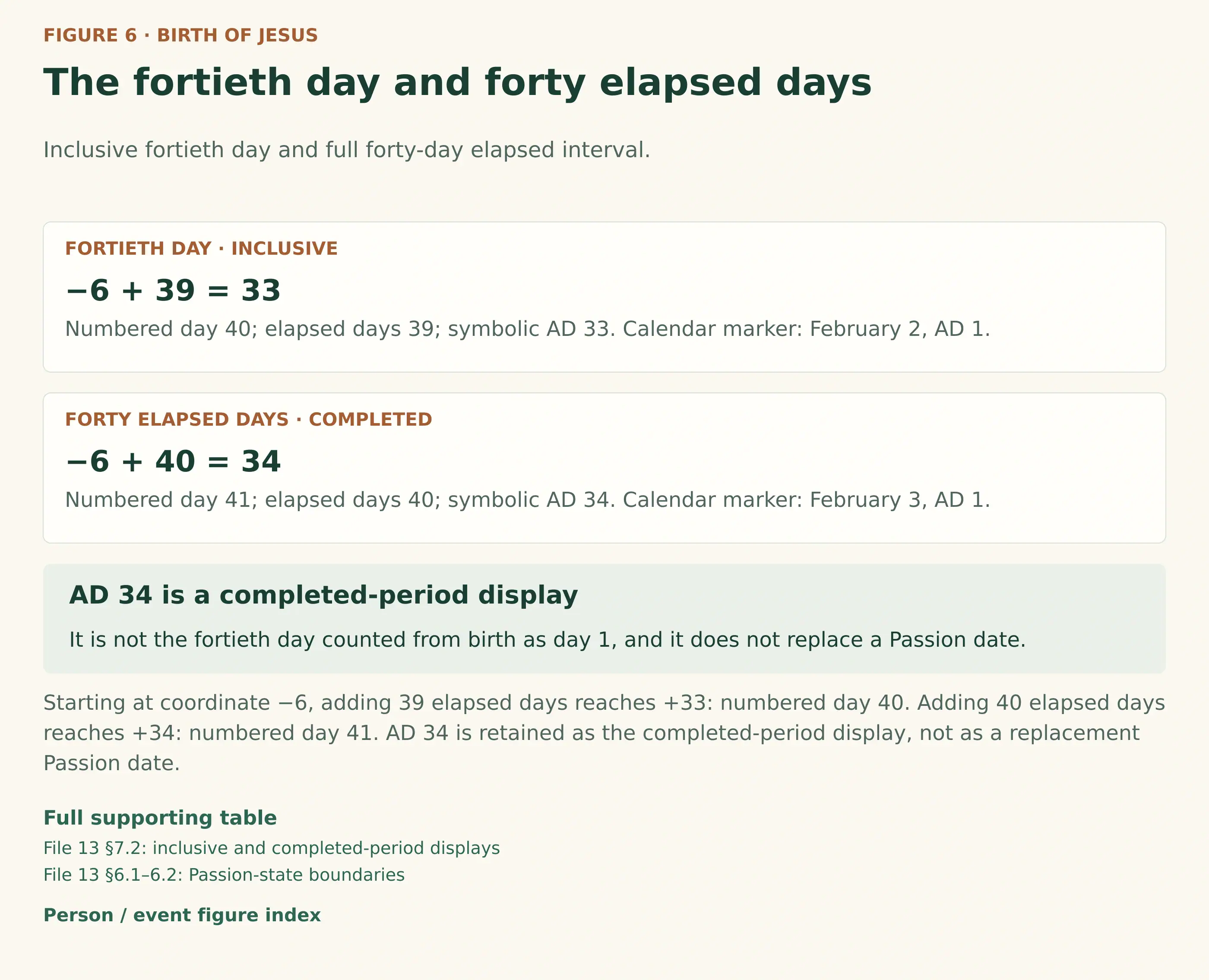
The fortieth day and forty elapsed days
Inclusive fortieth day and full forty-day elapsed interval.
Numbered day: 40
Elapsed days: 39
Symbolic label: AD 33
Calendar marker: February 2, AD 1
Numbered day: 41
Elapsed days: 40
Symbolic label: AD 34
Calendar marker: February 3, AD 1
Full supporting table · File 13 §7.2: inclusive and completed-period displays · File 13 §6.1–6.2: Passion-state boundaries
Counting and source notes
The calendar markers derive from the chosen traditional datum. The cards distinguish counting conventions; they do not establish a second purification law or a second Temple presentation. File 13 separately prefers AD 33n for the Passion, permits AD 30n, and classifies AD 33t as a completion member.
Image version and downloads for Figure 6
Full-size PNG · Editable SVG (ZIP) · Responsive diagram in this article
Download the exact standalone HTML, SVG and JSON source bundle (ZIP)
| Display | Arithmetic | Calendar marker in the example | Symbolic label | Meaning |
|---|---|---|---|---|
| Fortieth day, birth counted as day 1 | −6 + 39 = 33 | February 2, AD 1 | AD 33 | Inclusive purification marker |
| Full forty-day elapsed interval from the birth datum | −6 + 40 = 34 | February 3, AD 1 | AD 34 | Completed-period / exclusive-end display; numbered day 41 |
File 13 §7.2 retains both conventions. “Exclusive-end” is its completed-period display label. Luke describes presentation when the purification time was complete but supplies neither this civil calendar date nor a precise hour of travel or ritual completion. The table distinguishes the counted marker from a full elapsed interval, without creating a second historical presentation.
AD 33n is the preferred Nisan Passion state; AD 30n remains possible. AD 33t is a Tishri completion member, not another crucifixion. AD 34 belongs to the completed-period purification display and is not a Passion date (File 13 §§6–7; State Vocabulary Register §32G).
7. The 460-to-500 expansion
| Step | Expression | Classification | Meaning |
|---|---|---|---|
| Input | 460 = 20 × 23 | Source-retained Nativity model input | Associated with John-conception / Jesus-birth comparison; not an exact Gospel interval |
| Operator | 25/23 | Exact-rational Key-of-23 expansion | Same declared units on input and output; no dated endpoint assigned |
| Output | 460 × 25/23 = 500 | Arithmetic fact under declared operator | 20 units of 25 |
| Gain | 500 − 460 = 40 | Arithmetic fact; typological correspondence | Matches the counted purification total; does not change its 39 elapsed days |
The gain is 460 × (25/23 − 1) = 460 × 2/23 = 40. File 13 §7.3 retains this purification overlap, linking John’s conception, Jesus’ birth, Mary’s purification, the presentation and the two-bird offering. Its §7 argument-control note does not make the older article’s entire apparatus a local proof.
The legacy derivation uses 280 + 180 = 460. File 14 §1.1 preserves 280 as a biological-fractal model value. Luke 1 gives the sixth-month relationship, without specifying an exact 180-day separation or a uniform 280-day gestation. Accordingly, 460 is identified as a retained model input, its expansion as exact arithmetic, and its application to purification as typological.
The added forty can be compared with the law’s forty-day total. Assigning it an exact dated endpoint additionally requires the input’s origin and counting convention. Figure 5 therefore displays the duration expansion without choosing an unverified conception-to-presentation date. The full series’ successive expansions remain for its later comprehensive reconciliation.
8. Projection, comparison and Mirror
The Creation/Incarnation table compares corresponding positions in two seven-year structures. The day table assigns symbolic year labels to days. The Key of 23 expands a duration. None of these operations, by itself, reflects a date across the BC–AD axis.
File 13 calls January 1, AD 1 a local covenant Mirror hinge; File 69 develops that context further. The present illustrations use its 6 / 7 / 8 counting explanation, without importing the crossed Abrahamic Mirror fields. An actual reflection requires a named protocol, with paired Tishri/Nisan states controlled by File 09 Appendix A, File 13 §5 and File 00 §3.9.
Ordinary civil cross-axis spans use BC + AD − 1. Thus 6 BC → AD 1 gives 6 years, 6 BC → AD 2 gives 7 years, and the local symbolic labels 7 BC → AD 33 give 39 years. Counting the last pair’s labels inclusively gives 40. These checks do not introduce a civil year zero or a Mirror operation.
9. Person and event figure index
Each entry links to its relevant diagrams and full tables. Scripture links identify the narrative context; classifications distinguish biblical counts from traditional dates and calculated comparisons.
| Person / event / marker | Figures | Scripture context | Classification / tables |
|---|---|---|---|
| Creation week | Figure 2 | Genesis 1:31–2:3, BSB | Regular MT seven-year template: 4121 → 4115 → 4114 BC; six work-years plus rest; supporting table |
| Adam / humanity on the sixth day | Figure 2 | Genesis 1:26–31, BSB | Biblical sixth-day context; model Year 6 is 4116–4115 BC; supporting table |
| Seventh-day rest | Figure 2 | Genesis 2:1–3, BSB | Biblical seventh-day pattern; compared with the final year of each model week; supporting table |
| Incarnation / New Creation week | Figure 2 | Genesis 1:31–2:3; Luke 2, BSB | Canonical 6n BC → AD 2n week; January 1 covenant datum is inside Year 6; supporting table |
| Jesus | Figure 1; Figure 2; Figure 3; Figure 4; Figure 5; Figure 6 | Luke 2:21–24, BSB | Biblical person; traditional calendar and symbolic labels are separately declared; supporting table, supporting table, supporting table, supporting table, supporting table |
| Mary | Figure 1; Figure 4; Figure 5; Figure 6 | Luke 2:22–24, BSB | Biblical person; maternal ritual purification after childbirth; supporting table, supporting table, supporting table |
| John the Baptist | Figure 5 | Luke 1:24–26, BSB | Biblical person; 460 is the Nativity model input, not a stated Gospel interval; supporting table |
| Moses / childbirth law | Figure 1 | Leviticus 12:1–4, BSB | Biblical law: initial 7, circumcision on day 8, further 33; supporting table |
| Birth of Jesus | Figure 1; Figure 3; Figure 4; Figure 5; Figure 6 | Luke 2:6–7, BSB | Biblical event; day 1 in the count; traditional date assigned only in the calendar example; supporting table, supporting table, supporting table, supporting table |
| Circumcision | Figure 1; Figure 3; Figure 4 | Luke 2:21, BSB | Biblical event; day 8; seven elapsed days under the inclusive convention; supporting table, supporting table |
| Naming of Jesus | Figure 3 | Luke 2:21, BSB | Biblical event; traditional calendar covenant hinge; supporting table |
| Maternal purification | Figure 1; Figure 4; Figure 5; Figure 6 | Leviticus 12:2–4, BSB | Biblical count 7 + 33 = 40; fortieth-day marker under the declared inclusive convention; supporting table, supporting table, supporting table |
| Traditional December birth datum | Figure 3; Figure 4; Figure 6 | Luke 2:6–7, BSB | Traditional December 25, 1 BC datum; linked passage gives the event, not this date; supporting table, supporting table, supporting table |
| January 1 covenant hinge | Figure 2; Figure 3; Figure 4 | Luke 2:21, BSB | Derived eighth day in traditional calendar example; local covenant hinge in File_13; supporting table, supporting table, supporting table |
| Day coordinate zero | Figure 3 | Calculated coordinate; no separate narrative event | Calculated December 31 coordinate 0 → symbolic 1 BC; not a civil year zero; supporting table |
| AD 33 symbolic purification label | Figure 4; Figure 6 | Luke 2:22, BSB | Calculated day coordinate +33; comparison with preferred AD 33n Passion is typological; supporting table, supporting table |
| AD 34 completed-period display | Figure 6 | Calculated coordinate; no separate narrative event | Calculated coordinate +34 after forty elapsed days; numbered day 41; not a Passion date; supporting table |
| Temple presentation | Figure 4; Figure 5 | Luke 2:22–24, BSB | Biblical event after purification complete; this study does not establish an exact historical presentation date; supporting table, supporting table |
Download the figure index (JSON in source ZIP).
10. Canonical controls and edition notes
| Source | Sections used | Function |
|---|---|---|
| File 13: Christological Matrix | §§0.1, 2, 5–7 | Incarnation week, January 1 inside Year 6, anchor settings, day–year count, Passion boundaries and 460-to-500 comparison |
| File 07: Creation — The Seed and Decimal Root | §§1.1, 3.1 | Regular MT Creation week and the separate 4121, 4116 and 4114 BC positions |
| File 69: Enoch-Centered Genealogical Accordion | §3.4C | Six intervening dates, seven elapsed days, eight inclusively; Creation/covenant interpretation |
| File 14: Biological and Numerical Fractals | §§0.4–0.5, 1.1, 2.1 | Gestation-model scope and Levitical 7 + 33 count |
| File 00: Repository Foundation and File 09: Cumulative Architecture | File 00 §3.9; File 09 Appendix A and reciprocal guard | Year numbering, civil spans and separate Mirror protocols |
| File 12: Calendrical Physics and File 17: Prophetic Time Span Anatomy | Calendar and operation controls | Seasonal settings, exact ratios, declared units and purification-extension terminology |
| File 18: Chronological Data Tables | Regular MT table | Wider historical baseline; not the source of the traditional December dates |
| Repository Style Guide and State Vocabulary Register | Style Guide §§4, 18; Register §32G | Exact numbers, operation separation and Christological classifications |
These tables develop the defined introductory comparisons. The older discussion’s larger calendar matrices, iterative expansions and Mirror constructions require their own coordinated reconciliation. The complete source captures and editorial record accompany the publication files.
The main article’s Luke 2:21 quotation follows the linked eBible BSB edition, with “until His circumcision” and “before He had been conceived.” The separately downloaded official BSB corpus instead reads “before His circumcision” and “before He was conceived.” The quotation preserves the linked edition; the evidence records both readings. Leviticus 12:4 and the linked Genesis passages were checked individually. No NET quotation or translators’ note is reproduced.
Return to the introductory main article.
Scripture quotations: Berean Standard Bible (BSB), public domain.