Return to the birth-of-Jesus introduction · Detailed calendar study: Part 5A · Key of 23 Capstone: Part 5B
The Mirror in this day–year study is anchored to Christ’s circumcision and naming: January 1, AD 1, symbolically AD 1. The birth placement is counted backward from that covenant datum. This appendix explains the Julian and/or Gregorian wording: each calendar supplies its own January 1, and comparing them gives a reciprocal two-day displacement, or two symbolic years. The principal chronological reference remains Gear 2.
When the eight days until His circumcision had passed, He was named Jesus, the name the angel had given Him before He had been conceived.
Luke supplies the eight-day circumcision sequence. The traditional December 25 birth and January 1 naming placements belong to the calendar model used here, explained in the completed introduction.
Go directly to the birth-to-circumcision count · the two New Years · the MT gears · the SP counting example.
Tables can be scrolled sideways on narrow screens.
1. Count backward from the circumcision datum
Hold January 1, AD 1 fixed as symbolic AD 1. The preceding day is symbolic 1 BC, then 2 BC, and so on. The Julian weekdays make the sequence easy to see:
Table 1. Julian dates and the backward day–year count
| Literal Julian date | Weekday | Completed days to January 1 | Symbolic year |
|---|---|---|---|
| December 24, 1 BC | Friday | 8 | 8 BC |
| December 25, 1 BC | Saturday | 7 | 7 BC |
| December 26, 1 BC | Sunday | 6 | 6 BC |
| December 27, 1 BC | Monday | 5 | 5 BC |
| December 28, 1 BC | Tuesday | 4 | 4 BC |
| December 29, 1 BC | Wednesday | 3 | 3 BC |
| December 30, 1 BC | Thursday | 2 | 2 BC |
| December 31, 1 BC | Friday | 1 | 1 BC |
| January 1, AD 1 | Saturday | 0 | AD 1 |
Counting December 25 as day 1 makes January 1 day 8 inclusively, with 7 completed days between the date markers. Counting backward by 8 completed days instead reaches December 24. These two birth placements represent symbolic 7 BC and 8 BC respectively. Here “exclusive” means the completed-day interval; it does not mean excluding both date labels and counting only the intervening dates.
December 26 remains a useful lookup position, symbolically 6 BC; it is only 6 completed days before January 1, or 7 dates inclusively. It is not the eighth-day inclusive birth placement. The same backward mapping applies in the Gregorian frame using its own January 1; the weekdays above are specifically Julian.
The traditional December 25 placement is the inclusive eighth-day example controlled by File 13 §7.1. The larger 6 BC Incarnation/360-era anchor remains distinct from these local symbolic labels. The completed introduction’s counting table explains its six intervening dates, seven elapsed days, eight dates inclusively.
2. How both calendars are true at once
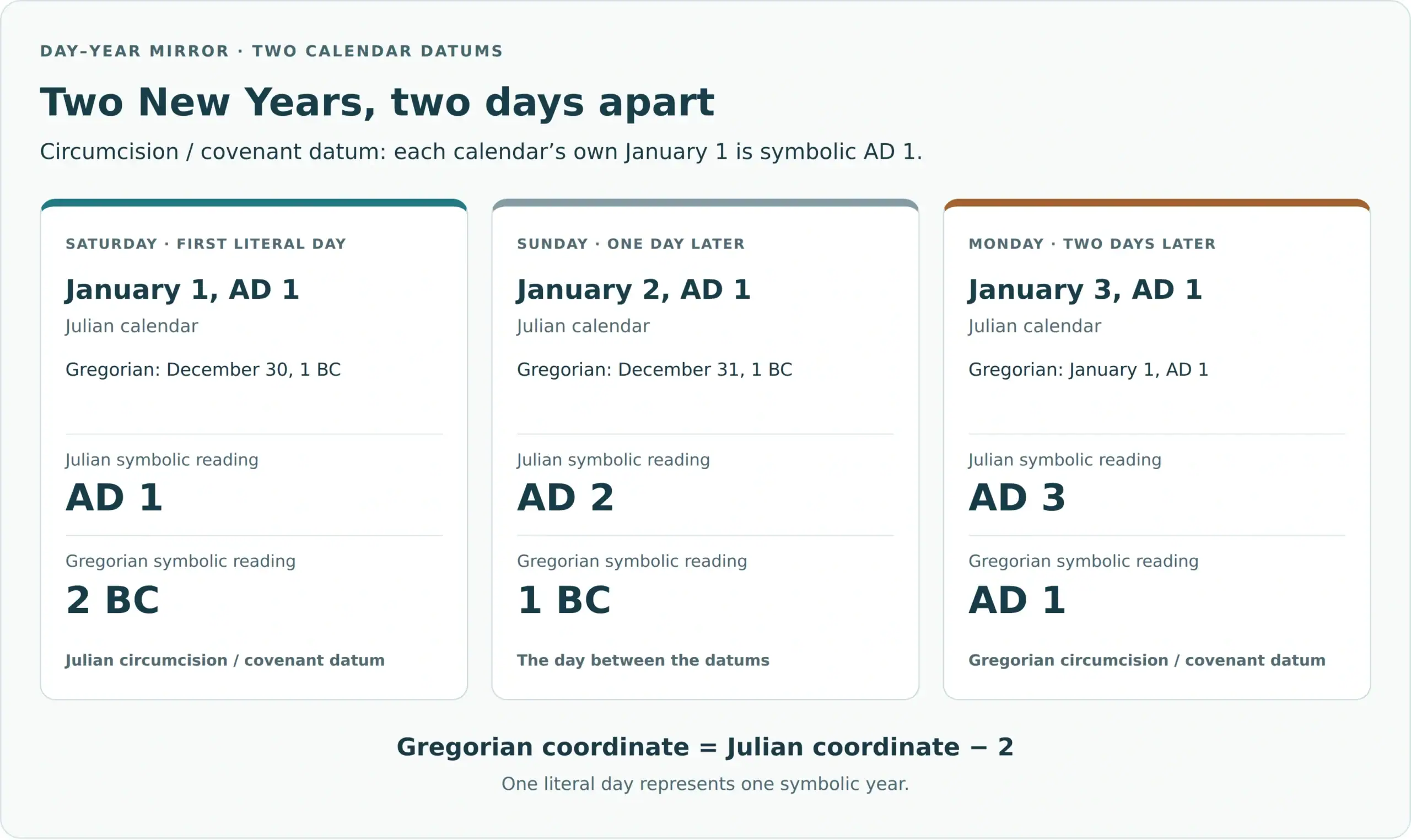
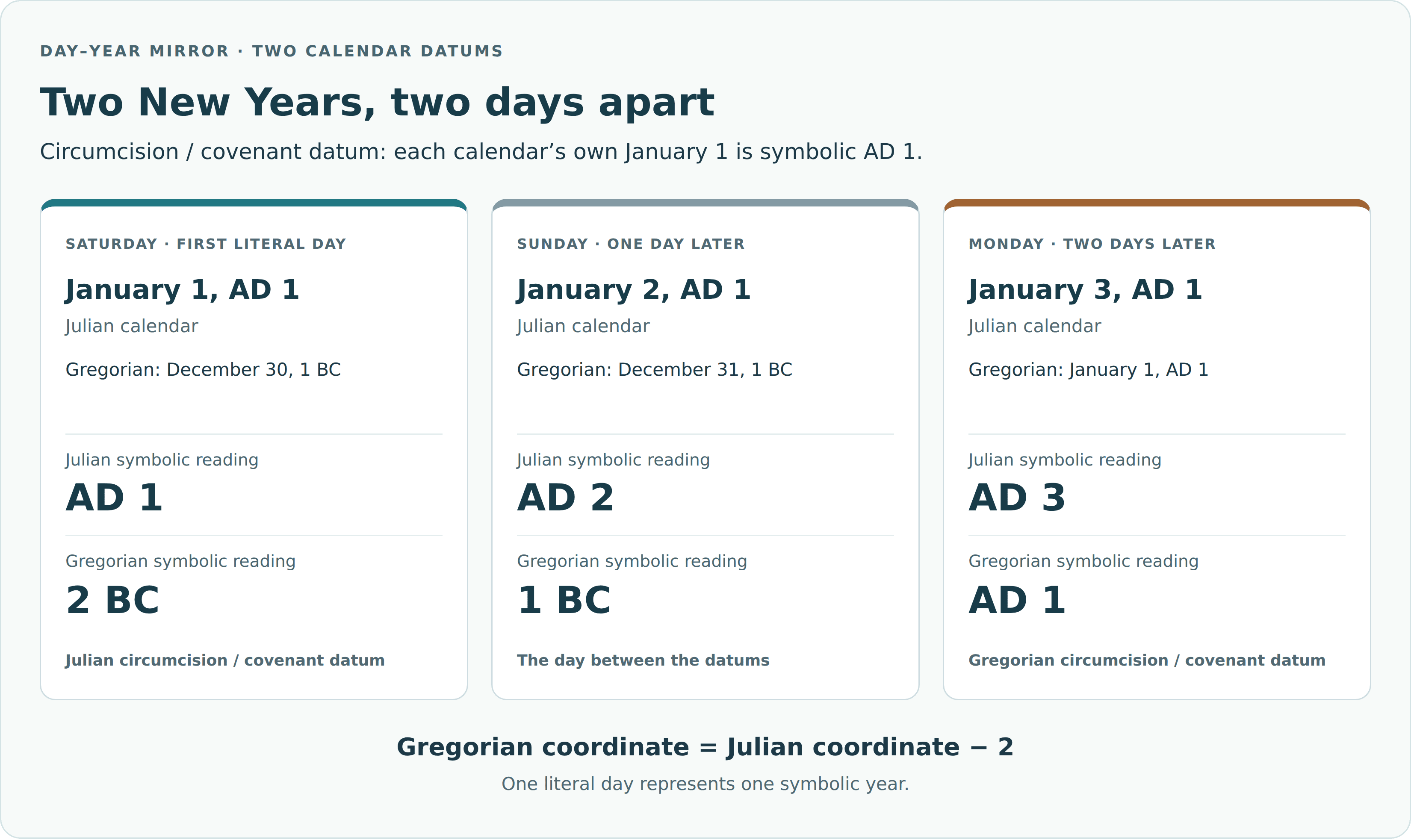
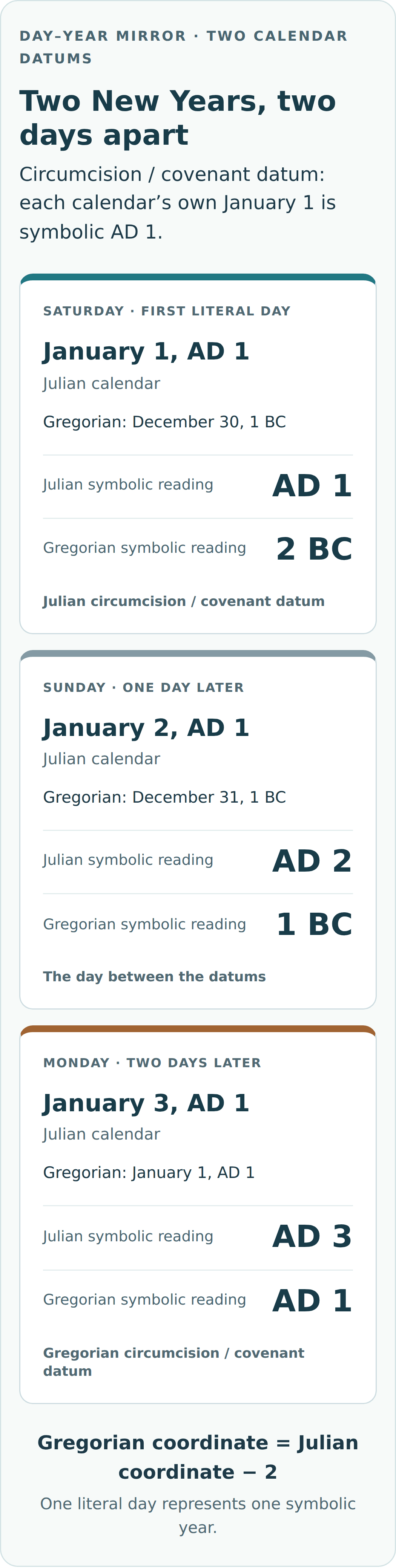
A particular instant has a date in both calendars. At this early epoch, Julian January 1, AD 1 is Gregorian December 30, 1 BC. Two days later, Julian January 3, AD 1 is Gregorian January 1, AD 1. “Gregorian” here means the proleptic Gregorian calendar: its rules are applied backward to the era being studied.
These conversions describe the same instants under different calendar labels. The study also allows each calendar’s own January 1 to serve as its circumcision/covenant Mirror datum. Those two named New Years are different instants, two days apart. Each is assigned symbolic AD 1 within its own day–year frame.
Table 2. Three literal days, two symbolic readings
| Literal Julian date | Same instant: Gregorian date | Julian-based symbolic year | Gregorian-based symbolic year |
|---|---|---|---|
| January 1, AD 1 | December 30, 1 BC | AD 1 | 2 BC |
| January 2, AD 1 | December 31, 1 BC | AD 2 | 1 BC |
| January 3, AD 1 | January 1, AD 1 | AD 3 | AD 1 |
Thus Gregorian New Year is symbolic AD 3 from the Julian datum, while Julian New Year is symbolic 2 BC from the Gregorian datum. Both descriptions are true once the governing datum is named.
DAY–YEAR MIRROR · TWO CALENDAR DATUMS
Two New Years, two days apart
Circumcision / covenant datum: each calendar’s own January 1 is symbolic AD 1.
SATURDAY · FIRST LITERAL DAY
January 1, AD 1
Julian calendar
Gregorian: December 30, 1 BC
Julian circumcision / covenant datum
SUNDAY · ONE DAY LATER
January 2, AD 1
Julian calendar
Gregorian: December 31, 1 BC
The day between the datums
MONDAY · TWO DAYS LATER
January 3, AD 1
Julian calendar
Gregorian: January 1, AD 1
Gregorian circumcision / covenant datum
Gregorian coordinate = Julian coordinate − 2
One literal day represents one symbolic year.
3. Why the reciprocal reading is ±2
The symbolic coordinate of a calendar’s own New Year is +1. The preceding day has coordinate 0, displayed as 1 BC; two days earlier has coordinate −1, displayed as 2 BC. Coordinate zero is therefore a label in the calculation, not a civil year zero.
For the same instant, the two signed coordinates satisfy:
Gregorian coordinate = Julian coordinate − 2.
The reverse reading adds 2. The ±2 describes the reciprocal directions of this one two-day separation. These are the two available New Year reference points for this day–year Mirror; a subsequent reflection of other dates must identify its operation separately.
The same distinction applies to December 25. Julian December 25, 1 BC converts to Gregorian December 23, 1 BC as the same instant. Choosing December 25 in each calendar instead gives two separate traditional-date datums, two days apart. In the 360-calendar comparison, the declared 6 BC era starts remain fixed when either December 25 endpoint is selected.
I understand this coexistence as providential: the calendar datums reproduce in literal days the two-year relationship familiar from the Noah–Shem chronological structure.
4. Gear 2 remains the normal center
In the Masoretic Text (MT) framework used here, Noah’s normal birth is 3058 BC and Shem’s normal reference is 2558 BC, 500 years later. Shem’s 600-year biography reaches 1958 BC. The outer gears lie two years on either side.
Table 3. The MT Noah–Shem reference field
| Gear | Noah’s birth | Shem’s birth/station | Shem’s death |
|---|---|---|---|
| Gear 3 | 3060 BC | 2560 BC | 1960 BC |
| Gear 2 — normal | 3058 BC | 2558 BC | 1958 BC |
| Gear 1 | 3056 BC | 2556 BC | 1956 BC |
The gears retain the qualified son-slot relationships involving Japheth, Shem and Ham. They are chronological reference states and bindings, not three biological births of Shem. File 47’s role-state clarification distinguishes the Gear-2 biological/triad reference from the Gear-1 elected-lineage station.
The calendar comparison recreates the outer readings. A normal 1958 BC projection on the Julian-based scale, read from the Gregorian datum, becomes 1960 BC. A normal 1958 BC projection on the Gregorian-based scale, read from the Julian datum, becomes 1956 BC. The signed coordinate changes by two; its displayed BC magnitude changes in the opposite direction.
One useful Gear-2 comparison is:
- 1958 BC → AD 3: 1958 + 3 − 1 = 1960 = 4 × 490 years.
- 1958 BC → 8 BC: 1958 − 8 = 1950 = 5 × 390 years.
The endpoints are ten symbolic years apart. In the Julian-based literal-day display, AD 3 is January 3, AD 1, while 8 BC is December 24, 1 BC. The former is also Gregorian January 1, AD 1.
5. The SP example adds a counting qualification
The Samaritan Pentateuch (SP) comparison uses the repository’s full-430 equalized frame. Its G2 primary Shem is 3208–2608 BC, with a separately qualified lower companion at 3207–2607 BC. The live Noah/Shem binding table gives the full pairings. The G1 Arphaxad-bound biography, 3206–2606 BC, remains a separate row.
For the G2 lower companion, the same totals reach 7 BC by completed-year subtraction, or 8 BC when both endpoint years are counted:
Table 4. The lower companion and the two counting conventions
| G2 lower-companion station | To 7 BC: completed years | To 8 BC: both endpoint years counted |
|---|---|---|
| Birth: 3207 BC | 3207 − 7 = 3200 | 3207 − 8 + 1 = 3200 |
| Death: 2607 BC | 2607 − 7 = 2600 | 2607 − 8 + 1 = 2600 |
On the Julian-based symbolic scale, 7 BC corresponds to December 25, literal 1 BC, while 8 BC corresponds to December 24. Holding the totals at 3200 and 2600, the inclusive count therefore reaches the preceding symbolic year and literal day.
The G2 primary row reaches that same 8 BC endpoint by ordinary subtraction: 3208 − 8 = 3200 and 2608 − 8 = 2600. The selected biography and the counting convention must travel together. This inclusive count applies to the specified comparison; each matched Shem biography still retains its 600-year lifespan. The SP count includes year labels from its patriarchal station; the circumcision count includes days from birth. Their different starting points must be kept explicit.
At 8 BC, the MT Gear-2 totals are 2558 − 8 = 2550 and 1958 − 8 = 1950. The corresponding SP totals, 3200 and 2600, are each 650 greater.
6. Reading the main tables
The main studies can use the normal Gear-2 display and link here for the calendar qualification. “Julian and/or Gregorian” means that either calendar’s own New Year can govern the symbolic count, while their reciprocal comparison supplies the ±2 reading. The SP’s one-year primary/companion distinction and its stated endpoint counting receive their own labels.
This establishes the two-datum relationship before any midpoint averaging. An averaged display requires its own stated endpoints and is handled separately.
Sources and related explanations
- Birth of Jesus: the completed introduction and Part 5A’s detailed study. Also see Part 5B’s Key of 23 Capstone.
- File 13 §§7.1–7.3: traditional birth, naming/circumcision datum and purification counts.
- File 47 §§0.3–0.4 and §5: MT Noah/Shem role-state distinctions and paired biographies.
- File 18 §3.2.1: SP primary/companion rows and named bindings; the directly linked live table.
- File 69: covenant-datum 6|7|8 guard: conversion of one instant preserves its elapsed interval.
- U.S. Naval Observatory calendar-conversion algorithms: independent verification of the Julian/Gregorian instants.
Scripture quotations: Berean Standard Bible (BSB), public domain.