Part 5B · A detailed companion to The Birth of Jesus: Eight Days, Forty Days, and the Day–Year Pattern
Know and understand this: From the issuance of the decree to restore and rebuild Jerusalem, until the Messiah, the Prince, there will be seven weeks and sixty-two weeks. It will be rebuilt with streets and a trench, but in times of distress.
Daniel’s seven weeks and sixty-two weeks total 69 weeks; the larger prophecy concerns 70 weeks (Daniel 9:24). This distinction supplies one of the numerical relationships explored here. The other is the Key of 23: a span expressed in units of 23 is converted into corresponding units of 25.
The starting point is the conception-and-birth framework already explained in Part 5A. Its 180 + 100 + 180 = 460 days connect John’s conception, Jesus’ conception, John’s birth and Jesus’ birth. A completed forty-day extension gives 500, and 460 × 25/23 = 500.
Here that relationship becomes a repeatable calculation. Begin with twelve selected coordinates, compare their spans, and extend both ends of each qualifying span. Four rounds of expansion produce a closed set of forty values. Its outline is particularly clear:
1260 + 990 + 1260 = 3510
The procedure is a numerical research model. Scripture provides the events and prophetic vocabulary; it does not prescribe this set-expansion algorithm.
Direct supporting tables: seed origins · every expansion round · the final forty values · further research connections.
The twelve starting values
The seed contains two six-value families:
| Family | Raw signed coordinates |
|---|---|
| Lower family | −5, 35, 175, 215, 315, 495 |
| Upper family | 1645, 1825, 1925, 1965, 2105, 2145 |
Within the upper family, the successive intervals are 180, 100, 40, 140, 40. The lower family reverses that order: 40, 140, 40, 100, 180. Each family therefore spans 500, with 1150 between them:
500 + 1150 + 500 = 2150
The upper six are exact ordinal day counts from the fixed Exodus-calendar beginning, Julian March 23, 6 BC, to the modeled events around Julian December 25, 1 BC. Count the era’s first day as day 1. Jesus’ birth then occupies day 2105, and the completed forty-day terminal occupies day 2145.
For the lower six, keep the seed as a fixed computational family. An explicit reconstruction takes those same events in a local frame with Julian January 30, AD 1 assigned +1, then reflects their signs. January 30 is 29 elapsed days after January 1; the seed-origin table shows every step. This local origin reproduces the twelve-value experiment without changing the circumcision Mirror’s January 1, AD 1 datum.
These are selected frames, not additional claims about the historical date of Jesus’ birth. The two-day Julian–Gregorian relationship remains in the calendar-datum appendix. It should not be used as an unnamed adjustment to this seed.
How one span produces two outputs
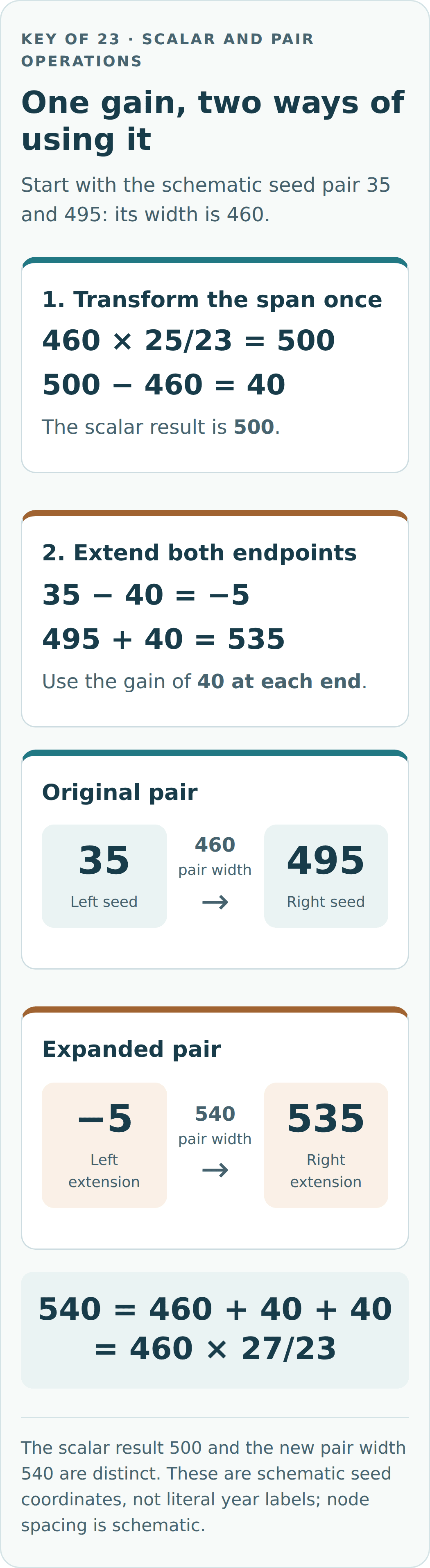
Take 35 and 495. Their difference is 460, or twice 230. Applying the Key gives:
460 × 25/23 = 500
The increase is 40. Move the lower endpoint back by 40 and the upper endpoint forward by 40:
35 − 40 = −5
495 + 40 = 535
The resulting outer endpoints span 540, because the procedure has added forty at each end. Thus two measurements must be kept distinct: the scalar conversion 460 → 500, and the full two-end extension 460 → 540.
KEY OF 23 · SCALAR AND PAIR OPERATIONS
One gain, two ways of using it
Start with the schematic seed pair 35 and 495: its width is 460.
1. Transform the span once
460 × 25/23 = 500
500 − 460 = 40
The scalar result is 500.
2. Extend both endpoints
35 − 40 = −5
495 + 40 = 535
Use the gain of 40 at each end.
Original pair
Expanded pair
540 = 460 + 40 + 40 = 460 × 27/23
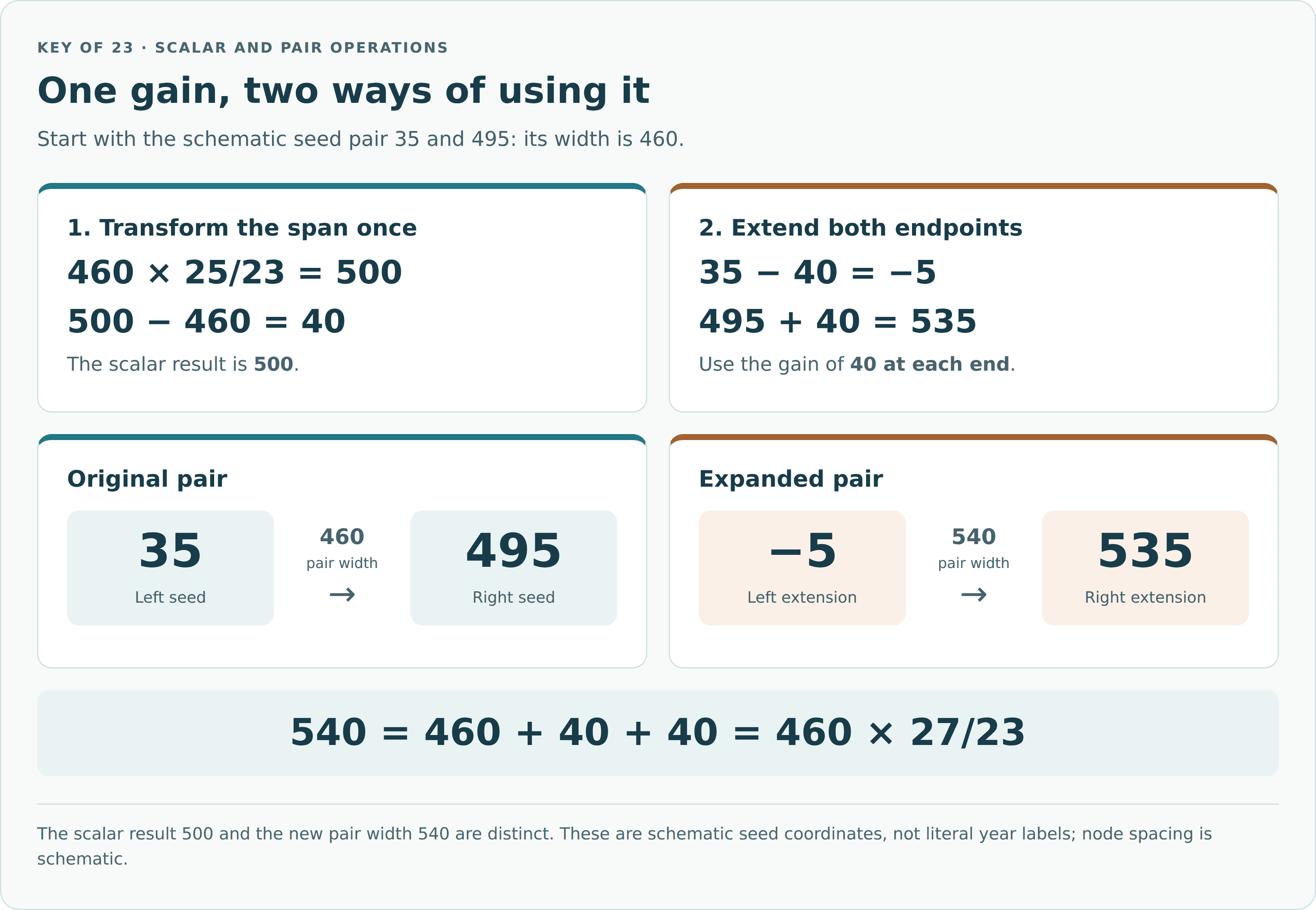
In general, for endpoints a and b separated by d, the increment at each end is 2d/23. The outputs are a − 2d/23 and b + 2d/23, with full width 27d/23. The canonical expansion protocols, File 46 §1, define the scalar 25/23. The two-end procedure here uses that scalar to generate a new pair.
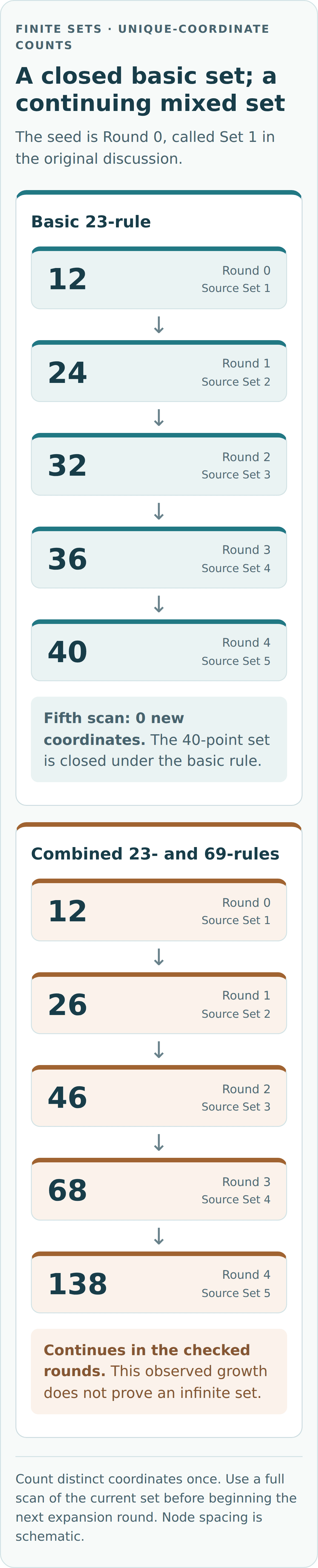
For each round, compare every pair in the existing set. Add all qualifying outputs together, remove duplicates, and then begin the next round. A generated value already present is not counted twice.
The basic calculation accepts spans divisible by 23. In this particular family all values end in 5, so an eligible span is also divisible by 230. Accordingly, the equivalent wording 250/230 gives the same basic result. The operator table explains why this equivalence holds here.
Four expansions, then closure
The twelve starting values grow as follows:
| Round | Values in the set | Distinct additions |
|---|---|---|
| 0 | 12 | Seed |
| 1 | 24 | 12 |
| 2 | 32 | 8 |
| 3 | 36 | 4 |
| 4 | 40 | 4 |
| 5 | 40 | 0 |
The original numbering calls these Sets 1–5, beginning with the seed. Here “round 0” means the unexpanded seed, making it clear that four rounds add values and the fifth scan checks closure.
FINITE SETS · UNIQUE-COORDINATE COUNTS
A closed basic set; a continuing mixed set
The seed is Round 0, called Set 1 in the original discussion.
Basic 23-rule
Fifth scan: 0 new coordinates. The 40-point set is closed under the basic rule.
Combined 23- and 69-rules
Continues in the checked rounds. This observed growth does not prove an infinite set.
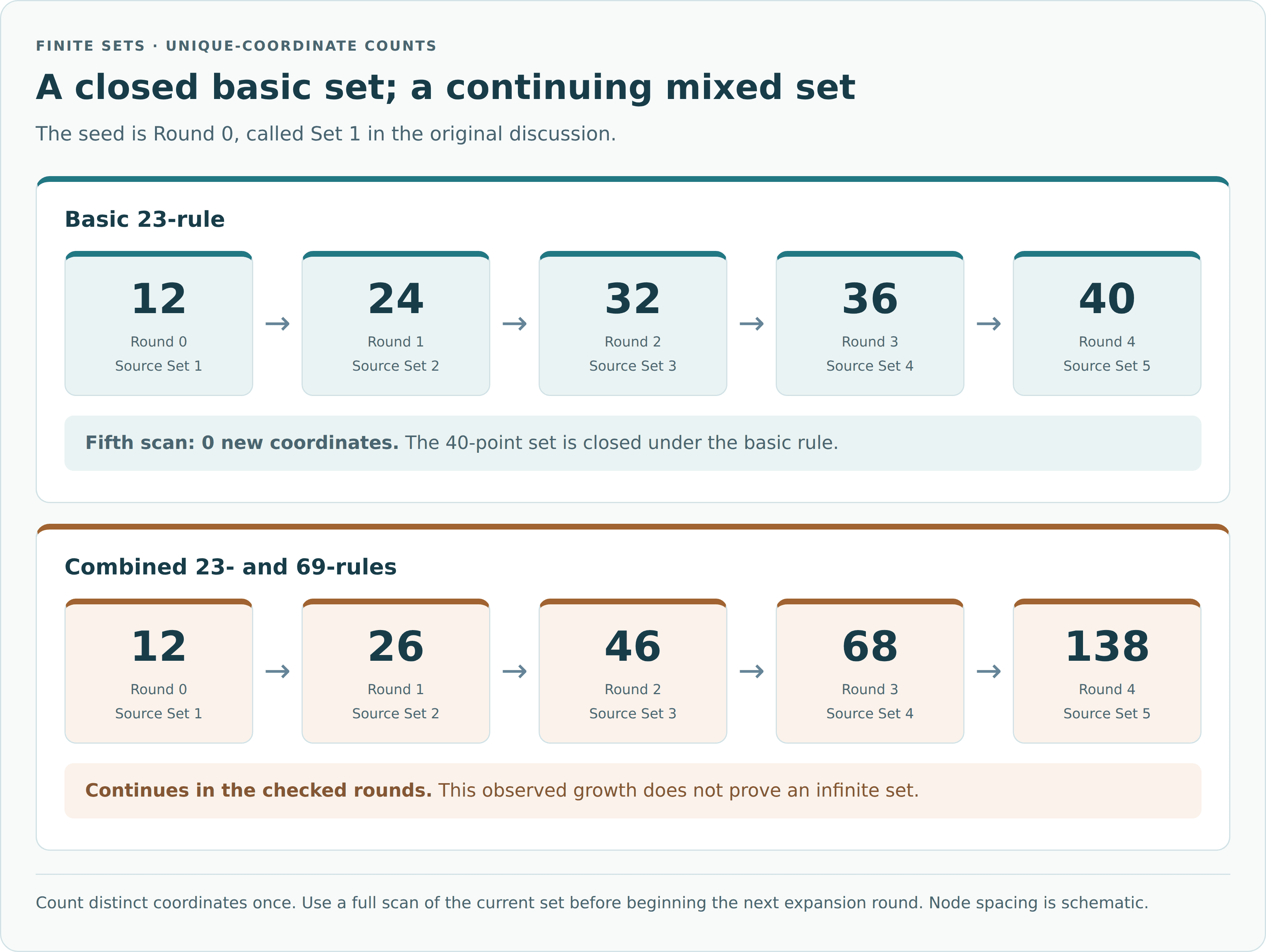
Closure is stronger than simply stopping the calculation. In the final forty-value set, all 42 qualifying pairs produce values already present. Repeating the same rule therefore leaves the set unchanged. The complete values and pair certificate make that result directly checkable.
The final shape: two 1260s around 990
Twenty values occupy the lower family and twenty the upper. Their limits are:
| Part of the final set | Raw boundaries | Span |
|---|---|---|
| Lower twenty | −685 → 575 | 1260 |
| Central interval, with no set values inside | 575 → 1565 | 990 |
| Upper twenty | 1565 → 2825 | 1260 |
Each 1260 = 7 × 180. All eight boundaries marking its seven half-year intervals occur in the set. Its finer spacing also retains the forty-day rhythm: there are twelve forty-unit gaps on each side.
BASIC RULE · THE CLOSED 40-COORDINATE SET
The final basic set: two equal occupied spans
Twenty coordinates in each outer interval; no coordinates inside the central gap.
Lower 20 coordinates
−685 → 575
1260
7 × 180
occupied interval width
Open central gap
575 → 1565
990
no points strictly inside
Upper 20 coordinates
1565 → 2825
1260
7 × 180
occupied interval width
The gap’s midpoint and the set’s reflection center are both 1070.
1260 + 990 + 1260 = 3510
Central 990: one selected schematic partition
990 = 360 + 270 + 360
Schematic year
360
Nine 30-day months
270
Schematic year
360
The 270-unit pregnancy interpretation is separate from the seed model’s 280. These are partition widths, not additional set members.
Opposite-pair sum
x + R(x) = 2140
Reflection rule
R(x) = 2140 − x
Seed-set center
2140 ÷ 2 = 1070
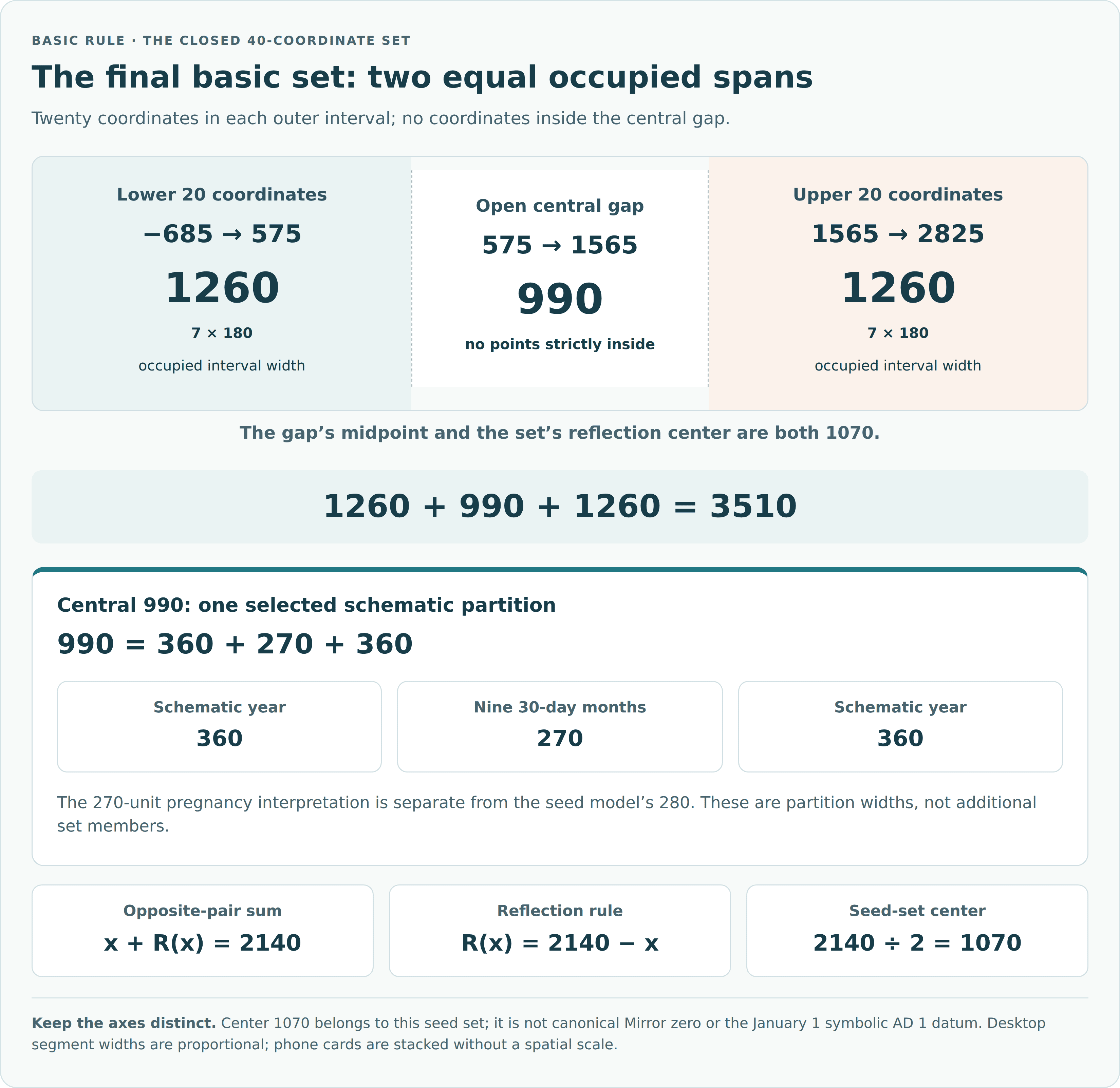

The central 990 admits the schematic decomposition 360 + 270 + 360. This preserves a seasonal and gestational reading alongside the two 1260 wings. The selected 270-unit interval belongs to that interpretation; the conception-and-birth seed itself uses 280-day pregnancies. The two models should remain separately identified.
The arrangement also has a simple complement: corresponding raw values add to 2140. Its numerical center is therefore 1070. This is the seed-set’s axis of symmetry; it is distinct from the calendar Mirror at the BC–AD boundary. The spacing table and sign conventions keep those relationships visible.
The optional 69-to-70 branch
There is another way to extend a qualifying span. The ratio 70/69 supplies an increment of d/69 at each end. For 35 → 2105, the span is 2070 = 69 × 30. Its scalar conversion is 2100 = 70 × 30, an increase of thirty:
35 − 30 = 5; 2105 + 30 = 2135
This brings the original 460 conception-to-birth span into a neighboring 490 relationship: 2135 − 1645 = 490. The added 2135 also matches the birth ordinal in the Christ-calendar frame, whose fixed 6 BC start is thirty days earlier than the Exodus frame’s.
Applying both rules to every pair in every round produces 12 → 26 → 46 → 68 → 138, with further growth in the checked continuation. A separate experiment adds only 5 and 2135 to form a fourteen-value seed and then resumes the 23 rule alone. These are distinct branches; their tables and calculation limits are supplied together.
The growing branches invite further research. Finite runs, including a thousand rounds of the original edge-retaining procedure, do not by themselves prove infinite growth or mathematical fractal self-similarity.
What the Capstone brings together
The strength of the basic construction is its visible progression: a 460-day event scaffold supplies a 500-unit family, the two-end rule generates new coordinates, and the process closes in two 1260 wings around 990. The forty-day extensions remain readable at every stage.
I read these correspondences as a Christ-centered pattern linking conception, birth, purification and prophetic time. The arithmetic establishes the relationships within the stated model; the theological reading concerns their meaning. The broader comparisons—to Daniel, Creation, the Exodus, Hezekiah and the Temple—remain available in the supporting research notes, with their chronological states identified.
Continue the series: Part 5C: sums and collective dates · Part 5D: expansion across the Mirror · Part 5E: inverted timelines.
Original research discussion: Read the preserved original Part 5B.
Scripture quotation: The Holy Bible, Berean Standard Bible, BSB is produced in cooperation with Bible Hub, Discovery Bible, OpenBible.com, and the Berean Bible Translation Committee. This text of God’s Word has been dedicated to the public domain.