An exploratory appendix to the birth-set studies, Parts 5a–5e.
The middle interval of 990 does more than separate the two halves of the birth-derived set. When I measure across it from each side, the interval belongs to both paths. This distinction between a single outer span and two overlapping paths makes the later 14400, 15480, and 18000 totals intelligible. It also helps explain why the reversed spans 5760 and 1080 reconnect with the biblical chronology.
I develop those relationships here from the two middle positions 575 and 1565. The numerical operations are explicit; the connections with Creation, covenant, Exodus, and Christ are my theological reading of the resulting pattern. This article remains an exploratory study alongside the Unified Chronology.
1. The middle pair and the way dates are displayed
The starting middle coordinates are 575 and 1565, separated by 990. In the civil display retained from the earlier discussion, a positive coordinate is its AD year, while a negative coordinate −n is year n + 1 BC. Thus −6175 means 6176 BC, and +8315 means AD 8315. Coordinate zero is a calculation position, displayed as 1 BC; it introduces no civil year zero.
Consequently, a civil interval from B BC to AD A is B + A − 1. Reflection changes the sign of a coordinate: AD 7325 therefore reflects to 7326 BC in this display. The current pure Rounded display in File_51b uses symmetric BC/AD numerals and a different displayed-width formula. Here I keep the expressly civil equations and their original AD labels together.
For an equal flank of length a, the four ordered positions are:
575 − a → 575 → 1565 → 1565 + a.
The three consecutive intervals are a, 990, and a. Their single outer span is 2a + 990. There are also two crossing paths: from the left outer position to 1565, and from 575 to the right outer position. Each is a + 990. Adding those two path lengths counts the shared middle interval twice:
(a + 990) + (990 + a) = 2a + 1980.
This is what I mean by the overlapping middle. It is a sum of two paths, not a claim that the elapsed distance between the outer endpoints has increased.
2. From 1260 to 6210, and from 6210 to 6750
I retain the placeholder-preserving reversal used in File_52a and File_52b: reverse the significant digits while keeping the trailing-zero scale. Thus 1260 → 6210, 6750 → 5760, and 990 → 990. Reversing the same span twice returns that span. An intervening expansion is a separate operation.
The initial three-part arrangement and its segmentwise reversal are:
1260 + 990 + 1260 = 3510
6210 + 990 + 6210 = 13410.
On the reversed arrangement, each crossing path is 6210 + 990 = 7200. Their combined length is therefore 14400. Now apply the Priestly Key of 23 to each flank:
6210 × 25/23 = 6750, a gain of 540 on each side.
The new consecutive arrangement is 6750 + 990 + 6750 = 14490. Each crossing path is now 6750 + 990 = 7740, and the two paths total 15480. The distinction between consecutive width and overlapping path sum is visible in the table.
| Flank | Single outer span: 2a + 990 | Each crossing path: a + 990 | Two-path sum |
|---|---|---|---|
| 6210 | 13410 | 7200 | 14400 |
| 6750 | 14490 | 7740 | 15480 |
For the 6750 flank, the four coordinates are −6175, +575, +1565, +8315, displayed as 6176 BC, AD 575, AD 1565, AD 8315. The crossing equations are 6176 BC → AD 1565 = 7740 and AD 575 → AD 8315 = 7740. Their overlap is precisely AD 575 → AD 1565, or 990 years.
3. The 400 and 430 registers
In the schematic precessional register used in this series, a cycle of 25920 years is divided into 360 units of 72 years. This is the convention behind the phrase “precessional day”:
25920 ÷ 360 = 72 years per unit.
The two-path sums above are 14400 = 200 × 72 and 15480 = 215 × 72. Reflection supplies a second arrangement with the same path lengths. Adding the two-path sum from each orientation gives:
| Flank | Path sum in one orientation | Sum over both orientations | 72-year units |
|---|---|---|---|
| 6210 | 14400 | 28800 | 400 |
| 6750 | 15480 | 30960 | 430 |
The resulting 400 and 430 recall the covenant and sojourn numbers of Genesis 15:13 and Exodus 12:40–41. Their historical interpretation belongs to the underlying chronology; here their numerals recur on the 72-year scale. The transition comes from expanding the two 6210 flanks while retaining the middle 990. It is not direct multiplication of the whole 28800 total by 25/23.
The reflected paths repeat the same construction in the opposite orientation. I regard the 400/430 correspondence as a symbolic relationship within that construction, not as four independent discoveries or a new elapsed interval between two dates.
4. Two held-endpoint expansions and the 18000 total
The ordinary span 14490 is itself divisible by 23:
14490 = 630 × 23 → 15750 = 630 × 25.
The gain is 15750 − 14490 = 1260.
There are two ways to apply that larger span to the existing outer pair −6175 and +8315. Holding the left endpoint extends the right endpoint by 1260. Holding the right endpoint extends the left endpoint by 1260. These are two anchored expansions of the same original interval:
| Endpoint held | Expanded interval in signed coordinates | Length |
|---|---|---|
| Left: −6175 | −6175 → +9575 | 15750 |
| Right: +8315 | −7435 → +8315 | 15750 |
Taking the two new outer limits together, while retaining 575 and 1565, gives −7435 → +575 → +1565 → +9575. The two flanks are now 8010 = 6750 + 1260. This combined arrangement has an ordinary outer span of:
8010 + 990 + 8010 = 17010.
Its two crossing paths each have length 8010 + 990 = 9000. Their sum supplies the intended 18000:
8010 + 990 + 990 + 8010 = 18000.
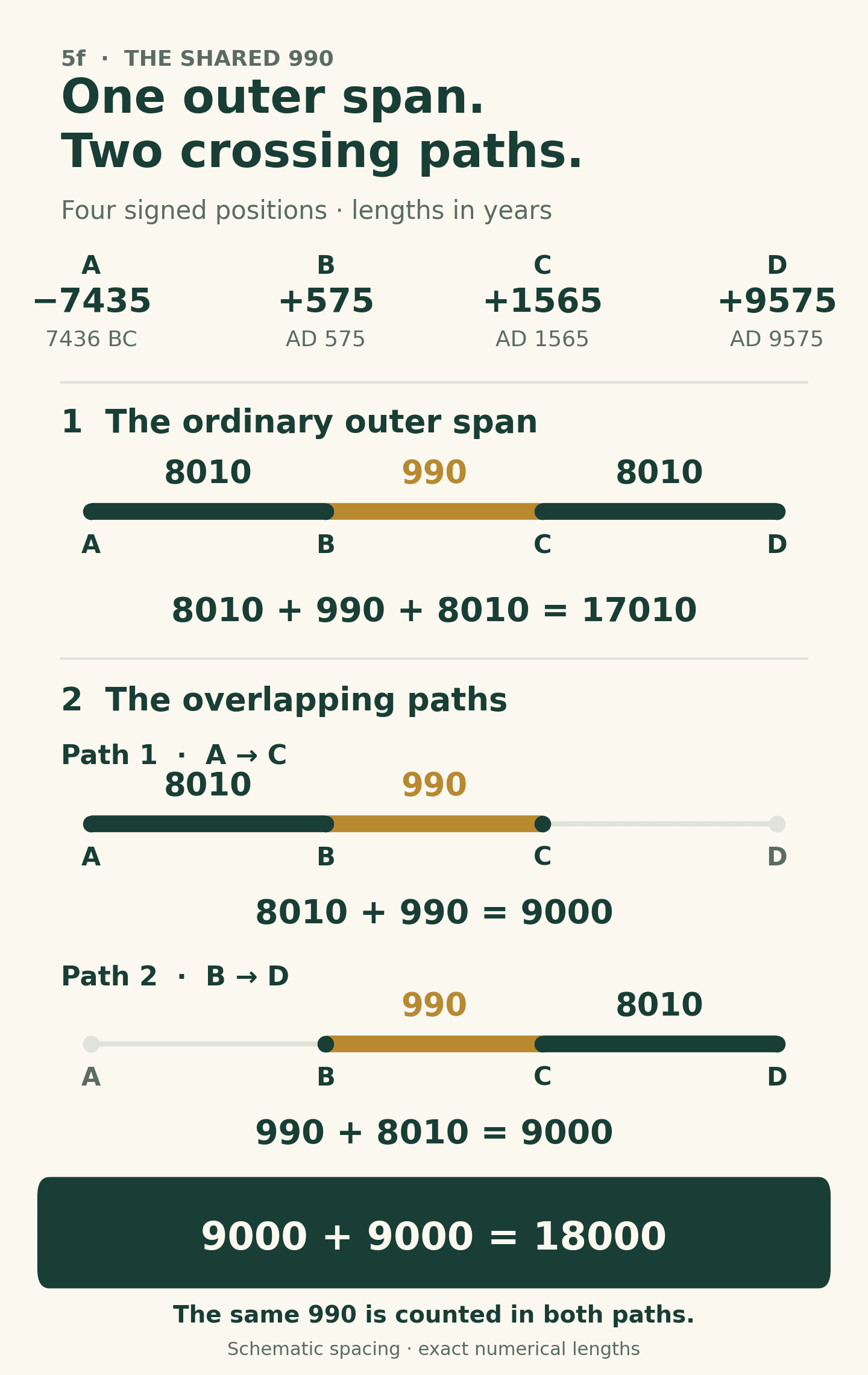
The reflected arrangement supplies the same 18000 path sum, so both orientations total 36000 = 500 × 72 = 100 × 360. Thus the overlapping-path register advances from 400 to 430 to 500 units of 72 years. At this last stage, 36000 also consists of one hundred 360-year blocks. The analogy with a 360-day year is a symbolic change of scale.
The two 15750 intervals and their 17010 outer envelope describe different measurements. Likewise, 18000 and 36000 are path sums. Keeping those quantities separate preserves the pattern without assigning several incompatible lengths to one interval.
5. Reversing 6750: the 5760 flank and the 7:3 division
The expanded flank has its own inverse:
I(6750) = 5760 = 16 × 360, and 5760 + 990 = 6750.
The difference between the inverse pair is exactly the middle interval. Rebuilding the four positions with 5760 on each side gives:
−5185 → +575 → +1565 → +7325,
or 5186 BC → AD 575 → AD 1565 → AD 7325.
The left endpoint divides the Rounded cumulative Creation-to-Conquest span into seven and three units of 1260:
| Comparison | Years | Reading |
|---|---|---|
| 14006 BC → 5186 BC | 8820 | 7 × 1260 = 49 × 180 = 18 × 490 |
| 5186 BC → 1406 BC | 3780 | 3 × 1260 |
| 14006 BC → 1406 BC | 12600 | 10 × 1260 |
The anchors 14006 and 1406 belong to the Rounded Scaffold. The generated 5186 node is an internal comparison point on that span. Its two additional connections are 5186 − 2886 = 2300 to the selected SKL/Babel comparison and 5186 − 586 = 4600 to the Jerusalem destruction comparison. The two 2300 steps are equal because 2886 − 586 is also 2300.
The opposite outer coordinate +7325 reflects to −7325, displayed as 7326 BC. From that reflected node to the Exodus:
7326 − 1446 = 5880 = 120 × 49.
I read the 120 forty-nine-year units in relation to Moses’ 120-year lifespan in Deuteronomy 34:7. The 1260 partitions likewise recall the three-and-a-half-year register of 1260 days on a schematic 360-day year. These are correspondences of scale: a chronology measured in years and a prophetic interval measured in days retain their respective units.
6. Creation-side comparisons: the Year-6 anchors
The current parent files distinguish the completion of Creation Week from the Year-6/Adam anchors. For the following comparisons I use the explicitly identified Year-6 states: 4116 BC on the MT base, 4176 BC with +60 Terah, and 5556 BC on the corresponding LXX +60 state. The last two retain the 1380-year MT–LXX difference. File_51a §§3.1 and 22.1 and File_51b’s Year-6 comparison identify these states.
| Selected state and generated endpoint | Civil count | Numerical relation |
|---|---|---|
| MT Year 6: 4116 BC → AD 5185 | 4116 + 5185 − 1 = 9300 | 10 × 930 |
| MT Year 6, +60: 4176 BC → AD 7325 | 4176 + 7325 − 1 = 11500 | 23 × 500 = 5 × 2300 = 10 × 1150 |
| LXX Year 6, +60: 5556 BC → AD 7325 | 5556 + 7325 − 1 = 12880 | 23 × 560 |
AD 5185 is the civil reflection of the generated 5186 BC endpoint. Its 9300-year comparison echoes Adam’s 930 years in Genesis 5:5, while the other reflected outer node supplies the Moses comparison above. The LXX span expands exactly:
12880 × 25/23 = 14000 = 7000 + 7000.
These equations specifically use Year 6. The distinct completion endpoints 4114, 4174, and 5554 BC would instead give 9298, 11498, and 12878 in the same civil comparisons. The two-year difference is a difference of source state, not a year-zero correction.
7. Why the corresponding positions stay 2140 apart
The 2140 relation is already built into the middle pair: 575 + 1565 = 2140. For the 5760 flank, write the original set and its sign-reflected set in chronological order:
| Ordered position | Reflected set | Original set | Difference |
|---|---|---|---|
| First | −7325 | −5185 | 2140 |
| Second | −1565 | +575 | 2140 |
| Third | −575 | +1565 | 2140 |
| Fourth | +5185 | +7325 | 2140 |
This persists for every equal flank a in the stated construction. The original set is centered on 1070; its reflection is centered on −1070. Translating the reflected, ordered set by 2140 returns the original ordered set. The invariant therefore follows from the shared middle pair and equal flanks.
The comparison is between corresponding positions in the two ordered sets, not between every possible pair of dates. For example, the full civil interval from 5186 BC to AD 7325 is 12510, whereas +5185 to +7325 is 2140. Nor is the reflected version of a result independent evidence for that result: reflection preserves its algebraic relationships.
What interests me is how this compact symmetry interacts with the chronological anchors. The word “fractal-like” can describe the repeated appearance of related forms, but the calculation here establishes this particular affine symmetry, not a general theorem about every date in biblical chronology.
8. The inverse pair 2140 / 4120: Creation and Abraham
Placeholder-preserving reversal joins the invariant to another span:
I(2140) = 4120 and I(4120) = 2140.
The Creation-week envelope 4121–4114 BC, used in the actual chronology, can be translated forward by 4120 years to the symbolic window 1 BC–AD 7:
| Corresponding boundaries | Elapsed count |
|---|---|
| 4121 BC → 1 BC | 4121 − 1 = 4120 |
| 4114 BC → AD 7 | 4114 + 7 − 1 = 4120 |
Both windows span seven elapsed units. In the birth-set reading developed in Part 5a, this supplies a symbolic comparison with the interval from birth to circumcision. Luke 2:21 places circumcision on the eighth day, after seven elapsed days. The symbolic window is not a replacement for the study’s separately stated birth anchor.
The inverse span has a corresponding Abraham comparison:
2166 BC → 26 BC = 2140.
In the civil reflection used here, 26 BC has coordinate −25 and reflects to AD 25. From 6 BC to AD 25 are 30 civil years, providing the “about thirty” association of Luke 3:23. The 2140 interval ends at the reflected-side node 26 BC; it is not the ordinary elapsed duration from Abraham’s birth to Jesus’ ministry.
I read Abraham as a figure of renewed beginning within the promise that leads to Christ. The 4120/2140 inverse pair places the Creation and Abraham comparisons beside one another. Romans 5:12–21 and 1 Corinthians 15:45 develop the Adam–Christ relation, while Genesis 12 and Galatians 3 develop the promise through Abraham. Those texts supply the redemptive thread through which I interpret the two numerical relations.
9. Reversing 8010: the 1080 return
The final flank in the expanded construction also reverses cleanly:
I(8010) = 1080 = 3 × 360.
With the same middle pair, the outer coordinates become 575 − 1080 = −505 and 1565 + 1080 = 2645. Thus:
−505 → +575 → +1565 → +2645,
displayed as 506 BC → AD 575 → AD 1565 → AD 2645.
The consecutive intervals are 1080 + 990 + 1080 = 3150. Each crossing path is 1080 + 990 = 2070, so the two-path sum is 4140. The same middle pair still produces the 2140 separation between corresponding ordered positions and their reflected set.
The two 1080 flanks suggest a three-plus-three form on the 360 scale. I place that form alongside the literary pairing of forming and filling in the first six days of Genesis 1. I also hear an echo in Mark 15:25, 33–37: the third hour, the sixth-hour onset of darkness, and the ninth hour frame the crucifixion in two three-hour movements. The numerical construction and the scriptural narratives remain distinct, but the paired form gives the comparison its theological interest.
Within that reading, I take the 990 middle interval as an image of a crossing: separation becomes part of both connecting paths. The Red Sea and Jordan crossings supply an analogy for God making a way through a barrier. This is a symbolic reading of the diagram, not an additional interval inserted into the Creation narrative. The crossing paths portray connection across the middle; they do not erase the middle or change the events of the past.
The study returns, then, to a small set of operations: a fixed middle pair, equal flanks, decimal reversal, a stated ratio, and the counting of overlapping paths. Their consequences are concrete: 400/430/500 on the selected 72-year register, the 7:3 partition of the cumulative trunk, and the 2140/4120 inverse relationship. I regard their convergence as a meaningful way to explore the unity of Creation, covenant, and redemption in Christ.
Related studies and chronological sources
Current companion articles present the source series in a shorter reading sequence: 5A — Symbolic dates and calendar frames; 5B — Expanding number sets; 5C — Sums and collective dates; and 5D — Expansion across the Mirror. Begin with The Birth of Jesus: Eight Days, Forty Days, and the Day–Year Pattern for the overview.
The preserved research discussions behind this appendix include the original Part 5b on iterative expansion, the original Part 5c on collective sums, and the original Part 5d on mirrored expansion. The current detailed explanation of inverse methods is Part 5e’s inverse study. The current numerical source states are documented in File_18, the Rounded Scaffold, and File_51b’s Mirror study.