Detailed study · 7 October 2026 · v1. Full tables and an unchanged original archive accompany this replacement.
The Flood narrative records months, days, intervals of waiting, and a new beginning on dry ground. This study places selected positions in that narrative beside a longer chronological sequence, using one symbolic day for ten years. The resulting pattern joins Creation comparisons, Noah and Shem, Jacob’s entry into Egypt, Joshua’s birth and Conquest, the Temple, and a Christological endpoint.
The opening and closing dates come from Genesis:
In the six hundredth year of Noah’s life, on the seventeenth day of the second month, all the fountains of the great deep burst forth, and the floodgates of the heavens were opened.
By the twenty-seventh day of the second month, the earth was fully dry.
The study has three layers: the events Genesis records, their positions on a schematic 360-day calendar, and the symbolic year coordinates generated from selected positions. Keeping those layers visible makes the connections easier to follow. The full tables and source notes retain the complete mapping and its secondary comparisons.
One symbolic day, ten years
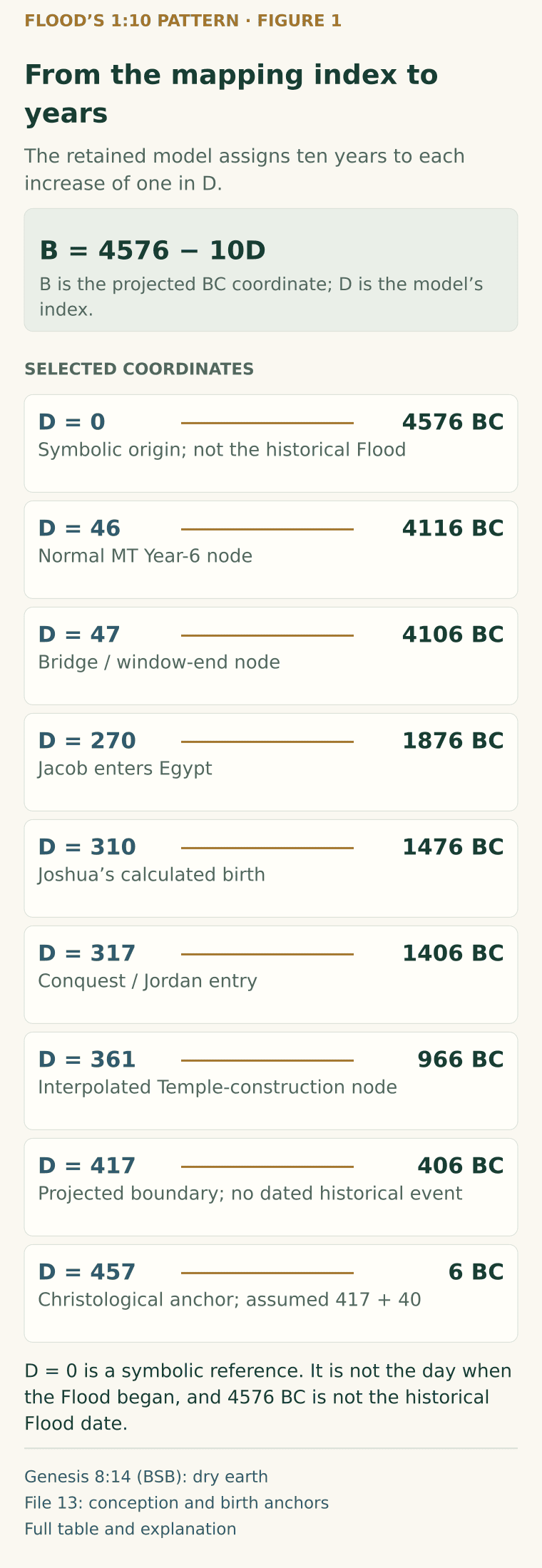
The principal construction sets its symbolic origin at 4576 BC. Let D be a selected position in the model. While the projected date remains BC, the calculation is:
Projected BC year = 4576 − 10D.
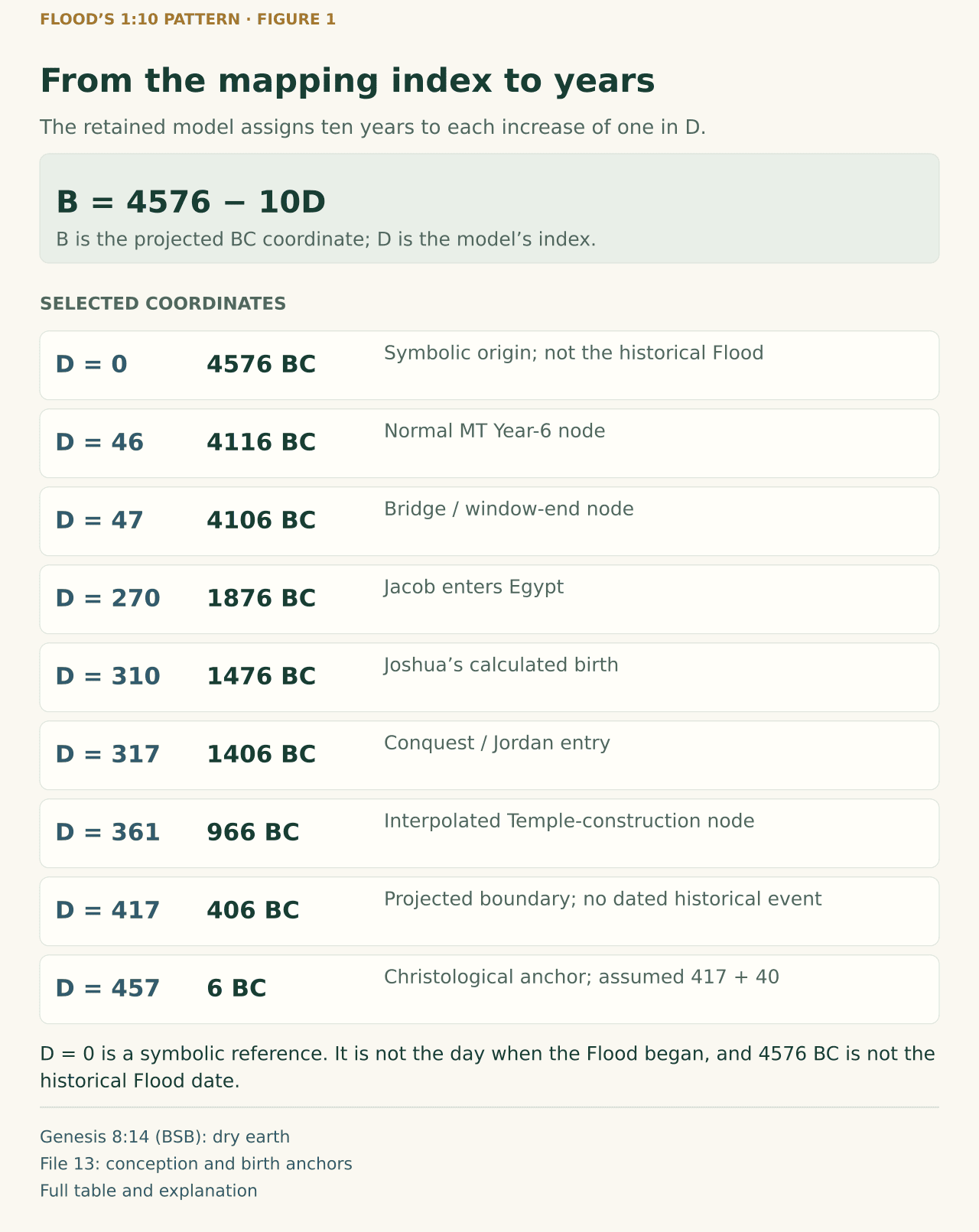
For example, position 270 gives 4576 − 2700 = 1876 BC, Jacob’s entry into Egypt in the ordinary 430-year Egyptian-sojourn chronology. Position 317 gives 4576 − 3170 = 1406 BC, the Conquest. Position 361 gives 966 BC, the historical Temple-foundation reference used in the chronological tables.
The origin is itself a symbolic construction: 6 + 457 × 10 = 4576. It is not the ordinary date of Noah’s Flood. The MT, SP, and LXX Flood dates retain their own chronological settings. File 44 provides the controls for chronological scaling; Files 07 and 18 control the dated nodes used here.
Full table and calculation · Scripture: Genesis 1:26–31 (BSB) · Genesis 47:9 (BSB) · Joshua 24:29 (BSB) · Joshua 4:19 (BSB) · 1 Kings 6:1 (BSB) · Luke 1:31 (BSB)
Open the full-resolution diagram: desktop image · phone image
| Model position D | Projected year, BC | Role in this study |
|---|---|---|
| 0 | 4576 | Chosen symbolic origin |
| 46 | 4116 | Normal MT Year-6 Creation node |
| 47 | 4106 | Purification/bridge endpoint; distinct from the regular Creation endpoint |
| 270 | 1876 | Jacob and Israel enter Egypt |
| 310 | 1476 | Joshua’s birth |
| 313 | 1446 | Exodus, interpolated into the model |
| 317 | 1406 | Conquest |
| 361 | 966 | Temple foundation, interpolated into the model |
| 417 | 406 | Generated closing coordinate; no historical event assigned |
| 457 | 6 | Christological anchor after an assumed additional forty units |
The Exodus position supplies a useful check: 4576 − 3130 = 1446 BC. Its placement in the model does not add an Exodus event to Genesis. Similarly, the Temple’s position is a chronological insertion beside the Flood sequence. These entries explain how the longer chronology intersects the symbolic grid.
A numbered day and an elapsed interval
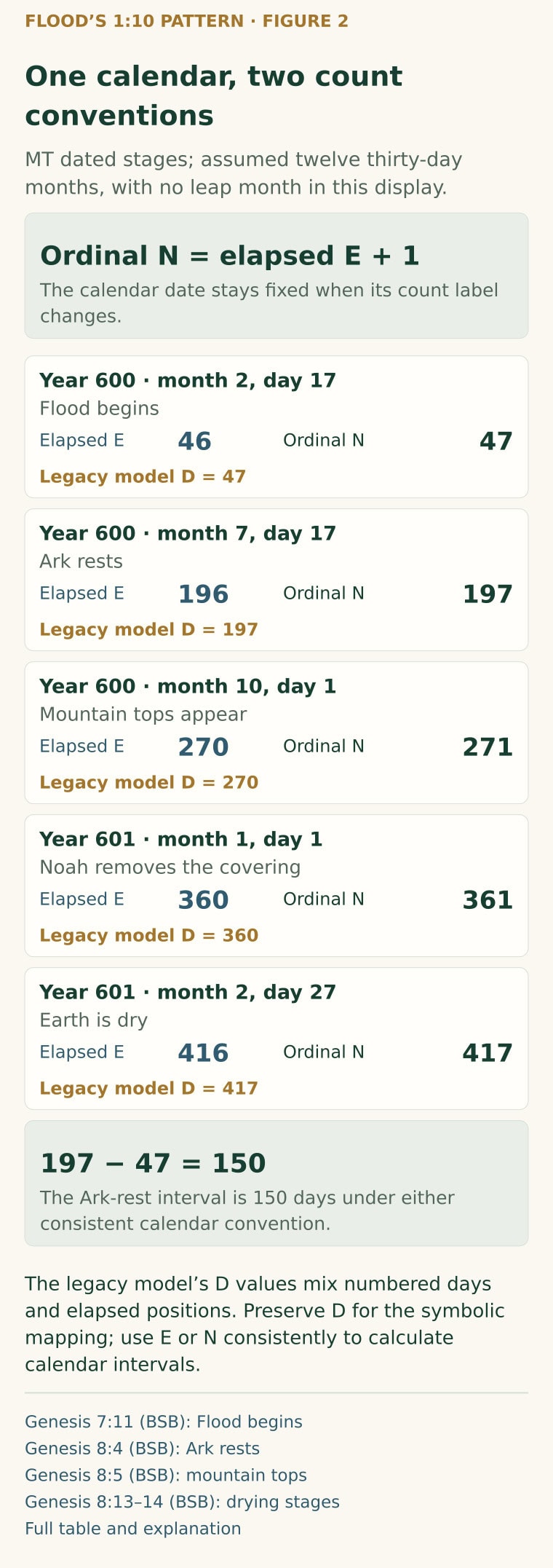
A calendar date names a day; an elapsed count measures how much time has passed before or between dates. On a schematic year of twelve thirty-day months, the seventeenth day of the second month is numbered day 47, with 46 completed days before its beginning. The seventeenth day of the seventh month is numbered day 197, with 196 completed days before it.
Both consistent counts give the same interval:
197 − 47 = 196 − 46 = 150 days.
Full table and calculation · Scripture: Genesis 7:11 (BSB) · Genesis 8:4 (BSB) · Genesis 8:5 (BSB) · Genesis 8:13 (BSB) · Genesis 8:14 (BSB)
Open the full-resolution diagram: desktop image · phone image
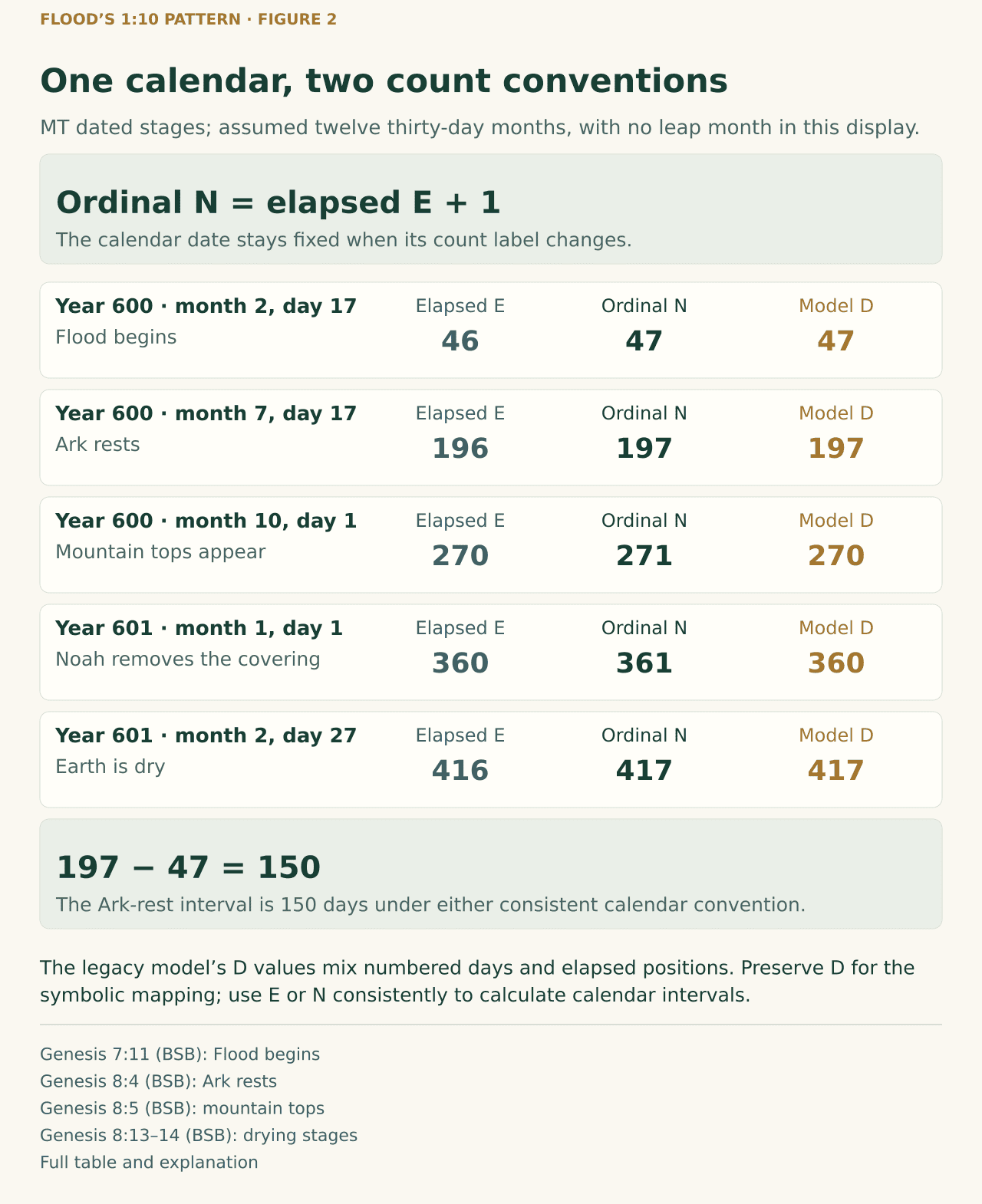
The retained mapping uses numbered positions for some rows and elapsed positions for others. It selects 47 for the Flood’s beginning, 197 for the Ark’s resting, 270 for the mountain tops, 360 for the covering’s removal, and 417 for the earth’s final dryness. Each choice is shown beside its calendar counterpart in the count comparison.
That distinction affects subtraction. The model’s 197 → 270 gives 73 units and therefore 730 years, whereas the consistent elapsed calendar positions 196 → 270 give 74 days. Likewise, the model’s 360 → 417 gives 57 units, whereas the elapsed positions 360 → 416 give 56 days. These are useful symbolic comparisons when their indexing is declared. They should not be described as identical literal intervals.
Position 0 therefore means the model’s origin. The narrative Flood begins at month 2, day 17, shown separately at position 47. Genesis does not describe a first forty-day rainfall before that dated beginning.
The narrative calendar layer here follows the MT-based Genesis dates. SP and LXX year chronologies are compared separately; their inclusion does not make this an identical month-day calendar for every textual tradition.
Rain, waiting birds, and the land
Genesis records forty days of rain, the Ark’s resting, the appearance of mountain tops, a further forty-day wait, and the sending of birds. The model associates these intervals with longer spans:
| Selected positions | Model units | Tenfold counterpart | Chronological relationship |
|---|---|---|---|
| 47 → 87 | 40 | 400 years | Bridge endpoint 4106 → selected SP Noah birth 3706 BC |
| 87 → 197 | 110 | 1100 years | Selected SP Noah birth 3706 → Shem death 2606 BC |
| 197 → 270 | 73 | 730 years | Selected SP Shem death 2606 → Jacob’s Egypt entry 1876 BC |
| 270 → 310 | 40 | 400 years | Egypt entry 1876 → Joshua’s birth 1476 BC |
| 310 → 317 | 7 | 70 years | Joshua’s birth 1476 → Conquest 1406 BC |
| 317 → 324 | 7 | 70 years | Conquest → first schematic seventy-year land block, 1336 BC |
| 324 → 331 | 7 | 70 years | Second schematic land block ending 1266 BC |
The SP stations require their full labels. 3706 BC for Noah’s birth and 2606 BC for Shem’s death use the Gear-1 primary stations, translated into the full-430-year comparison frame, with Terah’s optional +60 off. They are not the unchanged native SP coordinates or the ordinary Gear-2 default. The source-state table records the translation of these stations from File 18 §3.2.1.
The forty units from the mountain-top position to the bird sequence correspond to 1876 → 1476 BC. Joshua’s full ordinary lifespan remains 1476 → 1366 BC = 110 years. The next seven units correspond to his age of seventy at the 1406 BC Conquest. This comparison concerns Joshua’s birth and entry into the land; it does not redefine the ordinary 1846 → 1446 BC four-hundred-year affliction span.
The two subsequent seventy-year blocks express the land’s sabbatical rhythm: 70 = 10 × 7, followed by a total 140 = 20 × 7. Their endpoints, 1336 and 1266 BC, are generated positions, not independently established events in Judges. Nor do ideal block counts establish that Israel actually observed every sabbatical year.
Genesis explicitly describes two seven-day waits between the dove releases (Genesis 8:10–12, BSB). The first dove belongs to the bird sequence, but its exact spacing from the raven is not separately dated. A third closing week, reaching model position 331, remains an interpretive extension. The dove’s return with an olive leaf and its final absence make the land-entry comparison meaningful: the birds test whether the earth is becoming habitable, while the longer chronology moves toward settled life in the land.
Creation comparisons and the Key of 23
The pattern also intersects distinct Creation coordinates. The normal MT sequence distinguishes 4121 BC, the beginning of the seven-year Creation framework; 4116 BC, its Year-6 node; and 4114 BC, its terminal coordinate. Adding the optional sixty-year Terah adjustment gives 4181 → 4176 → 4174 BC.
At ten years per symbolic day, the five years from the beginning to Year 6 occupy half a model day; the remaining two years occupy one-fifth of a model day. The complete seven-year sequence occupies seven-tenths. A half-day illustration is therefore mathematically useful, although a particular morning/evening clock phase must be chosen separately.
The corresponding SP comparison sequences are 4421 → 4416 → 4414 BC and, with +60, 4481 → 4476 → 4474 BC. Here 4476 and 4416 are the Year-6 coordinates of two different settings. The physical Year-6 comparison at 4416 does not replace the preferred SP genealogical chain head at 4414. The fractional-position table shows exactly where each sequence falls. In the normal SP setting, the final 4416 → 4414 segment occupies the beginning of the numbered Day-17 model unit; the entire Creation week begins earlier.
The principal origin also relates to the LXX actual Year-6 node:
5496 − 920 = 4576, where 920 = 40 × 23.
From that origin, 4576 − 460 = 4116, where 460 = 20 × 23. A second origin, 4876 BC, gives the SP counterpart 4876 − 460 = 4416. These relationships preserve the Key-of-23 connection while keeping the MT, SP, and LXX states explicit. The LXX terminal is 5494 BC; its optional +60 Year-6/terminal pair is 5556/5554 BC. None of these labels should be substituted for the Rounded chronology merely because a familiar number occurs in both systems.
A floating month and a second origin
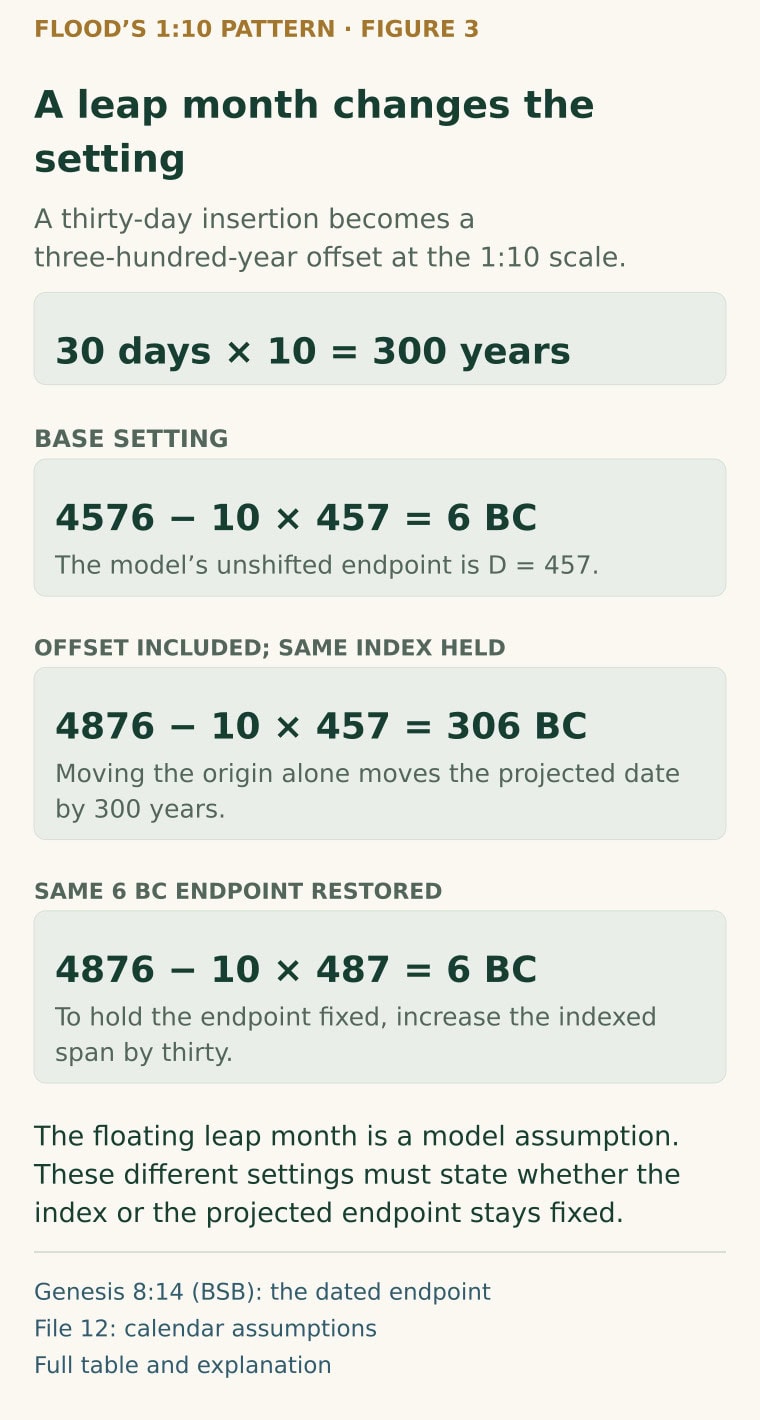
The study’s optional floating month contains 30 model days, corresponding to 300 years. Representing that month in the longer comparison places the symbolic origin three hundred years earlier, at 4876 BC instead of 4576 BC. This is a calendar-model setting, not a leap month explicitly prescribed in Genesis.
Full table and calculation · Scripture: Genesis 8:14 (BSB)
Open the full-resolution diagram: desktop image · phone image
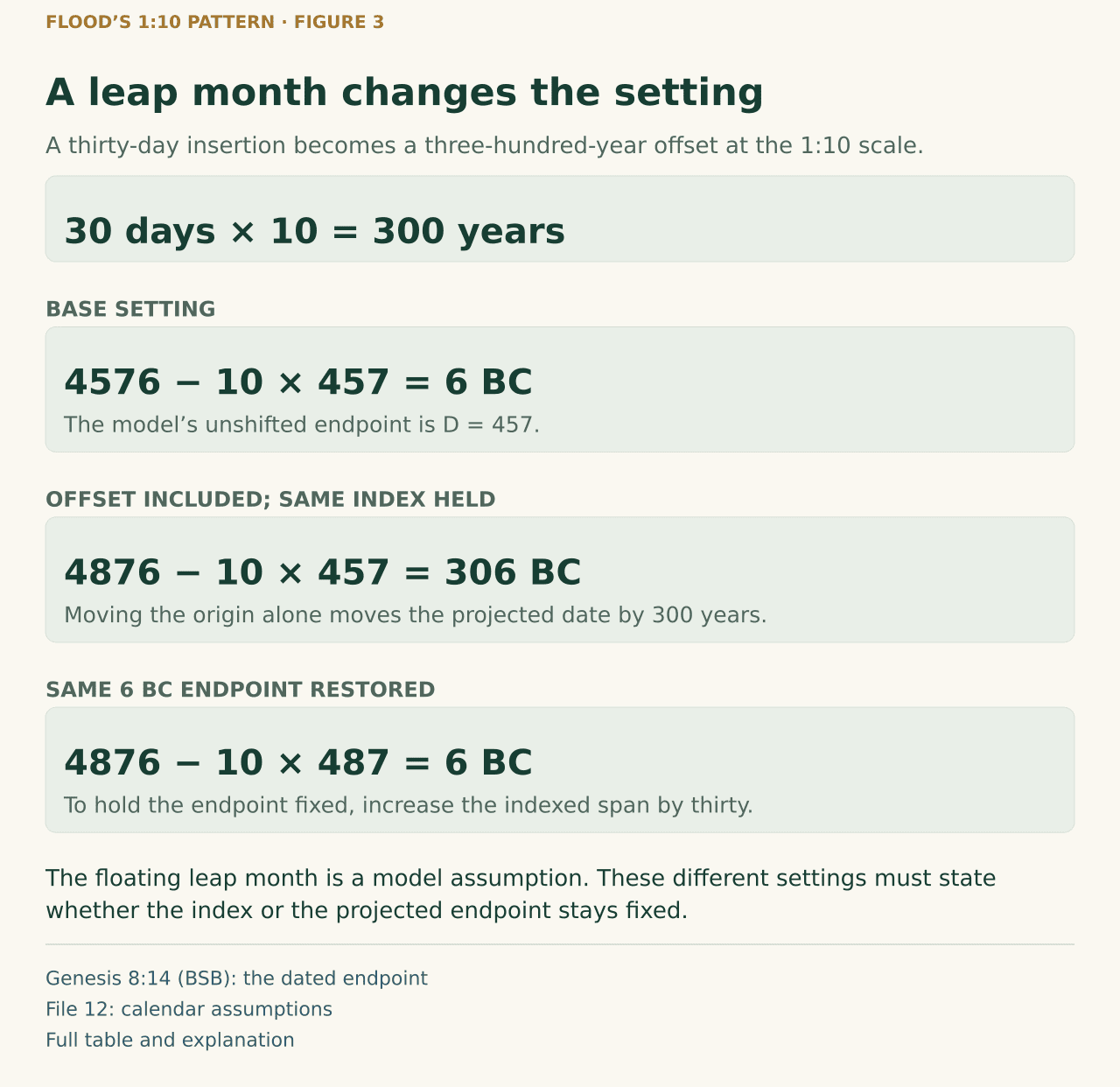
The shift must apply consistently. With the original index held at 457, the alternative calculation gives 4876 − 4570 = 306 BC. To retain the same 6 BC endpoint, the alternative index must also increase by thirty:
4876 − 487 × 10 = 6 BC.
Thus the two constructions can share an endpoint when their indices are translated together. They do not produce identical dates from unchanged indices. The alternative-origin table makes both operations visible.
From 4570 to 4600 and 4900
The closing construction adds an assumed forty units to the final Flood position:
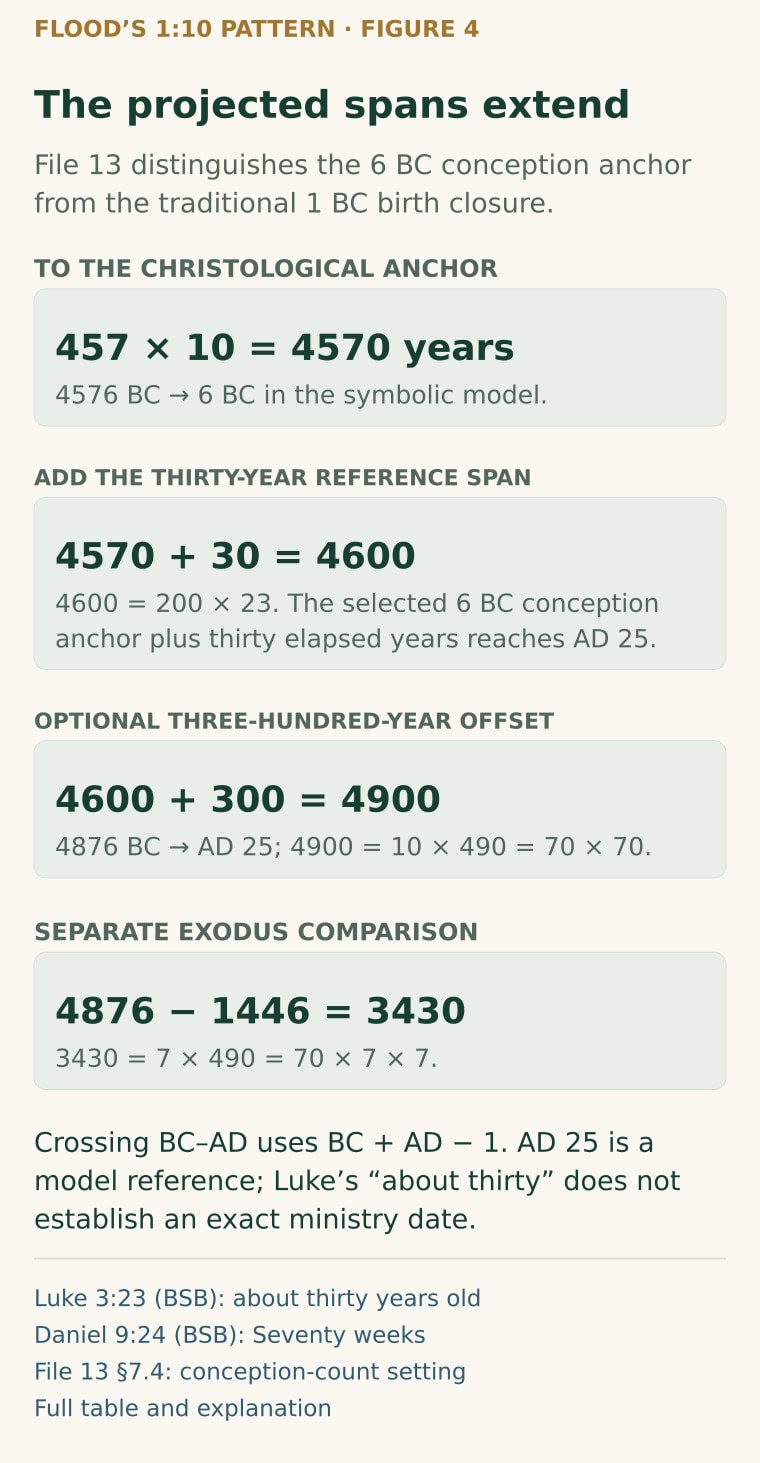
417 + 40 = 457; 457 × 10 = 4570 years.
Those forty units supply the final 406 → 6 BC comparison. Genesis dates the earth’s dryness and describes Noah’s departure and sacrifice, but does not date a further forty-day period after departure. The extension is theological: a new beginning after the Flood is placed beside the Christological endpoint.
The legacy study calls 6 BC Christ’s birth. The Canon preserves a 6 BC birth-hinge/pre-existent-Son reference and, in its more specific Incarnation rail, identifies 6 BC as the conception anchor, with the traditional December 25, 1 BC birth datum distinguished from it (File 13 §§0.1, 7.4). This study uses Christological anchor for the shared coordinate. The calendar datum is a traditional model reference, not a birth date stated by Luke.
Full table and calculation · Scripture: Luke 3:23 (BSB) · Daniel 9:24 (BSB) · Exodus 12:41 (BSB)
Open the full-resolution diagram: desktop image · phone image
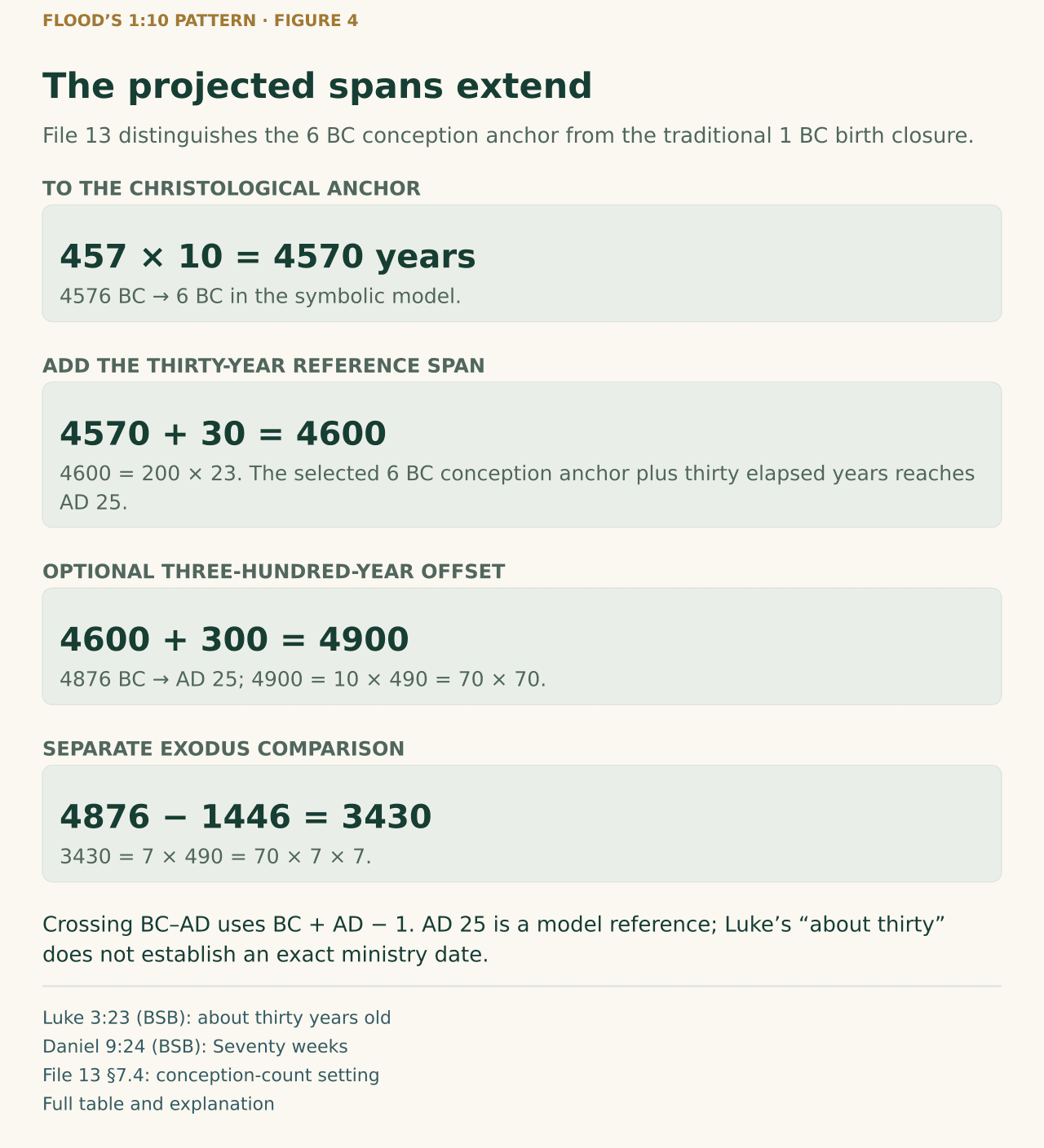
On the principal conception-count display, 6 BC → AD 25 supplies thirty years. Ordinary civil-era subtraction has no year zero, so the full span is:
4576 + 25 − 1 = 4600 = 200 × 23.
Luke describes Jesus as about thirty when He began His ministry (Luke 3:23, BSB). The model’s thirty-year extension concerns the reference-to-ministry interval; it is not thirty years of ministry or proof of an exact historical commencement date. A secondary paired construction, 4574 BC → AD 27, also gives 4600 years and remains separately labeled in the full tables.
Adding the optional 300-year origin shift gives:
4876 BC → AD 25 = 4900 = 70 × 70 = 10 × 490.
The triple product 70 × 7 × 7 belongs to a different span:
4876 − 1446 = 3430 = 7 × 490.
From the Exodus to AD 25, the remaining 1470 = 3 × 490 completes the total: 3430 + 1470 = 4900. The Danielic correspondence therefore has two distinct parts and correct endpoints. It is a theological numerical comparison, not a demonstrated fulfillment of every element of Daniel 9.
These are ordinary spans across the BC–AD boundary. They do not employ the BC–AD Mirror operation. The decimal relationship between 460, 4600, and tenfold scaling is also a numerical feature of the construction, rather than a separately established hundredfold Flood mapping.
Reading the pattern
The value of this model lies in its nesting: short Flood intervals are placed beside longer spans involving Creation, preservation, Egypt, the land, worship, and a new beginning in Christ. Some intersections use ordinary dated anchors; others require a selected textual tradition, a declared chronological variant, or an interpretive extension. Their meanings can be explored together without making every coordinate an independently dated historical event.
The complete evidence is provided in the full mapping, calendar counts, Creation states, and equation tables, with a linked figure index. The earlier related studies on Flood day–year datums and Jacob, the Flood, and sevens supply the broader calendar and narrative context.
Read the unchanged original article and its two tables. The archive preserves the earlier wording; the replacement and supporting tables explain the corrected labels and declared settings.
The Holy Bible, Berean Standard Bible, BSB is produced in cooperation with Bible Hub, Discovery Bible, OpenBible.com, and the Berean Bible Translation Committee. This text of God’s Word has been dedicated to the public domain.