Genesis places Enosh at the meeting of family continuity and worship. Seth is born after Abel’s death; Seth then has a son, Enosh, whose naming is followed by the notice that people began to call upon the LORD’s name (Genesis 4:25–26, NKJV). The next chapter supplies the lifespans that form this study’s starting point:
So Adam lived a total of 930 years, and then he died.
So Seth lived a total of 912 years, and then he died.
Their sum is 1842 years. In the Rounded cumulative chronology, the same two lives are represented by 930 + 910 = 1840. Applying the Key of 23 ratio, 25/23, then gives 2000. This progression connects two transmitted lifespans with an exact mathematical transformation. Its meaning depends on keeping each stage visible.
This detailed study develops the introductory article. It explains the ordinary and cumulative measurements, supplies the complete rounding table, and follows the more developed treatment of Adam and Enosh in the current chronological sources. That later work relates their cumulative positions to Moses’ three forties, and, in an explicitly identified second-Cainan variant, to a further 7360 → 8000 expansion.
The primary calculation follows the Masoretic Text (MT). Actual means the unrounded lifespan inputs used in the cumulative construction; Rounded means the separately defined representation obtained by rounding each lifespan to the nearest multiple of five. Neither label turns a cumulative position into an ordinary historical birth date. The central argument is controlled by File 51a §§16.1–16.2 and File 55 §§6.3 and 7.5.
1. What Genesis measures
Genesis 5 records both the age at which each patriarch fathers the next named son and the patriarch’s complete lifespan. These two kinds of information support two different arrangements of the genealogy.
| Patriarch | Age at next named son’s birth | Complete lifespan | Passage, BSB |
|---|---|---|---|
| Adam | 130, at Seth’s birth | 930 | Genesis 5:3–5 |
| Seth | 105, at Enosh’s birth | 912 | Genesis 5:6–8 |
| Enosh | 90, at Kenan’s birth | 905 | Genesis 5:9–11 |
| Kenan | 70, at Mahalalel’s birth | 910 | Genesis 5:12–14 |
In ordinary genealogy, Adam is 130 when Seth is born, and Seth is 105 when Enosh is born. The birth-to-birth interval from Adam to Enosh is therefore:
130 + 105 = 235 years.
The earlier generations are still alive when later generations are born. Adam’s 930 years and Seth’s 912 years overlap substantially. Adding both complete lives does not measure ordinary elapsed time between their births or between Adam’s birth and Enosh’s birth.
The cumulative method deliberately arranges the complete lives end to end. Adam’s lifespan carries the sequence to Seth’s position, and Seth’s lifespan carries it to Enosh’s position:
930 + 912 = 1842 years.
Enosh is the endpoint of this two-life interval. His own 905-year life begins there and carries the cumulative sequence onward to Kenan. Adding it would answer a different question:
930 + 912 + 905 = 2747 years from Adam’s cumulative position to Kenan’s.
This distinction also explains why a cumulative table can have very early BC coordinates without claiming that the ordinary patriarchal genealogy lasted that many years. The table measures a sum of lives against an assigned endpoint. File 09 sets out the cumulative method, and File 18 §6A supplies the Actual MT table used here.
2. Two ordinary relationships within the family
Before rounding or expanding the cumulative sum, two relationships in the ordinary MT genealogy deserve attention. Both can be calculated from ages alone, without choosing a BC date for Creation.
First, Enosh is born when Seth is 105 and lives another 905 years. Enosh’s death therefore falls 1010 years after Seth’s birth. Seth dies at 912, leaving a 98-year interval between their deaths:
105 + 905 − 912 = 98 = 2 × 49.
Second, Enosh is 90 when Kenan is born, and Kenan lives 910 years. From Enosh’s birth to Kenan’s death, the ordinary span is exactly:
90 + 910 = 1000 years.
This millennium has a different construction from the article’s 2000-year result. It combines one fatherhood age with the son’s whole life. It requires neither cumulative stacking nor the Key of 23. The Enosh–Kenan millennium also appears in the chronological comparisons of File 51a §§3.4 and 9.4.
| Measurement | Calculation | Result | Method |
|---|---|---|---|
| Adam’s birth to Enosh’s birth | 130 + 105 | 235 | Ordinary birth intervals |
| Seth’s death to Enosh’s death | 105 + 905 − 912 | 98 | Ordinary death spacing |
| Enosh’s birth to Kenan’s death | 90 + 910 | 1000 | Ordinary father-to-son lifespan overlap |
| Adam’s position to Enosh’s position | 930 + 912 | 1842 | Actual cumulative lifespan sum |
The same family data thus support several exact measurements. Their value lies in identifying what each measures. The ordinary 1000-year span remains meaningful alongside the transformed 2000-year span precisely because their inputs and operations can be compared openly.
3. The two-year difference: Seth’s 912 becomes 910
The Rounded cumulative chronology applies one rule to the whole Adam-to-Moses chain: round every lifespan independently to the nearest multiple of five, then calculate the cumulative sequence. Adam’s 930 is unchanged. Seth’s 912 becomes 910. Enosh’s 905 is unchanged.
| Input | Actual MT | Rounded | Change |
|---|---|---|---|
| Adam’s lifespan | 930 | 930 | 0 |
| Seth’s lifespan | 912 | 910 | −2 |
| Two-life sum before Enosh | 1842 | 1840 | −2 |
| Enosh’s own lifespan | 905 | 905 | 0 |
The defined rounding rule produces 1840 before the Key of 23 is applied. In particular, the two-year Noah/Shem chronological adjustments used elsewhere do not supply this reduction. The local cause is Seth’s lifespan representation.
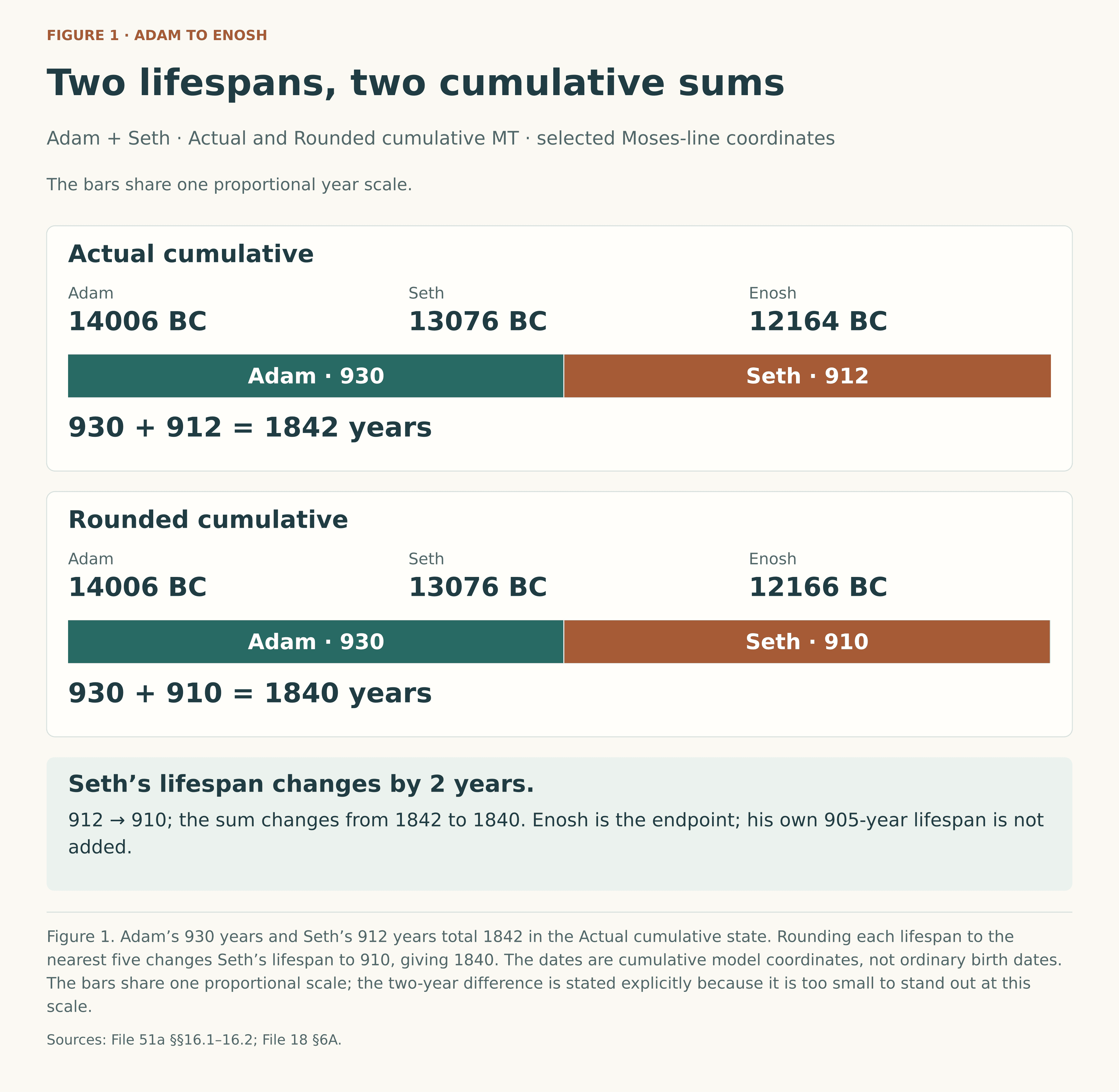
Both cumulative columns are anchored at Moses’ death and the beginning of the Conquest in 1406 BC. Each complete set of lifespans totals 12600, so both reach Adam at 14006 BC. The first steps are:
| Position in the cumulative sequence | Actual BC | Rounded BC |
|---|---|---|
| Adam | 14006 | 14006 |
| Seth | 13076 | 13076 |
| Enosh | 12164 | 12166 |
| Kenan | 11259 | 11261 |
Moving forward subtracts the next lifespan from the BC coordinate. Thus 13076 − 912 = 12164, while 13076 − 910 = 12166. The shorter Rounded interval reaches Enosh two years earlier on the BC scale. Enosh’s own lifespan has not been shortened.
Figure 1 · Adam to Enosh
Two lifespans, two cumulative sums
Adam + Seth · Actual and Rounded cumulative MT · selected Moses-line coordinates
The bars share one proportional year scale.
Actual cumulative
930 + 912 = 1842Years to the Enosh boundary in this cumulative state
Rounded cumulative
930 + 910 = 1840Years to the Enosh boundary in this cumulative state
Sources: File 51a §§16.1–16.2 · File 18 §6A
Calculation and model details
The Actual and Rounded cumulative lifespan tables are independently anchored to Moses’ death at 1406 BC. Both retain Adam at 14006 BC and Seth at 13076 BC. Actual Enosh is 12164 BC; Rounded Enosh is 12166 BC. The dates are propagated from the lifespan sums, not individually rounded. 14006−13076=930; 13076−12164=912; 13076−12166=910. Thus Actual Adam-to-Enosh is 1842 and Rounded Adam-to-Enosh is 1840. The displayed coordinates use the selected Moses line without restored second Cainan or Adam’s apparent-age extension.
Image version and full-size downloads
Open full-size PNG · Open full-size WebP · Download SVG source (ZIP)
These are the principal Moses-line cumulative coordinates. The present comparison does not add an apparent age to Adam, substitute the Aaron line, or insert the second Cainan. Such variants must be introduced separately when used.
A further detail matters for reading the table: the lifespans are rounded, and the dates are then propagated. The dates are not independently rounded to multiples of five. Since the endpoint is 1406 BC, subtracting or adding multiples of five produces coordinates ending in 1 or 6, such as 12166 and 11261.
The same two-year change has a different effect on the ordinary death-spacing calculation above. Representing Seth’s life as 910 while retaining the 105 and 905 inputs gives 105 + 905 − 910 = 100. The Actual death gap of 98 = 2 × 49 becomes 100 = 2 × 50 in this separate Rounded comparison of ordinary death spacing. This is a small example of the coordinated 49/50 forms discussed in File 51a; it leaves the transmitted lifespan of 912 intact.
4. Why 1840 expands to 2000
The Rounded sum can be expressed in two equivalent ways:
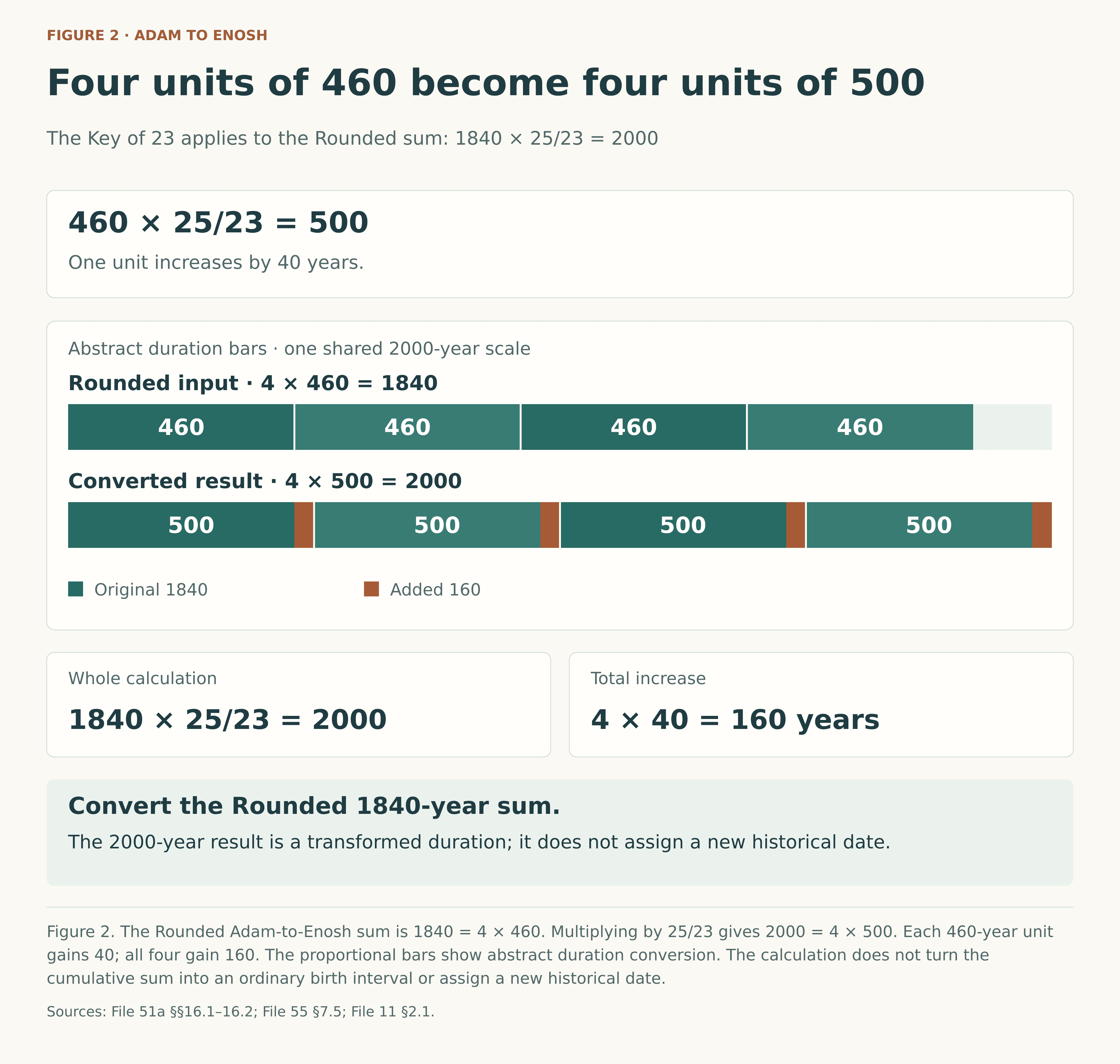
1840 = 23 × 80 = 4 × 460.
The Key of 23 operation used here multiplies a duration by 25/23. It expands twenty-three equal parts into twenty-five parts of the same size. For 1840, each part is 80 years:
1840 ÷ 23 = 80.
80 × 25 = 2000.
The fourfold expression shows the same change in smaller units:
460 × 25/23 = 500.
4 × 460 → 4 × 500.
Each unit gains 40, so the four units gain 160 altogether. The relation 1840 + 160 = 2000 is another expression of the same expansion.
Figure 2 · Adam to Enosh
Four units of 460 become four units of 500
The Key of 23 applies to the Rounded sum: 1840 × 25/23 = 2000
Abstract duration bars · one shared 2000-year scale
Sources: File 51a §§16.1–16.2 · File 55 §7.5 · File 11 §2.1
Calculation and model details
File 55 §7.5 expressly gives 14006−12166=1840=4×460 in the Rounded cumulative state. The multiplication uses the 25/23 operator in File 11 §2.1. 460×25/23=500; 500−460=40; 4×460=1840; 4×500=2000; 4×40=160. The shared duration scale is 2000 years. Each input segment is 23 percent of the full scale; each converted segment is 25 percent, consisting of a 23-percent original portion plus a 2-percent increase. No converted date is assigned.
Image version and full-size downloads
Open full-size PNG · Open full-size WebP · Download SVG source (ZIP)
File 55 §7.5 explicitly gives the Adam-to-Enosh Rounded interval as 1840 = 4 × 460. The 2000 result is this study’s direct application of the established 25/23 operator, described in File 11 §2.1, to that supplied interval. The interval, ratio, and calculated output each have a clear place in the argument.
Applying the ratio to the unrounded total would instead give:
1842 × 25/23 = 46050/23 = 2002 + 4/23, approximately 2002.174.
The exact 2000 belongs to the Rounded input. It is not the result of converting 1842 and rounding away the remaining fraction.
The two lives also remain unequal under a common multiplier. Their Rounded mean is 920, and 920 × 25/23 = 1000. But that is an average over the pair:
| Rounded input | Exact converted value | Decimal display |
|---|---|---|
| Adam: 930 | 23250/23 | 1010.870 |
| Seth: 910 | 22750/23 | 989.130 |
| Combined: 1840 | 46000/23 | 2000 exactly |
The fractions are exact; the individual decimals are displayed to three places. Saying that the pair represents two millennial units is compatible with this result. Saying that the common operation makes each life exactly 1000 would misdescribe it.
Finally, the expansion produces a duration. The extra 160 years are not a license to replace the canonical Adam or Enosh coordinate. Assigning the enlarged duration to particular endpoints would require another declared construction. The study’s basic result is complete without that additional step.
5. The complete lifespan ledger
The full table shows why the local adjustment at Seth can be considered within a consistent method. Among the 26 lifespans, 12 are unchanged and 14 are adjusted. Eight round upward, adding 12 years; six round downward, subtracting 12. The changes cancel exactly.
Both sets therefore total 12600, and both cumulative sequences begin at 14006 BC when anchored at 1406 BC. Each row’s lifespan carries the sequence to the next row. The BC columns contain model coordinates, while the lifespan columns contain the lengths being stacked.
The downloadable CSV includes the individual adjustments and coordinate shifts. The full canonical chronology table supplies the wider MT, SP, and LXX comparisons.
| Patriarch | Actual lifespan | Rounded lifespan | Actual coordinate, BC | Rounded coordinate, BC |
|---|---|---|---|---|
| Adam | 930 | 930 | 14006 | 14006 |
| Seth | 912 | 910 | 13076 | 13076 |
| Enosh | 905 | 905 | 12164 | 12166 |
| Kenan | 910 | 910 | 11259 | 11261 |
| Mahalalel | 895 | 895 | 10349 | 10351 |
| Jared | 962 | 960 | 9454 | 9456 |
| Enoch | 365 | 365 | 8492 | 8496 |
| Methuselah | 969 | 970 | 8127 | 8131 |
| Lamech | 777 | 775 | 7158 | 7161 |
| Noah | 950 | 950 | 6381 | 6386 |
| Shem | 600 | 600 | 5431 | 5436 |
| Arphaxad | 438 | 440 | 4831 | 4836 |
| Shelah | 433 | 435 | 4393 | 4396 |
| Eber | 464 | 465 | 3960 | 3961 |
| Peleg | 239 | 240 | 3496 | 3496 |
| Reu | 239 | 240 | 3257 | 3256 |
| Serug | 230 | 230 | 3018 | 3016 |
| Nahor | 148 | 150 | 2788 | 2786 |
| Terah | 205 | 205 | 2640 | 2636 |
| Abraham | 175 | 175 | 2435 | 2431 |
| Isaac | 180 | 180 | 2260 | 2256 |
| Jacob | 147 | 145 | 2080 | 2076 |
| Levi | 137 | 135 | 1933 | 1931 |
| Kohath | 133 | 135 | 1796 | 1796 |
| Amram | 137 | 135 | 1663 | 1661 |
| Moses | 120 | 120 | 1526 | 1526 |
| Moses’ death / Conquest | — | — | 1406 | 1406 |
| Total lifespans | 12600 | 12600 | — | — |
Seth’s reduction explains the first +2 change in the Rounded BC coordinates. Later adjustments accumulate and offset one another. The coordinate difference ranges from −4 to +5 years, returning to zero at several positions and at both ends. For example, Peleg has the same 3496 BC cumulative coordinate in both columns, and Moses begins at 1526 BC in both.
The table also prevents a common misunderstanding about Enosh. His 905 remains exactly 905 in both columns, yet his starting position moves because the preceding cumulative inputs have changed. A changed coordinate need not mean that the lifespan printed in that row was rounded differently.
The invariant total and the cancellation are arithmetic facts. They warrant examining how the two representations correspond. They do not, by themselves, supply a statistical probability that the pattern arose by chance. No probability estimate is needed for the present argument.
6. Ten names from Adam, eight from Enosh
The same two patriarchs whose lifespans precede Enosh also distinguish two inclusive counts of the antediluvian line. Genesis 5 contains ten names from Adam through Noah. Beginning with Enosh gives eight names through the same Noah.
| Patriarch | Position from Adam | Position from Enosh |
|---|---|---|
| Adam | 1 | — |
| Seth | 2 | — |
| Enosh | 3 | 1 |
| Kenan | 4 | 2 |
| Mahalalel | 5 | 3 |
| Jared | 6 | 4 |
| Enoch | 7 | 5 |
| Methuselah | 8 | 6 |
| Lamech | 9 | 7 |
| Noah | 10 | 8 |
These are counts of named people, including both endpoints. They contain nine and seven parent-to-son links respectively. Enosh is the third person in the full sequence and the first person in the shorter count. The two counting boundaries explain the difference without changing the genealogy.
File 55 §7.5 relates this ten/eight comparison to the ten-king Berossus and eight-king Sumerian King List selections used elsewhere in the project. Here that is a comparison of list structures; the present study neither reconstructs those external reign totals nor equates their kings with the Genesis patriarchs one by one. The numerical resemblance alone cannot establish that scribes inserted Adam and Seth into an earlier eight-name Genesis list.
The names also support a literary connection. Adam and Enosh both belong to the Hebrew vocabulary of human beings or mortal humanity. Psalm 8:4 places the corresponding terms for man and the son of man in parallel (Psalm 8:4, BSB); Genesis 5:2 also uses Adam’s name in connection with humanity (Genesis 5:2, BSB). File 55 draws on this shared vocabulary when comparing the two positions.
This gives the numerical relationship a narrative setting. The first human name and the later name associated with mortal humanity frame two lives in the cumulative sequence, while Genesis 4:26 associates Enosh’s generation with calling on God. I read the patterns against that continuity of human dependence and worship.
The wording must remain precise when the discussion turns to Christ. Paul’s last Adam and second man in 1 Corinthians 15:45–49 concern Christ. The Adam–Enosh name comparison does not assign those Pauline titles to Enosh.
7. How the Moses comparison works
The canonical treatment develops the Adam–Enosh comparison further by applying a one-third / two-thirds operation to cumulative coordinates. This is a second operation, introduced after lifespan rounding; it is not needed to obtain 1840 → 2000.
Its endpoints come from Moses’ life in the project’s ordinary chronology:
| Coordinate | Place in Moses’ life |
|---|---|
| 1526 BC | Birth |
| 1486 BC | Age 40 |
| 1446 BC | Age 80; Exodus |
| 1406 BC | Age 120; death and Conquest opening |
The age framework is grounded in Acts 7:23, Acts 7:30, Exodus 7:7, and Deuteronomy 34:7. The BC assignments belong to the project’s chronological reconstruction.
File 55 calls the final three coordinates—1486, 1446, and 1406 BC—the Moses-node primer. In ordinary language, they are a fixed set of three endpoints for the calculation. The model’s theological proposal connects its thirds with the darkening of a third of the luminaries in Revelation 8:12. That interpretive origin is distinct from the arithmetic rule, which can be stated directly.
For an input coordinate D, select the one endpoint N for which D − N is divisible by three. Divide that span by three to obtain T, then subtract T from the input:
T = (D − N) ÷ 3.
M = D − T.
The new coordinate M is the third marker. It lies one-third of the way from the input toward the selected endpoint, leaving two-thirds still to run. The display therefore has three positions: input, calculated marker, and endpoint.
Exactly one of the three endpoints works for any integer input. The endpoints differ by 40 years, so they cover all three possible remainders on division by three. The existence of a whole-number result is a built-in property of the method. The question explored in File 55 is what relationships the resulting markers display.
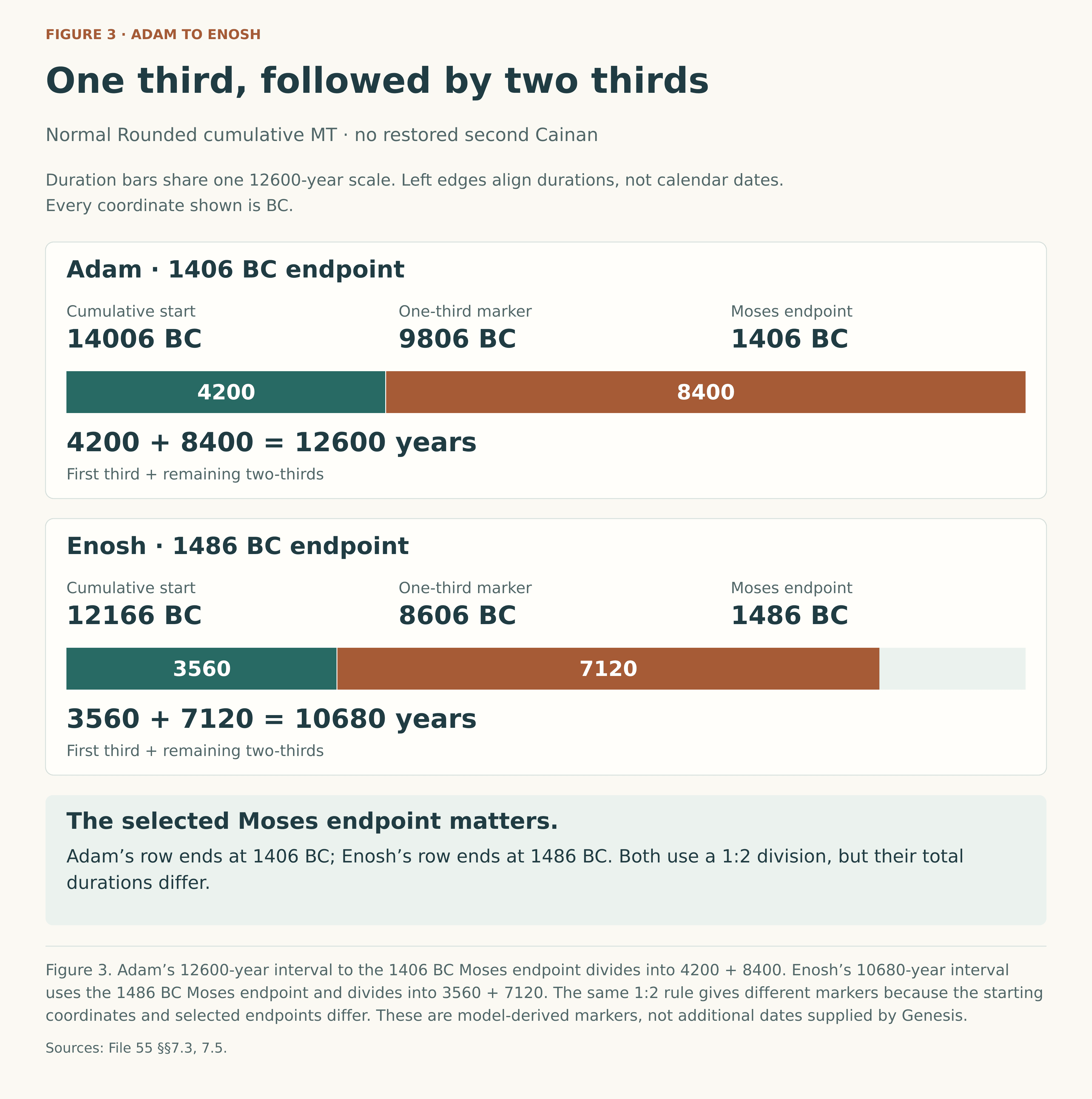
For Enosh, the relevant test is 12166 − 1486 = 10680. This divides into three parts of 3560. Subtracting one part gives 8606 BC, with 7120 remaining to 1486 BC. Thus the marker is calculated by a declared rule; it is not another birth date assigned to Enosh.
8. Adam and Enosh: paired markers
Applying the same rule to Rounded cumulative Adam and Enosh gives the following matched comparison:
| Rounded cumulative input | Selected Moses endpoint, BC | Full span | First third | Calculated marker, BC | Remaining two-thirds |
|---|---|---|---|---|---|
| Adam: 14006 BC | 1406 | 12600 | 4200 | 9806 | 8400 |
| Enosh: 12166 BC | 1486 | 10680 | 3560 | 8606 | 7120 |
Figure 3 · Adam to Enosh
One third, followed by two thirds
Normal Rounded cumulative MT · no restored second Cainan
Duration bars share one 12600-year scale. Left edges align durations, not calendar dates. Every coordinate shown is BC.
Adam · 1406 BC endpoint
4200 + 8400 = 12600First third + remaining two-thirds · years
Enosh · 1486 BC endpoint
3560 + 7120 = 10680First third + remaining two-thirds · years
Sources: File 55 §§7.3, 7.5
Calculation and model details
The selected normal Rounded MT rows are File 55 §7.3 for Adam and §7.5 for Enosh. Each marker lies one third of the way from the cumulative starting coordinate toward its selected ordinary Moses endpoint. 14006−1406=12600;12600÷3=4200;14006−4200=9806;9806−1406=8400. 12166−1486=10680;10680÷3=3560;12166−3560=8606;8606−1486=7120. Moses is 40 in 1486 BC and reaches his terminal year in 1406 BC within the selected model. No restored Cainan or apparent-age extension is used.
Image version and full-size downloads
Open full-size PNG · Open full-size WebP · Download SVG source (ZIP)
The two rows use different Moses endpoints because that is how the fixed divisibility rule routes their inputs. Both begin in the same Rounded cumulative state and use the same one-third operation.
File 55 §§7.3 and 7.5 then compares their markers with the project’s 6 BC birth-of-Christ reference:
| Marker | Same-side span to 6 BC | Form |
|---|---|---|
| Adam: 9806 BC | 9800 | 2 × 4900 |
| Enosh: 8606 BC | 8600 | 2 × 4300 |
These are secondary endpoint comparisons made after the third markers have been calculated. The birth-of-Christ reference is not substituted for the Moses endpoint in the thirding operation. All three coordinates are BC, so the differences use ordinary subtraction.
The doubled 4900 and 4300 give the Adam–Enosh pairing a wider form. The original two-life interval is 1840 = 4 × 460; the derived markers then relate the pair to two units of 4900 and two units of 4300. These quantities can be studied together while preserving the different operations that produce them.
There is a second 4900 relation in the same canonical section. The Rounded cumulative Flood boundary at 4836 BC routes through 1446 BC:
4836 − 1446 = 3390; 3390 ÷ 3 = 1130.
4836 − 1130 = 3706 BC.
Enosh’s marker then stands 4900 above that Flood marker:
8606 − 3706 = 4900 = 100 × 49.
Here 3706 BC is a calculated marker derived from the Rounded cumulative Flood boundary. It is not the ordinary MT Flood date. This naming keeps the relationship readable: the 4900 span joins two derived markers whose inputs and endpoints have already been specified.
9. The explicitly restored second-Cainan variant
The normal MT calculation above contains no second Cainan between Arphaxad and Shelah. File 55 also studies what happens when a second Cainan is restored as a comparison variant. Its full 460-year lifespan is inserted into the cumulative chain, shifting the earlier cumulative positions by 460 years.
The distinction between 130 and 460 is essential. The 130 is a fatherhood interval relevant to the corresponding regular-chronology insertion. The 460 is the full lifespan used in the cumulative insertion. They are different inputs for different methods. This comparison must also remain distinct from treating the entire chronology as the native LXX chronology; it is an explicitly restored-Cainan variant of the MT-derived cumulative model. The SP is not the source of this added Cainan.
The selected Brenton Septuagint rendering of Genesis 11 gives Cainan 130 years before fathering Sala (Shelah) and 330 afterward: 130 + 330 = 460.
Rounded cumulative Enosh consequently moves from 12166 BC to 12626 BC. The new input routes through 1406 BC:
12626 − 1406 = 11220.
11220 ÷ 3 = 3740.
12626 − 3740 = 8886 BC.
| Enosh comparison | No restored Cainan | With restored cumulative Cainan |
|---|---|---|
| Rounded cumulative input, BC | 12166 | 12626 |
| Selected Moses endpoint, BC | 1486 | 1406 |
| Full input-to-endpoint span | 10680 | 11220 |
| First third | 3560 | 3740 |
| Third marker, BC | 8606 | 8886 |
| Remaining two-thirds | 7120 | 7480 |
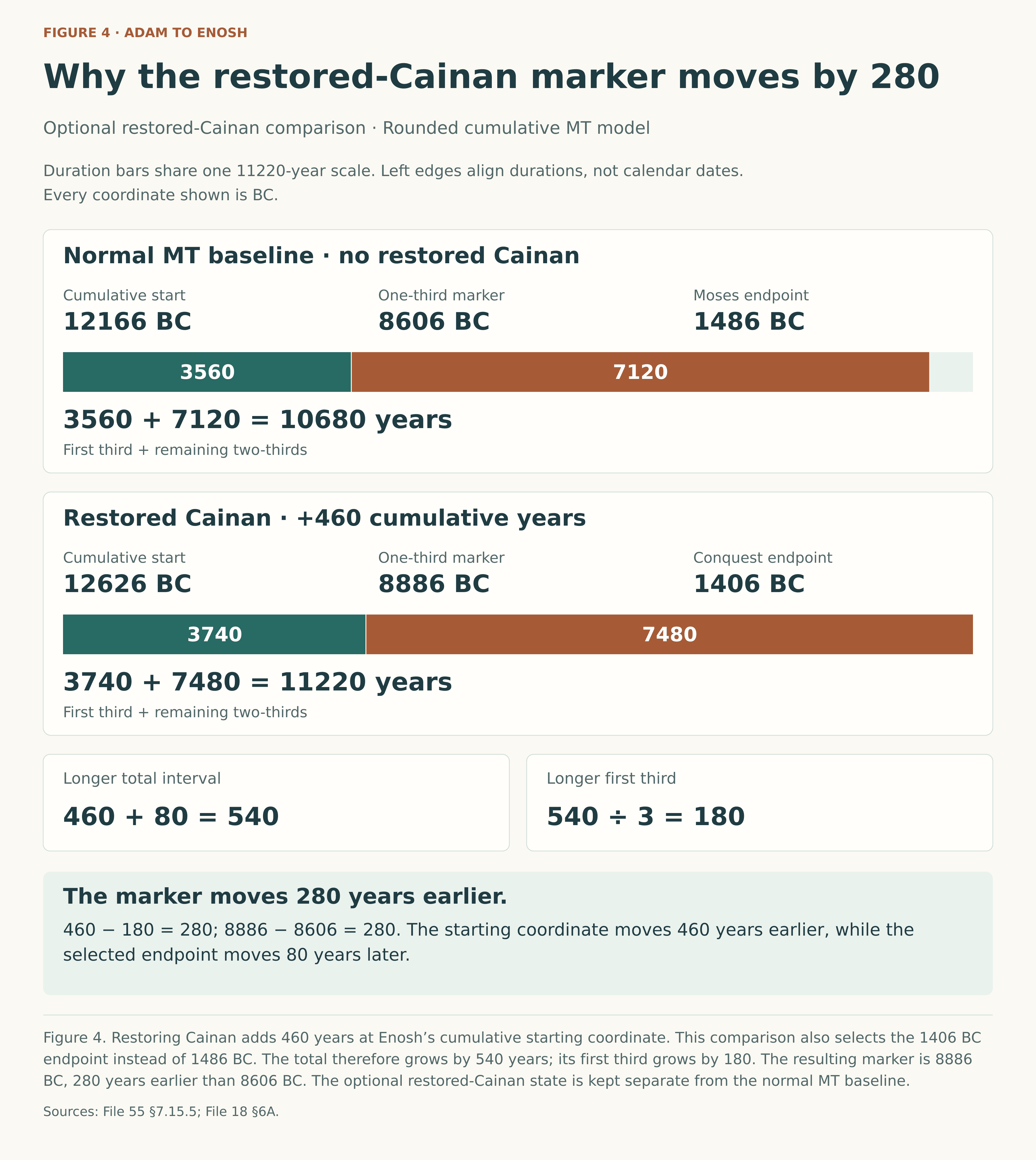
Figure 4 · Adam to Enosh
Why the restored-Cainan marker moves by 280
Optional restored-Cainan comparison · Rounded cumulative MT model
Duration bars share one 11220-year scale. Left edges align durations, not calendar dates. Every coordinate shown is BC.
Normal MT baseline · no restored Cainan
3560 + 7120 = 10680First third + remaining two-thirds · years
Restored Cainan · +460 cumulative years
3740 + 7480 = 11220First third + remaining two-thirds · years
Sources: File 55 §7.15.5 · File 18 §6A
Calculation and model details
File 55 §7.15.5 compares 12166→8606→1486 with 12626→8886→1406. The restored cumulative Cainan insertion is +460, not the +130 regular birth-chain insertion. 12626−1406=11220;11220÷3=3740;12626−3740=8886;8886−1406=7480. Compared with the normal total 10680, the restored total grows 540 = 460 + 80. Its first third grows 3740 − 3560 = 180. Thus 8886 − 8606 = 280 = 460 − 180 = (2 × 460 − 80) / 3. The ordinary Moses endpoints remain distinct from the cumulative starts and calculated markers.
Image version and full-size downloads
Open full-size PNG · Open full-size WebP · Download SVG source (ZIP)
The input shifts 460 years earlier, but the calculated marker shifts only 280:
8886 − 8606 = 280.
The endpoint also changes, moving 80 years later from 1486 to 1406 BC. The full span therefore increases by 540, whose first third is 180. Subtracting that additional first third from the 460-year input increase leaves 280. This accounts for the marker displacement without silently treating it as two-thirds of 460 under an unchanged endpoint.
The variant affects the earlier cumulative chain only as far as the inserted life requires. Shelah and the subsequent cumulative positions retain their baseline coordinates. The added Cainan is post-Flood, so it also leaves the ten names from Adam through Noah and eight names from Enosh through Noah unchanged.
10. The 8000-year extension and the 8880 comparison
The restored-Cainan Enosh marker allows two further comparisons explicitly developed in File 55 §7.15.5. One reaches Moses’ birth; the other reaches the project’s birth-of-Christ reference.
| Endpoint from the 8886 BC marker | Raw span | Treatment |
|---|---|---|
| Moses’ birth, 1526 BC | 7360 | 7360 × 25/23 = 8000 |
| Birth-of-Christ reference, 6 BC | 8880 | 888 × 10, without a Key-of-23 expansion |
The first has the same fourfold structure as the central 2000 calculation:
7360 = 4 × 1840 = 23 × 320.
7360 × 25/23 = 8000 = 4 × 2000.
This comparison relates the smaller and larger durations through a common factor. Its inputs are different: 1840 is the Rounded cumulative Adam-to-Enosh interval, while 7360 runs from the restored-Cainan Enosh third marker to Moses’ ordinary birth coordinate. The common multiplier makes their relationship exact without making them one continuous chronology.
The second comparison uses 8880 = 888 × 10 as a new-man and new-creation motif in File 55’s Christological reading. It is a different kind of numerical expression from the 7360 expansion. Here the whole same-side span from 8886 BC to 6 BC is retained; no years are added or removed.
The baseline marker also has a Mosaic relationship of its own:
8606 − 1406 = 7200 = 20 × 360.
Its direct thirding endpoint was 1486 BC; 1406 BC is a secondary comparison with Moses’ terminal year. Setting this beside the variant’s 7360 → 8000 makes the distinction clear: the first uses the baseline marker and Moses’ death, while the second uses the restored-Cainan marker and Moses’ birth.
I read these relationships within the biblical movement from the human line through Moses toward Christ. The promise of a prophet like Moses in Deuteronomy 18:15, 18 provides a textual setting for that comparison. The numerical relations express the study’s typological interpretation; they do not claim that Deuteronomy supplies the 25/23 rule or these calculated Enosh markers.
11. A supporting distinction: 8880, 8920, and 8640
The more extended canonical discussion also compares calendar-sized and generational units. A compact explanation is useful because these totals can otherwise be mistaken for interchangeable measurements.
The restored-Cainan marker-to-Christ span can be partitioned as:
8880 = 4300 + 4300 + 280.
Subtracting 4300 twice from 8886 BC produces 4586 BC and 286 BC; a further 280 reaches 6 BC. The intermediate 4586 and 286 are arithmetic division points, not separately established historical anchors.
Extending from 6 BC to AD 35 adds a civil span of 40 years, because ordinary BC/AD counting has no year zero:
6 + 35 − 1 = 40.
The continuous interval from 8886 BC to AD 35 is therefore 8920. In this construction, AD 35 is the endpoint of the selected forty-year interval after the 6 BC reference; no date for Paul’s conversion is required.
File 55 additionally isolates the two 4300 blocks and combines them with the later forty-year component, leaving out the intervening 280. This produces a selected-component total of 8640:
| Quantity | Components counted | Result |
|---|---|---|
| Entire same-side span to 6 BC | 4300 + 4300 + 280 | 8880 |
| Entire civil span to AD 35 | 4300 + 4300 + 280 + 40 | 8920 |
| Selected components, omitting the 280 | 4300 + 4300 + 40 | 8640 |
The last total factors as 24 × 360 and 120 × 72. In the project’s conventional astronomical comparison, 72 years represent one precessional day, giving a display of 120 such units. This is a schematic comparison under a declared convention, rather than a measured physical duration for 120 ordinary days. It also leaves the continuous 8920-year interval unchanged.
Likewise, the 280 = 7 × 40 marker displacement can support a symbolic comparison with a gestational day-number, but the marker displacement is measured in years. The typology compares numerical forms across units; it does not convert chronological years into biological days. These supporting observations belong after the core calculations, where their extra choices can be seen.
12. Reading the pattern within the narrative
The study begins with two particular lives. Adam’s 930 and Seth’s 912 total 1842. Their Rounded representations total 1840, and the Key of 23 expands that to 2000. The ten-name and eight-name counts differ by the same two people, giving the calculation a natural place within the genealogy.
The ordinary family relationships offer a useful comparison: Seth and Enosh die 98 years apart, while Enosh’s birth to Kenan’s death spans 1000 years. Those results use overlapping lives. The cumulative 2000 pattern uses complete lives arranged consecutively and then transformed. Holding the methods side by side lets each contribute its own information.
The later Moses comparisons deepen the construction through an additional stated rule. Rounded Adam and Enosh produce markers at 9806 and 8606 BC; the explicitly restored-Cainan Enosh variant produces 8886 BC. Their subsequent relationships to 4900, 4300, 8000, and 8880 remain traceable to named inputs and endpoints.
I understand the pattern as a coordinated reading of the numerical and narrative features of the human line. Genesis associates Enosh’s generation with calling upon the LORD. The genealogy’s repeated death notices accompany the continuation of the family; the later biblical witness places human hope in God’s action through Moses and finally in Christ. The shared vocabulary of Adam and Enosh supports this theme of humanity, while the chronological structures offer another way of examining its development.
The arithmetic establishes the relationships under the stated methods. Interpreting their coordination as intentional or providential design is a further theological judgment. This distinction allows the proposal to be presented positively while keeping the textual evidence, model operations, and interpretation open to examination.
The short introduction presents the central 1840-to-2000 argument. The supporting appendix provides its compact tables and calculation notes. The detailed study here replaces the earlier exploratory dialogue with the current, controlled construction.
Sources and calculation controls
| Source | Use in this study |
|---|---|
| Genesis 4–5, BSB | Enosh’s narrative setting; MT genealogy, fatherhood ages, and lifespans |
| File 18, especially §6A | Actual MT cumulative coordinates and the broader chronological tables |
| File 09 | Cumulative method and distinction from ordinary chronology |
| File 51a §§3.4, 9.4, 16.1–16.3 | Enosh–Kenan comparison, complete rounding ledger, shared 12600 total, Actual/Rounded distinction |
| File 11 §2.1 | Established Key of 23 operation, including 25/23 |
| File 55 §§1.2–1.4, 6.3–6.5, 7.1, 7.3, 7.5, 7.15.5 | Moses endpoint selection; Adam/Enosh markers; restored-Cainan comparison and its supporting calculations |
| Full lifespan chronology table | Wider MT, SP, and LXX context, with distinct textual and model states |
The 1840 → 2000 calculation and the elementary family-age equations are recomputed here from the stated inputs. File 55 explicitly supplies the principal third-marker comparisons. Quotations retain the linked edition’s wording and number formatting; digits used in calculations and tables belong to the study’s analytical prose.
Scripture quotations: Berean Standard Bible (BSB), public domain.