Genesis records both the age at which a patriarch became a father and the full length of his life. Those two quantities allow us to follow the same ancestry in two different ways. Regular chronology measures successive births within overlapping generations. Cumulative chronology places the complete lifespans in sequence, creating a longer numerical framework.
Adam’s account contains the distinction in miniature:
When Adam was 130 years old, he had a son in his own likeness, after his own image; and he named him Seth.
— Genesis 5:3, Berean Standard Bible (BSB)
So Adam lived a total of 930 years, and then he died.
The first measurement is 130 years to Seth’s birth; the second is Adam’s complete 930-year life. The numbers describe the same person, but answer different questions. Keeping that distinction clear allows the relationships among Jared, Shem, Kenan and the second Cainan to emerge without confusing the two chronologies.
This detailed study accompanies Regular and Cumulative Chronology: The Same Patriarchal Pattern. It develops the wider comparisons from the current canonical Markdown files, especially Files 18, 22, 11, 09 and 16. The default is the Masoretic Text (MT), Nisan reckoning, 430 years in Egypt, no additional 60 years for Terah, and no second Cainan. Variants enter only where expressly named. The figures here belong to the precise chronology; the separately constructed Rounded Chronology has its own comparisons.
Go directly to the regular chain, cumulative positions, Shem partition, Cainan transfer, Jared ladder, Kenan comparison, Creation bridges, Moses/Joshua comparisons, or famine-window correspondence.
1. Two ways of measuring the ancestral line
In regular chronology, Seth is born while Adam is alive. Cumulative chronology instead places Seth’s entire lifespan after Adam’s entire lifespan. Its coordinates are therefore positions in a constructed sum of lives. They do not assert that fathers died when their sons were born.
The distinction becomes especially clear between Adam and Jared. Both calculations use the same five men, in the same order:
Table 1. From Adam to Jared
| Father | Next named son | Age at the son’s birth | Complete lifespan |
|---|---|---|---|
| Adam | Seth | 130 | 930 |
| Seth | Enosh | 105 | 912 |
| Enosh | Kenan | 90 | 905 |
| Kenan | Mahalalel | 70 | 910 |
| Mahalalel | Jared | 65 | 895 |
| Total | 460 | 4552 |
Regular: 130 + 105 + 90 + 70 + 65 = 460.
Cumulative: 930 + 912 + 905 + 910 + 895 = 4552.
The cumulative construction does not enlarge every regular interval by one fixed multiplier. The correspondences considered below are particular relationships with named endpoints. Their interest lies in which relationships recur, and how they recur.
The normal regular framework retains the Exodus at 1446 BC. The cumulative MT trunk ends with Moses’ death / the Conquest at 1406 BC. Its direct ancestral line contains 26 lifespans totaling 12600 years, so its Adam Year-6 position is 1406 + 12600 = 14006 BC. The line proceeds through Jacob, Levi, Kohath, Amram and Moses; Joseph is not inserted into that direct ancestry. The cumulative-method introduction explains the full construction and its Moses/Aaron foundation, while the literal cumulative tables make the individual rows available.
Sources: Genesis 5, BSB; File 18, §§2.1, 6A.
2. The regular chronology’s chain of 23-multiples
The normal MT sequence places Adam’s genealogical table endpoint at 4114 BC, Jared at 3654 BC, Lamech at 3240 BC, the Flood at 2458 BC, and the Exodus at 1446 BC. Each successive interval is a multiple of 23.
490d · Regular and Cumulative Chronology · Figure 1
A chain of 23-year multiples
Creation, Jared, Lamech, and the Flood lead to the Exodus.
Regular MT · Nisan · 430 years in Egypt · second Cainan absent · Terah +60 off
460 = 20 × 23
414 = 18 × 23
782 = 34 × 23
1012 = 44 × 23
Creation 4114 BC to the Exodus 1446 BC: the four links form one continuous regular chronology.
All dates are regular BC coordinates in the stated baseline. Creation uses the 4114 BC endpoint; this is not the separate 4116 BC Adam Year-6 position. Card lengths do not represent time.
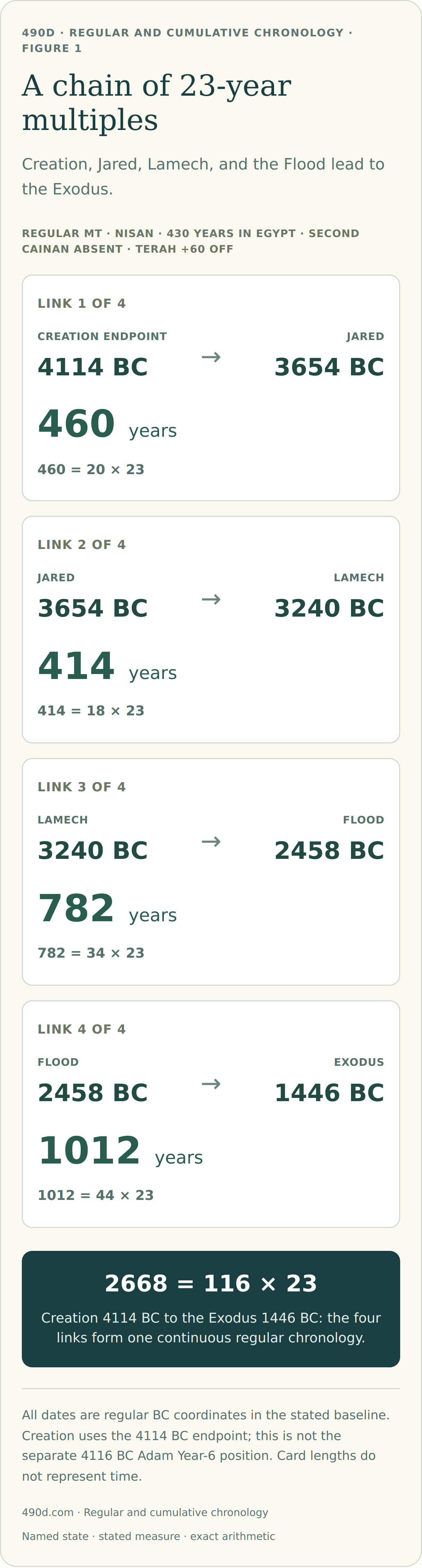
Table 2. The regular sequence
| Interval | BC endpoints | Years | Multiple of 23 |
|---|---|---|---|
| Adam → Jared | 4114 → 3654 | 460 | 20 × 23 |
| Jared → Lamech | 3654 → 3240 | 414 | 18 × 23 |
| Lamech → Flood | 3240 → 2458 | 782 | 34 × 23 |
| Flood → Exodus | 2458 → 1446 | 1012 | 44 × 23 |
| Whole sequence | 4114 → 1446 | 2668 | 116 × 23 |
The third interval can be understood biographically. Lamech begets Noah at 182, and the Flood comes when Noah is 600: 182 + 600 = 782. Jared to the Flood joins the preceding two intervals: 414 + 782 = 1196, or 52 × 23 = 4 × 299. This will matter when the Key-of-23 ratios are considered later.
The 4114 BC starting point is the regular table’s Creation endpoint. The separate Year-6 position is 4116 BC, within the symbolic Creation week 4121–4114 BC. The table above consistently uses 4114. Likewise, the Flood is the normal Gear-2 start at 2458 BC; Arphaxad’s regular birth remains 2456 BC. These labels have different roles and should remain distinct.
Sources: File 18, §§2.1.2–2.1.3, 2.2.1; File 22, §§7.11–7.12.
3. Reading a cumulative position and its range
A cumulative position is obtained by summing the lifespans still remaining before the terminal anchor. For example, Moses’ 120 years before 1406 put his cumulative position at 1526 BC. Adding Amram’s 137 places Amram at 1663 BC; adding Kohath’s 133 gives 1796 BC. Continuing backward produces the entire ancestral table.
The canonical presentation also carries related positions in seven-year envelopes. The ordinary whole-year construction uses the 2 + 3 + 2 framework; the phase-resolved Aaron/Moses relation is treated separately. An envelope records these related model positions. It is not permission to move a historical date freely to obtain a desired result.
Table 3. Selected original cumulative MT positions
| Patriarch / boundary | Moses-line Nisan position, BC | Forwarded seven-year range, BC |
|---|---|---|
| Adam, Year 6 | 14006 | 14011–14004 |
| Kenan | 11259 | 11264–11257 |
| Jared | 9454 | 9459–9452 |
| Lamech | 7158 | 7163–7156 |
| Shem | 5431 | 5436–5429 |
| Arphaxad / cumulative Flood boundary | 4831 | 4836–4829 |
| Shelah | 4393 | 4398–4391 |
| Abraham | 2435 | 2440–2433 |
| Moses | 1526 | 1531–1524 |
The cumulative Flood/Arphaxad boundary belongs to the lifespan construction. It does not collapse the ordinary historical Flood in 2458 BC and Arphaxad’s birth in 2456 BC into one historical event. Similarly, Shem’s cumulative 600-year block ends where Arphaxad’s formal block begins; historical Shem and Arphaxad overlap in life.
A useful check is Jared to Lamech. The ordinary cumulative core gives 9454 − 7158 = 2296, the sum 962 + 365 + 969 for Jared, Enoch and Methuselah. A different total obtained by selecting other members of their envelopes must identify those selections. This study names the core, head or lower member whenever that choice carries an argument.
Sources: File 18, §§6–6A; File 09. For the full week-of-years explanation, see the cumulative technical appendix.
4. Shem divides the whole into Abrahamic units
One of the clearest cumulative patterns uses the internal Year-6 positions throughout. From Adam at 14006 BC to Shem at 5431 BC are 8575 years; from Shem to the Conquest at 1406 BC are 4025 years.
Both spans are multiples of Abraham’s 175-year lifespan:
8575 = 49 × 175, and 4025 = 23 × 175.
490d · Regular and Cumulative Chronology · Figure 2
Shem divides the cumulative span
The same unit of 175 years joins the factors 49 and 23.
Cumulative MT · second Cainan absent · selected Year-6 coordinates
Adam to Shem
49 × 175
Shem to the Conquest
23 × 175
49 × 175 + 23 × 175 = 72 × 175
These are formal cumulative stations, not ordinary birth dates. Shem 5431 BC is an internal Year-6 coordinate; 5436 BC is the head of the same cumulative birth-week. The main bar is proportional to 8575:4025. The inset uses equal bars for its two equal spans.
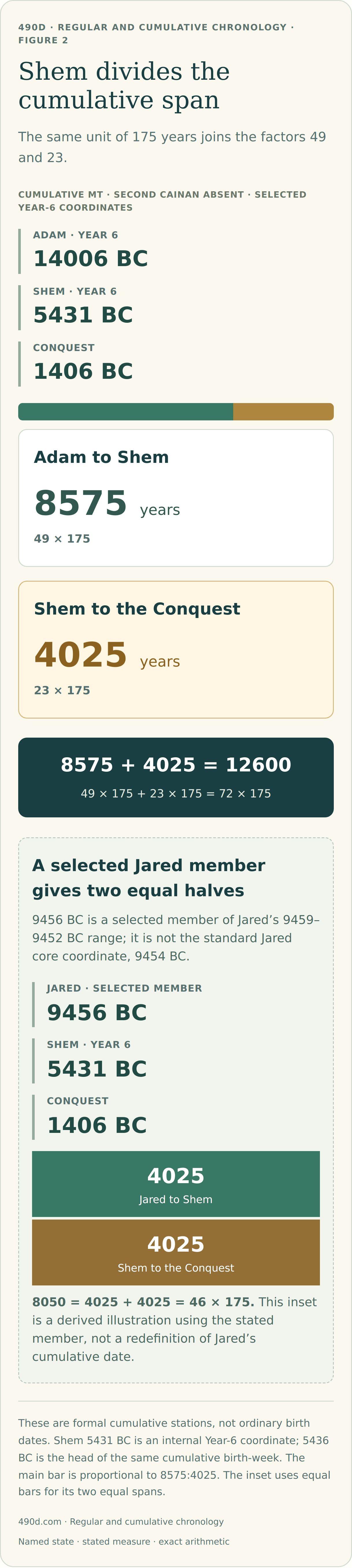
Table 4. The Shem partition and its selected-member companion
| Comparison | Calculation | Result | Kind of comparison |
|---|---|---|---|
| Adam → Shem | 14006 − 5431 | 8575 = 49 × 175 | Original cumulative Year-6 positions |
| Shem → Conquest | 5431 − 1406 | 4025 = 23 × 175 | Same Shem position; fixed terminal |
| Whole trunk | 8575 + 4025 | 12600 = 72 × 175 | 49 + 23 = 72 units |
| Selected Jared → Shem | 9456 − 5431 | 4025 = 23 × 175 | Jared selected within 9459–9452 |
| Selected Jared → Conquest | 9456 − 1406 | 8050 = 46 × 175 | Two equal 4025-year spans |
The first three rows are the partition stated in File 22 §1.2. Forty-nine supplies the seven-times-seven jubilee count; twenty-three supplies the Key-of-23 count. Together they account for the full 12600-year trunk in units of one patriarchal life.
The last two rows preserve a useful further illustration. Selecting 9456 BC within Jared’s range places Shem exactly halfway between that selected Jared position and the Conquest: 4025 + 4025 = 8050. The date 9456 is two years earlier than Jared’s ordinary core at 9454. This symmetrical illustration is therefore a selected-member comparison, not the same-core Jared interval. With the ordinary 9454 position, Jared to Shem would be 4023 years.
That distinction preserves both the suggestive symmetry and its actual basis. The selected illustration does not supply an independent probability claim, but it shows how Jared and Shem can participate in the same 175-and-23 structure already visible in the trunk.
Sources: File 22, §1.2; File 18, §6A. The last two rows are direct calculations from the stated source ranges.
5. The second Cainan changes the two methods differently
The second Cainan is the post-Flood figure between Arphaxad and Shelah, distinct from the earlier Kenan in Genesis 5. He is absent from the ordinary MT list. The comparison now opens the canonical restored-Cainan state, using 130 years to Shelah’s birth and 460 years for Cainan’s complete life. His textual background is discussed in The Second Cainan: Why 130 and 460 Years Matter.
Regular chronology gains the extra 130-year father-to-son interval. Cumulative chronology gains the extra 460-year lifespan. Thus all earlier positions through Arphaxad move back by the applicable amount, while Shelah and the subsequent ancestral line remain fixed.
For example, regular Creation’s endpoint becomes 4114 + 130 = 4244 BC. The cumulative Adam Year-6 position becomes 14006 + 460 = 14466 BC. These examples describe each method’s insertion; corresponding Creation phases will be paired explicitly in Table 8.
The difference between the two insertions is itself 460 − 130 = 330 years. It is important to retain that difference: the cumulative insertion must not be substituted for the regular one.
Sources: File 18, §§1.3.1, 6B; File 22, §§5A, 7.5.
6. Cainan’s complete life is preserved across a 2300-year transfer
The restored cumulative table places Cainan’s birth within 4858–4851 BC, and his death / Shelah’s formal birth within 4398–4391 BC. Use the lower member of each range: 4851 and 4391. The restored regular dates in the normal 430-year Egyptian framework are 2551 and 2091 BC, without the additional Terah years.
490d · Regular and Cumulative Chronology · Figure 3
One lifespan, the same transfer at both ends
The restored Cainan supplies two matching 2300-year comparisons.
Both rows restore the second Cainan · paired lower members
Cumulative formal stations
Regular comparison dates
Full cumulative ranges: birth 4858–4851 BC; death / Shelah’s station 4398–4391 BC. This comparison selects the lower member of each.
Both ends move by five complete Cainan lifespans.
Use the stated lower cumulative members and the restored regular full-430, Terah +60-off comparison. Birth and death labels in a cumulative sum denote formal stations. Endpoint cards are schematic; both lifespan measurements are 460.
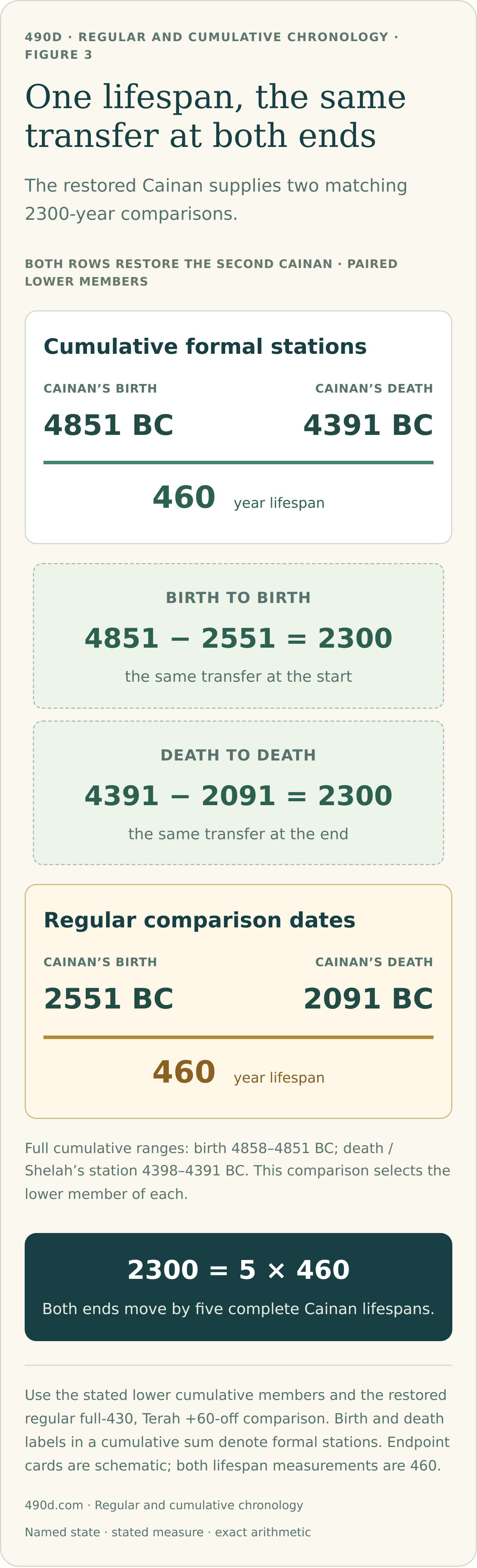
Table 5. Both ends of the lifespan
| Endpoint or interval | Cumulative restored Cainan | Regular restored Cainan | Comparison |
|---|---|---|---|
| Birth | 4851 BC | 2551 BC | 4851 − 2551 = 2300 |
| Death | 4391 BC | 2091 BC | 4391 − 2091 = 2300 |
| Lifespan | 4851 − 4391 = 460 | 2551 − 2091 = 460 | Same complete life |
The relationship is exact at both ends. Cainan’s 460-year life moves by 2300 = 5 × 460 = 100 × 23 years between the two constructions.
The regular birth can be derived from Shelah’s unchanged regular birth at 2421 BC: 2421 + 130 = 2551 BC. Subtracting Cainan’s 460-year lifespan gives 2091 BC. In the regular chronology Shelah is born during Cainan’s life; in cumulative chronology Shelah’s formal lifespan begins at Cainan’s formal death boundary. The construction differs, but the 460-year life and the paired transfer remain visible.
File 22 associates the 2300-year comparison with the sanctuary number in Daniel 8:14. That is a theological association with the numerical relationship. The paired subtraction is what establishes the transfer itself; it does not depend on settling every interpretation of Daniel’s evenings and mornings.
Sources: File 18, §§1.3.1, 6B; File 22, §§6.1, 7.8.
7. The Jared–Cainan ladder: 10, 11, 11 and 12
The regular interval from Adam to Jared was 460 years. The second Cainan’s lifespan supplies the same unit within the cumulative framework. Current File 22 develops that relationship as a ladder of completed boundary spans.
Original cumulative Jared has the range 9459–9452 BC. Restoring Cainan shifts it back by 460 years to 9919–9912 BC. Cainan’s restored birth range is 4858–4851 BC, and his death range is 4398–4391 BC. Two changes therefore each add 460: shifting Jared to the restored state, or extending the target from Cainan’s birth to his death.
490d · Regular and Cumulative Chronology · Figure 4
The Jared–Cainan 460-year ladder
Four comparisons reveal ten, eleven, eleven, and twelve complete units.
Cumulative chronology · canonical completed-boundary spans
Original Jared Restored Cainan’s birth
Original Jared Restored Cainan’s death
Restored Jared Restored Cainan’s birth
Restored Jared Restored Cainan’s death
Changing either selected endpoint adds one 460-year unit.
Each row is an independent, explicitly named comparison. These are the canonical completed-boundary totals, not raw subtraction of displayed BC labels. Endpoint-label totals are respectively 4601, 5061, 5061, and 5521. See the linked supporting table for both columns. This is a local forwarded-window rule, not a general subtraction rule for BC dates.
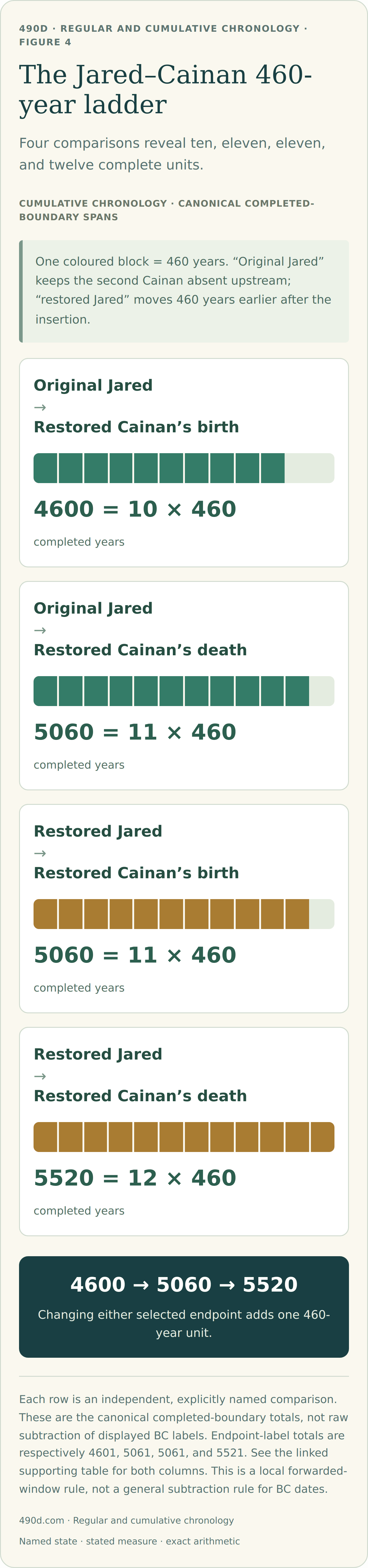
Table 6. Label differences and completed boundary spans
| Comparison | Corresponding opening-label subtraction | Completed span in File 22 §6.1 | Units of 460 |
|---|---|---|---|
| Original Jared → restored Cainan birth | 9459 − 4858 = 4601 | 4600 | 10 |
| Original Jared → restored Cainan death | 9459 − 4398 = 5061 | 5060 | 11 |
| Restored Jared → restored Cainan birth | 9919 − 4858 = 5061 | 5060 | 11 |
| Restored Jared → restored Cainan death | 9919 − 4398 = 5521 | 5520 | 12 |
Corresponding lower labels give the same differences: 9452 − 4851 = 4601, 9452 − 4391 = 5061, 9912 − 4851 = 5061, and 9912 − 4391 = 5521.
File 22 §6.1 assigns the extra 1 to the endpoint-label convention in these forwarded ranges. Its completed-boundary totals are the corresponding label differences less one. The diagram follows that local convention openly: it does not claim that ordinary BC subtraction of 9459 and 4858 equals 4600. Ordinary same-side subtraction continues to apply elsewhere in this article.
The two middle results agree because each makes exactly one 460-year change. Applying both changes gives the twelve-unit result. The first two rows deliberately compare original Jared with the restored Cainan field; the last two use restored Jared. These are four specified comparisons rather than four consecutive segments of one unchanged timeline.
This is the corrected canonical form of the Jared–Cainan relationship. It preserves the ten-, eleven- and twelve-unit structure while making the counting convention and the variant choices inspectable.
Sources: File 22, §6.1; File 18, §§6A–6B.
8. The two Kenans: a 910-year life and two 460-year intervals
A related comparison reaches back to Kenan, the earlier figure whose complete life is 910 years. This section deliberately opens a further state: regular restored Cainan with Gear 3 for the earlier line. It is a specific canonical comparison, not a change to the default dates used above.
The normal regular Kenan birth is 3789 BC. Restoring Cainan adds 130 years, and the stated Gear-3 adjustment adds another 2: 3789 + 130 + 2 = 3921 BC. Kenan’s 910-year life then ends in 3011 BC. Second Cainan retains 2551–2091 BC in this comparison.
490d · Regular and Cumulative Chronology · Figure 5
Kenan, Cainan, and a 460-year gap
The repeated 460 belongs to different parts of the comparison.
Restored regular MT · Gear 3 for this comparison · full 430 years · Terah +60 off
Kenan’s lifespan
Between the two lives
Second Cainan’s lifespan
Kenan’s birth 3921 BC to the second Cainan’s death 2091 BC
Kenan’s 910 years + the 460-year gap.
Kenan’s 910 years + Cainan’s 460 years. This omits the gap.
The two totals are equal because the gap equals Cainan’s lifespan. Kenan and Cainan themselves do not have equal lifespans. In each comparison, 1370 = 10 × 137.
Gear 3 is explicit and local to this comparison; it does not replace the normal chronology elsewhere. Second Cainan is restored. Kenan is the first Cainan, a distinct person. Card spacing is schematic.
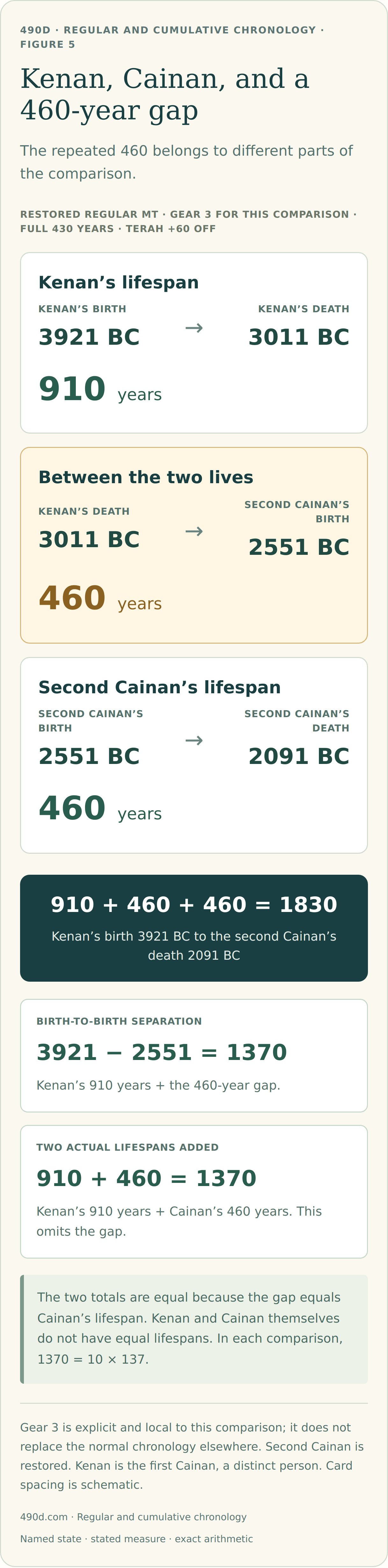
Table 7. The restored-Cainan / Gear-3 Kenan sequence
| Relationship | Calculation | Years |
|---|---|---|
| First Kenan’s life | 3921 − 3011 | 910 |
| Kenan’s death → second Cainan’s birth | 3011 − 2551 | 460 |
| Second Cainan’s life | 2551 − 2091 | 460 |
| Birth → birth | 3921 − 2551 | 1370 |
| Whole birth → final death span | 3921 − 2091 | 1830 |
Two different measurements yield 1370. The birth-to-birth interval contains Kenan’s life plus the intervening gap: 910 + 460. The sum of the two men’s stated lifespans is also 910 + 460. These are distinct measurements with the same total, because the gap equals Cainan’s full life.
The source expresses the result as 1370 = 10 × 137 = 10 × (7 + 130). A further genealogical check divides that birth-to-birth interval at Kenan’s son Mahalalel: 3921 − 70 = 3851 BC, followed by 3851 − 2551 = 1300. Thus the 1370 span is also 70 + 1300.
File 11 adds a cross-method comparison using 11721 BC, a selected cumulative Kenan position with Cainan restored. It lies within the restored full range 11724–11717 BC. Against regular Gear-3 Kenan at 3921 BC, the separation is 11721 − 3921 = 7800 = 60 × 130. Kenan’s own lifespan is 910 = 7 × 130. The two values share the 130 unit; 7800 is not his lifespan, nor is 11721 being asserted as the mathematical midpoint of the seven-year range.
Sources: File 18, §1.3.7; File 11, §§4.1–4.2.1; File 22, §7.7.
9. The Creation bridge depends on what is added to each side
The same distinction between a 130-year regular insertion and a 460-year cumulative insertion governs comparisons at Creation. Here the corresponding Year-6 positions are used on both sides. The normal pair is cumulative 14006 BC and regular 4116 BC, separated by 9890 = 23 × 430 years.
Restoring Cainan to both methods enlarges the gap by 460 − 130 = 330:
9890 + 330 = 10220 = 7 × 1460.
A different source comparison adds Cainan’s 460 years to the cumulative side but uses the separate 30-year apparent-age overlay on the regular side. That regular position is 4116 + 30 = 4146 BC. Its gap is 9890 + 460 − 30 = 10320 = 24 × 430.
Table 8. Three named Creation comparisons
| Comparison state | Cumulative Year-6 position, BC | Regular position, BC | Separation |
|---|---|---|---|
| Original MT | 14006 | 4116, Year 6 | 9890 = 23 × 430 |
| Cainan restored to both methods | 14466 | 4246, restored Year 6 | 10220 = 7 × 1460 |
| Cumulative Cainan / regular apparent-age overlay | 14466 | 4146, Year 6 + 30 | 10320 = 24 × 430 |
The second row also holds at corresponding week heads and closes: 14471 − 4251 = 10220, and 14464 − 4244 = 10220. Keeping the same kind of endpoint paired across both methods preserves the result throughout the Creation week.
These rows describe different operations. Simply adding 460 to the cumulative side while leaving regular Year 6 fixed at 4116 would give 10350, not 10320. The 24-sojourn result includes the regular +30 overlay. Likewise, the matched-Cainan 10220 comparison is the canonical seven-times-1460 correspondence, not an equation of the Key-of-23 1495 unit with a 1460-year cycle.
The underlying 9890 bridge is explained in Between Two Chronologies: The 9,890-Year Bridge. The separate 9900-year article treats the Rounded Chronology. A numerically tidy result does not by itself make a date or interval “rounded.”
Sources: File 22, §§5, 5A, 7.1–7.2; File 09.
10. What the Key-of-23 ratios do
The recurring divisibility allows certain spans to be expressed through exact ratios. Three principal operators are 25/23, 70/69, and 300/299. They produce different transformations and must be named individually.
Table 9. Exact ratio examples
| Starting span | Applied ratio | Result | Connection in this study |
|---|---|---|---|
| 460 | 25/23 | 500 | Regular Adam → Jared unit |
| 414 | 70/69 | 420 | Regular Jared → Lamech interval |
| 1196 | 300/299 | 1200 | Regular Jared → Flood: 4 × 299 becomes 4 × 300 |
| 2300 | 25/23 | 2500 | Five 460-year units become five 500-year units |
| 4025 | 25/23 | 4375 | 23 × 175 becomes 25 × 175 |
The equations operate on lengths. Turning an expanded length into a new date requires an additional decision about which endpoint stays fixed. The ratio alone does not alter the source table’s ages or establish a new historical event.
For example, 2300 = 5 × 460 becomes 2500 = 5 × 500 under 25/23. The five-unit structure survives the transformation. That is the kind of numerical correspondence the Key of 23 makes visible. The Key-of-23 introduction develops the method and its calendrical associations more fully.
Sources: File 22, §§7.4, 7.10, 7.12; the 414 and 4025 rows are direct applications of the stated operators to the checked spans.
11. Shem’s birth and the Moses–Joshua terminal pair
Two other useful comparisons start at the head of Shem’s cumulative birth range, 5436 BC. This is five years earlier than the internal 5431 position used for the partition in section 4. The endpoint must be named because the results depend on it.
The first target is Moses’ birth at 1526 BC. The second is the constructed Joshua completion at 1296 BC, obtained by extending 110 years beyond the cumulative Moses-death / Conquest boundary: 1406 − 110 = 1296. This Joshua coordinate belongs to the cumulative extension; it is not a claim about Joshua’s ordinary historical death date.
The two targets are separated by 1526 − 1296 = 230, representing Moses’ 120 and Joshua’s 110 years in sequence.
Table 10. Birth-head comparisons to the terminal pair
| Cumulative Shem birth-head state | To Moses, 1526 BC | To constructed Joshua completion, 1296 BC |
|---|---|---|
| Original: 5436 BC | 5436 − 1526 = 3910 = 170 × 23 | 5436 − 1296 = 4140 = 180 × 23 |
| Cainan restored: 5896 BC | 5896 − 1526 = 4370 = 190 × 23 | 5896 − 1296 = 4600 = 200 × 23 |
Moving to the second target adds 230 in either row. Restoring Cainan moves Shem’s birth-head back by 460, adding twenty more units of 23 in either column. The pattern therefore has two transparent steps: one ten-unit change across the table and one twenty-unit change down it.
The 3910 span begins at Shem’s cumulative birth-head, not his death. Shem’s 600-year life remains a distinct quantity. These four comparisons are recomputed from canonical positions; their arrangement here is an illustrative comparison, rather than a separate theorem or probability result.
Sources: File 18, §§6A–6B; File 22, §9A.3; File 09, Joshua completion controls.
12. From Cainan’s death range to the famine around Jacob’s entry
The paired 2300-year transfer reaches Cainan’s regular birth and death. A further canonical comparison translates his cumulative death / Shelah-birth range to the seven-year famine window surrounding Jacob’s entry into Egypt.
Its unit is 2520 = 7 × 360. The source range 4398–4391 BC and the historical famine window 1878–1871 BC have the same seven-year width. Their opening, selected internal position and closing all correspond under the same subtraction.
490d · Regular and Cumulative Chronology · Figure 6
A seven-year window reaches the famine
The 2520-year relationship preserves the whole envelope.
Restored cumulative MT → normal regular MT · Nisan · 430-year Egypt framework
Cainan’s death / Shelah’s formal station
The seven-year famine window
At Jacob’s entry, two famine years have elapsed and five remain.
Each selected member shifts by the same 2520 years; both seven-year windows remain intact.
The cumulative source is a formal Cainan / Shelah envelope. The regular target is the historical famine window in the canonical MT framework. Bars preserve the internal 2:5 division; cards above them are schematically spaced. The translation does not alter the cumulative table-generation method.
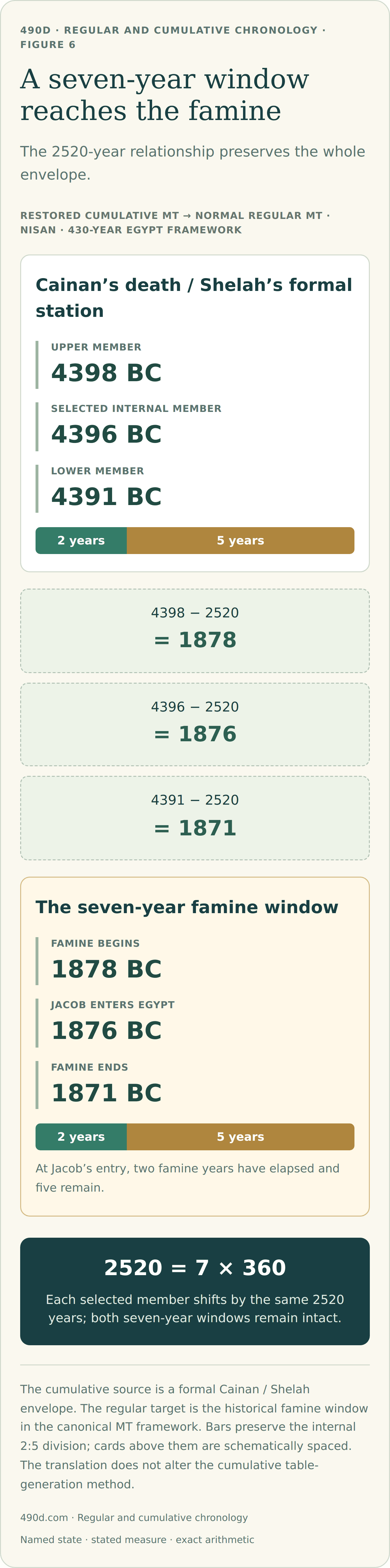
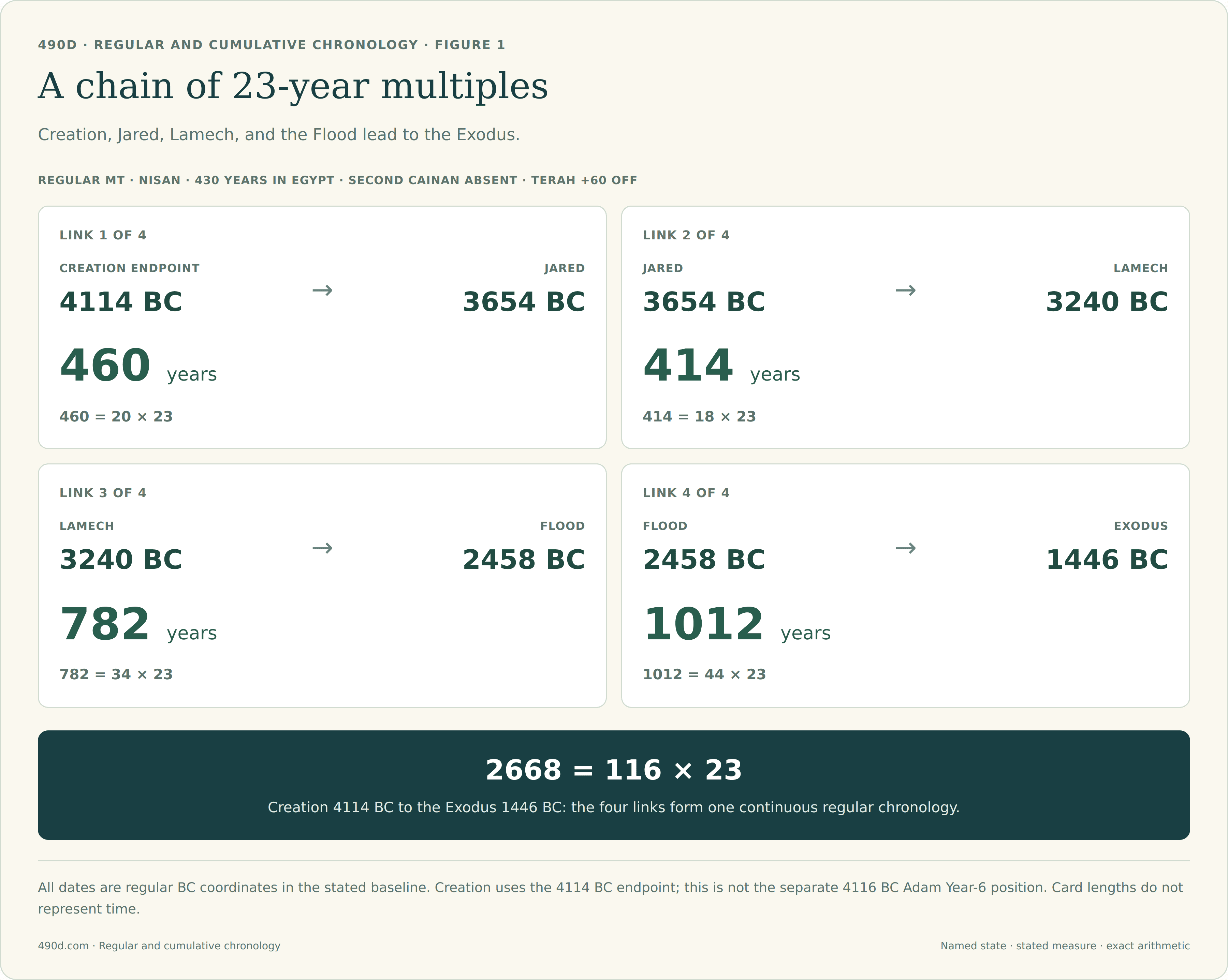
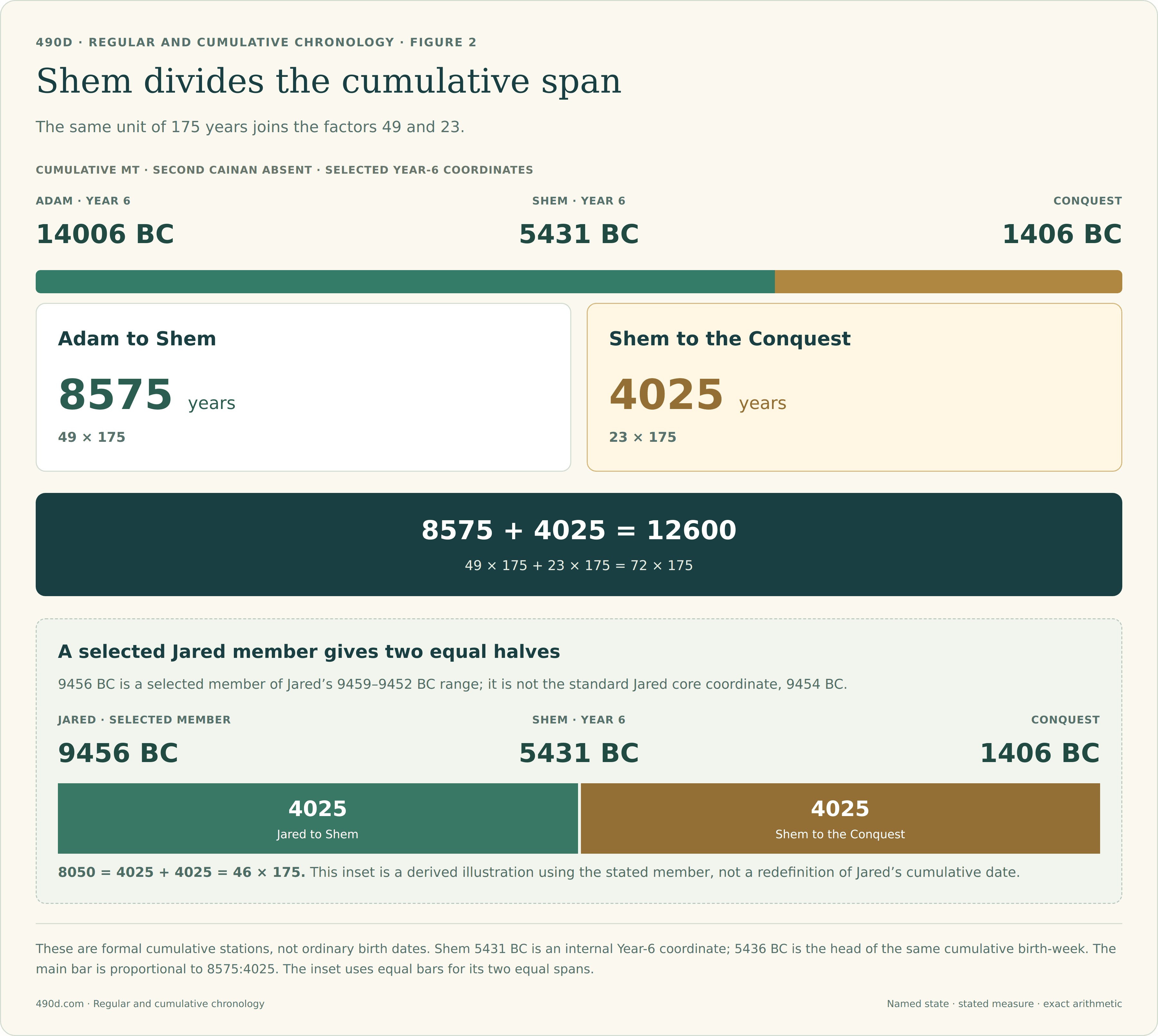
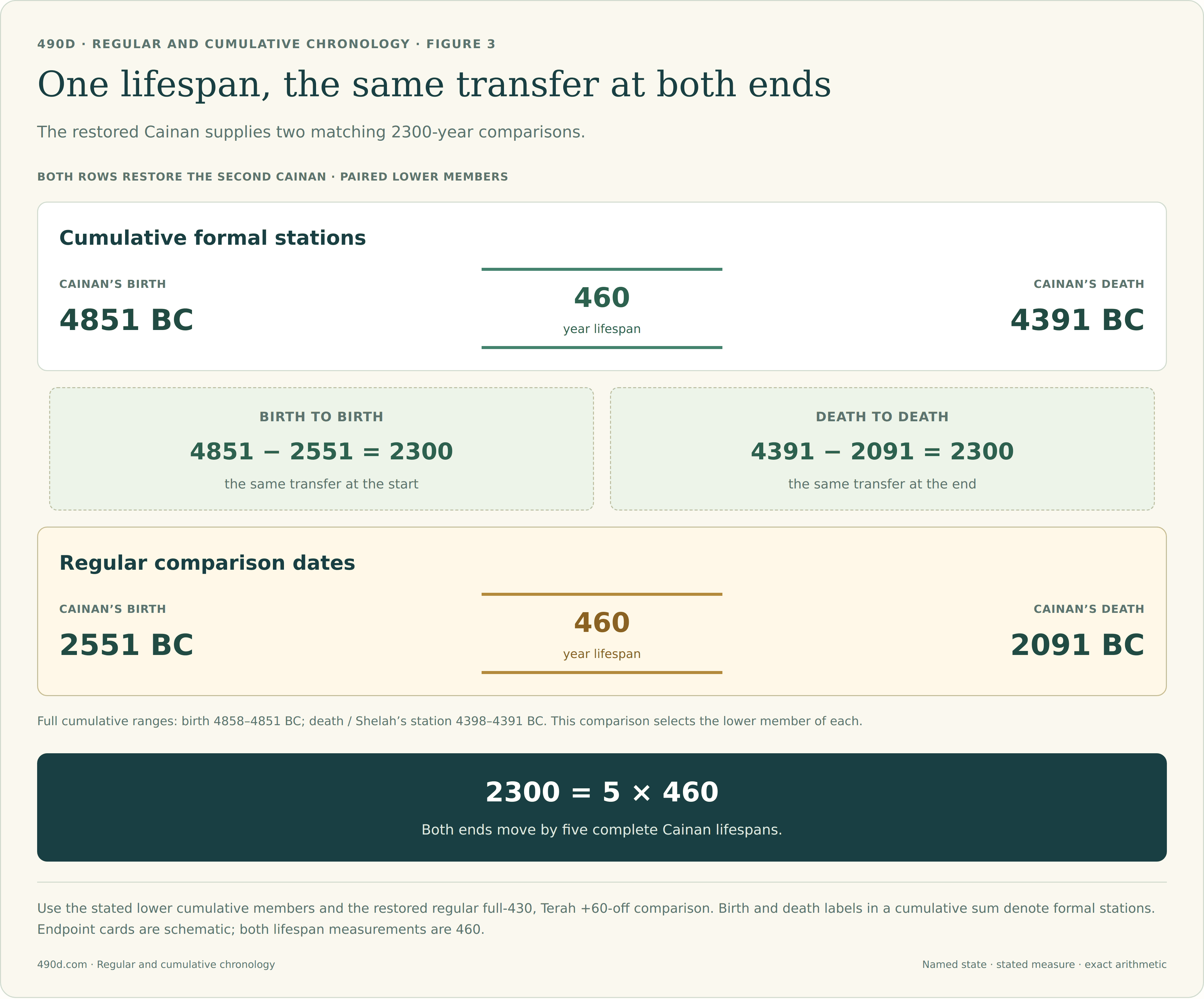
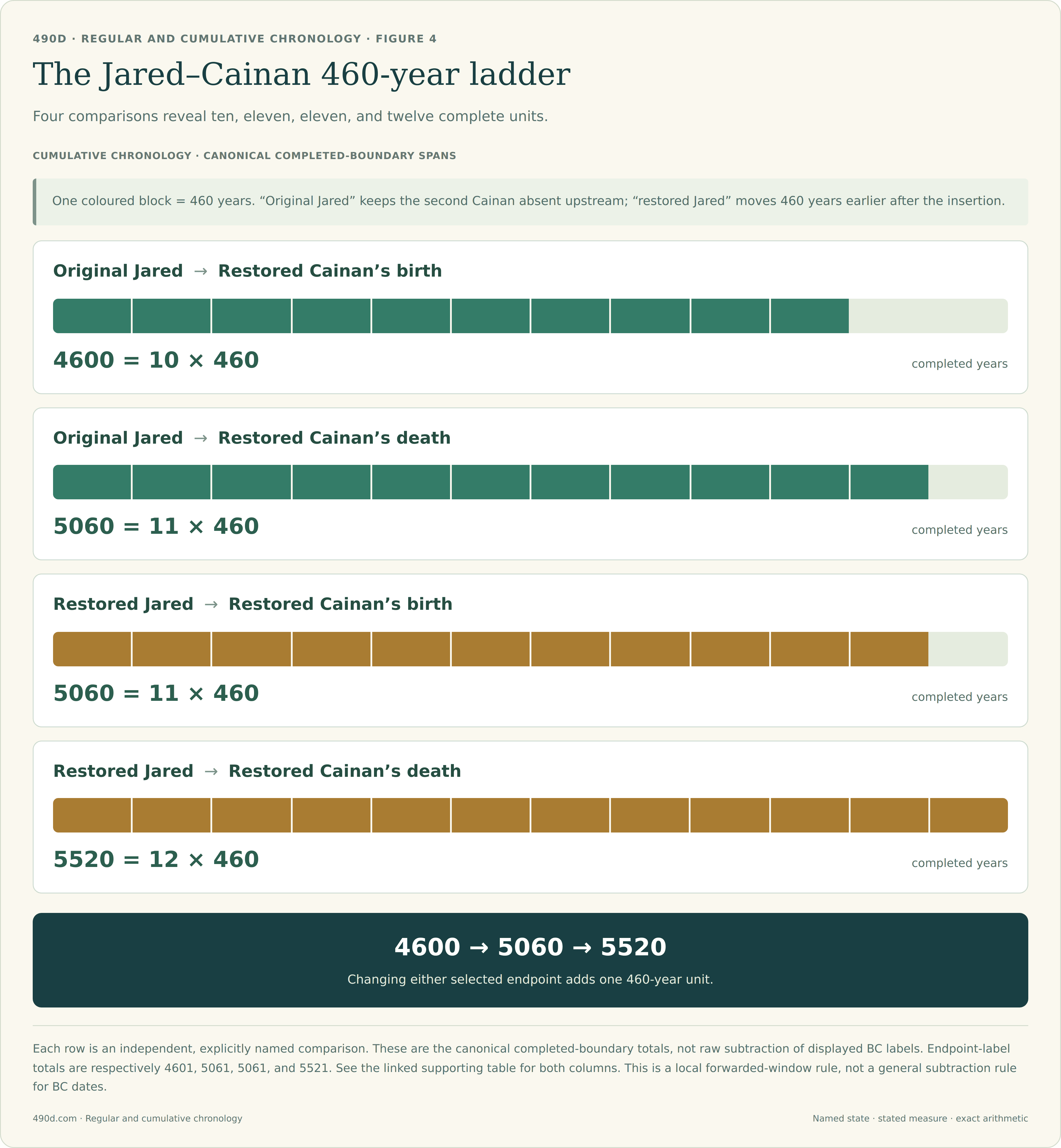
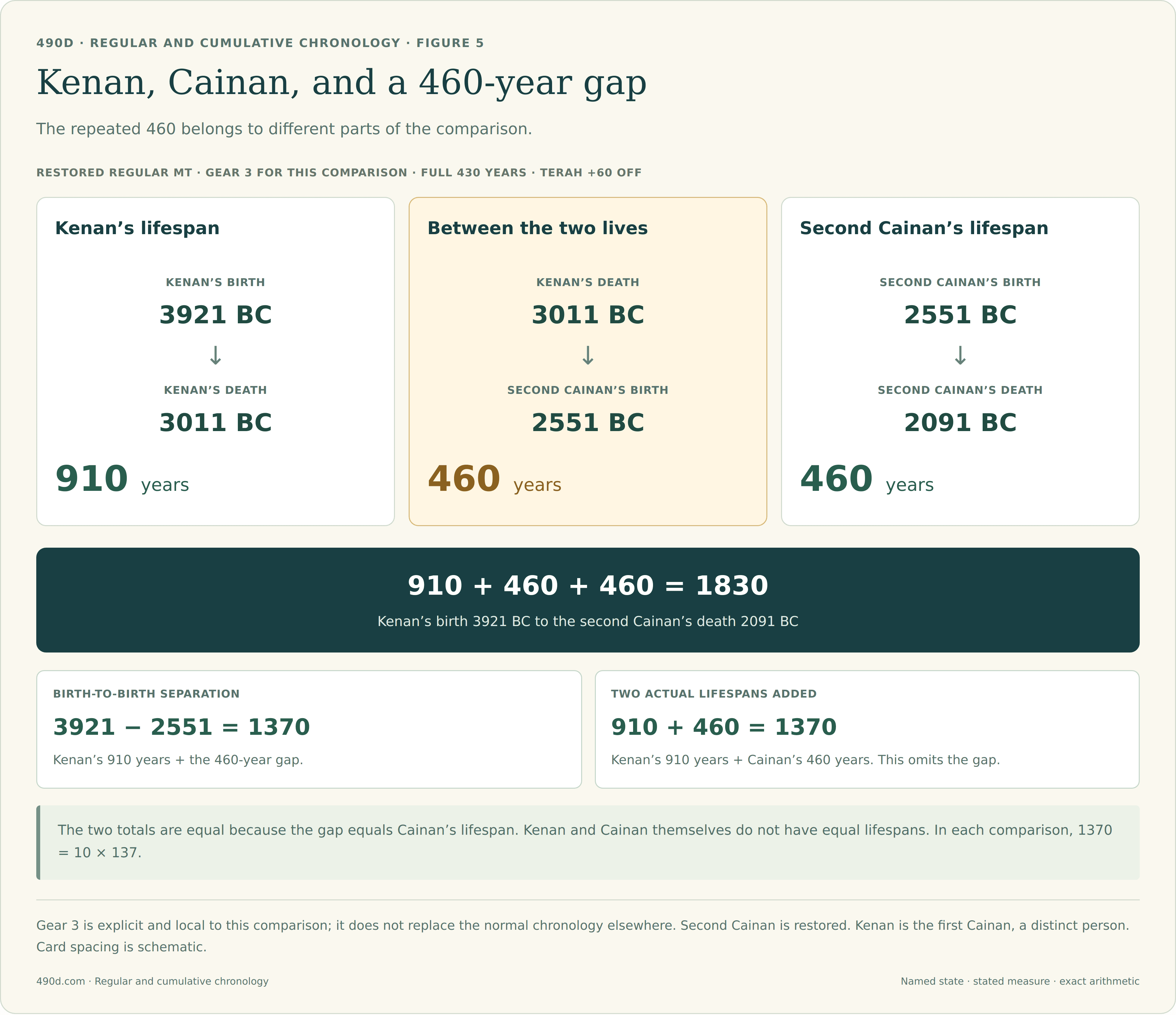
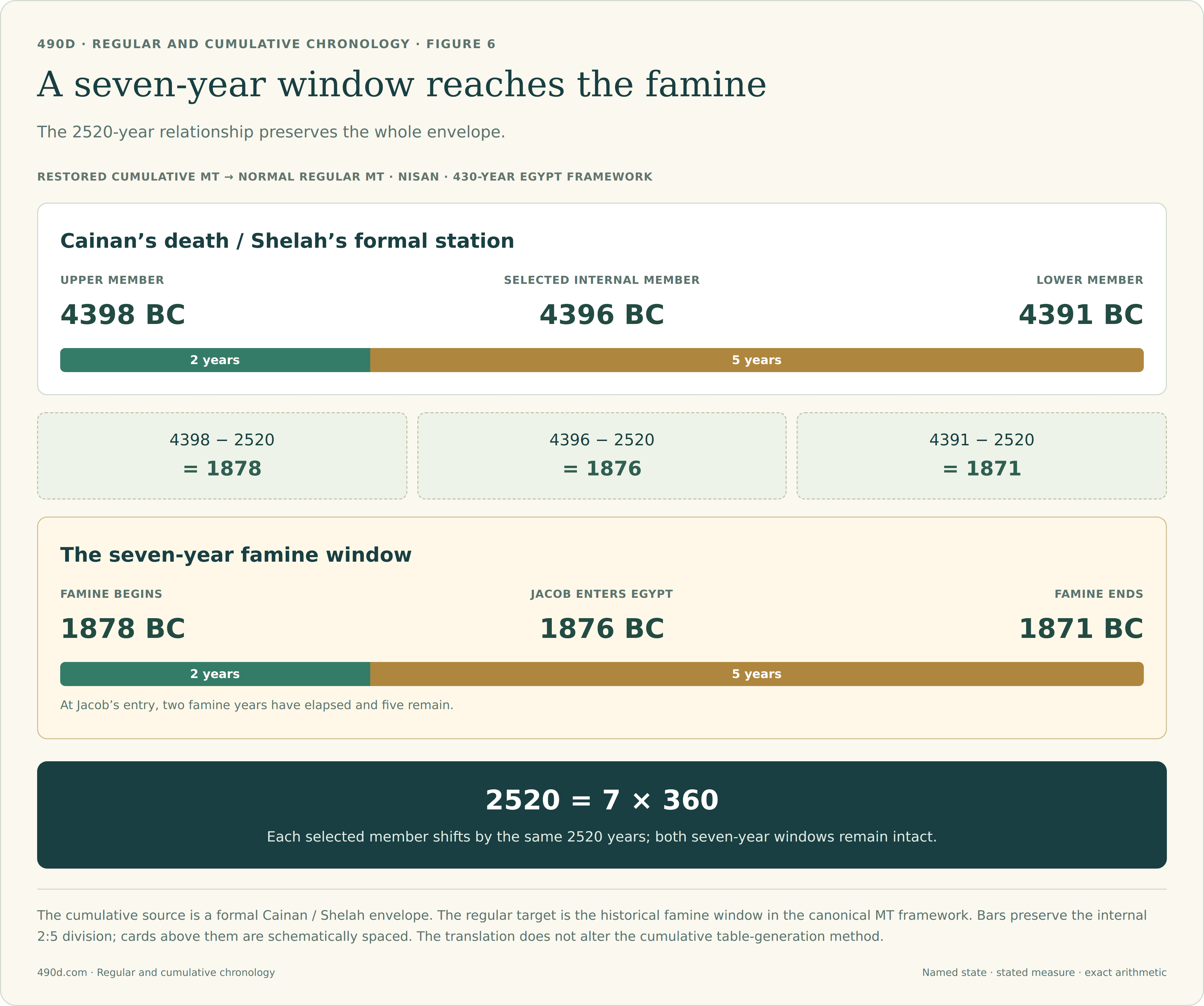
Table 11. The complete 2520-year window correspondence
| Position | Cumulative Cainan death / Shelah range, BC | Subtract 2520 | Famine-window target |
|---|---|---|---|
| Opening | 4398 | 4398 − 2520 = 1878 | 1878 BC, famine opening |
| Selected internal position | 4396 | 4396 − 2520 = 1876 | 1876 BC, Jacob enters Egypt; two famine years elapsed |
| Closing | 4391 | 4391 − 2520 = 1871 | 1871 BC, famine closing |
The internal division is 2 + 5 years in both ranges: 4398 − 4396 = 1878 − 1876 = 2, and 4396 − 4391 = 1876 − 1871 = 5. The statement that two years of famine had passed, with five remaining, is explicit in Genesis 45:6.
File 16 treats this as a structural correspondence between a cumulative source window and the historical entry setting. It does not turn Cainan’s cumulative death into the famine event, nor does the 2520-year translation replace the operations that generate either table. The normal Egyptian sojourn remains 1876–1446 BC = 430 years. The sojourn article treats that historical framework directly.
This final example shows why matching both ends matters. A complete seven-year interval, with its internal division, is transferred coherently. The dates, their event classes and the operation all remain visible.
Sources: File 16, §3.3A and §§3.3–3.3.5; File 18, §§1.3.8, 6B.
13. A pattern that can be followed and checked
The regular and cumulative methods draw different measurements from the ancestral record. Their correspondence is therefore most useful when it preserves recognizable relationships: a father-to-son interval, a complete life, a named partition, or both ends of a span.
Jared supplies the regular 460-year unit. Shem divides the cumulative trunk into 49 and 23 Abrahamic lifespans. Restored Cainan brings a 460-year life into the longer construction, a paired 2300-year transfer, and the ten-, eleven- and twelve-unit Jared ladder. The specified Kenan comparison adds a 910-year life followed by two 460-year intervals. Further comparisons preserve the distinct operations at Creation and the complete window around Jacob’s entry into Egypt.
The mathematical relationships are exact under the states and counting conventions identified here. Their theological significance lies in the order and correspondence one reads in the genealogy. That interpretation can be explored without turning a selected example into an unproved statistical certainty or making formal cumulative coordinates compete with ordinary historical dates.
Sources and related studies
| Controlling source | Principal sections used | What it supplies |
|---|---|---|
| File 18: Chronological Data Tables | §§1.3.1, 1.3.7–1.3.8; §2.1; §§6–6B | Regular values, cumulative positions, ranges and Cainan insertion |
| File 22: Cumulative MT Harmonics | §§1.2, 5–5A, 6.1, 7.1–7.12, 9A.3 | Shem partition, corrected Cainan ladder, Creation bridges and ratio comparisons |
| File 11: Three-Gear Protocol | §§4.1–4.2 | Stated Kenan Gear-3 comparison and selected cumulative control |
| File 09: Cumulative Architecture | Cumulative structure, Creation and Joshua controls | Meaning and limits of the longer construction |
| File 16: The 1876 BC Nexus | §3.3A; §§3.3–3.3.5 | Cainan/famine-window correspondence and its historical target |
For a shorter starting point, return to the introductory article and its technical appendix. The literal cumulative tables, cumulative-method introduction, second-Cainan study, and Key-of-23 introduction provide the wider framework. The canonical source index supplies the current controlling Markdown editions.
Scripture quotations: Berean Standard Bible (BSB), public domain.