“Noah was 600 years old when the floodwaters engulfed the earth.”
— Genesis 7:6, (NET)
Genesis gives Noah’s age at the Flood within a genealogy that measures time from one generation to the next. In the Masoretic Text (MT), those intervals total 1656 years from Creation to the Flood. The number is precise, yet its relationship to familiar biblical measures becomes clearer when it is expressed as 1800 or 1680 through two closely related conversions.
Why should those different numbers belong together? The answer begins with the unit being counted. A year can be represented through weekly priestly service, twelve 30-day months, or a 364-day calendar. A shorter unit must be counted more often to express a comparable duration.
The Key of 23 is the name used in these studies for three ratios that connect such measures. It gives a consistent way to examine chronological relationships while keeping the original dates visible. This introduction explains the ratios, follows one MT example, and shows how a fixed biblical event anchors a conversion.
Why 23 appears in three different ratios
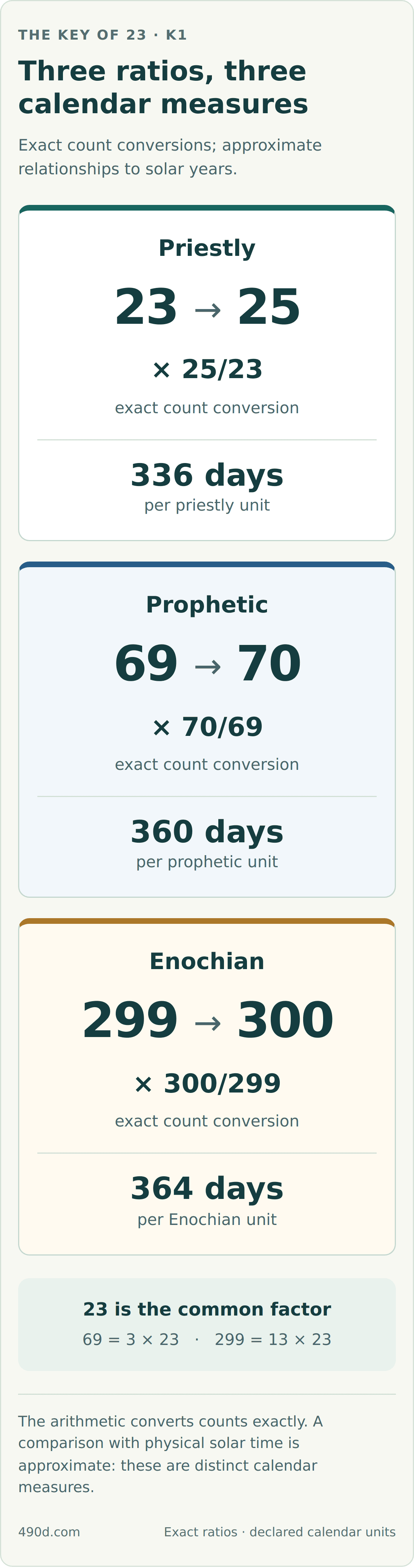
The three conversions are:
23 → 25 · 69 → 70 · 299 → 300
Their common feature is on the starting side: 69 = 3 × 23, and 299 = 13 × 23. Each starting count is a multiple of 23. The corresponding multipliers are 25/23, 70/69, and 300/299.
The same relationships recur at larger scales. Under 23→25, 46→50, 230→250, and 460→500 are simply two, ten, and twenty blocks of the basic conversion. This is why multiples of 23 are useful throughout the chronology.
Each multiplier belongs to a particular measure:
- Priestly: 336 days. Two weekly rotations of the 24 priestly courses give 48 weeks, or 336 days. The course divisions are listed in 1 Chronicles 24:1–19.
- Prophetic: 360 days. Twelve 30-day months give the measure familiar from the relationship between 42 months and 1260 days.
- Enochian: 364 days. Fifty-two weeks form four equal quarters of 91 days.
Priestly
Prophetic
Enochian
Sources: File 00 §3.1 · File 12 §§5.1, 6.3.
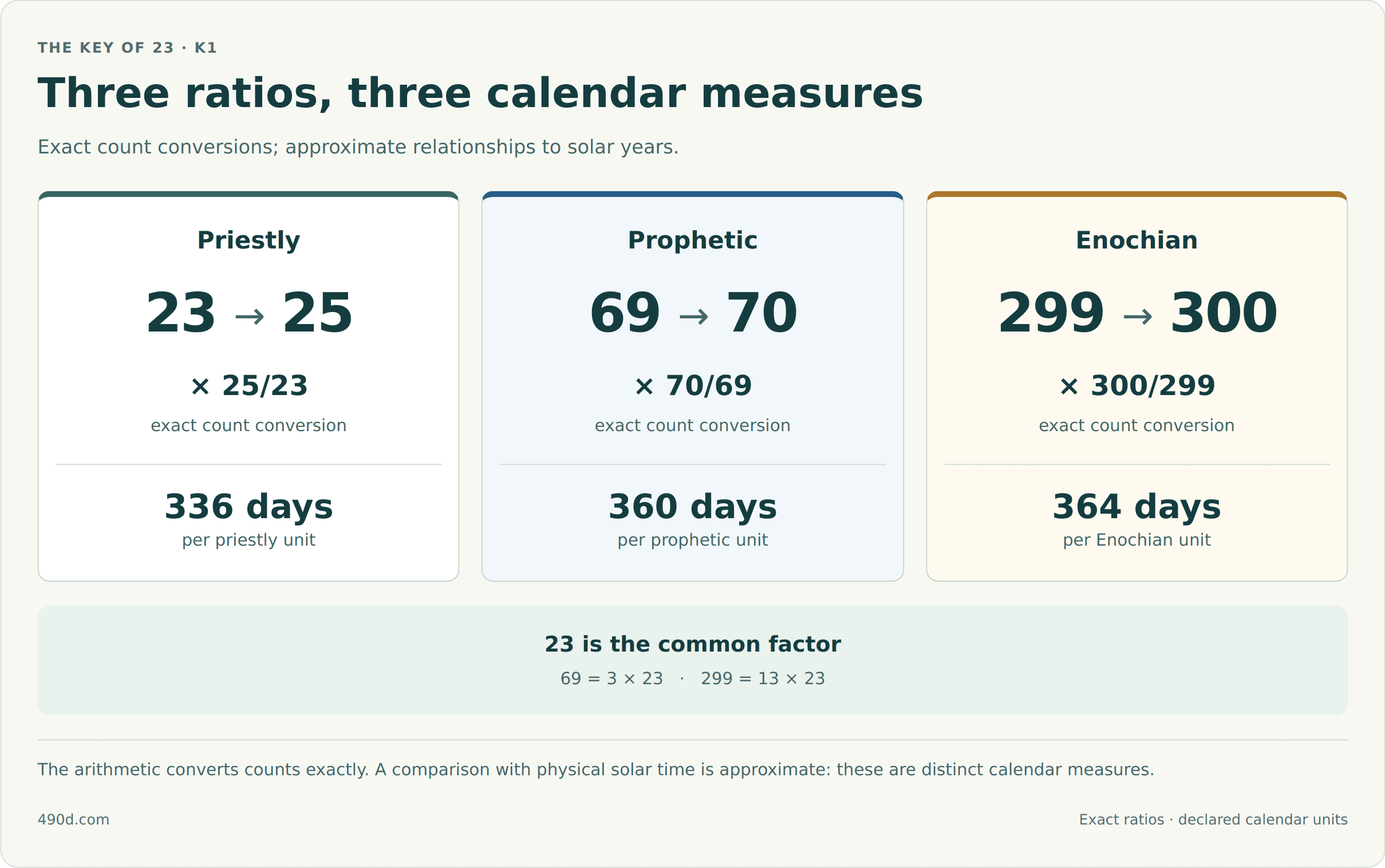
These are schematic measures with different structures. The priestly measure emphasizes service in weeks; the prophetic measure emphasizes months; the Enochian measure keeps a whole number of weeks in the year. The Levi study explains the priestly courses and their relationship to the 360-day measure in greater detail.
Their relation to solar time is remarkably close. For example, 25 priestly units of 336 days make 8400 days, nearly the length of 23 solar years. Thus a count of 23 becomes 25 when read through the priestly measure. The other two ratios work in the same way with their corresponding units.
All three ratios share one schematic reference year, approximately 365.21739 days. They therefore belong to one coordinated system. The ratios themselves are exact; their equivalence to physical solar time is approximate. The small differences are set out in the calendar comparison table, where they can be examined without interrupting the main explanation.
From Creation to the Flood: two routes through 1656
For the following examples, the ordinary chronology is MT/Nisan, with 430 years in Egypt, no additional Cainan, and no +60 Terah adjustment. Creation is 4114 BC, and the Flood is 2458 BC:
4114 − 2458 = 1656 years.
The total comes from the begetting intervals in Genesis 5, followed by Noah’s 600 years to the Flood. The generation-by-generation table shows the whole calculation.
The same 1656 is divisible by both 23 and 69:
1656 = 72 × 23 = 24 × 69.
Applying the corresponding conversions gives:
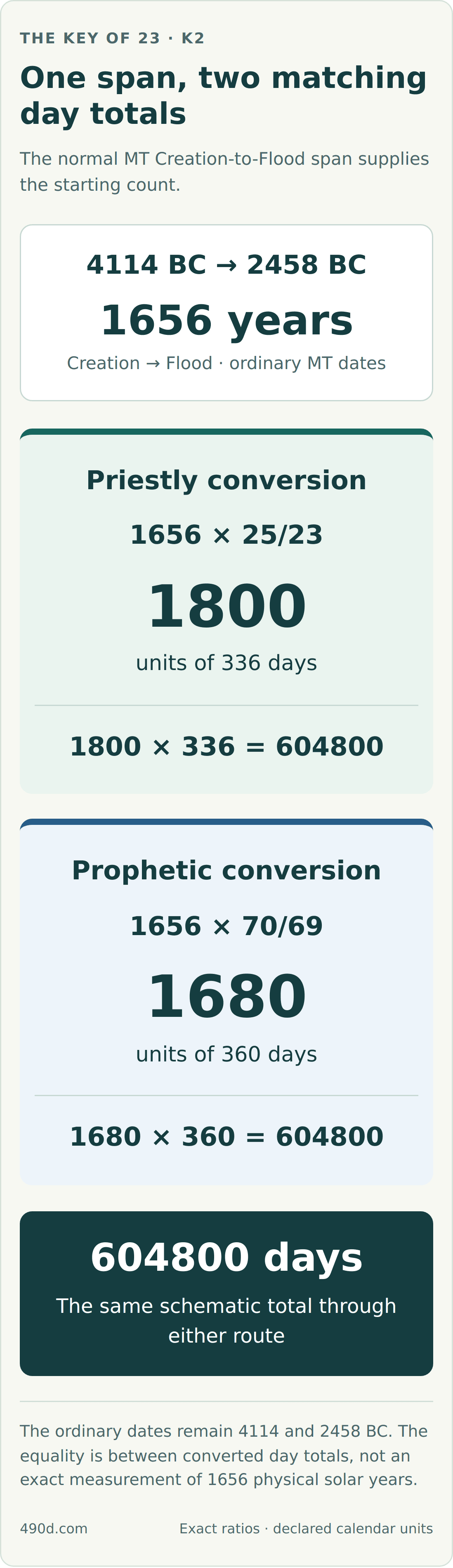
1656 × 25/23 = 1800 priestly units
1656 × 70/69 = 1680 prophetic units
The interest is more than the appearance of two round numbers. When the results are expressed in their respective day-units, they agree exactly:
1800 × 336 = 1680 × 360 = 604800 days.
Priestly conversion
Prophetic conversion
Sources: File 18 §4A.4 · File 00 §3.1 · File 12 §§5.1, 6.3.
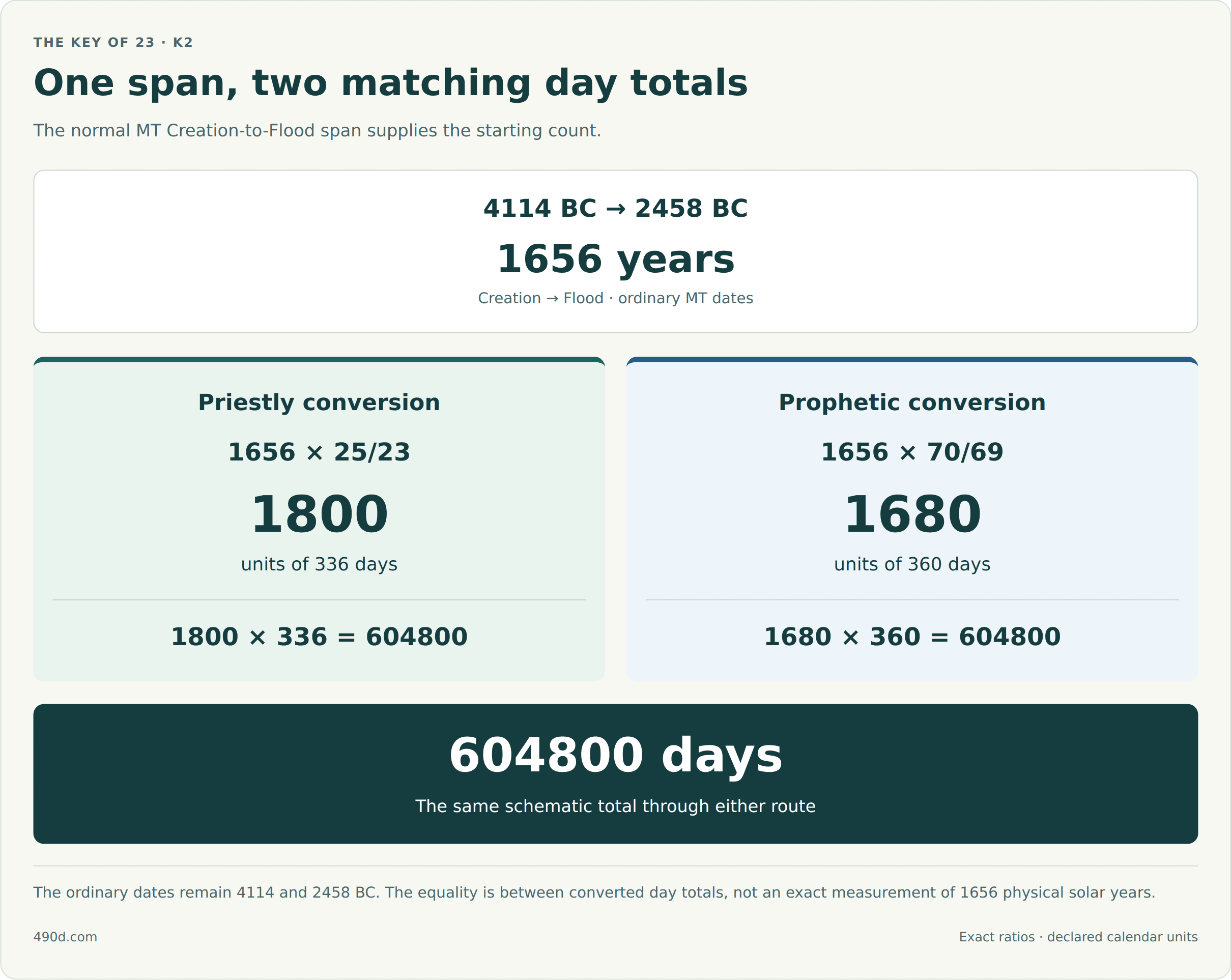
The two paths express one shared schematic day total. They also reveal an appealing exchange: 1800 = 5 × 360, while 1680 = 5 × 336. Each converted count contains the number belonging to the other measure. Their shared total is therefore 5 × 360 × 336.
This develops the 15:14 relationship explained in the Levi article: 15 priestly units and 14 prophetic units each contain 5040 days. Here both sides have been enlarged 120 times. The correspondence is built into the relationship between the measures; its chronological setting is the MT interval from Creation to the Flood.
The ordinary interval remains 1656 years. Its converted counts show how that interval can be read through the priestly and prophetic frameworks. The exact calculations keep the original count, multiplier, and result together.
What happens when the Exodus is held fixed?
The calendar relationships also supply a way to expand a chronological span around a fixed event. In this second use, the converted count becomes the length of a comparison span on the year axis. It produces a generated coordinate that can be compared with other biblical anchors. The Exodus provides a clear example.
From MT Creation to the Exodus in 1446 BC is:
4114 − 1446 = 2668 years = 116 × 23.
Under the priestly ratio, that count becomes:
2668 × 25/23 = 2900.
Hold the Exodus at 1446 BC and measure the converted span backward. The resulting comparison point is:
1446 + 2900 = 4346 BC.
the Exodus anchor stays in place
Sources: File 00 §3.1 · File 18, ordinary MT tables.
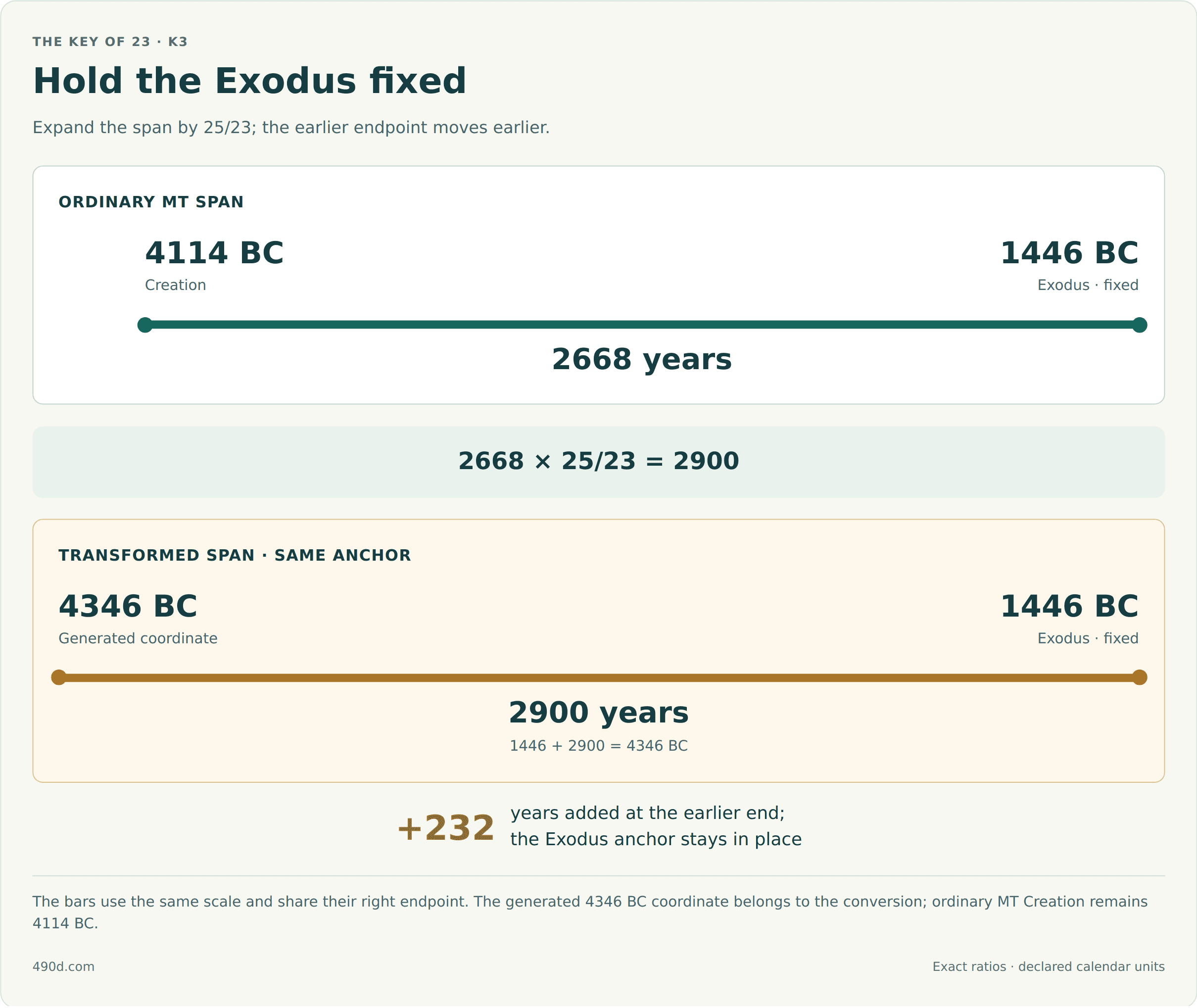
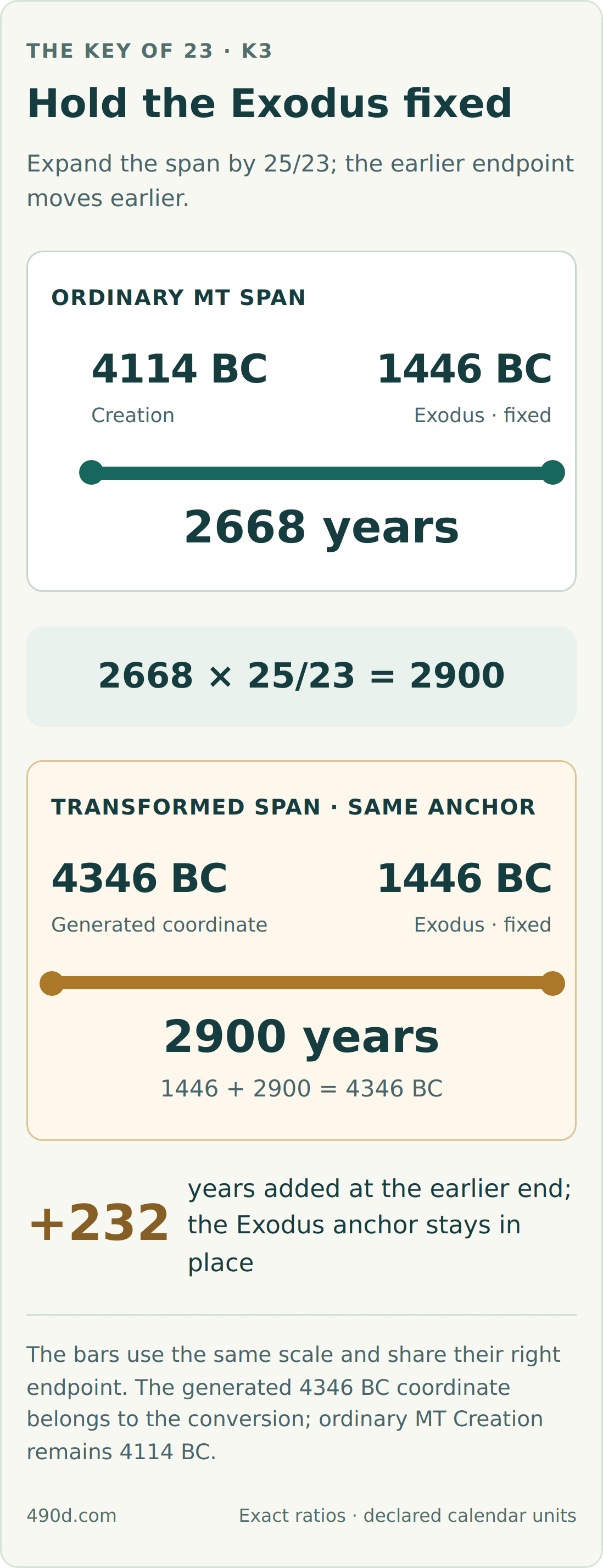
The diagram keeps the distinction visible: 4114 BC is the ordinary Creation date, while 4346 BC is the endpoint generated by this anchored conversion. Because the expanded span extends backward from the same Exodus, its beginning moves 232 years earlier.
This shows why the anchor matters. The operation acts on the interval between two named events. Only after the span has been converted do we place its new endpoint relative to the event held fixed. The anchored calculation table records each step.
The generated point also reveals a larger relationship. From 4346 BC to the Conquest in 1406 BC is 2940 = 6 × 490 years: the expanded 2900 to the Exodus, followed by the unchanged 40 years in the wilderness. Each 490 contains ten 49-year jubilee cycles. The comparison therefore connects the Key of 23 with the jubilee framework developed throughout these studies. File 22, sections 9.2–9.4, records this relationship and a second, explicitly identified route to the same point.
The 299→300 ratio has an equally concrete application. In the normal MT chronology, Lamech’s birth in 3240 BC stands 1794 = 6 × 299 years before the Exodus. Its Enochian conversion is 1800. The detailed study examines this alongside the Flood example and follows further connections involving Joseph and Levi.
A way to read the relationships
The Key of 23 draws attention to the interaction between biblical chronology and calendar form. Its three ratios bring weekly service, prophetic months, and the Enochian year into a coordinated mathematical relationship. The genealogical figures supply the intervals; the calendar measures reveal another way of reading them.
Within this study’s theological framework, that coordination suggests that biblical time carries meaning through both its events and its numerical form. Creation, judgment, deliverance, and priestly service provide the narrative setting in which the relationships are examined. The exact arithmetic supports that reading, while the interpretation asks why these particular persons and events belong together.
The method remains straightforward: name the original span, identify the measure, apply its ratio, and state the anchor if a new coordinate is generated. Readers can then follow the pattern without losing sight of the chronology from which it began.
Continue with the supporting tables and technical appendix, or explore the detailed study. The current canonical source files contain the wider framework.
The Scriptures quoted are from the NET Bible® http://netbible.com copyright ©1996, 2019 used with permission from Biblical Studies Press, L.L.C. All rights reserved