“The length of Levi’s life was 137 years.”
— Exodus 6:16, excerpt (NET)
Levi’s 137-year life belongs to the family history that leads to Moses and Aaron. A second number emerges when his death is placed beside the Exodus: 336 years. That interval connects the ancestor of the priestly tribe with the deliverance through which Israel becomes a nation serving God.
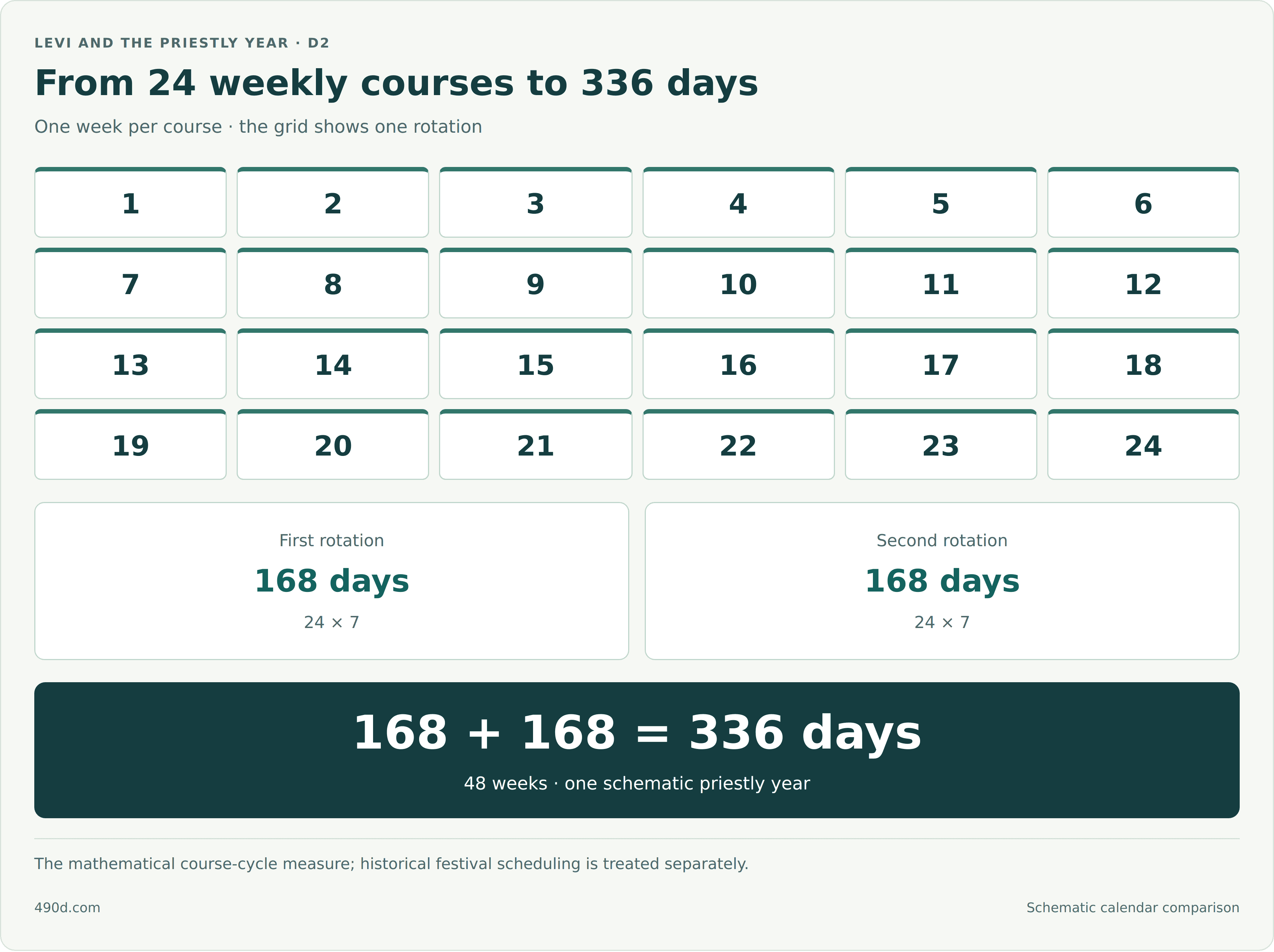
The number also has a priestly form. The 24 divisions of priests, counted in weekly rotations, give 24 × 7 = 168 days. Two rotations give 336 days. The correspondence is therefore between a span in the chronology and a measure of priestly service: a priestly “year of years.”
From this simple connection, we can see how the 336-day priestly measure relates to the familiar 360-day prophetic measure. The relationship becomes especially clear when the same chronological span is expressed through each.
From Levi’s death to the Exodus
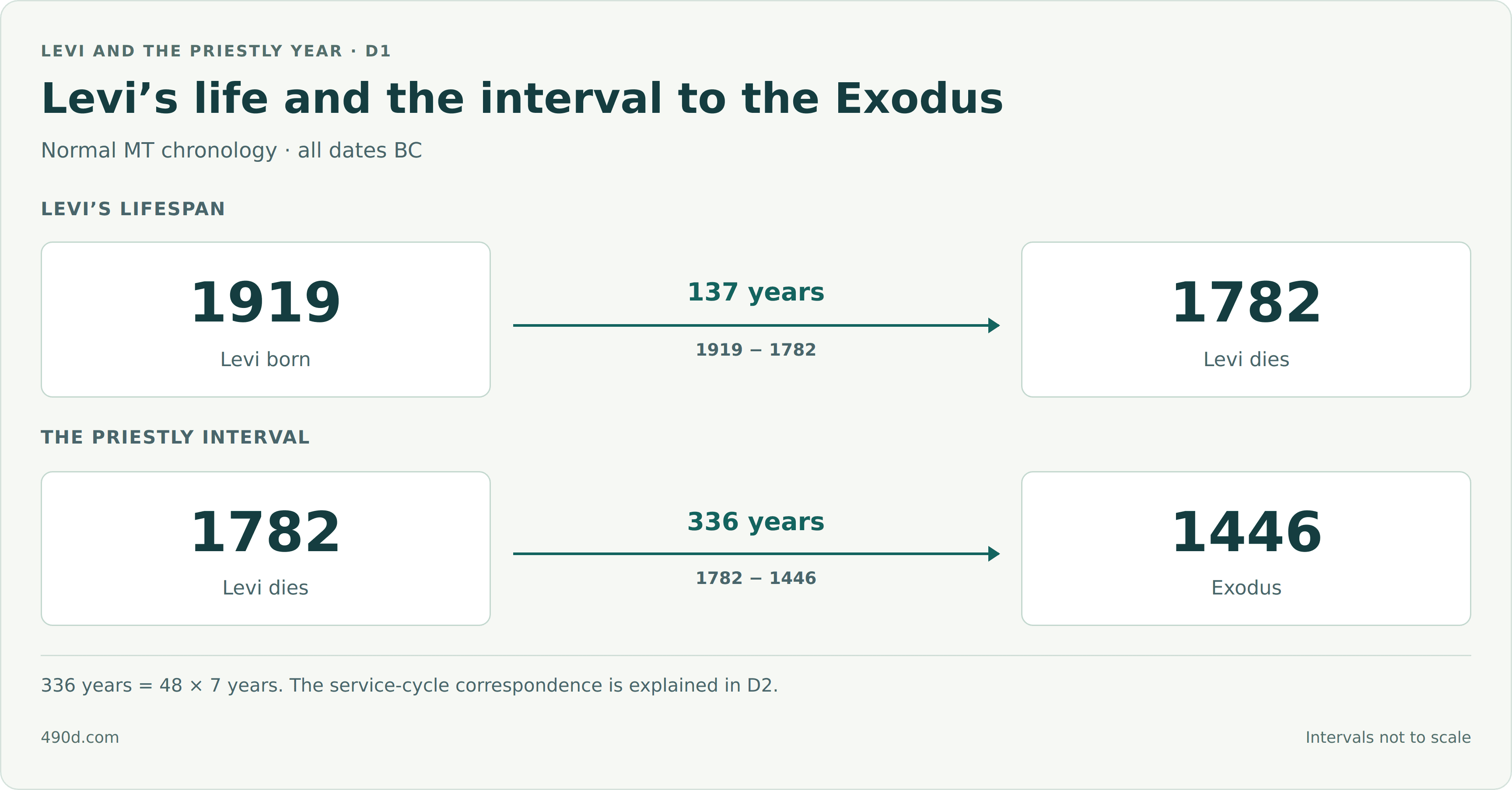
In the normal MT chronology used here, Levi lives from 1919 to 1782 BC. The Exodus follows in 1446 BC:
1919 − 1782 = 137 years of life
1782 − 1446 = 336 years to the Exodus
These dates use the normal Nisan framework with 430 years in Egypt. The BC dates are reconstructed chronological coordinates; the biblical text itself supplies Levi’s lifespan. The supporting date table shows the derivation and its canonical sources.
The Exodus is the appropriate endpoint for this comparison. Levi’s descendants Moses and Aaron stand at the beginning of Israel’s national deliverance and priestly service. The Tabernacle is erected in the following year, 1445 BC; its distance from Levi’s death is consequently 337, a related but different interval. Keeping the endpoints clear preserves the particular 336-year connection.
A nearby pattern strengthens the sense of division into priestly units: Peleg’s death in 2118 BC → Levi’s death in 1782 BC → the Exodus in 1446 BC gives 336 + 336 = 672 years. This is a calculation from the same ordinary MT dates, connecting the Peleg study with the present subject. Levi’s death divides the larger interval equally.
Why 336 is a priestly number
1 Chronicles 24:1–19 lists the 24 priestly divisions in their appointed order. Josephus likewise describes 24 courses and their Sabbath-to-Sabbath service (Antiquities 7.365). The weekly cycle supplies the basic arithmetic:
24 courses × 7 days = 168 days
2 rotations × 168 days = 336 days
This is the schematic priestly year used in the canonical studies: 48 service weeks, arranged as two complete rotations. It expresses the orderly repetition of the priestly courses. Historical calendars also require attention to festivals and the solar year; those questions belong to the calendar notes in the appendix.
We are now comparing two different scales. The chronological interval is 336 years; the service-cycle measure is 336 days. Reading the years through the pattern of the days gives the “year of years” interpretation. The shared number becomes meaningful through Levi’s priestly identity and the Exodus endpoint.
The 24-course organization described under David is later than Levi and Moses. Its use here is retrospective: the later priestly arrangement provides a numerical form through which to read the earlier chronology. The correspondence does not require the fully developed course system to have operated in Levi’s lifetime.
How 336 and 360 fit together
The 360-day prophetic year has a different shape: 12 × 30 days. The familiar relationship between 42 months and 1260 days in Revelation 11:2–3 supplies a biblical setting for that schematic measure. The priestly measure is built from weeks and courses; the prophetic measure is built from twelve 30-day months.
Their exact relationship is easiest to see with a small example:
| Measure | Number of units | Days in each unit | Total days |
|---|---|---|---|
| Priestly | 15 | 336 | 5040 |
| Prophetic | 14 | 360 | 5040 |
The shorter unit must be counted more often to cover the same total. Thus 15 priestly units equal 14 prophetic units in total days. This is the 15:14 relationship behind the comparison. It preserves the identity of both measures while allowing them to describe one span.
That distinction also explains the wording of this article’s title. The question is how 336 and 360 relate: one measures the same total with shorter units, the other with longer units. The exact conversions are collected in the ratio table.
One chronological span, two schematic expressions
The normal MT interval from Creation to the Flood provides a larger example:
4114 − 2458 = 1656 years.
The canonical studies apply two related ratios, commonly called the Key of 23 and the Prophetic Key:
1656 × 25/23 = 1800
1656 × 70/69 = 1680
The first gives the priestly count; the second gives the prophetic count. When each is read in its corresponding day-unit, the totals agree:
1800 × 336 = 1680 × 360 = 604800 days.
= 604800 days
= 604800 days
= 15 : 1415 × 336 = 14 × 360 = 5040 days
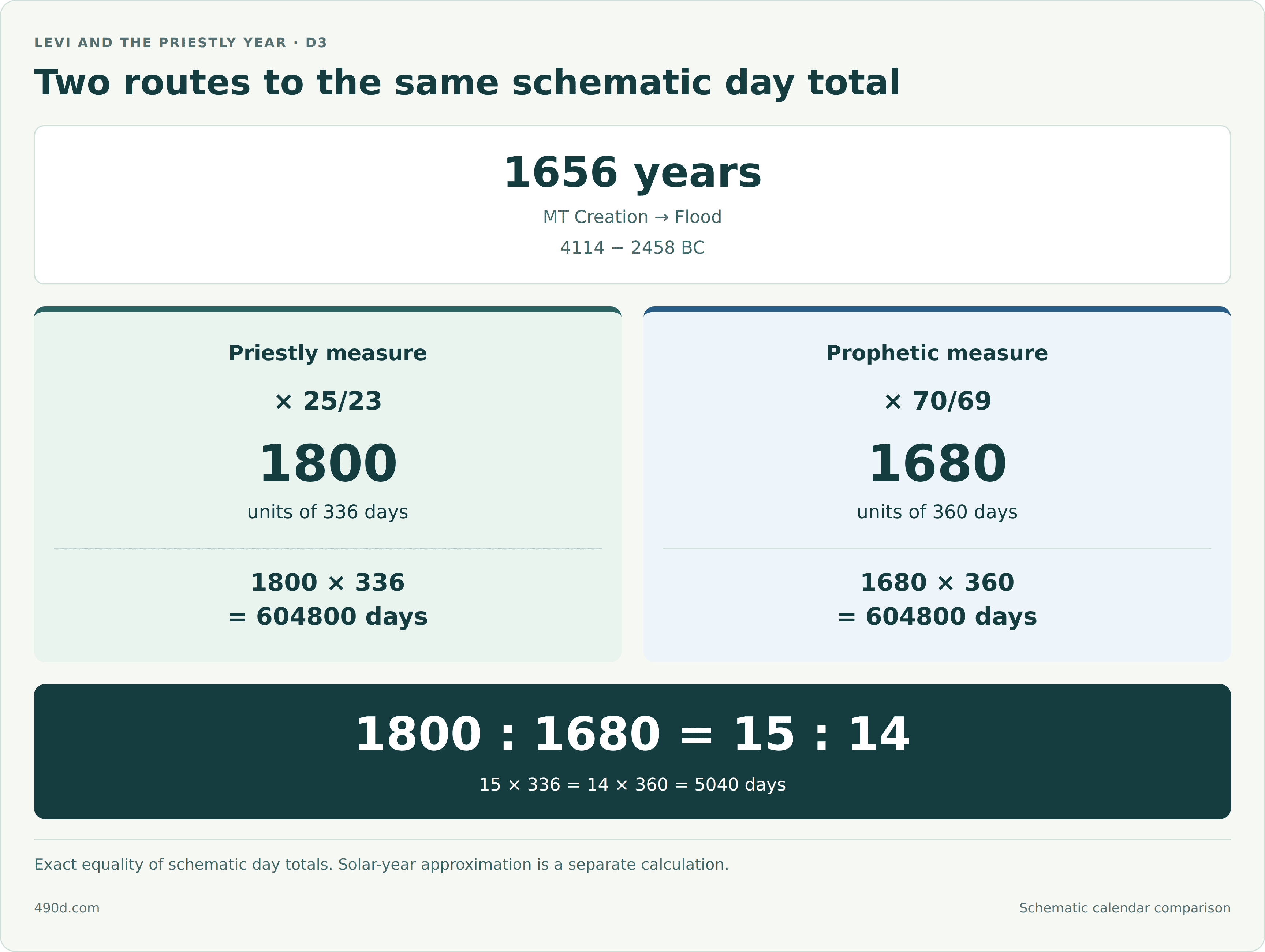
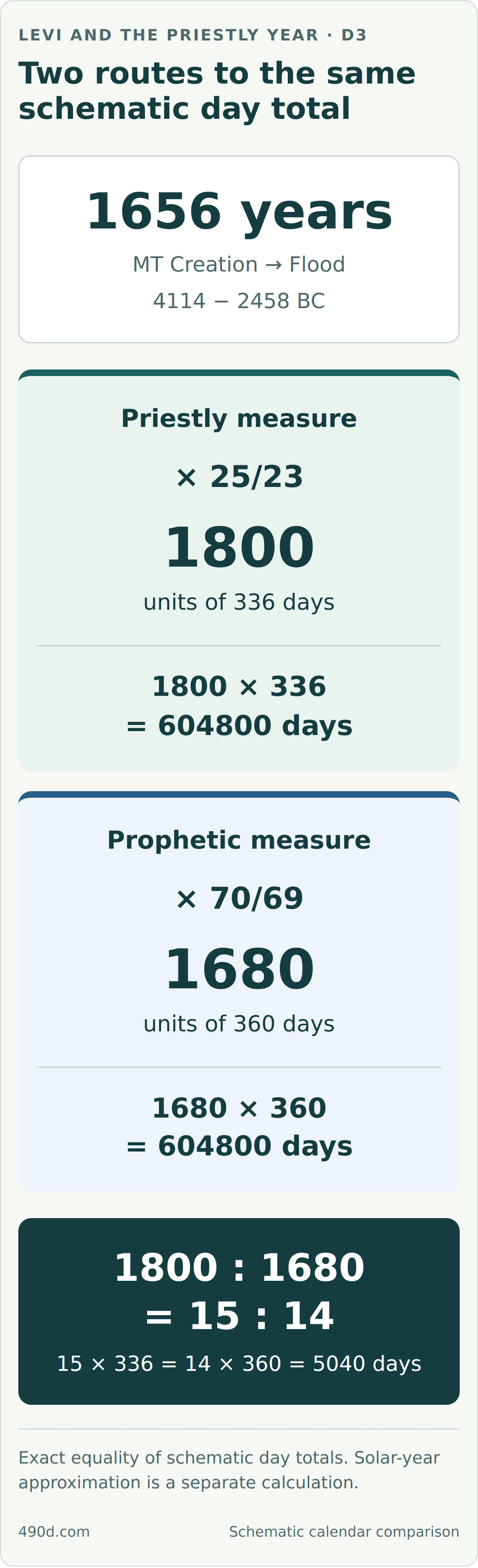
This is the same relationship as the small example, enlarged 120 times: 1800 = 120 × 15, and 1680 = 120 × 14. The two routes therefore preserve the 15:14 proportion.
There is also an appealing reversal in the figures: 1800 = 5 × 360, while 1680 = 5 × 336. The counts contain the opposite measure’s number. Their common day total is consequently 5 × 360 × 336.
These are exact relationships between the schematic measures. Their approximation to solar time is a separate matter, explained briefly in the calibration note. The calculation leaves Creation, the Flood, and Levi’s ordinary dates in their stated chronological positions.
A priestly reading of chronological time
The connection begins with a modest observation: Levi’s death stands 336 years before the Exodus. The priestly courses explain why that number has a recognizable form, and the comparison with 360 shows how the weekly and monthly measures can express a common total.
The arithmetic itself is exact. Its theological significance lies in the meeting of the person, the interval, and the pattern of service. Levi is the ancestral head of the priestly tribe; the Exodus opens the way to Israel’s worship and priestly order; the intervening span takes the form of a complete priestly service-year at the scale of years.
The two Key calculations share a mathematical basis, so their matching totals belong to one coordinated relationship. The chronological argument gains its interest from where that relationship appears. Here the weekly pattern of the priestly courses provides a way to read the long preparation between Levi and the Exodus.
For the fuller chronological comparisons, see Levi, Priestly Cycles, and the Relationship between 336 and 360: A Detailed Study.
For exact date derivations, calendar distinctions, and source sections, see the technical appendix. The current canonical chronology files preserve the wider research framework.
Scripture quoted by permission. Quotations designated (NET) are from the NET Bible® copyright ©1996, 2019 by Biblical Studies Press, L.L.C. https://netbible.com/ All rights reserved.