“This temple took forty-six years to build,”
John records the temple’s forty-six-year construction period, then explains that Jesus was speaking about His body and resurrection (John 2:21–22). The number supplies a point of comparison for this study; John’s stated interpretation remains the resurrection of Jesus.
The chronological relationships below belong to the 23 family: 46 = 2 × 23, and 460 = 20 × 23. Their value lies in the particular people, spans and calculations they connect. I distinguish exact arithmetic from the interpretation of the pattern, and both from statistical testing.
For the general method, begin with The Key of 23: How Biblical Time Spans Fit Together. This companion concentrates on the Creation-to-Flood span, Cainan’s 460-year measure, and the qualified evidence from the Rounded scaffold.
Read directly: Creation and the Flood · Cainan’s two settings · The 9890 bridge · The Rounded comparison · Sources and figure index.
1. Creation to the Flood: 36 measures of 46
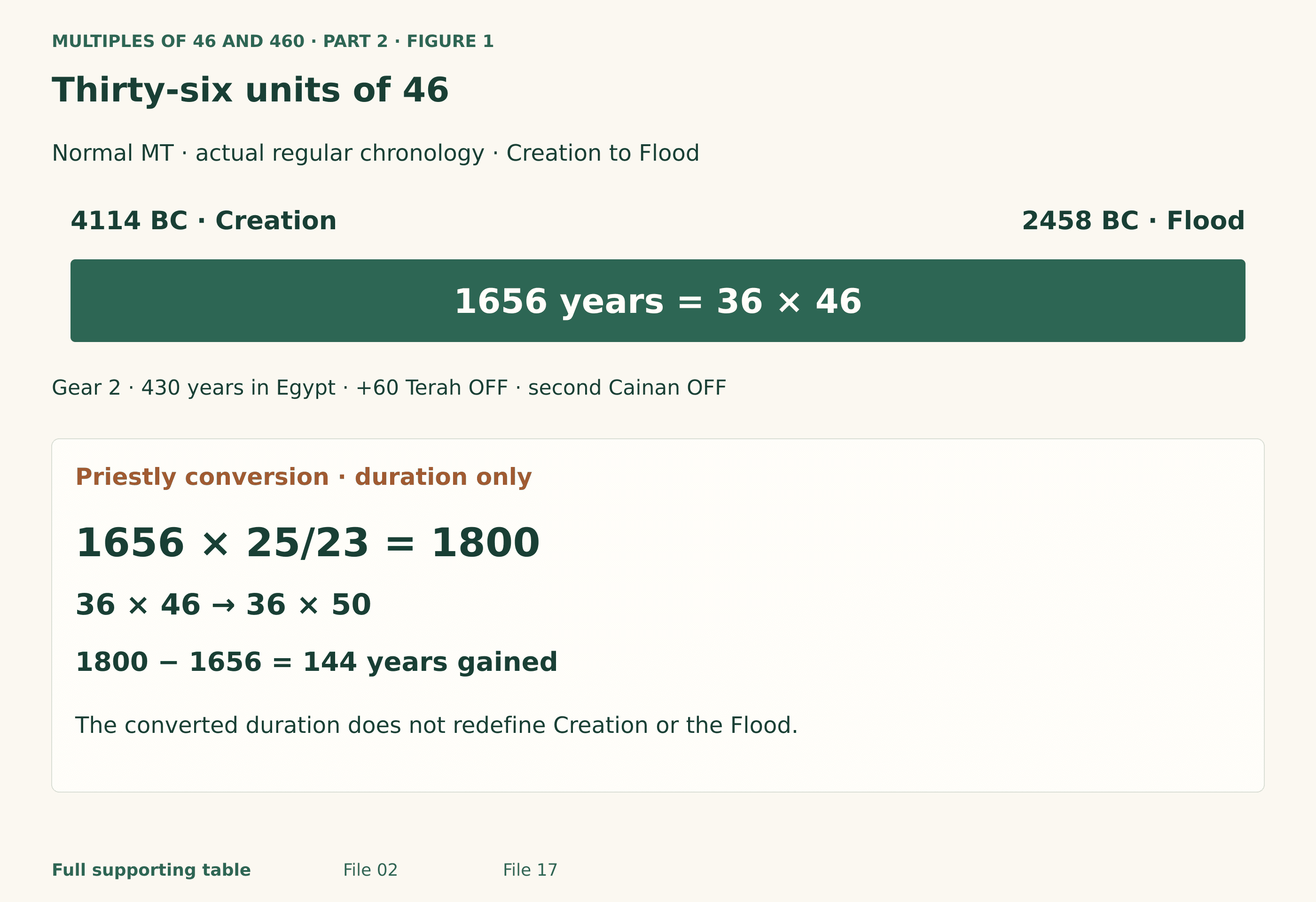
The normal Masoretic Text (MT) model places the Creation endpoint at 4114 BC and the Flood at 2458 BC. This is the normal Gear-2 setting, retaining 430 years in Egypt, with no additional sixty-year Terah adjustment and no restored second Cainan. Genesis supplies the ages; the BC labels are the model’s reconstruction.
The interval is:
4114 − 2458 = 1656 = 36 × 46 = 72 × 23.
The same 1656 is reproducible from the nine begetting ages in Genesis 5, followed by Noah’s age at the Flood in Genesis 7:6:
130 + 105 + 90 + 70 + 65 + 162 + 65 + 187 + 182 + 600 = 1656.
This calculation uses Noah’s 600 years to the Flood, rather than stopping at the 500 associated with the beginning of his sons’ generation (Genesis 5:32). It does not add Shem’s whole life after Noah’s age at the Flood.
The Priestly Key-of-23 operation replaces each 23-unit with 25:
1656 × 25/23 = 1800 = 36 × 50.
The increase is 1800 − 1656 = 144. Equivalently, thirty-six measures of 46 become thirty-six measures of 50. File 02 §§2.1 and 2.3 explicitly verifies the normal MT interval and its expansion; File 17 §14 develops the 1656 family.
Multiples of 46 and 460 · Part 2 · Figure 1
Thirty-six units of 46
Actual regular MT · Creation to Flood
Normal chronological interval
Gear 2 · 430 years in Egypt · +60 Terah OFF · second Cainan OFF
Priestly conversion · duration only
1656 × 25/23 = 1800
1800 − 1656 = 144 years gained
No expanded event dates are assigned.
Full supporting table · File 02 · File 17 · Genesis 7:6 (BSB)
View or download Figure 1 as an image
Full-size PNG · SVG sources (ZIP: all three figures and data) · WebP copies (same ZIP)
| Comparison | Calculation | Years | Meaning |
|---|---|---|---|
| Normal MT Creation → Flood | 4114 − 2458 | 1656 | Original BC interval; 36 × 46 |
| Priestly span conversion | 1656 × 25/23 | 1800 | Converted duration only; 36 × 50 |
| Added duration | 1800 − 1656 | 144 | Gain in the span; no new event date |
Figure 1 converts the span. It does not move the Flood to a new date or replace the textual 1656-year calculation. The distinction is important: 1656 → 1800 is a numerical operation on the displayed interval, while 4114 → 2458 BC identifies the original chronological setting.
The same operation appears at two scales:
46 × 25/23 = 50; gain 4.
460 × 25/23 = 500; gain 40.
The exact scalar relationship explains why 46 and 460 belong together. Connecting it with the temple language in John is a theological comparison, rather than an explicit biblical instruction to multiply dates by 25/23.
2. Cainan: 130 in regular chronology, 460 in cumulative chronology
Second Cainan stands between Arphaxad and Shelah in the selected Greek Genesis reading. Brenton’s LXX gives 130 years before Shelah’s birth and 330 afterward: 130 + 330 = 460 (Genesis 11:13, Brenton’s LXX). The MT-based Genesis 11:12–13 proceeds from Arphaxad directly to Shelah.
The two chronological methods therefore use different inputs. Restoring Cainan in a regular comparison introduces the 130-year begetting interval. Restoring him in a cumulative comparison introduces his complete 460-year lifespan. These are +130 and +460, respectively. Native LXX already contains him; restoring him to an otherwise MT comparison does not adopt the whole received LXX chronology.
The Second Cainan introduction explains the insertion more fully. The particular relationship retained here is the exact correspondence developed in File 22 §6.1:
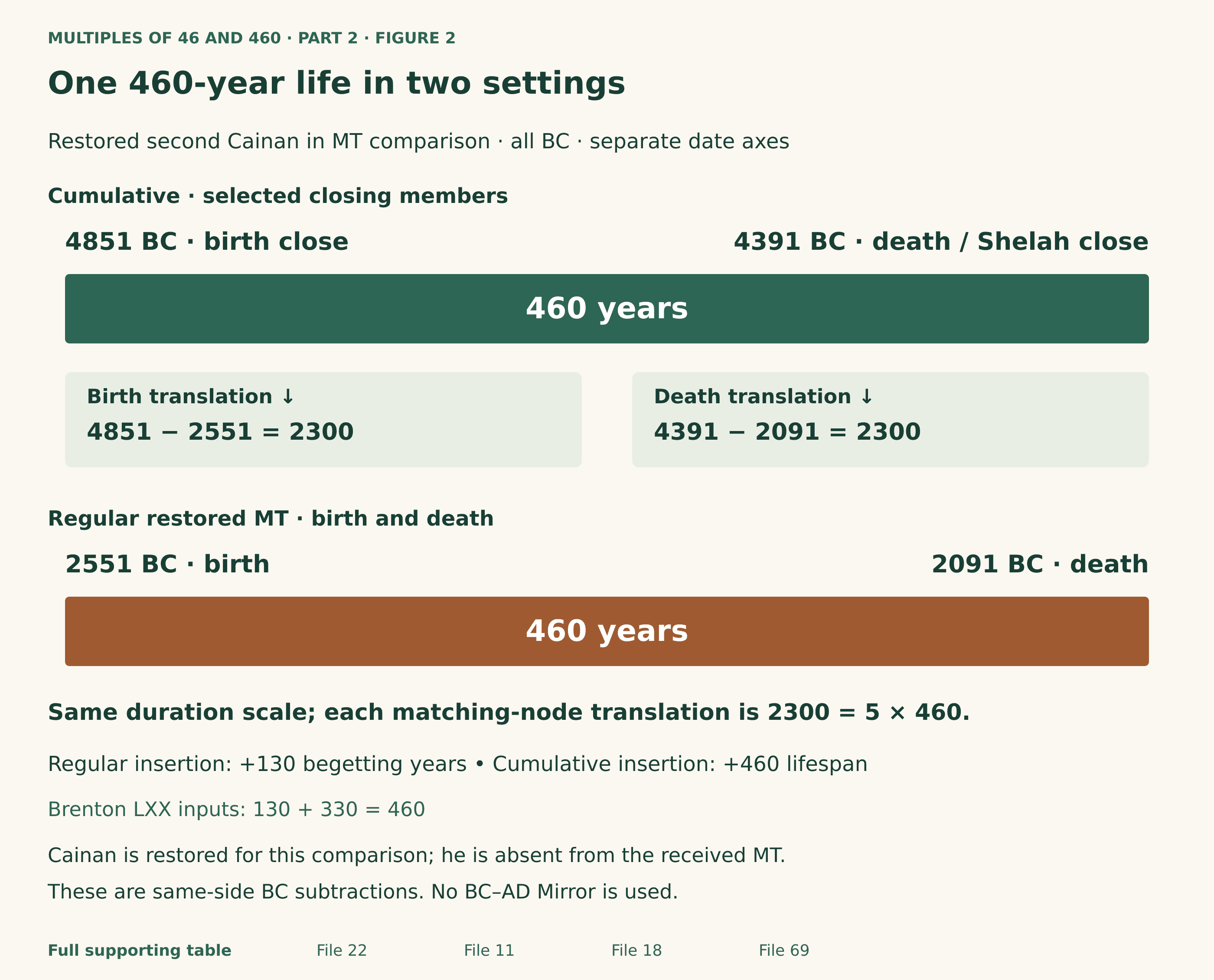
Cumulative restored Cainan: 4851 → 4391 BC = 460 years.
Regular restored Cainan: 2551 → 2091 BC = 460 years.
The corresponding beginnings and endings are separated by the same amount:
4851 − 2551 = 2300 = 5 × 460.
4391 − 2091 = 2300 = 5 × 460.
Multiples of 46 and 460 · Part 2 · Figure 2
One 460-year life in two settings
Restored second Cainan in an MT comparison · all dates BC
Cumulative · selected closing members
Regular restored MT · birth and death
Same duration scale; separate date axes. Each matching-node translation is 2300 = 5 × 460.
Cainan is restored for this comparison; he is absent from the received MT. Same-side subtraction; no BC–AD Mirror.
Full supporting table · File 22 · File 11 · File 18 · File 69 · Genesis 11:13 (Brenton LXX)
View or download Figure 2 as an image

Full-size PNG · SVG sources (ZIP: all three figures and data) · WebP copies (same ZIP)
| Selected comparison | Earlier member | Later member | Years | Setting |
|---|---|---|---|---|
| Cumulative restored Cainan | 4851 BC | 4391 BC | 460 | Selected closing members |
| Regular restored Cainan | 2551 BC | 2091 BC | 460 | Normal 430-year Egypt branch; +60 OFF |
| Matching birth members | 4851 BC | 2551 BC | 2300 | 5 × 460 |
| Matching death members | 4391 BC | 2091 BC | 2300 | 5 × 460 |
The regular row uses the normal 430-year Egypt branch, with no +60 Terah adjustment. The cumulative row uses the selected closes of the restored-Cainan birth field 4858–4851 BC and death/Shelah field 4398–4391 BC. Cumulative chronology stacks complete lives end to end; its coordinates are not ordinary overlapping biographies. The two 2300-year comparisons connect matching members of the stated fields. They do not authorize substitution of another opening, midpoint or date-label convention.
The rectangle stays entirely within BC dates and uses subtraction. No BC–AD Mirror operation is required. Its structure is two equal 460-year measures, with the same 2300-year separation at both ends.
The 460 → 500 Priestly conversion is another use of the interval (File 09 §3A.2.3). It does not change Cainan’s selected textual lifespan from 460 to 500.
3. The larger bridge: 215 measures of 46
A related comparison joins the regular and cumulative MT Creation closes:
14004 − 4114 = 9890 = 215 × 46 = 23 × 430.
These are corresponding Creation-close members in the two methods. The cumulative coordinate is a lifespan construction, not a competing historical date for Creation. File 22 §5.1 controls the 9890 bridge; File 68 §10.11 explicitly expresses it as 46 × 215.
This relationship links the 46-unit to the 430-year sojourn measure. Its full explanation belongs in Between Two Chronologies: The 9,890-Year Bridge; the brief comparison here shows why 46 remains useful beyond the temple reference.
4. A Rounded 460 framework—and what its test reports
The next example changes settings. The Rounded scaffold uses a baseline Creation/Adam coordinate of 4106 BC, rather than the normal regular endpoint 4114 BC. Its explicit +60 Terah variant gives 4166 BC. These settings remain distinct.
In that variant, File 51a §4.4 supplies:
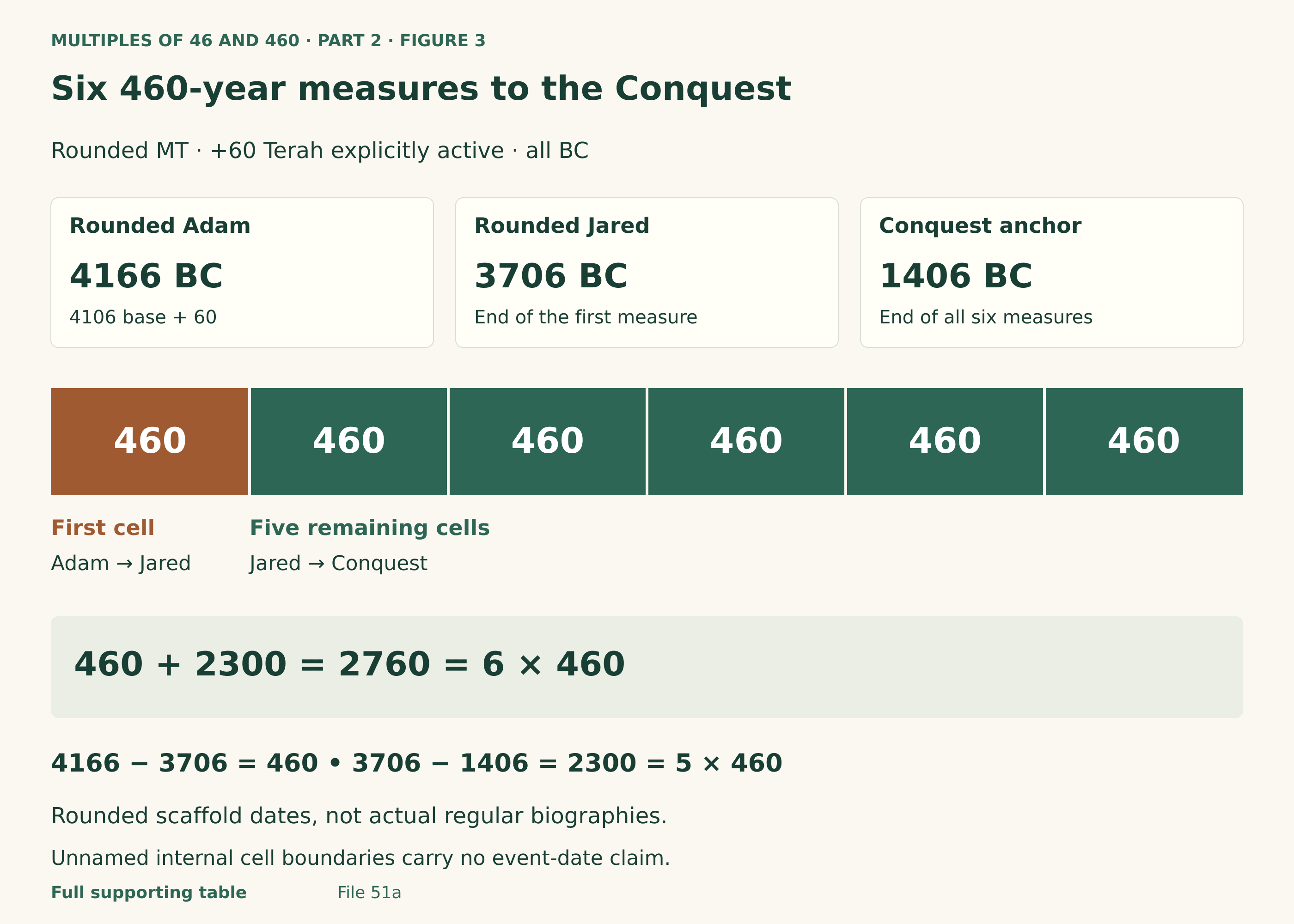
4166 → 3706 → 1406 BC = 460 + 2300 = 2760.
The selected Rounded Jared coordinate is 3706 BC, and 1406 BC is the Conquest boundary. The whole frame contains 6 × 460 years; the first measure reaches Jared, and the remaining 5 × 460 reach the Conquest. These are Rounded comparison coordinates, not replacements for the actual patriarchal biographies.
Multiples of 46 and 460 · Part 2 · Figure 3
Six 460-year measures to the Conquest
Rounded MT · +60 Terah explicitly active · all BC
460 + 2300 = 2760 = 6 × 460
Rounded scaffold dates; not actual regular biographies.
Only the named endpoints are assigned to events. Unnamed cell boundaries are duration divisions.
Full supporting table · File 51a · Genesis 5:18 (BSB)
View or download Figure 3 as an image

Full-size PNG · SVG sources (ZIP: all three figures and data) · WebP copies (same ZIP)
| Rounded +60 comparison | Calculation | Years | 460-year measures |
|---|---|---|---|
| Rounded Adam → Jared | 4166 − 3706 | 460 | 1 |
| Rounded Jared → Conquest | 3706 − 1406 | 2300 | 5 |
| Entire Rounded +60 frame | 4166 − 1406 | 2760 | 6 |
An exact six-unit frame is worth examining, but testing the frequency of 460 asks a separate question. File 51a §4A reports an exploratory scan of 81 cycles. Its birth/event test uses 28 endpoints, giving 378 pairwise spans. The two comparison models preserve the scaffold’s five-year structure: one shuffles the existing intervals, and the other generates random five-year-unit compositions with the same total.
The following are source-reported results, rather than a new simulation for this article:
| Source-reported setting | Endpoints / spans | 460-multiple hits | Raw permutation p |
|---|---|---|---|
| Rounded baseline; Terah 70 | 28 / 378 | 5 | 0.198 |
| Rounded +60 variant; Terah 130 | 28 / 378 | 9 | 0.022 |
| Baseline births plus deaths | 48 / 1128 | 12 | 0.398 |
The 460 result strengthens in the +60 Terah variant, where the total is itself 2760 = 6 × 460. It weakens when the endpoint set is trimmed, and the expanded birth-and-death test also gives a modest 460 result. These changes show why a result must remain attached to its particular chronological setting and endpoint universe.
The displayed p-values are raw results under the stated permutation model; they are not probabilities that the chronology was deliberately designed. With 81 cycles scanned, the Canon does not treat any single result as individually decisive after accounting for multiple comparisons. Its conclusion is an exploratory diagnostic, identifying structures for closer study. This Rounded test is separate from a pooled scan of ordinary MT/LXX, cumulative and reflected dates.
5. Reading the relationships
The strongest retained comparisons have identifiable inputs: the MT’s Creation-to-Flood ages, Cainan’s selected Greek lifespan, corresponding regular and cumulative members, and an explicitly adjusted Rounded frame. Their arithmetic can be checked directly. Their theological interpretation concerns the recurrence of temple, life, judgment and inheritance measures within the larger chronology.
File 00 §0.6 and §8.5 distinguishes arithmetic, structural inference, theological interpretation and statistical results. Following that distinction lets these relationships contribute to the study without making either an unexplained coincidence claim or an unsupported numerical proof of intention. The value of 46 and 460 is clearest when the people, textual tradition and calculation remain visible beside the numbers.
Sources, tables and figure index
The controlling passages are File 02 §§2.1–2.3, File 17 §14, File 22 §§5.1 and 6.1, File 09 §3A.2.3, File 68 §10.11, File 51a §§4.4 and 4A, and File 00 §0.6 and §8.5. Their current editions are supplied through the canonical source index.
Open the person and event figure index
| Person / event / comparison | Figures and full tables | Scripture / context |
|---|---|---|
| Adam | Figure 1 · table; Figure 3 · table | Passage · Textual person / event; diagram setting applies |
| Creation | Figure 1 · table | Model comparison |
| Noah | Figure 1 · table | Passage · Textual person / event; diagram setting applies |
| Flood | Figure 1 · table | Passage · Textual person / event; diagram setting applies |
| Priestly span conversion | Figure 1 · table | Model comparison |
| Second Cainan | Figure 2 · table | Passage · Textual person / event; diagram setting applies |
| Second Cainan’s birth | Figure 2 · table | Passage · Textual person / event; diagram setting applies |
| Second Cainan’s death | Figure 2 · table | Passage · Textual person / event; diagram setting applies |
| Shelah | Figure 2 · table | Passage · Textual person / event; diagram setting applies |
| Regular restored-Cainan comparison | Figure 2 · table | Model comparison |
| Cumulative restored-Cainan comparison | Figure 2 · table | Model comparison |
| Rounded Adam | Figure 3 · table | Model comparison |
| Jared | Figure 3 · table | Passage · Textual person / event; diagram setting applies |
| Rounded Jared | Figure 3 · table | Model comparison |
| Conquest | Figure 3 · table | Model comparison |
| Terah +60 variant | Figure 3 · table | Model comparison |
Download the calculation tables · Download calculation data and SVG/WebP sources (ZIP) · Download the reported statistical results.
Download the person and event figure index (CSV).
Scripture quotations: Berean Standard Bible (BSB), public domain.