One was named Peleg, because in his days the earth was divided
Peleg belongs to a generation of division and transition. The biblical notice associates his name with the dividing of the earth, while the genealogy places him within a marked shortening of patriarchal lifespans. The family line continues through Reu toward Abraham, whose descendants are to become a blessing to the nations.
This focused companion follows two related numerical themes: the shorter lives of Peleg and Reu, and the Jubilee measures that organize the cumulative Flood-to-Abraham-to-Conquest framework. The introductory Peleg and Babel article supplies the wider narrative. The Part 1 detailed study supplies the textual-tradition comparisons and the seasonal Mirror derivation.
Read directly: The two lives · The lifespan scaffold · The Jubilee partition · The Key of 23 · Sources and figure index.
1. Peleg and Reu: equal lifespans, overlapping lives
In the normal Masoretic Text (MT) chronology, Peleg lives from 2357 to 2118 BC. These are model dates derived from the genealogy; Genesis itself supplies the ages rather than BC labels. The setting retains 430 years in Egypt, with no additional sixty-year Terah adjustment and no restored second Cainan.
I use Peleg’s birth as the chronological marker for Babel. The biblical wording places the division “in his days”; identifying the birth as the marker is a chronological inference, rather than an age or exact date stated in Genesis 10:25.
Peleg is 30 when Reu is born and lives another 209 years. Reu is 32 when Serug is born and lives another 207 years. Their totals are identical:
Peleg: 30 + 209 = 239 years.
Reu: 32 + 207 = 239 years.
The individual inputs are linked in Genesis 11:18–19 and Genesis 11:20–21. Reu’s normal dates are 2327–2088 BC, thirty years after Peleg at both ends. The two 239-year lives therefore overlap for 209 years.
Peleg · Part 2 · Figure 1
Peleg and Reu: two actual 239-year lives
Normal MT · actual regular chronology · shared time scale
Full supporting table · File 47 · File 18 · File 51a · Genesis 11:16–21 (BSB)
View or download Figure 1 as an image

Full-size PNG · SVG sources (ZIP: all three figures and data) · WebP copies (same ZIP)
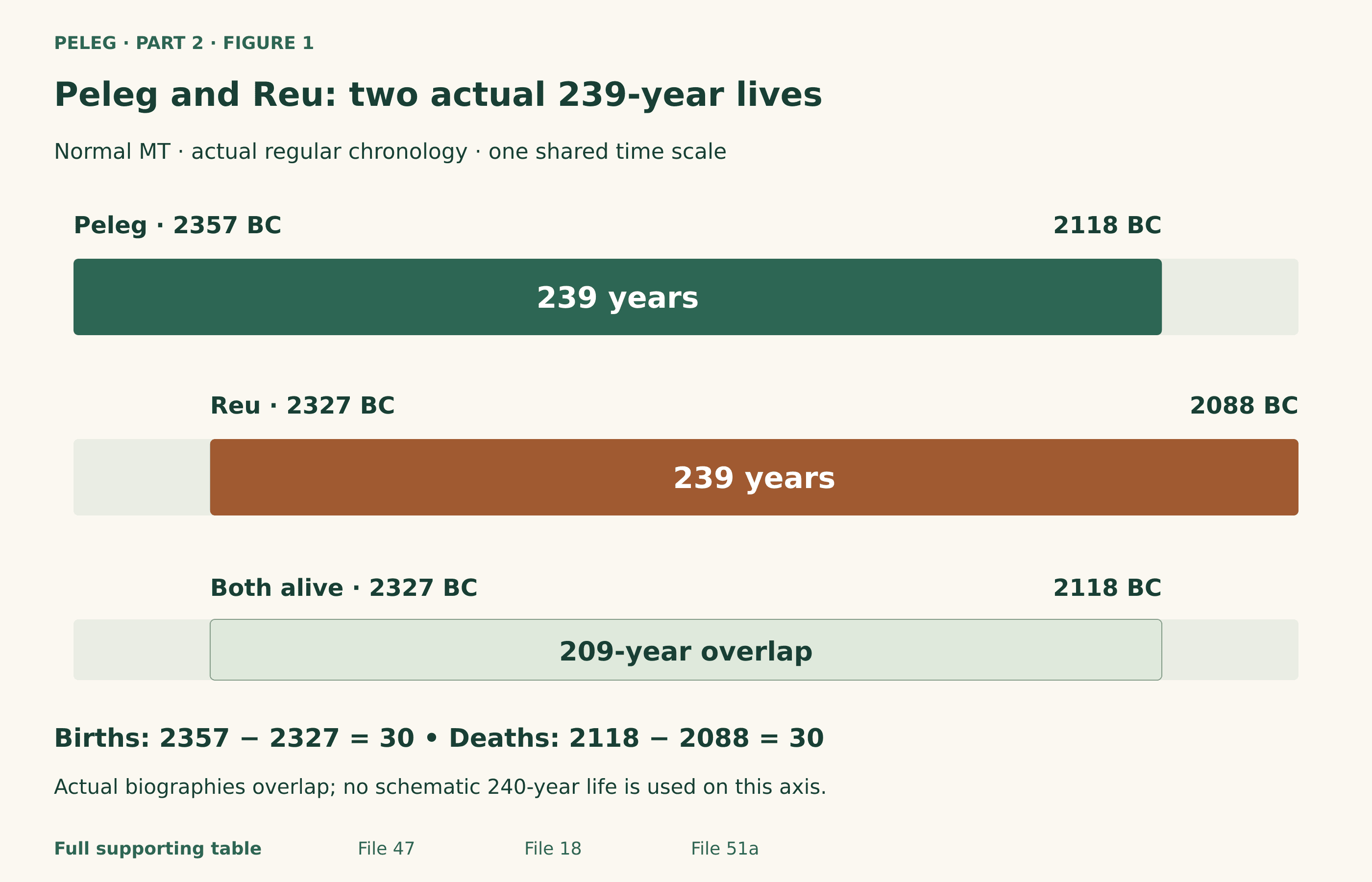
This father-and-son repetition has a clear place in the canonical analysis. File 47 §§2.2 and 5.1–5.2 groups Peleg and Reu as the third of six birth-pairs; File 23 §5.11 identifies their equal actual lifespans as witnesses to the shorter stage after the early post-Flood generations. The pairing concerns people and ages. It does not make the two lives successive, non-overlapping intervals.
2. The qualified lifespan-halving scaffold
The change is especially visible beside Eber, Peleg’s father. Eber’s 34 + 430 = 464 years (Genesis 11:16–17) are followed by Peleg’s and Reu’s 239 years each. The lifespan has fallen to approximately half its earlier level.
File 23 §§5.3 and 5.11 develops the ideal sequence:
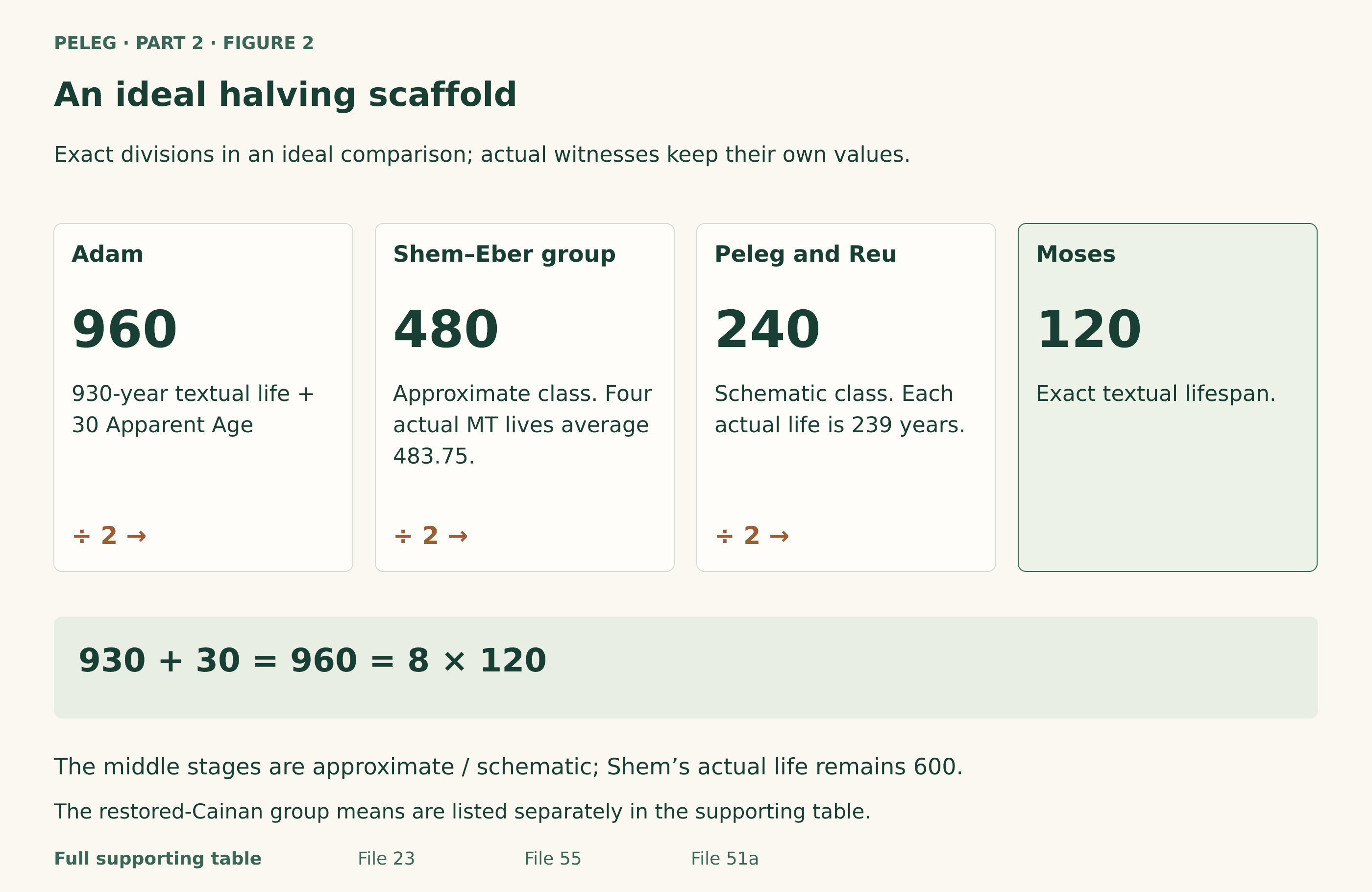
960 → 480 → 240 → 120.
The mathematics of that sequence is exact: each value is half the preceding value. Its relationship to the biblical biographies is a schematic comparison, with different qualifications at each stage.
Adam’s textual lifespan remains 930 years (Genesis 5:5). The model’s optional 30-year apparent-age allowance gives the comparison value 30 + 930 = 960. That allowance is an interpretive display of maturity; it is not another thirty lived years stated in Genesis. The exact half of the textual 930 is 465, so the 960 starting value must be identified before deriving 480.
The early post-Flood group supplies an approximate 480-year stage. Shem, Arphaxad, Shelah and Eber live 600, 438, 433 and 464 years, totaling 1935. Their average is 1935 ÷ 4 = 483.75. Peleg and Reu then supply two actual lives of 239, represented by the ideal 240 stage. Moses’ 120-year lifespan supplies the terminal value (Deuteronomy 34:7).
Peleg · Part 2 · Figure 2
An ideal halving scaffold
960 → 480 → 240 → 120 · an ideal comparison with actual witnesses
930 + 30 = 960 = 8 × 120
The ideal stages do not replace actual lifespans or regular dates.
Full supporting table · File 23 · File 55 · File 51a
View or download Figure 2 as an image

Full-size PNG · SVG sources (ZIP: all three figures and data) · WebP copies (same ZIP)
One optional comparison makes the 480 class more explicit. Restoring second Cainan adds his 460-year lifespan to the early post-Flood group; the inputs are 130 + 330 = 460 in Genesis 11:13, Brenton’s LXX. The actual five-life mean becomes 479; using the specified rounded lifespans for this comparison makes it 480 exactly. This is an MT-based comparison with restored Cainan, rather than the complete received LXX genealogy.
| Comparison setting | Lifespans added | Sum | Average |
|---|---|---|---|
| Actual MT, four lives | 600 + 438 + 433 + 464 | 1935 | 483.75 |
| Rounded lifespan comparison, four lives | 600 + 440 + 435 + 465 | 1940 | 485 |
| Actual MT + restored second Cainan | 600 + 438 + 460 + 433 + 464 | 2395 | 479 |
| Rounded lifespan comparison + restored second Cainan | 600 + 440 + 460 + 435 + 465 | 2400 | 480 |
The table preserves both the normal MT baseline and the optional restored-Cainan comparison. Without Cainan, rounding these four lifespans gives an average of 485, not 480. The exact five-life mean of 480 depends on the explicitly stated insertion and lifespan-rounding choices.
The 240 assigned to Peleg and Reu here belongs to the ideal lifespan scaffold. It must not be used to recalculate their actual death dates or silently substitute for every formal Rounded biography. The Canon distinguishes rounding a whole lifespan for a cumulative comparison from reconstructing a regular life through rounded fatherhood and remainder values. The actual 239-year lives in Figure 1 remain unchanged.
The scaffold gives Peleg a useful structural role: he marks the transition toward shorter lives. It does not require every patriarch to have the same lifespan as the ideal stage. File 55, Appendix B repeats the scaffold with this same distinction between schematic positions and actual biographies.
3. A cumulative partition: 49 + 21 measures of 49
The next comparison changes the method. Cumulative chronology adds complete lifespans end to end on the selected ancestral line and anchors the result at Moses’ death and the Conquest in 1406 BC. It is a numerical construction; the resulting coordinates do not date ordinary overlapping lives. The cumulative-chronology introduction explains the method more fully.
The controlling calculation in File 63 §§9.4–9.5 uses these selected coordinates:
4836 → 2435 → 1406 BC.
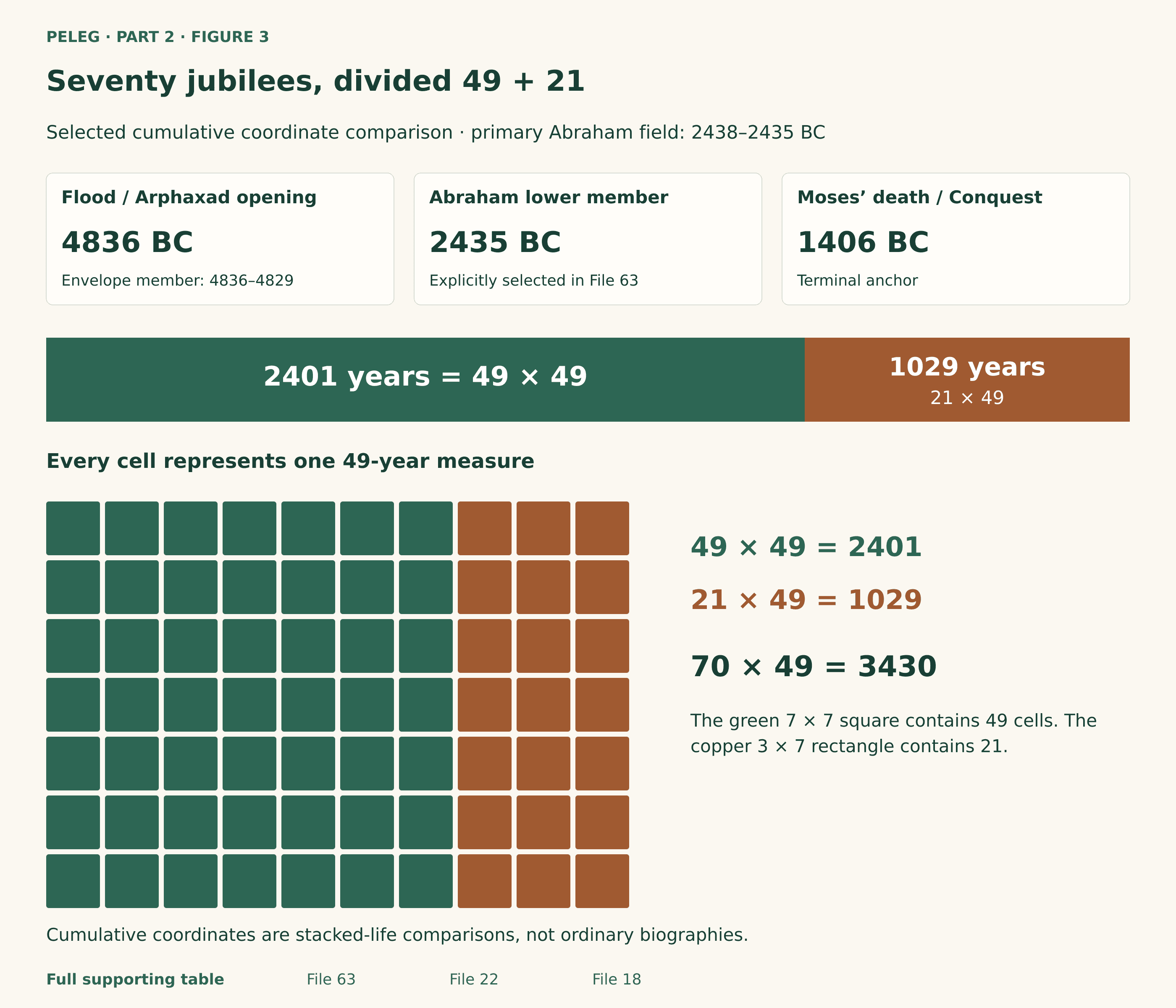
Each member has a defined role. 4836 BC is the opening member of the cumulative Flood/Arphaxad envelope. 2435 BC is the lower member of the primary cumulative Abraham field, 2438–2435 BC, governed by the ordinary three-year Aaron/Moses branch. 1406 BC is the Moses-death/Conquest boundary.
These are source-selected members of their respective fields. In particular, the full seven-year envelope used at the Flood is not automatically assigned to Abraham. The diagram uses the Canon’s authorized comparison, rather than claiming that all three labels were taken unchanged from one table column.
The first interval is a Jubilee square:
4836 − 2435 = 2401 = 49 × 49.
The second interval is:
2435 − 1406 = 1029 = 21 × 49.
Together they form:
2401 + 1029 = 3430 = 70 × 49 = 7 × 490.
Peleg · Part 2 · Figure 3
Seventy jubilees, divided 49 + 21
Selected cumulative coordinates · source-defined comparison
Every cell below represents one 49-year measure.
2401 + 1029 = 3430 = 70 × 49
These cumulative coordinates belong to a stacked-life comparison, not ordinary overlapping biographies.
Full supporting table · File 63 · File 22 · File 18
View or download Figure 3 as an image

Full-size PNG · SVG sources (ZIP: all three figures and data) · WebP copies (same ZIP)
| Selected cumulative comparison | Calculation | 49-year measures |
|---|---|---|
| Flood/Arphaxad opening → Abraham lower member | 4836 − 2435 = 2401 | 49 × 49 |
| Abraham lower member → Moses’ death / Conquest | 2435 − 1406 = 1029 | 21 × 49 |
| Selected Flood/Arphaxad opening → Moses’ death / Conquest | 4836 − 1406 = 3430 | 70 × 49 |
The 1029 is also independently reproducible from the seven cumulative lifespans Abraham → Isaac → Jacob → Levi → Kohath → Amram → Moses:
175 + 180 + 147 + 137 + 133 + 137 + 120 = 1029.
These are the selected cumulative MT inputs in File 18 §6A. Joseph is not inserted after Jacob: the chosen ancestry continues through Levi. This is a sum of lives, not a claim that 1029 historical years elapsed between Abraham’s actual birth and the Conquest.
The 49-year measure comes from seven sevens of years in Leviticus 25:8. The following verses explicitly proclaim the fiftieth year (Leviticus 25:10). Thus the calculation counts repetitions of the 49-year measure while retaining the biblical fiftieth-year language. The factorization alone does not establish that a dated historical Jubilee was observed at every boundary.
This partition has repeated canonical use. File 51a §16.3 places the same three spans within the actual cumulative 49/490 framework; File 22 §1.3 uses the Flood-to-Abraham 2401 in its Abrahamic comparison. That recurring role makes it more useful here than a long series of newly computed midpoints.
4. The compact Key-of-23 completion
The same Jubilee square has a further controlled relationship. Adding Abraham’s 175-year lifespan produces:
2401 + 175 = 2576 = 16 × 161.
The Priestly Key-of-23 operation then gives:
2576 × 25/23 = 2800 = 16 × 175.
The operation is transparent because 161 = 7 × 23, so each 161-year unit becomes 175 = 7 × 25. Sixteen such units pass from 2576 to 2800. File 22 §1.3 supplies the 2576 seed; File 63 §9.6 explicitly carries its expansion to 2800.
Here the 2401 interval and Abraham’s lifespan are identified separately before they are combined. The expanded 2800 is a transformed numerical total. The operation does not, by itself, assign a new historical birth, death or Babel date. The Key-of-23 introduction explains the wider method.
5. Reading the relationships together
The two principal comparisons answer different questions. Peleg and Reu’s 239-year lives belong to ordinary genealogy. The ideal halving scaffold describes a qualified transition in lifespan scale. The 2401 + 1029 partition organizes selected cumulative coordinates through the 49-year measure. Keeping these distinctions visible allows the same people to be compared across the constructions without changing their actual lifespans.
The theological connection is division followed by continuity: the earth is divided in Peleg’s days, the ancestral line continues toward Abraham, and the cumulative comparison closes at the inheritance of the land. The arithmetic establishes the displayed relationships. Reading them as a coordinated theological pattern is the interpretation developed from those relationships.
Part 1 supplies the related regular Peleg → Levi → Exodus comparison and the full 4900-year seasonal Mirror. The earlier lifespan study supplies the additional Rounded pivots. Those complete treatments allow this companion to remain focused on the equal lives, the qualified halving scaffold and the Jubilee partition.
Sources, tables and figure index
The controlling source passages are File 18 §§2.2 and 6A, File 23 §§5.3 and 5.11, File 47 §§2.2 and 5.1–5.2, File 51a §§3.4, 16.1 and 16.3, File 55, Appendix B, File 22 §1.3, and File 63 §§9.4–9.6. The canonical source index supplies their current editions.
Open the person and event figure index
| Person / event / comparison | Figures and full tables | Scripture / context |
|---|---|---|
| Peleg | Figure 1 · table; Figure 2 · table | Passage · Person, event or measurement reference |
| Peleg’s birth | Figure 1 · table | Passage · Person, event or measurement reference |
| Peleg’s death | Figure 1 · table | Passage · Person, event or measurement reference |
| Reu | Figure 1 · table; Figure 2 · table | Passage · Person, event or measurement reference |
| Reu’s birth | Figure 1 · table | Passage · Person, event or measurement reference |
| Reu’s death | Figure 1 · table | Passage · Person, event or measurement reference |
| Adam | Figure 2 · table | Passage · Person, event or measurement reference |
| Apparent-age comparison | Figure 2 · table | Model position or numerical comparison |
| Shem | Figure 2 · table | Passage · Person, event or measurement reference |
| Arphaxad | Figure 2 · table; Figure 3 · table | Passage · Person, event or measurement reference |
| Shelah | Figure 2 · table | Passage · Person, event or measurement reference |
| Eber | Figure 2 · table | Passage · Person, event or measurement reference |
| Second Cainan | Figure 2 · table | Passage · Person, event or measurement reference |
| Moses | Figure 2 · table | Passage · Person, event or measurement reference |
| Ideal halving scaffold | Figure 2 · table | Model position or numerical comparison |
| Flood | Figure 3 · table | Person, event or measurement reference |
| Cumulative Flood/Arphaxad opening | Figure 3 · table | Model position or numerical comparison |
| Abraham | Figure 3 · table | Passage · Person, event or measurement reference |
| Cumulative Abraham lower member | Figure 3 · table | Model position or numerical comparison |
| Moses’ death | Figure 3 · table | Passage · Person, event or measurement reference |
| Conquest | Figure 3 · table | Person, event or measurement reference |
| Jubilee measure | Figure 3 · table | Passage · Person, event or measurement reference |
Download the calculation tables · Download calculation data and SVG/WebP sources (ZIP).
Download the person and event figure index (CSV).
Scripture quotations: Berean Standard Bible (BSB), public domain.