Israel’s stay in Egypt begins with Jacob and ends, generations later, with Moses. Comparing the chronologies becomes clearer when we keep two things in view: what the 430 years include, and which parts of the patriarchal family’s life remain unchanged.
“Now the duration of the Israelites’ stay in Egypt was 430 years.”
The normal Masoretic Text (MT) chronology remains the starting point: Jacob enters Egypt in 1876 BC, and the Exodus follows in 1446 BC—430 years later. This is Israel’s Egyptian sojourn, including its early years of protection as well as its later oppression. It is not a claim that every year was spent in bondage.
The introductory article explains the three readings and quotes Exodus 12:40–41 side by side. This companion follows the family chronology behind them, especially Jacob’s 147 years and the relationship between Jacob, Levi, and the Conquest. Dates below belong to the regular chronology and use Nisan year-reckoning.
One total, different starting events
The Samaritan Pentateuch (SP) includes the fathers and names Canaan as well as Egypt. The Septuagint (LXX) likewise includes Canaan; the Rahlfs–Hanhart Greek edition names Egypt before Canaan, without the SP’s explicit reference to the fathers. All three texts already refer to the children of Israel. The textual difference that matters here is the extent of their sojourning.
The familiar 215 + 215 interpretation counts from Abram’s call out of Haran to Canaan. His wait for Isaac, Isaac’s age at Jacob’s birth, and Jacob’s age at descent supply 25 + 60 + 130 = 215 years. Including those years within the 430 leaves 215 for Egypt.
The localized 33 + 397 interpretation follows a different starting event: Jacob’s return from Haran with his household. He returns at 97 and enters Egypt at 130, giving 130 − 97 = 33 years. Including these within the 430 leaves 397 for Egypt. These divisions are chronological interpretations of the text; neither split is stated numerically in Exodus 12:40–41.
Table 1. The same family events in each reading
On small screens, swipe the table sideways.
| Reading | Abram’s call → Jacob’s entry, BC | Entry → Exodus, BC | Call → Exodus: total years |
|---|---|---|---|
| Normal MT: 430 in Egypt | 2091 → 1876 = 215 | 1876 → 1446 = 430 | 645 |
| 215-year Egypt alternative, associated with the broader SP/LXX reading | 1876 → 1661 = 215 | 1661 → 1446 = 215 | 430 |
| Localized LXX interpretation: 397 in Egypt | 2058 → 1843 = 215 | 1843 → 1446 = 397 | 612 |
The family interval from Abram’s call to Jacob’s entry stays 215 years in every row. The localized reading’s 430-year count begins later than Abram’s call: Jacob’s return in 1876 → entry in 1843 → Exodus in 1446 = 33 + 397. The 645 and 612 totals above are derived comparisons of the same named endpoints, rather than additional totals stated in Exodus.
“Canaan” in the 215-year division names the patriarchal phase; it includes journeys outside Canaan, including Jacob’s twenty years in Haran. The full textual comparison and edition notes are directly available in the introduction and appendix. Chronological controls: File 04, §§1–2; File 18, §§2.3–2.4, 3.3, 4.3.
The same 1876 BC label therefore identifies three different events. The common starting date follows from holding the Exodus at 1446 BC and counting back 430 years. Its repetition is a useful way to compare the readings, rather than three independent confirmations of a date.
The localized interpretation has earlier scholarly precedent. File 04 §2.1A credits J. Barton Payne’s 1975 chronology with the same 33 + 397 division and 1843 BC descent date. In the Unified Chronology, the −33 comparison is applied within a bounded family corridor, beginning at Terah and continuing through Abraham to Jacob and Levi. It does not require moving Noah, the Flood, or Creation back or forward by 33 years. These are localized comparisons, rather than BC dates printed in the Greek text.
Jacob’s life stays 147 years
“And Jacob lived in the land of Egypt seventeen years, and the length of his life was 147 years.”
Jacob’s lifespan does not change when we compare the readings. Neither do his twenty years with Laban or his seventeen years in Egypt. What changes is the placement of these events relative to the Exodus.
Table 2. The same life in three chronological positions
On small screens, swipe the table sideways.
| Jacob’s event | Age | Normal MT, BC | 215 Egypt alternative, BC | Localized −33, BC |
|---|---|---|---|---|
| Birth | 0 | 2006 | 1791 | 1973 |
| Flight to Haran | 77 | 1929 | 1714 | 1896 |
| Return from Haran | 97 | 1909 | 1694 | 1876 |
| Entry into Egypt | 130 | 1876 | 1661 | 1843 |
| Death | 147 | 1859 | 1644 | 1826 |
Source: File 04 §§1.1–1.2. Jacob’s flight age is reconstructed through Joseph’s ages and the service chronology; it is not an age explicitly attached to the flight in Genesis. The existing appendix shows that derivation.
Within every column, the successive periods are 77 + 20 + 33 + 17 = 147. His final 70 years begin with his flight to Haran: twenty years there, thirty-three after his return, and seventeen in Egypt. They do not begin at his return. Return to death is 33 + 17 = 50 years.
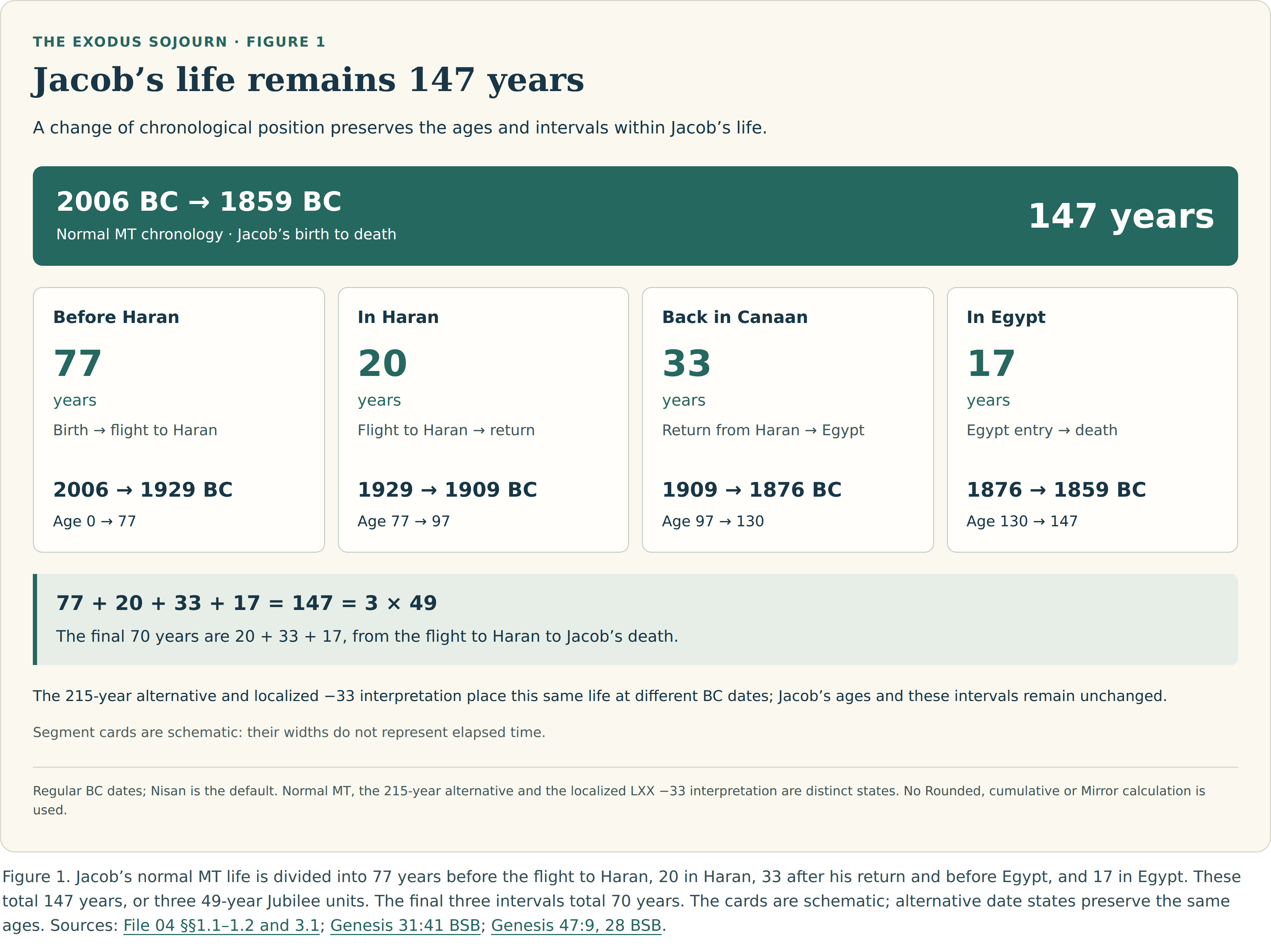
The Exodus Sojourn · Figure 1
Jacob’s life remains 147 years
A change of chronological position preserves the ages and intervals within Jacob’s life.
Before Haran
Birth → flight to Haran
2006 → 1929 BC
Age 0 → 77
In Haran
Flight to Haran → return
1929 → 1909 BC
Age 77 → 97
Back in Canaan
Return from Haran → Egypt
1909 → 1876 BC
Age 97 → 130
In Egypt
Egypt entry → death
1876 → 1859 BC
Age 130 → 147
77 + 20 + 33 + 17 = 147 = 3 × 49The final 70 years are 20 + 33 + 17, from the flight to Haran to Jacob’s death.
The 215-year alternative and localized −33 interpretation place this same life at different BC dates; Jacob’s ages and these intervals remain unchanged.
Segment cards are schematic: their widths do not represent elapsed time.
Regular BC dates; Nisan is the default. Normal MT, the 215-year alternative and the localized LXX −33 interpretation are distinct states. No Rounded, cumulative or Mirror calculation is used.

The lifespan has a simple Jubilee relationship: 147 = 3 × 49. A 49-year measure is seven weeks of years, the count that leads to the Jubilee in Leviticus 25:8–10. Here it serves as a numerical measure of Jacob’s life; it does not date three separately recorded Jubilee celebrations. File 04 makes this relationship central to its treatment of Jacob.
Jacob and Levi: 77 + 70 + 77
Levi connects Jacob’s household with the family line of Moses and Aaron. His biblical lifespan is 137 years (Exodus 6:16); the regular table places his birth in 1919 BC and death in 1782 BC. These coordinates come from File 18’s patriarchal chronology, whose minimum row is raised by 215 years for the normal MT position. They are not independent BC dates stated in Exodus.
The interval from Jacob’s birth to Levi’s death forms a balanced sequence:
77 years to Jacob’s flight + 70 to Jacob’s death + 77 to Levi’s death = 224 years.
Table 3. The Jacob–Levi arc
On small screens, swipe the table sideways.
| Reading | Jacob’s birth → flight to Haran | Flight → Jacob’s death | Jacob’s death → Levi’s death | Whole arc |
|---|---|---|---|---|
| Normal MT | 2006 → 1929 = 77 | 1929 → 1859 = 70 | 1859 → 1782 = 77 | 2006 → 1782 = 224 |
| Localized −33 | 1973 → 1896 = 77 | 1896 → 1826 = 70 | 1826 → 1749 = 77 | 1973 → 1749 = 224 |
All dates BC. Source: File 04 §3.4; File 18 §2.3 supplies Levi’s minimum 1704–1567 BC, hence normal 1919–1782 BC after adding 215.
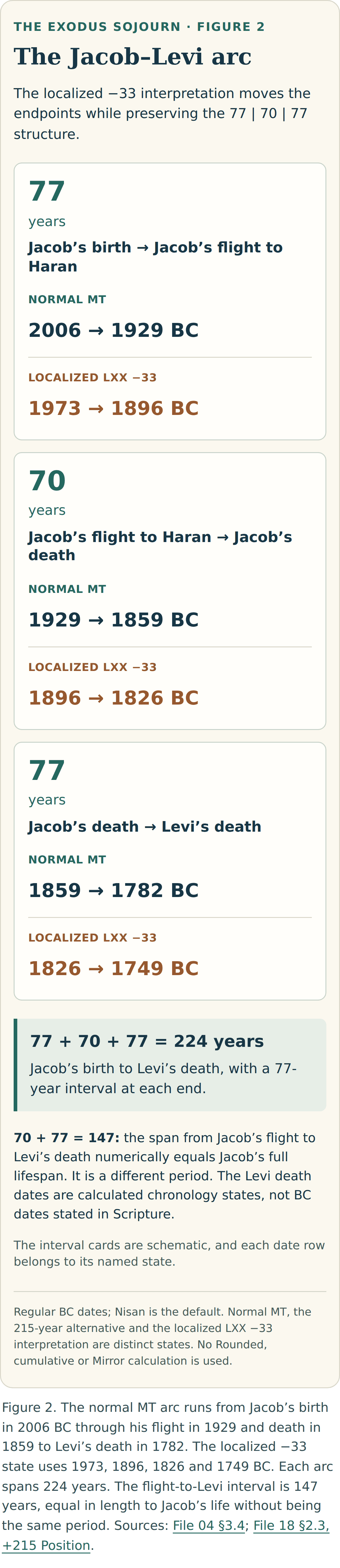
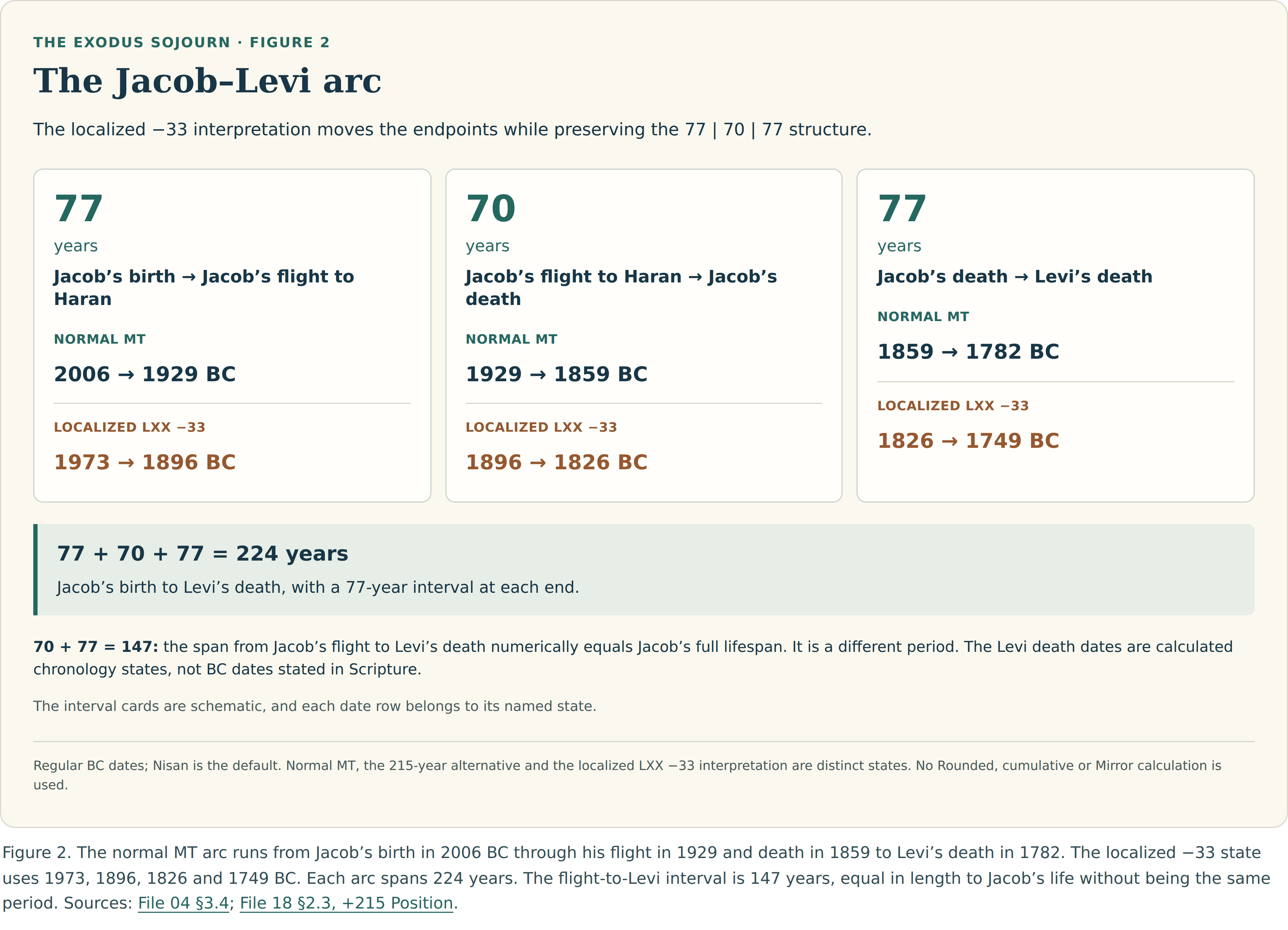
The Exodus Sojourn · Figure 2
The Jacob–Levi arc
The localized −33 interpretation moves the endpoints while preserving the 77 | 70 | 77 structure.
Jacob’s birth → Jacob’s flight to Haran
Normal MT
2006 → 1929 BC
Localized LXX −33
1973 → 1896 BC
Jacob’s flight to Haran → Jacob’s death
Normal MT
1929 → 1859 BC
Localized LXX −33
1896 → 1826 BC
Jacob’s death → Levi’s death
Normal MT
1859 → 1782 BC
Localized LXX −33
1826 → 1749 BC
77 + 70 + 77 = 224 yearsJacob’s birth to Levi’s death, with a 77-year interval at each end.
70 + 77 = 147: the span from Jacob’s flight to Levi’s death numerically equals Jacob’s full lifespan. It is a different period. The Levi death dates are calculated chronology states, not BC dates stated in Scripture.
The interval cards are schematic, and each date row belongs to its named state.
Regular BC dates; Nisan is the default. Normal MT, the 215-year alternative and the localized LXX −33 interpretation are distinct states. No Rounded, cumulative or Mirror calculation is used.
The surrounding 77-year intervals emphasize the seventy years that close Jacob’s life. Another relationship appears within the same sequence: 70 + 77 = 147 years run from Jacob’s flight to Levi’s death. That span equals Jacob’s full lifespan numerically, although it begins and ends at different events. Jacob’s own 147 years run from birth to his death.
This distinction lets the pattern remain clear: the chronology joins two lives without replacing either person’s biography.
The localized reading reaches ten Jubilee measures
Applying the localized −33 interpretation places Levi’s death at 1749 BC. The Conquest remains 1406 BC, so the remaining span is 1749 − 1406 = 343 = 7 × 49 = 7³ years.
Together with the preceding 147 years from Jacob’s flight, this gives:
147 + 343 = 490 = 10 × 49 = 70 × 7.
Table 4. From Jacob’s flight to the Conquest
On small screens, swipe the table sideways.
| Localized −33 interval | Dates, BC | Years |
|---|---|---|
| Flight to Jacob’s death | 1896 → 1826 | 70 |
| Jacob’s death to Levi’s death | 1826 → 1749 | 77 |
| Levi’s death to the Conquest | 1749 → 1406 | 343 = 7 × 49 |
| Whole span: flight to Conquest | 1896 → 1406 | 490 = 10 × 49 |
Sources: File 04 §§3.3–3.4; the existing appendix’s 490-year coda.
The Exodus Sojourn · Figure 3
From Jacob’s flight to the Conquest
Localized LXX −33 comparison only · 1896 BC → 1406 BC
Jacob’s flight to Haran → Jacob’s death
1896 → 1826 BC
Jacob’s death → Levi’s death
1826 → 1749 BC
Levi’s death → Conquest
1749 → 1406 BC
70 + 77 + 343 = 490 = 70 × 7 = 10 × 49The first 147 years equal 3 × 49; the remaining 343 equal 7 × 49.
This comparison belongs to the localized LXX −33 interpretation. Jacob’s flight is 1896 BC in this state; 1929 BC belongs to the normal MT chronology.
Only the colored bar is proportional to elapsed years. The event cards are schematic.
The stacked phone panels are schematic; their heights do not represent elapsed years.
Regular BC dates; Nisan is the default. Normal MT, the 215-year alternative and the localized LXX −33 interpretation are distinct states. No Rounded, cumulative or Mirror calculation is used.
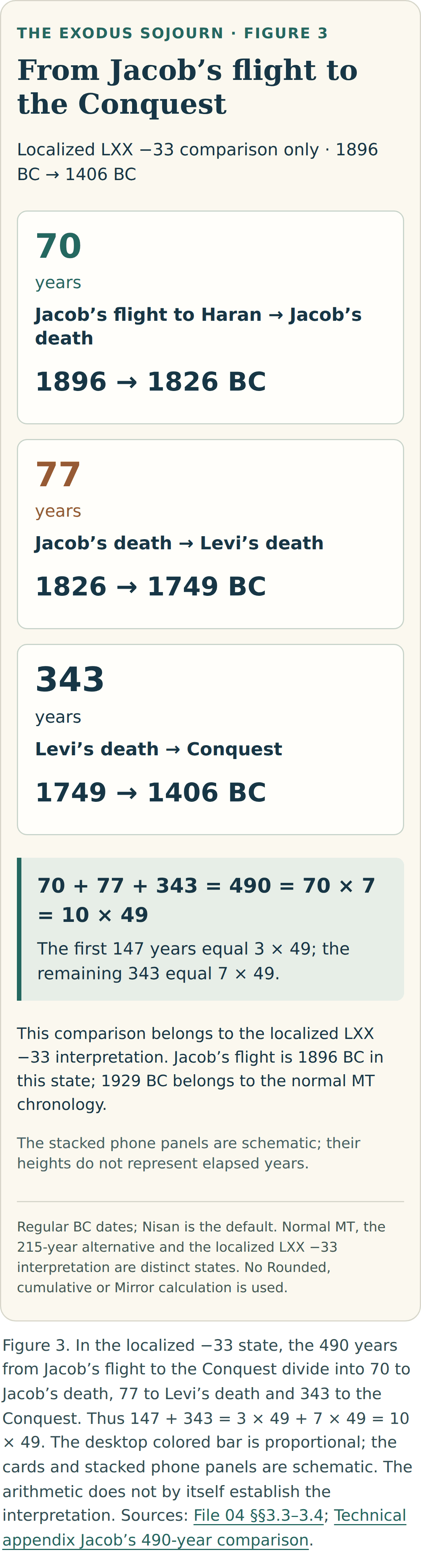
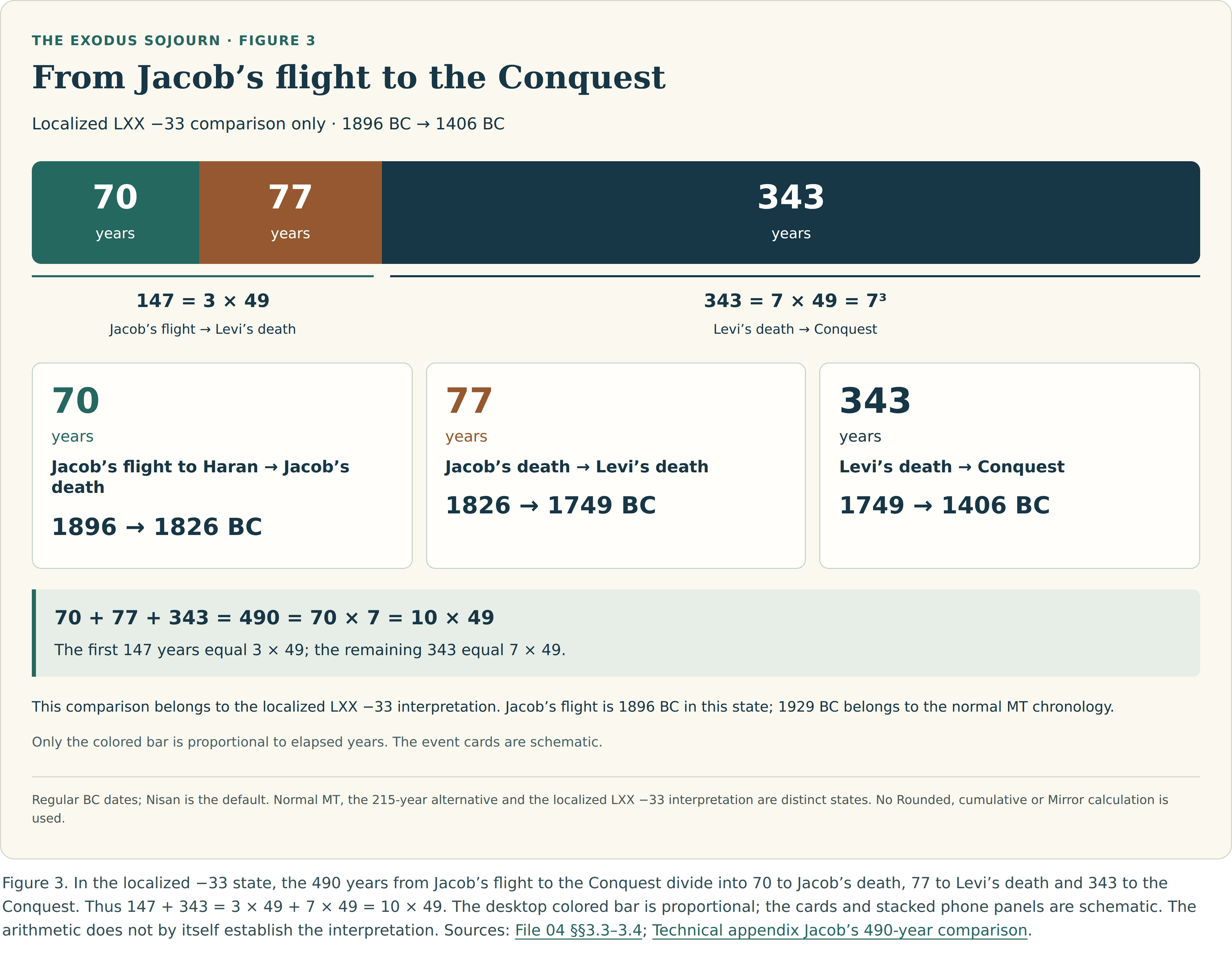
This particular 343-year ending belongs to the localized reading. In normal MT, Levi’s death to the Conquest is 1782 − 1406 = 376 years. The comparison therefore shows what the secondary interpretation brings into view, while keeping the normal MT chronology intact.
I read the 70 × 7 relationship as a resonance with Daniel’s seventy sevens. The span is exact within the stated chronology; the association is typological. It does not make Jacob’s flight the historical starting decree of Daniel 9, or establish this sojourn interpretation merely by its attractive arithmetic.
Two further lifespan echoes
File 04 §3.2 adds two compact relationships worth retaining. First, Jacob’s 147 + the 33-year comparison = 180, the lifespan of Isaac (Genesis 35:28). The 33 remains a chronological comparison; Jacob does not acquire thirty-three additional years of life.
Second, Jacob’s death in normal MT, 1859 BC, to Levi’s death in the localized reading, 1749 BC, gives 1859 − 1749 = 110—Joseph’s lifespan (Genesis 50:26). This deliberately compares two chronological positions. Within either position alone, Jacob’s death to Levi’s death remains 77, as Table 3 shows. The 110 is a correspondence with Joseph’s lifespan, not an additional historical interval within one uninterrupted chronology.
These echoes connect the three patriarchal lifespans 180, 147, and 110 with the 33-year comparison. Their value lies in the relationships they display alongside the more developed Jacob–Levi sequence.
Following the family story
The normal MT chronology gives Israel 430 years in Egypt. The 215-year alternative includes the earlier journey from Abram’s call, while the localized 33 + 397 interpretation begins with Jacob’s returning household. Keeping those starting events distinct allows each reading to be examined on its own terms.
Through all three, Jacob still lives 147 years. His final seventy years carry him through service, return, and descent into Egypt; the Jacob–Levi arc then links the patriarchal household with the line of deliverance. Under the localized reading, the span from Jacob’s flight to the Conquest separates into three and seven 49-year measures. These are useful connections within the covenant story, accompanying the family’s movement toward the promise of the land.
Sources and further tables
- File 04 — Jacob as Jubilee Standard and the LXX 33 + 397 Sojourn Interpretation: §§1.1–1.2, Jacob’s dates; §§2.1–2.2, the interpretation and Payne precedent; §2.5 and the September 13 scope guard, Terah-through-Levi localization; §§3.1–3.4, the lifespan and Jacob–Levi relationships.
- File 18 — Chronological Data Tables: §§2.3–2.4, patriarchal and fixed MT dates; §§3.3 and 4.3, the corresponding SP/LXX patriarchal positions. Its minimum dates require the stated +215 conversion for normal MT.
- Introduction: Harmonizing the Exodus Sojourn and technical appendix: text and translation notes, Jacob’s movements, service periods, and plenty and famine.
Downloads: Supporting Table 1 (CSV) · Supporting Table 2 (CSV) · Supporting Table 3 (CSV) · Supporting Table 4 (CSV) · HTML and JSON figure sources (ZIP).
Scripture quotations: Berean Standard Bible (BSB), public domain.