Noah’s life gives this study a tangible measure. Genesis records both the years after the Flood and the length of his whole life:
After the flood, Noah lived 350 years. So Noah lived a total of 950 years, and then he died.
Shem’s account supplies another clearly divided lifespan:
This is the account of Shem. Two years after the flood, when Shem was 100 years old, he became the father of Arphaxad. And after he had become the father of Arphaxad, Shem lived 500 years and had other sons and daughters.
Together with Noah’s age of 600 at the Flood (Genesis 7:6), these passages give two elementary divisions: 600 + 350 = 950 for Noah, and 100 + 500 = 600 for Shem. The chronological comparisons begin with these lives and their events. The absolute dates come from the reconstructed tables; they are not part of the biblical quotations.
The Mirror places chronological coordinates on opposite sides of a stated center. This allows a beginning to be compared with a reflected ending, or an early judgment with a later deliverance. The interest lies in the particular relationships that result when the dates, textual traditions, and method of reflection remain fixed.
This detailed companion develops the framework introduced in Across the BC–AD Divide. It starts with the normal chronology, then examines selected lower-coordinate comparisons from the astronomical-year study before turning to the canonical cumulative and seasonal constructions. Supporting tables are collected below, with direct links beside the relevant explanations.
1. Establish the dates before reflecting them
The normal Masoretic Text (MT) framework used here has 430 years in Egypt, Nisan as its calendar norm, and no additional sixty-year Terah adjustment. Noah’s normal Gear 2 life runs:
3058 BC → 2458 BC → 2108 BC.
These are his birth, the Flood’s beginning, and his death. Their intervals reproduce 600 + 350 = 950. The Flood’s closing year is 2457 BC, while Arphaxad’s regular birth remains fixed at 2456 BC.
Shem requires an additional distinction. File 47 identifies 2558 BC as his Gear 2 triad/biological reference and 2556 BC as his elected-lineage station. The latter is 100 years before Arphaxad’s birth. These roles must remain distinguishable when comparing the tables: the two labels do not describe two biological births. The corresponding matched 600-year intervals are 2558–1958 and 2556–1956 BC.
One interval, three different endpoints
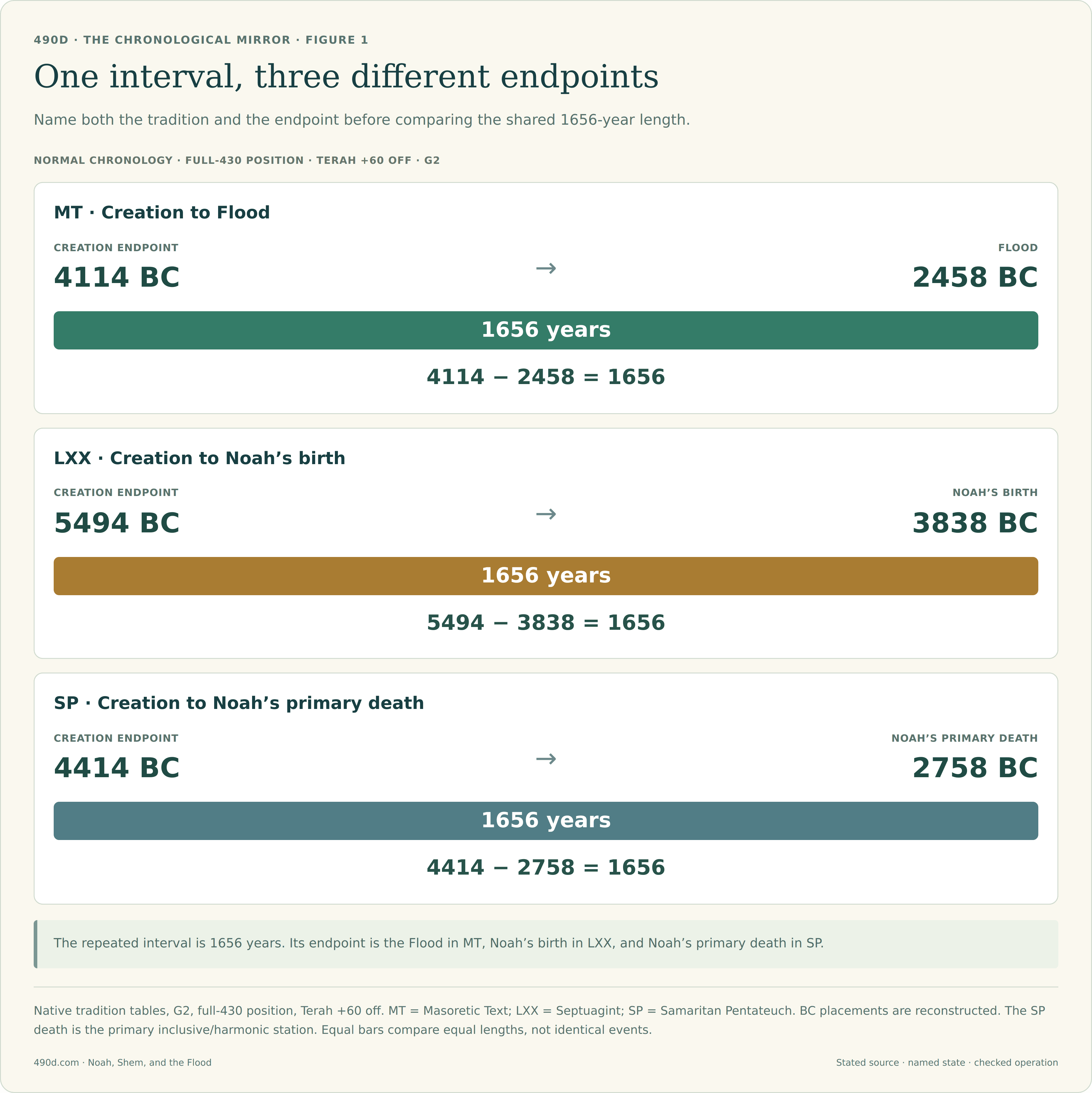
The Septuagint (LXX) and Samaritan Pentateuch (SP) distribute the early generations differently. File 02 §2.1 identifies a particularly helpful relationship: the same 1,656 years reaches a different Noah-related endpoint in each tradition. Using the current normal Gear 2 tables and the common 430-year comparison frame:
- MT: Creation 4114 BC → Flood 2458 BC.
- LXX: Creation 5494 BC → Noah’s birth 3838 BC.
- SP: Creation 4414 BC → Noah’s primary death coordinate 2758 BC.
490d · The Chronological Mirror · Figure 1
One interval, three different endpoints
Name both the tradition and the endpoint before comparing the shared 1656-year length.
Normal chronology · full-430 position · Terah +60 off · G2
MT · Creation to Flood
LXX · Creation to Noah’s birth
SP · Creation to Noah’s primary death
Native tradition tables, G2, full-430 position, Terah +60 off. MT = Masoretic Text; LXX = Septuagint; SP = Samaritan Pentateuch. BC placements are reconstructed. The SP death is the primary inclusive/harmonic station. Equal bars compare equal lengths, not identical events.
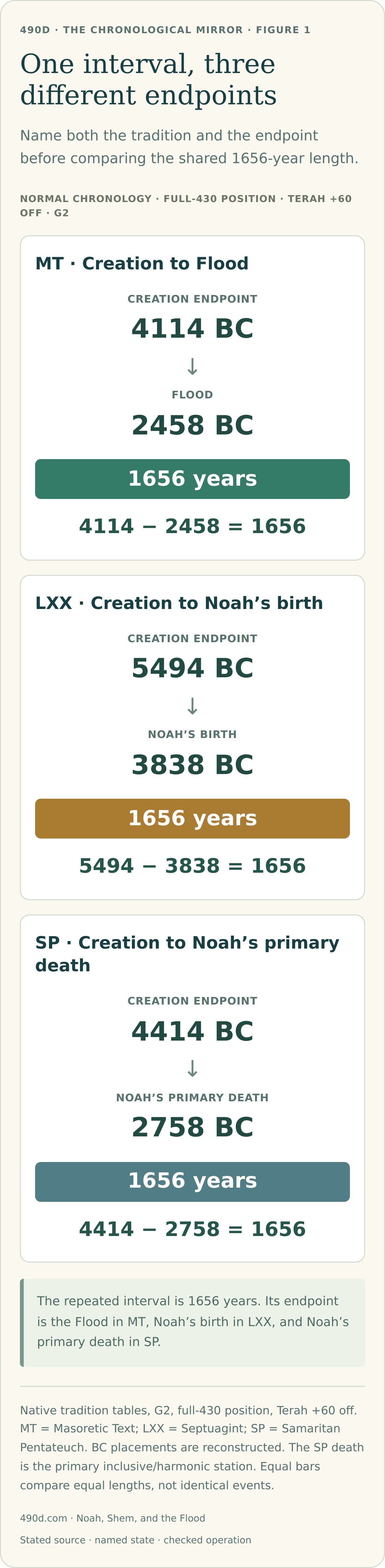
The equal length does not make these three versions of one Creation-to-Flood interval. Their significance is the distribution of the same measure among Noah’s birth, the Flood, and Noah’s death. The shared span is exact; interpreting that arrangement as coordinated design is the further theological reading.
The normal-date table makes the traditions and events explicit. The LXX column includes its native second Cainan. The SP column uses its primary Noah/Shem coordinates. Its separate one-year companions are local alternatives for those two patriarchs and are not a shift of the whole genealogy.
2. What an astronomical-year comparison measures
In civil notation, 1 BC is followed by AD 1. Astronomical numbering calls 1 BC year 0, 2 BC year −1, and 6 BC year −5. AD numbers remain unchanged. Nothing has been inserted into elapsed history; the labels have changed.
Write an astronomical year number as x. Then:
B BC → x = 1 − B, while AD D → x = D.
Reflecting a year number means changing its sign: x → −x. Thus 6 BC becomes −5 and reflects to +5, or AD 5. At corresponding points in those years, the civil span is 6 + 5 − 1 = 10.
For the next comparisons, we take one BC endpoint directly and reflect the year number of another BC endpoint. If the original BC numbers are B and C, the reflected target is AD (C − 1). Their separation is therefore:
B + (C − 1) − 1 = B + C − 2.
The two subtractions have different jobs. One converts the target’s BC year number into its reflected AD label; the other performs civil interval counting across BC and AD. Once the AD target is written down, ordinary BC + AD − 1 is all that is needed to check the span.
The next comparisons reproduce an astronomical year-number construction from selected canonical dates. They test relationships between year labels; they do not execute File 51b’s phase-resolved Mirror for actual dates. That formal construction requires its own seasonal rule. The generated AD labels here assign neither a month and day nor future repetitions of Noah’s life. The exact seasonal Mirror and the Rounded display are examined separately below.
3. The lower setting used in the regular comparisons
The normal Gear 2 framework remains the point of orientation. The following astronomical-year comparisons deliberately use the lower Gear 1 coordinates of Noah and Shem. Their relation to the biblical two-year question is explained in Files 18 and 47.
For MT, the selected Noah interval is 3056–2106 BC; the elected-lineage Shem interval is 2556–1956 BC. The corresponding LXX intervals are 3836–2886 and 3336–2736 BC. The SP primary intervals, in the same 430-year comparison frame, are 3706–2756 and 3206–2606 BC.
These are exact lower coordinates in the regular tables, not dates obtained by rounding. The complete input table also shows the optional +60 Terah versions. That named variant moves these earlier patriarchal coordinates sixty years farther back in BC; it is not switched on by default.
For SP, the primary Gear 1 coordinates must also remain distinct from its one-year companions. Noah’s primary 3706–2756 BC interval, for example, is different from the companion 3705–2755 interval. The comparisons below consistently use the primary values.
In this lower setting, a Gear 1 Flood-start label can coincide with the fixed Arphaxad label. The events still have different roles. Genesis 11:10 continues to say “Two years after the flood”; coincidence within a selected analytical setting does not rewrite the biblical statement.
4. Two ways to obtain the 6,000-year comparison
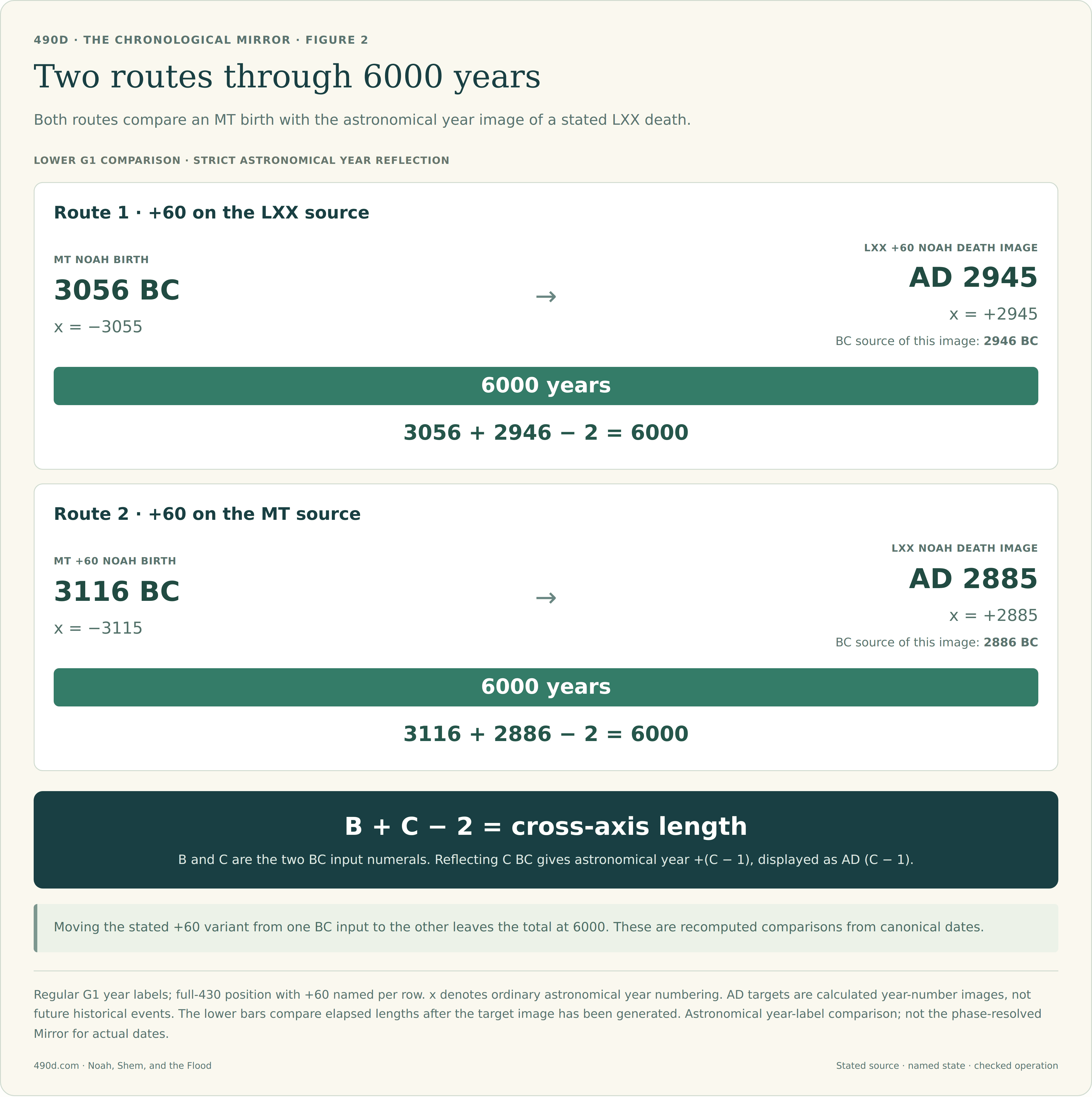
Begin with MT Noah’s birth at 3056 BC. In the LXX lower setting, Noah dies at 2886 BC; with the additional +60 Terah variant, that becomes 2946 BC. Its astronomical coordinate is −2945, whose reflected label is AD 2945.
The comparison is:
3056 BC → AD 2945 = 3056 + 2945 − 1 = 6000 years.
Now place the +60 adjustment on the MT starting point instead. MT Noah’s birth becomes 3116 BC, and the unshifted LXX death at 2886 BC supplies the reflected target AD 2885:
3116 BC → AD 2885 = 3116 + 2885 − 1 = 6000 years.
490d · The Chronological Mirror · Figure 2
Two routes through 6000 years
Both routes compare an MT birth with the astronomical year image of a stated LXX death.
Lower G1 comparison · strict astronomical year reflection
Route 1 · +60 on the LXX source
Route 2 · +60 on the MT source
B and C are the two BC input numerals. Reflecting C BC gives astronomical year +(C − 1), displayed as AD (C − 1).
Regular G1 year labels; full-430 position with +60 named per row. x denotes ordinary astronomical year numbering. AD targets are calculated year-number images, not future historical events. The lower bars compare elapsed lengths after the target image has been generated. Astronomical year-label comparison; not the phase-resolved Mirror for actual dates.
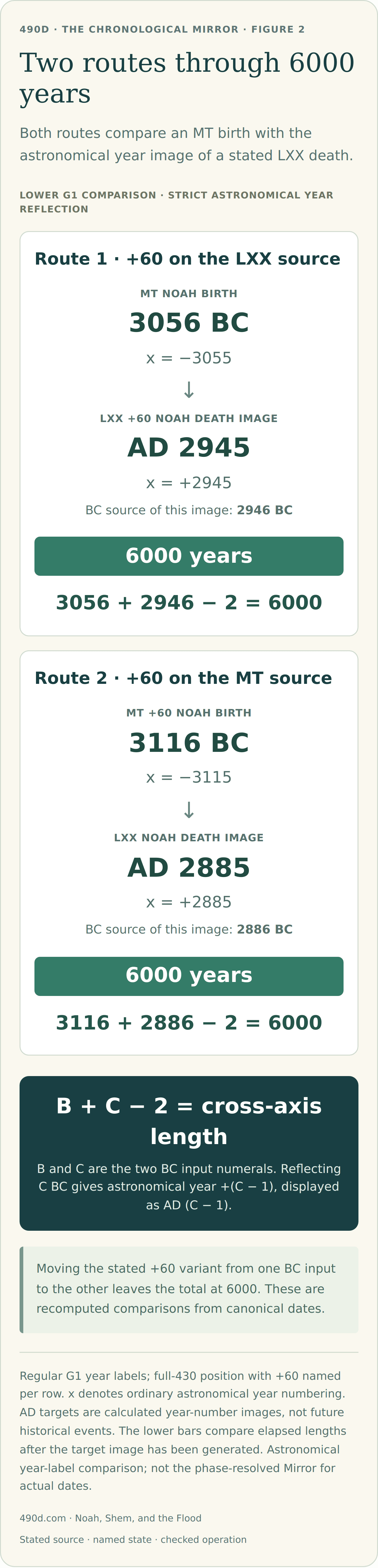
Both comparisons join Noah’s birth in one tradition to the image of his death in another. The sixty-year adjustment is carried by one endpoint in each arrangement. Moving it between the endpoints preserves their total.
These are recomputed comparisons from the regular source tables. Their two forms reveal the effect of a known chronological variant; they are not two independent proofs of the same conclusion. The 6,000-year table preserves each endpoint’s identity and the conversion into AD.
5. Noah and Shem’s deaths: the 4,900-year family
A similar relationship joins the deaths of Noah and Shem across MT and LXX. Take lower MT Noah’s death at 2106 BC, and LXX Shem’s death with +60 at 2796 BC. The latter reflects astronomically to AD 2795:
2106 + 2795 − 1 = 4900.
Moving the +60 adjustment to the MT endpoint gives 2166 BC → AD 2735, again 4,900 years. Reversing which death is placed on the BC side produces corresponding comparisons in the other direction.
The eight-row table records every arrangement. It contains four unordered endpoint pairs, each read in two directions. That distinction matters: the table displays the symmetry of the construction, rather than eight statistically independent discoveries.
The factorization is also familiar:
4900 = 70 × 70 = 100 × 49.
In the study’s 49-year jubilee measure, the interval is one hundred jubilees. Noah and Shem connect the world before the Flood with the world after it; these comparisons place the endings of their lives within a shared larger measure. The arithmetic can be checked directly, while the covenantal meaning belongs to the interpretation of those lives.
6. Noah’s 950 years appear as 8, 7, and 6 lifespans
The LXX–SP comparison makes the role of Noah’s complete life especially visible. Hold the same lower primary setting, using the +60 variant on the SP side:
- LXX Noah: 3836–2886 BC.
- SP Noah, +60: 3766–2816 BC.
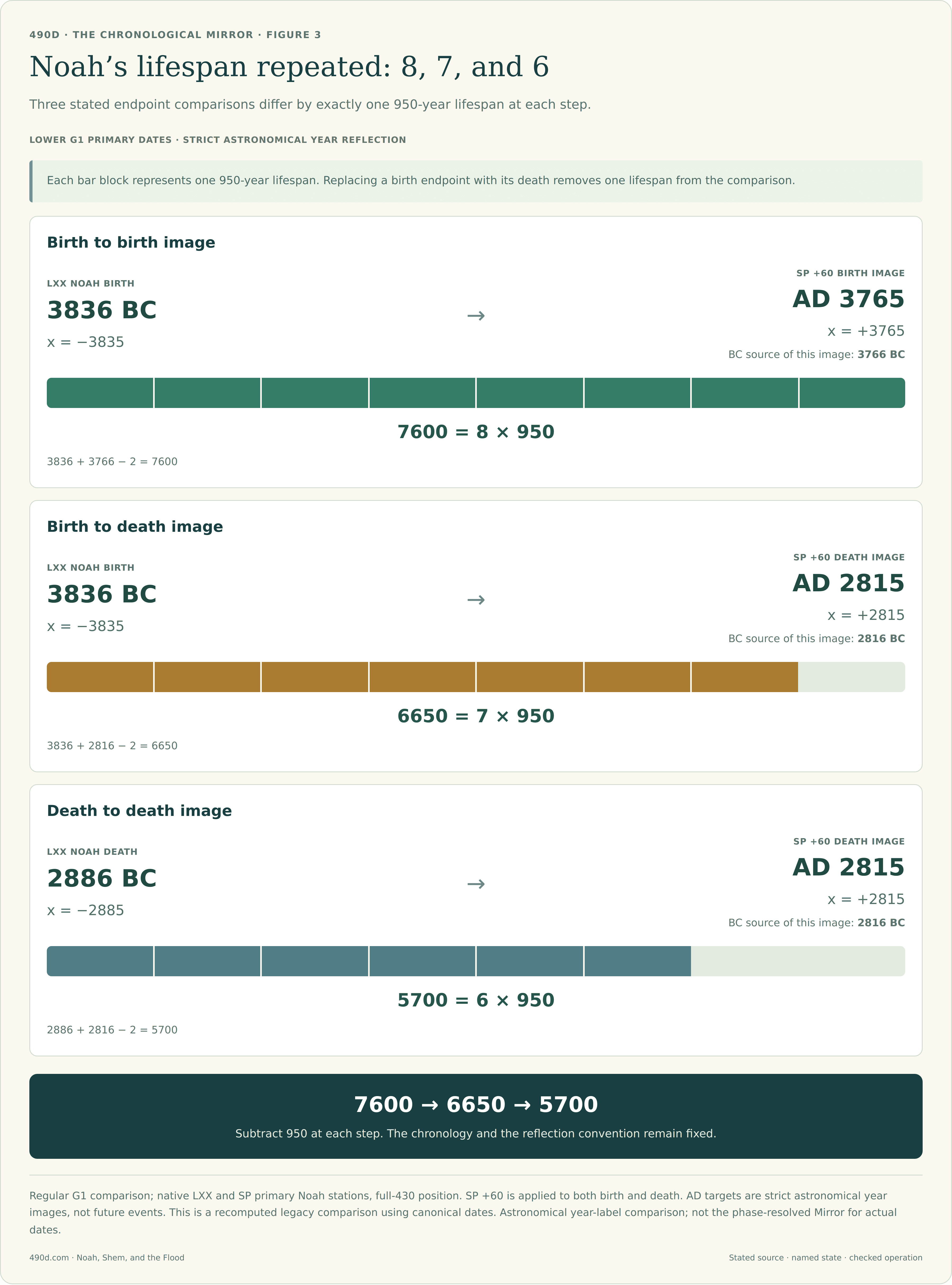
The reflected SP birth and death labels are AD 3765 and AD 2815. They produce three related spans:
3836 BC → AD 3765 = 7600 = 8 × 950.
3836 BC → AD 2815 = 6650 = 7 × 950.
2886 BC → AD 2815 = 5700 = 6 × 950.
490d · The Chronological Mirror · Figure 3
Noah’s lifespan repeated: 8, 7, and 6
Three stated endpoint comparisons differ by exactly one 950-year lifespan at each step.
Lower G1 primary dates · strict astronomical year reflection
Birth to birth image
3836 + 3766 − 2 = 7600
Birth to death image
3836 + 2816 − 2 = 6650
Death to death image
2886 + 2816 − 2 = 5700
Subtract 950 at each step. The chronology and the reflection convention remain fixed.
Regular G1 comparison; native LXX and SP primary Noah stations, full-430 position. SP +60 is applied to both birth and death. AD targets are strict astronomical year images, not future events. This is a recomputed legacy comparison using canonical dates. Astronomical year-label comparison; not the phase-resolved Mirror for actual dates.

The steps are easy to follow. Replacing the reflected SP birth with its death removes one 950-year life. Moving the LXX starting point from birth to death removes another. The sequence 8 → 7 → 6 is consequently built from the same two biographies.
This is the strongest way to read the pattern: a comparison of two complete lives generates a family of related lengths. The three totals are linked consequences of the chosen endpoints. The lifespan table shows the calculations without treating each row as a separate probability claim.
One further comparison connects LXX Shem with the SP Flood setting. LXX’s lower Shem station is 3336 BC; the SP Gear 1 Flood start with +60 is 3166 BC, whose reflected year number is AD 3165:
3336 + 3165 − 1 = 6500 = 13 × 500.
This 6,500-year comparison uses the same declared method, but different events. It is not the difference between the LXX and SP chronologies, and it does not replace the 950-year lifespan sequence.
7. The cumulative chronology carries 4,900 years across a whole week
Regular chronology measures successive births. Cumulative chronology adds complete lifespans along the ancestral line. The method is explained in Adding the Lifespans; its dates must be identified separately from ordinary birth-and-death chronology.
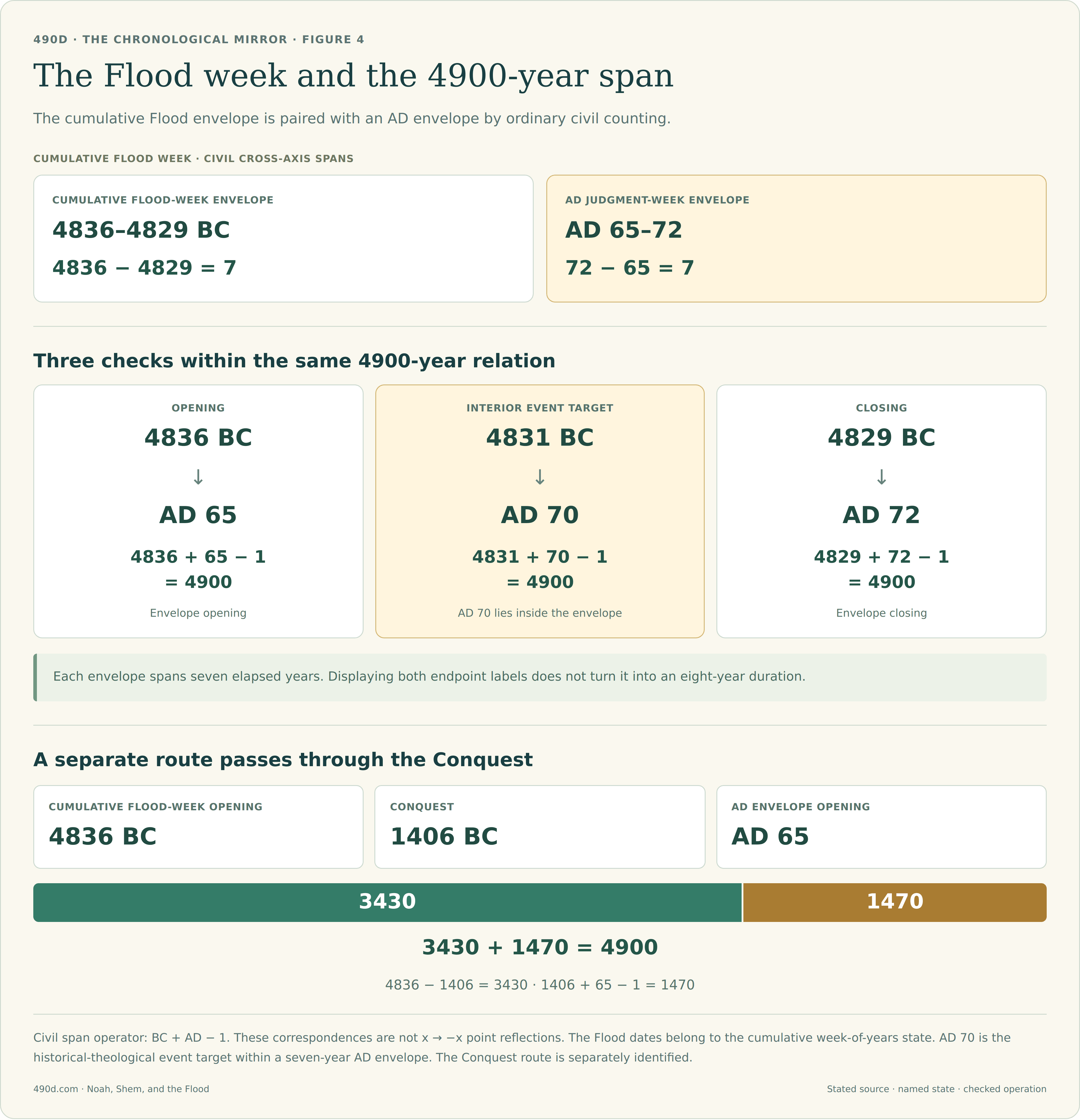
File 02 §5 supplies a canonical cumulative comparison extending the MT Flood/Shem-death field 4836–4829 BC to the AD judgment-week envelope AD 65–72. The opening, an interior point, and the closing boundary each yield the same civil interval:
4836 BC → AD 65 = 4900.
4831 BC → AD 70 = 4900.
4829 BC → AD 72 = 4900.
490d · The Chronological Mirror · Figure 4
The Flood week and the 4900-year span
The cumulative Flood envelope is paired with an AD envelope by ordinary civil counting.
Cumulative Flood week · civil cross-axis spans
Three checks within the same 4900-year relation
= 4900
Envelope opening
= 4900
AD 70 lies inside the envelope
= 4900
Envelope closing
A separate route passes through the Conquest
3430 + 1470 = 4900
4836 − 1406 = 3430 · 1406 + 65 − 1 = 1470
Civil span operator: BC + AD − 1. These correspondences are not x → −x point reflections. The Flood dates belong to the cumulative week-of-years state. AD 70 is the historical-theological event target within a seven-year AD envelope. The Conquest route is separately identified.

Each envelope spans seven years by subtraction. The AD 70 destruction of Jerusalem is the primary event-target within the AD envelope; it is not the closing boundary of the entire seven-year construction. The other labels mark the comparison window and should not each be equated with a separately established historical event.
The opening comparison can also be divided at the Conquest:
4836 BC → 1406 BC → AD 65
3430 + 1470 = 4900, or 7 × 490 + 3 × 490 = 10 × 490.
Here the chronological connection is the Flood, the inheritance of the land, and the later judgment upon Jerusalem. The cumulative table preserves the full envelope and the Conquest division.
This construction uses selected counterparts and civil elapsed spans. AD 65 is not the sign-reflection of the astronomical year number for 4836 BC. Keeping that distinction visible allows the larger canonical comparison to be understood on its own terms.
8. Why spring and autumn change the Mirror labels
Year numbers alone do not locate a date within the year. The canonical seasonal Mirror therefore distinguishes Nisan/spring, written n, from Tishri/autumn, written t.
File 09, Appendix A gives the Conquest pair as 1407t/1406n BC: autumn followed by the next spring. Its paired counterpart is AD 1406t/1407n, also autumn followed by spring. Each pair is approximately half a year wide.
For the source’s geometrical proof, let a = 0 at January 1, AD 1. Spring and autumn are represented by April 1 and October 1. These simplified phase coordinates demonstrate the geometry; they are not claims about the exact Gregorian dates of ancient festivals.
The BC pair occupies −1406.25 and −1405.75. The AD pair occupies +1405.75 and +1406.25. Their centers are therefore −1406 and +1406. Reflection reverses the order of the two members while preserving the pair as a whole.
490d · The Chronological Mirror · Figure 5
A seasonal pair reflects as a pair
The pair keeps its half-year width, while each reflected point changes seasonal position.
File 09 · phase-coordinate proof
Reflect the half-year pair as a set
BC Conquest pair
Pair center: a = −1406
Internal width: 0.5 year
AD pair in chronological order
Pair center: a = +1406
Internal width: 0.5 year
Same-season spans are separate comparisons
These rows measure from a BC component to the same-season AD component. They are not the point-image arrows above.
1407 + 1406 − 1 = 2812
1406 + 1407 − 1 = 2812
Creation to the paired Conquest image
The already established AD pair supplies two equal same-season comparisons.
4115 + 1406 − 1 = 5520
4114 + 1407 − 1 = 5520
6000 is the converted length. It is not a new literal elapsed span or an AD date.
Here a denotes File 09’s proof coordinate A, measured from Jan 1, AD 1. Apr 1 = n and Oct 1 = t are simplified proof phases, not claimed ancient festival dates. Point reflection exchanges the seasons; same-season span comparisons remain distinct. All cards are schematic.

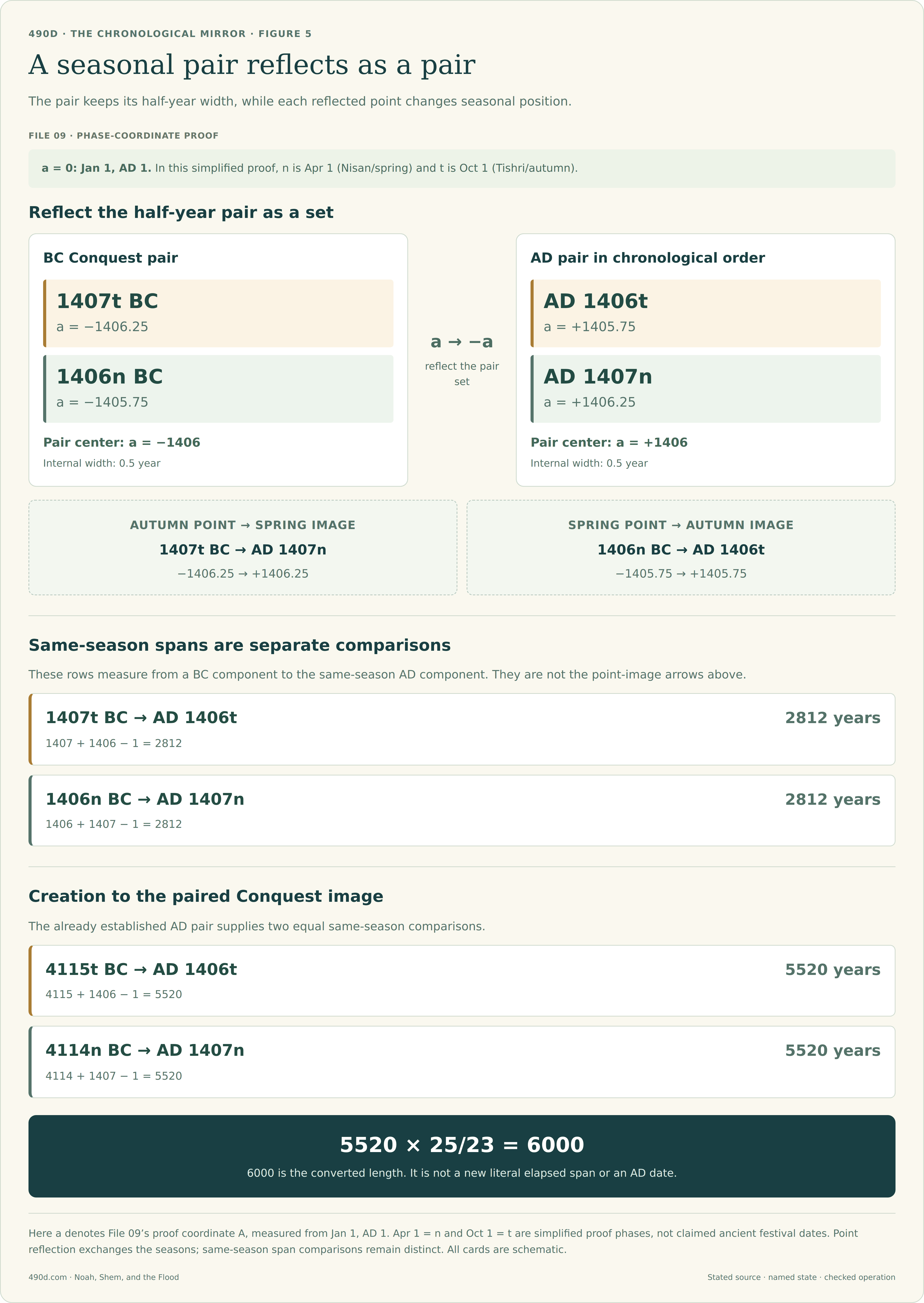
There are two different ways to connect these points. Individual point reflection takes the BC autumn member to the AD spring member, and the BC spring member to the AD autumn member. Comparing corresponding seasons instead gives two equal spans of 2,812 years. Those same-season comparison lines are not the individual reflection lines.
Standalone dates retain their own results: 1407t BC → AD 1407t = 2813, and 1406n BC → AD 1406n = 2811. Their mean is 2812, as in the paired construction. This explains one specified pair; it does not authorize averaging unrelated alternatives. The seasonal table keeps all four rows separate.
Creation and the reflected Conquest
The same canonical construction supports the 5,520-year comparison developed in the introductory article. The MT Creation-week endpoint pair is 4115t/4114n BC. Compare it with the Conquest’s paired counterpart, AD 1406t/1407n:
4115 + 1406 − 1 = 5520, and 4114 + 1407 − 1 = 5520.
Applying the Priestly ratio gives 5520 × 25/23 = 6000. The first quantity is the measured span; the second is its converted duration. This 6,000 is therefore reached by a different operation from the regular Noah comparisons above. A shared result does not make the calculations interchangeable.
The theological connection joins Creation’s work and rest with the Conquest’s inheritance and rest. Creation is being compared to a reflected Conquest target; the two are not themselves an equidistant pair around the origin.
9. Rounded labels and civil counts remain distinct
The current Rounded convention, clarified at the beginning of Files 51a and 51b, uses its own coordinate q. For B BC, q = −(B − 1); for AD D, q = D − 1. Reflection changes q to −q.
Thus q = −1405 and +1405 are displayed as 1406 BC and AD 1406. Their coordinate width is 2,810 Rounded units. Ordinary civil counting between those printed labels gives 2,811 years.
The Rounded comparison table makes this one-unit distinction explicit. Under the older astronomical rendering, +1405 prints as AD 1405; under the current symmetric Rounded display, it prints as AD 1406. The coordinate has not moved. Its naming rule has changed within the Rounded system.
Rounded labels do not acquire a spring or autumn phase because they end in 1 or 6. Nor does the Rounded rule shift the actual seasonal dates in File 09. This is why every figure needs both its date labels and its counting convention.
10. A further canonical Noah comparison: 9,500 years
File 30 §11.3 gives a separate, explicitly defined cumulative-to-regular Noah comparison. Within the cumulative Noah birth-week, its Gear 2 selection is 6383n BC. The source-defined regular Noah Mirror target is AD 3118n:
6383 + 3118 − 1 = 9500 = 10 × 950.
The regular birth coordinate behind that target is Noah’s 3058 BC + 60 = 3118 BC. The additional Terah variant is therefore active in this comparison. The cumulative coordinate belongs to the lifespan construction, not to Noah’s ordinary biography.
File 30 also retains a Gear 1 companion: 6385n BC → AD 3116n, again 9,500 years. The two-row table shows the selected members rather than merging them into a single date.
These are File 30’s Nisan Mirror counterpart labels. They are not generated by the strict year-number sign reflection used for the earlier regular comparisons: that operation would reflect 3118 BC to AD 3117. The declared source construction is part of the result.
The interest is the recurrence of Noah’s complete life as a measure—950 in the biography, and ten times 950 across the named cumulative and regular coordinates. Its interpretation as a correspondence between scales rests on that specified architecture; the multiplication alone would not establish it.
11. What the comparisons bring into view
The patterns become most intelligible when their people and events remain visible. The 1,656-year relations distribute one interval across Noah’s birth, the Flood, and his death. The 6,000- and 4,900-year regular comparisons join beginnings and endings across textual traditions. The 950-year ladder reveals how two complete lives organize the related totals of 7,600, 6,650, and 5,700.
The cumulative and seasonal constructions then widen the view. The Flood week reaches a later judgment envelope through 4,900 years; Creation and the reflected Conquest meet through 5,520 and its conversion to 6,000. These are distinct operations directed toward related theological themes: judgment, preservation, inheritance, and rest.
In that sense the Mirror offers a way to read relationships across biblical time. Its usefulness depends on retaining what makes each relationship specific: the textual tradition, the selected chronological setting, the identity of each event, and the operation that joins the endpoints.
Supporting tables and source notes
Direct links: normal dates · lower inputs · 6000 · 4900 death pairs · 950-year multiples · 6500 · cumulative Flood week · seasonal Mirror · Rounded display · 9500 · sources.
A. Normal Gear 2 orientation
All dates are BC. The traditions are compared in the full 430-year frame; +60 Terah is OFF. MT and SP have no restored second Cainan; LXX retains its native second Cainan. SP uses primary person-coordinates.
| Tradition | Creation endpoint | Noah birth | Flood start → close | Noah death | Shem G2 reference → death | Fixed Arphaxad |
|---|---|---|---|---|---|---|
| MT | 4114 | 3058 | 2458 → 2457 | 2108 | 2558 → 1958 | 2456 |
| LXX | 5494 | 3838 | 3238 → 3237 | 2888 | 3338 → 2738 | 3236 |
| SP, primary | 4414 | 3708 | 3108 → 3107 | 2758 | 3208 → 2608 | 3106 |
Checks: 4114 − 2458 = 5494 − 3838 = 4414 − 2758 = 1656. Each displayed Noah life spans 950; each matched Shem interval spans 600. The lower Shem references supply the 100-year Arphaxad link. In MT, File 47 calls 2556 BC the elected-lineage station; the LXX and SP lower rows are Arphaxad-bound references. These roles do not replace the Gear 2 references above. Source: File 18 §§2–4 and current SP clarification; File 47 §5.2; File 02 §2.1.
B. Lower inputs for the astronomical-year comparisons
All entries are BC year labels. These are regular Gear 1 / lower-lineage comparison settings. The SP entries are the primary coordinates, without its additional one-year companion adjustment. The +60 variant is confined here to the earlier patriarchal dates shown.
| Event or coordinate | MT | MT +60 | LXX | LXX +60 | SP | SP +60 |
|---|---|---|---|---|---|---|
| Noah birth | 3056 | 3116 | 3836 | 3896 | 3706 | 3766 |
| Noah death | 2106 | 2166 | 2886 | 2946 | 2756 | 2816 |
| Shem lower station | 2556 | 2616 | 3336 | 3396 | 3206 | 3266 |
| Shem matched endpoint | 1956 | 2016 | 2736 | 2796 | 2606 | 2666 |
| Gear 1 Flood start | 2456 | 2516 | 3236 | 3296 | 3106 | 3166 |
| Arphaxad birth | 2456 | 2516 | 3236 | 3296 | 3106 | 3166 |
The MT lower Shem row is the elected-lineage station; its LXX and SP counterparts are Arphaxad-bound lower references. The Flood and Arphaxad rows name different events even where their selected labels coincide. Arphaxad remains fixed when only the Noah/Shem Gear changes; the displayed +60 columns explicitly change the Terah variant as well. Sources: File 18 §§1.4, 2.2.1, 3.1.4, 3.2.1–3.2.2, and §4; File 47 §§5.1 and 9.2. The later SP controls in File 18 determine the primary/companion distinction.
C. The two 6,000-year comparisons
| BC source | Other BC endpoint before reflection | Reflected AD target | Civil calculation |
|---|---|---|---|
| MT Noah birth, 3056 BC | LXX +60 Noah death, 2946 BC | AD 2945 | 3056 + 2945 − 1 = 6000 |
| MT +60 Noah birth, 3116 BC | LXX Noah death, 2886 BC | AD 2885 | 3116 + 2885 − 1 = 6000 |
These are recomputed regular comparisons from Table B under strict astronomical year-number reflection. The optional +60 is used exactly once in each row.
D. Eight directed arrangements of four death pairs
| BC source death | Counterpart death before reflection | Reflected target | Civil check |
|---|---|---|---|
| MT Noah, 2106 BC | LXX +60 Shem, 2796 BC | AD 2795 | 2106 + 2795 − 1 = 4900 |
| MT +60 Noah, 2166 BC | LXX Shem, 2736 BC | AD 2735 | 2166 + 2735 − 1 = 4900 |
| LXX Noah, 2886 BC | MT +60 Shem, 2016 BC | AD 2015 | 2886 + 2015 − 1 = 4900 |
| LXX +60 Noah, 2946 BC | MT Shem, 1956 BC | AD 1955 | 2946 + 1955 − 1 = 4900 |
| MT Shem, 1956 BC | LXX +60 Noah, 2946 BC | AD 2945 | 1956 + 2945 − 1 = 4900 |
| MT +60 Shem, 2016 BC | LXX Noah, 2886 BC | AD 2885 | 2016 + 2885 − 1 = 4900 |
| LXX Shem, 2736 BC | MT +60 Noah, 2166 BC | AD 2165 | 2736 + 2165 − 1 = 4900 |
| LXX +60 Shem, 2796 BC | MT Noah, 2106 BC | AD 2105 | 2796 + 2105 − 1 = 4900 |
Inputs and operator are as in Tables B–C. Reversing a pair retains its sum. The rows must not be counted as eight independent tests.
E. The 950-year ladder
| BC source | Reflected SP +60 target | Civil calculation | Noah lifespans |
|---|---|---|---|
| LXX Noah birth, 3836 BC | Birth image, AD 3765 | 3836 + 3765 − 1 = 7600 | 8 × 950 |
| LXX Noah birth, 3836 BC | Death image, AD 2815 | 3836 + 2815 − 1 = 6650 | 7 × 950 |
| LXX Noah death, 2886 BC | Death image, AD 2815 | 2886 + 2815 − 1 = 5700 | 6 × 950 |
Each reduction is one complete 950-year life: 7600 − 6650 = 6650 − 5700 = 950. Inputs and operation are those of Table B; the generated AD labels are comparison coordinates.
F. The 6,500-year Shem/Flood comparison
| BC source | Counterpart before reflection | Generated AD target | Civil calculation |
|---|---|---|---|
| LXX lower Shem station, 3336 BC | SP +60 Gear 1 Flood start, 3166 BC | AD 3165 | 3336 + 3165 − 1 = 6500 = 13 × 500 |
The same SP input label also occurs in its +60 Arphaxad row, but that does not merge the two event identities. This row selects the Flood-start role.
G. The cumulative Flood-week comparison
| Cumulative MT field | AD counterpart | Civil span |
|---|---|---|
| Opening, 4836 BC | AD 65 | 4836 + 65 − 1 = 4900 |
| Interior, 4831 BC | AD 70 | 4831 + 70 − 1 = 4900 |
| Closing, 4829 BC | AD 72 | 4829 + 72 − 1 = 4900 |
| Opening to Conquest, 4836 → 1406 BC | Same-side division | 4836 − 1406 = 3430 |
| Conquest to opening target, 1406 BC → AD 65 | Cross-axis division | 1406 + 65 − 1 = 1470 |
The source classifies the BC field as the cumulative Flood week and the AD field as a judgment-week envelope. The table executes the civil operator, including subtraction of one, even though File 02 also uses “rounded cumulative” in describing the BC field. It is not a pure Rounded q-width calculation. Sources: File 02 §5; File 13 §2.4; File 18 §6A.
H. Seasonal dates and the Creation–Conquest comparison
| State | Endpoints or operation | Result |
|---|---|---|
| Standalone autumn | 1407t BC → AD 1407t: 1407 + 1407 − 1 | 2813 |
| Standalone spring | 1406n BC → AD 1406n: 1406 + 1406 − 1 | 2811 |
| Paired autumn comparison | 1407t BC → AD 1406t: 1407 + 1406 − 1 | 2812 |
| Paired spring comparison | 1406n BC → AD 1407n: 1406 + 1407 − 1 | 2812 |
| Creation autumn → paired target | 4115t BC → AD 1406t: 4115 + 1406 − 1 | 5520 |
| Creation spring → paired target | 4114n BC → AD 1407n: 4114 + 1407 − 1 | 5520 |
| Priestly conversion of that span | 5520 × 25/23 | 6000 |
Source: File 09 §§3.1–3.2 and Appendix A. Pair-center symmetry is about January 1, AD 1 in the proof coordinate a. Astronomical x = 0, by contrast, is the year label 1 BC. The same-season span rows do not replace the individual point-reflection connections. The unsuffixed expression “4114 BC + AD 1406 = 5520” is not a civil span equation; the phase-resolved rows above supply the intended exact comparisons.
I. One coordinate pair, different displays
| Convention | Coordinates | Printed labels | Quantity measured |
|---|---|---|---|
| Astronomical year numbering | x = −1405, +1405 | 1406 BC → AD 1405 | 2810 civil years |
| Current symmetric Rounded display | q = −1405, +1405 | 1406 BC → AD 1406 | 2810 Rounded units |
| Civil count of those Rounded labels | Civil endpoints | 1406 BC → AD 1406 | 2811 civil years |
For opposite-side Rounded labels, coordinate width is B + D − 2; the civil count between those labels is B + D − 1. This uses two displayed labels, unlike Table C’s derivation from two original BC inputs. Source: Files 51a and 51b, September 25 clarification. Their separate inverse-number constructions are outside this report.
J. File 30’s cumulative-to-regular Noah comparison
| Selected state | Cumulative Noah birth | Regular birth behind the +60 Mirror target | Source-defined target | Civil check |
|---|---|---|---|---|
| Gear 2 | 6383n BC | 3058 + 60 = 3118 BC | AD 3118n | 6383 + 3118 − 1 = 9500 |
| Gear 1 | 6385n BC | 3056 + 60 = 3116 BC | AD 3116n | 6385 + 3116 − 1 = 9500 |
Source: File 30 §11.3, with regular inputs from Files 18 and 47. The cumulative selections are members of the 6386–6379n BC birth-week; they are not the same ordinary date shifted at will. These targets belong to the source-defined Nisan Mirror display. The strict astronomical sign-reflection operator from §2 is not used to generate them. Only the two Noah settings discussed in this report are displayed here.
K. Controlling sources and related reading
| Source | Function in this report |
|---|---|
| File 00, §§2.2 and 3.9 | Interpretive Mirror foundation and civil cross-axis counting. |
| File 02, §§2.1 and 5 | Tradition-specific 1656 endpoints; cumulative Flood-week 4900 construction. |
| File 09, §§3.1–3.2 and Appendix A | Creation–Conquest comparison; seasonal pair geometry and distinct single-date states. |
| File 13, §2.4 | Cumulative Flood–Conquest–judgment division, 3430 + 1470. |
| File 18, §§1.4, 2–4, and 6A | Regular and cumulative data; +60 scope; current SP primary/companion controls. |
| File 30, §11.3 | Source-defined Noah 9500 family and selected cumulative birth-week members. |
| File 47, §§5.1–5.2 and 9.2; September 13 clarification | Noah/Shem role distinctions and matched lower comparison coordinates. |
| Files 51a and 51b, opening September 25 clarification | Current pure Rounded display and separation from civil and phase-resolved arithmetic. |
| NASA: Year Dating Conventions | Ordinary civil versus astronomical year numbering. |
The regular 6000, 4900 death-pair, 950-ladder, and 6500 rows are calculations reproduced here from named canonical inputs. They are distinguished from the constructions explicitly developed in Files 02, 09, and 30. Exact numerical agreement is retained without assigning a probability or presenting an interpretive conclusion as a mathematical theorem.
For a shorter introduction, read Across the BC–AD Divide and its technical appendix. Related explanations include the Key of 23, cumulative chronology, the rounded comparison of Shem and the Flood, and the Samaritan chronology’s regular tables. The Unified Chronology source index provides the current canonical Markdown files and amendments.
Scripture quotations: Berean Standard Bible (BSB), public domain.