After the Flood, two of Noah’s sons approached their father by walking backward:
Then Shem and Japheth took a garment and placed it across their shoulders, and walking backward, they covered their father’s nakedness. Their faces were turned away so that they did not see their father’s nakedness.
The action moves backward in order to restore and cover. In the chronological reading developed here, it supplies a theological image for looking back across time: later patterns illuminate earlier beginnings. The numerical method has its own work to do, establishing the dates, the point of reflection, and the intervals between them.
The chronological Mirror places dates on opposite sides of a declared center so that their relationships can be compared. A lifespan can retain its length while its order reverses; a beginning can be brought into relation with a reflected ending. Creation and the Conquest provide one particularly meaningful example, joining the themes of a world prepared for humanity and a land entered as an inheritance.
The Unified Chronology distinguishes several ways of making these comparisons. We can understand them by starting with ordinary year numbers, following Noah’s life, and then looking at the more precise seasonal and Rounded forms. The supporting tables keep each calculation within its stated convention.
Crossing the boundary between BC and AD
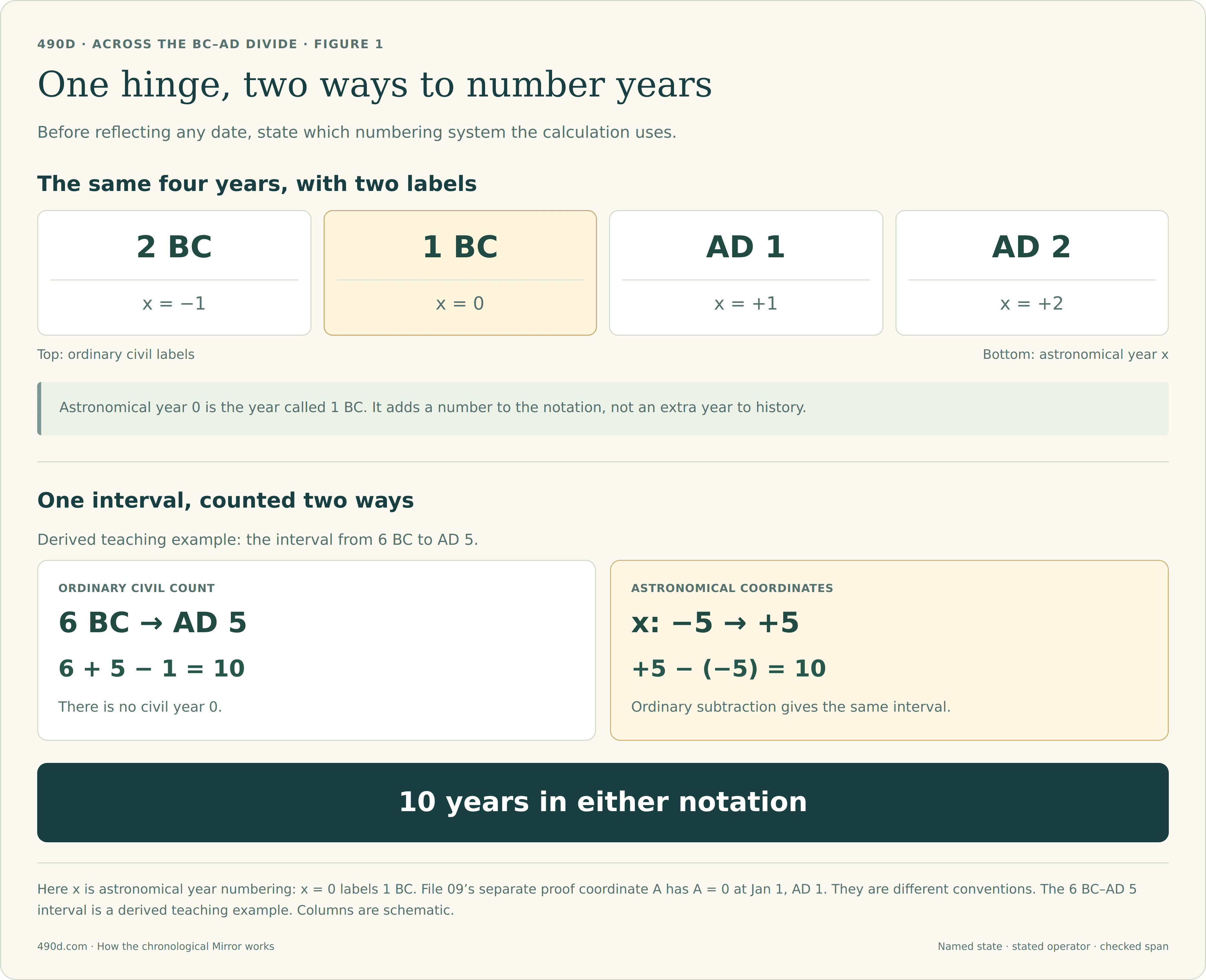
In ordinary historical notation, 1 BC is followed by AD 1. There is no intervening civil year zero. Consequently, the elapsed interval between corresponding points in a BC year and an AD year is found by adding their numbers and subtracting one:
BC number + AD number − 1.
For example, 6 BC to AD 5 is ten years: 6 + 5 − 1 = 10.
Astronomical year numbering expresses the same succession with signed numbers. 1 BC becomes year 0, 2 BC becomes −1, and 6 BC becomes −5. AD year numbers remain unchanged. The same ten-year interval therefore runs from −5 to +5.
490d · Across the BC–AD Divide · Figure 1
One hinge, two ways to number years
Before reflecting any date, state which numbering system the calculation uses.
The same four years, with two labels
One interval, counted two ways
Derived teaching example: the interval from 6 BC to AD 5.
There is no civil year 0.
Ordinary subtraction gives the same interval.
Here x is astronomical year numbering: x = 0 labels 1 BC. File 09’s separate proof coordinate A has A = 0 at Jan 1, AD 1. They are different conventions. The 6 BC–AD 5 interval is a derived teaching example. Columns are schematic.
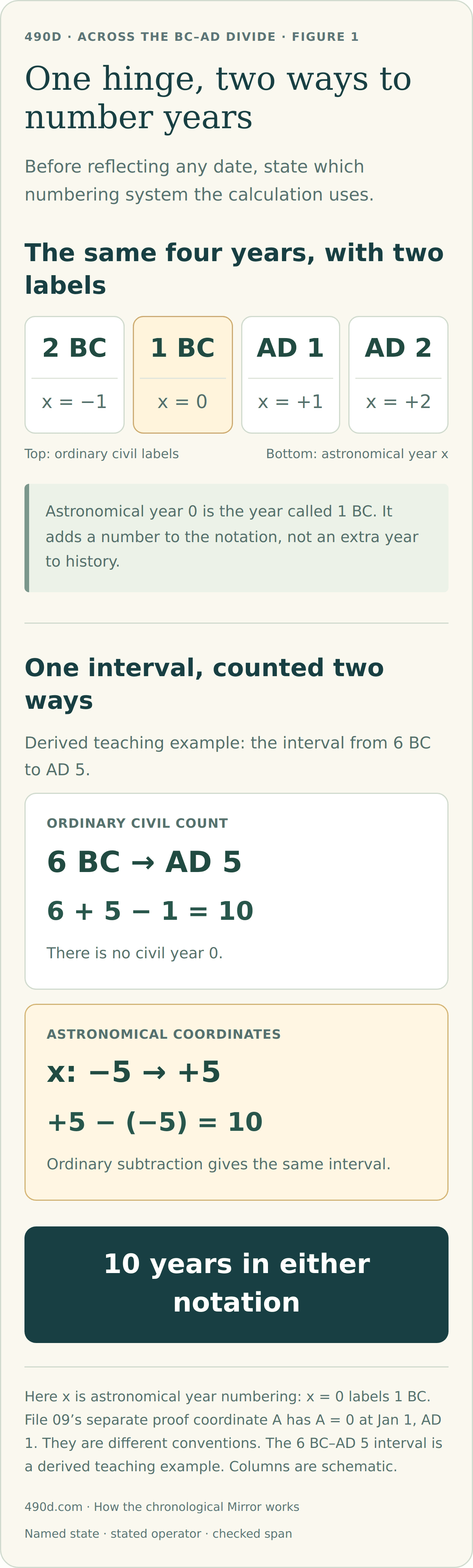
Changing the notation does not add or remove a year. It makes subtraction easier. Reflecting a number is a further step: on this signed number line, −5 reflects to +5. Thus 6 BC reflects to AD 5 under that particular rule. Simply matching the printed numeral—6 BC with AD 6—would select a different endpoint.
This first picture concerns year-number coordinates. Exact spring or autumn dates require a more precise center and calendar description, which we will come to below. The numbering table shows the conversions explicitly.
Noah’s life shows what reflection preserves
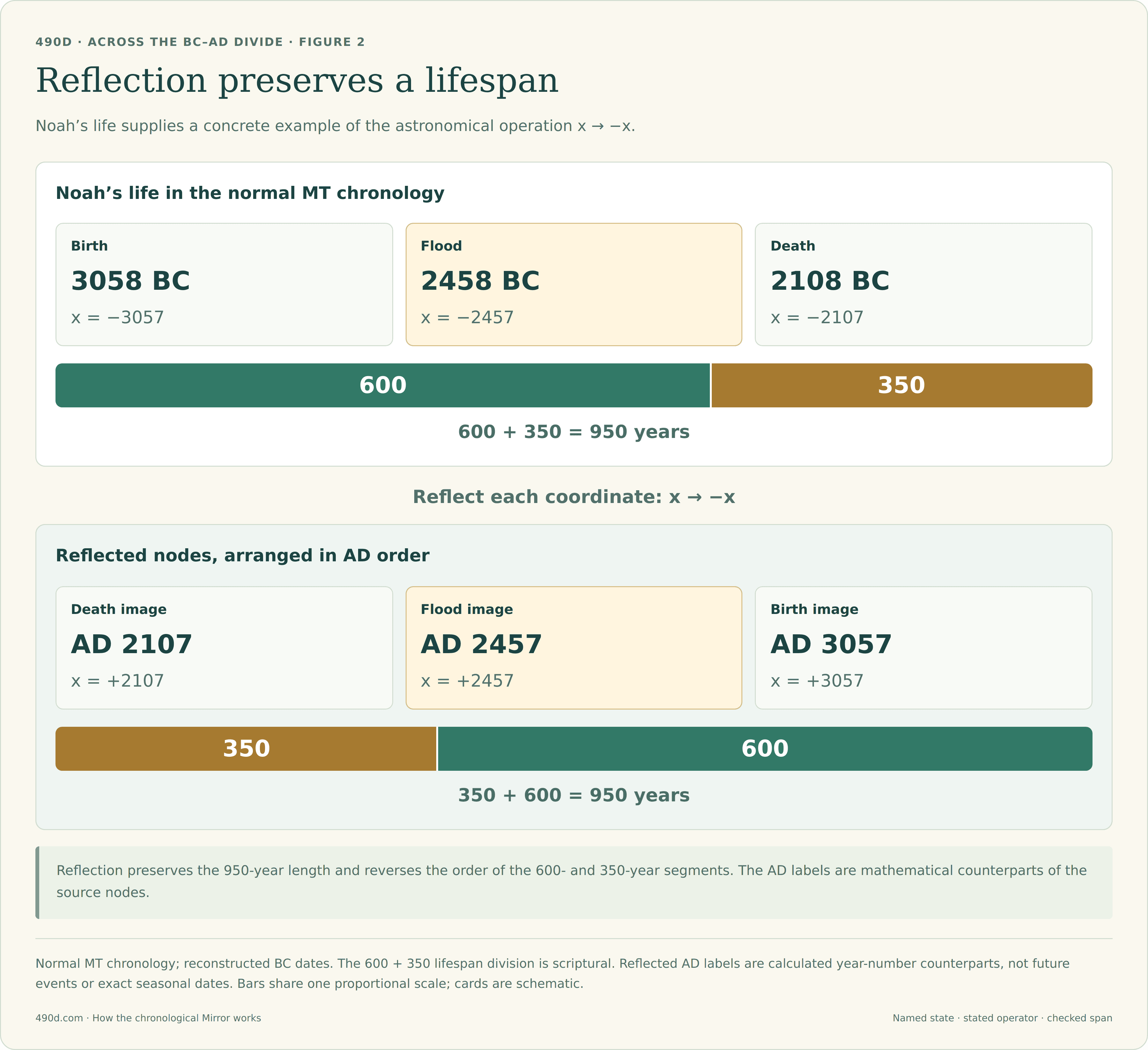
Noah gives us a complete life with a clear division. He is 600 when the Flood comes, and lives 350 years afterward, for a total of 950 (Genesis 7:6; 9:28–29).
Using the repository’s normal Masoretic Text (MT) reconstruction, these events are placed at:
3058 BC → 2458 BC → 2108 BC.
The first interval is 600 years; the second is 350. These are Noah’s normal Gear 2 dates, with the 430-year Egyptian sojourn and no additional 60-year Terah shift.
Now express the three year labels astronomically:
−3057 → −2457 → −2107.
Reflect their signs. When the resulting AD coordinates are arranged in chronological order, the image of Noah’s death comes first, followed by the image of the Flood and then the image of his birth:
AD 2107 → AD 2457 → AD 3057.
490d · Across the BC–AD Divide · Figure 2
Reflection preserves a lifespan
Noah’s life supplies a concrete example of the astronomical operation x → −x.
Noah’s life in the normal MT chronology
Birth
Flood
Death
600 + 350 = 950 years
Reflected nodes, arranged in AD order
Death image
Flood image
Birth image
350 + 600 = 950 years
Normal MT chronology; reconstructed BC dates. The 600 + 350 lifespan division is scriptural. Reflected AD labels are calculated year-number counterparts, not future events or exact seasonal dates. Bars share one proportional scale; cards are schematic.
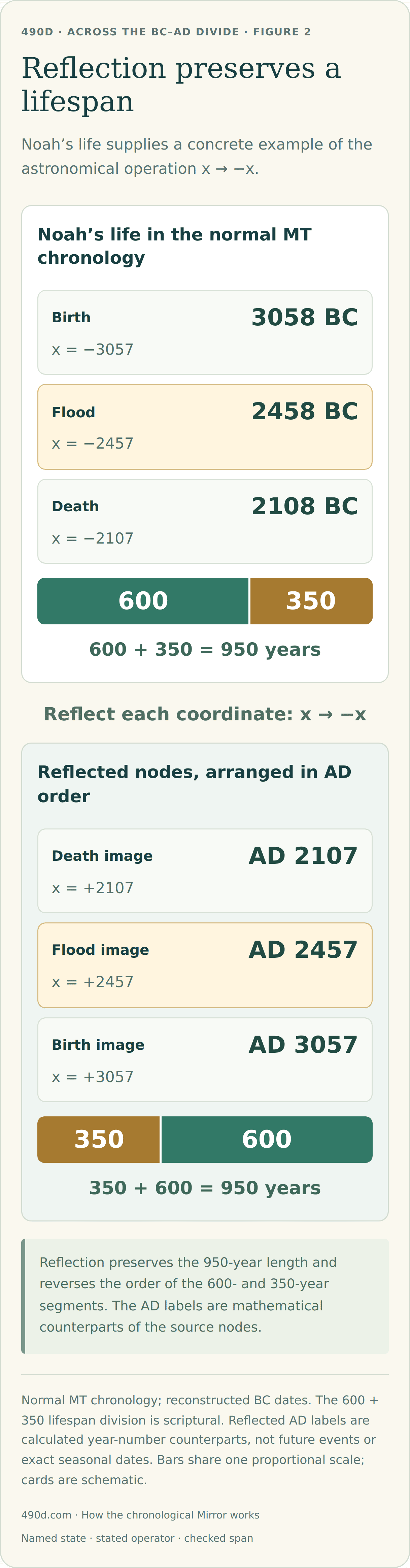
The reflected arrangement contains 350 + 600, where the original contains 600 + 350. The total remains 950. Reflection has reversed the order while preserving the distances.
Those AD labels are generated comparison points, not dates assigned to a future repetition of Noah’s biography. The value of the exercise is that it makes the operation visible: we can see exactly what changed and what stayed the same. The Noah table supplies the source dates, signed coordinates, and the interval checks.
A year can also have a spring and autumn setting
Whole-year labels are enough for the Noah illustration. Some canonical Mirror relationships depend on the position within the year.
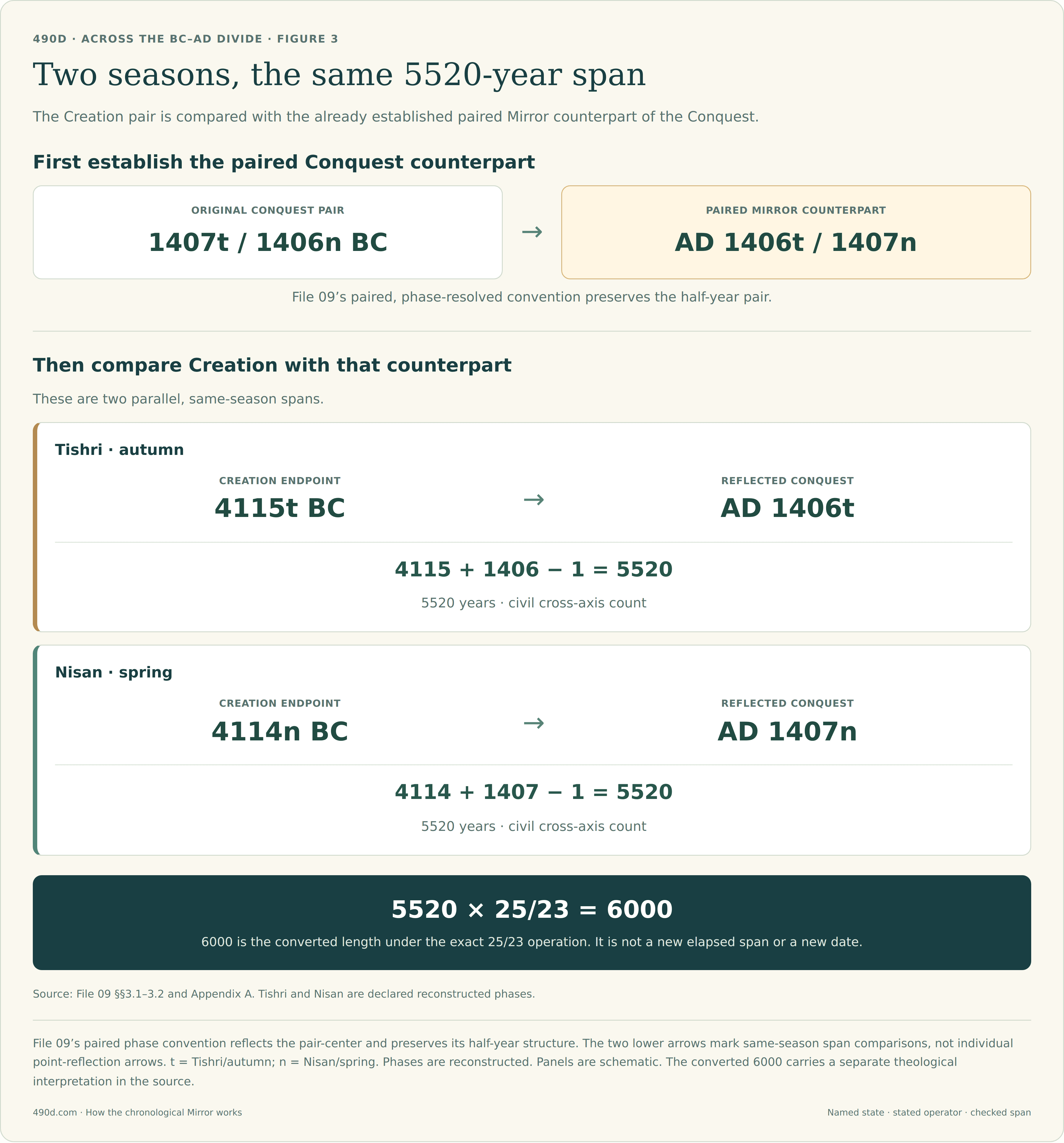
The repository uses Nisan for the spring setting and Tishri for the autumn setting. In its phase-resolved Conquest comparison, 1407 BC in autumn is paired with 1406 BC in spring, approximately half a year later. File 09 §3.1 associates the autumn component with the east-side occupation by the 2.5 tribes and the spring component with the Jordan crossing into the west-side land. The familiar 1406 BC remains the normal Jordan-crossing anchor.
The corresponding Mirror pair is AD 1406 in autumn, followed by AD 1407 in spring. Both pairs retain their half-year width. Matched autumn-to-autumn and spring-to-spring comparisons each span 2,812 years.
Here the centers of the two seasonal pairs are placed symmetrically around the start of AD 1. This is a more precise construction than changing the signs of whole-year numbers. File 09, Appendix A explains the distinction; the seasonal table shows why the spring and autumn labels matter.
From Creation to the reflected Conquest
We can now follow a substantive relationship built on that seasonal framework. File 09 §§3.1–3.2 compares the MT Creation-week endpoint, expressed as autumn 4115 / spring 4114 BC, with the reflected Conquest pair, autumn AD 1406 / spring AD 1407.
The two seasonal calculations agree:
4115 + 1406 − 1 = 5520.
4114 + 1407 − 1 = 5520.
The familiar Creation endpoint of 4114 BC is retained. Its autumn companion allows the same relationship to be followed through both seasonal components.
490d · Across the BC–AD Divide · Figure 3
Two seasons, the same 5520-year span
The Creation pair is compared with the already established paired Mirror counterpart of the Conquest.
First establish the paired Conquest counterpart
File 09’s paired, phase-resolved convention preserves the half-year pair.
Then compare Creation with that counterpart
These are two parallel, same-season spans.
Tishri · autumn
5520 years · civil cross-axis count
Nisan · spring
5520 years · civil cross-axis count
6000 is the converted length under the exact 25/23 operation. It is not a new elapsed span or a new date.
Source: File 09 §§3.1–3.2 and Appendix A. Tishri and Nisan are declared reconstructed phases.
File 09’s paired phase convention reflects the pair-center and preserves its half-year structure. The two lower arrows mark same-season span comparisons, not individual point-reflection arrows. t = Tishri/autumn; n = Nisan/spring. Phases are reconstructed. Panels are schematic. The converted 6000 carries a separate theological interpretation in the source.
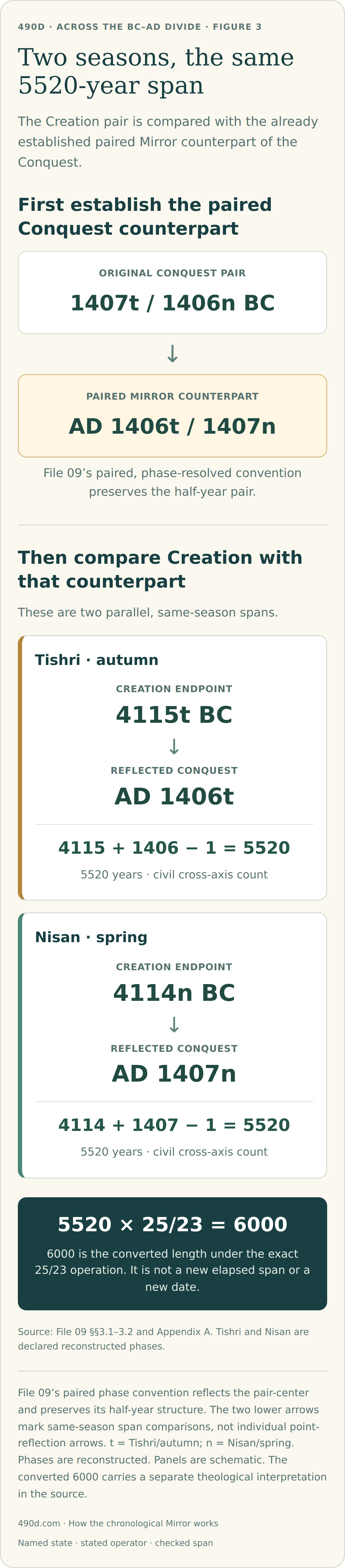
The interval is 240 × 23. Applying the Priestly ratio explained in the Key of 23 study gives:
5520 × 25/23 = 6000.
The significance comes from the endpoints as well as the number. Creation leads toward rest (Genesis 2:2–3); the Conquest leads toward inheritance and the land’s rest (Joshua 11:23). The canonical reading brings those themes together through a converted measure of six thousand years, understood as six days of work leading toward a seventh-day rest.
The 5,520 is the calculated span in the stated seasonal comparison. The 6,000 is its converted duration. Keeping those two stages visible lets the theological reading grow from an explicit numerical relationship. The complete calculation includes both seasonal rows and the conversion.
Rounded chronology uses its own display
Readers of the 9,900-year bridge will already have encountered the Rounded Chronology. Its Mirror calculations operate on a grid whose coordinates are multiples of five.
In the current convention, the coordinates −1405 and +1405 are displayed symmetrically as 1406 BC and AD 1406. Their distance on the Rounded grid is 2,810 units. An ordinary civil calculation between those same printed year labels gives 2,811 years.
490d · Across the BC–AD Divide · Figure 4
Rounded labels, two different counts
The September 25 clarification distinguishes the pure Rounded coordinate calculation from the civil count.
The pure Rounded display uses q
The same printed labels give two distinct quantities
Equivalently: 1406 + 1406 − 2
Elapsed-year count between the printed BC/AD labels.
The symmetric Rounded display is its own convention. It does not assign ordinary astronomical AD year numbers.
Source: File 51a, author clarification dated September 25, 2026.
Pure Rounded symmetric display, controlled by File 51a’s September 25, 2026 clarification. q = 0 is an algebraic origin, not an inserted civil year. No Tishri/Nisan season is inferred from a final digit. Cards are schematic; coordinate width and civil elapsed count remain separate quantities.
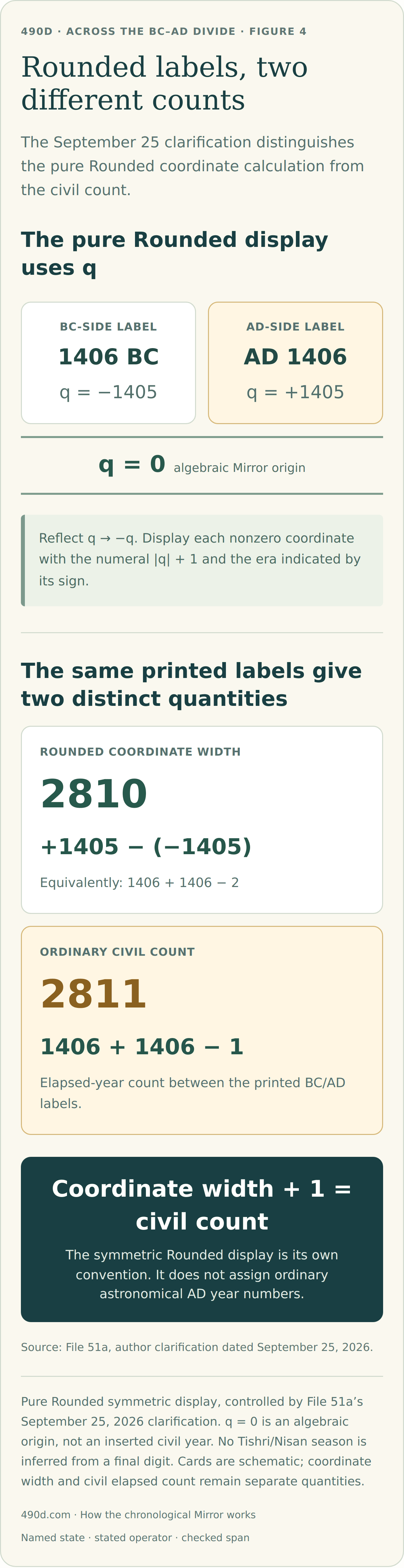
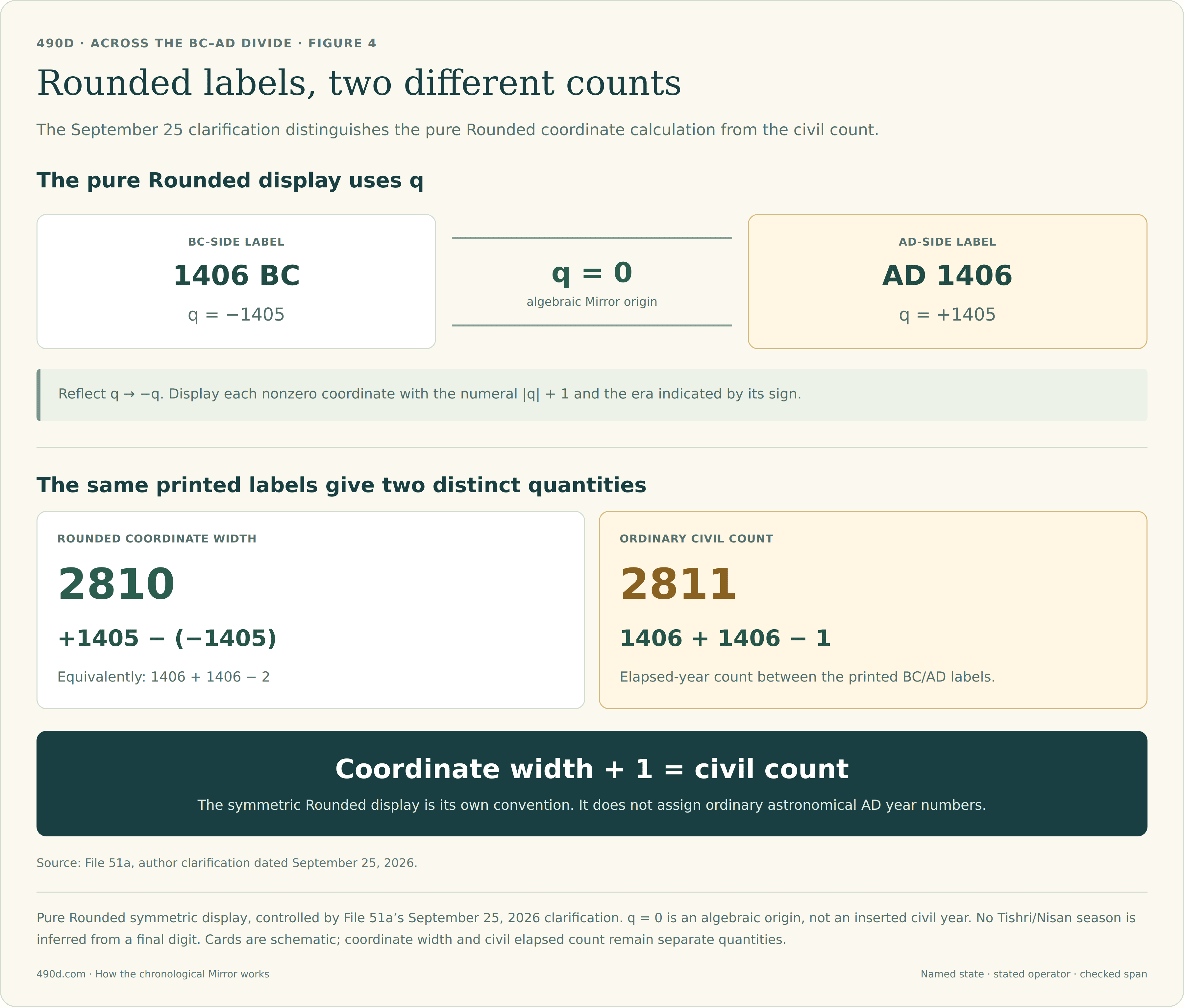
Both results have a defined use. 2,810 measures the Rounded coordinates; 2,811 counts civil years between the displayed labels. The rule for naming a Rounded AD coordinate differs from ordinary astronomical year numbering.
This distinction follows the September 25 clarification at the beginning of File 51a. It is especially useful when reading older diagrams: a positive coordinate once printed as AD 1405 may now appear as AD 1406 in the symmetric Rounded display, while its coordinate remains +1405. The Rounded table makes the old and current renderings easy to compare.
Reading a Mirror comparison with confidence
The central questions are simple: Which dates are being compared? Where is the center? What does the displayed distance measure?
Noah’s example shows how reflection preserves a life’s intervals while reversing their order. The Creation–Conquest comparison shows how a specified Mirror relationship can connect a numerical span with a biblical theme. The Rounded example shows why a diagram’s printed labels must be read according to its declared convention.
Together they make the Mirror a usable method of comparison. Its theological purpose is to look across the chronology and recognize correspondences between beginning and fulfillment; its numerical discipline is to make every step visible.
For further study, use the technical appendix and direct table links, the detailed study of Noah, Shem, and the Flood, the canonical Markdown sources, and the related explanation of cumulative chronology. The appendix keeps the more exact calendar work close at hand without making it necessary to follow the main examples.
Scripture quotations: Berean Standard Bible (BSB), public domain.