When the returned exiles laid the Temple’s foundation, praise and weeping rose together. Many who had seen the first Temple wept aloud; others shouted for joy. The new beginning carried the memory of what had been lost (Ezra 3:10–13).
The books of Kings and Ezra connect the two foundations through a simple detail: both belong to the second month. Kings records Solomon’s beginning:
The foundation of the house of the LORD was laid in the fourth year of Solomon’s reign, in the month of Ziv.
Ezra likewise places the start of the rebuilding in the second month, in the second year after the community’s arrival in Jerusalem (Ezra 3:8). Within the chronology followed here, the two foundations stand 430 years apart. A second pattern gathers the destruction, new foundation, and completion into 49 + 21 = 70 years.
Together, these spans give the reader two views of the same history: the long connection between the two houses, and the shorter journey from destruction to restoration.
Supporting tables: The two foundation dates · The 49 + 21 division · Scripture and chronological interpretation · The separate 430.5 calculation.
Two foundations in the same month
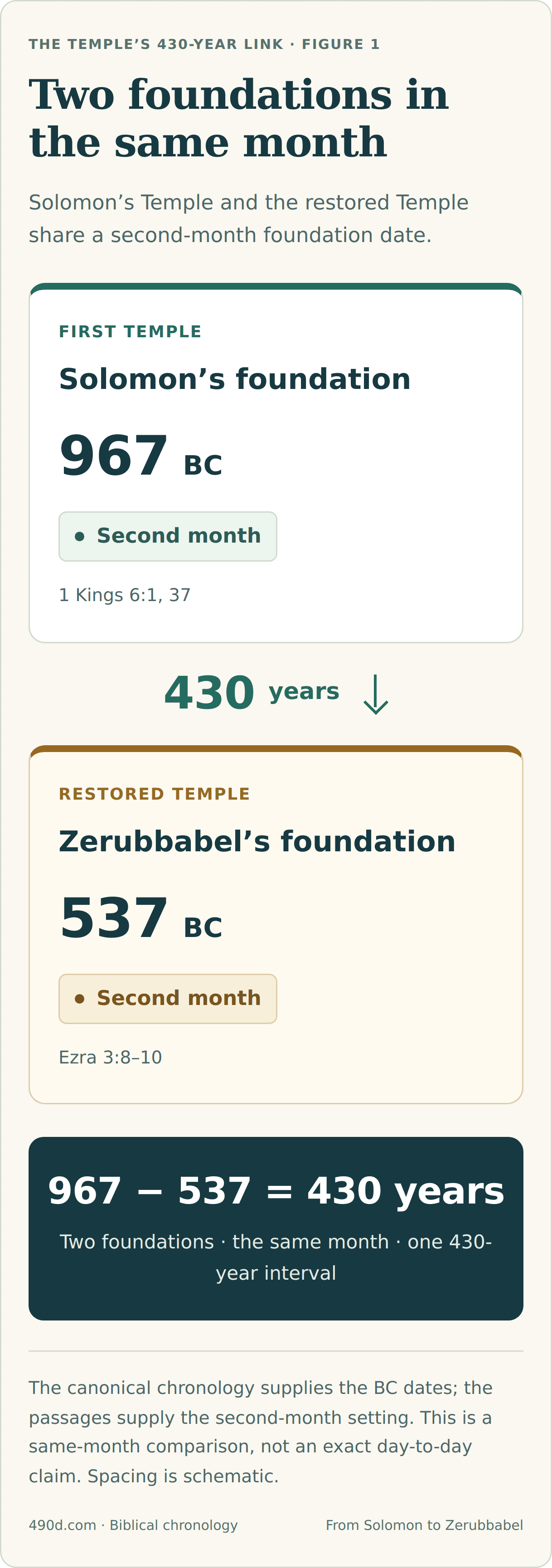
The foundation of Solomon’s Temple belongs to the fourth year of his reign, in Ziv, the second month (1 Kings 6:1, 37). Centuries later, Zerubbabel and Jeshua lead the returned community as work begins again. Ezra names the second month at this new beginning too.
The canonical chronology places the foundations at 967 BC and 537 BC in its same-month comparison:
967 − 537 = 430 years.
These BC coordinates are chronological reconstructions; Scripture gives the regnal and community-year settings and the months. We use one consistent set of dates here. The appendix explains the adjacent 966/536 BC display, which preserves the same 430-year separation.
The Temple’s 430-Year Link · Figure 1
Two foundations in the same month
Solomon’s Temple and the restored Temple share a second-month foundation date.
Solomon’s foundation
967 BCSecond month1 Kings 6:1, 37Zerubbabel’s foundation
537 BCSecond monthEzra 3:8–10The canonical chronology supplies the BC dates; the passages supply the second-month setting. This is a same-month comparison, not an exact day-to-day claim. Spacing is schematic.
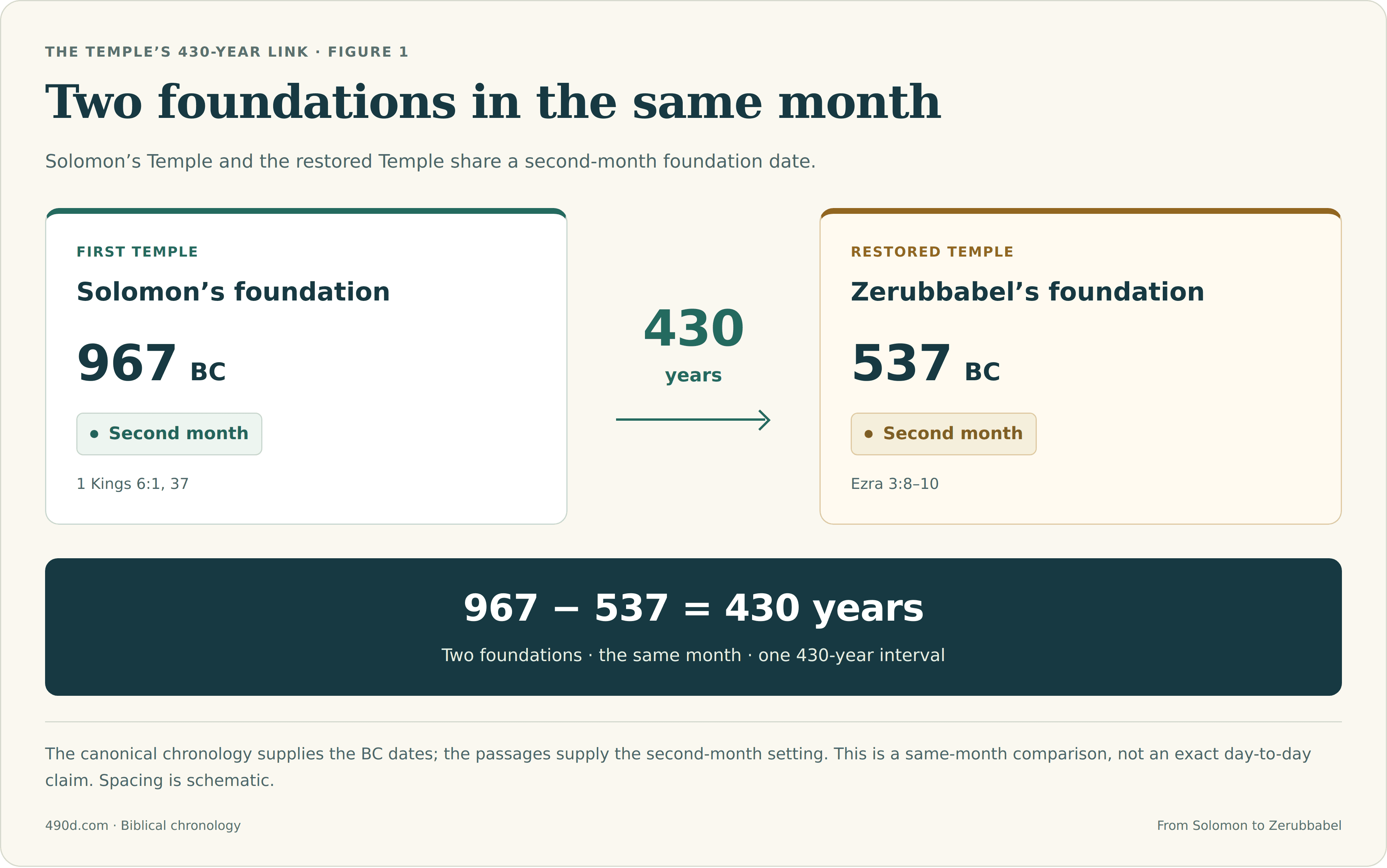
The significance lies in the matching events. We are counting from foundation laid to foundation laid again, with the second month marking both beginnings. The later foundation recalls the earlier house even as it opens a new chapter after exile.
The 430 also belongs to a wider biblical pattern. In the Masoretic Text (MT), Israel’s Egyptian sojourn lasts 430 years (Exodus 12:40–41); Ezekiel’s sign joins 390 + 40 days representing years (Ezekiel 4:5–6). The Temple comparison brings that same total into the story of rebuilding. These connections invite a reading of deliverance, judgment, and restoration together, while each passage retains its own events and counting framework.
The sojourn study and Ezekiel study explain those adjoining relationships.
Seventy years, divided at the new foundation
Now draw closer to the return. The first Temple falls in 586 BC. The new foundation is placed in 537 BC, and the completed second Temple in 516 BC. The foundation divides this seventy-year history:
586 − 537 = 49
537 − 516 = 21
49 + 21 = 70.
The Temple’s 430-Year Link · Figure 2
The foundation within seventy years
Fall, foundation, and completion mark three distinct points in the canonical chronology.
Jerusalem and the First Temple fall
586 BCSecond Temple foundation laid
537 BCSecond Temple completed
516 BCYear-label spans, not exact month/day durations: the events occur in different months. The 21 years do not mean continuous building. Spacing is schematic.
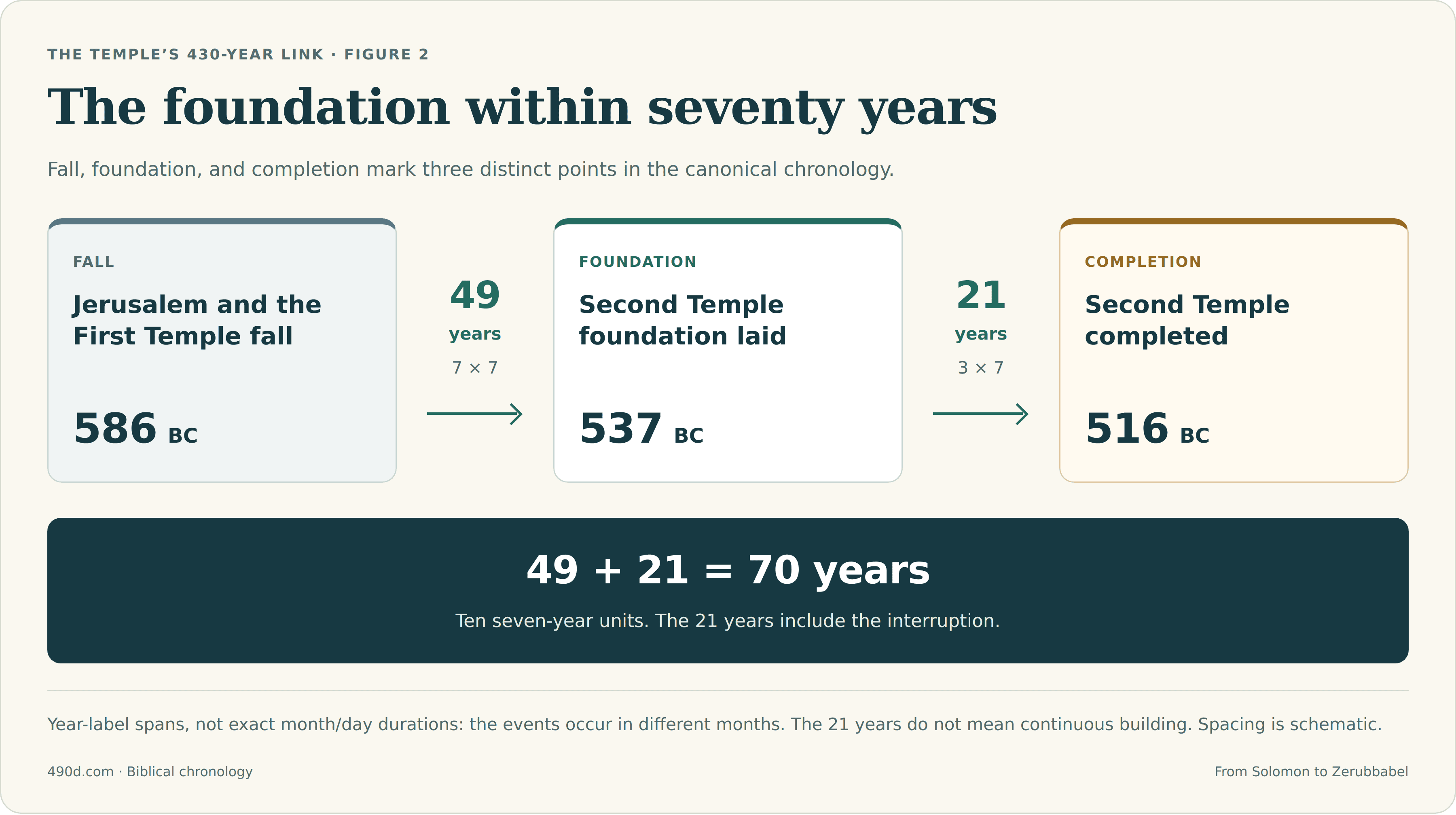
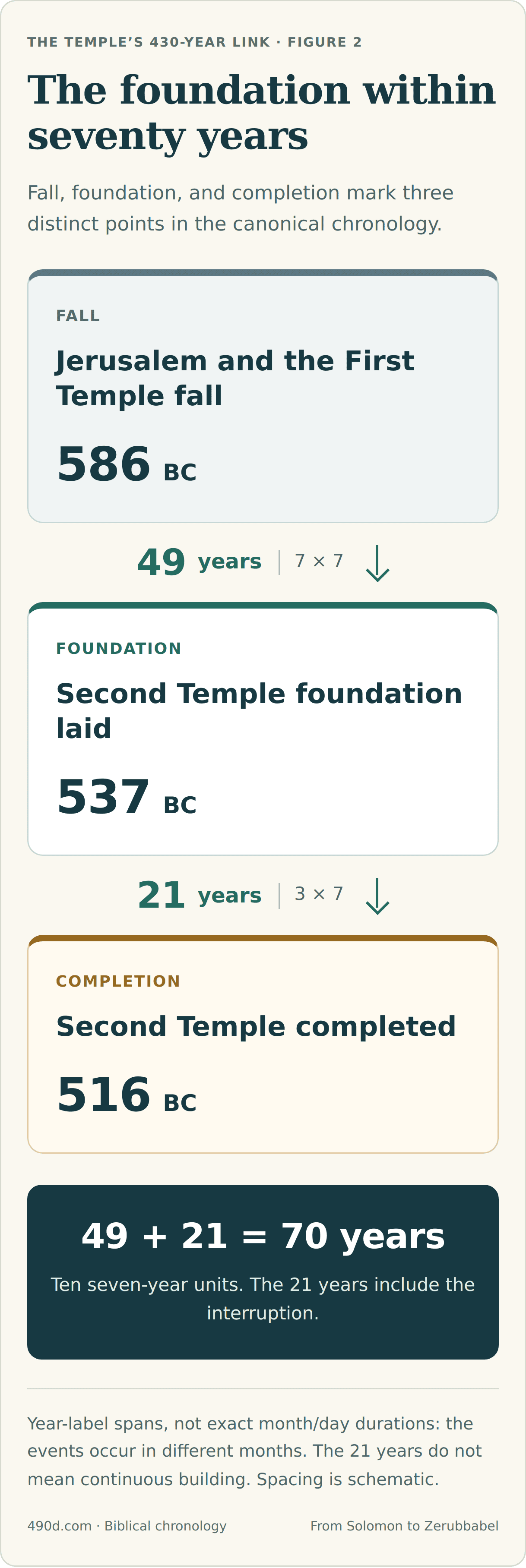
The division is especially readable in weeks of years. 49 = 7 × 7, while 21 = 3 × 7. The whole comprises ten seven-year units, divided into seven and three. The forty-nine-year portion also has the familiar shape of seven sabbatical cycles in Leviticus 25:8.
The foundation is the hinge. Before it lies the loss of the old house and the beginning of return; after it lies the difficult work of bringing the new house to completion. The 21-year interval includes the work’s interruption and renewal. It is the span from foundation to completion in this chronology, rather than twenty-one years during which no building took place.
Ezra describes the opposition and the cessation of work, followed by renewed building under the encouragement of Haggai and Zechariah (Ezra 4:24; 5:1–2). Zechariah expresses the promise in terms of the very same hands that began the work:
The hands of Zerubbabel have laid the foundation of this house, and his hands will complete it.
The numerical division therefore follows the narrative’s own movement: loss, a foundation laid, and a promise carried through to completion.
Daniel’s three weeks and the years of rebuilding
Daniel 10 supplies a smaller measure of waiting. Daniel mourns for three weeks, and the heavenly messenger speaks of opposition lasting twenty-one days (Daniel 10:2–3, 12–13). The connection to the Temple interval is straightforward at the numerical level:
3 × 7 = 21 days beside 3 × 7 = 21 years.
Read through the day–year pattern, the short period of waiting corresponds to the longer interval of rebuilding. The settings remain distinct: Daniel 10 does not explicitly identify its twenty-one days with Zerubbabel’s foundation-to-completion span. The comparison draws together two histories in which opposition delays an answer without cancelling its fulfillment.
This gives the seventy-year division a human dimension. The 49 years lead to a new beginning, but a beginning is not yet completion. The remaining 21 years contain resistance, renewed prophetic encouragement, and the eventual dedication of the house (Ezra 6:14–16).
From a foundation to a finished house
The two patterns hold different parts of the history together. 430 years joins Solomon’s foundation to Zerubbabel’s foundation in the same month. 49 + 21 = 70 traces the movement from the first Temple’s fall to the second Temple’s completion, with the new foundation dividing the whole.
The numbers are memorable because the events are clear. A house is lost; a foundation is laid again; the work encounters opposition; the house is completed. The patterns give those events a visible chronological form, while Zechariah’s promise keeps the meaning in view: the hands that laid the foundation would also finish the work.
Technical appendix and supporting tables · Canonical Temple comparison: File 19 §10.6 · Canonical restoration division: File 17 §7.3 · Detailed study: Solomon’s Temple and Prophetic Time.
Scripture quotations: Berean Standard Bible (BSB), public domain.