A detailed companion to Noah’s Flood: Forty Days, 150 Days, and a New Beginning. For a shorter reference, see the supporting tables and source notes.
In the six hundredth year of Noah’s life, on the seventeenth day of the second month, all the fountains of the great deep burst forth, and the floodgates of the heavens were opened. And the rain fell upon the earth for forty days and forty nights.
The Flood account combines a powerful story with unusually precise chronological markers. It names the beginning of the catastrophe, the resting of the Ark, the appearance of the mountain tops, and two stages in the drying of the earth. Around these dates stand periods of seven, forty and 150 days. The numbers accompany a movement from judgment through preservation to renewed life.
To understand their relationship, we must distinguish what Genesis dates, what a calendar model allows us to calculate, and what a later symbolic comparison proposes. These distinctions make the numerical patterns easier to follow. They also preserve the narrative’s own sequence: the Ark rests while Noah is still waiting, the ground becomes visibly dry before the earth is fully dry, and departure follows God’s command.
This study begins with the MT-based readings represented in the BSB. A separate comparison uses the dates in the linked Brenton English Septuagint. The day-count tables use an explicit working calendar of 12 months of 30 days, without intercalation. Genesis does not itself state all those calendar assumptions. BC dates appear only in the later sections, where their chronological settings are named.
1. Reading the chronological evidence
Genesis supplies two complementary forms of information. A dated event identifies a point in Noah’s life: year, month and day. A duration describes an interval, such as the forty days of rain. A duration can be securely stated even when its exact placement on a month-by-month chart requires interpretation.
The later forty-day wait illustrates the distinction. Genesis 8:6 says that Noah opened the window after forty days. The verse does not identify the starting month and day. A diagram may therefore show the forty-day wait confidently while leaving its absolute date open.
Calculated offsets form a third category. If five months are treated as five equal thirty-day units, they total 150 days. If the year has twelve such months, a return to the same month and day in the next year is 360 elapsed days. Those are exact calculations within the chosen model. Their certainty as arithmetic does not establish the historical length of every month in Noah’s calendar.
Finally, a symbolic comparison places a Flood number beside another biblical number or chronological interval. Such comparisons can illuminate a theological pattern. Their interpretation depends on the passages and the stated chronology; the numerical equality alone does not make one event a prediction of the other. This follows the distinction between textual data, arithmetic, structural inference and typology used in File 02, §0.3.
2. Forty days and 150 days
The opening rain lasts forty days and nights. The waters prevail for 150 days, and the account returns to the end of those 150 days as the waters recede (Genesis 7:12, 24; 8:3). In the continuous reading followed here, these two references describe the same 150-day period. The forty days of rain belong within it.
The dated Ark-rest event supports this reading. The Flood begins on month 2, day 17; the Ark rests on month 7, day 17. On the thirty-day-month grid, the difference is five months, or 150 days. Adding forty before the 150 would break that alignment.
Figure 1 · Noah’s Flood
Forty days within the 150 days
A continuous reading of Genesis 7–8 keeps the rainfall within the longer waters period.
ONE CONTINUOUS WATERS PERIOD
150 days
40 days of rain
The shorter blue bar belongs within the green 150-day span under this reading.
THE SAME PERIOD REFERRED TO TWICE
Genesis 7:24 · The waters prevail.
Genesis 8:3 · The 150 days reach their end.
Sources: Genesis 7:12 (BSB) · Genesis 7:24 (BSB) · Genesis 8:3–4 (BSB).
Model and calculation details
The bars show a reading of the narrative sequence, not an independently supplied calendar for the rain’s end. Genesis 7:12 states forty days and nights of rain; Genesis 7:24 states 150 days of prevailing waters. Genesis 8:3 returns to the endpoint of the 150 days. The dated Ark-rest event is separately stated in Genesis 8:4. No month/day for the end of the rainfall is asserted here.
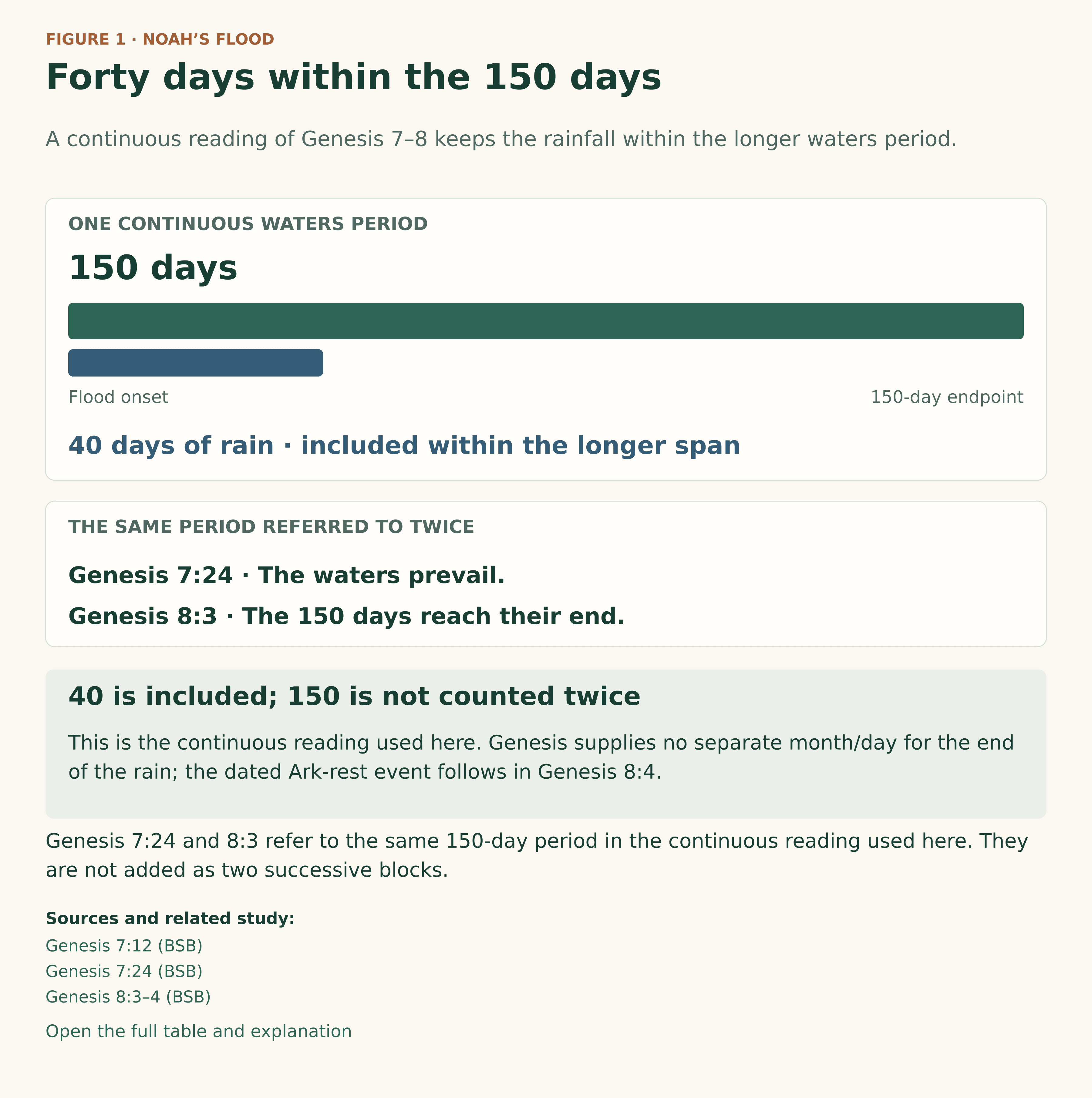
In this model, the part of the 150-day interval remaining after the forty days is 150 − 40 = 110 days. Genesis does not separately name a 110-day period or print a month/day for the rain’s end. The number is useful as a derived partition, provided its status remains clear.
| Event | Days | Source (BSB) | Scope |
|---|---|---|---|
| Warning before Flood onset | 7 | Genesis 7:4, 10 | Stated interval preceding the onset |
| Rain | 40 | Genesis 7:12 | Stated duration; included within the 150-day period in the continuous reading used here |
| Prevailing / receding waters | 150 | Genesis 7:24; 8:3 | One period referred to twice; not two successive 150-day blocks |
| Later wait before window opens | 40 | Genesis 8:6 | Stated duration; exact month/day starting point not stated in verse |
| Wait before the dove brings an olive leaf | 7 | Genesis 8:10–11 | Explicit wait between first and second dove sendings |
| Wait before the dove no longer returns | 7 | Genesis 8:12 | Explicit wait between second and third dove sendings |
The repeated durations also contribute to the account’s literary shape: forty days of rain; the prevailing waters and their 150-day limit; God’s remembrance of Noah; the recession of the waters; and a later forty-day wait. The repetition surrounds a decisive theological turn:
But God remembered Noah and all the animals and livestock that were with him in the ark. And God sent a wind over the earth, and the waters began to subside.
Literary recurrence does not mean that every occurrence names another elapsed block. In particular, the two 150-day references cannot be added to produce 300 days simply because they stand on opposite sides of this narrative turn. Nor does the literary arrangement itself require a doubled chronology projected into years.
3. The five dated stages
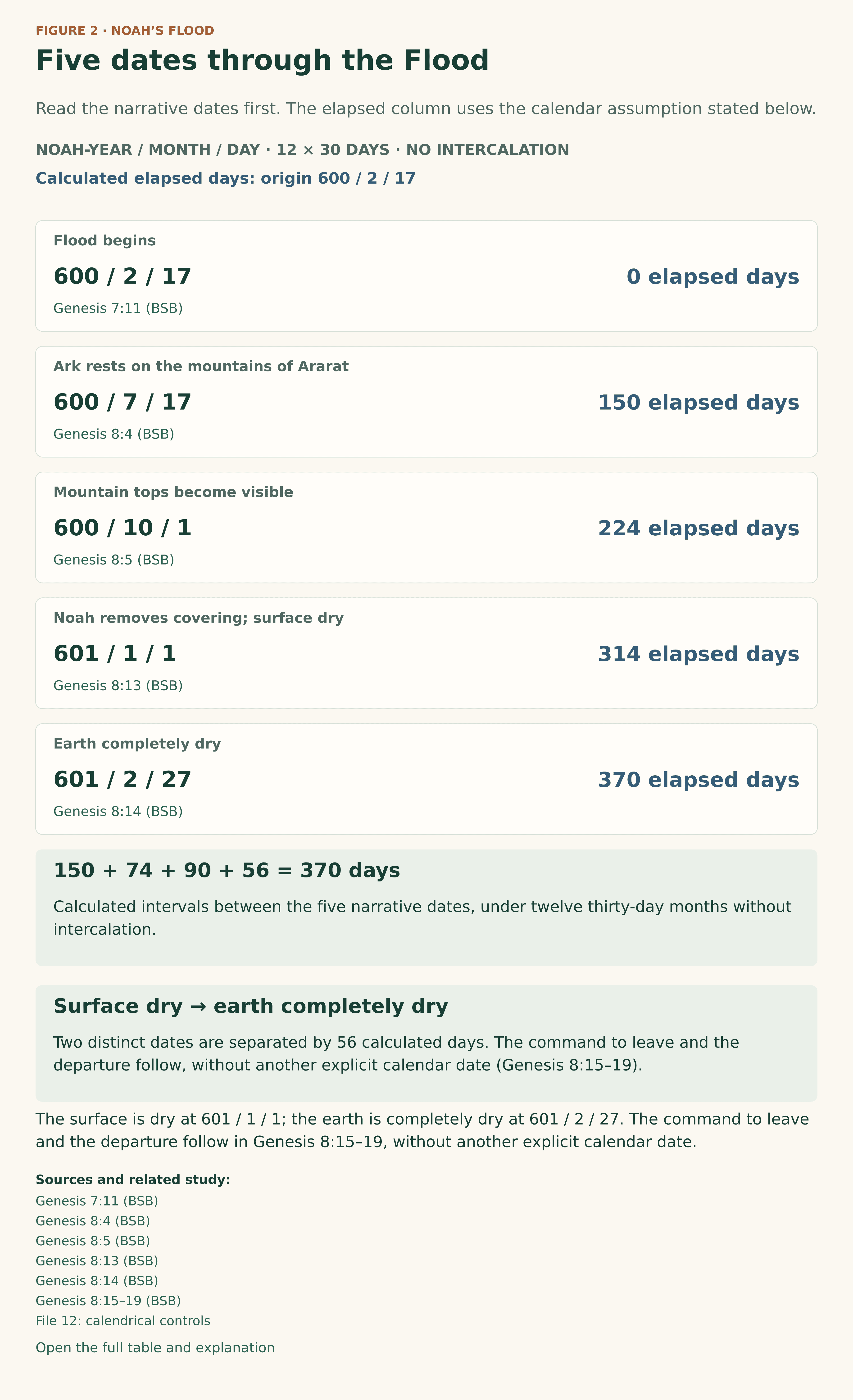
Five month-and-day markers provide the most secure chronological outline. The first three belong to Noah’s year 600; the last two belong to year 601.
Figure 2 · Noah’s Flood
Five dates through the Flood
Read the narrative dates first. The elapsed column uses the calendar assumption stated below.
INTERVALS BETWEEN THE FIVE DATES
150 + 74 + 90 + 56 = 370 days
Sources: Genesis 7:11 (BSB) · Genesis 8:4 (BSB) · Genesis 8:5 (BSB) · Genesis 8:13 (BSB) · Genesis 8:14 (BSB) · Genesis 8:15–19 (BSB) · File 12: calendrical controls.
Model and calculation details
Dates are Noah-year / month / day in the MT-based BSB. Calculated elapsed days assume twelve thirty-day months, no intercalation, and origin 600 / 2 / 17. E = 360 × (Y − 600) + 30 × (M − 2) + (D − 17). A 360-day calculation is not a claim that every biblical calendar year had this length. The 150-day rest coordinate matches five thirty-day months under this convention.
| Event | Noah-year / month / day | Elapsed from Flood onset | Source (BSB) |
|---|---|---|---|
| Flood begins | 600 / 2 / 17 | 0 | Genesis 7:11 |
| Ark rests on the mountains of Ararat | 600 / 7 / 17 | 150 | Genesis 8:4 |
| Mountain tops become visible | 600 / 10 / 1 | 224 | Genesis 8:5 |
| Noah removes covering; surface dry | 601 / 1 / 1 | 314 | Genesis 8:13 |
| Earth completely dry | 601 / 2 / 27 | 370 | Genesis 8:14 |
The Ark’s resting does not mean that the occupants can leave. It rests on the mountains of Ararat while the narrative continues to describe falling water. The mountain tops become visible later. The first-month observation and the fully dry earth are later stages again (Genesis 8:4–5; 8:13–14).
The two drying dates deserve particular attention. On the first day of year 601, Noah removes the covering and sees the dry surface. By the twenty-seventh day of the second month, the earth is fully dry. God then commands Noah to leave, and Noah, his family and the animals depart (Genesis 8:15–19). The departure receives no separately printed calendar date. The final dated endpoint in our table is therefore fully dry earth.
For the declared calendar, the elapsed-day formula from the Flood’s onset is:
Elapsed days = 360 × (Noah-year − 600) + 30 × (month − 2) + (day − 17).
It produces the offsets 0, 150, 224, 314 and 370. The successive intervals are:
| From | To | Calculation | Elapsed days |
|---|---|---|---|
| Flood begins | Ark rests on the mountains of Ararat | 150 − 0 | 150 |
| Ark rests on the mountains of Ararat | Mountain tops become visible | 224 − 150 | 74 |
| Mountain tops become visible | Noah removes covering; surface dry | 314 − 224 | 90 |
| Noah removes covering; surface dry | Earth completely dry | 370 − 314 | 56 |
| Ark rests on the mountains of Ararat | Earth completely dry | 370 − 150 | 220 |
| Flood begins | Earth completely dry | 370 − 0 | 370 |
Thus the four successive dated intervals give 150 + 74 + 90 + 56 = 370 days. The longer rows in the table are cross-checks, not extra periods to add. For example, Ark-rest to fully dry earth is 74 + 90 + 56 = 220 days.
This calculation has a defined scope. The five-month interval provides a reason to explore a thirty-day grid; extending that grid through the following year assumes a twelve-month year without additional days or a leap month. File 12, §§6–7A keeps prophetic, Enochian and solar calendar registers distinct. A 364-day scheme or a proposed leap-month schedule would need its own declared rules. Neither can be silently inserted into the present table.
4. The window, raven and dove
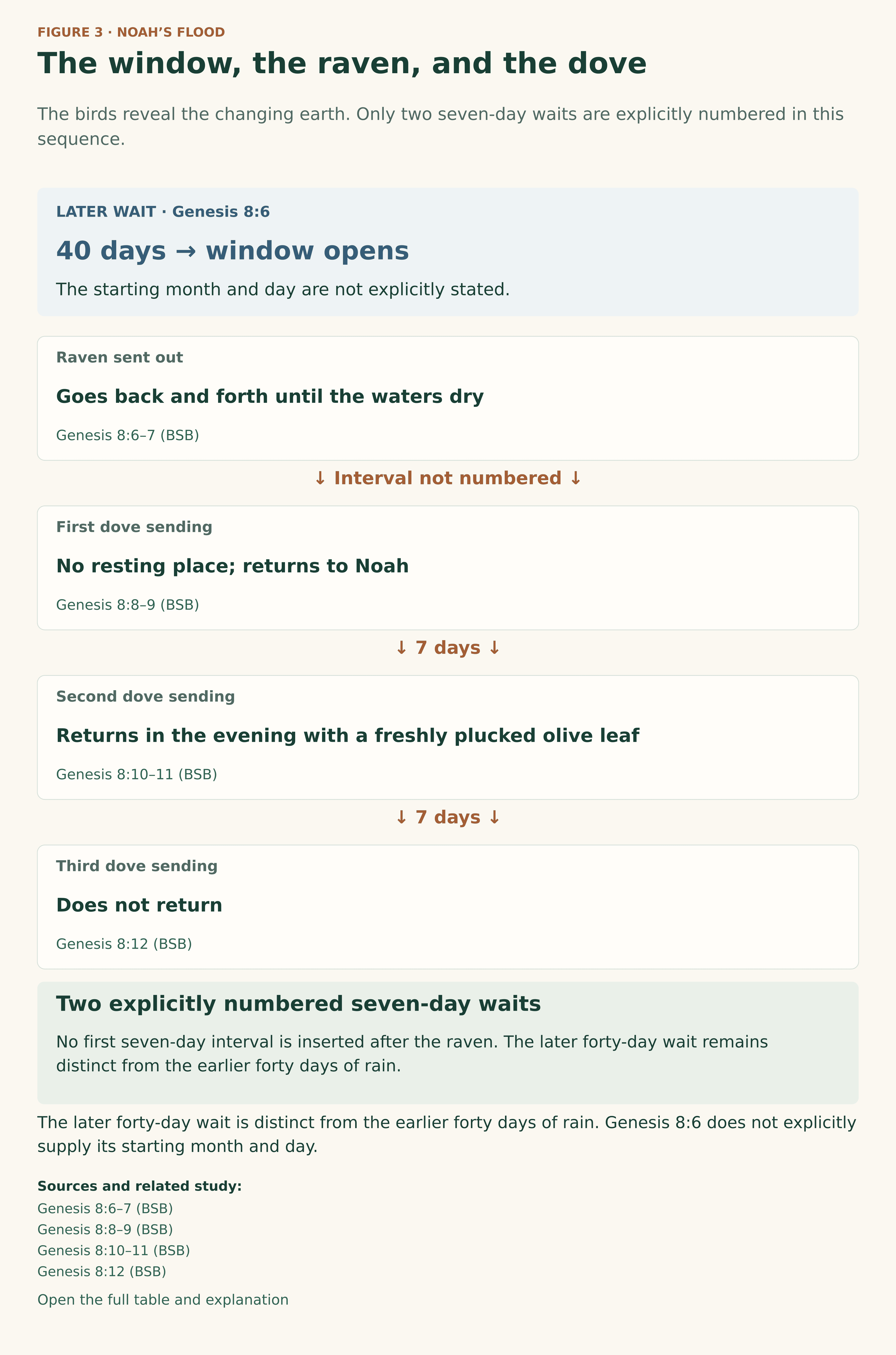
After the later forty-day wait, Noah opens the window and sends a raven. It goes back and forth until the waters dry. Noah also sends a dove, which finds no resting place and returns. After a seven-day wait, the dove returns with a freshly plucked olive leaf. After another seven days, Noah sends it again, and it does not return (Genesis 8:6–12).
Figure 3 · Noah’s Flood
The window, the raven, and the dove
The birds reveal the changing earth. Only two seven-day waits are explicitly numbered in this sequence.
LATER WAIT · GENESIS 8:6
40 days → window opens
The starting month and day are not explicitly stated.
Goes back and forth until the waters dry
Genesis 8:6–7 (BSB)↓ Interval not numbered
No resting place; returns to Noah
Genesis 8:8–9 (BSB)↓ 7 days
Returns in the evening with a freshly plucked olive leaf
Genesis 8:10–11 (BSB)↓ 7 days
Does not return
Genesis 8:12 (BSB)Sources: Genesis 8:6–7 (BSB) · Genesis 8:8–9 (BSB) · Genesis 8:10–11 (BSB) · Genesis 8:12 (BSB).
Model and calculation details
Genesis 8:6 places the window-opening after forty days. Verses 7–9 recount the raven and the first dove sending without specifying a numbered interval between them. Verses 10 and 12 each state a seven-day wait. The wording “another seven days” has prompted further reconstructions, but a first seven-day interval is not inserted into this diagram. No inferred absolute date is assigned to any bird sending.
| Sending | Reported result | Interval before sending | Source (BSB) |
|---|---|---|---|
| Raven sent out | Goes back and forth until the waters dry | After the later forty-day wait and opening of the window | Genesis 8:6–7 |
| First dove sending | No resting place; returns to Noah | No explicit numbered interval after the raven is given | Genesis 8:8–9 |
| Second dove sending | Returns in the evening with a freshly plucked olive leaf | 7 days | Genesis 8:10–11 |
| Third dove sending | Does not return | 7 days | Genesis 8:12 |
The two numbered seven-day waits occur between the three dove sendings. The passage does not explicitly give a numbered interval between the raven and the first dove. The wording about waiting seven more days may suggest an earlier weekly rhythm, but supplying a first seven-day gap remains an inference.
One reasonable reconstruction counts the later forty days from the nearest preceding dated event, the appearance of the mountain tops on month 10, day 1. On our grid, that event is 270 completed days from the beginning of Noah’s year 600. Adding forty gives 270 + 40 = 310, corresponding to month 11, day 11 under elapsed-day addition. This is a conditional calculation; Genesis does not print that date for the window opening.
Even with that starting point chosen, the raven-to-dove interval remains open. An additional seven-day assumption would change the bird dates again. Accordingly, the diagram presents the stated sequence and waits without assigning every sending an invented calendar date.
This also explains why the former 80 + 40 + 7 = 127 Flood-to-Moses alignment is not used here. Ark-rest to mountain visibility is 74 elapsed days on the selected dates. Making it eighty requires moving a boundary; completing the proposed bird sequence also requires an unstated interval. Moses’ chronological patterns can be studied on their own evidence in the Mosaic companion study.
5. Why 370 days and day 417 differ
A day’s number and an interval’s length answer different questions. At the beginning of day 1, zero complete days have elapsed. At the beginning of day 2, one has elapsed. The same distinction applies to larger chronological tables.
Let the first day of Noah’s year 600 be the year-origin. Under the flat calendar, month 2, day 17 falls after 30 + 16 = 46 completed days. It is numbered day 47. The final drying date falls after 360 + 30 + 26 = 416 completed days from that origin. It is numbered day 417.
Figure 4 · Noah’s Flood
Day 417 depends on the origin
Changing the counting origin changes the labels. The interval between the same two dates stays fixed.
Origin: Flood begins
Origin: Noah-year 600 begins
Same year origin; numbered days
Sources: Genesis 7:4, 10–11 (BSB) · Genesis 8:14 (BSB) · File 12: calendar assumptions · File 17: distinguish numerical units.
Model and calculation details
From the Flood onset, the earth-dry endpoint is 370 elapsed days later, or numbered day 371 when the onset is day 1. From 600 / 1 / 1, onset and dry earth are at 46 and 416 elapsed days, or numbered days 47 and 417. From the seven-day warning, dry earth is 377 elapsed days later, or numbered day 378; this changes the origin again. Subtracting seven from the year-origin label 417 produces 410 arithmetically but does not identify a dated Flood endpoint in Genesis.
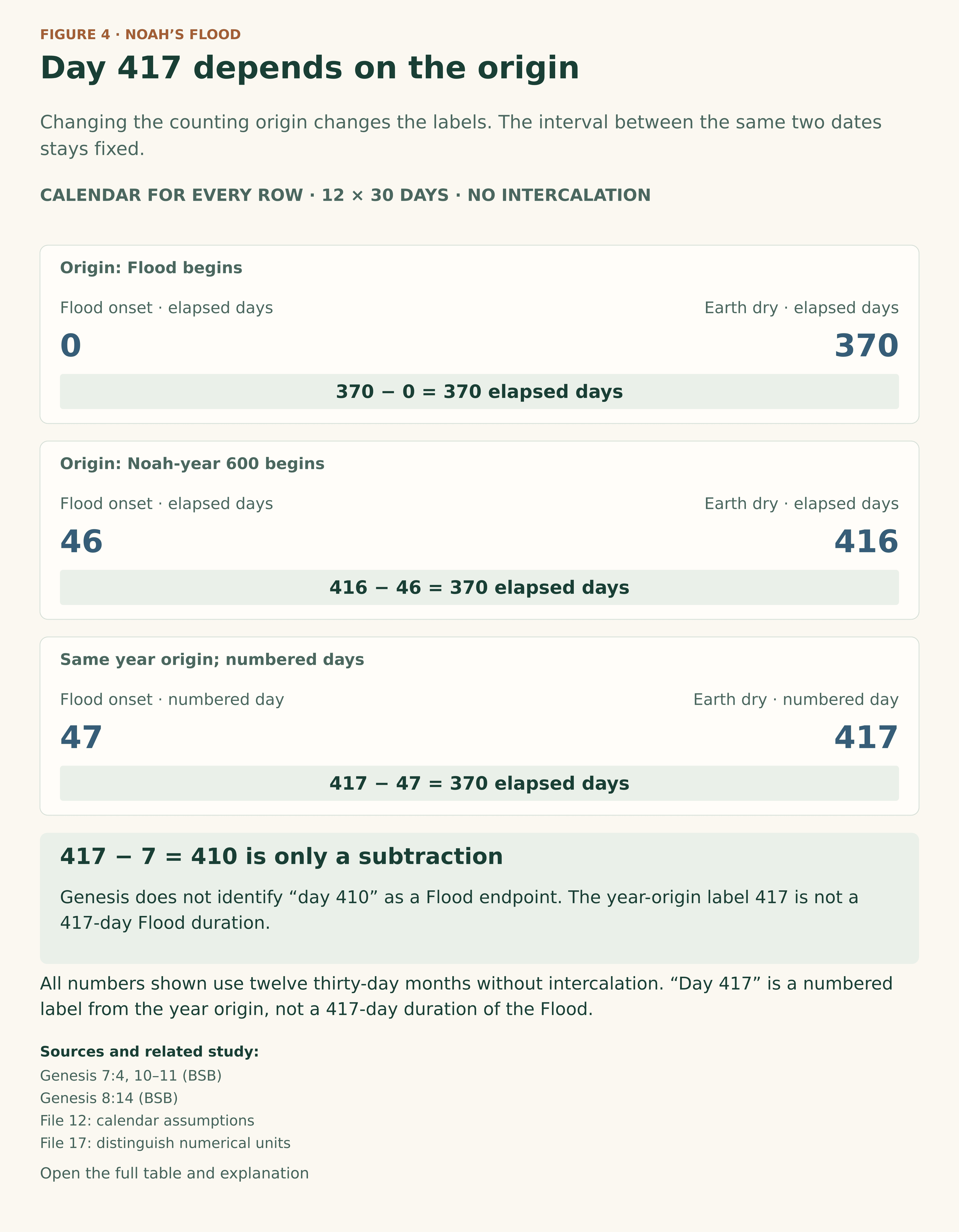
The interval from Flood onset to fully dry earth is therefore 416 − 46 = 370 days. Subtracting the consistently numbered dates gives the same result: 417 − 47 = 370. If both endpoint dates are counted as occupied days, the inclusive count is 371.
| Origin | Onset: completed days | Dry earth: completed days | Onset: numbered day | Dry earth: numbered day |
|---|---|---|---|---|
| Flood onset: year 600, month 2, day 17 | 0 | 370 | 1 | 371 |
| Start of Noah-year 600: month 1, day 1 | 46 | 416 | 47 | 417 |
| Seven-day warning before Flood onset | 7 | 377 | 8 | 378 |
The warning-origin row begins seven days before the outbreak, following Genesis 7:4, 10. Its 7 + 370 = 377 elapsed days run from the warning to fully dry earth. Changing the origin does not extend the Flood-onset interval itself. Nor does the warning prove seven continuous days of boarding: the text also describes entry on the day of the outbreak (Genesis 7:13).
The year-origin is a counting reference, not a separately narrated Creation-anniversary event. Likewise, “day 417” is a label produced by the selected origin and calendar. It is not a statement in Genesis that the Flood lasted 417 days.
6. MT and the Brenton LXX comparison
The MT-based BSB dates the outbreak and Ark-rest to the seventeenth day of their respective months. The linked Brenton English Septuagint dates both events to the twenty-seventh. The later three date markers agree in the selected editions.
Figure 5 · Noah’s Flood
MT / BSB and Brenton: matched dates
Two explicitly named textual witnesses are compared under the same flat-calendar assumption.
Sources: Genesis 7:11 (BSB) · Genesis 8:4 (BSB) · Genesis 8:5 (BSB) · Genesis 8:13 (BSB) · Genesis 8:14 (BSB) · Genesis 7:11 (Brenton) · Genesis 8:3 (Brenton) · Genesis 8:5 (Brenton) · Genesis 8:13 (Brenton) · Genesis 8:14 (Brenton).
Model and calculation details
This comparison uses the MT-based Berean Standard Bible and the eBible Brenton Septuagint reader, not a composite of all LXX witnesses. Both columns use twelve thirty-day months, no intercalation, with elapsed days counted from their own onset dates. Brenton’s Ark-rest sentence is linked at Genesis 8:3 and the mountain tops at 8:5 in this reader; the corresponding BSB locations are 8:4 and 8:5. Noah’s 600/601 labels are age-year labels. No Samaritan Pentateuch reading is asserted by this comparison.
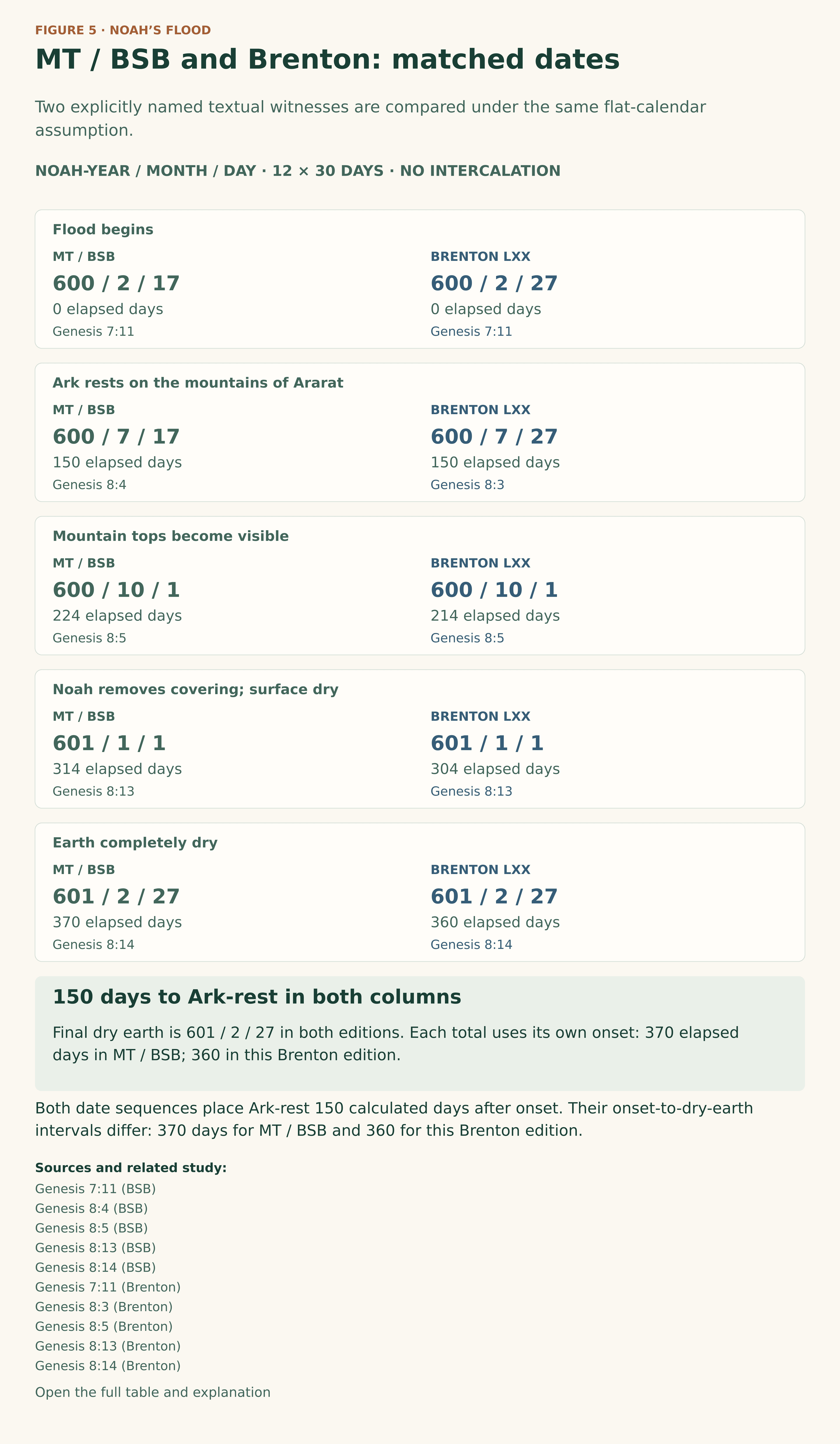
| Event | MT / BSB date | Brenton LXX date | MT elapsed | Brenton elapsed | Edition-specific sources |
|---|---|---|---|---|---|
| Flood begins | 600 / 2 / 17 | 600 / 2 / 27 | 0 | 0 | BSB Genesis 7:11; Brenton Genesis 7:11 |
| Ark rests on the mountains of Ararat | 600 / 7 / 17 | 600 / 7 / 27 | 150 | 150 | BSB Genesis 8:4; Brenton Genesis 8:3 |
| Mountain tops become visible | 600 / 10 / 1 | 600 / 10 / 1 | 224 | 214 | BSB Genesis 8:5; Brenton Genesis 8:5 |
| Noah removes covering; surface dry | 601 / 1 / 1 | 601 / 1 / 1 | 314 | 304 | BSB Genesis 8:13; Brenton Genesis 8:13 |
| Earth completely dry | 601 / 2 / 27 | 601 / 2 / 27 | 370 | 360 | BSB Genesis 8:14; Brenton Genesis 8:14 |
Each column must be calculated from its own beginning. On the same twelve-by-thirty grid, the BSB/MT dates give 370 elapsed days, while Brenton’s day-27 beginning and day-27 ending give 360. Both yield 150 days from outbreak to Ark-rest because their opening and resting dates retain a five-month interval.
The ten-day difference in the later offsets follows from the different outbreak dates. It is not a license to combine an MT beginning with a Greek resting date. Nor does this selected English LXX edition establish the readings of every Greek witness. No SP date column is inferred from either one.
Verse placement also matters. In the linked eBible Brenton edition, the Ark-rest clause appears within Genesis 8:3, where the BSB has 8:4. The mountain-top date is Genesis 8:5 in Brenton and 8:5 in the BSB. The edition-specific links in the table preserve that distinction.
7. What the 410/417 construction requires
The older presentation built a second chronological structure around 410 and 417. Its calendar labels alternated between numbered days and completed days: the outbreak appeared as day 47, the mountain-top date as day 270, the following New Year as day 360, and the final drying date as day 417. A consistent table must instead use either 47, 197, 271, 361, 417 as numbered dates or 46, 196, 270, 360, 416 as completed-day offsets from the same year-origin.
Subtracting seven from the final ordinal label gives 417 − 7 = 410. That subtraction is valid arithmetic, but it does not establish a 410-day Flood duration. Subtracting seven from the corresponding elapsed coordinate gives 416 − 7 = 409. A symbolic projection using 410 must therefore explain why it selects the ordinal convention, what the seven represents, and which event each endpoint denotes.
Doubling introduces a separate question: are the spans adjacent, separated by seven, or overlapping by seven? The answers produce different totals.
Figure 6 · Noah’s Flood
Adjacent spans, gaps and overlaps
Algebraic comparisons only: these bars do not represent dated intervals in the Flood narrative.
Adjacent spans
410 + 410 = 820
No gap or overlap.
With a seven-unit gap
410 + 7 + 410 = 827
Copper: seven-unit gap.
With a seven-unit overlap
410 + 410 − 7 = 813
Copper: seven-unit overlap.
Longer spans, same overlap
417 + 417 − 7 = 827
Copper: seven-unit overlap.
Sources: File 17: distinguish numerical units.
Model and calculation details
All bars use the same proportional scale of arbitrary units. Green is the first span and blue is the second. Copper marks a seven-unit gap or overlap where present. Adjacent spans: 410 + 410 = 820. A gap: 410 + 7 + 410 = 827. An overlap: 410 + 410 − 7 = 813. Enlarged overlapping spans: 417 + 417 − 7 = 827. These operations clarify the legacy arithmetic without assigning 410 or 417 as the elapsed duration of the Flood. Numerical agreement alone does not select a historical or theological model.
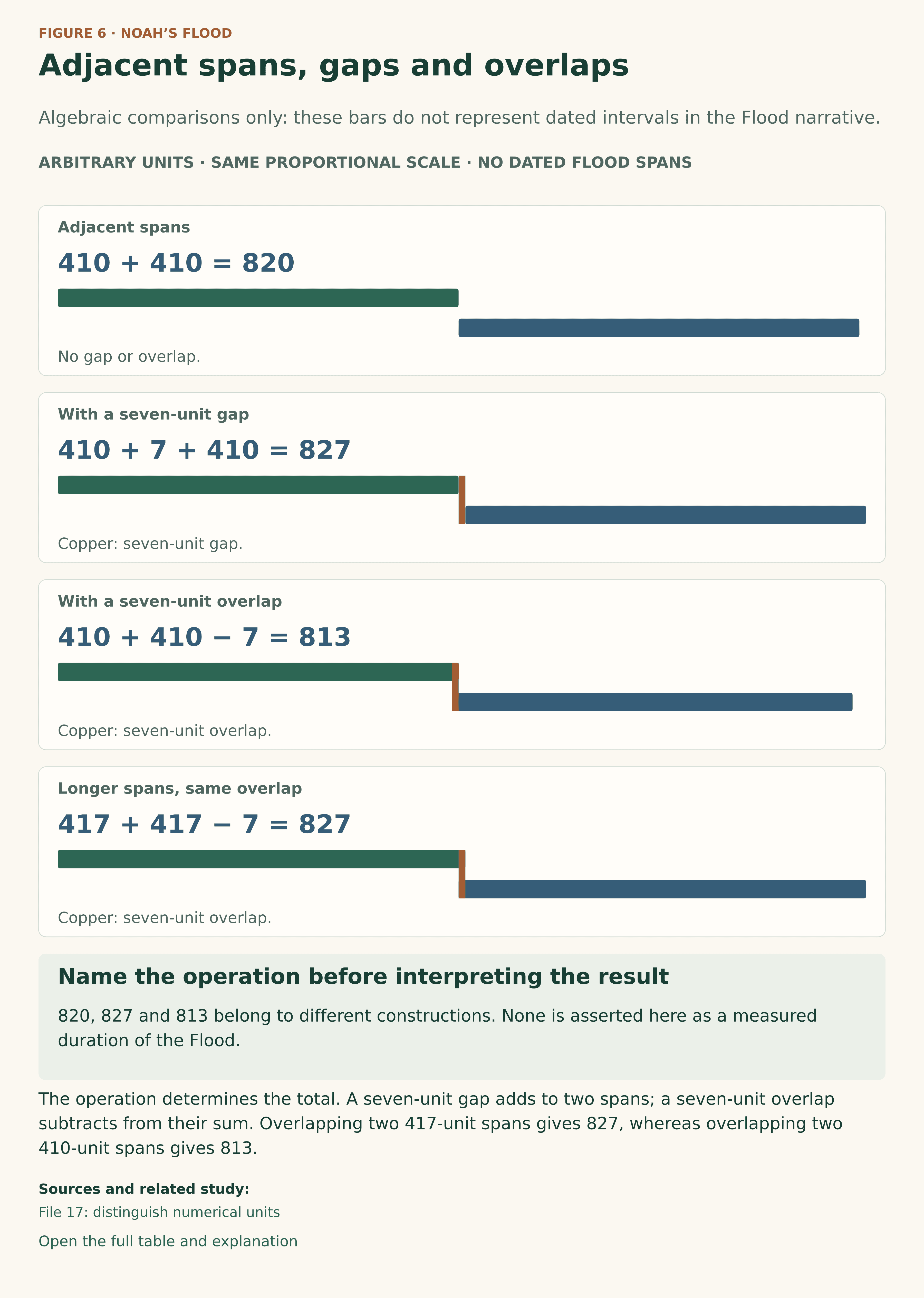
| Construction | Calculation | Covered units | Meaning |
|---|---|---|---|
| Two adjacent 410-unit spans | 410 + 410 = 820 | 820 | No overlap or intervening gap |
| Two 410-unit spans with a 7-unit gap | 410 + 7 + 410 = 827 | 827 | The middle seven is added |
| Two 410-unit spans sharing 7 units | 410 + 410 − 7 = 813 | 813 | The shared seven is counted once |
| Two 417-unit spans sharing 7 units | 417 + 417 − 7 = 827 | 827 | A different pair of spans produces the same 827 total |
In particular, 410 + 7 + 410 = 827, whereas two 410-unit spans sharing seven cover 813. Two 417-unit spans sharing seven also cover 827, but their component spans are different. Calling all these arrangements the same shared-week structure conceals a change in the operation.
These distinctions prevent the old duplicated date matrix from serving as the evidence for the article. A date reached by selecting an origin, choosing ordinal or elapsed counting, moving a week boundary and adding another chronological adjustment is a result of those choices. Its correspondence with a familiar biblical date still needs independent evaluation.
For the same reason, a percentage of supposedly covered weeks cannot establish that the alignments exceed chance. Such a claim would require a defined set of eligible events, fixed selection rules and a comparison model. The useful task here is to make the chronology and its assumptions visible.
8. When days represent years
Scripture sometimes explicitly relates days to years. Numbers provides a clear example:
In keeping with the forty days you spied out the land, you shall bear your guilt forty years—a year for each day—and you will experience My alienation.
The relation belongs to the spies’ forty days and Israel’s forty years of judgment. In Ezekiel 4:4–6, the MT-based text assigns days for years in the prophet’s sign-act: 390 and forty, giving 390 + 40 = 430. These passages establish particular correspondences with named subjects and instructions.
They also provide a basis for exploring analogous biblical patterns. Genesis 7–8, however, gives no corresponding command to turn every Flood date into a year. A proposed mapping must state its starting date, chronological setting, counting convention and transformation. File 17, §§0.3–0.6 supplies the relevant discipline: recurring components do not automatically become universal operators.
The same care applies to the 120 years in Genesis 6:3. File 23, §5.5 retains a theological and structural reading in which they represent a warning before the Flood. With Noah aged 600 at the Flood, this gives 600 − 120 = 480 for the proposed warning age. It can be compared with Moses’ lifespan of 120 years (Deuteronomy 34:7).
The calculation depends on interpreting the 120 years as that warning interval. Genesis does not state that Ark construction began at Noah’s age 480 or lasted exactly 120 years. Keeping the qualification allows the canonical comparison to remain useful without assigning the construction a date the narrative does not supply.
9. Noah, Shem and the BC settings
The narrative’s year/month/day labels are primary for the Flood calendar. When translating them into the site’s BC chronology, the normal regular MT setting is 2458–2457 BC, with the full 430 years in Egypt, the +60 Terah adjustment off, and no restored second Cainan. This is the Gear-2 setting in File 02, §0.4 and File 18, §3.1.4.
Here “Gear” names a defined two-year placement of the earlier chronological coordinates. Each Flood pair identifies its model start and following-year close. It is not a conversion of the 370-day calculation into a different lifespan.
| MT setting | Noah’s birth BC | Noah-bound Shem birth BC | Flood start → close BC | Fixed Arphaxad BC |
|---|---|---|---|---|
| Gear 2 · default | 3058 | 2558 | 2458 → 2457 | 2456 |
| Gear 1 | 3056 | 2556 | 2456 → 2455 | 2456 |
| Gear 3 | 3060 | 2560 | 2460 → 2459 | 2456 |
At these held settings, Arphaxad remains at 2456 BC. Regular Gear changes do not move the entire subsequent genealogy. In particular, Jacob’s entry into Egypt remains 1876 BC, and 1876 − 1446 = 430 to the Exodus. The two years already elapsed in Joseph’s famine cannot be used to relabel that entry as 1878 merely to preserve a Flood-derived alignment.
Shem’s two principal coordinates require an additional explanation:
This is the account of Shem. Two years after the flood, when Shem was 100 years old, he became the father of Arphaxad.
The 2556 BC Shem coordinate is the Arphaxad-bound setting: 2556 − 2456 = 100. Compared with the default Flood onset, it gives 2556 − 2458 = 98. The 2558 BC coordinate belongs to the Gear-2 Noah-bound comparison, where 2558 − 2458 = 100. These are named bindings preserved by the canonical framework, not interchangeable readings of a single calculation. The Restart Capsule, §10.31 distinguishes the Gear-2 birth reference from the Gear-1 covenant-line station.
A bounded 150-year comparison
Noah’s lifespan is 950 years (Genesis 9:28–29); Shem’s is 100 + 500 = 600 (Genesis 11:10–11). The canonical biographies permit a straightforward comparison when the endpoints are kept in matched settings.
Figure 7 · Noah’s Flood
Noah and Shem: a 150-year comparison
A coherent Noah-bound Gear-2 pair: canonical biographies first, numerical comparison second.
NOAH · 950 YEARS
3058 → 2108 BC
Same scale: 3058 → 1958 BC
SHEM · 600 YEARS
2558 → 1958 BC
Same scale: 3058 → 1958 BC
2108 − 1958 = 150 years. The births are 500 years apart: 3058 − 2558 = 500.
Paired Noah-bound Gear 1: Noah 3056–2106 BC; Shem 2556–1956 BC. The deaths remain 150 years apart. Keep each pair together.
Sources: Genesis 9:28–29 (BSB) · Genesis 11:10–11 (BSB) · File 02 §6.2: Noah-bound harmonic alignment · File 18 §3.1.4: Flood Gears and fixed Arphaxad.
Model and calculation details
This figure uses the regular MT chronology, 430 years in Egypt, no +60 Terah extension, and no restored second Cainan. The paired Noah-bound Gear-2 biographies give Noah 950 years and Shem 600 years, with births 500 years apart and deaths 150 years apart. Genesis 9:28–29 supplies Noah’s 350 years after the Flood and 950 total; Genesis 11:10–11 supplies Shem’s begetting at 100 and 500 further years. The BC coordinates and boundary alignment are the canonical model’s construction, not numbers printed in those verses. The corresponding Noah-bound Gear-1 pair is Noah 3056–2106 BC and Shem 2556–1956 BC, again with a 150-year death interval. Do not mix members of different pairs. The equality of the death interval in years and the Flood’s waters period in days is a numerical comparison, not evidence that Genesis converts days into years.
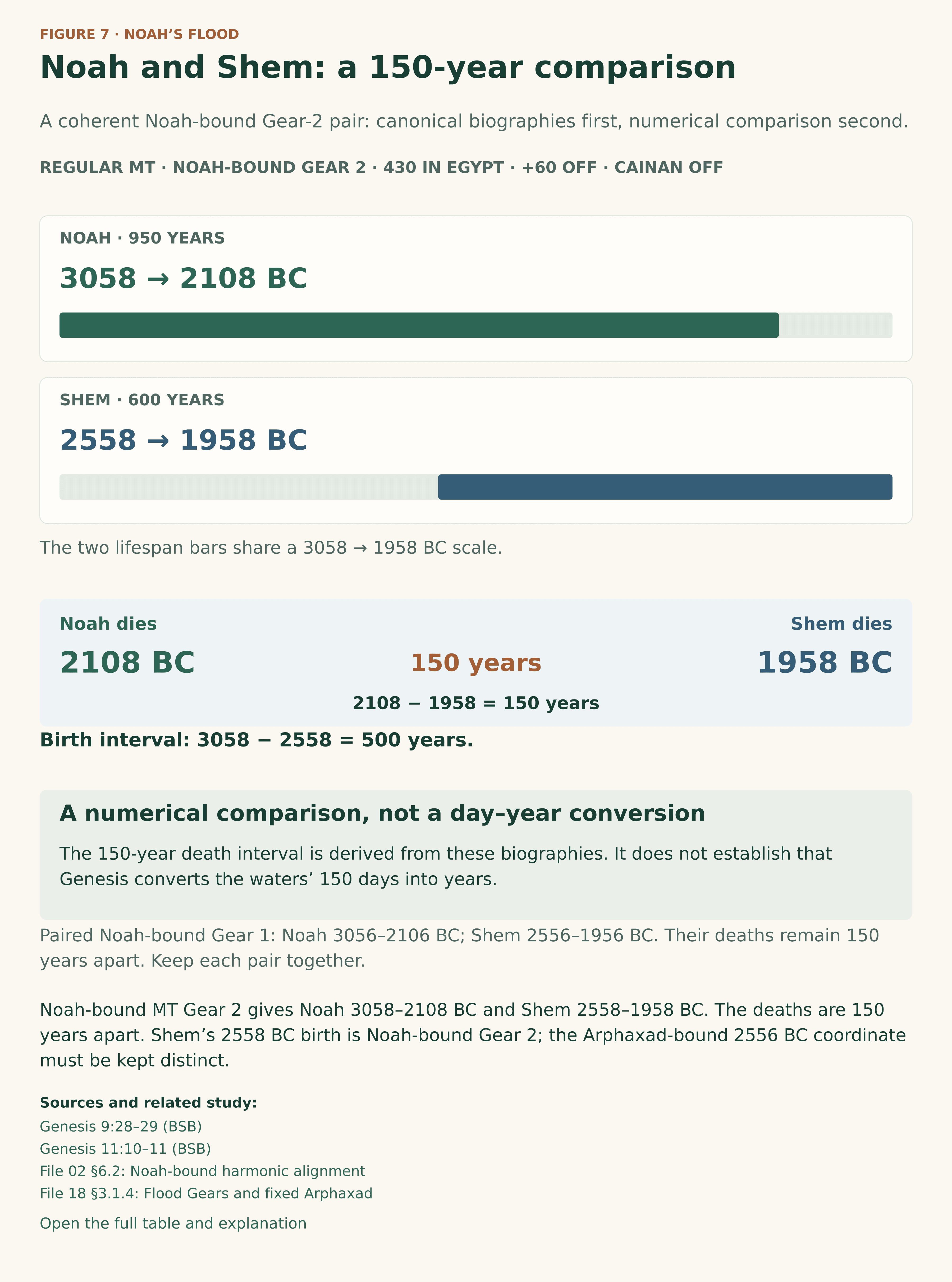
| Setting | Person | Birth BC | Death BC | Lifespan |
|---|---|---|---|---|
| Gear 2 | Noah | 3058 | 2108 | 950 |
| Gear 2 | Shem | 2558 | 1958 | 600 |
| Gear 1 | Noah | 3056 | 2106 | 950 |
| Gear 1 | Shem | 2556 | 1956 | 600 |
For Gear 2, the death interval is 2108 − 1958 = 150 years. For the matched Gear-1 biographies, it is 2106 − 1956 = 150 years. These are new calculations from the canonical rows in File 02, §6.2, read with File 18’s Gear controls. The 150-year result remains stable when both biographies move together.
Mixing endpoints would give 2108 − 1956 = 152 or 2106 − 1958 = 148. That is why the setting belongs beside the arithmetic. The matched 150-year interval offers a numerical comparison with the Flood’s 150 days; its theological significance remains an interpretation. It does not independently authorize a complete day-to-year projection of the Flood calendar.
The optional +60 Terah adjustment is another distinct operation. Applied to the Gear-2 Flood coordinate, it gives 2458 + 60 = 2518 BC; applied to Gear 1, it gives 2456 + 60 = 2516 BC. Thus 2516 is a named alternative, not the default MT Flood date. Ark height and the 120-year warning interpretation do not themselves require choosing it.
10. Shem to the Conquest: a canonical comparison
One of the original study’s broader connections can be retained independently of the 410/417 construction. File 17, §9.4 explicitly gives:
2556 BC → 1406 BC → 1399 BC = 1150 + 7 years.
The starting point is the Gear-1, Arphaxad-bound Shem coordinate in the full-430 MT comparison. The Conquest begins in 1406 BC; 1399 BC marks the canonical terminal land-rest endpoint. The corresponding comparison from the Gear-2 Shem coordinate is 2558 − 1406 = 1152 years. Its two-year difference must remain visible.
| Comparison | From BC | To BC | Years | Status |
|---|---|---|---|---|
| Matched Gear-2 Noah and Shem deaths | 2108 | 1958 | 150 | Derived arithmetic from canonical biographies; comparison with the Flood’s 150 days remains typological |
| Matched Gear-1 Noah and Shem deaths | 2106 | 1956 | 150 | Named alternative; not a correction of the Gear-2 default |
| Gear-1 / Arphaxad-bound Shem to Conquest | 2556 | 1406 | 1150 | Explicit File 17 §9.4 comparison; not derived from 417 or 410 |
| Gear-2 Shem to Conquest | 2558 | 1406 | 1152 | Default coordinate comparison; preserves the two-year distinction |
| Conquest to land-rest endpoint | 1406 | 1399 | 7 | File 18 §2.4: six years of war, 1406–1400; first Sabbath, 1399 |
| Jacob enters Egypt to Exodus | 1876 | 1446 | 430 | Fixed downstream full-430 MT chronology; regular Gear does not move Egypt entry |
File 18, §2.4 distinguishes six years of war, 1406–1400 BC, from the first Sabbath in 1399 BC. The latter supplies the terminal coordinate in the seven-year comparison. Joshua 14:15 narrates the land’s rest from war; it does not print a BC date or a seven-year duration. Those belong to the reconstructed chronology.
The produce eaten after the first Passover in Canaan belongs to the opening of the Conquest (Joshua 5:10–12). It must remain distinct from the later land-rest endpoint. The olive leaf and the produce of the land can be compared as signs of life and provision, but their narrative positions should not be moved to create an exact synchronization.
This Shem-to-Conquest comparison has a clear canonical basis and a defined starting coordinate. It neither depends on the disputed doubled Flood matrix nor turns the 1150-year interval into a duration stated in Genesis. Its interpretive interest is the movement from the preserved family of Noah toward Israel’s entry and rest in the land.
11. Judgment, preservation and renewal
The Flood’s theological structure is clearest in the narrative itself. God preserves life through judgment, remembers Noah, brings the waters down and commands a new beginning. The dove’s olive leaf gives Noah evidence of the changing earth. The family’s departure leads to an altar, the assurance of the earth’s continuing rhythms, and the covenant sign of the rainbow (Genesis 8:20–22; 9:8–17).
The link with Moses also has a textual foundation. The Hebrew tebah names Noah’s Ark and the vessel in which the infant Moses is placed (Genesis 6:14; Exodus 2:3). These two narrative settings connect preservation through water with a future deliverance. File 23, §1 treats that connection as typological: it helps explain the comparison’s meaning without creating an automatic chronological operator.
The New Testament itself makes a further connection between the eight people saved through water and baptism (1 Peter 3:20–21). This is an explicit interpretive use of the Flood. The numerical study can accompany such readings while keeping the different levels of evidence distinct.
The dated sequence consequently has value before any long-range projection is proposed. Forty days describe the rain; 150 describes the longer waters period; the later dates trace a gradual emergence into a renewed world. The carefully qualified 150-year and 1150 + 7-year comparisons extend that inquiry into the canonical chronology. Their value lies in showing their sources and operations clearly enough for readers to examine them.
12. Sources and downloadable tables
The main Scripture text is the Berean Standard Bible at eBible. The comparative Greek-tradition dates come from the specifically identified Brenton English Septuagint, Genesis 7 and Genesis 8. Quoted wording retains the translation’s number formatting; digit-based calculations are presented separately.
The controlling chronological sources are File 02: Flood integration, File 12: Calendrical Physics, File 17: Prophetic Time-Span Anatomy, File 18: Chronological Data Tables, File 23: The Tebah Protocol, and the current Restart Capsule. Section references above identify their particular roles.
Download the underlying tables: dated events, stated durations, dated intervals, bird sequence, counting origins, MT/Brenton comparison, overlap arithmetic, MT Gear settings, Noah–Shem biographies, and canonical comparisons.
For related reading, see the Ark-dimensions study, the Mosaic bookend, and the Conquest study.
The separately identified Brenton English Septuagint readings are paraphrased from the public-domain edition at eBible. Calculations and chronological interpretations are the author’s explanatory material.
Scripture quotations: Berean Standard Bible (BSB), public domain.