In keeping with the forty days you spied out the land, you shall bear your guilt forty years—a year for each day—and you will experience My alienation.
Numbers 14:34, Berean Standard Bible (BSB)
Numbers gives a direct connection between days and years: Israel’s forty-day reconnaissance becomes the measure of its wilderness sentence. Around that explicit relationship stand other forties—Moses’ three periods of forty years, the Flood’s forty days of rain, the mountain encounters at Sinai, and the purification periods in Leviticus. Together they make the Exodus a natural place to examine how biblical narrative and numerical structure meet.
This detailed companion to Moses and the Exodus: Forty Days, Forty Years develops those connections in prose, tables and diagrams. It also examines the dated events behind the older Mosaic timetable. The aim is to preserve the strongest comparisons while making every transition visible: from a biblical duration to a chronological date, from a date to a calendar count, and from that count to a proposed symbolic application.
The governing chronology is the site’s normal MT model: 430 years in Egypt, the Exodus in 1446 BC, and Moses’ death and the opening of the Conquest in 1406 BC. The default alignment is Nisan. Neither the optional +60 Terah adjustment nor a restored second Cainan is active. These settings matter because a numerical correspondence is meaningful only when its dates belong to the same declared chronology.
1. Four kinds of evidence
The argument uses four related kinds of information. Keeping them distinct makes the resulting patterns easier to evaluate.
| Kind of evidence | Example | What it establishes |
|---|---|---|
| Biblical datum | The spies return after forty days; Moses dies at 120 | A duration or age stated in the passage |
| Chronological coordinate | Moses’ birth at 1526 BC in the normal model | A date derived within the site’s coordinated chronology |
| Calendar calculation | Year 2, month 2, day 20 falls 409 completed days after the chosen origin in a flat 360-day scheme | An exact result under stated calendar and counting assumptions |
| Symbolic comparison | The Levitical 80 days placed beside Moses’ final 80 years | An interpretation connecting separately established quantities |
These categories can work together. A typological reading need not be dismissed because it is interpretive; it should be described as an interpretation. Equally, an exact sum does not establish every theological conclusion proposed for it. The sum, the choice of endpoints and the meaning assigned to their relationship are separate matters.
Files 14 and 17 make this distinction part of the canonical method. File 14 identifies its purification comparisons as typological; File 17 distinguishes textual spans from inferred component structures. File 55 adds a further safeguard: a mathematical procedure can guarantee some numerical properties before any historical input is considered. Those guaranteed properties cannot be counted again as independent evidence of intentional design.
2. Moses’ three forties
Stephen’s account supplies the first two divisions of Moses’ life. Moses was forty when he visited his fellow Israelites. After the rejection that led to his flight, another forty years passed before the encounter at the burning bush (Acts 7:23–30, BSB). Exodus places him at eighty when he and Aaron spoke to Pharaoh (Exodus 7:7, BSB). Stephen then names forty years in the wilderness, and Deuteronomy gives Moses’ age at death as 120 (Acts 7:36; Deuteronomy 34:7, BSB).
Figure 1 · Moses and the Exodus
Moses’ life: three forties
Four model dates enclose three equal intervals. Scripture supplies the ages and narrative sequence.
1. Birth
1526 BC
Age 0
2. Age forty / Midian
1486 BC
Age 40
3. Exodus
1446 BC
Age 80
4. Death / Conquest opens
1406 BC
Age 120
Egypt40 years
Midian40 years
Wilderness
Sources: Acts 7:23–30 (BSB) · Acts 7:36 (BSB) · Exodus 7:7 (BSB) · Deuteronomy 34:7 (BSB) · File 55 §1.2.
Model and calculation details
Normal MT, Nisan default. 1526–1486–1446–1406 BC. The first forty ends in the age-forty visit and flight; Acts 7:30 supplies the next forty, and Acts 7:36 the wilderness forty. No precise day of birth or death is inferred.
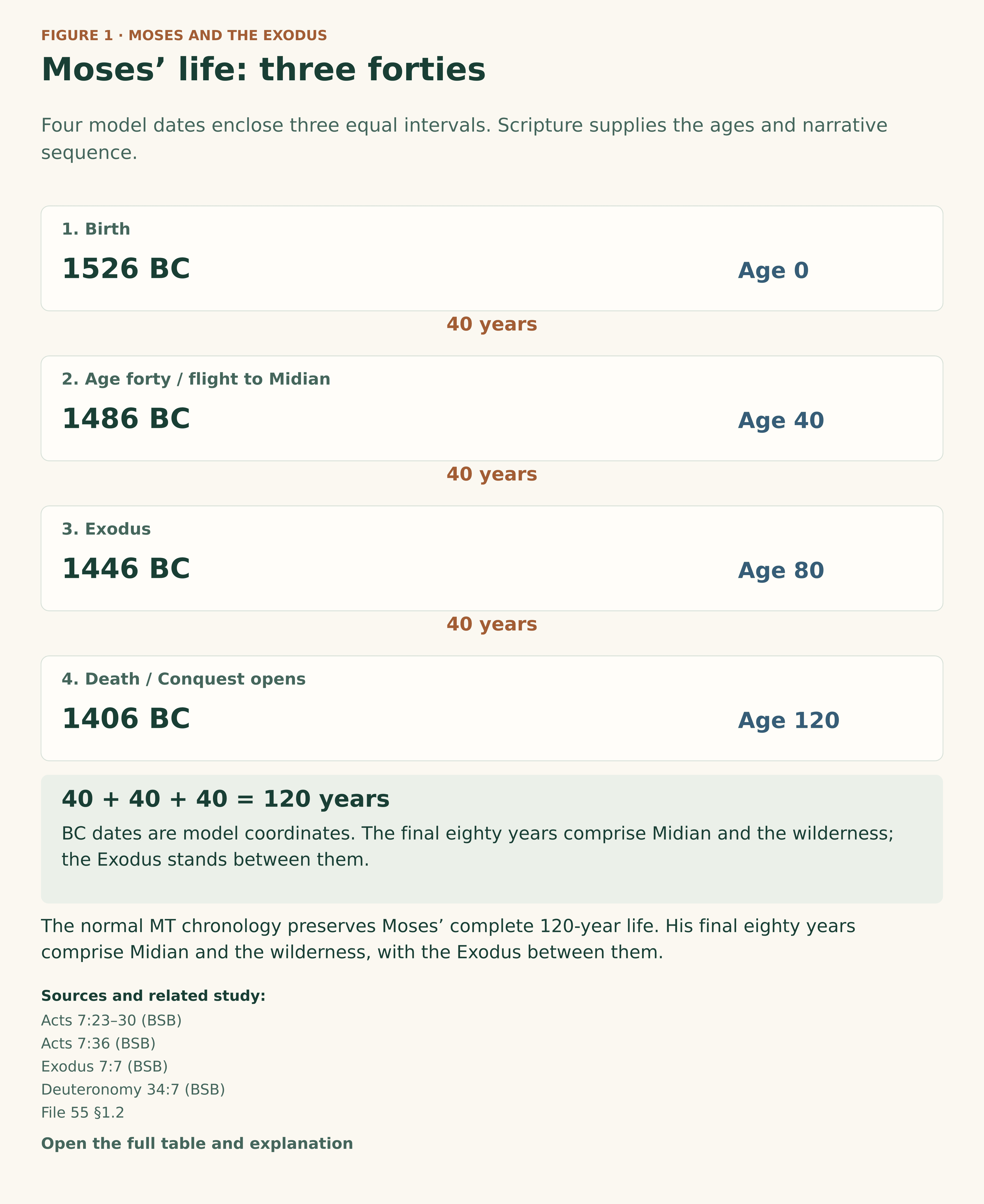
| Event | Model date BC | Age | Biblical basis (BSB) |
|---|---|---|---|
| Moses born | 1526 | 0 | Acts 7:20; chronological derivation |
| Age forty; flight to Midian | 1486 | 40 | Acts 7:23–30 |
| Exodus; Moses at eighty | 1446 | 80 | Exodus 7:7; Acts 7:30, 36 |
| Moses dies; Conquest opens | 1406 | 120 | Deuteronomy 34:7; Joshua 4:19 |
The BC labels follow the normal chronology’s Exodus and Conquest anchors:
1526 − 1486 = 40
1486 − 1446 = 40
1446 − 1406 = 40
1526 − 1406 = 120 years.
These are annual coordinates. They organize the biblical ages and periods without claiming that Scripture supplies an exact birthday for each boundary. The model also places Moses’ death and Joshua’s crossing in the same annual frame; it does not place them on the same day.
Two overlapping structures are therefore available. The whole life is 40 + 40 + 40. The final eighty years are 40 + 40, with the Exodus at the center:
1486 → 1446 → 1406 BC.
Moses spends the first of those two forties in preparation away from Egypt; Israel spends the second in the wilderness after deliverance. This arrangement becomes the basis of File 14’s purification comparison and File 55’s mathematical primer. Neither application changes his actual lifespan. Selecting an eighty-year portion is an operation on the biography, not a claim that Moses lived only eighty years.
Download the chronology table.
3. The direct day–year instruction
Numbers 14:34 is the strongest starting point because the passage itself relates a day to a year. The spies’ forty days are stated in Numbers 13:25, BSB; the wilderness judgment gives those days a corresponding measure in years. Ezekiel receives another explicit assignment of days to years in the instructions for his enacted sign (Ezekiel 4:4–6, BSB).
The Flood’s rain and Moses’ Sinai encounters are different cases. Genesis states forty days and nights of rain; Exodus states forty days and nights on the mountain (Genesis 7:12; Exodus 24:18, BSB). Their common duration makes comparison possible. Those verses do not themselves instruct the reader to convert their days into forty historical years.
Figure 2 · Moses and the Exodus
The same number, distinct events
Shared forty-day durations invite comparison; Numbers explicitly assigns forty years to the spies’ forty days.
Repeated narrative durations
Flood rainfall
40 days and nights
Genesis 7:12
Moses on Sinai
40 days and nights
Exodus 24:18
Explicit day–year correspondence · Numbers 14:34
Spies: 40 days
↓ a year assigned for each day ↓
Wilderness: 40 years
Sources: Genesis 7:12 (BSB) · Exodus 24:18 (BSB) · Numbers 13:25 (BSB) · Numbers 14:34 (BSB).
Model and calculation details
Genesis 7:12 refers to rainfall, not the full Flood duration. Exodus 24:18 refers to a mountain stay, not a complete harmonized Sinai schedule. Numbers 13:25 states the reconnaissance duration; Numbers 14:34 explicitly relates it to years.
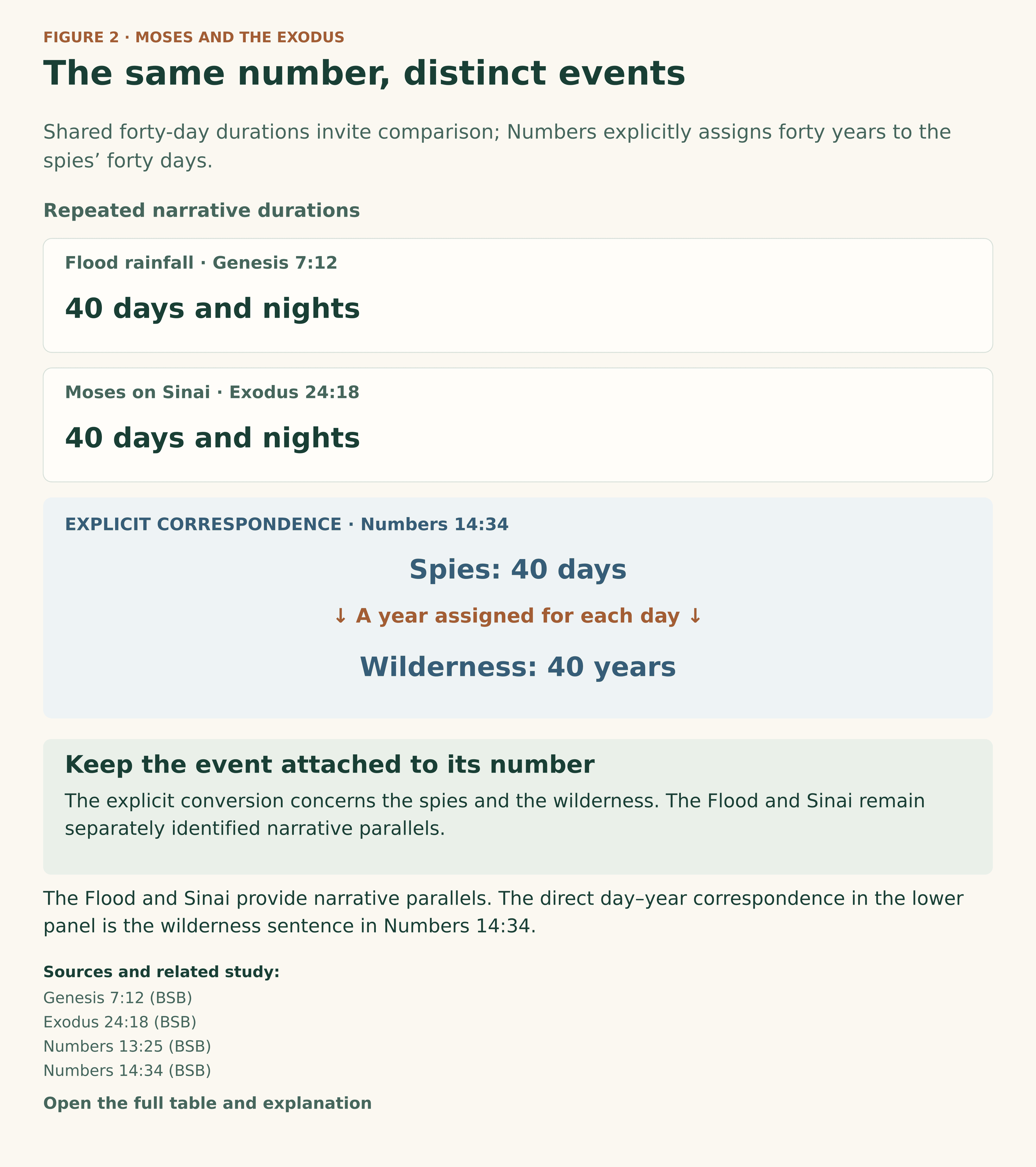
The distinction also protects the wilderness chronology. The spies go out after Israel’s second-year departure from Sinai. If the judgment were treated as forty additional complete years beginning after that second year, the result would no longer fit the established Exodus-to-entry frame. Deuteronomy explicitly gives 38 years from Kadesh-barnea to the crossing of the Brook of Zered (Deuteronomy 2:14, BSB). The canonical model retains 1446–1406 BC as the whole wilderness era.
That is an annual framework, not a claim of forty complete anniversaries between the precise departure and Jordan-crossing dates. The departure is dated to the fifteenth day of the first month, and the crossing to the tenth day of that month (Numbers 33:3; Joshua 4:19, BSB). Under the flat calendar calculation in §6, the crossing falls five days before the fortieth anniversary of the departure. Narrative year labels, annual BC coordinates and exact intervals answer different questions.
4. Egypt and Ezekiel: 390 + 40
The normal MT model places Jacob’s entry into Egypt at 1876 BC. Moses’ flight follows at 1486 BC, and the Exodus at 1446 BC. This produces a particularly clear division:
| Interval in the normal MT model | Calculation | Duration |
|---|---|---|
| Jacob enters Egypt → Moses flees | 1876 − 1486 | 390 years |
| Moses in Midian → Exodus | 1486 − 1446 | 40 years |
| Entire Egyptian sojourn | 1876 − 1446 | 430 years |
| Exodus → Moses’ death / Conquest opening | 1446 − 1406 | 40 years |
The final forty of the Egyptian sojourn and the forty in the wilderness are consecutive. They are not the same interval. During the first, Moses is in Midian while Israel remains in Egypt; during the second, Moses leads Israel after the Exodus.
The MT reading of Exodus 12:40–41, BSB supplies the 430-year Egyptian stay. The partition at Moses’ flight is a calculation from the chronology. The 390 is therefore a derived segment, whereas the 430 is a textual total interpreted in the stated sojourn setting.
In Ezekiel’s MT sign, 390 days are assigned to Israel and 40 days to Judah. The sign’s days represent years, giving the same numerical form:
390 + 40 = 430.
Figure 3 · Moses and the Exodus
A shared 390 + 40 structure
MT Ezekiel’s sign-days and the normal MT Egyptian-sojourn model retain separate units and contexts.
MT sign · days
390 + 40 = 430 days
Normal Egypt model · years
390 + 40 = 430 years
Sources: Ezekiel 4:5–6 (BSB) · Exodus 12:40–41 (BSB) · File 17 §16.2 · File 18 §§2.3–2.4.
Model and calculation details
Ezekiel 4:5–6 (MT / BSB): 390 days for Israel, then 40 for Judah. Normal Egypt-only 430 model: 1876–1486=390; 1486–1446=40. Ezekiel does not identify his burden-years with these Egyptian segments. SP/LXX sojourn alternatives and LXX Ezekiel readings are separate comparisons.
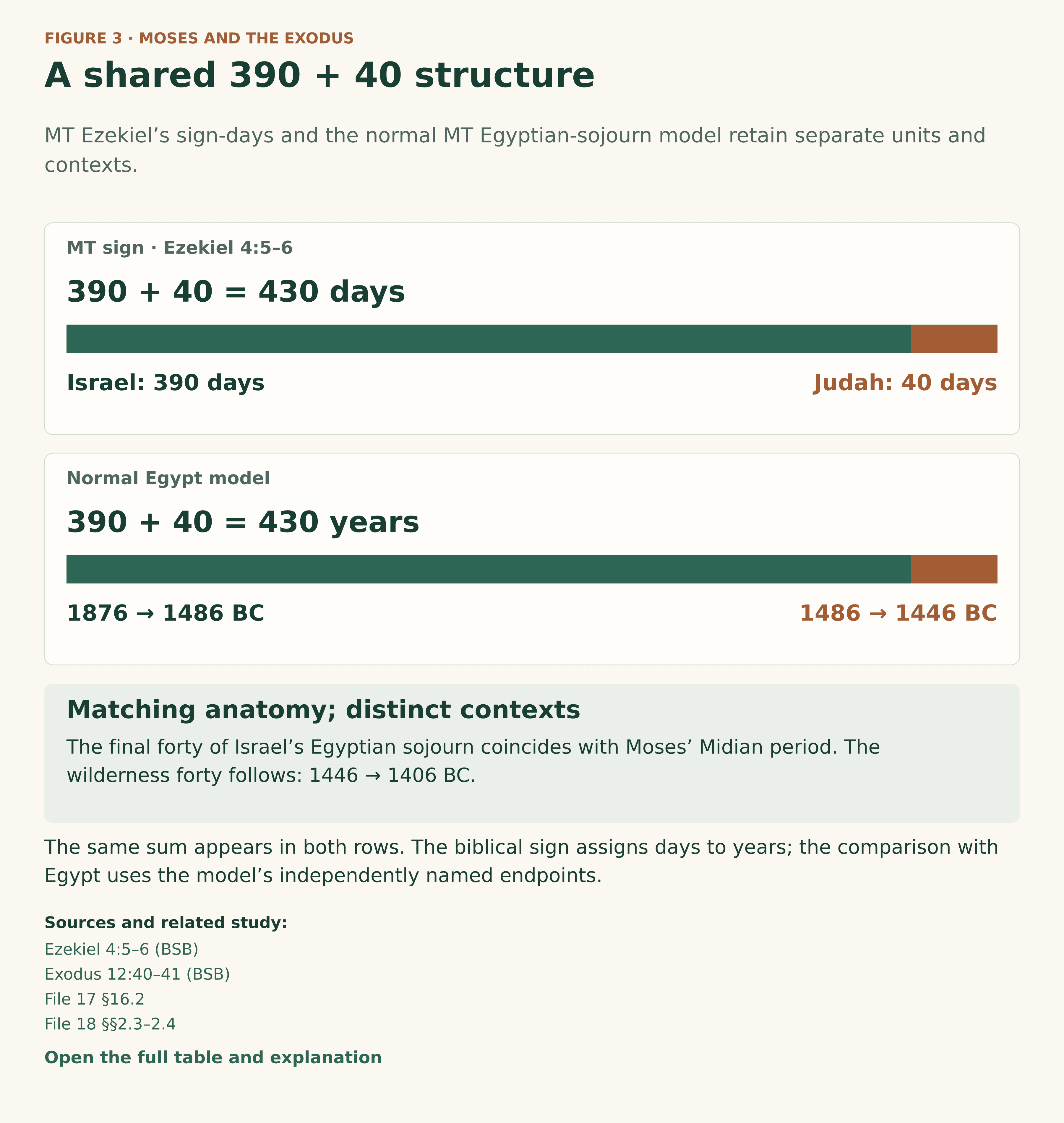
The match is exact, but the identification of its contexts remains interpretive. Ezekiel does not name Jacob’s arrival and Moses’ flight as the endpoints of his 390-year burden. The parallel shows the same numerical anatomy in the prophetic sign and the Egyptian chronology; it does not establish that they describe one historical interval.
Why the textual tradition matters
The diagram is explicitly MT. The SP and LXX readings of the sojourn include Canaan in their framing and support a different distribution in the repository’s minimum Egyptian-sojourn setting. File 18’s minimum date for Jacob’s entry is 1661 BC; restoring the normal Egyptian stay adds 215 to the affected patriarchal dates:
1661 + 215 = 1876 BC.
The Exodus remains fixed at 1446 BC. Consequently, 1661 − 1446 = 215 and 1876 − 1446 = 430 describe two declared settings. One cannot take the Egypt-entry date from the first and retain the 390 + 40 partition from the second.
Ezekiel’s Greek tradition likewise requires separate treatment. File 17 §3 uses 150 + 40 = 190 for its LXX component comparison. Brenton’s Septuagint translation, Ezekiel 4:4–9, gives 150 days in verse 4 and 40 in verse 6; it also gives 190 days in verses 5 and 9. The equation describes the model’s selected component comparison, not a claim that the chapter simply substitutes 150 for 390 throughout. These readings remain distinct from the BSB’s MT-based 390 + 40 = 430, and the study does not claim that every Greek witness has identical wording.
File 17 also observes component identities such as 390 = 360 + 30. This is a calendar-related decomposition. Its arithmetic does not prove that the particular Exodus year being examined contained an inserted month. A component pattern and an actual calendar reconstruction require separate evidence.
5. The Levitical 40/80 comparison
Leviticus 12:2–5, BSB describes an initial period after childbirth and a following period of purification. For a son, the periods are seven and thirty-three days. For a daughter, they are two weeks and sixty-six days. In analytical notation:
7 + 33 = 40 days
14 + 66 = 80 days.
The doubling is exact. The legal distinctions within each total also remain important: adding the periods does not mean that every restriction is identical throughout them. Nor does the law itself present the totals as measurements of biological development or as a general rule for converting days into years.
Figure 4 · Moses and the Exodus
Forty and eighty: law and chronology
The day totals come from Leviticus; their application to Moses and Israel is a typological comparison.
BIBLICAL DAY TOTALS · Leviticus 12
Son’s birth
7 + 33 = 40 days
Daughter’s birth
14 + 66 = 80 days
Typological comparison · File 14 §2.3
CHRONOLOGICAL MODEL · years
40 + 40 = 80 years
Midian1446 → 1406 BC
Wilderness
Sources: Leviticus 12:2–5 (BSB) · Exodus 4:22 (BSB) · File 14 §§2.1–2.3.
Model and calculation details
The initial and subsequent legal periods are distinct. 7+33=40 days; 14+66=80 days. Moses’ final eighty years: 1486–1446–1406 BC. This is a birth/purification analogy, not a claim that Leviticus dates these events or directly commands this year conversion.
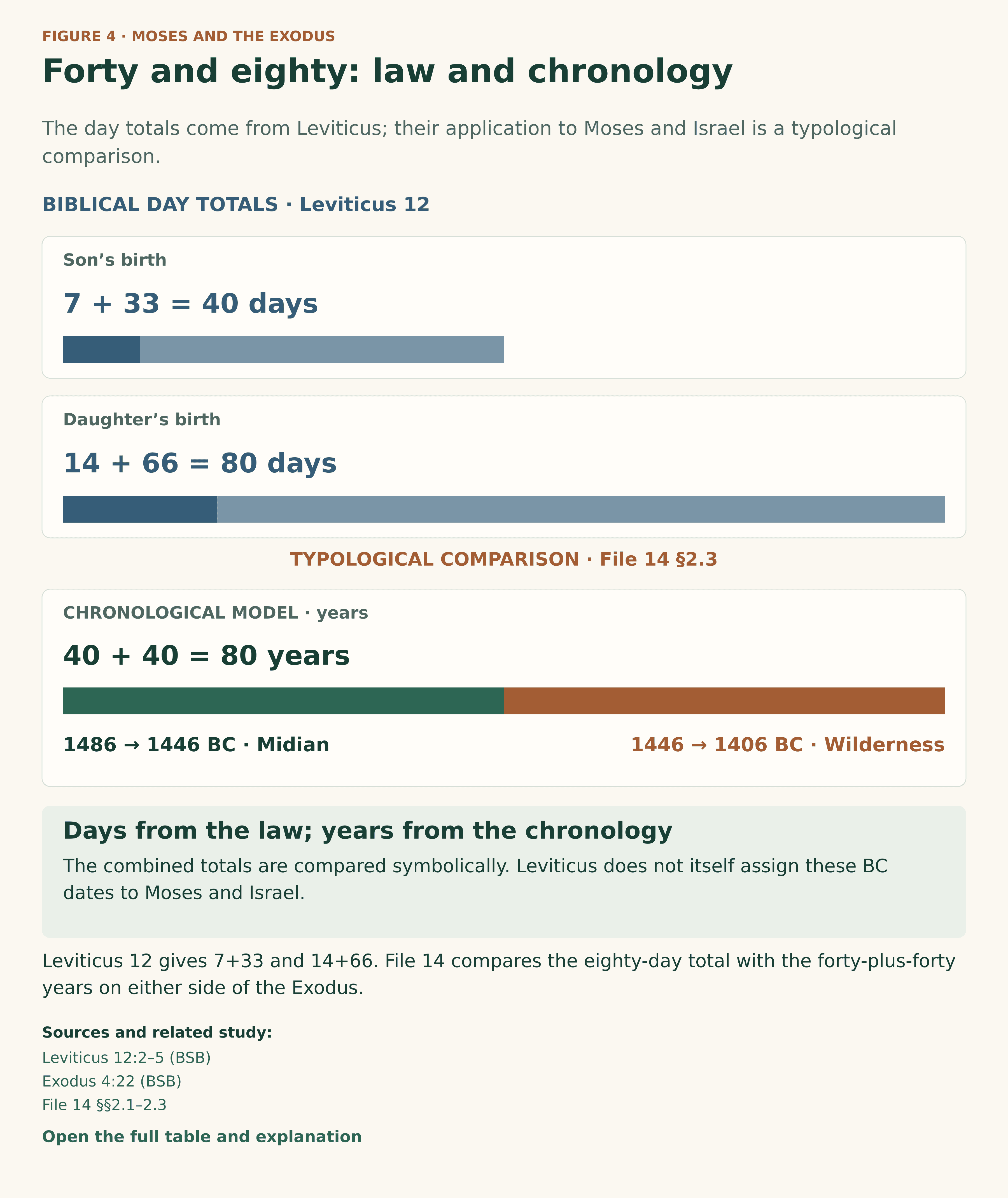
File 14 §2.3 sets these totals beside the Mosaic sequence:
1486 → 1446 → 1406 BC = 40 + 40 years.
The interpretation reads Moses’ preparation and Israel’s wilderness formation through purification and birth imagery. God’s designation of Israel as His firstborn son gives that imagery a direct biblical setting (Exodus 4:22, BSB). The two forty-year periods surround the Exodus, the central act of deliverance.
The law supplies the day totals, and the chronology supplies the year intervals. The comparison is strongest when both remain visible. It is a typological relationship, not a hidden statement in Leviticus that Moses fled in 1486 BC. Similarly, calling the two forties a reflection around the Exodus does not introduce the repository’s formal BC/AD Mirror operation. Only ordinary symmetry is being described here.
The comparison uses Moses’ final eighty years because they divide naturally at the Exodus. His first forty years remain part of his life and of the complete 120-year biography.
6. Dates and day counts
The original study’s detailed table begins with dated narrative events. Its most useful feature can be retained: a reader should be able to see the date, the source and the calculation together. The calendar must be declared before those dates become a continuous count.
The following table assumes twelve thirty-day months, a 360-day year, no intercalation, and an origin at the beginning of year 1, month 1, day 1. This is a schematic calculation. It does not establish that every historical month or wilderness year had that length.
For year Y, month M and day D:
Completed days = 360 × (Y − 1) + 30 × (M − 1) + (D − 1).
Numbered day = completed days + 1.
| Event | Year / month / day | Completed days | Numbered day | Source (BSB) |
|---|---|---|---|---|
| Counting origin | 1 / 1 / 1 | 0 | 1 | Declared origin; not a dated narrative event |
| Passover, year 1 | 1 / 1 / 14 | 13 | 14 | Exodus 12:6 |
| Departure from Egypt | 1 / 1 / 15 | 14 | 15 | Numbers 33:3 |
| Wilderness of Sin arrival | 1 / 2 / 15 | 44 | 45 | Exodus 16:1 |
| Sinai arrival: BSB day-of-month rendering | 1 / 3 / 15 | 74 | 75 | Exodus 19:1; read with Numbers 33:3 |
| Tabernacle erected | 2 / 1 / 1 | 360 | 361 | Exodus 40:17 |
| Passover, year 2 | 2 / 1 / 14 | 373 | 374 | Numbers 9:1–3 |
| Census instruction | 2 / 2 / 1 | 390 | 391 | Numbers 1:1 |
| Cloud lifts; departure from Sinai | 2 / 2 / 20 | 409 | 410 | Numbers 10:11 |
| Aaron dies | 40 / 5 / 1 | 14160 | 14161 | Numbers 33:38 |
| Moses delivers address | 40 / 11 / 1 | 14340 | 14341 | Deuteronomy 1:3 |
| Jordan crossing; next-year placement in model | 41 / 1 / 10 | 14409 | 14410 | Joshua 4:19 |
| Passover in Canaan; next-year placement in model | 41 / 1 / 14 | 14413 | 14414 | Joshua 5:10 |
The early Sinai-arrival row follows the linked BSB rendering of Exodus 19:1, read with the departure date in Numbers 33:3; §7 explains that choice. The two Canaan rows use the model’s following-year placement as year 41. Joshua supplies their month-and-day dates, not the label “year 41.” They extend the count for comparison; they are not newly discovered biblical year labels.
Figure 5 · Moses and the Exodus
A date, an elapsed count, a numbered day
Calculation setting: 12 months × 30 days; no intercalation; origin at year 1, month 1, day 1.
Sources: Numbers 33:3 (BSB) · Exodus 40:17 (BSB) · Numbers 10:11 (BSB) · File 12 calendar controls.
Model and calculation details
Completed days = 360×(Y−1)+30×(M−1)+(D−1). Numbered day = completed days+1. Tabernacle to Sinai departure: 409−360=410−361=49 days. A symbolic conversion to years is a separate declared operation, not contained in the date itself.
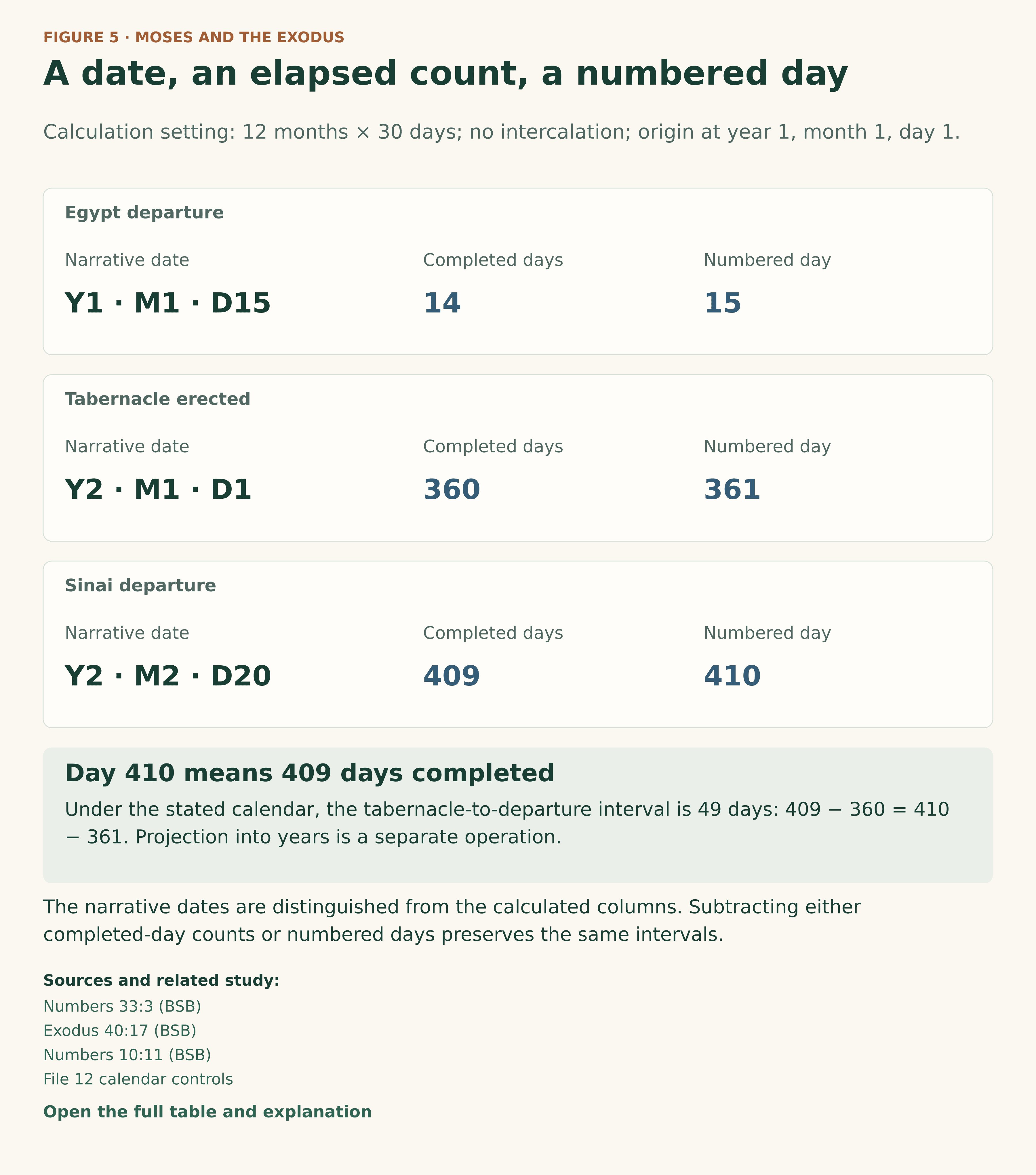
The tabernacle and the departure from Sinai
The tabernacle is erected on year 2, month 1, day 1 (Exodus 40:17, BSB). That is 360 completed days, or the beginning of numbered day 361, in the declared scheme. The cloud lifts on year 2, month 2, day 20 (Numbers 10:11, BSB). That is 409 completed days, or numbered day 410.
Subtracting either kind of count gives the same interval:
409 − 360 = 49 days
410 − 361 = 49 days.
The 49-day result does not establish a weekday or festival identification. Those would require additional information. It also does not mean the tabernacle was erected exactly one year after Israel left Egypt. The departure was on first-month day 15, not day 1; in this scheme the interval to the tabernacle is 360 − 14 = 346 days.
Counts over the whole wilderness era
The address in Deuteronomy 1:3 occurs in year 40, month 11, day 1. The same calculation gives 14340 completed days, or numbered day 14341. The date belongs to Moses’ address, not his death.
Extending the unbroken scheme to year 41, month 1, day 10 gives 14409 completed days at the Jordan crossing. Subtract the Egypt-departure offset of 14, and the schematic departure-to-crossing interval becomes 14395 days = 40 × 360 − 5. This illustrates why “forty years” as an era and an interval between two different month-and-day dates must not be interchanged without explanation.
File 12 distinguishes the Prophetic 360-day register from the Enochian 364-day register and other calendrical systems. Changing the register requires recalculation. Adding an intercalary month would likewise alter subsequent offsets; it cannot be introduced merely because an adjusted total gives an attractive correspondence.
Download the full calendar table.
7. Sinai and the spies: what can be dated?
Several events have a stated duration but no complete month-and-day placement. This is where a detailed timetable must show its limits most clearly.
Arrival at Sinai
The BSB rendering of Exodus 19:1 places Israel’s arrival in the third month on the same day of the month as its departure from Egypt. With Numbers 33:3’s fifteenth-day departure, that yields third-month day 15 for the BSB-based row in §6. Under the flat calendar, the arrival is 74 completed days from the year’s origin, and 74 − 14 = 60 days after departure.
The older third-month day 1 placement belongs to a different reading or reconstruction. It cannot be presented as the unambiguous wording of this BSB edition. Nor can the figure sixty be called both the time since departure and the time since month 1, day 1: those starting points are fourteen days apart.
The mountain periods
Exodus 24:18 records a forty-day mountain stay; Exodus 34:28 records another forty-day period in the covenant-renewal account. Deuteronomy 9:9–18 recalls the first tablets and a further forty-day intercession; Deuteronomy 10:1–10 returns to the replacement tablets and a forty-day stay (Exodus 24:18; Exodus 34:28; Deuteronomy 9:9–18; 10:1–10, BSB).
Exodus 32:30, BSB places Moses’ announced return to intercede on the next day, but does not supply the full gap before the replacement-tablet ascent in Exodus 34. A harmonized timetable must first decide how those accounts overlap and how the intercession relates to the two tablet episodes. It must then justify any intervening days. The repetition of forty alone cannot establish a two-day gap, two complete stays covering every episode, or an uninterrupted 120-day calendar block. This study preserves the stated periods without assigning precise dates to every ascent and descent.
The reconnaissance
Numbers dates the departure from Sinai and describes subsequent journeys and delays. It mentions a three-day journey, the judgment involving a month of meat, and the season of the first ripe grapes before the spies go out (Numbers 10:33; 11:19–20; 13:20, BSB). These details give narrative sequence and seasonal context. They do not furnish a complete dated ledger of all intervening events.
The spies’ forty-day mission is secure; their departure on “day 450” and return on “day 490” are not stated dates. Those placements are therefore excluded from the chronological table. The explicit correspondence in Numbers 14:34 stands without them.
8. The Flood’s dated sequence
The Flood account contains both durations and calendar dates. The forty days of rain are one part of that sequence, not the duration of the entire Flood. Genesis also names 150 days and dates the ark’s resting, the appearance of mountain tops, the drying surface and the fully dry earth.
For a controlled comparison with the Mosaic table, apply the same flat 12 × 30 calendar without intercalation. Here the principal origin is the Flood’s onset: Noah’s year 600, month 2, day 17. The year numbers in this table refer to Noah’s age-year sequence, not to the Exodus count.
| Event | Noah’s year / month / day | Days elapsed from Flood onset | Source (BSB) |
|---|---|---|---|
| Flood begins | 600 / 2 / 17 | 0 | Genesis 7:11 |
| Ark rests on Ararat | 600 / 7 / 17 | 150 | Genesis 8:4 |
| Mountain tops appear | 600 / 10 / 1 | 224 | Genesis 8:5 |
| Noah removes covering; surface dry | 601 / 1 / 1 | 314 | Genesis 8:13 |
| Earth completely dry | 601 / 2 / 27 | 370 | Genesis 8:14 |
Genesis 7:24 and 8:3 expressly supply the 150-day figure. The month 2, day 17 to month 7, day 17 span also equals 150 under the stipulated thirty-day-month calculation. This agreement does not independently establish that every month of the rest of the Flood year had the same length.
Figure 6 · Moses and the Exodus
The Flood: dates and elapsed days
Stated dates are read on a declared flat calendar: 12 months × 30 days, with no intercalation.
Change the origin; preserve the interval
If counting from Y600 · M1 · D1 instead, the Flood begins on numbered day 47 and the earth is dry on day 417.
417 − 47 = 370 elapsed days
Day 417 is a label from the earlier year origin, not a 417-day Flood.
Sources: Genesis 7:11 (BSB) · Genesis 8:4 (BSB) · Genesis 8:5 (BSB) · Genesis 8:13 (BSB) · Genesis 8:14 (BSB) · Genesis 7:24 (BSB) · Genesis 8:3 (BSB) · Genesis 7:12 (BSB) · File 12 calendar controls.
Model and calculation details
From the Flood’s beginning, elapsed days = 360×(Y−600)+30×(M−2)+(D−17). Genesis 7:24 and 8:3 separately state 150 days. The endpoint at 601/2/27 is 370 elapsed days, or 371 days with both endpoint days counted. If the origin is changed to 600/1/1, the Flood begins after 46 completed days (day 47), and the dry-earth date falls after 416 completed days (day 417). Thus 417 can be a numbered day from that earlier origin; it is not the Flood’s elapsed duration. All counts assume twelve thirty-day months with no intercalation.
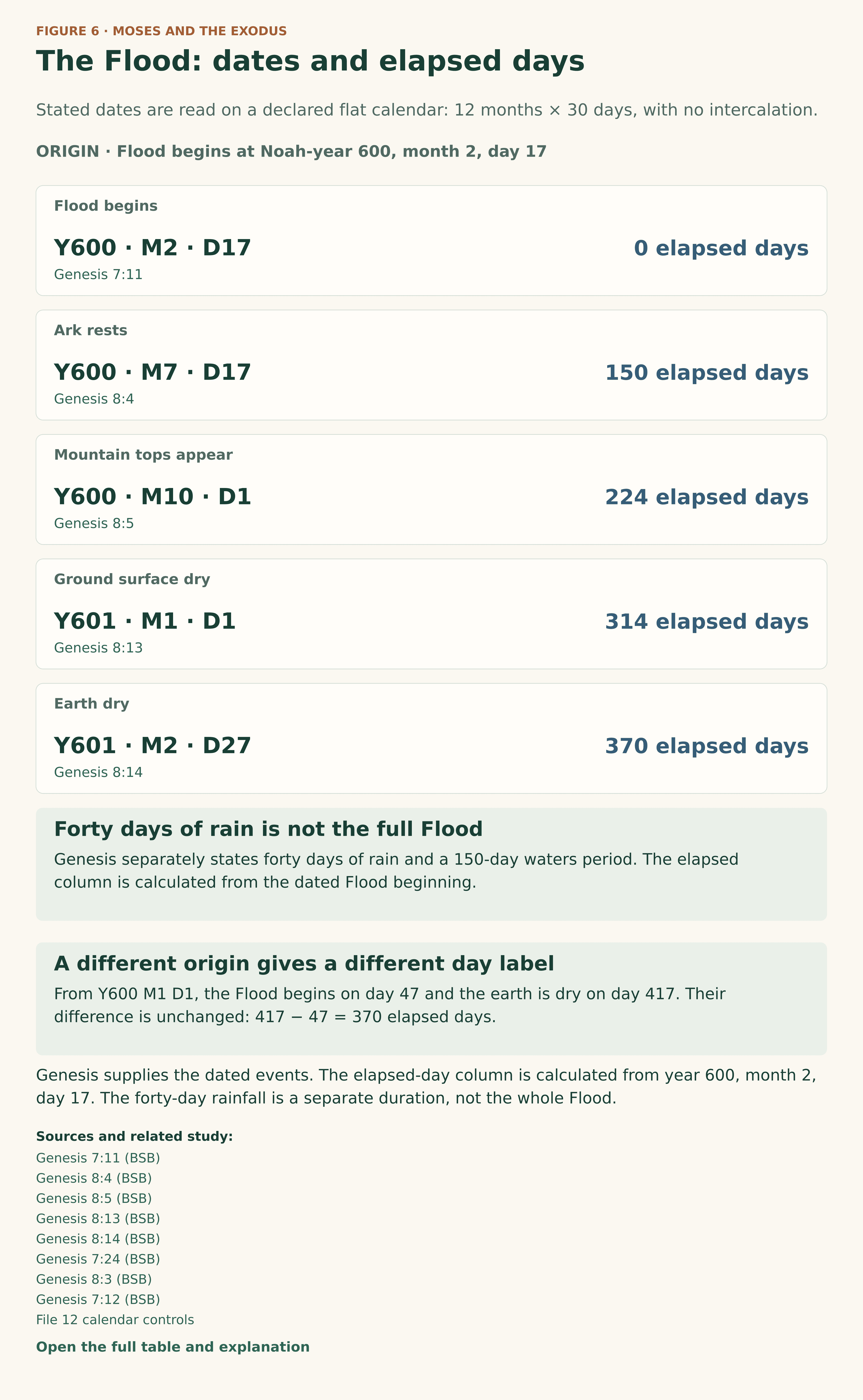
The onset-to-dry-earth span in this scheme is:
360 + (27 − 17) = 370 elapsed days.
Counting both endpoint dates inclusively produces 371 counted dates. The 150-day division leaves 370 − 150 = 220 days from the resting-date offset to the dry-earth-date offset. These are calendar calculations; the narrative does not explicitly call the remaining segment “220 days.”
Genesis 8:14 dates the fully dry earth. The command to leave and the family’s exit follow in verses 15–19, without another explicit month-and-day date. The table therefore names its endpoint precisely as the dry-earth date rather than claiming a separately dated disembarkation.
How day 417 belongs to a different origin
Start instead at Noah’s year 600, month 1, day 1. The Flood then begins at elapsed offset 46, or numbered day 47. The fully dry earth falls at elapsed offset 416, or numbered day 417:
416 − 46 = 370 days
417 − 47 = 370 days.
Thus, 417 is a valid numbered-day label under this declared origin. It is not a 417-day interval from the beginning of the Flood. Similarly, the mountain tops appear at elapsed offset 270 from the year origin but at offset 224 from the Flood’s onset. The different counts come from different origins, not from different events.
A further example is the seven-day warning before the Flood (Genesis 7:4, 10, BSB). Including that preceding interval gives 7 + 370 = 377 elapsed days to the dry-earth date in this scheme. That begins seven days earlier. It does not make 377 and 417 interchangeable measures of one interval.
The older presentation’s broad 377–417 range cannot therefore be justified merely by choosing 29- or 30-day months or switching to inclusive counting. Each total must retain its own origin and operation. This correction preserves useful numbers while removing the claim that they all measure the same thing.
Download the Flood date table.
9. What a symbolic projection must specify
An explicit day–year instruction and an independently constructed chronological projection are different operations. Numbers and Ezekiel give the former. A reconstruction that turns a table’s offsets into BC dates must supply further choices.
For an elapsed interval d assigned one year per day, and a chosen BC origin A, a forward projection wholly within BC would have the form:
Projected BC coordinate = A − d.
The expression is simple; the choice of A carries much of the argument. If the starting date is selected after looking for an attractive landing, the landing cannot then serve as independent evidence for that same starting date. The date, counting convention, direction and source of the origin must all be stated first.
| Required choice | Question the reader should be able to answer |
|---|---|
| Input | Is this an elapsed duration, an inclusive count, or a numbered label? |
| Calendar | Which month lengths and intercalations generate the count? |
| Origin | Which event supplies the starting year, and which canonical file authorizes that use? |
| Direction and scale | Are days assigned to years forward or backward, and by what rule? |
| Comparison | Is the resulting date independently established in the same chronological setting? |
For example, Sinai’s departure occurs at elapsed offset 409 but on numbered day 410. Mapping 409 elapsed days and mapping the label 410 are different constructions. Either can be defined mathematically; their difference must not be hidden as a counting adjustment introduced only at the endpoint.
The older discussion used 2206, 2146 and 1936 BC as origins for extended overlays. Their use as the proposed Mosaic day-count origins is not established by the controlling files for this study. A number’s occurrence elsewhere in the repository does not authorize transferring it to a new event or calendar origin. Those overlays, their reconstructed spies’ endpoints and their downstream predictions do not carry this replacement’s argument.
The same discipline applies to scaling. Multiplying a duration by a jubilee or calendar factor is a declared mathematical operation; it does not by itself identify a later historical fulfillment. Cross-axis BC/AD spans additionally require the no-year-zero rule. The speculative first-century fulfillment chains from the earlier dialogue are omitted because their source and arithmetic controls do not support their use here.
10. The Moses-node thirds method
File 55 provides a more fully defined way to investigate numerical structure around Moses. It begins with the three coordinates remaining after the first forty of his life has been set aside for analytical purposes:
1486, 1446 and 1406 BC.
For an input BC date D, choose the terminal node N for which D − N is divisible by 3. Then calculate:
T = (D − N) ÷ 3
M = D − T = N + 2T.
The result divides the selected span into a first third and a remaining two-thirds. For inputs earlier than the chosen node, the forward display is D → M → N. This procedure is mathematical; it is not the day–year assignment in Numbers 14.
Figure 7 · Moses and the Exodus
One third and two thirds
File 55’s operator divides a span to a selected Moses node. Every quantity shown here is measured in years.
Choose N from 1486, 1446 and 1406 BC so D − N is divisible by 3
T = (D − N) / 3
M = D − T = N + 2T
D = input date · M = derived marker · N = selected node
Moses: complete life
1526 → 1486 → 1406 BC
40 + 80 = 120 years
Abraham’s departure to Exodus
2091 → 1876 → 1446 BC
215 + 430 = 645 years
Sources: File 55 §1.3: operator · File 55 §4.3: Abraham comparison · File 18: normal MT coordinates · Genesis 12:4–5 (BSB) · Deuteronomy 34:7 (BSB).
Model and calculation details
Choose the unique node N among 1486, 1446 and 1406 BC for which D−N is divisible by 3. Set T=(D−N)/3 and M=D−T=N+2T. For D=1526, N=1406 and M=1486. For D=2091, N=1446 and M=1876. The 2091 BC coordinate is Abraham’s Haran-to-Canaan departure, not the earlier Mesopotamian call. A derived marker is identified with an event only after checking the chronological model; the operation does not shorten anyone’s lifespan or convert days into years.
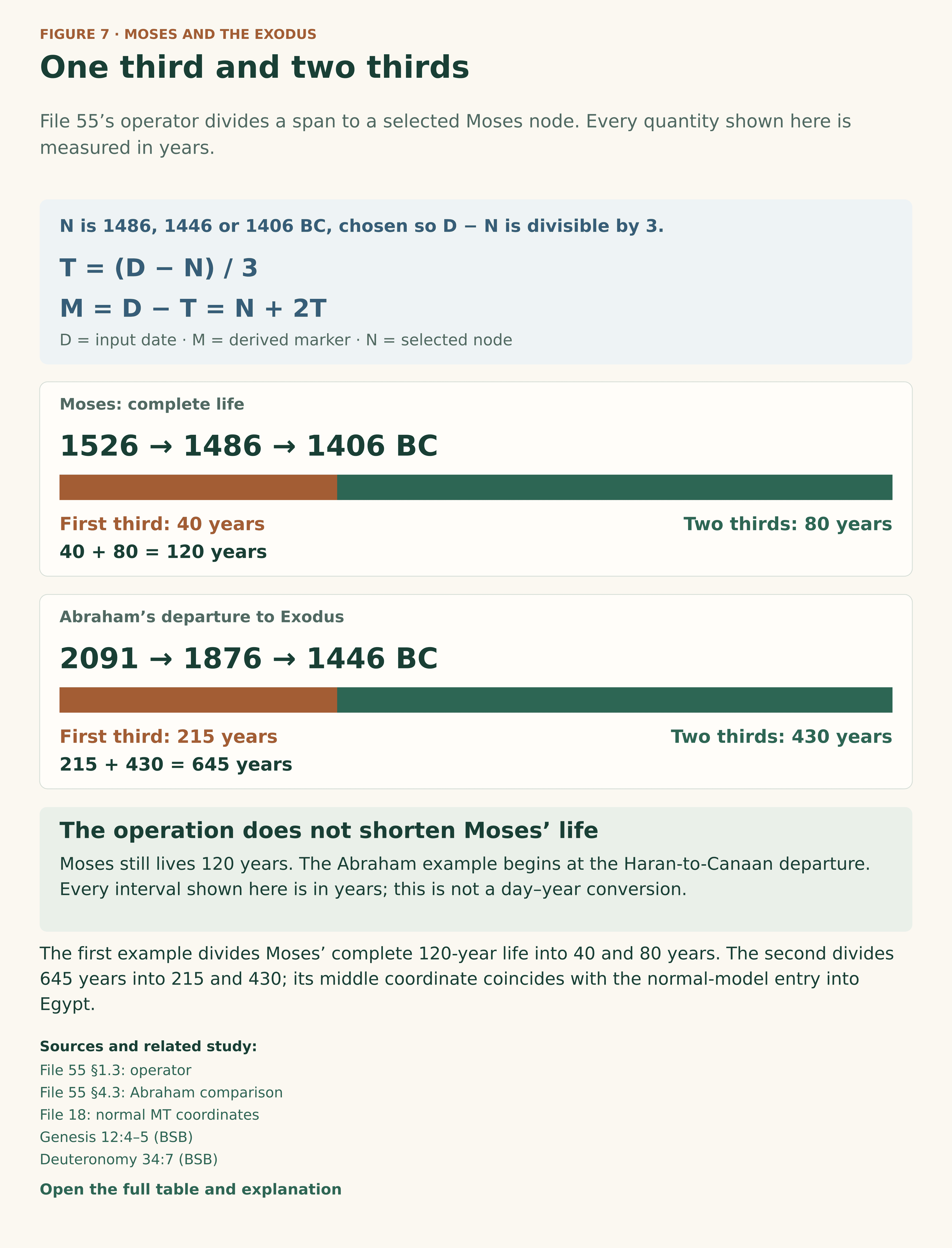
Moses: the whole life and the selected eighty
With D = 1526 and N = 1406:
T = (1526 − 1406) ÷ 3 = 40
M = 1526 − 40 = 1486.
The display becomes 1526 → 1486 → 1406 BC = 40 + 80 years. Its third marker coincides with Moses’ age-forty coordinate. The remaining eighty years contain the Exodus at their midpoint. The procedure selects portions of the life; the life itself remains 120 years.
Abraham: 215 and 430
File 55 §4.3 applies the same method to Abraham’s 2091 BC departure from Haran toward Canaan, at age seventy-five (Genesis 12:4–5, BSB). This is distinct from the earlier call in Mesopotamia recalled in Acts 7:2–4, BSB. With D = 2091 and N = 1446:
T = (2091 − 1446) ÷ 3 = 215
M = 2091 − 215 = 1876.
The result is 2091 → 1876 → 1446 BC = 215 + 430 years. The third marker coincides with Jacob’s Egypt-entry coordinate in the normal chronology. The arithmetic is exact and the events remain independently named. Its broader significance is the proposed structural relationship among the coordinated dates.
| Input BC | Terminal N, BC | First third T | Marker M, BC | Remaining 2T |
|---|---|---|---|---|
| Moses’ birth · 1526 | 1406 | 40 | 1486 | 80 |
| Abraham’s Haran-to-Canaan departure · 2091 | 1446 | 215 | 1876 | 430 |
Why unique routing is not a separate discovery
The three terminal numbers occupy the three different remainder classes on division by 3. Every integer-year input therefore routes to exactly one of them. File 55 §1.4 identifies this as a mechanical property of the procedure. The investigation concerns the resulting markers and their relationships to the chronology; it cannot treat the existence of one selectable node as an additional coincidence.
File 55 §8.9 also leaves the formal wider null-test boundary open. Selected exact examples show how the method works. They do not, by themselves, supply a completed statistical demonstration of intentional design.
Download the worked thirds table.
11. Moses, Joshua and the land’s rest
The transition at 1406 BC joins distinct events. Moses dies before Israel crosses the Jordan. Israel mourns him, Joshua assumes leadership, and the people enter the land (Deuteronomy 34:7–9; Joshua 4:19, BSB). The annual coordinate does not erase that sequence.
Nor does entry mark the immediate end of the conquest wars. File 18 §2.4 separately places the first Sabbath year of rest at 1399 BC. The narrative describes rest from the surrounding enemies after the conquest and distribution of the land (Joshua 21:44, BSB). The year 1399 is the model’s coordinate for that rest framework; the verse itself supplies no BC date.
Joshua’s regular lifespan remains 1476–1366 BC = 110 years, consistent with the age stated at his death (Joshua 24:29, BSB). The year 1366 is his date of death in this chronology, not 1406.
File 55’s signed thirds formula can nevertheless take his death-coordinate as an input. With D = 1366 and N = 1486, it gives T = −40 and M = 1406. This is a backward-directed mathematical calculation from a later BC coordinate toward an earlier node. It does not move Joshua’s actual death to the Conquest or replace his 110-year lifespan with an eighty-year span.
These distinctions matter for the bookend image. Moses’ death closes his leadership, the crossing opens the Conquest, the end of the wars brings a form of rest, and Joshua’s death closes a later life. They can participate in related numerical patterns while remaining separate events.
12. The theological bookends
Noah and Moses are linked by deliverance through water. Noah’s ark preserves life through judgment; Moses’ basket preserves the child who will later lead Israel out of Egypt (Genesis 6:14; Exodus 2:3, BSB). File 23 §1 develops the shared Hebrew term tebah in these two narrative settings. The connection concerns the ark and basket traditions, not a claim that the word occurs only twice as an individual token.
The New Testament gives each deliverance its own baptismal reading. First Peter relates Noah’s rescue through water to baptism; First Corinthians describes Israel’s passage under the cloud and through the sea in baptismal terms (1 Peter 3:20–21; 1 Corinthians 10:1–2, BSB). These are substantial literary and theological connections even before a chronological projection is proposed.
The number forty reinforces the comparison through rainfall, mountain encounter, reconnaissance and wilderness testing. Yet each forty belongs to its own event. Likewise, Genesis 6:3’s 120-year statement may be read within the broader model as a pre-Flood warning period, while Moses’ 120 is his explicitly stated lifespan. Genesis does not state that Noah spent precisely 120 years building the ark (Genesis 6:3, BSB).
The Mosaic bookend is therefore a coordinated comparison of rescue, judgment, covenant and movement toward rest. Its clearest numbers come from identifiable passages and named chronological intervals: 40 days and 40 years; 40 + 40 + 40; 390 + 40; and the Levitical totals of 40 and 80. The dated tables deepen that comparison by showing exactly how a calendar calculation is made. Their value lies in making the relationships inspectable, while allowing their theological meaning to remain an argument the reader can assess.
13. Sources and downloads
The following canonical files control the chronological and interpretive claims. The older dialogue is retained in the accompanying evidence package as the predecessor being replaced. It does not override these sources.
| Canonical source | Function in this study |
|---|---|
| File 14, §§2.1–2.3 | Levitical 40/80 totals and their typological application to the Mosaic sequence |
| File 17, §§0.1–0.6, 3–6 and 16 | Textual versus inferred components; MT/LXX distinctions; calendar and operator controls |
| File 55, §§1.2–1.4, 2.3, 4.3, 5.3 and 8.9 | Moses’ three forties; the thirds formula; Abraham and Joshua examples; methodological limits |
| File 18, §§2.3–2.4 | Normal/minimum patriarchal conversion; Mosaic anchors; Joshua’s lifespan and land-rest distinctions |
| File 05 | The primary Exodus anchor and separation of alternative chronology settings |
| File 12, calendar register and §6 | Distinct calendar registers and Nisan default; no silent calendar substitution |
| File 23, §1 | The Noah–Moses ark/basket connection and its typological status |
Download the chronology, comparison register, calendar calculations, Flood date table, or worked thirds examples. Each figure includes direct passage links and a link to the relevant full table or explanation. The complete package also supplies the original source captures, figure assets and a person/event figure index.
For a shorter introduction, return to Moses and the Exodus: Forty Days, Forty Years. The supporting tables and source notes provide the concise companion reference.
Passage links identify the translation. Dates, calculations and diagrams are analytical presentations, not additional Scripture quotations.
Scripture quotations: Berean Standard Bible (BSB), public domain.