This appendix supports Moses and the Exodus: Forty Days, Forty Years. It separates the biblical durations, the site’s regular chronology, calendar calculations and symbolic comparisons. The completed detailed study, The Mosaic Bookend to the Flood, provides the expanded calendar tables and canonical comparison.
A. The chronological setting
The main article uses the normal Masoretic Text (MT) chronology, 430 years in Egypt, Nisan alignment, with neither the optional +60 Terah adjustment nor a restored second Cainan. The Exodus remains 1446 BC, Moses’ death and the opening of the Conquest 1406 BC. Optional patriarchal adjustments must not silently move these fixed Mosaic anchors.
| Event | Model date BC | Age | Biblical basis (BSB) |
|---|---|---|---|
| Moses born | 1526 | 0 | Acts 7:20; chronological derivation |
| Age forty; flight to Midian | 1486 | 40 | Acts 7:23–30 |
| Exodus; Moses at eighty | 1446 | 80 | Exodus 7:7; Acts 7:30, 36 |
| Moses dies; Conquest opens | 1406 | 120 | Deuteronomy 34:7; Joshua 4:19 |
These are annual coordinates. Acts gives Moses’ age at the first crisis, a subsequent forty-year interval and forty years of wilderness leadership. Exodus gives his age when speaking to Pharaoh, and Deuteronomy his age at death. The BC assignments belong to the chronological model; the passages do not print BC dates or supply every birthday and intervening day.
The calculation is 1526 − 1486 = 1486 − 1446 = 1446 − 1406 = 40. Moses’ total is 1526 − 1406 = 120. The final eighty years are 1486 − 1406 = 80.
The boundary at 1406 BC joins distinct events in the same annual frame: Moses dies before Israel crosses the Jordan under Joshua. It is not a claim that both events occurred on the same day, nor that the wars ended immediately. File 18 separately lists the conquest-war period and the first Sabbath year of rest at 1399 BC. Joshua’s regular lifespan remains 1476–1366 BC = 110 years.
Download the chronology table. The controlling sources are File 18 §2.4 and File 55 §1.2.
B. Which comparisons are explicit?
| Source | Inputs | Operation / status | Boundary |
|---|---|---|---|
| Numbers 14:34 | 40 days; 40 years | Explicit days assigned to years; Textual correspondence | Applies directly to the reconnaissance and wilderness sentence |
| Ezekiel 4:5–6, MT / BSB | 390 days + 40 days = 430 days | Explicit sign-days assigned to years; addition; Textual inputs and arithmetic | Egyptian 1876–1486–1446 endpoints are a separate comparison |
| Leviticus 12:2–5 | 7 + 33 = 40 days; 14 + 66 = 80 days | Addition of two specified legal periods; Textual inputs and arithmetic | 1486–1446–1406 application is File 14 typology |
| File 55 §§1.2–1.3 | 120 years → selected final 80 years | One-third / two-thirds marker; Declared mathematical operation | Moses still lives 120 years; not a day–year conversion |
Numbers 14:34 directly explains the wilderness sentence by the days of reconnaissance. Ezekiel likewise assigns days to years. Neither passage makes every biblical day a coded year. A wider comparison needs its own endpoints, source reading and stated operation.
The forty-year wilderness framework must also retain its narrative placement. Israel leaves Sinai in the second year (Numbers 10:11), and the spies’ mission follows. Deuteronomy 2:14 gives thirty-eight years from Kadesh-barnea to the Brook of Zered. This is consistent with treating the wilderness forty as the whole era, not adding forty complete years after the second-year crisis.
The MT 390 + 40 comparison
Ezekiel 4:5–6 in the BSB reflects the MT 390 + 40 sequence. The article compares it with the normal Egyptian-sojourn model:
| Chronological interval | Calculation | Years |
|---|---|---|
| Jacob’s entry into Egypt → Moses’ flight | 1876 − 1486 | 390 |
| Moses’ Midian period → Exodus | 1486 − 1446 | 40 |
| Whole Egyptian sojourn | 1876 − 1446 | 430 |
| Subsequent wilderness period | 1446 − 1406 | 40 |
The last row follows the sojourn; it is not included in its 430-year total. The 390-year first segment is a subtraction from the chosen coordinates, not a separately stated biblical duration. The correspondence with Ezekiel is numerical and typological, not an assertion that Ezekiel names those Egyptian endpoints.
The comparison is specifically MT. File 17 §3 treats the Septuagint (LXX) Ezekiel material separately, and Files 18 and 05 distinguish the alternative Samaritan Pentateuch (SP) and LXX sojourn settings. This introduction does not combine their different textual and chronological inputs. The normal 1876 BC Egypt-entry date follows File 18’s instruction to add 215 to the minimum Egyptian-sojourn state: 1661 + 215 = 1876. This shifts the affected patriarchal dates; it does not shift the fixed 1446 BC Exodus.
Levitical totals and their application
Leviticus 12:2–5, BSB supplies 7 + 33 = 40 days and 14 + 66 = 80 days. The initial period and the following purification period retain their separate descriptions. The article uses the combined totals without implying that every legal restriction is identical throughout each period.
File 14 §2.3 compares these with 1486 → 1446 → 1406 BC = 40 + 40 years. The law supplies the day totals; the Exodus chronology supplies the years. Israel’s birth imagery is a theological reading supported by Exodus 4:22, BSB. It is not a claim that Leviticus itself dates Moses’ life.
Download the comparison register.
C. Calendar dates, elapsed days and numbered days
The following table is a 360-day schematic calculation. It assumes twelve thirty-day months, no intercalation within the interval, and an origin at the beginning of month 1, day 1, in Exodus year 1. These are declared calculation settings, not a reconstruction established in every detail by the narrative.
For year Y, month M and day D:
Completed days = 360 × (Y − 1) + 30 × (M − 1) + (D − 1).
Numbered day = completed days + 1.
| Event | Year / month / day | Completed days | Numbered day | Source (BSB) |
|---|---|---|---|---|
| Counting origin | 1 / 1 / 1 | 0 | 1 | Declared origin; not a dated narrative event |
| Passover, year 1 | 1 / 1 / 14 | 13 | 14 | Exodus 12:6 |
| Departure from Egypt | 1 / 1 / 15 | 14 | 15 | Numbers 33:3 |
| Tabernacle erected | 2 / 1 / 1 | 360 | 361 | Exodus 40:17 |
| Passover, year 2 | 2 / 1 / 14 | 373 | 374 | Numbers 9:1–3 |
| Census instruction | 2 / 2 / 1 | 390 | 391 | Numbers 1:1 |
| Cloud lifts; departure from Sinai | 2 / 2 / 20 | 409 | 410 | Numbers 10:11 |
Figure 5 · Moses and the Exodus
A date, an elapsed count, a numbered day
Calculation setting: 12 months × 30 days; no intercalation; origin at year 1, month 1, day 1.
Sources: Numbers 33:3 (BSB) · Exodus 40:17 (BSB) · Numbers 10:11 (BSB) · File 12 calendar controls.
Model and calculation details
Completed days = 360×(Y−1)+30×(M−1)+(D−1). Numbered day = completed days+1. Tabernacle to Sinai departure: 409−360=410−361=49 days. A symbolic conversion to years is a separate declared operation, not contained in the date itself.
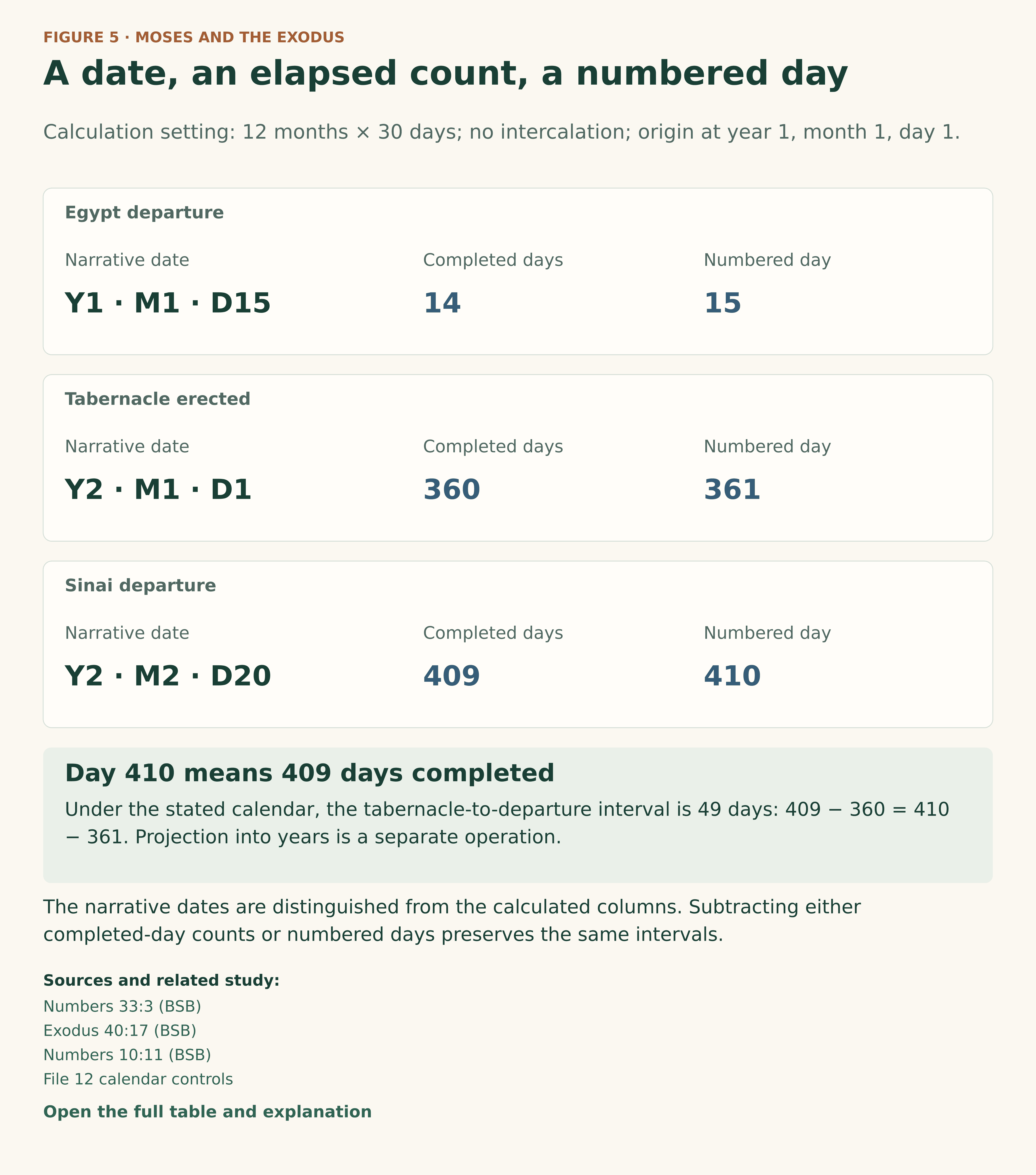
For the tabernacle, 360 × 1 + 30 × 0 + 0 = 360 completed days, so its numbered day is 361. For the departure from Sinai, 360 × 1 + 30 × 1 + 19 = 409, so its numbered day is 410. The difference between those two event dates is 409 − 360 = 49 days in this scheme. Subtracting their numbered days gives the same interval: 410 − 361 = 49.
The tabernacle is therefore not erected exactly one year after the Exodus departure. Its date is first-month day 1; the departure was on first-month day 15. In this particular 360-day calculation, the interval is 360 − 14 = 346 days. With another calendar’s month lengths or an inserted month, the completed-day interval would have to be recalculated.
File 12 keeps the 360-day Prophetic and 364-day Enochian registers distinct. The preceding arithmetic opens only the former as a schematic counting convention. It does not establish that all ancient Israelite years had 360 days or that a 364-day calendar can be substituted without changing the formula.
The 49-day result is an interval between dates under these assumptions. It does not by itself establish the weekday of either endpoint, identify a festival date, or turn the interval into 49 historical years. A symbolic day–year projection is another step: it must declare which duration or numbered label is being mapped, and to what year-origin. In particular, day 410 cannot silently become 410 completed days.
Download the calendar calculation table. Source dates: Exodus 12:6, Numbers 33:3, Exodus 40:17, Numbers 9:1–3, Numbers 1:1, and Numbers 10:11, all BSB.
D. Moses’ life and the thirds method
File 55 uses 1486, 1446 and 1406 BC as three fixed terminal dates. For an input BC date D, it selects the terminal date N for which D − N is divisible by 3. It then calculates:
T = (D − N) ÷ 3
Marker M = D − T = N + 2T.
The three terminal numbers have different remainders on division by 3, so exactly one is selected for any integer input. The result divides the selected span into one-third and two-thirds. It is a mathematical operation, distinct from the day–year instruction in Numbers 14.
| Input | Terminal N, BC | First third T | Marker M, BC | Remaining 2T |
|---|---|---|---|---|
| Moses’ birth · 1526 BC | 1406 | 40 | 1486 | 80 |
| Abraham’s Haran-to-Canaan departure · 2091 BC | 1446 | 215 | 1876 | 430 |
In the Moses example, 1526 → 1486 → 1406 BC = 40 + 80. The 1486 marker is also his age-forty coordinate in the biography. The selected 80-year portion does not replace his lifespan of 120.
The second example takes Abraham’s 2091 BC departure from Haran toward Canaan, not his earlier call in Mesopotamia. It produces 2091 → 1876 → 1446 BC = 215 + 430, with the marker coinciding with Jacob’s Egypt-entry date in the normal model. File 55 records this relation in §4.1. Its arithmetic is exact; its structural significance is an interpretation of the coordinated dates. The method’s wider statistical assessment remains open in File 55 §8.9.
These examples use the named Mosaic and Abrahamic coordinates. They do not introduce Rounded Creation, cumulative lifespans, apparent ages or restored-Cainan variants. Those are separate settings in File 55’s larger investigation.
Download the worked thirds table.
E. What the older discussion cannot establish by itself
The introductory article preserves the strongest sourced comparisons without treating every exploratory timetable as a narrative date. Several distinctions remain important in the detailed study:
- The spies: Numbers 13:25, BSB states forty days. It does not supply their departure or return date. The older “Day 450” and “Day 490” placements require reconstruction and do not support the present argument.
- Arrival at Sinai: Exodus 19:1, BSB renders the arrival as the same day of the month that Israel had left Egypt. The older third-month, first-day reconstruction must not be presented as the unambiguous wording of this edition.
- The mountain periods: Exodus 24:18 and 34:28 describe forty-day periods; Deuteronomy 9:18 also describes forty days of intercession, and 10:10 recalls a forty-day stay. A complete arrangement of these passages, including any overlap or intervening days, needs an explicit harmonization. A two-day gap or an uninterrupted 120-day total is not assumed here.
- Moses’ death: Deuteronomy 1:3, BSB dates his address, not his death. It cannot establish that he died on the first day of the eleventh month. File 18’s annual 1406 BC endpoint remains the control.
- Noah’s 120: Genesis 6:3, BSB gives the 120-year statement. Reading it as a pre-Flood warning period is an interpretation retained in the broader model. It is not a biblical statement that Noah spent exactly 120 years constructing the ark.
- Flood totals: In a flat 360-day scheme, second-month day 17 (Genesis 7:11, BSB) to second-month day 27 of the next year (Genesis 8:14, BSB) gives 370 elapsed days, or 371 dates counted inclusively. A longer construction needs additional intervals or a different defined starting point. The older 377–417 range cannot be derived merely by varying the months between 29 and 30 days or changing inclusive counting.
These restrictions do not remove the narrative relationship between Noah and Moses. They keep that relationship from depending on an unsupported day count. Nor do repeated exact sums by themselves establish intentional design through a completed statistical test; the article states the arithmetic and identifies its interpretive use.
F. Canonical source map and further reading
| Source | What it controls here |
|---|---|
| File 14, §§2.1–2.3 | Leviticus 12 totals and the typological 1486–1446–1406 comparison |
| File 17, component guard; §§3–4, 15–16 | Keeping textual traditions, component sums and applied interpretations distinct |
| File 55, §§1.2–1.4, 4.1, 8.9 | Moses’ three forties, the thirds operation and its methodological boundary |
| File 18, §§2.3–2.4 | Normal/minimum date conversion and fixed Mosaic/Joshua anchors |
| File 05 | Primary 1446 BC Exodus; separation of sojourn and Exodus-date alternatives |
| File 12, calendar register and §6 | Calendar distinctions and the Nisan default |
| File 23, §1 | Noah–Moses ark/basket typology; narrative meaning remains distinct from numerical proof |
The repository’s canonical Markdown and its current amendments control this article. The completed detailed Mosaic study develops the expanded calendar tables and canonical comparison. The original discussion’s full capture is retained in the evidence package.
Return to Moses and the Exodus: Forty Days, Forty Years.
Passage links identify the translation. Dates, calculations and diagrams are analytical presentations, not additional Scripture quotations.
Scripture quotations: Berean Standard Bible (BSB), public domain.