“Enoch walked with God, and then he was no more, because God had taken him away.”
Enoch’s place in the biblical genealogy provides one of the clearest examples of what this study calls a strategic overlap: an expanded chronological span reaches a related position in a specified numerical arrangement. The comparison begins with biblical people and events, but its arithmetic requires careful distinctions. Enoch’s scriptural lifespan is 365 years. A 70-year position assigned to him in a genealogical model measures something different.
This detailed study develops the examples introduced in “When Biblical Time Spans Meet: The Key of 23 in Action”. It follows the current canonical chronological files, replacing the earlier exploratory dialogue with a connected account of the retained calculations. Regular dates, cumulative coordinates and schematic genealogy positions remain visible throughout.
1. What an overlap requires
The Key of 23 uses exact ratios to expand specified lengths. This study concentrates on two:
| Ratio | Basic operation | Increase |
|---|---|---|
| 25/23 | 23 units become 25 | 2 units for every 23 |
| 70/69 | 69 units become 70 | 1 unit for every 69 |
Since 69 = 3 × 23, both belong to the same numerical family. They are nevertheless different operations. Their outputs are exact under the model; they should not be described as exact physical measurements of the astronomical year.
For a dated projection, the procedure has five parts: identify the chronology and original endpoints; calculate their distance; apply the stated ratio; keep one endpoint fixed; and place the expanded span from that endpoint. Only then can we ask whether the moving end meets another identified boundary.
For example, the normal regular MT span from 4114 BC to 1446 BC is 2668 years. Multiplying by 25/23 gives 2900. If the Exodus at 1446 BC remains fixed, the earlier endpoint becomes 1446 + 2900 = 4346 BC. Holding the other endpoint would produce a different placement. The multiplier alone does not choose between them.
Three distinctions govern the examples that follow:
| Kind of comparison | What the arithmetic establishes | Further requirement |
|---|---|---|
| Two paths converge | Two declared calculations produce the same coordinate | Keep each path’s variants, ratio and anchor visible |
| A span reaches a named boundary | Its output coincides with a specified genealogical position | Identify the selected arrangement and which edge of the position is used |
| Two lengths agree | Their numerical durations are equal | Supply a separate anchored calculation before identifying dates |
Regular chronology uses the relevant begetting ages and event intervals. Cumulative chronology adds lifespans in sequence. A schematic genealogy assigns a measuring unit to successive positions. These methods can be compared, but their coordinates do not automatically become the same kind of date. Method controls: File 00 §3.1 · Chronological tables: File 18.
2. Two paths converge on 4346 BC
The normal regular MT setting used here places Creation at 4114 BC, the Exodus at 1446 BC, and the Conquest at 1406 BC. In File 18, 4114 BC is the standard setting with the longer, Egypt-only 430-year Sojourn. It includes neither the optional +60 Terah adjustment nor a restored second Cainan.
The first path retains the Exodus and expands backward:
4114 − 1446 = 2668
2668 × 25/23 = 2900
1446 + 2900 = 4346 BC
The resulting 4346 BC is a generated comparison head. The operation leaves the original Creation date at 4114 BC and lengthens the comparison span by 232 years.
The second path changes both the chronological setting and the held endpoint. It opens +60 Terah and +130 regular restored Cainan:
4114 + 60 + 130 = 4304 BC
With the Conquest at 1406 BC fixed, it applies 70/69:
4304 − 1406 = 2898
2898 × 70/69 = 2940
1406 + 2940 = 4346 BC
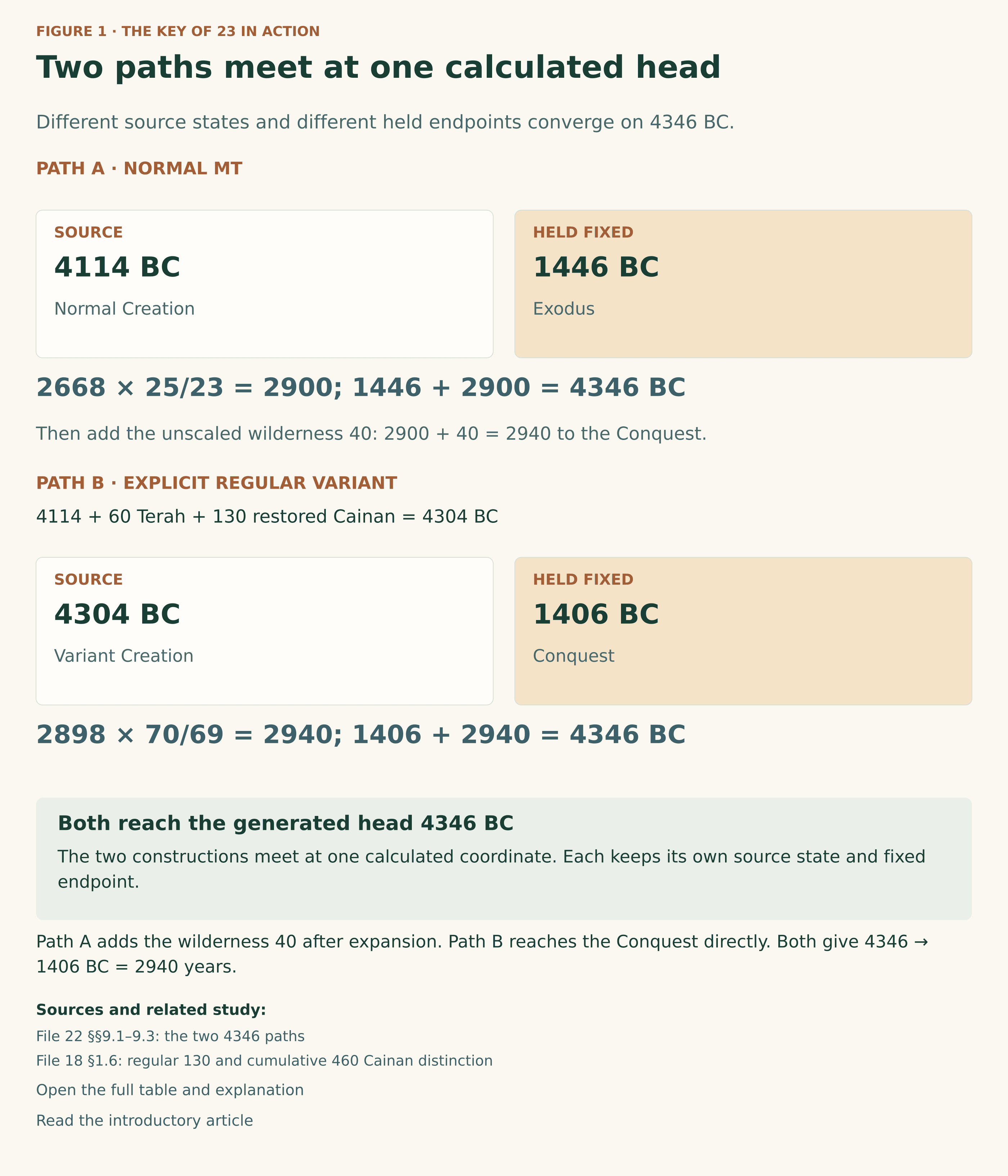
Figure 1 · The Key of 23 in Action
Two paths meet at one calculated head
Different source states and different held endpoints converge on 4346 BC.
Path A · normal MT
Normal Creation
Exodus
2668 × 25/23 = 2900
1446 + 2900 = 4346 BC
Then add the unscaled wilderness 40:
2900 + 40 = 2940 to the Conquest.
Path B · explicit regular variant
4114 + 60 Terah + 130 restored Cainan = 4304 BC
Variant Creation
Conquest
2898 × 70/69 = 2940
1406 + 2940 = 4346 BC
Sources: File 22 §§9.1–9.3: the two 4346 paths · File 18 §1.6: regular 130 and cumulative 460 Cainan distinction.
Model and calculation details
Path A uses standard MT Creation 4114 BC and holds the Exodus 1446 BC fixed: 2668 × 25/23 = 2900. The 40 wilderness years are then added without scaling, giving 2940 to the Conquest. Path B explicitly opens + 60 Terah and + 130 regular restored Cainan, giving 4304 BC. Holding the Conquest 1406 BC fixed, 2898 × 70/69 = 2940. Both backward calculations reach 4346 BC. This is an exact meeting of generated coordinates, not a redating of Creation or proof of ancient authorial intent.
Static image alternative
| Path / source | Settings | Held endpoint | Expansion | To the Conquest |
|---|---|---|---|---|
| Normal MT: 4114 BC | Standard / full Egypt 430; no +60/+130 | Exodus 1446 BC | 2668 × 25/23 = 2900 | 2900 + 40 = 2940 |
| Explicit regular variant: 4304 BC | +60 Terah and +130 restored second Cainan | Conquest 1406 BC | 2898 × 70/69 = 2940 | 2940; no further extension |
To put both results on the Conquest endpoint, add the wilderness interval to the first path after its expansion: 2900 + 40 = 2940. Those 40 years remain unscaled. The second path has already reached the Conquest and requires no such extension.
Both constructions therefore describe the generated interval 4346 → 1406 BC = 2940 years. Its factorization, 2940 = 6 × 490, supplies File 22’s theological comparison with the six days of Creation. The equalities are arithmetic facts; the six-day correspondence is an interpretation of their structure. File 22 §§9.1–9.4.
Why the variant must be stated
The +60 Terah option compares a 70-year begetting setting with a 130-year setting. The latter harmonizes Terah’s 205-year lifespan in Genesis 11:32, BSB, Abram’s departure at 75 in Genesis 12:4, BSB, and the departure after his father’s death in Acts 7:4, BSB: 205 − 75 = 130, and 130 − 70 = 60. Genesis 11:26 names Terah’s sons together; 130 is a harmonized age for Abram’s birth, not an age stated directly in that verse. File 18 §§1.1 and 1.3.1 defines the option and its upstream scope.
The second Cainan also requires a textual distinction. The MT-based sequence in Genesis 11:10–26, BSB proceeds from Arphaxad to Shelah without him. Luke 3:35–36, BSB includes Cainan between those ancestors. The restored regular chronology takes the 130-year begetting contribution from the LXX-based tradition represented by Brenton’s Genesis 11, under File 18 §1.6.
The cumulative contribution would instead be the full 460-year lifespan. It is not used in this 4304 BC variant. Selectively restoring Cainan to an MT-based calculation also does not turn the result into an unmodified LXX chronology. No SP chronology is substituted into either path.
3. From 989 years to a 430–215–430 arrangement
File 22 connects regular and cumulative chronology through a carefully matched Creation comparison:
| Matched coordinate role | Cumulative MT BC | Regular MT BC | Difference |
|---|---|---|---|
| Matched Creation endpoints | 14004 | 4114 | 9890 |
| Matched internal Year-6 coordinates | 14006 | 4116 | 9890 |
Both pairs yield 9890 = 23 × 430. The endpoint pair 14004 and 4114 must remain distinct from the corresponding Year-6 pair 14006 and 4116. Mixing 14006 with 4114 would give 9892, which is a different comparison. These are actual chronology settings; the separate Rounded 9900 comparison is not substituted here.
At Abraham, File 22 develops a related span one-tenth as long. Its cumulative MT Moses/Nisan coordinate for Abraham is 2435 BC. This is not his normal regular birth date of 2166 BC. From that cumulative position to the fixed Exodus:
2435 − 1446 = 989
989 × 25/23 = 1075
1446 + 1075 = 2521 BC
The generated earlier endpoint is 2521 BC. The increase is 86 years. When placed beside the regular dates of Abraham’s call and Jacob’s entry into Egypt, the expanded interval has a balanced internal division:
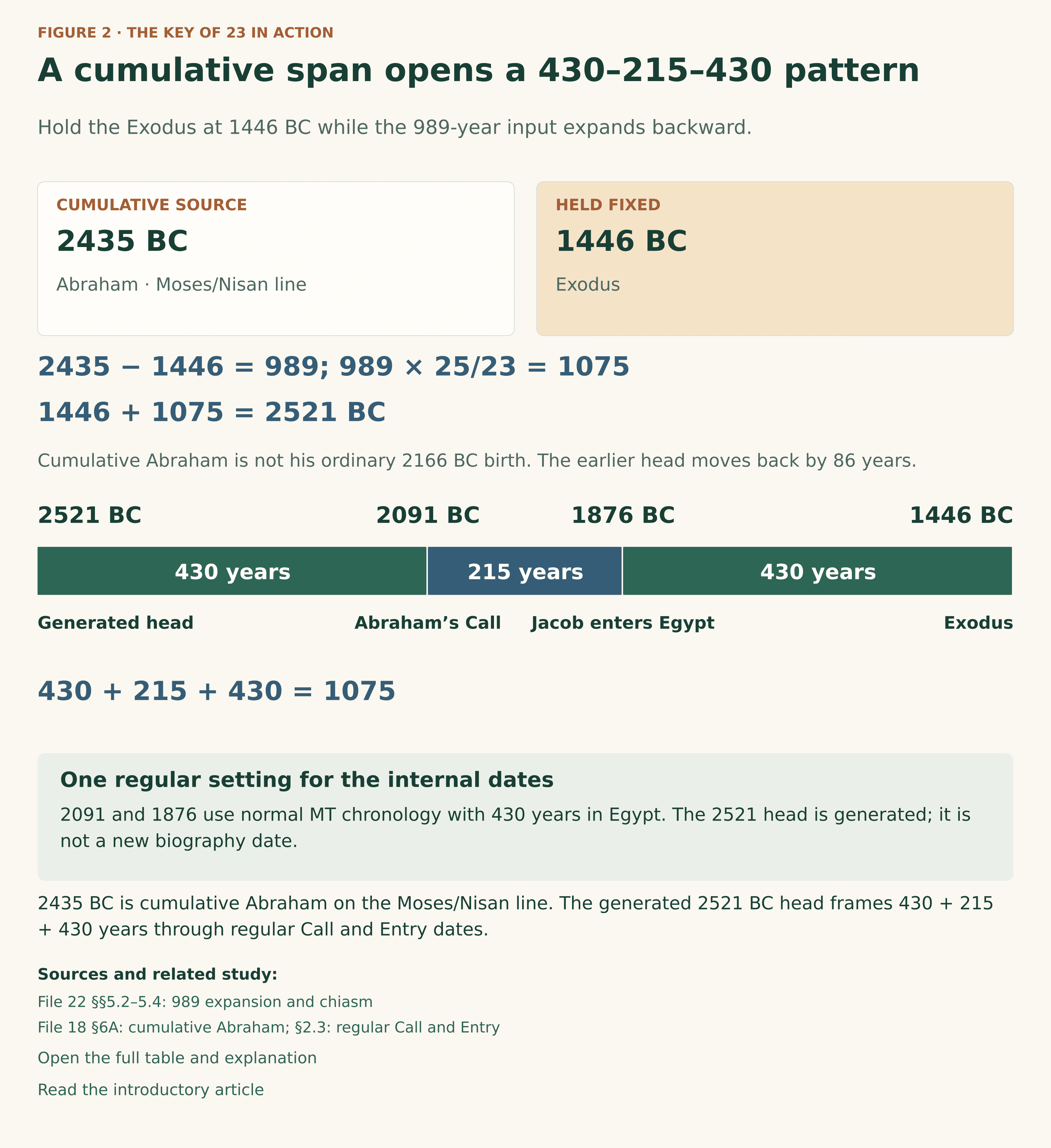
Figure 2 · The Key of 23 in Action
A cumulative span opens a 430–215–430 pattern
Hold the Exodus at 1446 BC while the 989-year input expands backward.
Abraham · Moses/Nisan line
Exodus
2435 − 1446 = 989
989 × 25/23 = 1075
1446 + 1075 = 2521 BC
The source is cumulative Abraham, not his ordinary 2166 BC birth. The earlier head moves back by 86 years.
Generated head
Abraham’s Call
Jacob enters Egypt
Exodus
430 + 215 + 430 = 1075
Sources: File 22 §§5.2–5.4: 989 expansion and chiasm · File 18 §6A: cumulative Abraham; §2.3: regular Call and Entry.
Model and calculation details
Cumulative Abraham 2435 BC to fixed Exodus 1446 BC gives 989. Multiplication by 25/23 produces 1075, an 86-year increase; 1446 + 1075 gives the generated 2521 BC head. Its partition is 2521 → 2091 → 1876 → 1446 BC = 430 + 215 + 430. The internal 2091 Call and 1876 entry of Jacob both use the normal regular MT full 430-year Egypt setting.2435 is not ordinary Abraham birth 2166.2521 is a generated comparison head, not an independently dated biography.
Static image alternative
| Interval BC | Years | Earlier boundary | Later boundary |
|---|---|---|---|
| 2521 → 2091 | 430 | Generated head | Abraham’s regular call |
| 2091 → 1876 | 215 | Abraham’s regular call | Jacob’s entry into Egypt |
| 1876 → 1446 | 430 | Jacob’s entry into Egypt | Exodus |
The 2091 BC call follows from Abraham’s regular birth at 2166 BC and departure at age 75. 1876 BC is Jacob’s entry into Egypt in the normal Egypt-only 430-year setting. Genesis 12:4 and Genesis 46 supply the narrative context; Exodus 12:40–41, BSB supplies the stated 430 years. The BC coordinates follow the declared chronology.
The result is 1075 = 430 + 215 + 430. Its first 430 begins at a generated head; it is not a separately narrated historical period. The central 215 runs from the call to entry into Egypt, while the final 430 belongs to the Egypt-only Sojourn. This is therefore an expanded span partitioned by regular event dates, rather than a claim that 2521 BC marks an independently known event. File 22 §§5.1–5.4.
4. Establishing the genealogical measuring scale
The next examples use the 70-year generational unit discussed in File 15 and applied in Files 43 and 46. This is an assigned measuring unit. It does not replace the varying lifespans and begetting ages in Genesis or imply that every Gospel ancestor fathered a child at 70.
In the selected Luke-side arrangement, 76 human figures give 75 intervals between the first and last names. The model’s Matthew branch uses an undoubled 41-figure arrangement, with 40 intervals to Christ’s model birth hinge at 6 BC. Assigning a full 70-year block to every name gives a different total from counting only the intervals between names.
| Counting state | Counted objects | Units × 70 | Years | Input to 8050? |
|---|---|---|---|---|
| Luke intervals | Between 76 human figures in the selected Ram inventory | 75 × 70 | 5250 | Included |
| Luke names-span | One assigned block for each selected figure | 76 × 70 | 5320 | Excluded |
| Matthew birth-hinge span | Intervals in the undoubled 41-figure arrangement | 40 × 70 | 2800 | Included |
| Matthew carrier span | One block for each of the 41 figures | 41 × 70 | 2870 | Excluded |
The textual inventory must be specified. The BSB’s Luke 3:33 has Admin and Arni. File 43’s selected inventory has one Ram entry at that point. Its 76-figure count is therefore not an unmodified count of the BSB edition, which has 77 human entries including Jesus. The quoted Scripture remains unchanged; the numerical model’s selected inventory is identified separately.
Matthew’s three groups of fourteen, stated in Matthew 1:17, BSB, also require a convention for shared group boundaries. File 69 analyzes a 42-slot Jeconiah-overlap arrangement as well as the undoubled count. That 42-slot attribution does not replace the File 43 branch used for the present calculations. File 43 §§2–3 · File 69.
Opening and closing boundaries
Each assigned block has two edges. The model’s Matthew-side Abraham block runs from 2806 to 2736 BC; its Solomon block runs from 1826 to 1756 BC. A calculation landing on 2736 or 1756 reaches a closing boundary. Calling either one an unqualified birth date would change the claim.
The model also extends a Matthew-side scale backward before Abraham. Matthew’s Gospel itself begins its genealogy with Abraham. Adam, Noah and Shem on this extended scale are model positions, not names newly discovered at the beginning of Matthew’s text.
| Selected display | Person | Assigned block | Boundary used | Status |
|---|---|---|---|---|
| Luke | Adam | 5256 BC → 5186 BC | Opening at 5256 | Schematic position |
| Luke | Jared | 4906 BC → 4836 BC | Opening at 4906 | Schematic position |
| Luke | Enoch | 4836 BC → 4766 BC | Opening at 4836 | Schematic position |
| Both selected displays | Christ | 6 BC → AD 65 | Opening at 6 BC; closing at AD 65 | Assigned 70-year block; not a lifespan |
| Matthew-side extension | Adam | 4206 BC → 4136 BC | Opening at 4206 | Pre-Abraham schematic extension |
| Matthew-side extension | Noah | 3576 BC → 3506 BC | Closing at 3506 | Pre-Abraham schematic extension |
| Matthew-side extension | Shem | 3506 BC → 3436 BC | Opening at 3506 | Pre-Abraham schematic extension |
| Matthew, undoubled | Abraham | 2806 BC → 2736 BC | Closing at 2736 | Selected 41-carrier arrangement |
| Matthew, undoubled | Solomon | 1826 BC → 1756 BC | Closing at 1756 | Selected 41-carrier arrangement |
This table identifies the selected rows needed below. The complete source display is directly available in File 43 §3.4. Its boundaries organize the numerical comparisons; they do not supply an independent textual chronology for these people.
5. Enoch’s position: 4830 becomes 4900 or 5250
On the selected Luke-side scale, Enoch’s opening boundary is 4836 BC. Its distance from the fixed 6 BC hinge is:
4836 − 6 = 4830
This input is divisible in both required ways: 4830 = 69 × 70 = 23 × 210. Applying each ratio separately gives:
4830 × 70/69 = 4900
4830 × 25/23 = 5250
With 6 BC fixed, the first output reaches 4906 BC, the opening boundary assigned to Jared. The second reaches 5256 BC, the opening boundary assigned to Adam.
Figure 3 · The Key of 23 in Action
One hinge, two alternative expansions
The 6 BC hinge stays fixed as the span expands backward through schematic genealogy positions.
Christ-generation hinge
Source · Enoch
4836 − 6 = 4830
Original span · schematic genealogy positions
Alternative A · Jared
4830 × 70/69 = 4900
Increase: 70 years · schematic genealogy positions
Alternative B · Adam
4830 × 25/23 = 5250
Increase: 420 years · schematic genealogy positions
Sources: File 46 §4.2: three coordinate realizations · File 43: schematic 70-year genealogy frame.
Model and calculation details
In File 46’s genealogy lattice, Enoch occupies 4836 BC, Jared 4906 BC, and Adam 5256 BC. These are calculated positions on the 70-year genealogical grid, not ordinary historical birth dates. Holding the 6 BC Christ-generation hinge fixed, 4836 − 6 = 4830; 4830 × 70/69 = 4900 places the earlier endpoint at 4906 BC; 4830 × 25/23 = 5250 places it at 5256 BC. The gains are 70 and 420, respectively. The factors are alternatives; the second row is not fed into the third.
Static image alternative
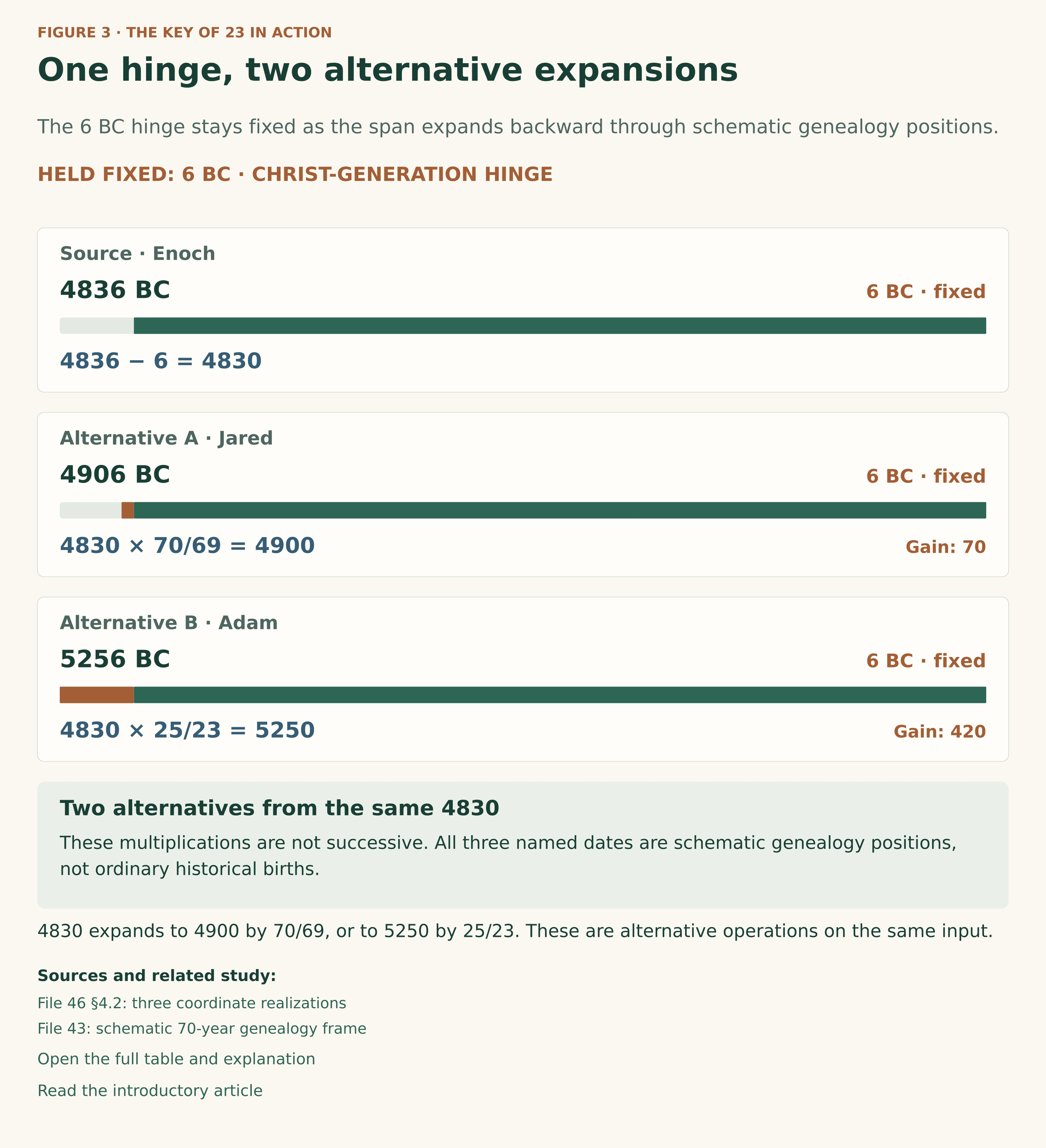
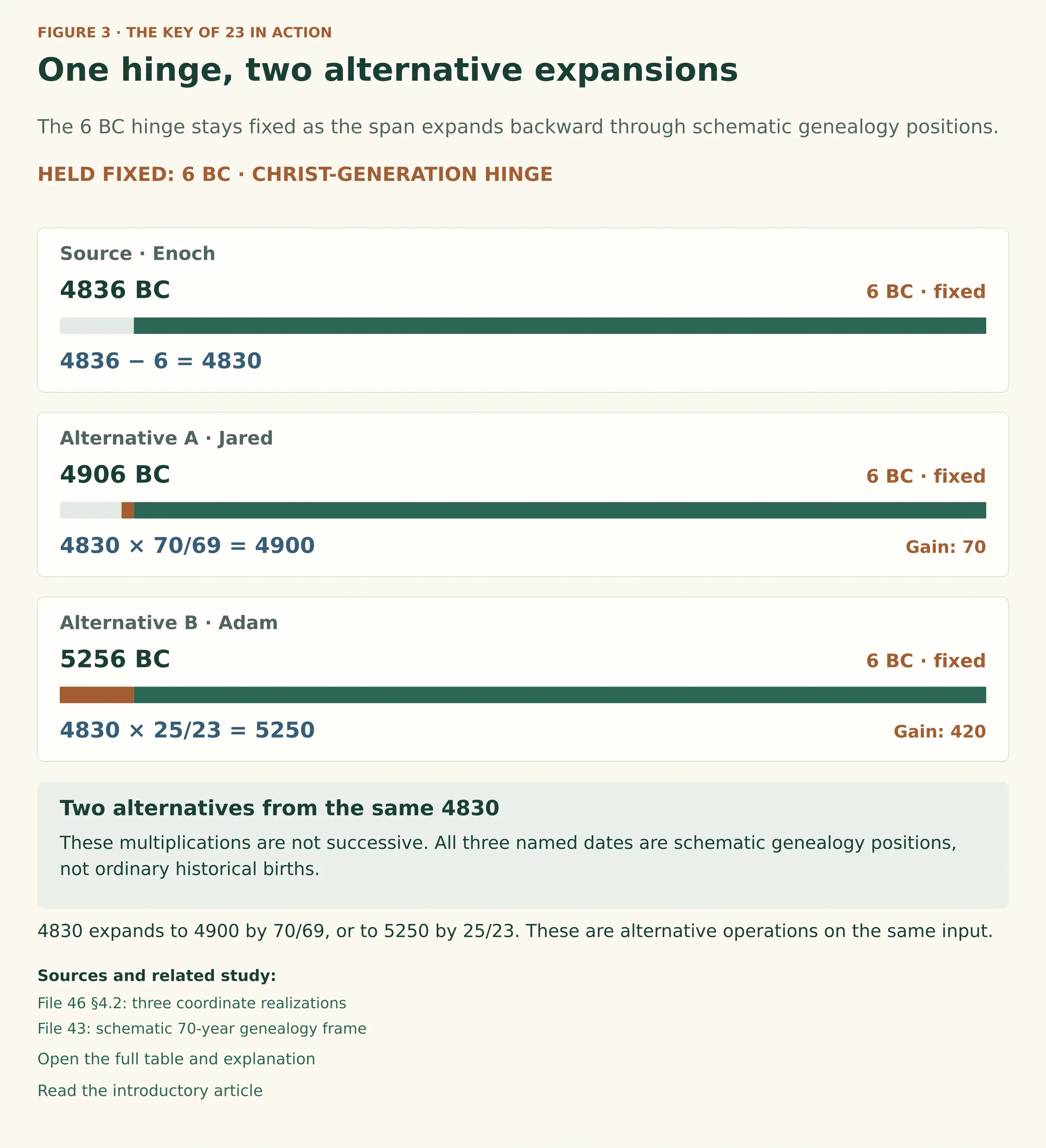
The increases are 70 and 420 years. On the 70-year scale, the earlier endpoint moves one position or six positions. Both expansions begin with the same 4830-year input; the output 4900 is not fed into the 25/23 calculation.
The relationship between Jared and Enoch comes from Genesis 5:18–24, BSB, and their place in Luke’s ancestry is shown in Luke 3:37–38. The dates plotted here come from the stated schematic arrangement. In particular, Enoch’s assigned 70-year block does not alter the 365 years in Genesis 5:23, BSB.
File 46 calls 4830 a solar-span input. That terminology does not make it 4830 Enochian 364-day years. The local argument uses the exact rational products above, with the 6 BC hinge retained throughout. File 46 §4.2 · File 54 §6.
6. Holding the opposite endpoint: the forward reach to AD 65
The same original interval can be expanded while holding 4836 BC fixed instead. The multiplication is unchanged: 4830 × 70/69 = 4900. Its placement now extends forward from Enoch’s schematic boundary and reaches AD 65.
Figure 4 · The Key of 23 in Action
The held endpoint changes the landing
The same 4830 → 4900 expansion has two different coordinate realizations.
4830 × 70/69 = 4900
Increase: 70 years
Hold the later end: expand backward
4836 BC moves to
Christ-generation hinge
4906 − 6 = 4900
Hold the earlier end: expand forward
6 BC moves to
Schematic Enoch position
4836 + 65 − 1 = 4900
The extension is also exact:
6 + 65 − 1 = 70 years.
Sources: File 46 L2 / §2.2: forward endpoint AD 65 · File 46 §4.2: backward endpoint 4906 BC.
Model and calculation details
Both constructions apply 70/69 to 4830, producing 4900 and adding 70 years. Holding 6 BC fixed and extending backward gives 4906 BC. Holding the schematic Enoch position 4836 BC fixed and extending forward gives AD 65. The forward elapsed span is 4836 + 65 − 1 = 4900; the extension from 6 BC to AD 65 is 6 + 65 − 1 = 70. These are anchored span expansions. Crossing BC–AD here does not activate a Mirror reflection.
Static image alternative
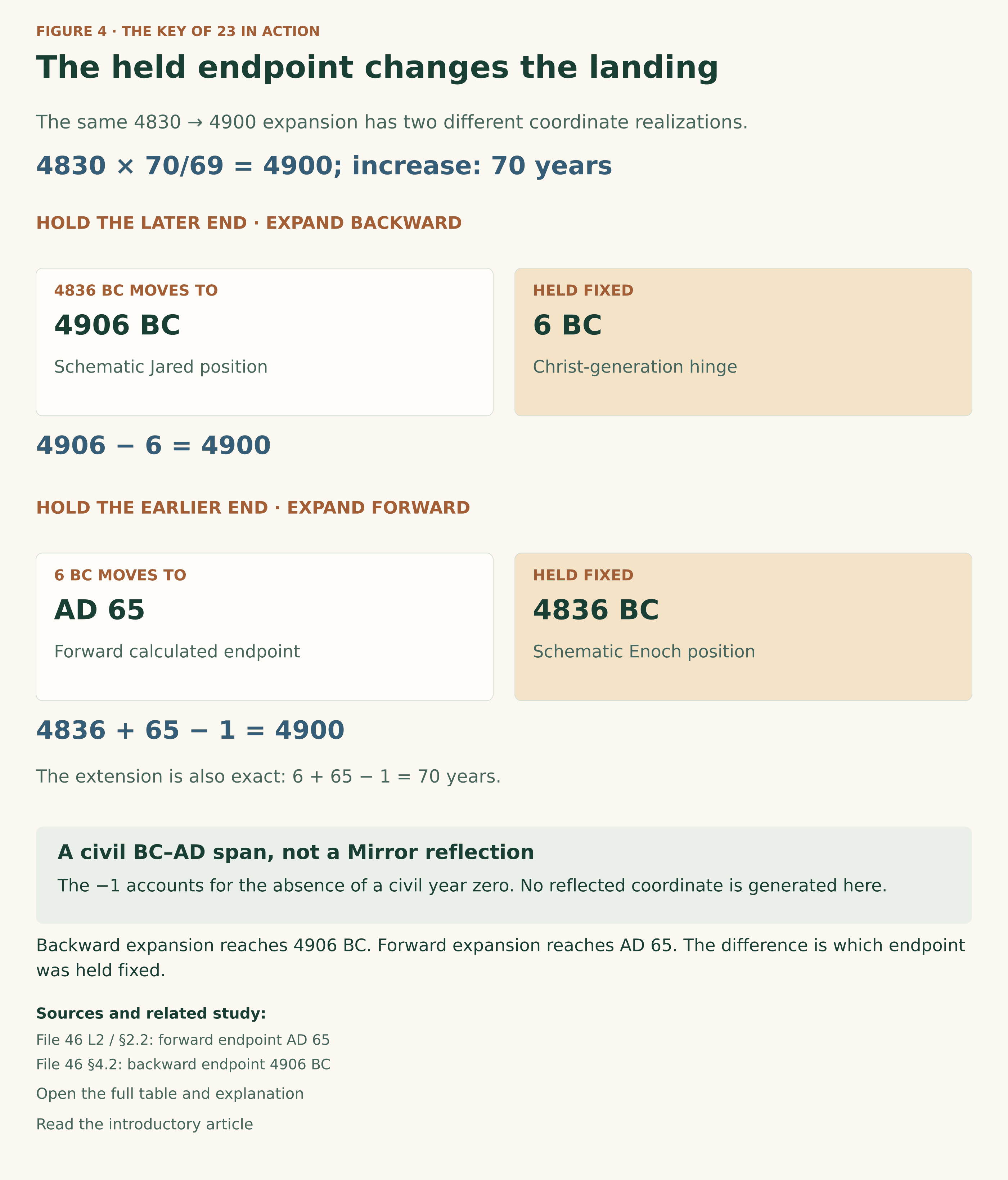
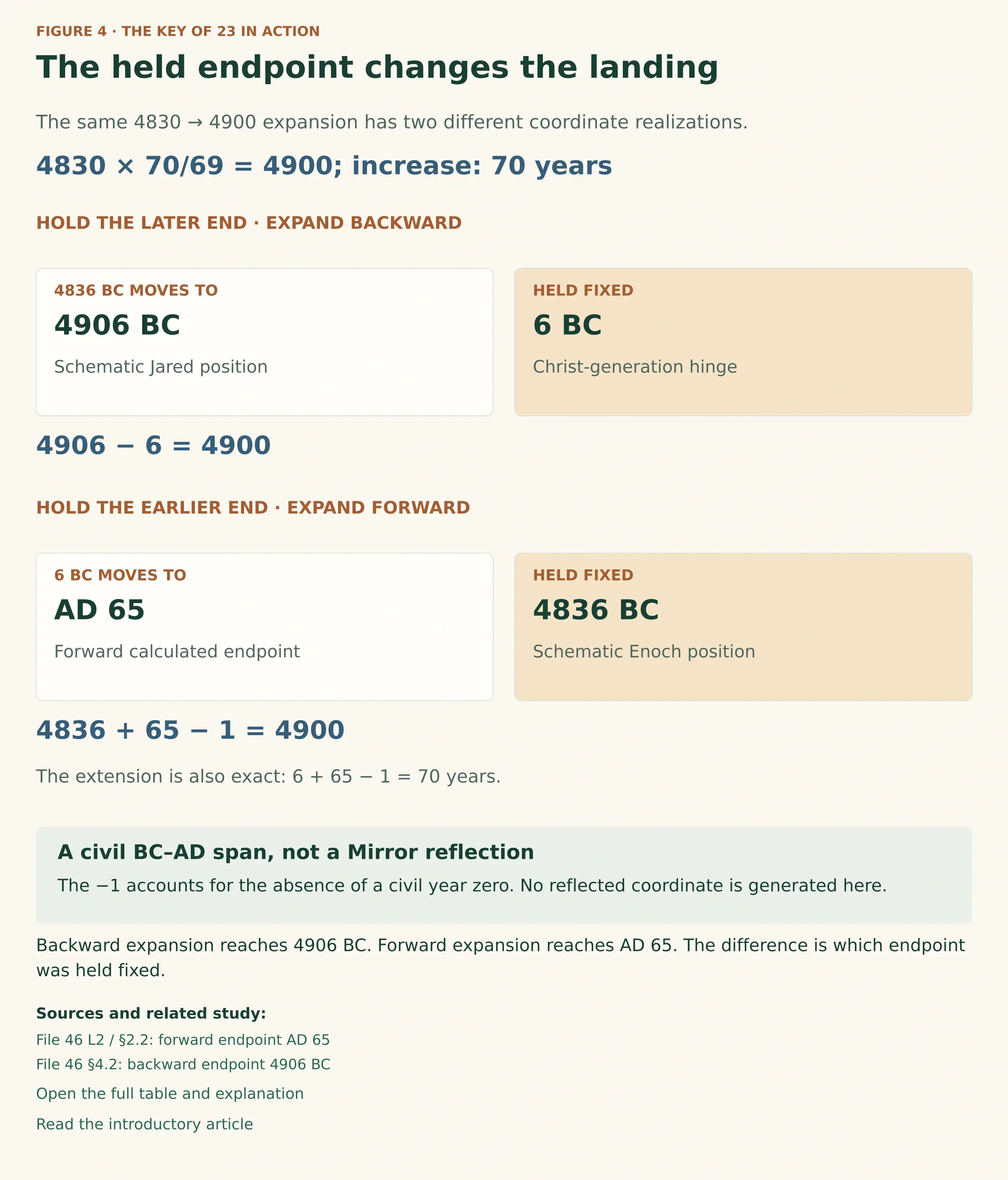
| Held endpoint | Direction | Resulting placement | Elapsed-year check | Model boundary |
|---|---|---|---|---|
| Later endpoint: 6 BC | Backward | 4906 BC → 6 BC | 4906 − 6 = 4900 | Jared opening |
| Earlier endpoint: 4836 BC | Forward | 4836 BC → AD 65 | 4836 + 65 − 1 = 4900 | Christ-generation closing |
Because civil BC–AD numbering has no year zero, the forward elapsed span is 4836 + 65 − 1 = 4900. The added interval from 6 BC to AD 65 is likewise 6 + 65 − 1 = 70.
AD 65 closes the assigned Christ-generation block in this model. It is not a proposed date for Jesus’ death. The result shows what happens when one added 70-year unit is placed at the later end rather than the earlier end.
This construction crosses the era boundary, but it performs no formal Mirror reflection. The civil missing-year correction measures elapsed time; it does not generate a reflected coordinate. Nor is this digit reversal. Those operations have separate canonical rules and should not be inferred from the presence of a BC and an AD date. File 46 §2.2 · File 00 §3.9 · File 09, Appendix A.
7. From Abraham’s closing boundary to Solomon’s
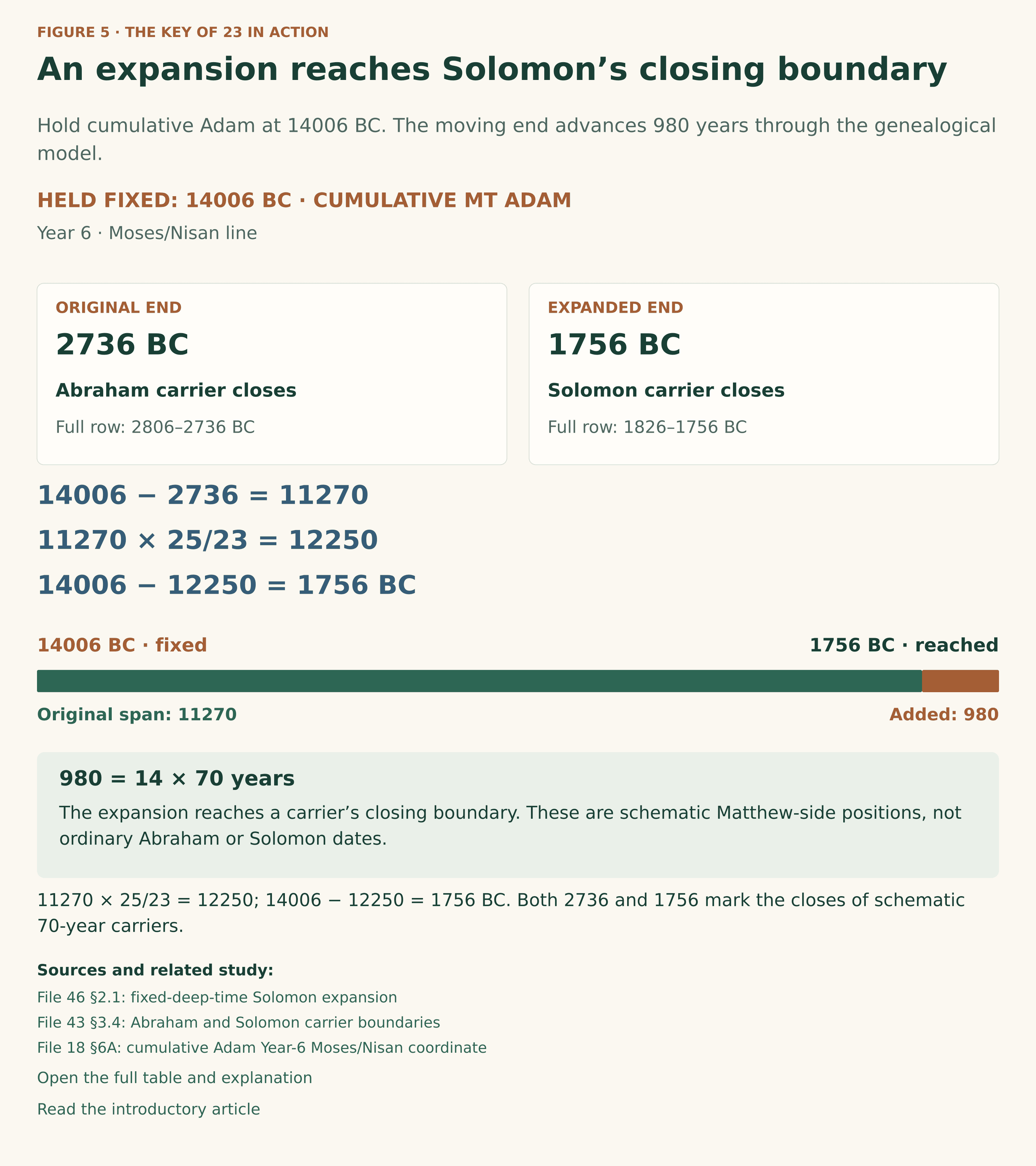
The next comparison retains an earlier anchor from cumulative chronology: 14006 BC, the standard MT Moses/Nisan Adam-Year-6 coordinate. It lies within the cumulative Creation-week display 14011–14004 BC; it is not the whole week’s opening boundary. Its role is controlled by File 18 §6A, File 22 §1.2 and File 09 §3A.1.
From that held coordinate to the closing boundary of Matthew-side Abraham at 2736 BC, the distance is:
14006 − 2736 = 11270
Expand the span by 25/23 while keeping 14006 BC fixed:
11270 × 25/23 = 12250
14006 − 12250 = 1756 BC
Figure 5 · The Key of 23 in Action
An expansion reaches Solomon’s closing boundary
Hold cumulative Adam at 14006 BC. The moving end advances 980 years through the genealogical model.
Cumulative MT Adam · Year 6 · Moses/Nisan
Abraham carrier closes
Full row: 2806–2736 BC
Solomon carrier closes
Full row: 1826–1756 BC
14006 − 2736 = 11270
11270 × 25/23 = 12250
14006 − 12250 = 1756 BC
Sources: File 46 §2.1: fixed-deep-time Solomon expansion · File 43 §3.4: Abraham and Solomon carrier boundaries · File 18 §6A: cumulative Adam Year-6 Moses/Nisan coordinate.
Model and calculation details
The held 14006 BC coordinate is cumulative MT Adam’s Year-6 Moses/Nisan member, not the regular Creation date or a Rounded-state substitution. The original endpoint 2736 BC closes the Matthew-side Abraham carrier 2806–2736 BC. The span 14006 − 2736 = 11270 expands by 25/23 to 12250. Holding 14006 fixed gives 1756 BC, the close of the Solomon carrier 1826–1756 BC. The gain is 980 = 14 × 70. The carrier boundaries are schematic positions, not historical birth or death dates.
Static image alternative
| Stage | Held cumulative coordinate | Span | Endpoint reached | Assigned block |
|---|---|---|---|---|
| Original | 14006 BC | 11270 | 2736 BC; Abraham closing | 2806–2736 BC |
| Expanded by 25/23 | 14006 BC | 12250 | 1756 BC; Solomon closing | 1826–1756 BC |
The new endpoint is the closing boundary of the model’s Solomon block, 1826–1756 BC. The added length is 980 = 14 × 70 years. Thus the comparison advances from one identified closing boundary to another, fourteen assigned positions later.
The argument combines a cumulative coordinate with a schematic genealogical arrangement. It does not place the historical Solomon in 1756 BC, and it does not redate the Temple. The Gospel’s Abraham-to-Solomon ancestry can be read in Matthew 1:1–7, BSB; the closing coordinates come from the selected File 43 display.
File 46 calls this a generator “lock.” Here the word identifies a verified numerical relationship under declared settings. File 46 §2.1.
8. Doubling the input: 9660 reaches Adam and the Noah–Shem boundary
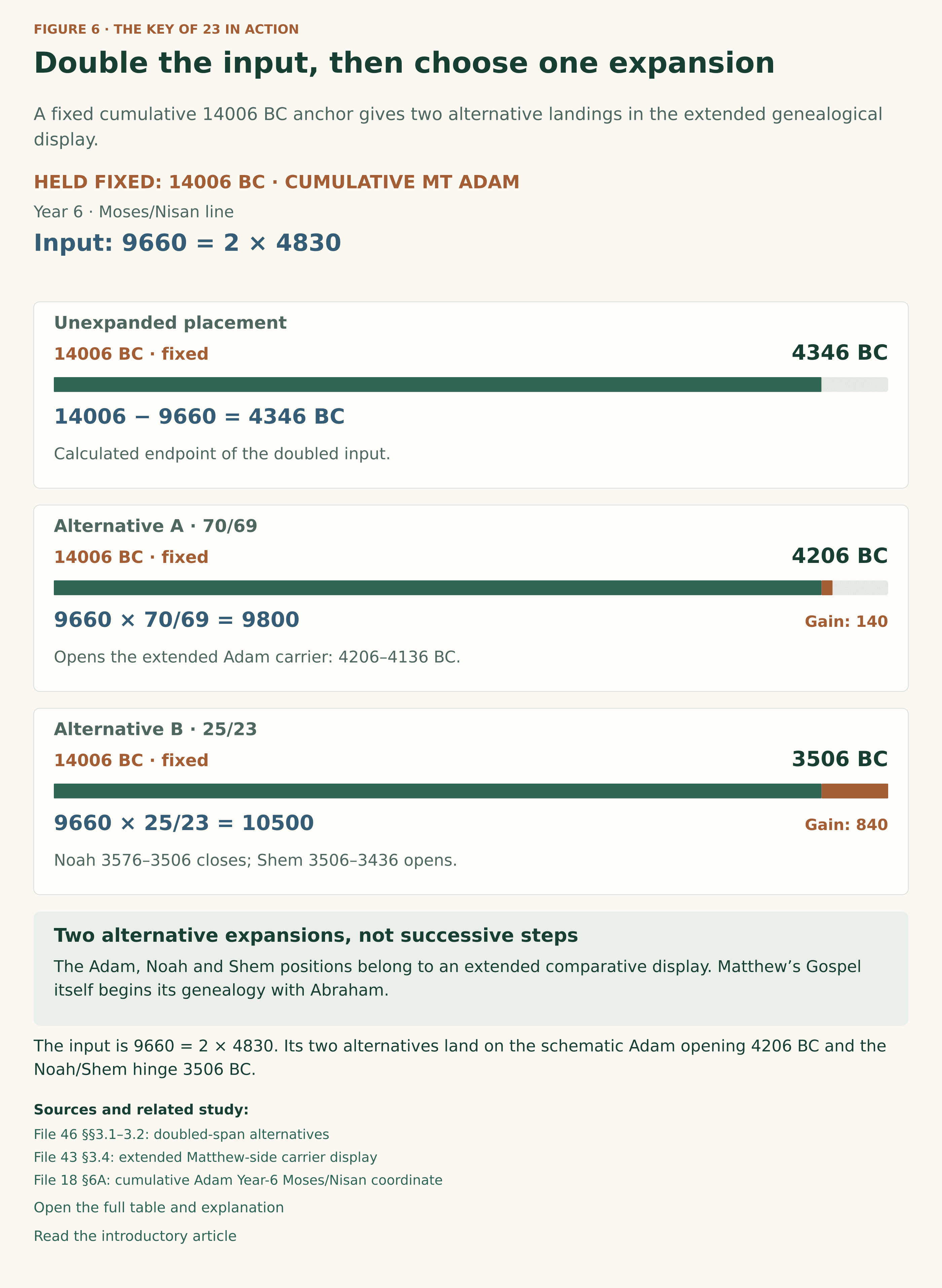
File 46 next takes twice the original 4830-year input:
2 × 4830 = 9660
This doubles a length. It does not, by itself, reflect a date or select an endpoint. The following applications explicitly retain the same cumulative coordinate, 14006 BC.
Before either expansion, a 9660-year span placed forward from 14006 BC reaches 4346 BC:
14006 − 9660 = 4346 BC
That is the generated coordinate reached by the two regular expansion paths in §2. The shared value supplies a connection between the constructions, while their different source states remain intact. The current Restart Capsule §10.28 also records this relationship.
Now apply the two ratios separately to 9660:
9660 × 70/69 = 9800
14006 − 9800 = 4206 BC
9660 × 25/23 = 10500
14006 − 10500 = 3506 BC
Figure 6 · The Key of 23 in Action
Double the input, then choose one expansion
A fixed cumulative 14006 BC anchor gives two alternative landings in the extended genealogical display.
Cumulative MT Adam · Year 6 · Moses/Nisan
Input: 9660 = 2 × 4830
Unexpanded placement
14006 − 9660 = 4346 BC
Calculated endpoint of the doubled input.
Alternative A · 70/69
9660 × 70/69 = 9800
Opens the extended Adam carrier: 4206–4136 BC. Increase: 140 years.
Alternative B · 25/23
9660 × 25/23 = 10500
Noah 3576–3506 closes; Shem 3506–3436 opens. Increase: 840 years.
Sources: File 46 §§3.1–3.2: doubled-span alternatives · File 43 §3.4: extended Matthew-side carrier display · File 18 §6A: cumulative Adam Year-6 Moses/Nisan coordinate.
Model and calculation details
Hold the cumulative MT Adam Year-6 Moses/Nisan coordinate 14006 BC fixed. The unexpanded 9660-year input has the calculated endpoint 4346 BC. Multiplying 9660 by 70/69 gives 9800; 14006 − 9800 = 4206 BC opens the Matthew-side extended Adam carrier 4206–4136 BC. Alternatively, 9660 × 25/23 = 10500; 14006 − 10500 = 3506 BC closes Noah 3576–3506 and opens Shem 3506–3436 in the same extended display. The gains are 140 and 840. The expansions are alternatives, not successive steps. The extension before Abraham belongs to the comparative model; Matthew’s Gospel itself begins its genealogy with Abraham.
Static image alternative
| Treatment of 9660 | Held coordinate | Resulting span | Later endpoint | Gain | Boundary reached |
|---|---|---|---|---|---|
| Doubled input | 14006 BC | 9660 | 4346 BC | 0 | Generated common coordinate |
| 70/69 alternative | 14006 BC | 9800 | 4206 BC | 140 | Matthew-side extended Adam opening |
| 25/23 alternative | 14006 BC | 10500 | 3506 BC | 840 | Noah closing / Shem opening |
The first result reaches 4206 BC, the opening Adam boundary in the model’s Matthew-side pre-Abraham extension. The second reaches 3506 BC, which closes Noah’s assigned block 3576–3506 BC and opens Shem’s 3506–3436 BC. It is a shared boundary between adjacent schematic positions.
The increases are 140 = 2 × 70 and 840 = 12 × 70. They are twice the gains from the corresponding 4830-year expansions. This is what doubling the common input predicts arithmetically; it should not be counted as an unrelated second proof of the ratios.
Neither endpoint is a replacement for the ordinary MT Creation date or the historical Flood chronology. Noah and Shem’s biblical relationship is represented in Genesis 5:32 and Luke 3:36; the particular 3506 BC boundary is a model assignment. File 46 §§3.1–3.2.
9. Combining spans: 8050 becomes 8750
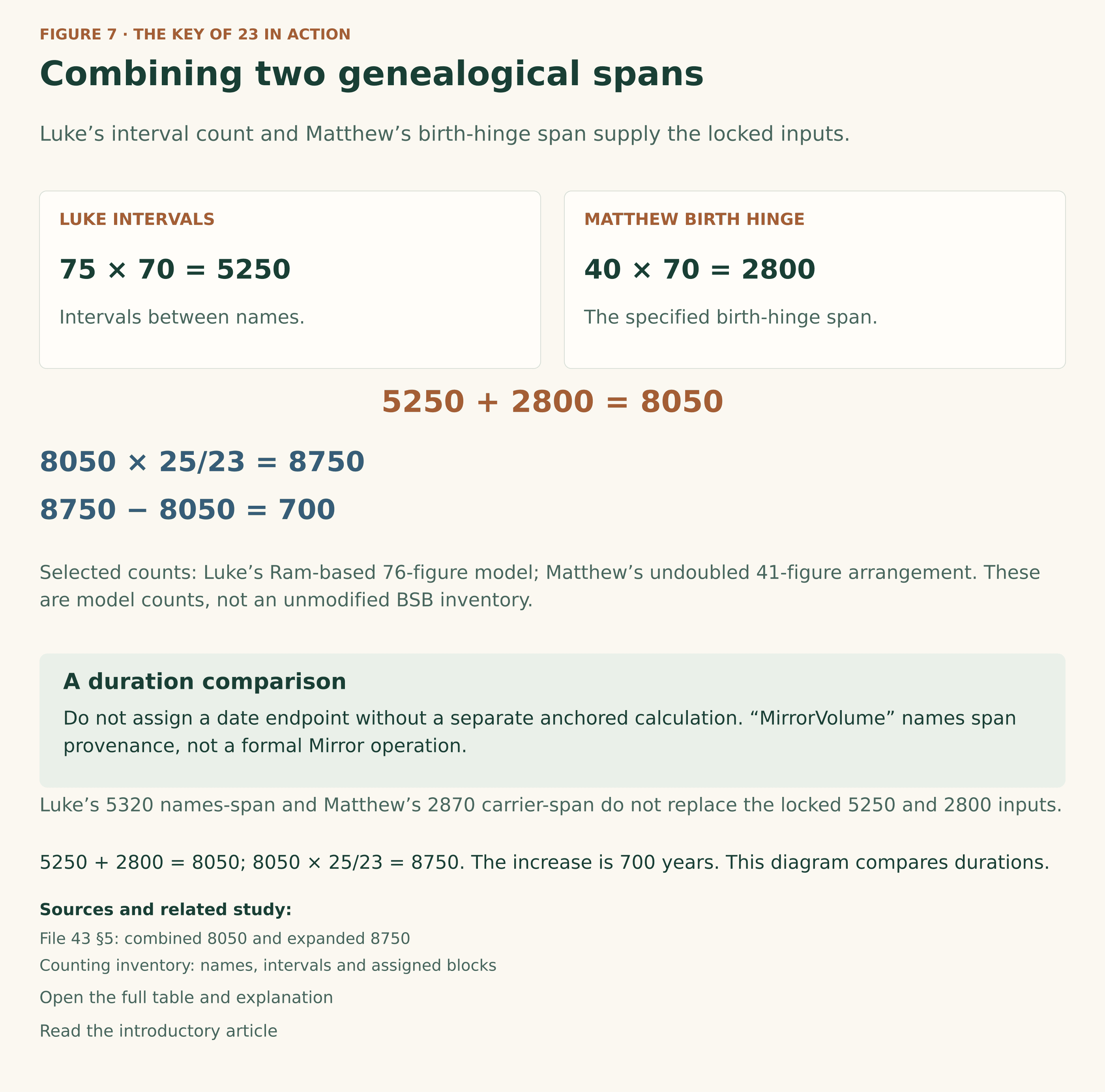
File 43 combines the 75 Luke intervals and the 40 Matthew birth-hinge intervals, each measured in units of 70 years:
5250 + 2800 = 8050
8050 × 25/23 = 8750
8750 − 8050 = 700 = 10 × 70
Figure 7 · The Key of 23 in Action
Combining two genealogical spans
Luke’s interval count and Matthew’s birth-hinge span supply the locked inputs.
Intervals between names.
The specified birth-hinge span.
5250 + 2800 = 8050
8750 − 8050 = 700
Selected counts: Luke’s Ram-based 76-figure model; Matthew’s undoubled 41-figure arrangement. These are model counts, not an unmodified BSB inventory.
Keep the inputs distinct: Luke’s 5320 names-span and Matthew’s 2870 carrier-span do not replace 5250 and 2800 here.
Sources: File 43 §5: combined 8050 and expanded 8750 · Counting inventory: names, intervals and assigned blocks.
Model and calculation details
File 43 distinguishes Luke’s 75 intervals at 70 years each, 5250, from a 76-name span of 5320. It also distinguishes Matthew’s birth-hinge 40 × 70 = 2800 from the carrier 41 × 70 = 2870. Only 5250 + 2800 enters the source’s MirrorVolume 8050. The 25/23 expansion gives 8750 and an increment 700. The terminology MirrorVolume names span provenance; it does not supply a formal Mirror-coordinate operation. No dated output endpoint is assigned in this figure. The count selection uses Luke’s Ram-based 76-figure model and Matthew’s undoubled 41-figure arrangement. The Luke inventory is not an unmodified count of the BSB edition.
Static image alternative
The 700 is generated by the expansion. It is not a third independently supplied input. The products 76 × 70 = 5320 and 41 × 70 = 2870 remain valid in their own counting states, but neither replaces the required 5250 and 2800 in this sum.
The canonical term MirrorVolume names the combined span’s provenance. It does not activate a formal Mirror, inverse-number operation or calendar-residue calculation. At this stage the equation establishes a duration relationship and assigns no dated endpoint. File 43 §5.
A separately specified 8750-year comparison
File 43 §8 also preserves a comparison between the cumulative coordinate 14006 BC and the Luke-side Adam boundary 5256 BC:
14006 − 5256 = 8750 = 125 × 70
The length agrees with the expanded combined span. This dated comparison is supplied separately, under the source’s authorized anchor set. It does not follow automatically from multiplying 8050. One endpoint belongs to cumulative MT chronology; the other belongs to the selected Luke-side schematic arrangement.
Since 125 = 5³, File 43 calls this a cumulative cube relationship. The factorization is exact; the architectural significance belongs to the structural interpretation. Its local authorization and provenance remain with File 43 §8, rather than being rederived from the genealogy’s display table alone.
10. What these correspondences mean—and what has been pruned
The retained examples share a disciplined form. The original span is specified, its expansion is exact, and its placement is explicit. A meaningful comparison then asks what kind of boundary has been reached: an ordinary event date, an identified schematic position, or a generated coordinate reached by another controlled path.
The biblical themes give the numbers their subject matter. Creation, Abraham’s call, deliverance from Egypt, entry into the land, the royal line and the genealogy leading to Christ are related within the biblical narrative. I read the numerical correspondences as a possible expression of that coherence. This theological reading goes beyond the equations while remaining accountable to their stated sources.
The equations do not establish direct Matthean or Lukan compositional intent. Nor does this study supply a defined random model, comparison population or selection procedure from which a probability of chance could be calculated. Claims of statistical impossibility and declarations that the correspondences prove deliberate design have therefore been removed.
The legacy 6900-year example
The original discussion repeatedly presented 6900 as a direct Jared-to-Shem dated interval. Current File 22 §7.10 instead treats it as the restored-Cainan birth-transfer composite 4600 + 2300. Its component settings cannot be flattened into the older timeline.
The scalar arithmetic remains valid:
6900 × 70/69 = 7000
6900 × 25/23 = 7500
But those products do not restore the legacy endpoint claims. No single held date is assigned to them here. The obsolete Jared/Shem coordinates and the repeated dialogue built upon them have been pruned. Current control: File 22 §§7.9–7.10.
The same editorial rule applies to the wider material. Repeated explanations have been consolidated; examples requiring unrelated prime, calendar-residue or LXX-overlay arguments have been left to their own controlled studies. Shared numbers remain comparisons whose chronology, units and boundaries must be named. This allows the strongest surviving relationships to be examined without carrying forward the transcript’s abandoned assumptions.
11. Complete calculation ledger and downloads
All lengths in the ledger are years. “Backward” means earlier in time, toward a larger BC number; “forward” means later in time. Rows beginning with the same input are alternative applications unless an explicit doubling is named.
| Original span | Setting | Held endpoint / direction | Expansion | Output / classification |
|---|---|---|---|---|
| 4114 → 1446 BC | Normal regular MT; no optional +60/+130 | Exodus 1446 BC; backward | 2668 × 25/23 = 2900 | 4346 BC; Generated comparison head |
| 4304 → 1406 BC | Regular MT-based +60 Terah / +130 second Cainan | Conquest 1406 BC; backward | 2898 × 70/69 = 2940 | 4346 BC; Generated comparison head |
| 2435 → 1446 BC | Cumulative MT Abraham, Moses/Nisan; regular Exodus | Exodus 1446 BC; backward | 989 × 25/23 = 1075 | 2521 BC; Generated chiasm head |
| 4836 → 6 BC | Luke-side schematic genealogy | Christ model hinge 6 BC; backward | 4830 × 70/69 = 4900 | 4906 BC; Jared opening boundary |
| 4836 → 6 BC | Luke-side schematic genealogy | Christ model hinge 6 BC; backward | 4830 × 25/23 = 5250 | 5256 BC; Adam opening boundary |
| 4836 → 6 BC | Schematic genealogy; earlier end held | Enoch position 4836 BC; forward | 4830 × 70/69 = 4900 | AD 65; Assigned Christ-generation closing boundary |
| 14006 → 2736 BC | Cumulative MT Year 6; undoubled Matthew-side display | Cumulative 14006 BC; forward | 11270 × 25/23 = 12250 | 1756 BC; Solomon closing boundary |
| 14006 → 4346 BC | Doubled 4830; Matthew-side pre-Abraham extension | Cumulative 14006 BC; forward | 9660 × 70/69 = 9800 | 4206 BC; Extended Adam opening boundary |
| 14006 → 4346 BC | Doubled 4830; Matthew-side pre-Abraham extension | Cumulative 14006 BC; forward | 9660 × 25/23 = 10500 | 3506 BC; Noah closing / Shem opening boundary |
Download the complete endpoint ledger (CSV).
| Supporting table | Download |
|---|---|
| Matched regular/cumulative Creation coordinates | CSV |
| Two paths to generated 4346 BC | CSV |
| Abraham’s 430–215–430 partition | CSV |
| Selected genealogical rows and their edges | CSV |
| Names, intervals and assigned blocks | CSV |
| Opposite held endpoints for 4830 → 4900 | CSV |
| The Solomon comparison | CSV |
| Doubled 9660-year input and its placements | CSV |
| Combined span and separate 8750 comparison | CSV |
| All study data with source bindings | JSON (JSON in ZIP) |
12. Person and event figure index
Scripture links identify the people and narrative relationships. They do not claim that a passage prints the model’s BC coordinate. The classifications in the final column distinguish regular events, cumulative coordinates, schematic positions and generated boundaries.
| Person / event | Figures | Scripture context | Coordinate classification / tables |
|---|---|---|---|
| Creation | Figure 1 | Genesis 1:1, BSB | Regular 4114 BC source and explicit 4304 BC variant in Figure 1; table 1 |
| Exodus | Figure 1; Figure 2 | Exodus 12:41, BSB | Regular 1446 BC held endpoint; table 1, table 2 |
| Conquest / Jordan crossing | Figure 1 | Joshua 4:19, BSB | Regular 1406 BC held endpoint; table 1 |
| Terah | Figure 1 | Genesis 11:26–32, BSB | Optional +60 setting, explicitly opened in Figure 1; table 1 |
| Second Cainan | Figure 1 | Luke 3:35–36, BSB | Restored regular +130 setting in Figure 1; table 1 |
| Generated 4346 BC head | Figure 1; Figure 6 | Generated boundary; no separate narrative event | Calculated convergence in Figure 1; baseline placement in Figure 6; table 1, table 6 |
| Abraham | Figure 2; Figure 5 | Genesis 12:4, BSB | Figure 2: cumulative 2435 and regular call 2091; Figure 5: schematic closing boundary 2736; table 2, table 5 |
| Jacob | Figure 2 | Genesis 46:6, BSB | Regular chronology context for Figure 2; table 2 |
| Jacob’s entry into Egypt | Figure 2 | Genesis 46:6, BSB | Regular 1876 BC in the full 430-year Egypt setting; table 2 |
| Generated 2521 BC head | Figure 2 | Generated boundary; no separate narrative event | Calculated head of the expanded 1075-year comparison; table 2 |
| Enoch | Figure 3; Figure 4 | Genesis 5:21–24, BSB | Schematic 4836 BC opening boundary in Figures 3 and 4; table 3, table 4 |
| Jared | Figure 3; Figure 4 | Genesis 5:18–20, BSB | Schematic 4906 BC opening boundary in Figures 3 and 4; table 3, table 4 |
| Adam in cumulative and schematic comparisons | Figure 3; Figure 5; Figure 6 | Luke 3:38, BSB | Figure 3: Luke-side 5256; Figures 5–6: cumulative 14006; Figure 6: extended Matthew-side 4206; table 3, table 5, table 6 |
| Christ’s model birth hinge | Figure 3; Figure 4 | Luke 3:23, BSB | 6 BC hinge retained by the selected genealogical model; table 3, table 4 |
| AD 65 generation boundary | Figure 4 | Generated boundary; no separate narrative event | Schematic close of the assigned Christ-generation block; not a death date; table 4 |
| Solomon | Figure 5 | Matthew 1:6–7, BSB | Schematic 1756 BC closing boundary; no historical redating; table 5 |
| Noah | Figure 6 | Genesis 5:32, BSB | Schematic 3506 BC closing boundary in the Matthew-side pre-Abraham extension; table 6 |
| Shem | Figure 6 | Luke 3:36, BSB | Schematic 3506 BC opening boundary in the same extension; table 6 |
| Luke’s genealogy | Figure 7 | Luke 3:23–38, BSB | Selected Ram-based 76-figure / 75-interval model; BSB inventory differs; table 7 |
| Matthew’s genealogy and model extension | Figure 5; Figure 6; Figure 7 | Matthew 1:1–17, BSB | Undoubled 41-figure arrangement; the pre-Abraham extension is schematic; table 5, table 6, table 7 |
Download the figure index (JSON in ZIP).
Canonical sources and companion reading
| Source | Role |
|---|---|
| File 00 | Exact operators, held endpoints and formal Mirror distinctions |
| File 09 | Cumulative architecture, the 14006 coordinate and Mirror safeguards |
| File 15 | The generational measuring units |
| File 18 | Regular/cumulative tables, variant scope, and Cainan’s 130/460 distinction |
| File 22 | The 9890 bridge, 989 expansion, 4346 convergence and composite 6900 control |
| File 43 | The selected genealogy display, counted units, 8050 expansion and separate 8750 comparison |
| File 46 | The 4830, 11270 and 9660 expansion protocols |
| File 54 | Corroborating Luke-side 70-year positions |
| File 69 | Later counting-state controls preserving the selected source branch |
| Restart Capsule §10.28 | The declared 14006 → 4346 = 9660 connection |
Begin with the introductory article for the shorter explanation, or use its supporting appendix for the initial examples. This detailed companion replaces the original discussion at its existing address. The publication package preserves the original capture and unchanged canonical sources for comparison.
Scripture quotation: Berean Standard Bible (BSB), public domain. References likewise use BSB except where Brenton’s English Septuagint is explicitly identified. Passage wording was checked against the linked editions. Official BSB terms. Brenton’s 1851 English Septuagint is public domain. No NET Scripture or translators’ notes are reproduced.