A year made entirely of complete weeks has a remarkable simplicity. Its dates return to the same weekdays, its seasons divide evenly, and its annual rhythm keeps the Sabbath in view. This is the organizing idea of the 364-day calendar described in 1 Enoch and Jubilees.
Genesis introduces the heavenly lights in relation to the ordering of time:
And God said, “Let there be lights in the expanse of the sky to distinguish between the day and the night, and let them be signs to mark the seasons and days and years.
Genesis supplies that larger setting. The explicit count of a 364-day year appears in the ancient calendar writings themselves. Jubilees directs that the years be observed according to this reckoning:
three hundred and sixty-four days, and (these) will constitute a complete year
— Jubilees 6:32, excerpt; R. H. Charles translation, 1913
The preceding verses describe four divisions of thirteen weeks and an entire year of fifty-two weeks. Written as a calculation, the principle is immediate: 52 × 7 = 364.
A year whose weeks fit perfectly
An ordinary 365-day year contains 52 weeks and one additional day. A 364-day year contains exactly 52 weeks. That difference determines what happens to the weekdays: after 364 days, the next year begins on the same weekday as the previous one.
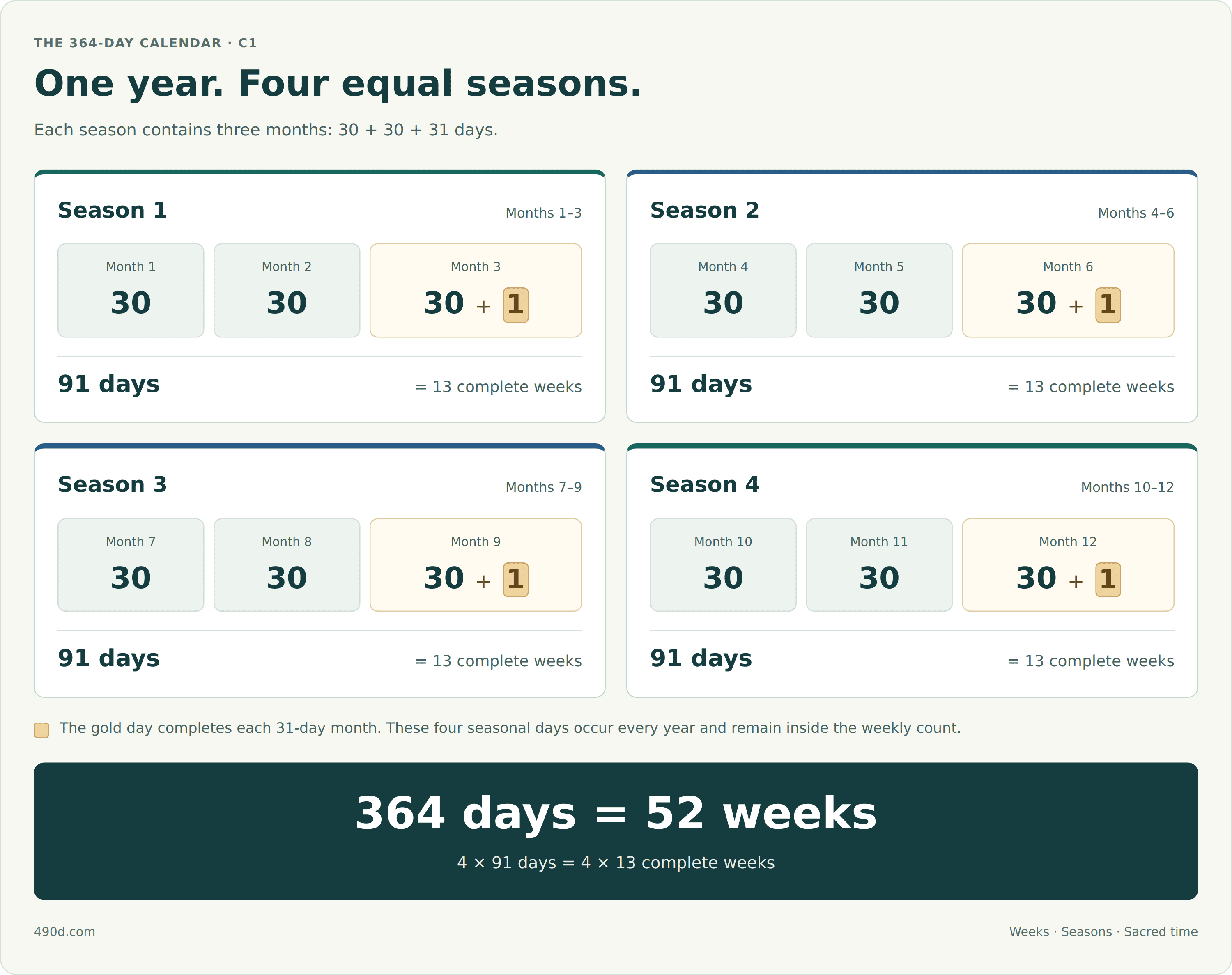
The same order operates within the year. Divide 364 into four equal parts, and each part contains 91 days—exactly 13 weeks. A quarter and a year therefore both return to their starting weekday.
One week: 7 days. One season: 13 weeks. One year: 4 seasons, or 52 weeks.
This gives the calendar its practical appeal for sacred time. The annual sequence of dates can be learned as a stable pattern of weeks. Each recurring festival date keeps its own weekday; the festivals do not all fall on one weekday.
Season 1
Months 1–3Season 2
Months 4–6Season 3
Months 7–9Season 4
Months 10–12Sources: File 12 §§5.2, 7; File 20 §6H, Jubilees source-control table.
Image version and full-size download

Download the full-size PNG · Download the WebP · Download the stacked phone PNG
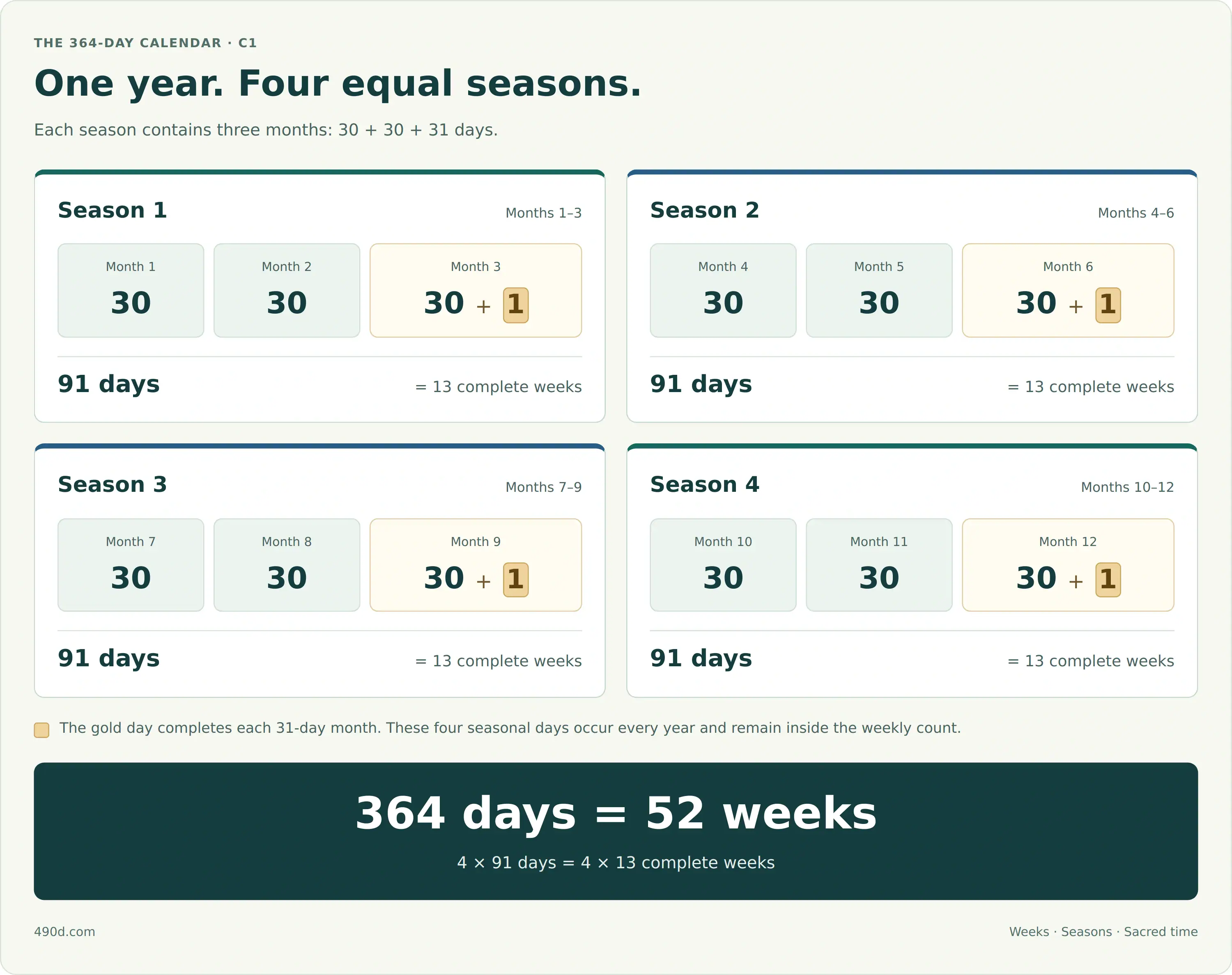
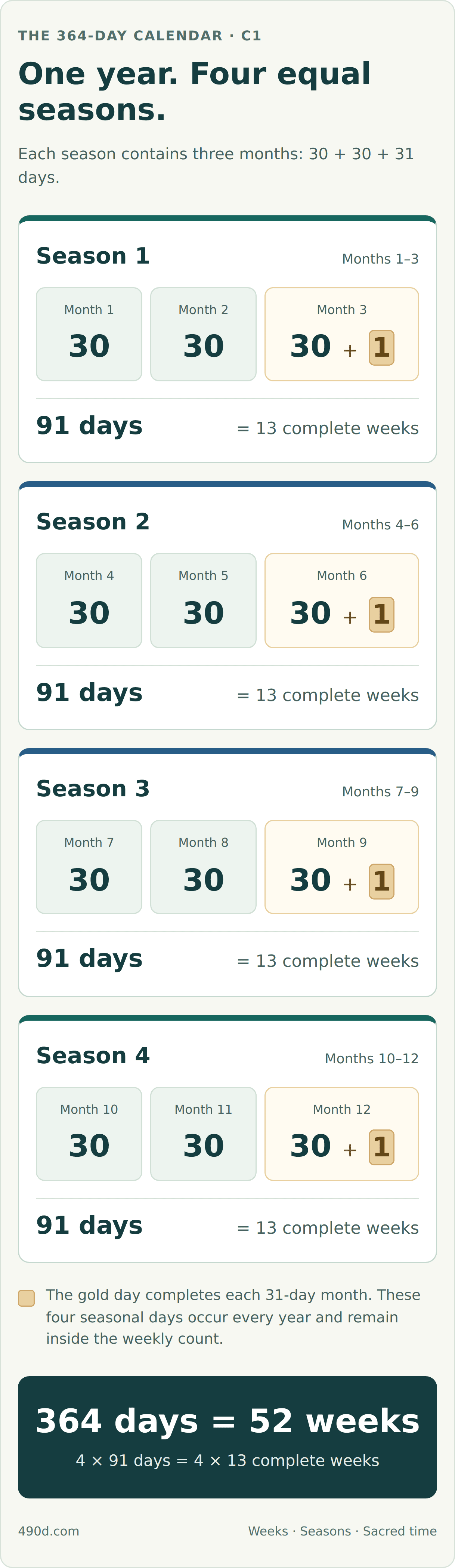
Each quarter follows the month-length pattern 30 + 30 + 31 = 91. Across the year, months 3, 6, 9, and 12 have 31 days; the other eight have 30. This arrangement follows the solar sequence described in 1 Enoch 72, while Jubilees 6:29–30 emphasizes its thirteen-week quarters and fifty-two-week year.
The twelve-month layout and an example of its weekday pattern are immediately available in the supporting calendar table.
Four days that complete the year
The month pattern also shows why both 360 and 364 appear in this discussion:
12 × 30 = 360; 360 + 4 = 364.
The four additional days complete the four seasons. In the diagram, each is shown as the final day of a 31-day month. These are annual seasonal days: they belong to every ordinary 364-day year and remain within its continuous sequence of weeks.
1 Enoch describes these days through the language of heavenly service and seasonal leaders. 1 Enoch 75:1–2 treats the four days separately in the reckoning; 1 Enoch 82:4–6, 11 expressly includes them in the completed 364-day year. Read together, these passages allow the twelve 30-day portions and the four seasonal days to be distinguished without losing any days from the full count.
That distinction is useful throughout the chronology. A schematic 360-day reckoning brings twelve equal months into view. The 364-day calendar brings complete weeks and equal thirteen-week seasons into view. We can compare their structures while keeping their lengths clear.
Where the priestly year fits
There is a related weekly pattern in the priestly courses. A schematic rotation of 24 courses, each serving for one week, gives 24 × 7 = 168 days. Two rotations give 336 days, or 48 weeks. The course structure and its wider relationships are explained in Levi and the Priestly Year.
Four more weeks bring that count to the 52-week year:
336 + 28 = 364.
The two comparisons should remain distinct. From 360 to 364, the difference is four days. From 336 to 364, it is four weeks. The first identifies the annual seasonal days; the second shows how the priestly service pattern fits mathematically within a complete-week year. The arithmetic alone does not specify how every historical priestly roster handled festivals or additional weeks.
Priestly
24 seven-day courses
Prophetic
30-day-month reckoning
Enochic
of complete weeks
Sources: File 12 §§6.3, 7.

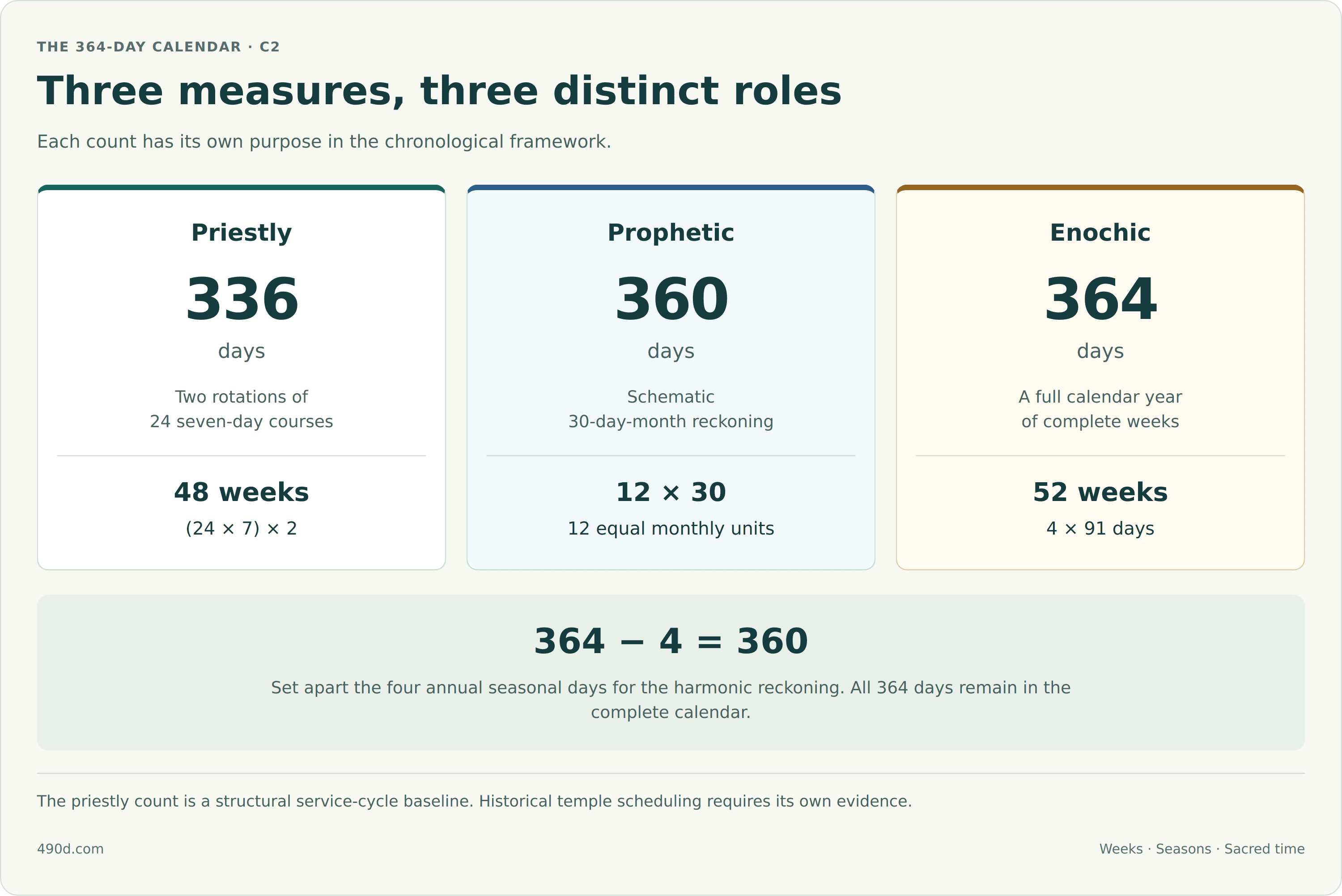
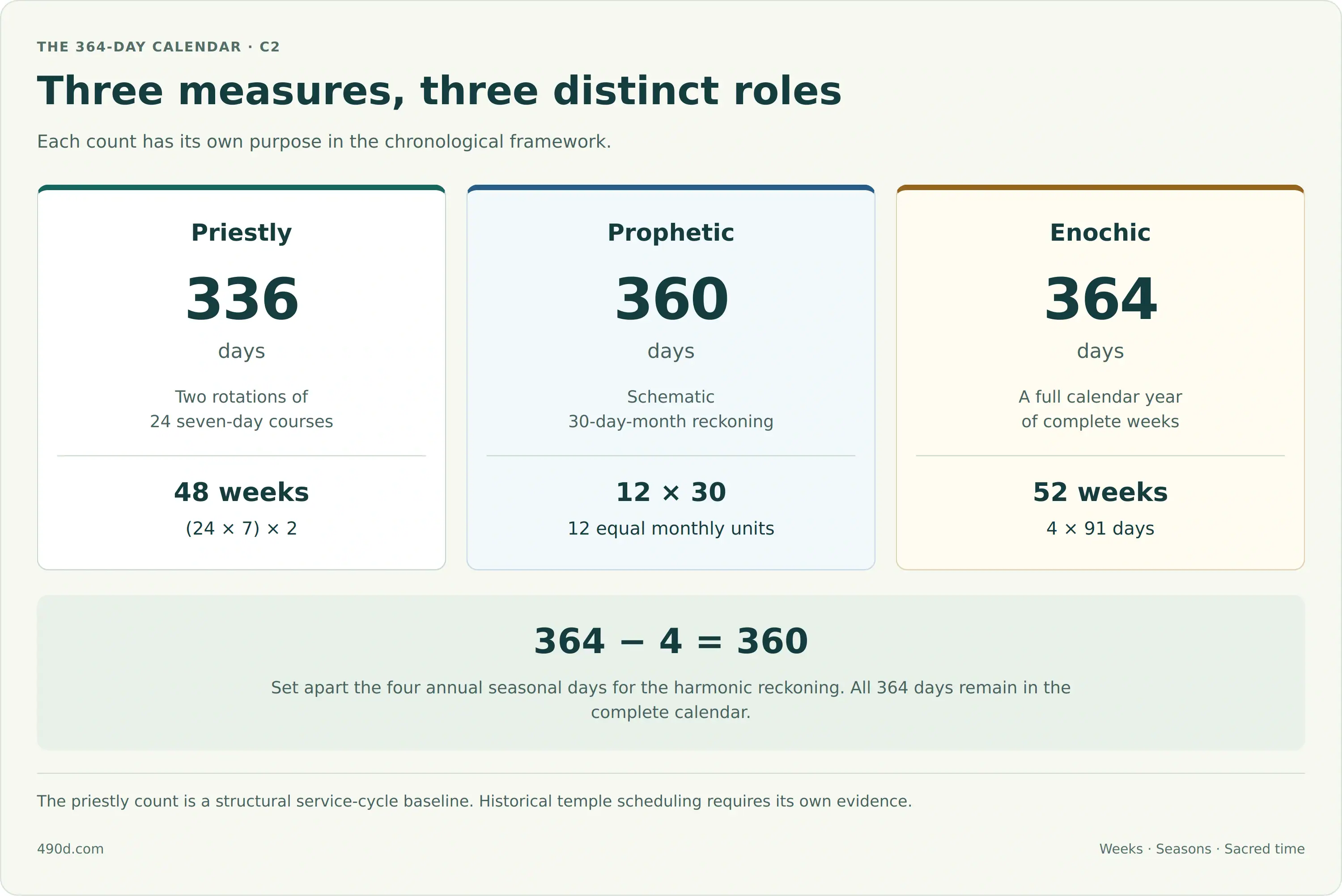
These relationships make the 364-day calendar a useful meeting point between priestly service, seasonal divisions, and the week. The comparison table sets out the three counts together. Further numerical relationships belong to The Key of 23, where the conversion ratios receive their own explanation.
Keeping the calendar near the seasons
The calendar’s weekly order raises a further question. The tropical year—the seasonal cycle measured astronomically—is approximately 365.24 days, about 1.24 days longer than 364. Without adjustment, a succession of 364-day years would gradually move against the observed seasons.
The four seasonal days have already been included in the 364. They cannot also supply the remaining solar adjustment.
An occasional additional whole week offers a way to adjust the calendar while preserving its weekday pattern. Since seven days make a complete week, the named dates after the insertion can still keep their weekdays. Choosing exactly when to insert such weeks is a further question, however, and the ancient passages cited here do not prescribe the particular 40- and 400-year schedule explored in the detailed study.
The appendix’s short intercalation note explains that proposed schedule and checks its totals. Understanding the calendar’s basic structure does not depend on adopting it.
The week carried through the year
The strength of this calendar is visible before we attempt any long chronology. Days form weeks; thirteen weeks form a season; four seasons complete the year. The same weekly rhythm runs through every level.
This is why 364 matters. It joins 12 months, 4 seasons, and 52 complete weeks in one orderly whole. The recurring Sabbath and the annual round of sacred dates can be contemplated together, while the separate question of solar adjustment remains clear.
For the calculations and primary passages, see the technical appendix. The controlling calendar distinctions are developed in File 12: Calendrical Physics, especially §§5.1A, 5.2, 6.3, and 7; the Jubilees references are verified in File 20, §6H. The Detailed Study preserves the longer exploratory work behind this introduction.
Scripture quotations: Berean Standard Bible (BSB), public domain. The quotation from Jubilees uses R. H. Charles’s 1913 public-domain translation; its original wording and number formatting are retained.