Supporting tables for From Adam to Joshua: The 930–950–930 Pattern. The detailed study develops the Cainan, cumulative, and comparative material.
This appendix states the chronological settings used by the main article and detailed study.
1. The active chronological setting
| Setting | Selection in the main article |
|---|---|
| Textual tradition | Masoretic Text (MT) |
| Method | Regular chronology; begetting intervals with overlapping lives |
| Seasonal designation | Nisan |
| Sojourn framework | Full 430 years in Egypt; +215 relative to the minimum table |
| Terah | +60 active before Abraham; Terah born 2296 BC |
| Second Cainan | Absent: native MT, not the restored comparison |
| Adam’s starting position | Year 6, 4176 BC |
| Related Creation endpoint | 4174 BC, a distinct position |
| Abraham’s birth | 2166 BC, unaffected by Terah +60 |
| Joshua | Regular lifespan 1476–1366 BC; death 1366 BC |
| Counting operation | Ordinary subtraction between BC coordinates |
File 07 §2.11.1a explicitly pairs the native-MT 4176 Year-6 position with the 4174 endpoint under +215 Sojourn and +60 Terah. This pairing supplies the starting-date distinction. It does not move the Noah/Flood Gear system wholesale into Adam’s genealogy.
File 18 §§1.3.1 and 1.4 controls the sojourn and Terah boundaries. The +60 operation changes Terah and earlier positions, while Abraham and the later full-430 targets remain fixed. Its §2.4 supplies Joshua’s regular dates.
2. Derivation of the four-date construction
| Quantity | Calculation or source | Result |
|---|---|---|
| Adam, selected Year-6 position | File 07 §2.11.1a: native MT, +215 and +60 | 4176 BC |
| End of Adam’s 930-year measure | 4176 − 930 | 3246 BC |
| Terah’s birth, +60 setting | Full-430 base 2236 + 60 | 2296 BC |
| Joshua’s regular death | Birth 1476 − lifespan 110 | 1366 BC |
| First outer span | 4176 − 3246 | 930 years |
| Middle span | 3246 − 2296 | 950 years |
| Last outer span | 2296 − 1366 | 930 years |
| Whole interval | 4176 − 1366 | 2810 years |
The equality 930 + 950 + 930 = 2810 is exact for these coordinates. The 930 and 950 lifespans are biblical inputs; the 3246 terminal is calculated from the selected 4176 start. The middle span has the same length as Noah’s life but is bounded by the Adam measure and Terah’s birth.
The core construction draws on several source-controlled inputs. It is not presented as a verbatim table independently supplied by one canonical section.
3. The paired 130 + 800 divisions
| Comparison | First interval | Second interval | Total |
|---|---|---|---|
| Adam’s life, measured from the selected Year-6 start | 4176 → 4046 = 130, to Seth | 4046 → 3246 = 800, afterward | 930 |
| Terah through Abraham to Joshua | 2296 → 2166 = 130, to Abraham’s birth | 2166 → 1366 = 800, to Joshua’s death | 930 |
Genesis 5:3–5 supplies Adam’s 130 and 800. 4046 BC is the internal Seth position calculated for this Year-6 comparison. It must not silently replace Seth’s entry in a separate table measured from the Creation endpoint. The second row joins different lives and generations; it does not assign Abraham an 800-year lifespan.
The +60 Terah state also preserves his 205 years: 2296 → 2091 = 205. Abraham’s call/departure from Haran at age 75 is 2166 → 2091 = 75. Hence 205 − 75 = 130. This is the project’s alignment of Genesis 11:32, Genesis 12:4, and Acts 7:4. Genesis 11:26’s grouping of Terah’s sons is not treated as a statement that all three were born in the same year.
4. Why the Year-6 choice matters
490d · Adam to Joshua · Figure 3
Why the starting node matters: 950 or 948
MT · Nisan · full 430-year Egypt framework · +60 Terah · Cainan OFF
Selected construction · Adam’s Year-6 node
Sensitivity check · Creation endpoint instead
Canonical inputs: File 07 §2.11.1a; File 18 §§1.3.1, 1.4, 2.1, 2.4.
Read the dates, calculation, and scope
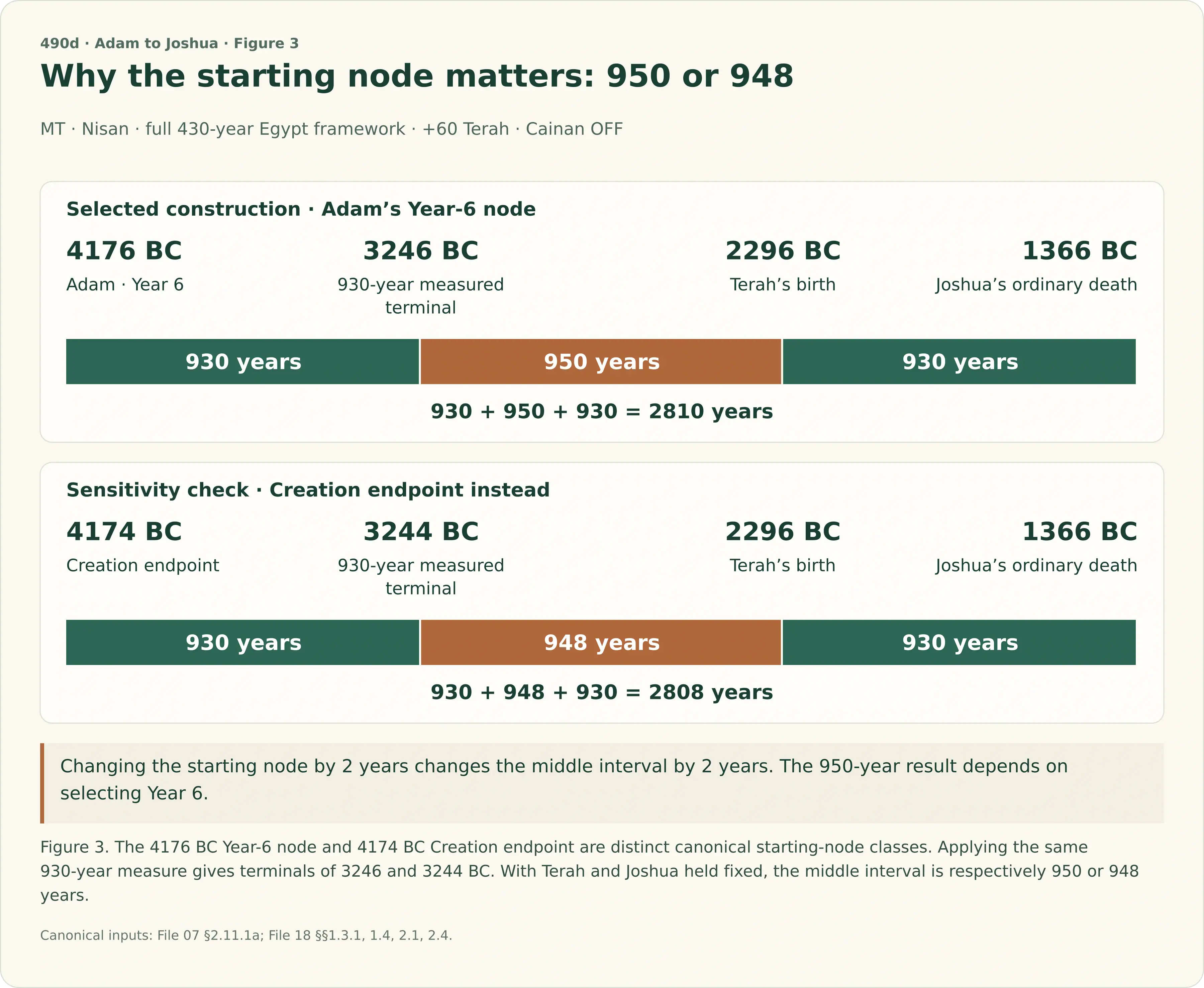
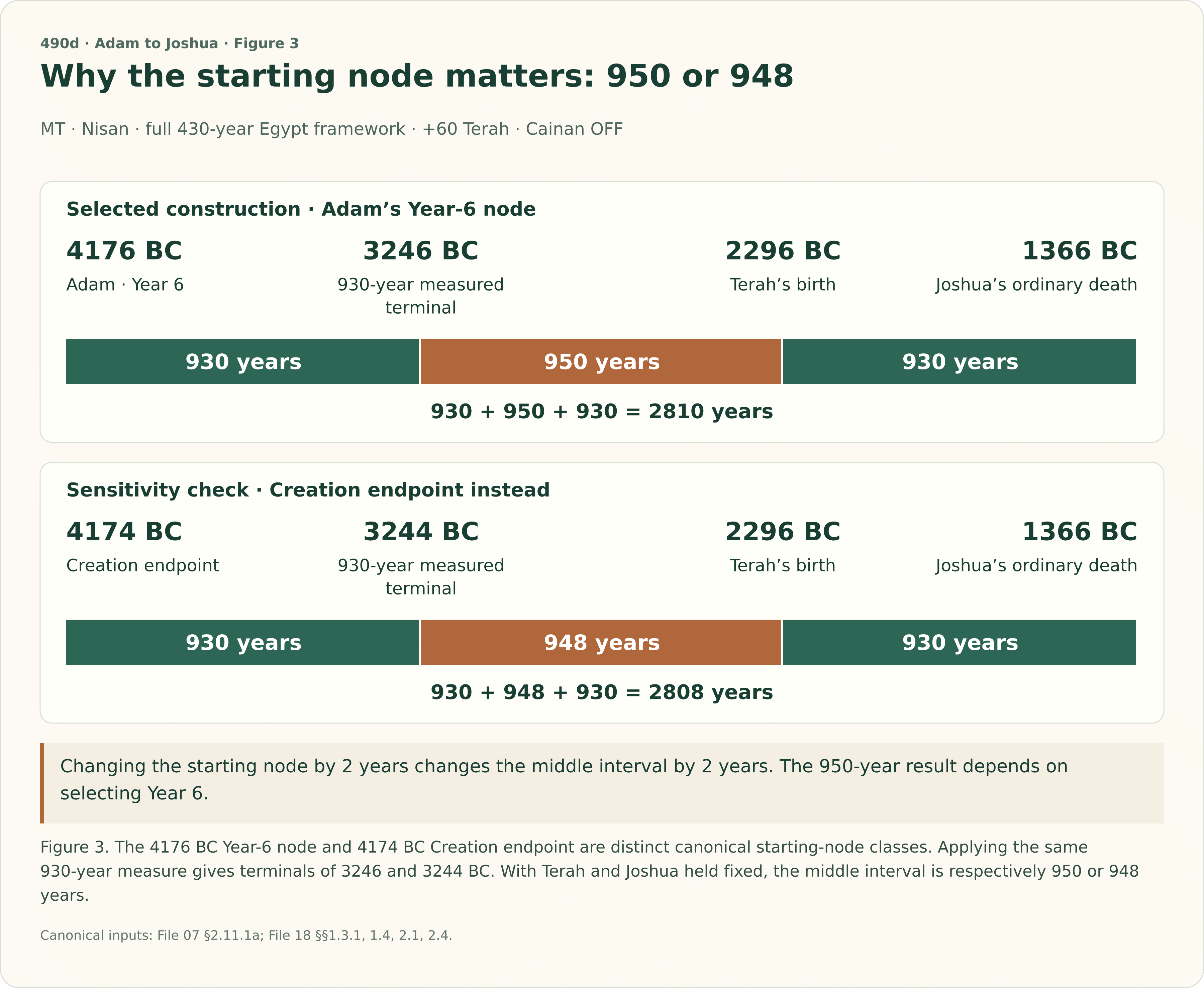
File 07 §2.11.1a distinguishes native-MT +60 Year 6 at 4176 BC from its 4174 BC Creation endpoint. The first calculation is 4176 − 930 = 3246, then 3246 − 2296 = 950. The sensitivity calculation is 4174 − 930 = 3244, then 3244 − 2296 = 948. Both retain Terah at 2296 and Joshua at 1366, so their final span remains 930. Their totals are 2810 and 2808. The bars are scaled within each row; aligning them for comparison does not make their absolute dates or total durations identical.
| Starting-position selection | 930-year terminal | Terah’s birth | Joshua’s death | Three spans | Total |
|---|---|---|---|---|---|
| +60 Year 6: 4176 | 3246 | 2296 | 1366 | 930 + 950 + 930 | 2810 |
| +60 Creation endpoint: 4174 | 3244 | 2296 | 1366 | 930 + 948 + 930 | 2808 |
The two-year difference affects the selected Adam start and its 930-year terminal. Terah and Joshua retain their dates. The main article therefore identifies its Year-6 starting position in the prose, table, and figures. The central 950 is conditional on that choice.
For comparison, removing Terah +60 throughout the relevant early chronology gives 4116 → 3186 → 2236 → 1366 = 930 + 950 + 870, still using Year 6. Both Adam-related dates and Terah move 60 years later; Joshua remains fixed. The final outer span loses 60 years. This comparison makes the role of the +60 setting visible without claiming the same symmetry in every variant.
The native no-+60 Creation-endpoint calculation is instead 4114 → 3184 → 2236 → 1366 = 930 + 948 + 870. These distinctions also explain why the legacy 930–888–930 presentation needs a cross-state label: it joins the no-+60 Adam endpoint with the +60 Terah birth. The detailed study explains the cross-state comparison.
5. The Cainan comparison uses a separate setting
Restoring the second Cainan’s 130-year begetting interval in the MT comparison changes the earlier chronology. File 07 §2.11.1a gives the restored +60 Year-6 position as 4306 BC, with Creation endpoint 4304 BC. Terah, Abraham, and Joshua are later than the insertion and keep their selected dates.
| Selected MT setting | Adam Year 6 | End of his 930-year measure | Terah birth | Joshua death | Result |
|---|---|---|---|---|---|
| Native, Cainan absent; +60 | 4176 | 3246 | 2296 | 1366 | 930 + 950 + 930 = 2810 |
| Restored Cainan; +60 | 4306 | 3376 | 2296 | 1366 | 930 + 1080 + 930 = 2940 |
The second row gives 2940 = 6 × 490 = 60 × 49. It preserves the two 930-year outer measures while extending the middle by 130. It does not keep all three original intervals unchanged. This is a direct arithmetic comparison of the two admitted starting states.
A further comparison joins native-MT Adam’s terminal 3246 with restored-Cainan G1 Noah’s birth 3246. That correspondence deliberately compares different Cainan settings. In the restored setting itself, Adam’s measured terminal is 3376.
6. Joshua, the Conquest, and Cumulative chronology
| Event or methodological endpoint | BC coordinate | Role |
|---|---|---|
| Joshua’s birth | 1476 | Regular biography |
| Moses’ death / Conquest begins | 1406 | Fixed event anchor |
| Conquest/rest framework closes | 1399 | Distinct from Joshua’s death |
| Joshua’s death | 1366 | Main article’s terminal date; age 110 |
| SP Cumulative Joshua endpoint | 1296 | Separate lifespan-stacking construction |
File 18 §2.4 establishes the regular biography and Conquest/rest anchors. Its §6C gives the SP cumulative Joshua construction. The 930–950–930 pattern uses 1366 throughout. It does not substitute 1296 or treat the end of the Conquest and Joshua’s death as simultaneous.
7. Sources and interpretation
| Subject | Direct source |
|---|---|
| Year-6 and Creation-endpoint positions; native/restored Cainan field | File 07 §2.11.1a |
| Sojourn and Terah boundaries | File 18 §§1.3.1 and 1.4 |
| Adam’s and Noah’s lifespan data | File 18 §2.1; Genesis 5; Genesis 9 |
| Joshua’s regular dates | File 18 §2.4; Joshua 24:29 supplies age 110 |
| Separate SP Cumulative endpoint | File 18 §6C |
The arithmetic is reproducible from the stated inputs. The reading of the symmetry as creation, preservation, and inheritance is the study’s theological interpretation. The distinction allows the pattern to be assessed without requiring every numerical correspondence to settle a question about manuscript history.
Return to the main article · Read the detailed study · Canonical source catalog.