The reigns of Judah can be read both as a historical succession and as a sequence of recorded durations. Those readings preserve different features of the biblical account. Historical chronology asks when a ruler began and ended his rule, allowing for shared rule and differing accession conventions. A formal reign ledger asks what the recorded durations produce when they are placed end to end.
The Temple provides a natural point of comparison:
In the four hundred and eightieth year after the Israelites had come out of the land of Egypt, in the month of Ziv, the second month of the fourth year of Solomon’s reign over Israel, he began to build the house of the LORD.
Within the normal MT chronology used here, the historical Temple foundation is 966 BC. The formal Kings ledger also supports a 1016 BC schematic Temple pivot, fifty years earlier. Keeping those meanings distinct opens a coherent series of relationships: the balanced 430 + 430 arrangement, the 49/50 Jubilee comparison, and a smaller 299/300 completion at the transition between Ahaziah and Athaliah. The ages and reigns of individual kings give these larger relationships a more personal setting, culminating in Hezekiah’s added years and Jerusalem’s deliverance.
For a shorter introduction, begin with The Kings of Judah: Reign Totals and the Fifty-Year Difference. This detailed study supplies the reign-by-reign comparison and explains the additional structure preserved in the current canonical files.
Direct links: Historical and schematic reign table · The exact fifty-year calculation · Ahaziah and the 299/300 completion · Hezekiah’s 115/125 comparison · The closing reign patterns · The Judges route · Calendar qualifications · Sources.
1. The Temple as a movable point of comparison
The normal annual display places the Exodus in 1446 BC, the Temple foundation in 966 BC, and Jerusalem’s fall in 586 BC. The Temple divides that span into 480 + 380 = 860 years.
The schematic display retains the Exodus and Jerusalem endpoints but places the Temple at 1016 BC. It divides the same span into 430 + 430 = 860 years.
Historical ledger
Schematic ledger
Historical ledger
Schematic ledger
Sources: File 08 §§1.1, 1.3; File 18 §§2.5.4–2.5.5.
Image version and full-size download

Download the full-size PNG · Download the WebP · Download the stacked phone PNG
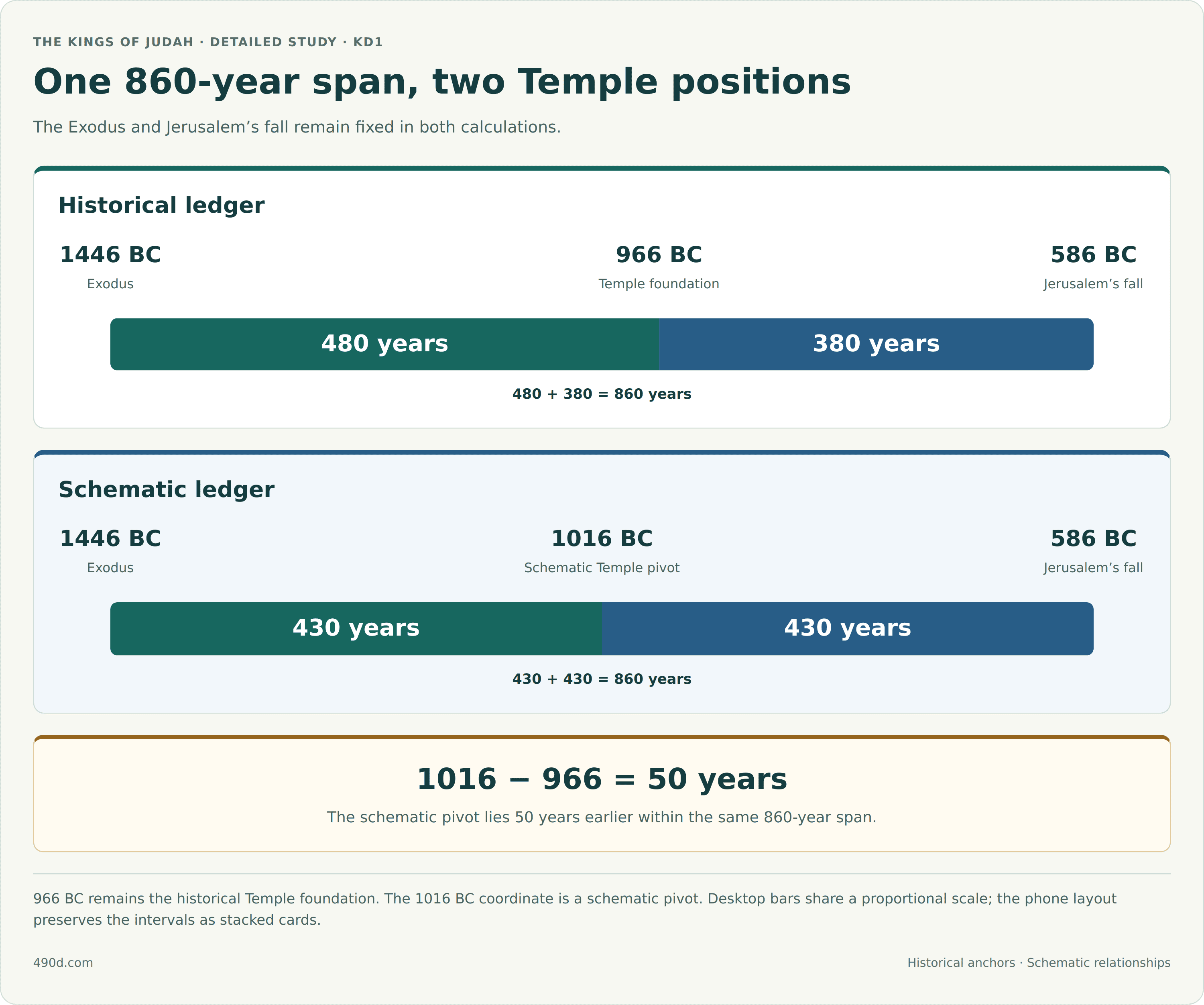
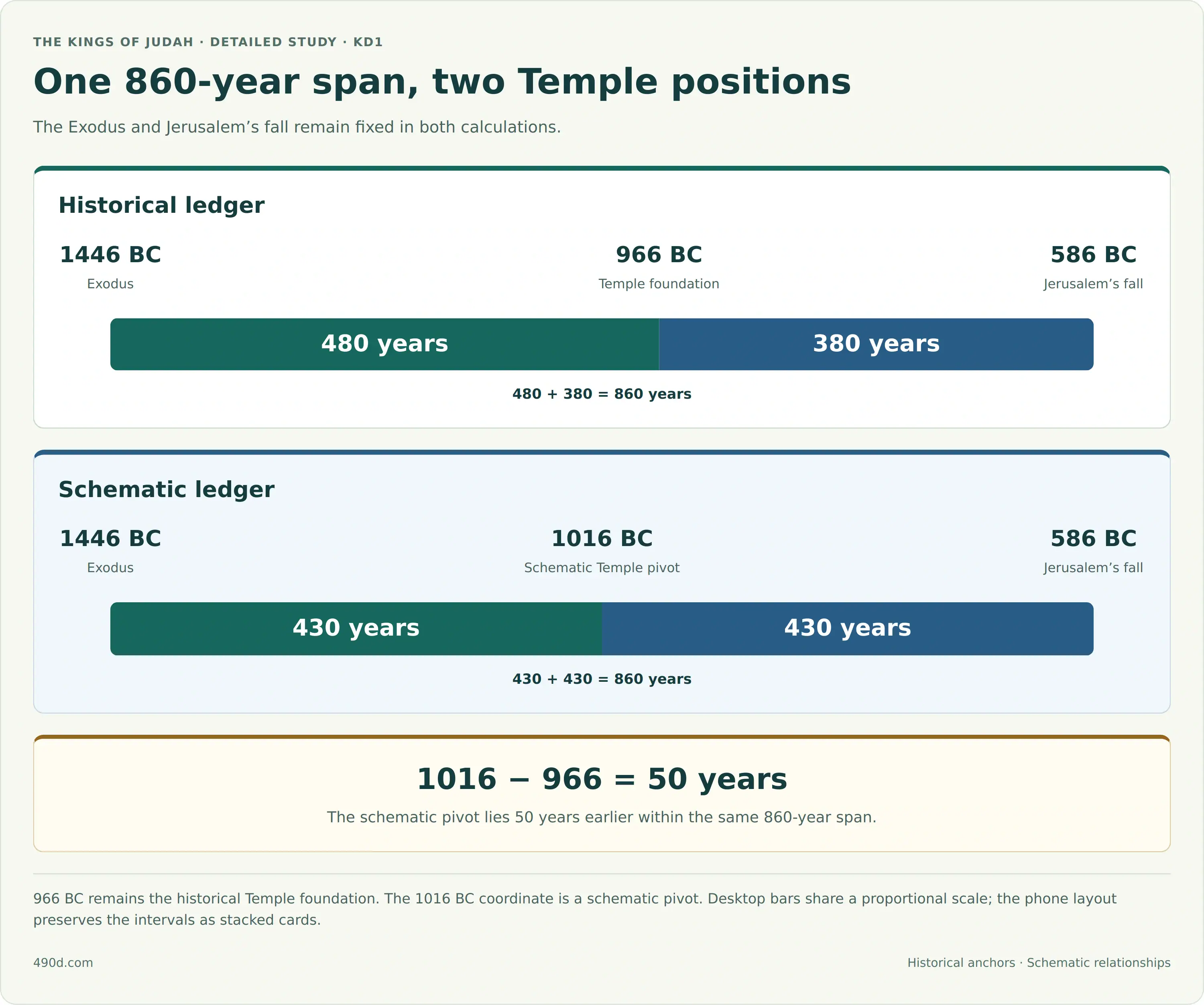
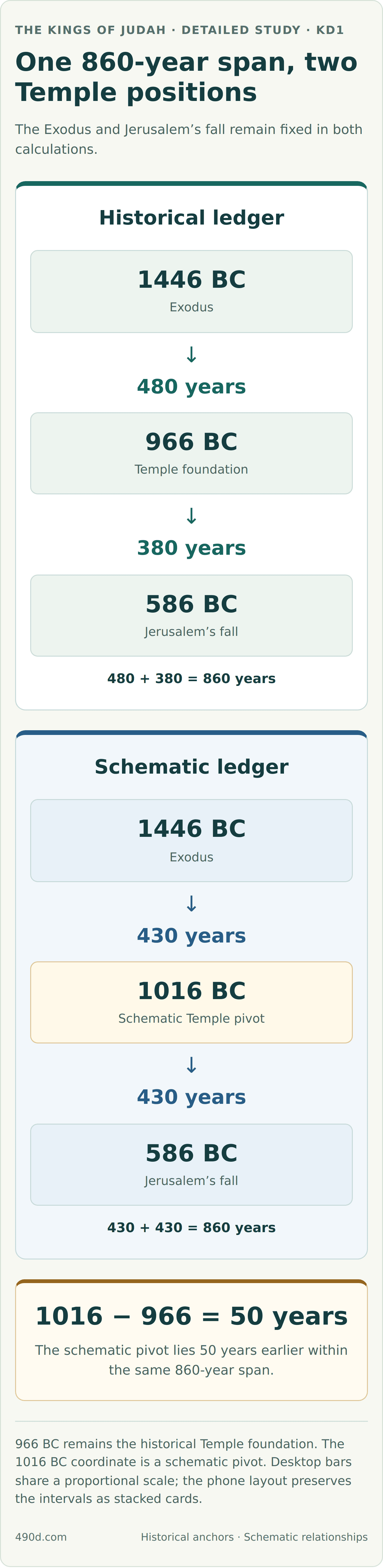
The fifty years are a difference between arrangements. Moving the central coordinate from 966 to 1016 BC transfers fifty years from the first interval to the second; the outer span stays fixed. The historical foundation remains 966 BC throughout this study.
The original comparison also used two ways of anchoring the schematic sequence itself. These deserve separate names:
- Forward-anchored projection A: place the formal Temple foundation at 966 BC and count the schematic reign blocks toward the fall. Its annual fall label becomes 536 BC.
- Backward-anchored projection B: hold the fall at 586 BC and count the same schematic blocks backward. Its Temple label becomes 1016 BC.
Projection A’s calculated fall at 536 BC is not the historical restoration event assigned to that same year. Every corresponding A/B coordinate differs by fifty years. Neither projection is identical to the historical accession sequence. The historical and schematic lines may coincide at a chosen anchor and then separate by different amounts as the individual reigns accumulate.
That distinction explains the three date columns in the table below. For example, Joash’s conventional accession is 835 BC; his A/B schematic heads are 828/878 BC. The two schematic heads differ by fifty, while the difference between the conventional date and the backward schematic head is 43. Hezekiah’s 715 BC conventional accession and 725 BC backward schematic head differ by 10, not fifty.
2. The reign ledger, ruler by ruler
This table joins the conventional comparison in File 18 §2.5.3 to the whole-year schematic sequence in File 66 Appendix A.2. Column A is calculated as B − 50. All dates are BC; schematic heads are calculated positions, not proposed historical accessions.
The whole-year sequence temporarily holds the two three-month reigns outside its integer-year coordinates. Their names and durations remain in the table, and the next section restores their half-year. A dash means that no separate integer-year head has been assigned to that short reign.
On smaller screens, scroll a wide table horizontally to see every column.
| Ruler and reign notice | Reign / counting form | Conventional head | A: forward schematic | B: backward schematic |
|---|---|---|---|---|
| Rehoboam — 1 Kings 14:21 | 17 | 931/930 | 930 | 980 |
| Abijam (Abijah) — 1 Kings 15:2 | 3 | 913 | 913 | 963 |
| Asa — 1 Kings 15:10 | 41 | 911 | 910 | 960 |
| Jehoshaphat — 1 Kings 22:42 | 25 | 870 | 869 | 919 |
| Jehoram — 2 Kings 8:17 | 8 | 848 | 844 | 894 |
| Ahaziah — 2 Kings 8:26 | 1 | 841 | 836 | 886 |
| Athaliah — 2 Kings 11:3–4 | 7 boundary; 6 completed | 841 | 835 | 885 |
| Joash — 2 Kings 12:1 | 40 | 835 | 828 | 878 |
| Amaziah — 2 Kings 14:2 | 29 | 796 | 788 | 838 |
| Uzziah (Azariah) — 2 Kings 15:2 | 52 | 767 | 759 | 809 |
| Jotham — 2 Kings 15:33 | 16 | 740 | 707 | 757 |
| Ahaz — 2 Kings 16:2 | 16 | 732 | 691 | 741 |
| Hezekiah — 2 Kings 18:2 | 29 | 715 | 675 | 725 |
| Manasseh — 2 Kings 21:1 | 55 | 687 | 646 | 696 |
| Amon — 2 Kings 21:19 | 2 | 643 | 591 | 641 |
| Josiah — 2 Kings 22:1 | 31 | 640 | 589 | 639 |
| Jehoahaz — 2 Kings 23:31 | 3 months (¼) | 609 | — | — |
| Jehoiakim — 2 Kings 23:36 | 11 | 609 | 558 | 608 |
| Jehoiachin — 2 Kings 24:8 | 3 months (¼) | 598 | — | — |
| Zedekiah — 2 Kings 24:18 | 11 | 597 | 547 | 597 |
| Whole-year total | 394 | — | 930 → 536 | 980 → 586 |
| With both short reigns | 394½ | — | Fractions restored separately | Fractions restored separately |
The conventional column preserves File 18’s selected accession display, including its adjacent 931/930 BC boundary for Rehoboam. A recorded reign may begin with shared rule before the conventional head used in a comparison table; accession counting also affects the labels. Consequently, this column should not be converted into reign lengths by simple subtraction, nor treated as a claim that every historical reign occupied its own uninterrupted block.
Athaliah is the exceptional entry. 2 Kings 11:3–4 describes six years of Joash’s concealment while she ruled, followed by Jehoiada’s action in the seventh year. The primary schematic sequence follows that seventh-year boundary. It does not turn the text into a statement of seven completed years. The six-year completed-duration reading remains a subordinate audit of the calculation.
Using the seventh-year boundary, the whole-year reigns total 394. Using six completed years, they total 393. The sum apart from Athaliah is the same in both: 387. The two short reigns then give the source-complete Kings totals 394½ and 393½.
Rehoboam’s age links the Temple to the kingdom’s division
Rehoboam was forty-one when he became king (1 Kings 14:21). Applying that age to the schematic accession at 980 BC gives a calculated birth label of 1021 BC. The Temple pivot divides the forty-one into 5 + 36:
On smaller screens, scroll a wide table horizontally to see every column.
| Comparison | Calculated birth → Temple → accession | Division of the age |
|---|---|---|
| Schematic | 1021 → 1016 → 980 BC | 5 + 36 = 41 |
| Historical annual comparison | 971 → 966 → 930 BC | 5 + 36 = 41 |
The second row uses the 930 member of the 931/930 accession pair. Each corresponding coordinate is fifty years later. The birth labels are derived from the selected accessions and age notice; they are not independently dated birth events. This File 67 §6.1 comparison gives the 36-year Temple-to-division allowance a second setting within the royal family.
3. The fifty years, with the fractions retained
Solomon reigned forty years (1 Kings 11:42), and the Temple foundation belongs to his fourth year. The formal Temple-era calculation therefore begins with 40 − 4 = 36 years. This is the canonical remaining-reign allowance; the verse’s second-month construction date is a finer level of precision.
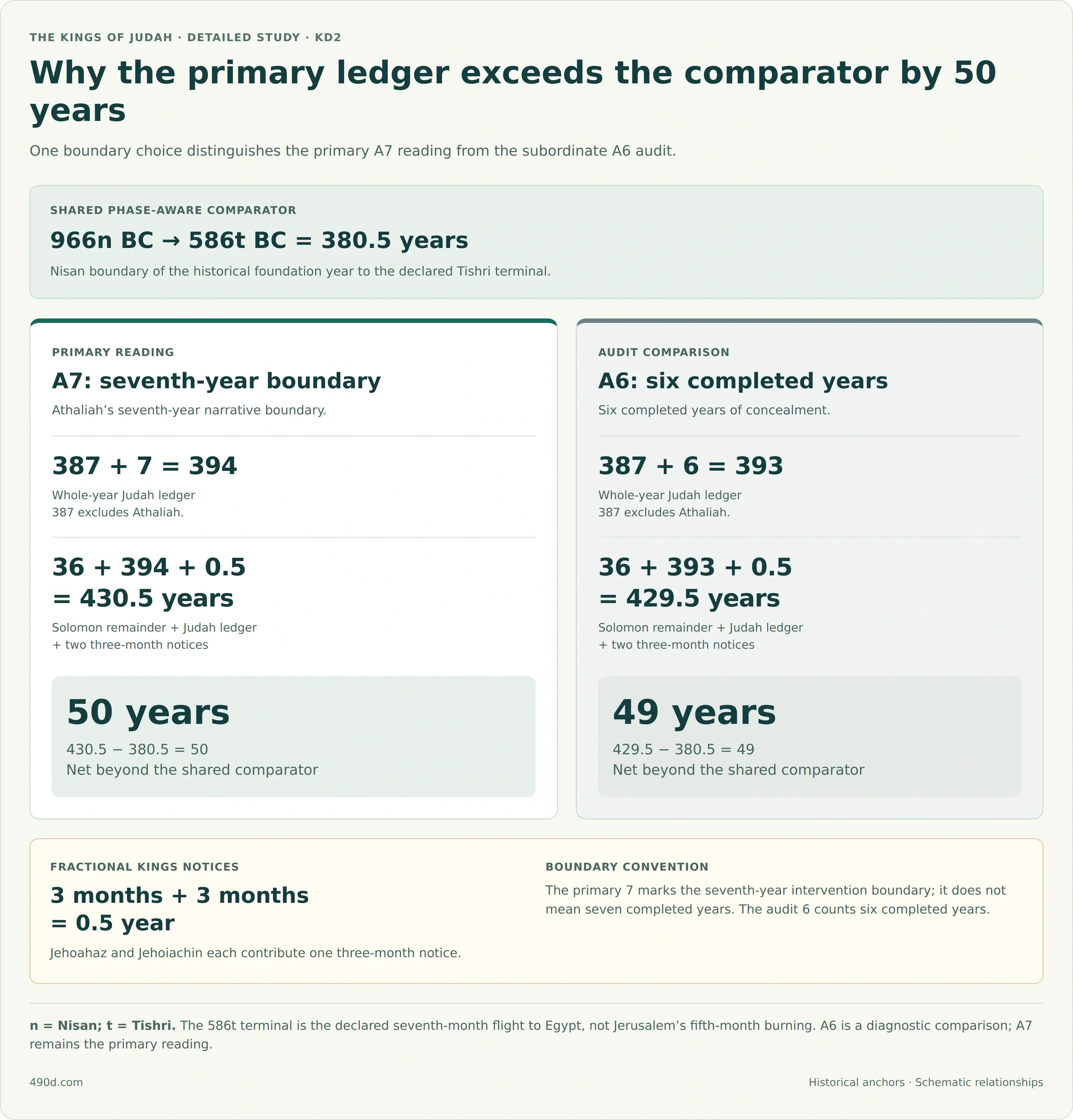
Adding that allowance to the primary Judah ledger gives:
36 + 394 + ½ = 430½ years.
A7: seventh-year boundary
Athaliah’s seventh-year narrative boundary.
387 excludes Athaliah.
+ two three-month notices
Net beyond the shared comparator
A6: six completed years
Six completed years of concealment.
387 excludes Athaliah.
+ two three-month notices
Net beyond the shared comparator
Jehoahaz and Jehoiachin each contribute one three-month notice.
The primary 7 marks the seventh-year intervention boundary; it does not mean seven completed years. The audit 6 counts six completed years.
Sources: File 65 §§2.1–2.4, 2.13–2.14; §7.4.
Image version and full-size download

Download the full-size PNG · Download the WebP · Download the stacked phone PNG
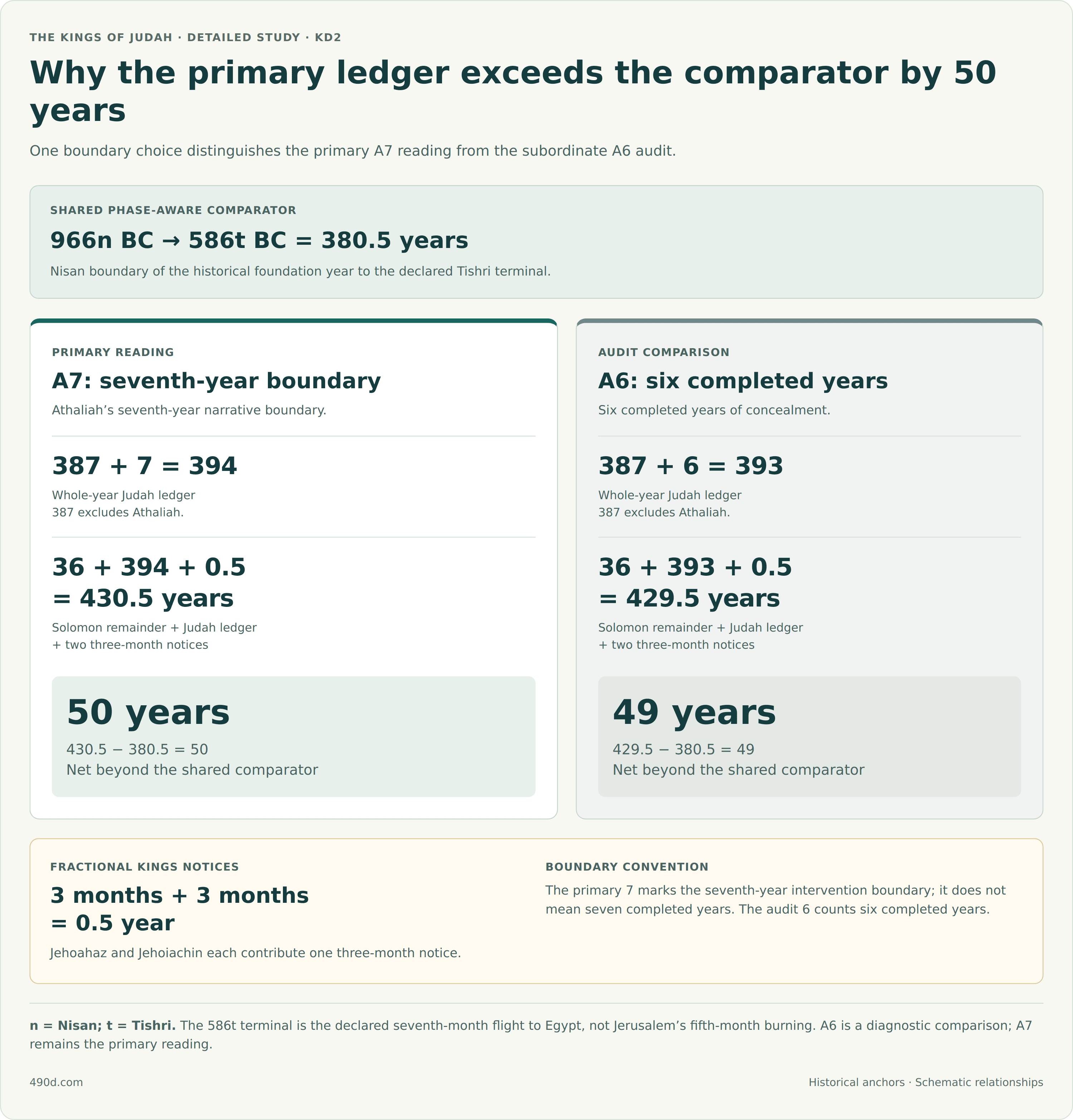

The half-year comes from Jehoahaz’s three months and Jehoiachin’s three months. In the final portion of the ledger, each short reign is paired with an eleven-year reign:
| Terminal pair | Formal duration |
|---|---|
| Jehoahaz + Jehoiakim | ¼ + 11 = 11¼ |
| Jehoiachin + Zedekiah | ¼ + 11 = 11¼ |
| Combined | 22½ years |
To compare like with like, the canonical phase calculation uses 966n → 586t = 380½ years. Here n is the spring Nisan boundary and t the autumn Tishri boundary. The formal half-year is matched by the comparator’s half-year:
430½ − 380½ = 50.
The six-completed-year audit lowers the formal total by one:
429½ − 380½ = 49.
The selected 586t endpoint is a seventh-month comparison boundary. The Temple was burned in the fifth month (2 Kings 25:8–9); the calculation does not relocate that event. Likewise, 966n is an annual boundary, while the foundation verse names the second month. The exact fifty is a result within the declared phase comparison, rather than a claim about the precise number of days between laying the foundation and burning the building.
Chronicles supplies a further detail: Jehoiachin reigned three months and ten days (2 Chronicles 36:9). Kings gives three months. Keeping the witnesses distinct produces:
On smaller screens, scroll a wide table horizontally to see every column.
| Counting form | Kings surplus | With Chronicles’ ten-day increment |
|---|---|---|
| Seventh-year boundary: primary | 50 years | 50 years + 10 days |
| Six completed years: audit | 49 years | 49 years + 10 days |
This treatment preserves every short-reign component. The annual 430 + 430 diagram shows the whole-year structure; the ledger records the fractions and the conventions under which they cancel or remain.
The boundary choice also affects the Temple’s position within the full 860 years. Holding the fall at 586 BC gives:
On smaller screens, scroll a wide table horizontally to see every column.
| Athaliah counting form | Annual Temple pivot | Exodus → pivot | Pivot → fall |
|---|---|---|---|
| Seventh-year boundary: primary | 1016 BC | 430 | 430 |
| Six completed years: audit | 1015 BC | 431 | 429 |
Both rows total 860. Only the primary row places the Temple at the midpoint. The audit therefore makes the dependence on the six/seventh-year distinction visible; its forty-nine-year surplus cannot simply be substituted into the balanced diagram (File 66 §§7.1–7.2).
4. The smaller pattern at the Ahaziah–Athaliah transition
The fuller canonical treatment identifies a second relationship inside the reign ledger. Begin with Joash and count to Zedekiah, holding the two quarter-year reigns outside the whole-year operation:
40 + 29 + 52 + 16 + 16 + 29 + 55 + 2 + 31 + 11 + 11 = 292.
That fixed body can be extended across Athaliah’s boundary in two ways:
On smaller screens, scroll a wide table horizontally to see every column.
| Reading | Whole-year components | Total |
|---|---|---|
| Primary seventh-year form | 292 + Athaliah’s 7 | 299 |
| Completed-duration audit | 292 + Athaliah’s 6 + Ahaziah’s 1 | 299 |
The two expressions cover differently bounded selections: one begins with Athaliah’s seventh-year form; the other includes Ahaziah’s one year along with Athaliah’s six. Their equality does not merge the two rulers or give Ahaziah a second historical year.
The resulting 299 = 13 × 23 can be completed to 300 through the exact factor used in the Key of 23:
299 × 300/299 = 300.
The multiplication itself is straightforward. The point of interest is that the fixed post-Athaliah total and the narrative’s six/seventh-year distinction generate the same 299 before the operator is applied.
The two three-month notices are handled separately. This phase normalization is not a forward sequence of historical events.
Post-Athaliah whole-year body + seventh-year boundary
The +1 is Ahaziah’s existing one-year seam notice, not a second reign year.
Before completion
885n BC → 586n BC885 − 586 = 299 yearsAfter completion
886n BC → 586n BC886 − 586 = 300 yearsThe completed body within the schematic 430
Sources: File 65 §§2.4, 2.6–2.10.
Image version and full-size download

Download the full-size PNG · Download the WebP · Download the stacked phone PNG
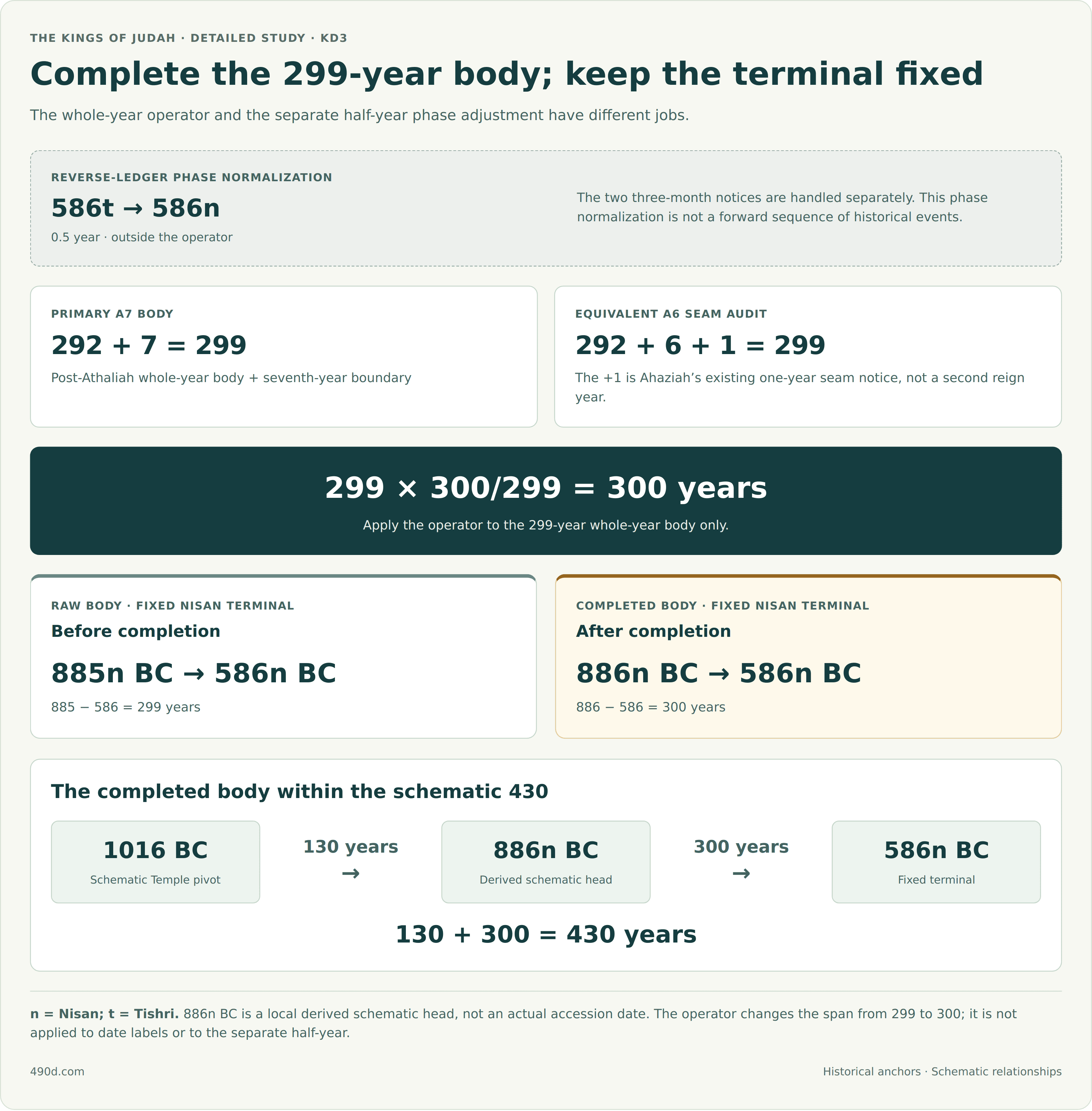

For the reverse calculation, the short-reign half-year first takes the terminal from 586t back to 586n. It remains outside the 299/300 operation. Holding 586n fixed, 299 years reaches 885n BC; 300 years reaches 886n BC.
The completed 886n is a local schematic head at the Ahaziah–Athaliah transition. In the whole-year sequence, Ahaziah begins at 886 and Athaliah at 885; the completion moves the comparison head across that one-year boundary. No biblical reign duration is rewritten, and 886 is not being proposed as their historical accession year.
This head divides the last schematic 430 into:
1016 → 886 → 586 BC = 130 + 300 = 430.
The source therefore offers more than a fifty-year displacement between two Temple labels. It gives an internal partition of the schematic Temple-to-fall interval, derived from the succession ledger itself.
Ahaziah supplies the adjoining twenty-three
The age notice adds a further connection. 2 Kings 8:26 gives Ahaziah’s accession age as twenty-two and his reign as one year. On the whole-year schematic sequence, his accession at 886 BC therefore yields a calculated birth label of 908 BC:
908 → 886 → 885 BC = 22 + 1 = 23.
That twenty-three joins directly to the raw 299-year body:
908 → 885 → 586 BC = 23 + 299 = 322 = 14 × 23.
908 → 885 → 586 BC
23 + 299 = 322(1 + 13) × 23
908 → 701 → 586 BC
207 + 115 = 322(9 + 5) × 23
Sources: File 67 §§4.1–4.3; 2 Kings 8:26, BSB.
Image version and full-size download

Download the full-size PNG · Download the WebP · Download the stacked phone PNG
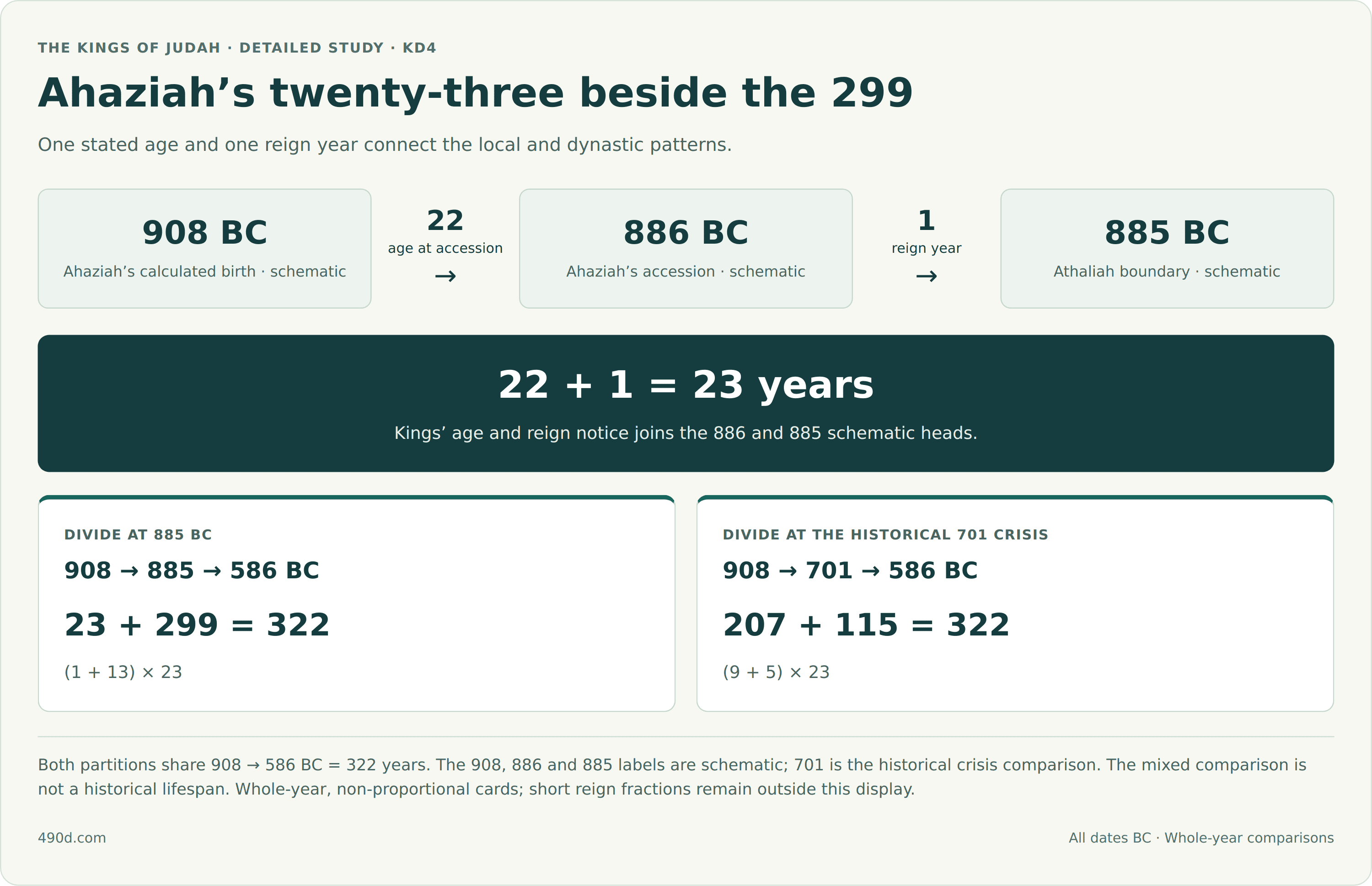
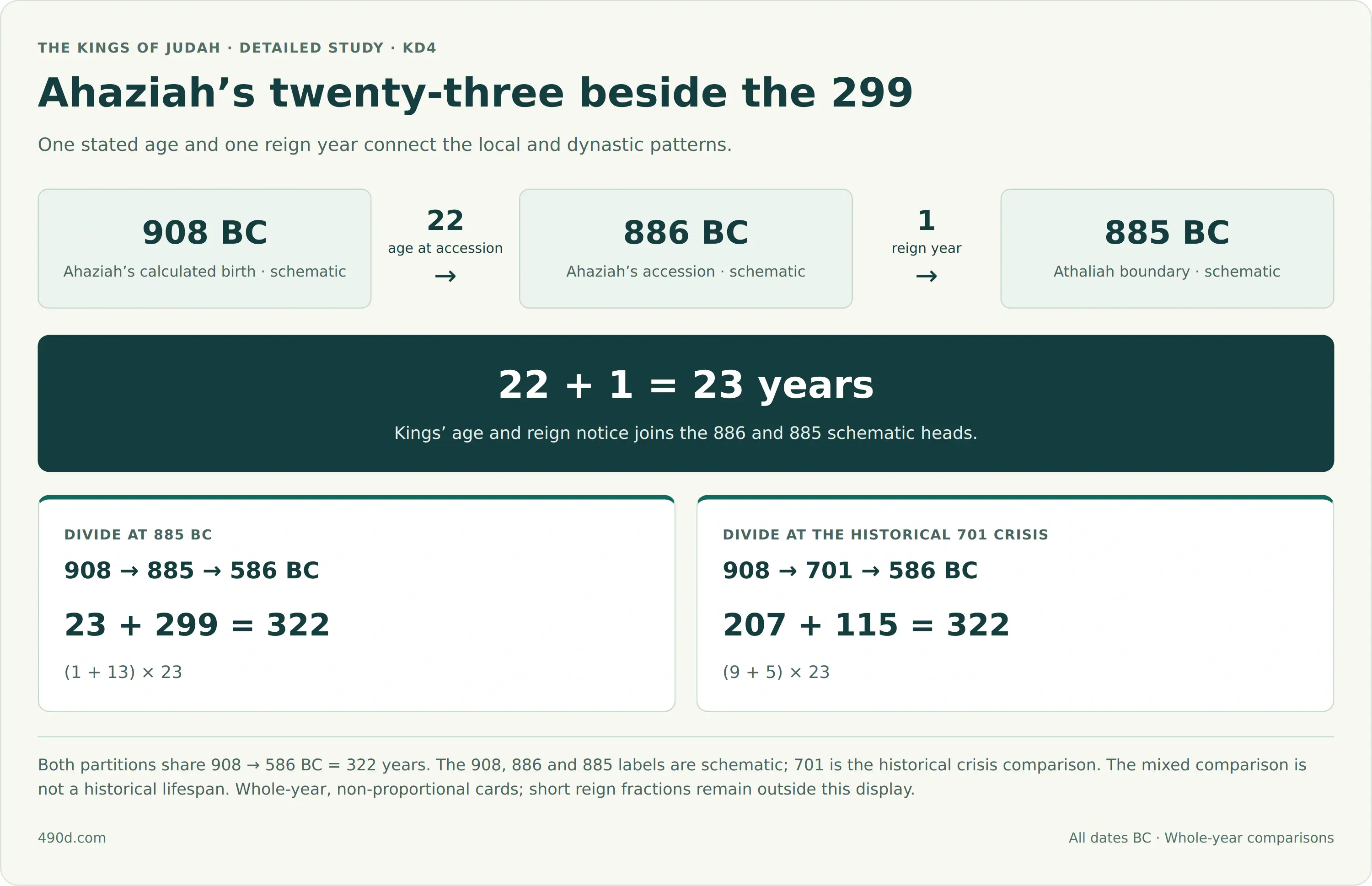
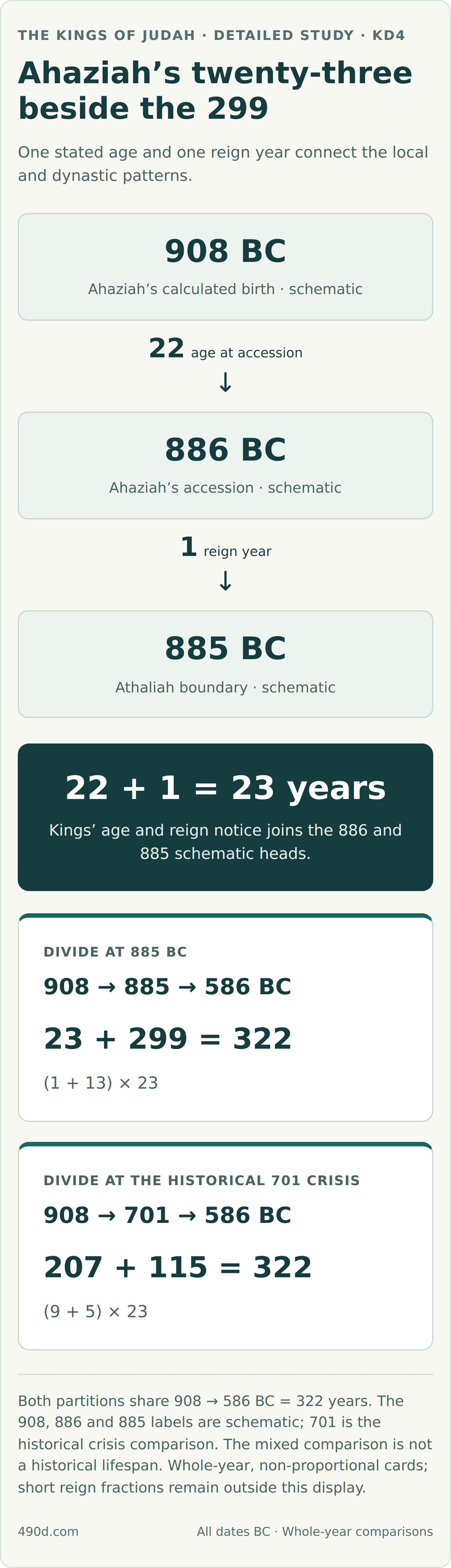
The same outer span divides at Hezekiah’s historical crisis in 701 BC: 207 + 115 = 322, or 9 × 23 + 5 × 23. The two partitions are related views of one span. Their interest lies in the age and reign notice placing a twenty-three-year unit immediately beside the already established 13 × 23 body (File 67 §§4.1–4.3).
The 908 and 885 labels remain schematic; comparing them with 701 does not make the entire line a historical biography. A textual note below explains why the calculation follows Kings’ age of twenty-two despite the different MT reading in Chronicles.
5. Hezekiah: ten years within the fifty-year pattern
Hezekiah became king at twenty-five. In the first year of his reign, in the first month, he opened and repaired the Temple doors (2 Chronicles 29:1–3). His story later joins the king’s life to the city’s preservation. Isaiah brings an answer to his prayer:
I will add fifteen years to your life. And I will deliver you and this city from the hand of the king of Assyria.
The accompanying sign moves the shadow backward ten steps (2 Kings 20:9–11). Scripture describes steps and an added lifespan. The canonical interpretation relates those ten steps to the ten-year displacement between Hezekiah’s historical and schematic chronologies; it does not claim that the verse itself calls the steps ten years.
The two comparisons preserve the same 25 + 14 + 15 biography:
On smaller screens, scroll a wide table horizontally to see every column.
| Hezekiah’s life | Schematic ledger | File 66 historical comparison | Difference |
|---|---|---|---|
| Calculated birth label | 750 BC | 740 BC | 10 |
| Accession at age 25 | 725 BC | 715 BC | 10 |
| Fourteenth-year crisis | 711 BC | 701 BC | 10 |
| Death after the 15-year extension | 696 BC | 686 BC | 10 |
The age and reign notices are in 2 Kings 18:2, the crisis in 18:13, and the extension in chapter 20. File 66 §3.1 supplies the two date sequences. Its selected 701/686 historical comparison and the conventional accession table above have different purposes; the boundary notes retain that distinction.
From the historical crisis to Jerusalem’s fall is 701 − 586 = 115 = 5 × 23 years. The Priestly form of the Key of 23 changes five units of twenty-three into five units of twenty-five:
115 × 25/23 = 125; the increase is 10 years.
Holding Jerusalem’s fall fixed, 586 + 125 = 711 BC. The operation thus reaches the schematic crisis already supplied by the reign ledger. This is more informative than moving an arbitrary date backward ten years: the historical span, fixed endpoint, and resulting schematic date each have a specified role.
The earlier schematic head reaches Hezekiah’s accession in 161 years: 886 − 725 = 161 = 7 × 23. Applying the same Priestly factor gives 161 × 25/23 = 175 = 7 × 25. This time the 886 BC head stays fixed, so 886 − 175 = 711 BC, reaching the same schematic crisis from the opposite end. The gain of fourteen is Hezekiah’s 725 → 711 interval. These are coordinated applications of one declared model rather than separate proofs of its historical dates (File 67 §4.6).
701 → 586 BC
115 = 5 × 23Fixed endpoint: Jerusalem’s fall
711 → 586 BC
125 = 5 × 25711 agrees with the schematic crisis.
Hezekiah’s ten-year shift within the Temple’s fifty-year shift
The first twenty-five within the completed 125
Sources: File 66 §§2.3–3.3, 7.1, 8.1–8.2; 2 Kings 20:6–11, BSB.
Image version and full-size download

Download the full-size PNG · Download the WebP · Download the stacked phone PNG
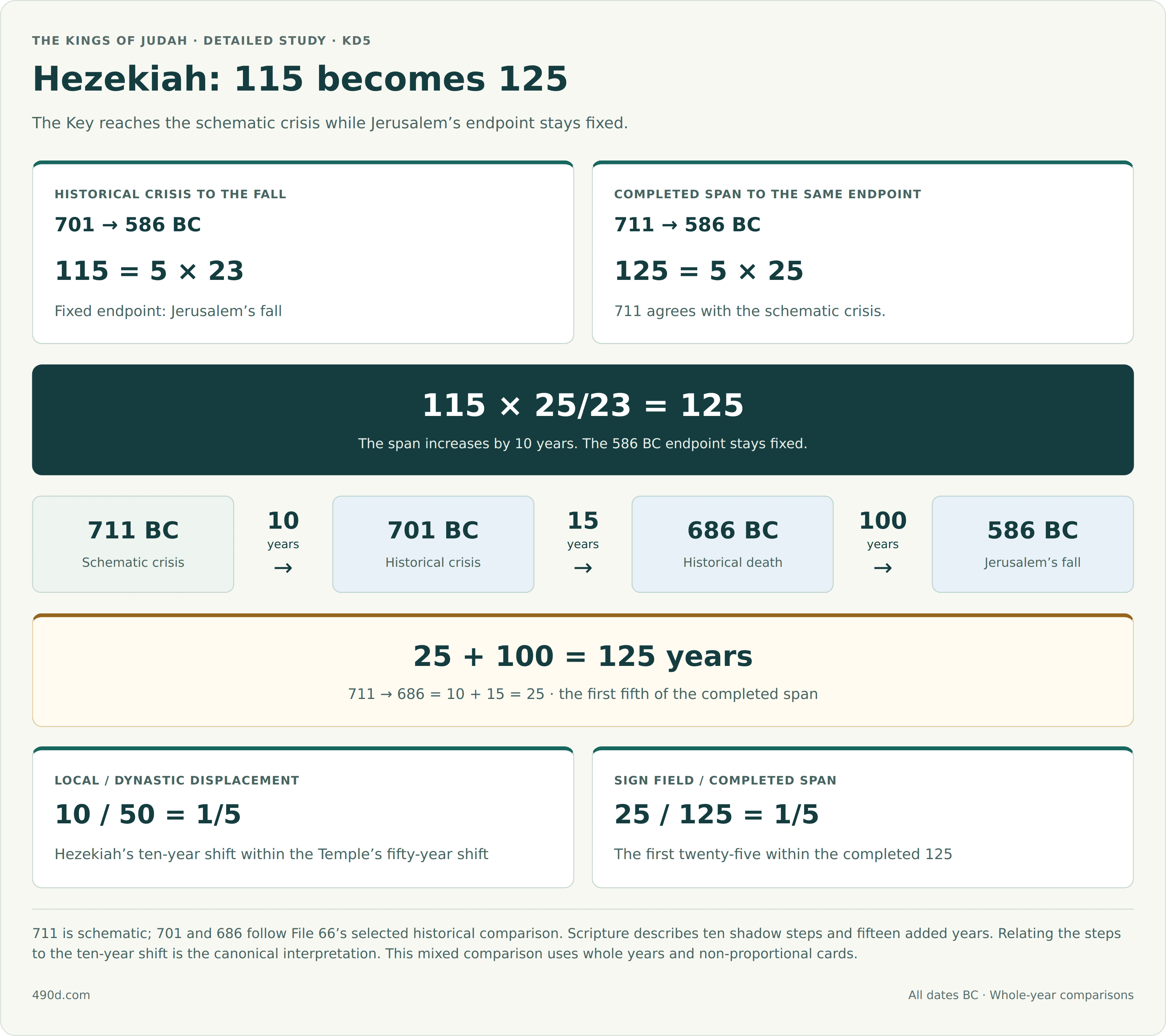
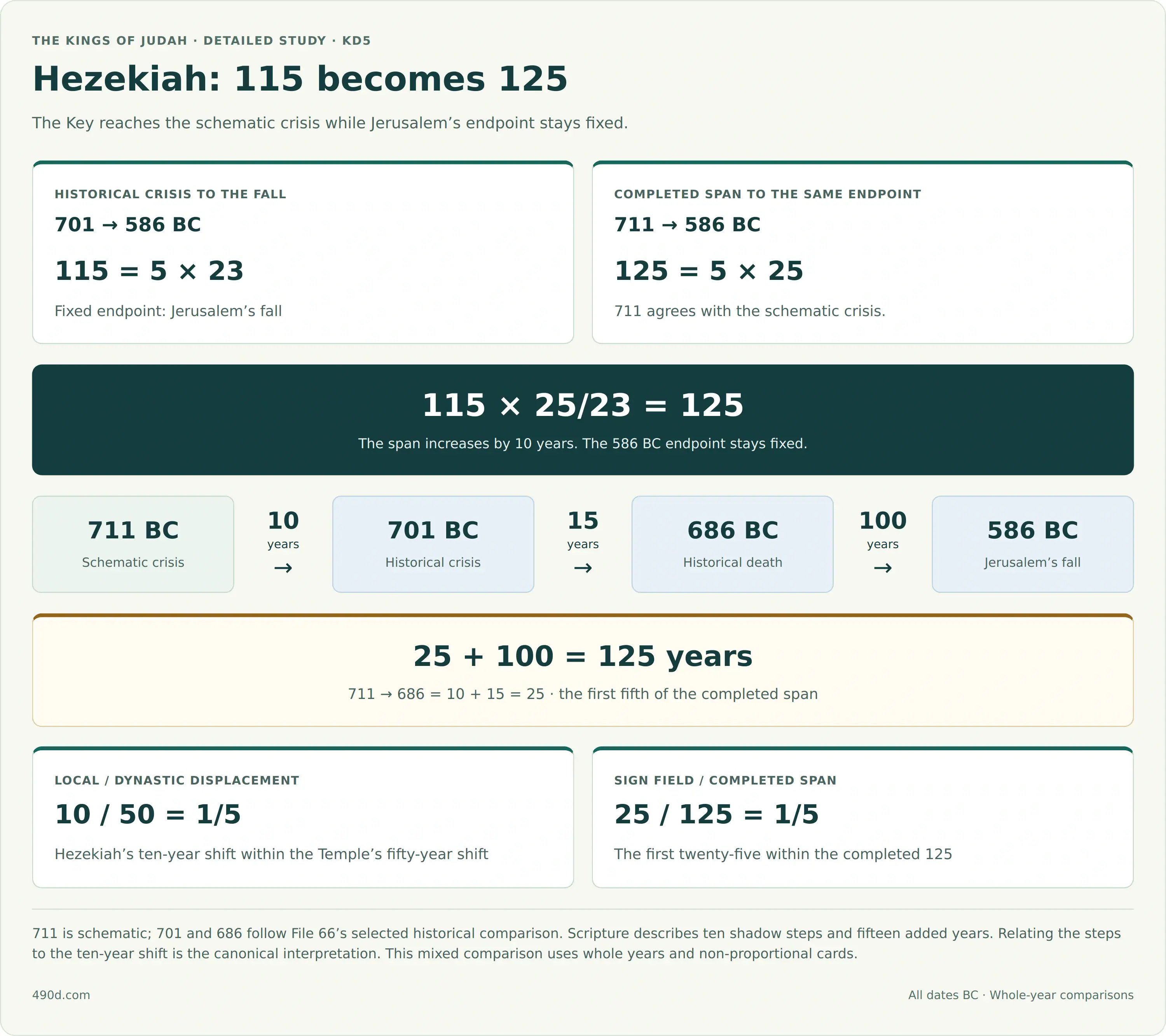

Across the two chronologies, 711 → 701 → 686 BC = 10 + 15 = 25. Hezekiah’s historical death then divides the completed span into 711 → 686 → 586 BC = 25 + 100 = 125. The full twenty-five-year field occupies its first fifth; the ten-year displacement is likewise one fifth of the dynasty’s fifty-year Temple displacement: 10/50 = 25/125 = 1/5.
These are comparisons across declared chronologies, with the shadow sign providing their interpretive setting (File 66 §§2–3, 7–8). The text expressly promises to preserve both king and city. Reading that joined preservation through the numerical pattern is the chronological proposal, not an additional statement quoted from Scripture.
The closing reigns also divide into recognizable units
The later kings continue the whole-year pattern. Manasseh’s fifty-five years equal the combined 2 + 31 + 11 + 11 = 55 whole-year reigns after him. Amon’s accession age of twenty-two supplies a second, overlapping arrangement (2 Kings 21:1, 21:19; File 67 §§5.2–5.3):
| Whole-year schematic comparison | Division |
|---|---|
| Manasseh’s accession → Amon’s accession → Jerusalem’s fall: 696 → 641 → 586 BC | 55 + 55 = 110 |
| Amon’s calculated birth → his accession → Josiah’s death → fall: 663 → 641 → 608 → 586 BC | 22 + 33 + 22 = 77 |
Here 33 = 2 + 31 joins Amon and Josiah, while the final 22 = 11 + 11 joins Jehoiakim and Zedekiah. These displays use the same whole-year convention as the reign table. Restoring Jehoahaz and Jehoiachin adds the half-year to the later portions: 55½ and 22½ in the source-complete Kings ledger. The balanced integer forms do not cancel those short reigns.
This also explains the 125 entirely within the schematic sequence: 711 → 696 → 641 → 586 BC = 15 + 55 + 55. Hezekiah’s added years are followed by Manasseh’s reign and an equal whole-year remainder (File 66 Appendix G.3.1).
The story gives Manasseh a pivotal role as well. Chronicles recounts his capture by Assyrian officers, removal to Babylon, prayer, and restoration to Jerusalem (2 Chronicles 33:11–13). Kings nevertheless traces Judah’s later judgment to his sins (2 Kings 23:26–27). Personal restoration and national judgment meet in the same reign. This connection supplies a narrative setting for the division without assigning an invented date to his captivity.
6. How the smaller and larger patterns meet
The completed 886 BC head has a clear position between the Conquest and the canonical exile-start label:
On smaller screens, scroll a wide table horizontally to see every column.
| Span | Calculation | Form |
|---|---|---|
| Conquest to schematic head | 1406 − 886 = 520 | 40 × 13 |
| Schematic head to exile-start label | 886 − 606 = 280 | 40 × 7 |
| Exodus to schematic head | 1446 − 886 = 560 | 8 × 70 |
| Schematic head to restoration | 886 − 536 = 350 | 5 × 70 |
The 606 BC date is the canonical exile-start coordinate used in this comparison, not a new dating of the Temple’s destruction. The 536 BC restoration label likewise has its own role. These relations retain the schematic identity of the 886 head.
Within 1446 → 606 BC = 840 years, the same point produces 560 + 280, or two-thirds followed by one-third. The arrangement is suggestive because the head was generated from the reign ledger before this division was considered. The resulting equations are related consequences of one set of coordinates, rather than separate independent proofs.
A forward route from the Judges
The 1016 BC pivot also receives a separate route in File 64 §§2–3. Jephthah’s territorial statement gives three hundred years (Judges 11:26). In the canonical comparison, the east-Jordan occupation at 1407 BC reaches the 1107 BC speech position in 300 years, while the west-Jordan Conquest at 1406 BC reaches it in 299.
The following source-order ledger totals 91: Jephthah’s 6, Ibzan’s 7, Elon’s 10, Abdon’s 8, the Philistine oppression’s 40, and Samson’s 20 (Judges 12:7–14; 13:1; 16:31). Thus:
| Component | Years |
|---|---|
| Exodus → west-Jordan Conquest | 40 |
| Conquest → Jephthah’s schematic speech position | 299 |
| Source-order tail: 6 + 7 + 10 + 8 + 40 + 20 | 91 |
| Total: 1446 → 1016 BC | 430 |
This is an addition of recorded durations. Samson’s service occurs during Philistine domination, so the last forty and twenty are not being asserted as sixty uninterrupted historical years. The Judges route and the Judah route approach the same schematic Temple coordinate through different textual ledgers.
At the largest scale used here, the Egyptian sojourn joins the two schematic Temple intervals:
On smaller screens, scroll a wide table horizontally to see every column.
| From | To | Span | Kind of interval |
|---|---|---|---|
| 1876 BC: Jacob enters Egypt | 1446 BC: Exodus | 430 | Normal MT Egypt-only sojourn |
| 1446 BC: Exodus | 1016 BC: Temple pivot | 430 | Uses schematic Temple coordinate |
| 1016 BC: Temple pivot | 586 BC: Jerusalem’s fall | 430 | Uses schematic Temple coordinate |
| 1876 BC | 586 BC | 1290 | 3 × 430 |
The first interval belongs to the normal historical framework of this study. The later two depend on the schematic pivot. Their coherence lies in the repeated measure and the sequence of entry, deliverance, sanctuary, and judgment.
The Temple pair and the exile’s twenty and fifty
The same relationship extends to the restoration endpoint. The canonical exile display is 606 → 586 → 536 BC = 20 + 50 = 70. Its twenty years precede Jerusalem’s destruction; its fifty follow it. Subtracting 430 from the following earlier coordinates preserves that division:
On smaller screens, scroll a wide table horizontally to see every column.
| Position | Earlier coordinate | 430 years later |
|---|---|---|
| Opening | 1036 BC: Samson’s opening in the direct schematic Judges route | 606 BC: exile-start label |
| Joint | 1016 BC: schematic Temple pivot | 586 BC: Jerusalem’s fall |
| Closure | 966 BC: historical Temple foundation | 536 BC: restoration label |
| Internal division | 1036 → 1016 → 966 = 20 + 50 | 606 → 586 → 536 = 20 + 50 |
The 1036 coordinate is obtained from Samson’s twenty-year block ending at the direct route’s 1016 pivot; it is not a new historical date for Samson. The central and final columns show 1016 → 586 = 430 beside 966 → 536 = 430. The fifty-year separation of the Temple coordinates reappears as the fifty between destruction and restoration.
File 64 §8.4 establishes this comparison, and File 68 Appendix J.6 carries it into its larger sanctuary framework. The table preserves the mixed meanings of its coordinates. It explains how the Kings pattern closes into the exile-and-restoration period without turning every earlier position into a historical event date.
7. The Jubilee setting of the pattern
Leviticus 25:8–10 counts seven sabbaths of years, 7 × 7 = 49, and consecrates the fiftieth year for liberty and the return of possessions. The primary fifty-year surplus and the subordinate forty-nine-year audit thus fall within a recognizably biblical relationship.
Athaliah’s overthrow also supplies an appropriate narrative setting. The account brings together Sabbath duty rotations, the preservation and coronation of the Davidic heir, the giving of the “Testimony,” trumpet sounding, and covenant renewal (2 Kings 11:5–17, BSB). Chronicles adds explicit reference to the Law of Moses in the restoration of Temple service (2 Chronicles 23:18). The local six/seventh-year form and the larger forty-nine/fifty relation both suit this movement from usurpation to restored covenantal order.
The language should remain precise. The coronation’s Testimony should not simply be renamed “the book of the law.” Nor are the coronation trumpets and the Jubilee horn the same Hebrew instrument term. The correspondence is cultic and thematic; the narrative does not expressly identify Athaliah’s seventh year as a historical Jubilee.
The exile supplies a complementary theme. 2 Chronicles 36:21 interprets the land’s desolation in terms of its sabbath rest. Jubilee restoration and unpaid sabbath rest belong to a related theological world, while remaining distinct parts of the argument.
Ezekiel supplies another corresponding total: 390 + 40 = 430, with a day assigned for a year (Ezekiel 4:4–6). Those prophetic sign periods reinforce the significance of 430 without supplying the individual reign figures. Arithmetic establishes the relationships under the specified conventions; the proposal that those relationships reflect deliberate literary design remains an interpretation of their combined numerical and narrative fit.
8. Calendar and boundary notes
These distinctions keep the detailed comparison reproducible.
The two counting forms are ordered. The canonical schematic ledger leads with Athaliah’s seventh-year boundary, commonly called A7. A6 names the six-completed-year audit. These A7/A6 labels concern Athaliah and should not be confused with the forward/backward projections A and B in the reign table.
430 and 430½ have different jobs. The integer-year table holds the short reigns outside its coordinates: 36 + 394 = 430. Restoring them produces 430½. In the phase comparison, the matching 380½ historical span gives the net fifty. Using the unphased 380 instead would give 50½. No fraction should disappear without its comparator being specified.
The day counts use a declared calendar. In the schematic 360-day model, the two three-month notices supply 180 days, or 190 days when Chronicles’ additional ten days are retained. Historical lunar months are not all thirty days. These totals must therefore be identified as schematic day counts rather than exact elapsed durations of unspecified civil months. Once the common half-year has cancelled in the phase comparison, it is not added to the net surplus again.
Adjacent dates change the result. The primary phase pair is 966n→586t. The source also retains nearby alternatives:
On smaller screens, scroll a wide table horizontally to see every column.
| Temple/fall phase pair | Comparator | A7 surplus | A6 surplus |
|---|---|---|---|
| 966n → 586t | 380½ | 50 | 49 |
| 967n → 586t | 381½ | 49 | 48 |
| 966n → 587t | 379½ | 51 | 50 |
| 967n → 587t | 380½ | 50 | 49 |
The opening verse’s “four hundred and eightieth year” is ordinal. The canonical files preserve 967 BC as the adjacent 480th-year boundary reading, alongside the normal cardinal display 1446 − 480 = 966. The table makes the dependence on a selected endpoint pair visible.
David’s half-year belongs to David’s reign. 2 Samuel 5:5 gives seven years and six months at Hebron and thirty-three at Jerusalem; 1 Kings 2:11 summarizes seven and thirty-three. The canonical precise diagonal 1010n → 970t = 40½ preserves the former, while the same-phase forty-year comparison remains distinct. David’s half-year cannot be added to a Temple-era sum that starts later, within Solomon’s reign. The separate Rounded monarchy sequence also should not be substituted into this ledger.
Construction totals are another level of description. The Temple is assigned seven years and the palace thirteen, with twenty explicitly stated for the two houses (1 Kings 6:37–38; 7:1; 9:10). These are the text’s construction totals. The named foundation and completion months should be retained whenever an exact month-to-month comparison is attempted.
At this whole-year construction resolution, the schematic 1016 → 1009 → 996 BC and historical comparison 966 → 959 → 946 BC both give 7 + 13 = 20. Every corresponding position differs by fifty. These construction years are distinct from the 20 + 50 sanctuary/exile comparison above (File 64 §8.9).
Restoration is a separate endpoint. The ordinary historical foundation-to-foundation display 966 → 536 BC = 430 differs from the schematic foundation-to-destruction display 1016 → 586 BC = 430. File 19 also preserves the adjacent second-month foundation pair 967 → 537 BC. Equal spans do not make the endpoints identical events.
Ahaziah’s age has a textual variant. The calculation uses the twenty-two in 2 Kings 8:26. The MT of 2 Chronicles 22:2 has forty-two; the BSB prints twenty-two and records the Hebrew reading in its note. File 67 follows Kings, regarding forty-two as a copying error because Chronicles identifies Ahaziah as Jehoram’s youngest son, while Jehoram’s stated age and reign total only forty (2 Chronicles 21:20; 22:1). The numerical argument does not depend on claiming identical readings in the two MT passages.
Hezekiah’s local historical comparison is explicitly selected. The 715 → 701 → 686 sequence follows File 66’s sole-accession, crisis, and death comparison. File 18’s conventional table retains its own selected accession labels, including 687 for Manasseh; File 67 §2.2 separately discusses Manasseh’s 697/696 co-regency and the later sole rule. These belong to different regnal comparisons and should not be combined by subtracting unrelated heads. The schematic 725 → 711 → 696 sequence is the exact whole-year execution used here.
All calculations here remain on the BC side. No year-zero adjustment, Mirror operator, or September 25 Rounded display convention is active.
9. What the detailed comparison shows
The most useful result is a connected structure whose components remain visible. The historical Temple label and the schematic Temple pivot differ by fifty. The primary reign ledger produces that same surplus under the declared calendar comparison, while the six-year audit exposes its forty-nine-year companion. Within the larger structure, the post-Athaliah body and succession boundary generate the paired 299 expressions and the completed 130 + 300 = 430 partition.
The individual kings strengthen the connection between those totals and their narrative setting. Rehoboam’s age preserves 5 + 36 around the Temple; Ahaziah’s 22 + 1 adjoins the 13 × 23 body; Hezekiah’s 115 → 125 produces the ten-year difference already present between his two chronologies. The closing reigns and the 20 + 50 exile arrangement show how the same ledger reaches Jerusalem’s fall and restoration.
These relationships give substance to the Jubilee reading while remaining open to examination. The arithmetic can be checked exactly under the stated conventions. Its theological significance rests on the connected reading of royal succession, sanctuary, preservation, judgment, and return. The shorter article presents the central balance; this detailed companion shows why the individual figures deserve attention as well.
The Berossus companion discussion explores a further application: 536 BC remains the historical restoration reference, while 486 BC serves as a computational anchor fifty years later. File 34 keeps those functions distinct. The translation does not relocate the restoration or change the historical framework used here.
Sources and related reading
On smaller screens, scroll a wide table horizontally to see every column.
| Canonical source | Sections used | Contribution |
|---|---|---|
| File 08: Kings Resolution | §§1.0A–1.3; current reciprocal controls | Historical/schematic distinction, precise monarchy, triple 430 and fifty-year offset |
| File 18: Chronological Data Tables | §§2.5.1–2.5.5 | Conventional reference dates, source reigns and Temple boundary conventions |
| File 65: Comparative Open Items Ledger | §§2.1–2.16; §3.2; Appendix A | Athaliah priority/audit, 292/299/300, phase-resolved surplus and interpretive limits |
| File 66: Dial of Ahaz and Hezekiah | §§1.1–1.2, 2–3, 7.1–7.2, 8.1–8.2; Appendices A.2–A.3, G.3.1 | Temple reopening, whole-year sequence, A7/A6 midpoint sensitivity, Hezekiah’s twin dates, 115/125 and the 15+55+55 continuation |
| File 67: Flanking Kings of the Hezekiah Sign | §§2.2, 4.1–4.3, 4.6, 5.2–5.3, 6.1 | Rehoboam’s age, Ahaziah’s 22/42 control and 23/299 partition, the 161/175 connection, closing reign patterns |
| File 64: Jephthah–Judges Sanctuary Nexus | §§2–3, 8.4, 8.9; File 65 reciprocal note | Explicit forward Judges route, 20/50 closure and paired construction spans |
| File 68: Enochic Seven-Week Core | Appendix J.6, with File 08 reciprocal control | Bounded Temple/exile rows of the sanctuary framework; wider Enochic derivation remains in the source |
| File 19: Hezekiah Prophetic Complex | §§10.4–10.6 | 430½ ledger and the distinct historical foundation-to-foundation comparison |
| File 34: SKL, Berossus, and the Bible | §0.1; §1 | Historical 536 BC versus computational 486 BC in the related Berossus study |
See also the introductory article, its supporting appendix, and the canonical source index.
Scripture quotations: Berean Standard Bible (BSB), public domain. Digit-based calculations and chronological tables are presented separately from the translation’s wording.