Start here: The Birth of Jesus: Eight Days, Forty Days, and the Day–Year Pattern
The Rounded Chronology can be read through more than one arrangement of its intervals. A complete Creation-to-Conquest span can be reversed as one number. The same chronology can instead be divided at the Flood, or followed through every ancestral generation. Each operation asks a different question, and each produces a different kind of comparison.
The introductory article, “Reversing the Numbers”, follows the clearest shared pattern. This detailed study explains the rules behind it, develops its connections to biblical persons and events, and compares the Masoretic Text (MT), Septuagint (LXX), and Samaritan Pentateuch (SP). The central result is the agreement of the selected MT regular and cumulative constructions at 12026 BC, and their completed form at 14726 BC.
The biblical ages remain the starting material:
“So Adam lived a total of 930 years, and then he died.”
“Moses was a hundred and twenty years old when he died, yet his eyes were not weak, and his vitality had not diminished.”
Their 930 and 120 years frame the cumulative ancestral line. They also furnish a small inverse relationship: 930 + 120 = 1050, while their individual reversals, 390 + 210, total 600. Those two intervals reappear in the larger structure below.
Direct access: the three methods · the completed MT backbone · Jacob’s entry · the 62100 expansion · the Actual Creation bridge · MT–LXX–SP comparison · the accepted SP construction · restoration spans · all 32 whole-span source dates · regular chain · cumulative chain.
1. The dates being compared
Regular chronology follows the years between successive births. Cumulative chronology adds complete lifespans along a stated ancestral line. Its dates are formal stations in that serial sum; they are not ordinary historical birth dates measured on the regular timeline.
Here the primary framework is the Rounded MT, without the additional second Cainan or the +60 Terah variant. Its regular Creation boundary is 4106 BC, and its cumulative boundary is 14006 BC. Both are compared with the Conquest at 1406 BC. The 9900-year bridge explains their relationship; its regular rounding table and cumulative table show how the inputs are obtained.
The normal unrounded MT chronology remains Creation 4114 BC, Flood 2458 BC, and Abraham’s birth 2166 BC, with 430 years in Egypt and Nisan as the normal phase. The symbolic Creation week is 4121–4114 BC, with Adam’s Year-6 position at 4116 BC. Rounded chronology is a declared comparison layer. Its underlying intervals are rounded and propagated from their anchors; the procedure does not independently round every printed BC date.
Table 1. The selected MT Rounded stations
| Station | Regular BC | Cumulative BC |
|---|---|---|
| Creation boundary | 4106 | 14006 |
| Noah’s birth station | 3056 | 6386 |
| Shem’s birth station | 2556 | 5436 |
| Flood/Arphaxad boundary | 2456 | 4836 |
| Conquest anchor | 1406 | 1406 |
In the cumulative column, 5436 − 4836 = 600 represents Shem’s complete life ending at the Flood/Arphaxad station. It does not place the historical death of Shem at the regular Flood. Sources: File 51a, especially §§3, 16 and 24; File 52f, §§0.1 and 3.5.
2. Reverse the interval, keeping its trailing zeros
“Inverse” here means decimal digit reversal, not the reciprocal of a number. Write 2700 as 27 hundreds: reversing 27 gives 72, so the inverse is 7200. Similarly, 12600 → 62100. The zeros preserve the scale. A single significant digit, as in 600, remains unchanged; 3430 also remains unchanged because its significant part, 343, reads the same in either direction.
Formally, if s = 10ᵏ × m, with m having no trailing zero, then I(s) = 10ᵏ × rev(m). Define I(0) = 0. In this exact register, applying the operation twice restores the original interval. Internal zeros remain part of the reversed core: 1020 → 2010 → 1020.
To generate an inverse date, first measure from a named anchor, reverse that measured interval, and rebuild from the same anchor. For example:
4106 − 1406 = 2700 → 7200; 1406 + 7200 = 8606 BC.
The number 4106 itself was not reversed. The resulting 8606 BC is a generated comparison coordinate, not a replacement historical Creation date.
For independent whole-span inversions, the source’s final digit selects the matching member of the chosen anchor family:
Table 2. The whole-span anchor selector
| Source date ends in | Nativity-family anchor | Conquest-family anchor |
|---|---|---|
| 6 | 6 BC | 1406 BC |
| 1 | 1 BC | 1401 BC |
Thus Shelah’s Rounded 2421 BC birth gives 2420 → 2420, returning 2421 BC from the 1 BC anchor. From 1401 BC, it gives 1020 → 2010, rebuilding 3411 BC. Keep the source date unchanged; select the appropriate anchor before calculating. The subsidiary 1401 BC anchor does not redate the Conquest, and the rule introduces no 1441 BC Exodus anchor. Sources: File 52a §2.1; File 52b §1.1; File 52f §1.
Digit reversal preserves the digit sum. Consequently, the difference between a number and its inverse is divisible by 9. This is an elementary property of decimal notation, not a rule that their sum must be divisible by 9 or that reversal preserves divisibility by 23.
3. Three operations, three kinds of result
A whole interval, a selected historical outline, and a complete genealogical sequence must be distinguished. Reversing an interval does not generally distribute over addition: I(1650 + 1050) = I(2700) = 7200, whereas I(1650) + I(1050) = 5610 + 5010 = 10620.
Table 3. Results rebuilt from the 1406 BC anchor
| Operation | Regular construction and resulting BC coordinate | Cumulative construction and resulting BC coordinate |
|---|---|---|
| Reverse the complete Creation–Conquest span | 2700 → 7200; 8606 | 12600 → 62100; 63506 |
| Divide at the Flood, reverse the two parts, then add | 1650 + 1050 → 5610 + 5010; 12026 | 9170 + 3430 → 7190 + 3430; 12026 |
| Reverse the individual genealogical intervals | Regular begetting-chain reconstruction; 6176 | Cumulative lifespan-chain reconstruction; 14526 |
490d · Inverted Timelines · Figure 1
Three operations, three kinds of result
Name the intervals being reversed before comparing the resulting nodes.
Rounded Masoretic Text (MT) · Conquest reference: 1406 BC
1Whole span
Reverse the undivided Creation-to-Conquest span.
1406 + 7200
1406 + 62100
2Two macro intervals
Divide at the Flood; reverse each interval before adding.
1406 + 10620
1406 + 10620
3Individual genealogical chain
Reverse each registered age or lifespan; apply the source’s grid rule.
2006 + 4170
1406 + 13120
No second Cainan or Terah +60 is added. The individual chains alone use the cited table’s additional grid normalization. All shown dates are BC; all inverse dates are generated positions. A different segmentation is a different operation.
Supporting table and calculation details
Image version and full-size downloads
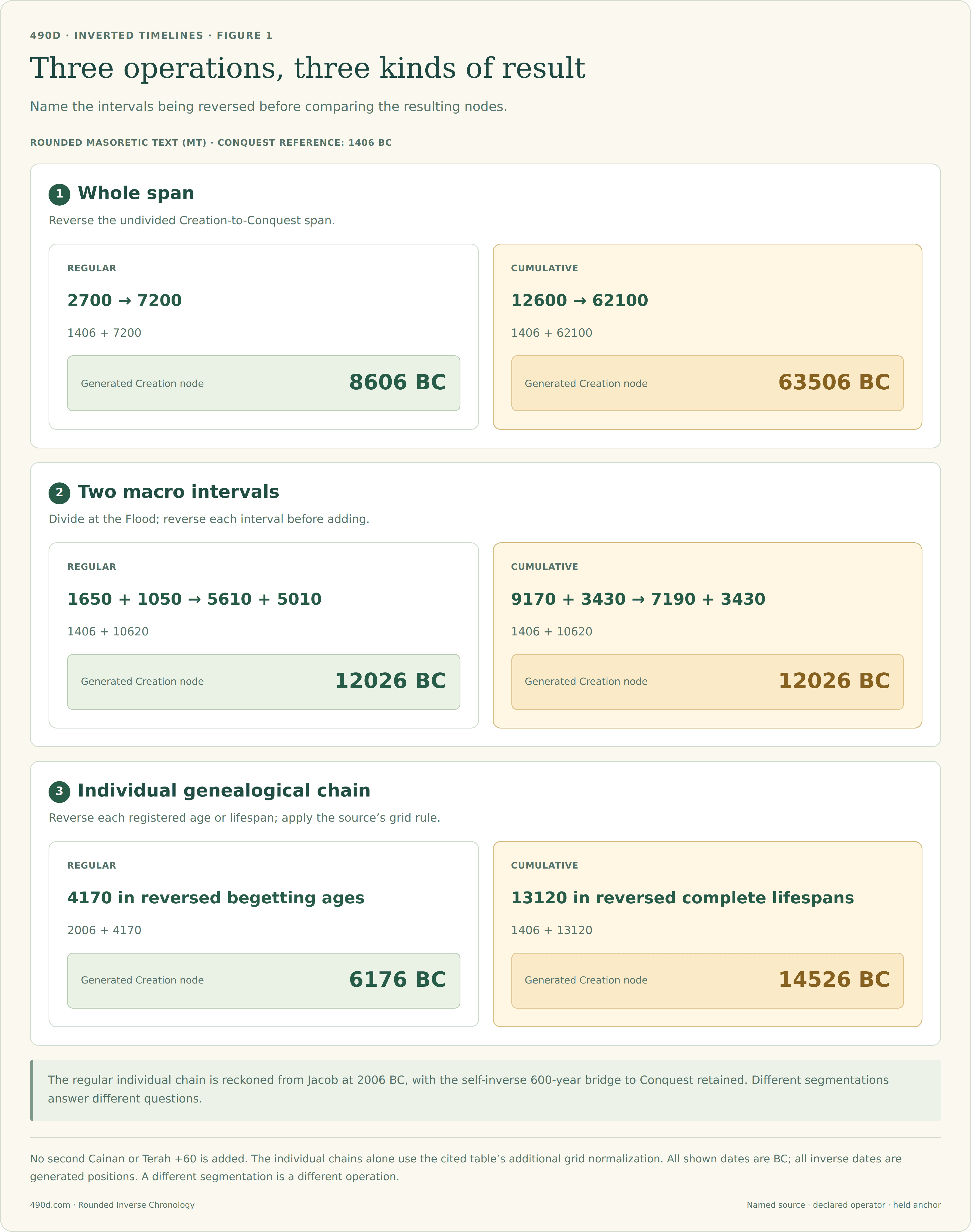

The full chains use the separate segment rule in File 52b: an inverse that falls outside the five-year grid is normalized to its nearest multiple of 5. For example, Enoch’s 365 → 563 → 565 in the cumulative chain. The matched-anchor whole spans and the main Flood-divided constructions need no such adjustment. The complete regular table and cumulative table expose every input rather than asking the reader to accept their endpoint totals.
The regular chain also has a defined foundation: Jacob remains at 2006 BC, 600 years before the Conquest. Reversing that 600 leaves it unchanged. Earlier begetting intervals are then accumulated backward from Jacob. Abraham remains at 2166 BC in this chain, although his independent whole-span inversion gives a different result. These tables describe their stated constructions; they do not turn an inverse coordinate into the ordinary biography of the person whose row it occupies.
4. The shared MT backbone: 12026 and 14726 BC
In the regular outline, Creation 4106 → Flood 2456 → Conquest 1406 BC gives 1650 + 1050. In the cumulative outline, 14006 → 4836 → 1406 BC gives 9170 + 3430. Separately reversed, both total 10620:
5610 + 5010 = 7190 + 3430 = 10620.
Adding that total to 1406 BC gives the shared boundary 12026 BC. Their intermediate inverse Flood stations differ: 6416 BC in the regular route and 4836 BC in the cumulative route.
Noah makes the regular arrangement especially clear. 4106 → 3056 → 2456 → 1406 BC gives 1050 + 600 + 1050. Its inverse is 5010 + 600 + 5010, again totaling 10620. The two outside intervals remain equal, and the central 600 is unchanged. The earlier Adam–Moses comparison supplies the same two units: their original lives total 1050; their separately reversed lives total 600. This does not mean that the inverse of their combined 1050 is 600—I(1050) is 5010.
The next step completes the path to the adopted 6 BC Nativity anchor. The additional original interval is 1406 − 6 = 1400, whose inverse is 4100. Rebuilding from 6 BC begins with this nearest interval, then adds the other reversed parts.
Table 4. The completed MT routes
| Route, read backward from 6 BC | Original successive intervals | Reversed intervals | Rebuilt path, all BC |
|---|---|---|---|
| Regular: 6 → 1406 → 2456 → 4106 | 1400 + 1050 + 1650 | 4100 + 5010 + 5610 | 6 → 4106 → 9116 → 14726 |
| Cumulative: 6 → 1406 → 4836 → 14006 | 1400 + 3430 + 9170 | 4100 + 3430 + 7190 | 6 → 4106 → 7536 → 14726 |
490d · Inverted Timelines · Figure 2
Completing the MT backbone from 6 BC
The extra 1400-year partition reverses to 4100 years in both routes.
Three declared source intervals · rebuild backward from 6 BC
Regular MT
Original route · moving toward earlier datesCumulative MT
Original route · moving toward earlier datesThe displacement comes from reversing the added interval: 4100 − 1400 = 2700.
Selected Rounded MT states; all dates BC. These routes run from later to earlier BC dates. Rebuilt nodes retain their source-leg roles: generated 4106 is the Conquest leg, not a new historical identification as Creation. Spacing is schematic.
Supporting table and calculation details
Image version and full-size downloads
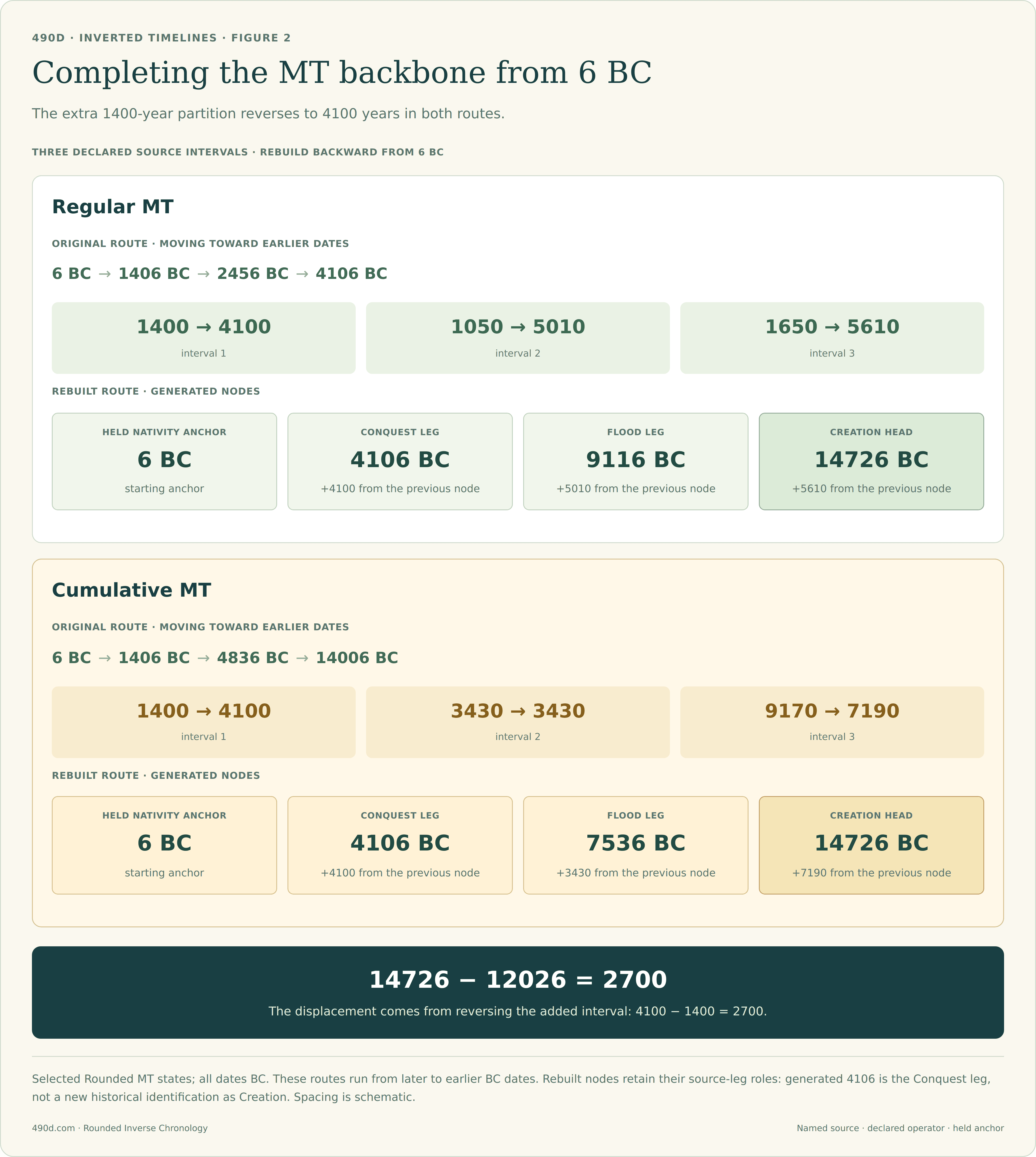

The first generated 4106 BC station represents the inverted Conquest-to-Nativity leg. Its numeral matches Rounded regular Creation, but its role in this path is different. The common final interval is 14720, so 6 + 14720 = 14726 BC.
The change from 12026 to 14726 follows from the operation itself:
I(1400) − 1400 = 4100 − 1400 = 2700.
This explains the 2700-year displacement. It is not an arbitrary translation applied after an unrelated result. Sources: File 52a §7; File 52f §§3.3–3.6.
5. What the completed boundary connects
The importance of 14726 BC is clearer when its companions are named. Rounded cumulative Shem at 5436 BC gives a Nativity-held whole-span inverse of 3456 BC: 5430 → 3450, then add 6. Regular Shem at 2556 BC similarly gives 5526 BC: 2550 → 5520, then add 6. Meanwhile, cumulative Flood 4836 BC remains fixed in its Conquest-held inversion because 3430 is self-reversing.
Table 5. Named relations from 14726 BC
| Companion | Exact interval | Numerical form |
|---|---|---|
| Nativity anchor, 6 BC | 14726 − 6 = 14720 | 23 × 640 |
| Whole-span inverse cumulative Shem, 3456 BC | 14726 − 3456 = 11270 | 23 × 490 |
| Conquest-held inverse cumulative Flood, 4836 BC | 14726 − 4836 = 9890 | 23 × 430 |
| Whole-span inverse regular Shem, 5526 BC | 14726 − 5526 = 9200 | 23 × 400 |
The 490, 430, and 400 units link the common boundary to distinct Shem and Flood constructions. The 430-year Egyptian sojourn and the 400-year affliction remain different registers; they should not be collapsed into one label.
Applying the Key-of-23 ratio 25/23 to 14720 gives 16000. With 6 BC held, the expanded boundary is 16006 BC. Regular Shem’s 5520 span to 6 BC expands under the same rule to 6000, placing it at 6006 BC. The expanded line therefore reads 16006 → 6006 → 6 BC, or 10000 + 6000. This is expansion of two named inverse results, with a common held endpoint. Sources: File 52f §§3.6 and 3.8.2; the Key-of-23 introduction explains the conversion framework.
6. Jacob’s entry, Joseph, and Joshua
Some inverse relationships become more meaningful when read beside the event they transform. Jacob’s entry into Egypt is placed at 1876 BC, when he is 130 years old (Genesis 47:9, BSB). Its two whole-span inversions approach the Exodus through different units.
Table 6. Two inverse routes from the entry into Egypt
| Held anchor | Measured span and inverse | Rebuilt inverse BC date | Comparison with Exodus 1446 BC |
|---|---|---|---|
| 1406 BC | 1876 − 1406 = 470 → 740 | 2146 | 2146 − 1446 = 700 = 14 × 50 |
| 6 BC | 1876 − 6 = 1870 → 7810 | 7816 | 7816 − 1446 = 6370 = 130 × 49 |
490d · Inverted Timelines · Figure 3
Jacob’s entry and two jubilee registers
One source event supplies a 50-year comparison and a 49-year comparison.
Original event: Jacob enters Egypt, 1876 BC · Exodus target: 1446 BC
Conquest anchor · 1406 BC
470 → 740
1846 BC is the selected affliction-model node.
Nativity anchor · 6 BC
1870 → 7810
The panels use different declared inversion anchors and share the same Exodus target. Generated inverse Entry positions are distinct from the original 1876 BC event. The 1846 BC position is a selected chronological model for 400 years of affliction; Egypt’s 430-year sojourn remains a separate duration. Layout is schematic.
Supporting table and calculation details
Image version and full-size downloads
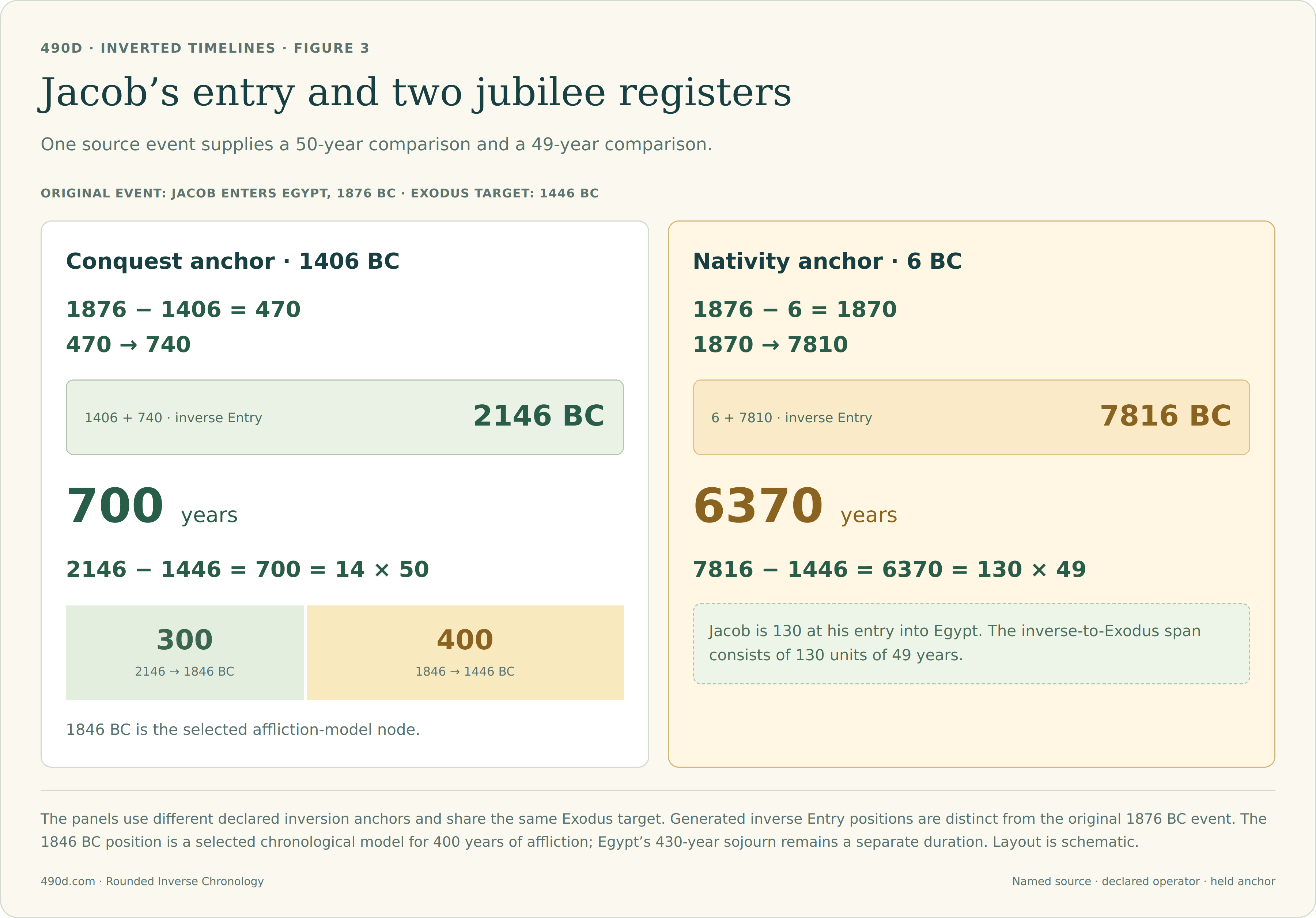
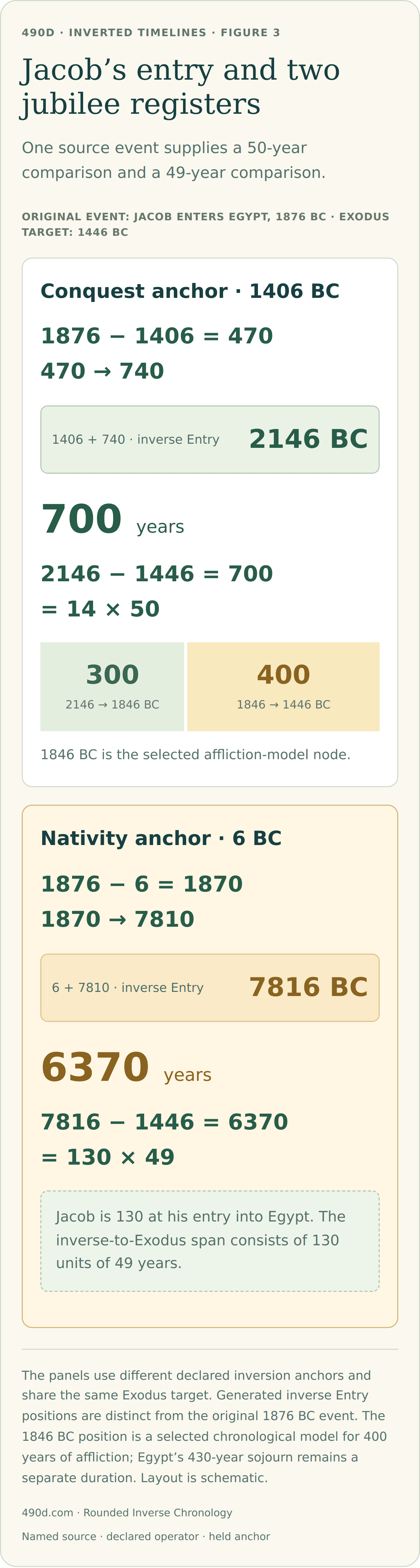
The first result divides at the selected 1846 BC affliction node into 300 + 400 years. The second uses 130—Jacob’s age at entry—as the multiplier of 49, the seven-times-seven jubilee register. The 1846 BC placement is a chronological construction from the 400-year duration, not a BC date supplied directly by Genesis 15:13.
The same hub stands at the midpoint of inverse Abraham and Moses. From the 1406 BC anchor, Abraham’s 2166 BC birth gives 760 → 670 → 2076 BC; Moses’ 1526 BC birth gives 120 → 210 → 1616 BC. Thus 2076 − 1846 = 1846 − 1616 = 230. The 460-year span has an exact center already meaningful within the affliction–Exodus framework. File 52f §5 develops these connections without treating them as independent statistical events.
Joseph and Joshua provide another concise comparison. Both biblical lifespans are 110 years (Genesis 50:26; Joshua 24:29). Their selected Rounded lives are 1916–1806 BC and 1476–1366 BC. These absolute placements belong to the model; the textual lifespan is the 110-year datum.
Joseph’s birth gives 1916 − 1406 = 510 → 150, rebuilding 1556 BC, exactly 110 years before the Exodus. Joshua’s Nativity-held inverse is 1476 − 6 = 1470 → 7410, rebuilding 7416 BC. From that station, the spans to Joseph’s birth and death are 5500 and 5610, or 50 and 51 × 110; those to Joshua’s birth and death are 5940 and 6050, or 54 and 55 × 110.
The biblical narrative itself joins these lives: Joseph anticipates the departure from Egypt, Moses carries his bones, and their burial appears beside the closing account of Joshua (Genesis 50:24–26; Exodus 13:19; Joshua 24:29–32). The numerical fit can therefore be considered within a stated narrative relationship. Reconstructing an inverse death date remains a separate, provisional operation; the comparisons here require only the inverse birth stations and named original endpoints. Source: File 52f §4.
7. From 62100 to 70000: follow the anchors
The cumulative whole-span result opens a larger construction. The original 12600 reverses to 62100, placing the direct inverse at 63506 BC from the Conquest anchor. The following sequence then applies two different expansion ratios, with an explicit change of anchor.
Table 7. The complete inverse-plus-expansion sequence
| Step | Calculation | Result and retained reference |
|---|---|---|
| Reverse the cumulative span | 14006 − 1406 = 12600; I(12600) = 62100 | Direct inverse: 1406 + 62100 = 63506 BC |
| Apply 70/69 | 62100 × 70/69 = 63000 | Keep 1406 BC held |
| Rebuild | 1406 + 63000 | 64406 BC |
| Measure to the Nativity anchor | 64406 − 6 = 64400 | New measured interval: 2800 × 23 |
| Apply 25/23 | 64400 × 25/23 = 70000 | Keep 6 BC held |
| Rebuild | 6 + 70000 | 70006 BC |
490d · Inverted Timelines · Figure 4
Follow the operation—and the held anchor
The route to 70006 BC is more than a repeated reversal.
Cumulative MT · one reversal followed by two declared expansions
These successive generated dates come from reversal, expansion, and an explicit change of anchor.
All dates are BC. Each ratio acts on a span, with the named endpoint held fixed. Step 4 deliberately measures a different span before applying the second ratio. Generated coordinates are not new historical date assignments. The step layout is schematic.
Supporting table and calculation details
Image version and full-size downloads
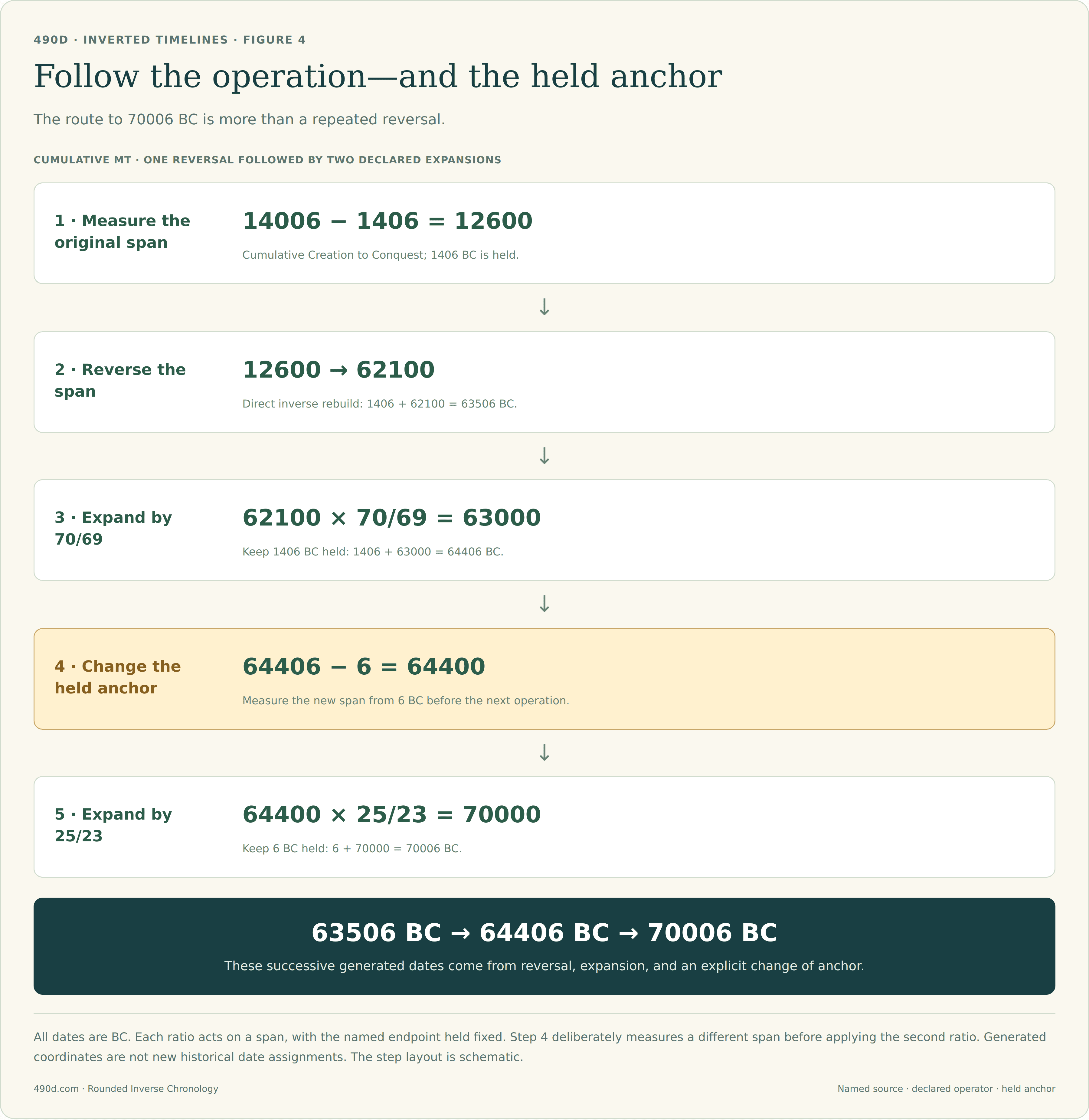
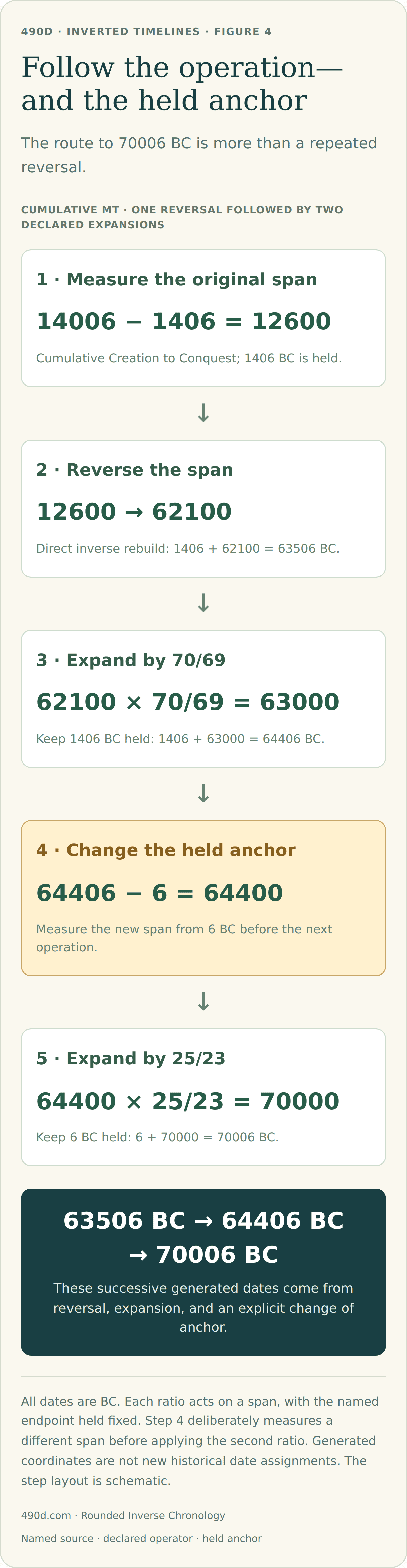
The first expansion adds 900 years. Measuring from 6 BC then adds the 1400 years between the anchors. Together, 900 + 1400 = 2300, explaining why the new interval is 62100 + 2300 = 64400. The steps are connected, but they are not one undifferentiated operation.
The expanded 64406 BC endpoint also stands 49680 years from the completed backbone at 14726 BC: 49680 = 23 × 2160 = 23 × 6 × 360. This adds the sixfold 360 register to the Shem and Flood relationships in Table 5. Calling the sequence a “double inverse” would obscure its meaning: two exact digit reversals alone would restore 12600, not produce 63000 or 70000. Sources: File 52a §16.3; File 52f §§3.6 and 7.
8. The same 12026 boundary divides the Actual bridge
The Rounded Creation gap is 14006 − 4106 = 9900. The normal Actual completion endpoints give a slightly shorter gap: 14004 − 4114 = 9890. Remarkably, the same generated 12026 BC boundary divides both in the ratio 1:4.
Table 8. One dividing coordinate, two declared source states
| Source state | Earlier part | Later part | Total |
|---|---|---|---|
| Rounded: 14006 → 12026 → 4106 BC | 1980 | 7920 = 4 × 1980 | 9900 |
| Actual endpoints: 14004 → 12026 → 4114 BC | 1978 | 7912 = 4 × 1978 | 9890 |
| Actual intervals expanded by 25/23 | 2150 = 5 × 430 | 8600 = 20 × 430 | 10750 = 25 × 430 |
490d · Inverted Timelines · Figure 5
One boundary divides both bridges 1:4
Rounded and Actual endpoint selections preserve the same proportion.
One generated boundary, two explicitly selected Creation bridges
The Actual row uses the source’s selected 14004/4114 BC endpoint pair, not the separate 14006/4116 Year-6 pair. Original endpoints and the generated division point are distinct. Each bar has its own normalized scale; the expansion panel compares lengths and does not assign new dated endpoints.
Supporting table and calculation details
Image version and full-size downloads
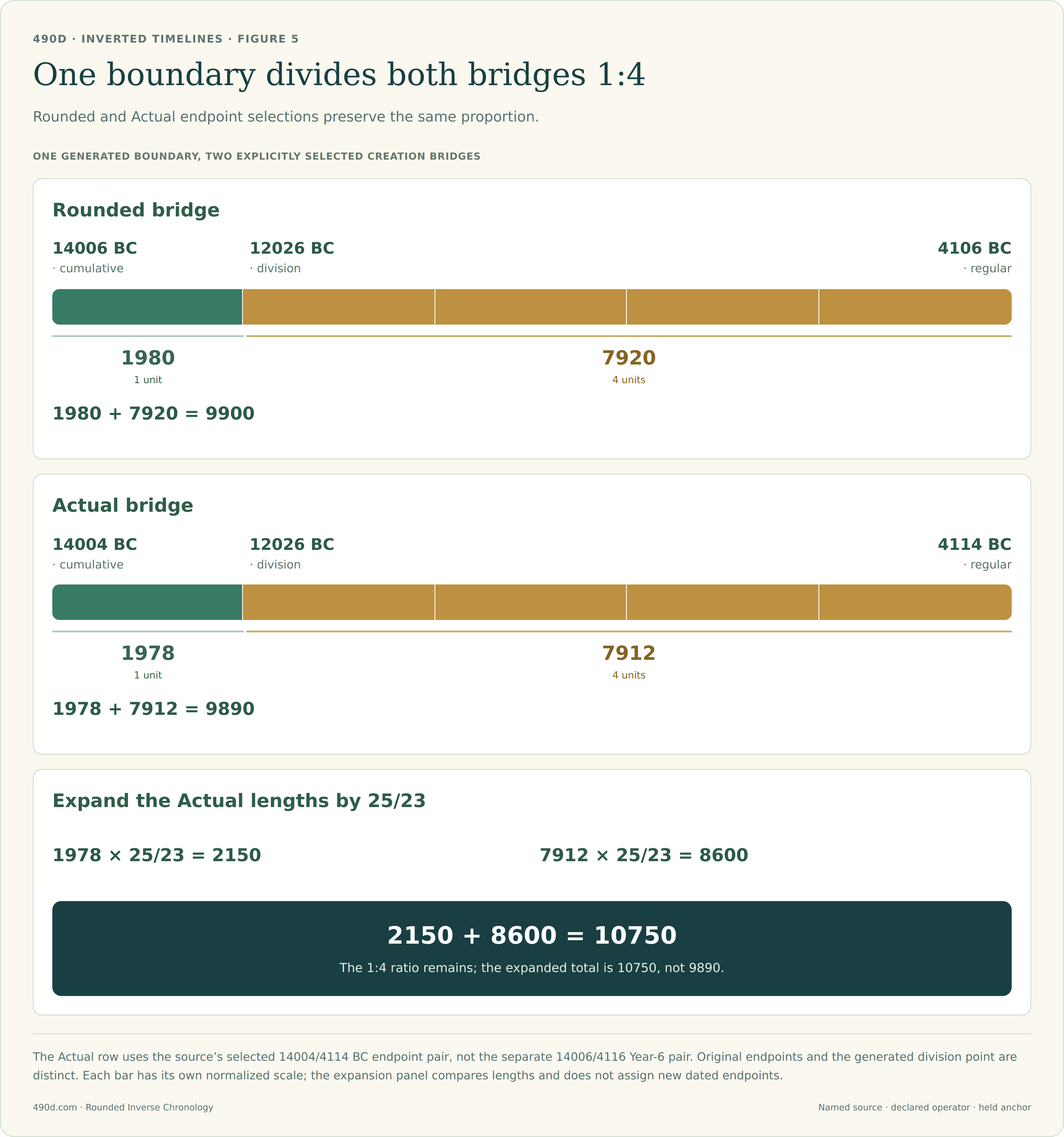
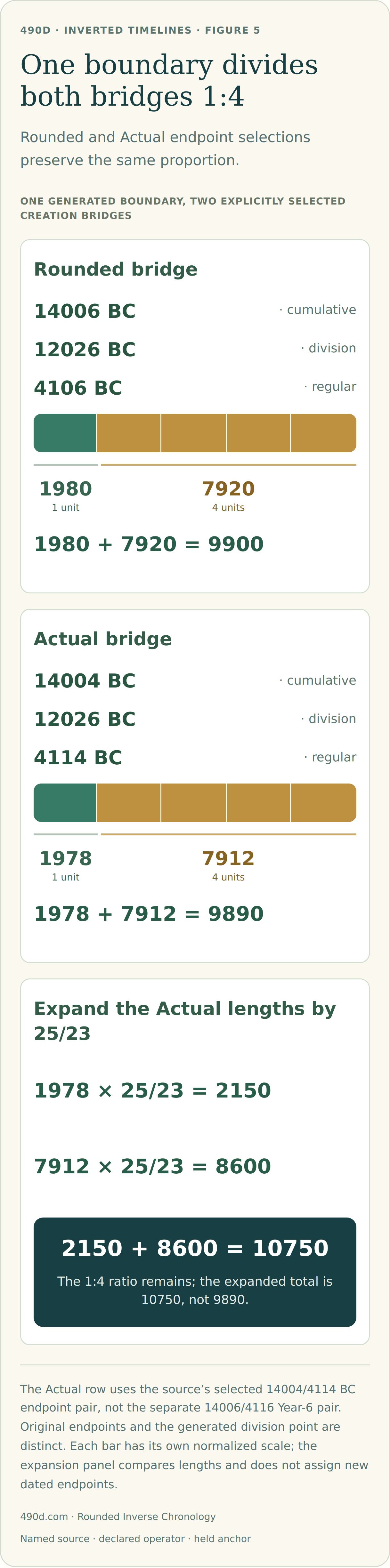
The converted parts total 10750; they are not subdivisions of the unexpanded 9890. The original Rounded and Actual intervals retain their identities. File 52f §3.14 develops this comparison from File 22’s Actual Creation endpoints.
The same 12026 BC coordinate also orders a selected Actual sequence into consecutive multiples of 598 = 2 × 299:
Table 9. Jared, Noah, and the Flood
| Selected source BC date | Span from 12026 BC | Original span ×300/299 | Original span ×25/23 |
|---|---|---|---|
| Jared 3654 | 8372 = 14 × 598 | 8400 = 14 × 600 | 9100 = 14 × 650 |
| Noah 3056, Gear 1 | 8970 = 15 × 598 | 9000 = 15 × 600 | 9750 = 15 × 650 |
| Flood 2458, Gear 2 | 9568 = 16 × 598 | 9600 = 16 × 600 | 10400 = 16 × 650 |
This example deliberately selects Noah’s Gear-1 birth and the Gear-2 Flood. It neither changes the normal Noah convention nor applies gears to Jared. Their successive original separations are 598 + 598; the common ratios make them 600 + 600 or 650 + 650. The result supplies a further reason to study the 12026 boundary, while the broader interpretation of all the generated dates remains partially explored. Source: File 52f §3.15.
9. The LXX comparison and the accepted SP construction
The MT remains the primary example. The comparative traditions add value when their distinct source states are retained. The LXX here includes its native second Cainan and uses the stated full-430 framework. Its Rounded regular Creation and Flood stations are 5486 and 3236 BC; the cumulative stations are 14896 and 5746 BC.
Applying the same Flood-divided construction yields two LXX endpoints, 10436 and 10936 BC, rather than the MT’s single 12026 boundary. The Nativity-stage versions are 13136 and 13636 BC. Their 500-year separation can be followed through the intervals: (4340 − 3810) + (5190 − 5220) = 530 − 30 = 500.
Table 10. The six comparative constructions
| Tradition and layer | Original intervals, from Conquest toward the earlier boundary | Reversed intervals | Result from 1406 BC | Completed result from 6 BC |
|---|---|---|---|---|
| MT regular | 1050 + 1650 | 5010 + 5610 | 12026 | 14726 |
| MT cumulative | 3430 + 9170 | 3430 + 7190 | 12026 | 14726 |
| LXX regular | 1830 + 2250 | 3810 + 5220 | 10436 | 13136 |
| LXX cumulative | 4340 + 9150 | 4340 + 5190 | 10936 | 13636 |
| SP regular, from the Fall | 1700 + 1300 | 7100 + 3100 | 11606 | 14306 |
| SP cumulative, from the Fall | 3310 + 8680 | 1330 + 8680 | 11416 | 14116 |
Every completed result adds the separately reversed 1400 → 4100 leg and holds 6 BC, producing the same 2700-year displacement from its two-stage result. Sources: File 52f Appendix D §§D.2–D.3 and D.7.
Why the SP starts its final segment at the Fall
The accepted SP construction preserves the lower Rounded Creation members 4411 BC regular and 13401 BC cumulative. It then selects the Fall five years forward, at 4406 and 13396 BC, before calculating the intervals. The lower Flood stations remain 3106 and 4716 BC. Nothing is repaired by changing the last digit of an already inverted result.
Table 11. The accepted SP paths
| Step | Regular SP | Cumulative SP |
|---|---|---|
| Select the Fall before inversion | 4411 − 5 = 4406 BC | 13401 − 5 = 13396 BC |
| Fall to Flood | 4406 − 3106 = 1300 → 3100 | 13396 − 4716 = 8680 → 8680 |
| Flood to Conquest anchor | 3106 − 1406 = 1700 → 7100 | 4716 − 1406 = 3310 → 1330 |
| Rebuild from 1406 BC | 1406 → 8506 → 11606 | 1406 → 2736 → 11416 |
| Rebuild with the third leg from 6 BC | 6 → 4106 → 11206 → 14306 | 6 → 4106 → 5436 → 14116 |
490d · Inverted Timelines · Figure 6
Begin the SP construction at the Fall
Apply the five-year source adjustment first; retain the same Flood seams throughout.
Samaritan Pentateuch (SP) · accepted Fall-node construction
Regular SP
Move forward five years before forming the intervals.
1300 → 3100
1700 → 7100
1406 BC held
6 BC held
Cumulative SP
Move forward five years before forming the intervals.
8680 → 8680
3310 → 1330
1406 BC held
6 BC held
Including the third source leg shifts each generated head 2700 years earlier.
The source adjustment is forward five years from lower Creation to Fall, before reversal. It is not a post-reversal rounding correction or a change of Flood seam. SP cumulative reconstruction includes Joshua’s 1296 BC terminal; 1406 BC remains the declared inversion pivot. All dates are BC; panel spacing is schematic.
Supporting table and calculation details
Image version and full-size downloads
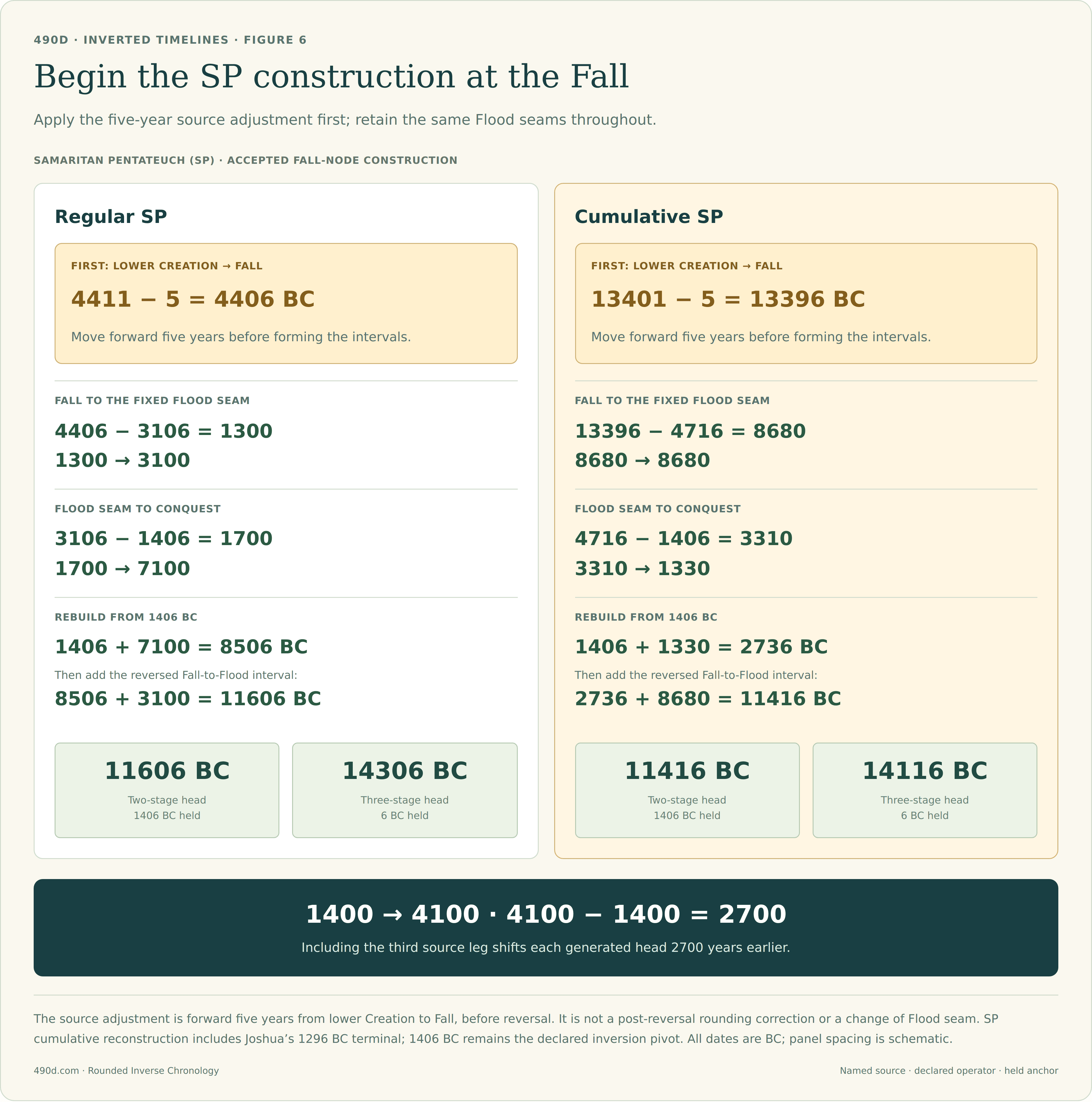

The cumulative SP source itself is reconstructed through Joshua at 1296 BC: 1296 + 12105 = 13401. The 1406 BC station serves as the inversion comparison anchor. Keeping these two functions distinct avoids replacing the terminal foundation of the cumulative source.
The regular 1300 recalls the SP Fall-to-Flood structure, while the cumulative 8680 is self-reversing. The accepted construction therefore supplies distinct regular and cumulative patterns without requiring them to converge exactly as the MT does. The suggestion of a wider reciprocal relationship between the LXX and SP remains an interpretation to develop; the specific SP paths above are the established construction used here.
10. Where the comparative spans meet the Exodus and restoration
The clearest further relationships retain the event associated with each generated station. A three-stage inverse Flood coordinate, for example, must not be renamed an inverse Creation boundary merely because both belong to the same route.
Table 12. Selected comparisons with named endpoints
| Generated station and construction | Comparison | Exact result |
|---|---|---|
| MT cumulative inverse Flood, three-stage 7536 BC | Restoration 536 BC | 7000 |
| SP cumulative inverse Flood, three-stage 5436 BC | Restoration 536 BC | 4900 |
| LXX regular inverse Creation, three-stage 13136 BC | Restoration 536 BC | 12600 |
| SP regular inverse Flood, three-stage 11206 BC | Conquest 1406 BC | 9800 = 20 × 490 |
| Same SP inverse Flood 11206 BC | AD 65, expressly civil elapsed count | 11206 + 65 − 1 = 11270 = 23 × 490 |
490d · Inverted Timelines · Figure 7
Where the generated nodes meet later anchors
Keep each tradition, inverse construction, and counting rule visible.
Generated three-stage nodes · named restoration and Conquest targets
MT cumulative inverse Flood
MT three-stage Flood node: 6 + 4100 + 3430 = 7536.
SP cumulative inverse Flood
SP three-stage Flood node: 6 + 4100 + 1330 = 5436.
LXX regular inverse Creation
LXX three-stage Creation head: 6 + 4100 + 3810 + 5220 = 13136.
SP regular inverse Flood
1470 = 3 × 490
SP three-stage Flood node: 6 + 4100 + 7100 = 11206.
11206 + 65 − 1 = 11270.
AD 65 remains the civil endpoint.
The cards compare generated nodes with named targets; they are not one merged historical timeline. MT = Masoretic Text; SP = Samaritan Pentateuch; LXX = Septuagint, retaining native Cainan in its cited route. BC-to-BC spans use subtraction. The AD 65 card uses civil counting, BC + AD − 1. Spacing is schematic.
Supporting table and calculation details
Image version and full-size downloads
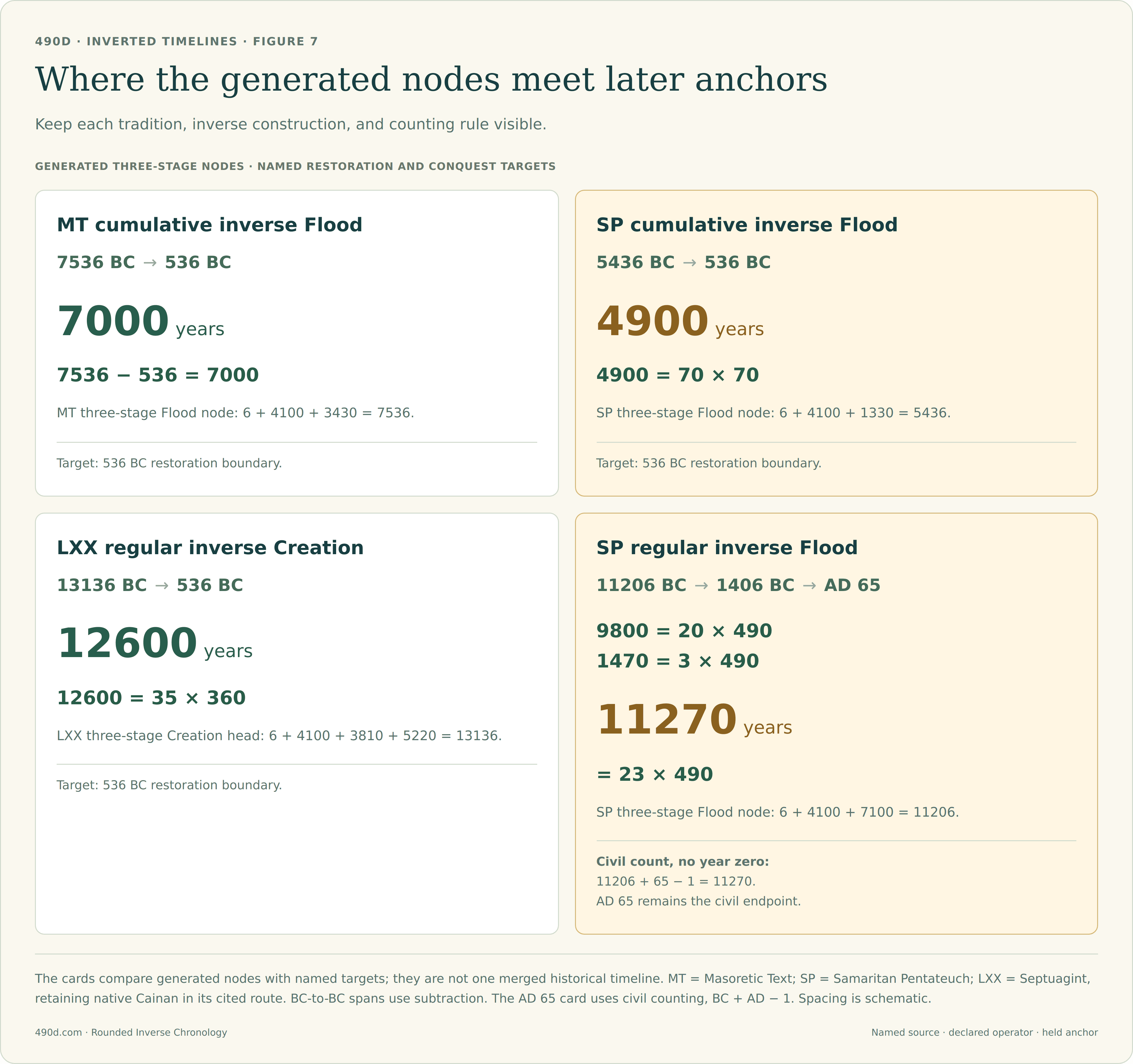
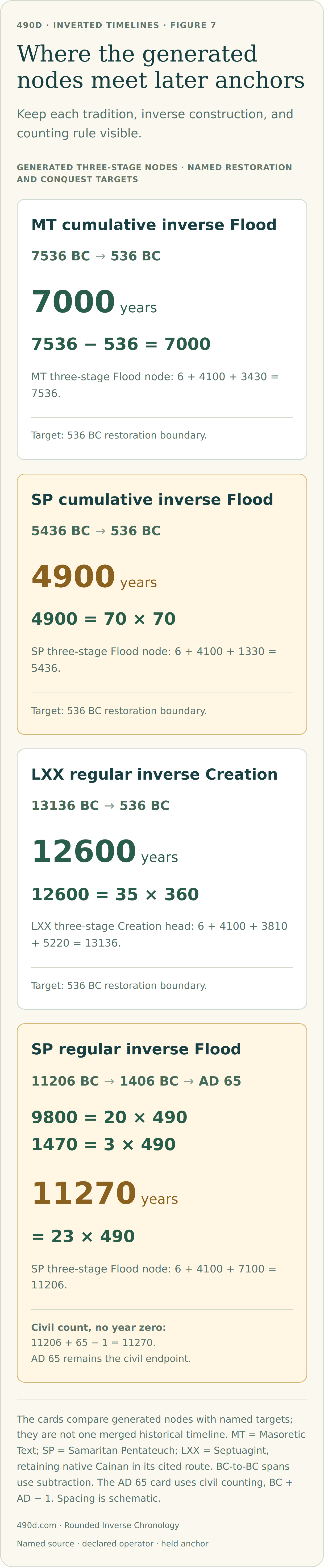
The last two rows form one continuous comparison: 11206 → 1406 BC is 9800 years, and 1406 BC → AD 65 is 1470 = 3 × 490 civil years. Together they make 11270. The civil count is specified here; the Rounded coordinate width between the same printed endpoints would be 11269.
The SP cumulative intermediate also reconnects with the MT before the third leg is added. 14006 − 2736 = 11270 = 23 × 490 links MT cumulative Creation with SP inverse Flood; 5436 − 2736 = 2700 links that inverse Flood with original MT cumulative Shem. The original 5436 BC Shem station is numerically the same as the completed SP inverse Flood station, but their constructions remain distinct.
Another compact comparison recovers the SP’s original 1700-year Flood–Conquest interval. The LXX regular inverse head 13136 BC stands 11730 years from 1406 BC; expanding that span by 70/69 gives 11900, rebuilding 13306 BC with 1406 held. Its separation from the SP two-stage head is 13306 − 11606 = 1700. Relative to original Rounded LXX Creation 5486 BC, those two generated heads give 7820 = 17 × 460 and 6120 = 17 × 360. Their difference again recovers 1700. This is the source’s proposed reciprocal relationship in a concrete form; it does not yet define a full inverse mapping between the chronologies. Source: File 52f Appendix D §§D.6.2 and D.7.7.
Sources for Table 12: File 52f Appendix D §§D.4.2 and D.7.5–D.7.8.
11. The Mirror and the 529 family
Digit reversal and reflection across the BC–AD divide are different operations. The September 25 Rounded convention gives a BC date B the coordinate q = −(B − 1) and an AD date A the coordinate q = A − 1. Reflection changes the sign of q. Thus 1406 BC and AD 1406 display −1405 and +1405.
The Rounded width across the divide is B + A − 2. Ordinary civil elapsed counting, with no year zero, gives B + A − 1. A particular factorization can belong to one count without belonging to the other.
The common 2700-year displacement also connects the restoration comparisons with Abraham’s reflected birth. Moving both endpoints forward by 2700 on the Rounded grid takes 536 BC to AD 2166: −535 + 2700 = +2165, displayed as AD 2166. The earlier endpoints then return to their two-stage inverse coordinates, preserving each span.
Table 13. The same restoration spans on the Rounded Mirror grid
| Original comparison, all BC | Both endpoints moved forward 2700 | Preserved Rounded width |
|---|---|---|
| LXX regular inverse Creation: 13136 → 536 | 10436 BC → AD 2166 | 10436 + 2166 − 2 = 12600 |
| MT cumulative inverse Flood: 7536 → 536 | 4836 BC → AD 2166 | 4836 + 2166 − 2 = 7000 |
| SP cumulative inverse Flood: 5436 → 536 | 2736 BC → AD 2166 | 2736 + 2166 − 2 = 4900 |
The span-preservation follows from moving both ends together. The contextual correspondence is that the repeated 536 BC target moves to AD 2166, the Rounded reflection of Abraham’s 2166 BC birth, by the same 2700 displacement already generated by 1400 → 4100. These are Rounded widths throughout; their civil elapsed counts would each be one year larger. Source: File 52f Appendix D §D.7.8.
Table 14. Selected 529 relations and their counting rules
| Construction | Starting duration | One ×25/23 expansion | Second ×25/23 expansion |
|---|---|---|---|
| 12026 BC → Exodus 1446 BC; same-side subtraction | 10580 = 20 × 529 | 11500 | 12500 |
| 8606 BC → AD 1446; expressly civil | 10051 = 19 × 529 | 10925 | 11875 |
| Inverse Seth 7936 BC → 1 BC; same-side subtraction | 7935 = 15 × 529 | 8625 | 9375 |
Because 529 = 23², two successive applications of 25/23 are exact: k × 23² → k × 23 × 25 → k × 25². This explains what the factorization permits. The second step is not a second independent discovery.
For the middle row, the neighboring Rounded width is 10050, not 10051. For Seth, 3976 − 6 = 3970 → 7930, producing 7936 BC; reflecting its coordinate gives AD 7936. Their full Rounded width is 15870 = 30 × 529, whereas the civil count is 15871. File 52f §6 keeps these distinctions explicit.
12. Reading the relationships together
The organizing structure is now visible. The MT regular and cumulative outlines meet at 12026 BC when their Flood-divided intervals are rebuilt from the Conquest. Completing the Nativity leg brings both to 14726 BC. That boundary relates to Shem and the Flood through 23 × 490, 23 × 430, and 23 × 400. The same 12026 coordinate divides both the Rounded and Actual Creation bridges in the ratio 1:4.
The person-and-event comparisons give the arithmetic a narrative setting. Jacob’s entry is associated with his age of 130 and the jubilee register; Joseph and Joshua retain their common 110-year lives; the SP construction begins at the Fall; the comparative Flood stations reach named Conquest and restoration anchors. These relationships are worth examining as a connected architecture rather than as an undifferentiated list of large numbers.
Their significance must also be stated at the right level. The calculations are exact under the declared constructions. Their theological meaning is an interpretation of that structure. Relations produced from shared endpoints or by the same linear expansion are connected consequences, not automatically independent evidence. Nor does a decimal reversal by itself establish that an ancient writer used modern decimal notation to design the chronology.
File 52f’s bounded survey records all outcomes, including misses: 64 whole-span routes from 32 source dates, followed by a separately identified two-construction backbone extension. Its conditional probability calculations and methodological qualifications belong together. The detailed narrative here does not turn those exploratory benchmarks into a probability that the whole chronology is intentional.
The following tables allow the main procedures to be checked directly. For a shorter reading, return to the introductory article. For the wider numerical–narrative study and LXX/SP Appendix D, continue to File 52f — Rounded Whole-Span Inverse Detailed Study.
Supporting tables
Table A. The 32 whole-span sources and both inverse routes
Every row is an independent whole-span operation from its selected anchor family, not the next step in a genealogical chain. All date labels are BC. The source manifest follows File 52f §2 and Appendix A. The original source dates are kept even when their results do not support a selected comparison.
| Source | Rounded source BC | Nativity family: anchor + inverse span | Conquest family: anchor + inverse span |
|---|---|---|---|
| Adam / Creation | 4106 | 6 + I(4100) = 1406 | 1406 + I(2700) = 8606 |
| Seth | 3976 | 6 + I(3970) = 7936 | 1406 + I(2570) = 8926 |
| Enosh | 3871 | 1 + I(3870) = 7831 | 1401 + I(2470) = 8821 |
| Kenan | 3781 | 1 + I(3780) = 8731 | 1401 + I(2380) = 9721 |
| Mahalalel | 3711 | 1 + I(3710) = 1731 | 1401 + I(2310) = 2721 |
| Jared | 3646 | 6 + I(3640) = 4636 | 1406 + I(2240) = 5626 |
| Enoch’s birth | 3486 | 6 + I(3480) = 8436 | 1406 + I(2080) = 9426 |
| Methuselah | 3421 | 1 + I(3420) = 2431 | 1401 + I(2020) = 3421 |
| Lamech | 3236 | 6 + I(3230) = 3236 | 1406 + I(1830) = 5216 |
| Noah | 3056 | 6 + I(3050) = 5036 | 1406 + I(1650) = 7016 |
| Shem | 2556 | 6 + I(2550) = 5526 | 1406 + I(1150) = 6516 |
| Arphaxad / Flood | 2456 | 6 + I(2450) = 5426 | 1406 + I(1050) = 6416 |
| Shelah | 2421 | 1 + I(2420) = 2421 | 1401 + I(1020) = 3411 |
| Eber | 2391 | 1 + I(2390) = 9321 | 1401 + I(990) = 2391 |
| Peleg | 2356 | 6 + I(2350) = 5326 | 1406 + I(950) = 1996 |
| Reu | 2326 | 6 + I(2320) = 2326 | 1406 + I(920) = 1696 |
| Serug | 2296 | 6 + I(2290) = 9226 | 1406 + I(890) = 2386 |
| Nahor | 2266 | 6 + I(2260) = 6226 | 1406 + I(860) = 2086 |
| Terah | 2236 | 6 + I(2230) = 3226 | 1406 + I(830) = 1786 |
| Abraham | 2166 | 6 + I(2160) = 6126 | 1406 + I(760) = 2076 |
| Isaac | 2066 | 6 + I(2060) = 6026 | 1406 + I(660) = 2066 |
| Jacob | 2006 | 6 + I(2000) = 2006 | 1406 + I(600) = 2006 |
| Joseph | 1916 | 6 + I(1910) = 1916 | 1406 + I(510) = 1556 |
| Aaron | 1531 | 1 + I(1530) = 3511 | 1401 + I(130) = 1711 |
| Moses | 1526 | 6 + I(1520) = 2516 | 1406 + I(120) = 1616 |
| Joshua | 1476 | 6 + I(1470) = 7416 | 1406 + I(70) = 1476 |
| 120-year Flood countdown | 2576 | 6 + I(2570) = 7526 | 1406 + I(1170) = 8516 |
| Abraham’s call / departure | 2091 | 1 + I(2090) = 9021 | 1401 + I(690) = 2361 |
| Jacob’s entry into Egypt | 1876 | 6 + I(1870) = 7816 | 1406 + I(470) = 2146 |
| 400-year affliction node | 1846 | 6 + I(1840) = 4816 | 1406 + I(440) = 1846 |
| Exodus | 1446 | 6 + I(1440) = 4416 | 1406 + I(40) = 1446 |
| Enoch’s ascension (provisional) | 3121 | 1 + I(3120) = 2131 | 1401 + I(1720) = 4111 |
Aaron’s 1531 BC row is the elected Rounded companion, not a replacement for normal Aaron/Moses chronology. Joshua’s 1476 BC birth is a model placement; his 110-year lifespan is textual. Enoch’s 3121 BC ascension is retained as the source study’s provisional direct-date construction, 3486 − 365. It is distinct from reconstructing a terminal date from an inverted birth and lifespan. Arphaxad and the selected Rounded Flood share one source row, not two.
The Temple at 966 BC is a separate reference outside that manifest. Its Nativity route gives 966 − 6 = 960 → 690, rebuilding 696 BC. Relative to 1406 BC it lies on the later side: retain the negative offset, 966 − 1406 = −440, so its self-inverse magnitude returns 1406 − 440 = 966 BC. File 52f §2.5 states this signed extension locally; it is not needed for the positive source offsets in Table A.
Table B. The regular individual-interval inverse chain
This table follows File 52b §§3–4. Jacob remains at 2006 BC, because the terminal 600 years to Conquest 1406 BC are self-reversing. Each earlier rounded begetting interval is reversed and added backward from Jacob. Adam-to-Jacob totals 4170 after reversal; adding the terminal 600 gives 4770, rebuilding 6176 BC from 1406. In this chain register, 105 → 501 → 500; the normalized interval used in reconstruction is shown explicitly.
| Patriarch | Source begetting age | Rounded age | Inverse used | Rebuilt BC |
|---|---|---|---|---|
| Adam | 130 | 130 | 310 | 6176 |
| Seth | 105 | 105 | 500 | 5866 |
| Enosh | 90 | 90 | 90 | 5366 |
| Kenan | 70 | 70 | 70 | 5276 |
| Mahalalel | 65 | 65 | 55 | 5206 |
| Jared | 162 | 160 | 610 | 5151 |
| Enoch | 65 | 65 | 55 | 4541 |
| Methuselah | 187 | 185 | 580 | 4486 |
| Lamech | 182 | 180 | 810 | 3906 |
| Noah | 500 | 500 | 500 | 3096 |
| Shem | 100 | 100 | 100 | 2596 |
| Arphaxad / Flood | 35 | 35 | 55 | 2496 |
| Shelah | 30 | 30 | 30 | 2441 |
| Eber | 34 | 35 | 55 | 2411 |
| Peleg | 30 | 30 | 30 | 2356 |
| Reu | 32 | 30 | 30 | 2326 |
| Serug | 30 | 30 | 30 | 2296 |
| Nahor | 29 | 30 | 30 | 2266 |
| Terah | 70 | 70 | 70 | 2236 |
| Abraham | 100 | 100 | 100 | 2166 |
| Isaac | 60 | 60 | 60 | 2066 |
| Jacob | — | — | — | 2006 |
The Noah-to-Shem row uses the selected 500-year begetting interval; the Shem-to-Arphaxad row uses 100. Their sum is the Rounded 600-year Noah-to-Flood outline. These selected intervals do not remove the two-year qualifications in ordinary Genesis chronology. The table’s 6176 BC head belongs to the full chain, not to the macro result at 12026 BC.
Table C. The cumulative individual-lifespan inverse chain
This table follows File 52b §8. It adds reversed Rounded complete lifespans backward from Moses’ terminal anchor at 1406 BC. Moses’ 120 → 210 gives the first rebuilt birth station, 1616 BC. Rows are shown in ancestral order for comparison, although reconstruction runs from the bottom upward.
| Patriarch | Source lifespan | Rounded lifespan | Inverse used | Rebuilt BC |
|---|---|---|---|---|
| Adam | 930 | 930 | 390 | 14526 |
| Seth | 912 | 910 | 190 | 14136 |
| Enosh | 905 | 905 | 510 | 13946 |
| Kenan | 910 | 910 | 190 | 13436 |
| Mahalalel | 895 | 895 | 600 | 13246 |
| Jared | 962 | 960 | 690 | 12646 |
| Enoch | 365 | 365 | 565 | 11956 |
| Methuselah | 969 | 970 | 790 | 11391 |
| Lamech | 777 | 775 | 575 | 10601 |
| Noah | 950 | 950 | 590 | 10026 |
| Shem | 600 | 600 | 600 | 9436 |
| Arphaxad | 438 | 440 | 440 | 8836 |
| Shelah | 433 | 435 | 535 | 8396 |
| Eber | 464 | 465 | 565 | 7861 |
| Peleg | 239 | 240 | 420 | 7296 |
| Reu | 239 | 240 | 420 | 6876 |
| Serug | 230 | 230 | 320 | 6456 |
| Nahor | 148 | 150 | 510 | 6136 |
| Terah | 205 | 205 | 500 | 5626 |
| Abraham | 175 | 175 | 570 | 5126 |
| Isaac | 180 | 180 | 810 | 4556 |
| Jacob | 147 | 145 | 540 | 3746 |
| Levi | 137 | 135 | 530 | 3206 |
| Kohath | 133 | 135 | 530 | 2676 |
| Amram | 137 | 135 | 530 | 2146 |
| Moses | 120 | 120 | 210 | 1616 |
| Moses’ death / Conquest | — | — | — | 1406 |
The two Cainan names must not be confused: Kenan in Genesis 5 remains in this MT line; the additional post-Flood Cainan is not inserted. After Jacob, the cumulative line continues through Levi, Kohath, Amram, and Moses, not through Joseph. The table gives formal serial lifespan stations, ending at 14526 BC for Adam. It does not assign these coordinates as ordinary births, and it does not add an Aaron overlay.
Sources and further study
| Source | Sections chiefly used | Role in this article |
|---|---|---|
| File 51a — Rounded Scaffold | §§3, 7.6, 16, 24; September 25 clarification | Rounded inputs and distinction from Actual chronology |
| File 52a — Inverse-Number Architecture | §§2–7, 10–11, 16.3; September 25 clarifications | Basic operation, macro structures and expansion framework |
| File 52b — Technical Tables | §§1–4 and 8 | Whole-span anchor selector and individual genealogical chains |
| File 52f — Rounded Whole-Span Inverse Detailed Study, combined with LXX/SP Appendix D | §§1–7, 8–9, 3.14–3.15; Appendices A and D | Whole-span study, narrative correspondences, Actual bridge, bounded survey, and accepted SP solution |
| File 22 — Cumulative MT Harmonics | §§5.1 and 7.1 | Actual 9890-year Creation bridge and endpoint/Year-6 distinction |
| File 46 — Harmonic Expansion Protocols | §§1 and 4 | Declared 25/23 and 70/69 expansion operators |
The whole-span study is now File_52f in the Unified Repository. Its former research-stage File_52c label is historical. The separate File_52c — Inverse of the Inverse remains an exploratory second-order article at its existing WordPress address.
Related inverse explorations
The connected exploratory articles extend different parts of the construction: 5f develops overlapping path sums and Key-of-23 expansions; File_52c follows selected aggregates into second-order closure; File_52d examines the BJ trunk; and File_52e develops a distinct +60 LXX branch with an SP appendix. These articles retain their exploratory status; each names its own source state and operations.
Scripture quotations: Berean Standard Bible (BSB), public domain.