Detailed study · 6 October 2026 · v1. Supporting tables and the original discussion are linked at the end.
So Noah lived a total of 950 years, and then he died.
Noah’s 950 years and Shem’s 600 years give the Flood narrative two overlapping measures of a human life. When their chronological positions are compared across the Masoretic Text (MT), Samaritan Pentateuch (SP), and Septuagint (LXX), those measures also produce larger numerical relationships. This study follows a selected set of dates through a BC–AD coordinate reflection, explaining the 6000, 6500, and repeated 950-year spans that result.
The choices matter. These particular comparisons use Gear 1, an ideal alignment admitted by the chronology’s canonical framework. They are not a substitute for the ordinary Gear 2 narrative chronology. The AD endpoints are mathematical counterparts of BC dates; their labels do not predict events in those AD years.
1. Begin with Noah and Shem’s stated ages
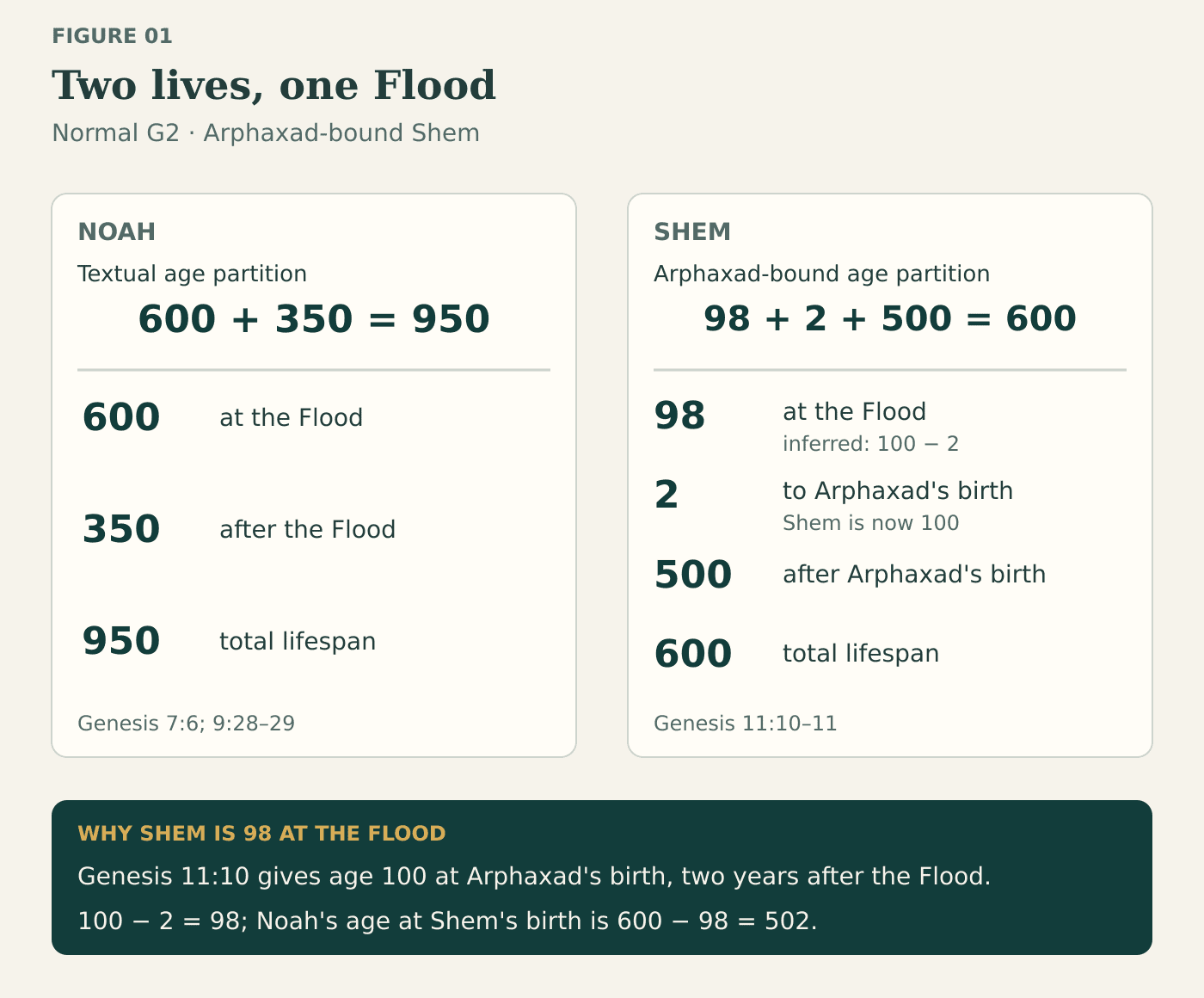
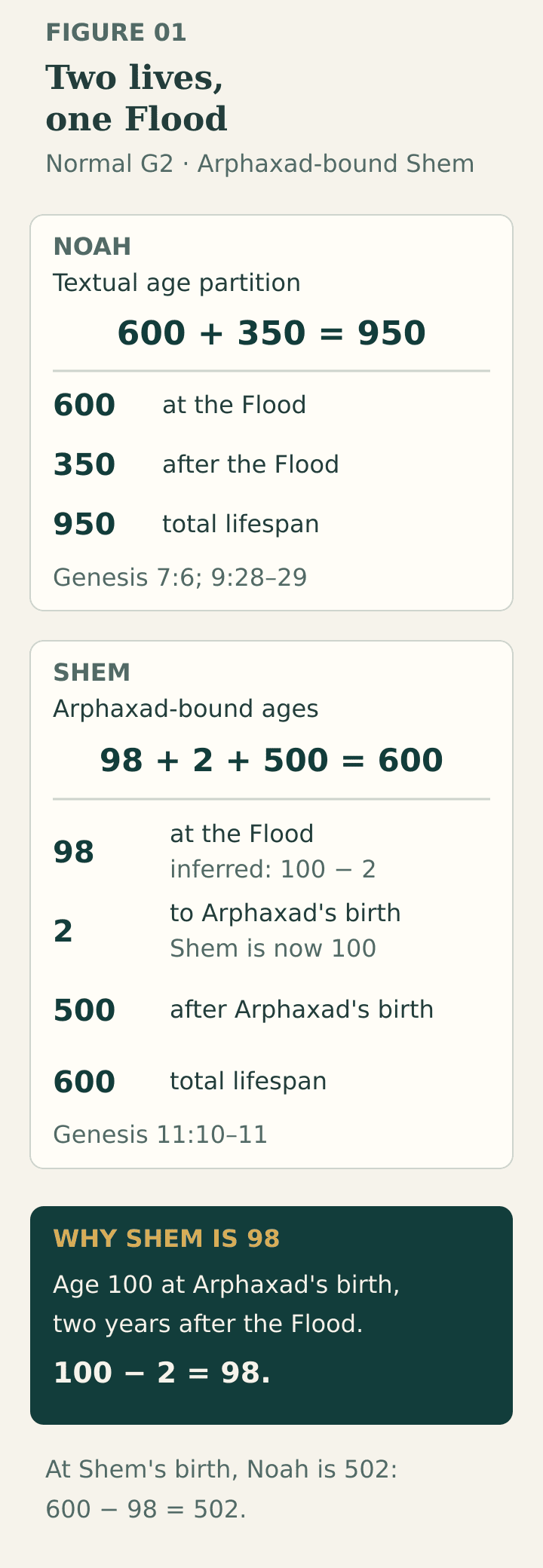
Genesis 7:6 places Noah at age 600 when the Flood came. Genesis 9:28–29 gives another 350 years afterward and a total life of 950 years. The calculation is straightforward:
600 + 350 = 950 years.
Shem’s relation to the Flood needs closer attention. Genesis 11:10–11 places him at age 100 when Arphaxad was born, two years after the Flood, followed by another 500 years. On the ordinary reading, Shem was therefore 98 at the Flood:
98 + 2 + 500 = 600 years.
The ordinary MT Gear 2 dates illustrate that reading: Noah’s birth 3058 BC, Shem’s birth 2556 BC, the Flood’s start 2458 BC, and Arphaxad’s birth 2456 BC. Noah and Shem then die in 2108 and 1956 BC, respectively. These are derived chronological dates; Genesis supplies the ages and intervals.
Full table and calculation · Scripture: Genesis 7:6 (BSB) · Genesis 9:28–29 (BSB) · Genesis 11:10–11 (BSB)
Gear 1 supplies a related ideal alignment. In the MT comparison, Noah’s birth and the Flood move two years forward, to 3056 and 2456 BC, while the Arphaxad-bound Shem dates remain 2556–1956 BC. This yields the schematic partition:
500 + 100 + 500 = 1100 years, from Noah’s birth to Shem’s death.
The middle 100 years reach the Gear 1 Flood coordinate, which coincides with the fixed Arphaxad coordinate. The literal two-year interval belongs to the ordinary Gear 2 sequence shown above. Keeping these two alignments distinct preserves both the narrative and the ideal pattern. File 02 and File 18 control the underlying distinctions; the supporting tables give the exact references.
2. The selected dates across MT, SP, and LXX
The table below holds the same full-430 comparison frame across the traditions, with Terah +60 OFF. MT and SP have no restored second Cainan; LXX retains its native second Cainan and the canonical main selection of Lamech’s 753 years. The SP entries select the Gear 1 primary Noah/Shem stations, rather than their lower one-year companions.
| Selected Gear 1 event | MT, BC | SP, BC | LXX, BC |
|---|---|---|---|
| Noah’s birth | 3056 | 3706 | 3836 |
| Shem’s birth | 2556 | 3206 | 3336 |
| Flood start | 2456 | 3106 | 3236 |
| Noah’s death | 2106 | 2756 | 2886 |
| Shem’s death | 1956 | 2606 | 2736 |
Within this selected table, corresponding SP coordinates stand 650 years earlier than MT, and LXX coordinates 780 years earlier than MT:
650 = 5 × 130; 780 = 6 × 130; 780 − 650 = 130.
The optional Terah +60 ON setting adds 60 to every BC value in this table. It arises from the alternate Terah–Abraham relationship, discussed through Genesis 11:26, 32, Genesis 12:4, and Acts 7:4. It does not move Abraham’s own birth or the downstream Exodus anchor. Here it is an expressly selected variant, alongside the +60 OFF dates.
Five events with two Terah settings make 10 entries per tradition, or 30 BC entries altogether. The complete table identifies each entry, its astronomical coordinate, and its AD reflection. This is a defined comparison set, not an exhaustive list of every admissible chronological state.
3. What “Mirror” means in this study
In astronomical year numbering, AD 1 = +1 and 1 BC = 0. A BC date therefore converts by:
Astronomical coordinate = 1 − BC year.
Thus 3056 BC = −3055. Reflecting that coordinate changes its sign, producing +3055, or AD 3055. The elapsed span checks in ordinary civil notation:
3056 + 3055 − 1 = 6110 years.
The minus one is essential because civil BC–AD numbering has no year zero.
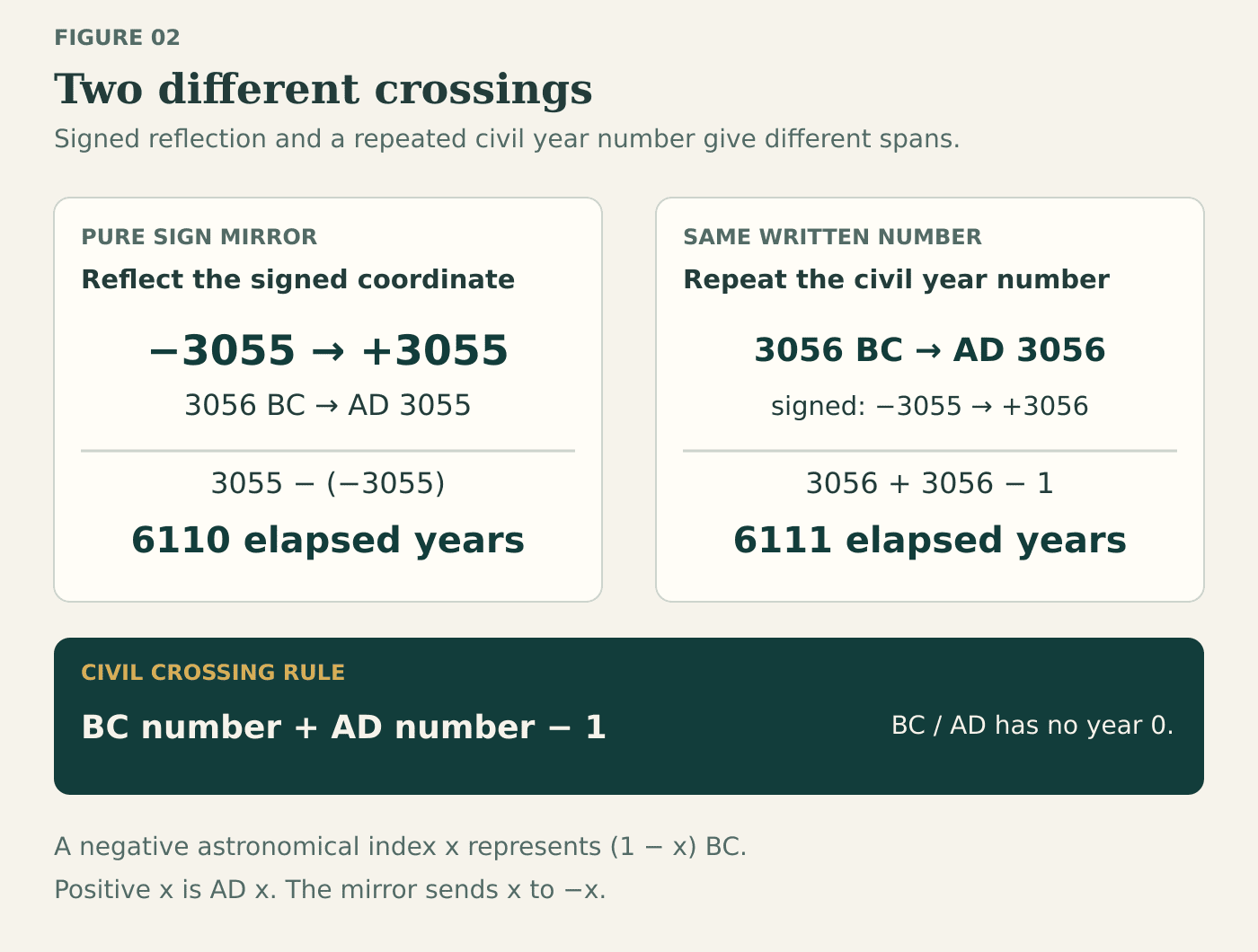
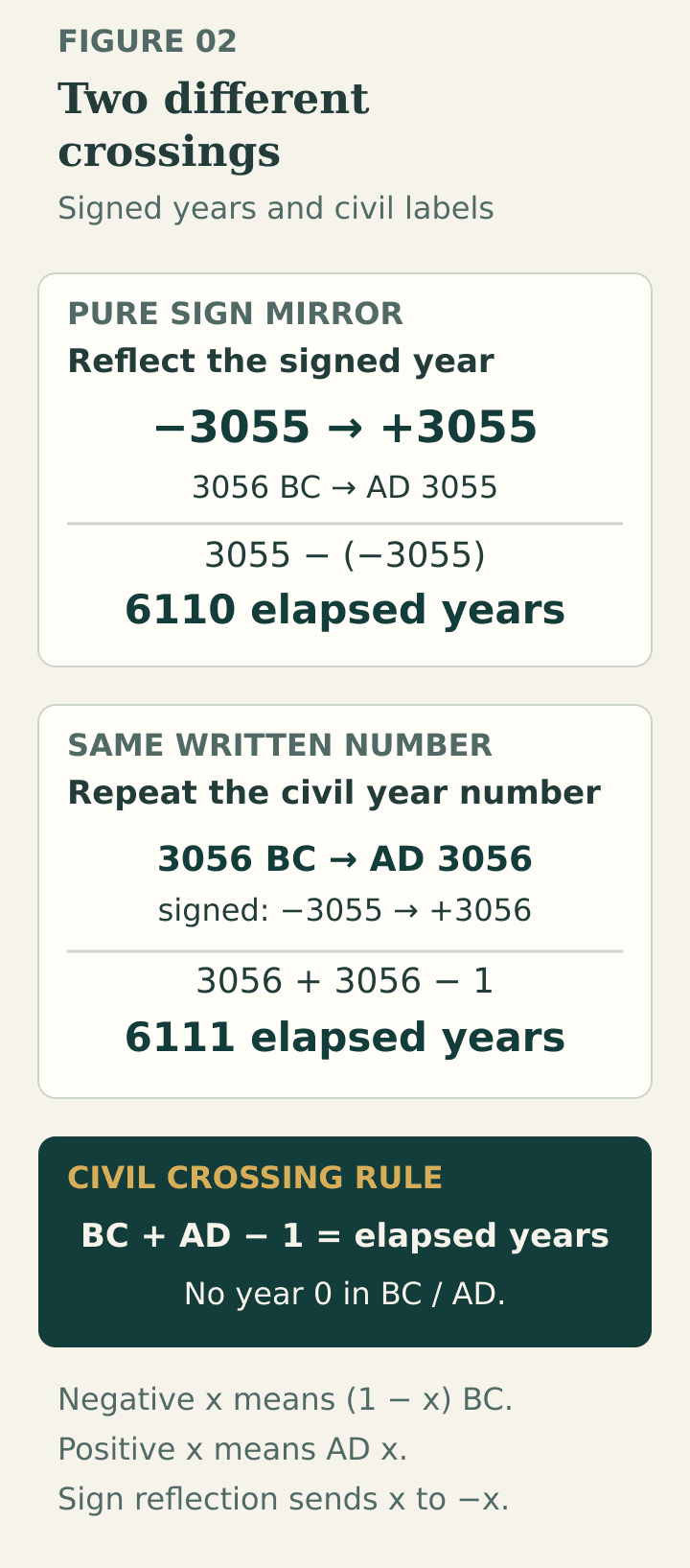
This operation must be distinguished from retaining the same numeric year label on both sides. 3056 BC → AD 3056 gives 6111 years, a different span. A paired Tishri/Nisan Mirror is different again: its seasonal components must be reflected together using the suffix-inversion rules in File 09, Appendix A. A pair of dates 60 years apart is a pair of alternative Terah settings, not a seasonal slash-pair.
The present table uses sign reflection of astronomical coordinates. It does not open the File 51a Rounded Scaffold or the Protocol 2 seasonal calculation. The coordinate rule resembles the integer reflection used in Protocol 1, but clean numbers alone do not make this a Rounded chronology. File 00 §3.9 and the worked conventions table distinguish coordinate generation from the civil span calculation.
4. Two worked spans: 6000 and 6500 years
The large numbers become easier to follow when the endpoints are named.
For 6000 years, begin with MT Noah’s birth at 3116 BC, using Gear 1 and Terah +60 ON. The LXX Gear 1 Noah-death coordinate with Terah +60 OFF is 2886 BC; its astronomical reflection is AD 2885:
3116 + 2885 − 1 = 6000 years.
For 6500 years, begin with SP Noah’s birth at 3766 BC, using Gear 1 primary and Terah +60 ON. LXX Shem’s death with Terah +60 OFF is 2736 BC; its reflection is AD 2735:
3766 + 2735 − 1 = 6500 years.
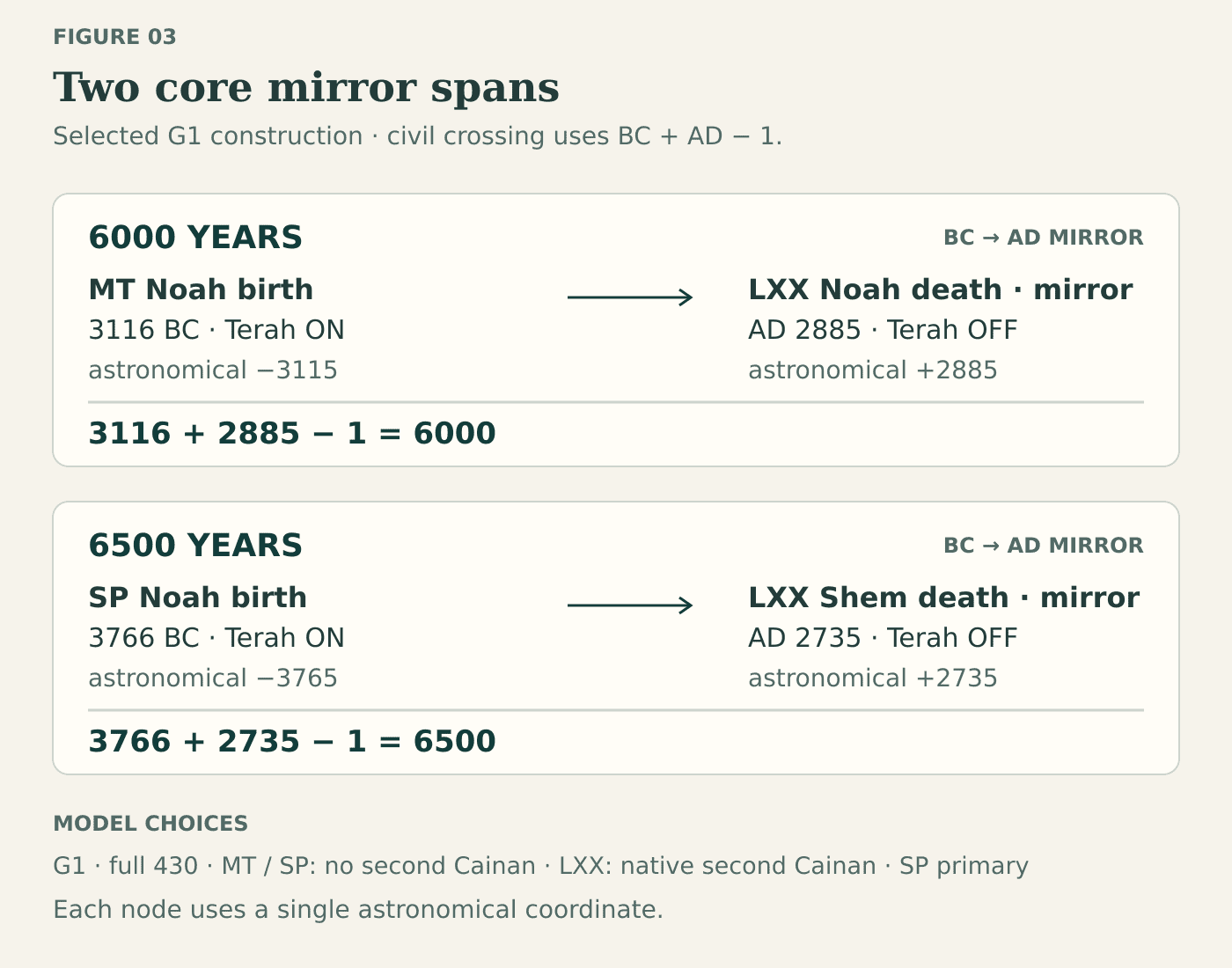
Full table and calculation · Scripture: Genesis 9:28–29 (BSB) · Genesis 11:10–11 (BSB)
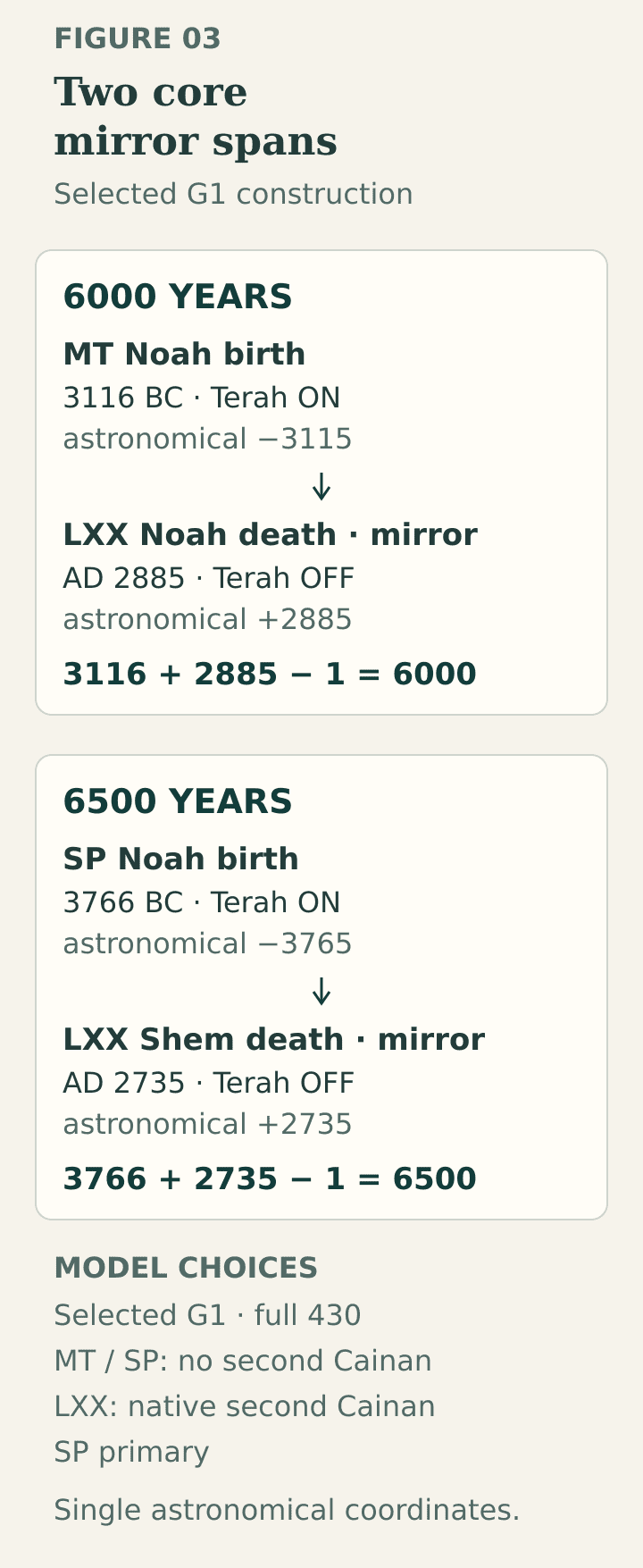
Both calculations compare one tradition and variant setting with the reflected coordinate of another. They are exact within the stated dataset. They do not describe a single uninterrupted ordinary genealogy running from Noah into the distant future.
The 30 BC entries can each be compared with all 30 reflected AD entries, giving 900 ordered comparisons. Recalculation produces:
| Span, years | Ordered BC-to-AD comparisons | Reciprocal pairs counted once |
|---|---|---|
| 6000 | 16 | 8 |
| 6500 | 16 | 8 |
| 5850 | 16 | 8 |
| 5720 | 16 | 8 |
The secondary pair relates directly to the main spans: 6500 − 650 = 5850 and 6500 − 780 = 5720. The matched-endpoint tables show every occurrence, with its tradition and Terah setting.
These counts describe the chosen set. Reciprocal placements, repeated lifespan relations, and translated copies of the same pattern make the comparisons dependent on one another. A count of 16 is therefore not 16 independent witnesses, nor does it establish a probability of intentional design. No statistical significance is assigned here.
5. Noah’s 950 years on a larger scale
The SP–LXX relationship also produces a descending ladder of eight, seven, and six Noah lifespans. Use LXX Gear 1 with Terah +60 ON, and reflect SP Gear 1 primary with Terah +60 OFF:
| BC starting coordinate | Reflected AD endpoint | Civil span | Noah-lifespan multiple |
|---|---|---|---|
| LXX Noah’s birth, 3896 BC | SP Noah’s birth, AD 3705 | 7600 | 8 × 950 |
| LXX Noah’s birth, 3896 BC | SP Noah’s death, AD 2755 | 6650 | 7 × 950 |
| LXX Noah’s death, 2946 BC | SP Noah’s death, AD 2755 | 5700 | 6 × 950 |
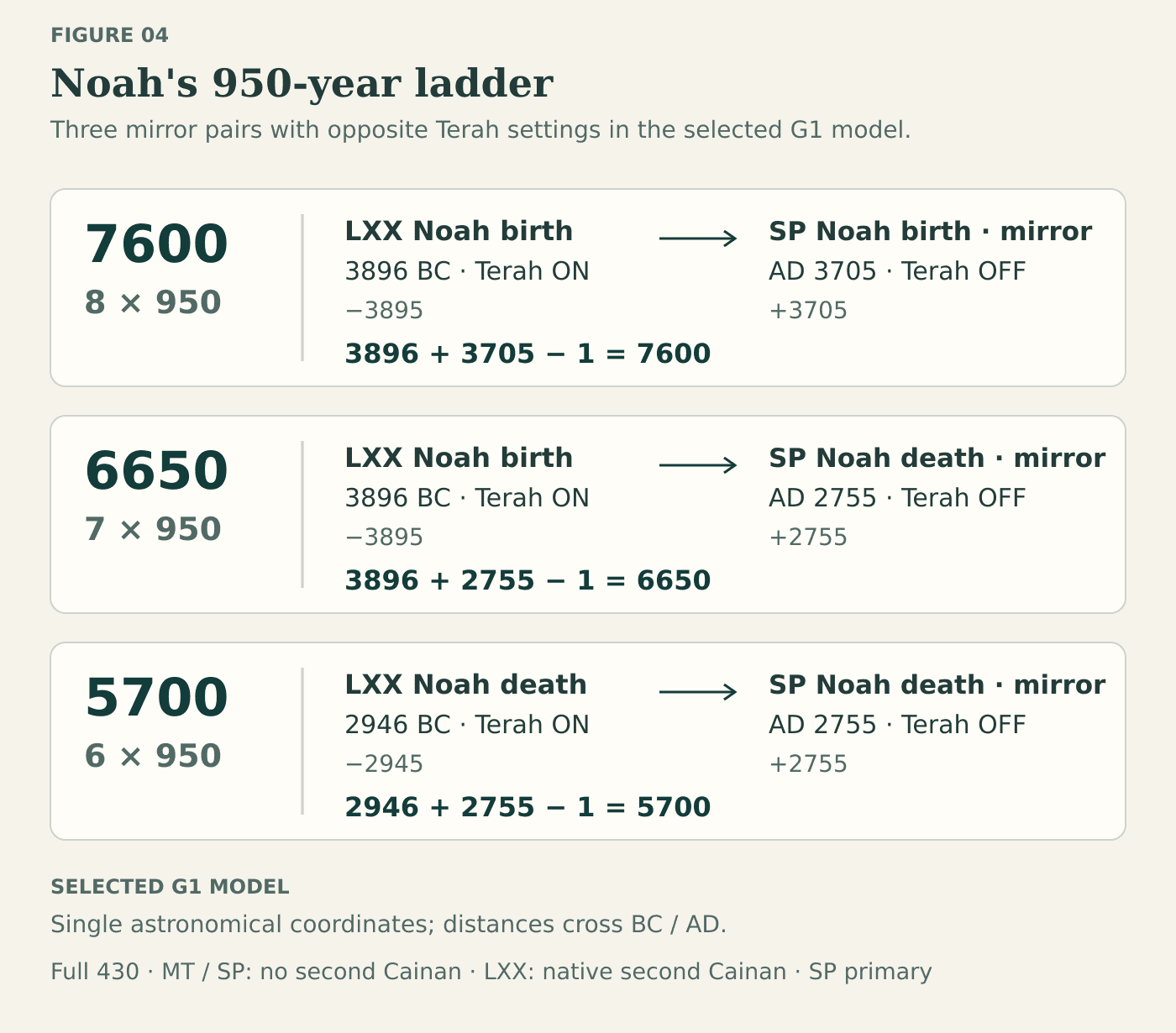
Full table and calculation · Scripture: Genesis 9:28–29 (BSB)
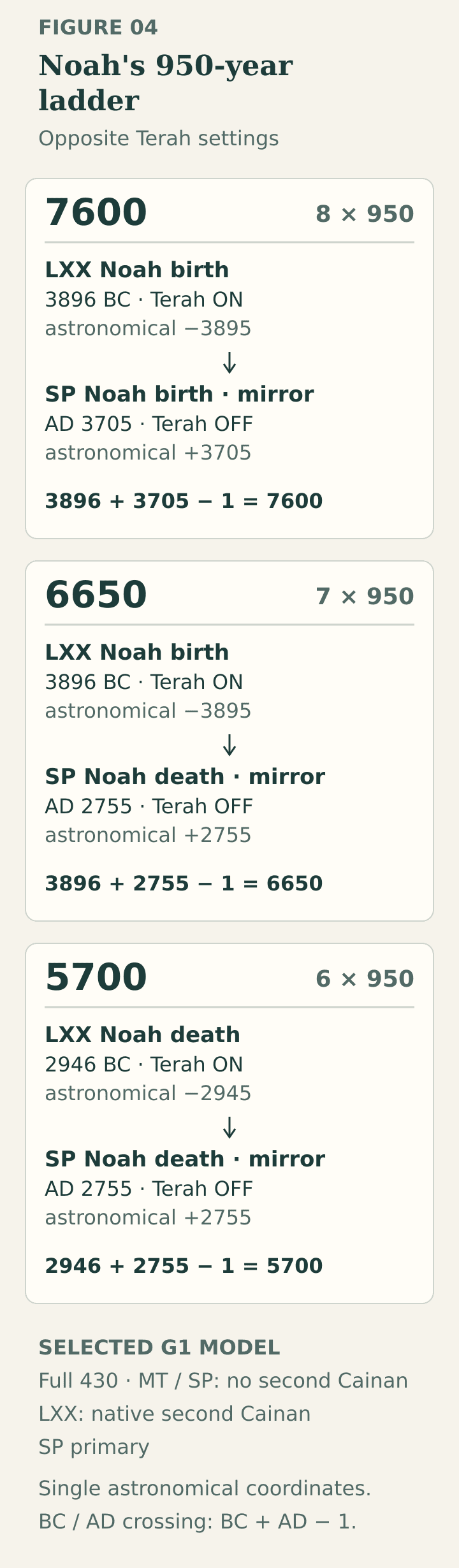
Each step removes one 950-year lifespan from an endpoint. Reflecting the SP biography reverses its order: the coordinate of Noah’s death appears at AD 2755, before the coordinate of his birth at AD 3705. The difference remains 950 years.
The first span is 7600 = 8 × 950. First Peter 3:20 identifies eight people saved through the waters, making the eightfold lifespan an intelligible theological correspondence. The sevenfold and sixfold spans arise by subtracting Noah’s own lifespan once and twice. This is a proposed symbolic reading of the arithmetic, not a claim that Scripture assigns 950 years to each person on the Ark.
The larger Sabbath analogy is similarly interpretive. Six thousand years can be compared with six days of work, and seven thousand with a completed week and rest, through Genesis 2:2–3, Psalm 90:4, and 2 Peter 3:8. Those texts supply the theological imagery; they do not prescribe the present coordinate-reflection calculation.
6. The Key of 23: show which endpoint stays fixed
The same selected Gear 1 table yields a useful pair of smaller comparisons. With Terah +60 OFF throughout, the span from SP Noah’s birth, 3706 BC, to MT Shem’s birth, 2556 BC, is:
3706 − 2556 = 1150 years.
The Priestly Key-of-23 ratio expands that span:
1150 × 25/23 = 1250; 1250 − 1150 = 100 years.
Hold SP Noah’s birth fixed. Extending the other end by 100 years reaches MT Gear 1 Flood start, 2456 BC:
3706 − 1250 = 2456 BC.
A second application works in the opposite direction. From SP Gear 1 Flood start, 3106 BC, to MT Shem’s death, 1956 BC, is another 1150 years. Hold Shem’s death fixed and expand backward:
1956 + 1250 = 3206 BC, the selected SP Shem-birth coordinate.
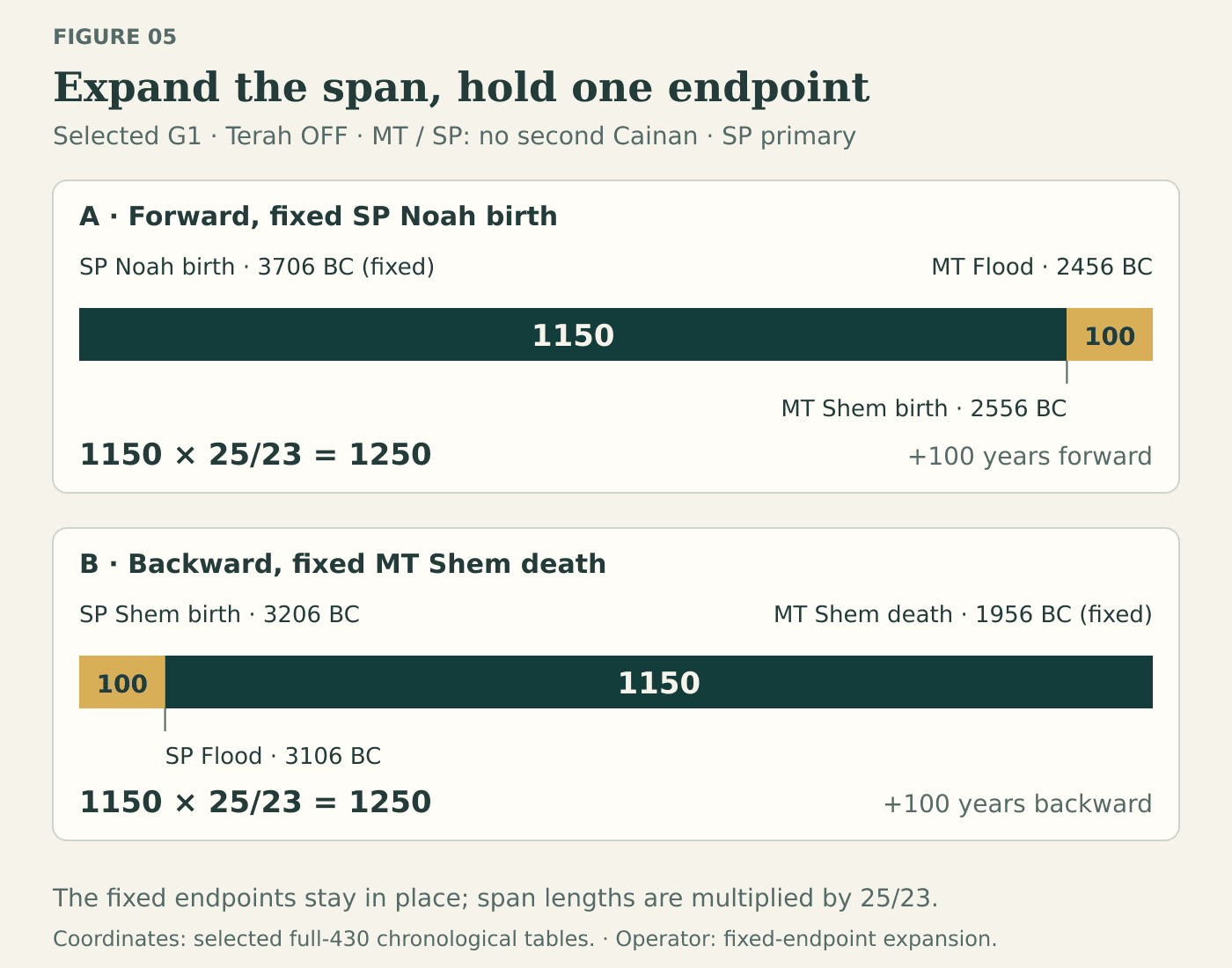
Full table and calculation · Scripture: Genesis 11:10–11 (BSB)
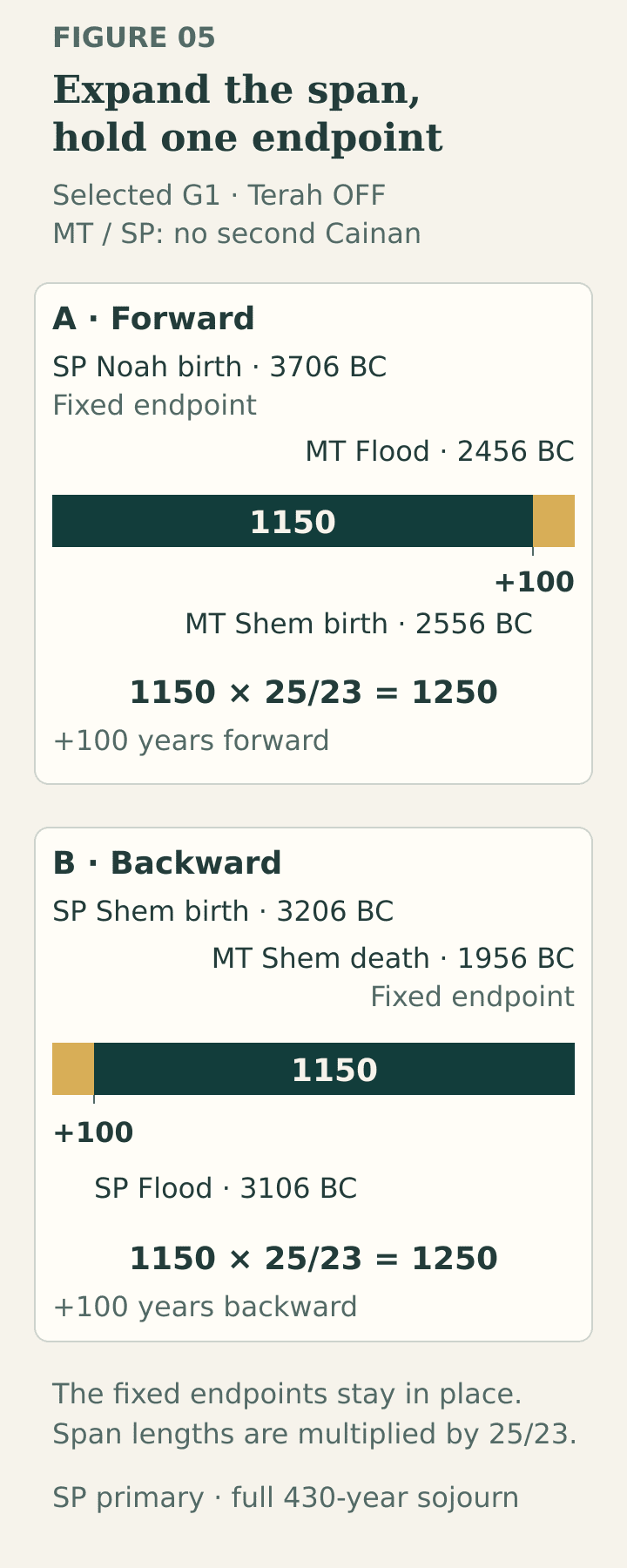
The two expansions each add 100 years, but their anchors differ. One reaches forward from Noah’s birth to the MT Flood; the other reaches backward from Shem’s death to SP Shem’s birth. The diagram makes that choice visible. File 46 controls the expansion method; the endpoint inputs remain the expressly selected dates in File 18.
Using SP Gear 2 primary Noah’s birth, 3708 BC, with the unchanged MT Arphaxad-bound Shem birth, 2556 BC, gives 1152 years. The 1150-to-1250 comparison therefore cannot simply be relabeled as Gear 2. Its exactness belongs to its stated alignment.
7. Ten Noah lifespans in the cumulative chronology
The cumulative chronology places successive lifespans end to end, producing a longer timeline than the regular begetting-age chronology. File 30 §11.3 develops a separate Noahic Mirror comparison of 9500 = 10 × 950 years:
| Gear | Selected cumulative Noah-birth member | Named regular-Noah Mirror target | Civil span |
|---|---|---|---|
| 1 | 6385n BC | AD 3116n | 9500 |
| 2 | 6383n BC | AD 3118n | 9500 |
| 3 | 6381n BC | AD 3120n | 9500 |
Here n means Nisan. All three cumulative starting members lie within the controlled 6386–6379n BC Noah-birth week. The regular Noah counterparts use Terah +60 ON. Each row checks by the same civil span formula; for example:
6385 + 3116 − 1 = 9500 years.
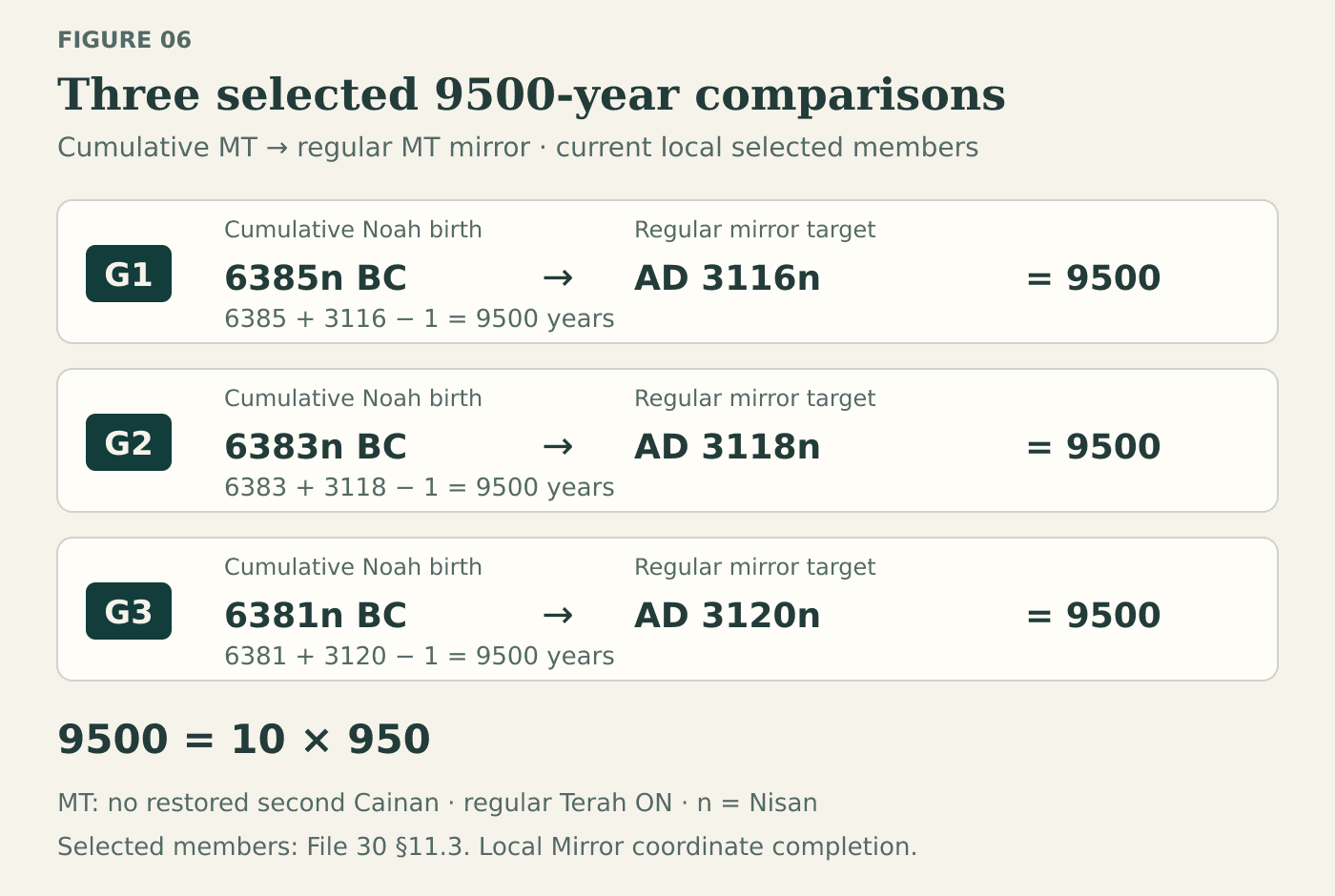
Full table and calculation · Scripture: Genesis 9:29 (BSB)
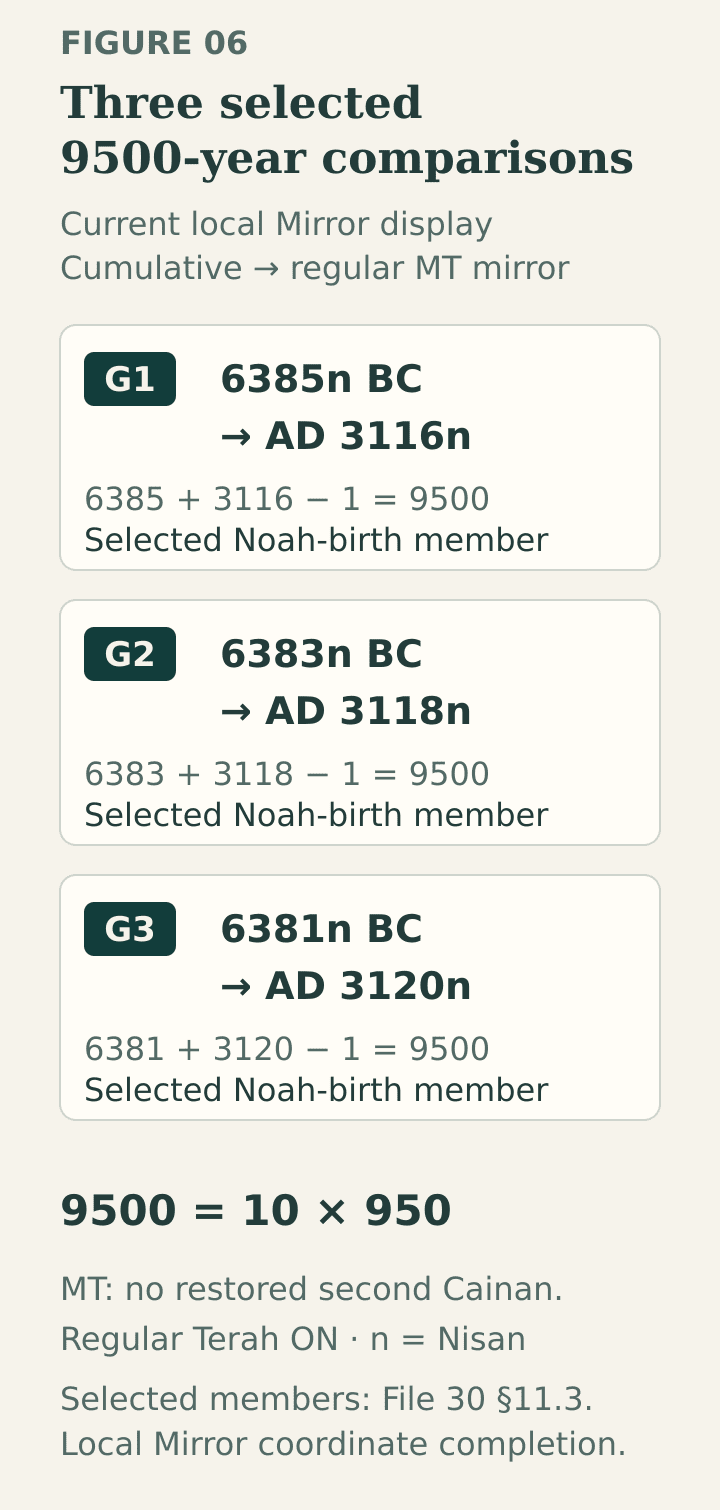
File 30 names the cumulative members and precise numeric-year AD targets used here. They are not generated by applying the 30-entry table’s sign-reflection rule to the cumulative starting date. Keeping the constructions distinct shows how the same Noahic lifespan can recur in more than one controlled chronological relationship.
8. What the pattern contributes
The enduring value of this study is the interaction of stated lifespans, admitted chronological variants, and a reproducible Mirror operation. Noah’s 950 years and Shem’s 600 years remain constant; the selected cross-tradition offsets and Terah settings determine which larger spans appear. The Key of 23 then supplies an additional comparison with a visibly fixed endpoint.
These relationships can be read as a numerical expression of the Flood’s movement from judgment to preservation and renewed life. The arithmetic supports that reading as a coherent interpretation. It does not settle whether each correspondence reflects deliberate scribal planning or a broader providential synchronization of the traditions.
The full tables and source notes include the complete 30-entry dataset, all leading matched endpoints, the ordinary-versus-ideal distinctions, and a bounded assessment of the older cumulative proposals. For the wider mechanics, see the Chronological Mirror introduction and its linked detailed study.
Read the original study, preserved unchanged in the archive.
The Holy Bible, Berean Standard Bible, BSB is produced in cooperation with Bible Hub, Discovery Bible, OpenBible.com, and the Berean Bible Translation Committee. This text of God’s Word has been dedicated to the public domain.