Detailed study · 7 October 2026 · v1. Full tables and an unchanged original archive accompany this replacement.
Jacob’s life supplies a useful starting point for reading this table:
And Jacob lived in the land of Egypt seventeen years, and the length of his life was 147 years.
His 147 years remain 147 when a comparison moves both endpoints of his life by the same amount. A calculation that expands a longer span is a different operation. Much of the earlier table becomes clearer once those two movements are distinguished.
The Key of 23 uses three exact ratios: 25/23, 70/69, and 300/299. Applied to a declared span, they produce a larger comparison span. The resulting gain can then be carried to other dates as an explicitly defined section shift. The table therefore brings together ordinary MT dates, expanded spans, and translated comparison coordinates. Each needs its own label.
This study explains the method, supplies worked examples, and links to a complete reconstruction of the useful date comparisons. Its baseline is the normal MT chronology with 430 years in Egypt, no optional +60 Terah, and no restored second Cainan. Alternate Noah/Shem bindings and proposed seasonal comparisons are stated where they occur. The calculations do not replace the ages printed in Scripture.
Full reference: Ratios and carriers · The chronological table · Creation · Seasonal comparisons · Statistical audit.
1. Begin with the ordinary chronology
The Exodus is the principal fixed reference in the earlier table: 1446 BC. The Conquest begins 40 years later, in 1406 BC. The ordinary chronology supplies the dates from which the comparisons are made. Scripture supplies the ages and the narrative setting:
Now the duration of the Israelites’ stay in Egypt was 430 years. At the end of the 430 years, to the very day, all the LORD’s divisions went out of the land of Egypt.
The normal MT construction uses 1876 → 1446 BC = 430 years for the Egyptian sojourn. Jacob’s ordinary life is 2006–1859 BC = 147, and Moses’ life is 1526–1406 BC = 120. The Conquest and land-rest field extends from 1406 toward 1400–1399 BC. These are distinct narrative positions; the Conquest’s opening, the end of fighting, and the following rest interval should not be compressed into one date.
The Creation display also needs a distinction. The ordinary table uses 4114 BC as its Creation-completion endpoint, within the 4121–4114 BC Creation-week framework. Adam’s Year-6 coordinate is 4116 BC. They serve different functions. The familiar 4114–3184 interval gives the table’s 930-year Adam display; using it in a worked comparison does not erase the Year-6 distinction. See the Creation and AM-date explanation and the full settings notes.
2. The three ratios
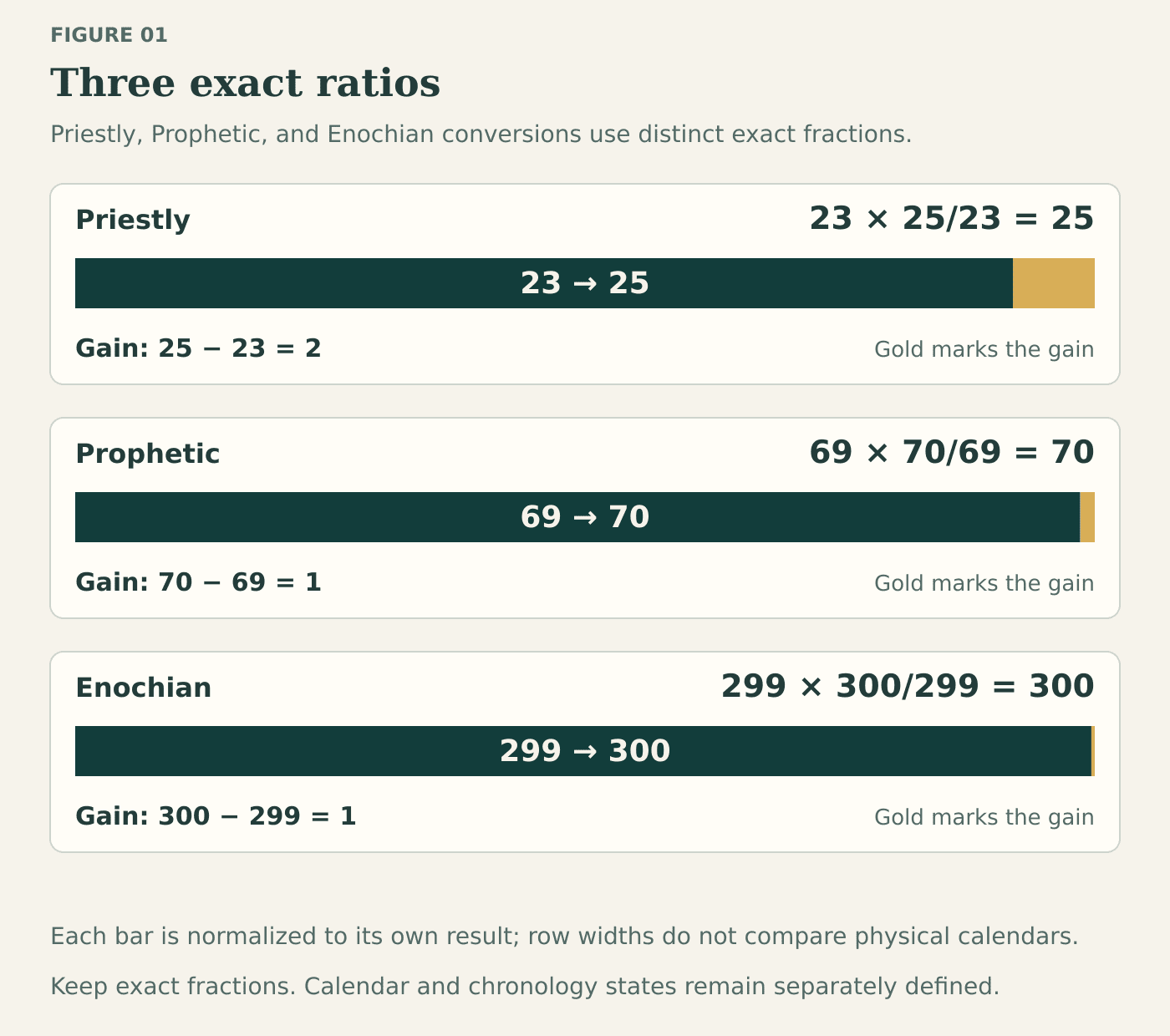
The smaller units show what each operation does:
Full table and calculation · Scripture: Daniel 9:24 (BSB)
| Exact operator | Input unit | Output unit | Gain |
|---|---|---|---|
| 25/23 | 23 | 25 | 2 |
| 70/69 | 69 = 3 × 23 | 70 | 1 |
| 300/299 | 299 = 13 × 23 | 300 | 1 |
For a span S, the expanded span is S × ratio, and the gain is the expanded value minus S. The original span, the ratio, and the held endpoint must all be declared. When the relevant denominator divides the span, the resulting gain is a whole number of years.
The repository associates these with Priestly, Prophetic, and Enochian comparisons. Those names describe their roles in the model. The exact fractions are the operative rules. A physical solar-year calibration or a residual-day calculation requires a separately stated calendar calculation; it should not be inferred merely from a ratio’s name.
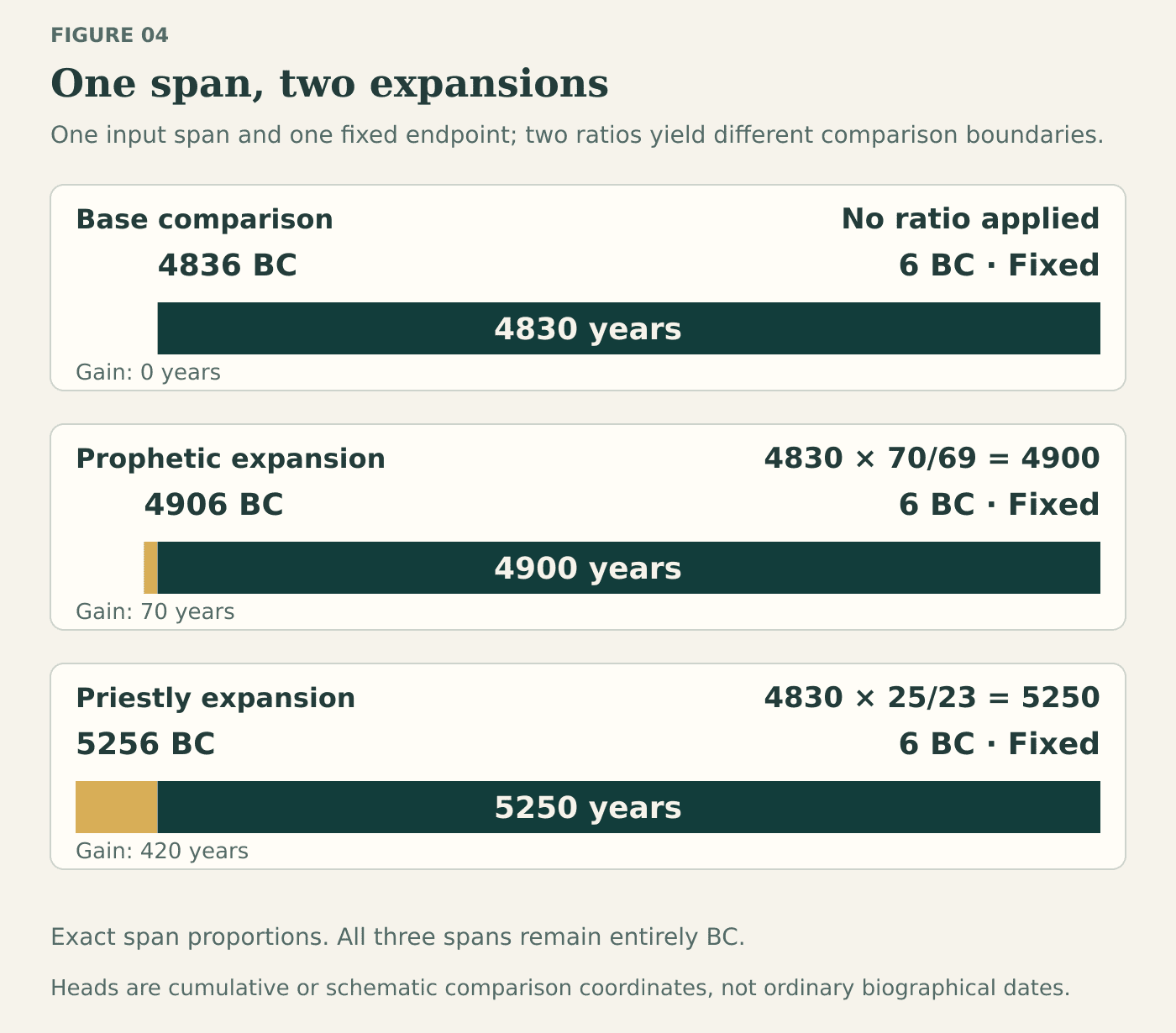
For example, 4830 × 70/69 = 4900, while 4830 × 25/23 = 5250. The same input supports two different comparisons because the declared operators differ. The distinction is developed in The Key of 23 and the strategic-overlap study.
3. A worked expansion: Creation to the Exodus
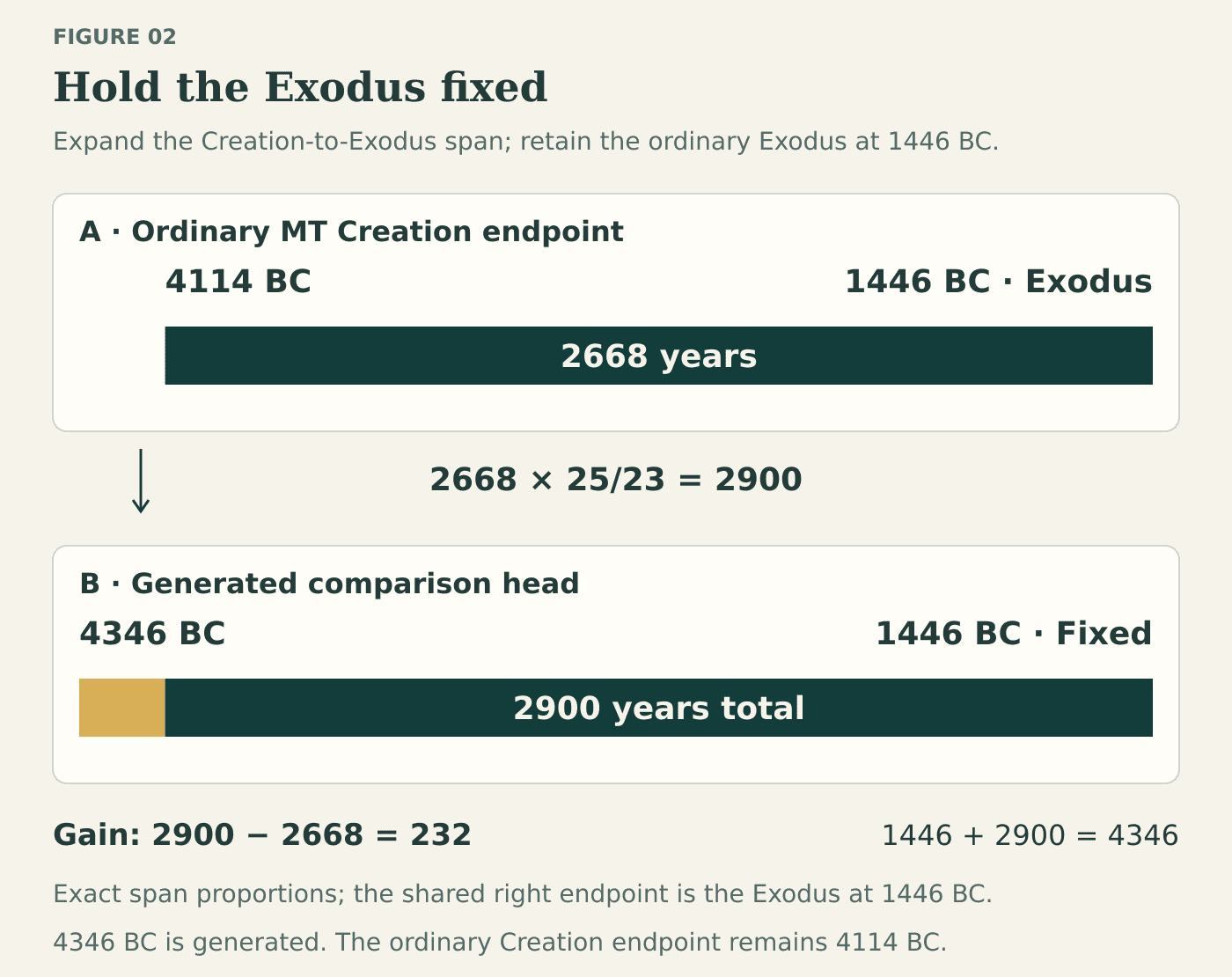
Hold the Exodus at 1446 BC. The ordinary Creation-completion endpoint at 4114 BC is 2668 years earlier:
4114 − 1446 = 2668
Apply the 25/23 operator:
2668 × 25/23 = 2900
The gain is 2900 − 2668 = 232 years. Counting the expanded span backward from the same Exodus reference produces 4346 BC:
1446 + 2900 = 4346
Full table and calculation · Scripture: Genesis 2:1–3 (BSB) · Exodus 12:40–41 (BSB)
This is the generated 4346 BC Creation comparison supplied by File 22 §9.2. Ordinary Creation remains at 4114 BC in its own table. The construction neither introduces an optional Terah shift nor inserts Cainan. Its result follows from the stated ordinary endpoints, ratio, and fixed Exodus.
The earlier table also displayed 4306 BC for its first Creation-completion comparison. That is a different route: the 192-year gain generated from Jared’s span to the Exodus is inherited by the earlier section. The direct Creation expansion gives +232; the Jared-section translation gives +192. They should not be presented as one calculation with interchangeable results.
4. Expanding a span and translating a life
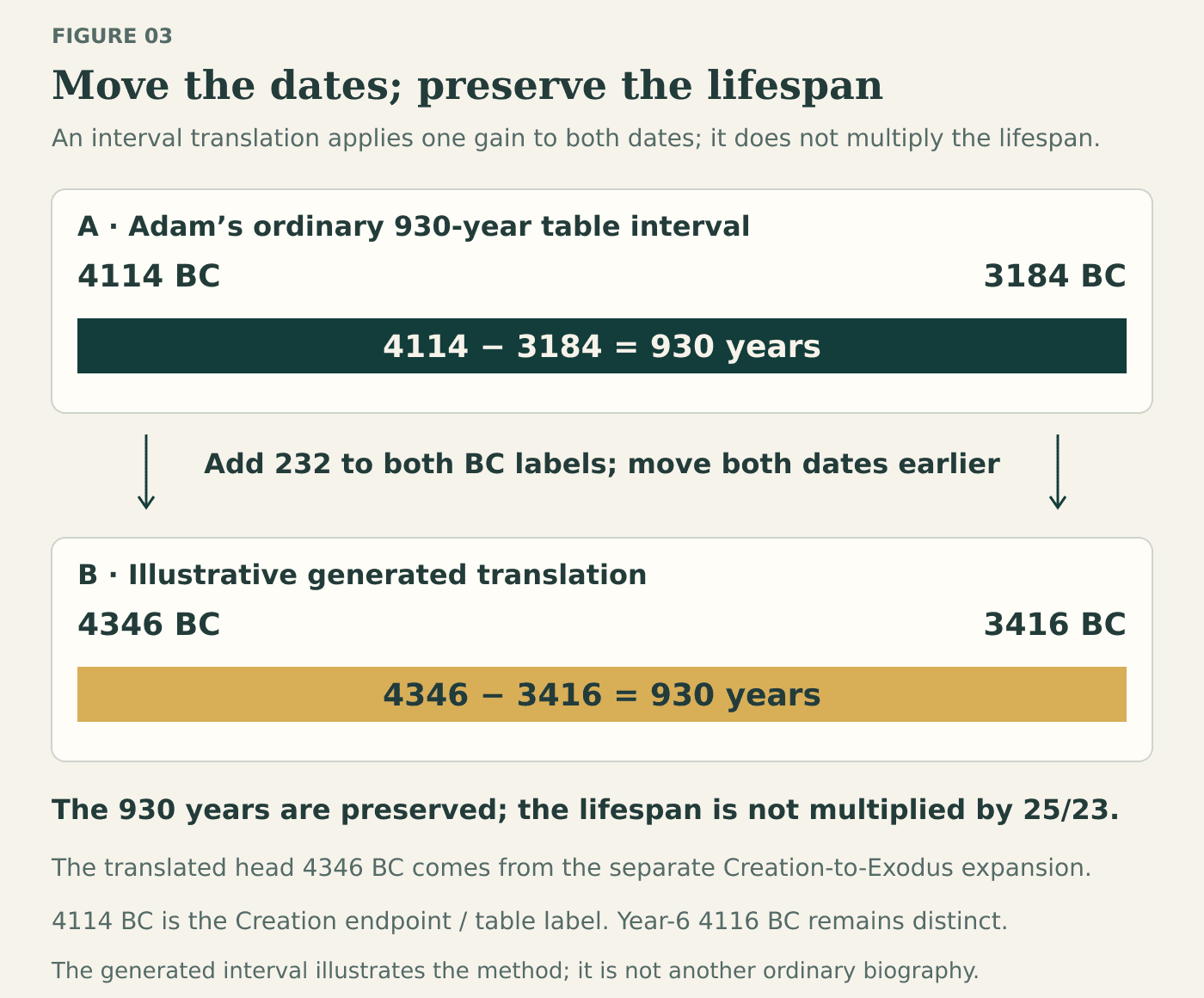
A span expansion changes the distance between its endpoints while one endpoint stays fixed. A section translation moves both endpoints by the same amount and preserves their distance.
The Adam table interval provides a simple illustration. If the 232-year gain from the Creation example is applied to both ends, the comparison becomes:
4114–3184 BC → 4346–3416 BC
Both intervals are 930 years:
4114 − 3184 = 4346 − 3416 = 930
Full table and calculation · Scripture: Genesis 5:5 (BSB)
The second interval is an illustrative translated comparison, rather than another assertion of Adam’s ordinary biography. His 930-year Scripture lifespan stays intact (Genesis 5:5, BSB).
This explains why the original expanded-date columns could retain the printed lifespans. They often carry a common gain through a whole section. They do not multiply each person’s lifespan by the column’s ratio. Likewise, moving Jacob’s two endpoints by 35 years gives 2041–1894 BC, still 147 years. The 35-year section has a proposed seasonal reconstruction, explained separately in the supporting table.
Different sections can inherit different gains. Their generated dates therefore do not form one replacement historical genealogy. In particular, a translated parent’s date and a child’s date from another section must not be subtracted to claim a new biblical begetting age.
5. Read each column through its generating span
The main carriers in the earlier table can be checked directly against the fixed Exodus reference. Their ordinary dates and the exact operators are source controlled; carrying the resulting gain into the surrounding rows is the table’s declared comparison rule.
| Carrier and ordinary date, BC | Span to Exodus 1446 BC | Expanded span | Gain |
|---|---|---|---|
| Jared, 3654 | 2208 | 2208 × 25/23 = 2400 | 192 |
| Jared, 3654 | 2208 | 2208 × 70/69 = 2240 | 32 |
| Lamech, 3240 | 1794 | 1794 × 25/23 = 1950 | 156 |
| Lamech, 3240 | 1794 | 1794 × 70/69 = 1820 | 26 |
| Lamech, 3240 | 1794 | 1794 × 300/299 = 1800 | 6 |
| Flood opening, 2458 | 1012 | 1012 × 25/23 = 1100 | 88 |
| Isaac’s conception/Sodom field, 2067 | 621 | 621 × 25/23 = 675 | 54 |
| Isaac’s conception/Sodom field, 2067 | 621 | 621 × 70/69 = 630 | 9 |
| Jacob’s Bethel reference, 1929 | 483 | 483 × 25/23 = 525 | 42 |
| Jacob’s Bethel reference, 1929 | 483 | 483 × 70/69 = 490 | 7 |
The distinction at Jacob is especially useful. The direct 483 → 525 expansion adds 42, so it places the generated Bethel coordinate at 1971 BC, holding Exodus fixed. It does not by itself explain the earlier table’s 1964 BC coordinate. The latter inherits a 35-year gain from a different proposed phase-aware calculation. Both numerical constructions can be described, but their generating spans must remain visible.
An optional 80.5 → 87.5 phase comparison also supplies a seven-year gain. In the Mosaic table, that gain is inherited as a whole-section translation. The resulting Exodus coordinate 1453 BC belongs to that translated block; the independent phase expansion still holds 1446n BC fixed.
The full chronological table identifies the inherited gain, ordinary date, generated coordinate, and any phase or binding qualification for every retained row. Blank cells indicate that no comparison is being asserted in that column.
6. One input, two expanded spans
File 46 provides a larger comparison with particularly clear endpoint control. Its 4830-year span can expand to 4900 or 5250. Hold the later comparison boundary at 6 BC:
Full table and calculation · Scripture: Luke 2:1–7 (BSB) · Luke 3:37–38 (BSB)
The earlier boundary moves from 4836 BC to 4906 BC under 70/69, or to 5256 BC under 25/23. The gains are 70 and 420. Every calculation in this diagram stays on the BC side, so ordinary subtraction is sufficient.
These are boundaries in a generational comparison. They should not be assigned to ordinary patriarchal births simply because their labels resemble dates in another chronological table. The example clarifies the operator and fixed endpoint; it does not replace the ordinary MT Flood date with 4836 BC.
This also distinguishes the construction from a BC–AD Mirror. Expanding or translating a span is not a sign reflection across an axis. When another example actually crosses the era boundary, ordinary civil elapsed years use BC + AD − 1, with seasonal positions retained when supplied.
7. Creation’s fourth day and the Conquest
The generated Creation-week display associated with 4346 BC runs 4353–4346 BC. Its fourth numbered position is 4350 BC. From that generated Day-4 position to the ordinary Conquest reference:
4350 − 1406 = 2944 = 23 × 128
This is the exact relationship in the earlier article. It uses the Conquest opening at 1406 BC. The separate forward expansion 46 → 50 holds Exodus at 1446 BC and generates 1396 BC from the 1400 BC end-of-fighting reference. Substituting that generated endpoint gives 4350 − 1396 = 2954, a different span.
The literary comparison draws on the lights appointed for signs, seasons, days, and years (Genesis 1:14–19, NIV) and Joshua’s account of the sun and moon (Joshua 10:12–14, BSB). I read these as a Creation-and-inheritance correspondence. The Day-4 coordinate belongs to the generated schematic week; Genesis does not print a BC date or teach the 2944-year calculation.
8. What the statistical discussion can establish
The earlier article counted how often its generated entries fell at particular multiples from 1446, 1406, and the adjacent 1407 BC reference. Those descriptive counts can be reproduced, provided the exact list and counting convention are preserved.
The posted Python lists contain 154 entries, including repeated date labels in different columns. For multiples of 23, 18 of those 154 entries align from 1406 BC. That describes the original code’s dataset. It is not a count from the corrected reference tables supplied here. Some introductory percentages used a different, undocumented denominator; the audit table keeps the versions separate.
A probability calculation also depends on how the data are generated. The old simulation selected every coordinate independently, while the actual table inherits common section shifts and shared genealogical inputs. It also examines several ratios, divisors, and nearby anchors. Those choices matter when estimating how unusual an observed count is. Several reported numerical results reproduce under the stated simplified model, but they should not be presented as unconditional odds of deliberate design.
The useful result here is the verified network of spans, gains, and endpoints. I read its theological significance through Creation, the patriarchal family, deliverance from Egypt, and inheritance of the land. That interpretation should be assessed alongside the chronology and Scripture, rather than rest on an unreconciled probability figure.
Full tables, sources, and original article
The supporting tables and source notes provide the ordinary settings, the reconstructed comparison columns, all carrier calculations, proposed seasonal routes, corrections, and the person-and-event figure index. File 18 controls the chronological data; File 17 controls the exact ratios; Files 11 and 12 control related gear/calendar distinctions; File 22 §9.2, File 46, and the proposed comparisons in File 62 control the specific applications.
The original article, tables, discussion, and code are preserved unchanged in the archive. This replacement presents the checked explanation at the same webpage address.
The Holy Bible, Berean Standard Bible, BSB is produced in cooperation with Bible Hub, Discovery Bible, OpenBible.com, and the Berean Bible Translation Committee. This text of God’s Word has been dedicated to the public domain.