A detailed companion to Enoch’s Seven Weeks: The 70- and 72-Year Framework. This study develops the corrected generational table and its comparisons with Luke, Matthew, the biblical chronological traditions, and the 360- and 364-day calendar measures. The technical appendix provides shorter reference tables and the correction history.
The central construction is straightforward: seven weeks of seven positions give 49 schematic generations. At 70 years per generation, the sequence spans 3430 years; at 72 years, it spans 3528. In their translated placement, both sequences end at AD 65. Their starting dates, assigned figures, and calendar relationships must be read within those defined settings.
The ancient text supplies the week structure and its narrative themes. The year lengths, BC/AD placements, and comparisons below belong to the 490d chronological interpretation. Keeping those levels distinct makes it possible to examine the full pattern without turning every numerical correspondence into a claim about an ancient author’s intention.
1. The ancient weeks and the chronological proposal
The Apocalypse of Weeks appears in 1 Enoch 93:1–10 and 91:11–17. In numerical order, the received sequence contains ten weeks and then an unnumbered righteous future. Its first seven weeks move through creation and early judgment, preservation, election, law, the sanctuary, dispersion, and the emergence of a community instructed in wisdom.
File 68 §§1–2 develops the hypothesis that a complete seven-week composition preceded the expanded form. The concentrated judgment, awakening, and wisdom language of 91:8–10 contributes to that literary argument. The hypothesis concerns compositional history: it is not a surviving manuscript edition that can simply be placed beside the ten-week text.
The damaged Aramaic witness 4Q212, or 4QEnᵍ, already supports the ancient expanded sequence and the adjacency of material corresponding to 93:10 and 91:11. Verse 91:11 completes the seventh week; 91:12 begins the eighth. The appendix’s textual discussion identifies the manuscript evidence and the English edition used for passage checks.
Within the proposed seven-week reading, Enoch’s seventh position becomes the organizing principle for seven groups of seven. The primary generation length is 70 years, associated in the model with the Jeremiah–Daniel pattern of 70 and 490. The companion length is 72 years, associated with the idealized precessional arithmetic:
72 × 360 = 25920.
This is a schematic precessional measure, not an exact, unchanging measurement of physical precession. Nor does the coexistence of the two constructions establish which was historically earlier. Both are retained on their stated terms.
2. The corrected seven-week framework
The first week contains Adam, Seth, Enosh, Kenan, Mahalalel, Jared, and Enoch. Enoch is seventh from Adam; Methuselah begins Week 2. Six intervals therefore separate the beginnings of Adam’s and Enoch’s positions:
6 × 70 = 420 years; 6 × 72 = 432 years.
A symbolic interval before Adam lies outside the numbered weeks. It is a theological bookend, not a human ancestor or an additional textual week. Consequently, the seven-week body contains 49 intervals, while the complete outer frame contains 50.
| Measure | Primary, 70-year generations | Companion, 72-year generations |
|---|---|---|
| One week | 7 × 70 = 490 years | 7 × 72 = 504 years |
| Seven-week body | 49 × 70 = 3430 years | 49 × 72 = 3528 years |
| Earlier Adam position → close | 3476 BC → 46 BC | 3574 BC → 46 BC |
| Translated Adam position → close | 3366 BC → AD 65 | 3464 BC → AD 65 |
| Translated interval before Adam | 3436–3366 BC | 3536–3464 BC |
| Complete translated outer frame | 50 × 70 = 3500 years | 50 × 72 = 3600 years |
Every corresponding boundary in the translated placement falls 110 years later than its earlier counterpart. That operation moves the whole sequence while preserving each internal interval. The illustration displays the translated weeks by position; the two rows are not drawn on one common absolute-date scale.
490d · Enoch’s seven weeks · Figure 1
Seven weeks, two carriers, one AD 65 endpoint
Translated schematic coordinates · 49 generations within the numbered weeks
Schematic alignment by week number. The rows are not one shared absolute-date axis or duration scale.
Primary carrier · 70 years per generation
Week 1
3366 BC↓2876 BC490 yearsWeek 2
2876 BC↓2386 BC490 yearsWeek 3
2386 BC↓1896 BC490 yearsWeek 4
1896 BC↓1406 BC490 yearsWeek 5
1406 BC↓916 BC490 yearsWeek 6
916 BC↓426 BC490 yearsWeek 7
426 BC↓AD 65490 years7 × 490 = 3430 years · 3366 BC → AD 65
Companion carrier · 72 years per generation
Week 1
3464 BC↓2960 BC504 yearsWeek 2
2960 BC↓2456 BC504 yearsWeek 3
2456 BC↓1952 BC504 yearsWeek 4
1952 BC↓1448 BC504 yearsWeek 5
1448 BC↓944 BC504 yearsWeek 6
944 BC↓440 BC504 yearsWeek 7
440 BC↓AD 65504 years7 × 504 = 3528 years · 3464 BC → AD 65
No year zero: a BC-to-AD span is BC + AD − 1.
Source controls: File 68 §§6.1–6.3, 7.2–7.3; Appendix C.
Read the calculation and scope
The primary week boundaries are 3366, 2876, 2386, 1896, 1406, 916, 426 BC and AD 65. The companion boundaries are 3464, 2960, 2456, 1952, 1448, 944, 440 BC and AD 65. Civil cross-era arithmetic has no year zero: 3366 + 65 − 1 = 3430 and 3464 + 65 − 1 = 3528. The pre-Adam intervals are 3436 − 3366 = 70 and 3536 − 3464 = 72. Thus the numbered core contains 49 generations; the outside interval makes 50 carrier spans only when included separately. These are schematic coordinates in the article’s reconstruction.
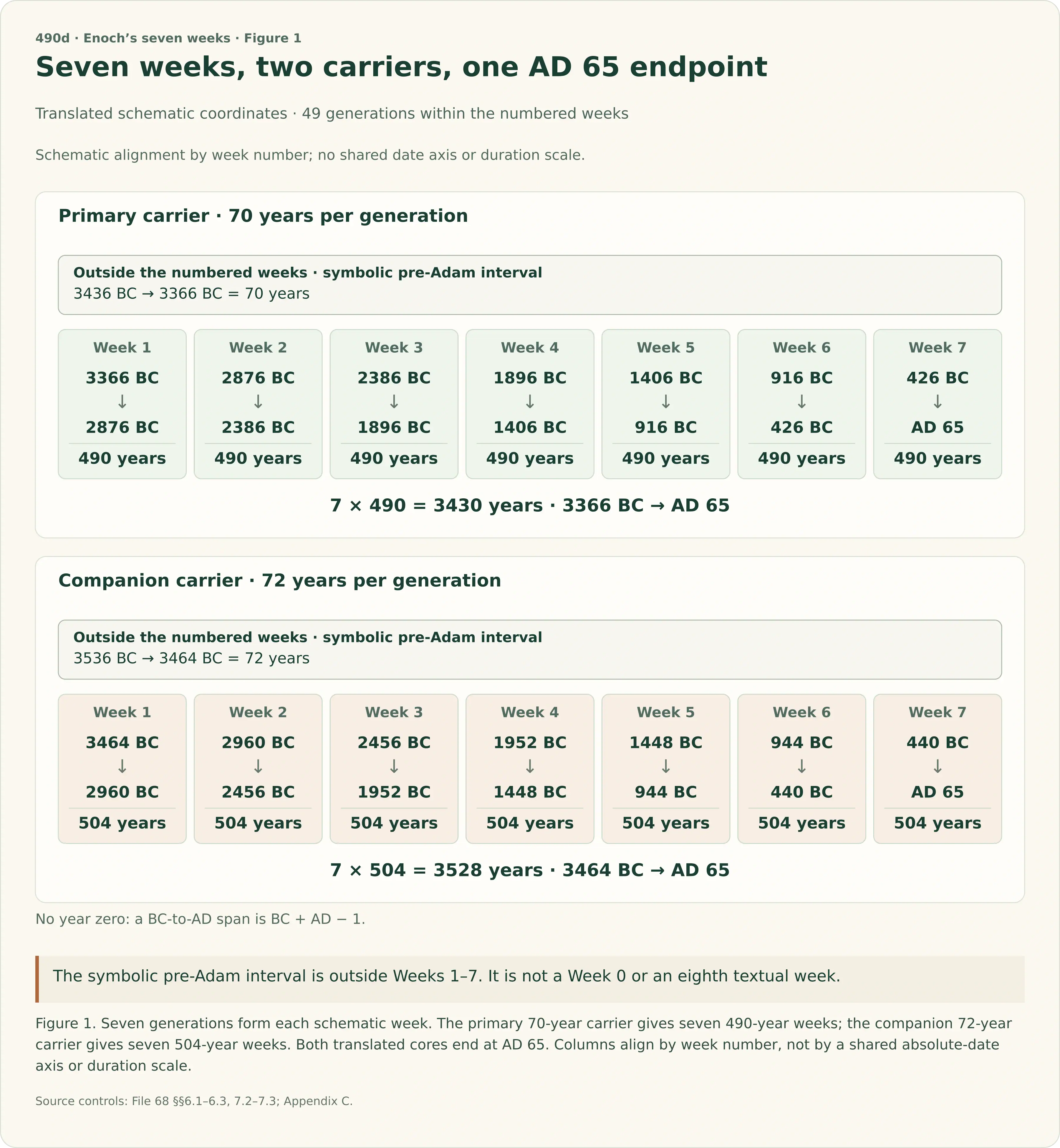
View or download the full-size illustration
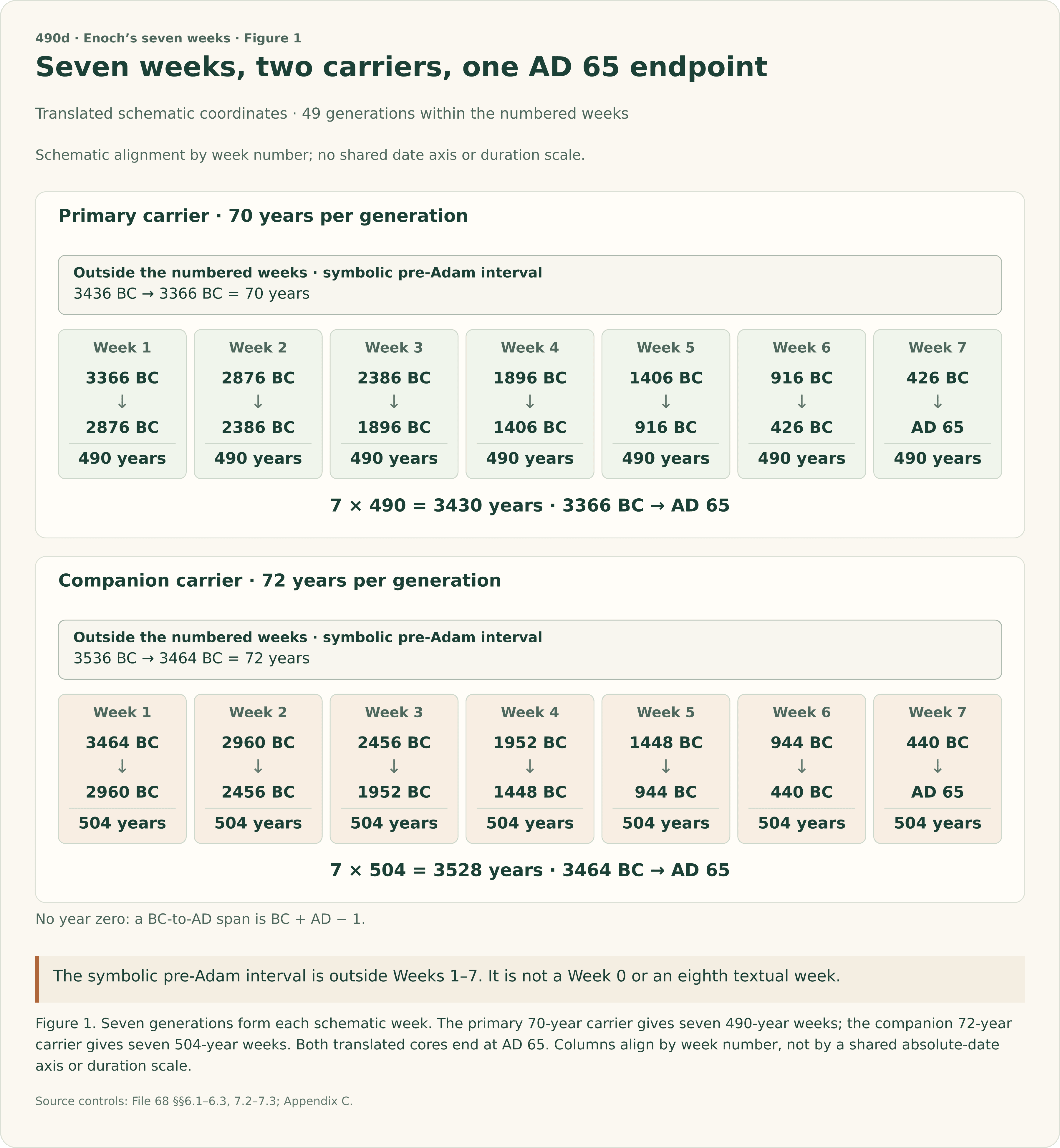
Civil chronology has no year zero. A span crossing from BC to AD therefore uses BC + AD − 1:
3366 + 65 − 1 = 3430, and 3464 + 65 − 1 = 3528.
The final generations are 6 BC–AD 65 and 8 BC–AD 65. AD 65 is the schematic completion of both sequences. It does not replace the historical Temple destruction in AD 70 or designate the historical date of Christ’s death. The previously displayed AD 67 ending is superseded.
Source: File 68 §§6.1–6.4, 7.2–7.3, and Appendix H.
3. All 49 positions: names, themes, and dates
The following table reproduces the translated Nisan intervals and their assigned names or themes from File 68 Appendix C.4–C.10. A named interval is a schematic assignment, not that person’s ordinary lifespan. Later generic positions remain generic; no otherwise unattested succession of kings or priests has been supplied to fill them.
The table retains the second Cainan between Arphaxad and Shelah for the defined LXX/Lukan comparison. Kenan in Week 1 is a different genealogical position. The ordinary MT and SP genealogies omit the second Cainan.
Open the complete 49-position table, arranged by week
Week 1
| Position | Day | Assigned name or theme | 70-year interval | 72-year interval |
|---|---|---|---|---|
| 1 | 1 | Adam — Creation; Week 1 begins | 3366–3296 BC | 3464–3392 BC |
| 2 | 2 | Seth | 3296–3226 BC | 3392–3320 BC |
| 3 | 3 | Enosh | 3226–3156 BC | 3320–3248 BC |
| 4 | 4 | Kenan | 3156–3086 BC | 3248–3176 BC |
| 5 | 5 | Mahalalel | 3086–3016 BC | 3176–3104 BC |
| 6 | 6 | Jared | 3016–2946 BC | 3104–3032 BC |
| 7 | 7 | Enoch — seventh in Week 1 | 2946–2876 BC | 3032–2960 BC |
Week 2
| Position | Day | Assigned name or theme | 70-year interval | 72-year interval |
|---|---|---|---|---|
| 8 | 1 | Methuselah — Week 2 begins | 2876–2806 BC | 2960–2888 BC |
| 9 | 2 | Lamech | 2806–2736 BC | 2888–2816 BC |
| 10 | 3 | Noah | 2736–2666 BC | 2816–2744 BC |
| 11 | 4 | Shem | 2666–2596 BC | 2744–2672 BC |
| 12 | 5 | Arphaxad — Flood-event schematic head | 2596–2526 BC | 2672–2600 BC |
| 13 | 6 | Cainan — LXX/Luke | 2526–2456 BC | 2600–2528 BC |
| 14 | 7 | Shelah | 2456–2386 BC | 2528–2456 BC |
Week 3
| Position | Day | Assigned name or theme | 70-year interval | 72-year interval |
|---|---|---|---|---|
| 15 | 1 | Eber — Week 3 begins | 2386–2316 BC | 2456–2384 BC |
| 16 | 2 | Peleg — earth/peoples divided | 2316–2246 BC | 2384–2312 BC |
| 17 | 3 | Reu | 2246–2176 BC | 2312–2240 BC |
| 18 | 4 | Serug | 2176–2106 BC | 2240–2168 BC |
| 19 | 5 | Nahor | 2106–2036 BC | 2168–2096 BC |
| 20 | 6 | Terah | 2036–1966 BC | 2096–2024 BC |
| 21 | 7 | Abraham — chosen plant at Week 3 close | 1966–1896 BC | 2024–1952 BC |
Week 4
| Position | Day | Assigned name or theme | 70-year interval | 72-year interval |
|---|---|---|---|---|
| 22 | 1 | Isaac — Week 4 begins | 1896–1826 BC | 1952–1880 BC |
| 23 | 2 | Jacob | 1826–1756 BC | 1880–1808 BC |
| 24 | 3 | Levi | 1756–1686 BC | 1808–1736 BC |
| 25 | 4 | Kohath | 1686–1616 BC | 1736–1664 BC |
| 26 | 5 | Amram | 1616–1546 BC | 1664–1592 BC |
| 27 | 6 | Moses/Aaron | 1546–1476 BC | 1592–1520 BC |
| 28 | 7 | Joshua I — closes at Moses’ death / Conquest transition | 1476–1406 BC | 1520–1448 BC |
Week 5
| Position | Day | Assigned name or theme | 70-year interval | 72-year interval |
|---|---|---|---|---|
| 29 | 1 | Joshua II — begins at Conquest / settlement; Week 5 begins | 1406–1336 BC | 1448–1376 BC |
| 30 | 2 | Week 5, Day 2 | 1336–1266 BC | 1376–1304 BC |
| 31 | 3 | Week 5, Day 3 | 1266–1196 BC | 1304–1232 BC |
| 32 | 4 | Week 5, Day 4 | 1196–1126 BC | 1232–1160 BC |
| 33 | 5 | Week 5, Day 5 | 1126–1056 BC | 1160–1088 BC |
| 34 | 6 | Week 5, Day 6 | 1056–986 BC | 1088–1016 BC |
| 35 | 7 | House of glory / Temple closing generation | 986–916 BC | 1016–944 BC |
Week 6
| Position | Day | Assigned name or theme | 70-year interval | 72-year interval |
|---|---|---|---|---|
| 36 | 1 | Wisdom-forsaking / Temple order — Week 6 begins | 916–846 BC | 944–872 BC |
| 37 | 2 | Week 6, Day 2 | 846–776 BC | 872–800 BC |
| 38 | 3 | Week 6, Day 3 | 776–706 BC | 800–728 BC |
| 39 | 4 | Man ascends / blindness hinge | 706–636 BC | 728–656 BC |
| 40 | 5 | Temple-burning / dispersion crisis | 636–566 BC | 656–584 BC |
| 41 | 6 | Exile–restoration field | 566–496 BC | 584–512 BC |
| 42 | 7 | Week 6 close / restoration aftermath | 496–426 BC | 512–440 BC |
Week 7
| Position | Day | Assigned name or theme | 70-year interval | 72-year interval |
|---|---|---|---|---|
| 43 | 1 | Apostate generation — Week 7 begins | 426–356 BC | 440–368 BC |
| 44 | 2 | Week 7, Day 2 | 356–286 BC | 368–296 BC |
| 45 | 3 | Week 7, Day 3 | 286–216 BC | 296–224 BC |
| 46 | 4 | Week 7, Day 4 | 216–146 BC | 224–152 BC |
| 47 | 5 | Week 7, Day 5 | 146–76 BC | 152–80 BC |
| 48 | 6 | Messianic approach | 76–6 BC | 80–8 BC |
| 49 | 7 | Christ / Second Adam | 6 BC–AD 65 | 8 BC–AD 65 |
The symbolic outside intervals—3436–3366 BC and 3536–3464 BC—are excluded from these 49 rows. The shorter appendix table displays the opening two weeks without expansion.
File 68 §7.5 and Appendix C.11 also define a Cainan-omitted attribution overlay. It keeps the dates fixed and advances the names after Arphaxad through the existing rows. Thus Shelah occupies the former Cainan position. The bounded reassignment continues through Joshua II; it does not authorize moving the date grid or carrying a name shift through all the later thematic rows. This overlay must remain distinct from the native MT and SP chronologies.
4. Joshua, restoration, and the final generation
One Joshua and two schematic positions
The table gives Joshua two adjacent positions around the Conquest transition. Joshua I closes Week 4, and Joshua II opens Week 5. They organize two phases associated with the same historical man.
| Setting | First Joshua position | Second Joshua position | Meaning |
|---|---|---|---|
| Translated 70-year model, Cainan retained | 1476–1406 BC | 1406–1336 BC | Two schematic intervals, totaling 140 years |
| Translated 72-year companion, Cainan retained | 1520–1448 BC | 1448–1376 BC | Two schematic intervals, totaling 144 years |
| Regular biography | Birth 1476 BC; Conquest transition 1406 BC | Death 1366 BC | One lifespan of 110 years: 70 + 40 |
The regular death date remains 1366 BC. The ends of the schematic Joshua II rows, 1336 and 1376 BC, are different kinds of boundaries. Likewise, 1448 in the 72-year table is a companion coordinate; the regular Exodus remains 1446 BC, and Moses’ death and the Conquest transition remain 1406 BC. The rest/settlement node at 1399 BC is another separately defined point.
With Cainan omitted in the bounded overlay, the primary 1476–1406 row becomes Joshua II rather than Joshua I. Its dates remain unchanged. This illustrates why occupant changes and date changes must be tracked separately.
The restoration theme in two placements
In the earlier 70-year placement, Week 6 runs 1026–536 BC, and its final generation runs 606–536 BC. The study’s 586 BC destruction of Jerusalem lies within that final interval. After the entire pattern is translated by 110 years, the corresponding spans become 916–426 BC and 496–426 BC.
These translated dates preserve the model’s structure; they do not redetermine the historical dates of Jerusalem’s destruction or the return from exile. The same distinction applies to the later thematic rows. For example, the ascent motif assigned to the 706–636 BC row should not be converted into an independently established date for Elijah’s ascension.
The midpoint and the three additional weeks
The primary final generation divides exactly at AD 30:
6 BC → AD 30 → AD 65 = 35 + 35 years.
The first half is calculated as 6 + 30 − 1 = 35. File 68 §11.4 separately retains AD 33 as its preferred Passion refinement. AD 30 is the exact schematic midpoint; AD 33 serves the distinct historical refinement.
The received ten-week text adds three weeks to the first seven. In generational terms, that gives 49 + 21 = 70 positions. At the primary rate, ten weeks give 10 × 490 = 4900 years as a scalar total. This does not by itself establish ten consecutive dated periods in the present reconstruction.
File 68 §12 also identifies an overlapping three-week field:
1406 BC → AD 65 = 1406 + 65 − 1 = 1470 = 3 × 490 years.
It begins at the Conquest transition. The model therefore allows the last three textual weeks to unfold or recapitulate the consummation without requiring three newly dated historical ages after the seven-week close. The ancient ten-week form retains its significance even while the earlier seven-week composition remains the study’s leading literary hypothesis.
Sources: File 68 §7.2, §9F.4–F.5, §11.4, §12, and Appendix C; File 18 §2.4.
5. Comparing Enoch with Luke and Matthew
Luke’s genealogy reaches backward through Adam to God. Matthew presents the Abraham-to-Jesus succession in three groups of fourteen. These different arrangements invite comparison, but the objects being counted must be stated.
| Construction used in File 69 | Count | What the count represents |
|---|---|---|
| Luke, corresponding-boundary comparison | 76 | Intervals between matched schematic boundaries |
| Luke, full outer comparison | 77 | The wider span including the completed final Christ generation |
| Matthew, undoubled begetting chain | 41 | Distinct male figures from Abraham through Jesus |
| Matthew, arranged positions | 42 | Three groups of fourteen under the study’s Jeconiah-overlap reading |
| Matthew with the study’s 21-position preface | 63 | The 42-position arrangement plus the modeled pre-Abraham extension |
| Reduced Matthew comparison | 62 | The 41-figure count plus that same 21-position extension |
| Enoch, complete outer frame | 50 | The 49 numbered positions plus the separate symbolic interval |
For Luke’s primary construction, 5326 BC → 6 BC = 5320 = 76 × 70, while 5326 BC → AD 65 = 5390 = 77 × 70. These measure different endpoint selections. The figurative God position in the outer schematic does not assign God a birth date or finite lifespan.
The Matthew arrangement counts Jeconiah on both sides of the deportation boundary to execute three groups of fourteen. Its 63 and 62 composites include an extension supplied by the study; they are not numbers of names printed in Matthew. Similarly, Enoch’s 50 is an outer-frame count, while its seven numbered weeks contain 49. File 69 develops larger chronological comparisons only after making such conventions explicit.
The Enoch table’s Levitical route—Levi, Kohath, Amram, and Moses/Aaron—also has a different function from the Gospel genealogies’ continuation through Judah. Its presence does not turn the 49-row schematic into a verbatim Gospel genealogy.
These arrangements can be read together as complementary presentations of sacred history. A numerical correspondence establishes a defined structural relationship; it does not, on its own, prove that one complete genealogy was historically constructed from another.
Source: File 69 §§1.7–1.10. The appendix gives a compact count reference.
6. The 110-year translation and the calendar measures
The paired chronology also permits a second measurement. Take a starting boundary in the earlier placement and the next generation boundary in the translated placement. The resulting span contains the ordinary generation plus the 110-year separation:
70 + 110 = 180 = 360 ÷ 2.
72 + 110 = 182 = 364 ÷ 2.
For example, the primary earlier Adam position is 3476 BC, while the end of the translated Adam interval is 3296 BC. Their difference is 3476 − 3296 = 180. The corresponding companion calculation is 3574 − 3392 = 182.
490d · Enoch’s seven weeks · Figure 2
The local +110 extension: 180 and 182
Paired source and translated boundaries · the translation moves 110 years later
Paired boundaries · schematic rectangle
The horizontal rows pair corresponding boundaries; this is not a single chronological axis.
Forward measure A → B′ = g + 110
Primary carrier
70 + 110 = 180180 = 360 ÷ 2Companion carrier
72 + 110 = 182182 = 364 ÷ 2Repeat the local extension in all seven generation cells
7 × 180 = 1260 = 3.5 × 360
7 × 182 = 1274 = 3.5 × 364
Keep the three measurements distinct
Source controls: File 68 §§6.3, 8.5, 8.8.
Read the calculation and scope
Let A and B be an ordinary generation’s start and end, separated by g. Translation sends each boundary 110 years later to A′ and B′, so A′→B′ is still g. The forward cross-rail measurement A→B′ is g + 110, not g − 110. The primary first cell illustrates this: source 3476→3406 BC, translated 3366→3296 BC, and 3476−3296=180. The companion cell is 3574→3502 BC, translated 3464→3392 BC, giving 3574−3392=182. Seven local cells give 7×180=1260=3.5×360 and 7×182=1274=3.5×364. In contrast, extending one ordinary week once gives 490+110=600 or 504+110=614. The calendar equalities express numerical forms in their named registers; they do not turn civil years into literal days.
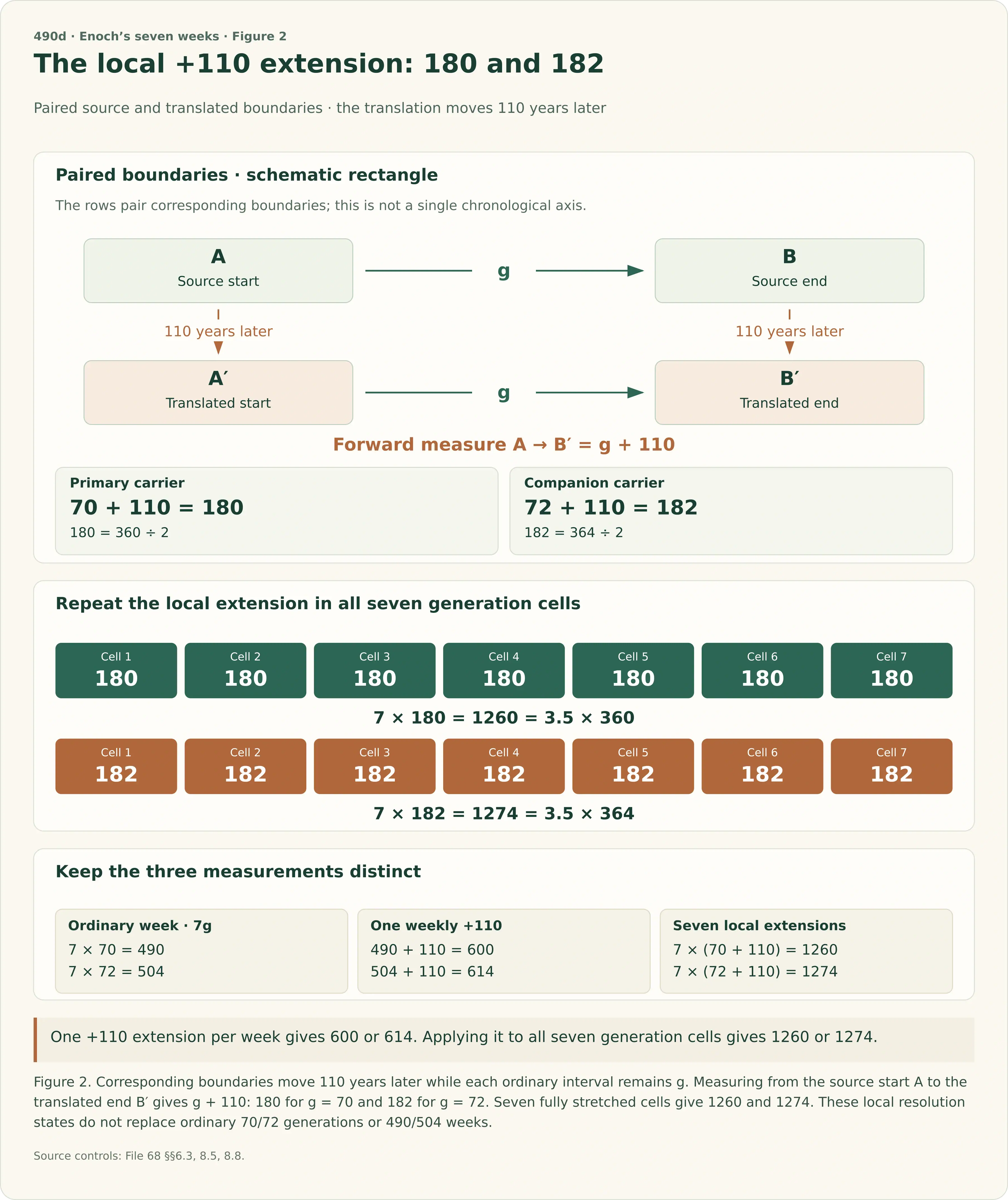
View or download the full-size illustration
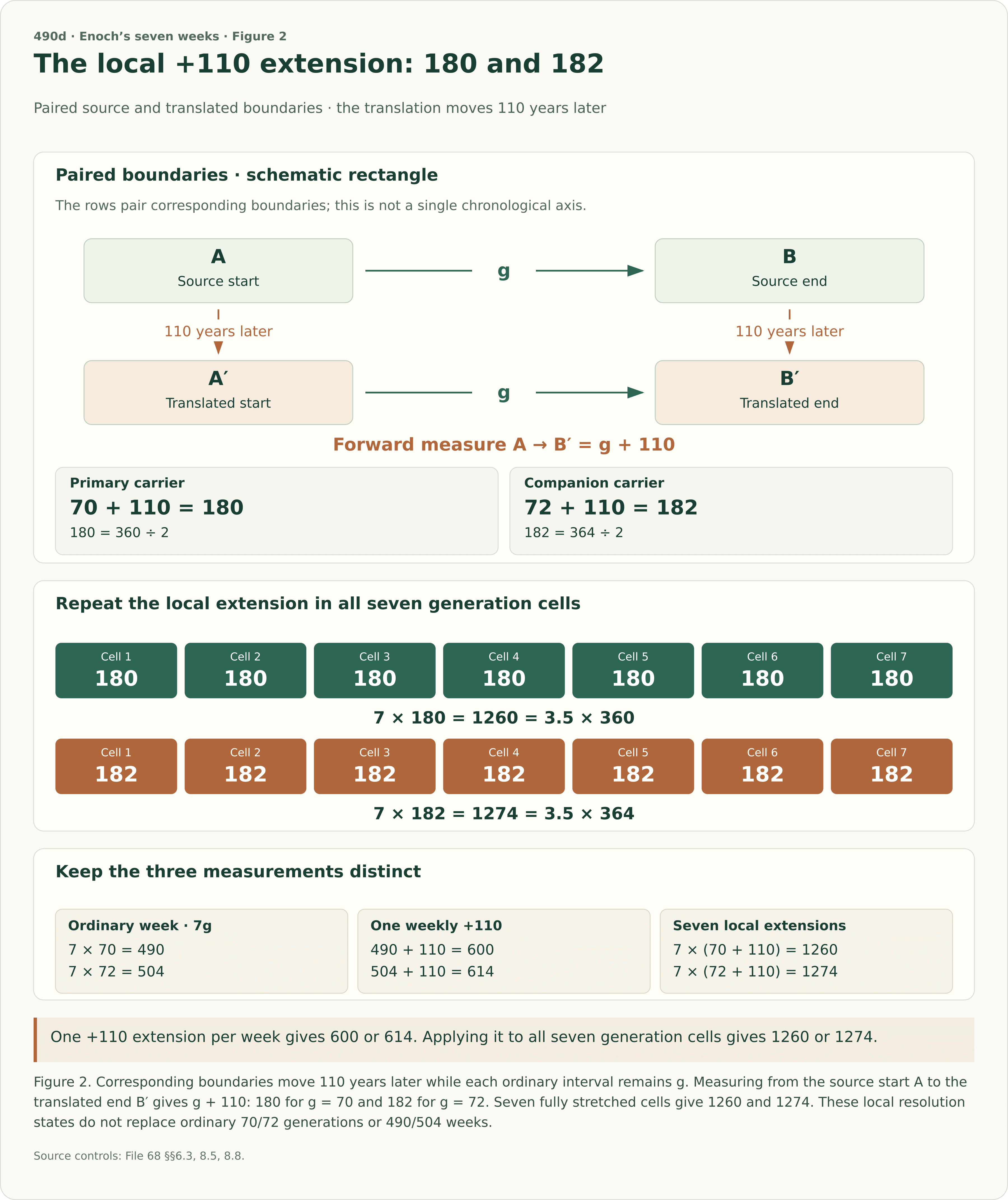
The generation-level expansion and the whole-week expansion give different results:
| Operation | Primary result | Companion result |
|---|---|---|
| Seven ordinary generations | 7 × 70 = 490 | 7 × 72 = 504 |
| Add 110 once to an ordinary week | 490 + 110 = 600 | 504 + 110 = 614 |
| Expand every generation, then total seven | 7 × 180 = 1260 | 7 × 182 = 1274 |
| Calendar numerical form | 1260 = 3.5 × 360 | 1274 = 3.5 × 364 |
These chronological measurements are in schematic years. Their resemblance to calendar day counts is a numerical correspondence across scales. The 364-day calendar itself has 52 weeks, four 91-day seasons, and 360 + 4 days. Its four seasonal days occur annually. The separate 360-day reckoning does not erase them from the 364-day calendar.
This provides a current explanation of the calendar connection without relying on the retired 72-year dates. It also keeps the 360-day and 364-day measures distinct from physical solar time.
Sources: File 68 §§8.8–8.10; File 69 §2.1; File 12 §§5.1A and 7.
7. The ordinary MT, SP, and LXX Creation settings
The schematic Enochic Adam positions can be compared with the ordinary chronological systems, provided that each date retains its setting. MT denotes the Masoretic Text, SP the Samaritan Pentateuch, and LXX the Septuagint tradition used in these tables.
Two choices produce the four ordinary positions displayed below. The full-430-year sojourn adds 215 years to the affected earlier dates relative to the minimum-sojourn setting. The separate Terah +60 choice adds 60 years to the relevant pre-Abraham chronology. Neither operation should be silently applied to every event.
Each cell gives a Creation-week start → Creation endpoint, using Nisan labels. The seven-year interval must not be collapsed into a single interchangeable Creation date.
| Sojourn and Terah setting | MT, native Cainan omitted | SP, native Cainan omitted | LXX, native Cainan retained |
|---|---|---|---|
| Full 430, +60 | 4181 → 4174 BC | 4481 → 4474 BC | 5561 → 5554 BC |
| Full 430, no +60 | 4121 → 4114 BC | 4421 → 4414 BC | 5501 → 5494 BC |
| Minimum, +60 | 3966 → 3959 BC | 4266 → 4259 BC | 5346 → 5339 BC |
| Minimum, no +60 | 3906 → 3899 BC | 4206 → 4199 BC | 5286 → 5279 BC |
These are the repository’s defined chronological constructions from the textual traditions, rather than BC dates printed in those manuscripts. The SP table uses the preferred 4199 BC minimum endpoint and its stated offsets.
At matching settings, all four rows preserve the same differences:
LXX − MT = 1380; SP − MT = 300; LXX − SP = 1080.
The older study also compared unlike Terah settings. Those relationships remain valid when identified explicitly. For example, 5561 − 4121 = 1440 = 4 × 360 compares LXX with +60 against MT without +60, both in the full-430 setting. Similarly, 4481 − 4121 = 360 compares SP with +60 against MT without it. Thus the wider gaps are 1380 + 60 and 300 + 60. They are not the gaps between matching variants.
Sources: File 07 §1.1; File 18 §§1.1, 1.4, 2.1, 3.1, and 4.1.
8. Comparing the regular dates with the Enochic pattern
The corrected Adam position at 3366 BC
The translated primary Adam position remains 3366 BC, now correctly assigned to Adam at the beginning of Week 1. The following differences from selected ordinary Creation-week starts therefore survive the correction of the older table:
| Earlier regular week-start | Defined setting | Distance to schematic Adam at 3366 BC |
|---|---|---|
| 3906 BC | MT minimum, no +60 | 540 = 1.5 × 360 |
| 3966 BC | MT minimum, +60 | 600 = 10 × 60 |
| 4266 BC | SP minimum, +60 | 900 = 2.5 × 360 |
| 5346 BC | LXX minimum, +60 | 1980 = 5.5 × 360 |
Their dependence is transparent. File 68 §10.1 gives 3906 − 3476 = 430 and 3966 − 3476 = 490 for the earlier Enochic placement. Translating Adam 110 years later changes those distances to 540 and 600. The SP and LXX comparisons then incorporate their already defined gaps from MT. These related constructions should be understood together, rather than counted as independent historical witnesses.
The 3966 BC comparison and Jacob’s lifespan
The selected 3966 BC date is the MT minimum-sojourn, +60 Creation-week start. Abraham at 2166 BC and Jacob at 2006–1859 BC belong to the full-430-year sojourn setting. Comparing them is therefore a deliberate comparison across variants. It does not form a single ordinary timeline using one sojourn choice.
| Selected target | Difference from 3966 BC | Target setting |
|---|---|---|
| Abraham’s birth, 2166 BC | 1800 = 5 × 360 | Full-430 patriarchal date |
| Jacob’s birth, 2006 BC | 1960 = 40 × 49 | Full-430 patriarchal date |
| Jacob’s death, 1859 BC | 2107 = 43 × 49 | Full-430 patriarchal date |
| Exodus, 1446 BC | 2520 = 7 × 360 | Fixed Exodus anchor |
| Restoration, 536 BC | 3430 = 70 × 49 = 7 × 490 | Defined member of the 538–536 restoration field |
| Nativity anchor, 6 BC | 3960 = 11 × 360 | Beginning of the primary final generation |
The Jacob comparison has a useful internal partition. His regular lifespan is 2006 − 1859 = 147 = 3 × 49 years. The selected Creation-week start stands 40 such units before his birth. A further 1859 − 536 = 1323 = 27 × 49 years connects his death to the restoration anchor. This last subdivision is directly derived arithmetic.
490d · Detailed Enoch study · Figure 3
A cross-variant comparison: 40 + 3 + 27
Selected coordinates measured in 49-year units · schematic spacing
Creation head to Jacob’s birth
3966 BCCreation-week startMinimum sojourn · +60 TerahJacob’s lifespan
2006 BCJacob’s birthFull-430-year sojournJacob’s death to restoration
1859 BCJacob’s deathFull-430-year sojournCanonical inputs: File 07 §1.1; File 18 §§1.1, 1.4, 2.1.1, 2.3; File 68 §7.2; Appendix B.4.
Read the state labels and calculation
The Creation-week opening 3966 BC belongs to the MT minimum-sojourn +60 Terah envelope 3966–3959 BC. It must remain distinct from Enochic Adam heads and ordinary default Creation dates. File 18’s minimum Jacob dates, 1791–1644 BC, become 2006–1859 BC under the +215 sojourn shift; this diagram therefore compares explicitly different variant settings. The calculations are 3966−2006=1960=40×49; 2006−1859=147=3×49; 1859−536=1323=27×49. Adding them gives 3430=70×49=7×490. The 536 BC endpoint is the exact restoration member used here, within File 68’s broader 538–536 field. Equal-sized panels are schematic, not proportional. The new 1323-year span is an arithmetic derivation, not a claim that 27 Jubilees were historically observed.
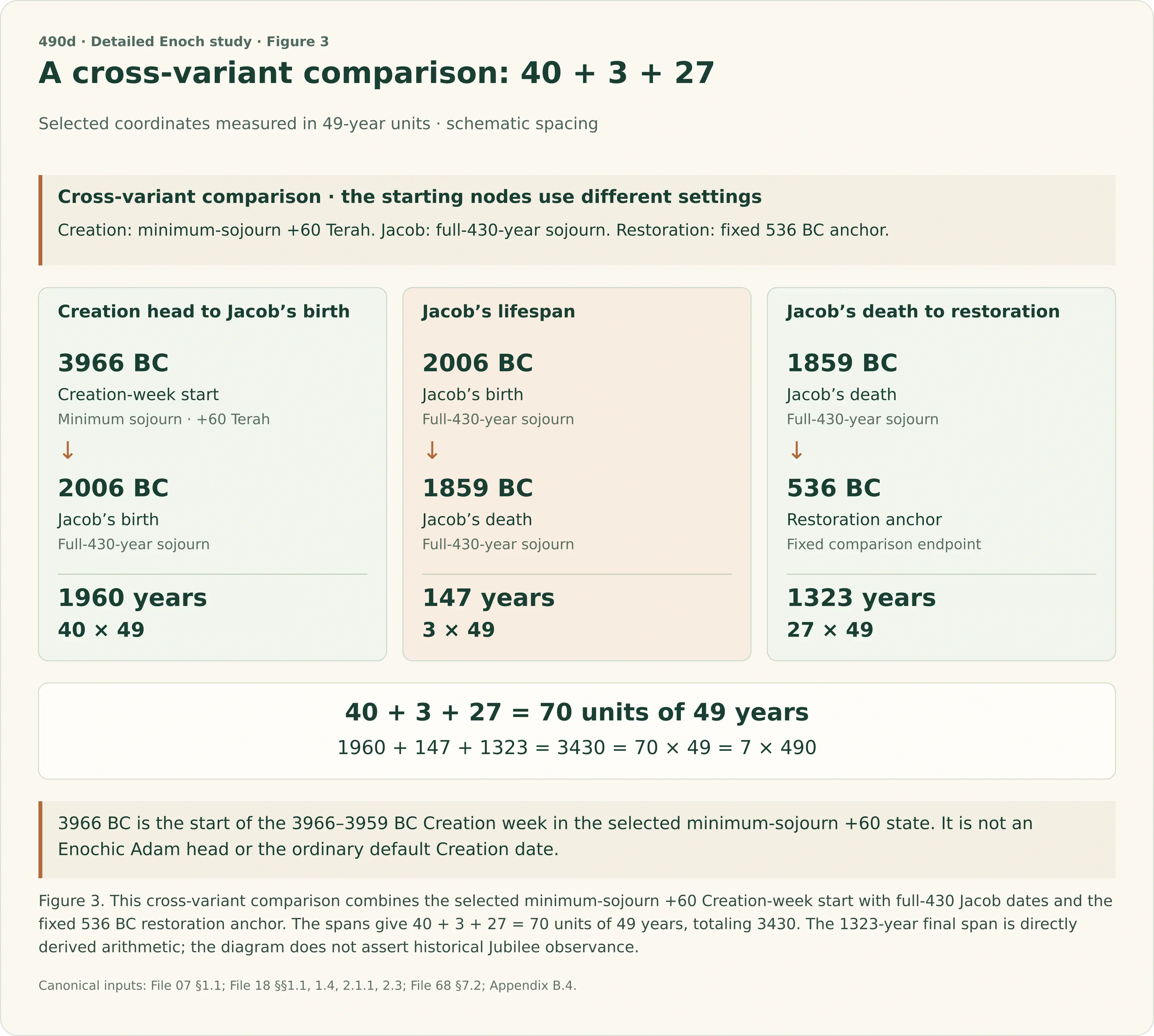
View or download the full-size illustration
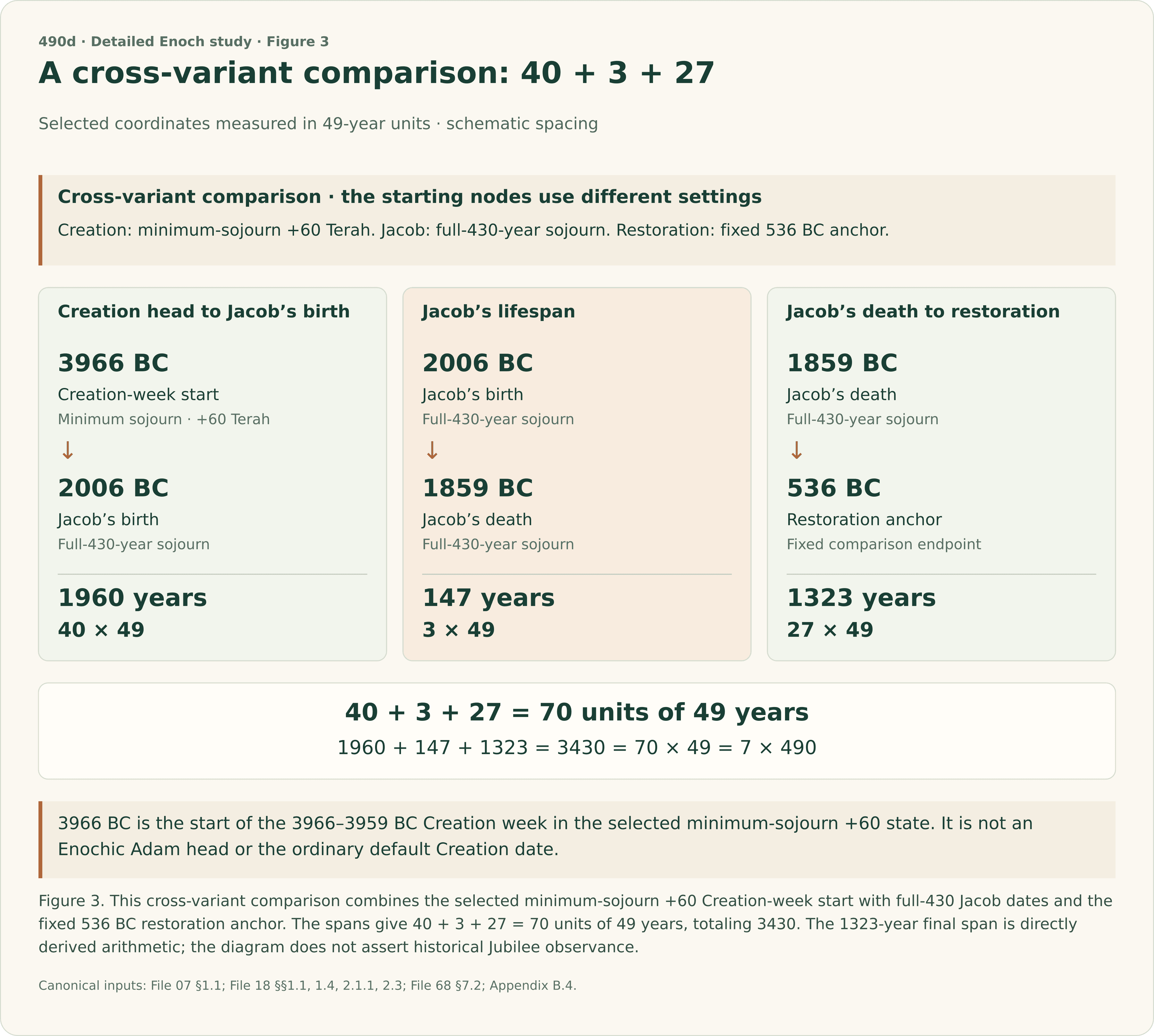
The total is 40 + 3 + 27 = 70 units of 49 years. This is a numerical pattern in the selected coordinates; it does not establish historically observed Jubilee cycles from Creation. The exact 536 BC comparison also belongs within the broader restoration field, rather than assigning every decree and return event to that single year.
One especially clear correspondence follows:
3966 − 536 = 3430 = 3366 + 65 − 1.
The selected Creation-to-restoration span and the translated seven-week Enochic body have the same length. Their endpoints perform different roles, which is precisely what makes this a comparison between constructions.
Sources: File 68 §§7.2 and 10.1, Appendix B.4; File 18 §§1.4, 2.3, and 2.4.
9. The Key-of-23 ratios and their limits
The broader comparison uses two exact count transformations: 69 → 70, associated with the prophetic 360-day reckoning, and 23 → 25, associated with the priestly 336-day measure. They are applied as the ratios 70/69 and 25/23.
Three distinct 1656-year relationships
In the full-430 setting without Terah +60, the ordinary Creation endpoints produce the following pattern. This uses the repository’s normal alignment, called G2, and the primary SP Noah line. MT and SP use their native omission of the second Cainan; LXX retains him.
| Textual chronology | Creation endpoint | Selected Noah event | Interval |
|---|---|---|---|
| MT | 4114 BC | Flood start, 2458 BC | 1656 years |
| LXX | 5494 BC | Noah’s birth, 3838 BC | 1656 years |
| SP | 4414 BC | Noah’s primary death position, 2758 BC | 1656 years |
The events differ. Calling all three a Creation-to-Flood interval would erase the pattern’s actual form. File 68 §10.1A explains the LXX relation through six additional 100-year begetting components: 1056 + 6 × 100 = 1656 from Creation to Noah’s birth, while Noah’s subsequent 600 years to the Flood remain a separate interval. With the endpoints declared, the transformations are exact:
1656 = 72 × 23.
1656 × 70/69 = 1680.
1656 × 25/23 = 1800, an increase of 144.
These transformations operate on the stated interval. Their increments cannot simply be added to unrelated dates without defining a new comparison and its fixed endpoint.
Expanding 1380 while holding MT fixed
The matched LXX–MT gap gives another exact operation:
1380 × 70/69 = 1400, an increase of 20 years.
To turn that expanded interval into a coordinate, hold the MT Creation-week start fixed and place a generated starting point 1400 years before it:
| Setting | Fixed MT start | Ordinary LXX start | Generated start after expansion |
|---|---|---|---|
| Full 430, +60 | 4181 BC | 5561 BC | 5581 BC |
| Full 430, no +60 | 4121 BC | 5501 BC | 5521 BC |
| Minimum, +60 | 3966 BC | 5346 BC | 5366 BC |
| Minimum, no +60 | 3906 BC | 5286 BC | 5306 BC |
The final column contains generated coordinates, not new ordinary LXX Creation dates. Choosing a different fixed endpoint would generate different coordinates.
The related 1440 → 1460 comparison requires one further distinction. It keeps a separate +60 variant offset unchanged while expanding only the 1380 component:
1380 + 60 = 1440 → 1400 + 60 = 1460.
This is not multiplication of the entire 1440 interval by 70/69. Its result 1460 = 4 × 365 uses the rounded 365-day measure, not an exact physical tropical year.
The same care applies to the calendar interpretation of the ratios themselves. Their common exact value is:
336 × 25/23 = 360 × 70/69 = 8400/23 ≈ 365.217391.
That rational value is distinct from the approximate physical solar reference of 365.2422 days. File 12 supplies the separate calibration and residue methods. The former article’s long-cycle week-deletion recipe is not used here as the current calibration or as a claim to an exact physical year.
Sources: File 11 §2.1 and §8.1; File 18 §§2.1, 3.1.4, 3.2.1, and 4.1; File 68 §10.1A; File 12 §5.1A. The generated-start table applies the admitted ratio locally to the declared intertradition interval.
10. Reading the pattern as sacred history
The strength of the corrected construction is its defined sequence. Enoch occupies the seventh position. Seven such groups form the main body. The same paired placements then yield the 180/182 generation measurements and the corresponding 360/364 calendar forms. The broader comparisons preserve distinctions among textual traditions, ordinary dates, schematic positions, and generated coordinates.
These relationships support the study’s theological reading of history through creation, judgment, preservation, inheritance, exile, and renewed wisdom. They can be understood as coordinated witnesses within a providential interpretation. The further historical claim that one ancient tradition was deliberately generated from the complete mathematical system would require evidence beyond the arithmetic itself.
The detailed table therefore ends where its stated construction ends, at AD 65, while the Gospel, calendar, and ordinary chronological comparisons retain their own definitions. This gives the reader a consistent basis for investigating the wider patterns.
Source guide
| Subject | Controlling source |
|---|---|
| Ancient week structure, reconstructed core, and expanded form | File 68 §§1–2 and 12 |
| Corrected 49 positions, paired dates, Cainan overlay, and older-chart corrections | File 68 §§6–8; Appendices C and H |
| Gospel counts and calendar comparison | File 69 §§1–2 |
| Calendar measures and calibrated solar comparisons | File 12 §§5 and 7 |
| Creation settings and regular patriarchal dates | File 07 §1.1; File 18 §§1–4 |
| Admitted ratios and the 1656-year comparison | File 11 §2.1 and §8 |
The technical appendix’s edition note identifies R. H. Charles’s 1917 English edition and the manuscript-order discussion.
Read the introductory article · Open the technical appendix · Return to the complete table.