Exploratory second-order study. Revised October 7, 2026. This article develops the second-order and square-gate interpretation of the inverse system. The current Repository parents control their own dates, states, and operations; the present article remains outside the Repository canon.
Reading guide and current sources
Read File_51a — Rounded Scaffold for the rounded input scaffold, File_51b — Mirror mechanics for Mirror conventions, File_52a — Inverse-number architecture for the architectural hierarchy, and File_52b — Technical tables for the row-by-row chains and four-triad data. The live raw Markdown sources take precedence over their earlier WordPress versions.
Identity distinction. File_52f — Rounded whole-span inverse study, with LXX/SP Appendix D is a separate study. Its research-stage filename also used File_52c, but that whole-span study is now registered as File_52f. The present article retains the existing second-order File_52c URL and subject.
Biblical frame. Luke 3:23 supplies the “about thirty” association used in the apparent-age comparisons. Ezekiel 48:8–22, 30–35 supplies the measured allotment and twelve-gate setting; Revelation 21:12–21 supplies the New Jerusalem’s equal dimensions and twelve gates. These texts guide the theological interpretation. The numerical constructions below must still be stated and checked on their own terms.
Related noncanonical studies: File_52d — the 2450-year BJ trunk and double 3430; File_52e — the subordinate LXX inverse.
Scope of the claim. “Closure” here names the particular returns, preserved offsets, and repeated cycle values exhibited in this study. It is not a theorem that every further inverse operation closes on a finite node set, nor a calculated probability for the system as a whole. Source status can be checked in the current raw-source index and State Vocabulary Register.
The argument of File_52a reached its natural threshold when the first-order triadic field, the centered dates, and the Christ super-anchor began to generate a second centered field of their own. File_52c takes up that threshold directly: it examines the inverse of the inverse and tests whether the main trunk merely repeats, or whether it closes back upon itself in a deeper and more explicit geometry.
1. Thesis and relation to the previous files
File_52a argued that the Rounded Scaffold carries a second structural layer governed by inverse-number behavior under base-10 reversal, and that this layer is best understood as a trunk-and-branches architecture rather than a loose collection of curiosities (see especially File_52a §§1, 10–15). File_52b then supplied the full regular and cumulative inverse tables, the constrained chains, the 2nd-Cainan overlays, and the expanded technical confirmations promised at the end of File_52a §16.
The present file follows selected inverse-derived chains through a second stage. It asks whether their newly aggregated spans, and the triads obtained from changed anchors, continue to exhibit the cyclical relationships found in the parent study. The calculations below give specific examples of such continuity. Their architectural and theological significance is the interpretation developed here.
The analysis begins with the regular and cumulative full row-by-row inverse chains, then considers whole aggregates, Cainan overlays, and the four-triad field. These are identified separately from File_52a’s primary macro-segmented backbones.
2. Method: from first-order inverse trunk to second-order inverse trunk
The starting chains in Parts I and II come from File_52a — Inverse-number architecture §§12 and 9, with their full tables in File_52b — Technical tables §§8 and 4 respectively. The cumulative chain yields 1406 → 8836 → 14526 BC; the regular chain yields 1406 → 2496 → 6176 BC. Each has already been built by reversing and, where the parent specifies it, normalizing individual rounded age inputs.
| Construction | Cumulative path, BC | Controlling location |
|---|---|---|
| Primary macro-segmented inverse | 1406 → 4836 → 12026 | File_52a §10 |
| Full row-by-row inverse lifespan chain, summarized at its major nodes | 1406 → 8836 → 14526 | File_52a §12; File_52b §8 |
| Second-stage reversal of the latter chain’s two aggregate segments | 1406 → 4876 → 14526 | This article §3 |
What is reversed a second time? Write I(s) for placeholder-preserving decimal reversal: retain the trailing-zero scale, reverse the remaining digits, and restore that scale. Thus 7430 → 3470, 13120 → 21310, and 100 → 100. Before any mod-5 normalization, this operation satisfies I(I(s)) = s.
The different second-stage results arise because the operation is applied to a new aggregate, after row normalization, or from a different declared anchor. Reversal is not additive: I(7430 + 5690) = 21310, whereas I(7430) + I(5690) = 3470 + 9650 = 13120. A normalized row also need not be reversible without loss: the parent’s 105 → 501 → 500 step includes a separate rounding operation.
For a same-side BC construction with D ≥ A, define FA(D) = A + I(D − A), retaining the anchor itself when D = A. As pointwise images of date sets, the later square has North = F6(South), East = F1406(South), and West = F6(East). The resulting values are placed in the gate order specified in §12.1; that order can permute a set’s direct image. The final relation changes anchors between stages; it is not the same fixed-anchor map applied twice.
Calculation register. Pure Rounded displays use q(B BC) = −(B − 1) and q(AD A) = A − 1, with reflection q → −q. Consequently 1406 BC reflects to symmetric Rounded AD 1406, and a cross-axis width is B + A − 2. The civil elapsed count between those printed numerals is B + A − 1. Earlier astronomical/civil rendering writes the same positive coordinate as AD q. This article’s existing AD endpoint calculations are expressly retained in that legacy civil rendering where their equations use B + A − 1; they are not silently shifted by one year. For example, 4876 BC → civil AD 25 is 4900 years.
The no-placeholder comparisons in §11 retain their separate off-mod-5 values and civil equations. The +30 apparent-age overlay, fixed-offset transport, averaging, local reflection, and ratio conversion are each declared where used. “Base” or “uninverted” in a comparison means the Rounded source state unless an Actual chronology is expressly opened.
2.1 Apparent-age branch-field
Adam’s +30 apparent-age overlay is applied to the parent’s named Creation branches. The higher families 6806/6836, 41006/41036, 53606/53636, and 63506/63536 arise after the Christ super-anchor and the first inverse constructions are active. Their detailed Mirror returns are collected in File_52b. Here they show that the selected +30 companions can remain productive at second order; they do not authorize an unrestricted 30-year shift of every source date.
The +30 branch remains subordinate to the parent’s node restrictions. For the separate calendar discussion, see 336/360: Levi, priestly cycles, and numerical patterns. Its calendar-state controller is File_12 — Calendrical Physics. No calendar conversion is introduced by the decimal reversal itself.
Part I. The cumulative inverse trunk under second-order inversion
3. Segmental second-order inversion of the cumulative inverse trunk
The cumulative trunk extracted from the full row-by-row inverse lifespan chain in File_52a §12 and File_52b §8 is:
| Node | Date |
|---|---|
| Conquest | 1406 BC |
| Inverse cumulative Flood | 8836 BC |
| Inverse cumulative Creation | 14526 BC |
Its two trunk segments are:
| Span | Years |
|---|---|
| 1406 BC → 8836 BC | 7430 |
| 8836 BC → 14526 BC | 5690 |
Inverting these inverse spans again gives:
| Inverse span | Re-inversed span |
|---|---|
| 7430 | 3470 |
| 5690 | 9650 |
Rebuilt from the Conquest anchor:
| Step | Result |
|---|---|
| 1406 BC + 3470 | 4876 BC |
| 4876 BC + 9650 | 14526 BC |
Thus the second-stage reversal of these two cumulative aggregates preserves the outer inverse Creation node, 14526 BC. The first segment changes by −3960 and the second by +3960, leaving their sum 13120 unchanged. This cancellation is exact for these inputs; it is not a general law of reversing two segments.
The new lower node, however, is highly productive:
| Node | Target | Span | Value |
|---|---|---|---|
| 4876 BC | 1446 BC | 3430 | 7×490 |
| 4876 BC | AD 25 | 4900 | 10×490 |
Therefore the decisive 3430, already central in File_52a §10, reappears one level deeper, but now on the Exodus rail rather than the Conquest rail. Moreover, the same node stands 4900 years before AD 25, the natural horizon of Christ being “about thirty years of age” if born about 6 BC (Luke 3:23). The second-order inversion of the cumulative trunk therefore enlarges, rather than weakens, the jubilee grammar.
4. Whole-span second-order inversion of the cumulative inverse trunk
The same cumulative inverse trunk may also be treated as a single total span:
| Span | Years |
|---|---|
| 14526 BC → 1406 BC | 13120 |
Re-inverted:
| Inverse span | Re-inversed span |
|---|---|
| 13120 | 21310 |
Applied again from the Conquest anchor:
| Step | Result |
|---|---|
| 1406 BC + 21310 | 22716 BC |
So the cumulative inverse trunk yields two lawful second-order outcomes:
| Mode | Result |
|---|---|
| Segmental re-inversion | 1406 BC → 4876 BC → 14526 BC |
| Whole-span re-inversion | 1406 BC → 22716 BC |
These are not contradictory operations. They are two different readings of the same trunk: one preserves the internal segmentation, while the other treats the entire trunk as a single member. Both are legitimate because both follow the same inverse rule already used in File_52a.
5. 2nd Cainan as amplifier of the cumulative re-inverted trunk
File_52a §13 introduced the 2nd-Cainan overlay. File_52b then showed its constrained placement on the cumulative inverse rail. Here that same insertion is followed through to the total trunk.
In the cumulative system, Cainan’s lifespan-value 460 is read under inversion as 640. Therefore the inverse cumulative Creation node rises:
| Node | Date |
|---|---|
| Baseline inverse cumulative Creation | 14526 BC |
| Cainan-adjusted inverse cumulative Creation | 15166 BC |
Now compute the full trunk to the Conquest:
| Span | Years |
|---|---|
| 15166 BC → 1406 BC | 13760 |
Re-inverted:
| Inverse span | Re-inversed span |
|---|---|
| 13760 | 67310 |
Applied from the Conquest anchor:
| Step | Result |
|---|---|
| 1406 BC + 67310 | 68716 BC |
This produces the following relation:
| Node | Date |
|---|---|
| Baseline re-inverted cumulative trunk Creation | 22716 BC |
| Cainan-adjusted re-inverted cumulative trunk Creation | 68716 BC |
| Difference | 46000 |
Thus the insertion of 2nd Cainan alters not merely a local branch near Arphaxad and Shelah, but the whole re-inverted cumulative trunk. The difference is exactly 46000 = 100×460, that is, Cainan’s own number at the ×100 scale.
This amplified trunk effect should be read together with the internal upper-rail confirmations already latent in File_52a §12 and extended in File_52b. Under the full cumulative Cainan insertion the shifted upper rail is:
| Node | Date |
|---|---|
| Shelah | 8396 BC |
| 2nd Cainan | 9036 BC |
| Inverse cumulative Flood | 9476 BC |
| Shem | 10076 BC |
| Kenan | 14076 BC |
| Cainan-adjusted inverse Creation | 15166 BC |
Hence:
| Span | Years | Value |
|---|---|---|
| 9036 BC → 14076 BC | 5040 | 14×360 = 4×1260 |
| 14076 BC → 10076 BC | 4000 | exact |
| 14076 BC → 9476 BC | 4600 | exact |
So the older Shelah-to-Kenan span of 5040 is transferred directly onto Cainan, while Kenan’s 4000 and 4600 relations remain intact because the whole upper rail has shifted together. This shows that the 2nd-Cainan insertion is not a detached appendage. It is absorbed into the Kenan-Flood complex itself.
Part II. The regular inverse trunk under second-order inversion
6. Segmental second-order inversion of the regular inverse trunk
The regular trunk extracted from the full row-by-row inverse begetting chain in File_52a §9 and File_52b §4 is:
| Node | Date |
|---|---|
| Conquest | 1406 BC |
| Regular inverse Flood | 2496 BC |
| Regular inverse Creation | 6176 BC |
Its two inverse segments are:
| Span | Years |
|---|---|
| 1406 BC → 2496 BC | 1090 |
| 2496 BC → 6176 BC | 3680 |
Re-inverted again:
| Inverse span | Re-inversed span |
|---|---|
| 1090 | 9010 |
| 3680 | 8630 |
Rebuilt from the Conquest anchor:
| Step | Result |
|---|---|
| 1406 BC + 9010 | 10416 BC |
| 10416 BC + 8630 | 19046 BC |
These second-order regular nodes are immediately productive:
| Node | Target | Span | Value |
|---|---|---|---|
| 10416 BC | 1446 BC | 8970 | 23×390 |
| 19046 BC | 1406 BC | 17640 | 49×360 |
Thus the regular line behaves like the cumulative one. Repeated inversion does not disperse into arbitrary values. It yields strong numbers already native to the repository grammar.
7. Whole-span second-order inversion of the regular inverse trunk
The whole regular inverse trunk may also be taken as one total member:
| Span | Years |
|---|---|
| 6176 BC → 1406 BC | 4770 |
Re-inverted:
| Inverse span | Re-inversed span |
|---|---|
| 4770 | 7740 |
Applied from the Conquest anchor:
| Step | Result |
|---|---|
| 1406 BC + 7740 | 9146 BC |
This node is productive in two ways:
| Node | Target | Span | Value |
|---|---|---|---|
| 9146 BC | 1406 BC | 7740 | 6×1290 = 18×430 = 21.5×360 |
| 19046 BC | 9146 BC | 9900 | exact |
So 9146 BC forms the whole-span counterpart to the segmentally rebuilt 10416 BC / 19046 BC line. It carries the 7740 prophetic complex directly to the Conquest, and it also stands exactly 9900 years below the outer re-inverted regular Creation node 19046 BC. Since 9900 is already a central transfer constant in File_52a §3 and a governing relation throughout that file, this linkage is especially important.
The significance of the re-inversed whole-trunk value 7740 becomes especially clear when the inverse-Creation node is read through its customary +30 apparent-age register. Thus, 9146 BC becomes 9176 BC, which stands 7770 years before the Conquest in 1406 BC, and 7777 years before the seventh year of Conquest in 1399 BC. The inherited +30 therefore does not alter the pattern arbitrarily, but discloses its fuller heptadic form.
8. 2nd Cainan on the regular re-inverted trunk
The regular system has its own second-Cainan extension. The restored regular begetting input is 130; placeholder-preserving reversal gives the inverse-chain increment 310. Thus the regular inverse Creation node shifts:
| Node | Date |
|---|---|
| Baseline regular inverse Creation | 6176 BC |
| Cainan-adjusted regular inverse Creation | 6486 BC |
The new total trunk to the Conquest is:
| Span | Years |
|---|---|
| 6486 BC → 1406 BC | 5080 |
Re-inverted:
| Inverse span | Re-inversed span |
|---|---|
| 5080 | 8050 |
And:
| Re-inverted node | Target | Re-inverted span | Value |
|---|---|---|---|
| 9456 BC, from the 6486 BC chain’s total 5080 → 8050 | 1406 BC | 8050 | 7 × 1150 |
This is the regular counterpart to the cumulative Cainan amplification above. Once Cainan is inserted into the regular inverse trunk, the total span itself becomes newly productive under second-order inversion.
This result is corroborated by a node already present in the Rounded cumulative scaffold of File_51a — Rounded Scaffold §§8.4 and 16.2:
| Node | Target | Span | Value |
|---|---|---|---|
| Jared, Rounded cumulative: 9456 BC | 1406 BC | 8050 | 7 × 1150 |
So the regular Cainan-adjusted second-order inversion lands on a value already native to the chronology through Jared. This is especially apt because Jared is the Watcher-descent node, occurring when Adam was 460 years old. Thus the Cainan 460/640 grammar and the Jared-Watcher complex converge on the same 8050.
The Cainan displacement of 310 is preserved whether one reads the earlier inverse-Creation pair 6176/6486 or the re-inversed pair 9146/9456. In each case the corresponding former-to-re-inversed span is 2970, which under the repository’s +30 apparent-age grammar resolves in the expected double form: 3000 = 6×500 and 2940 = 6×490.
9. Mirror confirmation of the re-inverted trunk nodes
The significance of the mirror layer is that multiples of 230 govern the endpoints of the re-inverted trunk itself, especially Creation and Conquest. The 230-grammar is therefore not limited to internal branch relations, but reaches the terminal nodes of the second-order structure. Since the same relation is already present at the first inverse-to-uninverted-Rounded junction, where 6176 BC → 4106 BC = 2070 = 230×9, the later re-inverted mirror pairings are best understood as an expansion of that original endpoint grammar: -9485 → 9145 and -9455 → 9175 each equal 18630 = 230×81 = 230×9×9, which is 230×3^4.
The mirror confirms that the re-inverted trunk nodes are not numerically inert endpoints. They repeatedly bridge to the Conquest anchor 1406 and its mirror-side counterparts by exact multiples of 230 or 460, whether within the same polarity or across the BC/AD divide. This is strengthened further by the initial relation between the regular inverse Creation and the uninverted Rounded Creation itself. The span from 6176 BC to 4106 BC is 2070 = 230×9. Thus the 230-grammar is not introduced only at the later mirror or re-inverted stages, but is already present at the first junction between the inverse system and the underlying chronological base. The later 230- and 460-based bridges therefore represent an expansion of an original relation, not a fresh numerical intrusion.
The regular re-inverted +30 nodes show this clearly. In signed-year notation, the pair -9175 and -9145 cross to 1405 and 1435 by 10580 = 23×460, and cross to 9455 and 9485 by 18630 = 23×810 = 230×81 = 40.5×460. The point is not merely that one span happens to land on a multiple of 230 or 460, but that the same small family of re-inverted nodes continues to generate such spans against the Conquest-side anchors on more than one route.
The cumulative re-inverted +30 creation nodes continue the same grammar with exact pairings. Thus -22745 → 9455 and -22715 → 9485 each equal 32200 = 70×460, while -68745 → 9455 and -68715 → 9485 each equal 78200 = 170×460. The internal negative spans are likewise exact: -9145 → -22715 and -9175 → -22745 each equal 13570 = 230×59, while -9145 → -68715 and -9175 → -68745 each equal 59570 = 230×259. Accordingly, the same 230/460 grammar governs the re-inverted nodes whether one moves forward across the mirror or remains within the negative rail itself.
On an ideal uniform lattice of multiples of five, one residue class out of 46 is divisible by 230. That conditional fraction is not a probability assigned to the present selected nodes. Shared anchors, reversal rules, and translated +30 pairs create dependencies; equal translated spans cannot be counted as independent trials. The demonstrated result is the set of exact 230/460 relations above. Their recurrence supports the structural reading developed here, but this section supplies no combined chance estimate.
Part III. Methodological conclusion
10. Second-stage results and their cyclical interpretation
The principal numerical result is that the selected second-stage constructions preserve or generate the following cyclical values. These values are exact outputs of the stated procedures; interpreting their recurrence as a unified biblical architecture is the next, explicitly interpretive, step.
| Value | Reading |
|---|---|
| 3430 | 7×490 |
| 4900 | 10×490 |
| 8970 | 23×390 |
| 7740 | 6×1290 = 18×430 = 21.5×360 |
| 8050 | 7×1150 |
| 17640 | 49×360 |
| 9900 | governing inverse transfer constant |
| 46000 | cumulative Cainan amplification at the ×100 scale |
The sequence therefore remains productive in the cases displayed: the Rounded input scaffold leads to inverse chains, and those chains lead to further cycle-bearing relations when their selected aggregate spans are reversed. This continues the working architectural reading of Files_51a and 52a.
The result does not establish that every segmentation, anchor change, or later iteration must be equally productive. The operations and comparison targets remain visible so that each example can be assessed on its own terms.
11. The inverse of the inverse: secondary reversal and the 2070 gap
The inverse system may itself be reversed a second time. This does not create a rival architecture, but a tertiary notation whose value lies in what it preserves and what it newly reveals. The clearest example appears on the regular no-placeholder rail. There the total from Rounded Creation to the Conquest-side terminus is 513. If this is reversed again, 513 → 315. Counted upward from the Conquest, 1406 BC + 315 = 1721 BC; counted downward from Rounded Creation, 4106 BC − 315 = 3791 BC. The span between these two secondary nodes is therefore 2070 = 23×90. This is the main result of the second reversal on the regular rail. The significance is that the re-reversal does not dissolve the Key-of-23 field, but contracts the no-placeholder system directly onto one of its major governing values. Since 2070 is already a load-bearing number elsewhere in the architecture, the inverse of the inverse proves not to be numerical noise, but a tertiary confirmation of the same controlling grammar.
The cumulative no-placeholder rail behaves differently. There the no-placeholder total is 3175, which under second reversal becomes 5713. From the Conquest side, 1406 BC + 5713 = 7119 BC; from the completed-sixth-day boundary in File_52b §5.3.3 (distinct from Rounded Creation 14006 BC), 14005 BC − 5713 = 8292 BC. These two termini still pass the mirror test, since 8292 BC → AD 7119 = 15410 = 23×670. But here the preserved value of 15410 is not itself a special discovery of the second reversal. It is simply the fixed mirror span already inherent in the anchors, for 1406 BC → AD 14005 = 15410. The same value had already appeared in the unreversed no-placeholder case, and it remains unchanged because the second reversal shifts the termini by equal and opposite amounts: 5713 − 3175 = 2538, so one side moves 2538 years farther into the past while the other moves 2538 years toward the present. The cumulative inverse-of-inverse therefore confirms the stability of the mirror baseline, but does not generate a new governing value in the way that the regular rail does.
Thus, the tertiary reversal should be read asymmetrically. On the regular no-placeholder rail, the important result is the emergence of 2070 = 23×90 between the two new termini. On the cumulative no-placeholder rail, the important result is not a new gap, but the retention of the pre-existing mirror constant 15410 = 23×670. The two effects are complementary: one shows that the inverse of the inverse can generate a fresh Key-of-23 value, while the other shows that even a second reversal cannot break the deeper mirror geometry already built into the cumulative anchors.
The next closure is therefore not merely another branch-result, but the higher mean-field generated when the four triads themselves are gathered into one square gate-structure.
12. The twelve-gated mean-field of the four triads
A further closure appears when the four triads already established in the sequence are no longer read only as separate disclosures, but are gathered into a single twelve-gated field. This is not a departure from the trunk-first method, but its next natural consequence. The earlier centered disclosures had already shown that the inverse architecture, once passed through Christ and the inverse rails, does not dissipate into loose expansions, but begins to generate a wider center-grid of its own. The present section asks whether that center-generating behavior survives one level higher still: if each of the four triads yields a meaningful center, do the four triads together yield a meaningful grand mean-field? The answer is that they do, and that they do so most clearly when displayed not as a line of twelve values, but as a square gate-structure.
12.1 The square as the primary display
The four triads are recorded in File_52b — Technical tables Appendix B. They contain twelve positions but eight distinct dates: 1406 and 4106 BC each occur three times, while the other six dates occur once. The means below weight all twelve positions as supplied by the four constructions. For a compact display, a BC date D may be represented by its span D − 6 to the 6 BC anchor; for example, 8606 BC becomes the span 8600. This subtracts six years; it does not create a new date or drop a digit.
In counterclockwise order from the southeast corner, the exact dates and their span displays are:
| Side | Exact dates, BC | Spans to 6 BC | Mean date, BC |
|---|---|---|---|
| East | 8606, 1406, 63506 | 8600, 1400, 63500 | 24506 |
| North | 1406, 41006, 4106 | 1400, 41000, 4100 | 15506 |
| West | 6806, 4106, 53606 | 6800, 4100, 53600 | 21506 |
| South | 4106, 14006, 1406 | 4100, 14000, 1400 | 6506 |
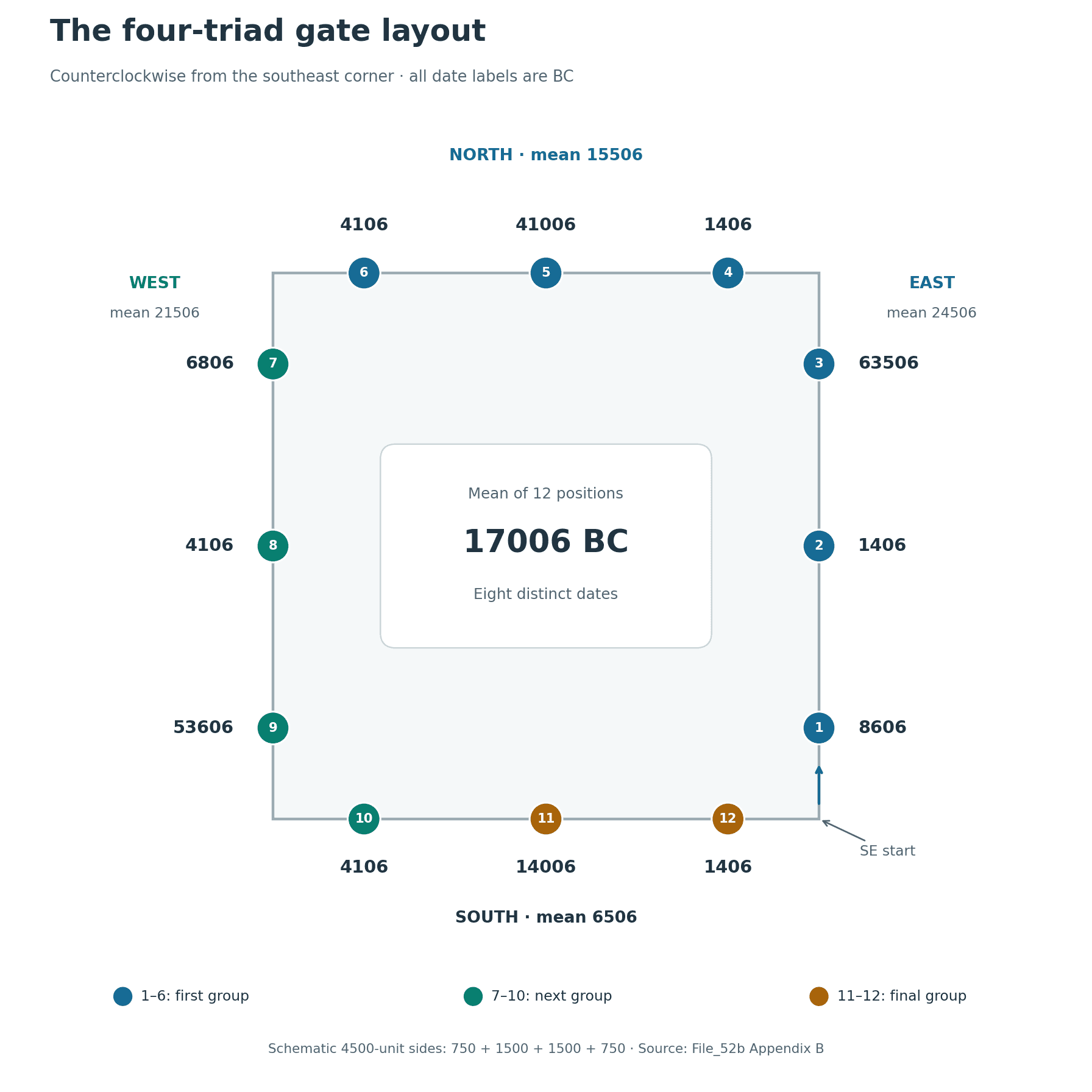
This arrangement is not a free permutation of values. The South and East sides belong to the Conquest-anchored derivations from 1406 BC, whereas the North and West sides belong to the Birth-anchored derivations from 6 BC. Thus the square is already governed by the two principal anchors of the field.
The diagonal-pairing interpretation belongs to the symbolic reading of this arrangement. The calculated center 17006 BC is the weighted arithmetic mean of the twelve date positions. A scalar date mean does not by itself prove that every inverse-pair line meets at one geometric point: a claim of geometric concurrence would additionally require fixed positions and explicit connection rules. The figure therefore displays the specified order and grouping, while the arithmetic below states exactly which centers are established.
12.2 Side-means, axis-means, and the three centers
The four side-means are:
- East = 24500
- North = 15500
- West = 21500
- South = 6500
From these, the two principal axis-means arise immediately:
(24500 + 21500)/2 = 23000
(15500 + 6500)/2 = 11000
and their own mean gives the grand center:
(23000 + 11000)/2 = 17000
Thus the square yields three ordered center-fields:
11000 → 17000 → 23000
each separated from the next by 6000. The lower field corresponds to the more exact Group One average 11006, the upper field to Group Two average 23006, and the grand hinge to the full average 17006. What the arithmetic records technically, the square now renders architecturally.
12.3 The 3000-based gate-spacing of the square
Listed in descending order, the mean spans are East 24500, West 21500, North 15500, and South 6500. Their successive differences are 3000, 6000, and 9000. A separate schematic for a 12000-unit side may place three gates at quarter points, giving four equal 3000 intervals. Equal quarter-point placement is an added layout choice, not a consequence of there being three gates. It is also distinct from the parent’s Ezekiel-oriented 4500-unit side, whose proposed intervals are 750 + 1500 + 1500 + 750.
The same feature reappears in the center-bridge. The cross-paired bridge value 34040 expands by the Priestly operator to 37000, while the doubled core mean is 34000. Thus the converted bridge stands exactly 3000 above the doubled center. More precisely, the bridge already carries an internal surplus of 40 above 34000, and the Key of 23 supplies the remaining 2960, so that the total displacement becomes a full 3000. This suggests that the Priestly operator is locking into the square’s native 3000-based spacing rather than acting as an arbitrary overlay.
12.4 The common 920 → 1000 conversion rail
The two governing side-fields are not redundant. The lower field resolves by the Priestly operator as:
11040 = 12 × 920 → 12000 = 12 × 1000
while the upper field resolves as:
23000 = 25 × 920 → 25000 = 25 × 1000
The bridge between them does the same:
34040 = 37 × 920 → 37000 = 37 × 1000
The three conversions share the ratio 25/23 and the unit relation 920 → 1000, with coefficients 12, 25, and 37. Their inputs nevertheless belong to explicitly different readings: 23000 is the mean span 23006 BC → 6 BC; 11040 is the civil span 6 BC → AD 11035 in the mirrored +30 field (§12.15); and 34040 is their stated sum. The common ratio does not erase those coordinate and overlay distinctions.
12.5 The group-centers as BC- and AD-side fields
The upper mean has a legacy civil mirror at AD 23005 and an apparent-age companion at AD 23035. The endpoints must be paired explicitly:
| Endpoints | Civil span | Reading |
|---|---|---|
| 6 BC → AD 23035 | 23040 | 64 × 360 |
| 2166 BC → AD 23035 | 25200 | 70 × 360; Abraham birth comparison |
| 2886 BC → AD 23035 | 25920 | SKL/Babel comparison |
| AD 23035 → AD 29515 | 6480 | 18 × 360; Jachin comparison |
The lower mean supplies the 11040 → 12000 relation through AD 11035 and the fixed 6 BC anchor. These selected endpoint pairings are the basis of the city/land interpretation; polarity alone does not force that interpretation.
12.6 The grand center as a hinge-field
The grand center is also productive. Its apparent companion AD 17035 stands 19200 years above Abraham’s birth at 2166 BC:
17035 + 2166 – 1 = 19200 = 12 × 40 × 40
This is fitting not only because the field contains twelve gate-values, but because Abraham is the covenantal ancestor from whom the tribal structure eventually emerges. The same field already contains Jacob internally, since Jacob’s birth at 2006 BC lies 160 = 40×4 years below Abraham’s.
From the raw grand mean 17006 BC to the original triad, the spans are likewise strong:
17006 → 1406 = 15600 = 390 × 40
17006 → 4106 = 12900 = 10 × 1290 = 30 × 430
17006 → 14006 = 3000
Since 17006/17036 is an average, it is not surprising in itself that it should generate meaningful sums. What is significant is that it does so on load-bearing values rather than miscellaneous totals: 390×40, 30×430, and 12×40×40. The grand mean is therefore not inert. It behaves as a genuine hinge-field.
12.7 The doubled side-register and the 34000 ↔ 43000 closure
A second register appears when the side-means are doubled:
24500 × 2 = 49000
21500 × 2 = 43000
6500 × 2 = 13000
15500 × 2 = 31000
The doubled mean spans are 49000, 43000, 13000, and 31000. Reversing each separately gives 94000, 34000, 31000, and 13000. Their average is (94000 + 34000 + 31000 + 13000)/4 = 43000. Meanwhile the average before reversal is 34000, whose reversal is also 43000. This is an exact agreement for these four inputs. Digit reversal does not generally commute with averaging, so the equality is a checked property of this selected field rather than a completion forced by the central mean.
12.8 Generation and jubilee registers
The gate-square also gathers the principal generation-registers. At the level of side-means, East + North = 40000 = 400 generations of 100 years, while West + South = 28000 = 400 generations of 70 years. The 40-year generation is already present in the grand-center field itself, especially in AD 17035 → Abraham = 19200 = 12×40×40, in the Jacob offset of 160 = 40×4, and in the Conquest-facing span 17006 → 1406 = 390×40. Thus the final arrangement gathers the 100-, 70-, and 40-year generation grammars into one ordered field.
The East-gate node 1406 BC is especially apt here. Reckoned to the Christ super-anchor at 6 BC it yields 1400 years, and this functions as a common multiple of the three principal generation registers already native to the wider chronology: 14×100, 20×70, and 35×40. In this sense the East gate is not merely the Conquest anchor or the inverse of Rounded Creation. It is also the generational hinge of the square, where the Abrahamic, Jacobic, and Mosaic generation-patterns converge in one Christward span.
The square also remains legible on the jubilee register. If the side-means are read as jubilees of 50 years, the East, West, South, and North sides resolve respectively as 490, 430, 130, and 310 jubilees. Thus 490, 430, and 130 reappear in one ordered field, while 310 stands as the inverse complement of 130. This does not establish a new architecture apart from the previous one. It confirms that the mean-field remains compatible with another already native register of the chronology.
12.9 The ordered gate-field on the 900 lattice
A further regularity appears when the distinct gate-values are arranged from lowest to highest:
1406, 4106, 6806, 8606, 14006, 41006, 53606, 63506.
The successive nonzero gaps are:
2700, 2700, 1800, 5400, 27000, 12600, and 9900.
These are not merely multiples of 300, but of 900:
Gaps = 900 × (3, 3, 2, 6, 30, 14, 11)
The coefficients sum to 69. Therefore the full span from 1406 BC to 63506 BC is:
69 × 900 = 62100 = 23 × 2700
This is an important compression, because it shows that the gate-field is discretized on a 900-unit lattice rather than merely on a 300-unit one. It also explains why the two repository operators behave so naturally here. Under 70/69 the total expands by one further 900-unit step to 63000; under 25/23 it expands by six further 900-unit steps to 67500. The field is therefore not only orderly in its static arrangement. Its expansibility is already built into the same 900-grid.
12.10 The 62100 rail in the apparent-age field
This 69×900 structure immediately renders the free inverse rail more intelligible. In the apparent-age field:
63536 → 1436 = 62100
Under 70/69 this expands by one further 900-unit step to:
62100 × 70/69 = 63000
landing at 536 BC. This is especially weighty because 63000 is not merely a larger round total: under the rounded jubilee register of 50 years it becomes 1260 jubilees. Thus the landing at 536 BC answers not only the end of the exile, but also the wider Danielic–apocalyptic 1260 field later elaborated in Revelation 11–12.
Under 25/23 the same rail expands by six 900-unit steps to:
62100 × 25/23 = 67500
placing the upper landing at AD 3965, itself 2520 = 1260 + 1260 above AD 1445, the mirror of the Exodus. Thus the 62100 rail is not only a formal inverse span. In the apparent-age field it sits at a highly productive position, capable of meaningful expansion in both directions at once.
12.11 Completion notes: the remaining adjacent pairings
For completeness, the remaining adjacent side-sums should also be noted. Besides the principal pairings East + North = 40000 and West + South = 28000, the other adjacent sums are North + West = 37000 and South + East = 31000. Their inclusion is methodologically useful: the square has been surveyed from all natural side-pairings, and no residual combination breaks the order.
These two sums are asymmetrical in a meaningful way. Since North and West both belong to the Birth-anchor field and are already inverse-derived, their sum 37000 is naturally read in reverted form as 73000, which halved yields 36500 = 100×365. This gives a genuine solar-generation register. By contrast, South + East = 31000 reverts to 13000, and halved yields 6500, which simply returns to the existing South-side field. Thus the Birth-side pairing discloses a new solar register, whereas the Conquest-side pairing confirms what is already present.
This Birth-side half-field should not be mistaken for a sterile remainder. Its fuller Abrahamic productivity is real, but is left largely undeveloped here for the sake of keeping the section bounded. The point is not that the corner lacks further consequence, but that the present section has already reached the threshold at which elaboration would become a separate branch-discussion.
12.12 Measured land, measured city, and the twelve gates
The directional comparison is an interpretive use of the selected layout. Ezekiel 48:8–22, 30–35 gives the west–east allotment setting, and 23000 × 25/23 = 25000 supplies its numerical correspondence. The North–South mean is associated here with the 11040 → 12000 construction. Revelation 21:12–21 gives the city equal length, width, and height; it does not reserve the 12000 measure for a uniquely North–South axis.
The 25000 land measure and the 12000 city measure therefore remain meaningful symbolic comparisons within the proposed arrangement. Chronological years, cubits, and stadia are different quantities. Matching their numerals is a typological reading, not a physical unit conversion or a historical dating rule.
The two group means, 11006 and 23006 BC, differ by 12000, and their mean 17006 BC lies 6000 from each. Those arithmetic relations are exact. Ezekiel 48:31 places Judah among the three north-gate tribes, alongside Reuben and Levi; the text does not rank Judah as the principal gate. The proposed square reads the group-mean relation together with the scriptural measured-city imagery without claiming that the passage itself specifies the chronology’s positions.
The four-triad construction can consequently be assessed at two levels: its stated means and converted spans are numerical results, while its reading as a twelve-gated city and temple-land pattern is architectural interpretation. Repeated values, paired means, and translated dates remain related consequences of the same inputs rather than independent confirmations.
12.13 The 18000 range and the 6 + 4 + 2 gate traversal
The range of the side means is 24506 − 6506 = 18000. Sorting the four means gives differences 9000 + 6000 + 3000 from lowest to highest, or the reverse order descending. This range is not the accumulated change around the assigned East → North → West → South → East order. The square’s chronological range and a geometrical perimeter must therefore be stated separately.
File_52b Appendix B.1c supplies a schematic 4500-unit side, partitioned as 750 + 1500 + 1500 + 750. Giving each of the twelve gate positions a 1500-unit allotment produces a perimeter of 18000 units. That is a separate measured-city model. Its numerical agreement with the side-mean range is the symbolic comparison.
Appendix B.1d then groups the counterclockwise gate sequence from the southeast corner as six positions, four positions, and two positions:
| Group | Exact BC date positions | Sum | Mean, BC | Mean span to 6 BC | 50-year jubilees |
|---|---|---|---|---|---|
| First 6 | 8606 + 1406 + 63506 + 1406 + 41006 + 4106 | 120036 | 20006 | 20000 | 400 |
| Next 4 | 6806 + 4106 + 53606 + 4106 | 68624 | 17156 | 17150 | 343 |
| Last 2 | 14006 + 1406 | 15412 | 7706 | 7700 | 154 |
This selected grouping yields whole jubilees after the group means are measured to 6 BC. It is different from simply dividing each side mean by three. The results are 400, 343, and 154 jubilees; the grouping and its repeated positions are part of the construction.
A further schematic correspondence can allocate the 18000 total as 9000 + 6000 + 3000, or 180 + 120 + 60 jubilees. If one chooses to parameterize a full circuit as 360 degrees, those portions represent 180, 120, and 60 degrees, matching six, four, and two of twelve equal gate allotments. Here one jubilee per degree is an explicit display scale. It is not an equality of physical units or a proof about the angles subtended by the drawn square.
12.14 Ezekiel’s measured city and Revelation’s consummated city
Ezekiel 48:8–22, 30–35 gives a city side of 4500 and a perimeter of 18000, set within the wider 25000 allotment scheme. Revelation 21:12–21 describes twelve gates, three on each side, and a city measuring 12000 stadia with equal length, width, and height. These are distinct scriptural settings and measures. The present study places their numerical forms alongside the gate-range and mean conversions; it does not equate the cities’ physical dimensions.
A cube is a natural geometric analogy for the equal dimensions in Revelation. If a cube has twelve edges of length 12000, their total is 144000, and 144000 ÷ 360 = 400. The edge total is a calculation within that analogy; Revelation does not state it as the city’s combined edge measure. Its association with the 144000 elsewhere in Revelation is a symbolic comparison.
The narrative comparison likewise remains theological. Hebrews 12:18–24 contrasts the Sinai setting with Mount Zion and the heavenly Jerusalem. Revelation 22:1–2 links the city’s river and tree of life with twelve kinds or crops of fruit and a monthly cycle. Read together with the twelve gates, these passages supply the language of measured fullness used here. They do not independently derive the chronological mean-field.
12.15 AD-Mirror axis-fold into 12000/24000
In the legacy civil rendering of the apparent-age mirror field, the South and North means stand at AD 6535 and AD 15535, averaging AD 11035. West and East stand at AD 21535 and AD 24535, averaging AD 23035. Measured from 6 BC, the civil spans are 6 + 11035 − 1 = 11040 and 6 + 23035 − 1 = 23040. Holding the same AD endpoints fixed and instead starting at AD 5 would give 11030 and 23030. That is not the operation used here.
The inner span expands directly by the Priestly ratio: 11040 × 25/23 = 12000. Its gain is 960. Holding AD 11035 fixed and extending the opposite endpoint 960 years before 6 BC lands at 966 BC, so 966 BC → AD 11035 = 12000 civil years.
The outer relation reuses that hinge through an explicitly different step: (23040 − 960) × 25/23 = 22080 × 25/23 = 24000. The same total is 23040 + 960, hence 966 BC → AD 23035 = 24000. This is a subtract-then-expand construction using the previously derived 960; it is not direct multiplication of the unmodified 23040 span by 25/23.
The two fixed AD mean endpoints therefore share the 966 BC landing through a 12000/24000 relation. The inner route generates 960 by direct expansion, and the outer route uses that 960 in the stated fold. This relation is derived from the axis means without first dividing them into gate units. Its resemblance to the measured-city register is the proposed architectural reading.
The BC landing at 966 BC adds a further typological precision. The 12000 generated from the inner axis does not terminate at an arbitrary date, but at the conventional date of Solomon’s Temple. Thus the 960-year hinge runs from Solomon’s Temple to Christ’s birth, and does so at the very point where Christ compared his own body to the Temple. The result is therefore not merely numerical but typological: temple to Temple, first house to embodied fulfillment.
A secondary observation may then be added, though it remains subordinate to the trunk. The primary result is 12000 itself, not its subdivision. Yet a tripartite articulation is not without biblical precedent. Moses’ 120 years are classically distributed in three movements of 40 years each: first in Pharaoh’s house, then in Midian, then in the return to Egypt and wilderness leadership terminating short of Jordan. By analogy, the division of 12000 into three lesser “gates” or stages may be read as a branch-structure of the trunk rather than its primary definition. The main force lies in the emergence of 12000; the threefold articulation is a secondary corroboration, patterned after the Mosaic 120 = 40 + 40 + 40.
Temple state note. The 966 BC inception comparison is dependency-controlled by File_08 — Kings and Temple chronology. A separately chosen mod-5 comparison can round the approximately 7.5-year building duration upward to ten years and thereby use 956 BC. In that optional comparison, 23036 − 956 = 22080 = 11040 + 11040. The 956 label is a constructed ten-year rounded endpoint, not the source-controlled historical completion date; the established whole-year construction comparison 966 → 959 → 946 remains distinct.
12.16 The inverse Pillars and the paired land-motif
A further corroboration may now be added from the Pillar field. Taking the established Pillars AD 29515 and AD 29465, with shared inner boundary AD 29395, as fixed repository terminals, the inverse test may be run against the same two biblical anchors that govern the present file: 6 BC and 1406 BC. The resulting field is especially weighty because the inverse Pillars do not produce one isolated return but a paired land-motif.
From the Christ anchor, 6 BC → AD 29515 is 29520 civil years. Reversal gives 25920, which lands at AD 25915. The companion structure is then transported rigidly: Boaz stays 50 years inward, at AD 25865, and the common inner boundary stays 120 years inward, at AD 25795. These offsets are preserved by the declared transport; they are not independently obtained by reversing each companion’s own span.
The resulting exile/return pairs are AD 25915 to 536 BC and AD 25865 to 586 BC, each 26450 = 23 × 1150 civil years. For comparison, independently reversing Boaz’s original 29470-year distance from 6 BC would give 74920 and civil AD 74915, a different construction.
From the Conquest anchor, 1406 BC → AD 29515 is 30920 civil years; reversal gives 29030 and the new Jachin endpoint AD 27625. Rigid transport places Boaz at AD 27575 and the common inner boundary at AD 27505, retaining 50 + 70 = 120. Thus 1406 BC → AD 27575 and 1476 BC → AD 27505 each equal 28980 = 23 × 1260.
The 1476 BC Joshua birth node is derived from death at 1366 BC and a lifespan of 110, as classified in File_54 — Luke’s 70-year lattice. Expanding 28980 by 70/69 yields 29400 = 60 × 490. Holding AD 27505 fixed, the additional 420 years moves the earlier endpoint from 1476 to 1896 BC; 1896 → 1476 → 1406 gives 420 + 70 = 490.
The 1896 endpoint is first a derived comparison. If it is associated with the Jacob/Bethel covenant setting, that association belongs to the localized LXX −33 state in File_04 — Jacob chronology and the localized LXX −33 state §7.1, distinct from the standard 1929 BC rail. It is not an unqualified MT Abrahamic Covenant date.
The two transported Pillar comparisons thus produce 23 × 1150 and 23 × 1260, associated here with return to the land and entry into the land. The half-registers 1150 = 2300/2 and 1260 = 2520/2 supply the numerical comparison. Their theological relationship is the interpretation; the paired equalities depend on the stated transport and matching endpoint offsets.
The Conquest-side doublet also integrates directly into the 490 architecture. 1476 BC to 6 BC is 1470 = 3 × 490, while 1406 BC to AD 65 is likewise 1470 = 3 × 490. Correspondingly, 6 BC to AD 29395 is 29400 = 60 × 490, and AD 65 to AD 29465 is also 29400 = 60 × 490. Thus the 23 × 1260 line does not stand in isolation, but lands naturally within the Danielic and jubilee registers already governing the wider file.
12.17 The inverse Pillars as macro-scale corroboration
The Pillar field also passes the broader inverse test. The primary contraction is simple: AD 29515 descends to AD 25915 by 3600 years = 10 × 360 = 60 × 60. This is structurally apt in the SKL environment, since 3600 is itself a native sexagesimal unit. The effect is not to dissolve the earlier Pillar spans, but to lower them by one 3600-tier while preserving their internal 360-grammar. Thus 2886 BC to AD 29515 = 32400 = 90 × 360 contracts to 28800 = 80 × 360 at AD 25915; 20886 BC to AD 29515 = 50400 = 140 × 360 contracts to 46800 = 130 × 360; and the Berossus Flood anchor 34566 BC to AD 29515 = 64080 = 178 × 360 contracts to 60480 = 168 × 360 = 336 × 180. The inverse Pillar therefore behaves not as a disruption of the SKL field but as a controlled scalar descent within it.
A further inward confirmation appears at the shared inner boundary. Since AD 29395 stands 120 years inside AD 29515, with that 120 itself decomposing as 50 + 70 through Boaz and the common inner skin, the same inner grammar may be read on the inverse side. AD 25915 brought inward by the same 120 yields AD 25795. Relative to 6 BC, these two inverse states are then 25920 and 25800 respectively. Thus the Pillar’s internal 120 not only survives inversion formally, but transforms the first precessional form into the second.
The exile-side relation also returns to Babel: 586 BC → AD 25865 is 26450 = 23 × 1150; multiplying by 25/23 gives 28750. With AD 25865 fixed, that span begins at 2886 BC. The resulting ladder has three explicit endpoint pairs:
| Endpoints | Span | Register |
|---|---|---|
| 2886 BC → 6 BC | 2880 | Same-side BC |
| 2886 BC → AD 25915 | 28800 | Civil cross-axis |
| 262086 BC → AD 25915 | 288000 | Civil cross-axis |
The direct SKL Creation-to-Babel interval is instead 262086 − 2886 = 259200. Babel is shared by the first two members; inverse Jachin is shared by the second and third. The ladder therefore links the field through overlapping endpoint pairs rather than measuring all three spans from Babel.
262086 BC → AD 25915 = 288000
AD 25865 → 586 BC = 26450 = 23 × 1150
26450 × 25/23 = 28750
2886 BC → AD 25865 = 28750
2886 BC → 6 BC = 2880
2886 BC → AD 25915 = 28800
The Jachin side discloses a further Christ-centered Mirror effect. AD 27625 answers the mirror of the Conquest at AD 1405 by 26220 = 23 × 1140. At the same time, Jachin inverse AD 27625 and Boaz inverse in the Mirror as 27576 BC stand 55200 years apart across the Mirror. This span is bisected exactly at AD 25, since each side is 27600 = 12 × 2300. The full cross-Mirror relation is therefore 24 × 2300. Under the Priestly operator it expands to 60000, yielding a symmetric 30000 + 30000 about the Christ-at-30 midpoint. This symmetry is strengthened by the millennial day principle, since the 30000 years to Christ at age 30 may be heard as a year-day correspondence concentrated at the center of the span.
The shorter gate-field and the much larger Pillar field both exhibit exact relations under their declared procedures. This is useful for comparing the reach of the construction across scales. It does not by itself supply a statistical probability: decimal reversal, held anchors, and transported offsets remain part of the selection and dependency structure. The proposed coherence is an architectural reading of the displayed results.
12.18 The Babylonian triad and the 2880 / 28800 / 288000 ladder
The Pillars are treated here as shared biblical/SKL comparison structures; the following section examines the distinct Babylonian triad of 262086 BC, 2886 BC, and 6 BC. The first is the selected principal SKL Creation pole, the second the selected Babel comparison, and the third the Christ birth comparison used as a local origin. The Babel label 2886 BC is the +30 companion of the 2856 BC comparison in File_52b §12.4; it is not a replacement for every Babel state in the repository.
Local-reflection convention. Reflection about 6 BC is a separate Christ-anchored construction. For the signed distances used below, a BC date D has distance D − 6 and an AD date A has distance −(A + 5), so the past is positive and the future negative. Local reflection negates that distance. It does not relocate the formal q = 0 Mirror origin controlled by File_51b.
Within this Babylonian triad, 262086 BC functions for the SKL in the same structural role that the principal Creation poles function in the rounded biblical field, while 2886 BC functions in the same structural role that 1406 BC serves in the biblical inverse architecture. The difference is not one of numerical magnitude alone, but of chronological domain. The Pillars belong to both domains. Babylon is the distinct sexagesimal field into which those shared terminal structures may also be read.
The bridge is the same declared exile-side calculation: 586 BC → AD 25865 = 26450; 26450 × 25/23 = 28750; and 2886 BC → AD 25865 = 28750. The linked 2880 / 28800 / 288000 ladder then uses the three endpoint pairs in §12.17. Its largest member is 262086 BC → AD 25915. The same-side interval 262086 BC → 2886 BC is 259200, the non-self-inverse bridge examined next.
The following branches state which of the three selected nodes is held fixed. The 6 BC comparison remains the common reference for the resulting field, while 2886 BC is its selected Babel comparison anchor and 262086 BC its selected SKL Creation pole. Their analogy to the biblical triads concerns the structure of these declared operations.
12.19 The bifurcated inversion of the Babylonian triad: 298086 BC and AD 33115
The Babylonian bridge 259200 reverses to 295200. Applying that reversed span while holding either original endpoint fixed produces two inverse states. This differs from the selected MT 9900 bridge, which is self-inverse under the placeholder-preserving rule. The bifurcation records two declared held-anchor operations.
The first branch arises when 2886 BC is held fixed. Since 262086 BC to 2886 BC is 259200 = 10 × 25920, inversion yields 295200. Reckoned again from the Babel anchor, this produces 298086 BC. The resulting state is immediately productive. 298086 BC to 6 BC is 298080 = 23 × 12960 = 828 × 360. Under the Priestly operator this expands by exactly 25920, one full precessional year, and so lands at inverse Jachin AD 25915. Equivalently, 298086 BC to AD 25915 is 324000 = 360 × 900, and 298086 BC to the original Jachin Pillar AD 29515 is 327600 = 360 × 910 = 364 × 900. Thus the first inverse branch moves from Babel backward into inverse Creation while preserving direct contact with the Pillar field.
The second branch arises when 262086 BC is held fixed. The same inverse bridge 295200 is now carried forward from SKL Creation, yielding AD 33115. This is the missing companion state and should not be omitted. Its significance is immediate. AD 33115 to 6 BC is 33120, and 33120 × 25/23 = 36000. The expansion therefore exceeds the original Christ-anchored span by 2880, which is exactly the span from 2886 BC to 6 BC. In other words, the second inverse branch expands back to its own original Babel anchor. The reciprocity is exact.
This makes the symmetry of the bifurcated inverse field apparent. The Pillar side contracts from AD 29515 to AD 25915 by 3600. The SKL Creation side expands from 262086 BC to 298086 BC by 36000. Their net difference is therefore 32400, which is exactly the increase from the original span 262086 BC → AD 29515 = 291600 to the inverse span 298086 BC → AD 25915 = 324000. Thus the inverse does not merely relocate its endpoints. It enlarges the full Creation-to-Pillar field by 32400 = 90 × 360, producing the new total 324000 = 900 × 360.
The bifurcated Babylonian field closes still more tightly when the two inverse states are taken together. 298086 BC to AD 33115 is 331200 = 10 × 33120, where 33120 is the span from AD 33115 to the Christ anchor at 6 BC. Under the Priestly operator, 331200 × 25/23 = 360000 = 600². A further symbolic closure appears here as well, since 331200 ÷ 2300 = 144 exactly. Thus the full reciprocal span of the two inverse Babylonian states, already governed by the 2300 register, resolves at total scale into the number 144, the inverse counterpart to the perfected city-symbolism of Jerusalem.
The displayed 3600 / 36000 / 360000 sequence fits the sexagesimal scale emphasized in the SKL comparison. Decimal digit reversal and the prior choices of endpoints still belong to its derivation. The alignment with the 60-based register is therefore a feature of this construction and its interpretation, not a separate demonstration that the whole architecture is statistically inevitable.
A further explanation of the coherence appears at the level of centers. The original Babylonian pair, 262086 BC and 2886 BC, has midpoint 132486 BC. Because the inverse pair, 298086 BC and AD 33115, are each displaced outward by 36000, the midpoint remains unchanged. This is structurally significant, because 132486 BC to 6 BC is 132480 = 23 × 5760, which under the Priestly ratio expands exactly to 144000. Thus the bifurcated Babylonian field is not only symmetric in span, but centered on a Christ-anchored value that resolves to the same 144000 grammar already associated elsewhere with the perfected people and city.
The same coherence appears when the six Babylonian nodes are grouped as 4 + 2 around the 6 BC super-anchor. The first four nodes — 262086 BC, 2886 BC, 298086 BC, and AD 33115 — share the midpoint 132486 BC, which yields 144000 as just shown. The remaining two Babylonian nodes directly tied to the 6 BC Mirror — 8826 BC and 802626 BC — average 405726 BC, which stands 405720 = 23 × 49 × 360 years before 6 BC and therefore expands to 441000 = 490 × 900. Thus the six-node Babylonian field resolves by grouped means into the paired values 144000 and 441000, while 6 BC remains the seventh and central super-anchor of the whole structure.
The same six-node field also resolves directly, without grouping, when reckoned as signed distances to the 6 BC Mirror: 262080 + 298080 + 2880 + 8820 + 802620 − 33120 = 1341360, whose mean is 223560. Under the Prophetic operator this becomes 226800, and doubled across the Mirror yields 453600 = 1260 × 360. Thus the full six-node Babylonian field, taken directly and not merely through grouped means, resolves to the Revelation-Babylon total of 1260 years of 360 days. This is especially fitting, since Revelation itself links sacred measurement with the 1260-day register when the temple is measured while the witnesses prophesy for 1260 days.
A final symbolic condensation may be noted. If the six Babylonian nodes are mirrored, they become 6 + 6 = 12 outer positions, with 6 BC itself retained as the thirteenth and central node. Read symbolically, this yields a twelvefold perimeter organized around one central Christic hinge, or two mirrored heptads when the center is counted on each side. Thus even the Babylonian field, when reflected through the Christ-anchor, condenses once more into a Jerusalem-like grammar: twelve outer “gates,” one middle atoning node, and the same recurrent numeric language of 7, 12, and 13.
12.20 Inversion from the local reflection about 6 BC: 802620, 8826 BC, and the 3430 / 1260 × 1274 field
The Babylonian field may also be inverted directly from the 6 BC Mirror. In the original state, 262086 BC to 6 BC is 262080 = 364 × 720. Thus the SKL Creation date was already primed on the 364 register before inversion. Across the local reflection about 6 BC, the doubled original span becomes 524160 = 364 × 1440 = 364 × 360 × 4. The Enochian register is therefore native to the original field and not imported by the inverse.
Inverting the same 262080 from the 6 BC Mirror yields 802620. This inverse state is immediately productive. Doubled across the Mirror, it becomes 1605240 = 1260 × 1274, where 1260 = 3.5 × 360 and 1274 = 3.5 × 364. Thus the doubled inverse field unites in one product the two corresponding 3.5-year forms, one on the 360 register and one on the 364 register. The original field was already primed for this result; the inverse now intensifies that latent symmetry by coupling the two year-forms together.
The 3430 grammar also shifts under inversion. In the original state, 262086 BC to 1406 BC is 260680 = 76 × 3430, so the register answers the Conquest anchor. In the inverse state, 802620 = 234 × 3430 = 13 × 7³ × 180, while the doubled inverse state is 1605240 = 13 × 7³ × 360. Thus the 3430 register moves from the Conquest anchor to the Christ anchor when SKL Creation is inverted. What was previously measured from 1406 BC is now remeasured from 6 BC.
A final hinge appears when 2886 BC itself is inverted relative to 6 BC. Since 2886 BC to 6 BC is 2880, inversion yields 8820, and therefore the inverse Babel node is 8826 BC. Doubled across the Mirror, this gives 17640 = 49 × 360, that is, a jubilee of years on the 360 register. The same hinge also joins the Pillar field: 8826 BC to inverse Boaz AD 27575 is 36400 = 364 × 100. And when the inverse SKL Creation state 802626 BC is measured to 8826 BC, the span is 793800 = 1260 × 630, that is, half of 1260². Thus the inverse Babel node 8826 BC functions as a secondary hinge linking the jubilee register, the Enochian register, and the inverse Boaz field.
The three domains remain distinguishable: the measured-city square, the transported Pillar structures, and the Babylonian triad. Each has now been followed through its own stated operations. Their recurring cycles and compatible selected landings support the architectural reading proposed here, while the tables retain the information needed to distinguish independent calculations from consequences of common anchors, offsets, and means.
12.21 Higher-dimensional analogy: from square to cube to a reflected field
The square layout, the cube analogy drawn from Revelation’s equal dimensions, and the reflected chronological fields may be compared conceptually. Each adds a different kind of relation to the display. That does not construct a four-dimensional object or establish a tesseract.
The nearest “four-dimensional” comparison is therefore a metaphor for considering layout, date, and transformation together. The numerical results remain those already calculated; the metaphor contributes no additional date, equation, or proof.
13. File-function within the sequence
File_52a establishes the inverse-number architecture; File_52b supplies its full chains and technical tables. This noncanonical File_52c study follows selected chains and aggregates into second-stage constructions. Section 11 gives the regular no-placeholder gap 2070 = 23 × 90 and retains the cumulative civil baseline 15410 = 23 × 670. The first depends on the selected reversed aggregate; the second is the invariant already built into its two anchors. Section 12 develops the four-triad means and their measured-city interpretation.
This article is the second-order companion to Files_52a and 52b. File_52f — Rounded Whole-Span Inverse Detailed Study, with LXX/SP Appendix D develops the independent whole-span source manifest and comparative traditions. The two studies illuminate different operations and retain their separate identities.
Related inverse studies
Part 5e explains the whole-span and segmented constructions; Part 5f develops overlapping path sums and their expansions. The comparative derivatives are File_52d, the BJ double 3430, and File_52e, the subordinate LXX inverse with SP Appendix A.