Lamech’s lifespan stands beside a hope for the future. Genesis gives him 777 years, but it also preserves the words with which he named Noah: a longing for comfort from the toil of the cursed ground. His story therefore supplies both a number and a theme. The number belongs to the Hebrew genealogy; the theme carries us toward the Flood, a renewed earth, and the later promise of rest in the land.
This study follows those connections through the chronology used at 490d. Its central sevenfold comparison requires a particular construction: the cumulative Masoretic Text (MT) chronology with a restored second Cainan, adding 460 years. The normal MT baseline remains alongside it throughout. Making that choice visible allows us to see both the strength of the arithmetic and the limits of what it establishes.
Lamech’s hope for Noah
When Lamech was 182 years old, he had a son. And he named him Noah, saying, “May this one comfort us in the labor and toil of our hands caused by the ground that the LORD has cursed.” And after he had become the father of Noah, Lamech lived 595 years and had other sons and daughters. So Lamech lived a total of 777 years, and then he died.
The passage places Lamech’s 777 years within a family history. He becomes Noah’s father at 182 and lives another 595 years. Noah later reaches 600 when the floodwaters arrive (Genesis 7:6, BSB). The resulting calculation is straightforward:
182 + 595 = 777 years for Lamech; 600 − 595 = 5 years between Lamech’s death and the Flood’s beginning.
In the normal MT chronology used here, these ages correspond to Lamech’s birth in 3240 BC, Noah’s birth in 3058 BC, Lamech’s death in 2463 BC, and the Flood’s opening in 2458 BC. These BC dates are calculated coordinates in the chronology; Genesis supplies the ages. The standard framework places Creation in 4114 BC, the Exodus in 1446 BC, and entry into Canaan in 1406 BC.
Figure 1 · Lamech / 777
Lamech’s 777 years and Noah’s 600
Ordinary MT birth chronology · aligned life comparison
Schematic segments: equal widths do not mean equal elapsed years.
Lamech’s life
5 years before the Flood
Noah’s age
Sources: File 18 §2.1
Calculation and model details
File 18 §2.1 minimum-state dates are shifted by 215 years to the ordinary MT normal 430-year Egypt state. The displayed dates are Lamech’s birth 3240 BC, Noah’s birth 3058 BC, Lamech’s death 2463 BC, and the Flood opening 2458 BC. The intervals are 3240−3058=182, 3058−2463=595, and 2463−2458=5. Thus 182+595=777 and 595+5=600. This is a comparison of individual lifespans and ages in ordinary chronology; the equal-width display does not portray elapsed time proportionally.
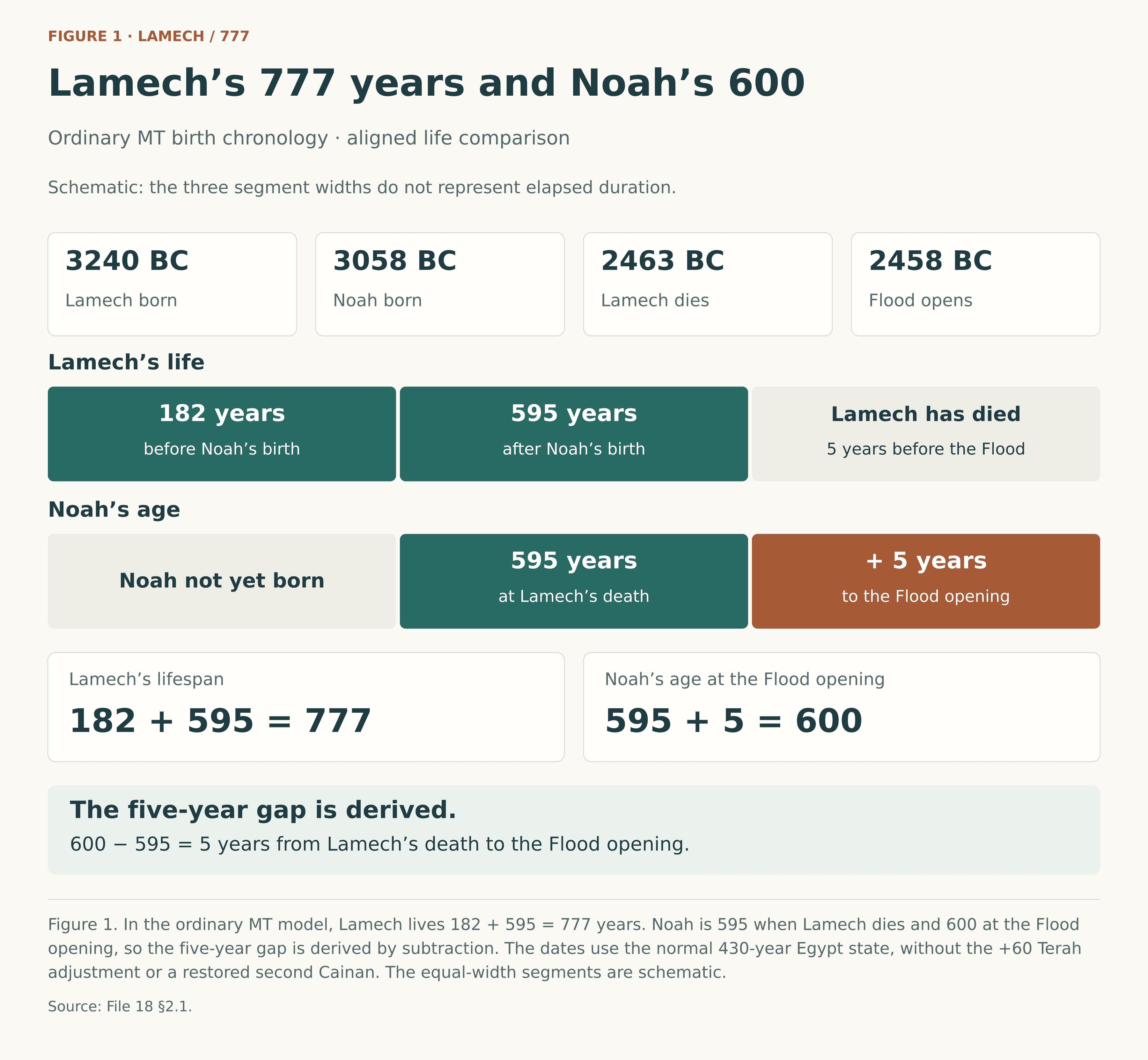
Lamech therefore dies before the event that dominates Noah’s life. His words look beyond his own lifetime. The BSB preserves them as a hope—“May this one comfort us”—and the ensuing narrative invites us to consider how that hope develops.
The 777 used in this article is the Masoretic Text’s lifespan. The main Septuagint (LXX) chronology used in 490d’s controlling chronological tables retains 753 for Lamech. Those figures belong to distinct textual and chronological settings; the LXX reading is not silently changed to make the MT pattern work. The supporting appendix explains the transmitted figures and the selected LXX reconstruction.
From the ground’s toil to the land’s rest
After the Flood, Noah builds an altar. God’s response promises the continuance of seedtime and harvest, seasons, and day and night (Genesis 8:20–22, BSB). The ground mentioned in Lamech’s naming speech thus returns at a decisive point in Noah’s story. Judgment is followed by preservation and a new beginning.
This does not mean that every consequence of the earlier curse has disappeared. Genesis 8 still acknowledges the evil inclination of the human heart. The connection is more specific: Noah’s story moves through judgment toward the preservation of life and the stability of the earth’s seasons.
Joshua provides a later movement toward inheritance and rest:
So Joshua took the entire land, in keeping with all that the LORD had spoken to Moses. And Joshua gave it as an inheritance to Israel according to the allotments to their tribes. Then the land had rest from war.
The summary describes a real transition from war to settled inheritance. Yet Joshua 13:1 also says that much land remained to be possessed. Rest is a stage in the story, with further work and faithfulness still required.
The chronology places the Conquest and initial land-rest within 1406–1399 BC. This is the study’s reconstructed seven-year span, not a BC date range printed in Joshua. Caleb’s age statements in Joshua 14:7–10, BSB, read with the wilderness chronology, help establish the sequence. The appendix explains the interval and its calendar conventions.
The narrative connection is now in place: Lamech hopes for relief, Noah emerges into a preserved earth, and Israel enters a land that comes to rest from war. The numerical comparison asks how the chronological structure can give these related themes a shared form.
Why the cumulative dates are different
Ordinary genealogy follows the ages at which fathers beget their sons. Cumulative chronology instead lays complete lifespans end to end, working backward from the Moses–Conquest anchor. It arranges the recorded lives in sequence. A cumulative starting date is consequently not a second claim about the person’s ordinary historical birth date.
The distinction matters immediately for Lamech and Noah. In ordinary MT chronology, Noah is born 182 years after Lamech. In the cumulative arrangement, Noah’s starting boundary follows Lamech’s entire 777-year lifespan. Their cumulative starts are therefore 777 years apart because that is how the arrangement is built.
The canonical cumulative tables also organize the coordinates into seven-year comparison windows. These are part of the model’s structure. They do not mean that a birth or the Flood lasted seven years, and they are not simply estimates of uncertain event dates.
Two versions of this cumulative arrangement are relevant:
| Version | Genealogical choice | Effect on the early coordinates |
|---|---|---|
| Normal cumulative MT baseline | No second Cainan between Arphaxad and Shelah | Uses the standard cumulative MT table |
| Cumulative MT with restored second Cainan | Inserts Cainan’s complete 460-year life | Moves Adam through Arphaxad 460 years earlier; Shelah and later coordinates remain fixed |
The second Cainan appears between Arphaxad and Shelah in Luke 3:35–36, BSB and in the Septuagint genealogy. Luke supplies the name; the LXX genealogy supplies the lifespan used for this construction: 130 + 330 = 460 years. Inserting that life into the cumulative MT sequence produces an explicitly qualified MT-based variant. It does not turn the whole chronology into the native LXX chronology.
Because the method adds complete lives, the insertion here is 460, rather than the 130-year begetting interval used in a regular genealogical calculation.
Figure 2 · Lamech / 777
Two states of the cumulative MT model
Full lifespans joined in sequence · all dates BC
Seven-year comparison windows (2 + 3 + 2) organize the model’s dates; they are not event durations.
Sources: File 18 §§6A–6B · File 09 · whole-year 2 + 3 + 2 architecture
Calculation and model details
File 18 §§6A–6B compares baseline cumulative MT with the MT-based variant that restores the second Cainan as a 460-year lifespan. Full lifespans are concatenated rather than measured as the ordinary father-to-son birth chronology. The added lifespan shifts Adam through Arphaxad earlier by 460 years; Shelah onward remains fixed. File 09 describes the whole-year 2+3+2 architecture underlying the seven-year coordinate envelope. Seven-year comparison windows organize the model’s dates; they are not event durations.
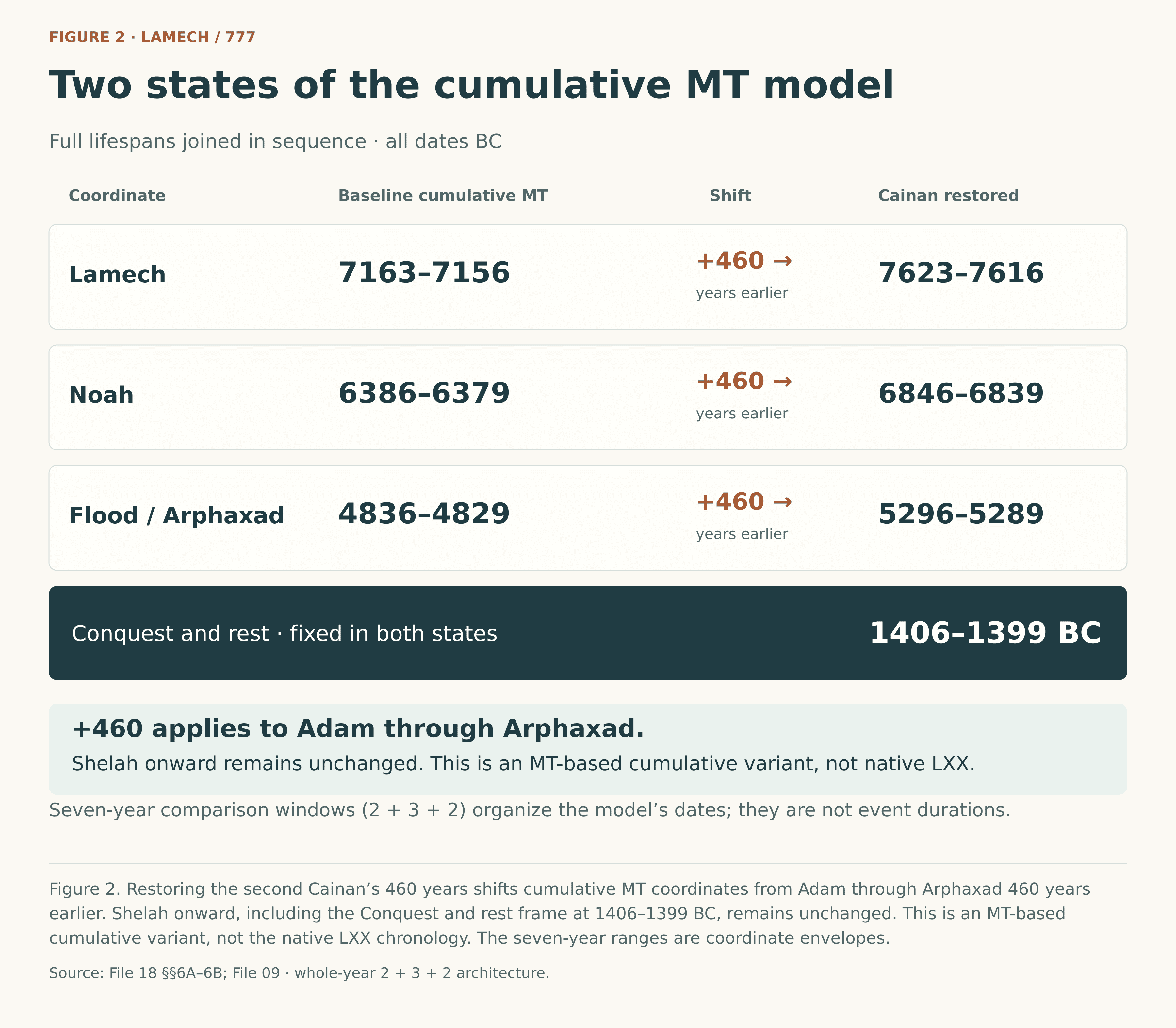
The crucial result is Noah’s window. It is 6386–6379 BC in the baseline and 6846–6839 BC after the 460-year insertion. The latter supplies the starting point for the featured sevenfold comparison.
Seven lifespans and the Conquest window
It helps to begin with a comparison that uses the unextended MT baseline. Its cumulative Flood window is 4836–4829 BC. Moving both ends forward by 3430 years, or 70 × 49, gives:
| Starting window | Span counted forward | Result |
|---|---|---|
| Baseline cumulative MT Flood: 4836–4829 BC | 70 × 49 = 3430 years | 1406–1399 BC |
This result matches the Conquest-and-rest window exactly. In BC notation, counting forward makes the year labels smaller: 4836 − 3430 = 1406, and 4829 − 3430 = 1399. The 49-year unit is seven weeks of years, the jubilee structure used elsewhere in these studies (Leviticus 25:8, BSB).
The restored-Cainan comparison begins at Noah rather than the Flood. Seven repetitions of Lamech’s lifespan total 777 × 7 = 5439 years:
| Starting window | Span counted forward | Result |
|---|---|---|
| Restored-Cainan cumulative MT Noah: 6846–6839 BC | 777 × 7 = 5439 years | 1407–1400 BC |
The two endpoint calculations are 6846 − 5439 = 1407 and 6839 − 5439 = 1400. This window overlaps the canonical 1406–1399 BC Conquest-and-rest window. Its corresponding edges stand one whole-year label earlier. The shared portion is 1406–1400 BC, a span of six elapsed years.
Figure 3 · Lamech / 777
An exact match and a one-year offset
Two cumulative MT calculations · compare their endpoints
Baseline cumulative MT · Flood
4836–4829 BC
− 3430 years70 × 49 = 3430
Restored-Cainan cumulative MT · Noah
6846–6839 BC
− 5439 years7 × 777 = 5439
The 7 × 777 result and the Conquest and rest
BC axis · eight one-year intervals · nine boundary labels · time moves right →
Sources: File 18 §§6A–6B · File 09 · coordinate-envelope architecture
Calculation and model details
All endpoints are BC, so each calculation subtracts the stated duration from both labels of the source envelope. 70×49=3430; 4836−3430=1406 and 4829−3430=1399. Separately, 7×777=5439; 6846−5439=1407 and 6839−5439=1400. Both results are seven elapsed years wide, but they differ by one year. Their shared interval is 1406−1400=6 elapsed years. The proportional desktop diagram uses eight one-year intervals and nine integer tick labels. The mobile view presents the same endpoints and overlap as cards.
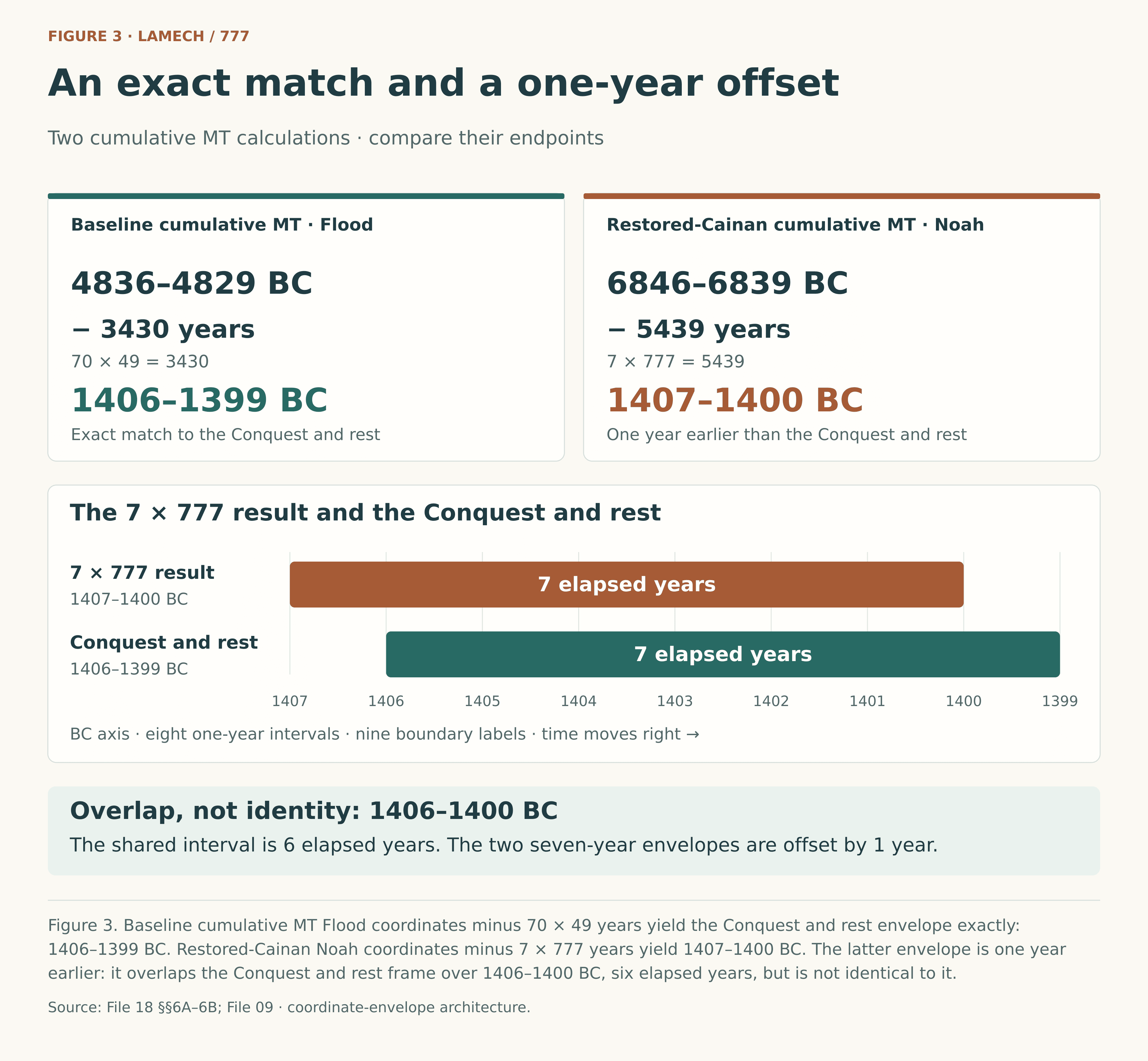
That one-year difference belongs in the explanation. The sevenfold calculation does not independently relocate the Conquest to 1407 BC. The fixed Nisan-based Conquest coordinate remains 1406 BC; the result is a closely overlapping comparison window within the stated variant.
The two rows therefore make related but distinct contributions. The baseline Flood comparison gives an exact match through 70 × 49; the restored-Cainan Noah comparison gives an overlapping window through 7 × 777. Each depends on its stated starting point and genealogy. Combining the starting coordinate from one version with the calculation from another would obscure the argument.
What the pattern suggests
The repeated sevens draw attention to completion and rest within this reading of the chronology. Lamech’s life supplies 777; the cumulative arrangement carries that lifespan into a sevenfold comparison with the era of the land’s inheritance. Alongside it, the baseline Flood reaches the land-rest window through seventy 49-year units.
I read these relationships as a numerical accompaniment to the narrative movement from toil and judgment toward preservation, inheritance, and rest. Their force lies in the way a declared chronological construction brings those themes together. The arithmetic can be checked exactly. Whether the correspondences reflect deliberate ancient design is a further interpretive question; arithmetic alone cannot settle it or establish why a name entered or left a textual tradition.
Nor does Joshua’s rest exhaust the biblical theme. Hebrews 4:8–9, BSB looks beyond Joshua and speaks of a Sabbath rest still remaining for God’s people. The theological movement therefore continues beyond the endpoint of the diagram.
Lamech’s 777 years become most meaningful when kept within that larger story. His life ends before the Flood, but the hope expressed at Noah’s naming reaches forward. The chronology offers a structured way to contemplate that hope alongside the later rest of the land, while keeping Scripture’s statements, calculated dates, and interpretation distinguishable.
Tables and sources
The supporting appendix gives the regular dates, both cumulative versions, the full endpoint calculations, the LXX distinction, and the more limited overlap near the Flood. For the method itself, see Cumulative Biblical Chronology: Adding the Lifespans.
Supporting calculations: Cumulative coordinates and the Cainan insertion · Endpoint calculations · The overlap near the Flood.
The chronological controls are File 18, Chronological Data Tables, especially §§2.1–2.4, 4A, and 6–6B; File 09, Cumulative Architecture, especially §3A.1; and File 22, Cumulative MT Harmonics. Dates and calculations follow the current canonical files checked on October 4, 2026.
Scripture quotations: Berean Standard Bible (BSB), public domain.
Detailed study: 777 × 7: Lamech, the Flood, and the Promised Land.