Hezekiah’s story brings the life of a king and the life of a city into the same promise. Facing death, the king prays. Isaiah returns with an answer that joins his recovery to Jerusalem’s deliverance:
I will add fifteen years to your life. And I will deliver you and this city from the hand of the king of Assyria.
The sign is a reversal of the shadow:
So Isaiah the prophet called out to the LORD, and He brought the shadow back the ten steps it had descended on the stairway of Ahaz.
The narrative supplies the starting point: fifteen years added, ten steps reversed, and a king and city preserved together. Its numerical setting becomes especially interesting when the fifteen years are placed beside Jerusalem’s later fall and the 185000 Assyrians whose deaths are recorded in 2 Kings 19:35.
Supporting tables: The dates and their meanings · Both calculations with 185000 · The 215-year pattern · The shadow and the 720-year comparison.
The king’s fifteen years and the city’s longer life
The chronology used for this comparison places the Assyrian crisis and healing promise in 701 BC, Hezekiah’s death in 686 BC, and Jerusalem’s fall in 586 BC. These are the selected dates of the canonical Hezekiah study; the appendix explains the date conventions.
The king’s extension is 701 − 686 = 15 years. From his death to Jerusalem’s fall is another 100 years. Together:
701 → 686 → 586 BC = 15 + 100 = 115 years.
Fifteen years for the king
The king’s added years stand within a longer horizon for Jerusalem.
Dates follow the Hezekiah comparison in Files 19 and 66; schematic layout, not to scale.
Image version and full-size download

Download full-size PNG · Download WebP · Download stacked phone PNG
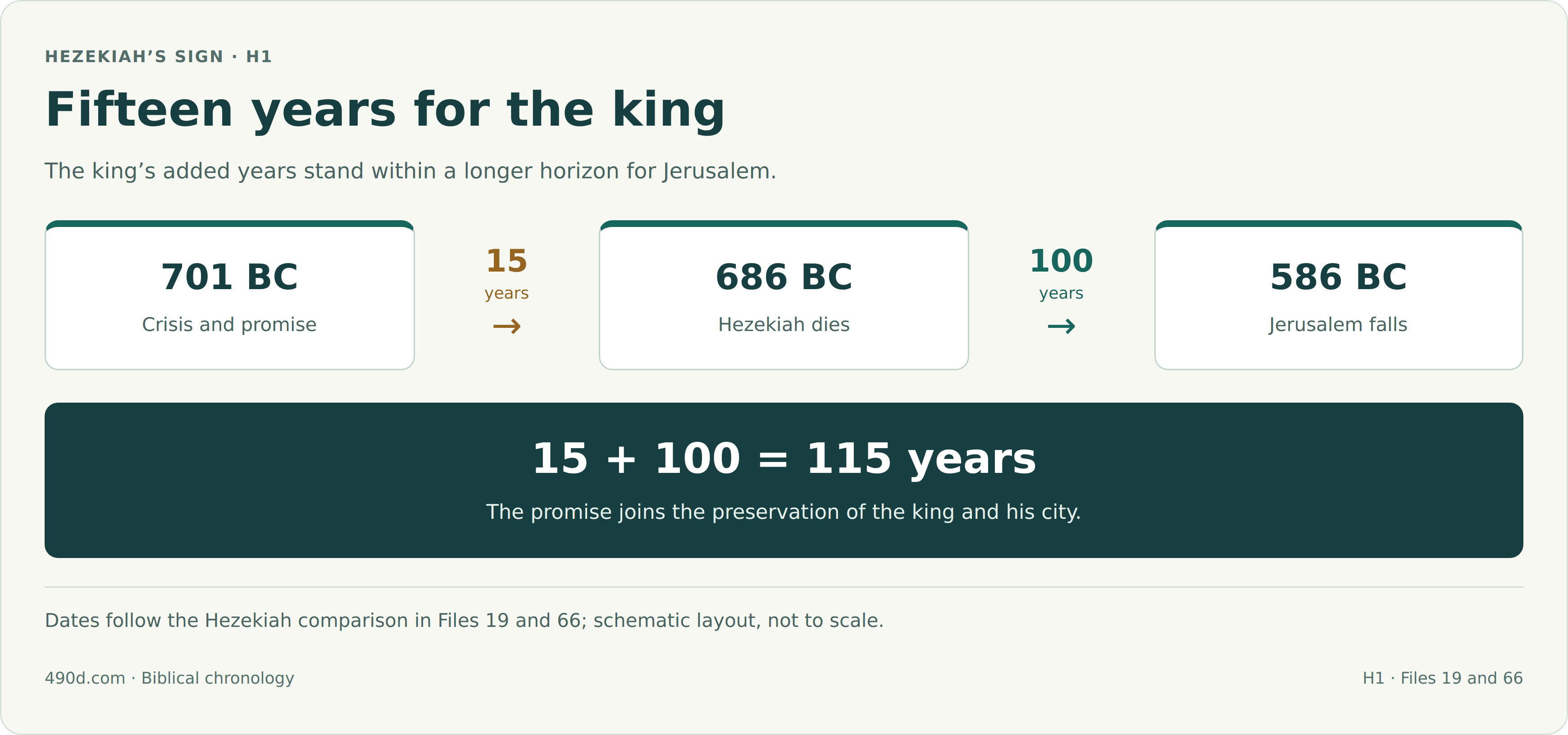
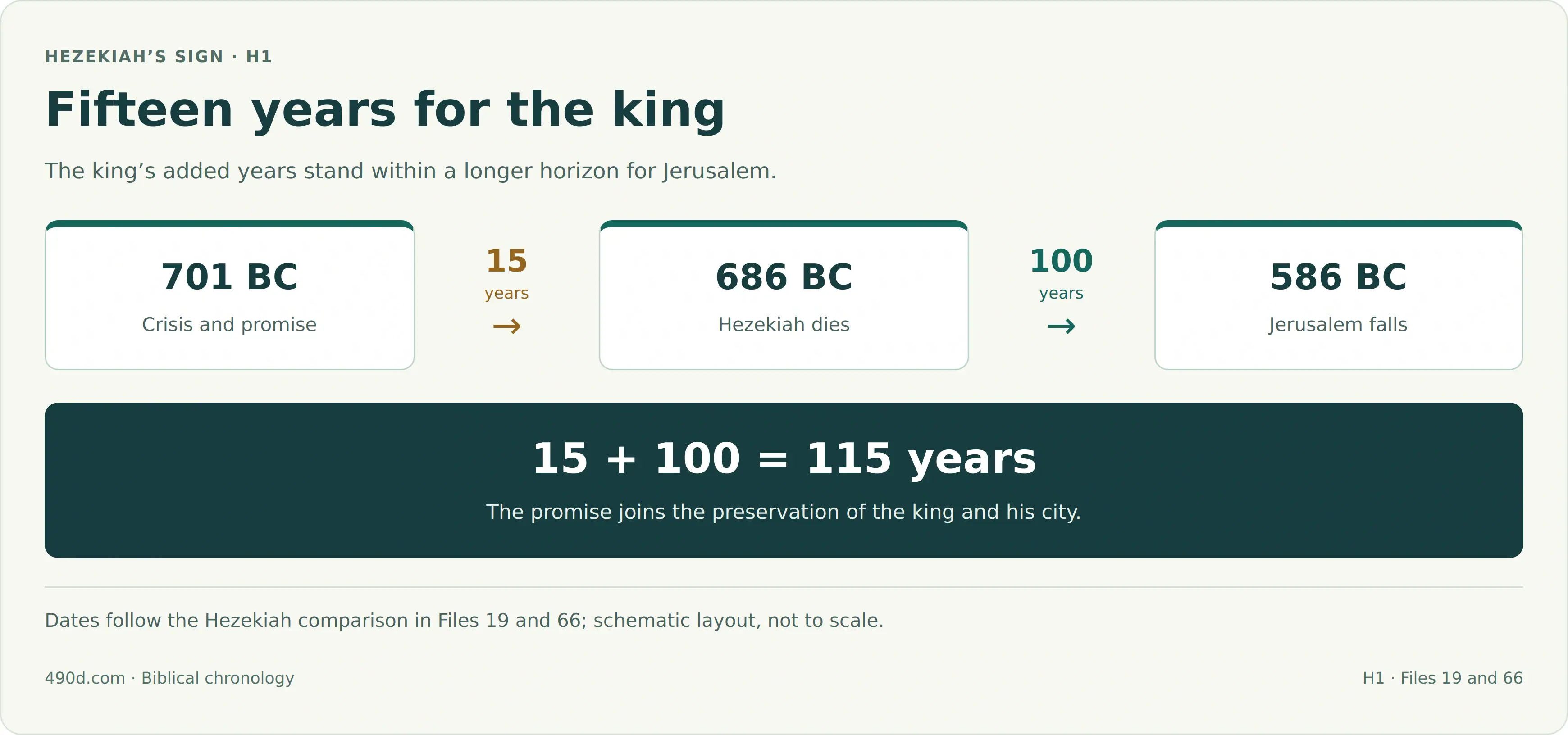
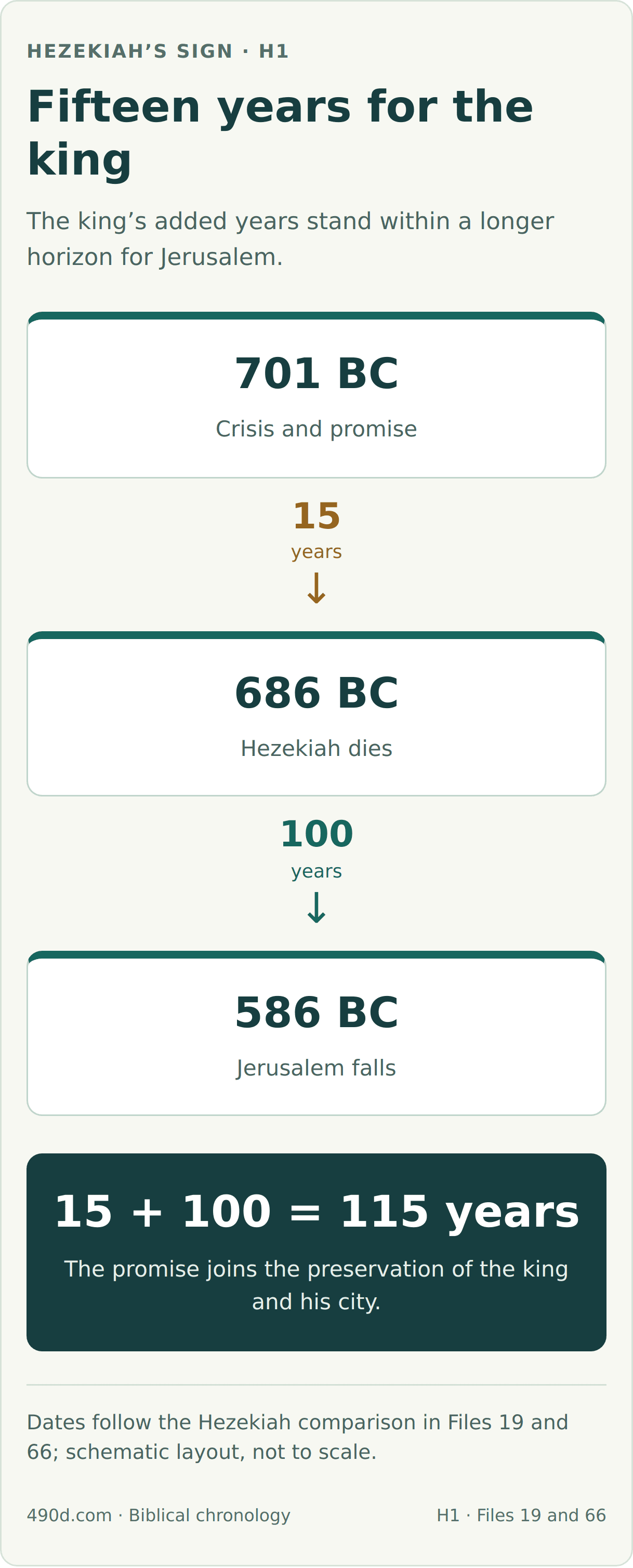
This gives the narrative two scales. Hezekiah receives fifteen more years, while the city survives the crisis and continues for a much longer span. Scripture explicitly joins their deliverance. Reading the interval to Jerusalem’s eventual fall as a corresponding extension of the city’s life is the chronological interpretation developed here.
The distinction also keeps the story clear: 701 BC is the crisis; 686 BC is the king’s later death. The shadow sign belongs to the crisis setting.
What the Assyrian count contributes
The number 185000 has a simple relationship to the 430 years already familiar from the Egyptian sojourn:
430 × 430 = 184900
185000 = 184900 + 100.
The count exceeds the square of 430 by exactly 100—the interval between Hezekiah’s death and Jerusalem’s fall in the selected chronology.
To explore that correspondence, the study treats the count as a measure of years. This is an interpretive step: the biblical text counts men, while the chronological comparison uses the number as a span. The 430-year measure itself comes from the normal MT framework of Israel’s sojourn in Egypt.
Begin at 686 BC and project a span of 185000 years forward. The calculated endpoint is AD 184315. Measuring backward from that same endpoint by 184900 years reaches 586 BC. The remaining hundred years are precisely the separation between the king’s death and the city’s fall.
Now apply the same span in the opposite direction, backward from the 701 BC crisis. It reaches 185701 BC. Measuring forward from that endpoint by the same square, 184900, reaches 801 BC, a hundred years before the crisis.
Two projections, one 100-year remainder
A textual count of 185000 is treated as a span of years in the numerical comparison.
Forward from 686 BC
Start at Hezekiah’s death and project forward.
686 − 586 = 100 years
Civil span = BC + AD − 1
Backward from 701 BC
Start at the crisis and project backward.
Rows still read earlier to later.
801 − 701 = 100 years
BC span = earlier label − later label
Projected endpoints are numerical coordinates, not predictions or dated events. All rows are schematic and not to scale; civil BC/AD calculations have no year zero.
Image version and full-size download

Download full-size PNG · Download WebP · Download stacked phone PNG
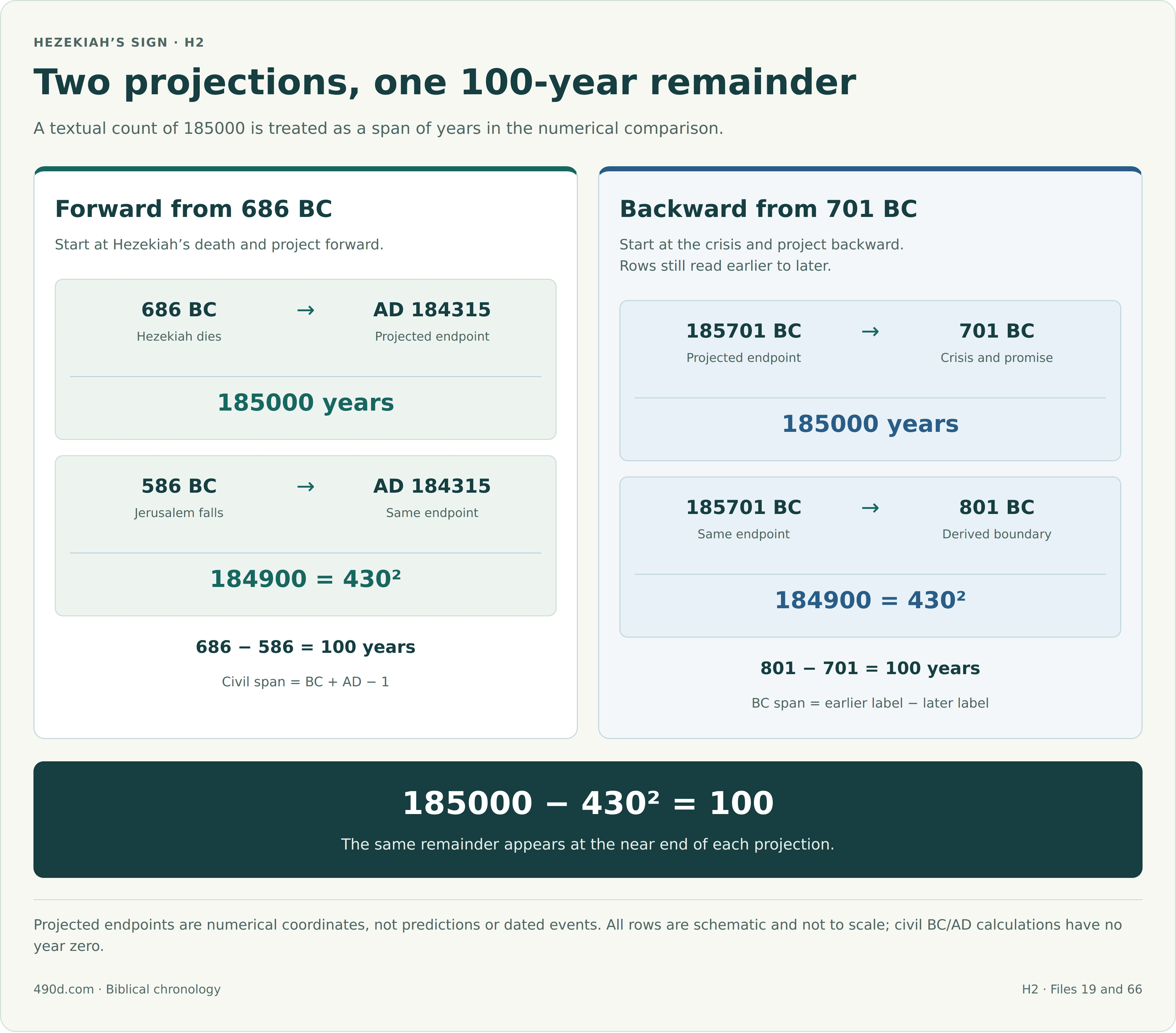
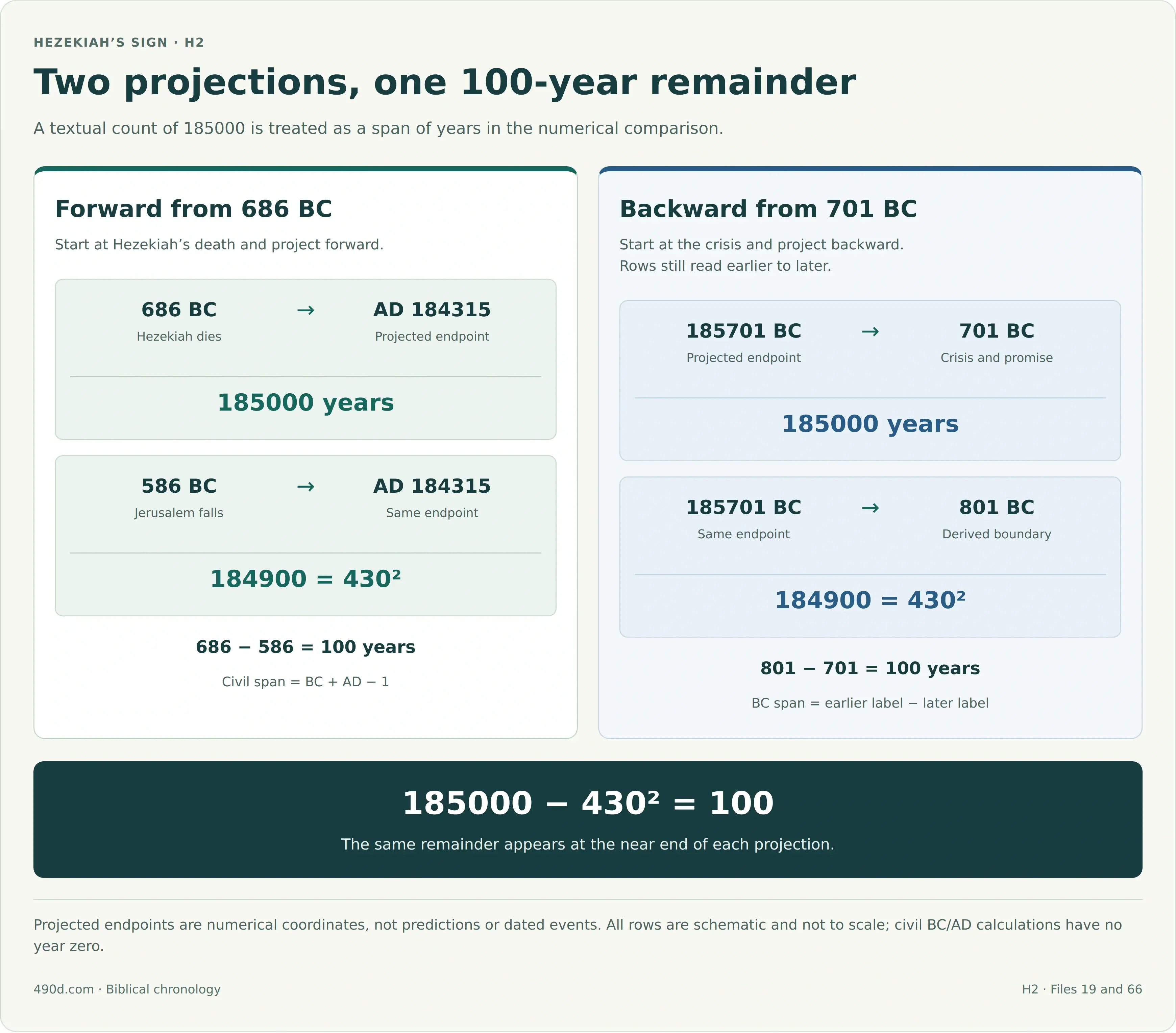
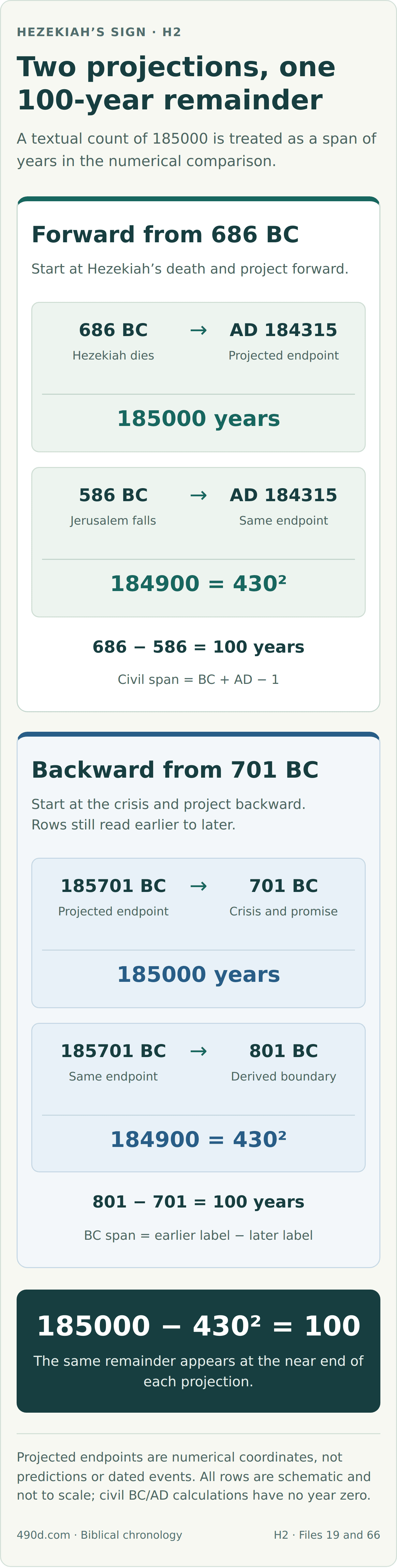
These distant endpoints are mathematical coordinates used to compare spans. The useful result is close to the biblical narrative: one hundred years after Hezekiah’s death, and a corresponding hundred years before his crisis. The full arithmetic, including the absence of a year zero between BC and AD, is shown in the appendix.
Fifteen years at the center
Bringing the two results together produces a compact arrangement:
801 → 701 → 686 → 586 BC.
Its three parts are:
100 + 15 + 100 = 215 years.
The fifteen years between equal flanks
The two 100-year remainders enclose the king’s 15-year extension.
801 BC is derived from the backward comparison; no historical event is assigned to it. Schematic layout, not to scale.
Image version and full-size download

Download full-size PNG · Download WebP · Download stacked phone PNG
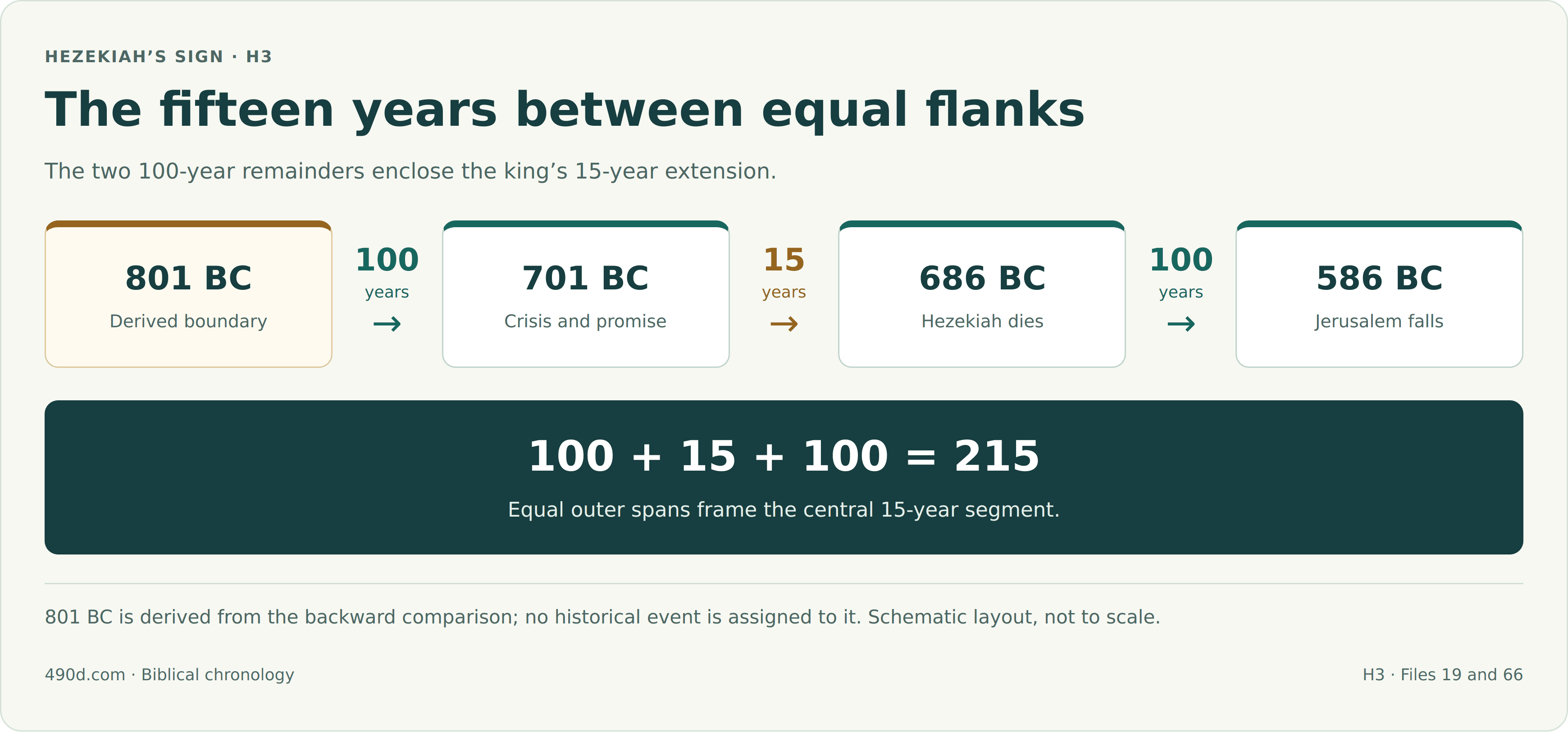
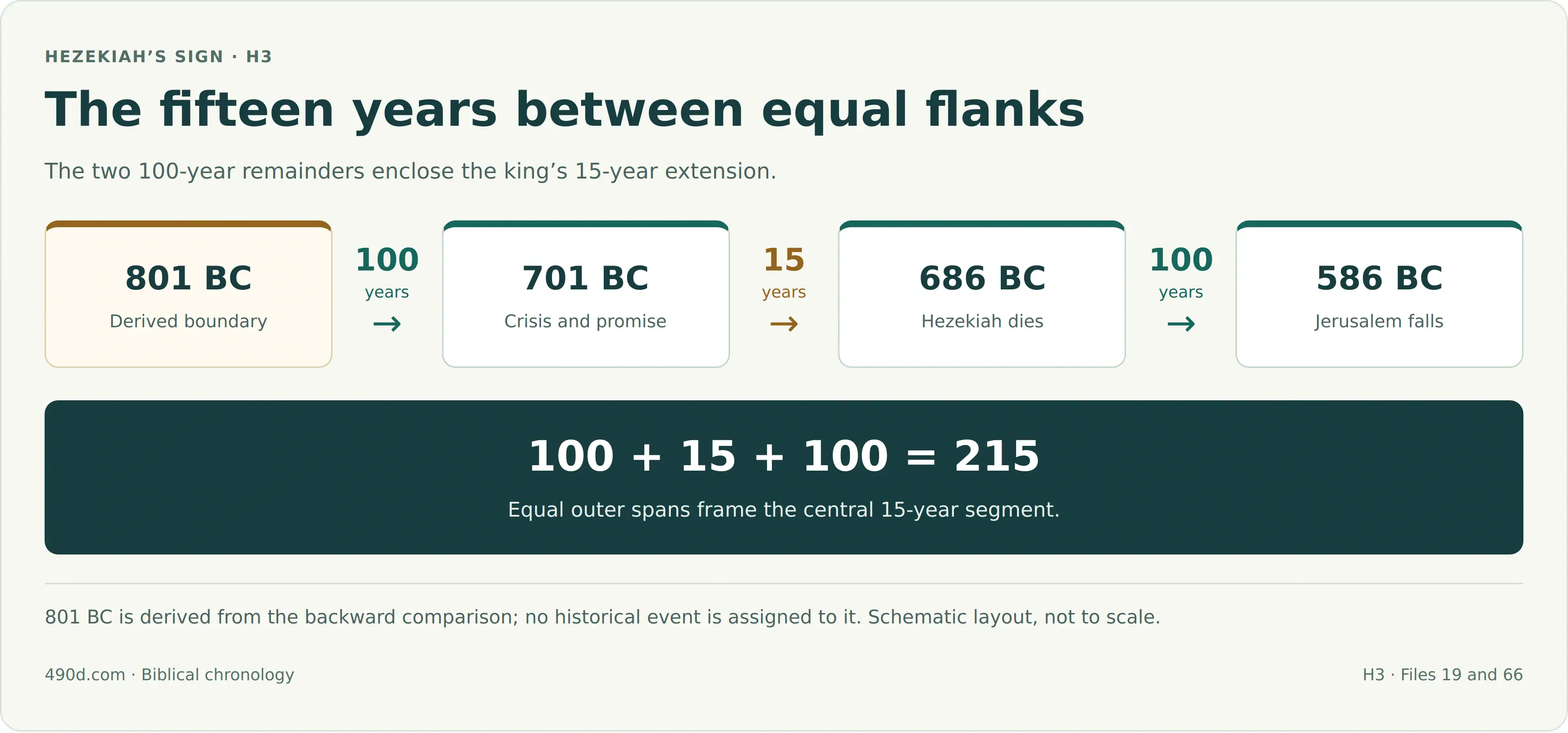
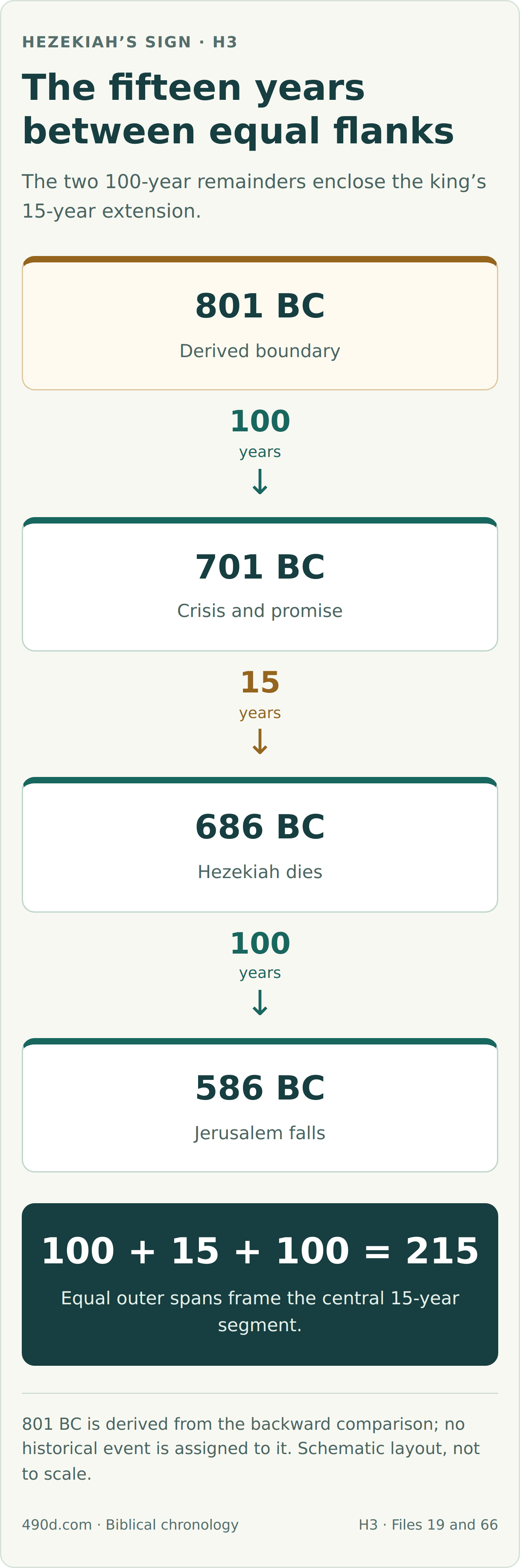
The fifteen years of the promise stand between equal hundred-year spans. The first date, 801 BC, is the boundary generated by the calculation; it is not assigned a historical event. The other dates retain their stated roles: crisis, king’s death, and city’s fall.
This also gives two overlapping spans of 115 years:
| Span | Length |
|---|---|
| 801 → 686 BC | 115 years |
| 701 → 586 BC | 115 years |
They share the central fifteen years, so 115 + 115 − 15 = 215. The whole is half of 430. Here the 215 is generated by the two remainders and the life extension; the ordinary MT sojourn remains 430 years in Egypt.
The important correspondence is the match between the hundred-year historical interval and the hundred left over from 185000 − 430². Applying the same operation backward displays that relationship symmetrically. These are connected expressions of one construction, rather than separate independent proofs.
Reading the reversing shadow
The sign’s backward movement gives the forward-and-backward comparison a fitting narrative setting. Time is extended for Hezekiah while the shadow retraces its path. The numerical reading follows those two directions while keeping the fifteen-year promise at its center.
The comparison between the schematic and historical Kings chronologies also places 711 BC ten years before the 701 BC crisis. The fifteen-year extension then reaches 686 BC, giving 711 → 701 → 686 BC = 10 + 15 = 25. Within this reading, the backward ten is represented by the gap between two chronological arrangements, while the forward fifteen remains the king’s extension. The appendix explains this comparison.
The canonical study also explores the shadow through a larger celestial measure. In its 25920-year precessional model, one degree corresponds to 72 years, and ten degrees to 720 years. Reading the ten steps through that angular model is a proposed symbolic correspondence; the passage itself describes steps on Ahaz’s stairway.
One concise chronological connection is 1406 − 686 = 720: the normal Conquest date to Hezekiah’s death. It links the setting of Joshua’s long day with the king whose sign reverses the shadow. The supporting note states the model and keeps its astronomical units distinct from the wording of Scripture.
The promise within the pattern
The pattern’s center remains the promise that began the study. A threatened king receives fifteen years; the city named in the same answer survives beyond him. In the selected chronology, the hundred years between their deaths match the hundred by which 185000 exceeds 430². The backward comparison then places an equal span before the crisis, yielding 100 + 15 + 100.
This is a theological reading of a checked numerical relationship. Its force lies in the way the arithmetic follows the narrative’s joined preservation of king and city. The reversing shadow becomes a sign through which the study considers time withheld, time restored, and mercy extending beyond a single life.
Continue with the technical appendix and source tables, the Kings of Judah introduction, or the fuller canonical studies in File 19 and File 66. For the wider calculations and their sources, continue with Hezekiah’s Sign in Detail: The Shadow, the 185000, and Berossus. The current canonical files govern this presentation.
Scripture quotations: Berean Standard Bible (BSB), public domain.