The story of the Flood marks a division between an old world and a new beginning. Shem belongs to both sides of that division. His lifespan also provides a useful way to compare three ancient forms of the biblical text: the Masoretic Text (MT), the Samaritan Pentateuch (SP), and the Greek Septuagint (LXX).
Genesis gives the starting point:
“These are the generations of Shem: Shem was an hundred years old, and begat Arphaxad two years after the flood:
And Shem lived after he begat Arphaxad five hundred years, and begat sons and daughters.”
The two parts of Shem’s life total 100 + 500 = 600 years. These are his full years of life. They are not his age at the Flood; Genesis 7:6 assigns the Flood age of 600 to Noah.
In cumulative chronology, complete lifespans are placed end to end along the ancestral line. That differs from ordinary chronology, which follows the years between successive births. The introduction to cumulative chronology explains the method and its foundation. Here we concentrate on what becomes visible when the three cumulative lines are compared around Shem.
A Rounded view, with the full tables close at hand
This article uses Rounded cumulative coordinates. Each retained lifespan is rounded to the nearest five years before the lifespans are added. Shem’s 600 remains unchanged. The fixed comparison dates—such as the Exodus in 1446 BC and the Conquest in 1406 BC—remain the anchors; they are not being rounded.
The purpose is to make a few large relationships easy to see. The unrounded lifespans and full cumulative date ranges are available in the non-rounded cumulative tables, with direct access to the MT, SP, and LXX sections. Our supporting table shows the actual rounding of each lifespan.
These cumulative dates are calculated positions in a lifespan chain. They do not mean that the patriarchs historically lived one after another without overlap. In that chain, the end of Shem’s 600-year block meets the next lifespan at the Flood/Arphaxad boundary. This label preserves the relationship to the Flood narrative without moving Arphaxad’s ordinary birth from its stated position two years after the Flood.
On a narrow screen, scroll the table sideways to see every column.
| Rounded cumulative line | Shem’s starting coordinate | Flood/Arphaxad boundary | Shem’s lifespan |
|---|---|---|---|
| MT | 5436 BC | 4836 BC | 600 years |
| SP | 5316 BC | 4716 BC | 600 years |
| LXX, including second Cainan | 6346 BC | 5746 BC | 600 years |
The MT and LXX calculations run backward from Moses’ death and the Conquest in 1406 BC. The SP line continues through Joshua’s 110-year life to a cumulative endpoint at 1296 BC; those 110 years join that foundation to the same 1406 comparison boundary. The foundation and coordinate table keeps these details together.
Two 600-year spans, displaced by 120 years
Begin with the MT and SP. Their rounded Shem coordinates differ by 120 years:
5436 − 5316 = 120.
Their Flood boundaries differ by the same amount:
4836 − 4716 = 120.
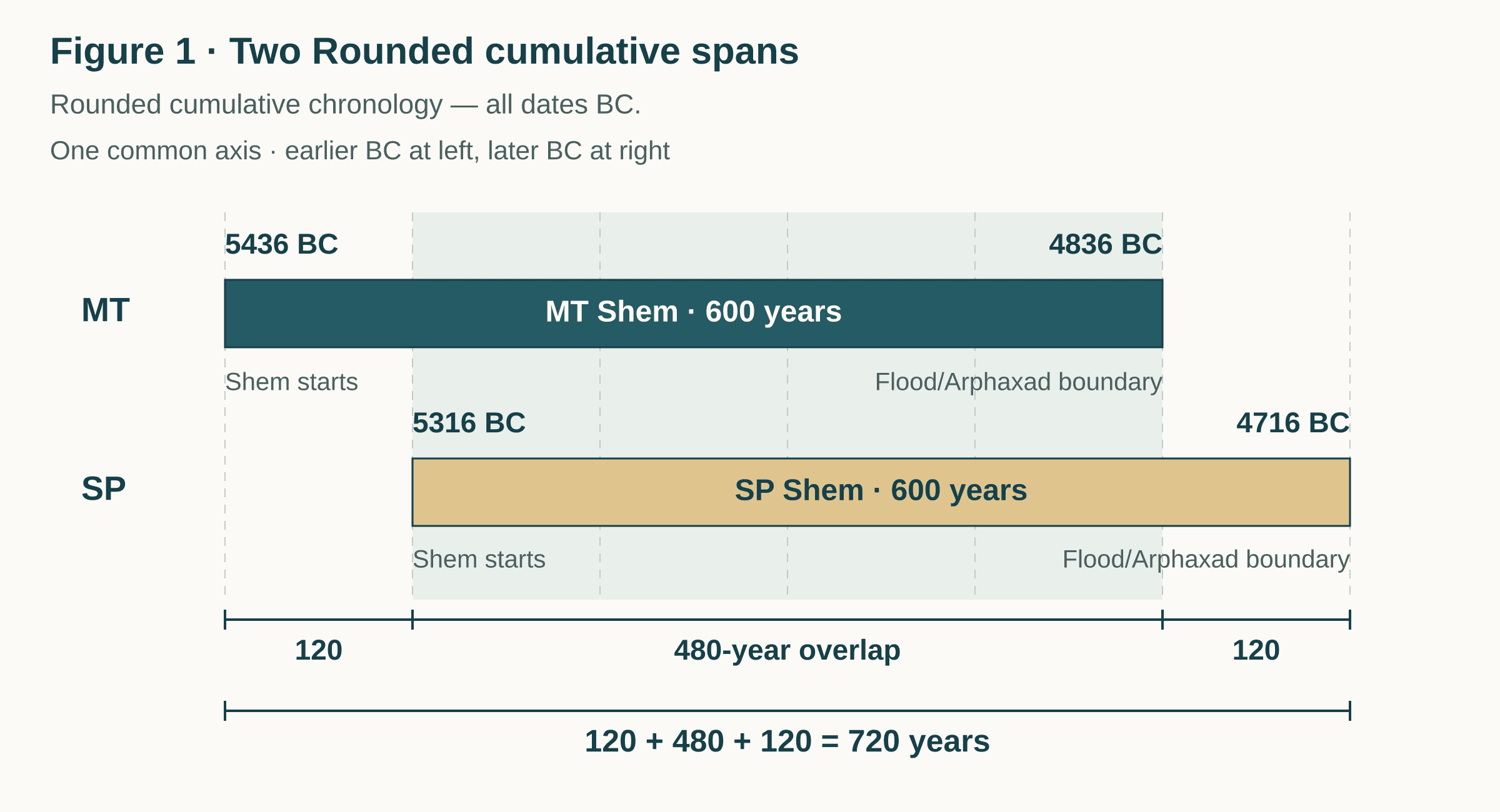
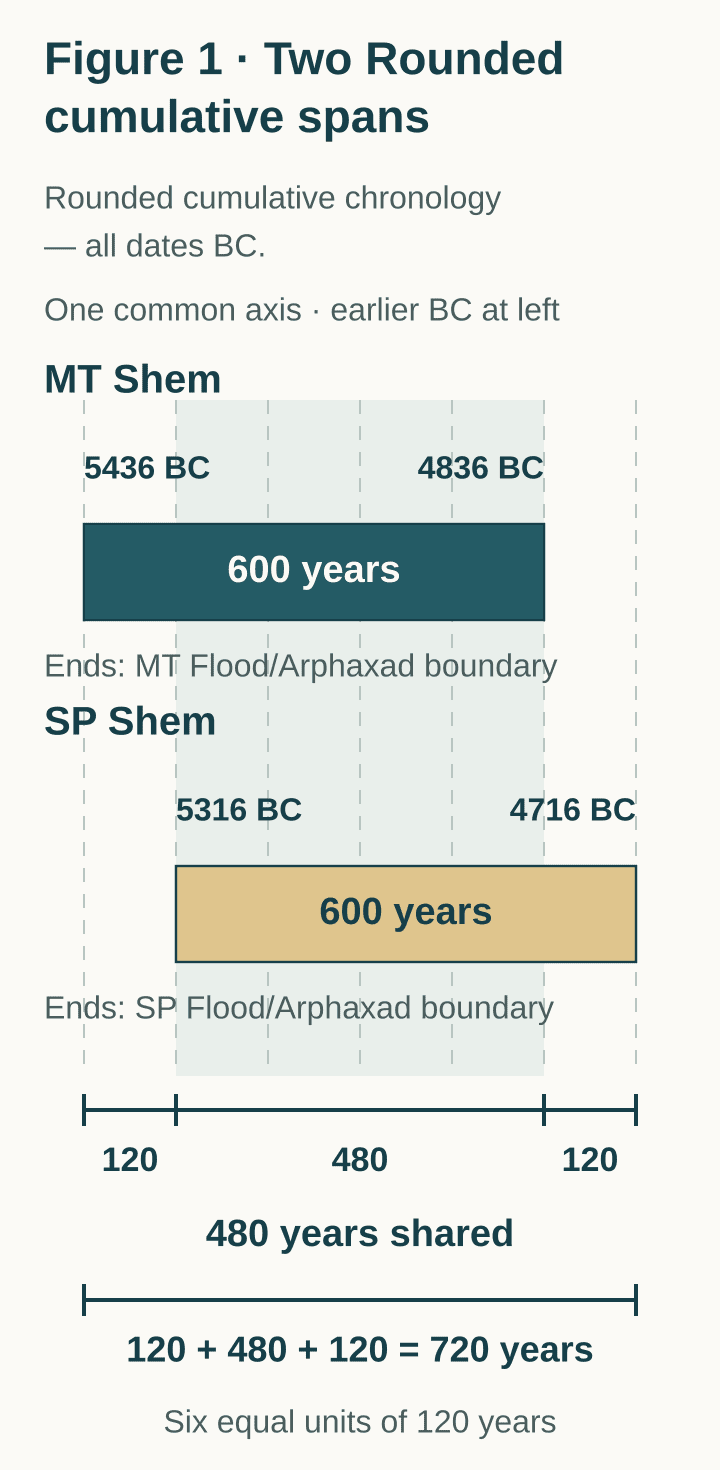
Because both lines give Shem a full 600 years, moving one 600-year span forward by 120 leaves an overlap of 480 years. The four boundaries therefore divide the combined span into:
120 + 480 + 120 = 720 years.
Swipe or scroll sideways to inspect the complete diagram.
Rounded lifespan derivation; separate Actual-envelope comparison.
Full text description of Figure 1
Two 600-year Rounded cumulative Shem spans share one earlier-to-later BC axis. The MT begins at 5436 BC and ends at its Flood/Arphaxad boundary at 4836 BC. The SP begins 120 years later, at 5316 BC, and ends at 4716 BC. They overlap for 480 years, from 5316 to 4836 BC. The complete arrangement is 120 plus 480 plus 120, totaling 720 years. These are constructed cumulative boundaries, not Shem’s ordinary historical birth and death dates.
Every part can be expressed in units of 120. Each life occupies five units; the overlap occupies four; the whole arrangement occupies six. Thus 480 = 4 × 120, 600 = 5 × 120, and 720 = 6 × 120.
The displacement also has a transparent basis in the lifespan data. Eber’s MT and SP lives differ by 60 years, and Terah’s differ by another 60. Rounding preserves both differences: Eber becomes 465/405, while Terah remains 205/145. Together they account for the 120-year separation. The paired lifespan table lets the reader follow the calculation rather than take the starting dates on trust.
Genesis 6:3 supplies the familiar number of 120 years. Read in the Flood-warning framework used here, it gives this displacement a fitting narrative setting. A unit associated with the approach of the Flood also measures the separation between two cumulative Flood boundaries. The 480-year overlap then binds their two 600-year spans into a single, easily visible arrangement.
From the Flood boundary to the land: 3430 years
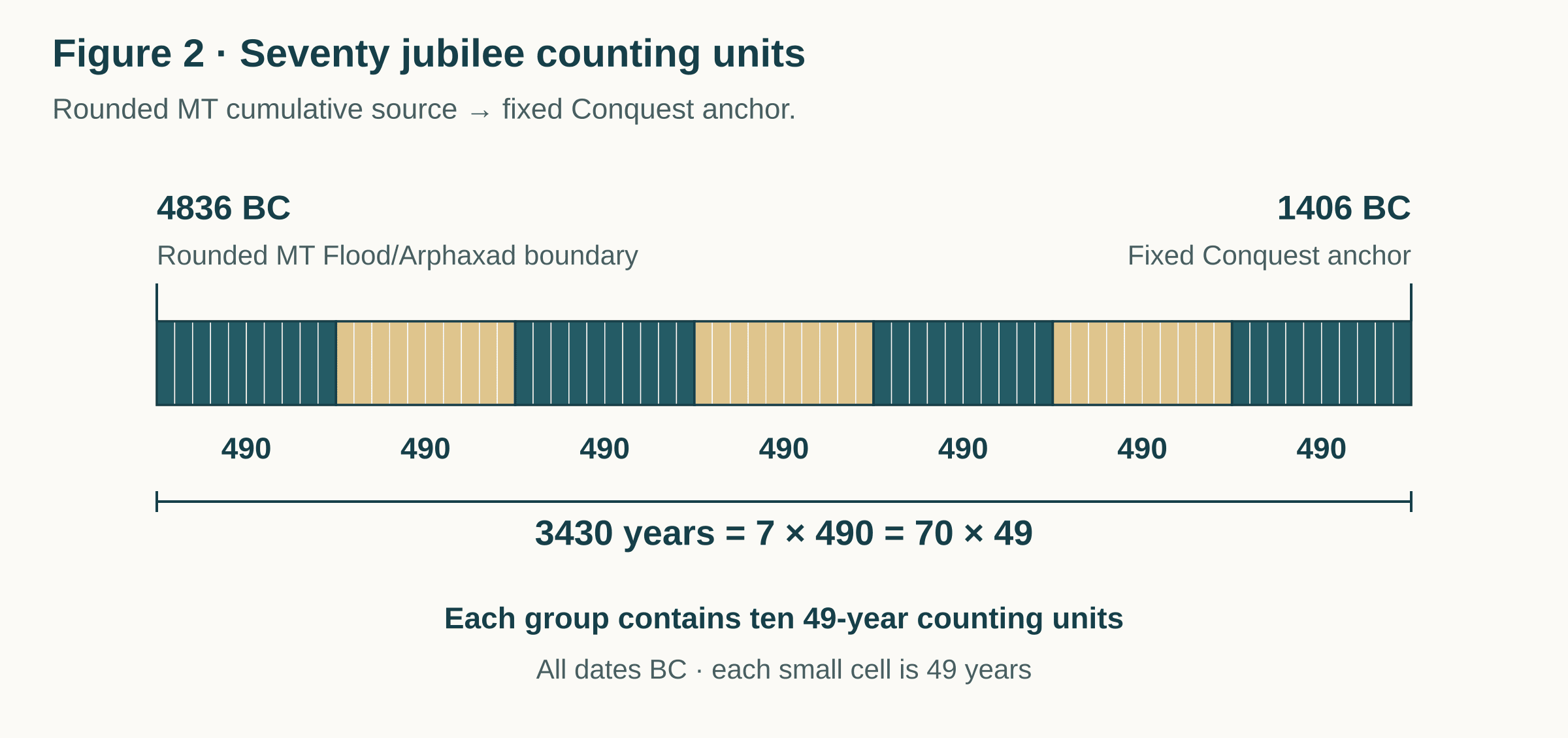
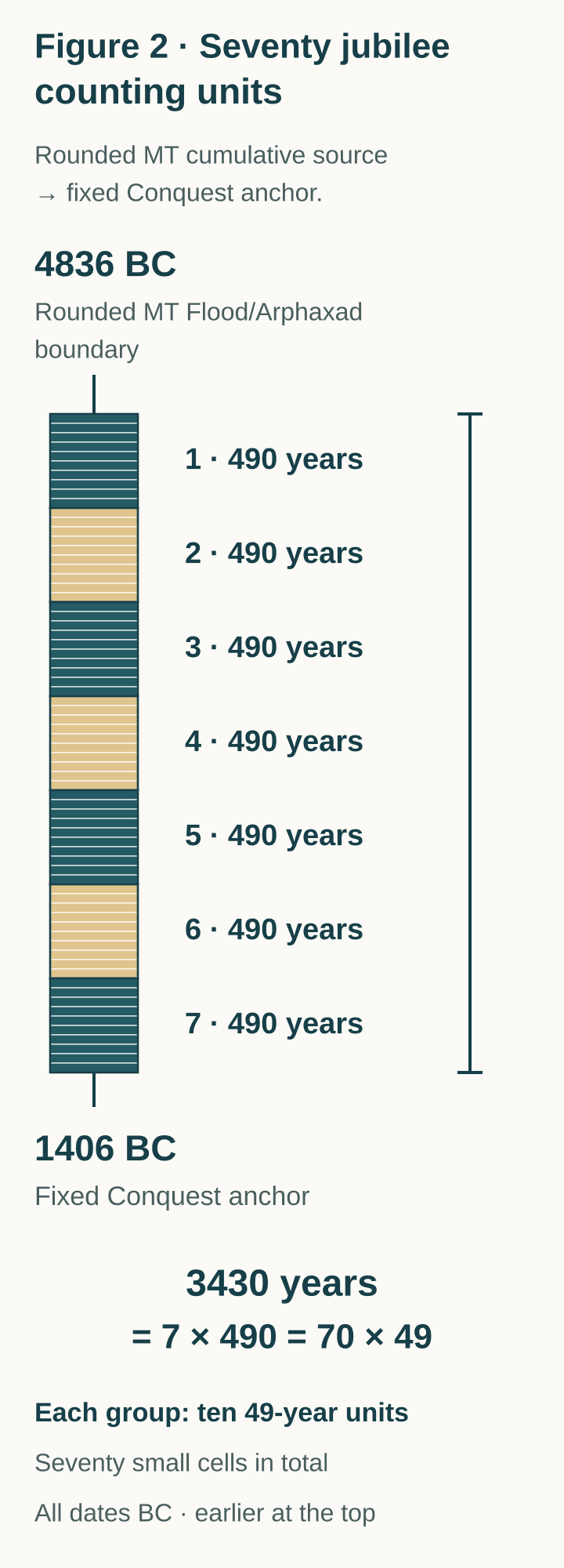
The Rounded MT Flood/Arphaxad coordinate is 4836 BC. From there to the Conquest in 1406 BC lies:
4836 − 1406 = 3430 years.
This becomes especially meaningful when expressed through the jubilee counting unit:
3430 = 7 × 490 = 70 × 49.
Leviticus 25:8 directs the counting of seven sabbaths of years—seven times seven, or 49 years. Seventy such units give 3430. The following designation of the fiftieth year belongs to the fuller jubilee discussion; the arithmetic here uses the explicit 49-year count.
Swipe or scroll sideways to inspect the complete diagram.
Rounded endpoint calculation; 49-year count and fiftieth-year designation.
Full text description of Figure 2
A 3430-year span connects the Rounded MT cumulative Flood/Arphaxad coordinate 4836 BC with the fixed Conquest anchor 1406 BC. The span contains seven equal groups of 490 years, each containing ten units of 49 years: seventy 49-year units in total. Leviticus’s fiftieth-year designation is distinguished in the appendix.
This connects two beginnings in the biblical story: renewed life after the Flood and Israel’s entrance into the land. The sabbatical and jubilee instructions govern Israel’s life in that land. The numerical comparison therefore has a natural relationship to its subject.
The non-rounded cumulative chronology preserves a related, more detailed form of this connection, involving corresponding boundaries of its seven-year ranges. Those calculations remain immediately available in the non-rounded comparison table. The Rounded view gives the reader the large span in a single line.
The same 4900 and 4300 at two deliverance anchors
The LXX supplies another useful comparison. In its Rounded cumulative line, Shem begins at 6346 BC, and the Flood/Arphaxad boundary falls at 5746 BC. Measured to the Exodus in 1446 BC, these give:
6346 − 1446 = 4900 years.
5746 − 1446 = 4300 years.
The Rounded MT gives the same two spans to 536 BC, the restoration target at the end of the 70-year exile in this chronology:
On a narrow screen, scroll the table sideways to see every column.
| Rounded cumulative comparison | Shem → named target | Flood/Arphaxad → the same target |
|---|---|---|
| LXX → Exodus, 1446 BC | 6346 − 1446 = 4900 | 5746 − 1446 = 4300 |
| MT → restoration, 536 BC | 5436 − 536 = 4900 | 4836 − 536 = 4300 |
Swipe or scroll sideways to inspect the complete diagram.
Source coordinates and foundations; exact endpoint ledger.
Full text description of Figure 3
Two Rounded cumulative lanes are aligned at their respective Shem starting coordinates. In the MT lane, 5436 BC to 4836 BC is 600 years, followed by 4300 years to restoration at 536 BC. In the LXX lane, 6346 BC to 5746 BC is 600 years, followed by 4300 years to the Exodus at 1446 BC. Corresponding dates in the LXX lane are 910 years earlier in BC numbering. Within the LXX lane’s final 4300 years, the Rounded SP Shem marker at 5316 BC is 430 years after the LXX Flood boundary and 3870 years before the Exodus. The fixed MT Egypt-entry target at 1876 BC is 3870 years after that Flood boundary and 430 years before the Exodus. Together they divide the interval into 430, 3440, and 430 years. Each longer 3870-year span equals nine times 430 and three times 1290.
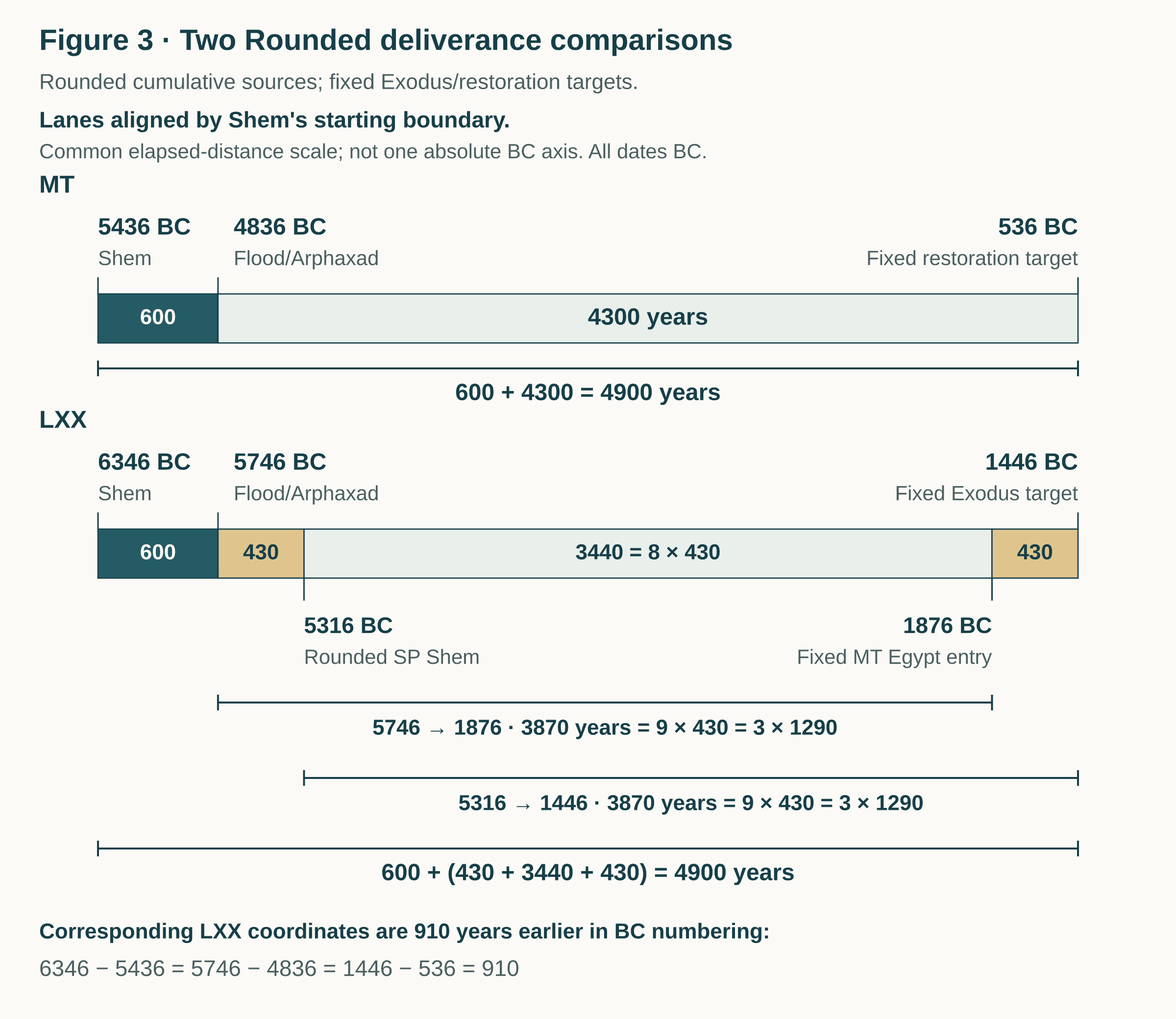
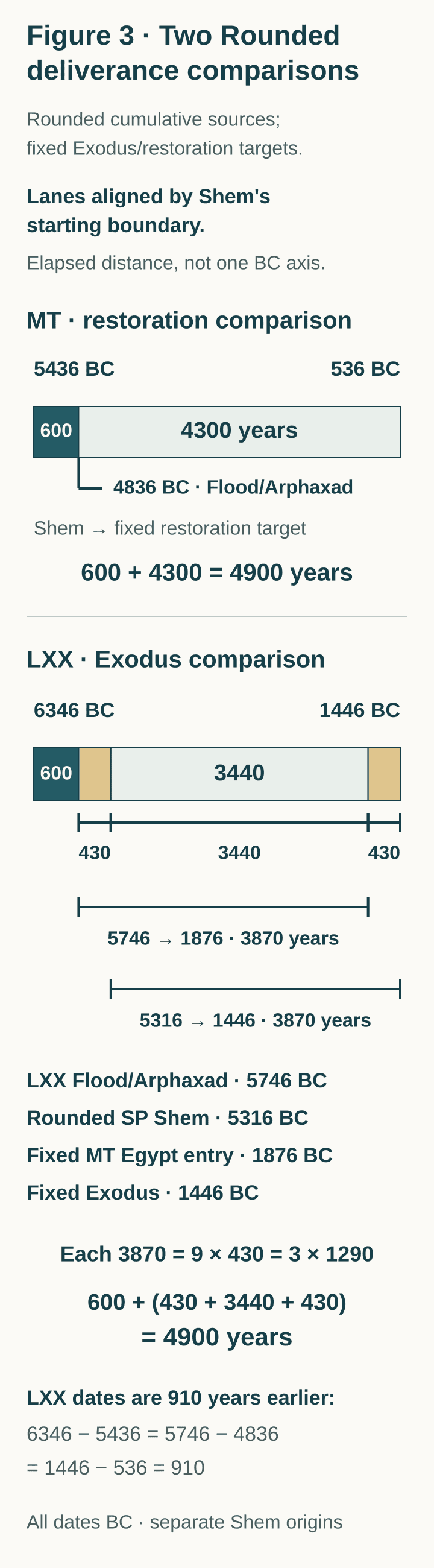
Shem’s unchanged 600 years explains the difference between the two totals: 4900 − 4300 = 600. The larger spans draw together familiar biblical units: 4900 is ten times the 490-year framework of Daniel’s seventy weeks, while 4300 is ten times the 430 years associated with the Exodus.
The Egypt-entry date makes the second relationship more concrete. From the Rounded LXX Flood boundary at 5746 BC to the MT entry into Egypt at 1876 BC is 3870 = 9 × 430 years. The following 430 years, from 1876 to 1446 BC, complete the 4300. This uses the normal MT Egypt-only sojourn as its target framework, explained in the sojourn article.
The SP supplies a complementary division of the same 4300 years. Its Rounded Shem coordinate, 5316 BC, is 430 years after the Rounded LXX Flood boundary at 5746 BC. From SP Shem to the Exodus is 5316 − 1446 = 3870 = 9 × 430 = 3 × 1290 years. Thus the same 3870-year span appears with the 430-year portion at either end:
On a narrow screen, scroll the table sideways to see every column.
| Division of 5746→1446 BC | First span | Final span |
|---|---|---|
| Through SP Shem, 5316 BC | 430 | 3870 = 9 × 430 |
| Through MT Egypt entry, 1876 BC | 3870 = 9 × 430 | 430 |
In the SP’s 215 + 215-year sojourn chronology, 1876 BC marks Abram’s call to Canaan.
The MT restoration and LXX Exodus comparisons also align as wholes. Moving from the MT row to the LXX row increases both source coordinates and the target by 910 years: 5436 becomes 6346, 4836 becomes 5746, and 536 becomes 1446. The internal 600 + 4300 structure remains intact. The endpoint ledger records each subtraction and its stated frame.
Reading the traditions together
The cumulative comparison brings several relationships into view without requiring every variant and seasonal calculation at once. The MT and SP arrange two 600-year spans around a 480-year overlap. The MT then reaches the land through seventy units of 49. The Rounded MT and LXX give the same 4900/4300 division at the restoration and Exodus anchors.
I read this coherence as a form of complementary witness: distinct textual traditions participating in a shared biblical language of warning, deliverance, and renewal. The arithmetic makes the relationships visible; their theological significance lies in how those relationships are understood within the scriptural story.
This Rounded presentation is an entrance to that wider study. The full non-rounded cumulative tables preserve the lifespans and detailed ranges. The technical appendix shows exactly how the Rounded coordinates used here are built. The detailed Synergy study retains the broader exploration; the current canonical files govern the figures and their qualifications.