This appendix supports The Exodus at the Center: Two 490-Year Spans. Its central comparison is 1936 → 1446 → 956 BC = 490 + 490. The tables identify what each date represents and how each total is obtained.
1. The three central dates
| Date | What it represents | Active setting | Derivation / control |
|---|---|---|---|
| 1936 BC | Death of restored second Cainan | Regular variant: +60 Terah; minimum Sojourn | 2396 − 460 = 1936; File 18 §1.3.1; File 64 §8.8 |
| 1446 BC | Exodus | Fixed repository historical anchor | Center of the comparison; File 64 §0.3 |
| 956 BC | Joshua-extended Judges endpoint | Schematic duration ledger | 1446 − (40 + 40 + 410) = 956; File 64 §5.4; §8.8 |
The Exodus is the fixed historical anchor within this chronology. The left endpoint is a selected regular genealogical variant; the right is a calculated endpoint of a compositional ledger. The comparison preserves those different statuses. A shared numerical axis does not make all three dates independently established historical events.
Arithmetic check: 1936 − 1446 = 490; 1446 − 956 = 490; 1936 − 956 = 980. The midpoint check, (1936 + 956) ÷ 2 = 1446, answers a different question from the elapsed-span subtraction. In particular, 1936 + 956 = 2892 is not the elapsed span between the endpoints.
2. Four restored-Cainan settings
File 18 §1.3.1 gives four positions for restored second Cainan. These are alternate settings within the model, not four conflicting readings of a biblical BC date.
| Shelah’s birth BC | Cainan’s birth BC | Cainan’s death BC | Active settings |
|---|---|---|---|
| 2481 | 2611 | 2151 | +60 Terah; +215 Sojourn |
| 2421 | 2551 | 2091 | No +60 Terah; +215 Sojourn |
| 2266 | 2396 | 1936 | +60 Terah; minimum Sojourn — selected |
| 2206 | 2336 | 1876 | No +60 Terah; minimum Sojourn |
The third row supplies this article’s 1936 BC. It retains the minimum Sojourn setting and activates +60 Terah. The +215 Sojourn option moves the earlier chronology into the full-430-years-in-Egypt comparison while keeping the Exodus at 1446 BC. The minimum setting uses the shorter, 215-year Egyptian stay. It must not be confused with the separate option of moving the Exodus itself by 215 years.
The +60 Terah adjustment is a distinct upstream setting. Within a selected Sojourn setting, the +60 Terah option uses a begetting age of 130 rather than 70. Terah and earlier dates move back 60 years, while Abraham’s birth stays fixed. This is not an automatic addition to every person’s date. File 18 places second Cainan within the four-position field and holds the later Exodus anchor fixed. The normal MT chronology, with the full Egyptian 430 and no automatic Terah adjustment or second-Cainan restoration, remains a separate baseline.
The selected row can be checked from Shelah’s birth:
2266 + 130 = 2396 BC for Cainan’s birth; 2396 − (130 + 330) = 1936 BC for his death.
The 130 + 330 inputs are found in Brenton’s Genesis 11, in the Cainan passage between the printed verses 13 and 14. Brenton calls the son Sala; the chronology uses Shelah. The passage is part of the LXX tradition. MT and SP lack this second Cainan in Genesis 11; his appearance in Luke 3:35–36 (BSB) supplies a distinct Gospel witness. Restoring him to an MT-based calculation is an explicit model choice, not a claim that the MT text contains him.
The regular restoration adds the begetting-age step 130 to the appropriate earlier ancestry. Cumulative restoration uses the lifespan 460. Those operations must remain distinct even though the same person’s biography supplies both values. Nor should a second restoration be added to an LXX sequence that already contains Cainan.
3. The complete Judges duration ledger
The following inventory follows File 64 Appendix A.2. All Scripture links in this table open the BSB. Durations and running totals are our digit-based tabulation, not quotations.
| No. | Period | Category | Years | Running total | Passage (BSB) |
|---|---|---|---|---|---|
| 1 | Cushan-rishathaim / Mesopotamian servitude | subjugation | 8 | 8 | Judges 3:8 |
| 2 | rest after Othniel | rest/rule/judgeship | 40 | 48 | Judges 3:11 |
| 3 | Eglon / Moabite servitude | subjugation | 18 | 66 | Judges 3:14 |
| 4 | rest after Ehud | rest/rule/judgeship | 80 | 146 | Judges 3:30 |
| 5 | Jabin / Canaanite oppression | subjugation | 20 | 166 | Judges 4:3 |
| 6 | rest after Deborah and Barak | rest/rule/judgeship | 40 | 206 | Judges 5:31 |
| 7 | Midianite oppression | subjugation | 7 | 213 | Judges 6:1 |
| 8 | rest in Gideon’s days | rest/rule/judgeship | 40 | 253 | Judges 8:28 |
| 9 | Abimelech rules | rest/rule/judgeship | 3 | 256 | Judges 9:22 |
| 10 | Tola judges | rest/rule/judgeship | 23 | 279 | Judges 10:2 |
| 11 | Jair judges | rest/rule/judgeship | 22 | 301 | Judges 10:3 |
| 12 | Ammonite oppression | subjugation | 18 | 319 | Judges 10:8 |
| 13 | Jephthah judges | rest/rule/judgeship | 6 | 325 | Judges 12:7 |
| 14 | Ibzan judges | rest/rule/judgeship | 7 | 332 | Judges 12:9 |
| 15 | Elon judges | rest/rule/judgeship | 10 | 342 | Judges 12:11 |
| 16 | Abdon judges | rest/rule/judgeship | 8 | 350 | Judges 12:14 |
| 17 | Philistine subjugation | subjugation | 40 | 390 | Judges 13:1 |
| 18 | Samson judges in the days of the Philistines | rest/rule/judgeship | 20 | 410 | Judges 15:20; 16:31 |
The category totals provide an independent check:
| Category | Durations added | Total |
|---|---|---|
| Subjugation: six entries | 8 + 18 + 20 + 7 + 18 + 40 | 111 |
| Rest, rule, or judgeship: twelve entries | 40 + 80 + 40 + 40 + 3 + 23 + 22 + 6 + 7 + 10 + 8 + 20 | 299 |
| All eighteen entries | 111 + 299 | 410 |
“Rest, rule, or judgeship” is an accounting category, not a claim that Abimelech’s rule or every judgeship was peaceful. The ledger follows the order of the passages and totals their stated periods. It does not resolve overlapping historical periods by adding them all as uninterrupted elapsed time.
Three inclusion rules matter. First, Samson’s twenty years in Judges 15:20 and 16:31 describe the same tenure and count once. Second, Jephthah’s retrospective territorial 300 years in Judges 11:26 is not an additional tenure or oppression. Third, the Joshua forty is external to these eighteen entries: it is derived from 1406 − 1366 = 40, rather than printed as a duration in Judges.
Useful subtotals are 319 before Jephthah’s own six-year judgeship, 350 through Abdon, 390 through the Philistine forty, and 410 through Samson. The CSV also gives the running totals for both categories.
4. Three routes from the Exodus
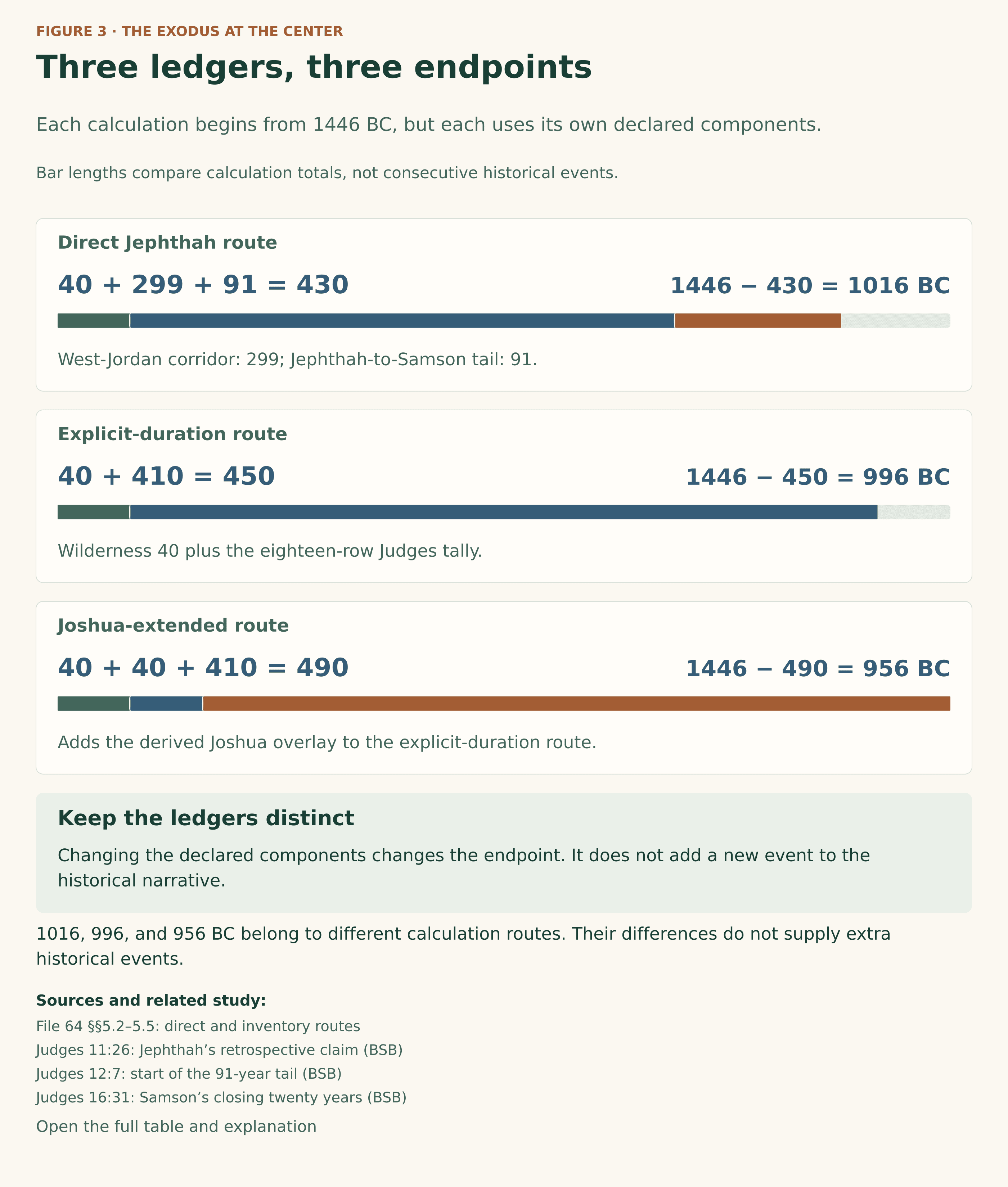
File 64 compares three constructions with a common starting coordinate. Their different inputs explain their different endpoints.
Figure 3 · The Exodus at the Center
Three ledgers, three endpoints
Each calculation begins from 1446 BC, but each uses its own declared components.
Bar lengths compare the totals. They do not map consecutive historical events.
Direct Jephthah route
40 + 299 + 91 = 430
1446 − 430 = 1016 BC
West-Jordan corridor: 299; Jephthah-to-Samson tail: 91.
Explicit-duration route
40 + 410 = 450
1446 − 450 = 996 BC
Wilderness 40 plus the eighteen-row Judges tally.
Joshua-extended route
40 + 40 + 410 = 490
1446 − 490 = 956 BC
Adds the derived Joshua overlay to the explicit-duration route.
Sources: File 64 §§5.2–5.5: direct and inventory routes · Judges 11:26: Jephthah’s retrospective claim (BSB) · Judges 12:7: start of the 91-year tail (BSB) · Judges 16:31: Samson’s closing twenty years (BSB).
Model and calculation details
The direct Jephthah route combines 40 wilderness years with the 299-year West-Jordan corridor and the 91-year tail: 40 + 299 + 91 = 430. The explicit-duration route uses 40 + 410 = 450. Adding the derived Joshua forty-year overlay yields 40 + 40 + 410 = 490. These routes end at 1016, 996, and 956 BC respectively. The 299-year corridor in the direct route and the 299 non-subjugation subtotal inside the full Judges tally have different derivations and must not be treated as the same input.

| Route | Components | Total years | Endpoint | What is added |
|---|---|---|---|---|
| Direct Jephthah route | 40 + 299 + 91 | 430 | 1016 BC | Wilderness + Conquest-to-Jephthah difference + six-duration tail |
| Full printed-duration ledger | 40 + 410 | 450 | 996 BC | Wilderness + all eighteen Judges durations |
| Joshua-extended ledger | 40 + 40 + 410 | 490 | 956 BC | Wilderness + derived Joshua forty + all eighteen Judges durations |
The 430-year route through Jephthah
The direct Jephthah route begins with the territorial retrospect. In the chronology, 1407 → 1107 BC = 300 years links the east-Jordan occupation to Jephthah’s statement. Using the adjacent west-Jordan Conquest date instead gives 1406 → 1107 BC = 299 years.
From Jephthah onward, the ledger’s remaining six durations are 6 + 7 + 10 + 8 + 40 + 20 = 91. The resulting construction is 40 + 299 + 91 = 430, measured from the Exodus to 1016 BC. The speech/accession coordinate 1107 BC is retained here; File 64’s completed-boundary companion 1106 BC is a distinct reckoning and is not substituted into this subtraction.
The 299 in that route is the Conquest-to-Jephthah coordinate difference. The 299 category total in the full eighteen-entry ledger is obtained by summing the twelve rest/rule/judgeship entries. Their numerical equality is meaningful within the canonical comparison, but their derivations differ.
The 450- and 490-year ledgers
Adding the full printed-duration total to the wilderness forty gives 40 + 410 = 450 and the endpoint 996 BC. Adding the derived Joshua forty as well gives 40 + 40 + 410 = 490 and 956 BC. This last, explicitly extended construction supplies the right endpoint of the introductory article.
The final Philistine–Samson module has the same 40 + 20 values in each route, but different schematic positions:
| Route | Philistine forty | Samson twenty | Position of 1016 BC |
|---|---|---|---|
| Direct 430-year route | 1076 → 1036 BC | 1036 → 1016 BC | Module closes |
| Full 450-year ledger | 1056 → 1016 BC | 1016 → 996 BC | Internal joint |
| Joshua-extended 490-year ledger | 1016 → 976 BC | 976 → 956 BC | Module opens |
This is one module compared under three constructions, not three historical Philistine oppressions or three Samson tenures. Similarly, 996 − 956 = 40 is the separation between two route endpoints; it is not an additional oppression to insert into the ledger.
Download the route comparison.
5. The inner 430 + 430 comparison
Within the outer arrangement, File 64 §8.8 also places 1876 → 1446 → 1016 BC = 430 + 430. The two outer extensions are 1936 → 1876 = 60 and 1016 → 956 = 60. As coordinate arithmetic:
60 + 430 + 430 + 60 = 980.
The underlying settings still matter. Under the normal MT full-Egypt chronology, 1876 BC is Jacob’s entry into Egypt, 430 years before the Exodus. Under the minimum-Sojourn setting used for Cainan’s 1936 BC endpoint, Jacob’s entry is 1661 BC, while Abraham’s Call occupies 1876 BC. The shared 1876 coordinate permits comparison between declared settings; it does not turn them into one uninterrupted biography.
On the right, 1016 BC is the direct Jephthah route’s schematic endpoint. The second 430 is consequently a modeled span. It should not be presented as a second independently established historical interval equivalent in status to the normal MT Egyptian sojourn.
A neighboring canonical comparison uses 1936 → 1476 → 1016 BC = 460 + 460. Its center is Joshua’s birth at 1476 BC, not the Exodus. Keeping the centers named prevents the 460 and 490 arrangements from being merged.
6. Same-side symmetry and formal Mirror
File 64 Appendix D.2 expresses the local Exodus-centered complement as R₁₄₄₆(x) = 2892 − x. Here x is a BC date label within the stated local comparison. Thus 2892 − 1936 = 956, and 2892 − 1876 = 1016. Each pair has midpoint 1446 BC.
| Operation | What it does | Rule | Use here |
|---|---|---|---|
| Same-side BC subtraction | Measures a distance within BC chronology | Earlier BC label − later BC label | 1936 − 1446 = 490 |
| Local Exodus-centered complement | Pairs stated BC coordinates equally distant from 1446 BC | R₁₄₄₆(x) = 2892 − x | 1936 ↔ 956; 1876 ↔ 1016; local audit only |
| Formal repository Mirror target generation | Generates counterpart coordinates in a declared cross-axis state | Appropriate Mirror protocol with single/paired and phase controls | Not activated by the 980-year comparison |
| Civil BC–AD elapsed span | Measures elapsed time after cross-axis endpoints are specified | BC + AD − 1 | Not applied to these BC-only spans |
This local notation does not operate on astronomical year numbers. It must not be extended across 1 BC / AD 1 by treating a negative answer as an AD year. It pairs the declared BC coordinates and supplies no independent historical event for a computed endpoint.
The formal Mirror remains a distinct, active part of the repository. File 00 §3.9 and File 09 Appendix A control its operations. The current Repository Style Guide §18.3 names Protocol 1’s pure rounded astronomical-integer reflection and Protocol 2’s seasonal phase reflection about a midpoint. These controls also preserve the distinction between a single date and a paired Tishri/Nisan state. Neither protocol is activated merely because a diagram looks symmetrical.
After cross-axis endpoints have been specified, an ordinary civil elapsed span uses BC + AD − 1. Selecting a counterpart and measuring a span are separate operations. No AD counterpart is needed to establish the present 980-year relationship, and no cross-axis correction is applied to its BC-only subtractions.
Download the method comparison.
7. Historical anchors and the limits of the claim
The normal historical Temple foundation remains 966 BC, controlled by File 08. The adjacent 967 boundary belongs to its own stated reckoning; it is not silently exchanged with 966 here. 1 Kings 6:1 (BSB) places the foundation in the four hundred and eightieth year after the Exodus; the digit-based comparison used here is 1446 − 966 = 480.
The 1016 BC sanctuary coordinate and 956 BC extended Judges endpoint retain their schematic status. Neither changes the historical foundation date. Nor does this article identify 956 BC with a historical midpoint of Solomon’s building projects or derive its 490-year arm from a Flood-day conversion.
| Claim | What the evidence supports |
|---|---|
| The two arms are 490 years each | Exact subtraction for the declared coordinates |
| Second Cainan supplies the 1936 endpoint | The selected restored regular row, with +60 Terah and minimum Sojourn |
| The extended Judges ledger closes at 956 | The declared 40 + 40 + 410 construction |
| The Exodus is central | Exact midpoint within this arrangement |
| The symmetry has theological significance | An interpretation of the correspondence, distinct from arithmetic proof |
| Scripture prescribes this particular 980-year design | Not established by the comparison |
8. Source and download guide
The principal controls are File 64, especially §§5.2–5.5, 8.8, Appendix A, and Appendix D; File 18 §§1.3.1, 1.6, and 2.4; and the Mirror rules in Files 00 and 09. File 06 supports the Judges bridge, File 01 distinguishes Abraham’s regular and adjusted dates, and File 08 retains the historical Temple control.
The combined data file (ZIP) preserves the tables and source bindings. The person-and-event figure index (ZIP) connects the diagrams to their people, events, Scripture passages, and supporting tables. The publication package includes the full retrieved canonical files and Scripture evidence for checking these selections.
Return to the illustrated introduction.
For the full analysis, see The Exodus at the Center: A Detailed Study of the 980-Year Scaffold.
Scripture quotations: Berean Standard Bible (BSB), public domain.
Scripture references use the Berean Standard Bible (BSB), except where Brenton’s English Septuagint is expressly identified. Brenton edition information is available from eBible.org.